

Defense & Security
The Increasing Tensions in the Caribbean. The US and Venezuela amid a Regional Security Complex
Image Source : Shutterstock
Subscribe to our weekly newsletters for free
If you want to subscribe to World & New World Newsletter, please enter
your e-mail


 Provider of in-depth & balanced analysis on hot issues around the world
Defense & Security
Image Source : Shutterstock
First Published in: Dec.15,2025
Dec.12, 2025
Share Article


Recently, the U.S.-Venezuela relations have deteriorated significantly under President Donald Trump, marking a continuation of longstanding tensions rooted in U.S. opposition to the socialist government led by President Nicolás Maduro, including past sanctions and diplomatic isolation. [1] The year 2025 has seen a sharp escalation in U.S. military posturing framed as a counternarcotics campaign, with Trump signing a secret directive in August authorising Pentagon forces against select Latin American drug cartels, including those allegedly tied to Venezuelan entities.[2] This has involved designating groups like Tren de Aragua (TdA) as a foreign terrorist organisation in February and the Cartel de los Soles as a transnational terrorist group in July, with unsubstantiated claims linking them to Maduro's regime in drug trafficking operations targeting the U.S.[3] Recent developments alarmingly include a U.S. military build-up in the Caribbean since August 2025, featuring assets such as Aegis-class destroyers, nuclear-powered submarines, the USS Gerald R. Ford carrier strike group, over 4,000 troops deployed off Venezuela's coast, an additional 5,000 on standby in Puerto Rico, F-35 fighter jets, MQ-9 Reaper drones, and B-52 bomber demonstration flights over Caracas. Starting in September, the U.S. has conducted at least 16 airstrikes on suspected drug-running boats in the Caribbean and eastern Pacific waters, resulting in at least 67 deaths. However, critics argue that these lack sufficient evidence of drug ties and raise concerns over extrajudicial killings.[4] Administration officials, including Secretary of State Marco Rubio and Defence Secretary Pete Hegseth, have emphasised that these operations are limited to maritime counternarcotics and intelligence gathering, with no current plans for strikes inside Venezuela itself, citing a lack of legal justification for land-based actions under existing Justice Department opinions. However, the administration is seeking a new legal opinion to potentially authorise future land strikes without congressional approval, aligning with Trump's hints that Maduro's leadership is nearing its end.[5] On November 6, 2025, the U.S. Senate rejected a bipartisan resolution under the 1973 War Powers Act that would have required congressional authorisation for any military attack on Venezuela, failing by a 51-49 vote, with only two Republicans — Sens. Rand Paul and Lisa Murkowski — joining Democrats in support.[6] Some have interpreted this vote as giving tacit approval to Trump's "America First" doctrine, which critics compare to past interventions in Panama (1989) or Iraq (2003), warning of risks like regional instability or failed regime change efforts. Economically, the intensified U.S. pressure has led to a surge in Venezuelan bond prices, reflecting investor speculation on the potential for regime change amid the country's $150 billion in defaulted debt and interest payments.[7] Broader implications include debates over Trump's endgame, with experts suggesting limited strikes to pressure elites around Maduro rather than a full invasion. However, this could echo U.S. misadventures in Afghanistan or Libya.[8] From Venezuela's perspective and allied views, these actions represent an imperialistic push to undermine the Bolivarian Revolution, potentially through fabricated pretexts or assassinations, with international actors like China and Russia conducting joint exercises in the region to counter U.S. moves.[9] Congressional Democrats have voiced scepticism over the campaign's legality and transparency, while Republicans largely support executive authority in combating drug threats.[10]

Diplomatic relations were terminated in 2019 following the United States' recognition of opposition leader Juan Guaidó as Venezuela's interim president. Consequently, as reported by the media, several South American nations, including Brazil, Colombia, and Peru, have also acknowledged Mr. Guaidó as the legitimate president of Venezuela.[11] In response to President Trump's recognition of the opposition leader, President Maduro severed diplomatic relations with the United States and mandated that its diplomatic personnel vacate Venezuela within 72 hours. He accused Washington of attempting to govern Venezuela remotely and alleged that the opposition was endeavouring to orchestrate a coup. Consequently, the U.S. embassy in Caracas remains closed. The United States continues to recognise the National Assembly elected in 2015, but ceased to acknowledge Guaidó's presidential claim in 2023. The U.S. government maintains that neither Maduro nor his affiliates represent the legitimate Venezuelan government. [12] Furthermore, the United States has markedly augmented its military presence in the Caribbean Sea as part of "Operation Southern Spear," purportedly to address drug trafficking. This initiative includes the deployment of the USS Gerald R. Ford aircraft carrier and thousands of military personnel, constituting the largest military deployment to the region in several decades.[13] As reported by the Centre for Strategic and International Studies, recent operations have primarily targeted vessels suspected of drug smuggling. The initial attack was recorded on September 2 in the Caribbean, and since then, the frequency of these attacks has increased, extending into the Eastern Pacific.[14]
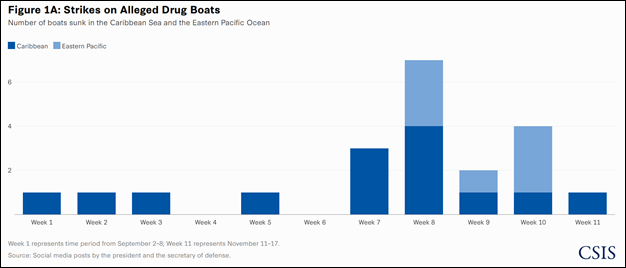
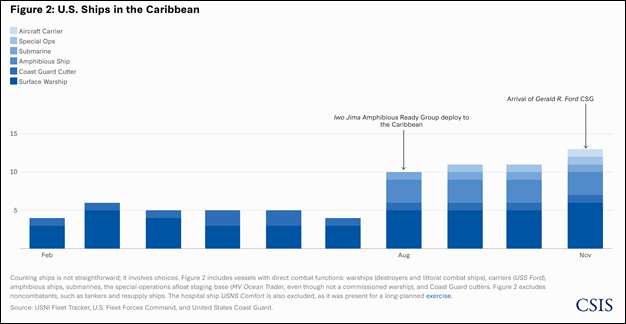
Reports suggest the strikes in the Caribbean have occurred near the Venezuelan coast. Previous analysis by the Centre for Strategic and International Studies (CSIS) described a potential U.S. surveillance operation off the coast, which the United States has purportedly established to detect and target potential drug traffickers before they integrate with the dense maritime traffic of the Caribbean.[15] Until late summer, the deployment of U.S. Navy ships to the Caribbean was relatively limited compared to previous years. However, as illustrated in Figure 2, this situation changed in August when the administration initiated a significant increase in forces to combat drug smuggling. Deployment levels further escalated with the arrival of the Gerald R. Ford Carrier Strike Group (CSG).[16]
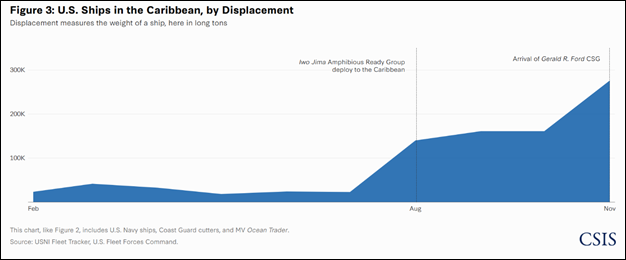
Recent deployments have also involved larger vessels, which bring substantial firepower and additional combat capabilities. A rudimentary method to quantify the enhancement in capability is to examine the displacement of the deployed ships. Figure 3 illustrates the significant increase in the displacement of deployed ships since the commencement of the second Trump administration. The initial major increase occurred with the deployment of the Iwo Jima Amphibious Ready Group; the arrival of the Ford CSG nearly doubled the number.[17]
Since September 2025, the U.S. has conducted a series of airstrikes on boats in the Caribbean and Pacific, which it claims are drug-trafficking vessels operated by "narco-terrorist" organisations like the Tren de Aragua gang.[18] On Monday, September 15, President Trump announced that, under his directive, United States military forces executed a second kinetic strike against drug trafficking cartels and narco-terrorists identified as extraordinarily violent within the SOUTHCOM area of responsibility. This strike was conducted while these confirmed narco-terrorists from Venezuela were in international waters, transporting illegal narcotics intended for the United States, which he described as a deadly weapon poisoning Americans. In the same announcement, President Trump asserted that these extremely violent drug trafficking cartels pose a threat to U.S. national security, foreign policy, and vital U.S. interests.[19] The strike on September 15 resulted in the deaths of three individuals aboard the vessel. Subsequently, on Friday, September 19, U.S. military forces executed an additional strike. President Trump asserted that, under his directive, forces conducted a strike against a designated terrorist organisation involved in narco-trafficking. Intelligence confirmed that the vessel was transporting illicit narcotics and was en route to harm Americans. The strike resulted in the deaths of three male narco-terrorists. It remains unclear which group within the USSOUTHCOM area of responsibility was targeted in the third airstrike.[20] On September 2, 2025, the United States military conducted its initial strike, resulting in the deaths of 11 individuals suspected of narco-terrorism. Following the third strike, the cumulative number of suspected drug traffickers killed reached 17. By mid-November 2025, at least 20 strikes had been announced, resulting in over 80 deaths, with most occurring in the Caribbean and several expanding to the Pacific off South America's coast.[21] U.S. officials, including President Trump and Defense Secretary Pete Hegseth, have justified the actions as part of a counternarcotics campaign against groups like TdA and the Colombian National Liberation Army (ELN), framing them as an "armed attack" on the U.S. and releasing videos of some strikes.[22] Maduro's government has denounced the U.S. actions as acts of aggression and "regime change through military threat," launching its own "massive mobilisation" of troops and military exercises in response.[23] Additionally, the Colombian president, Gustavo Petro, who is in the midst of a spat with Donald Trump over the boat strikes and tariffs, said: "The attack on another boat in the Pacific … killed people. It is murder. Whether in the Caribbean or Pacific, the U.S. government strategy breaks the norms of international law." Interestingly, María Corina Machado, a prominent Venezuelan politician and opposition leader, was awarded the Nobel Peace Prize in 2025 for her "unwavering commitment to promoting democracy and human rights in Venezuela", according to The Nobel Prize.[24] Following her award on October 10, 2025, Machado has called for increased international support, urging U.S. leaders like Donald Trump to intensify pressure on Maduro to facilitate a democratic transition, including by calling for military intervention.[25] The military build-up has fueled speculation of a potential U.S. invasion, though President Trump downplayed the possibility, saying he "doubts it". Experts disagree on the likelihood of a full-scale invasion, noting the U.S. has previously opted for sanctions and diplomatic pressure over direct military action.
As of mid-November 2025 (when this analysis is written), the likelihood of a full-scale war between the United States and Venezuela remains elevated but not imminent or inevitable.[I] While tensions have escalated dramatically through U.S. military build-up and operations in the Caribbean, several restraining factors—including domestic U.S. opposition, legal hurdles, and high risks of failure would suggest a medium probability of limited escalation to airstrikes or missile attacks on Venezuelan targets, but a lower chance of a ground invasion or prolonged conflict. As mentioned above, the U.S. did launch "Operation Southern Spear" on November 13, a joint task force under U.S. Southern Command aimed at defending against "narco-terrorists" allegedly tied to Venezuela.[26] The arrival of the USS Gerald R. Ford carrier strike group on November 11 has shifted the focus toward potential anti-Maduro operations, supported by a build-up of over a dozen warships, an attack submarine, amphibious vessels, roughly 15,000 troops (including Marines in joint exercises with Trinidad and Tobago), 10 F-35 fighter jets, drones, and special operations forces in the region and Puerto Rico. [27] President Trump has authorised CIA covert operations in Venezuela and, on November 14, stated he has "sort of made up my mind" on military options after briefings from top officials like Defence Secretary Pete Hegseth and Secretary of State Marco Rubio. [28] He has suggested "the land is going to be next" after maritime strikes, hinting at ground operations or strikes on Venezuelan soil, such as military facilities, drug routes, or even targeting Maduro directly.[29] However, Trump has also mentioned possible discussions with Maduro and expressed caution about actions that could fail or entangle U.S. troops. In response, Venezuela has mobilised around 200,000 military personnel, civilians, and militias in large-scale exercises, deploying aging Russian-made equipment like 5,000 Igla missiles and preparing for guerrilla warfare, sabotage, and "anarchization" strategies to make the country ungovernable for invaders[30] Maduro has warned that U.S. intervention would turn Venezuela into "another Gaza, Afghanistan, or Vietnam," emphasising national resistance.[31] What could enhance the likelihood of a war between the U.S. and Venezuela? The U.S. holds overwhelming advantages in air, sea, and missile capabilities (e.g., up to 170 Tomahawk missiles in the region, stealth bombers for long-range strikes), making initial air or missile campaigns feasible without ground forces.[32] Venezuela's forces are numerically larger on land but poorly trained, under-equipped, and focused on internal control, with limited operational aircraft and inoperable submarines.[33] Experts note that this imbalance could encourage U.S. escalation, similar to the 1989 invasion of Panama.[34] Trump's administration views the situation as an "armed attack" on the U.S. via drugs and migration, with regime change as a potential endgame to disrupt flows and secure oil deals.[35] The Senate's rejection of a War Powers Act resolution earlier in November gives tacit executive leeway. Analysts describe the region as "on the brink," with the carrier deployment starting a "shot clock" for action before unsustainable costs mount.[36] There are several arguments against a potential war. According to YouGov.US, polls show that 55% of Americans oppose a U.S. invasion, with only 15% in support, including majorities among Democrats, Independents, and even some Republicans.[37] Apparently, Trump's anti-war coalition, including figures like Vice President JD Vance and Hegseth, is sceptical of foreign entanglements.[38] According to experts, there is no current legal justification for land strikes, as the War Powers Act's 60-day limit has expired and Congress is pressing for transparency.[39] Regional leaders (e.g., Brazil's Lula, Colombia's Petro, Mexico's Sheinbaum) condemn the build-up as aggression, suspending intelligence sharing and evoking "gunboat diplomacy." What is more, the UN and human rights criticisms label U.S. actions as potential extrajudicial killings, risking broader isolation.[40] A full invasion could require 50,000 - 150,000 troops, facing guerrilla resistance in challenging terrain and leading to a failed state or protracted insurgency (comparisons to Iraq, Afghanistan, Libya). Experts warn it won't solve drug or dictator issues, damaging U.S. credibility in Latin America (e.g., falling favourability ratings) and diverting from diplomatic alternatives.
Russia has been Venezuela's primary arms supplier since the early 2000s under former President Hugo Chávez, providing a wide array of military equipment that forms the backbone of the Bolivarian National Armed Forces (FANB) and plays a central role in its defence strategy amid escalating U.S. - Venezuela tensions in 2025.[41] This arsenal, largely Soviet-era designs manufactured or upgraded by Russia, distinguishes Venezuela's military from others in Latin America, which typically rely on U.S. or European weaponry, and is intended to deter external aggression, particularly from the U.S., through asymmetric warfare capabilities.[42] Among the most critical for countering U.S. air and naval superiority are Russian-derived air defence and missile systems. In this category, according to media, the key assets include: 12 batteries of S-300 long-range surface-to-air missiles (SAMs), nine Buk-M2E medium-range SAMs, 44 S-125 Pechora-2M short-range SAMs, and thousands of portable Igla-S shoulder-fired SAMs (with up to 5,000 units reported in some estimates).[43] The S-300 and Buk systems are positioned to protect key sites like oil facilities and radar installations, potentially threatening U.S. aircraft, helicopters, and drones at various altitudes. Igla-S launchers are distributed to regular troops and the Bolivarian Militia for low-altitude defence.[44] As for the aircraft and anti-ship capabilities, experts estimate around 20-30 Sukhoi Su-30MK2 multirole fighter jets, armed with Kh-31 "Krypton" anti-ship and anti-radar missiles, serve as the core of Venezuela's air force. [45] These jets, equipped with long-range air-to-air missiles, could challenge U.S. naval vessels in the Caribbean by launching sea-skimming attacks, forcing U.S. forces to operate under heightened risk. Russia has also provided Mi-17 and Mi-35 helicopters for transport and attack roles.[46] As for ground and artillery systems, Venezuela fields 92 T-72B1 main battle tanks, 123 BMP-3 infantry fighting vehicles, Msta-S self-propelled howitzers, and Smerch multiple rocket launchers.[47] Infantry weapons include Kalashnikov rifles (e.g., AK-103) and Dragunov sniper rifles, with a new factory opened in July 2025 for producing Kalashnikov munitions to sustain supply.[48] Finally, as for other support systems, Russian radar arrays and electronic warfare tools, integrated with Chinese communications, enable jamming of U.S. signals, creating a contested electromagnetic environment.[49] These systems contribute to Venezuela's overall force of about 150,000 active personnel, plus a Bolivarian Militia estimated at 220,000 - 1 million (with government claims up to 8 million), which could use Russian arms for guerrilla-style resistance.[50] Amid heightened U.S. pressure, President Nicolás Maduro drafted a letter in October 2025 requesting additional Russian missiles, radars, drones, upgraded aircraft, and other support directly from Vladimir Putin.[51] According to the media, a Russian Ilyushin Il-76 cargo plane, linked to military or Wagner Group operations, landed in Caracas in late October to deliver cargo, potentially including arms or parts.[52] Russia has also allegedly assisted in maintenance and opened a Kalashnikov munitions factory in Venezuela in July 2025. However, experts caution that Russia's commitments may be limited due to its focus on Ukraine, economic strains, and reliance on allies like China and Iran for broader support, suggesting more symbolic gestures (e.g., past bomber deployments in 2018-2019) than substantial reinforcements.[53] This aid seems to be part of a multipolar strategy involving China and Iran, but Russia's role remains pivotal in sustaining Venezuela's deterrent posture.
What about Venezuela's rare earths? Venezuela does have deposits of rare earth elements (REEs), though they are not among the world's largest or most developed reserves. Known occurrences include the Navay phosphate deposit in southwestern Venezuela, where phosphorites contain REE concentrations averaging around 208 parts per million, with potential for extraction as a byproduct of phosphoric acid production.[54] Additional deposits occur in the Amazon Basin and the Guiana Shield, particularly in the Bolívar and Amazonas states, where REEs are found alongside other critical minerals, such as coltan (a source of tantalum), tin, and tungsten.[55] These areas feature preliminary survey results indicating reserves of around 43 million tons of ore with REE oxide concentrations averaging 1.5%, though much of the extraction is informal and unregulated.[56] Historically, Venezuela has exported small amounts of REE compounds, such as $27,600 worth in 2003, but current production is limited and often tied to illicit mining.[57] REEs play a minor but notable role in the ongoing tensions between the U.S. and Venezuela, primarily as part of broader competition over critical minerals rather than as a central driver of the conflict. The main issues in US-Venezuela relations remain oil sanctions, political disputes over the Maduro regime, and human rights concerns, but Venezuela's mineral resources—including REEs and coltan—have drawn international attention amid global supply chain vulnerabilities.[58] The U.S. defence and technology sectors rely on these materials for applications such as fighter jets, missiles, and electronics, and Venezuela's deposits are seen as potential alternatives to China's dominant supply, especially after China's recent export restrictions heightened Western diversification efforts.[59] Mining in these areas is often controlled by armed groups like the ELN and FARC (Revolutionary Armed Forces of Colombia) dissidents—designated as terrorist organisations by the U.S.—leading to smuggling, environmental damage, and human rights abuses that complicate international involvement.[60] Some analysts suggest that U.S. policies, including sanctions and border measures, may indirectly aim to secure access to these resources to counter China's influence, viewing Venezuela's alliances with Beijing as a strategic threat in the context of rare-earth dependencies.[61] However, REEs are not the primary motivator compared to oil, and their extraction remains largely illicit rather than a formalised point of diplomatic contention.[62]
[I] Importantly, on November 29, 2025, President Donald Trump declared that the airspace "above and surrounding" Venezuela should be considered "closed in its entirety. See more at: https://www.politico.com/news/2025/11/29/trump-venezuelan-airspace-military-00670743
[1] U.S. Relations With Venezuela. (2024, July 18). U.S. Department of State. https://2021-2025.state.gov/u-s-relations-with-venezuela/ [2] U.S. Confrontation With Venezuela. (2025, July 11). Global Conflict Tracker. https://www.cfr.org/global-conflict-tracker/conflict/instability-venezuela [3] The United States Continues Its Attempt to Overthrow Venezuela’s Bolivarian Revolution: The Forty-Fifth Newsletter (2025). (2025, November 6). Tricontinental: Institute for Social Research. https://thetricontinental.org/newsletterissue/us-threats-venezuela/ [4] Bertrand, N., Hansler, J., Lillis, K. B., Cohen, Z., & Atwood, K. (2025, November 7). Trump admin tells Congress it currently lacks legal justification to strike Venezuela. CNN. https://edition.cnn.com/2025/11/06/politics/trump-venezuela-legal-congress-land [5] War looms in Venezuela as Trump tests an “Americas First” doctrine. (2025, November 6). The Economist. https://www.economist.com/the-americas/2025/11/06/war-looms-in-venezuela-as-trump-tests-an-americas-first-doctrine [6] O’Brien, C., & Gould, J. (2025, November 6). Senate sinks measure to block military action against Venezuela. POLITICO. https://www.politico.com/live-updates/2025/11/06/congress/senate-venezuela-vote-00640088 [7] Campos, R. (2025, November 7). Venezuela bonds surge as US pressure intensifies on Maduro. Reuters. https://www.reuters.com/world/americas/venezuela-bonds-surge-us-pressure-intensifies-maduro-2025-11-06/ [8] Kroenig, M., & Marczak, J. (2025, November 6). The expert conversation: What’s Trump’s endgame in Venezuela? Atlantic Council. https://www.atlanticcouncil.org/blogs/new-atlanticist/the-expert-conversation-whats-trumps-endgame-in-venezuela/ [9] The United States Continues Its Attempt to Overthrow Venezuela’s Bolivarian Revolution: The Forty-Fifth Newsletter (2025). (2025, November 6). Tricontinental: Institute for Social Research. https://thetricontinental.org/newsletterissue/us-threats-venezuela/ [10] Bertrand, N., Hansler, J., Lillis, K. B., Cohen, Z., & Atwood, K. (2025, November 7). Trump admin tells Congress it currently lacks legal justification to strike Venezuela. CNN. https://edition.cnn.com/2025/11/06/politics/trump-venezuela-legal-congress-land [11] Juan Guaidó: US backs opposition leader as Venezuela president. (2019, January 24). BBC. https://www.bbc.com/news/world-latin-america-46980913 [12] Lee, D. D., & News Agencies. (2025, October 7). Venezuela’s Maduro says US embassy ‘false flag’ bombing foiled in Caracas. Al Jazeera. https://www.aljazeera.com/news/2025/10/7/venezuelas-maduro-says-us-embassy-false-flag-bombing-foiled-in-caracas#:~:text=Following%20the%20rupture%20of%20diplomatic,and%20upkeep%20of%20the%20premises. [13] Operation Southern Spear: Latest Development in Operationalizing Robotic and Autonomous Systems. (2025, January 28). America’s Navy. https://www.navy.mil/Press-Office/Press-Releases/display-pressreleases/Article/4044322/operation-southern-spear-latest-development-in-operationalizing-robotic-and-aut/ [14] Cancian, M. F., & Park, C. H. (2025, November 10). Trump’s Caribbean Campaign: The Data Behind Operation Southern Spear. https://www.csis.org/analysis/trumps-caribbean-campaign-data-behind-developing-conflict [15] Ibidem. [16] Ibidem. [17] Ibidem. [18] Ducharme, J. (2025, September 22). Trump’s Caribbean Campaign: The Data Behind Operation Southern Spear. Orion Policy Institute. https://orionpolicy.org/airstrikes-on-drug-traffickers-in-the-caribbean/ [19] Ibidem. [20] Madhani, A. (2025, September 19). Trump says U.S. has carried out another fatal strike targeting alleged drug-smuggling boat. CNBC. https://www.nbcmiami.com/news/local/trump-us-strike-drug-smuggling-boat/3694397/ [21] Flaherty, A., & Pereira, I. (2025, November 17). Timeline: US strikes on alleged drug boats. CBCNews. https://abcnews.go.com/Politics/timeline-us-strikes-alleged-drug-boats/story?id=126940218 [22] Jaffe, A. (2025, October 30). Assessing the Facts and Legal Questions About the U.S. Strikes on Alleged Drug Boats. FactCheck.Org. https://www.factcheck.org/2025/10/assessing-the-facts-and-legal-questions-about-the-u-s-strikes-on-alleged-drug-boats/ [23] Lowell, H., & staff, G. (2025, October 23). US military kills five people in strikes on alleged drug-trafficking boats in Pacific. The Guardian. https://www.theguardian.com/us-news/2025/oct/22/military-boat-strike-pacific-pete-hegseth [24] Maria Corina Machado Facts. (2025, November 20). The Nobel Prize. https://www.nobelprize.org/prizes/peace/2025/machado/facts/ [25] Nobel Peace Prize Winner: US Escalation Is “Only Way” to Free Venezuela. (2025, October 31). Bloomberg. https://www.bloomberg.com/features/2025-maria-corina-machado-weekend-interview/?embedded-checkout=true [26] Cancian, M. F., & Park, C. H. (2025, November 10). Trump’s Caribbean Campaign: The Data Behind Operation Southern Spear. CSIS. https://www.csis.org/analysis/trumps-caribbean-campaign-data-behind-developing-conflict [27] Ibidem. [28] Klein, B., Liptak, K., Britzky, H., & Atwood, K. (2025, November 17). Trump has suggested he’s made a decision on Venezuela military operations. Here’s what we know. CNN. https://edition.cnn.com/2025/11/15/politics/venezuela-trump-military-what-we-know [29] Reuters. (2025, November 12). Venezuelan military preparing guerrilla response in case of US attack. Reuters. https://www.reuters.com/world/americas/venezuelan-military-preparing-guerrilla-response-case-us-attack-2025-11-11/ [30] Venezuela announces ‘massive mobilization’ of military forces as America’s largest warship sails into region. (2025, November 12). CNN. https://edition.cnn.com/2025/11/11/americas/venezuela-military-mobilization-us-buildup-intl-latam [31] Venezuelan military preparing guerrilla response in case of US attack. (2025, November 12). Reuters. https://www.reuters.com/world/americas/venezuelan-military-preparing-guerrilla-response-case-us-attack-2025-11-11/ [32] Cancian, M. F., & Park, C. H. (2025, November 10). Trump’s Caribbean Campaign: The Data Behind Operation Southern Spear. CSIS. https://www.csis.org/analysis/trumps-caribbean-campaign-data-behind-developing-conflict [33] Ibidem. [34] Cancian, M. F., & Park, C. H. (2025, November 10). Trump’s Caribbean Campaign: The Data Behind Operation Southern Spear. CSIS. https://www.csis.org/analysis/trumps-caribbean-campaign-data-behind-developing-conflict [35] Vidaurri, M., Marckwardt, J., & Gedan, B. N. (2025, November 14). A War in Venezuela Would Not Solve Latin America’s Drug and Dictator Problems. STIMSON. https://www.stimson.org/2025/a-war-in-venezuela-would-not-solve-latin-americas-drug-and-dictator-problems/ [36] Cancian, M. F., & Park, C. H. (2025, November 10). Trump’s Caribbean Campaign: The Data Behind Operation Southern Spear. CSIS. https://www.csis.org/analysis/trumps-caribbean-campaign-data-behind-developing-conflict [37] Rossell Hayes, A., & Orth, T. (2025, October 31). The U.S. Navy deployment near Venezuela has become even less popular in the past month. YouGov.US. https://today.yougov.com/international/articles/53298-the-us-navy-deployment-near-venezuela-has-become-even-less-popular [38i] Klein, B., Liptak, K., Britzky, H., & Atwood, K. (2025, November 17). Trump has suggested he’s made a decision on Venezuela military operations. Here’s what we know. CNN. https://edition.cnn.com/2025/11/15/politics/venezuela-trump-military-what-we-know [39] Vidaurri, M., Marckwardt, J., & Gedan, B. N. (2025, November 14). A War in Venezuela Would Not Solve Latin America’s Drug and Dictator Problems. STIMSON. https://www.stimson.org/2025/a-war-in-venezuela-would-not-solve-latin-americas-drug-and-dictator-problems/ [40] Tisdall, S. (2025, November 16). The US is now a rogue state - look at its extrajudicial killings off Venezuela’s coast. The Guardian. https://www.theguardian.com/commentisfree/2025/nov/16/us-rogue-state-extrajudicial-killings-venezuela [41] Padinger, G. (2025, November 14). How Venezuela’s aging Soviet-era military stacks up against US forces in the Caribbean. CNN. https://edition.cnn.com/2025/11/13/americas/venezuela-military-us-tensions-explainer-intl-latam [42] Frazier, A. (2025, October 20). What U.S. Forces Face as Venezuela Puts Russian-Armed Military on Wartime Alert. MIlitary.Com. https://www.military.com/daily-news/investigations-and-features/2025/10/20/what-us-forces-face-venezuela-puts-russian-armed-military-wartime-alert.html [43] Ibidem. [44] Padinger, G. (2025, November 14). How Venezuela’s aging Soviet-era military stacks up against US forces in the Caribbean. CNN. https://edition.cnn.com/2025/11/13/americas/venezuela-military-us-tensions-explainer-intl-latam [45] Frazier, A. (2025, October 20). What U.S. Forces Face as Venezuela Puts Russian-Armed Military on Wartime Alert. MIlitary.Com. https://www.military.com/daily-news/investigations-and-features/2025/10/20/what-us-forces-face-venezuela-puts-russian-armed-military-wartime-alert.html [46] Ibidem. [47] Padinger, G. (2025, November 14). How Venezuela’s aging Soviet-era military stacks up against US forces in the Caribbean. CNN. https://edition.cnn.com/2025/11/13/americas/venezuela-military-us-tensions-explainer-intl-latam [48] Bayoumi, I., & Magid, S. (2025, November 4). Facing the threat of US strikes, Maduro has requested Russia’s help. He shouldn’t expect much. Atlantic Council. https://www.atlanticcouncil.org/blogs/new-atlanticist/facing-the-threat-of-us-strikes-maduro-has-requested-russias-help-he-shouldnt-expect-much/ [49] Frazier, A. (2025, October 20). What U.S. Forces Face as Venezuela Puts Russian-Armed Military on Wartime Alert. MIlitary.Com. https://www.military.com/daily-news/investigations-and-features/2025/10/20/what-us-forces-face-venezuela-puts-russian-armed-military-wartime-alert.html [50] Romero, S. (2025, November 5). How Venezuela’s Military Might Respond to U.S. Attacks. The New York Times. https://www.nytimes.com/2025/11/05/us/venezuela-military-maduro-coup.html [51] Bayoumi, I., & Magid, S. (2025, November 4). Facing the threat of US strikes, Maduro has requested Russia’s help. He shouldn’t expect much. Atlantic Council. https://www.atlanticcouncil.org/blogs/new-atlanticist/facing-the-threat-of-us-strikes-maduro-has-requested-russias-help-he-shouldnt-expect-much/ [52] Romero, S. (2025, November 5). How Venezuela’s Military Might Respond to U.S. Attacks. The New York Times. https://www.nytimes.com/2025/11/05/us/venezuela-military-maduro-coup.html [53] Bayoumi, I., & Magid, S. (2025, November 4). Facing the threat of US strikes, Maduro has requested Russia’s help. He shouldn’t expect much. Atlantic Council. https://www.atlanticcouncil.org/blogs/new-atlanticist/facing-the-threat-of-us-strikes-maduro-has-requested-russias-help-he-shouldnt-expect-much/ [54] Linares, E., Velasquez, G., Manrique, J., Monsalve, J., Lo Mónaco, S., & Shumlyanskyy, L. (2026). REE + Y signatures of the Navay phosphate deposit, SW Venezuela: Seawater paleoredox conditions and diagenetic implications. Journal of South American Earth Sciences, 129. https://doi.org/https://doi.org/10.1016/j.jsames.2023.104532 [55] Venezuela’s rare earth rush. A growing supply chain risk. (2025, November 12). Southern Pulse. https://southernpulse.substack.com/p/venezuelas-rare-earth-rush [56 Killeen, T. J. (2024, July 12). Industrial minerals in the Pan Amazon. MONGABAY. https://news.mongabay.com/2024/07/more-industrial-minerals-on-brazils-borders-with-ecuador-venezuela-and-colombia/ [57] Rare-Earth Metal Compounds in Venezuela. (2025, November 25). OEC. https://oec.world/en/profile/bilateral-product/rare-earth-metal-compounds/reporter/ven [58] Garcia, J. (2025, October 26). Trading Oil for Influence. The Heights. https://bcheights.com/224288/opinions/column/trading-oil-for-influence/ [59] Russell, M., & Ellner, M. (2025, November 15). The US War on China, Venezuela, and the Global Left. Common Dreams. https://www.commondreams.org/opinion/us-war-china-venezuela [60] bus, B. (2025, November 7). ‘Drug trafficking, extortion, kidnapping’: the lawless rush for rare earth minerals in Venezuela. The Guardian. https://www.theguardian.com/global-development/2025/nov/07/drug-trafficking-extortion-kidnapping-the-lawless-rush-for-rare-earth-minerals-in-venezuela [61] Giunta, C. (2015, May 6). Follow the Minerals: Why the US is Threatened by Venezuela’s ‘Blue Gold.’ Venezuelanalysis. https://venezuelanalysis.com/analysis/11372/ [62] Blakemore, R., Harmon, A., & Engelke, P. (2025, November 19). Critical minerals in crisis: Stress testing US supply chains against shocks. Venezuelanalysis. https://www.atlanticcouncil.org/in-depth-research-reports/issue-brief/critical-minerals-in-crisis-stress-testing-us-supply-chains-against-shocks/
First published in :
World & New World Journal

Silence and shadows: The West’s Quiet Stance on Gaza’s Agony
What’s Driving Pakistan-Afghanistan War? Islamabad’s Never-Ending Cycle of Insecurity
Polycrisis in the Indo-Pacific Demands a Stronger Anzac Alliance
‘Destruction is not the same as political success’: US bombing of Iran shows little evidence of endgame strategy
Unlock articles by signing up or logging in.
Become a member for unrestricted reading!