

Defense & Security
If the US carries out military strikes against Iran, what will happen? Which scenarios will follow?
Image Source : Shutterstock
Subscribe to our weekly newsletters for free
If you want to subscribe to World & New World Newsletter, please enter
your e-mail


 Provider of in-depth & balanced analysis on hot issues around the world
Defense & Security
Image Source : Shutterstock
First Published in: Feb.23,2026
Feb.23, 2026
Share Article


In late December 2025, mass protests erupted across Iran, driven by public anger over the deepening economic crisis. Initially led by bazaar merchants and shopkeepers in Tehran, the demonstrations quickly spread to universities and major cities such as Shiraz, Isfahan, and Mashhad, becoming the largest unrest since the 2022 Mahsa Amini protests. Over time, the movement expanded beyond economic demands to include calls for freedom and, in some cases, the overthrow of the regime. Protesters chanted anti-government slogans such as “death to the dictator.” [1] In response, since late December 2025 Iranian state security forces have engaged in massacres of dissidents. The Iranian government has also cut off internet access and telephone services in an attempt to prevent protesters from organizing. The Iranian government has accused the US and Israel of fueling the protests, which analysts suggest may be a tactic to increase security forces’ willingness to kill protesters. A Sunday Times report, based on information from doctors in Iran, said more than 16,500 people were killed and more than 330,000 injured during the mass protests. The Interior Ministry in Iran verified 3,117 people had been killed in protests. [2] The Iranian protests, the largest in the Islamic republic’s 46-year history, appear to have subsided for now in the face of a violent government crackdown. US President Donald Trump has threatened to “hit very hard” if the situation in Iran escalates, reigniting concerns about possible US intervention in the region. Even Trump called Iran’s Supreme Leader Ayatollah Ali Khamenei “sick man” in an interview with Politico on 17 January 2026, and said, “It’s time to look for new leadership in Iran.” It appeared to be the first time Trump had called for the end of Khamenei’s rule in Iran. [3] Despite having repeatedly threatened to attack Iran if the regime were to start killing protesters, Trump has held off on any immediate military action against the Islamic Republic. While the US reportedly sent the USS Abraham Lincoln carrier strike group to the Middle East on January 15, 2026, President Trump has not specified what he might do. However, on January 28, 2026, Trump posted on social media: “A massive Armada is heading to Iran... It is a larger fleet, headed by the great Aircraft Carrier Abraham Lincoln, than that sent to Venezuela. Like with Venezuela, it is ready, willing, and able to rapidly fulfill its mission, with speed and violence, if necessary.” Saying that time is running out, Trump demanded that Iran immediately negotiate a nuclear deal. He also suggested his country’s next attack on Iran could be worse than last year’s. In response, Iranian Supreme Leader Ali Khamenei has warned the US that any attack on his country would result in a “regional war” as US President Donald Trump has amassed military assets in the Middle East. “They should know that if they start a war this time, it will be a regional war,” the 86-year-old supreme leader, who has held absolute power for 37 years, said at an event in downtown Tehran on February 1, 2026. With this tension between Iran and the US running high, Iran and the US agreed to resume nuclear talks on Friday on February 6, 2026, in Oman. US Special Envoy Steve Witkoff and Iranian Foreign Minister Abbas Araghchi will meet in Oman in an effort to revive diplomacy over a long-running dispute about Iran’s nuclear program and dispel fears of a new regional war, However, experts expect that the deal will not be reached. Then the US will consider military strikes on Iran. Reflecting the pessimistic prospects, the US military on February 3, 2026 shot down an Iranian drone that “aggressively” approached the Abraham Lincoln aircraft carrier in the Arabian Sea. So if the US carries out military strikes against Iran, what will happen? Which scenarios will follow? This paper deals with this issue. It first describes the US military presence in the Middle East and then examines the scenarios if the US conducts military strikes on Iran.
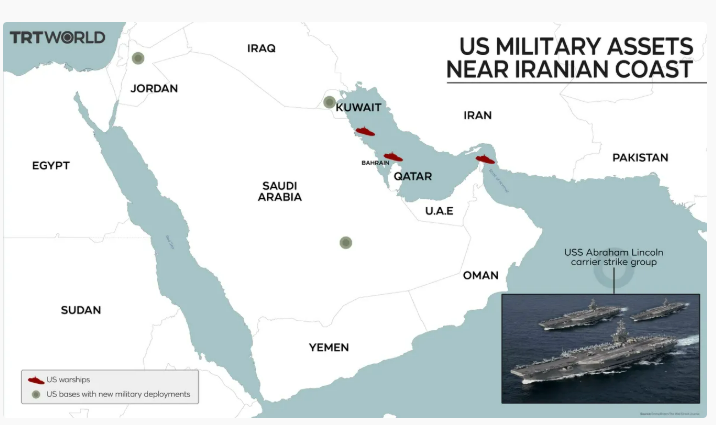
As President Donald Trump considers a major strike on Iran after discussions about limiting Iran’s nuclear program and ballistic missile production haven’t progressed, the US military has accelerated a weeks-long buildup of military hardware in the Middle East, open-source data shows. That includes near-constant surveillance flights and dozens of C-17 and C-5 military planes dropping off loads of cargo at US military bases across the region. As Figure 1 shows, the arrival of the Lincoln Carrier Strike Group, now in the northern Arabian Sea, represents the most dramatic shift in military positioning. The group includes the USS Abraham Lincoln along with three guided-missile destroyers and the carrier air wing which includes squadrons of F-35C Lightning II fighters, F/A-18E Super Hornet fighters, and EA-18G Growler electronic warfare jets.
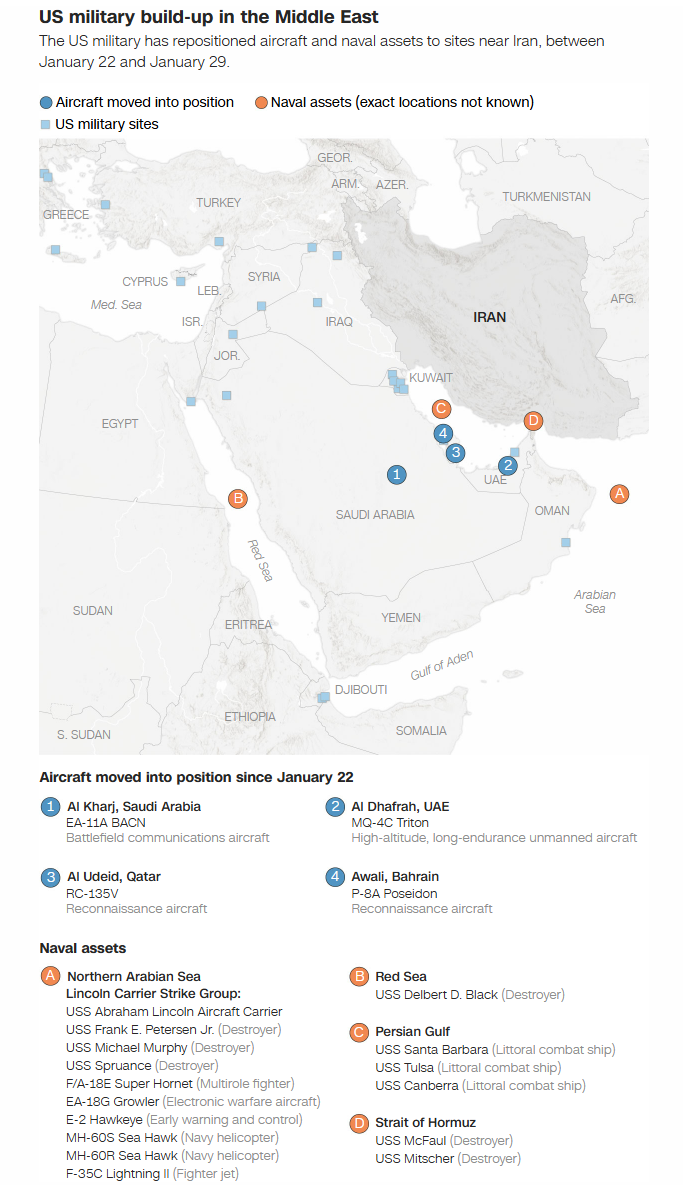
The Navy also has three destroyers — the USS McFaul, USS Delbert D. Black, and USS Mitscher — in the region separate from the aircraft carrier strike group. Three littoral combat ships — USS Canberra, USS Santa Barbara, and USS Tulsa — based out of Bahrain could be called upon for minesweeping duties if Iran chooses to deploy such armaments. In recent days, the US has deployed various air defense systems to the region as well, including additional Terminal High Altitude Area Defense (THAAD) systems, and Patriot missile systems that appeared at Al-Udeid Air Base in Qatar last week, Those systems would be key to combating retaliatory missile strikes if Iran were to respond to a strike by taking aim at either US military assets or US allies in the region. The equipment has accumulated as Trump has repeatedly threatened military action, saying on Wednesday that if Iran doesn’t agree to a deal, “the next attack will be far worse” than last June’s attack on its nuclear facilities. “Like with Venezuela, it is, ready, willing, and able to rapidly fulfill its mission, with speed and violence, if necessary,” Trump said of the Abraham Lincoln. [4] The guided-missile destroyers steaming with the Lincoln and elsewhere in the region offer significant strike potential. Each destroyer can carry dozens of Tomahawk Land Attack Missiles with a range of 1,000 miles and wields a 1,000-pound conventional warhead. In addition, US Navy carrier strike groups usually operate with an attack submarine that can also launch Tomahawks, but the presence of submarines is almost never disclosed. While the carrier provides a floating base for military operations, the US has a number of permanent locations in the region where a slew of other aircraft have also been heading. As Figure 2 shows, according to the Council on Foreign Relations, the US has at least 19 military bases - eight of which are considered to be permanent - across the Middle East. The US has a major military presence in Qatar, Bahrain, Kuwait, Egypt, Iraq, Israel, Jordan, Saudi Arabia, Syria, Oman and the UAE. While in Djibouti and Turkey, the US maintains large military bases that serve different regional commands, but contribute to activities in the Middle East. Currently, there are approximately 40,000 American troops in the Middle East, according to US defense officials. Around a quarter of them are in Al-Udeid, which hosts combat aircraft, tankers, aerial refueling and intelligence assets. Al-Udeid airbase in Qatar, in the desert on the outskirts of Doha, is the tactical headquarters of the US Central Command, also known as Centcom. Centcom’s area of responsibility is not only the Middle East, but also parts of Central and South Asia. Al-Udeid is the largest American base in the region, hosting around 10,000 troops. The next biggest military base in terms of personnel is thought to be the naval base in Bahrain.
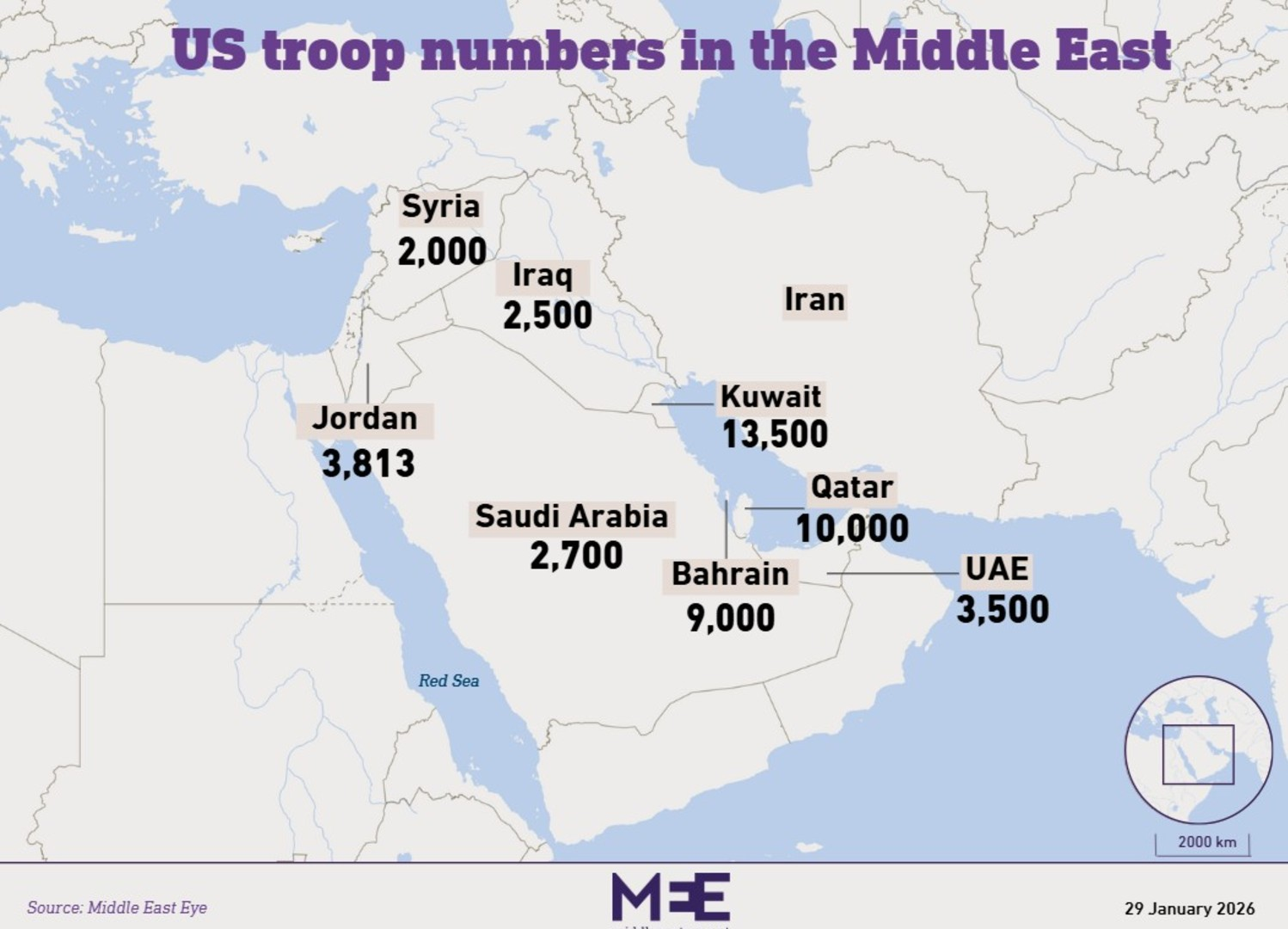
Bahrain (hosting 9,000 American troops) is where the US navy’s fifth fleet is headquartered, with responsibility over the Gulf, Arabian Sea, Red Sea, and some of the Indian Ocean. Kuwait hosts Camp Arifjan. That is the name of the tactical (or forward) headquarters of the US Army Central - a military formation that serves as the army component for Centcom. Ali al-Salem air base, known as “The Rock” for its isolated environment, is also in Kuwait, along the Iraqi border. Another Kuwait base is Camp Buehring, which has been a staging post for units heading to Syria and Iraq. In total, around 13,500 US troops are stationed in Kuwait. The UAE is home to 3,500 American troops, as well as al-Dhafra airbase, a site shared between the US and the Emiratis. It has been used during missions against the Islamic State group, as well as for reconnaissance missions in the region. The American presence in Iraq includes the Ain al-Asad airbase in Anbar - a site that was targeted by Iranian missiles after the US assassination of Qassem Soleimani, the senior Iranian general. There’s also the Erbil airbase in the semi-autonomous Kurdistan region, which is used for training exercises. Approximately 2,700 American troops are stationed in Saudi Arabia, providing air and missile defense capabilities. The Prince Sultan airbase, near Riyadh, is a major air force hub where its main assets include Patriot missile batteries. For its missions in the Levant, Muwaffaq Salti airbase in Jordan’s Azraq is the key hub. It hosts the US’s 332nd Air Expeditionary Wing. Further afield in Turkey, the major base run jointly with Turkish forces is the Incirlik airbase in southern Adana. That base reportedly hosts US nuclear warheads. The size of US military bases, personnel, and equipment has fluctuated in recent years and months, reflecting shifting regional priorities. Early in President Trump’s second term, several warships departed the Middle East to support US international operations. However, naval and air power is now being bolstered in the region to attack Iran. On January 29, 2026, an E-11A jet arrived at Al Udeid Air Base in Qatar. This is one of the last critical assets the US needs to coordinate complex operations. The E-11A, a converted business jet, serves as a high-altitude communications relay system, transmitting data to support air and ground forces. [5] On the same day, a transport aircraft modified for combat search and rescue operations arrived in the area of operation. A squadron of F-15E Strike Eagle fighters, capable of carrying a variety of guided bombs and air-to-surface missiles, also recently deployed to the region as part of a planned troop rotation. Surveillance flights by US drones and reconnaissance aircraft have continued in the Strait of Hormuz and the Persian Gulf. Since last Monday, reconnaissance aircraft have been flying nonstop from US bases in Bahrain, Qatar, and even beyond the Middle East. Modified versions of the RC-135 reconnaissance aircraft, capable of detecting radioactive debris and interpreting electromagnetic signals, have also been deployed to the region. On January 29, 2026, at least eight aerial refueling tankers, used to provide aerial refueling for small military aircraft, crossed the Atlantic and landed at Morón Air Base in Spain. Several of the tankers transmitted messages during the flight, suggesting they were supporting at least seven additional small aircraft ‘en route’, likely conducting electronic warfare or fighter missions. Messages sent by two tankers on Thursday night specifically referred to the F-35 Operations Center, and these were recorded on the flight tracking dashboard tbg.airframes.io, showing that the F-35 fighter was crossing the Atlantic. Both, aerial refueling tankers mentioned in the message took off from Homestead Air Force Base in Florida. Less than two hours after the message was sent, six F-35 fighter jets landed at Lages Air Base in Portugal. Amid high tensions over President Trump’s recent threats, US Central Command announced on January 27, 2026 that it had conducted several days of training exercises across the Middle East to demonstrate its “ability to deploy, distribute, and sustain combat power.” [6] Given the US military’s extensive aerial refueling tanker network, it is unclear what other assets from around the world will be deployed in the military operation against Iran. As a reminder, in June 2025, seven B-2 Spirit stealth bombers flew from Whiteman Air Force Base in Missouri to Iran for 37 hours, dropping over a dozen bombs on three Iranian nuclear sites. Furthermore, guided missile submarines were also used in the attack on Iranian nuclear facilities in June 2025. The U.S. Navy has four Ohio-class guided missile submarines, converted ballistic missile submarines whose locations are kept secret, that can carry up to 154 Tomahawk missiles.
Iran and the US agreed to resume nuclear talks on Friday on February 6, 2026, in Oman. However, if no last-minute deal with Iran can be reached and President Donald Trump decides to order US forces to attack Iran, then what are the possible outcomes? Here are seven scenarios. [7]
Scenario 1: Targeted, surgical strikes, minimal civilian casualties, a transition to democracyUS naval and air forces conduct limited, precision strikes targeting military bases of Iran’s Islamic Revolutionary Guards Corps (IRGC) and the Basij unit - a paramilitary force under the control of the IRGC - ballistic missile launch and storage sites as well as Iran’s nuclear program. An already weakened Iranian regime is toppled, eventually making a transition to a genuine democracy where Iran can rejoin the rest of the world. This is a highly optimistic scenario but is highly unlikely. Western military intervention in both Iraq and Libya did not bring a smooth transition to democracy. Although it ended brutal dictatorships in both countries, it ushered in years of chaos and bloodshed. US secretary of state Marco Rubio assessed that the Iranian regime was probably weaker than it had ever been. However, a senior Israeli official said that Israel does not believe US airstrikes alone can topple the Islamic Republic, if that is Washington’s goal. A protracted US air campaign is considered unlikely, experts say, citing Trump‘s reported desire for a limited and decisive attack. But even a monthslong offensive would not guarantee the fall of the Iran regime. “A sustained US air campaign could severely degrade Iran‘s conventional military by ripping up command-and-control, and fixed infrastructure, but it is unlikely by itself to produce the collapse of Iranian security forces, which can disperse, hide, and shift to low-signature internal repression,” said Michael Horowitz, an independent defense expert in Israel. [8] “If you’re going to topple the Iran regime, you have to put boots on the ground,” he told Reuters, noting that even if the US killed Supreme Leader Ayatollah Ali Khamenei, Iran would “have a new leader that will replace him.” [9] Only a combination of external pressure and an organized domestic opposition could shift Iran’s political trajectory, the Israeli official said. The Israeli official said Iran’s leadership had been weakened by the massive protests but remained firmly in control despite the ongoing deep economic crisis that sparked the protests. Western diplomats and Arab officials also told Reuters that they were concerned that instead of bringing people onto the streets, US air strikes could weaken a movement already in shock after the bloodiest repression by Iranian authorities since the 1979 Islamic Revolution. Alex Vatanka, director of the Iran Program at the Middle East Institute, said that without large-scale military defections Iran’s protests remained “heroic but outgunned.” Trump has notably avoided endorsing a successor, and Iran’s exiled crown prince Reza Pahlavi lacks sufficient support within the country to immediately be installed as a leader. Jason Brodsky, a member of the Atlantic Council’s Iran Strategy Project, said President Trump has historically favored “quick, surgical, targeted, dramatic, and decisive military operations,” pointing to US airstrikes in Syria during his first term. He said any US military intervention could involve leadership decapitation alongside attacks on Iran’s military and security infrastructure. However, Brodsky cautioned that Iran’s political system is designed to survive even major leadership losses. [10] “The Islamic Republic is bigger than any one individual,” he said, noting that institutions and succession mechanisms exist to fill any vacuum — even if the removal of Supreme Leader Ayatollah Ali Khamenei could be temporarily destabilizing.
Scenario 2: Regime survives but moderates its policiesThis could broadly be called the “Venezuelan model” whereby swift, powerful US military action leaves the regime intact but with its policies moderated. Some in Washington hope that US military pressure could force Iran to moderate its behavior — scaling back its nuclear ambitions, missile program and regional proxy network. In Iran’s case, this would mean the Islamic Republic survived, which won‘t satisfy large numbers of Iranians, but is forced to curtail its support for violent militias across the Middle East, curtail or cease its domestic nuclear and ballistic missile programs as well as easing up on its suppression of protests. Again, this is at the more unlikely end of the scale. The Islamic Republic leadership has remained defiant and resistant to change for 47 years and is unlikely to shift its course now. Danny Citrinowicz, a former Israeli intelligence official now with the Atlantic Council, warned that US military strikes could actually strengthen hardliners. “A US attack would more likely consolidate elite cohesion around the regime, marginalize protesters and reinforce Iran’s narrative of external siege,” he said.
Scenario 3: Iran regime is replaced by military ruleMany experts think that this is the most likely possible scenario. While the Iran regime is clearly unpopular with many, and each successive wave of protests over the years weakens it further, there remains a huge and pervasive security deep state with a vested interest in the status quo. The main reasons why the protests have so far failed to overthrow the Iran regime is because there have been no significant defections to their side, while those in control are prepared to use unlimited force and brutality to remain in power. At present, there is no credible alternative pathway to a stable and democratic Iran. Any attempt by the US to impose regime change by force, whether through the dismantling of the regime or the assassination of Khamenei, would almost certainly produce catastrophic outcomes. The most likely scenarios would be a full takeover by Iran's Islamic Revolutionary Guards Corps (IRGC) or a descent into civil war. Iran currently lacks a viable domestic opposition capable of governing the country. At the same time, the exiled opposition, including figures such as Reza Pahlavi, remains fragmented, weak, and organizationally unprepared to assume power. In the confusion of the aftermath of any US strikes it is highly likely that Iran ends up being ruled by a strong, military government composed largely of IRGC figures. One of the most likely scenarios, according to both Atlantic Council experts and BBC analysts, is a shift toward overt military rule. [11] If Iran’s current leadership gets weak but does not collapse, power could move fully into the hands of the IRGC — a force that already dominates Iran’s security network and large parts of its economy. Brodsky at the Atlantic Council said that an IRGC figure like parliamentary speaker Mohammad Bagher Ghalibaf could emerge as a central authority. But rather than bringing reform, such a transition could entrench a more hardline system.
Scenario 4: Regime collapses, replaced by chaosThis is a very real danger and is one of the major concerns of neighbors like Qatar and Saudi Arabia. The greatest danger now is that President Trump, having amassed powerful military forces close to Iran‘s borders, decides he must act, and a war starts with no clear end-state and with unpredictable and potentially damaging repercussions. Despite its Persian-speaking majority, Iran has a diverse population with at least 40% belonging to different non-Persian ethnic groups, which may play a significant role in the event of a US attack, according to several analysts. Perhaps the gravest risk, experts say, is the collapse of central authority in Iran. BBC analysis highlights the possibility of civil war, ethnic unrest involving Baluchis and Kurds, and a humanitarian crisis in a country of over 90 million people. Atlantic Council analysts warn that regime failure without an organized opposition could produce great instability rather than democracy. Citrinowicz, a former Israeli intelligence official, said that “Iran lacks a credible, organized opposition capable of governing the country.” He added that externally imposed regime change could lead to chaos. While some Western media have pointed out Reza Pahlavi – the son of the ousted Shah of Iran – who had called on protesters to take to the streets against Khamenei’s rule, as a possible alternative, many analysts don’t see in him the ingredients of a true leader. Many people see Pahlavi as a figure too close to Israel’s Zionist Prime Minister Benjamin Netanyahu. “Reza Pahlavi, even himself, is not looking forward to coming back to Iran,” says Fatemeh Karimkhan, an Iranian journalist. Karimkhan says that while there are some pro-monarchy supporters in Iran, they are not as many as projected. Karimkhan claims that “they are much less in number and in ability.”
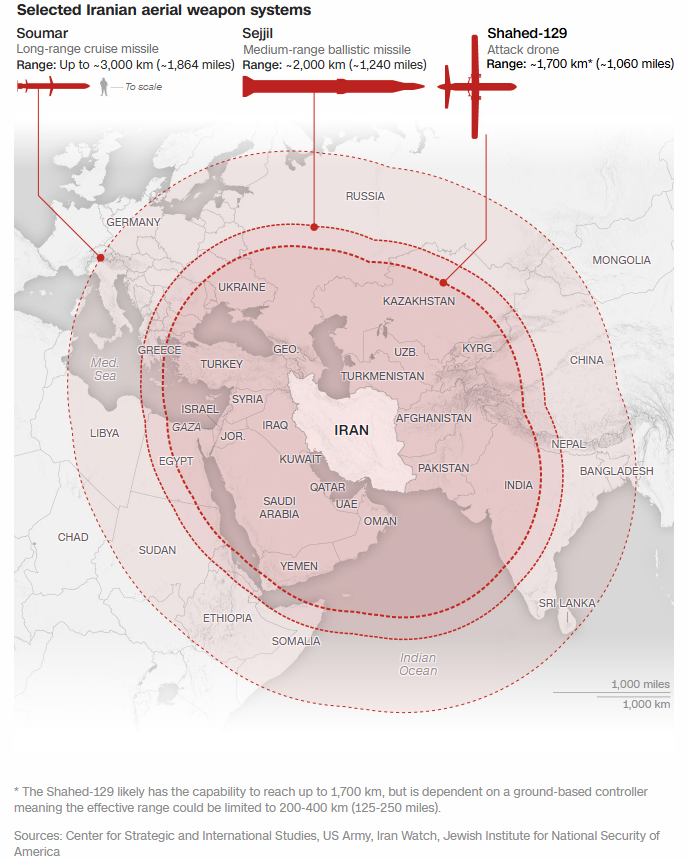
Scenario 5: Iran retaliates by attacking US forces and neighbors using missiles and dronesIran has vowed to retaliate against any US attack, saying that “its finger is on the trigger.” Specifically, on February 1, 2026, Iranian Supreme Leader Ali Khamenei warned the US that any attack on his country would result in a “regional war” as President Donald Trump has amassed US military assets in the Middle East. Iran is clearly no match for the might of the US Navy and Air Force but it could still lash out with its arsenal of ballistic missiles and drones, many concealed in caves, underground or in remote mountainsides. During the 12-day war in June 2025, Israel hit Iran’s military infrastructure, including missile-production centers. Israel struck sites around Tehran, including the Parchin military complex, the Khojir military base, the Shahrud missile site, and a factory in the Shamsabad Industrial Zone. The strikes took aim at Iran’s production of medium-range ballistic missiles that have threatened Israel and are “fairly potent,” said Sascha Bruchmann, a military analyst at the International Institute for Strategic Studies. [13] Even then, Iran was still capable of firing hundreds of ballistic missiles at Israel. Dozens of the missiles, aimed mostly at military sites, penetrated Israel’s formidable air defenses. Israel estimated that Iran had 1,000–1,500 missiles remaining after the 12-day war in June 2025, down from 2,500 held previously. But by the end of 2025, it assessed that Iran was rebuilding its inventory. As a result, Figure 3 shows, Iran “still has a large arsenal of short and medium range missiles that can easily hit US military bases in the Middle East, as well as cruise missiles and drones that it would likely use to target US ships,” said Michael Horowitz, an Israeli independent defense expert. [14]
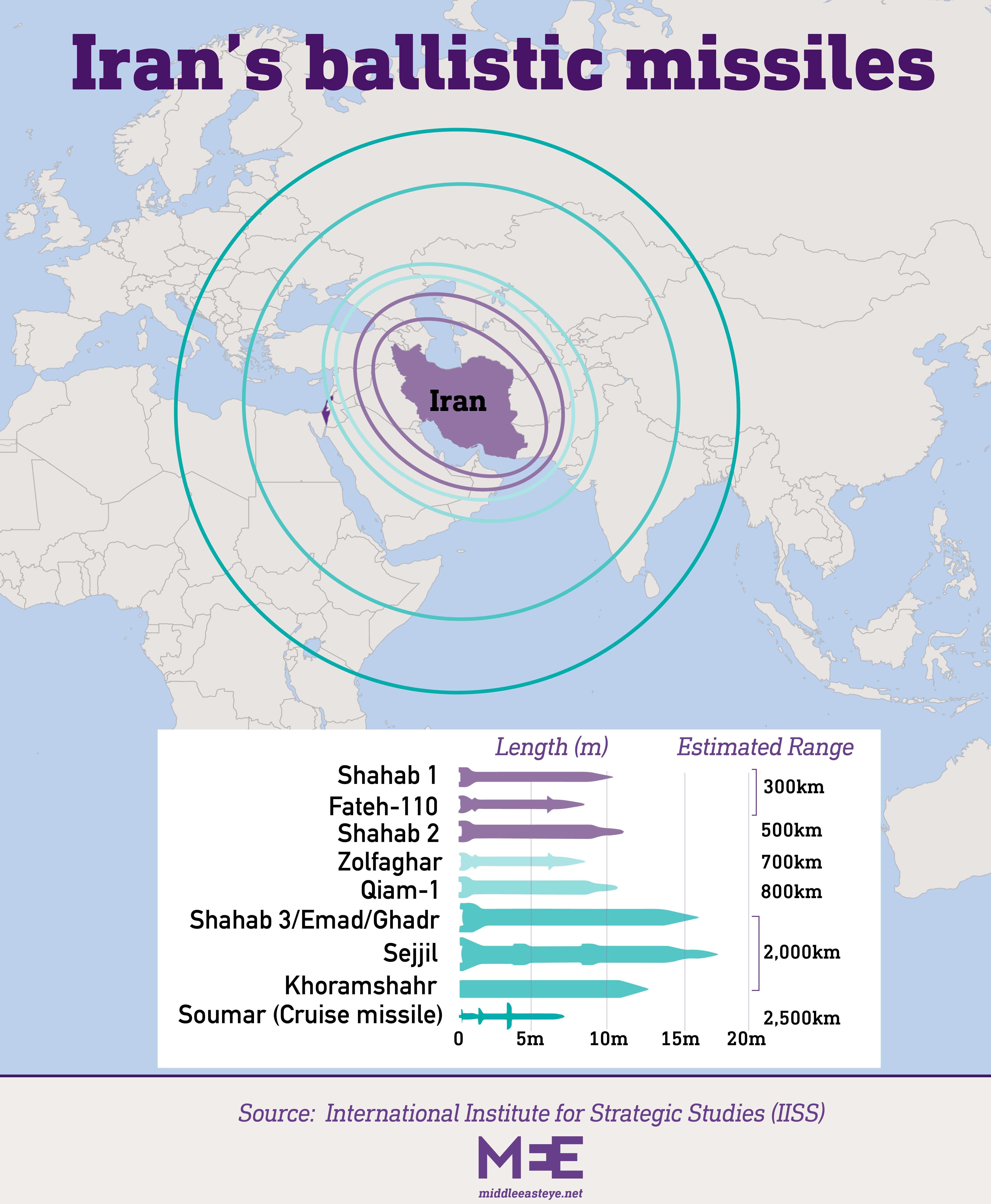
Many of the medium-range ballistic missiles are “liquid-fueled and rely on infrastructure to be loaded, fueled, and launched,” said Bruchmann. Iran also possesses short-range ballistic missiles that are “often solid-fueled, much more flexible, and thus more difficult to detect before launch,” added Bruchmann, estimating that Iran has several thousand of the missiles. [15] Bruchmann said the short-range missiles “constitute a real threat, particularly for the smaller Gulf countries” like Bahrain and Qatar that house US bases and forces. There are US military bases and facilities dotted along the Arabian side of the Gulf, notably in Bahrain and Qatar. As Figure 4 shows, almost all US bases in the region fall within the range of Iran’s ballistic missile capabilities. But Iran could also, if it chose, target the critical infrastructures of any nation it considered was complicit in a US attack, such as Jordan or Israel. Moreover, Iran has had large-scale production of cheap short-range armed drones over the past decade. These drones have already been used to exert chilling effects in Ukraine by Russia. They are easily hidden and their manufacture can be readily dispersed into numerous small factories. Iran’s Shahed suicide drone, for example, has proved to be a destructive tool in Russia’s war in Ukraine. While few have the range to cause serious damage to Israel, many drones are well within range of plenty of US military forces, including its largest air base in the region, in Qatar, and the headquarters of the US Navy’s Fifth Fleet in Bahrain. Iran has prepared many drones after the US attack in June 2025. Iran’s Army Chief, General Amir Hatami, said Iran changed its military strategy after the 12-day conflict in June 2025. As part of this shift, Iran has prepared a large number of drones. Recently the IRGC received a batch of 1,000 new drones while Iran has prepared for a military confrontation with the US. [16] General Amir Hatami said these drones can be launched from both land and sea. The devastating missile and drone attack on Saudi Aramco’s petrochemical facilities in 2019, attributed to an Iranian-backed militia in Iraq, showed the Saudis just how vulnerable they were to Iranian missiles.
Iran’s Gulf neighbors, all US allies, are understandably extremely jittery right now that any US military strike on Iran is going to end up rebounding on them. This is because Iran could use its arsenal of ballistic missiles and drones to hit infrastructures in Middle East countries it sees as complicit.
Scenario 6: Iran retaliates by laying mines in the Gulf or closing the Strait of HormuzIran could disrupt global energy flows by laying sea mines in the Gulf or closing the Strait of Hormuz, a vital shipping route through which around a fifth of the world’s oil and gas exports pass, as Figure 5 shows. Laying mines in the Gulf has long loomed as a potential threat to global shipping and oil supplies ever since the Iran-Iraq war when Iran mined the shipping lanes in the Gulf. The narrow Strait of Hormuz between Iran and Oman is a critical chokepoint. Approximately 20% of the world‘s Liquified Natural Gas exports and between 20-25% of oil and oil byproducts pass through this strait each year. Iran has conducted military exercises in rapidly deploying sea mines. If it did so, then it would inevitably impact on world trade and oil prices.
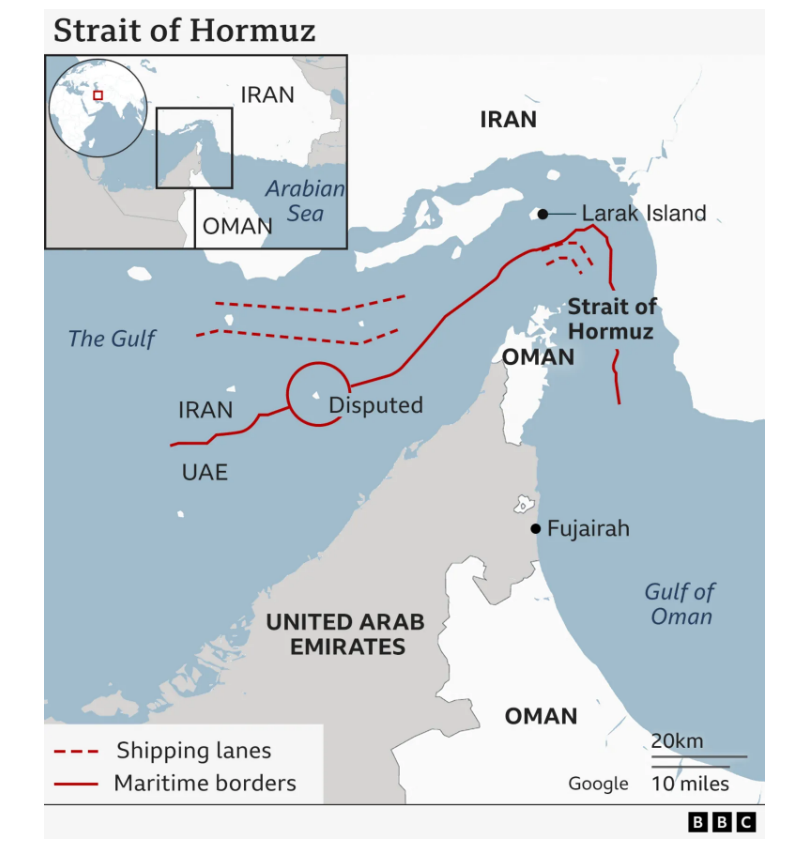
Iran, one of the world’s biggest energy producers, sits on the Strait of Hormuz, a narrow waterway. The Iran regime has threatened to close it if it is attacked — a prospect that experts warn could send fuel prices soaring far beyond Iran’s borders and trigger a global economic recession. The Strait of Hormuz is one of the world’s very important shipping chokepoints connecting the oil-rich Persian Gulf to the rest of the world. Approximately 20% of global production flows through the waterway. Iran controls its northern side.
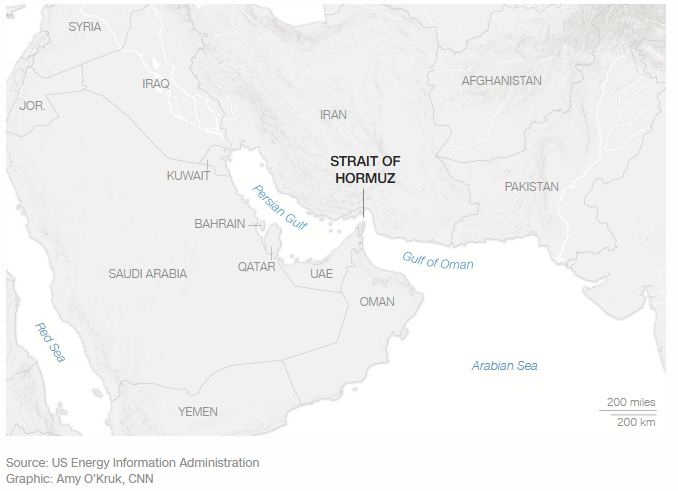
Experts say that targeting the global economy through the Strait of Hormuz may be one of Iran’s most effective options. However, it is also the most dangerous because of its widespread impact. A prolonged closure of the Strait would represent a “dangerous scenario,” said Umud Shokri, a senior fellow at George Mason University. “Even partial disruptions could drive sharp price spikes, disrupt supply chains and amplify inflation globally. In such a scenario, a global recession could be a realistic risk.” [17] Such an aggressive move would likely be a last resort for Iran, because it would severely disrupt its own trade and that of neighboring Arab states, many of which have lobbied President Trump against attacking Iran and pledged not to allow US access to their territory for an assault on Iran. The Iranian regime says that it has naval bases deep underground across the country’s coast with dozens of fast attack boats ready to deploy across Persian Gulf waters. The Iranian military has spent three decades building its own fleet of ships and submarines with production ramped up over the past years in anticipation of possible naval showdown. Retired Vice Adm. Robert Harward, a former deputy commander of US Central Command, said that Iranian naval capabilities and proxies present a challenge for shipping in the Strait of Hormuz that “can be addressed very quickly.” However, he said “asymmetric” tools such as drones and other tactics could prove challenging for shipping and oil flow. [18] Iran’s ability to disrupt global shipping and shock the global economy has historical precedent. In 2019, several oil tankers were hit in the Gulf of Oman during heightened tensions between Iran and Arab nations of the Persian Gulf following President Trump’s withdrawal from a nuclear agreement with Iran. Iran was widely believed to have been responsible. More recently, during the Israel-Hamas war, the Houthis disrupted commercial shipping at the Bab al-Mandab Strait in the Red Sea, through which approximately 10% of the world’s seaborne trade passes. Together with Iran’s ability to threaten traffic through the Strait of Hormuz, Iran wields outsize power to inflict global economic pain. The Houthi group in Yemen has been targeted by both Israel and the US, but it remains one of Iran’s most strong and destructive surrogates, and it has also indicated that it will defend Iran, its patron. Last weekend, the Houthis released a video showing images of a ship engulfed in flames, accompanied by the simple caption, “Soon.” With Iranian support over the past few years, the Houthi group has struck Saudi Arabia, the UAE, and Israel, as well as US ships in the Red Sea.
Scenario 7: Iran retaliates, sinking a US warshipA US Navy Captain onboard a warship in the Gulf claimed that one of the threats from Iran he worries about most is a “swarm attack.” [19] This is where Iran launches so many high explosive drones and fast torpedo boats at a single or multiple targets that even the US Navy’s formidable close-in defenses are not able to eliminate all of them in time. The IRGC Navy has long replaced the conventional Iranian Navy in the Gulf, some of whose commanders were trained at Dartmouth during the time of the Shah. Iran’s naval crews have focused much of their training on unconventional or “asymmetric” warfare, looking at ways to overcome or bypass the technical advantages enjoyed by their main adversary, the US Navy’s Fifth Fleet. As Figure 7 shows, the sinking of a US warship near Iran, accompanied by the possible capture of survivors among its crew, would be a massive humiliation for the US.
While this scenario is unlikely, the billion-dollar destroyer the USS Cole was crippled by an Al-Qaeda suicide attack in Aden harbor in 2000, killing 17 US sailors. [20] Before that, in 1987 an Iraqi jet pilot fired two Exocet missiles at a US warship, the USS Stark, killing 37 sailors. While considered unlikely, analysts warn that Iran has trained extensively for “swarm attacks” using drones and fast boats designed to overwhelm US naval defenses. A successful strike on a US warship would represent a major escalation and a symbolic blow to US military dominance in the region.
This paper raised a question, “What would happen if the US carried out military attacks on Iran?” amidst escalating tensions between Iran and the US. To address this question, this paper first examined the US military presence in the Middle East, which is intended to attack Iran. It then analyzed seven scenarios that could arise if the US conducts military attacks on Iran and evaluated the feasibility of each scenario. The most likely scenarios currently are Scenario 3 (Iran’s regime transition to military rule), Scenario 4 (Iran’s regime collapses and chaos ensues), and Scenario 5 (Iran retaliates with missiles and drones against the US military and US allies in the Middle East).
[1] Barin, Mohsen (31 December 2025). "Iran's economic crisis, political discontent threaten regime". DW News. [2] https://www.timesofisrael.com/irans-president-warns-us-attack-on-supreme-leader-would- mean-full-scale-war/ [3] https://www.politico.com/news/2026/01/17/trump-to-politico-its-time-to-look-for-new-lead ership-in-iran-00735528?_kx=LSFywwe4GSg_lcFWo5DyId8VKdphy2F0zhlZVneJnA97jKgVYFyty4cB80GJkTHR.U5D8ER&utm_id=01KF7GKF35MAAW8BRA143VFM9M&utm_medium=cam2paign&utm_source=Klaviyo [4] https://abcnews.go.com/Politics/trump-massive-armada-heading-iran-warns-time-running /story?id=129635685 [5] https://www.itamilradar.com/2026/02/02/usaf-e-11a-heads-back-to-the-united-states-as-a -second-bacn-aircraft-reinforces-the-gulf/ [6] It had conducted several days of training exercises across the Middle East to demonstrate its “ability to deploy, distribute, and sustain combat power.” [7] https://www.bbc.com/news/articles/ce3kenge1k9o [8] https://www.bbc.com/news/articles/ce3kenge1k9o [9] https://www.bbc.com/news/articles/ce3kenge1k9o [10] https://www.independent.co.uk/news/world/middle-east/trump-iran-us-strikes-war-regim e-change-nuclear-b2909957.html [11] https://gulfnews.com/world/mena/if-the-us-strikes-iran-what-could-happen-next-experts -warn-of-chaos-and-escalation-1.500424901 [12] https://www.bbc.com/news/articles/ce3kenge1k9o [13] https://www.rferl.org/a/iran-us-israel-strikes-war/33662293.html [14] https://www.rferl.org/a/iran-us-israel-strikes-war/33662293.html [15] https://www.rferl.org/a/iran-us-israel-strikes-war/33662293.html [16] https://www.jpost.com/middle-east/iran-news/article-884948 [17] https://caspianpost.com/analytics/if-u-s-strikes-iran-possible-scenarios-and-regional-fall out [18] https://edition.cnn.com/2026/01/29/middleeast/iran-response-options-trump-intl [19] https://www.bbc.com/news/articles/ce3kenge1k9o [20] https://www.bbc.com/news/articles/ce3kenge1k9o
First published in :
World & New World Journal

Silence and shadows: The West’s Quiet Stance on Gaza’s Agony
What’s Driving Pakistan-Afghanistan War? Islamabad’s Never-Ending Cycle of Insecurity

Polycrisis in the Indo-Pacific Demands a Stronger Anzac Alliance
‘Destruction is not the same as political success’: US bombing of Iran shows little evidence of endgame strategy
Unlock articles by signing up or logging in.
Become a member for unrestricted reading!