

Defense & Security
Will NATO even survive?
Image Source : Shutterstock
Subscribe to our weekly newsletters for free
If you want to subscribe to World & New World Newsletter, please enter
your e-mail


 Provider of in-depth & balanced analysis on hot issues around the world
Defense & Security
Image Source : Shutterstock
First Published in: Feb.23,2026
Feb.23, 2026
Share Article


Allegedly, Lord Ismay (Hastings Lionel Ismay), the first Secretary of the North Atlantic Treaty Organisation (NATO), famously claimed that NATO was set up for three major reasons: to keep the Americans in, to keep the Russians out (he meant the USSR) and to keep the Germans down.[1] Historians and international security experts generally agree that NATO has been a fundamental part of European security architecture, helping maintain peace on the European continent during the Cold War amid the great powers’ rivalry. Not only did the American presence on the European continent deter a possible Soviet invasion, but it also served as a pacifier regarding European military and political ambitions, especially German. As of today, "the Alliance" (as Nato is often referred to) seems to be edging towards the end of its coherence due to many internal and external reasons. This short paper will explore some of them, albeit the topic naturally requires a much longer and deeper approach.
On December 9, 2025, Republican Congressman Thomas Massie of Kentucky introduced H.R. 6508, the NATO Act, which calls for the United States to withdraw from NATO. In his statement, following (consciously or not Lord Ismay) Massie states: “NATO is a Cold War relic. We should withdraw from NATO and use that money to defend our own country, not socialist countries. NATO was created to counter the Soviet Union, which collapsed over thirty years ago. Since then, U.S. participation has cost taxpayers trillions of dollars and continues to risk U.S. involvement in foreign wars. Our Constitution did not authorise permanent foreign entanglements, something our Founding Fathers explicitly warned us against. America should not be the world’s security blanket — especially when wealthy countries refuse to pay for their own defense.”[2] This is but a small ripple in a much bigger pool of water that hosts the U.S. concerns regarding their involvement in the European Security architecture. To cut a long story short, there seems to be a formidable force in U.S. politics advocating a "refocus" of US foreign policy doctrine and the consequent foreign policy and security strategies. Not surprisingly, therefore, the U.S. President has recently unveiled the new National Security Strategy of the United States of America. The 2025 National Security Strategy (NSS) released by the Trump administration indicates a shift away from the U.S. focus on Europe in foreign and security policy, emphasising greater self-reliance for European allies and prioritising other regions.[3] The NSS ranks global regions by priority, placing the Western Hemisphere first (elevated from fifth in the 2017 NSS), Asia second, and Europe third—a demotion from its previous second-place ranking. This reorientation aligns with an "America First" approach that emphasises burden-sharing, non-interventionism, and a narrower definition of U.S. national interests, thereby avoiding overextension in regions such as Europe. Key elements signalling a less focused approach to Europe include, among others, the encouragement of European self-defence. The strategy calls for Europe to assume primary responsibility for its own security as sovereign nations. It urges ending NATO's expansion and requires allies to meet a new 5% of GDP defence spending commitment (dubbed the "Hague Commitment"), far above the current 2% target, to ensure fair burden-sharing. Secondly, the NSS outlines a limited U.S. role in Europe. The U.S. involvement is framed as diplomatic support for stability (e.g. negotiating an end to the Ukraine war and fostering relations with Russia for reconstruction and strategic stability) rather than sustained military commitments. The document criticises Europe's economic decline, migration issues, and EU "transnationalism" that undermines sovereignty, but positions the U.S. as a helper only for aligned partners willing to open markets and combat hostile practices such as mercantilism. As far as the Western Hemisphere is concerned, the NSS asserts U.S. preeminence through a "Trump Corollary" to the Monroe Doctrine, focusing on migration control, supply chains, and denying adversarial influence through active military and economic measures (Central and South America and the Caribbean). This marks a departure from past NSS documents, which often centred on Europe due to NATO commitments and threats like Russia, toward a more transactional and restrained U.S. posture in the region.[4] With regards to that last point, the very latest National Defence Strategy of the U.S. confirms the direction away from Europe.[5] The strategy prioritises Europe taking primary responsibility for its own conventional defence, with critical but more limited support from the United States. This includes supporting Ukraine’s defence as primarily a European responsibility. Moreover, according to the document, Russia remains a persistent but manageable threat to NATO's eastern members.
The ongoing war in Ukraine, which has lasted for 4 years now, has allowed the Russian army to make formidable advances in the field. Russian experts and military advisors are pushing for control of Odessa (I write about it here). It appears probable at this stage that the Russian Federation will want to control as much territory of Ukraine as possible and that the lack of effective diplomacy means that the outcome of the war will be settled on the battlefield rather than in the comfort of negotiation chambers. Regardless of the mainstream narratives constantly pushed by CNN or BBC, the Russians have not really changed their fundamental demand - that Ukraine should not be permitted to become a NATO member. Western societies and their political elites can, of course, feel moral outrage when confronted with such demands. The facts are, however, painfully simple. After the end of the Cold War, the reunification of Germany was agreed to and accepted by the then-Soviet Union, on the condition that NATO would not expand eastward. (I write about here). NATO did expand westward multiple times, however. From the Kremlin's perspective, Ukraine's possible membership in NATO is the last red line Russia cannot allow to be crossed. Put simply, Ukraine's geography makes it a strategic asset to NATO. Let us also remember that countries such as Turkey, Poland, all three Baltic states, and, recently, even Finland are already NATO members.[6] Importantly, Russian security and military experts see this as a fundamental threat to Moscow and its European environment. (Russia, after all, is also a European country). (The pivotal moment came at the April Bucharest Summit, where NATO leaders — despite opposition from France and Germany — declared that Ukraine (and Georgia) "will become members of NATO." This was not an immediate invitation but a promise of future membership once conditions were met, with the U.S. lobbying heavily for a Membership Action Plan (MAP). Ukraine had formally requested a MAP in January 2008.)[7]
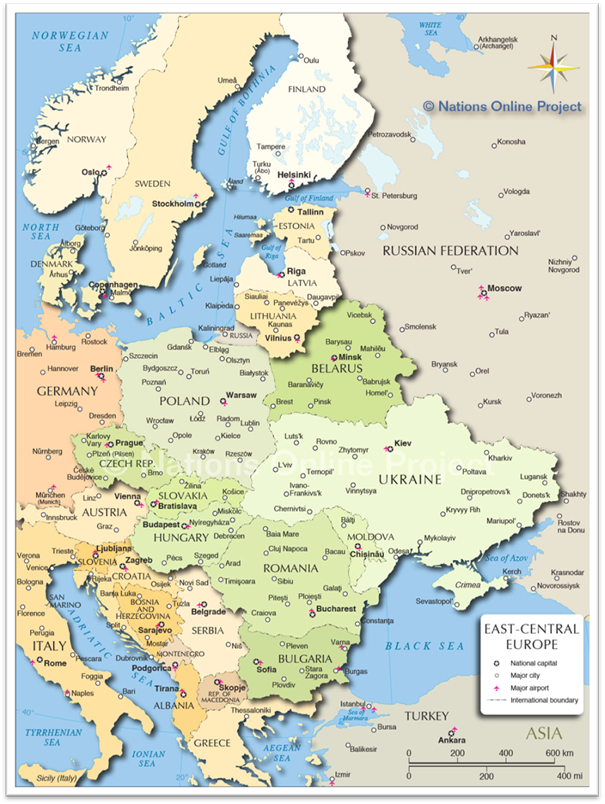
According to the European Parliament, as early as back in 2014, Moscow identified several challenges as threats to its national security, with a particular focus on the West. First, it is the opposition to Russia's independent foreign policy. Russia perceives that its independent foreign and domestic policies are met with resistance from the United States and its allies, who seek to maintain their domination in world affairs and to "contain" Russia through political, economic, military, and informational pressure.[8] Second, Russia had always viewed the enlargement of NATO, the location of its military infrastructure close to Russian borders, NATO's "offensive capabilities," and the trend towards NATO acquiring global functions as direct challenges to its security Third, Russia was concerned about U.S. initiatives like the global antimissile system, Global Strike capabilities, and the militarisation of space, which it views as efforts to undermine its strategic deterrent. Fourth, Russia resented Western criticism of its policies in the post-Soviet countries, often described by Moscow as neo-imperialistic, and perceives NATO and the EU's enlargement and development of cooperative ties in the shared neighbourhood as expanding their spheres of influence at Russia's expense. Fifth, Moscow condemned efforts to provoke regime changes through means such as "colour revolutions," as it views these as attempts to destabilise its internal situation, supported at times by military force. This includes references to events in Georgia (2003), Ukraine (2004 and 2014 "Revolution of Dignity"), Kyrgyzstan (2005), and the Arab Spring (2010-2012). Sixth, the Kremlin perceived an increasing competition with the West, including rival systems of values and societal models, and it rejects the normative dimension of the EU's external action, which it sees as an attempt to impose its norms and values on Russia. Next, Russia faced economic sanctions, financial, trade, investment, and technological policies used by the West as instruments to address geopolitical problems and contain alternative centres of power, such as Russia. Finally, across its strategic documents, Russia consistently emphasised the West (including the EU) as its main challenger to its great-power ambitions and security. The latest National Security Strategy of the Russian Federation as approved by President Putin in July 2021 (still before the beginning of the War in Ukraine), NATO and Western European countries are perceived by Russia as sources of pressure and threats.[9] The Strategy states that attempts to exert pressure on Russia, its allies, and partners, including building up NATO military infrastructure near Russian borders and intensifying intelligence activities, contribute to increasing military dangers and threats to Russia. Moreover, there is mention of Western countries' desire to maintain hegemony, which is associated with the crisis of economic development models, rising disparities and social inequality, attempts to limit the role of states, and the exacerbation of political problems and inter-state contradictions. The document also notes that some states view Russia as a threat or even a military adversary, and that there are efforts to instigate disintegration processes within the Commonwealth of Independent States to undermine Russia's ties with its traditional allies. Additionally, unfriendly actions by foreign countries, including Western states, are seen as attempts to exploit Russia's socio-economic problems to undermine internal unity and radicalise protest movements. Furthermore, information campaigns by foreign countries seek to form a hostile image of Russia, restrict the use of the Russian language, ban Russian media activities, and impose sanctions on Russian athletes. The document describes these as unjustified accusations and discrimination against Russian citizens and compatriots abroad. Overall, NATO and Western European countries are portrayed as pursuing policies aimed at containing Russia, undermining its sovereignty, and interfering in its internal affairs, which Russia views as threats to its national security and statehood. Now, as mentioned here, it seems that the outcome of the War in Ukraine is most likely to be decided on the battlefield and that the Russians will keep expanding their territory control, possibly even including Odessa, and that ultimately, they will want to keep as much Ukrainian territory under their direct or indirect control as possible. It is very unlikely at this stage that Ukraine will ever regain its territorial integrity (compared to pre-2014 status and Crimean operation).
In one of the recent publications (available here), I claimed that German leadership has, for some time now, promoted the idea of "special responsibility" for Europe and European security. To briefly recollect: "The former Chancellor, Olaf Scholz, at Charles University in Prague on 24 August 2022, recently elaborated on German leadership’s vision regarding the European defence efforts. His presentation paints a broad picture of the EU's future at the beginning of the 3rd decade of the 21st century, against the backdrop of the Russian invasion of Ukraine. Among the four “revolutionary” ideas mentioned by Scholz, two stand out in particular. Firstly, given the potential enlargement of the European Union to up to 35 states, a transition to majority voting in the Common Foreign and Security Policy is urged. Secondly, regarding European sovereignty, the former German Chancellor asserts that Europeans are becoming more autonomous across all fields, assuming greater responsibility for their security, working more closely together, and standing even more united to defend their values and interests worldwide. In practical terms, Scholz indicates the need for one command and control structure for European defence efforts.[10] Arguably, Germany's self-proclaimed special role stems from a re-evaluation of its strategic culture, moving from "restraint to readiness."[11] Post-reunification in 1990, Germany was reluctant to lead on security issues, preferring multilateralism through the EU and NATO while avoiding military assertiveness due to its Nazi past and a culture associating power with guilt rather than responsibility. However, events like the 2014 Crimea annexation and the 2022 Ukraine invasion forced a "profound transformation," with leaders arguing that Germany's previous "strategic ambiguity" is no longer viable in a world of revisionist threats.[12] Former Chancellor Scholz described this as a "mandate to act," not just a description of change, emphasising Germany's obligation to secure peace and foster EU solidarity. [13] Chancellor Merz has built on this, asserting that "everything else is subordinate to external security" and that Europe expects German leadership after years of underperformance.[14] German leaders generally justify this role through a combination of geopolitical, economic, and normative arguments, often tied to specific policy actions like defence spending hikes and institutional reforms. First, geopolitical necessity and threat response. Germany portrays itself as uniquely positioned to confront existential threats like Russian aggression, given its central location in Europe and proximity to conflict zones. Scholz argued that Germany must act as the "guarantor of European security that our allies expect us to be," defending the international order against autocracies and serving as a bridge-builder in the EU. [15] Merz has emphasised the need to fill the void left by U.S. disinterest, stating that Germany faces a "dual shock" from Russian imperialism and American retrenchment, necessitating leadership to maintain transatlantic security. [16] This includes strengthening NATO's deterrence, with Germany committing to nuclear sharing and viewing alliance solidarity as part of its "reason of state."[17] Second, economic power and resource capacity. As Europe's largest economy, Germany justifies its role by leveraging its financial clout for defence investments, aiming to reach 3 - 3.5% of GDP by 2029 — surpassing NATO's 2% target and outpacing France and the UK.[18] Apparently, recently, Merz has relaxed the constitutional debt brake to fund €500 billion in infrastructure and defence, arguing this enables Germany to lead systemic renewal in European security without overburdening allies. [19] Leaders like Scholz and Merz frame this as a responsibility commensurate with Germany's potential, turning economic strength into security leadership rather than mere fiscal discipline.[20] Third, there is the question of perceived historical responsibility and the evolution of strategic culture. Drawing on Germany's past, its contemporary political leaders argue for a shift from "fence-sitting" to "pace-setting," redefining power as responsibility rather than aggression.[21] This includes overcoming "outdated beliefs" about post-Cold War peace and embracing a "geopolitical, security-driven master narrative." Scholz invoked Germany's duty to foster multilateral solutions and reject isolationism, while Merz highlights the need to reshape public perceptions of military force as a tool for stability. This narrative aligns with broader values such as defending democracy, human rights, and the rules-based order, positioning Germany as a defender of European unity.[22]
Turkey has been a member of NATO since 1952, joining primarily to counter Soviet threats during the Cold War, and it remains a pivotal ally due to its unique geopolitical position, military strength, and contributions to alliance objectives. As far as the country's location, Turkey straddles Europe and Asia, serving as NATO's southeastern anchor and controlling the Bosporus and Dardanelles straits, which connect the Black Sea to the Mediterranean.[23] Under the 1936 Montreux Convention, Turkey regulates naval traffic through these waterways, effectively limiting Russian (and other non-Black Sea states') military movements — a role that's become even more critical amid Russia's actions in Ukraine and increased Black Sea presence.[24] This position also borders key regions like the Middle East (Syria, Iraq, Iran), the Caucasus, and Europe, enabling NATO to project influence and address threats from multiple fronts, including countering Russian A2/AD (anti-access/area denial) strategies. In terms of military strength, Turkey boasts NATO's second-largest standing army, providing significant "military mass" for defending extended frontiers and sustaining operations where other allies might lack scale. [25] It hosts vital NATO assets, including the Incirlik Air Base (which stores around 50 U.S. nuclear weapons and supports Middle East operations), the Allied Land Command headquarters in İzmir, AWACS facilities at Konya, and a radar station in Kürecik for NATO's ballistic missile defence system. [26] These capabilities enhance the alliance's rapid response and deterrence in Europe, the Middle East, and beyond. Turkey has actively participated in numerous NATO operations, from sending 4,500 troops to the Korean War (which helped secure its NATO membership) to leading roles in Afghanistan (ISAF and Resolute Support), Iraq, the Balkans, and Mediterranean patrols like Operation Active Endeavour. More recently, it has supplied military aid to Ukraine, including Bayraktar TB2 drones that have proven effective against Russian forces, and co-led the Black Sea Grain Initiative to ensure global food security amid the ongoing war.[27] Turkey also collaborates on counterterrorism efforts against groups like ISIS and the PKK, and helps stabilise regions like the South Caucasus and Eastern Mediterranean. [28] Turkey's growing defence sector produces affordable, battle-tested equipment, such as drones and other systems, which offer NATO alternatives to more expensive Western options and enable rapid production for allies like Ukraine.[29] This industrial capacity strengthens the alliance's overall resilience and reduces dependency on single suppliers. Beyond military might, Turkey extends NATO's diplomatic reach through cultural, economic, and political ties in Africa, the Middle East, Central Asia, and Southeast Asia — areas where Western allies often face credibility gaps. It engages with challenging regimes to secure resources, energy deals, and counter Russian or Chinese influence, acting as a bridge for the alliance. However, recently Turkey's relations with NATO have faced strains — such as its purchase of Russian S-400 systems (leading to U.S. sanctions and F-35 exclusion), disputes with Greece over Cyprus and the Eastern Mediterranean, and delays in approving Finland and Sweden's memberships (resolved by 2024). It is fair to say that Turkey plays a strategically important role in European security, and its leadership effectively leverages this position against European partners. Given its geographic location and military potential, Ankara will largely influence NATO's future.
Perhaps the most intriguing in recent days is the U.S. President's claim regarding Greenland. As of January 27, 2026, tensions between the United States, Denmark, and Greenland have escalated due to renewed U.S. interest in expanding its strategic presence on the Arctic island. President Donald Trump has reportedly issued an ultimatum, pushing for greater control over parts of Greenland to bolster military bases and counter Russian influence in the region, including restrictions on drilling rights for Russia. This follows historical U.S. attempts, such as Trump's 2019 proposal to purchase Greenland outright, which was rebuffed by Denmark. Importantly, the U.S. already operates Pituffik Space Base in Greenland for early warning and missile defence, but the current demands aim to expand this amid Arctic geopolitical competition with Russia and China. Recent talks in Washington between U.S. and Danish officials have led to the formation of a working group aimed at a diplomatic resolution. However, interpretations differ: U.S. officials, including Ambassador Leavitt, frame it as facilitating a transfer or enhanced control, while Denmark emphasises disagreement and no sale. For example, a recent New York Times report indicates Denmark may grant the U.S. sovereignty over select land pockets for military bases, modelled after arrangements like those in Cyprus, to strengthen Arctic defences. [30] Greenland's Prime Minister has declared the island's sovereignty a "red line," rejecting any outright transfer.[31] Denmark has reportedly increased troop deployments to Greenland in response, insisting the territory is not for sale. To spice things up, Trump has questioned Denmark's legal claims, stirring further controversy.[32] This has arguably strained U.S. - EU relations, with Europe adopting a firmer stance against Trump's approach. As a NATO member and EU affiliate through Denmark, Greenland's status has prompted calls for allies to boost Arctic security.[33] Some European leaders worry this could force divestment from U.S. ties or heighten NATO divisions.[34] In an interesting twist, a number of European leaders issued strong rhetoric against Trump and his claims about Greenland. A Joint Statement from European Leaders declared in a collective rebuke: "Greenland belongs to its people. It is for Denmark and Greenland and them only to decide on matters concerning Denmark and Greenland," […] "Security in the Arctic must therefore be achieved collectively, in conjunction with NATO allies including the United States, by upholding the principles of the UN Charter, including sovereignty, territorial integrity and the inviolability of borders. These are universal principles, and we will not stop defending them."[35] Herein lies the fundamental conundrum: the core of the security guaranteed by NATO (at least legally speaking) is Article 5 of the Washington Treaty, the so-called Casus Foederis.[36] The article 5 states: "The Parties agree that an armed attack against one or more of them in Europe or North America shall be considered an attack against them all and consequently they agree that, if such an armed attack occurs, each of them, in exercise of the right of individual or collective self-defence recognised by Article 51 of the Charter of the United Nations, will assist the Party or Parties so attacked by taking forthwith, individually and in concert with the other Parties, such action as it deems necessary, including the use of armed force, to restore and maintain the security of the North Atlantic area." Originally conceived as a defensive military alliance, NATO was established to protect its member states from external threats, according to its founders. In the event that one member state turns against the others, the Alliance risks becoming ineffective, akin to the Warsaw Pact during the Cold War, which served as a mechanism for exerting control over weaker states. Should such a scenario occur, the survival of NATO would be in jeopardy. Historical precedent suggests that oppressive institutions inevitably collapse over time.
It is imperative to acknowledge that NATO is currently engaged, albeit indirectly, in a conflict with Russia. This situation is significant as it serves as a test of NATO's capabilities. Presently, it appears that NATO is not prevailing. Furthermore, it is reasonable to assert, as I have argued in my previous analysis (available here), that Russia is likely to achieve its primary objective: ensuring that Ukraine will not join NATO. Additionally, I expect Russia to retain its territorial acquisitions and, in some manner, exert influence over the political system that will emerge in Ukraine following the conflict. Several pertinent questions arise in this context. Will the eventual peace, following the conclusion of the conflict, be sustainable? Will it adequately consider the national interests of all parties involved? Will it offer a satisfactory compromise? Is there a probability of a resurgence of Cold War-like relations between Western European nations and Russia? In the event of a renewed Cold War scenario, will NATO continue to be perceived as an effective instrument? Furthermore, given the United States' strategic focus on the Far and Middle East, will it remain committed to participating in the European security framework through institutions such as NATO?
[1] NATO. (2026, January 15). A short history of NATO. NATO. https://www.nato.int/en/about-us/nato-history/a-short-history-of-nato [2] Rep. Massie Introduces Bill to Remove the United States from NATO. (2025, December 9). Congressman Thomas Massie. https://massie.house.gov/news/documentsingle.aspx?DocumentID=395782 [3] United States of America. (2025). National Security Strategy of the United States of America (November 2025). The White House. Washington. https://www.whitehouse.gov/wp-content/uploads/2025/12/2025-National-Security-Strategy.pdf [4] Grieger, G. (2025, December). The 2025 US National Security Strategy. European Parliamentary Research Service. https://eprs.in.ep.europa.eu [5] Department of War. (2025). National Defense Strategy [Unclassified document]. U.S. Government. https://media.defense.gov/2026/Jan/23/2003864773/-1/-1/0/2026-NATIONAL-DEFENSE-STRATEGY.PDF [6] See more at: https://www.nato.int/en/about-us/organization/nato-on-the-map [7] Pifer, S. (2024, August). Ukraine’s Long Path toward NATO. American Diplomacy. https://americandiplomacy.web.unc.edu/2024/08/ukraines-long-path-toward-nato [8] Facon, I. (2017). Russia’s national security strategy and military doctrine and their implications for the EU (Policy Department, Directorate-General for External Policies, EP/EXPO/B/SEDE/FWC/2013-08/Lot6/11 EN). European Parliament. https://op.europa.eu/en/publication-detail/-/publication/379ea707-e9dc-11e6-ad7c-01aa75ed71a1/language-en [9] President of the Russian Federation. (2021, July 2). National Security Strategy of the Russian Federation (Decree No. 400). Kremlin. [10] Sliwinski, K. (2025, June 16). Germany – the EU’s challenging leadership in challenging times. World and New World Journal. https://worldandnewworld.com/germany-eu-leadership/ [11] Harsch, M. F. (2025, December 30). From Restraint to Readiness? Germany Considers Conscription. War on the Rocks. https://warontherocks.com/2025/12/from-restraint-to-readiness-germany-considers-conscription/ [12] Kandyuk, O. (2025, October 15). THE END OF STRATEGIC AMBIGUITY? GERMANY’S NEW ROLE IN EUROPEAN SECURITY. Ukraine Analytica. https://ukraine-analytica.org/the-end-of-strategic-ambiguity-germanys-new-role-in-european-security/ [13] Bartenstein, A., & Wessels, W. (2024). German Claims for Leadership: From a Federalist to a Geopolitical Leadership Master Narrative. German Politics, 1–22. https://doi.org/10.1080/09644008.2024.2374371 [14] Cliffe, J., & Puglierin, J. (2025, May 6). From fence-sitter to pace-setter: How Merz’s Germany can lead Europe. European Council on Foreign Relations. https://ecfr.eu/article/from-fence-sitter-to-pace-setter-how-merzs-germany-can-lead-europe/ [15] Bartenstein, A., & Wessels, W. (2024). German Claims for Leadership: From a Federalist to a Geopolitical Leadership Master Narrative. German Politics, 1–22. https://doi.org/10.1080/09644008.2024.2374371 [16] Freytag von Loringhoven, A. (2025, December 16). Germany: Europe’s New Security Leader. Centre for European Policy Analysis. https://cepa.org/article/germany-europes-new-security-leader/ [17] Dempsey, J. (2023, June 22). Judy Asks: Is Germany Getting Serious About Security and Defense? Carnegie Europe. https://carnegieendowment.org/europe/strategic-europe/2023/06/judy-asks-is-germany-getting-serious-about-security-and-defense?lang=en [18] Koenig, N., & Schütte, L. (n.d.). Don’t Dodge Dilemmas Three Tests for German Leadership in European Defense. Munich Security Conference. Retrieved January 23, 2026, from https://securityconference.org/en/publications/analyses/dont-dodge-dilemmas-german-leadership-in-european-defense [19] Fuhrhop, P., & Kempin, R. (2025, December). New ambitions, old constraints: Germany’s role in shaping European defence. Berlin Perspectives, (08). Institut für Europäische Politik. https://www.iep-berlin.de [20] U.S. Department of State. (2024). Integrated Country Strategy: Germany (Approved May 25, 2022; Revised January 30, 2024). [Report]. https://placeholder-url-for-document.org [21] Harsch, M. F. (2025, December 30). From Restraint to Readiness? Germany Considers Conscription. War on the Rocks. https://warontherocks.com/2025/12/from-restraint-to-readiness-germany-considers-conscription/ [22] Weiss, S. (2016, October 1). Germany’s Security Policy. From Territorial Defense to Defending the Liberal World Order? Newpolitik. https://www.bfna.org/politics-society/germanys-security-policy-1ozhaghk6w/ [23] The United States and Türkiye: A Key NATO Ally and Critical Regional Partner. (2023, February 19). U.S. EMBASSY TÜRKİYE. https://tr.usembassy.gov/the-united-states-and-turkiye-a-key-nato-ally-and-critical-regional-partner/ [24] Ellehuus, R. (2019, December 2). Turkey and NATO: A Relationship Worth Saving. Centre for Strategic &International Studies. https://www.csis.org/analysis/turkey-and-nato-relationship-worth-saving [25] Jones, D. (2025, February 20). Turkish army could play key role in Europe’s security. Voice of America. https://www.voanews.com/a/turkish-army-could-play-key-role-in-europe-s-security/7982514.html [26] Turkish Armed Forces. (n.d.). Wikipedia. Retrieved January 24, 2026, from https://en.wikipedia.org/wiki/Turkish_Armed_Forces [27] Lucas, R. (2025, March 18). Turning Towards Turkey: Why NATO Needs to Lean into Its Relationship. RAND. https://www.rand.org/pubs/commentary/2025/03/turning-towards-turkey-why-nato-needs-to-lean-into.html [28] The United States and Türkiye: A Key NATO Ally and Critical Regional Partner. (2023, February 19). U.S. EMBASSY TÜRKİYE. https://tr.usembassy.gov/the-united-states-and-turkiye-a-key-nato-ally-and-critical-regional-partner/ [29] Lucas, R. (2025, March 18). Turning Towards Turkey: Why NATO Needs to Lean into Its Relationship. RAND. https://www.rand.org/pubs/commentary/2025/03/turning-towards-turkey-why-nato-needs-to-lean-into.html [30] Jakes, L., Tankersley, J., & Kanno-Youngs, Z. (2026, January 21). Trump Says He Has Framework for Greenland Deal as NATO Mulls Idea of U.S. Sovereignty Over Bases. The New York Times. https://www.nytimes.com/2026/01/21/us/politics/trump-greenland-threats-diplomacy-force.html?searchResultPosition=2 [31] Greenland and Denmark say sovereignty ‘red line’ after latest Trump remarks. (2026, January 22). Aljazeera. https://www.aljazeera.com/news/2026/1/22/trumps-greenland-pact-will-demand-allies-boost-arctic-security-nato-chief [32] Westfall, S. (2026, January 25). Trump tells one history of Greenland. Historians tell another. The Washington Post. https://www.washingtonpost.com/world/2026/01/25/greenland-deal-trump-history-denmark-europe/ [33] Adler, K. (2026, January 20). Confronted over Greenland, Europe is ditching its softly-softly approach to Trump. BBC. https://www.bbc.com/news/articles/c0lx7j1lrwro [34] Schoen, D. E. (2026, January 26). What Trump’s risking in the row over Greenland. The Hill. https://thehill.com/opinion/international/5703677-trump-greenland-geopolitical-impact/ [35] Joint Statement on Greenland. (2026, January 6). ÉLYSÉE. https://www.elysee.fr/en/emmanuel-macron/2026/01/06/joint-statement-on-greenland [36] See more at: https://www.nato.int/en/about-us/official-texts-and-resources/official-texts/1949/04/04/the-north-atlantic-treaty
First published in :
World & New World Journal

Silence and shadows: The West’s Quiet Stance on Gaza’s Agony
What’s Driving Pakistan-Afghanistan War? Islamabad’s Never-Ending Cycle of Insecurity
Polycrisis in the Indo-Pacific Demands a Stronger Anzac Alliance
‘Destruction is not the same as political success’: US bombing of Iran shows little evidence of endgame strategy
Unlock articles by signing up or logging in.
Become a member for unrestricted reading!