Subscribe to our weekly newsletters for free

Subscribe to an email

If you want to subscribe to World & New World Newsletter, please enter
your e-mail

Defense & Security
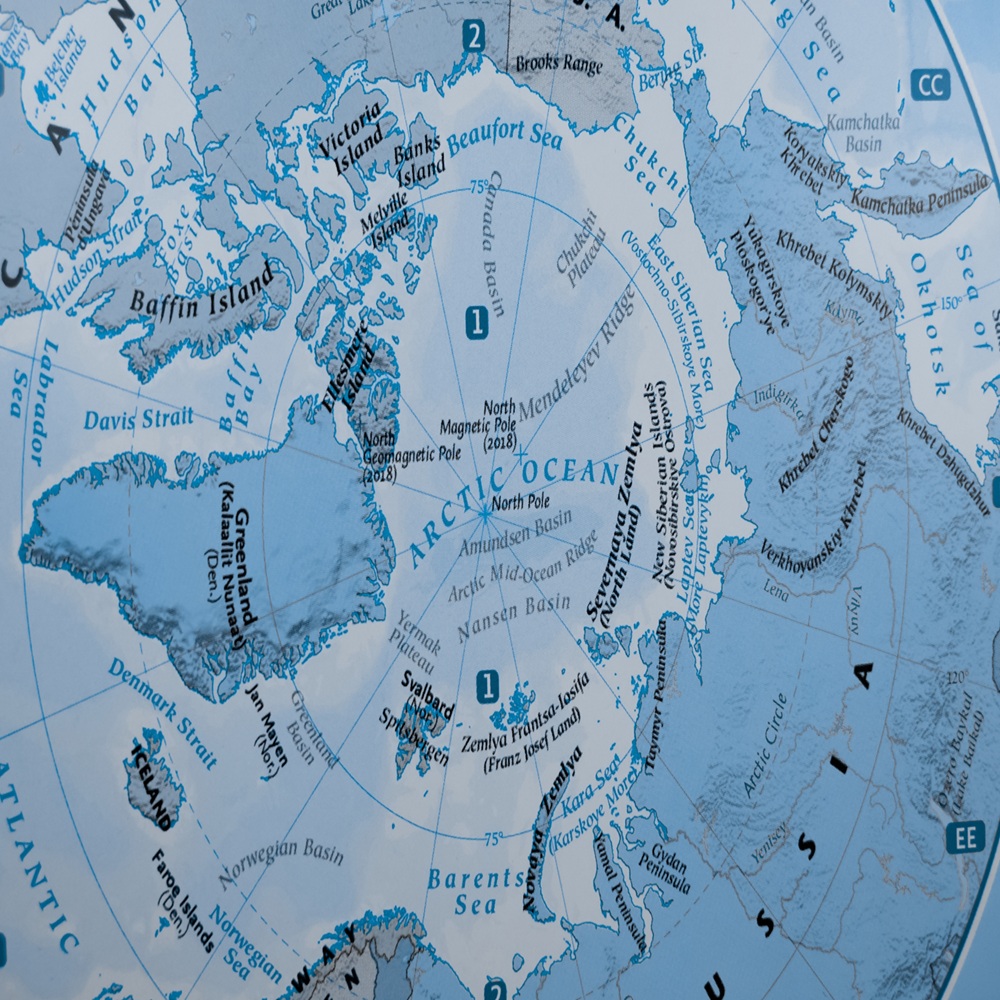
Map of Arctic Ocean styled in grey color. Selective focus on label, close-up view

Greenland at the Center of the Arctic Power: US NSS 2025, NATO Cohesion, and the New Geopolitics of the High North.

by World & New World Journal

In the chilling expanse of the Arctic, where ice and ocean frame the edges of the known world, a geopolitical drama has quietly gathered momentum. The world’s strategic gaze is no longer fixed solely on the traditional theatres of diplomacy in Europe, the Middle East, or the Indo-Pacific. Instead, the High North — and particularly Greenland, the vast Arctic territory within the Kingdom of Denmark — has emerged as a critical arena where great-power competition, national security priorities, global trade dynamics, and climate change converge. This transformation did not occur overnight. For decades, military planners, geographers, and strategic thinkers recognized the Arctic’s latent importance. Yet only in recent years have those projections translated into urgent geopolitical reality. At the center of this shift stands the United States’ National Security Strategy 2025 (NSS 2025), unveiled in late 2025, which redefines American priorities in a world shaped by renewed great-power rivalry. While the strategy addresses multiple global theatres, its emphasis on territorial security, critical resources, strategic geography, and adversarial competition underscores why Greenland has moved from the periphery to the heart of international geopolitics. Greenland today sits at the intersection of U.S. homeland defense, NATO cohesion, Arctic militarization, global trade transformation, and the accelerating race for critical minerals. The tensions surrounding the island reveal not only disputes among allies but also deeper structural changes in the international system. This article argues that Greenland is no longer a remote outpost but a strategic fulcrum of the Arctic, whose future will shape the balance of power in the High North and beyond. America’s Strategic Recalibration in the 2025 National Security Strategy The NSS 2025 marks a clear departure from post-Cold War doctrines centered on expansive multilateralism and global institution-building. Instead, it reflects a return to strategic realism, prioritizing the protection of core national interests, territorial security, and the prevention of adversarial dominance in critical regions. The strategy defines the United States’ primary objective as “the continued survival and safety of the United States as an independent, sovereign republic,” coupled with maintaining decisive military, technological, and economic power. Although the Indo-Pacific remains central, the strategy elevates the Western Hemisphere and adjacent strategic regions, emphasizing the need to prevent hostile encroachment on areas vital to U.S. security and economic resilience. Supply chains, critical minerals, missile defense, and strategic geography feature prominently throughout the document. Within this framework, Greenland has transitioned from a peripheral Arctic territory to a linchpin of U.S. strategic defense and resource security. While the NSS does not outline a standalone Arctic doctrine, its underlying logic — securing access to essential materials, protecting strategic approaches to the homeland, and denying adversaries positional advantages — aligns directly with the intensifying focus on Greenland. Latest developments: US position over Greenland. As already mentioned, the release of the NSS 2025 made one thing clear: US foreign policy is now defined by an assertive approach towards the entire Western Hemisphere – where Greenland is part of –. Moreover, this implies that the US might claim the right to intervene in other countries’ domestic affairs in order to guarantee its strategic and corporate interests. Therefore, after Venezuela – in addition to its rhetoric towards Cuba and Mexico – Greenland has become a hot topic, due its geopolitical, economical and strategical position and of course as part of the US “national security” and interest. The interest from the US over Greenland is not new, during Trump’s first administration an attempt to buy Greenland occurred and even at the beginning of his second administration there were comments to obtain the island. Next are presented the developments that occurred until January 22nd: - The US-Greenland-NATO crisis escalated when Trump’s desire to have Greenland either “by hook or by crook” sparked the global debate, while Europeans, Greenlanders and Danish rejected his ideas and showed support for Greenland and the Kingdom of Denmark itself. - A later diplomatic meeting between Danish, Greenlandic and US officials in Washington ended up in a “fundamental disagreement” over the sovereignty of the island on January 14th. - A joint statement of several European countries supporting the idea that “Greenland belongs to its people, and only Denmark and Greenland can decide on matters concerning their relations” was released on January 18th. - Launch of “Operation Arctic Endurance” and the initial deployment of a small number of troops from the European allies plus Danish soldiers. By January 18th there were over 100 troops in Nuuk and another 100 in Kangerlussuaq. (numbers could be increased in a short time). - Worries within Europe and the NATO allies. In addition, China urged the US to stop using the so-called “China threat” as a pretext for pursuing its own interest. - General concern for Greenlanders and several protest in Denmark, and Greenland against the US actions. - The imposition of 10% tariffs from the US over Denmark, Norway, Sweden, France, Germany, Finland, the UK and the Netherlands that would increase by 25% on June 1st if there is no deal reached. After Trump’s speech in the World Economic Forum, he confirmed that tariffs threats were off the table as there was a “framework of a future deal” for Greenland. In summary, in January 2026, Washington’s posture toward Greenland has sharpened into a high-profile mix of strategic urgency and political brinkmanship, framed publicly as an Arctic and homeland-security imperative. Recent reporting describes President Donald Trump repeatedly arguing the U.S. “needs” Greenland for security, while also signaling limits on how far he would go — saying at the World Economic Forum in Davos that he would not use military force to acquire it. At the same time, the episode has clearly strained allied politics: coverage indicates Denmark has insisted Greenland’s sovereignty is not negotiable even as the U.S. debate escalated, and Greenland’s own authorities have taken the moment seriously enough to urge practical preparedness at home. The most concrete “near-term” direction emerging in January 2026 is not annexation but a NATO – and alliance-linked security bargain. Multiple outlets report Trump backing away from threatened tariffs after announcing a “framework” tied to future Arctic security cooperation with NATO leadership — suggesting the administration is trying to convert its Greenland pressure campaign into expanded defense access, posture, or burden-sharing rather than an immediate territorial transfer. Even where details remain vague, the logic is consistent: Greenland’s geography — especially its role in Arctic air/sea lanes and missile-warning architecture — makes it a leverage point for U.S. deterrence and homeland defense planning, and U.S. officials appear to be testing what they can gain diplomatically inside the alliance system when outright sovereignty change is off the table. This posture also lines up with the 2025 National Security Strategy (NSS), which elevates the Western Hemisphere as the top priority region and argues the U.S. will “deny non-Hemispheric competitors” the ability to “own or control strategically vital assets” in the hemisphere, while calling for readjusting military presence and “establishing or expanding access in strategically important locations.” While the NSS text excerpt does not name Greenland in the lines above, its framework — reasserting hemispheric primacy, blocking external footholds, and expanding access — maps neatly onto a Greenland approach that treats the island as a critical node in Arctic security competition and infrastructure control. European Parliament analysis likewise characterizes the NSS as a “pivot” toward a Monroe Doctrine–style sphere-of-interest logic in the Western Hemisphere, reinforcing the idea that Greenland is being handled less as a narrow Denmark dispute and more as part of a broader hemispheric strategy. Greenland’s Geographic Centrality: The broader US security interest of the Island. Figure 1: Arctic states, counties and other administrative regions with capitals. Source: Map by Arto Vitikka, Arctic Centre, University of Lapland. Credit for the border data: Runfola, D. et al. (2020) geoBoundaries: A global database of political administrative boundaries. PLoS ONE 15(4): e0231866. https://doi.org/10.1371/journal.pone.0231866e. Figure 2: Arctic Population Centers. Map by Arto Vitikka, Arctic Centre, University of Lapland. When viewed from a polar perspective, the Arctic is not a distant fringe but the shortest connective space between North America, Europe, and Eurasia. The Arctic as seen in Figure 1 is composed of several administrative areas, including Canada, Alaska (USA), Russia, Norway, Sweden, Finland, Iceland and Greenland (Denmark). The latter can be said to be located at the center between North America and Europe and Eurasia, underscoring its geopolitical importance. In other words, Greenland occupies the central Atlantic–Arctic axis, the shortest air and missile trajectories between Russia and North America and a pivotal position between the Canadian Arctic Archipelago and the Russian Arctic coast. This geography carries deep strategic implications. First, Greenland is part of the so-called GIUK (Greenland-Iceland-UK) Gap, a crucial corridor for monitoring naval and air activity in the North Atlantic. The GIUK Gap played an important role during the Second World War and the Cold War and nowadays it has become crucial in securing air and sea surveillance through radar stations, while securing the sea lines of communication (SLOCs) as well as supply lines making them uninterrupted between NATO’s European members and the USA. The GIUK Gap can assist in ensuring maritime visibility and assist anti-submarine warfare (ASW) in case of conflicts. The presence of Russian submarines in the Arctic is a central pillar of Russia’s military strategy and nuclear deterrence, making the region one of the most militarized maritime spaces in the world. Russia views the Arctic as both a strategic sanctuary and a launch platform. In consequence, its Northern Fleet – headquartered on the Kola Peninsula –, is the most powerful of Russia’s fleets and operates a large share of its nuclear-powered ballistic missile submarines (SSBNs), such as the Borei and Delta IV classes. These submarines carry submarine-launched ballistic missiles (SLBMs) and are designed to remain hidden under Arctic ice, ensuring a second-strike capability in the event of a nuclear conflict. The ice cover, combined with Russia’s familiarity with Arctic waters, provides concealment and operational depth. In addition to SSBNs, Russia deploys nuclear-powered attack submarines (SSNs) and guided-missile submarines (SSGNs) in the Arctic. These vessels conduct intelligence gathering, protect ballistic missile submarines, and pose threats to NATO naval forces and undersea infrastructure, including communication cables. Russian submarines regularly transit through key chokepoints such as the GIUK Gap, bringing them into strategic relevance for Greenland, Iceland, and NATO’s anti-submarine warfare (ASW) posture. In addition, the Arctic also supports Russia’s broader bastion defense concept, which seeks to create heavily defended maritime zones where submarines can operate safely. Air defenses, surface ships, icebreakers, and coastal missile systems complement submarine operations. As climate change reduces sea ice and increases accessibility, Russian submarine activity in the Arctic is expected to remain intense, reinforcing the region’s importance for NATO surveillance, early warning systems, and transatlantic security — especially for locations like Greenland that sit astride critical Arctic–Atlantic routes. Second, Greenland’s high latitude makes it an ideal place for early detection of long-range missile launches. Russia has long-range intercontinental ballistic missiles (ICBMs), if ever launched from Russia toward the United States, the total flight time would be roughly between 25 to 35 minutes – depending on the launch location and target. But because of the Earth’s curvature, the shortest path from Russia to the continental US goes over the Arctic which is why Greenland is so strategically important for early detection and missile defense. In practical terms, US decision-makers would have only minutes to assess the threat and respond after a launch is detected. Establishments such as the U.S. Pituffik Space Base underscore how Greenland functions as a first line of surveillance against possible ballistic missile threats from the Eurasian landmass. Therefore, Greenland is indispensable to early-warning and missile-defense systems. Sensors, radars, and space-tracking infrastructure based on the island form a crucial layer of “U.S. homeland defense”. Finally, Greenland is the only large Arctic landmass under Western democratic control outside Eurasia. Russia dominates the Eurasian Arctic coastline, while Alaska and Canada anchor North America. Greenland bridges these spaces, serving as a keystone for transatlantic Arctic security. Its isolation does not diminish its importance; rather, it magnifies it. – making Greenland a linchpin of US homeland defense and NATO’s northern security architecture. Greenland and NATO: The Fragile Architecture of Arctic Security Figure 3: NATO’s and Russia’s militarization in the Arctic. Figure 3 exposes a stark asymmetry in the Arctic militarization between NATO and Russian. The latter maintains a dense, continuous network of military bases stretching from the Kola Peninsula to the Bering Strait. These installations support air defense, naval operations, missile forces, and surveillance — forming an integrated arc of control along Russia’s northern frontier. On the other hand, NATO’s Arctic posture is fundamentally different. It relies on discrete strategic nodes rather than territorial saturation, interoperability over mass and coordination among multiple sovereign states. Within this fragmented architecture, Greenland is NATO’s most critical node. Nonetheless, the US has presence in Greenland, specifically with the Pituffik Space Base (formerly Thule Air Base), which is located in northwest Greenland. This base – as mentioned before – is indispensable for early missile warning, space surveillance and tracking adversary launches across the polar region. While the UK has presence in Norway in the logistic Camp Viking site. Without Greenland, NATO’s Arctic posture would fracture into disconnected segments — North America on one side, Scandinavia on the other — with no central anchor. This reality explains the sharp European response in 2025–2026 to U.S. rhetoric suggesting unilateral action or coercive pressure regarding Greenland. The deployment of European troops under Operation Arctic Endurance was not merely symbolic; it was an assertion that Greenland is a collective NATO concern, not a bilateral bargaining chip. Greenland’s Resources: Strategic Minerals in a Fragmenting World Beyond military geography, Greenland’s subsoil wealth significantly enhances its geopolitical importance. The island holds substantial deposits of rare earth elements (REEs), lithium, graphite, niobium, titanium, uranium and zinc. As it is well known these strategic materials are indispensable and critical for renewable energy systems, electric vehicles, advanced electronics, missile guidance and radar technologies and space and defense infrastructure. Last but not least there is also oil and gas, but the conditions and viability to extract them make them an economic challenge. In the context of the control of natural resources, the NSS 2025 repeatedly stresses the need to reduce U.S. dependence on adversarial supply chains — an implicit reference to China’s dominance in rare-earth processing. Therefore, US eyes are on Greenland, as it represents one of the few politically aligned alternatives with large-scale potential reserves – ironically not under Chinese or Russian influence, but under US “allies” control. Yet resource abundance does not automatically translate into strategic advantage. Mining in Greenland faces severe challenges: extreme climate conditions, environmental risks, limited infrastructure, and strong local opposition to environmentally destructive projects. As a result, Greenland’s mineral wealth is strategically valuable but politically sensitive. Its development requires local consent and long-term cooperation, not coercion — a fact often overlooked in external strategic calculations. The Arctic Trade Revolution: Melting Ice, Shifting Routes Figure 4: Arctic Seaways (Northern Sea Route, Northwest Passage and Transpolar Sea Route). Source: Map by Arto Vitikka, Arctic Centre, University of Lapland. Climate change is transforming the Arctic faster than any other region on Earth. As sea ice recedes, new maritime routes are becoming seasonally viable, with potentially transformative consequences for global trade. The Northern Sea Route (NSR) along Russia’s Arctic coast already reduces transit times between Europe and Asia by up to 40%, even though some parts are free of ice for some months per year. On the other hand, a future transpolar route, cutting directly across the Arctic Ocean, could bypass traditional chokepoints such as: The Suez Canal, The Panama Canal or The Strait of Malacca. Therefore, Greenland importance relies on its geographic position that places it adjacent to these emerging corridors. Potential roles for the island include: the search-and-rescue hubs, refueling and logistics points, maritime surveillance and communications infrastructure. This elevates Greenland from a military asset to a potential gatekeeper of future Arctic trade, linking regional security directly to global economic flows. Icebreakers and Power Projection: Mobility as Sovereignty Figure 5: Major Icebreakers and Ice-Capable Patrol Ships highlight a decisive but underappreciated imbalance. Source: generated with Chat GPT using Routers Nov 2022 data. The transit in the Arctic can be defined by the possibility to move freely without any inconvenience due its extreme conditions – or at least with the least inconveniences. In consequence major ice breakers and ice-capable patrol ships became very important assets for the countries in the region. In a simple comparison, Russia possesses more icebreakers than NATO combined, as shown in Figure 5, including nuclear-powered vessels capable of year-round Arctic operations. These ships are instruments of sovereignty, enabling continuous military presence, escort of commercial shipping, enforcement of Arctic regulations and rapid crisis responses. By contrast, the United States has long underinvested in icebreaking capacity. NATO relies on a patchwork of national fleets, with Finland and Sweden contributing significantly but still lagging behind Russia’s scale. The strategic implication is clear: Russia controls mobility while NATO controls nodes. In such an environment, fixed strategic anchors like Greenland become even more critical. Competing Arctic Visions Russia Russia views the Arctic as a core strategic and economic priority, central to its national identity, security, and long-term development. Its Arctic vision emphasizes sovereignty, military security, and the exploitation of vast natural resources, particularly hydrocarbons and minerals. Moscow sees the Northern Sea Route as a critical shipping corridor that can enhance Russia’s control over Arctic navigation and generate economic revenues. To support this vision, Russia has invested heavily in Arctic infrastructure, icebreaker fleets, and military modernization, positioning itself as the dominant Arctic power and framing the region as vital to its great-power status. The Arctic is not an extension of Russian power; it is central to it. Figure 6: Cargo volume in Russia’s Northern Sea Route (1933-2023) China China approaches the Arctic as a “near-Arctic state,” framing its vision around scientific research, economic opportunity, and global governance. Beijing emphasizes participation in Arctic affairs through international law, particularly the UN Convention on the Law of the Sea, and promotes cooperation rather than territorial claims. Its strategy emphasizes long-term access to resources, influence over Arctic governance norms, and participation in future trade routes. Its concept of a “Polar Silk Road” reflects an interest in future shipping routes, energy projects, and digital connectivity, linking the Arctic to China’s broader Belt and Road Initiative. Even though China presents its Arctic engagement as peaceful and mutually beneficial, while gradually expanding its strategic and economic footprint in the region, it also has interest in Greenland’s mining sector, for example, which has heightened concerns about strategic leverage rather than direct control. Figure 7: Map of China’s Polar Silk Road. Source: Map by Arto Vitikka, Arctic Centre, University of Lapland. United States The U.S. approach, as reflected in the NSS 2025, is reactive but intensifying. Greenland crystallizes American concerns about strategic vulnerability, supply-chain dependence, and alliance credibility. Yet pressure tactics risk undermining the very alliances that make Arctic stability possible. The United States views the Arctic as an increasingly important region for national security, environmental stewardship, and economic opportunities. At the same time, it recognizes the strategic implications of growing Russian and Chinese activity in the region. Arctic States The European Arctic states emphasize sustainability, human security, and regional cooperation as the foundation of their Arctic vision. Their policies prioritize environmental protection, responsible resource management, and the rights and livelihoods of Indigenous peoples, while balancing economic development in sectors such as fisheries, renewable energy, and limited resource extraction. These states strongly support multilateral governance through institutions like the Arctic Council and stress adherence to international law. Collectively, they view the Arctic as a region where stability, cooperation, and climate leadership are essential, especially amid rising geopolitical tensions and accelerating environmental change. Canada Canada’s Arctic vision centers on sovereignty, Indigenous partnership, and sustainable development, reflecting the region’s importance to national identity and security. Ottawa emphasizes the protection of its northern territories and views the Northwest Passage as internal waters, while supporting a rules-based Arctic order. A core pillar of Canada’s approach is its collaboration with Indigenous peoples, recognizing their rights, knowledge, and role in governance and stewardship. Canada also prioritizes climate change adaptation, environmental protection, and responsible economic development, seeking to ensure that increased Arctic activity benefits northern communities while maintaining peace and stability in the region. India India’s Arctic vision is primarily science-driven and climate-focused, reflecting its broader emphasis on environmental security and multilateral cooperation. Through its Arctic research station, Himadri, and active participation in the Arctic Council as an observer, India seeks to understand the Arctic’s impact on global climate systems, particularly the Indian monsoon. New Delhi also recognizes the long-term economic and geopolitical significance of the Arctic but approaches the region cautiously, prioritizing sustainable development, international collaboration, and respect for Arctic states’ sovereignty. Strategic Futures: Cooperation or Fragmentation The future of Greenland and the Arctic more broadly will hinge on whether the region evolves toward structured cooperation or strategic fragmentation. In a cooperative scenario, Greenland becomes a stabilizing anchor within a renewed Arctic security framework, where the United States, Denmark, and NATO align their defense priorities with Greenlandic self-determination and environmental safeguards. Such an approach would emphasize multilateral governance, transparency in resource development, confidence-building military measures, and shared investment in infrastructure, search-and-rescue capabilities, and climate resilience. Cooperation would not eliminate competition, particularly with Russia and China, but it would establish rules, norms, and mechanisms to prevent escalation and miscalculation in an increasingly accessible Arctic. By contrast, a fragmented Arctic would be characterized by unilateral actions, coercive diplomacy, and the erosion of trust among allies. Pressure tactics aimed at securing access, influence, or control over Greenland could weaken NATO cohesion, fuel local resistance, and open political space for external actors to exploit divisions. In such a scenario, the Arctic risks becoming a patchwork of contested zones rather than a managed strategic commons. Therefore, fragmentation would increase the likelihood of militarization without coordination, resource development without legitimacy, and crisis dynamics without effective communication channels — conditions that historically precede instability rather than security. Conclusion Greenland’s transformation from a remote Arctic territory into a strategic fulcrum reflects deeper shifts in the international system. The United States’ National Security Strategy 2025 captures a world defined by renewed great-power rivalry, supply-chain vulnerability, and the reassertion of geography as destiny. In this context, Greenland sits at the intersection of homeland defense, NATO credibility, critical resource security, and emerging Arctic trade routes. Its importance is not a product of any single factor, but of the convergence of military, economic, and environmental dynamics reshaping the High North. Yet Greenland’s strategic value does not grant external powers unlimited leverage. Geography may confer importance, but legitimacy, consent, and alliance cohesion determine whether that importance translates into durable influence. Attempts to treat Greenland as a transactional asset risk undermining NATO unity, destabilizing Arctic governance, and alienating the very population whose cooperation is essential for security and development. The Arctic’s future must not be decided solely by military deployments or mineral deposits, but by the political relationships that sustain them. Ultimately, Greenland illustrates the central paradox of the new Arctic geopolitics: the region’s growing accessibility increases both opportunity and risk. Stability will depend not on dominance, but on restraint, not on unilateralism, but on partnership. Whether the Arctic becomes a zone of managed competition or strategic fragmentation will shape not only the balance of power in the High North, but the credibility of international order adapting to a rapidly changing world. Also, it is important to highlight Greenland’s voice – referring to sovereignty and identity. Usually under great-power maneuvering, Greenland’s own population has often been sidelined. Yet Greenland is not merely an object of strategy; it is a political community with a strong Indigenous identity, environmental concerns, and aspirations for greater autonomy. Therefore, it is important to keep in mind its constitutional status within the Kingdom of Denmark, their principle of self-determination and the political costs of alienating local consent. Paradoxically, the more external powers push, the more Greenlandic society resists — complicating both security arrangements and resource development. Finally, the Arctic is not only Greenland, the US or the NATO, there are other authors involved, Russia for instance appears as the main one, while, China and India are increasing their interests in the region Moreover, climate change seems to be game changer as new Arctic seaways gain importance in terms of trade and mobility, which in consequence are and will redefine sovereignty. For instance, either icebreakers or minerals would become as strategic as missiles. The Arctic transformation is already happening, and who will lead and what will happen in the region in the future are questions to be solved in the near future. References Agneman, G. (2025, February 04). Trump wants Greenland – but here’s what the people of Greenland want. Retrieved from The Conversation: https://theconversation.com/trump-wants-greenland-but-heres-what-the-people-of-greenland-want-248745 Aljazeera. (2026, January 15). European troops arrive in Greenland as talks with US hit wall over future. Retrieved from Aljazeera: https://www.aljazeera.com/news/2026/1/15/european-troops-arrive-in-greenland-as-talks-with-us-hit-wall-over-future Aljazeera. (2026, January 18). Trump announces new tariffs over Greenland: How have allies responded? Retrieved from Aljazeera: https://www.aljazeera.com/news/2026/1/18/trump-announces-new-tariffs-over-greenland-how-have-eu-allies-responded Arctic Centre University of Lapland. (n.d.). Arctic Region. Retrieved from https://arcticcentre.org/en/arctic-region/maps/polar-silk-road/ Bassets, M. (2026, Enero 11). “Por las buenas o por las malas”: así puede Trump conquistar Groenlandia. Retrieved from El País: https://elpais.com/internacional/2026-01-10/por-las-buenas-o-por-las-malas-asi-puede-trump-conquistar-groenlandia.html Bateman, T. (2026, January 14). Danish minister says 'fundamental disagreement' remains after 'frank' Greenland talks with US. Retrieved from BBC: https://www.bbc.com/news/live/cn824zzp670t BBC News. (2026, January 21). Trump drops threat of tariffs over Greenland after Nato talks in Davos. Retrieved from BBC News: https://www.bbc.com/news/live/cjrzjqg8dlwt Bierman, P. (2025, February 19). Greenland’s melting ice and landslide-prone fjords make the oil and minerals Trump is eyeing dangerous to extract. Retrieved from The Conversation: https://theconversation.com/greenlands-melting-ice-and-landslide-prone-fjords-make-the-oil-and-minerals-trump-is-eyeing-dangerous-to-extract-249985 Bierman, P. (2025, February 19). Greenland’s melting ice and landslide-prone fjords make the oil and minerals Trump is eyeing dangerous to extract. Retrieved from The Conversation: https://theconversation.com/greenlands-melting-ice-and-landslide-prone-fjords-make-the-oil-and-minerals-trump-is-eyeing-dangerous-to-extract-249985 Bierman, P. (2026, January 14). US military has a long history in Greenland, from mining during WWII to a nuclear-powered Army base built into the ice. Retrieved from The Conversatiion: https://theconversation.com/us-military-has-a-long-history-in-greenland-from-mining-during-wwii-to-a-nuclear-powered-army-base-built-into-the-ice-273355 Bonsoms, J. (2025, Dececmber 16). ‘Extreme melting’ episodes are accelerating ice loss in the Arctic. Retrieved from The Conversation: https://theconversation.com/extreme-melting-episodes-are-accelerating-ice-loss-in-the-arctic-272114 Brincat, S. (2026, January 18). Trump has threatened European countries with higher tariffs if he doesn’t get Greenland. Will it work? Retrieved from The Conversation: https://theconversation.com/trump-has-threatened-european-countries-with-higher-tariffs-if-he-doesnt-get-greenland-will-it-work-273698 Brincat, S., & Naranjo Cáceres, J. Z. (2026, January 07). Trump wants Greenland. Europe’s tepid response is putting NATO and global security at risk. Retrieved from The Conversation: https://theconversation.com/trump-wants-greenland-europes-tepid-response-is-putting-nato-and-global-security-at-risk-272819 Brooks, J. (2026, January 20). Pro-Greenland protesters mock Trump’s MAGA slogan with ‘Make America Go Away’ caps. Retrieved from AP: https://apnews.com/article/denmark-greenland-maga-trump-protest-cd1213dd73e9ea1e4da43285704c95ea Bryant, M., & Sabbagh, D. (2026, January 15). Greenland's defence is 'common concern' for Nato, Danish PM says as European troops fly in. Retrieved from The Guardian: https://www.theguardian.com/world/2026/jan/15/greenland-defence-nato-denmark-prime-minister-european-troops Burrows, E., Ciobanu, C., & Niemann, D. (2026, January 16). European troops arrive in Greenland as talks with US highlight 'disagreement' over island's future. Retrieved from AP: https://apnews.com/article/greenland-united-states-denmark-trump-vance-rubio-meeting-b10f5151008f1f18a788dc0751473c0e CNN. (2026, January 21). Trump says he’s formed a ‘framework of a future deal’ on Greenland. Retrieved from CNN: https://edition.cnn.com/politics/live-news/trump-administration-news-01-21-26 Davies, M. (2026, January 19). Starmer holds phone call with Trump over Greenland tariff threat. Retrieved from BBC: https://www.bbc.com/news/articles/cwyn90l1dneo Dodds, K. (2026, January 09). As the Arctic warms up, the race to control the region is growing ever hotter. Retrieved from The Conversation: https://theconversation.com/as-the-arctic-warms-up-the-race-to-control-the-region-is-growing-ever-hotter-273118 Dunbar, M. (2026, January 18). Trump's calls to seize Greenland ignite fresh criticism from Republican party. Retrieved from The Guardian: https://www.theguardian.com/us-news/2026/jan/18/trump-greenland-republican-party FitzGerald, J. (2026, January 19). Why does Trump want Greenland and what could it mean for Nato? Retrieved from BBC: https://www.bbc.com/news/articles/c74x4m71pmjo Fleck, A. (2025, January 24). NATO’s and Russia’s Militarization of the Arctic. Retrieved from statista: https://www.statista.com/chart/33824/military-bases-in-the-arctic-belonging-to-nato-and-russia/?srsltid=AfmBOoqwc5PmGe6_JB6mYjQSP9pr9fIZE_LcEtMOo_rtnCD86zMcQpwn Gjedssø Bertelsen, R. (2025). Divided Arctic in a Divided World Order. Strategic Analysis, 48(Issue 6: Changing Dynamics in the Arctic: Actors and Alliances), 568-577. doi:https://doi.org/10.1080/09700161.2025.2453322 Government Offices of Sweden. (2026, January 18). Statement by Denmark, Finland, France, Germany, the Netherlands, Norway, Sweden and the United Kingdom. Retrieved from Government Offices of Sweden: https://www.government.se/statements/2026/01/statement-by-denmark-finland-france-germany-the-netherlands-norway-sweden-and-the-united-kingdom/ Grillo, F. (2026, January 08). As the US eyes Greenland, Europe must turn a global problem into an opportunity. Retrieved from The Conversation: https://theconversation.com/as-the-us-eyes-greenland-europe-must-turn-a-global-problem-into-an-opportunity-272872 Gupta, P. (2024, September 18). Understanding the potential of the Northern Sea Route. Retrieved from ORF: https://www.orfonline.org/expert-speak/understanding-the-potential-of-the-northern-sea-route Harvey, L. (2026, January 16). European nations send additional troops to Greenland as US annexation threats escalate. Retrieved from CNN: https://edition.cnn.com/2026/01/15/world/europe-troops-greenland-trump-nato-intl-hnk Hastings Dunn MBE, D., Webber, M., & Wolff, S. (2026, January 07). US action against Greenland would undermine Nato, but now is not the time to panic. Retrieved from The Conversation: https://theconversation.com/us-action-against-greenland-would-undermine-nato-but-now-is-not-the-time-to-panic-272911 Holland, S., Mason, J., & Erickson, B. (2026, January 07). Trump discussing how to acquire Greenland, US military always an option, White House says. Retrieved from Reuters: https://www.reuters.com/world/trump-advisers-discussing-options-acquiring-greenland-us-military-is-always-an-2026-01-06/ huaxia. (2026, January 19). China urges U.S. to stop using so-called "China threat" as pretext for pursuing selfish gains. Retrieved from Xinhua: https://english.news.cn/20260119/57899ee8d43345ddbfa222828ec1d0a4/c.html Jakes, L., Tankersley, J., & Kanno-Youngs, Z. (2026, January 22). Trump Touts Greenland Framework as NATO Mulls U.S. Sovereignty Over Bases. Retrieved from The New York Times: https://www.nytimes.com/live/2026/01/21/us/trump-davos-greenland-news Karjee, M. (2025, August 20). Russia’s Arctic Corridor: Between Ice and Isolation. Retrieved from E-International Relations: https://www.e-ir.info/2025/08/20/russias-arctic-corridor-between-ice-and-isolation/ Katila, A. (2026, January 15). As US and Denmark fight, Greenland’s voices are being excluded once again. Retrieved from The Conversation: https://theconversation.com/as-us-and-denmark-fight-greenlands-voices-are-being-excluded-once-again-273131 Kennedy-Pipe, C. (2026, January 14). Whether or not US acquires Greenland, the island will be at the centre of a massive military build-up in the Arctic. Retrieved from The Conversation: https://theconversation.com/whether-or-not-us-acquires-greenland-the-island-will-be-at-the-centre-of-a-massive-military-build-up-in-the-arctic-273301 Khanna, M. (2025, March 19). China and the Arctic: An Overview. Retrieved from ORF: https://www.orfonline.org/research/china-and-the-arctic-an-overview Kirby, P. (2026, January 16). European military personnel arrive in Greenland as Trump says US needs island. Retrieved from BBC: https://www.bbc.com/news/articles/cd0ydjvxpejo Kotak, S. (2025, September 08). Leveraging India’s Arctic Observer Status: Scientific Diplomacy as a Lever for Climate, Resource and Security Advancement. Retrieved from World & New World Journal: https://worldandnewworld.com/india-arctic-observer-status/ Kottasová, I., & Edwards, C. (2026, Enero 19). Trump le dice a Noruega que ya no se siente obligado a "pensar únicamente en la paz" en carta sobre el Nobel y Groenlandia. Retrieved from CNN Español: https://cnnespanol.cnn.com/2026/01/19/eeuu/trump-paz-noruega-nobel-reux Kumar, A., & Haldar, S. (2024, October 2024). An evolving partnership in the Arctic between China and Russia. Retrieved from ORF: https://www.orfonline.org/expert-speak/an-evolving-partnership-in-the-arctic-between-china-and-russia L. Montgomery, S. (2026, January 14). 4 reasons why the US might want to buy Greenland – if it were for sale, which it isn’t. Retrieved from The Conversation: https://theconversation.com/4-reasons-why-the-us-might-want-to-buy-greenland-if-it-were-for-sale-which-it-isnt-246955 Lebowitz, M. (2026, January 18). Treasury secretary defends Greenland tariffs: 'The national emergency is avoiding the national emergency'. Retrieved from NBC News: https://www.nbcnews.com/politics/trump-administration/treasury-secretary-bessent-tariffs-national-emergency-greenland-eu-rcna254650 Levison, J., & Russell, L. (2026, January 19). Why Trump says the US 'needs' Greenland - and what the fallout could be. Retrieved from Sky news: https://news.sky.com/story/why-trump-says-the-us-needs-greenland-and-what-the-fallout-could-be-13285350 Lubold, G., Kube, C., Williams, A., & Alba, M. (2026, January 14). Buying Greenland could cost as much as $700 billion. Retrieved from NBC News: https://www.nbcnews.com/politics/white-house/buying-greenland-cost-much-700-billion-rcna253921 Manners, I. (2026, January 09). Four ways to understand what’s going on with the US, Denmark and Greenland. Retrieved from The Conversation: https://theconversation.com/four-ways-to-understand-whats-going-on-with-the-us-denmark-and-greenland-272873 Nicholas, P., & Smith, A. (2026, January 20). Trump won't say whether he would use force to seize Greenland. Retrieved from NBC News: https://www.nbcnews.com/politics/trump-administration/trump-greenland-use-of-force-nobel-norway-europe-tariffs-ukraine-rcna254786 Passi, R. (2018, February 21). One belt, one road, and now one circle. Retrieved from ORF: https://www.orfonline.org/expert-speak/one-belt-one-road-and-now-one-circle Paul, J. (2026, January 08). Greenland is rich in natural resources – a geologist explains why. Retrieved from The Conversation: https://theconversation.com/greenland-is-rich-in-natural-resources-a-geologist-explains-why-273022 Reuters. (2021, July 16). Greenland ends unsuccessful 50-year bid to produce oil. Retrieved from Reuters: https://www.reuters.com/business/energy/greenland-puts-an-end-unsuccessful-oil-adventure-2021-07-16/#:~:text=Naaja%20Nathanielsen%2C%20Greenland's%20minister%20of,profits%20or%20make%20a%20loss Rønberg, N., Gjerding Nielson, E., & Haugaard, M. (2026, January 06). Kampen om Grønlands fremtid. Retrieved from Nyheder: https://nyheder.tv2.dk/live/2025-01-06-kampen-om-groenlands-fremtid/over-200-soldater-i-groenland-lige-nu?entry=c342b2d3-e01d-4f60-b1dc-8df98fdac85b Sergunin, A., & Konyshev, V. (2025, April 21). The Arctic Great Game: The Need for Cautious Optimism. Retrieved from ORF: https://www.orfonline.org/expert-speak/the-arctic-great-game-the-need-for-cautious-optimism Sheftalovich, Z., & Jack, V. (2026, January 07). How Trump gets Greenland in 4 easy steps. Retrieved from Politico: https://www.politico.eu/article/donald-trump-greenland-easy-steps-nato-policy-deal-military/ Shetty, K. (2023, June 06). The Northern Sea route: A gamechanger or a road to hegemony? Retrieved from ORF: https://www.orfonline.org/expert-speak/the-northern-sea-route Slothuus, L. (2026, January 12). Why Greenland’s vast natural resources won’t necessarily translate into huge profits. Retrieved from The Conversation: https://theconversation.com/why-greenlands-vast-natural-resources-wont-necessarily-translate-into-huge-profits-273137 Soufi Burridge, T., Gardiner, C., & Pereira, I. (2026, January 16). France, other NATO countries send troops to Greenland for exercises after meeting with Vance and Rubio. Retrieved from ABC News: https://abcnews.go.com/Politics/france-nato-countries-send-troops-greenland-exercises-after/story?id=129241103 Talmazan, Y. (2026, January 15). European troops arrive in Greenland as Trump throws another curveball. Retrieved from NBC News: https://www.nbcnews.com/world/greenland/european-troops-arrive-greenland-trump-throws-curveball-rcna254166 Tanno, S., & Waldenberg, S. (2026, Enero 10). Trump dice que Estados Unidos tomará Groenlandia "por las malas" sino puede hacerlo por las buenas. Retrieved from CNN Español: https://cnnespanol.cnn.com/2026/01/10/eeuu/trump-groenlandia-malas-trax Testoni, M. (2026, January 16). US-Greenland negotiations have hit a wall. Here are three ways the crisis could end. Retrieved from The Conversation: https://theconversation.com/us-greenland-negotiations-have-hit-a-wall-here-are-three-ways-the-crisis-could-end-273629 tg24. (2026, January 16). Groenlandia, scattata la missione "Arctic Endurance": cosa sapere. Retrieved from tg24: https://tg24.sky.it/mondo/2026/01/16/groenlandia-arctic-endurance-esercitazione-militare The White House. (2025, November). National Security Strategy of the United States of America. Retrieved from The White House: https://www.whitehouse.gov/wp-content/uploads/2025/12/2025-National-Security-Strategy.pdf
Defense & Security
Soldier in engineering role uses AI application on laptop to manage server hub systems. Army commander reviews secret intelligence information using artificial intelligence in data center, camera A

Dual-Use AI Technologies in Defense: Strategic Implications and Security Risks

by Mayukh Dey

Introduction Artificial intelligence has become a critical technology in the 21st century, with applications spanning healthcare, commerce, and scientific research. However, the same algorithms that enable medical diagnostics can guide autonomous weapons, and the same machine learning systems that power recommendation engines can identify military targets. This dual-use nature, where technologies developed for civilian purposes can be repurposed for military applications, has positioned AI as a central element in evolving global security dynamics. The strategic implications are substantial. China views AI as essential for military modernization, with the People's Liberation Army planning to deploy "algorithmic warfare" and "network-centric warfare" capabilities by 2030 (Department of Defense, 2024). Concurrently, military conflicts in Ukraine and Gaza have demonstrated the operational deployment of AI-driven targeting systems. As nations allocate significant resources to military AI development, a critical question emerges: whether the security benefits of dual-use AI technologies can be realized without generating severe humanitarian consequences. The Reversal Commercial Innovation Driving Military Modernization Historically, military research and development drove technological innovation, with civilian applications emerging as secondary benefits, a phenomenon termed "spin-off." The internet, GPS, and microwave ovens all originated in defense laboratories. This dynamic has reversed. Commercially developed technologies now increasingly "spin into" the defense sector, with militaries dependent on technologies initially developed for commercial markets. This reversal carries significant implications for global security. Unlike the Cold War era, when the United States and Soviet Union controlled nuclear weapons development through state programs, AI innovation occurs primarily in private sector companies, technology firms, and university research institutions. Organizations like DARPA influence global emerging technology development, with their projects often establishing benchmarks for research and development efforts worldwide (Defense Advanced Research Projects Agency, 2024). This diffusion of technological capacity complicates traditional arms control frameworks based on state-controlled military production. The scale of investment is considerable. The U.S. Department of Defense's unclassified AI investments increased from approximately $600 million in 2016 to about $1.8 billion in 2024, with more than 685 active AI projects underway (Defense One, 2024). China's spending may exceed this figure, though exact data remains unavailable due to the opacity of Chinese defense budgeting. Europe is pursuing comparable investments, with the EU committing €1.5 billion to defense-related research and development through initiatives like the European Defence Fund. Dual-Use Applications in Contemporary Warfare AI's military applications span the spectrum of warfare, from strategic planning to tactical execution. Current deployments include: Intelligence, Surveillance, and Reconnaissance (ISR): AI systems process large volumes of sensor data, satellite imagery, and signals intelligence to identify patterns beyond human analytical capacity. In 2024, "China's commercial and academic AI sectors made progress on large language models (LLMs) and LLM-based reasoning models, which has narrowed the performance gap between China's models and the U.S. models currently leading the field," enabling more sophisticated intelligence analysis (Department of Defense, 2024). Autonomous Weapons Systems: Autonomous weapons can identify, track, and engage targets with minimal human oversight. In the Russia-Ukraine war, drones now account for approximately 70-80% of battlefield casualties (Center for Strategic and International Studies, 2025). Ukrainian officials predicted that AI-operated first person view drones could achieve hit rates of around 80%, compared to 30-50% for manually piloted systems (Reuters, 2024). Predictive Maintenance and Logistics: The U.S. Air Force employs AI in its Condition-Based Maintenance Plus program for F-35 fighters, analyzing sensor data to predict system failures before occurrence, reducing downtime and operational costs. Command and Control: AI assists military commanders in processing battlefield information and evaluating options at speeds exceeding human capacity. Project Convergence integrates AI, advanced networking, sensors, and automation across all warfare domains (land, air, sea, cyber, and space) to enable synchronized, real-time decision-making. Cyber Operations: AI powers both offensive and defensive cyber capabilities, from automated vulnerability discovery to malware detection and sophisticated social engineering campaigns. Gaza and Ukraine: AI in Contemporary Conflict Recent conflicts have provided operational demonstrations of AI's military applications and associated humanitarian costs. Israel's Lavender system reportedly identified up to 37,000 potential Hamas-linked targets, with sources claiming error rates near 10 percent (972 Magazine, 2024). An Israeli intelligence officer stated that "the IDF bombed targets in homes without hesitation, as a first option. It's much easier to bomb a family's home" (972 Magazine, 2024). The system accelerated airstrikes but also contributed to civilian casualties, raising questions about algorithmic accountability. The system's design involved explicit tradeoffs: prioritizing speed and scale over accuracy. According to sources interviewed by 972 Magazine, the army authorized the killing of up to 15 or 20 civilians for every junior Hamas operative that Lavender marked, while in some cases more than 100 civilians were authorized to be killed to assassinate a single senior commander (972 Magazine, 2024). Foundation models trained on commercial data lack the reasoning capacity humans possess, yet when applied to military targeting, false positives result in civilian deaths. Data sourced from WhatsApp metadata, Google Photos, and other commercial platforms created targeting profiles based on patterns that may not correspond to combatant status. Ukraine has implemented different approaches, using AI to coordinate drone swarms and enhance defensive capabilities against a numerically superior adversary. Ukrainian Deputy Defense Minister Kateryna Chernohorenko stated that "there are currently several dozen solutions on the market from Ukrainian manufacturers" for AI-augmented drone systems being delivered to armed forces (Reuters, 2024). Ukraine produced approximately 2 million drones in 2024, with AI-enabled systems achieving engagement success rates of 70 to 80 percent compared to 10 to 20 percent for manually controlled drones (Center for Strategic and International Studies, 2025). Both sides in the conflict have developed AI-powered targeting systems, creating operational arms race dynamics with immediate battlefield consequences. Civilian Harm: Technical and Legal Limitarions The integration of AI into lethal military systems raises humanitarian concerns extending beyond technical reliability. AI's inability to uphold the principle of distinction, which requires protecting civilians by distinguishing them from combatants in compliance with international humanitarian law, presents fundamental challenges. Current AI systems lack several capabilities essential for legal warfare:  Contextual Understanding: AI cannot comprehend the complex social, cultural, and situational factors that determine combatant status. A person carrying a weapon might be a combatant, a civilian defending their home, or a shepherd protecting livestock.  Proportionality Assessments: International humanitarian law requires that military attacks not cause disproportionate civilian damage. Human Rights Watch noted that it is doubtful whether robotic systems can make such nuanced assessments (Human Rights Watch, 2024).  Moral Judgment: Machines lack the capacity for compassion, mercy, or understanding of human dignity, qualities that have historically provided safeguards against wartime atrocities.  Accountability: With autonomous weapon systems, responsibility is distributed among programmers, manufacturers, and operators, making individual accountability difficult to establish. As one expert observed, "when AI, machine learning and human reasoning form a tight ecosystem, the capacity for human control is limited. Humans have a tendency to trust whatever computers say, especially when they move too fast for us to follow" (The Conversation, 2024). The risks extend to specific populations. Autonomous weapons systems trained on data predominantly consisting of male combatants in historical records could create algorithmic bias. In the case of Lavender, analysis suggests "one of the key equations was 'male equals militant,'" echoing the Obama administration's approach during drone warfare operations (The Conversation, 2024). Communities of color and Muslim populations face heightened risks given historical patterns of discriminatory force deployment. Export Controls and Technology Transfer Challenges Recognizing AI's strategic importance, governments have implemented export control regimes. The U.S. Bureau of Industry and Security now requires licenses for exports of advanced computing chips and AI model weights, imposing security conditions to safeguard storage of the most advanced models. These controls face inherent tensions. Overly broad restrictions risk hampering legitimate research and commercial innovation. Analysis suggests that if AI technology is too extensively controlled, American universities may face difficulties performing AI research, resulting in a less robust U.S. AI ecosystem. Insufficient controls enable adversaries to acquire cutting-edge capabilities. The effectiveness of export controls remains uncertain. In 2024, hundreds of thousands of chips, totaling millions of dollars, were smuggled into China through shell companies, varying distributors, and mislabeling techniques (Oxford Analytica, 2025). China's DeepSeek models, which achieved performance approaching U.S. systems, were reportedly trained on chips that circumvented export restrictions. International Governance: Fragmentation and Competing Frameworks The international community has struggled to develop coherent governance frameworks for dual-use AI. Rather than a cohesive global regulatory approach, what has emerged is a collection of national policies, multilateral agreements, high-level summits, declarations, frameworks, and voluntary commitments. Multiple international forums have addressed AI governance: ● The UN Secretary-General created an AI Advisory Board and called for a legally binding treaty to prohibit lethal autonomous weapons systems without human control, to be concluded by 2026 ● The Group of Governmental Experts on Lethal Autonomous Weapons Systems has held discussions under the Convention on Certain Conventional Weapons since 2013, with limited concrete progress ● NATO released a revised AI strategy in 2024, establishing standards for responsible use and accelerated adoption in military operations ● The EU's AI Act, adopted in 2023, explicitly excludes military applications and national security from its scope This fragmented landscape reflects geopolitical divisions. The perceived centrality of AI for competition has led the U.S. to position itself as leader of ideologically aligned countries in opposition to China, including for security purposes. China promotes its own governance vision through initiatives like the Belt and Road, exporting technology standards alongside infrastructure. Strategic Stability Implications AI creates strategic stability challenges. Autonomous weapons enable substitution of machines for human soldiers in many battlefield roles, reducing the human cost and thus political cost of waging offensive war. This could increase the frequency of conflicts between peer adversaries, each believing they can prevail without significant domestic casualties. For conflicts between non-peer adversaries, reduced casualties further diminish domestic opposition to wars of aggression. The implications extend beyond conventional warfare. Armed, fully-autonomous drone swarms could combine mass harm with lack of human control, potentially becoming weapons of mass destruction comparable to low-scale nuclear devices. The technical barriers to such systems are declining as components become commercially available. AI also complicates nuclear stability. Advances in AI-enhanced sensors and data processing could undermine second-strike capabilities by improving detection of mobile missile launchers and submarines. This erosion of assured retaliation could incentivize first strikes during crises. Simultaneously, AI systems managing nuclear command and control create risks of accidents, miscalculations, or unauthorized launches. Ethical Framework Limitations The integration of AI into warfare strains traditional ethical frameworks. Just War Theory requires that combatants maintain moral responsibility for their actions, possess the capacity to distinguish combatants from civilians, and apply proportionate force. Automation bias and technological mediation weaken moral agency among operators of AI-enabled targeting systems, diminishing their capacity for ethical decision-making. When operators interact with targeting through screens displaying algorithmic recommendations rather than direct observation, psychological distance increases. This mediation risks transforming killing into a bureaucratic process. The operator becomes less a moral agent making decisions and more a technician approving or rejecting algorithmic suggestions. Furthermore, industry dynamics, particularly venture capital funding, shape discourses surrounding military AI, influencing perceptions of responsible AI use in warfare. When commercial incentives align with military applications, the boundaries between responsible innovation and reckless proliferation become unclear. Companies developing AI for civilian markets face pressure to expand into defense contracting, often with insufficient ethical deliberation. Conclusion Dual-use AI technologies present both opportunities and risks for international security. One trajectory leads toward normalized algorithmic warfare at scale, arms races in autonomous weapons that erode strategic stability, and inadequate international governance resulting in civilian harm. An alternative trajectory involves international cooperation that constrains the most dangerous applications while permitting beneficial uses. The timeframe for establishing governance frameworks is limited. AI capabilities are advancing rapidly, and widespread proliferation of autonomous weapons will make policy reversal substantially more difficult. The challenge resembles nuclear non-proliferation but unfolds at greater speed, driven by commercial incentives rather than state-controlled programs. Because AI is a dual-use technology, technical advances can provide economic and security benefits. This reality means unilateral restraint by democratic nations would cede advantages to authoritarian competitors. However, uncontrolled competition risks adverse outcomes for all parties. Concrete action is required from multiple actors. States must strengthen multilateral agreements through forums like the UN Convention on Certain Conventional Weapons to establish binding restrictions on autonomous weapons without meaningful human control. NATO and regional security alliances should harmonize AI ethics standards and create verification mechanisms for military AI deployments. Military institutions must implement mandatory human-in-the-loop requirements for lethal autonomous systems and establish clear chains of accountability for AI-driven targeting decisions. Technology companies developing dual-use AI systems bear responsibility for implementing ethical safeguards and conducting thorough threat modeling before commercial release. Industry alliances should establish transparency standards for military AI applications and create independent audit mechanisms. Universities and research institutions must integrate AI ethics and international humanitarian law into technical training programs. Export control regimes require coordination between the United States, EU, and allied nations to prevent regulatory arbitrage while avoiding overreach that stifles legitimate research. Democratic governments should lead by demonstrating that military AI can be developed within strict ethical and legal constraints, setting standards that distinguish legitimate security applications from destabilizing weapons proliferation. As Austrian Foreign Minister Alexander Schallenberg observed, this represents the Oppenheimer moment of the current generation, recognizing that dual-use AI, like nuclear weapons, represents a technology whose military applications demand collective restraint. The policy choices made in the next few years will have long-term consequences. They will determine whether AI becomes a tool for human advancement or an instrument of algorithmic warfare. The technology exists; the policy framework remains to be established. The actors are identified; the question is whether they possess the political will to act before proliferation becomes irreversible. References 972 Magazine (2024) 'Lavender': The AI machine directing Israel's bombing spree in Gaza. https://www.972mag.com/lavender-ai-israeli-army-gaza/ Center for Strategic and International Studies (2024) Where the Chips Fall: U.S. Export Controls Under the Biden Administration from 2022 to 2024. https://www.csis.org/analysis/where-chips-fall-us-export-controls-under-biden-administration-2022-2024 Center for Strategic and International Studies (2025) Ukraine's Future Vision and Current Capabilities for Waging AI-Enabled Autonomous Warfare. https://www.csis.org/analysis/ukraines-future-vision-and-current-capabilities-waging-ai-enabled-autonomous-warfare Defense One (2023) The Pentagon's 2024 Budget Proposal, In Short. https://www.defenseone.com/policy/2023/03/heres-everything-we-know-about-pentagons-2024-budget-proposal/383892/ Department of Defense (2024) Military and Security Developments Involving the People's Republic of China 2024. https://media.defense.gov/2024/Dec/18/2003615520/-1/-1/0/MILITARY-AND-SECURITY-DEVELOPMENTS-INVOLVING-THE-PEOPLES-REPUBLIC-OF-CHINA-2024.PDF Foreign Policy Research Institute (2024) Breaking the Circuit: US-China Semiconductor Controls. https://www.fpri.org/article/2024/09/breaking-the-circuit-us-china-semiconductor-controls/ Human Rights Watch (2024) A Hazard to Human Rights: Autonomous Weapons Systems and Digital Decision-Making. https://www.hrw.org/report/2025/04/28/a-hazard-to-human-rights/autonomous-weapons-systems-and-digital-decision-making National Defense Magazine (2024) Pentagon Sorting Out AI's Future in Warfare. https://www.nationaldefensemagazine.org/articles/2024/10/22/pentagon-sorting-out-ais-future-in-warfare Queen Mary University of London (2024) Gaza war: Israel using AI to identify human targets raising fears that innocents are being caught in the net. https://www.qmul.ac.uk/media/news/2024/hss/gaza-war-israel-using-ai-to-identify-human-targets-raising-fears-that-innocents-are-being-caught-in-the-net.html Reuters (2024) Ukraine rolls out dozens of AI systems to help its drones hit targets. https://euromaidanpress.com/2024/10/31/reuters-ukraine-rolls-out-dozens-of-ai-systems-to-help-its-drones-hit-targets/

Defense & Security
Soldier, CPU computer (central processing unit) US and Chinese flag on white background. US vs China chip war or tech war, semiconductor industry concept. US restrict and control chip export to China.

Superpowers Without Soldiers: Can Technology Replace Traditional Hegemony?

by Syeda Farani Fatima

Introduction Hegemony is the core principle in International Relations. It has been conceptualized through military strength, economic influence, and ideological control. The theory of cultural hegemony by Antonio Gramsci is based on assuming control but not necessarily through force, whereas realist theorists such as John Mearsheimer stress the relevance of military strength for ensuring global dominance (Mearsheimer 2001). The 21st century, though, brought into being a different era of transformation and technological breakthroughs that turned the existing arrangements on their head. With the advent of Artificial Intelligence (AI), cyber war, and space technology, great powers are transforming from traditional soldiers to cyberspace warriors. AI and other cyber tools are altering the strategic equation between major powers, providing avenues for countries like China and Russia to undermine US hegemony (Rooney et al. 2022). Hegemony in the past had been founded on military superiority, but at present, academics have discovered that technological hegemony is leading the way. Lethal Autonomous Weapons (LAWs) and AI have captivated researchers because they can transform war. Cyberspace has become the new battleground of power. The US and China are competing for cyber hegemony (Akdaǧ 2025). Space is increasingly regarded as a new battleground in geopolitics. The US Space Force and China’s BeiDou system illustrate how nations weave surveillance and communication in their strategic decision-making (O’Hanlon 2020). Thus, new technologies are reshaping the China-US rivalry. To counter this, countries are investing in tech-based industries, which will change the way human thinks. The analysis will explore whether emerging technologies can efficiently replace traditional tools of hegemony or not. Joseph Nye’s concept of smart power provides a critical framework in this modern era, where influence may flow from military boots to silicon chips. Global powers are moving towards influence and deterrence-based tech models, supplementing hard power. However, this transition has its risks, such as overdependence and ethical concerns. The paper argues that a complete transformation is not happening, but there will be dual-track hegemony where military and technology will coordinate to dominate. Policy implications of this shift are profound. Global powers must collaborate to draft international norms for AI and cyberwarfare, developing nations must develop their technology rather than dependency on global powers, as it will be easier for them to surveil and dominate, and international institutions must proactively govern the techno-political landscape to prevent destabilization. This study will use a qualitative approach, and it will be a case-based methodology combining theoretical perspectives of philosophers. This analysis is important as it delves into the transformation of the mechanics of global power from military hegemony to technology-oriented hegemony. It uses secondary sources like policy briefs, think tank reports, books, etc. Finally, this analysis concludes that soldiers may never be the first line of every fight, but the battle for global supremacy is firmly human-hinged in decisions on technology, ethics, and governance. Hegemony is a core concept in International Relations, grounded in military capacity, economic influence, and institutional influence. Historically, great civilizations like the Roman and British empires attained hegemony by dominating in naval power, making alliances and expanding their territories. In the post-World War II era, the US built dominance through overseas military bases and nuclear deterrence. Historical Foundations of Traditional Hegemony The Roman Empire, a classic example of past hegemony, attained this power by constructing roads, forts, and legions in the world's islands. Later, the British Empire sustained its dominance by modernizing the Royal Navy and the global trade network. The post-World War II era saw the hegemony of the United States with overseas military bases and security alliances. John Mearsheimer, in his book The Tragedy of Great Power Politics, says that according to great powers, hegemony is the best way to ensure their security (Mearsheimer 2001). Limitations of Traditional Hegemony The primary limitation of the traditional hegemonic model is the risk of overreach, entering into too many overseas agreements that become economically and politically unsustainable. Imperial overstretch, a model proposed by Paul Kennedy, explains the collapse of empires when they are unable to maintain their economy due to huge global aims (Kennedy 1988). Concurrently, we can see that after so many years have passed in the Vietnam, Afghanistan, and Iraq wars, the US is spending trillions. Approximately $3.68 trillion was spent on Iraq and Afghanistan (Costs of War | Brown University 2025). This highlights that military dominance can be costly and unsustainable. Mearsheimer, in an interview at the New York Times, claimed that ‘the United States is responsible for causing the Ukraine crisis’. Lack of legitimacy and local resistance is another great flaw in the traditional hegemonic pattern. For example, in Vietnam, soldiers used their knowledge of geography to push back against America's advanced weapons. Similarly, in Afghanistan and Iraq, foreign-led missions struggled with local insurgents. The New Tools of Technological Hegemony Cyber Power Cyber power has rapidly become a strategic field where states project their influence far beyond the geographic borders, often without soldiers. Cyber operations are dominating in this digital age, and the SolarWinds hack shows how states can achieve global influence through an Information Technology (IT) infrastructure breach. In March 2020, Russian hackers placed a secret backdoor in SolarWinds’ Orion software. This infected around 18000 users, including US major government departments (Cybersecurity 2021). The cyberattacks went undetected for several months, revealing vulnerabilities in the digital network. It was the worst cyber-espionage attack ever, an analyst described. Iran's 2019 cyberattack on the oil infrastructure of Saudi Arabia shows that the acquisition of digital superiority can help influence norms, command the critical infrastructure, and set global political narratives without foreign boots on the ground. To address this vulnerability, it is essential to know cyber deterrence theory. It discusses capability, attribution, and resolution. States should advance digital tools, modify their tracking system and enhance communication and transparency. The most lethal weapon today may not fire a projectile-it fires packets. This metaphor illustrates that state actors can erode adversary national infrastructure, banks and election systems without traditional warfare. The US Secretary of Defense Lloyd J. Austin III described the integrated Deterrence that integrates cyber with land, sea, and space under a unified strategy (Masitoh, Perwita, and Rudy 2025). Cybersecurity experts say that cyberpower is now a geopolitical power. And cyber warfare is not a sideshow; it’s a frontline strategy. Artificial Intelligence (AI) and Big Data AI’s strategic significance for national security has been emphasized by leaders like Jason Matheny, CEO of RAND Corporation. He warns that AI could make it easier to make harmful weapons and dangerous technologies (Matheny 2024). The 2023 report of RAND on AI and Geopolitics argues that AI may be the next frontier in US-China rivalry (Pavel et al. 2023). ChatGPT and Bard, like generative AI models, have humanitarian strategic applications, which makes fake news so believable that it feels like fact. This capability of AI can transform propaganda into scalable digital warfare. Beyond surveillance, AI has transformed military operations tactics. Military applications like drone swarming, algorithmic targeting, and predictive ISR create scenarios where the frontline shifts from kinetic zones to data centers. AI diplomacy is becoming the new foreign aid. Financial Times article notes that tech giants are deploying AI mechanisms in Africa not only for development but for their advantage as an influence tool. Thus, AI and big data are a new form of informational hegemony. Space Militarization and Satellite Dominance Space militarization emerged during the Cold War. States like the US, China, Russia, India, and Japan have developed anti-satellite (ASAT) capabilities (Samson and Cesari 2025). General John Jay Raymond at the US Space Command Launch said that, “Outer space is now recognized as a domain of military operations” (Raymond 2021). China’s 2007 ASAT test, which destroyed its own Fengyun-1C weather satellite, is still a thorn in the eyes of major powers. Russia has also launched missions like Kosmos-2553. Evolution from GPS to GNSS (Global Navigation Satellite Systems) reflects strategic change. The US has GPS, China has BeiDou, Elon Musk’s Starlink satellite constellation, and Europe has Galileo; each system highlights the sovereignty in digital positioning. China’s counterpart doctrine states in its 2021 Space White Paper that space-based assets are not crucial for renaissance only but for strategic deterrence without deploying soldiers or causing deaths of your military men (The State Council Information Office of the People’s Republic of China 2022). Undersea Cables and Digital Infrastructure Control Undersea cables carry over 95% of global data transmission (Sherman 2021). Disruption or surveillance of these cables can impact the worldwide flow of data and diplomatic communications. In developing countries like Pakistan, Kenya, and Ecuador, Huawei-funded infrastructure provides smart city services. Cable route is not just wiring undersea, it is influenced by encryption. The US and EU have Amazon Web Services (AWS), Microsoft Azure, and Google Cloud, like surveillance platforms. Cable-Landing zones (CLZs) are the chokepoints used for manipulation, Cloud interconnection policies allow control of traffic flow, and Surveillance software and firmware installed at data centers can be remotely controlled, bypassing local safeguards. Blocking connections can slow or disrupt foreign economic leverage. Digital infrastructure has become a domain for hegemony that is more insidious in strategic potential. This map exposes the physical foundations of digital power. Nations with greater cable landing nodes, like the U.S. and China, wield asymmetric influence, not through soldiers, but through network control. Disruption or surveillance of these cables can cripple economies or governance. Regional chokepoints also reflect strategic leverage in geo-economics and cyber diplomacy, making this infrastructure as consequential as traditional military bases. Figure 1: This map shows the physical foundations of digital power, nations with greater cable landing nodes, like the U.S. and China, wield asymmetric influence, not through soldiers, but through network control.Superpowers’ Technological Footprint United States Silicon Valley is the heart of US technological hegemony, and some other government agencies, like Defense Advanced Research Projects Agency (DARPA), are contributing to maintaining US technological hegemony. Lethal Autonomous Weapons (LAWs), drones, and defense-grade AI-powered decision-support systems are a tech-military hybrid force. Furthermore, the US controls major pillars of technology like operating systems (Microsoft, Apple, Google dominate desktops and mobile devices), and Satellites. Advanced technologies have enabled remote force projection like drone strikes, executing surgical operations, Cyber Command operations from SolarWinds retaliation, deployment of Overhead Persistent Infrared (OPIR) and Space Based Kill Assessment (SKA), enhancing deterrence. China Made in China 2025 vision aims to displace US techno-hegemony. China’s centralized Social Credit System reflects a template of techno-surveillance hegemony. Beijing is now selling surveillance systems to developing countries, highlighting its tech supremacy. China is controlling telecommunications architecture by promoting Huawei’s 5G worldwide. China’s cyber army, the People’s Liberation Army Strategic Support Force (PLASSF), specializes in offensive and defensive cybertech warfare (The State Council Information Office of the People’s Republic of China 2019). China’s Digital Silk Road links infrastructure investments in Asia and Africa with national encryption systems and cloud data centers. Ethiopian Prime Minister Abiy Ahmed, in a bilateral dialogue, said that ‘our fiber networks and data exchanges are now integrated with Beijing’s national infrastructure policy’. Thus, acquiring such a position in technology will prove China’s hegemony and can make it a superpower, making the world again a bipolar one. China’s strategic doctrine focuses on autonomous systems and digital authoritarian export over occupancy and geopolitical projection, respectively. Russia Russia’s global strategy remains rooted in a hybrid doctrine that combines cyber tools, space capabilities and disinformation operations. The Gerasimov Doctrine, Vladimir Putin’s strategic vision, emphasizes the blend of political, cyber, and economic tools to achieve strategic goals without casualties. The Ukraine conflict is a great example of cyber dominance. Russia has cyber units such as APT28 (Fancy Bears), Satellite Spoofing and Jamming, and the Internet Research Agency (IRA), which have executed targeted hacks against North Atlantic Treaty Organization (NATO), disrupted Global Positioning System (GPS) signals, and led disinformation campaigns. Russia’s power formula centers on dense cyber capacity, economic coercion, and unpredictability (making deterrence harder). Risks and Criticism of Tech-Based Hegemony Technology provides tools for security and influence, but overdependence causes strategic vulnerability, which leads to ethical dilemmas and raises questions about digital sovereignty. Overdependence and System Vulnerability A fundamental flaw of technological hegemony is its fragility. Systems are dependent on infrastructure (cloud servers, AI control nodes, etc.). The UN Group of Governmental Experts (GGE) says that lethal autonomous weapons are the cause of escalation in conflicts (CCW 2022). Take the SolarWinds breach of 2020, in which an update exposed thousands of sensitive pieces of information. Ethical Concerns China, Ethiopia, and some other states have AI-powered surveillance regimes. China exports networked camera systems and facial recognition tools to states that use them to suppress dissent. A senior researcher at Amnesty noted that, ‘delegating life and death decisions to software is ethically unjustifiable’. Global South Dependency and Digital Colonialism Due to technological influence, digital dependency has increased in the Global South. Digital dependency without regulatory safeguards leads to digital colonialism. Countries lacking advanced technology are reliant on digital ecosystems developed by superpowers. It is said by Dr Ruha Benjamin that ‘when code becomes law, and pipelines become policy enforcers, sovereignty is outsourced’. Hegemony Without Consent Soldiers are a visible force, but technology imposes itself quietly via platforms, which results in domination without democracy. Tech-enabled coercion doesn’t need tanks; it needs standards embedded in devices, laws baked into algorithms. This contradicts liberal norms of International Relations (IR), where hegemony should rest on consent for international legitimacy (Sakumar, Broeders, and Kello 2024). Future Power Projections: Domain-wise Breakdown There are five interconnected domains of future power projections: land, air, sea, cyber, and space. Land Domain In traditional combat, troops were used to counter enemy force, but now in the third digital era, surveillance grids, AI-powered motion detection systems, and autonomous land robots are replacing soldiers. The Israeli military is testing unmanned ground vehicles (UGVs), which they have named Jaguar, to patrol borders, and this will reduce human casualties. The diagram illustrates the interaction or the coordination between a human coordinator and an autonomous weapon system (AWS), and the target within a given environment. At first, the operator gives a high-level command which activates the controller, and the system provides feedback to the operator, such as mission success or failure. The controller is the brain of this system. It monitors the environment, processes data and controls the weapons. It operates in loops, evaluating the environment and updating the decision. Once the target is detected autonomously, the gun acts, which includes missile launch or gunfire. This entire process takes place in a dynamic environment. Figure 2: The coordination between a human coordinator and an autonomous weapon system (AWS) Air Domain Traditional manned fighter jets were dominating in aerial combat. Now, aerial dominance is shifted towards hypersonic weapons and AI-enabled drone swarms. Russia’s Zircon and China’s DF-ZF are hypersonic missiles that can travel at Mach 5+ speeds. AI drone swarms are rendering conventional missile defense systems obsolete. The US Air Force’s “Golden Horde” project and China’s GJ-11 stealth drone exemplifies this shift. Sea Domain Sea powers used to refer to blue-water navies and submarine fleets. They remain the core of maritime protection, but unmanned underwater vehicles (UUVs) are quickly supplanting aircraft carriers. UUVs are being used to surveil for months on their own, and they will not be detected. Subsea data cables, which transport 95% of internet traffic, are a strategic resource; such cables are undersea digital arteries. Securing the sea in the 21st century means controlling what is beneath it. The diagram illustrates major elements of an autonomous underwater vehicle (AUV). It is an important element in current naval battles and marine monitoring. The GPS/RF module is situated at the top of the AUV, through which the vehicle can position itself beneath the water. The propeller motor is the mobility unit of an AUV, driven by lithium-ion batteries. It provides thrust and directional movements. An electronic aid container serves as a housing store; it includes an onboard computer, a mission processor, a power distribution unit, and communication interfaces. AUVs have sensors which detect how deep the AUV is in the water column by measuring hydrostatic pressure. Acoustic Doppler Current Profile (ADCP), is a sonar device that uses Doppler shift in acoustic signals to measure the speed of water currents. An AUV manage its vertical position with a buoyancy tank. AUVs use an inertial navigation system; they determine the position of the AUV based on prior data. AUVs also contain forward-looking (Sound Navigation and Ranging) SONARs and Altimeters that scan and detect any obstacles in front of them and maintain a safe height from the seabed, respectively. Transducers are the mouth and ears of AUVs; they transmit and receive acoustic signals. They are crucial for clandestine communication and sensing of the environment. These AUVs are extremely crucial in contested sea areas such as the South China Sea or the Arctic. Therefore, AUVs are revolutionizing maritime operations by enlarging surveillance, exploration, and undersea warfighting capabilities. As technology evolves, AUVs will define the future of naval strategy and oceanographic study. Figure 3: Major elements of an autonomous underwater vehicle (AUV). Cyber Domain Cyberspace has no borders. Global powers like the US, China and Russia have developed cyber command units to disrupt the power grids of the opposite side. Russia’s cyber interference in the 2016 U.S. elections, China’s alleged breach of U.S. personnel databases (OPM hack), and the Stuxnet worm targeting Iran’s nuclear program exemplify how software has become a strategic weapon. According to NATO’s 2025 Cyber Doctrine, ‘A cyberattack triggering Article 5 [mutual defense] is not just theoretical—it’s a matter of time.’ Space Domain Traditionally, space power was limited to spy satellites, but now anti-satellite weapons (ASAT), Starlink and military satellite systems have transformed into a combat zone. The US created its Space Force in 2019 to dominate in space militarization. In the Ukraine war, SpaceX’s Starlink became crucial for Ukrainian battlefield communication, prompting Elon Musk to limit military use to avoid escalation. Table 1 (figure 4): Old model versus new model comparison in each domain of future power projection. Done by the author. Domain Old Model New Model Land Troop deployment - Armored divisions - Occupation warfare AI-enabled surveillance grids - Unmanned Ground Vehicles (UGVs) - Real-time satellite + sensor networks Air Fighter jets - Airbases - Strategic bombers Hypersonic missiles (e.g., DF-ZF, Zircon) - Drone swarms with AI autonomy - Human-out-of-loop air dominance Sea Naval fleets - Aircraft carriers Submarines Unmanned Underwater Vehicles (ORCA UUV) - Seafloor cable warfare - Autonomous maritime surveillance Cyber (No traditional equivalent) State-sponsored hacking - Data theft & disinformation ops - Cyber jamming, spoofing in kinetic war Space Reconnaissance satellites Missile early-warning systems ASAT weapons (China, Russia tests) - Satellite internet constellations (Starlink) - Real-time warfighting integration (JADC2) Can Technology Fully Replace Military Power? The emergence of advanced technologies like AI, autonomous weapons and space militarization has sparked the debate about whether technology can replace military power, wholly or not? Strategic autonomy, in which a nation’s ability to defend its interests independently requires both technology and military. Technology acts as a critical enabler but not a substitute. AI can analyze satellite data in seconds, but only trained personnel can conduct peacekeeping missions in fragile regions. Modern warfare is shifting towards grey zone conflicts that fall below the threshold of open combat. Russian operations in Crimea in 2014 blended cyberattacks and physical deployments of troops, due to which the line between technology and military became blurry. This incident shows that technology without boots is of no advantage. In addition, technology needs regular upgrades and educated users, and excessive reliance upon these systems may cause interruptions such as electronic warfare (EW) and electromagnetic pulse (EMP) attacks. In a time of humanitarian crisis, disaster response, and counterinsurgency, forces are indispensable. To defeat an enemy or to dominate, one must employ both technology and an educated military. Unmanned aerial vehicles (drones) have altered the character of air war. Great powers are investing heavily in military AI and quantum communication to improve battlefield awareness, minimize human loss of life, and enhance decision-making, but note that international decisions do not depend on a machine. They don't aim to replace the military, but they want to develop their technology. Thus, the emerging model of global power is not soldiering versus technology, but it is soldiers plus technology. It is known as dual-track hegemony, and a nation that acquires it will dominate shortly. A tech-savvy soldier, supported by AI and robotics, is the face of tomorrow’s war. Conclusion The United States, China and the EU are global powers of the modern era. These states possess the technological capital and military infrastructure that shape the regulation of engagement in cyberspace and AI. Firstly, they must strengthen international norms for cyber operations and AI governance. UNGGE has made some progress relevant to this, but this needs a broader enforcement mechanism like the Geneva Conventions. Secondly, global powers must invest in ethical and auditable technology. As AI is dangerous due to biased surveillance systems, facial recognition abuses, and it is also used in predicting policies, which is a major ethical concern. Algorithmic transparency, data protection, and privacy rights must be enforced as soon as possible. Lastly, multilateralism must extend to outer space. As space is becoming a battlefield, complicating geopolitical rivalry, to counter it, multilateralism must be encouraged. For developing countries like Pakistan, Indonesia, or Nigeria, the emergence of technological hegemony is both a threat and an opportunity. These countries should enforce digital sovereignty policies. These nations should avoid digital dependency, as it will be easier for global powers to surveil and dominate. Emerging powers should build defensive cyber infrastructure instead of offensive. They should build secure networks and legal protection against espionage on their own. Defensive strategy will serve as a strategic safeguard and can be used as a pawn in great power rivalries. Emerging powers should pursue a multilateral coalition among Muslim majority states to enhance their connectivity and ties. South-south cooperation must be promoted. The UN, G20 and other international bodies must move towards digital governance mechanisms instead of vague declarations. UN should form a Global Charter on Tech Governance, similar to a Digital Magna Carta. The charter should have ethical limits on the establishment and use of Artificial Intelligence and Lethal Autonomous Weapons. They should increase their coordination with the G20 to amplify these efforts. G20 should create a Tech and Ethics working Group, which can bridge the trust gap between Developed and developing countries in the digital arena. Global order continues to evolve in the 21st century, and the foundations of power projection are rewritten. There is a paradigm shift from boots to bots. This research demonstrates that while technology has transformed, it cannot entirely replace traditional modes of combat. Technology can only help the military to dominate in a region or conflict, but cannot fully replace it. There will be dual track hegemony, and the one who will acquire this hegemony will control world islands, and controlling world islands means ruling the world. However, this transformation comes with serious risks like AI miscalculations, vulnerabilities of digital infrastructure and ethical concerns. But we should keep in mind that military power is no longer sufficient, nor is technology alone a guarantee of dominance, in post-silo, where military, technological, and normative tools must function together to sustain leadership.ReferencesAkdaǧ, Yavuz. 2025. “Great Power Cyberpolitics and Global Cyberhegemony.” Perspectives on Politics. doi:10.1017/S1537592725000040.CCW. 2022. “Document Viewer.” : 16. https://docs.un.org/en/CCW/GGE.1/2021/3 (October 18, 2025).“Costs of War | Brown University.” https://costsofwar.watson.brown.edu/ (October 18, 2025).Cybersecurity, Centre for. 2021. SolarWinds: State-Sponsored Global Software Supply Chain Attack. https://www.cfcs.dk/globalassets/cfcs/dokumenter/rapporter/en/CFCS-solarwinds-report-EN.pdf.Kennedy, Paul. 1988. “Paul-Kennedy-the-Rise-and-Fall-of-the-Great-Powers-19891.” : 704. https://cheirif.wordpress.com/wp-content/uploads/2015/08/paul-kennedy-the-rise-and-fall-of-the-great-powers-19891.pdf.Masitoh, Yuniar Tri, Anak Agung Banyu Perwita, and Elphis Rudy. 2025. “Integrated Deterrence in Practice: The 2022 United States National Defense Strategy Towards the Russia-Ukraine War.” International Journal of Humanities, Education, and Social Sciences 3(3): 1030–48. doi:10.58578/ijhess.v3i3.7317.Matheny, Jason. 2024. “A National Security Insider Does the Math on the Dangers of AI | WIRED.” https://www.wired.com/story/jason-matheny-national-security-insider-dangers-of-ai/ (October 18, 2025).Mearsheimer, John. 2001. “S2-Mearsheimer-2001.” file:///C:/Users/sh/Downloads/s2-mearsheimer-2001.pdf.O’Hanlon, Michael. 2020. “Forecasting Change in Military Technology, 2020-2040 - Joint Air Power Competence Centre.” https://www.japcc.org/essays/forecasting-change-in-military-technology-2020-2040/ (October 18, 2025).Pavel, Barry, Ivana Ke, Michael Spirtas, James Ryseff, Lea Sabbag, Gregory Smith, Keller Scholl, and Domenique Lumpkin. 2023. “AI and Geopolitics: How Might AI Affect the Rise and Fall of Nations? | RAND.” https://www.rand.org/pubs/perspectives/PEA3034-1.html (October 18, 2025).Raymond, John W. 2021. “U.S. Leadership in Space: A Conversation With General John Raymond | Council on Foreign Relations.” https://www.cfr.org/event/us-leadership-space-conversation-general-john-raymond (October 18, 2025).Rooney, Bryan, Grant Johnson, Tobias Sytsma, and Miranda Priebe. 2022. Does the U.S. Economy Benefit from U.S. Alliances and Forward Military Presence? RAND Corporation. https://www.rand.org/content/dam/rand/pubs/research_reports/RRA700/RRA739-5/RAND_RRA739-5.pdf.Sakumar, Arun, Dennis Broeders, and Monica Kello. 2024. “Full Article: The Pervasive Informality of the International Cybersecurity Regime: Geopolitics, Non-State Actors and Diplomacy.” https://www.tandfonline.com/doi/full/10.1080/13523260.2023.2296739 (October 18, 2025).Samson, Victoria, and Laetitia Cesari. 2025. “Secure World Foundation: 2025 Global Counterspace Capabilities Report.” https://www.swfound.org/publications-and-reports/2025-global-counterspace-capabilities-report (October 18, 2025).Sherman, Justin. 2021. Cyber Defense across the Ocean Floor : The Geopolitics of Submarine Cable Security. Atlantic Council, Scowcroft Center for Strategy and Security.The State Council Information Office of the People’s Republic of China. 2019. China’s National Defense in the New Era. Foreign Languages Press. https://english.www.gov.cn/archive/whitepaper/201907/24/content_WS5d3941ddc6d08408f502283d.html.The State Council Information Office of the People’s Republic of China. 2022. “Full Text: China’s Space Program: A 2021 Perspective.” https://english.www.gov.cn/archive/whitepaper/202201/28/content_WS61f35b3dc6d09c94e48a467a.html (October 18, 2025)

Defense & Security
flag country Europe defense army

European Union Strategic Autonomy. Necessary but potentially problematic?

by Krzysztof Śliwiński

Abstract This paper examines the evolving concept of European Union Strategic Autonomy (EU-SA) within the context of contemporary geopolitical challenges, with a particular focus on EU-Russia and EU-China relations. EU-SA reflects the EU's aspiration to act independently in foreign policy, security, defence, and economic affairs, moving from a rule-taker to a rule-maker in global politics. The study outlines the historical development of EU-SA from 2013 to the present, highlighting key milestones such as the Strategic Compass and the impact of the Ukraine War, which accelerated efforts toward defence collaboration, energy independence, and economic resilience. It explores the transatlantic dynamics, noting growing uncertainties in the U.S. commitment to NATO and the resulting push for a more autonomous European defence posture. Additionally, it addresses the complex EU-China relationship, marked by both cooperation and competition, as well as the strained EU-Russia ties amid ongoing conflict. The paper concludes by questioning the economic feasibility and political risks of deeper EU strategic autonomy, especially regarding security centralisation and Germany's leadership role. Key Words: EU, Strategic Autonomy, Security, Geopolitics, U.S, China, Russia Introduction At the 2025 North Atlantic Treaty Organisation (NATO) Summit in The Hague, member states (Allies) committed to investing 5% of their Gross Domestic Product (GDP) annually in core defence requirements and defence- and security-related spending by 2035. They will allocate at least 3.5% of GDP annually, based on the agreed-upon definition of NATO defence expenditure, by 2035 to resource core defence requirements and meet the NATO Capability Targets. Allies agreed to submit annual plans that show a credible, incremental path to achieving this goal.[1] At the same time, Spain secured a special compromise, committing to meet core requirements with just 2.1% of GDP, making it the only exception to the broader 5% target. Previously, in 2014, NATO Heads of State and Government had agreed to commit 2% of their national GDP to defence spending, to help ensure the Alliance's continued military readiness. This decision was taken in response to Russia's illegal annexation of Crimea, and amid broader instability in the Middle East. The 2014 Defence Investment Pledge was built on an earlier commitment to meeting this 2% of GDP guideline, agreed in 2006 by NATO Defence Ministers. In light of the increase in defence spending, given that 23 out of 32 NATO Allies are EU member states, the idea of European Union strategic autonomy (EU-SA) comes to mind. This paper will explore the issue of EU-SA with a specific reference to EU-Russia and EU-China relations.[2] A Brief History of EU Strategic Autonomy European Union strategic autonomy is an evolving concept that reflects its ambition to act independently in strategically important policy areas, including foreign policy, security, defence, and economic relations. Strong strategic autonomy, according to Barbara Lippert, Nicolai von Ondarza and Volker Perthes, means being able to set, modify and enforce international rules, as opposed to (unwillingly) obeying rules set by others. The opposite of strategic autonomy is being a rule-taker, subject to strategic decisions made by others, such as the United States, China, or Russia.[3] The concept was first prominently discussed in the context of defence in 2013 and has since expanded to encompass a broader range of policy areas. Historically speaking, one can identify numerous phases during which EU-SA evolved. - 2013-2016: During this period, EU-SA focused on security and defence, with initiatives like the Permanent Structured Cooperation (PESCO) and the European Defence Fund, aiming to strengthen the EU's defence capabilities.[4]  - 2017-2019: During this period, the EU-SA shifted its focus to defending European interests in a hostile geopolitical environment, influenced by events such as Brexit, the Trump presidency, and China's growing assertiveness.- 2020: The COVID-19 pandemic highlighted economic vulnerabilities, prompting a focus on mitigating dependence on foreign supply chains, particularly in critical sectors like health and technology.- Since 2021: The scope widened to virtually all EU policy areas, including digital, energy, and values, with terminology evolving to include "open strategic autonomy," "strategic sovereignty," "capacity to act," and "resilience".- 2022: The Ukraine War and Accelerated Implementation. Russia's invasion of Ukraine catalysed concrete actions toward EU-SA, notably in defence, energy independence, and economic resilience. The European Council's Versailles Declaration (March 2022) expressed strong political will to increase EU-SA, calling for collaborative investments in defence, phasing out dependency on Russian energy, and reducing reliance on critical raw materials, semiconductors, health, digital technologies, and food imports.[5] - The Strategic Compass for security and defence policy (endorsed March 2022) outlines a roadmap to 2030, emphasising strengthened EU defence capacities. Among others, it includes: o   Establishment of a strong EU Rapid Deployment Capacity of up to 5000 troops for different types of crises.o   Ready to deploy 200 fully equipped Common Security and Defence Policy (CSDP) mission experts within 30 days, including in complex environments.[6]o   Conducting regular live exercises on land and at sea.o   Enhanced military mobility.o   Reinforcement of the EU's civilian and military CSDP missions and operations by promoting a rapid and more flexible decision-making process, acting more robustly and ensuring greater financial solidarity.o   Making full use of the European Peace Facility to support partners.[7] According to the EU itself, the EU-SA is not a zero-sum game, but rather a sliding scale between complete autonomy and full dependency, with different results for different policy areas. What is more, when compared to the famous Maslow's hierarchy of needs (European Parliament briefing's language), the EU is not only perceived as an economic power, but it is also seen as a normative power. Therefore, the EU is recognised for its core values of democracy, human rights and the rule of law. Ultimately, Maslow's “self-actualisation” could mean the achievement of an EU in which citizens recognise their European identity and which has realised its full autonomous policy potential.[8]   As if this is not enough, the same source introduces the concept of the 360° strategic autonomy wheel, which reportedly illustrates policy areas in which the EU aims for greater strategic autonomy, as well as the connections between them. Mutual influence between policy areas can happen across the wheel, but is particularly strong in adjacent areas. Military action, for example, can cause migration, health is linked to food quality, energy policy influences the climate, and misinformation undermines democracy. The wheel can help to understand links, set priorities and view potential conflicts. More autonomy in the digital green economy will, for example, require vast quantities of “rare earth” materials, making the EU more (instead of less) dependent on imports. Reductions in energy consumption achieved through the digitalisation of the economy (for example, by reducing transport) will be partly offset by the increase in energy consumption by electronic devices and data centres.   Global Context The significance of EU-SA lies in ensuring the EU's political survival and global influence in a multipolar world where its relative power is diminishing. The EU's long-term economic outlook is bleak: its share of global GDP, now at 17% (at current prices), could nearly halve by 2050. According to the World Economic Forum, this economic backsliding not only threatens Europe's ability to fund its social model but also risks weighing on the bloc's global influence, leaving it even more dependent on the U.S. and China.[9] Moreover, the COVID-19 pandemic highlighted the conflictual nature of economic interdependence, as reliance on foreign supply chains for critical goods exposed vulnerabilities. Soft power has become an instrument of hard power, necessitating autonomy in trade, finance, and investment.  The U.S.'s strategic pivot to Asia, the exclusion of Europe in conflicts like Nagorno-Karabakh, Libya, and Syria (termed Astanisation[10], which favours Russia and Turkey), the sidelining of the EU in EU-Russia negotiations regarding the war in Ukraine, and China's state-led economic model have all pushed the EU towards the sidelines. Transatlantic divide Security is a critical dimension, with significant uncertainty surrounding the U.S. commitment to NATO under the Trump administration. Reports indicate Trump has questioned NATO's Article 5 guarantees, with actions like withdrawing military personnel from a Ukraine aid hub in Poland on April 8, 2025, and proposing to stand down 10,000 light infantry troops in Poland, Romania, and the Baltic states by 2025.[11] This has led to fears of a "NATO-minus" scenario, where the EU must fill security gaps without full U.S. backing. In response, the EU is pushing for greater strategic autonomy in defence. Initiatives like ReArm EU are mentioned, with calls for the EU to develop a stand-alone, integrated military capacity to stabilise the global economy. As Jean-Pierre Maulny, Deputy Director of the French Institute for International and Strategic Affairs (IRIS), adequately observes "The risk is now clear: a form of bilateral agreement between the United States and Russia, benefiting the interests of both countries, could leave Ukraine severely weakened and an easy prey for Moscow, thereby weakening other European countries consequently. As a consolation prize, we will have to ensure Europe's conventional security, as U.S. Secretary of Defence Pete Hegseth announced to Europeans at the opening of the NATO ministerial meeting held in Brussels on 12–13 February 2025. This situation will place Europeans in a terrible dilemma: Either they do not wish to provide security guarantees to Ukraine and risk completely discrediting themselves in the eyes of powers such as the United States, Russia, and China, as Europeans will have demonstrated that they are unable to defend the continent, while also creating a significant long-term risk to Europe's security. Alternatively, they could provide security guarantees to Ukraine, accepting the financial burden that would impact the European Union's long-term competitiveness. In light of this situation, some advocate for the establishment of a European pillar within NATO. If one considers that the United States is negotiating peace in Europe without and against the Europeans, and that they no longer wish to defend Europe with conventional military means (will they respect the NATO Defence Planning Process?), Europeans should take on Europe's security fully. This would mean taking control of NATO. It will also be easier to make NATO and the European Union work together with a more Europeanised organisation".[12] Economically, there are several issues that contemporary demand addresses, but the most pressing is, of course, the Tariffs. The U.S. and European Union are running out of time to strike a deal on trade tariffs. Negotiations have been slow since both the U.S. and EU temporarily cut duties on each other until July 9. If an agreement is not achieved by then, full reciprocal import tariffs of 50% on EU goods, and the bloc's wide-spanning countermeasures are set to come into effect.[13] According to Almut Möller, Director for European and Global Affairs and head of the Europe in the World programme (European Policy Centre), "for the first time in decades, Europeans can no longer rely on a benign partner on the other side of the Atlantic, leaving them dangerously exposed and acutely vulnerable, including on the very foundations of liberal democracy. Until recently, the U.S. dominated a world order that provided a favourable environment for the EU to extend its membership, further develop, and leverage its strengths, particularly as a trading power, without having to worry much about geopolitics. Suddenly, liberal Europe looks very lonely, and is struggling to keep up with a world of change".[14] Other problems arguably include digital regulation and data protection, antitrust policy and digital taxation, fiscal policy and social protection, geopolitical rivalries, China's rise, and competition and trade policy. EU–China conundrum Both the EU and the U.S. are concerned about China's growing economic and technological influence, but they have differing approaches to addressing this challenge. The EU has sought to maintain a balance between cooperation and competition with China, while the U.S. has adopted a more confrontational approach.[15] These differences have led to tensions in areas such as trade policy and technology regulation. For example, the EU has been critical of the U.S.'s unilateral approach to addressing China's trade practices, while the U.S. has accused the EU of being too lenient towards China. These disagreements have made it difficult to achieve a coordinated transatlantic response to China's rise.[16] According to German experts, the balance of power between China and the EU and its member states is developing increasingly asymmetrically to Europe's disadvantage. Only in trade policy – and partially in investment – can the EU maintain its position in a manner respected by China.[17] Europe holds significant importance for China across various dimensions: economically, as its top supplier and second-largest export destination; technologically, as a source of advanced technology; institutionally, as a model to emulate; politically, to advance its objectives concerning other nations, particularly the United States; and selectively, as a collaborator in areas like global health and regional stabilisation. Unlike Russia and the United States, China perceives a vital interest in the EU's continued existence and unity within a multipolar world; yet, it employs a "divide and rule" strategy. China selectively rewards or penalises individual EU countries based on their political and economic significance and their compliance with China's expectations on key issues. These issues include arms sales to Taiwan, meetings with the Tibetan Dalai Lama, and positions on the Uighurs, human rights in China, and the South China Sea. China engages with Europe on multiple levels — political, economic, technological, cultural, and academic — using various political channels (such as strategic partnerships with the EU and individual EU member states), dialogue formats (like the 16+1 format with sixteen Central and Eastern European countries), and high-level bilateral intergovernmental consultations with Germany, France, and the United Kingdom. China's hopes that the European Union would emerge as an independent and comprehensive player in global politics, serving as a counterbalance to the United States, have diminished. However, China would be supportive of any European efforts towards achieving strategic autonomy, provided it does not translate into a confrontational approach towards China itself. In contrast, Europe's political priorities—such as ensuring peace and stability in East Asia, China's role in global stability, development, environmental issues, climate change, and non-proliferation, as well as improving human rights in China — are often considered secondary and are not actively pursued by all EU member states. Europe lacks a unified and assertive foreign policy stance regarding the geopolitical rivalry between the United States and China for dominance in the Asia-Pacific region. There is also an absence of a clear position on China's authoritarian vision of order. Even in trade and investment disputes, Europe struggles to establish a unified approach to resolving these issues. The EU member states are too diverse in terms of size, profiles, and interests in their dealings with China: Economically, there is a divide between countries that are appealing industrial and technological partners for China and those that compete for favour in Beijing. Some nations have a clear interest in global governance. Additionally, the United Kingdom and France maintain their respective military presences in the Asia region. In this context, ReArm EU and its financial instrument SAFE (analysed here https://worldnewworld.com/page/content.php?no=5384 ) have the potential to provide the EU with meaningful strategic autonomy and invite genuine geopolitical actorness. EU–Russia conundrum Since Donald Trump took office as the U.S. president, the coordination of transatlantic policies regarding Russia has largely disintegrated. The White House's openness to a comprehensive "deal" with Russian President Vladimir Putin contrasts with Congress's attempts to limit Trump's foreign policy options with Russia, resulting in the marginalisation of coordination with European allies. This situation is further complicated by Washington's increasing reliance on extraterritorial sanctions, a trend that began before Trump's presidency. Consequently, according to European foreign and security experts, Europe must achieve greater strategic autonomy in its dealings with Russia. However, this relationship is particularly strained by significant conflicts of interest. Russia's invasion of Ukraine significantly disrupted the previously peaceful and liberal democratic relations among European nations. Putin's "special military operation" compelled the EU to introduce seventeen (so far) escalating economic sanction packages aimed at undermining the Russian economy and ultimately limiting Russia's capacity to continue the war. In a gesture of solidarity with Ukraine, the EU has also allocated billions of euros to both EU member states and Ukraine to avert a humanitarian disaster and ensure the provision of essential needs for Ukrainians fleeing the conflict.[18] After three and a half years from the outset of the war, Russia continues to pose a complex challenge that the EU and European nations cannot address independently in the foreseeable future. If the U.S. security guarantee weakens before Europe can bolster its own capabilities, the EU could face new vulnerabilities that Russia might exploit along its external borders, such as in the Baltic states, and elsewhere. Currently, the EU and its member states lack sufficient means to deter Russia from pursuing its interests aggressively and recklessly in the shared neighbourhood.[19] Critics, on the other hand, argue that calls for EU strategic autonomy, particularly the creation of a European Army and a significant increase in military spending, are a double-edged sword. First, the primary official rationale is that the EU must prepare itself for a possible attack on EU member states by Russia. The legacy media are full of European leaders claiming that Russia will sooner or later attack Europe.[20] Yet, this claim is not substantiated with much evidence. The proponents of the European army completely disregard numerous doubts surrounding the 2013/2014 "Euromaidan" and the role of the CIA in the events.[21] Second, according to the Office of the High Commissioner for Human Rights (OHCHR) 's estimations, the total number of conflict-related casualties in Ukraine from April 14, 2014, to December 31, 2021, stood at 51,000 – 54,000. These numbers are broken down as follows: 14,200 - 14,400 killed (at least 3,404 civilians, estimated 4,400 Ukrainian forces, and estimated 6,500 members of armed groups), and 37,000 - 39,000 injured (7,000 – 9,000 civilians, 13,800 – 14,200 Ukrainian forces and 15,800 - 16,200 members of armed groups).[22] In short, the situation was chaotic, with many casualties among civilians. Third, it was allegedly Europeans who torpedoed a first chance of peace negotiations as early as April 2014 in Istanbul.[23] Fourth, many European leaders seem to be utterly oblivious to the fact that the prolongation of the war adds to the destruction of Ukraine and Ukrainian society, deaths and emigration. Last but not least, given the fact that it is Germany that calls for both the European Army and the federalisation of Europe (with some assistance from France), one should be extra careful given the role of Germans during the WWII and the fact that neither has there been any official peace treaty with Germany nor have they recompensated countries such as Poland. Conclusion Strategic autonomy may be a necessity for Europe, given the dynamics of transatlantic relationships. The questions, however, that have to be pondered (and it does not seem that anyone in the legacy media or mainstream academia is ready to ask them) are numerous. Who will pay for that? Can Europeans afford such expenses under the current economic circumstances, and even worse economic prospects? Is the centralisation of security and military a Pandora's box? Should Europeans allow Germany (of all EU member states) to take special responsibility for this project? Isn't the pro-war rhetoric of Western political leaders making relations with Russia even more tense and dangerous, in other words, leading to escalation? History has solemnly proven that when left to their own devices, the Europeans inevitably create disastrous conflicts that have lasting consequences for generations. The American pivot to Asia and the consequent withdrawal from Europe may therefore have tragic ramifications for the European continent. References[1] Defence expenditures and NATO’s 5% commitment. (2025, June 27). North Atlantic Treaty Organization. https://www.nato.int/cps/en/natohq/topics_49198.htm[2] NATO and the EU have 23 members in common: Belgium, Bulgaria, Croatia, Czechia, Denmark, Estonia, Finland, France, Germany, Greece, Hungary, Italy, Latvia, Lithuania, Luxembourg, the Netherlands, Poland, Portugal, Romania, Slovakia, Slovenia, Spain and Sweden. See more at: https://www.consilium.europa.eu/en/policies/eu-nato-cooperation/#0[3] Lippert, B., von Ondarza, N., & Perthes, V. (2019, March). European Strategic Autonomy. Actors, Issues, Conflicts of Interests. Stiftung Wissenschaft Un Politic. Deutches Institut für Politik Und Sicherheit. https://www.swp-berlin.org/ doi:10.18449/2019RP04/#hd-d14204e263[4] Damen, M. (2022, July). EU strategic autonomy 2013-2023: From concept to capacity (EU Strategic Autonomy Monitor). European Parliamentary Research Service. https://www.eprs.ep.parl.union.eu[5] Informal meeting of the Heads of State or Government Versailles Declaration. (2022, March 10–11). Stiftung Wissenschaft Un Politic. Deutches Institut Fur Politik Und Sicherheit. https://www.consilium.europa.eu/media/54773/20220311-versailles-declaration-en.pdf[6] See more at: https://www.eeas.europa.eu/eeas/csdp-structure-instruments-and-agencies_en[7] See more at: https://fpi.ec.europa.eu/what-we-do/european-peace-facility_en[8] Damen, M. (2022, July). EU strategic autonomy 2013-2023: From concept to capacity (EU Strategic Autonomy Monitor). European Parliamentary Research Service. https://www.eprs.ep.parl.union.eu[9] Open but Secure:  Europe’s Path to Strategic Interdependence. INSIGHT REPORT. (2025). World Economic Forum. https://reports.weforum.org/docs/WEF_Open_but_Secure_Europe%E2%80%99s_Path_to_Strategic_Interdependence_2025.pdf[10] In reference to the Astana format on Syria) which leads to the exclusion of Europe from the settlement of regional conflicts in favour of Russia and Turkey. See more: https://www.eeas.europa.eu/eeas/why-european-strategic-autonomy-matters_en[11] Tilles, D. (2025, April 8). US to withdraw military from Ukraine aid hub in Poland. Notes from Poland. https://notesfrompoland.com/2025/04/08/us-to-withdraw-military-from-ukraine-aid-hub-in-poland/[12] Maulny, J.-P. (2025, February 13). United States – Europe: Our Paths Are Splitting. The French Institute for International and Strategic Affairs (IRIS). https://www.iris-france.org/en/united-states-europe-our-paths-are-splitting/[13] Kiderlin, S. (2025, June 18). These are the sticking points holding up a U.S.-EU trade deal. CNBC. https://www.cnbc.com/2025/06/18/these-are-the-sticking-points-holding-up-a-us-eu-trade-deal.html#:~:text=The%20EU%20and%20US%20flags,Poland%20on%20March%206%2C%202025.&text=Afp%20%7C%20Getty%20Images-,The%20U.S.%20and%20European%20Union%20are%20running%20out%20of%20time,($1.93%20trillion)%20in%202024?[14] Möller, A. (2025, February 26). Europe in the World in 2025: Navigating a perilous world with realism and ambition. European Policy Centre. https://www.epc.eu/publication/Europe-in-the-World-in-2025-Navigating-a-perilous-world-with-realism-625da4/#:~:text=2025%20will%20be%20a%20year,with%20a%20world%20of%20change[15] Bradford, A. (2023). When Rights, Markets, and Security Collide (pp. 221–254). Oxford University Press. https://doi.org/10.1093/oso/9780197649268.003.0007[16] Portanskiy, A. (2023). UE - US: new barriers to trade. Современная Европа. https://doi.org/10.31857/s020170832304006x[17] Lippert, B., von Ondarza, N., & Perthes, V. (2019, March). European Strategic Autonomy. Actors, Issues, Conflicts of Interests. Stiftung Wissenschaft Un Politic. Deutches Institut für Politik Und Sicherheit. https://www.swp-berlin.org/ doi:10.18449/2019RP04/#hd-d14204e263 [18] Klüver, L. (2025, April 18). Putin’s War on Ukraine: What can the EU actually do? European Careers Association. https://ecamaastricht.org/blueandyellow-knowyourunion/putins-war-on-ukraine-what-can-the-eu-actually-do#:~:text=Similarly%2C%20the%20Strategic%20Compass%2C%20the%20most%20recent,its%20interests%20and%20promote%20its%20values%20internationally.[19] Lippert, B., von Ondarza, N., & Perthes, V. (2019, March). European Strategic Autonomy. Actors, Issues, Conflicts of Interests. Stiftung Wissenschaft Un Politic. Deutches Institut für Politik Und Sicherheit. https://www.swp-berlin.org/ doi:10.18449/2019RP04/#hd-d14204e263 [20] ochecová, K. (2025, February 11). Russia could start a major war in Europe within 5 years, Danish intelligence warns. Politico. https://www.politico.eu/article/russia-war-threat-europe-within-5-years-danish-intelligence-ddis-warns/[21] Katchanovski, I. (2024). The Maidan Massacre in Ukraine The Mass Killing that Changed the World. Palgrave Macmillan. https://doi.org/https://doi.org/10.1007/978-3-031-67121-0[22] Office of the United Nations High Commissioner for Human Rights. (2022, January 27). Conflict-related civilian casualties in Ukraine: December 2021 update. United Nations Human Rights Monitoring Mission in Ukraine. https://ohchr.org[23] Johnson, J. (2022, May 6). Boris Johnson Pressured Zelenskyy to Ditch Peace Talks With Russia: Ukrainian Paper. Common Dreams. https://www.commondreams.org/news/2022/05/06/boris-johnson-pressured-zelenskyy-ditch-peace-talks-russia-ukrainian-paper

Defense & Security
The flags of the Russia, United States, China and are drawn on a piece of ice in the form of an Arctic iceberg against a blue sky. Conflict of interests in the Arctic, Cold War, Arctic shelf

Divided Arctic in a Divided World Order

by Rasmus Gjedssø Bertelsen

한국어로 읽기 Leer en español In Deutsch lesen Gap اقرأ بالعربية Lire en français Читать на русском Introduction Arctic order historically, currently, and in the future reflects the world order. The idea of ‘Arctic exceptionalism’ is not valid and is a poor guide for policy. During Cold War bipolarity, the Arctic was divided between the Soviet Arctic and the Nordic and North American Arctic. US victory and Soviet defeat in the Cold War led to US unipolarity and hegemony which was the basis for a circumpolar (including Russia) liberal (as opposed to realist) Arctic order with organizations, such as the Arctic Council, International Arctic Science Committee, University of the Arctic, Barents and Bering regional cooperation, all on liberal topics such as science, environment, Indigenous rights, people-to-people cooperation.Footnote1 US unipolarity and hegemony are slipping away to world order characteristics of continued US unipolarity and hegemony, Sino-American bipolarity in economics and S&T and multipolarity illustrated by BRICS+. Sino-US competition and US-Russia conflict to the extent of proxy-war in Ukraine reflect these changes. The Arctic, which is de facto divided between the US-led NATO-Arctic and the Russian Arctic, where Russia reaches out to the BRICS+ in diplomacy, economics, and S&T, reflects these changes to world order. There is wishful thinking in the West of returning to post-Cold War US unipolar and hegemonic ‘liberal world order’ or ‘rules-based order’ and the circumpolar liberal Arctic order with it. This wish is probably unrealistic for global trends in demography, economics, S&T, legitimacy, etc. Significant conflict can be expected between the US/West and China and Russia on developments in world order, with the Global South standing by. The Arctic is likely to remain divided between the US-led NATO Arctic and the Russian Arctic seeking engagement with the BRICS+ world for the future with extremely limited cooperation and risk of spill-over from the Ukraine War and other US-Russia-China conflicts. The Arctic in international order There are two common, but invalid, narratives about the Arctic, which are poor guides for policy: First, ‘Arctic exceptionalism’, that the Arctic was apart from international politics and allowed for West-Russia cooperation unlike elsewhere, especially between the Russian annexation of Crimea in 2014 and the Russian full-scale invasion of Ukraine in 2022. Second, a presentist discourse, where international interests in the Arctic are seen as rising in the last 15 years, driven by climate change, the Russian flag planting on the seafloor of the North Pole in 2007, and the United States Geological Survey’s assessment of oil and gas resources in 2008, north of the Arctic Circle. Rather, the Arctic has for centuries closely mirrored the international system, whether multipolar with Western colonial empires before the World Wars, bipolar Cold War between the US and the USSR, post-Cold War US unipolarity and hegemony, or the current emerging Sino-American bipolarity and multipolarity. During 2014–2022, cooperation in the Arctic was not exceptional compared to US-Russia non-proliferation cooperation, most notably with the Iran nuclear deal in 2015, or removing chemical weapons from Syria. There was extensive US-Europe-Russia and wider collaboration around the International Space Station. There was extensive energy trade and investment between Russia and Europe, most notably with the Nord Stream 1 and 2 pipelines under the Baltic Sea. The bipolar Cold War Arctic in the bipolar Cold War order Bipolarity with two superpowers standing out from all other great powers due to their demographic, economic, science and technology, military, and ideological weight and global claims, the US and the USSR, shaped the the Cold War order. Bipolar logic shaped the international order. John Mearsheimer explains well the structural logic of a nuclear-armed bipolar superpower security competition, and he points out how each superpower formed ‘bounded orders’ of allies and clients to discipline them and mobilize their resources. These bounded orders were the West for the US with its institutions, and the East Bloc for the USSR.Footnote2 This bipolar logic was also clear in the Arctic, divided between the Nordic and North American Arctic of the West and the Soviet Arctic by the Iron Curtain in Europe and the Ice Curtain in the Bering Strait. Circumpolar Arctic cooperation was limited to the Polar Bear Treaty of 1973 between the USSR, Norway, Kingdom of Denmark, Canada, and the US, Norwegian Soviet joint fisheries management in the Barents Sea, and some Bering Strait cooperation. The Arctic was exceptionally militarized during the Cold War driven by the mutual nuclear deterrence between the US and the USSR, where the Arctic played a central role for geostrategic and technological reasons. The Arctic was the shortest flight path for bombers and missiles, and sea ice offered cover for nuclear ballistic submarines. This exceptional militarization of the Arctic harmed the human security of Arctic local and indigenous communities through forced displacement, security service surveillance, and pollution, including notable nuclear accidents, as the 1968 B52 bomber crash off Northwest Greenland with four H-bombs causing extensive radioactive contamination of much Soviet nuclear material in and around the Kola Peninsula, including sunken submarines with nuclear fuel or weapons on board.Footnote3 Circumpolar liberal Arctic order under US unipolarity The Cold War ended with US victory and Soviet defeat and dissolution, also caused by the US pressuring the USSR into a strategic nuclear arms race, that the Soviet economy could not support. US Navy operations near the Soviet Northern Fleet nuclear bastion around the Kola Peninsula were an important part of this pressure.Footnote4 The Arctic was also part of Mikhail Gorbachev’s attempt to save the USSR by reform and lowering external tension. Gorbachev called the Arctic as a zone of peace, environmental protection and scientific collaboration in his 1987 Murmansk speech, in contrast to being at the heart of a strategic nuclear arms race with the US, which the USSR could not sustain. Gorbachev’s reforms failed to avert the dissolution of the USSR and deep socio-economic, public health, and law and order crisis in Russian society during the 1990s. The Russian State withdrew to a significant extent from its Arctic, leaving military facilities and society behind. Sino-American bipolarity comes to the Arctic The relative distribution of comprehensive material and immaterial power of the strongest States shapes international order. States stay the predominant actors since the emergence of a state system, not denying powerful non-State actors historically and today. The US unipolarity after the Cold War was an exceptional time of international history and not the ‘End of History’ as believed by some quarters in the West (Fukuyama). History is returning to normal with the return of major centres of economic output and science and technology outside the West. Ironically, US unipolarity laid the foundation for the ‘Return of history’, rather than the ‘End of History’. Since the 1990s, the world experienced globalization with economic, science and technology, and cultural integration. The US as the sole superpower provided public goods and facilitated and coordinated many of these economic, scientific, and technological, and cultural flows. Globalization undermined US unipolarity, facilitating the faster relative growth of non-Western States. China’s export-oriented growth, returning it to its historical position as one of the world’s largest economies is the most important dimension for changes to world order. In parallel, other emerging markets have grown adding multipolar dimensions to international order. International Relations theory serves to think about how to respond to the return of China. About 20–25 years ago, Professor Joseph S. Nye (Harvard University) and Professor John Mearsheimer (University of Chicago) articulated two major approaches with coherent theoretical and strategic visions for the Sino-American relationship. Nye, as a liberal institutionalist scholar and policymaker in the Bill Clinton Administration, presented a vision of ‘integrate, but hedge’. China integrated in the US-led world economy as member state of the World Trade Organization, while the US hedged against the rise of China by reinforcing its alliance with Japan.Footnote5 There were strong US and Western liberal expectations of Chinese economic growth and openness leading to political openness and reform. These expectations proved to be belied and ethnocentric. Mearsheimer, in line with his offensive realist theory, clearly outlined how the US had to keep China from becoming a regional hegemon in East Asia through a containment strategy.Footnote6 The US’ China strategy has shifted from the Nye perspective to the Mearsheimer perspective, while Mearsheimer himself is ostracized for his valid, but politically unacceptable, analysis of the Ukraine War. Mearsheimer explains how Sino-American bipolarity works with realist great power State security competition, and how competing great powers form their ‘bounded orders’ of allies and clients to discipline and mobilize these.Footnote7 The US is shaping a NATO+ order of the NATO member states and Australia, New Zealand, Japan, and South Korea. The US is increasingly engaging in trade and technology wars with China to slow down its growth rate, clearly denying its access to fundamental technologies of future knowledge-based economies. A realist focus on relative gains explains US policy to reduce China’s growth rate. China has a population more than three times that of the US with an absolute economy approaching the US economy. The US cannot allow China to catch up relatively with it, as that would imply a much larger Chinese economy than that of the US. Liberals (politically and theoretically) would ascribe the US policy to different domestic political systems, but the logic of anarchy points out how domestic political systems are of secondary concern, and empirically the US firmly bypassed and disciplined the previous Anglo-Saxon superpower, Britain. US-India relations can be expected to deteriorate with India’s socio-economic development, where India has a much younger population than China with great economic growth potential. China predicted the US abandoning its own open and globalized international economic policy out of concern for China’s relative rise to the US. China pursued a domestic and international economic policy much less dependent on US benevolence. In the domestic sphere, China pursued an economy based on domestic demand. Externally, China built up a parallel international economic and science and technology system with the Belt and Road Initiative with the Asian Infrastructure Investment Bank. Other bodies, such as the Shanghai Cooperation Organization in security reflect parallel orders and institutions to the US-led Western institutions. Sino-American bipolarity also became clear in the Arctic about 10–15 years ago. China started to appear as a diplomatic, economic, science and technology actor in the Arctic. Western surprise and consternation to this development reflects the great difficulties many Westerners have in facing a world, where the Rest takes an interest in the West, and not only the West taking an interest in the Rest as during centuries of imperialism and colonialism. It should not be surprising that China as one of the world’s two largest national economies and science and technology systems (with the US) has interests in the Arctic, or anywhere else in the world. The US is globally present in politics, defence, diplomacy, economics, science and technology, culture, etc. The unfortunate Chinese term of ‘near-Arctic State’ to legitimize Chinese involvement in the Arctic drew much Western ridicule and opposition. In comparison, the US and the West seem to be ‘near-everywhere’ States. One place where the Sino-American bipolar logic appeared soon and clearly has been the Kingdom of Denmark with the North Atlantic and Arctic overseas autonomies of the Faroe Islands and Greenland. The US applies pressure on the Kingdom of Denmark to exclude Chinese investment, science and technology, in line with Mearsheimer’s argument of a superpower building bounded orders to mobilize and discipline allies and clients in security competition with a competing great or superpower. The Faroe Islands are located between Iceland, Norway, and Scotland. They are centrally placed in the Greenland-Iceland-UK Gap controlling North-South access and blocking the Soviet-Russian Northern Fleet going south for NATO or the US and NATO navies going north for USSR/Russia. The Faroe Islands are becoming increasingly independent from Denmark. Huawei has long been a partner for the Faroese telecom company, which planned to continue with Huawei for 5G. This partnership came under increasing scrutiny from Danish and US sides. The Chinese ambassador to Copenhagen during a visit to the Faroe Islands linked the Faroe Islands choosing Huawei with prospects for a Sino-Faroese free trade agreement (the Faroe Islands are outside the EU and pursue an independent trade policy).Footnote8 The US ambassador to Copenhagen publicly spoke strongly against the Faroe Islands collaborating with Huawei for 5 G.Footnote9 Greenland is geographically North American (remember the Monroe Doctrine), crucial to US (North American) homeland defence, and pursuing independence from the Kingdom of Denmark. Greenland and China have for some time eyed each other for investment and science and technology opportunities. Greenlandic independence primarily rests on economic independence from Denmark and human capital. The economic independence should be through, among other domains, mining, where China and Chinese companies were considered as very important likely investors. Copenhagen regarded Sino-Greenlandic mutual interest with great suspicion for a long time, which was evident from the report on Greenlandic mining from 2014.Footnote10 In 2014, the Royal Danish Navy abandoned Grønnedal, a small, remote old naval facility, established by the US during the Second World War, which was put up for sale. A Chinese mining company showed interest in the facility as a logistics hub for future operations in Greenland. The Danish government promptly took the facility off the market maintaining a token naval presence.Footnote11 Developing Greenlandic tourism requires upgrading the airport infrastructure, which is an enormous project for a nation of 57,000 on a 2 M km2 island. One of the finalists to an international tender was the China Construction Communication Company (4C), which might also have provided financing.Footnote12 The Danish government convinced the Greenlandic government to accept a Danish financing (with a Danish stake) of the renovated and new airports against choosing a Danish construction company.Footnote13 The Greenlandic government was reshaped over this intervention with a coalition party leaving in protest over accepting such Danish interference in Greenlandic affairs. In 2017, China publicly presented its interest in a research station in Greenland, including a satellite ground station, which the Government of Greenland might have been positive towards.Footnote14 This idea has never materialized, first probably delayed by the COVID-19 pandemic, but Denmark and the US would never accept a Chinese research station and/or satellite station in Greenland. The US government has made its pressure on the Danish government public, through former Secretary of Defense, General Jim Mattis.Footnote15 China and Iceland spearheaded Sino-Nordic Arctic research cooperation from the official visit of Chinese premier Wen Jiabao to Iceland in 2012. In 2013, the China Nordic Arctic Research Center was founded, a virtual centre of Chinese and Nordic institutions hosted by the Polar Research Institute of China in Shanghai. CNARC has hosted an annual symposium between China and a Nordic country as well as researcher exchange. Today, Sweden has withdrawn from CNARC, and Denmark does not participate, as the participating Nordic Institute of Asian Studies at the University of Copenhagen has been closed. PRIC and RANNÍS (The Icelandic Center for Research, equivalent to Research Council) held the groundbreaking ceremony for the construction of the China-Iceland Aurora Observatory, now China Iceland Arctic Observatory, at Kárhóll, Northeast Iceland, in June 2014, which I attended. The Observatory opened formally—although unfinished—in October 2018. This collaboration had been hampered by the COVID-19 pandemic and negligence from central authorities and research institutions in the capital, Reykjavik. Today, Iceland is under pressure from the US, including a recent visit by US Congressional staffers, to close CIAO.Footnote16 US-Russia Eastern European security competition divides the Arctic US-Russia security competition, especially in Eastern Europe, became increasingly clear from around 2007–2008. In 2007, Russian President Vladimir Putin delivered a speech at the Munich Security Conference, where he unsurprisingly denounced US unipolarity. Russia had rejected US unipolarity and called for multipolarity since the Primakov Doctrine of the 1990s calling for Russia, China, and India to balance the US. In spring 2008, at the initiative of the US—and with French and German reservations—the NATO Bucharest summit invited Georgia and Ukraine to become member states. In the autumn, fighting broke out between Georgia and Russian forces in the separatist enclaves of Abkhazia and South Ossetia leading to Georgia’s defeat. In autumn 2013, the EU proposed an agreement to Ukraine, which forced Ukraine to choose between Russia and the EU. The Ukrainian President rejected the EU’s proposal, leading to popular protests met with government violence and eventually the President fleeing the country. Russia intervened annexing Crimea and supporting an insurgency in the Donbas.Footnote17 In December 2021, Russia proposed a treaty to the US blocking former Soviet Republics from joining NATO and rolling back NATO troops and equipment in Central and Eastern Europe, which was rejected by the US and allies in January 2022. On 24 February 2022, Russia launched a full-scale invasion of Ukraine, which had led to a war of attrition between Russia and Ukraine. The West extends wide-ranging political, military, economic, and further support to Ukraine and tries to isolate Russia as much as possible. The Rest of the world follows Western policy of isolating Russia to a very limited extent. The Russian annexation of Crimea affected the Arctic in limited ways. The West stopped military dialogues with Russia in the Arctic Security Forces Roundtable and Arctic Chiefs of Defense Forum. The West imposed sanctions on Russian Arctic energy projects, as the US $27 billion Yamal LNG project, which initially had Russian Novatek (60 per cent), French Total (20 per cent), and China National Petroleum Cooperation (20 per cent) ownership. Sanctions forced Novatek to sell 9.9 per cent to the Chinese government’s Silk Road Fund and rely on Chinese bank funding. Russia responded to these sanctions with counter sanctions on Western food exports to Russia, which also affected some Arctic seafood export to Russia. Russia accepted Faroese salmon exports, which led to a boom in Faroese economy. In 2014, there was some protests in the Arctic Council from the Chair, Canada. Otherwise, Arctic Council and other scientific, people-to-people, cooperation continued between Russia and the seven other Arctic States. For Northern Norway, extensive regional cooperation in the Barents region continued. The Russian full-scale invasion of Ukraine led to an almost complete Western cessation of Arctic collaboration with Russia. The other seven Arctic countries refused to collaborate with Russia in the Arctic Council, chaired by Russia 2021–2023. The Seven—now all NATO member states—Arctic Council member states have since backed down significantly. The Arctic Council was always more important to them than to Russia, suggesting that this Western brinkmanship was poorly thought through. There are extensive Western sanctions against the Russian economy, including against Russian Arctic energy projects, which were a key basis for developing the Russian Arctic. Russia had sought to develop a Europe-Russia-East Asia energy system with Russian Arctic oil and gas being exported both West to Europe and East to East Asia and with balanced Western and East Asian investments.Footnote18 The West has almost completely cut science and technology relations with Russia, also in the Arctic. The rare exceptions to continued Arctic science collaboration between West and Russia are for instance, the Norway-Russia Barents Sea Fisheries Commission because Norway also depends on this collaboration. The US continues more academic collaboration with Russia than European countries allow themselves; for instance, receiving Russian Fulbright professors. Norway pursued an extensive regional cooperation policy with Russia, Finland, and Sweden in the Barents Region since 1993 with much support for cross-border people-to-people exchange for youth, in education, academia, culture, environment, business development, and further. This collaboration built extensive insight, experience, networks, and access in Russia at North Norwegian institutions, as UiT The Arctic University of Norway, UNN The University Hospital of Northern Norway, the Norwegian Polar Institute, the Arctic Frontiers Conference, businesses such as Akvaplan-Niva marine environmental consultancy, and in academia, civil society, education, and government. The border town of Kirkenes depended for about a third of its economic turnover on trade with Russia. These connections are now almost completely cut by Norwegian government policy. Russian society and politics did become much more closed and authoritarian during this period, but that was for internal political reasons and not directed against Norway. Personally, I had successful high-level academic cooperation with some of the key Russian academic institutions funded by Norwegian public funds until they were forbidden by Norwegian government policy after the Russian invasion of Ukraine. My last personal visit to Moscow was in December 2019, and I was planning to visit with a sizeable group of Norwegian faculty and PhD candidates in April 2020, postponed due to the COVID-19 pandemic. The rapid division of world order in a NATO+ and a BRICS++ world The world is separating into a NATO+ grouping of NATO countries and Australia, New Zealand, Japan, and South Korea, under clear US leadership, and the Rest. The Rest, I call BRICS++ for the BRICS+ grouping and many other countries. This separation is clear through demography, economy, and science and technology. Humanity is about 8 billion people, compared to the West, which is about 1 billion, making it a small minority. Humanity is expected to grow to 10 billion, where the West will remain at about 1 billion, a shrinking small minority. The dominance of the West has rested on economic development and science and technology, translated into military force, with a shrinking demographic share of the world economy, scientific and technological development and relative power shifts from the West to the Rest. Legitimacy and credibility divisions are also clearly visible between the NATO+ and the BRICS++ worlds concerning the war in Ukraine, where the West is astonished by its own isolation. To great surprise, the Rest of the world have not followed the West’s attempts to isolate Russia diplomatically and economically. This rejection of the West’s position was clear from the very first UN Security Council debate on the Russian invasion of Ukraine on 24 February 2022. Russian veto and Chinese and Indian abstentions were not surprising, but the abstention by the United Arab Emirates was remarkable considering the close security and other partnerships between the GCC countries and the US and historically the UK. The speech during the debate on 21 February 2022, a few days prior, by the Kenyan ambassador to the Security Council, condemning Russia’s recognition of breakaway regions but reminding that other UNSC permanent members had also violated international law, showed the lack of Western credibility and legitimacy on the issue.Footnote19 Western credibility and legitimacy have eroded further by supporting Israel’s genocide in Gaza since the 7 October 2023 Hamas attack on Israel. The Division of the Arctic in a NATO Arctic and Russian BRICS++ Arctic. The effects of world order on the Arctic are clear, applying the analytical lenses of unipolar, bipolar, and multipolar traits of world order to the Arctic. The world is increasingly becoming Sino-American bipolar, where the US seeks to maintain unipolarity through a global containment strategy of China. This struggle is also evident in the Arctic; for instance, US pressure on the Kingdom of Denmark to exclude Chinese investment, science and technology in the Faroe Islands and Greenland. The US keeps up an ever-stronger anti-Chinese Arctic discourse from Secretary of State Mike Pompeo’s 2019 speech in Rovaniemi, Finland, to US Senator Lisa Murkowski at the Arctic Circle Assembly in Reykjavik in 2024. Russia has opposed US unipolarity since the 1990s, seeking multipolarity. The conflict between US and Russian multipolarity ultimately escalated via the 2014 annexation of Crimea, the 2022 invasion of Ukraine and the proxy war in Ukraine. This conflict has led to an almost complete division of the Arctic into NATO-Arctic (collaborating with the wider NATO+ world and further) and the Russian Arctic. Russia reaches out all it can diplomatically, economically, and in science and technology to the BRICS++ world, especially China and India. The Rest of the World seems restrained from pursuing Russian Arctic opportunities by the risk of US and Western secondary sanctions and other NATO Arctic pushbacks. Conclusion: looking forward for world and Arctic order The world is—as usual for international history—marked by the struggle over the world order among the strongest State actors. This struggle was forgotten especially by European observers during the post-Cold War era, with the illusion of End of History and confounding globalization and modernization with Westernization. Instead, we have had the Return of History and the return of historically very large non-Western economic, science and technology actors as China, followed by others. The current struggle over the world order also shapes the Arctic, as was historically clear, especially during the Second World War and the Cold War. The US is determined to prolong post-Cold War unipolar dominance expressed as ‘rules-based order’, where the US defines the rules, to whom, and when they apply. Europe has found an apparently comfortable and completely dependent position in this US-led order. The Rest of the World less so, with China and Russia explicitly rejecting this US-led order. The conflict over world order between the US and its bounded order in the NATO+ world in Europe, Oceania, and East Asia and the Rest of the World, can only be expected to escalate. The US must either stop Chinese economic, science and technology development (and later other peer competitors), or demographics, economy, science and technology will lead to a more bipolar and multipolar world. Europe by its dependence on the US is forced to follow this US strategy. The war in Ukraine can lead to a frozen conflict, where the overall Russia-West relationship remains highly conflictual, including in the Arctic. Ukrainian defeat or a negotiated settlement with a neutralized Ukraine and cessation of territory to Russia will also probably lead to a decadal severance of economic, science and technology, people-to-people ties between Russia and the West, including in the Arctic. A Russian defeat is unlikely because of difference in Russian and Ukrainian manpower and resources. China is unlikely to allow Russia to succumb to the US, which would put defeated Russia on China’s Northern frontier in China’s own conflict with the US. All in all, world order seems highly conflictual and with increased separation between the NATO+ and the BRICS++ world, which will only bring humanity more conflict and less economic development and growth, unlike the age of post-Cold War globalization. This division will be replicated in the Arctic. Disclosure statementNo potential conflict of interest was reported by the author(s).Additional informationNotes on contributorsRasmus Gjedssø Bertelsen is Professor at UiT The Arctic University of Norway. Views expressed are personal. Notes 1. Rasmus Gjedssø Bertelsen, ‘Unipolarity and Order in the Arctic’. Nina Græger, Bertel Heurlin, Ole Wæver, Anders Wivel, (Eds.), Polarity in International Relations. Governance, Security and Development, Palgrave Macmillan, Cham, 2022 at https://doi.org/10.1007/978-3-031-05505-8_16. 2. John J. Mearsheimer, ‘Bound to Fail: The Rise and Fall of the Liberal International Order’, International Security, 43 (4), 2019, pp. 7–50 at https://doi.org/10.1162/isec_a_00342 3. George Lindsey, ‘Strategic Stability in the Arctic’, Adelphi Papers 241, International Institute for Strategic Studies, 1989. 4. Steven E. Miller, ‘The Return of the Strategic Arctic’, in The Arctic Yearbook, 2023 at https://arcticyearbook.com/images/yearbook/2022/Commentaries/6C_AY2022_Miller.pdf. 5. Joseph S. Nye, ‘The Challenge of China’, in Stephen Van Evera (Ed.) How to Make America Safe: New Policies for National Security, The Tobin Project, Cambridge, MA 2006 at https://tobinproject.org/sites/default/files/assets/Make_America_Safe_The_Challenge_Of_China.pdf. 6. John J. Mearsheimer, ‘The Rise of China Will Not Be Peaceful at All’, The Australian, 18 November 2005 at https://www.mearsheimer.com/wp-content/uploads/2019/06/The-Australian-November-18-2005.pdf. 7. John J. Mearsheimer, ‘Bound to Fail: The Rise and Fall of the Liberal International Order’, International Security, 43 (4), pp. 7–50, 2019 athttps://doi.org/10.1162/isec_a_00342. 8. Thomas Foght, ‘Hemmelig lydoptagelse: Kina pressede Færøerne til at vælge Huawei’ [Secret Sound Recording: China Pressured the Faroe Islands to Choose Huawei]. Danmarks Radio, 2019 at https://www.dr.dk/nyheder/indland/hemmelig-lydoptagelse-kina-pressede-faeroeerne-til-vaelge-huawei. 9. Adam Satariano, ‘At the Edge of the World, a New Battleground for the US and China’, New York Times, 2019 at https://www.nytimes.com/2019/12/20/technology/faroe-islands-huawei-china-us.html. 10. The Committee for Greenlandic Mineral Resources to the Benefit of Society, ‘To the Benefit of Greenland’. Ilisimatusarfik-University of Greenland; University of Copenhagen, 2014 at https://vbn.aau.dk/ws/files/208241864/To_the_benefit_of_Greenland.pdf. 11. Martin Breum, ‘Analyse: Stoppede Danmarks statsminister kinesisk opkøb i Grønland?’ [Analysis: Did the Danish Prime Minister Stop Chinese Acquisition in Greenland?]. High North News, 2018 at https://www.highnorthnews.com/nb/analyse-stoppede-danmarks-statsminister-kinesisk-opkob-i-gronland. 12. Teis Jensen, ‘Greenland shortlists Chinese company for airport construction despite Denmark’s concerns’, Reuters, 2018 at https://www.reuters.com/article/world/greenland-shortlists-chinese-company-for-airport-construction-despite-denmarks-idUSKBN1H32XG/. 13. Statsministeriet, ‘Aftale mellem regeringen og Naalakkersuisut om dansk engagement i lufthavnsprojektet i Grønland og styrket erhvervssamarbejde mellem Danmark og Grønland’ [Agreement Between the [Danish] Government and Naalakkersuisut [Government of Greenland] on Danish Involvement in the Airport Project in Greenland and Enhanced Business Collaboration Between Denmark and Greenland] Statsministeriet. Formandens Departement, 2018 at https://www.stm.dk/media/8148/10-09-2018_aftale_mellem_regeringen_og_naalakkersuisut.pdf. 14. Martin Breum, ‘Kina vil bygge kontroversiel forskningsstation i Grønland’. [China Wants to Build Controversial Research Station in Greenland], 2017 at https://www.information.dk/udland/2017/10/kina-bygge-kontroversiel-forskningsstation-groenland. 15. Damian Paletta and Itkowitz Colby, ‘Trump Aides Look into US Purchasing Greenland after Directives from President’. The Washington Post, 2019 at https://www.washingtonpost.com/business/2019/08/16/america-first-greenland-second-is-trumps-latest-white-house-directive/. 16. ‘Letter to Anthony Blinking and Lloyd Austin’, Select Committee on the Chinese Communist Party, United States Congress, 2017 at https://democrats-selectcommitteeontheccp.house.gov/sites/evo-subsites/democrats-selectcommitteeontheccp.house.gov/files/evo-media-document/10.16.24_PRC%20dual%20use%20research%20in%20the%20Arctic__.pdf. 17. John J. Mearsheimer, ‘Why the Ukraine Crisis is the West’s Fault: The Liberal Delusions That Provoked Putin’, Foreign Affairs, September/October, 2014 at https://www.mearsheimer.com/wp-content/uploads/2019/06/Why-the-Ukraine-Crisis-Is.pdf. 18. Mariia Kobzeva and Rasmus Gjedssø Bertelsen, ‘European-Russian-Chinese Arctic Energy System’,in Xing Li (Ed) China-EU Relations in a New Era of Global Transformation, London: Routledge, London, 2021, 22p. 19. Martin Kimani, ‘Statement by Amb. Martin Kimani, during the Security Council Urgent Meeting on the Situation in Ukraine’, The Permanent Mission of the Republic of Kenya, United Nations Security Council, February 2022 at https://www.un.int/kenya/sites/www.un.int/files/Kenya/kenya_statement_during_urgent_meeting_on_on_ukraine_21_february_2022_at_2100.pdf.

Defense & Security
Meeting of NATO Ministers of Defence during a two-day meeting of the alliance's Defence Ministers at the NATO Headquarters in Brussels, Belgium on February 14, 2023.

Where is the transatlantic relationship heading?

by Florentino Portero

한국어로 읽기 Leer en español In Deutsch lesen Gap اقرأ بالعربية Lire en français Читать на русском The social dimension of the Alliance The North Atlantic Treaty Organization, the organization created by the signatory states of the Washington Treaty to achieve the goals set by the Alliance, is an institution characteristic of the democratic realm, where governments depend on their respective public opinions when trying to establish a security policy. The people matter – and this is something we must keep in mind – when reflecting on their future. The simplest and most logical answer to the question posed in the title of this conference, the one that responds to common sense, is wherever its member states want. And this is the core of the problem. Do the allies have a common vision? Do they share interests as they did in 1949? Do they still believe they are a community united by their commitment to democracy? Is it reasonable to consider that they form a “collective defense system”? Without clearly answering these questions, it becomes very difficult to move forward with this analysis. We would be venturing into speculative territory. On the other hand, we cannot ignore reality, and this leads us to acknowledge that it is unlikely we will receive clear answers due to a set of considerations characteristic of the present time. The first refers to the lack of reliability of the State because of the high fragmentation of public opinion. Globalization and the Digital Revolution are causing social and economic changes that have led the population to distrust their political elites. Traditional parties are disappearing or losing seats, while new political forces emerge, questioning many of the paradigms we have been working with for years. The societies of the member states no longer have as clear a sense of the purpose of the Alliance as they did a decade ago, because there is confusion about what the actual risks, challenges, and threats they face are. The second is the absence of prominent figures with the authority to exercise leadership at the heads of the allied governments. We cannot ignore that in times of uncertainty, leadership is more necessary than ever, because in its absence, it becomes extremely difficult to shape a sufficiently common position among the citizens. The third is the empirical realization that the Alliance has not been able to manage the crises in Afghanistan and Ukraine in a competent and professional manner. In the first case, the European allies decided to activate Article 5 of the Washington Treaty even though it wasn’t necessary, but wanting to show their solidarity with the state that had guaranteed their security for decades. However, on the battlefield, the vast majority shield themselves behind their ‘rules of engagement’ to avoid complicated situations. The goal was to comply with the United States more than to commit to victory. For its part, the United States was unable to maintain consistent objectives and strategy over time, which led to a humiliating defeat. What was the point of the waste of lives and money if, in the end, the same people returned to power? What was the point of the Alliance's technological superiority if it was defeated by poorly armed militias? In the second case, we have observed that despite the obvious incompetence of its armed forces, its limited capabilities, and its dire economic situation, Russia has managed to consolidate its control over a significant portion of Ukrainian territory and continues to advance. For the average citizen, it is incomprehensible that, having committed ourselves to reclaim all Ukrainian sovereign territory and being much wealthier, our strategy has led Ukraine to the unfortunate situation it finds itself in. Why didn’t we offer them the weapons they needed from the very beginning? Why have we deprived them of the victory we formally committed to? The fourth is a derivative of the previous one. In this context, does it make sense for the citizen to trust the Alliance? Isn’t it understandable that they try to seek refuge within the national framework and fear that the Alliance, in the hands of unqualified people, will drag them into scenarios that are not critical to their lives? Whether we like it or not, the citizen's distrust in NATO is as justified as their intuition that only NATO can guarantee their security, which includes both their freedom and their well-being. What is the Alliance today? In circumstances as complex as those we are currently experiencing, it is virtually impossible for an organization composed of thirty-two member states to be a community committed to the defense and promotion of democracy. The mere reference to Turkey, Hungary, or Spain is proof of how far there are nations within it that are heading in a different direction. The evolution of European political systems points to a worsening of the situation rather than the exceptional nature of the mentioned cases. The community, as well as the idea that it constitutes a "collective defense system," falls within the realm of aspirations. The Alliance has been a “collective defense system,” and I have no doubt that there are allies who continue to act consistently with this idea. However, putting aside formalities, I believe that when assessing the transatlantic relationship, we must focus on its strict condition as an alliance. NATO is an asset that no one wants to lose, even though in its current state, it leaves much to be desired. Its strength does not lie in the common perception of the threat, the solidarity of its members, the available capabilities, or in sharing a strategy, which is clearly nonexistent. What makes its members want to keep it alive is the accumulated legacy after 75 years of shared experiences and the deep sense of insecurity in the face of the dual realization of a world undergoing profound change and poorly prepared national defenses from any point of view. Outside the Alliance, it’s even colder. NATO provides us with a starting point to try to react collectively, knowing that, in reality, except for the United States, no member state has the critical size to act as a "strategic actor." We have a history, an institutional framework, civilian and military bodies, doctrines, resources... that allow us to try to adapt without having to start from scratch. The European Perspective In recent years, the European states that are members of the Alliance have experienced the contrast between the claim that the European Union should assume the role of a "strategic actor" and the harsh, relentless reality of its impotence to effectively and competently address the crises in the Middle East and Ukraine. In parallel, they have shifted from contempt for the United States, due to its erratic foreign policy and its inability to successfully complete its foreign initiatives, to seeking shelter once again under its military strength, considering the evidence of their own inability to understand international politics and act accordingly. It seems beyond doubt that the dynamics of the European integration process are heading towards the establishment of a federation. The transfer of sovereignty represented by the single currency was a milestone, marking the creation of "political Europe" through the Maastricht Treaty. Gradually, we are moving toward a single fiscal policy, with banking union, European monetary fund... ultimately towards the consolidation of an economic and monetary policy. Such significant common economic interests demand both a shared legal framework and a unified foreign policy. However, the factor of time plays a fundamental role. The passing of generations has allowed us to make progress, overcoming nationalist prejudices. Despite the formidable progress made, which is easily reflected in the recognition by young people that we live in a common cultural environment, the reality is that we are still far from forming what Miguel Herrero y Rodríguez de Miñón referred to decades ago as a "European people." One thing is to delegate certain public policies to European institutions, and another, undoubtedly very different, is the exercise of actions that are characteristically sovereign. History and geography matter, and we must acknowledge that we have not yet formed that continental identity that would allow us to credibly face the formidable challenge of establishing a common foreign policy. The advantages of planning together and having the same capabilities are obvious, but above all, what matters is its viability. The Union is still not in a position to replace American leadership. This humbling realization transforms into a flow of energy in favor of the Alliance, assuming as inevitable the implementation of changes that allow it to adapt to a new international environment. For years, we have been aware that the Washington Treaty, and especially its Article 5, are anachronistic. The emergence of new domains – space, cyber, and cognitive – and the development of hybrid strategies challenge some of its foundations. Even so, we try to adapt without facing a reform of the treaty, in an exercise of understandable but risky caution. We are aware that the European theater is no longer the same as it was in 1949, that globalization and the "competition among great powers" in the race to win the "Digital Revolution" have shaped a considerably different scenario that we must integrate into, but we feel dizzy at the thought of leaving our own geographic zone, when we are not even in a position to effectively address our own problems. The American Perspective Since the creation of the United States, American society has lived with the contradiction between its isolationist vocation and its dependence on foreign trade. It fears becoming involved in the affairs of others at a high cost. However, the commercial dimension of its economy demands freedom of navigation, legal security, access to raw materials, and the ability to penetrate other markets, conditions that lead to an international role. From the First and Second World Wars, they learned that it was impossible to turn their back on what was happening in other countries, that they had to commit to international security, trying to establish an order that would guarantee their national interests. After years of involvement in international conflicts that seemed to have no end, isolationist and nationalist sentiment has grown, as a classic pendulum effect. In this context, it is understandable that the public debate openly questions its presence in the Atlantic Alliance. Is NATO a guarantee of the security of the United States? In the years immediately preceding the Madrid Summit, it was evident that the Alliance lacked a threat to unite it, a strategy to guide its steps, and capabilities that would allow it to carry out combined activities. It should therefore come as no surprise that since the second term of the Bush Administration, statements from senior officials have been warning of the dangerous drift of the Organization or threatening its withdrawal. There has been much talk about the low defense spending by many of the European allies. It is evident that without investment, there is no modernization, and without it, there is a technological disconnect that prevents the joint action of the armed forces of the different member states. However, what is truly concerning is what this implies in terms of abuse and disregard towards the United States. Hence, the heated reactions we receive from the other side. It is indecent that we spend on welfare, reaching levels that are unattainable for the average American, while we let them bear the cost of our security, both in economic terms and in human lives. As grave as, or even more than, the lack of investment is the absence of a shared vision and strategy, but it is understandable that the debate has focused on investment, an instrumental element. For European allies, increasing defense spending under the current economic circumstances will be as difficult as it is painful, but it will not be any less difficult or painful to reach an agreement that gives meaning to NATO's existence in the coming years. One of the few consensuses in the Capitol is to consider China as its main rival, around which all its economic, foreign, and defense policies revolve. In the Strategic Concept approved in Madrid, we can read that China is a “systemic challenge” for all of us. What policy have we derived from this categorical statement? Is there an Atlantic vision on this? It is hard to imagine that the Alliance can have a future if the states on both sides of the Atlantic do not reach a common position on how to engage with the great Asian power. In the same document, we find the statement that Russia is a “threat,” which does not align with statements from American leaders of both parties, though more from the Republican side than the Democratic one. It is neither acceptable nor responsible that, after the approval of such an important document, just two and a half years later, the United States acts as if the problem is not theirs. Putting formal aspects aside, is Russia a threat to the United States? To what extent does the behavior of the Moscow government in Eastern Europe affect U.S. national interests? Does it make sense for the United States to get involved in the war in Ukraine? Was Biden's behavior a reflection of a Cold War veteran, detached from the international circumstances of today? The establishment of the Atlantic Alliance was not the result of U.S. leaders in the early postwar years being convinced that the Soviet Union posed a threat to their national interests. On the contrary, they were fully aware that it did not. What concerned them was the extreme weakness of the European states, ravaged by a brutal war, the absence of a democratic culture, the high risk of totalitarian currents feeding off misery and uncertainty, and leading the Old Continent to a Third World War. European governments felt Soviet pressure. The area occupied by the Red Army was experiencing the extermination of representative institutions, Germany was torn between neutrality and partition, communist parties were gaining parliamentary positions in significant countries like France and Italy, supported by the prestige earned in the Resistance. For U.S. analysts, the European perception of the Soviet threat was exaggerated, but its effects could be concerning. The United States chose to engage in European reconstruction to prevent its drift towards fragmentation and totalitarianism, as the consequences of this drift could directly affect their national interests. They established a comprehensive strategy based on two pillars, the Marshall Plan and the Atlantic Alliance. NATO has been and continues to be an instrument to guarantee cohesion and democracy on the Old Continent. The second Trump administration must resolve the tension between the isolationist demand of the citizenry, the need to create jobs on domestic soil through the erection of tariff barriers, the necessity of securing supply and distribution chains, and the consolidation of alliances or understandings between different regional blocs in response to Chinese initiatives. It is a set of contradictory actions wrapped in the populist demagoguery characteristic of our time, but which will require decisions in times marked by a succession of crises. Time for decisions An organization inhabited by officials does not need meaning to continue functioning. From 9 AM to 5 PM, qualified staff will move papers from one office to another, showcasing their professionalism and operational efficiency. However, it is important not to confuse NATO with the Alliance. The latter does need meaning, which is now in question. Whether we like it or not, the coming years will be crucial for its future. We will witness how the decisions made regarding a set of circumstances and debates will ultimately determine it, as well as the link between the two shores of the Atlantic. As happened at its origin, that link will go far beyond security, which is instrumental in consolidating that community which was the original aspiration and is now marked by its absence. The war in Ukraine is undoubtedly the central issue in the transatlantic relationship, as it brings to the negotiation table many of the fundamental issues that question its very existence. We are facing a continental conflict that arises after a Russian diplomatic attempt to reach an agreement on a new balance of power. Moscow's proposal demanded the withdrawal of U.S. units from areas bordering its territory and the removal of its nuclear weapons stationed in the Old Continent. Putin’s government felt threatened by NATO and the European Union's eastward expansion and demanded compensation. When it was not granted, it launched its third campaign on Ukraine and its fifth on territories that were once part of the Soviet Union. This is not a campaign that can be understood in a bilateral Russia-Ukraine logic, but rather as part of an effort by a revived Russian imperialism to reconstitute its historical sphere of influence. This invasion is not the first, and unless the Alliance acts wisely, it will not be the last. The role played by the Europeans has been disappointing. Their response to previous aggressions – Moldova, Georgia, Crimea, and Donbas – was the perfect example of how supposedly educated elites learn nothing from history. The French, Germans, and Italians collectively made the same mistakes as Chamberlain in Munich, thinking that the aggressor would be satisfied by acknowledging their right to aggression, when, in reality, they were encouraging them to proceed and prepare for new expansionist ventures. This attitude provoked the logical irritation and distrust in the Slavic-Scandinavian space, which was never deceived by the ongoing process under the Russian government. These powers refused to believe U.S. intelligence warnings about Russia's willingness to invade and reacted too late and poorly. All this, combined with the old problem of lack of investment in defense, made European armed forces ineffective and their industry powerless in responding to a demand for military capabilities in a short period of time. If the Europeans do not take their defense seriously, if they have become accustomed to parasitizing U.S. leadership, the frustration of their elites with their European allies is understandable. The Biden administration tried to use the Ukraine War to reconstitute the Alliance, but the strategy of attrition applied, renouncing victory out of fear of its political and military consequences, has led to a very high number of Ukrainian casualties and to public fatigue, which, following the Russian plan, is pushing through new political formations from both the right and the left to reach an unfeasible understanding with Russia at Ukraine’s expense. In the new international scenario, characterized by competition among great powers to achieve technological hegemony within the framework of the Digital Revolution, the United States needs Europe as much as Europe needs the United States. Russia does not pose a direct threat to U.S. interests, but it has become a vassal of China and an instrument of Beijing to weaken the cohesion of the Western bloc. The Trump administration must not fall into the temptation of turning its back on its allies, no matter how irresponsible and incompetent they may be, as this would cede ground to the rival. An even more protectionist policy could push European states, if not the Union itself, to seek alternative markets in China. A policy of greater withdrawal would encourage both division among continental powers and the pursuit of a middle ground between the two superpowers. What is at stake is much more than tariffs or investment in defense. What we will decide soon is whether we are a community or not, whether we face the challenges of a new era together, or if we choose separation. Within the framework of the Atlantic Alliance, the United States has valuable allies, particularly the United Kingdom and the Slavic and Scandinavian blocs. Attempting to find a diplomatic solution to the Ukraine War could mean a victory for Russia by recognizing its right to alter Europe's borders by force, and the loss of trust from these allies, who are aware that even Trump would have fallen into the Munich trap, and despite his brash rhetoric, he would have ended up playing Chamberlain’s role. This would be a grave mistake for the United States, which, on the contrary, should rely on these countries to contain Russian expansionism and send a very clear message to Beijing about its commitment to updating and maintaining the cohesion of the Western community. Such an update would require allies, this time for real, to commit to defense investment and be prepared to use their capabilities when necessary. The Alliance needs a strategy. The concept approved in Madrid was merely the political framework to develop it. It is up to the Trump administration to lead its development in order to ultimately agree on what to do about the "Russian threat" and the "systemic challenge" posed by China. The Middle East crisis is unfolding in a scenario defined by two fronts established after years of diplomatic work: the "Abraham Accords" and the Axis of Resistance. Hamas’ aggression towards Israel has materialized in a harsh military campaign in the Gaza Strip, which has severely damaged the political and military capabilities of the Islamist group, and has extended to Lebanon, where Hezbollah is also suffering a heavy blow. In addition, Iran has seen its defense industry, anti-aircraft artillery systems, and, more limitedly, its nuclear network has suffered significant damage, while its intelligence system has been humiliated and degraded. In this context, despite the damage suffered by the Gazan population, the block formed by the Abraham Accords has remained cohesive, aware of Hamas' blackmail and the cost of yielding to it. On the other hand, Europe has presented itself as divided, lacking a strategic vision, not understanding that this was not a problem between Israelis and Palestinians, but an instrumental conflict aimed at undermining the regimes of Arab countries not aligned with the Axis of Resistance. Its criticism of Israel for the effects of its military campaign on the Gazan population consciously ignored both Hamas’ responsibility in turning them into human shields and the cost that accepting Hamas' blackmail would have had for all of us — Arabs, Israelis, and Europeans — if the campaign had not continued. How is it possible that we have so easily forgotten how the Axis powers were defeated? What would have happened in Europe during WWII if we had followed the European Union's demands during the Gaza War? The Middle East is a critical space for the Atlantic Alliance. It is understandable that the United States is frustrated with many of its European allies who, once again, have acted in a frivolous and irresponsible manner, unable to think in strategic terms. Israel has long chosen to turn its back on Europe, in response to a behavior it associates with a new form of anti-Semitism. The Arab bloc appreciates the European sensitivity to the suffering of the Gazan or Lebanese people, but it seeks security under the umbrella of the United States and Israel in the face of the Axis of Resistance, which poses a challenge of internal subversion, asymmetric warfare, and nuclear threat. A renewed Alliance needs to establish a strategy for the MENA region focused on containing Islamism and consolidating moderate regimes. China and Russia are taking advantage of the instability to infiltrate and hinder our missions. For them, instability on our southern front is a strategic objective, one that would fuel migration and insecurity, and with them, division within the Alliance and the Union. The Arab-Israeli bloc distrusts the United States due to its inability to maintain a strategy over time and does not rely on the Europeans. Only a firm stance from the Alliance in favor of this group of countries and against the Axis of Resistance could overcome this situation and guarantee both the cohesion of the Alliance and its authority in the region. The circumstances that led to the creation of the Alliance are behind us. They are history. However, today the Alliance is more necessary than ever. The circumstances have changed, but the community of values and interests remains the same, even though not everyone may understand this. Dissolving this community would be a grave mistake that would only benefit those powers whose goal is nothing more than to "revise" our legacy. Reviving it will not be easy. It will require political awareness and high-level diplomacy. Challenges that are impossible to achieve without leadership that matches the times. 

Defense & Security
Harris and Trump presidential election 2024. Word cloud showing their political key issues.

The Armageddon Agenda: Kamala Harris, Donald Trump, and the Race to Oblivion

by Michael T. Klare

한국어로 읽기 Leer en español In Deutsch lesen Gap اقرأ بالعربية Lire en français Читать на русском The next president of the US will face various challenges that divide the nation, including a nuclear defense policy. The next president of the United States, whether Kamala Harris or Donald Trump, will face many contentious domestic issues that have long divided this country, including abortion rights, immigration, racial discord, and economic inequality. In the foreign policy realm, she or he will face vexing decisions over Ukraine, Israel/Gaza, and China/Taiwan. But one issue that few of us are even thinking about could pose a far greater quandary for the next president and even deeper peril for the rest of us: nuclear weapons policy. Consider this: For the past three decades, we’ve been living through a period in which the risk of nuclear war has been far lower than at any time since the Nuclear Age began — so low, in fact, that the danger of such a holocaust has been largely invisible to most people. The collapse of the Soviet Union and the signing of agreements that substantially reduced the U.S. and Russian nuclear stockpiles eliminated the most extreme risk of thermonuclear conflict, allowing us to push thoughts of nuclear Armageddon aside (and focus on other worries). But those quiescent days should now be considered over. Relations among the major powers have deteriorated in recent years and progress on disarmament has stalled. The United States and Russia are, in fact, upgrading their nuclear arsenals with new and more powerful weapons, while China — previously an outlier in the nuclear threat equation — has begun a major expansion of its own arsenal. The altered nuclear equation is also evident in the renewed talk of possible nuclear weapons use by leaders of the major nuclear-armed powers. Such public discussion largely ceased after the Cuban Missile Crisis of 1962, when it became evident that any thermonuclear exchange between the U.S. and the Soviet Union would result in their mutual annihilation. However, that fear has diminished in recent years and we’re again hearing talk of nuclear weapons use. Since ordering the invasion of Ukraine, Russian President Vladimir Putin has repeatedly threatened to employ nuclear munitions in response to unspecified future actions of the U.S. and NATO in support of Ukrainian forces. Citing those threats, along with China’s growing military might, US Congress has authorized a program to develop more “lower-yield” nuclear munitions supposedly meant (however madly) to provide a president with further “options” in the event of a future regional conflict with Russia or China. Thanks to those events and related developments, the world is now closer to an actual nuclear conflagration than at any time since the end of the Cold War. And while popular anxiety about a nuclear exchange may have diminished, keep in mind that the explosive power of existing arsenals has not. Imagine this, for instance: even a “limited” nuclear war — involving the use of just a dozen or so of the hundreds of intercontinental ballistic missiles (ICBMs) possessed by China, Russia, and the United States — would cause enough planetary destruction to ensure civilization’s collapse and the death of billions of people. And consider all of that as just the backdrop against which the next president will undoubtedly face fateful decisions regarding the production and possible use of such weaponry, whether in the bilateral nuclear relationship between the U.S. and Russia or the trilateral one that incorporates China. The U.S.-Russia Nuclear Equation  The first nuclear quandary facing the next president has an actual timeline. In approximately 500 days, on February 5th, 2026, the New Strategic Arms Reduction Treaty (New START), the last remaining nuclear accord between the U.S. and Russia limiting the size of their arsenals, will expire. That treaty, signed in 2010, limits each side to a maximum of 1,550 deployed strategic nuclear warheads along with 700 delivery systems, whether ICBMs, submarine-launched ballistic missiles (SLBMs), or nuclear-capable heavy bombers. (That treaty only covers strategic warheads, or those intended for attacks on each other’s homeland; it does not include the potentially devastating stockpiles of “tactical” nuclear munitions possessed by the two countries that are intended for use in regional conflicts.) At present, the treaty is on life support. On February 21st, 2023, Vladimir Putin ominously announced that Russia had “suspended” its formal participation in New START, although claiming it would continue to abide by its warhead and delivery limits as long as the U.S. did so. The Biden administration then agreed that it, too, would continue to abide by the treaty limits. It has also signaled to Moscow that it’s willing to discuss the terms of a replacement treaty for New START when that agreement expires in 2026. The Russians have, however, declined to engage in such conversations as long as the U.S. continues its military support for Ukraine. Accordingly, among the first major decisions the next president has to make in January 2025 will be what stance to take regarding the future status of New START (or its replacement). With the treaty’s extinction barely more than a year away, little time will remain for careful deliberation as a new administration chooses among several potentially fateful and contentious possibilities. Its first option, of course, would be to preserve the status quo, agreeing that the U.S. will abide by that treaty’s numerical limits as long as Russia does, even in the absence of a treaty obliging it to do so. Count on one thing, though: such a decision would almost certainly be challenged and tested by nuclear hawks in both Washington and Moscow. Of course, President Harris or Trump could decide to launch a diplomatic drive to persuade Moscow to agree to a new version of New START, a distinctly demanding undertaking, given the time remaining. Ideally, such an agreement would entail further reductions in the U.S. and Russian strategic arsenals or at least include caps on the number of tactical weapons on each side. And remember, even if such an agreement were indeed to be reached, it would also require Senate approval and undoubtedly encounter fierce resistance from the hawkish members of that body. Despite such obstacles, this probably represents the best possible outcome imaginable. The worst — and yet most likely — would be a decision to abandon the New START limits and begin adding yet more weapons to the American nuclear arsenal, reversing a bipartisan arms control policy that goes back to the administration of President Richard Nixon. Sadly, there are too many members of Congress who favor just such a shift and are already proposing measures to initiate it. In June, for example, in its version of the National Defense Authorization Act for fiscal year 2025, the Senate Armed Services Committee instructed the Department of Defense to begin devising plans for an increase in the number of deployed ICBMs from 400 of the existing Minuteman-IIIs to 450 of its replacement, the future Sentinel ICBM. The House Armed Services Committee version of that measure does not contain that provision but includes separate plans for ICBM force expansion. (The consolidated text of the bill has yet to be finalized.) Should the U.S. and/or Russia abandon the New START limits and begin adding to its atomic arsenal after February 5th, 2026, a new nuclear arms race would almost certainly be ignited, with no foreseeable limits. No matter which side announced such a move first, the other would undoubtedly feel compelled to follow suit and so, for the first time since the Nixon era, both nuclear powers would be expanding rather than reducing their deployed nuclear forces — only increasing, of course, the potential for mutual annihilation. And if Cold War history is any guide, such an arms-building contest would result in increased suspicion and hostility, adding a greater danger of nuclear escalation to any crisis that might arise between them. The Three-Way Arms Race  Scary as that might prove, a two-way nuclear arms race isn’t the greatest peril we face. After all, should Moscow and Washington prove unable to agree on a successor to New START and begin expanding their arsenals, any trilateral nuclear agreement including China that might slow that country’s present nuclear buildup becomes essentially unimaginable. Ever since it acquired nuclear weapons in 1964, the People’s Republic of China (PRC) pursued a minimalist stance when it came to deploying such weaponry, insisting that it would never initiate a nuclear conflict but would only use nuclear weapons in a second-strike retaliatory fashion following a nuclear attack on the PRC. In accordance with that policy, China long maintained a relatively small arsenal, only 200 or so nuclear warheads and a small fleet of ICBMs and SLBMs. In the past few years, however, China has launched a significant nuclear build-up, adding another 300 warheads and producing more missiles and missile-launching silos — all while insisting its no-first-use policy remains unchanged and that it is only maintaining a retaliatory force to deter potential aggression by other nuclear-armed states. Some Western analysts believe that Xi Jinping, China’s nationalistic and authoritarian leader, considers a larger arsenal necessary to boost his country’s status in a highly competitive, multipolar world. Others argue that China fears improvements in U.S. defensive capabilities, especially the installation of anti-ballistic missile systems, that could endanger its relatively small retaliatory force and so rob it of a deterrent to any future American first strike. Given the Chinese construction of several hundred new missile silos, Pentagon analysts contend that the country plans to deploy as many as 1,000 nuclear warheads by 2030 and 1,500 by 2035 — roughly equivalent to deployed Russian and American stockpiles under the New START guidelines. At present, there is no way to confirm such predictions, which are based on extrapolations from the recent growth of the Chinese arsenal from perhaps 200 to 500 warheads. Nonetheless, many Washington officials, especially in the Republican Party, have begun to argue that, given such a buildup, the New START limits must be abandoned in 2026 and yet more weapons added to the deployed U.S. nuclear stockpile to counter both Russia and China. As Franklin Miller of the Washington-based Scowcroft Group and a former director of nuclear targeting in the office of the secretary of defense put it, “Deterring China and Russia simultaneously [requires] an increased level of U.S. strategic warheads.” Miller was one of 12 members of the Congressional Commission on the Strategic Posture of the United States, a bipartisan group convened in 2022 to reconsider America’s nuclear policies in light of China’s growing arsenal, Putin’s nuclear threats, and other developments. In its final October 2023 report, that commission recommended numerous alterations and additions to the American arsenal, including installing multiple warheads (instead of single ones) on the Sentinel missiles being built to replace the Minuteman ICBM and increasing the number of B-21 nuclear bombers and Columbia-class ballistic-missile submarines to be produced under the Pentagon’s $1.5 trillion nuclear “modernization” program. The Biden administration has yet to endorse the recommendations in that report. It has, however, signaled that it’s considering the steps a future administration might take to address an expanded Chinese arsenal. In March, the White House approved a new version of a top-secret document, the Nuclear Employment Guidance, which for the first time reportedly focused as much on countering China as Russia. According to the few public comments made by administration officials about that document, it, too, sets out contingency plans for increasing the number of deployed strategic weapons in the years ahead if Russia breaks out of the current New START limits and no arms restraints have been negotiated with China. “We have begun exploring options to increase future launcher capacity or additional deployed warheads on the land, sea, and air legs [of the nuclear delivery “triad” of ICBMs, SLBMs, and bombers] that could offer national leadership increased flexibility, if desired, and executed,” said acting Assistant Secretary of Defense Policy Vipin Narang on August 1st. While none of those options are likely to be implemented in President Biden’s remaining months, the next administration will be confronted with distinctly ominous decisions about the future composition of that already monstrous nuclear arsenal. Whether it is kept as is or expanded, the one option you won’t hear much about in Washington is finding ways to reduce it. And count on one thing: even a decision simply to preserve the status quo in the context of today’s increasingly antagonistic international environment poses an increased risk of nuclear conflict. Any decision to expand it, along with comparable moves by Russia and China, will undoubtedly create an even greater risk of instability and potentially suicidal nuclear escalation. The Need for Citizen Advocacy  For many of us, nuclear weapons policy seems like a difficult issue that should be left to the experts. This wasn’t always so. During the Cold War years, nuclear war seemed like an ever-present possibility and millions of Americans familiarized themselves with nuclear issues, participating in ban-the-bomb protests or the Nuclear Weapons Freeze Campaign of the 1980s. But with the Cold War’s end and a diminished sense of nuclear doom, most of us turned to other issues and concerns. Yet the nuclear danger is growing rapidly and so decisions regarding the U.S. arsenal could have life-or-death repercussions on a global scale. And one thing should be made clear: adding more weapons to the U.S. arsenal will not make us one bit safer. Given the invulnerability of this country’s missile-bearing nuclear submarines and the multitude of other weapons in our nuclear arsenal, no foreign leader could conceivably mount a first strike on this country and not expect catastrophic retaliation, which in turn would devastate the planet. Acquiring more nuclear weapons would not alter any of this in the slightest. All it could possibly do is add to international tensions and increase the risk of global annihilation. As Daryl Kimball, executive director of the Arms Control Association, a nonpartisan research and advocacy outfit, put it recently: “Significant increases in the U.S. deployed nuclear arsenal would undermine mutual and global security by making the existing balance of nuclear terror more unpredictable and would set into motion a counterproductive, costly action-reaction cycle of nuclear competition.” A decision to pursue such a reckless path could occur just months from now. In early 2025, the next president, whether Kamala Harris or Donald Trump, will be making critical decisions regarding the future of the New START Treaty and the composition of the U.S. nuclear arsenal. Given the vital stakes involved, such decisions should not be left to the president and a small coterie of her or his close advisers. Rather, it should be the concern of every citizen, ensuring vigorous debate on alternative options, including steps aimed at reducing and eventually eliminating the world’s nuclear arsenals. Without such public advocacy, we face the very real danger that, for the first time since the atomic bombings of Hiroshima and Nagasaki in August 1945, nuclear weapons will again be detonated on this planet, with billions of us finding ourselves in almost unimaginable peril. The article was translated and licensed under CC BY-SA 3.0 ES (Atribución-CompartirIgual 3.0 España).

Defense & Security
Solomon Islands

Russia and China co-ordinate on disinformation in Solomon Islands elections

by Albert Zhang , Adam Ziogas

한국어로 읽기 Leer en español In Deutsch lesen Gap اقرأ بالعربية Lire en français Читать на русском Moscow and Beijing likely worked together to sow disinformation globally that was propagated locally by political parties in the lead-up to Solomon Islands’ national and provincial elections on 17 April 2024. Both countries’ propaganda systems accused the United States, without evidence, of using its foreign aid and networks across the country to interfere in voting and of preparing to foment riots and orchestrate regime change in response to an unsatisfactory election result. This campaign adds to a growing body of evidence showing that China’s and Russia’s ‘no limits’ partnership extends to coordinating their disinformation campaigns in the Indo-Pacific. The narratives haven’t gained widespread attention or media coverage in Solomon Islands. Australia, the United States and other Pacific partners should nonetheless be concerned, as Russia and China can be expected to learn from this campaign and will likely use the lessons to further improve their influence operations in the region. Individually, China and Russia are adept and expert at pushing disinformation to disrupt other nations but, by coordinating their efforts, they have a force-multiplier effect. The campaign consisted of an alleged ‘leaked’ letter, articles published on authoritarian state-controlled media outlets and a fringe journal publication, which were then shared and amplified on social media platforms. A fortnight before election day, an unknown author by the name of Richard Anderson published an explosive article in CovertAction Magazine alleging that the US was seeking regime change in Solomon Islands. The US-based magazine was co-founded in 1978 by the late Philip Agee, a former CIA officer who after his retirement became a vocal critic of the agency and of US policy and had reported links with Soviet and Cuban intelligence. The magazine was set up ‘on the initiative of the KGB’, the Soviet Union’s main intelligence agency, according to a book by KGB defector Vasili Mitrokhin and British intelligence historian Christopher Andrew. Anderson had no previous history of writing for CovertAction Magazine. A week after that article was published, Russian state-controlled media agency Sputnik further fuelled the allegations, writing that the US was ‘plotting [an] electoral coup’. This article cited an anonymous source who had ‘intimate familiarity’ with the activities of USAID, the main United States foreign aid and international development agency. This mirrored how Anderson is described in his CovertAction Magazine bio, though Sputnik’s article did not explicitly mention him or his article. Sputnik’s claims were amplified four days later by the Chinese state-controlled tabloid newspaper the Global Times, which did directly reference Anderson’s article and has the potential to legitimise these narratives to an audience the Chinese Communist Party (CCP) is actively targeting. During the same period, a poorly fabricated letter from an unconfirmed (and potentially non-existent) IFES project consultant was circulated among Solomon Islanders by an unknown source claiming that the US was seeking a ‘democratic transition by violent means in necessary circumstances.’ The text in this letter mirrored language used by Sputnik’s alleged anonymous source. Figure 1: Paragraph from Sputnik article (top) and a screenshot of the alleged IFES letter (bottom).     To be clear, there is no evidence that the US, or any other country, is supporting violent riots or interfering in Solomon Islands. Ann Marie Yastishock, US Ambassador to Papua New Guinea, Solomon Islands, and Vanuatu, has strongly refuted these allegations. This is not the first time the CCP-controlled media has spread disinformation in Solomon Islands or accused the US of seeking to instigate riots in the country. Following the 2021 Honiara riots, the CCP falsely accused Australia, the US and Taiwan of organising the riots, fomenting unrest and discrediting the relationship between Solomon Islands and China. In contrast, Russian media outlets also covered the 2021 Honiara riots but didn’t promote any explicit accusations of US or foreign interference. This time, China and Russia have been in lockstep. In the lead-up to the April elections, Russian state media was more direct and damning in its reporting with the release of Sputnik’s original article and in the subsequent coordination and dissemination of false narratives alongside Chinese state media. While Sputnik published only one follow-up article to the initial investigation, China’s Global Times was more prolific and varied, with six articles alleging US meddling in Solomon Islands. Of these six articles, four explicitly referenced Sputnik’s claims and two referenced US influence operations in more general terms. The indications of Russia-China propaganda coordination in this campaign were further supported by China’s Ministry of Foreign Affairs (MFA) post on 19 April 2024 titled ‘The Hypocrisy and Facts of the United States Foreign Aid’. The post on their website claims the US is giving aid to Solomon Islands, among other countries, only because it sees it as a political threat. This was the first article ever published by the MFA to smear USAID. Moscow, however, has consistently campaigned against USAID since it ejected the US agency from Russia in 2012 for ‘meddling in politics’. Russian media has pushed a consistent narrative that the organisation is a US imperialist tool of regime change, accusing it of fomenting civil unrest and coup attempts as far afield as Belarus, Cuba, Georgia and Mexico. However, this latest attack against USAID appears to be the first where Russia’s narratives are working to the benefit of CCP interests. It’s been clear since at least 2018 that Russian and Chinese state media are converging on media narratives that serve their governments’ strategic and political interests. According to leaked documents from Russian state broadcaster VGTRK, Russian and Chinese propaganda entities also signed an agreement to ‘further cooperate in the field of information exchange, promoting objective, comprehensive and accurate coverage of the most important world events’. While previous ASPI research has demonstrated Russian and Chinese state-coordinated narratives on the Russia-Ukraine conflict, the repeated re-airing of Sputnik’s conspiratorial claims of interference in Solomon Islands’ elections in Global Times articles indicates this propaganda cooperation is now a global initiative. There was also some evidence of amplification by inauthentic accounts on social media of these narratives, but they were limited and it is unclear whether they were state linked. For example, one X account with the handle @jv79628 shared the original Sputnik investigation. The account posts links almost exclusively from Sputnik, Global Times, Australian website Pearls and Irritations and videos with artificial intelligence-generated voices from the pro-CCP YouTube channel Chinese Revival, which may be linked to the Shadow Play network previously uncovered by ASPI. Other accounts sharing the original Sputnik report, such as @de22580171, pose as pro-Russian US citizens. They share articles mostly from Sputnik or Russia Today. At the time of publication of this report, Russia’s and China’s state media articles, and the accusations contained in them, have had minimal reach into online Pacific communities. In the public Solomon Islands Facebook groups ASPI viewed, online discourse remains more focussed on the emergence of new coalitions and the election of a new Prime Minister than on discussion of foreign influence or interference. According to Meta’s social monitoring tool, CrowdTangle, none of the articles from the Global Times have been shared in open and public Solomon Islands Facebook groups. However, Sputnik’s first article may have been more successful in reinforcing anti-Western sentiments in outgoing Prime Minister Manasseh Sogavare’s O.U.R. Party, who are strong contenders to be part of the coalition that forms the next government. That article was posted on the O.U.R. Party Solomon Islands Facebook page, which is run by the party, on 10 April. It was reshared to several public Facebook groups in Solomon Islands, including news aggregation sites and local island forum pages. This is significant because it is the first time a news article has been posted on the O.U.R. Party Solomon Islands Facebook page, which typically shares positive images of the party’s activities and political campaigns. As of 1 May 2024, the post (below) has had over 180 interactions, which is higher than the average number of interactions a typical post has on this page. Figure 2: Screenshot of Sputnik article posted in O.U.R Party Solomon Islands Facebook page.     Sogavare, a founding member of the O.U.R. Party, has made similar remarks about ‘foreign forces’ previously. According to an article published in the Solomon Star, when US Ambassador Yastishock visited Solomon Islands in late March to present her letter of credentials to Governor-General John Oti, Sogavare claimed foreign forces were ‘intervening in the national general election’ and ‘may fund some political parties and plan to stage another riot during the election to disrupt the electoral process and undermine social stability’. Despite the low online interaction so far, the barrage of US regime change allegations lays the foundation for future narratives that may resurface if Solomon Islands experiences future unrest. Beijing and Moscow can be expected to learn from these disinformation efforts, leaving the US, Australia and their Pacific partners no room for complacency about the threat the regimes pose, nor the need for effective strategic communication. The Russian and Chinese governments are seeking to destabilise the Pacific’s information environment by using disinformation campaigns and influence operations to undermine traditional partnerships. In this digital age, leaders of governments and civil society across the region need to consistently confront and counter baseless lies pushed by authoritarian state media, such as accusations that the governments of Australia and the US are instigating riots. If they fail to do so, partnerships with, and trust in, democratic countries are at risk of deteriorating, which can reduce the development benefits provided to Pacific Island Countries by Western partners. Australia, the US, and other close Pacific partners, such as Japan, New Zealand and the European Union, must take a stronger stance against false and misleading information that is starting to circulate in the region as a result of authoritarian state-backed disinformation campaigns. These nations must also better support and encourage local media and governments to take further steps to identify and combat false information online. This includes providing more training packages and opportunities for dialogue on media-government communication procedures to tackle disinformation and misinformation. Countering the effects of disinformation requires ongoing efforts to call out false statements, educate the public, and build country-wide resilience in the information environment. Greater transparency and public awareness campaigns from the region’s partners can also help to ‘prebunk’—or anticipate and delegitimise—disinformation and alleviate concerns about malign activity.

Defense & Security
President Xi Jinping shaking hands with Vladimir Putin

The Chinese are not “tolerant”: they are preparing a global counteroffensive

by Yuri Tavrovsky

Moscow-Beijing: combat coordination is growing. Powerful cold currents from the West determine the political atmosphere of the planet. Efforts are being made to counter them with warm currents from the East. Only the synergy of actions between Russia and China prevents the the consolidated camp of hegemony from entering the "final and decisive battle" against each of these recalcitrant powers individually. We are well aware of the situation on the western front of the global Cold War. However, on the eastern front, where there is no Ukrainian-scale conflict yet, tensions are approaching critical levels. Defense-related Chinese trade publications have published some very disturbing material in recent weeks. ... To destroy the latest American nuclear aircraft carrier Gerald Ford and the battle group accompanying it from a cruiser and 5 missile frigates, 24 hypersonic missiles without nuclear warheads were enough. In a computer simulation, rocket launches were carried out from 6 different areas, including even the Gobi Desert in Northwest China. Considered unsinkable, the carrier group was completely destroyed by a series of launches of distracting and damaging missiles. The Chinese took into account the capabilities of both the standard set of anti-aircraft weapons and the latest American SM-3 anti-missiles. According to the scenario described in the Chinese-language Journal of Test and Measurement, the American armada entered the waters of the South China Sea and continued to move in a menacing course, despite warnings. Similar scenarios play out regularly near Chinese shores. Another Chinese publication spoke about the mortal danger of such actions. The South China Morning Post, published in Hong Kong in English, reported that the war between China and the United States could begin in the South China Sea. On January 5, 2021, three US Navy anti-submarine aircraft searched for Chinese submarines near the Dongsha Qundao (Pratas) archipelago. Reconnaissance aircraft, as always, dropped electronic buoys and tracked the routes of Chinese submarines that were participating in major exercises. However, one plane flew too close to China, and Chinese fighters flew in from there. The Chinese regarded the situation as a huge threat to national security. There was a possibility of an armed conflict, and the Americans, taking into account the unfolding actions of the PRC Air Force and Navy, began to prepare for the worst and even destroyed expensive buoys with top-secret equipment. The description of the conflict in the Chinese specialized magazine Shipboard Electronic Countermeasures does not give details of the confrontation. However, everything was very, very serious. No wonder the Chairman of the Joint Chiefs of Staff of the United States, General Mark Milley, made a phone call to the Chinese Minister of Defense a couple of days later, assuring him that the Pentagon had no intention of provoking a real war. He even promised to inform his counterparts in Beijing in advance about the intentions of policymakers in the event of a critical situation. These two sensational publications did not appear by accident. One can only guess how many dangerous situations arise on the line of contact between the military of China and America in the Asia-Pacific basin. But, as the Chinese proverb says, “Heaven proposes, Xi Jinping disposes.” The Supreme Commander, acting at the strategic level of planning and decision-making, is responding to Washington's growing aggressiveness by demonstrating readiness for retaliatory actions on the battlefield and intensifying combat coordination with Russia. Planned for April, Xi Jinping's visit to Moscow was postponed to the end of March, and negotiations with Vladimir Putin lasted a total of 8 hours. Even not so much the published documents as the subsequent events showed qualitative changes in the partnership between Moscow and Beijing. The time has come for all-round combat coordination. It began with hours of face-to-face talks between the two supreme commanders. Soon, Chinese Defense Minister Li Shangfu came to Moscow. After the visit of an experienced and energetic military commander, Chen Wenqing, curator of internal and external intelligence services, arrived in Moscow. Reports of his meetings with the secretary of our Security Council, Nikolai Patrushev, showed the resolute attitude of the chief intelligence officer of the Celestial Empire towards the West. For its part, the Kremlin decided to reinforce the dynamics of combat coordination with a "volley of the main guns." A delegation of high-ranking officials and business leaders headed by Prime Minister Mikhail Mishustin headed to Beijing, unprecedented in size and level. The visit was prepared in a hurry and took place under the vigilant eye of the Western intelligence services. Therefore, the number and quality of signed agreements disappointed the optimists. But the bilateral meetings of officials, bankers and experts of the two countries that took place on the sidelines advanced the ongoing negotiations on strategic areas of cooperation and prepared serious deals. During the visit, influential publications noted the mutual interest of both countries in the accelerated growth of trade. Thus, the Global Times, which is close to the CCP Central Committee, noted the synergy of the two trends. Russia needs to increase the export of raw materials, especially energy. Against the backdrop of a rapid economic recovery, China needs to expand imports of the same oil and gas, agricultural products and other types of raw materials. The development of China's relations with the West repeats the history of the deterioration of Russia's relations with the West. The sanctions already imposed on China will be tightened. Access to sources of raw materials and markets will become a priority for Beijing for the foreseeable future. We should not turn a blind eye to the reaction of some Chinese experts and blogosphere activists to the arrival in Beijing of Mikhail Mishustin at the head of a thousandth army of the Russian elite. The emphasis is not even so much on the vital need for Moscow to receive income from trade with China as on the desirability of not offending the West, leaving the door open for relations with America. However, after 40 years of Chinese-American marriage of convenience, it would be naive to expect a quick change of shoes. There does not seem to be any improvement in relations between America and China, despite Biden's hints and the visit of Chinese Commerce Minister Wang Wentao to the United States. Overcoming the pathological hatred of politicians for China, business people in Washington continue to do business even in the most adverse conditions. In 2022, bilateral trade reached an all-time high of $691 billion. At the same time, the Americans were able to sell their goods to the Chinese for less than 154 billion. The reduction or abolition of duties, which President Trump began to introduce back in 2018 and President Biden is increasing, could help improve the quality and further increase trade. They cost each American family $1,000 a year. However, the prospects for curtailing the trade war are very illusory. The White House and both houses of the US Congress are on the warpath. Any attempt to improve US-China relations ends in scandal—Pelosi's scandalous trip, the big white ball... The same fate awaits current hopes. The visit of Pelosi's heir, Speaker of the House of Representatives Kevin McCarthy to Taiwan is being prepared. At the G7 summit in Tokyo, there was a military coordination between NATO and Japan. China, along with Russia, is designated in the final documents as the main enemy. The bloc's regional headquarters is to be opened in Tokyo. It is impossible to get rid of historical parallels. Similarly, in 1936, Japan concluded the Anti-Comintern Pact with Nazi Germany, directed against the Soviet Union. A few months later, the emboldened Japanese began an all-out war against the Celestial Empire, capturing Beijing, Shanghai, Wuhan and Nanjing in 1937. Only the diplomatic, military and financial assistance of the Soviet Union prevented the capitulation of the Republic of China along the lines of France. Stubbornly resisting China, in turn, prevented Tokyo from attacking the USSR at the already appointed time - August 29, 1941. Then there were two fronts - Soviet and Chinese. Now the situation is repeating itself. The Chinese were not patient. They were defending then. Now, relying on a reliable Russian rear, they launched a counteroffensive. Thanks to Beijing's 12-point peace plan for Ukraine and Xi Jinping's phone call with Zelensky, China is destroying the Yellow Threat stereotype at minimal cost in the European theater and strengthening its image as a peacemaker. There is competition with America. The first study trip to Kyiv, Paris, Berlin, Brussels and Moscow of Special Representative Xi Jinping, Ambassador Li Hui, has just ended. It was preceded by trips of "heavyweights" - Chinese Vice President Han Zheng, foreign policy curator on the party line Wang Yi, Foreign Minister Qin Gang. Another area of China's global counteroffensive is to prevent the West from filling the strategic vacuum in Central Asia. That was the task of the summit of the five countries of this region and China in Xi'an, the ancient capital of several Chinese dynasties. This also meets the strategic interests of Moscow. The combat coordination of the two mighty powers of the Eurasian continent is gaining momentum and taking on new forms. How can one not recall that in March, Xi Jinping, when saying goodbye to Vladimir Putin on the steps of the Grand Kremlin Palace, said: “Now there are changes that have not happened in 100 years, and we are driving these changes.” Putin's answer was short but meaningful: "I agree."

Defense & Security
Sukhbaatar, the parliament building of the government of Mongolia in Ulan Bator

Renewed Geopolitical Rivalries: Challenges and Options for Mongolia

by Mendee Jargalsaikhan

IntroductionDuring a break in the COVID-19 pandemic, the foreign ministers of China, Russia, Japan and the United States boosted Mongolia into international headlines. Returning from the Shanghai Cooperation Organization meeting in Moscow, for instance, Chinese Foreign Minister Wang Yi stopped in Ulaanbaatar (15–16 September) with a message: Do not take sides with China’s competitors if Mongolia wants to rely on the Chinese economic powerhouse. Within the week, Mongolian Foreign Minister Enkhtaivan Nyamtseren was invited by Russian Foreign Minister Sergey Lavrov to meet on short notice. Even though the ministers jointly announced the finalization of a treaty on the permanent comprehensive strategic partnership, the Kremlin showed its will to lead trilateral economic projects (such as a gas pipeline) with China and impose the Eurasian Economic Union agenda on Mongolia. Then on 29 September, the United States Secretary of State Michael Pompeo announced the inclusion of Mongolia in his trip to visit allies in East Asia—Japan and the Republic of Korea.2 Although the trip was ultimately cancelled due to an outbreak of COVID-19 cases among White House officials, Pompeo talked by telephone with President Battulga Khaltmaa and highlighted their shared commitment to democracy and regional security. A few days later, Japanese Foreign Minister Toshimitsu Motegi, considered a key insider of then Prime Minister Shinzo Abe’s geopolitics, flew to Ulaanbaatar. In addition to updating the strategic partnership plan until 2022, the Japanese Foreign Minister’s interests centred on Mongolia’s inclusion in the Free and Open Indo-Pacific strategy. Mongolia has declared strategic partnerships with each of these great powers and is thus entering a complicated geopolitical setting. It is not entirely new. A similar scene occurred in the summer of 1991. Chinese President Yang Shangkun, Japanese Prime Minister Toshiki Kaifu and the United States Secretary of State James Baker each visited Mongolia within a month’s time. China wanted agreement to non-interference in its internal affairs, whereas Japan and the United States imposed non-reversal conditionality on Mongolia’s democratic transition to receive much-needed economic assistance. The primary difference then was the absence of Russia. This policy paper discusses the renewed geopolitical rivalries of the great powers, explains Mongolia’s challenges to manoeuvring in this tough geopolitical terrain and then proposes pursuit of a pragmatic, neutral foreign policy option similar to Finland’s strategic concessions to its neighbouring great power, the Soviet Union.Renewed geopolitical rivalriesThe great power competition also is nothing new. Even after the Cold War, China, Japan, Russia and the United States were watching each other suspiciously while avoiding unnecessary tension. In the 1990s, policymakers and academics in Japan, Russia, and the United States debated over the China threat and the consequences of China’s economic rise. Russian leaders, such as Foreign Minister and later Prime Minister Yevgeny Primakov and President Vladimir Putin, sought ways to balance with the United States and to integrate into the European economic and security framework. It was not a surprise when Putin hinted at Russia’s inclusion in the North Atlantic Treaty Organization (NATO) because the country was already supporting American military operations in Afghanistan. Similarly, in 2000, the United States Congress mandated its Defense Department to report annually on China’s security strategy and military development. China and Japan had similar outlooks. China was wary of the United States, whereas Japan remained vigilant of both China and Russia. In the mid-2000s, all these countries reassessed their long-term geopolitical and economic objectives as the geopolitical setting began to shift. With similar geopolitical concerns about American strategies, China and Russia advanced their partnership by conducting an annual joint military exercise (Peace Mission, beginning in 2005) and even demanded the withdrawal of American forces from Central Asia. When the United States proposed another round of NATO’s expansion into Ukraine and Georgia and new missile defence systems in the Czech Republic and Poland, Russia quickly reacted. This resulted in a brief military conflict with Georgia in 2008. Following the breakdown with Europe, Russia began pursuing policies to reassert its influence in former Soviet republics through the Eurasian Economic Union as well as the Collective Security Treaty Organization. China and Russia jointly strengthened the Shanghai Cooperation Organization and created a new bloc with Brazil, Russia, India and South Africa (BRICS) for collaborating on major geopolitical issues. From 2012, the great power rivalries intensified. Chinese President Xi Jinping renounced the “hide and bide” principle of Deng Xiaoping by pledging that China would take an active role in global politics. A year later, China unveiled a new grand strategy, known as the Belt and Road Initiative (BRI), to invest in infrastructure that increases global connectivity. Chinese leaders explained that the BRI is a “win–win” developmental initiative. The ambitions and ambiguity of the BRI, however, immediately raised geopolitical concern from all the great powers, as if China was about to reshape the global and regional order for its geopolitical advantage. For example, building on its earlier strategy (Pivot to East Asia), the United States launched a series of measures to contain China. It endorsed Japanese Prime Minister Shinzo Abe’s quadrilateral security dialogue (for the alliance of Japan, India, Australia and the United States) and strengthened ties with India, Myanmar, Singapore and Vietnam, all of whom are cautious of China’s economic and military powers. Meanwhile, in 2014, Russia annexed Crimea and intervened in Eastern Ukraine, based on its geopolitical concerns for Ukraine’s potential membership in NATO. Then, in 2015, Russia deployed its military to Syria to check the United States’ interventions while declaring its strategic partnership with China. In response, the United States cited China and Russia as the biggest threats in its National Defense Strategy (2018), which is the country’s long-term strategic defense document.6 The American Defense Department released its Indo–Pacific Strategy Report, and the State Department defined its Free and Open Indo–Pacific vision. Both documents prioritized containing China’s growing economic and military power in the Indo–Pacific region. In addition to sanctions against China and Russia, the United States pressured its allies to ban Chinese telecommunication companies from participating in the development of the 5G network. In contrast, Russia welcomed the Chinese telecommunication giant—Huawei—to develop its 5G network and pledged to develop Chinese missile defence capabilities. This new round of great power rivalries is changing the geopolitical setting for a small State like Mongolia.Challenges for MongoliaThe primary challenge for Mongolia is to maintain its sovereignty. For centuries, geography has dictated the country’s fate as a classic buffer State between two expansionist and rival great powers—China and Russia. While serving the Kremlin’s geopolitical interests from 1921 to 1986, Mongolia gained United Nations membership and its independence from China. During this period, Mongolia remained under close control of the Kremlin and became a militarized buffer State whenever Russian geopolitical interests were threatened. The Kremlin deployed its military three times: in 1921, 1936 and 1960. Following the Sino– Soviet rapprochement and the collapse of the Soviet Union, Mongolia normalized its relations with China and developed new ties with the United States and its allies. In the 1990s, Mongolia did not experience any geopolitical pressure from the great powers and firmly declared a series of neutrality policies. At the time, Mongolia’s two neighbours were preoccupied with maintaining their domestic matters and also coping with security concerns elsewhere. The United States and Japan focused on Mongolia’s political and economic transition while explicitly avoiding developing security ties. In that period, Mongolia adopted a series of neutrality policies: the constitutional prohibition on foreign military transition and basing, a non-aligned foreign policy stance, declaration of a nuclear weapon-free zone and bilateral treaties with all the great powers, with a “against no third party” principle. In this favourable geopolitical context, Mongolia increased Its engagement with international and regional organizations and sought ways to attract the interests of so-called “third neighbours”. The most important endeavour was its military deployment in support of American operations in Iraq, when China and Russia were strongly opposing the United States war in Iraq. Then, Mongolia deployed its military to Kosovo and Afghanistan. This military contribution resulted in close political and defence ties with the United States and NATO members as of 2003. The other endeavour was the conclusion of an investment agreement with Anglo–Australian mining giant Rio Tinto and Canadian Ivanhoe Mines to develop the Oyu Tolgoi copper and gold deposit. These endeavours triggered reactions from China and Russia. China’s security experts cautioned Mongolia’s inclusion in the American “strategic encirclement” of China, whereas Russia was wary of losing its geopolitical privileges in Mongolia to NATO members. China and Russia jointly pressured Mongolia to join the Shanghai Cooperation Organization. As a result, Mongolia became an observer in 2005. Since then, Russia has taken assertive action to secure its geopolitical and geo-economic interests in critical areas such as railway construction, the energy sector and uranium mining. To be clear, neither China nor Russia attempted in this period to influence Mongolia’s domestic politics, especially its elections. Now all these great powers want to include Mongolia in their competing geopolitical visions. China declared a comprehensive strategic partnership in 2014 and included Mongolia as one of six economic corridors of the BRI. Beijing leaders hope that Mongolia will join the Shanghai Cooperation Organization to fulfil its regionalization strategy of Central Asia. They also want Mongolia to commit to non-intervention in its internal affairs, especially in matters related to Tibet, Xinjiang, Hong Kong, Taiwan and Inner Mongolia, in return for economic assistance and market access. In 2019, Russia quickly upgraded its strategic partnership with conclusion of a permanent treaty, which imposed Mongolia’s adherence to the Russian geopolitical agenda. Specifically, the treaty prioritizes bilateral consultations, renews defence technical cooperation and requires Mongolia’s adherence to the 1,520 mm (Russian standard railway gauge) for the railway extension. As hinted by some Russian officials, the Kremlin even dreams of Mongolia’s inclusion in the Eurasian Economic Union and the Collective Security Treaty Organization, considering how Mongolia is traditionally wary of Chinese expansion. The United States and Japan have included Mongolia in their Free and Open Indo–Pacific strategy because Mongolia shares similar values (democracy, human rights) and security concerns regarding China and Russia. Interestingly, the American Pentagon’s Indo–Pacific Strategy (June 2019) identified Mongolia as a “reliable, capable and natural partner of the United States,” while designating Mongolia’s two neighbours as the biggest security threats: China as a revisionist power and Russia a revitalized Malign Actor. The American State Department’s Free and Open Indo–Pacific visionary document highlights Mongolia as one of the beneficiaries and supporters of its strategy. Japan also included Mongolia in its Partnership for Quality Infrastructure (PQI), a developmental assistance alternative to China’s BRI, and designated a new international airport and railway flyover (Sun Bridge) in Ulaanbaatar as PQI projects. Like many small States, Mongolia’s challenge is determining how to manoeuvre in this round of great power competitions without compromising its sovereignty and undermining its institutions of democratic governance.Options for MongoliaIdeally, the best option for Mongolia is to maintain friendly ties with all the great powers and to benefit economically as it sits at the merging point of different geopolitical strategies. In fact, this has been the case to a certain degree. Mongolia’s nuclear weapon-free zone status has been endorsed by all permanent members of the United Nations Security Council. The country’s peacekeeping efforts, whether military deployments or hosting training events, have been supported by all the involved great powers. Both China and Japan have aided in road development, such as with the Chinese-built Moon Bridge (BRI funding) and the Japanese Sun Bridge (PQI project) in the capital city. At the moment, China and the United States are assisting to improve the capital city’s water supply and infrastructure. Hopefully, China and Russia will construct a natural gas pipeline through Mongolia, which would increase trilateral economic cooperation. Current trends, however, force a consideration of the likelihood of consequences in the worst- and best-case scenarios. The most likely worst-case scenario has China alone or together with Russia entering into conflict with the United States. This circumstance would force Mongolia to limit its relations with the United States and even to stand with its neighbours against the United States and its allies. The other worst-case scenario, which is less likely at the moment, is the emergence of Sino–Russian geopolitical tension. This would create the direst situation, in which Mongolia could easily fall into the control of either neighbour or become a battleground. The best-case scenarios are also possible and would create a favourable overarching setting for Mongolia to manoeuvre and maintain its sovereignty. The best-case scenarios have all the great powers seeking strategic stability because they are intertwined with domestic challenges or geopolitically distracted elsewhere. In all these scenarios, the primary objective for Mongolian leaders would remain the same—to maintain sovereignty and independence. However, Mongolia’s options to maintain its sovereignty are limited. First, it is a regionless country. Therefore, it cannot rely on any regional security alliance, such as NATO or the Collective Security Treaty Organization. The only close alliance is the Shanghai Cooperation Organization, but Mongolia is wary of jeopardizing its sovereignty if it joins. Second, it is impossible for leaders in Ulaanbaatar to gain security guarantees from one or several of the great powers, with the possible exception of Russia. Leaders in Washington and Tokyo are not likely to make any such deal as with the Philippines or Taiwan. Mongolia is too cautious of losing its sovereignty to Russia and provoking China by renewing the mutual defence clause with Russia. Lastly, Mongolia is too economically poor to build its defence capabilities in a way that is similar to Singapore, Switzerland and the Democratic People’s Republic of Korea. Therefore, the most suitable option would be to make strategic concessions to the great powers following the example of the Finnish experience during the Cold War. This option requires that Mongolia avoid joining in the security alliance of any great power, just as Finland avoided joining NATO and the Warsaw Pact. In this sense, Mongolia should not attempt to upgrade its current level of confidence-building security defence relations with members of NATO, the Collective Security Treaty Organization and, potentially, the Shanghai Cooperation Organization (if it turns into a regional security organization). In regard to the Free and Open Indo– Pacific, Mongolia should limit its security cooperation to specific areas: peacekeeping, humanitarian assistance, disaster relief and defence diplomacy. This type of neutrality policy would also require Mongolia to abstain from taking any stance on controversial matters related to its neighbours and their geopolitical competitors. Such avoidance would help Mongolia to promote itself as a neutral place for all great powers to negotiate, such as the Finnish model of the Helsinki process. At the same time, Mongolia should strengthen its democratic governance: the parliamentary system, civil society and the rule of law. Democratic governance would distinguish Mongolia’s identity within the authoritarian great powers and ensure self-rule free from those great powers. One of the downsides of this type of neutral, pragmatic strategy, however, is its limit on participation in foreign policy decision-making processes. This requires that only professional diplomats handle foreign policy matters while encouraging informed public discourse. In return for this neutral policy, Mongolia would expect the great powers to respect its sovereignty and restrain any actions to influence its policies.ConclusionWhen the foreign ministers of the great powers gave some attention to Mongolia in the fall of 2020, Mongolia reacted with proactive diplomacy amid the pandemic. On 29 February, Mongolian President Battulga became the first foreign dignitary to visit China during the pandemic and extended a gift of 30,000 sheep as a goodwill gesture. On 21 June, the Mongolian airline, MIAT, conducted a long-awaited flight to North America and delivered more than US$1 million worth of assistance and 60,000 personal protective equipment to the United States. On June 24th, despite Russia having the second highest number of coronavirus cases, the Mongolian military marched in the Victory Day Parade, marking the 75th anniversary of the Soviet victory in the Second World War, in which Mongolia stood as a close ally. As with the proactive diplomacy, the renewed geopolitical tensions among the great powers will require unity, patience and deft diplomacy from Mongolian leaders to steer through the rough sea.