

Diplomacy
Diplomacy in times of uncertainty: Mexico’s foreign policy in the face of the unpredictability of the Trump administration
Image Source : Shutterstock
Subscribe to our weekly newsletters for free
If you want to subscribe to World & New World Newsletter, please enter
your e-mail


 Provider of in-depth & balanced analysis on hot issues around the world
Diplomacy
Image Source : Shutterstock
First Published in: Jul.15,2025
Aug.11, 2025
Share Article


Over time, the bilateral relationship between Mexico and the United States has gone through multiple stages and transitions, reflecting both moments of collaboration and episodes of deep antagonism. At certain points, both countries have succeeded in consolidating frameworks of cooperation in specific areas, such as the peaceful resolution of the El Chamizal territorial dispute in 1967 or the promotion of academic exchange through the Fulbright-García Robles Scholarship Program. However, this interaction has also been marked by significant conflicts, most notably the war of 1846–1848. This confrontation, whose outcome was unfavorable for Mexico, culminated in the signing of the Treaty of Guadalupe Hidalgo, through which the country was forced to cede more than half of its territory. This episode left a deep imprint on Mexico's collective memory. The shared history thus reveals a complex and constantly evolving dynamic.
The geographical proximity between Mexico and the United States, with a land border exceeding 3,000 kilometers, requires both governments to adjust their priorities to respond to shared challenges in areas such as security, trade, investment, migration, and other strategic issues. This border condition generates a constant bilateral dynamic, in which national priorities must be harmonized with bilateral and regional interests. From a theoretical perspective inspired by Robert Keohane and Joseph Nye, Dr. Rafael Velázquez Flores argues that this relationship is configured as an asymmetric and multifaceted interdependence. Within this framework, Mexico seeks to expand its decision-making capacity in an environment characterized by structural power imbalances. For his part, Dr. Jorge Schiavon contends that the bilateral agenda operates within a logic of complex interdependence, in which the dense network of institutions and the multiple economic, social, and political ties restrict the ability of either country to act unilaterally.
One of the most evident manifestations of the interdependence that characterizes the North American region was the signing of NAFTA in 1992, which came into effect two years later and was transformed into the USMCA in 2018 following a deep renegotiation process. This economic integration mechanism, though less ambitious than the European Union’s model, has strengthened trade and production ties in the region, generating reciprocal benefits. On one hand, U.S. companies have consolidated preferential access to inputs from Mexico, which has boosted key sectors such as automotive, electronics, and agribusiness. Through stricter rules of origin, the agreement has encouraged greater domestic production of components within the United States, protecting industries in strategic states such as Michigan, Texas, and Ohio. In this context, Mexico became the United States’ main trading partner in 2023, with imports valued at $475 billion, surpassing both China and Canada.
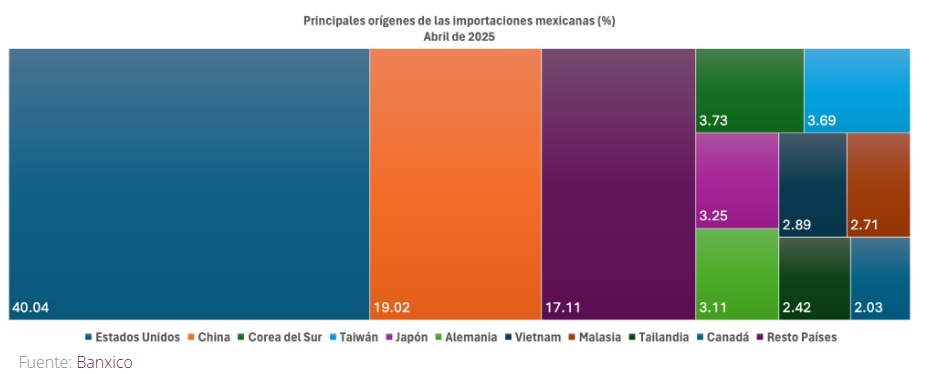
On the other hand, Mexico regards the United States as its main trading partner, which as of April 2025 accounted for over 80% of its exports and more than 40% of its total imports. The preferential access established by the USMCA has enabled the Mexican economy to position itself as a strategic supplier of goods and services to the U.S. economy, with particular significance in sectors such as automotive, electronics, manufacturing, and agribusiness. The stricter provisions on rules of origin in the automotive sector have encouraged deeper regional integration, leading plants located in Mexico to expand their role in component production and assembly processes. Although the automotive sector captures a large share of the benefits, other industries have also experienced significant growth. As a result, Mexico has become the United States’ main agricultural supplier and has strengthened its presence in sectors such as pharmaceuticals, chemicals, and capital goods, including machinery, electrical equipment, and computing devices.
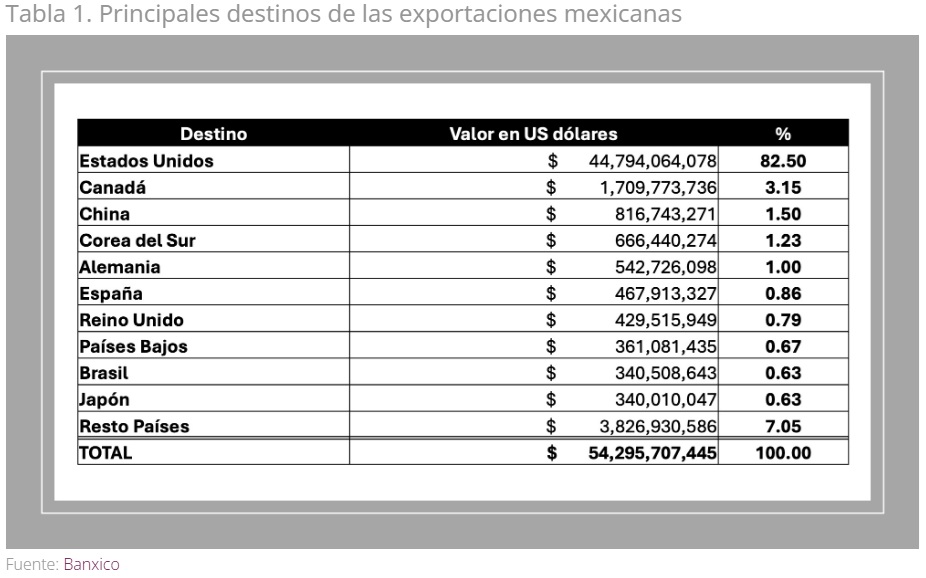
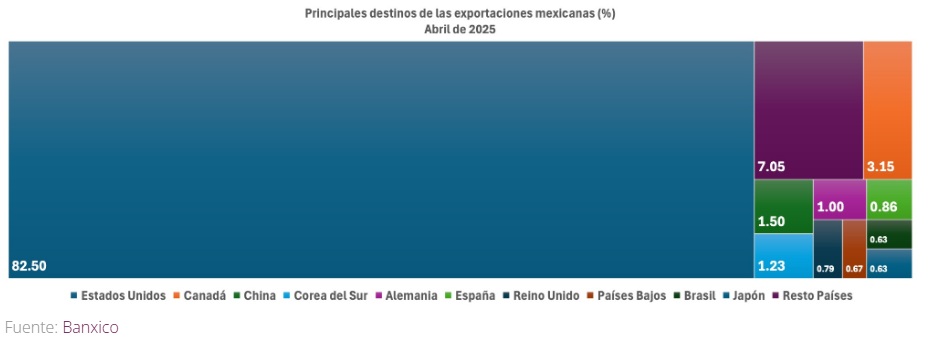
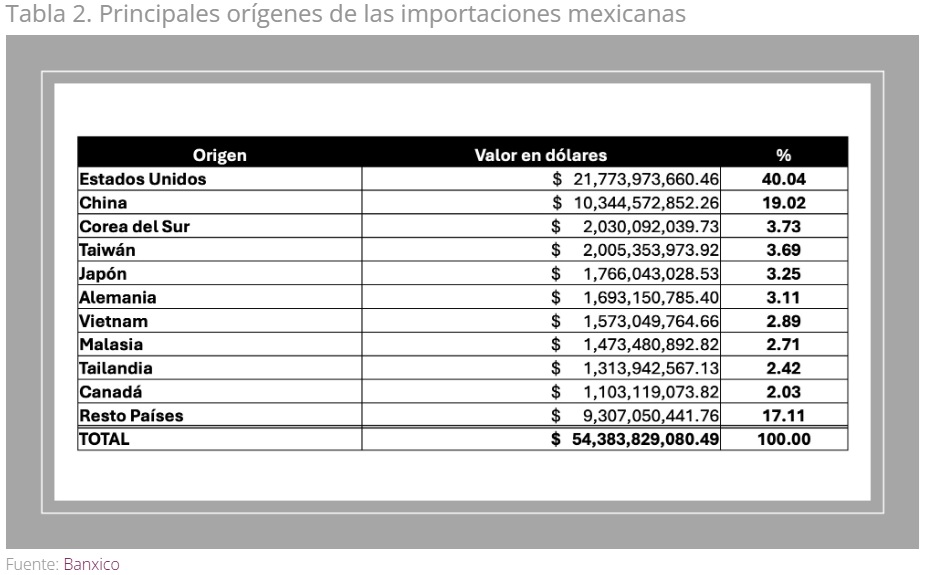
As shown in Table 1, the United States and Canada occupy the top two positions as destinations for Mexican exports. Based on data from April 2025, the U.S. market imported nearly $45 billion worth of goods from Mexico. Regarding Mexican imports during the same period, the United States ranked first as Mexico’s main trading partner, exceeding $21 billion, with China in second place at just over $10 billion. In this context, it is worth noting that, as shown in Table 2, Canada ranked 10th as a source of Mexican imports.
This scenario highlights that the economic integration between Mexico and the United States goes beyond the exchange of goods: both countries have built an integrated and highly specialized production network that generates millions of jobs while fostering growth in the North American region.
On the issue of migration, Mexico and the United States maintain a deep interdependence that permeates the bilateral agenda not only in socioeconomic matters but also in security-related issues. In 2023, approximately 10.6 million Mexican-born immigrants were legally residing in the United States, representing 23% of the total foreign-born immigrant population. At the same time, according to the Pew Research Center, around 4 million Mexicans were living without legal status — down from a peak of 6.9 million in 2007. Thus, the Mexican presence in the U.S. continues to have a dual impact: it contributes labor and demographic stability to the American economy while also generating a steady flow of remittances and transnational ties that support regional development in Mexico and strengthen binational relations. In fact, the Bank of Mexico estimated that remittances sent from the United States to Mexico exceeded $62 billion in 2024 — far surpassing Mexican exports of petroleum products, which amounted to approximately $30 billion that same year.
In the current scenario of complex interdependence between Mexico and the United States, the re-election of Donald Trump has introduced a climate of tension that has weakened traditional channels of bilateral dialogue and cooperation. The Republican administration has replaced structured diplomacy with a rhetoric characterized by threats, misperceptions, and a widespread atmosphere of uncertainty. Although President Trump’s confrontational strategy is not limited to Mexico — as it stems from the narrative that the international community has excessively and asymmetrically taken advantage of its relationship with Washington — his administration has intensified the portrayal of Mexico as a key factor behind various domestic grievances in the United States. Irregular migration, drug trafficking, and the trade imbalance have become recurring issues through which the White House channels internal demands, reinforcing a narrative of confrontation. This dynamic undermines the institutional mechanisms of bilateral understanding and places at risk the progress made in economic cooperation, security, and cross-border governance.
Since the beginning of his second term, President Trump has implemented a series of unilateral actions that intensify his restrictive immigration agenda. On the very day of his inauguration, he declared a national emergency at the southern border and signed multiple executive orders that eliminated access to asylum, suspended the refugee resettlement program, and reinstated the “Remain in Mexico” policy. He also delegated border control functions to the Department of Defense and authorized the deployment of the military and National Guard to perform tasks traditionally carried out by civilian agencies. Through the 1798 Alien Enemies Act, he ordered expedited deportations, including those targeting unaccompanied minors. U.S. Immigration and Customs Enforcement (ICE) has carried out mass raids, even in sanctuary cities, schools, and hospitals. This institutional offensive has intensified the criminalization of undocumented individuals, while the use of military forces in urban areas has undermined legal certainty and created an atmosphere of insecurity that fractures social cohesion and amplifies collective fear.
In the commercial sphere, President Donald Trump has promoted executive orders imposing tariffs on Mexican exports of steel, aluminum, and automobiles, justifying such measures with arguments related to the trade deficit, irregular migration flows, and efforts to combat fentanyl trafficking. Although his administration has temporarily suspended some duties on products covered by the USMCA, these unilateral decisions have heightened uncertainty in the bilateral relationship by contradicting commitments made under the agreement. Constant threats to expand tariffs to goods not included in the treaty, along with the use of extraordinary powers to impose trade restrictions, have eroded the climate of trust between the productive sectors of both countries. In response, the Mexican government has pursued diplomatic actions and dialogue mechanisms aimed at ensuring the proper implementation of the USMCA and establishing safeguards to reduce the risks posed by protectionist measures that affect the stability and predictability of regional trade.
In the current context, President Trump has disregarded the strategic importance of the United States’ historic allies and trade partners by adopting measures that have eroded trust not only with Mexico but also with other key partners such as Canada and the European Union. This situation has confronted the Mexican government with a complex challenge: preserving the stability of its most important economic relationship while also maintaining a strong consular protection policy. To this end, Mexico operates one of the world’s largest consular networks, with 53 consulates distributed throughout U.S. territory. The work of the Mexican Foreign Service is essential in this scenario, as it strengthens diplomatic dialogue and underscores to Washington that Mexico shares democratic and economic values with the United States. Recognizing mutual interdependence is vital: the prosperity and stability of both countries are intertwined, and a strong bilateral relationship is a key component of sustained economic growth in North America as a whole.
Although it is uncertain what future decisions President Trump may make, the Mexican government must prioritize dialogue and political coordination as underlying strategies of its foreign policy, avoiding any confrontational maneuvers, as these only undermine the bilateral relationship. President Claudia Sheinbaum’s administration faces the critical task of accurately identifying the priorities of the U.S. government to act proactively with clarity and consistency. Mexico cannot allow its foreign policy to be reduced to merely reacting to unilateral initiatives marked by aggressive rhetoric and uncertainty. In this context, the Mexican Foreign Service must firmly exercise its well-established negotiating capacity to consolidate Mexico’s position as a reliable neighbor and a key actor in the regional economic structure. The bilateral relationship must clearly convey that the prosperity of the United States is closely linked to Mexico’s stability and growth — an interest grounded in a shared logic of structural interdependence.
First published in :
Centro de Enseñanza y Análisis sobre la Política Exterior de México (CESPEM)


Es licenciado en RR. II. por la Universidad del Mar y maestro en RR. II. por la Universidad La Trobe, en Melbourne, Australia. Es profesor de asignatura en la Facultad de Economía y Relaciones Internacionales de la Universidad Autónoma de Baja California. Funge como Secretario General de la AMEI durante el periodo 2023 – 2025. Actualmente se desempeña de forma voluntaria como Asistente de la Junta de Gobierno del World International Studies Committe (WISC).

Beyond Borders: Türkiye’s Growing Footprint in the Western Indo-Pacific Amid Global Instability

Opinion – As Israel Pushes for Annexation, Is There Hope for Palestinians?

Sudan’s latest peace plan: what’s in it and does it stand a chance?
Secretary of State Marco Rubio at the 50th Regular Meeting of the Conference of CARICOM Heads of Government
Unlock articles by signing up or logging in.
Become a member for unrestricted reading!