

Diplomacy
President Meloni’s press statement with Chancellor Merz
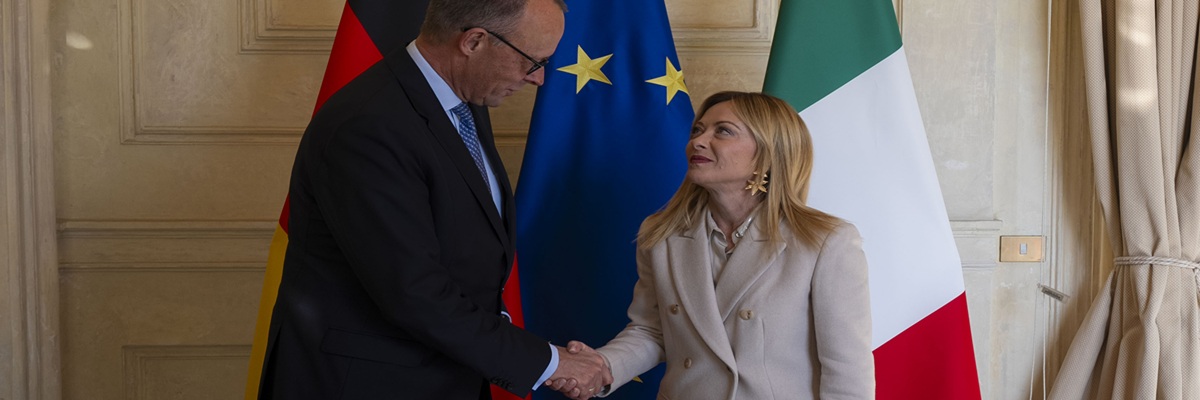
Image Source : Italian Government Presidency of the Council of Ministers
Subscribe to our weekly newsletters for free
If you want to subscribe to World & New World Newsletter, please enter
your e-mail


 Provider of in-depth & balanced analysis on hot issues around the world
Diplomacy
Image Source : Italian Government Presidency of the Council of Ministers
First Published in: Jan.23,2026
Feb.16, 2026
Share Article


Good afternoon everyone, and thank you again for being here. I am very pleased to have hosted Chancellor Merz and his Ministers in Rome today for this intergovernmental summit between Italy and Germany – the second in just over two years, following the one we held in Berlin in November 2023. Among other things, this summit kicks off a particularly significant year for the bilateral relationship between our nations, with 2026 marking the 75th anniversary of the resumption of diplomatic relations between Rome and Berlin. This summit is also clearly being held at a particularly complex moment in time, which is forcing Europe to choose whether it intends to play a leading role in its own destiny, or have its destiny dictated to it. In our view, this phase requires clarity of mind, responsibility, courage and, above all, the intelligence required to transform crises into opportunities. I am personally convinced that, at this turning point in history, Italy and Germany have a special responsibility, by virtue of their history, influence and leadership. We are two great European nations, founders of the European Union and leading players in international dynamics. We are Europe’s two main manufacturing powers, with strongly interconnected production and industrial systems that are complementary in many ways. However, above all, we both share a common vision on some of the most strategic issues, and are in fact pursuing the same underlying goal: to build an authoritative Europe that is aware of its role in the world and is able to be competitive on the global stage, a Europe capable of strengthening its strategic autonomy with pragmatism, concreteness and common sense. Two years ago, in Berlin, we signed an Action Plan whose objective was to take our bilateral cooperation to a higher level and explore new areas for common growth. That is precisely what we have done over these years and months, as can be seen in the many examples of collaboration we have developed. I am thinking of the agreement on the security of gas supplies; the joint venture between Leonardo and Rheinmetall; the agreement for the integration of ITA Airways into the Lufthansa Group; and I could name many others. With today’s summit, we have decided to continue along this path and keep investing with conviction in our strengthened cooperation by setting ourselves even more ambitious goals. I believe I can now say that Italy and Germany are closer than ever, and I think this is good news, not only for our peoples, but also for Europe as a whole. For if two important nations are friends, allies, and solid from both an economic and an industrial point of view – as Italy and Germany are – and they decide to move in the same direction, with each contributing their own added value, then the conditions are in place to achieve excellent and significant results for our businesses, our workers, our citizens, and their families. Today, we have decided to strengthen our cooperation - cooperation in the truest sense of the word. As I have said before on several occasions: the etymology of words gives us back a picture and the underlying meaning of what we say. ‘Cooperation’ comes from the Latin ‘co-operari’, meaning ‘to work with’. Cooperation never involves an active and a passive role, someone who buys and someone who sells, for example. When there is true cooperation, something new is always born, with each party contributing their own added value. That is precisely what we are doing, and what we have done on this important day by adopting three very significant documents, in addition to the agreements you saw signed and exchanged earlier. The first is a cooperation protocol to expand our areas of collaboration, which updates the bilateral Action Plan we signed in 2023. I am thinking of agriculture, our plans to further strengthen our already solid industrial cooperation, cultural dialogue, and cooperation in the management of migration flows. Migration is one of the crucial challenges for our continent, on which there is full alignment with the German Chancellor. We both think the main challenge lies in defending the European Union’s external borders, fighting human trafficking, and working to ensure respect for legality in strengthening the return system, as well as in cooperating with the nations of origin and of transit, which Italy in particular (but not only Italy) is trying to develop through a new model of cooperation with the African continent. Clearly, our goal is to consolidate the change of approach which, thanks also to our governments, has taken hold and is becoming increasingly well established in Europe. Over the last years, this new approach has enabled us to guarantee a significant reduction in the number of irregular entries, illegal departures and landings. Italy also intends to pursue this commitment through innovative solutions, starting with the protocol with Albania we have been promoting. I want to tell Chancellor Merz that I am grateful for his decision to regularly participate in the informal working group of like-minded countries, which meets in the margins of European Council meetings to discuss precisely the issue of migration. The other very important matter on which Chancellor Merz and I agree is the need for a decisive step change in Europe regarding the competitiveness of our companies. It is now evident and clear to anyone with intellectual honesty that a certain ideological view of the green transition has ended up bringing our industries to their knees, giving Europe new and dangerous strategic dependencies, and without even managing to have a real impact in terms of protecting the environment and nature globally. We are convinced there is room to correct these mistakes and avoid our continent’s industrial decline, but, of course, courage is required. We want to accelerate on these issues, which is why we will be presenting our joint non-paper at the next informal meeting in Brussels on 12 February, where discussions will begin regarding the next European Council meeting in March - of particular importance precisely for matters regarding competitiveness. This joint non-paper is focused on a number of priorities which, in our view, cannot be postponed: simplifying and cutting EU red tape; strengthening the single market; relaunching the automotive industry based on technological neutrality; ensuring an ambitious trade policy based on shared rules and a level playing field. This is the second document we signed today, and it is a document which I consider to be very significant and which we intend to share with the European Commission and the President of the European Council as well as with all the other leaders who will be participating in these discussions. The third document we signed this morning on defence, security and resilience is equally as important. These are sectors in which Italy and Germany can count on industrial players of absolute excellence, which generate incredibly high added value. We want to strengthen our cooperation in this area, and we believe our production systems can make a significant contribution to building a solid European pillar within the Atlantic Alliance, which for many years we have been calling for without ever really making any progress, and to act accordingly. To this end, I have informed Chancellor Merz of Italy’s decision to join the multilateral agreement on arms exports, which is already in place between Germany, France, Spain and the United Kingdom. This is the reason why we held an important 2+2 meeting this morning between our Foreign and Defence Ministers, in order to coordinate our positions and also work even more closely together on the main international issues, starting with Ukraine and the Middle East. We have always been strongly aligned on both of these fronts too, and we will continue to do our part to achieve a just and lasting peace in Ukraine and to build a stable framework for security and prosperity in the Middle East. This morning, we also discussed how to enhance our cooperation in many other areas. I am thinking of energy interconnections and economic and infrastructure interconnections, which are increasingly crucial in this era. We are working together to support strategic initiatives that are in line with this goal, for example: the SoutH2 Corridor; Medlink; Elmed; and the IMEC, which is the corridor that will connect India, the Middle East and Europe, and in relation to which Italy and Germany are playing a key role in Europe. The work we have done, and have still yet to do, is very extensive. Today, Italy and Germany are not only confirming their partnership but are also deciding to strengthen it at all levels, by working side by side on challenges that are crucial for our time. I’ve read a number of comments over the last few hours, with some observers saying that 2026 will be “the year of Italy and Germany”. I can’t say whether this prediction corresponds to reality, but what I can say is that we intend to give it our all; we absolutely intend to do our part in order to consolidate a friendship that is strategic not only for our nations, but for Europe as a whole. Thank you again.
First published in :
Italian Government. Presidency of the Council of Ministers

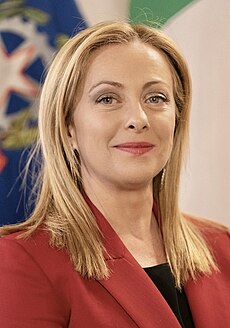
Prime Minister of the Italian Republic.
Beyond Borders: Türkiye’s Growing Footprint in the Western Indo-Pacific Amid Global Instability
Opinion – As Israel Pushes for Annexation, Is There Hope for Palestinians?
Sudan’s latest peace plan: what’s in it and does it stand a chance?
Secretary of State Marco Rubio at the 50th Regular Meeting of the Conference of CARICOM Heads of Government
Unlock articles by signing up or logging in.
Become a member for unrestricted reading!