Energy & Economics
If the US carries out military strikes against Iran, what will happen to global oil supply and global oil price?

Image Source : Shutterstock
Subscribe to our weekly newsletters for free
If you want to subscribe to World & New World Newsletter, please enter
your e-mail


 Provider of in-depth & balanced analysis on hot issues around the world
Energy & Economics
Image Source : Shutterstock
First Published in: Mar.16,2026
Mar.16, 2026
Share Article


Oil prices are climbing amid signs that the US may plan to launch military strikes on Iran, raising questions about the potential economic fallout of heightened conflict in the Middle East. US President Trump has increased pressure on Iran, home to some of the world’s largest oil reserves, over the country’s disputed nuclear program. Open hostilities between the US and Iran could restrict global oil flows, raising US energy prices and driving up inflation, according to economists. While President Trump hasn‘t yet made a final decision about whether to strike Iran, top national security officials have told the president that the US military could be ready as soon as Saturday on February 21, 2026, sources familiar with the discussions have told CBS News. At the inaugural meeting for President Trump’s “Board of Peace” on Thursday, February 19, 2026, the president said that Iran has about 10 days to make a deal ending its nuclear program, or “bad things will happen.” [1] If the US carries out military strikes on Iran, it can create a lot of economic problems. This paper first examines the situations of US military build up around Iran and then explores the scenarios of oil supply disruption when the US carries out military strikes on Iran and its impact on global oil price.
As US President Donald Trump considers a major military strike on Iran, US military has accelerated weeks-long buildup of military hardware in the Middle East. As Figure 1 shows, the arrival of the Lincoln Carrier Strike Group, now off the coast of Oman, about 700km (430 miles) from Iran, represents the most dramatic shift in military positioning. As Figure 2 shows, the Abraham Lincoln, a nuclear-powered Nimitz-class aircraft carrier, together with three Arleigh Burke-class destroyers forms a carrier strike group, plus two destroyers capable of conducting long-range missile strikes and three specialist ships for combat near to the shore that are currently positioned at Bahrain naval station in the Gulf.
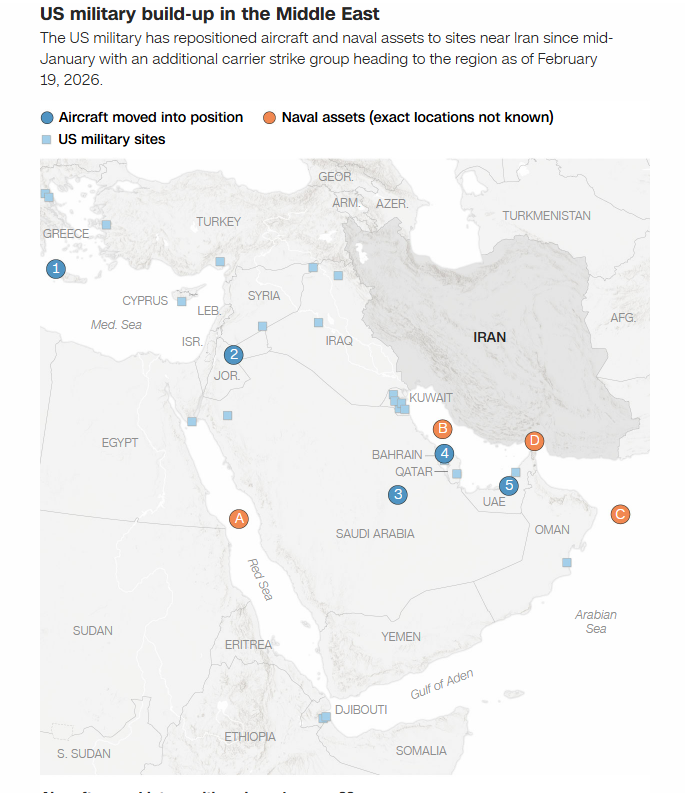
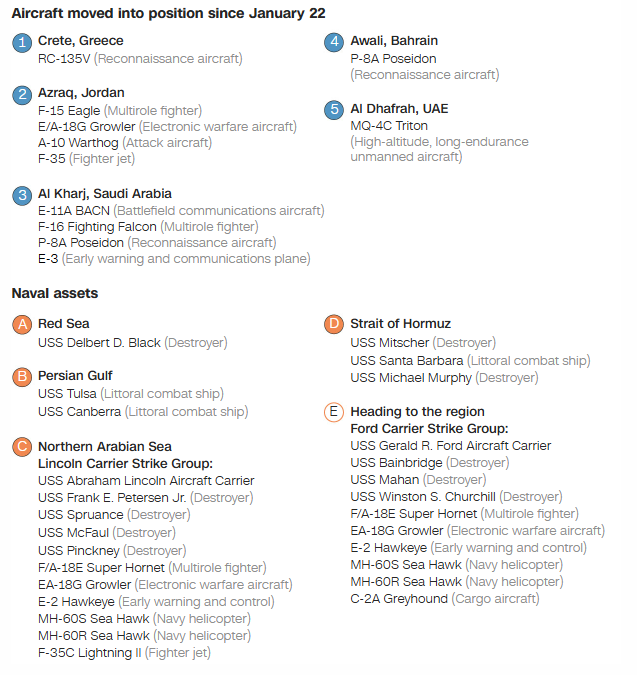
Figure 1: US military presence around Iran (Congressional Research Service, Airframes.io, Flightradar24, Planet Labs PBC, Airbus
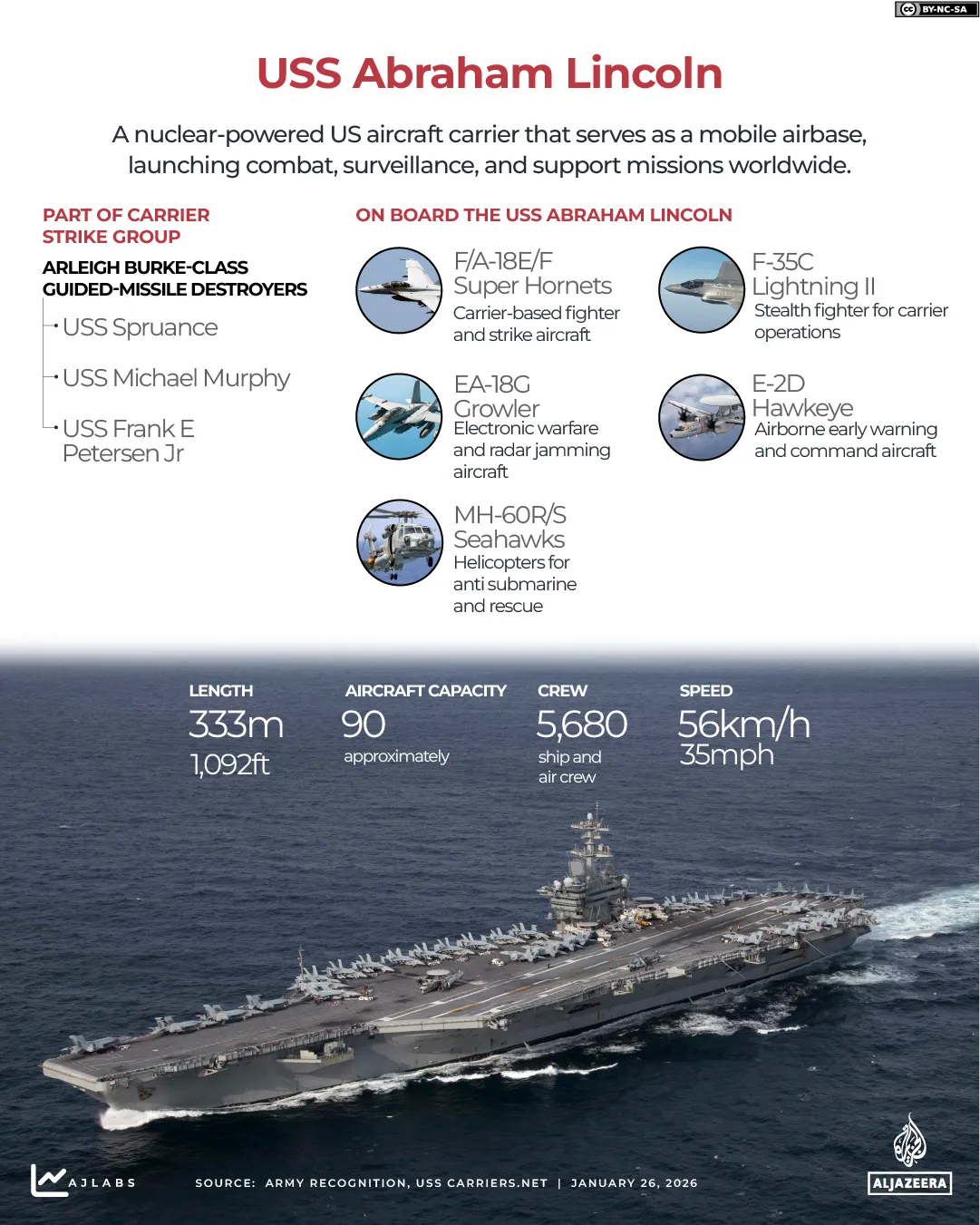
Figure 2: The USS Abraham Lincoln Strike Group (source: Al Jazeera)
In addition, the USS Abraham Lincoln strike group includes the carrier air wing of squadrons of F-35C Lightning II fighters, F/A-18E Super Hornet fighters, and EA-18G Growler electronic warfare jets.
According to BBC, two other destroyers have also been seen in the eastern Mediterranean near the Souda Bay US base, and one more in the Red Sea. Moreover, the world’s largest warship is heading towards the Middle East. As Figure 3 shows, the USS Gerald R Ford passed through the Strait of Gibraltar towards the Mediterranean on February 20, 2026 and is expected to arrive off Israel’s coast and dock in Haifa, Israel on Friday, February 27, 2026. BBC confirmed the USS Mahan, one of the destroyers in the USS Gerald R Ford’s strike group, passed through the Strait. The Gerald R Ford had briefly broadcast its location off Morocco’s Atlantic coast on last Wednesday. [2]
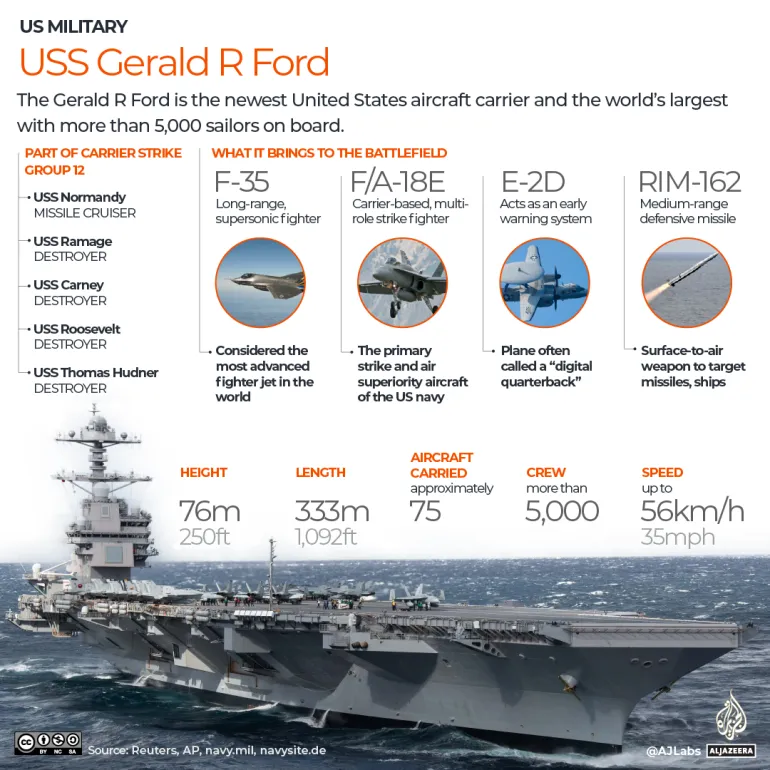
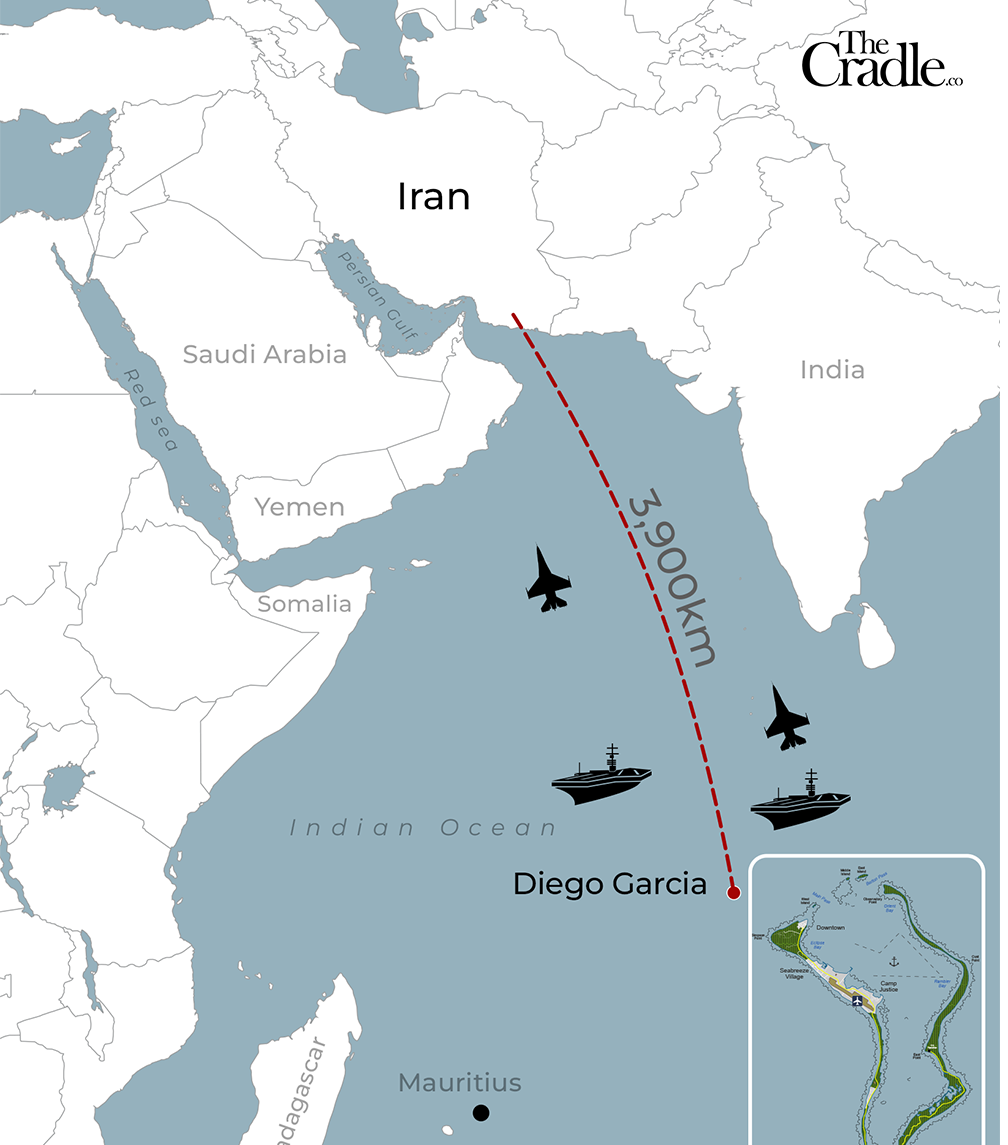
The arrival of two of the 11 aircraft carriers operated by US Navy adds to what we know about the military build-up in the Middle East over the past few weeks. Both Abraham Lincoln and Gerald R Ford lead strike groups with several guided missile destroyer warships. They are operated by over 5,600 crews and carry dozens of aircraft. Moreover, according to intelligence analysts and military flight-tracking data, the US appears to have deployed more than 120 aircraft to the region within the past few days – the largest surge in US airpower in the Middle East since the Iraq war in 2003. BBC confirmed the movements of large numbers of US aircraft to both Middle Eastern and European airbases, including: [3] • E-3 Sentry command and surveillance aircraft designed to coordinate large-scale operations • F-22 and F-35 fighter jets • KC-46 and KC-135 refueling tankers used to support the long-range movement of other aircraft • C-5M strategic transport aircraft, the largest in the US Air Force, used for cargo and personnel • C-17A heavy-lift military transport aircraft used for delivering troops and cargo • Navy P-8A patrol and reconnaissance jets used for long-range anti-submarine warfare Recently, attention has focused on Diego Garcia, the joint US-UK military base in the Indian Ocean’s Chagos Islands, which is capable of hosting long-range US strategic bombers, including B-2 aircraft. As Figure 4 shows, the remote base has historically served as a launch point for major US air campaigns in the Middle East. It could be used for US military attacks against Iran. However, Diego Garcia is a British sovereign territory leased to the US, meaning that UK must approve its use for offensive operations. According to reports in UK media, Prime Minister Keir Starmer has indicated to President Trump that the US cannot use British airbases – including Diego Garcia and RAF Fairford in the UK, which is home to the US’s heavy bomber fleet in Europe – for strikes on Iran, as this would violate international law.
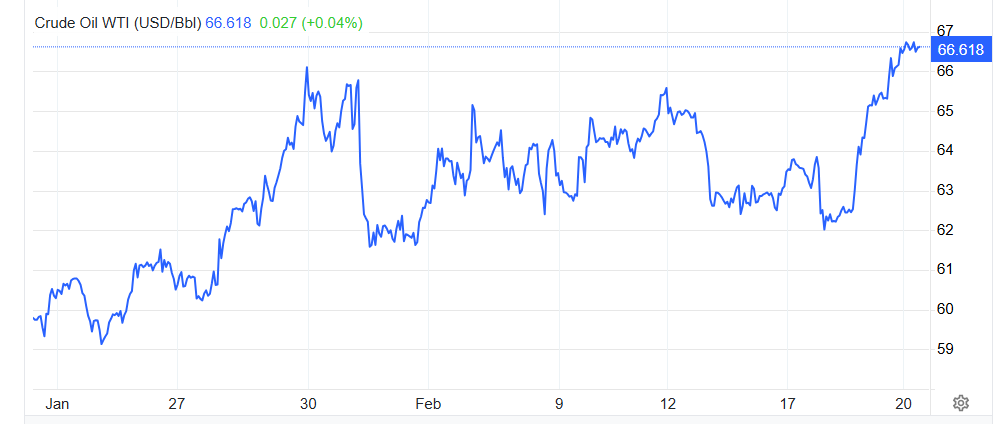
Crude oil prices have fluctuated in recent days along with media headlines about potential US military strikes on Iran, as a second round of talks between US and Iranian representatives concluded on February 17, 2026 without resolving underlying disputes. Although US and Iran held a third round of nuclear talks in Geneva on February 26, 2026, the chances of a deal that could avert a war remain unclear. As Figure 5 shows, international benchmark WTI crude oil prices climbed to $66.618 (USD/Bbl) on February 20 and $66.30 on February 25, 2026.
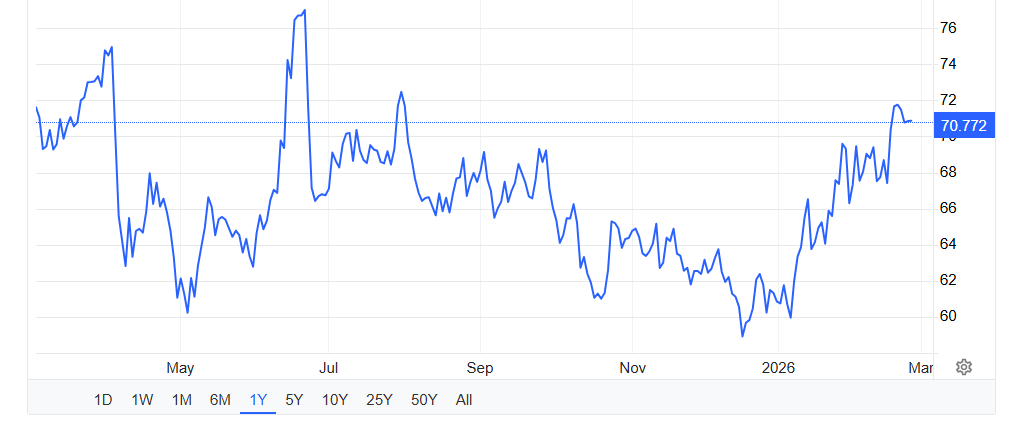
On the other hand, Brent crude oil futures rebounded 2% to above $70 per barrel on February 25, 2026, reversing earlier losses.
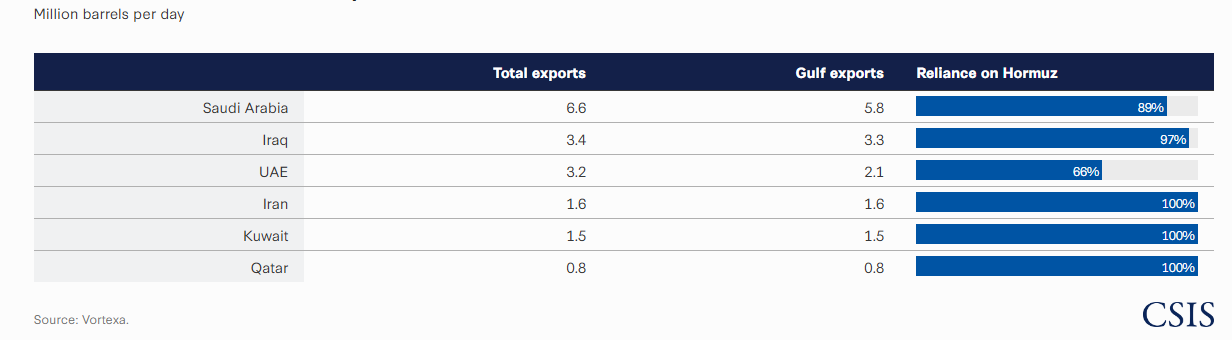
During Twelve-Day War between Iran and Israel in June 2025, joined by the US in Operation Midnight Hammer, Gulf oil exports avoided major disruption. As the Twelve-Day War transpired, Iran perceived that it was not facing an existential crisis, as its oil exports continued unimpeded, and Iran made no attempt to target Arab Gulf oil assets or shipping. Fast forward to today-the Islamic Republic of Iran faces unprecedented vulnerability following the blows inflicted by Israel, including the degradation of Hezbollah’s capabilities, and more recently, the biggest wave of anti-government protests in its 47-year history. Meanwhile, US president Trump is publicly escalating rhetoric by assembling significant military assets in the Gulf region, pressuring the Iranian regime to accept US demands, and personally threatening Supreme Leader Ayatollah Ali Khamenei. Therefore, if hostilities between Iran and the US or Israel, resume, Iran may indeed perceive an existential threat, bringing its counterthreat against regional oil supplies into play. Six oil-producing countries in the Middle East depend on unimpeded shipping access via the Strait of Hormuz to reach world oil markets, as Figure 7 shows. Their relative dependency on the strategic waterway is shown in Table 1 below.
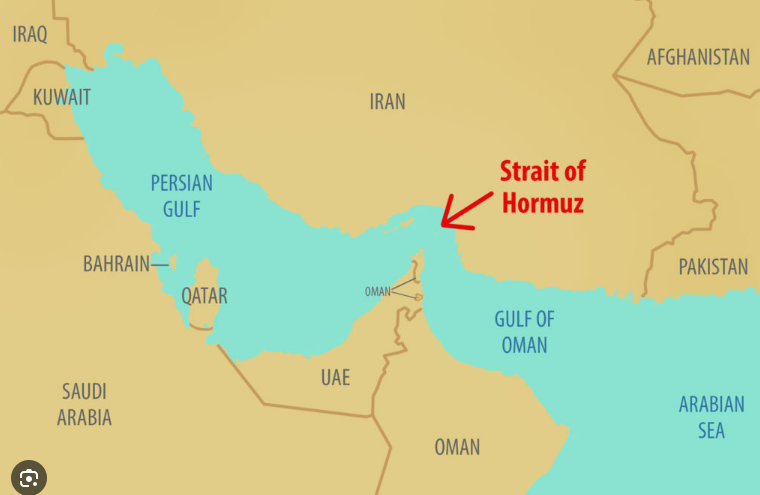
According to Table 1, Iran, Kuwait, and Qatar depend on the Strait of Hormuz 100 percent for the exports of their crude oil, while Iraq depends 97 percent and Saudi Arabia 89 percent. If there are problems with the Strait of Hormuz resulting from US-Iran conflicts, therefore, oil supply disruption could take place.
Table 1: Middle East Gulf Oil Exporters’ Reliance on Strait of Hormuz
According to Clayton Seigle at CSIS, there are four oil supply disruption scenarios worth considering. [4]
Scenario 1: Iran disrupts Arab Gulf oil shippingIf the US strikes Iran, then Iran could disrupt oil shipping of Arab Gulf countries. This campaign would likely target Gulf export flows transiting the Strait of Hormuz, in which the outbound and inbound shipping lanes are only two miles wide. Iran could attempt to divert or seize control of oil tankers, or strike them outright using fast attack aircraft, anti-ship missiles, drones, or naval mines. Up to 18 million barrels per day-perhaps far less-of non-Iranian crude oil and refined petroleum products could be throttled or temporarily halted. This scenario might see several million barrels per day disrupted for a period of weeks until US naval forces could neutralize sea- and shore-based threats to energy cargo flows. Oil prices would initially spike with surging freight and insurance rates, and with some ship operators likely fleeing the region, further reducing export capacity. As traders assess the volume and duration of a physical disruption, crude oil prices could rise past $90 per barrel, pushing US retail gasoline prices well above $3 per gallon on a national average basis (some regions much higher). Fortunately, this chain of events is reversible; Iran could call off its disruptive activities at any time, or global forces could quell their attempts at interruption, enabling Gulf export volumes to rebound.
Scenario 2: Iran directly attacks Arab Gulf oil facilitiesIf the US strikes Iran, then Iran could directly attacks oil facilities in Arab Gulf countries. As Figure 8 shows, these attacks could include producing fields, gathering and processing nodes, or oil export terminals.
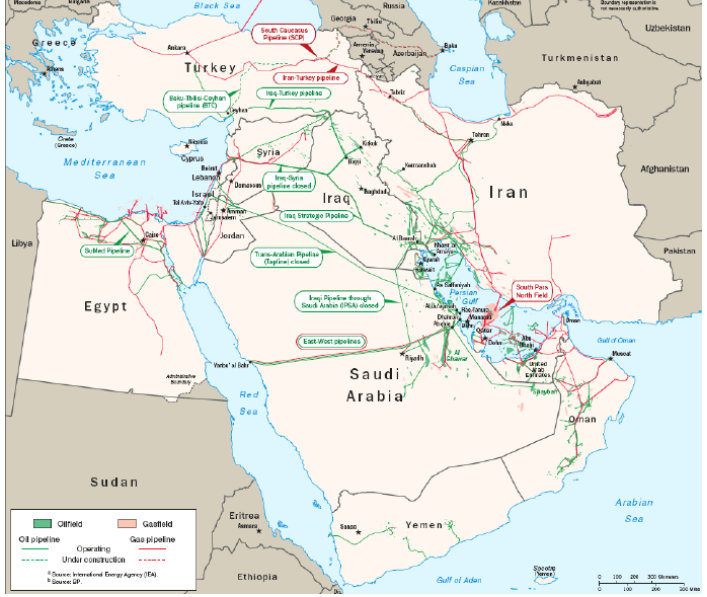
In this scenario, a substantial portion of the 18 million barrels per day non-Iranian oil exports from the Gulf region, depending on which assets might be taken offline and for how long, could be at stake. Moreover, potentially millions more barrels per day in the affected countries’ domestic crude feedstocks and refined product supply would be at risk. This scenario could lead to a historically unprecedented oil price spike, potentially higher than the $130 per barrel that was touched in 2022 after Russia invaded Ukraine. The oil supply at risk at that time was approximately 5 million barrels per day. Like Scenario 3, this case could see oil facilities heavily damaged or even destroyed, removing export capacity for a protracted period. This is true not only for onshore infrastructure, but also for offshore loading platforms, which constitute a critical bottleneck in export capacity. One example of this vulnerability is that Iraq’s entire Gulf export flow of 3.5 million barrels per day depends on offshore loading facilities very close to Iranian territorial waters. These offshore loading points may take considerable time to repair - an Ukrainian attack on a similar offshore loading platform at the Black Sea’s Caspian Pipeline Consortium on November 29, 2025 terminal knocked 500 thousand barrels per day - a third of the terminal’s output - offline for several months. Onshore facilities are also vulnerable but may be repaired faster, depending on the repair resources available. For instance, the September 2019 attack on Saudi Aramco’s Abqaiq crude oil processing facility initially disrupted approximately 5 million barrels per day, but most of that volume was restored in less than two weeks after rapid repair efforts.
Scenario 3: US or Israel directly attacks Iranian oil facilitiesIf President Trump order the US military to attack Iran, then US (and with Israel) forces could attack not only Iranian military facilities, but also Iranian oil facilities. In this scenario, US naval and air forces would strike Kharg Island and its supply lines, offshore production platforms, and (less likely) Iran’s oil refineries. As Figure 9 shows, Iran’s export terminal at the Kharg Island accounts for nearly all of its 1.6 million barrels per day average export volume. Kharg could be taken offline in several ways, including destroying or disabling its ship loading equipment (pumps, hoses, and connecting hardware), damaging its oil storage tanks, or cutting off the flow of oil that reaches Kharg via subsea pipelines.
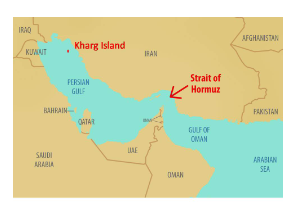
Choke points for oil deliveries to the Kharg Island include the onshore Ghurreh booster station, the manifold station at Ganaveh, and the pipelines themselves. Not only are Iran’s 1.6 million barrels per day crude oil exports (if limited to Kharg) at stake, but also its additional 1.5 million barrels per day of domestic oil production (should platforms/fields be targeted) and its domestic supply of transportation fuels such as gasoline (if refineries are damaged). The oil price impacts would likely be greater than the $10–12 per barrel spike anticipated with scenario 1 for two reasons: (1) damage to or destruction of Iranian infrastructure could keep barrels off the oil market for a protracted period of time (potentially offset by activation of OPEC spare production capacity), and (2) anticipation of a further escalation by Iran with something like scenario 4 (described below). This track, therefore, might take oil prices above $100 per barrel. [5]
Scenario 4: US or Israel Disrupts Iranian Crude Oil ShipmentsIf President Trump order the US military to attack Iran, then US (and with Israel) forces could attack not only Iranian military facilities, but also Iranian oil facilities. This could take the form of blockading or seizing Kharg Island, the main facility for loading Iranian oil onto ships, and seizing oil tanker vessels transporting Iranian crude oil. This could disrupt up to 1.6 million barrels per day of Iranian crude oil exports, all of which go to China. However, since oil is a global, fungible commodity, a disruption anywhere influences prices everywhere. A loss of Iranian barrels might cause China to bid for substitute supplies, probably worth at least a $10–12 increase in the global price of crude oil. This scenario is reversible, meaning that the US or Israel could call off its campaign against Iranian shipments at any time with no permanent damage having been incurred and export volumes rebounding thereafter, like what was seen after the US quarantine on Venezuelan oil shipments. Insurance and war-risk premiums could keep prices elevated longer than any physical supply interruption.
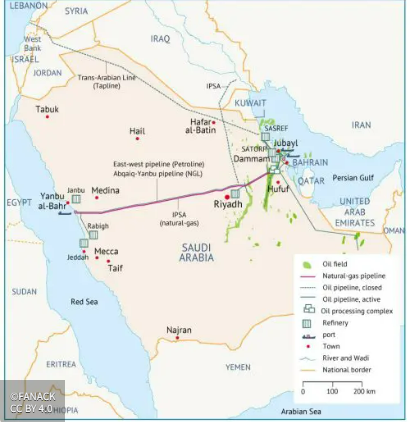
Oil export routes that bypass the Strait of Hormuz handle only a fraction of daily Gulf exports. As Figure 10 shows, Saudi Aramco’s East-West Pipeline connects Saudi Arabia’s oil production centers in the Eastern Province with the Red Sea Yanbu Port. The pipeline could reroute some barrels from the Gulf to the Red Sea, but only in reduced volumes. The pipeline has a capacity of 5 million barrels per day. But it is already supplying Yanbu with close to 800 thousand barrels per day for export cargoes, and likely supplying six Saudi Aramco refineries in western and central Saudi Arabia with about 1.8 million barrels per day. That would leave only approximately 2.4 million barrels per day of spare capacity in the pipeline, compared to Saudi Arabia’s typical 6 million barrels per day from its Gulf terminals - enabling the rerouting of less than half of its Gulf exports.
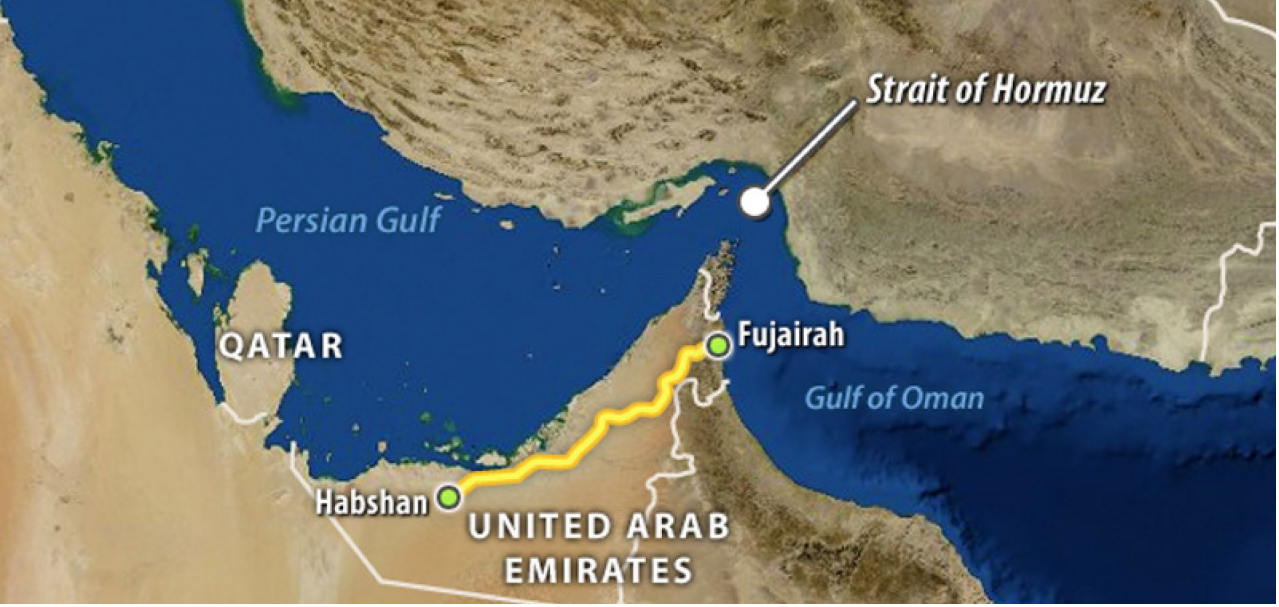
As Figure 11 shows, the United Arab Emirates (UAE) may reroute about half of its 2 million barrels per day of Gulf exports via pipeline to its port of Fujairah on the Gulf of Oman, bypassing the Strait of Hormuz. The port of Fujairah already accounts for approximately one-third of the UAE’s total 3.2 million barrel per day export volume, implying that the remaining third (1 million barrels per day) might remain stranded in a Hormuz closure. Other Gulf oil-exporting countries—Qatar, Kuwait, Bahrain, Iraq (5.7 million barrels per day total volume)—have no Hormuz bypass capacity; likewise, there’s no other outlet for Qatar’s 10 billion cubic feet per day of LNG exports.
US President Trump faces a dilemma in how to confront Iran without incurring an unwanted oil supply disruption and gasoline price spike. In Operation Midnight Hammer and in the operation to capture Venezuela president Nicholas Maduro, Trump selected military options with low risk of negative consequences (in terms of US casualties and energy price increases). But scenarios 1 and 2, described in this paper, afford Iran leverage that could deter Trump from undertaking a major military operation against Iran. This is because in scenarios 1 and 2, Iran could disrupt the supply and export of crude oil of Gulf countries. Meanwhile, Israel, which launched the Twelve-Day War against Iran in summer of 2025, remains a wildcard. [6] The US certainly has a large list of Iranian targets for kinetic action, many of which may not involve energy. Insofar as oil leverage may be used as part of a pressure campaign against Iran, it is likely to start with scenario 1 (US or US/ Israel, disrupts Iranian crude oil shipments), and Iran will face a dilemma about how to respond. If Iran pursues Scenario 1 (Iran disrupts Arab Gulf oil shipping), the US will seek to neutralize Iran’s naval and shore-based anti-ship capabilities, leaving Iran with only scenario 2 (Iran directly attacks Arab Gulf oil facilities) left to employ—one that could cause the US to carry out scenario 3 (US/Israel directly attack Iranian oil facilities)—and seek the regime’s outright defeat or destruction. Iran’s “use it or lose it” dilemma could provoke a miscalculation in Iran, resorting to scenario 2 (Iran directly attacks Arab Gulf oil facilities) as its last card to play to stave off defeat.
This paper examined the scenarios of oil supply disruption when the US carries out military strikes on Iran. In doing so, this paper first showed US military build-up around Iran and then proposed 4 scenarios of oil supply disruption and evaluated them. The largest oil supply disruption and the resulting highest oil price surge are likely to happen in scenario 2 when Iran attacks oil facilities in the Gulf region and scenario 3 when the US attacks oil facilities in the Kharg Island of Iran.
[1] https://www.cbsnews.com/news/iran-us-conflict-impact-on-oil-inflation/ [2] https://www.bbc.com/news/articles/c1d64p3q2d0o [3] https://www.bbc.com/news/articles/c1d64p3q2d0o [4] https://www.csis.org/analysis/if-trump-strikes-iran-mapping-oil-disruption-scenarios [5] https://www.csis.org/analysis/if-trump-strikes-iran-mapping-oil-disruption-scenarios [6] https://www.csis.org/analysis/if-trump-strikes-iran-mapping-oil-disruption-scenarios
First published in :
World & New World Journal

Unlock articles by signing up or logging in.
Become a member for unrestricted reading!