

Diplomacy
The genocide in Gaza divides the leaders of the 'Arab street'
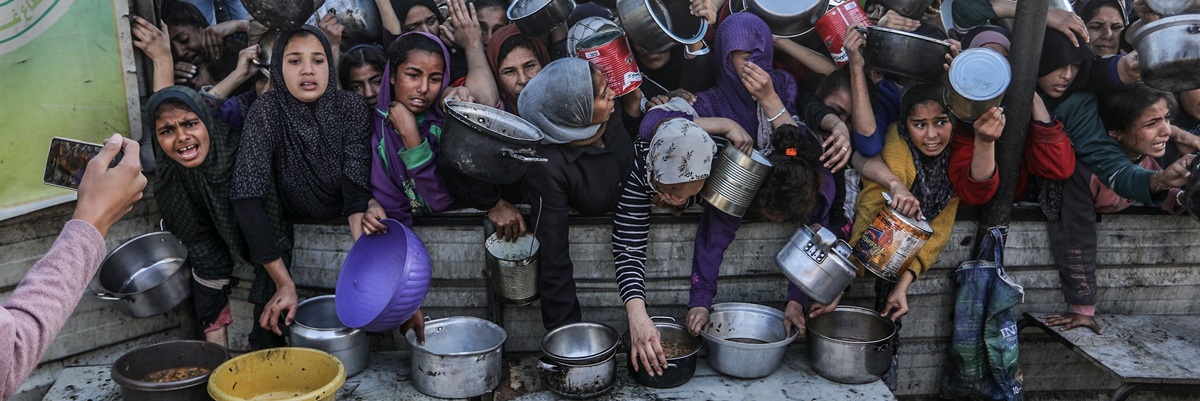
Image Source : Shutterstock
Subscribe to our weekly newsletters for free
If you want to subscribe to World & New World Newsletter, please enter
your e-mail


 Provider of in-depth & balanced analysis on hot issues around the world
Diplomacy
Image Source : Shutterstock
First Published in: Aug.24,2025
Aug.29, 2025
Share Article


As the two-year mark of Israel’s invasion of Gaza approaches, many wonder why Arab countries are not pressuring Israel. The answer is often simple: they are prioritizing their strategic and economic interests.
Since the beginning of Israel’s ruthless offensive in Gaza on October 7, 2023, images have repeatedly shown Palestinian civilians crying out desperately to the cameras for help: “Where are the Arabs? Why isn’t anyone stopping this?”
Almost two years later, despite the fact that fewer voices doubt that what began as a war has turned into a genocide that has taken the lives of more than 60,000 Palestinians, Arab states have not shifted even an inch from their initial stance: harmless statements of condemnation, without any action to pressure Israel.
“Where are the Arabs? Taking a nap… By Arabs, I mean their rulers, with their heads buried in the sand,” declared Fawaz Gerges, professor at the London School of Economics, in a recent interview with the U.S. network NBC. In fact, it has often been non-Arab countries, thousands of kilometers away from Gaza, that have tried to stand up. Such is the case of South Africa, the country that denounced the existence of genocide in the enclave before the International Court of Justice in The Hague.
“In general, Arab regimes have not taken concrete measures in response to the ongoing genocide in Gaza. The main reason is the prioritization of their strategic and economic interests over popular sentiments of support for Palestinians in the face of the horror they are experiencing. This is not surprising given that most [of the regimes] rule based on growing authoritarianism,” asserts Yara Hawari, co-director of the Palestinian think tank Al Shabaka.
The gap between the street and the palace
This gap between the opinion of the so-called “Arab street” and its rulers is evident in every new survey. In one of the most comprehensive, conducted by the Doha Institute with the participation of around 8,000 people from 16 different Arab countries, 92% of respondents believe that the Palestinian cause concerns all Arabs and not only Palestinians. A similar percentage, 89%, opposes normalizing relations with Israel. For an overwhelming majority, 84%, the genocide in Gaza represents a source of “great psychological stress,” and for another 13% it also constitutes a source of stress, though to a lesser degree.
“Although they are not democratic, Arab regimes cannot entirely ignore their respective public opinions, which are horrified by what is happening in Gaza. That is why they must strike a delicate balance. They fear that discontent over their positions on Gaza could converge with other grievances — of which there are many — and potentially trigger social unrest,” explains Haizam Amirah Fernández, executive director of the Center for Contemporary Arab Studies (CEARC). So far, this has translated into statements condemning the massacres of civilians perpetrated by Israel, others in support of creating a Palestinian state, and the delivery of humanitarian aid to Gazans when approved by Tel Aviv.
Of the 22 states that make up the Arab League, a total of six have signed an agreement to establish diplomatic relations with Israel. The first to do so was Egypt (1979), followed by Jordan (1994), and then Morocco, the United Arab Emirates, Bahrain, and Sudan joined under the so-called Abraham Accords sponsored by Trump in 2020 — although Sudan, currently in civil war, has not implemented it. In addition, other states maintain varying degrees of economic relations or security cooperation with Israel, such as Saudi Arabia. Among all these countries, none has broken diplomatic relations with the Israeli state over Gaza, and only Jordan has withdrawn its ambassador.
On the other side, among Arab countries with a more hostile stance toward Israel, are Algeria, Tunisia, and Houthi-controlled Yemen, the only one that has applied military pressure on Israel by launching missiles and harassing maritime traffic in the Suez Canal. Lebanon and Iraq represent particular cases, as both are highly fragmented politically and home to pro-Iranian militias that consider Israel an enemy, such as Hezbollah — an opinion not shared by the entire political class.
The reasons behind the indifference of so many Arab states toward Gaza are varied. First, some leaders — especially those of the Gulf petro-monarchies — perceive Iran or the Muslim Brotherhood, an organization linked to Hamas, as a greater threat than Israel. Faced with this sense of insecurity, also shared by President el-Sisi in Cairo, many look toward the West.
“The permanence in power of these leaders does not depend on the choice of their citizens or subjects, but on external support from the United States, and this shapes their position on Palestine,” asserts Amirah Fernández, who lists several actions these countries could have taken to pressure Israel: from breaking or suspending bilateral agreements, such as the Camp David Accords between Israel and Egypt, to applying serious pressure to break Israel’s blockade of Gaza and thus allow humanitarian aid to reach the enclave, whether by land or by sea. Egypt, for example, has dedicated itself to repressing activists who attempted to carry out such actions near the Gaza border.
The “realpolitik” of the new generation of leaders
Beyond their deference to the West, the positions of Arab states in some cases respond to a stark calculation of “realpolitik”: the benefits they can gain from their relationship with Israel — a technological and military power — outweigh what an occupied people like the Palestinians can offer. [...]
In an interview with El Salto, journalist Antony Loewenstein, author of the book “The Palestine Laboratory”, explained how the sale of weapons and cyber-espionage tools has become a kind of insurance policy for Israel against possible retaliatory actions. “Almost a quarter of Israel’s [arms] exports went to Arab dictatorships, such as the United Arab Emirates […]. No Arab state has cut ties with Israel, and they won’t,” Loewenstein said.
Against this backdrop, for decades the only common denominator among Arab states regarding the Palestinian issue has been the mere signing of joint declarations in support of the “two-state solution” to resolve the conflict with Israel.
At the end of July, within the framework of a United Nations-sponsored summit to promote that solution, the “Arab consensus” unexpectedly expanded with all Arab League countries signing a declaration urging Hamas to disarm and hand over control of Gaza to the Palestinian Authority. Thus, the only bold — and unprecedented — action taken during nearly two years of genocide in Gaza has been to pressure Hamas and not Israel. A very bleak record for pan-Arab solidarity.
First published in :
Revista El Salto


Contributor to El Salto
Beyond Borders: Türkiye’s Growing Footprint in the Western Indo-Pacific Amid Global Instability

Opinion – As Israel Pushes for Annexation, Is There Hope for Palestinians?
Sudan’s latest peace plan: what’s in it and does it stand a chance?

Secretary of State Marco Rubio at the 50th Regular Meeting of the Conference of CARICOM Heads of Government
Unlock articles by signing up or logging in.
Become a member for unrestricted reading!