

Diplomacy
The geopolitical strategy of the United States to maintain its global hegemony
Image Source : Shutterstock
Subscribe to our weekly newsletters for free
If you want to subscribe to World & New World Newsletter, please enter
your e-mail


 Provider of in-depth & balanced analysis on hot issues around the world
Diplomacy
Image Source : Shutterstock
First Published in: Feb.02,2026
Feb.02, 2026
Share Article


The United States has employed different geopolitical strategies to maintain its status as a dominant power vis-à-vis rival countries such as China and to achieve its foreign policy objectives. Since his return to the White House, President Donald Trump has announced tariff increases on 60 countries, issued ultimatums to Russia to end the War in Ukraine, and recently intervened in Venezuela by capturing Nicolás Maduro. In this way, a rise in the use of hard power by the United States can be observed, aimed at forcing other countries to behave in a particular manner in order to achieve its geopolitical objectives. The foreign policy process of a state is the most important means through which it formulates and implements the policies that determine its interactions with other actors in the international system. Hans Morgenthau (1949) argued that self-preservation is the primary duty of a nation; in this regard, the choice of foreign policy objectives and means is predetermined in two ways: by the goals to be pursued and by the power available to achieve them. For his part, Joseph Nye (1999) argued that a state’s interests are not revealed solely through power or security considerations, since they also include economic concerns. Thus, countries also focus on economic relations, which may entail interdependence effects among states. Consequently, both national security and economic well-being are important to states’ interests. Within this framework, it is possible to discern the geopolitical landscape that the United States is developing through its foreign policy. Secretary of State Marco Rubio stated that they would not allow the Western Hemisphere to become a base of operations for adversaries, competitors, and rivals of the United States. “This is our hemisphere,” he affirmed, “and President Trump will not allow our security to be threatened” (The White House, 2026). This warning, together with the National Security Strategy and the recent intervention in Venezuela, represents a new form of the Monroe Doctrine. In his address to Congress in 1823, President James Monroe articulated the United States’ policy regarding the new political order that was developing in the Americas and Europe’s role in the Western Hemisphere. The Monroe administration warned the European imperial powers not to interfere in the affairs of the newly independent Latin American states. In this way, it sought to increase U.S. influence and trade throughout the southern region (Office of the Historian, n.d.). Likewise, the Trump administration’s geopolitical objective is to consolidate its hemisphere of influence in the face of rival powers, primarily China. Marco Rubio indicated that it is important to secure the national interest in the region and stated: “we have seen how our adversaries are exploiting and extracting resources from Africa. They are not going to do it in the Western Hemisphere” (The White House, 2026). In addition to Latin America, the United States has sought to increase its presence in Africa to counterbalance China. China’s main foreign policy strategy is the Belt and Road Initiative (BRI), launched by President Xi Jinping in 2013 with the aim of strengthening global connectivity through infrastructure initiatives such as roads, ports, and railways. As a result, China’s economic and political influence expanded by linking Asia, Europe, and Africa. By early 2025, more than 150 countries had joined the BRI, representing approximately 75% of the world’s population and more than half of global GDP. China’s Ministry of Commerce reported that the cumulative value of BRI investments and construction contracts has exceeded one trillion dollars across all participating countries (Ulubel, 2025). In Africa, one example of Belt and Road infrastructure is the Mombasa–Nairobi railway in Kenya, which was financed by Chinese banks under the framework of the agreements. As a result, more than 2 million passengers and around 6 million tons of goods are transported annually, allowing transportation costs to be reduced by 40%. In addition, the expansion of the line toward Uganda, Rwanda, and South Sudan is planned, with the aim of integrating the economies of East Africa into a common railway system (Ulubel, 2025). Figure 1 illustrates the countries that have partnered with the Belt and Road Initiative, by year of accession. The geographic areas where China is consolidating its presence can be observed, especially on the African continent.
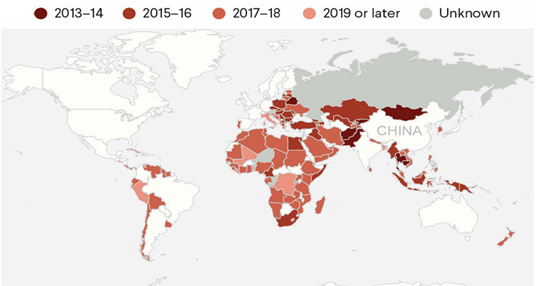
The Belt and Road Initiative, with the support of state-owned banks and Chinese companies, is displacing U.S. exports and challenging American firms in BRI countries. Consequently, the United States has increasingly moved closer to African countries to counter China’s influence. Recently, the House of Representatives voted to continue trade programs such as the African Growth and Opportunity Act (AGOA), which protect and strengthen U.S. strategic, economic, and national security interests, including access to critical minerals found outside the country. In this way, AGOA seeks to challenge the economic coercion and exploitation of African nations by China and Russia (Ways & Means, 2026). This approach has also been pursued during the foreign policy of former President Joe Biden. In 2022, the Secretary of State of the Biden administration, Antony Blinken, launched the U.S. Strategy Toward Sub-Saharan Africa, which reinforced the view that African countries are geostrategic actors and key partners on urgent issues, ranging from promoting an open and stable international system to shaping the technological and economic future (U.S. Department of State, 2022). In this context, Blinken stated: “Africa is a major geopolitical force. It has shaped our past, it is shaping our present, and it will shape our future” (US Africa Media Hub, 2022). In 2022, Blinken indicated that even as President Putin’s war continues, they remained focused on the most serious and long-term challenge to the international order: the People’s Republic of China. This is because it is the only country with both the intention to reshape the international order and has the economic, diplomatic, military, and technological power to do so. Consequently, Blinken stated: “China is a global power with extraordinary reach, influence, and ambition. It is the second-largest economy, with world-class cities and public transportation networks. It is home to some of the world’s largest technological companies and seeks to dominate the technologies and industries of the future. It has rapidly modernized its military and aims to become a top tier fighting force. And it has announced its ambition to create a sphere of influence in the Indo-Pacific and to become the world’s leading power” (Blinken, 2022). Consequently, the United States has sought to consolidate its bilateral relations in regions where China has a greater presence. However, U.S. power in the international system relies on the strength of the dollar. The petrodollar system helps sustain the dollar’s status as the world’s reserve currency. In 1974, Saudi Arabia and other regional oil suppliers agreed to accept only dollars for the sale of oil in exchange for military aid and equipment from the U.S. In addition, the Saudis invested the surpluses from that production in U.S. Treasury bonds, thereby financing U.S. spending (Wong, 2016). This process, commonly called “petrodollar recycling,” is beneficial for the parties involved: oil-producing countries have a reliable destination to invest the income from their exports, while the United States ensures a source of financing to cover its fiscal deficit. Consequently, countries seeking to purchase oil must do so using U.S. dollars, which drives demand for this currency in international markets (Grant, 2018). Since that time, the oil market has been trading in dollars, increasing demand for the currency. The predominance of the dollar as the world’s reference currency gives the United States enormous geopolitical influence, with the ability to impose sanctions on countries it considers adversaries, freeze dollar-denominated assets, or exclude a country from the international financial system, paralyzing its foreign trade or complicating the import of raw materials priced in that currency, such as oil. This mechanism represents one of the foundations of U.S. power and allows it to maintain its status as a hegemonic power. However, if oil trade were to begin taking place in another currency, it would affect the dominant position of the United States. Within this framework, the United States has prevented rival countries from attempting to displace the supremacy of the dollar, such as the members of BRICS. This bloc has sought to reduce dependence on the dollar by using local currencies for trade. One example is the BRICS Pay initiative, a cross-border digital payment system being developed by the BRICS countries. This means that trade among its members could be settled directly in reais, rubles, rupees, yuan, or rand, with the system managing conversion, clearing, and settlement without routing transactions through the U.S. dollar. The initiative is part of a broader strategic effort to reduce dollar dependence, strengthen financial sovereignty, and create alternative global payment infrastructures outside systems controlled by the West (BRICS, 2026). With the creation of the BRICS New Development Bank, there has been speculation that they could launch a common currency as a strategy for de-dollarization. Given this possibility, many market operators advocate for the currency to be digital, backed by gold or other resource assets. If the project materializes, the implications for the international monetary system and financial markets would be significant (Lissovolik, 2024). The United States was aware of this possibility. When the BRICS 2025 summit was held, Trump stated that the bloc is not a serious threat, but that they are attempting to destroy the dollar so that another country could take control. “If we lose the dollar as the global standard,” he declared, “it would be like losing a great world war; we would no longer be the same country. We will not allow that to happen” (Messerly et al., 2025). Later, on his Truth Social account, he wrote: “Any country that aligns with the BRICS’ anti-American policies will receive an additional 10% tariff. There will be no exceptions to this policy” (Reuters, 2025). Although there is still no BRICS currency, the United States has anticipated its potential effects. Dollar supremacy also gives the U.S. the power to sanction or economically isolate certain countries, such as Russia in 2022. In response to the invasion of Ukraine, the European Union, the United States, Canada, and the United Kingdom agreed to exclude several Russian banks from the international payment messaging system SWIFT. This decision was one of the most forceful sanctions within a set of measures aimed at economically isolating Russia and, consequently, weakening its financial system, with the goal of pressuring Vladimir Putin’s government to end its military operations in Ukraine (Pérez, 2022). Therefore, Russia has conducted its commercial transactions in another currency, such as the Chinese yuan. In this context, the growing weight of the Chinese currency in financial markets could erode the primacy of the dollar, a trend that began to concern Washington. In this scenario, Venezuela announced in 2017 that the country was prepared to sell oil to China and receive payments in yuan, thus making international agreements using a currency other than the dollar (Valladares & Medina, 2017). In 2023, Petróleos de Venezuela Sociedad Anónima (Pdvsa) announced that PetroChina International Corp purchased one million barrels of Venezuelan crude, a transaction carried out in digital yuan through the Shanghai International Energy Exchange. In this way, a trend is marked toward abandoning the dollar as the currency for transactions in the energy market (CIIP, 2023). When the United States intervened in Venezuela this year and captured Nicolás Maduro, it was not only seeking oil but also preventing the displacement of the petrodollar system. As a result, this operation directly affects China, since part of Venezuela’s oil exports to China is used to pay debts, estimated between 10 and 12 billion dollars. The U.S. intervention endangered the flow of discounted Venezuelan oil to China’s teapot refineries and will likely affect the role of Chinese oil companies in Venezuela’s upstream business. The Trump administration has declared that all Venezuelan oil will now flow through legitimate and authorized channels, in accordance with U.S. law and national security. This strategy seeks to prevent any influence over natural resources in the region. Consequently, the U.S. president’s approach of directing all oil flows from Venezuela will negatively impact China, Venezuela’s largest oil customer and a major creditor (Downs & Palacio, 2026). However, it is not only rival countries that have been affected by the U.S. attempt to maintain its hegemony; its allies and strategic partners have also been impacted. In January 2025, Trump posted an image of the map of Canada with the U.S. flag, hinting at a possible annexation. On other occasions, Trump referred to his neighbor as the 51st state. In February of that year, the White House announced an additional 25% tariff on Canadian imports and a 10% tariff on its energy resources (The White House, 2025). As a result, Prime Minister Mark Carney negotiated trade agreements with China, allowing for a mutual reduction of tariffs (Yousif, 2026). On the other hand, Trump generated tensions within NATO when he threatened to annex Greenland by force and warned those who did not support him of increased tariffs. He later declined both measures and assured that a framework agreement had been reached (Holland & Hunnicutt, 2026). Nevertheless, the political damage was already done. Trump’s plan for territorial expansion destroyed an important post-World War II norm: that borders cannot be redrawn by force of arms. Mark Carney stated at this year’s Davos Forum that “great powers have begun using economic integration as a weapon, tariffs as leverage, and financial infrastructure as coercion.” In this way, he indicated that the world order is “in the middle of a rupture, not a transition” (World Economic Forum, 2026). Consequently, the United States, as a hegemonic power, has acted unilaterally, disregarding the rule-based world order, and has even accelerated its breakdown. Therefore, from this background, it can be concluded that the United States has developed geopolitical strategies to remain a global power vis-à-vis rival countries, primarily China. Two strategies can be discerned. First, the U.S. emphasizes national security by securing the Western Hemisphere, reviving the Monroe Doctrine. Second, economic interdependence is intensified through the dollar as the world’s reserve currency, preventing financial alternatives. Moreover, the attention the United States has directed toward Africa responds to the intention to balance China’s growing influence in the region gained through the Belt and Road Initiative. Finally, it can be observed that the Trump administration has set aside soft power (attraction and persuasion) and has relied on hard power mechanisms, such as military threats to annex Greenland, ultimatums to Russia, intervention in Venezuela, and economic sanctions and tariff increases on countries that do not comply with its directives. These measures demonstrate that the United States has lost its capacity for attraction and has had to resort to threats to influence the behavior of other states. In summary, the frequent use of hard power shows that the status of the United States as the leading power has begun to decline, and it is striving to maintain its global hegemony by force, regardless of the consequences for the international order.
Blinken, A. (2022). The Administration’s Approach to the People’s Republic of China. Department of State. https://2021-2025.state.gov/the-administrations-approach-to-the-peoples-republic-of-china/ BRICS. (2026). What Is BRICS Pay and How Does It Work?What Is BRICS Pay and How Does It Work? BRICS. https://infobrics.org/en/post/77791/ CIIP. (2023). Compra de petróleo venezolano en yuanes afianza desdolarización del mercado energético global. Centro Internacional de Inversión Productiva. https://www.ciip.com.ve/compra-de-petroleo-venezolano-en-yuanes-afianza-desdolarizacion-del-mercado-energetico-global/ Downs, E. y Palacio, L. (2026). US Action Threatens Venezuela-China Oil Flows, Debt Repayment, and Investments. Center on Global Energy Policy al Columbia SIPA. https://www.energypolicy.columbia.edu/venezuela-china-oil-ties-severely-impacted-by-us-action/ Grant, J. (2018). The end of the petrodollar? American Foreign Policy Council. https://www.afpc.org/publications/articles/the-end-of-the-petrodollar Holland, S. y Hunnicutt, T. (2026). Trump backs down on Greenland tariffs, says deal framework reached. Reuters. https://www.reuters.com/business/davos/determined-seize-greenland-trump-faces-tough-reception-davos-2026-01-21/ Lew, J., Roughead, G., Hillman, J. y Sacks, D. (2021). Task Force Report N° 79: China’s Belt and Road: Implications for the United States. Council on Foreign Relations. Lissovolik, Y. (2024). Changing the Global Monetary and Financial Architecture: The Role of BRICS-Plus. BRICS Journal of Economics, 5(1). https://brics-econ.arphahub.com/issue/4634/ Messerly, M., Hawkins, A. and Bazail-Eimil, E. (2025). ‘The president is pissed’: Trump's Brazil tariff threat is part of a bigger geopolitical dispute. Politico. https://www.politico.com/news/2025/07/10/trumps-brics-fueled-anger-sparked-50-percent-tariff-threat-on-brazil-00447814 Morgenthau, H. (1949). The Primacy of the National Interest. The American Scholar, 18(2), 207–212. https://www.jstor.org/stable/41205156 Nye, J. (1999). Redefining the National Interest. Foreign Affairs, 78(4), 22–35. https://doi.org/10.2307/20049361 Office of the Historian. (s. f.). Monroe Doctrine, 1823. Milestones in the History of U.S. Foreign Relations. https://history.state.gov/milestones/1801-1829/monroe Pérez, C. (2022). What Does Russia’s Removal From SWIFT Mean For the Future of Global Commerce? Foreign Policy. https://foreignpolicy.com/2022/03/08/swift-sanctions-ukraine-russia-nato-putin-war-global-finance/ Reuters. (2025). Trump says alignment with BRICS' 'anti-American policies' to invite additional 10% tariffs. Reuters. https://www.reuters.com/world/china/trump-says-alignment-with-brics-anti-american-policies-invite-additional-10-2025-07-07/ The White House. (2025). Fact Sheet: President Donald J. Trump Imposes Tariffs on Imports from Canada, Mexico and China. The White House. https://www.whitehouse.gov/fact-sheets/2025/02/fact-sheet-president-donald-j-trump-imposes-tariffs-on-imports-from-canada-mexico-and-china/ The White House. (2026). RUBIO: This Is Our Hemisphere — and President Trump Will Not Allow Our Security to be Threatened. The White House. https://www.whitehouse.gov/articles/2026/01/rubio-this-is-our-hemisphere-and-president-trump-will-not-allow-our-security-to-be-threatened/ Ulubel, Y. (2025). 12 years, over 150 countries: Inside the Belt and Road Initiative's global legacy. China Daily. https://www.chinadaily.com.cn/a/202509/17/WS68ca22caa3108622abca13d4.html US Africa Media Hub. (2022). [@USAfricaMediaHub]. X. https://x.com/AfricaMediaHub/status/1604782790029049858 U.S. Department of State. (2022). Travel to Cambodia, the Philippines, South Africa, the Democratic Republic of the Congo, and Rwanda, August 2-12, 2022. U.S. Department of State. https://2021-2025.state.gov/secretary-travel/travel-to-cambodia-the-philippines-south-africa-the-democratic-republic-of-the-congo-and-rwanda-august-2-11-2022/ Valladares, D. y Medina, J. (2017). Venezuela venderá petróleo a China en yuanes. Ministerio del Poder Popular de Economía y Finanzas. https://www.mppef.gob.ve/venezuela-vendera-petroleo-a-china-en-yuanes/ Ways & Means (2026). House Advances America’s Strategic Interests in Africa and Haiti, Eliminates Payments to Dead People. United States House Comittee on Ways and Means. https://waysandmeans.house.gov/2026/01/12/house-advances-americas-strategic-interests-in-africa-and-haiti-eliminates-payments-to-dead-people/ Wong, A. (2016). The Untold Story Behind Saudi Arabia’s 41-Year U.S. Debt Secret. Bloomberg. https://www.bloomberg.com/news/features/2016-05-30/the-untold-story-behind-saudi-arabia-s-41-year-u-s-debt-secret World Economic Forum. (2026). Davos 2026: Special address by Mark Carney, Prime Minister of Canada. World Economic Forum. https://www.weforum.org/stories/2026/01/davos-2026-special-address-by-mark-carney-prime-minister-of-canada/ Yousif, N. (2026). Canada's deal with China signals it is serious about shift from US. BBC. https://www.bbc.com/news/articles/cm24k6kk1rko
First published in :
World & New World Journal

I studied journalism and, after graduating, I enrolled in the Master’s program in International Relations at the Pontifical Catholic University of Valparaíso, Chile. (I graduated just recently, at the end of last November). I wrote my master’s thesis on the leadership of the United States in global health diplomacy post-COVID-19. That is when I began studying U.S. foreign policy and its Global Health Strategy, which also involves competition with China in various areas. I have written articles on U.S. policy that have been published in media outlets. Currently, I am analyzing the role of religion and how it influences international relations.
Beyond Borders: Türkiye’s Growing Footprint in the Western Indo-Pacific Amid Global Instability
Opinion – As Israel Pushes for Annexation, Is There Hope for Palestinians?
Sudan’s latest peace plan: what’s in it and does it stand a chance?
Secretary of State Marco Rubio at the 50th Regular Meeting of the Conference of CARICOM Heads of Government
Unlock articles by signing up or logging in.
Become a member for unrestricted reading!