Subscribe to our weekly newsletters for free

Subscribe to an email

If you want to subscribe to World & New World Newsletter, please enter
your e-mail

Defense & Security
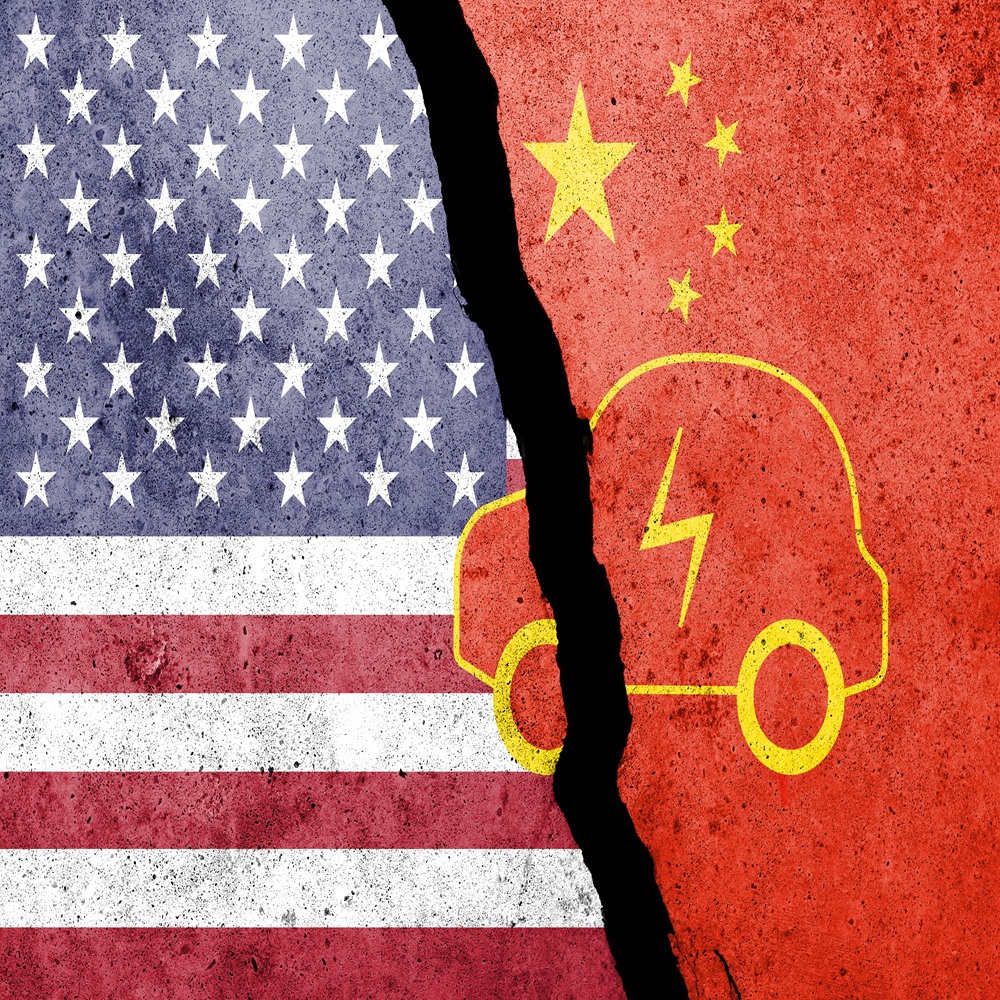
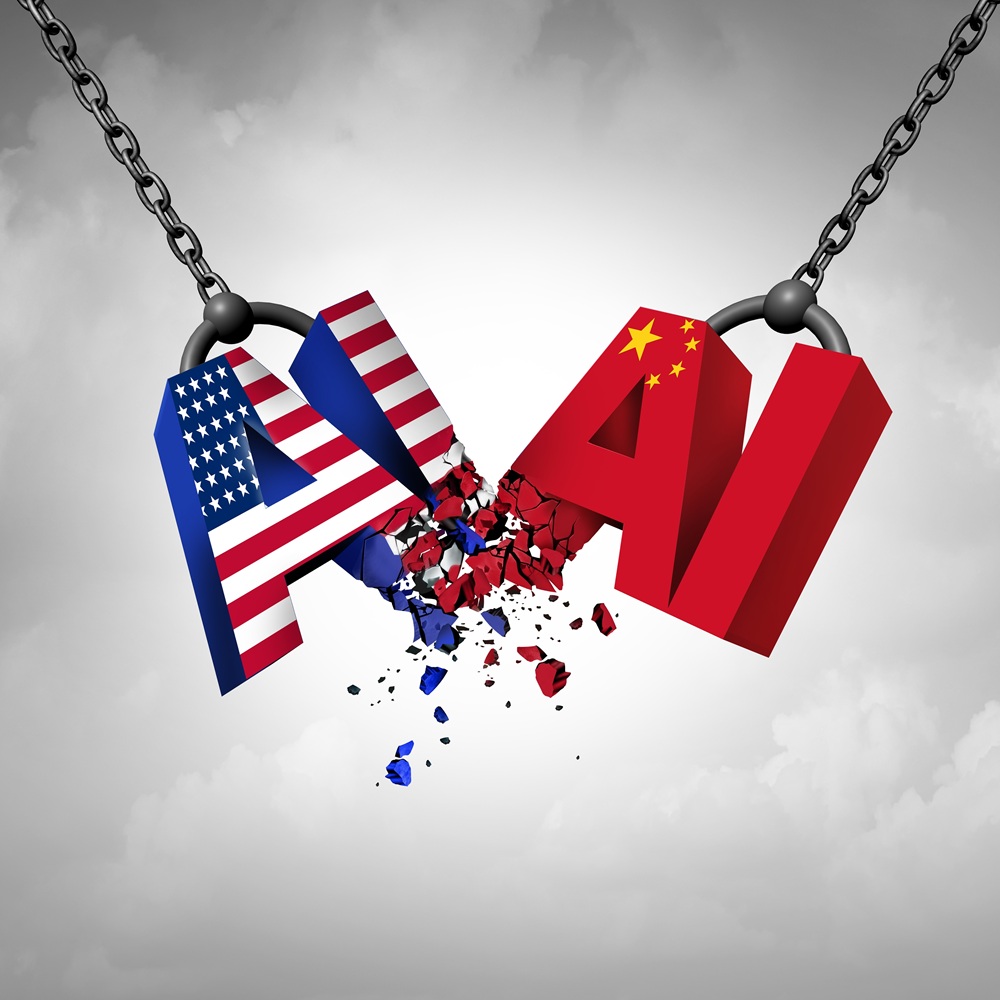
AI US China Technology War as Chinese and American Technology competition for technological dominance and artificial intelligence trade war or national security risk as a 3D illustration.

The high-Tech Cold War: US-China Rivalry and the Battle for Global Innovation

by Eraj Farooqui

Since the 1970s, the US-China relationship has been defined by a combination of cooperative and competitive objectives. Competitive interests, however, have prevailed, resulting in a rising competition between the two countries. (Pillsbury, 2015) Candidates in the 2016 presidential election treated China as an adversary, with Donald Trump's China-bashing becoming a trademark of his campaign. Rivalry with China has become the organising premise of American foreign policy under Trump's administration. Republicans and Democrats differ on most issues, but they agree on the need to change America's approach towards China. This has sparked speculation about whether the US-China relationship has devolved into a possibly violent clash or a new Cold War. The Trump administration has openly announced a shift in US policy towards China, with Matt Pottinger claiming that the US has modified its China policy to emphasise competition. Former Vice President of Trump Pence stated that the United States will combat China aggressively on all fronts, including economic, military, diplomatic, political, and ideological. This statement is regarded as "the declaration of a new Cold War." (Pence’s, 2018) Former Trump advisor Stephen K. Bannon has declared economic war on China, blaming its exports on the American working and middle classes. Many people agree that China is economically dominating America, and the US government and industry have done little to solve the situation. Globalists such as Madeline Albright, Tom Friedman, and Fareed Zakaria have grown increasingly concerned about China's lack of reciprocity in economic dealings with the United States. David Lampton, a pro-engagement advocate, has criticised China's WTO membership for increasing bilateral trade surpluses. (Staff R. , 2017) The second stage began when Donald Trump determined to halt Chinese commercial and technological advancements, renouncing liberal internationalism in favor of a new grand strategy against China. (Drezner D. R., 2021) The growing view of Xi Jinping as a harsh leader with an aggressive foreign policy contributes to the sense of an ideological clash. China and the United States have initiated an unconstrained war for bilateral, regional, and global dominance, ushering in a new age of strategic conflict that has yet to be fully defined. (Rudd, 2020) The US-China conflict appears to be a Cold War, and any return to a pre-2017 environment of "strategic engagement" with Beijing is no longer politically viable. (Rudd, 2020)However, (Zakaria, 2019) does not feel that the liberal international order has deteriorated as much as is widely assumed, and China is far from a grave threat to the liberal international system. Despite the best intentions of both countries, the US-China relationship is more likely to devolve into economic and military competition. (Lake, 2018) China's strategy aims to modernize its industrial capacity and secure its position as a global powerhouse in high-tech industries. The strategy aims to reduce reliance on foreign technology imports, increase Chinese-domestic content of core materials, and upgrade its dominant position in major strategic industries, such as pharmaceutical, automotive, aerospace, semiconductors, and most importantly, IT and robotics. The 14th Five-Year Plan of China (2021-2025) emphasizes high-quality growth driven by green and high-tech industries, service sectors, and domestic consumption. The US judged China's old growth model as generating a somewhat balanced win-win relationship between the two economies, based on "comparative advantage" and "cost-benefit" evaluations. However, Beijing's new growth model, particularly the "Made in China 2025" aspiration, is perceived as competition with the US service and knowledge economy, resulting in trade and high-tech warfare between the two countries since 2018. (Bernal-Meza L. X., China-US rivalry: a new Cold War or capitalism’s intra-core competition?, 2021) The US business community, once a staunch supporter of engagement, has complained that China has hacked American industrial secrets, created barriers to American firms investing in China, enforced regulations that discriminate against foreigners, maintained high tariffs that should have been reduced decades ago, and blocked American Internet businesses. In a rare joint statement by the allies, the intelligence chiefs of the Five Eyes countries convened on Tuesday to charge China with stealing intellectual property and using artificial intelligence to hack and spy on the countries. (Bing, 2023) The officials from the United States,Britain,Canada,Australia and Huawei,for example,has tight relations with the Party and has been accused of stealing intellectual property as well as spying on Western countries. The United States is concerned about Huwaie's 5G supremacy, which is why it’s CEO, Meng Wan Zhou, was arrested in Canada. Indeed, its importance was highlighted when the United States imposed restrictions restricting, and in some cases prohibiting, Chinese telecoms operations in the American market, and launched a global effort to persuade friends, partners, and others to follow suit. Thus, while President Trump allowed one company (ZTE) a respite from what appeared to be a ban that would put it out of business, later American limitations on Huawei threatened to destroy China's premier international technology company's global viability. (Goldstein, 2020) When it comes to both green technology and chips, it is now at the center of American politics. The CHIPS Act, approved by Congress last year, included $52 billion in grants, tax credits, and other subsidies to stimulate American chip production. That's the kind of industrial policy that would make Hamilton gape and clap. Over the next few years and decades, China will pour vast sums of money into its own industrial strategy programmes, spanning a wide spectrum of cutting-edge technology. According to one Centre for Strategic and International Studies researcher, China already spends more than 12 times as much of its GDP on industrial programmes as the United States. (BROOKS, 2023) Certain social media sites, such as Facebook and Google, are prohibited in China.In the United States, there is a restriction on TIKTOK and WECHAT. To counter China, the United States has implemented a number of statutes, including the: 1.COMPETES Act 2020.: The House Science, Space, and Technology Committee decided to advance the America Competes Act of 2022, which intends to improve America's scientific and technology efforts in the twenty-first century in order to compete with China in vital fields. The bipartisan Act is divided into eleven sections, with Division K headed "Matters Related to Trade." Trade Adjustment Assistance, Import Security and Fairness Act, National Critical Capabilities Review, Modification and Extension of Generalized System of Preferences, Reauthorization of the American Manufacturing Competitiveness Act of 2016 and Other Matters, and Temporary Duty Suspensions and Reductions are the seven sections of the Act. President Joe Biden has indicated his support for the Act, arguing that it will strengthen America's supply chains and reenergize the economy's innovation engine, allowing it to compete with China and the rest of the globe for decades to come. 2.Chips and Science Act 2022: President Joe Biden signed the Chips and Science (or CHIPS) Act into law, promising local semiconductor producers more than $50 billion to expand home output and "counter China." (Cosgrove, 2023) 3.The United States passed the Inflation Reduction Act 2022: Although China now dominates clean technology manufacturing, the Inflation Reduction Act contains provisions geared primarily at strengthening the United States' clean energy supply chain. Furthermore, the global transition to clean technology such as solar panels and electric vehicles is unavoidable and ongoing as they become more affordable than fossil-fueled alternatives and countries take action to achieve their Paris climate obligations. (NUCCITELLI, 2023) CHIP War After failing to achieve an agreement with Chinese regulators, Intel cancelled a $5.4 billion takeover deal with Israel-based Tower Semiconductor. China is one of Intel's most important markets, and on July 3, Beijing announced a license requirement for exporters of gallium and germanium, rare-earth metals used in semiconductor manufacturing. The chip war is mostly motivated by the United States' concerns about China's military exploitation of semiconductor technology. However, China's military sector has a key weakness: most of its cutting-edge applications rely on foreign technological inputs, particularly microprocessor exports. China will be the world's largest buyer of semiconductor manufacturing equipment in 2021, accounting for 26% of worldwide demand. Biden established an export license requirement in October 2022, limiting China's access to semiconductor innovations manufactured by US corporations. In July 2023, Japan officially prohibited the sale of 23 types of semiconductor equipment to China, which is significantly more widespread than the US restriction, impeding China's development of advanced chips and basic chips used in technology such as automobiles and smartphones. The Netherlands Standing Committee on Foreign Trade and Development Cooperation said in September that it will begin limiting its semiconductor technology exports to China. According to Nikkie Asia, this new legislation would prohibit the Dutch ASML from exporting innovative chip manufacturing methods without first getting government-approved licenses. (CHENG TING-FANG, 2023) These export limitations have pushed Beijing to retaliate, with China's most recent regulation on gallium and germanium shipments serving as a direct retaliation to the US' global allies. According to the New York Times Magazine, Taiwan manufactures more than 90% of the world's most advanced microchips and could risk armed confrontation if China goes on the offensive in the future. (Palmer, 2023) Former national security advisor Robert O'Brien, on the other hand, believes that in the case of an impending invasion,the US would destroy Taiwan's semiconductor manufacturers rather than allow them to fall into the hands of China. The chip battle has further pushed Taiwan into an awkward position in the changing geopolitical landscape. (Carr, 2023) The Biden administration intends to restrict shipments of advanced artificial intelligence chips designed by Nvidia to China as part of a broader set of actions aimed at preventing Beijing from gaining advanced US technologies to enhance its military. The action is intended to address regulatory gaps and limit China's access to advanced semiconductors, which might feed AI advances and sophisticated computers crucial to Chinese military purposes. Gina Raimondo, Secretary of Commerce, emphasised that the administration's goal is not to harm Beijing economically. (Alexandra Alper, 2023) In the words of Lampton, "There was a widespread public perception that the Sino-American economic playing field had been unfair to Americans, with the assertion that the American economy was hollowed out, in part due to overt and covert technology transfer to China" (Lampton, 2015) . China's new growth strategy is leading to more rivalry than complementarity in the China-US economic partnership. The fact that "China's achievement in moving up in the global supply and value chains has led to Beijing's larger share of global surplus and the reduction of the profit margin for traditional core states" has disturbed the United States. (Li X. , 2020) As Lenin would have argued, the dynamics of the US-China rivalry are an inter-imperial rivalry driven by inter-capitalist struggle. Competition for the global market could quickly escalate into escalating confrontations of zones of influence, if not war. Conclusion The US-China rivalry is characterised by a complex interplay of economic, technological, and ideological issues. Although the relationship resembles a new Cold War, some argue that it is best understood as a capitalist intra-core competition driven by inter-imperial rivalry. As Lenin foresaw, competition for global markets may escalate into conflicts over areas of control. The contest is likely to last and have an impact on the global order for many years to come since both nations have made large investments in industrial strategy and technology. Advanced semi-conductors and AI chips are necessary for the next race for technological supremacy. 6G telecom and quantum computing. The globe was forced to protect the supply chain for rare earth materials due to this high-tech rivalry. Since they are currently the epicentre of the world's military and economic might. For many years to come, its influence will shape international politics, trade disputes, and technological advancements. Global struggle for these minerals is anticipated in the twenty-first century, much like the wars for oil and gas in the twentieth. Rare earths will be the focus of the twenty-first century. Mineral-rich nations like Brazil, India, Australia, and Vitenam will also become strategically significant for other reasons. As competition for these resources intensifies, international relations will shift and geopolitical alignment will result. 5Gs is no longer the focus of this new technical cold war. It now comes down to controlling the basic materials that enable technology. For this reason, JD Vance adds, "Give us your financial resources, and we'll take care of you." In the trade and technology conflict that has intensified since the Biden Administration increased the restrictions on sales of cutting-edge American technology to China, the Pentagon has designated rare earth as a strategic mineral that is essential for US defence.In response to US technology sanctions, China restricted the export of rare earth materials.It has nothing to do with economics, but rather with military supremacy on a worldwide scale. This is how the US sees the discovery of these rare earth minerals. Donald Trump is threatening Canada, Greenland, and Ukraine for this reason. Due to their large stockpiles of rare earth materials, they are able to protect the global supply chain in this way.Interestingly, however, China produces 63% of rare earth minerals and refines 83% of them. It can store 44 million metric tonnes of reserves in this manner. The US would still have 4-5 million tonnes of metric reserves if it were to seize the deposits of Greenland, Canada, and Ukraine.Thus, they are negligible compared to 44 million metric tonnes in China. If China wisely controls its rare earth export strategy, it will be powerful enough to remind the world of its might without being overly harsh. Then it can demonstrate that Beijing is just as adept at using resources as Washington is at using dollars or sanctions. However, if the world manages to get past it or if China's grip wanes, its greatest advantage may begin to diminish. The next few months are critical because tanks and missiles are not being used in the largest power fight this time. Minerals and magnets will be used to combat it. Bibliography Alexandra Alper, K. F. (2023, October 18). Biden cuts China off from more Nvidia chips, expands curbs to other countries. Retrieved from Reuters: https://www.reuters.com/technology/biden-cut-china-off-more-nvidia-chips-expand-curbs-more-countries-2023-10-17/Bernal-Meza, L. X. (2021, May 1). China-US rivalry: a new Cold War or capitalism’s intra-core competition? Revista Brasileira de Política Internacional, vol. 64, no. 1. Retrieved from https://www.redalyc.org/journal/358/35866229009/html/#B39Bing, Z. S. (2023, May 23). Chinese hackers spying on US critical infrastructure, Western intelligence says. Retrieved from Reuters: https://www.reuters.com/technology/microsoft-says-china-backed-hacker-targeted-critical-us-infrastructure-2023-05-24/BROOKS, D. (2023, March 23). The Cold War With China Is Changing Everything. Retrieved from The NewYork Times: https://www.nytimes.com/2023/03/23/opinion/cold-war-china-chips.htmlCarr, E. (2023, August 22). The 2023 US–China Chip War: The Nexus Of High Tech And Geopolitics. Retrieved from Forbes: https://www.forbes.com/sites/earlcarr/2023/08/22/uschina-chip-war-the-nexus-of-high-tech-and-international-relations/?sh=618bc5ed1bd3CHENG TING-FANG, L. L.-B. (2023, June 30). Netherlands unveils chip tool export curbs in fresh blow to China. Retrieved from Nikkei Asia: https://asia.nikkei.com/Business/Tech/Semiconductors/Netherlands-unveils-chip-tool-export-curbs-in-fresh-blow-to-ChinaCosgrove, L. (2023, May 5). Lawmakers Tout Effect of CHIPs Act in US Competition with China. Retrieved from THE EPOCH TIMES: https://www.theepochtimes.com/us/lawmakers-tout-effect-of-chips-act-in-us-competition-with-china-5243151Drezner, D. R. (2021, May/June 13). The end of grand strategy. Retrieved from Foreign Affairs,: https://www.foreignaffairs.com/articles/world/2020-04-13/end-grand-strategyGoldstein, A. (2020). US–China Rivalry in the twenty-first century: Déjà vu and Cold War II. China International Strategy Review volume 2,, 48-62.Kautsky, K. (1914, September 11). Ultra-imperialism. Der Imperialismus," Die Neue Zeit, 32 (1914), Vol. 2, 908-922. Retrieved from https://www.marxists.org/archive/kautsky/1914/09/ultra-imp.htmLake, D. A. (2018). Economic openness and great power competition: lessons for China and the United States. The Chinese Journal of International Politics 11, no. 3, 237-70.Lake, D. A. (2018). Economic openness and great power competition: lessons for China and the United States. The Chinese Journal of International Politics 11, no. 3, 237-270.Lampton, D. (2015, June 2). David Lampton on “A Tipping Point in U.S.-China Relations”. Retrieved from COUNCIL PACIFIC AFFAIRS: https://www.councilpacificaffairs.org/news-media/security-defense/dr-david-lampton-on-a-tipping-point-in-u-s-china-relations/Li, X. (2020). The rise of China and its impact on world economic stratification and re-stratification. Cambridge Review of International Affairs 34, no. 4 , 530-50.NUCCITELLI, D. (2023, September 20). The Inflation Reduction Act is reducing U.S. reliance on China. Retrieved from The YALE Climate Connection: https://yaleclimateconnections.org/2023/09/the-inflation-reduction-act-is-reducing-u-s-reliance-on-china/Palmer, A. W. (2023, August 11). An Act of War’: Inside America’s Silicon Blockade Against China. Retrieved from The NewYork Times Magazine : https://www.nytimes.com/2023/07/12/magazine/semiconductor-chips-us-china.htmlPence’s, P. J. (2018, October 5). China Speech Seen as Portent of ‘New Cold War’. Retrieved from New York Times. : https://www.nytimes.com/2018/10/05/world/asia/pence-china-speech-cold-war.htmlPillsbury, M. (2015). The Hundred-Year Marathon: China's Secret Strategy to Replace America as the Global Superpower . Henry Holt and Co.Rudd, K. (2020, May 6). The coming post-COVID anarchy. Retrieved from Foreign Affairs: https://www.foreignaffairs.com/articles/united-states/2020-05-06/coming-post-covid-anarchyStaff, R. (2017, August 17). Trump adviser Bannon says U.S. in economic war with China: media. Retrieved from Reuters: https://www.reuters.com/article/us-usa-china-bannon-idUSKCN1AX0DEZakaria, F. (2019, December 6). The new China Scare: why America shouldn’t panic about its latest challenger. Retrieved from Foreign Affairs: https://www.foreignaffairs.com/articles/china/2019-12-06/new-china-scare 

Defense & Security
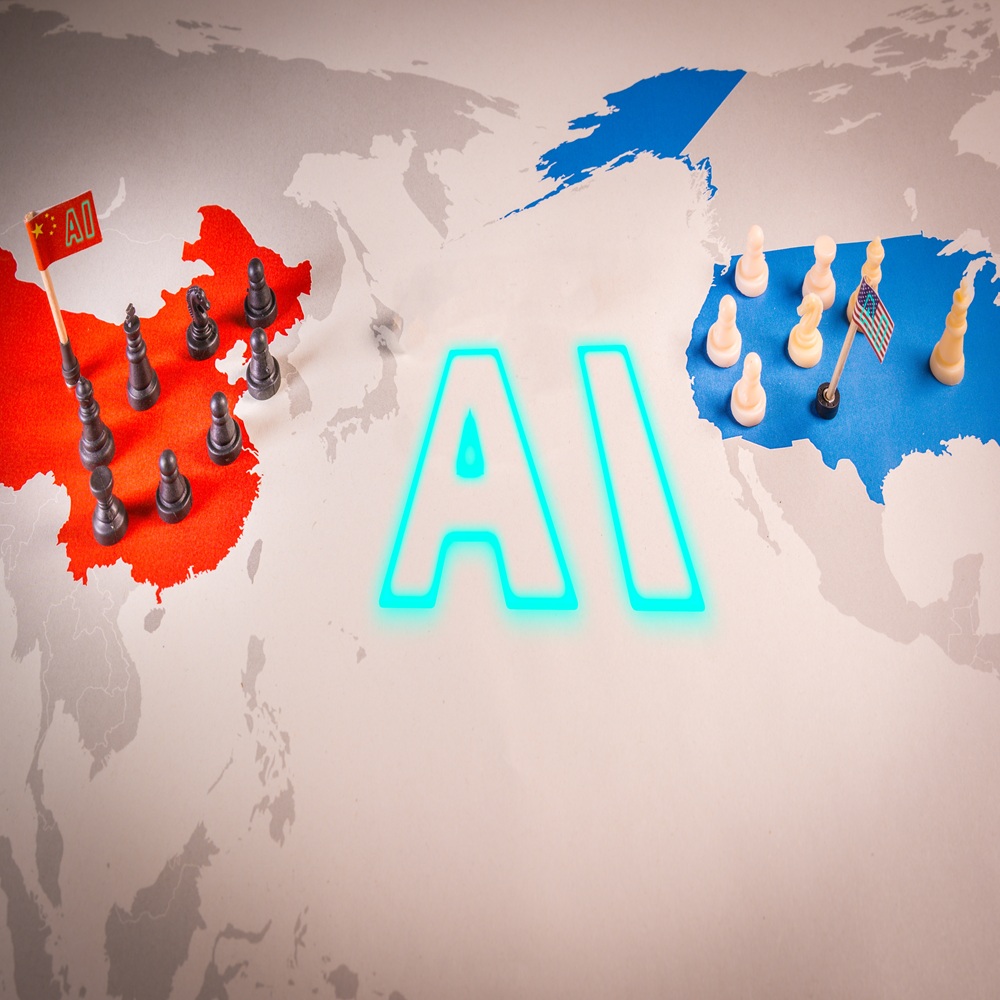
USA and China competing in AI supremacy, represented by chess pieces on a world map highlighting technological rivalry. AI wars between USA and china concept.

Emerging global AI order: a comparative analysis of US and China's AI strategic vision

by Hammad Gillani

Introduction   The 21st century global politics has now taken a new shape with the advent of artificial intelligence (AI). The traditional nature of great power rivalry revolves around military maneuvers, defensive-offensive moves, and weapons deployment to challenge each other, maintaining their respective hegemony over the international arena. The revival of artificial intelligence has reshaped the conventional great power game.(Feijóo et al. 2020) From now onwards, whenever the strategic circles discuss the security paradigm, AI has to be its part and parcel. The emergence of AI has altered the status quo, where major powers are now shifting towards AI-based technology. As the most basic function of AI is to create such machines and platforms that can perform tasks more proficiently than humans, it has the ability to enhance decision-making, increase efficiency, and reduce the likely risk of human errors. But at the same time, risks are also lingering.   The United States (US) and the People's Republic of China (PRC) are considered to be the main players of great power politics. Their rivalry has long been centered around territorial conflicts and maritime contests. With the PRC claiming most of the territories in the South China Sea and East China Sea, the US, under its Indo-Pacific Strategy (2022), has challenged the Chinese assertion.(Hassan and Ali 2025) But what the world has witnessed is that both economic hegemons have been avoiding any direct military conflict with each other. The most prominent area where both the US and the PRC are now in a continuous competition is the technological domain. China has always maintained an edge over the US in the respective field due to the fact that it holds most of the world’s known rare earth minerals—a key to technological superiority. Through trade barriers, i.e., tariffs, quotas, etc., and restricting trade with prominent Chinese companies, the US has always tried to contain technological developments in China.(Wang and Chen 2018)   “The reality is that both China and the United States are focused on getting the infrastructure necessary to win the so-called AI race. Now, whether it’s actually a race is a separate question, but data, energy, and human capital are all critical inputs to this. The massive investment infrastructure is top of mind for leaders in both countries as they seek to do it. China’s access to the advanced technology and semiconductors is going to be a key cornerstone in this regard.”(Sacks, 2025) US and China have placed AI at the center of their national policies and global strategies. Both have been introducing various policy papers, strategies, and action plans for the advancements in the field of artificial intelligence and how to counter the side. Now, the international arena is witnessing two parallel AI setups: one created by the US and the other by China. As both are tremendously investing in research, development, and innovation in artificial intelligence, their national narratives and global plans are competing with each other, further exacerbating the international AI landscape.   This paper aims to critically analyze key policies highlighted under the national action plans and strategies launched by the US and the PRC, respectively. Applying the theoretical lens of constructivism, which deals with the role of ideas, norms, and values in shaping the international system, the paper will demonstrate key differences between the AI strategies of the US and China and how their ideological beliefs shape their respective AI policies. Moreover, the analysis will provide expert views on the future landscape of the AI race, its relation to the Great Game, and its political, economic, and military repercussions for the rest of the world. Furthermore, the analysis will mostly rely on expert interviews, key excerpts from official administrative documents, and research findings. This study will also provide insights into the Trump 2.0 administration’s policy outlooks vis-à-vis Beijing’s National AI policy.   America’s AI Action Plan 2025   President Trump unveiled his administration’s national strategy on artificial intelligence on 23rd July 2025. Entitled as “Winning the Race: America’s AI Action Plan”, this strategy is a long-term road map to counter and contain China’s growing profile in the tech world, in particular the AI.(White House, 2025) The title of the strategy explicitly announces that the US has entered into the global AI race. Under this strategy, the United States does not want to eliminate China, rather the US desires to lead the AI world as a core nation, while the PRC should operate as a periphery nation. On July 15 2025, while addressing the AI Summit in Pittsburgh, President Donald Trump stated, “The PRC is coming at par with us and we would not let it happen. We have the great chips and we have everything great. And, we will be fighting them in a friendly fashion. I have a great relationship with President Xi and we smile at the back and forth, but we are leading…...”(AFP, 2025)   America’s AI Action Plan: Key Pillars   A. Accelerate AI Innovation   This first pillar of the AI national strategy by the US deals with the fact that AI should be integrated into every sector of American lives. From the grassroots level to the national or international level, the US should be a leading AI power. AI innovation states that any type of barrier, i.e., legal, regulatory, or domestic constraints, must be eradicated at first to promote, enhance, and boost AI innovation in the US. The strategy clearly states the innovation in artificial intelligence to be the fundamental step towards AI global dominance. The American beliefs, values and norms hold much significance in this regard. This strategy laid down the framework where AI platforms and models should have to align with the US democratic principles, including free speech, equality, transparency, and recognition. This means that the US AI action plan will operate under the umbrella of capitalist ideology.(White House, 2025)   Another most important feature in the field of AI innovation is the conglomeration of public-private ventures. Both the governmental authorities and public institutions are provided with such policies and frameworks to integrate AI platforms into their day-to-day operations. Creating an AI ecosystem is the cornerstone of this strategy.(White House, 2025) It aims to build an American workforce mastered in AI capabilities, defense forces and their key platforms integrated with AI, and provide a secure and safe environment to national and international investors, thus encouraging them to increase their investments in the US. Last but not least, the development of various departments countering the unethical use of AI, i.e., deep fakes, thus securing the national sovereignty and integrity of the homeland.   Principal Deputy Director of the Office of Science and Technology Policy (OSTP), Lynne Parker, while highlighting the significance of the US 2025 AI Action Plan, stated, “The Trump Administration is committed to ensuring the United States is the undeniable leader in AI technology. This plan of action is our first move to enhance and preserve the US AI interest, and we are eager to receive our public perception and viewpoints in this regard.”(House, 2025) The AI innovation drive is indicative of the US being a liberal-democratic and entrepreneurial society. It has an innovation culture that focuses on open research, leadership in the private sector, and ethics based on its national myth of freedom, individualism and technological optimism.   B. Building the AI Infrastructure   This is the most crucial pillar of the US AI Action Plan 2025. From propagating the idea of AI innovation, the next step is to build a strong, secure, and renowned infrastructure to streamline the policy guidelines highlighted in the national AI strategy. This includes the development of indigenous AI factories, companies, data facilities, and their integration into the American energy infrastructure. The most significant step highlighted in this pillar is the construction of indigenous American semiconductor manufacturing units.(White House, 2025) Now what does it mean? As of today, China is considered to be the center of semiconductor manufacturing. Semiconductors are the basic units of any technology, i.e., weapons, aircraft, smartphones, etc. The US has long been importing semiconductor chips from China. Integration of the US energy infrastructure with that of the AI facilities is the ultimate objective of this strategy. Immense energy-producing units, i.e., electricity, under the ‘National Energy Emergency Act’ would be established to provide a continuous supply of electricity to AI data centers and facilities without any hindrance.(House, 2025)   But the Trump 2.0 administration, under its protectionist policies, aspires to restrict imports from China and build a domestic semiconductor processing unit. Highlighting the American dependence on Chinese chips, the American chemist and politician John Moolenaar stated, “The Trump administration has made one thing abundantly clear: we must reassert control over our own economic destiny. That’s not isolationism; that’s common sense. The Chip Security Act, outbound investment restrictions, and stronger export controls—those aren’t closing ourselves off. They are about ensuring America isn’t subsidizing or facilitating our own decline. The Chinese Communist Party (CCP) is using American capital to fund aircraft carriers, fighter jets, and AI systems that target our allies and threaten our freedoms.”(Moolenaar, 2025)   The norm of decentralized innovation is applied in developing the infrastructure, and it empowers universities, startups, and private corporations. This is an expression of confidence in market mechanisms and civil liberties, which is in line with its social values of open innovation and competition.   C. AI Diplomacy and Security   The last pillar of the US AI national action plan is to collaborate with international partners and allies. This simply means to export American AI technology to strategic partners and those with common interests. This will, as a result, give rise to new types of groupings known as ‘AI Alliances.”(White House, 2025) The Global Partnership on AI (GPAI), QUAI AI Mechanism, and US-EU Trade and Technology Council are some of its best manifestations. Like the security and defense partnerships, the AI alliances will enable the US and the West to encircle the PRC in the tech world, where strong western collaborations and partnerships would hinder the PRC from becoming the tech giant or from excelling in AI production. It Encourages responsible AI governance and a democratic form of AI standards of the US, which are based on its self-perception as a global governor of the liberal values.   Thus, in order to enhance AI-related exports to allies, the US has established various institutions, including the US International Development Finance Corporation (DFC). The US AI diplomacy aims to counter China’s growing footprints in the international bodies and institutions.(State 2023) As these global bodies are a key to spreading particular norms and values, shaping the public perception, and framing the global order, the US wants to challenge Chinese entrenchments in these organizations through political and diplomatic coalitions and groupings. Doing this, the West will be able to propagate their version of the global AI order. This means capitalism vs. communism will now be clearly visible in the global AI race between the economic hegemons.   The US Vice President J.D. Vance, while addressing the European Union (EU) leaders in Paris explicitly stated, “The US really wants to work with its European allies. And we wish to start the AI revolution with an attitude of cooperation and transparency. However, international regulatory frameworks that encourage rather than stifle the development of AI technology are necessary to establish that kind of trust. In particular, we need our European allies to view this new frontier with hope rather than fear.”(Sanger 2025) In case of security, the strategy aims to establish various AI Safety Institutes (AISIs) to reduce or eliminate the risk of AI-related accidents, which include errors in AI platforms, most specifically in the AI-operated weapon systems, and the unethical use of AI programs, i.e., generative AI or LLMs. Similarly, the strategy emphasized the danger posed by the non-state actors. These violent actors must be restrained from acquiring such advanced yet sophisticated technology.(White House, 2025)   China’s New Generation Artificial Intelligence Development Plan   For the first time in July 2017, the PRC launched its long-term national AI vision 2030, entitled “New Generation Artificial Intelligence Development Plan,” which is comprised of all the policies, guidelines, and measures to be taken by the Chinese Communist Party (CCP) to foster its AI developments.(Council 2017) China’s AI 2030 vision is none other than the extension of the idea that President Xi Jinping circulated in 2012 regarding China’s future role in the field of Artificial Intelligence (AI). This strategy aims to strengthen China’s AI footprints in the international arena. Ranging from investments to infrastructure, this plan of action explicitly declared to develop the PRC into the hub of AI innovation and investment by 2030. This plan of action is determined to bring about a profit of $160 billion by 2030.(O’Meara 2024) While addressing the Politburo Study Session on 25th April 2025, the Chinese President Xi Jinping noted, “To gain a head start and secure a competitive edge in AI, it is a must to achieve breakthroughs in basic theories, methodologies, and tools. By leveraging AI to drive the transformation of scientific research paradigms, we can speed up achieving breakthroughs in scientific and technological innovation in all sectors.”(Agency 2025)   China’s AI Vision 2030: Key Objectives   A. AI Leadership (2020)   The PRC has successfully accomplished this objective. Under this pillar, China has established significant AI infrastructure, including key facilities and data centers, coming at par with the US. Within this, the CCP urged the academic institutions to promote, enhance, and foster research in the AI domain, which resulted in the major developments in the sectors of big data, swarm intelligence, and super artificial intelligence.(Council 2017) China has successfully established its domestic AI industrial complex worth $22 billion. Various educational institutions, i.e., Tsinghua, Peking, etc., and major companies, i.e., Baidu, iFlyTek, etc., have now completely transformed into AI hubs where research, innovation, and practices are conducted through highly advanced AI platforms.   Commenting on the US-China AI leadership contest, Dr. Yasar Ayaz, the Chairman and Central Project Director of the National Center for AI at NUST, Islamabad, explicitly remarked, “Efficiency is the new name of the game now. Chinese AI inventions and developments clarify the fact that even with the smaller number of parameters, you could achieve the same kind of efficiency that others with an economic edge are achieving.”(Ayaz 2025) The AI leadership symbolically builds the socially constructed narrative of the Chinese Dream and national rejuvenation into the need to overcome the century of humiliation and take its place in the world order. Here, AI leadership is not just a technical objective but a discursive portrayal of the Chinese self-concept of being a technologically independent and morally oriented civilization.   B. AI Technology (2025)   The second most important objective of China’s AI Vision 2030 is to reach a level of tech supremacy in the international arena by 2025. Major work areas include localization of chip industries, advancements in semiconductors and robot manufacturing, etc. The first phase of 2020 basically laid the infrastructural foundation of the plan, while this phase deals with the development and innovation of key AI-operated platforms, including robots, health equipment, and quantum technology.(Council 2017) Another most crucial feature of the 2025 phase is to establish various AI labs throughout mainland China. This would result in the integration of AI into different public-private sectors, i.e., finance, medical, politics, agriculture, etc. Last but not least, a civil-military collaboration is described to be a cornerstone in this regard.   The AI-operated platforms would be utilized by both civil and military institutions, thus preserving the PRC’s national security and safety. Giving remarks over China’s technological edge, Syed Mustafa Bilal, a technology enthusiast and research assistant at the Centre for Aerospace and Security Studies (CASS), added, “China, which for the longest time has been criticized for having a technologically closed-off ecosystem, is now opting for an open-source approach. That was evident by the speeches of Chinese officials at the Global AI Action Summit, in which they tried to frame China’s AI strategy as being much more inclusive as compared to the West. And one illustration of that is the ironic way in which deep search is currently furthering OpenAI's initial selfless objective of increasing AI adoption worldwide.”(Bilal 2025) Thus, the AI vision of China reflects ideational promises of social order, central coordination, and a moral government, ideals that are based on its political culture and civilization background.   C. AI Innovation Hub (2030)   By 2030, China aims to be at the epicenter of global AI innovations, development, and investments. The PRC’s political, economic, and defense institutions will be governed under AI overhang. The most significant feature of this phase is to counter the US-led AI order by challenging the US and the West in various international bodies like the International Telecommunication Union (ITU). The main tenet of China’s 2030 vision is to transform it into a completely AI-driven economy—an AI economic giant.(Council 2017) As the PRC is ruled by the communist regime of President Xi Jinping, China aspires to counter the Western-led AI order through instigating its communist values, including high surveillance, strict national policies, and population control. By avoiding a completely liberal, free speech AI environment in mainland China, the CCP aims to come on par with the US by having authoritative control over its people, thus maintaining its doctrine of ‘techno self-reliance.’   Giving his insights on the new global AI order and the ideological rift between the US and China, Dr. Wajahat Mehmood Qazi, advisor on AI and digital transformation to the private tech companies and faculty member at the COMSATS University, Lahore, explicated, “Yes, there is a digital divide, but the interesting part over here is this: the world is evolving, so this big divide is no more about the decentralization or the centralization. If we look at how China is promoting openness by releasing its foundation models, at the same time the ecosystem of their LM models or AI is still in close proximity. Whereas, the western world is having a different narrative. They are talking about the openness of the models, but at the same time it’s more market-driven. In my view, we are entering into a world where innovation requires openness and closed methods simultaneously.”(Qazi 2025)   The concept of innovation with Chinese features is used to describe a socially constructed attempt to exemplify another approach to technological modernity, which combines dictatorial rule and developmental prosperity. It is a mirror image of self-concept in China as a norm entrepreneur that wants to legitimize its system of governance and impact the moral and technological discourse of AI at the global scale.   Conclusion   The constructivist perspective informs us that the competition between Washington and Beijing is not predetermined; it is being conditioned by the perceptions, suspicion, and competing versions that can be rebuilt through dialogue and mutual rules. The ideological divide can be overcome by creating inclusive tools of AI governance, with transparency, ethical principles, and shared responsibility in their focus. The common ground created through the establishment of a mutual conception of the threats and the ethical aspects of AI will enable the United States and China to leave the zero-sum game on AI and enter into a model of normative convergence and accountable innovation. Constructivism thereby teaches us that cooperation in AI is not just a strategic requirement but also a social option, which is constructed on shifting identities and the recognition of global interdependence with each other.   The great power competition is now in its transformative phase, bypassing the traditional arms race for a more nascent yet powerful AI race. In the context of the US-China contest, administrations on both sides are trying their utmost to launch, implement, and conclude critical national strategies and formulations in the field of artificial intelligence. Both are moving forward at a much greater pace, thus developing advanced technologies in the political, economic, and military domains. Be it China’s Deep Seek or the Western Chat GPT, be it Trump’s Stargate project or Xi’s AgiBot, both are investing heavily into the tech-AI sector. Despite this contest, both economic giants also need joint efforts and collaborations in various matters of concern. Until now, it’s been very difficult to declare which will lead the global AI order. The chances of a global AI standoff are there.ReferencesAFP. 2025. “Trump Vows to Keep US Ahead in AI Race with China.” The News International. Accessed July 24, 2025. https://www.thenews.com.pk/latest/1328672-trump-vows-to-keep-us-ahead-in-ai-race-with-china.Agency, Xinhua News. 2025. “20th Collective Study Session of the CCP Central Committee Politburo.” Center for Security and Emerging Technology, 1–3.Ayaz, Dr. Yasar. 2025. “Global AI Rivalry: U.S vs China.” PTV. Accessed July 24, 2025. https://www.youtube.com/watch?v=_82MMzI_g2c&t.Bilal, Syed Mustafa. 2025. “Global AI Rivalry: U.S vs China.” PTV. Accessed July 24, 2025. https://www.youtube.com/watch?v=_82MMzI_g2c&t.Council, State. 2017. “Next Generation Artificial Intelligence Development Plan.https://digichina.stanford.edu/work/full-translation-chinas-new-generation-artificial-intelligence-development-plan-2017/.Feijóo, Claudio, Youngsun Kwon, Johannes M. Bauer, Erik Bohlin, Bronwyn Howell, Rekha Jain, Petrus Potgieter, Khuong Vu, Jason Whalley, and Jun Xia. 2020. “Harnessing Artificial Intelligence (AI) to Increase Wellbeing for All: The Case for a New Technology Diplomacy.” Telecommunications Policy 44 (6). https://doi.org/10.1016/j.telpol.2020.101988.Hassan, Abid, and Syed Hammad Ali. 2025. “Evolving US Indo-Pacific Posture and Strategic Competition with China.” Policy Perspectives 22 (1). https://doi.org/10.13169/polipers.22.1.ra4.House, White. 2025. “Declaring a National Energy Emergency – The White House.” Accessed July 24, 2025. https://www.whitehouse.gov/presidential-actions/2025/01/declaring-a-national-energy-emergency/.House, White. 2025. “Public Comment Invited on Artificial Intelligence Action Plan – The White House.” Accessed July 24, 2025. https://www.whitehouse.gov/briefings-statements/2025/02/public-comment-invited-on-artificial-intelligence-action-plan/.Moolenaar, John. 2025. “The 2025 B.C. Lee Lecture Featuring Congressman John Moolenaar.” Accessed July 24, 2025. https://www.youtube.com/watch?v=QIIUZlaKofU.O’Meara, Sean. 2024. “China Ramps Up AI Push, Eyes $1.4tn Industry By 2030.” Asia Financial. Accessed July 24, 2025. https://www.asiafinancial.com/china-ramps-up-ai-push-eyes-1-4tn-industry-by-2030-xinhua.Qazi, Dr. Wajahat Mehmood. 2025. “Global AI Rivalry: U.S vs China.” PTV. Accessed July 24, 2025. https://www.youtube.com/watch?v=_82MMzI_g2c&t=.Sacks, Samm. 2025. “China’s Race for AI Supremacy - YouTube.” Accessed July 24, 2025. https://www.youtube.com/watch?v=xaccSxP8pOQ&t=8s.Sanger, David E. 2025. “Vance, in First Foreign Speech, Tells Europe That U.S. Will Dominate A.I.” THe NewYork Times. Accessed July 24, 2025. https://www.nytimes.com/2025/02/11/world/europe/vance-speech-paris-ai-summit.html.State, US Department of. 2023. “Enterprise Artificial Intelligence Strategy,” no. October, 103–13. https://www.state.gov/wp-content/uploads/2023/11/Department-of-State-Enterprise-Artificial-Intelligence-Strategy.pdfWang, You, and Dingding Chen. 2018. “Rising Sino-U.S. Competition in Artificial Intelligence.” China Quarterly of International Strategic Studies 4 (2): 241–58. https://doi.org/10.1142/S2377740018500148.White House. 2025. “Winning the Race: America’s AI Action Plan.” https://www.whitehouse.gov/wp-content/uploads/2025/07/Americas-AI-Action-Plan.pdf

Defense & Security
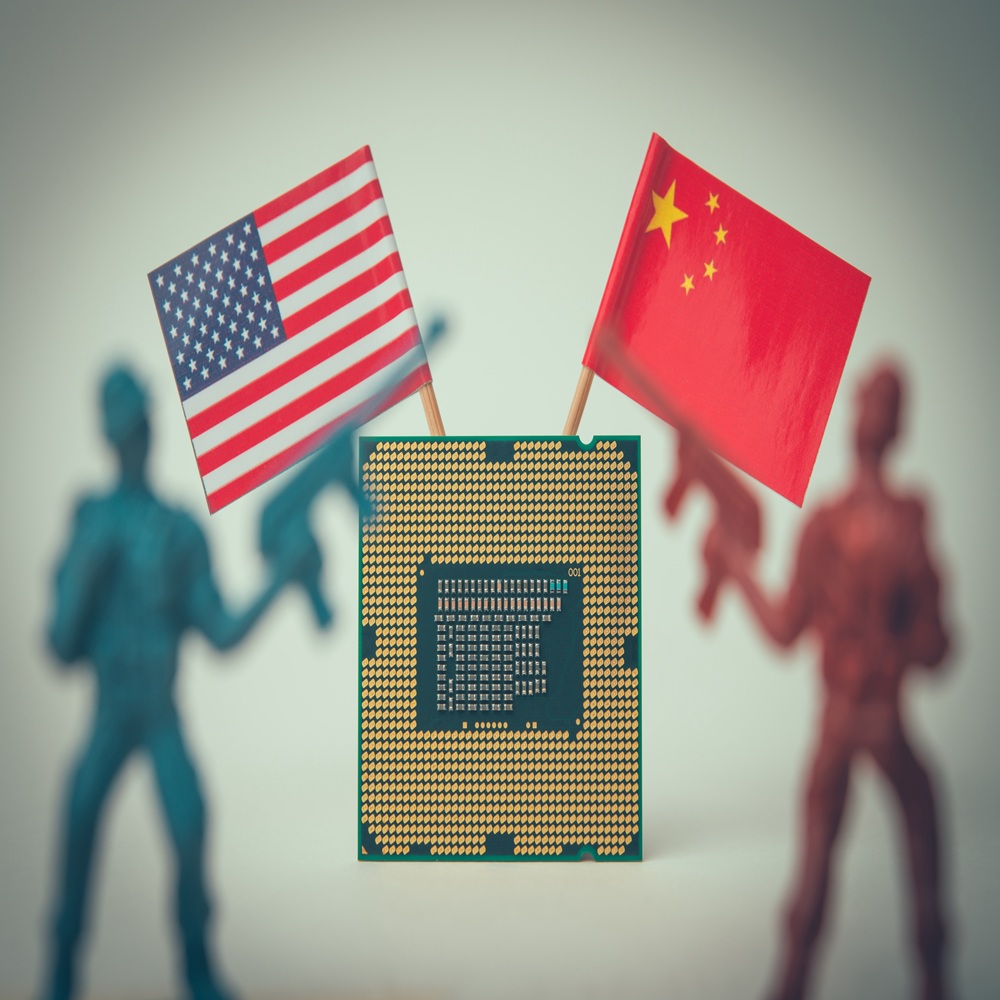
Soldier, CPU computer (central processing unit) US and Chinese flag on white background. US vs China chip war or tech war, semiconductor industry concept. US restrict and control chip export to China.

Superpowers Without Soldiers: Can Technology Replace Traditional Hegemony?

by Syeda Farani Fatima

Introduction Hegemony is the core principle in International Relations. It has been conceptualized through military strength, economic influence, and ideological control. The theory of cultural hegemony by Antonio Gramsci is based on assuming control but not necessarily through force, whereas realist theorists such as John Mearsheimer stress the relevance of military strength for ensuring global dominance (Mearsheimer 2001). The 21st century, though, brought into being a different era of transformation and technological breakthroughs that turned the existing arrangements on their head. With the advent of Artificial Intelligence (AI), cyber war, and space technology, great powers are transforming from traditional soldiers to cyberspace warriors. AI and other cyber tools are altering the strategic equation between major powers, providing avenues for countries like China and Russia to undermine US hegemony (Rooney et al. 2022). Hegemony in the past had been founded on military superiority, but at present, academics have discovered that technological hegemony is leading the way. Lethal Autonomous Weapons (LAWs) and AI have captivated researchers because they can transform war. Cyberspace has become the new battleground of power. The US and China are competing for cyber hegemony (Akdaǧ 2025). Space is increasingly regarded as a new battleground in geopolitics. The US Space Force and China’s BeiDou system illustrate how nations weave surveillance and communication in their strategic decision-making (O’Hanlon 2020). Thus, new technologies are reshaping the China-US rivalry. To counter this, countries are investing in tech-based industries, which will change the way human thinks. The analysis will explore whether emerging technologies can efficiently replace traditional tools of hegemony or not. Joseph Nye’s concept of smart power provides a critical framework in this modern era, where influence may flow from military boots to silicon chips. Global powers are moving towards influence and deterrence-based tech models, supplementing hard power. However, this transition has its risks, such as overdependence and ethical concerns. The paper argues that a complete transformation is not happening, but there will be dual-track hegemony where military and technology will coordinate to dominate. Policy implications of this shift are profound. Global powers must collaborate to draft international norms for AI and cyberwarfare, developing nations must develop their technology rather than dependency on global powers, as it will be easier for them to surveil and dominate, and international institutions must proactively govern the techno-political landscape to prevent destabilization. This study will use a qualitative approach, and it will be a case-based methodology combining theoretical perspectives of philosophers. This analysis is important as it delves into the transformation of the mechanics of global power from military hegemony to technology-oriented hegemony. It uses secondary sources like policy briefs, think tank reports, books, etc. Finally, this analysis concludes that soldiers may never be the first line of every fight, but the battle for global supremacy is firmly human-hinged in decisions on technology, ethics, and governance. Hegemony is a core concept in International Relations, grounded in military capacity, economic influence, and institutional influence. Historically, great civilizations like the Roman and British empires attained hegemony by dominating in naval power, making alliances and expanding their territories. In the post-World War II era, the US built dominance through overseas military bases and nuclear deterrence. Historical Foundations of Traditional Hegemony The Roman Empire, a classic example of past hegemony, attained this power by constructing roads, forts, and legions in the world's islands. Later, the British Empire sustained its dominance by modernizing the Royal Navy and the global trade network. The post-World War II era saw the hegemony of the United States with overseas military bases and security alliances. John Mearsheimer, in his book The Tragedy of Great Power Politics, says that according to great powers, hegemony is the best way to ensure their security (Mearsheimer 2001). Limitations of Traditional Hegemony The primary limitation of the traditional hegemonic model is the risk of overreach, entering into too many overseas agreements that become economically and politically unsustainable. Imperial overstretch, a model proposed by Paul Kennedy, explains the collapse of empires when they are unable to maintain their economy due to huge global aims (Kennedy 1988). Concurrently, we can see that after so many years have passed in the Vietnam, Afghanistan, and Iraq wars, the US is spending trillions. Approximately $3.68 trillion was spent on Iraq and Afghanistan (Costs of War | Brown University 2025). This highlights that military dominance can be costly and unsustainable. Mearsheimer, in an interview at the New York Times, claimed that ‘the United States is responsible for causing the Ukraine crisis’. Lack of legitimacy and local resistance is another great flaw in the traditional hegemonic pattern. For example, in Vietnam, soldiers used their knowledge of geography to push back against America's advanced weapons. Similarly, in Afghanistan and Iraq, foreign-led missions struggled with local insurgents. The New Tools of Technological Hegemony Cyber Power Cyber power has rapidly become a strategic field where states project their influence far beyond the geographic borders, often without soldiers. Cyber operations are dominating in this digital age, and the SolarWinds hack shows how states can achieve global influence through an Information Technology (IT) infrastructure breach. In March 2020, Russian hackers placed a secret backdoor in SolarWinds’ Orion software. This infected around 18000 users, including US major government departments (Cybersecurity 2021). The cyberattacks went undetected for several months, revealing vulnerabilities in the digital network. It was the worst cyber-espionage attack ever, an analyst described. Iran's 2019 cyberattack on the oil infrastructure of Saudi Arabia shows that the acquisition of digital superiority can help influence norms, command the critical infrastructure, and set global political narratives without foreign boots on the ground. To address this vulnerability, it is essential to know cyber deterrence theory. It discusses capability, attribution, and resolution. States should advance digital tools, modify their tracking system and enhance communication and transparency. The most lethal weapon today may not fire a projectile-it fires packets. This metaphor illustrates that state actors can erode adversary national infrastructure, banks and election systems without traditional warfare. The US Secretary of Defense Lloyd J. Austin III described the integrated Deterrence that integrates cyber with land, sea, and space under a unified strategy (Masitoh, Perwita, and Rudy 2025). Cybersecurity experts say that cyberpower is now a geopolitical power. And cyber warfare is not a sideshow; it’s a frontline strategy. Artificial Intelligence (AI) and Big Data AI’s strategic significance for national security has been emphasized by leaders like Jason Matheny, CEO of RAND Corporation. He warns that AI could make it easier to make harmful weapons and dangerous technologies (Matheny 2024). The 2023 report of RAND on AI and Geopolitics argues that AI may be the next frontier in US-China rivalry (Pavel et al. 2023). ChatGPT and Bard, like generative AI models, have humanitarian strategic applications, which makes fake news so believable that it feels like fact. This capability of AI can transform propaganda into scalable digital warfare. Beyond surveillance, AI has transformed military operations tactics. Military applications like drone swarming, algorithmic targeting, and predictive ISR create scenarios where the frontline shifts from kinetic zones to data centers. AI diplomacy is becoming the new foreign aid. Financial Times article notes that tech giants are deploying AI mechanisms in Africa not only for development but for their advantage as an influence tool. Thus, AI and big data are a new form of informational hegemony. Space Militarization and Satellite Dominance Space militarization emerged during the Cold War. States like the US, China, Russia, India, and Japan have developed anti-satellite (ASAT) capabilities (Samson and Cesari 2025). General John Jay Raymond at the US Space Command Launch said that, “Outer space is now recognized as a domain of military operations” (Raymond 2021). China’s 2007 ASAT test, which destroyed its own Fengyun-1C weather satellite, is still a thorn in the eyes of major powers. Russia has also launched missions like Kosmos-2553. Evolution from GPS to GNSS (Global Navigation Satellite Systems) reflects strategic change. The US has GPS, China has BeiDou, Elon Musk’s Starlink satellite constellation, and Europe has Galileo; each system highlights the sovereignty in digital positioning. China’s counterpart doctrine states in its 2021 Space White Paper that space-based assets are not crucial for renaissance only but for strategic deterrence without deploying soldiers or causing deaths of your military men (The State Council Information Office of the People’s Republic of China 2022). Undersea Cables and Digital Infrastructure Control Undersea cables carry over 95% of global data transmission (Sherman 2021). Disruption or surveillance of these cables can impact the worldwide flow of data and diplomatic communications. In developing countries like Pakistan, Kenya, and Ecuador, Huawei-funded infrastructure provides smart city services. Cable route is not just wiring undersea, it is influenced by encryption. The US and EU have Amazon Web Services (AWS), Microsoft Azure, and Google Cloud, like surveillance platforms. Cable-Landing zones (CLZs) are the chokepoints used for manipulation, Cloud interconnection policies allow control of traffic flow, and Surveillance software and firmware installed at data centers can be remotely controlled, bypassing local safeguards. Blocking connections can slow or disrupt foreign economic leverage. Digital infrastructure has become a domain for hegemony that is more insidious in strategic potential. This map exposes the physical foundations of digital power. Nations with greater cable landing nodes, like the U.S. and China, wield asymmetric influence, not through soldiers, but through network control. Disruption or surveillance of these cables can cripple economies or governance. Regional chokepoints also reflect strategic leverage in geo-economics and cyber diplomacy, making this infrastructure as consequential as traditional military bases. Figure 1: This map shows the physical foundations of digital power, nations with greater cable landing nodes, like the U.S. and China, wield asymmetric influence, not through soldiers, but through network control.Superpowers’ Technological Footprint United States Silicon Valley is the heart of US technological hegemony, and some other government agencies, like Defense Advanced Research Projects Agency (DARPA), are contributing to maintaining US technological hegemony. Lethal Autonomous Weapons (LAWs), drones, and defense-grade AI-powered decision-support systems are a tech-military hybrid force. Furthermore, the US controls major pillars of technology like operating systems (Microsoft, Apple, Google dominate desktops and mobile devices), and Satellites. Advanced technologies have enabled remote force projection like drone strikes, executing surgical operations, Cyber Command operations from SolarWinds retaliation, deployment of Overhead Persistent Infrared (OPIR) and Space Based Kill Assessment (SKA), enhancing deterrence. China Made in China 2025 vision aims to displace US techno-hegemony. China’s centralized Social Credit System reflects a template of techno-surveillance hegemony. Beijing is now selling surveillance systems to developing countries, highlighting its tech supremacy. China is controlling telecommunications architecture by promoting Huawei’s 5G worldwide. China’s cyber army, the People’s Liberation Army Strategic Support Force (PLASSF), specializes in offensive and defensive cybertech warfare (The State Council Information Office of the People’s Republic of China 2019). China’s Digital Silk Road links infrastructure investments in Asia and Africa with national encryption systems and cloud data centers. Ethiopian Prime Minister Abiy Ahmed, in a bilateral dialogue, said that ‘our fiber networks and data exchanges are now integrated with Beijing’s national infrastructure policy’. Thus, acquiring such a position in technology will prove China’s hegemony and can make it a superpower, making the world again a bipolar one. China’s strategic doctrine focuses on autonomous systems and digital authoritarian export over occupancy and geopolitical projection, respectively. Russia Russia’s global strategy remains rooted in a hybrid doctrine that combines cyber tools, space capabilities and disinformation operations. The Gerasimov Doctrine, Vladimir Putin’s strategic vision, emphasizes the blend of political, cyber, and economic tools to achieve strategic goals without casualties. The Ukraine conflict is a great example of cyber dominance. Russia has cyber units such as APT28 (Fancy Bears), Satellite Spoofing and Jamming, and the Internet Research Agency (IRA), which have executed targeted hacks against North Atlantic Treaty Organization (NATO), disrupted Global Positioning System (GPS) signals, and led disinformation campaigns. Russia’s power formula centers on dense cyber capacity, economic coercion, and unpredictability (making deterrence harder). Risks and Criticism of Tech-Based Hegemony Technology provides tools for security and influence, but overdependence causes strategic vulnerability, which leads to ethical dilemmas and raises questions about digital sovereignty. Overdependence and System Vulnerability A fundamental flaw of technological hegemony is its fragility. Systems are dependent on infrastructure (cloud servers, AI control nodes, etc.). The UN Group of Governmental Experts (GGE) says that lethal autonomous weapons are the cause of escalation in conflicts (CCW 2022). Take the SolarWinds breach of 2020, in which an update exposed thousands of sensitive pieces of information. Ethical Concerns China, Ethiopia, and some other states have AI-powered surveillance regimes. China exports networked camera systems and facial recognition tools to states that use them to suppress dissent. A senior researcher at Amnesty noted that, ‘delegating life and death decisions to software is ethically unjustifiable’. Global South Dependency and Digital Colonialism Due to technological influence, digital dependency has increased in the Global South. Digital dependency without regulatory safeguards leads to digital colonialism. Countries lacking advanced technology are reliant on digital ecosystems developed by superpowers. It is said by Dr Ruha Benjamin that ‘when code becomes law, and pipelines become policy enforcers, sovereignty is outsourced’. Hegemony Without Consent Soldiers are a visible force, but technology imposes itself quietly via platforms, which results in domination without democracy. Tech-enabled coercion doesn’t need tanks; it needs standards embedded in devices, laws baked into algorithms. This contradicts liberal norms of International Relations (IR), where hegemony should rest on consent for international legitimacy (Sakumar, Broeders, and Kello 2024). Future Power Projections: Domain-wise Breakdown There are five interconnected domains of future power projections: land, air, sea, cyber, and space. Land Domain In traditional combat, troops were used to counter enemy force, but now in the third digital era, surveillance grids, AI-powered motion detection systems, and autonomous land robots are replacing soldiers. The Israeli military is testing unmanned ground vehicles (UGVs), which they have named Jaguar, to patrol borders, and this will reduce human casualties. The diagram illustrates the interaction or the coordination between a human coordinator and an autonomous weapon system (AWS), and the target within a given environment. At first, the operator gives a high-level command which activates the controller, and the system provides feedback to the operator, such as mission success or failure. The controller is the brain of this system. It monitors the environment, processes data and controls the weapons. It operates in loops, evaluating the environment and updating the decision. Once the target is detected autonomously, the gun acts, which includes missile launch or gunfire. This entire process takes place in a dynamic environment. Figure 2: The coordination between a human coordinator and an autonomous weapon system (AWS) Air Domain Traditional manned fighter jets were dominating in aerial combat. Now, aerial dominance is shifted towards hypersonic weapons and AI-enabled drone swarms. Russia’s Zircon and China’s DF-ZF are hypersonic missiles that can travel at Mach 5+ speeds. AI drone swarms are rendering conventional missile defense systems obsolete. The US Air Force’s “Golden Horde” project and China’s GJ-11 stealth drone exemplifies this shift. Sea Domain Sea powers used to refer to blue-water navies and submarine fleets. They remain the core of maritime protection, but unmanned underwater vehicles (UUVs) are quickly supplanting aircraft carriers. UUVs are being used to surveil for months on their own, and they will not be detected. Subsea data cables, which transport 95% of internet traffic, are a strategic resource; such cables are undersea digital arteries. Securing the sea in the 21st century means controlling what is beneath it. The diagram illustrates major elements of an autonomous underwater vehicle (AUV). It is an important element in current naval battles and marine monitoring. The GPS/RF module is situated at the top of the AUV, through which the vehicle can position itself beneath the water. The propeller motor is the mobility unit of an AUV, driven by lithium-ion batteries. It provides thrust and directional movements. An electronic aid container serves as a housing store; it includes an onboard computer, a mission processor, a power distribution unit, and communication interfaces. AUVs have sensors which detect how deep the AUV is in the water column by measuring hydrostatic pressure. Acoustic Doppler Current Profile (ADCP), is a sonar device that uses Doppler shift in acoustic signals to measure the speed of water currents. An AUV manage its vertical position with a buoyancy tank. AUVs use an inertial navigation system; they determine the position of the AUV based on prior data. AUVs also contain forward-looking (Sound Navigation and Ranging) SONARs and Altimeters that scan and detect any obstacles in front of them and maintain a safe height from the seabed, respectively. Transducers are the mouth and ears of AUVs; they transmit and receive acoustic signals. They are crucial for clandestine communication and sensing of the environment. These AUVs are extremely crucial in contested sea areas such as the South China Sea or the Arctic. Therefore, AUVs are revolutionizing maritime operations by enlarging surveillance, exploration, and undersea warfighting capabilities. As technology evolves, AUVs will define the future of naval strategy and oceanographic study. Figure 3: Major elements of an autonomous underwater vehicle (AUV). Cyber Domain Cyberspace has no borders. Global powers like the US, China and Russia have developed cyber command units to disrupt the power grids of the opposite side. Russia’s cyber interference in the 2016 U.S. elections, China’s alleged breach of U.S. personnel databases (OPM hack), and the Stuxnet worm targeting Iran’s nuclear program exemplify how software has become a strategic weapon. According to NATO’s 2025 Cyber Doctrine, ‘A cyberattack triggering Article 5 [mutual defense] is not just theoretical—it’s a matter of time.’ Space Domain Traditionally, space power was limited to spy satellites, but now anti-satellite weapons (ASAT), Starlink and military satellite systems have transformed into a combat zone. The US created its Space Force in 2019 to dominate in space militarization. In the Ukraine war, SpaceX’s Starlink became crucial for Ukrainian battlefield communication, prompting Elon Musk to limit military use to avoid escalation. Table 1 (figure 4): Old model versus new model comparison in each domain of future power projection. Done by the author. Domain Old Model New Model Land Troop deployment - Armored divisions - Occupation warfare AI-enabled surveillance grids - Unmanned Ground Vehicles (UGVs) - Real-time satellite + sensor networks Air Fighter jets - Airbases - Strategic bombers Hypersonic missiles (e.g., DF-ZF, Zircon) - Drone swarms with AI autonomy - Human-out-of-loop air dominance Sea Naval fleets - Aircraft carriers Submarines Unmanned Underwater Vehicles (ORCA UUV) - Seafloor cable warfare - Autonomous maritime surveillance Cyber (No traditional equivalent) State-sponsored hacking - Data theft & disinformation ops - Cyber jamming, spoofing in kinetic war Space Reconnaissance satellites Missile early-warning systems ASAT weapons (China, Russia tests) - Satellite internet constellations (Starlink) - Real-time warfighting integration (JADC2) Can Technology Fully Replace Military Power? The emergence of advanced technologies like AI, autonomous weapons and space militarization has sparked the debate about whether technology can replace military power, wholly or not? Strategic autonomy, in which a nation’s ability to defend its interests independently requires both technology and military. Technology acts as a critical enabler but not a substitute. AI can analyze satellite data in seconds, but only trained personnel can conduct peacekeeping missions in fragile regions. Modern warfare is shifting towards grey zone conflicts that fall below the threshold of open combat. Russian operations in Crimea in 2014 blended cyberattacks and physical deployments of troops, due to which the line between technology and military became blurry. This incident shows that technology without boots is of no advantage. In addition, technology needs regular upgrades and educated users, and excessive reliance upon these systems may cause interruptions such as electronic warfare (EW) and electromagnetic pulse (EMP) attacks. In a time of humanitarian crisis, disaster response, and counterinsurgency, forces are indispensable. To defeat an enemy or to dominate, one must employ both technology and an educated military. Unmanned aerial vehicles (drones) have altered the character of air war. Great powers are investing heavily in military AI and quantum communication to improve battlefield awareness, minimize human loss of life, and enhance decision-making, but note that international decisions do not depend on a machine. They don't aim to replace the military, but they want to develop their technology. Thus, the emerging model of global power is not soldiering versus technology, but it is soldiers plus technology. It is known as dual-track hegemony, and a nation that acquires it will dominate shortly. A tech-savvy soldier, supported by AI and robotics, is the face of tomorrow’s war. Conclusion The United States, China and the EU are global powers of the modern era. These states possess the technological capital and military infrastructure that shape the regulation of engagement in cyberspace and AI. Firstly, they must strengthen international norms for cyber operations and AI governance. UNGGE has made some progress relevant to this, but this needs a broader enforcement mechanism like the Geneva Conventions. Secondly, global powers must invest in ethical and auditable technology. As AI is dangerous due to biased surveillance systems, facial recognition abuses, and it is also used in predicting policies, which is a major ethical concern. Algorithmic transparency, data protection, and privacy rights must be enforced as soon as possible. Lastly, multilateralism must extend to outer space. As space is becoming a battlefield, complicating geopolitical rivalry, to counter it, multilateralism must be encouraged. For developing countries like Pakistan, Indonesia, or Nigeria, the emergence of technological hegemony is both a threat and an opportunity. These countries should enforce digital sovereignty policies. These nations should avoid digital dependency, as it will be easier for global powers to surveil and dominate. Emerging powers should build defensive cyber infrastructure instead of offensive. They should build secure networks and legal protection against espionage on their own. Defensive strategy will serve as a strategic safeguard and can be used as a pawn in great power rivalries. Emerging powers should pursue a multilateral coalition among Muslim majority states to enhance their connectivity and ties. South-south cooperation must be promoted. The UN, G20 and other international bodies must move towards digital governance mechanisms instead of vague declarations. UN should form a Global Charter on Tech Governance, similar to a Digital Magna Carta. The charter should have ethical limits on the establishment and use of Artificial Intelligence and Lethal Autonomous Weapons. They should increase their coordination with the G20 to amplify these efforts. G20 should create a Tech and Ethics working Group, which can bridge the trust gap between Developed and developing countries in the digital arena. Global order continues to evolve in the 21st century, and the foundations of power projection are rewritten. There is a paradigm shift from boots to bots. This research demonstrates that while technology has transformed, it cannot entirely replace traditional modes of combat. Technology can only help the military to dominate in a region or conflict, but cannot fully replace it. There will be dual track hegemony, and the one who will acquire this hegemony will control world islands, and controlling world islands means ruling the world. However, this transformation comes with serious risks like AI miscalculations, vulnerabilities of digital infrastructure and ethical concerns. But we should keep in mind that military power is no longer sufficient, nor is technology alone a guarantee of dominance, in post-silo, where military, technological, and normative tools must function together to sustain leadership.ReferencesAkdaǧ, Yavuz. 2025. “Great Power Cyberpolitics and Global Cyberhegemony.” Perspectives on Politics. doi:10.1017/S1537592725000040.CCW. 2022. “Document Viewer.” : 16. https://docs.un.org/en/CCW/GGE.1/2021/3 (October 18, 2025).“Costs of War | Brown University.” https://costsofwar.watson.brown.edu/ (October 18, 2025).Cybersecurity, Centre for. 2021. SolarWinds: State-Sponsored Global Software Supply Chain Attack. https://www.cfcs.dk/globalassets/cfcs/dokumenter/rapporter/en/CFCS-solarwinds-report-EN.pdf.Kennedy, Paul. 1988. “Paul-Kennedy-the-Rise-and-Fall-of-the-Great-Powers-19891.” : 704. https://cheirif.wordpress.com/wp-content/uploads/2015/08/paul-kennedy-the-rise-and-fall-of-the-great-powers-19891.pdf.Masitoh, Yuniar Tri, Anak Agung Banyu Perwita, and Elphis Rudy. 2025. “Integrated Deterrence in Practice: The 2022 United States National Defense Strategy Towards the Russia-Ukraine War.” International Journal of Humanities, Education, and Social Sciences 3(3): 1030–48. doi:10.58578/ijhess.v3i3.7317.Matheny, Jason. 2024. “A National Security Insider Does the Math on the Dangers of AI | WIRED.” https://www.wired.com/story/jason-matheny-national-security-insider-dangers-of-ai/ (October 18, 2025).Mearsheimer, John. 2001. “S2-Mearsheimer-2001.” file:///C:/Users/sh/Downloads/s2-mearsheimer-2001.pdf.O’Hanlon, Michael. 2020. “Forecasting Change in Military Technology, 2020-2040 - Joint Air Power Competence Centre.” https://www.japcc.org/essays/forecasting-change-in-military-technology-2020-2040/ (October 18, 2025).Pavel, Barry, Ivana Ke, Michael Spirtas, James Ryseff, Lea Sabbag, Gregory Smith, Keller Scholl, and Domenique Lumpkin. 2023. “AI and Geopolitics: How Might AI Affect the Rise and Fall of Nations? | RAND.” https://www.rand.org/pubs/perspectives/PEA3034-1.html (October 18, 2025).Raymond, John W. 2021. “U.S. Leadership in Space: A Conversation With General John Raymond | Council on Foreign Relations.” https://www.cfr.org/event/us-leadership-space-conversation-general-john-raymond (October 18, 2025).Rooney, Bryan, Grant Johnson, Tobias Sytsma, and Miranda Priebe. 2022. Does the U.S. Economy Benefit from U.S. Alliances and Forward Military Presence? RAND Corporation. https://www.rand.org/content/dam/rand/pubs/research_reports/RRA700/RRA739-5/RAND_RRA739-5.pdf.Sakumar, Arun, Dennis Broeders, and Monica Kello. 2024. “Full Article: The Pervasive Informality of the International Cybersecurity Regime: Geopolitics, Non-State Actors and Diplomacy.” https://www.tandfonline.com/doi/full/10.1080/13523260.2023.2296739 (October 18, 2025).Samson, Victoria, and Laetitia Cesari. 2025. “Secure World Foundation: 2025 Global Counterspace Capabilities Report.” https://www.swfound.org/publications-and-reports/2025-global-counterspace-capabilities-report (October 18, 2025).Sherman, Justin. 2021. Cyber Defense across the Ocean Floor : The Geopolitics of Submarine Cable Security. Atlantic Council, Scowcroft Center for Strategy and Security.The State Council Information Office of the People’s Republic of China. 2019. China’s National Defense in the New Era. Foreign Languages Press. https://english.www.gov.cn/archive/whitepaper/201907/24/content_WS5d3941ddc6d08408f502283d.html.The State Council Information Office of the People’s Republic of China. 2022. “Full Text: China’s Space Program: A 2021 Perspective.” https://english.www.gov.cn/archive/whitepaper/202201/28/content_WS61f35b3dc6d09c94e48a467a.html (October 18, 2025)

Defense & Security
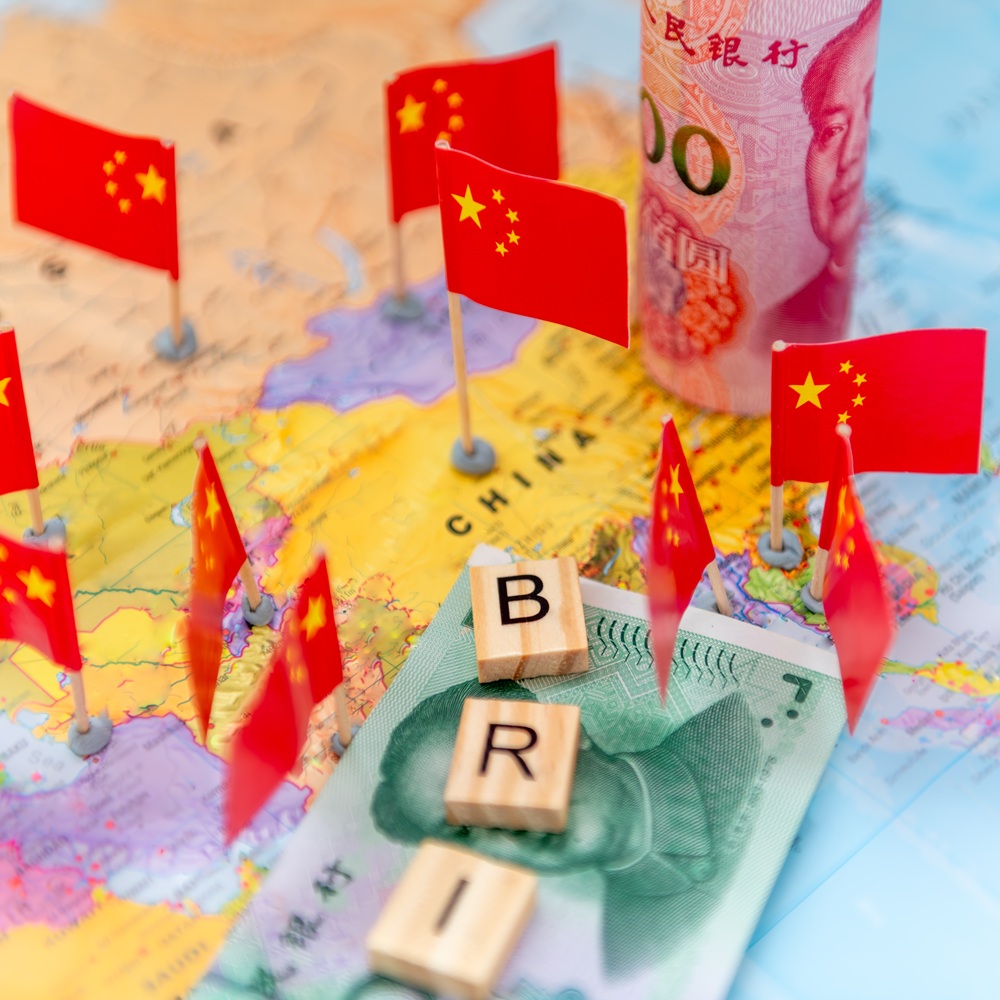
Letter tiles, Chinese Yuan bank notes and national flags on a word map. A Belt And Road Initiative concept.

Blocking the Belt and Road: Activation and deactivation of conflicts to contain China

by Alonso Ronald Ortiz García

Introduction Contemporary geopolitical competition has moved away from traditional paradigms of direct military conflict, giving way to more sophisticated forms of strategic rivalry. In this new landscape — where the lines between peace and war are increasingly blurred — the control of critical infrastructure and trade routes has emerged as a fundamental element of national power. The Belt and Road Initiative (BRI) — conceived by Beijing as the most ambitious geoeconomic project since the Marshall Plan — seeks to reshape the Eurasian trade architecture, positioning China as the central node of an integrated connectivity system. However, the events of 2025 reveal that this project does not operate in a strategic vacuum; rather, it faces a coordinated response from rival powers that have developed sophisticated strategies to limit, fragment, or condition its expansion. This article examines the indirect containment strategies directed against the BRI, focusing on one particular dimension: the deliberate activation and deactivation of conflicts as a tool of geoeconomic blockade. Through the analysis of two paradigmatic cases, it illustrates how rival powers can employ geoeconomic methods to block, fragment, or constrain large infrastructure projects by strategically manipulating regional conflicts. Two seemingly disconnected but strategically linked events will be examined — both of which have redefined the struggle for control over Eurasian trade routes. On one hand, the military escalation between India and Pakistan in the southern sector, specifically in the Rajasthan–Sindh–Southern Punjab Corridor; on the other, the peace agreement between Armenia and Azerbaijan, which revived the Zangezur Corridor Project, now under U.S. control. Both events represent concrete manifestations of a new form of great power rivalry centered on the instrumental use of conflicts to systematically obstruct the BRI. Geoeconomics as a Theater of War Geoeconomics, understood as an analytical discipline, examines how geographic, economic, and political factors intertwine to determine the relative power of states within the international system. Within this framework, connectivity infrastructures transcend their technical or commercial nature to become strategic assets capable of altering the regional balance of power. At its core, the BRI represents China’s attempt to create a network of economic dependencies that enables it to project political influence across Eurasia. This network includes both land and maritime corridors connecting East Asia with Europe, Africa, and the Middle East, establishing China as the central node of an integrated commercial system. However, the interconnected nature of this system also generates specific vulnerabilities: the disruption of critical segments can produce cascading effects that compromise the functionality of the entire network. Containment strategies, therefore, do not need to dismantle the BRI entirely to be effective. It is enough to introduce points of friction, uncertainty, or external control in key segments to alter participants’ cost-benefit calculations and reduce the overall attractiveness of the Chinese system. This logic of “selective blockade” allows rival powers to exert disproportionate influence with limited resources. In this context, the strategic activation and deactivation of conflicts emerge as a particularly refined tool. Unlike direct blockades — which require a permanent military presence and entail significant political costs — the manipulation of conflicts enables the introduction of instability indirectly, leveraging preexisting tensions to generate disruptions along critical BRI corridors. Thus, the temporal simultaneity of the India–Pakistan crisis and the resolution of the Caucasus conflict does not constitute a geopolitical coincidence but rather the manifestation of a deliberate geoeconomic containment strategy that employs the selective activation and deactivation of conflicts to block the fundamental pillars of the BRI. Case 1: Activation of the Indo-Pakistani Conflict The China–Pakistan Economic Corridor (CPEC) stands as the flagship project of the BRI in South Asia. With an estimated investment exceeding $60 billion, the CPEC aims to connect China’s Xinjiang region with the Port of Gwadar on the Arabian Sea, providing China with an alternative trade route that bypasses strategic straits controlled by rival maritime powers. The fundamental vulnerability of the CPEC lies in its dependence on Pakistan’s territorial stability—particularly in the southern provinces, where both critical infrastructure and the energy resources that sustain the project are concentrated. This is precisely where the strategy of conflict activation reaches its fullest expression. Following the escalation recorded in May 2025, intelligence analysts suggest that the timing and intensity of the Indo-Pakistani crisis indicate a deliberate activation of preexisting tensions with specific geoeconomic objectives. The impact of a hypothetical Indian incursion into the Rajasthan–Sindh–Southern Punjab belt would not necessarily aim for the permanent occupation of Pakistani territory, but rather for a demonstration of capability to disrupt the territorial continuity of the corridor. This interdiction strategy through conflict activation operates across multiple dimensions simultaneously. On the physical level, temporary control over this belt would effectively sever the connection between southern Pakistan and the routes leading to China, forcing costly detours or temporary suspensions of operations. On the economic level, the mere threat of disruption would significantly increase security and insurance costs for Chinese investments, thereby reducing the projected profitability of the corridor. More importantly, on the psychological level, a successful demonstration of interdiction capability through controlled escalation would create lasting uncertainty about the security of Chinese investments in the region. This uncertainty would not be limited to the CPEC, but would extend to other BRI projects that depend on the stability of strategic partners. The implicit message is clear: China cannot guarantee the security of its trade corridors against the strategic activation of conflicts by rival powers. The temporal dimension of this strategy is particularly sophisticated. The activation of conflicts makes it possible to generate immediate disruptions in the functioning of the corridors, while their eventual deactivation — once the strategic objectives have been achieved — avoids the long-term costs of a prolonged confrontation. This modulation of conflict intensity transforms regional tensions into precise instruments of geoeconomic policy. Access to the hydrocarbon reserves in southeastern Sindh adds an additional layer to this activation strategy. By temporarily controlling these resources during periods of escalation, India would not only obtain direct economic benefits but would also deny Pakistan and China the revenues that could otherwise be used to finance and expand the CPEC. This logic of “resource denial through conflict” is particularly effective in infrastructure projects that rely on sustained revenue flows to justify their initial investments. Case 2: Deactivation of the Armenian–Azerbaijani Conflict The second case illustrates the complementary side of this strategy: the use of conflict deactivation as a mechanism to gain control over critical infrastructure. The Zangezur Corridor, renamed the “Trump Corridor for Peace and International Prosperity” (TRIPP), represents a paradigmatic example of how a major power can insert control points into connectivity networks through the instrumental resolution of conflicts. In August 2025, U.S. mediation in the Armenian–Azerbaijani conflict allowed Washington to obtain exclusive development rights over this corridor for 99 years, effectively transforming what could have been a component of the BRI into an asset under Western control. This maneuver is particularly ingenious because it uses conflict resolution — seemingly a global public good — as a tool for broader geoeconomic objectives. The conflict deactivation strategy operates under a logic that is different but complementary to activation. While activation seeks to generate immediate disruptions in existing corridors, deactivation enables lasting control over critical segments of the connectivity network through the establishment of new contractual and regulatory frameworks that emerge from the peace process. The TRIPP occupies a crucial strategic position within the Eurasian connectivity network. As part of the Trans-Caspian Corridor (the so-called “Middle Corridor”), it provides a direct land route between Central Asia and Europe that bypasses both Russia and Iran. For China, this corridor represented a vital alternative to reduce its dependence on routes controlled by rival powers. However, by securing contractual control over the TRIPP segment through the instrumental deactivation of the conflict, the United States effectively introduced a strategic bottleneck in the middle of this network. The effectiveness of this strategy lies in its ability to condition the use of the corridor without explicitly prohibiting it. Washington can employ a variety of regulatory, tariff, and security instruments to make the transit of Chinese goods more expensive or cumbersome, rendering the route less attractive to traders and investors. This form of “administrative friction” can be as effective as a physical blockade, but with far lower political costs and reduced risks of escalation. Moreover, control over the TRIPP allows the United States to modulate its policy toward the BRI according to its broader strategic needs. During periods of bilateral tension, it can tighten restrictions on the corridor as a form of pressure; during periods of détente, it can ease such measures as a gesture of goodwill. This flexibility transforms the corridor into a permanent bargaining instrument in Sino–American relations. Integrated Logic: Activation and Deactivation of Conflicts as a Containment System The true sophistication of the analyzed cases becomes evident when one understands that the activation and deactivation of conflicts are not isolated tactics, but rather components of an integrated system of geoeconomic containment. The effectiveness of each element is amplified when they operate in coordination, creating a dynamic that maximizes pressure on the BRI while minimizing costs for the implementers. The activation of conflicts generates immediate disruptions and heightens the perception of risk associated with Chinese projects. Simultaneously, the selective deactivation of other conflicts allows rival powers to establish alternative control frameworks that channel trade flows toward systems under their own influence. This combination produces a “push-and-pull” effect: pushing trade away from routes controlled by China through the creation of instability, while pulling it toward alternatives managed by rival powers through the creation of selective stability. The temporal dimension of this integrated strategy is crucial to its effectiveness. Cycles of activation and deactivation can be calibrated to maximize the impact on long-term investment decisions, generating sufficient uncertainty to discourage future commitments — without creating levels of instability that would undermine the broader interests of the implementing powers. Systemic Dynamics The strategies of conflict activation and deactivation go beyond their immediate tactical objectives to generate broader systemic effects on the BRI and on global geopolitical competition. These effects operate across multiple levels and time scales, creating dynamics that can fundamentally alter the strategic calculations of all actors involved. First, these strategies introduce an element of structural uncertainty deeper than that produced by conventional forms of interference. While direct blockades or sanctions are predictable in their application, the manipulation of conflicts introduces elements of volatility that are far more difficult to anticipate and mitigate. International connectivity depends on the predictability and reliability of trade routes, but when those routes become subject to the unpredictable dynamics of strategically activated conflicts, investor and trader confidence in the system as a whole is eroded. Second, the alternation between activation and deactivation creates a pattern of cyclical instability that complicates long-term planning. Investors must consider not only the current state of stability in a region but also the likelihood that latent conflicts may be activated in the future for geoeconomic purposes. This additional consideration translates into demands for higher returns to compensate for perceived risk, thereby increasing the cost of capital for future BRI projects. Third, the strategy of activation and deactivation can generate demonstration effects that shape third countries’ perceptions of the BRI’s viability. When these countries observe that middle powers can effectively disrupt segments of China’s system by manipulating local conflicts, they may feel empowered to adopt more assertive positions in their own negotiations with Beijing. This dynamic can gradually erode China’s position as a preferred partner for infrastructure projects. Finally, these strategies create dangerous precedents for the stability of the international system. If the activation and deactivation of conflicts become normalized as tools of geoeconomic competition, other actors may adopt similar tactics, fostering a more volatile and unpredictable global environment. China’s Counterstrategies The strategies of conflict activation and deactivation do not operate in a strategic vacuum; rather, they generate adaptive responses from China that can alter their long-term effectiveness. Beijing has developed a variety of counterstrategies specifically designed to reduce the vulnerability of the BRI to this kind of indirect interference. One of the most important responses has been the development of mediation and conflict-prevention capabilities. Recognizing that many of the conflicts which can be strategically activated have roots in genuine, unresolved disputes, China has significantly expanded its involvement in international mediation. This approach seeks to address the underlying causes of instability that could otherwise be exploited by rival powers. At the same time, Beijing has intensified efforts to build early warning systems that enable it to anticipate the imminent activation of conflicts in regions critical to the BRI. These systems combine traditional intelligence with big data analysis and predictive modeling to identify patterns suggesting the external manipulation of local tensions. China has also pursued a more systematic geographic diversification of routes and corridors, developing multiple pathways to the same destinations to reduce dependence on any single segment of the network. This strategy of “planned redundancy” increases system costs but also enhances resilience against selective blockades caused by activated conflicts. A third line of response has been the development of specialized financial and insurance instruments for projects in high-risk regions. These tools allow China to maintain the economic viability of BRI projects even in unstable environments, thereby reducing the impact of conflict activation strategies. Future Projections The analysis of conflict activation and deactivation strategies directed against the BRI reveals the growing sophistication of contemporary geopolitical competition. The examined cases demonstrate that rival powers have developed effective methods to condition, fragment, or disrupt large-scale infrastructure projects without resorting to direct military confrontation, instead employing the strategic manipulation of conflicts as a tool of containment. These strategies represent an evolution of traditional forms of containment operating within the geoeconomic domain, using the interdependence of connectivity systems and their vulnerability to regional instability as vectors of strategic influence. Their effectiveness lies not necessarily in their ability to dismantle the BRI entirely, but in their capacity to introduce cyclical frictions and structural uncertainties that diminish the overall attractiveness of the Chinese system. However, the adaptive nature of geopolitical competition suggests that these activation and deactivation strategies will generate countermeasures and counter-countermeasures that continuously reshape the balance of advantages. China’s capacity to develop alternatives and redundancies, combined with its growing mediation and conflict-prevention capabilities, may eventually limit the effectiveness of these containment tactics. In the long term, competition surrounding the BRI will likely evolve into even more sophisticated forms of geoeconomic rivalry, where the ability to create, control, and protect connectivity networks — as well as to manipulate or resolve the conflicts that affect them — will become a fundamental measure of national power. This dynamic will have far-reaching implications not only for the main actors involved but also for the international system, which will need to adapt to an era in which the strategic activation and deactivation of conflicts has emerged as a central tool in great-power competition. The growing sophistication of these strategies suggests that the future of geopolitical competition will be marked by an increasing instrumentalization of regional conflicts for global geoeconomic objectives, creating new challenges for international stability and requiring the development of normative and institutional frameworks adapted to this new reality. References Chatham House. (2025). India-Pakistan ceasefire remains shaky; relations unlikely to return to status quo. https://www.chathamhouse.org/2025/05/india-pakistan-ceasefire-remains-shaky-relations-unlikely-return-status-quo Consejo Previsional Mundial (WPC). (2025). Informe sobre la brecha de infraestructura en Asia y el impacto de la BRI. La división de los BRICS y la guerra que estamos ignorando entre India y Pakistán. (2025, 8 de mayo). Navarra Confidencial. https://www.navarraconfidencial.com/espana/la-division-de-los-brics-y-la-guerra-que-estamos-ignorando-entre-india-y-pakistan/ La iniciativa de la Franja y la Ruta es un proyecto de cooperación internacional presentado por China en 2013, con enfoque en infraestructura, comercio y conectividad. (2025, 1 de septiembre). Lisanews. https://www.lisanews.org/internacional/iniciativa-franja-ruta-que-es-objetivos/ Le Grand Continent. (2025, 10 de agosto). Al firmar un acuerdo de paz entre Armenia y Azerbaiyán, EE.UU. desplaza a Rusia en el Cáucaso Meridional. https://legrandcontinent.eu/es/2025/08/10/al-firmar-un-acuerdo-de-paz-entre-armenia-y-azerbaiyan-ha-desplazado-trump-a-putin-del-caucaso-meridional/ Ministerio de Defensa de España. (2025). La visión estratégica de la República Popular China en la nueva era: Análisis del Libro Blanco sobre Seguridad Nacional. https://www.defensa.gob.es/ceseden/-/ieee/la_vision_estrategica_de_la_republica_popular_china_en_la_nueva_era_analisis_del_libro_blanco_sobre_seguridad_nacional_2025 Nedopil, C. (2025). Países de la Iniciativa del Cinturón y la Ruta (BRI). Green Finance & Development Center. https://greenfdc.org/countries-of-the-belt-and-road-initiative-bri/ Reuters. (2025, 7 de agosto). EE. UU. asegura un corredor de tránsito estratégico en el acuerdo de paz Armenia-Azerbaiyán. https://www.reuters.com/world/us-secures-strategic-transit-corridor-armenia-azerbaijan-peace-deal-2025-08-07/

Defense & Security
China Cyber Security Ransomware Email Phishing Encrypted Technology, Digital Information Protected Secured. 3d illustration

Chinese cyberespionage: The Invisible War That Threatens the West

by Gabriele Iuvinale

On March 4, the U.S. Department of Justice charged ten Chinese nationals with carrying out massive hacks against government agencies, media outlets, and dissidents in the United States and around the world. They allegedly acted on behalf of the Chinese company i-Soon, under contract from the Beijing government. Two officials from China’s Ministry of Public Security (MPS) were also indicted, identified as the ones “directing the attacks.” According to documents held by the U.S. justice system, China’s domestic intelligence services (MPS) and foreign intelligence (Ministry of State Security, MSS) relied on a vast network of private companies and domestic contractors to hack and steal information, thereby masking the Chinese government’s direct involvement. In some cases, the MPS and MSS paid private hackers to target specific victims. In many others, the attacks were speculative: hackers identified vulnerable computers, breached them, and extracted information that was later sold — either directly or indirectly — to the Chinese government. The Growth of Chinese Cyberespionage and Its Main Areas of Operation This is not an isolated case. Over the past decade, the People’s Republic of China’s (PRC) hacking program has expanded rapidly. In 2023, then-FBI Director Christopher Wray stated that it was larger than that of all other world powers combined. This increase in power and sophistication has led to success in three key areas: political interference, sabotage of critical infrastructure, and large-scale intellectual property theft. Beijing integrates computer networks, electronic warfare, economic, diplomatic, legal, military, intelligence, psychological, and military deception resources, along with security operations, to weaken states, make them economically dependent on China, and more receptive to a “new authoritarian world order with Chinese characteristics.” For this reason, unlike traditional interpretations, Chinese state-sponsored hacking should be understood within a broader context — where control over technology, strategic infrastructure, and global supply chains is part of “trans-military” and “non-military” warfare operations, as described by two People’s Liberation Army (PLA) colonels in the 1999 book “Unrestricted Warfare”. This approach is known as liminal warfare — an escalating conflict in which the spectrum of competition and confrontation with the West is so wide that the battlefield is, quite literally, everywhere. Cyberespionage as a Tool of Electronic Warfare In electronic warfare, hacking is used for sabotage during times of crisis or conflict. These actions are led by the People’s Liberation Army (PLA), the armed wing of the Chinese Communist Party. In 2023, it was discovered that a hacker group linked to the PLA, known as “Volt Typhoon”, had infiltrated a wide range of critical infrastructure in the U.S. for years, including ports, factories, and water treatment plants — both on the mainland and in strategic locations like Guam. “Volt Typhoon is a military operation with political and potentially military strategic purposes,” explained Ciaran Martin, former director of the UK’s cybersecurity agency. Led by the PLA’s cyber unit, the operation involved installing readiness capabilities — “digital traps,” as some call them — within critical U.S. infrastructure. In addition to a sustained attack in 2023 on a power company in Massachusetts, which aimed to extract sensitive data about its operational technology (OT) infrastructure, “Volt Typhoon” gained notoriety for multiple attacks on telecommunications systems in the U.S. and other critical infrastructures globally. One of its subunits, “Voltzite”, targeted the Littleton Electric and Water Departments, prompting the FBI and cybersecurity firm Dragos to respond jointly and publish a detailed report on the attack and its mitigation. Intellectual Property Theft Through Cyberespionage The most damaging channel for intellectual property theft is cyberespionage. These intrusions allow Chinese companies — sometimes with direct support from the Communist Party or the state — to access information on operations, projects, and technology from foreign firms. China has used state-backed and coordinated cyberespionage campaigns to steal information from companies in strategic sectors such as oil, energy, steel, and aviation. These actions serve both to acquire science and technology and to gather intelligence useful for future attacks on military, government, or technical systems. In the United States, there have been numerous precedents: • In 2014, five PLA hackers were indicted for economic espionage.• In 2017, three hackers linked to the Chinese firm Boyusec were charged with stealing confidential business information.• In 2018, two Chinese nationals were indicted for intellectual property theft.• In 2020, two hackers connected to the MSS were charged with targeting COVID-19 research. Among these, the 2018 indictment stands out as part of a broader U.S. effort to raise awareness about Chinese cyberespionage. On that occasion, Chinese hackers carried out a campaign known as “Cloud Hopper”, which involved a supply chain attack on service providers like Hewlett Packard and IBM. The defendants worked for Huaying Haitai and collaborated with the Tianjin State Security Bureau of the MSS. In 2017, the U.S. Commission on the Theft of American Intellectual Property estimated that such crimes cost the U.S. economy up to $600 billion annually — a figure comparable to the Pentagon’s defense budget and greater than the combined profits of the 50 largest companies in the Fortune 500. Beyond the United States: The Global Impact of Chinese Cyberespionage In June 2024, Dutch military intelligence (MIVD) warned that Chinese cyberespionage was broader than previously believed, affecting Western governments and defense companies. A 2023 cyberattack on the Dutch Ministry of Defense reportedly affected at least 20,000 people within a few months. In 2018, the Czech Republic’s National Cyber and Information Security Agency (NUKIB) issued a warning about risks linked to China. Since then, the country has strengthened its capabilities and controls against Beijing and has worked on mechanisms to counter foreign information manipulation. According to U.S. prosecutors, dozens of European parliamentarians have been targeted by Chinese attacks. In March 2024, the U.S. Department of Justice indicted hackers linked to the MSS for attacking “all EU members” of the Inter-Parliamentary Alliance on China (IPAC), a coalition critical of Beijing. In 2021, the hackers sent over a thousand emails to around 400 accounts linked to IPAC, attempting to spy on their internet activity and devices. In addition, ASML, the Dutch leader in semiconductor lithography, suffers “thousands of security incidents per year,” including several successful infiltration attempts by Chinese actors. Research centers like Imec (Belgium) are also frequent targets. Belgium has expelled Chinese researchers suspected of espionage. The European Union has reinforced security and identified advanced semiconductors as one of four critical technologies requiring risk assessments and enhanced protection. Notably, APT41 is one of the most active and sophisticated Chinese cyberespionage groups, based in the PRC and linked to the MSS. According to Google’s Threat Intelligence Group, APT41 combines state espionage with ransomware attacks — malicious programs that encrypt files and demand financial ransom to restore them — making attribution more difficult. Unlike other PLA-aligned groups whose operations are region-specific, APT41 acts globally, attacking strategic sectors in the U.S., Europe, Latin America, and the Caribbean. It also carries out financially motivated operations, particularly in the gaming industry. Mandiant, a global cybersecurity leader, highlights APT41’s technical capabilities: it frequently exploits zero-day and n-day vulnerabilities and uses techniques like phishing, social engineering, and SQL injections. Since 2020, APT41 has conducted large-scale campaigns against over 75 companies in more than 20 countries. It is responsible for compromising supply chains, such as in the “ShadowHammer” campaign targeting ASUS, which affected over 50,000 systems in 2018. APT41 is also linked to the use of “MESSAGETAP” malware in telecommunications networks. The Role of Chinese Universities in Cyberespionage Chinese universities also collaborate with the PLA and MSS in state-sponsored cyberespionage operations. Shanghai Jiao Tong University works directly with the Chinese military on such operations. Zhejiang University and the Harbin Institute of Technology are key centers for recruiting hackers. Xidian University offers students hands-on experience at provincial MSS offices and previously maintained ties with the Third Department of the PLA’s General Staff before its reorganization in 2015 into the Network Systems Department. One of its graduate programs is co-directed with the Guangdong Office of the Chinese Information Technology Security Evaluation Center (ITSEC), an MSS-run office that leads an active team of contractor hackers. Southeast University also maintains links with security services and co-manages the “Purple Mountain Lab” with the PLA’s Strategic Support Force. There, researchers collaborate on “critical strategic requirements,” operating systems, and interdisciplinary cybersecurity studies. The university also receives funding from the PLA and MSS to develop China’s cyber capabilities. The Cybersecurity undergraduate program at Shanghai Jiao Tong University (SJTU) is taught at a PLA information engineering base. Within this program, SJTU claims to work on “network and information systems testing and evaluation, security testing for connected smart networks, APT attack and defense testing, and key technologies for cyber ranges.” Universities associated with the MSS for talent recruitment include the University of Science and Technology of China, Shanghai Jiao Tong University, Xi’an Jiao Tong University, Beijing Institute of Technology, Nanjing University, and the Harbin Institute of Technology. In addition, some cybersecurity firms — such as Beijing TopSec — collaborate with the PLA in hacking campaigns, operator training, and developing future hackers. This article was originally published by Agenda Digitale and later by Expediente Abierto, who granted us permission for its translation and republication.

Defense & Security
Chess made from USA, EU and China flags on a white background. Chess made from China, Europe Union and United States of America flags. Trade, tariffs, duty and customs war

Europe’s transatlantic China challenge

by Gesine Weber

Abstract European states currently lack a clear joint strategy on China and a coordinated approach to US–China competition. This article offers a novel perspective on the challenges for European approaches to this issue due to an omnipresent transatlantic component and the risk of an alliance dilemma. Illustratively focusing on France, Germany and the UK, it demonstrates that Europeans are facing a transatlantic alliance dilemma with the risks of abandonment and entrapment. It argues that Europe needs to strike a balance between its dependence on Washington, especially with regard to European security, while fearing entrapment by the US approach towards Beijing as it aims to maintain economic ties with China. The article concludes that the ramifications of this dilemma can be mitigated through a distinctly European approach to China, strengthening European coordination on China and bolstering European strategic autonomy. As a conceptual piece rather than a full empirical analysis, this article therefore unpacks the strategic challenge and lays the groundwork for further empirical works on the topic. Introduction Strategic competition between the US and China plays out in many realms of international affairs, ranging from global trade to security in the Indo-Pacific. European states are directly affected by this dynamic as they maintain critical ties with both sides. Albeit allies of the US through NATO, Europeans have been reluctant to align with the US on its approach to the Indo-Pacific and China, which is currently characterised by the quest to win the strategic competition with Beijing in all areas of international affairs (see Leoni 2023). Furthermore, Europe maintains close economic ties with Beijing, and imports from China to the EU have most recently increased (Lovely and Yan 2024). European governments certainly do not pursue an approach of maintaining equidistance between the US and China: not only do they regularly emphasise their strategic proximity to Washington, but more recent events, such as the willingness of European allies to publicly adopt the wording of the communiqué from NATO’s Washington summit (NATO 2024) describing China as an ‘enabler of Russia’s war effort in Ukraine’, clearly demonstrate that the tone is changing in European capitals (Politi 2023). However, Europeans still tend to emphasise China’s role in global affairs and the importance of including it in multilateral cooperation formats. With the re-election of Donald Trump as US president, European policy on China and its approach to US–China competition will increasingly be a focus of the US administration. While the exact approach of the new US government still remains to be defined, there are good reasons to anticipate a more hawkish China policy from Washington, through which the US might seek not only to further compete with China, but to actually win this competition (see Pottinger and Gallagher 2023). When designing their approaches towards China—which, among the key European states, only Germany has done so far, with the publication of its China strategy in 2023—Europeans always face a transatlantic elephant in the room. US–China competition, a structuring feature of international relations shaping the global order today through the increasing emergence of geopolitical blocs (see Leoni and Tzinieris 2024), and China’s rising global influence in almost all areas of international affairs—ranging from climate to economics, the rules-based order and security—are forcing European states to reflect on their approach vis-à-vis Beijing (for a full discussion, see Oertel 2023; García-Herrero and Vasselier 2024). As NATO members, European states also need to adapt their strategy in light of the partnership with the US as their key ally. This article argues that European approaches towards China, as shown in the examples of France, Germany and the UK, have a distinctly transatlantic component. It illustrates how these three European states find themselves in an alliance dilemma with the US, and how the risks associated with alliances also define European approaches to China and US–China competition more broadly. As the US administration regularly refers to China as a ‘challenge’ (US Department of Defense 2022), this article alludes to this formulation through the coining of the term ‘transatlantic China challenge’ to describe the strategic challenges Europeans are facing with regard to defining their approach vis-à-vis China and US–China competition more broadly. It offers a conceptual understanding of the strategic challenges for Europe in this context and thereby constitutes a basis for a more thorough empirical analysis. The alliance dilemma and European strategy in US–China competition Originating in realist international relations theory, the alliance dilemma generally describes a situation in which states face risks resulting from joining an alliance. As demonstrated by Snyder (1984), smaller allies especially face a parallel risk of abandonment and entrapment by a hegemon, that is, the dominating power, after joining an alliance. Abandonment, in these circumstances, implies that the hegemon has no further interest in defending or supporting the smaller allies, whereas entrapment refers to a situation in which a state is ‘dragged into a conflict over an ally’s interests that [it] does not share, or shares only partially’ (see Snyder 1984, 466–8). In the context of alliances, a small state is ‘the weaker part in an asymmetric relationship, which is unable to change the nature or functioning of the relationship on its own’ (Wivel et al. 2014, 9), and hence has more limited space for action than the great powers (Wivel and Thorhallsson 2018, 267). This definition arguably applies to Europe in its partnership with the US, as demonstrated by the excessive military and economic dominance of the US as compared to the European states (see Stockholm International Peace Research Institute n.d.; International Monetary Fund 2025). The re-election of Trump as US president now presents the risk of an increased alliance dilemma for Europeans. On the one hand, Trump has announced several times that he does not value the alliance commitments within NATO and potentially would not defend European allies (Sullivan 2024), threatening Europe with abandonment. This scenario is being taken seriously in European capitals, and reflections on how ‘defending Europe with less America’ (Grand 2024) could shape up have gained traction, especially in 2024. Similarly, defence initiatives within the EU to enhance the European contribution to the continent’s security have leapt forward in recent years (see Scazzieri 2025). On the other hand, even the Biden administration had pushed Europe to align with the US approach on China (see Lynch et al. 2023). However, France and Germany in particular, as the big EU member states, have been hesitant to do so, as reflected in France’s opposition to the opening of a NATO liaison office in Tokyo (McCurry 2023) and Germany’s vote against tariffs on Chinese electric vehicles, fearing reprisals from Beijing (Demarais 2024). Trump’s foreign policy might be strongly characterised by issue linkage, which means that policies in one area will be linked to those in another area. Through this strategy, the new US administration might force Europeans into alignment and thereby entrap them, making them accept policies they are not eager to support (see Barkin and Kratz 2025). The exact policies of the Trump administration vis-à-vis European allies remain to be seen, but it is not hard to imagine a scenario in which abandonment and entrapment could emerge or increase, namely when the threat of abandonment is used to entrap allies and force them to support certain policy decisions. The alliance dilemma could play out for Europeans specifically when designing their approaches towards China (see Barkin and Kratz 2025) and formulating their response to US–China competition more generally. As noted above, among the big European states, only Germany has formally adopted a strategy on China, in 2023 (The Federal Government of Germany 2023). However, China and the response to US–China competition takes a prominent place in France’s Indo-Pacific Strategy and its strategy review (Government of France 2021; Secrétariat général de la défense et de la sécurité nationale 2022), and the UK systematically included the dimension of strategic competition in its Integrated Review and its refresh (Government of the United Kingdom 2021, 2023) and has announced an ‘audit’ of its China policy under the new government (Taylor 2024). While these strategies emphasise their individual approaches towards China and the risks stemming from US–China competition, the US has increasingly pressured Europe to align with its approach (Lynch et al. 2023) and can be expected to continue this pressure (Barkin and Kratz 2025). Through the potential issue linkage of security (openly questioned by President Trump) and China policy, Europe therefore finds itself in a new form of alliance security dilemma. European approaches to US–China competition: strategic hedging How can Europe respond to the alliance dilemma of the risks of abandonment and entrapment when it comes to its approaches to China? Reviewing the theoretical literature on the alliance dilemma, one can imagine different strategies. According to Snyder, members of alliances can choose between strategies that strengthen or weaken their commitment to the alliance. To demonstrate commitment, actions could include reassurances for the ally or demonstrations of loyalty, whereas actions to weaken the commitment to the alliance could consist of restraining the ally (mostly to reduce the risk of entrapment in a conflict), increasing bargaining power over the ally or preserving options for realignment outside the existing alliance (for a full discussion, see Snyder 1984, 466–9). Alternative strategies include hiding from cooperation, that is, ‘seeking to maximize autonomy by opting out of specific aspects of the cooperation or by setting up “bastions” in the cooperation’, or bandwagoning, through which states pursue strategies of adaptation ‘to the more powerful actors in the cooperation’ (Pedersen 2023, 442). At the moment, it seems that France, Germany and the UK ‘drive on sight’ rather than approaching the question holistically. The following analysis aims to unpack how the three European states see US–China competition, the risk of the alliance dilemma and how these reflections have played out so far in their strategies. The strategies of France, Germany and the UK on China demonstrate that their approaches are influenced by a distinctly transatlantic component and reflect the transatlantic alliance dilemma. This is visible in their (1) high awareness of the risks stemming from great power competition, (2) approaches to managing the risk of short-term abandonment, and (3) hedging to mitigate the medium- and long-term risks of abandonment and entrapment. The empirical evidence for this analysis was gathered through a qualitative analysis of European strategic documents, statements and policy decisions taken mostly during the period of the Biden administration. However, in light of the risk of a scaling-up of the alliance dilemma under the Trump administration, sources and evidence accessible by the end of January 2025 were included to illustrate the European approaches. In addition to publicly available documents and the sources mentioned above, this paper draws on conversations with policymakers and experts under the Chatham House rule. Mitigating risks from US–China competition: multilateralism instead of alignment That France, Germany and the UK are close allies with the US is clearly visible in their respective strategies on China, not least because of references they make to the importance of the alliance and their descriptions of their own positions between the two great powers. Overall, France, Germany and the UK share the perception of US–China competition and the emergence of blocs as potentially harmful to their interests. As a consequence, all three call for an inclusive multilateral order instead of falling into a logic of blocs, as the increasing competition is seen as a risk for Europe (Secrétariat général de la défense et de la sécurité nationale 2022, 9–15; The Federal Government of Germany 2020, 24–6; Government of the United Kingdom 2023, 22–6). The response of all three European powers to the emergence of blocs is multilateralism: instead of clearly aligning with the US, the French, German and British strategies call for building broader multilateral coalitions, which should, eventually, also include China (The Federal Government of Germany 2020, 23–6; Government of the United Kingdom 2023). The tone in Paris, Berlin and London towards Beijing has clearly changed over recent years; accordingly, the European capitals were also willing to support strong wording on China in the 2024 NATO summit declaration, which describes China as a ‘critical enabler’ of Russia’s ongoing war against Ukraine (NATO 2024). Albeit also recognised as a critical partner for key issues such as climate policy and trade, European states openly describe China as a ‘systemic rival’ and occasionally call out China’s behaviour, as they did, for example, in the case of a note verbale on the South China Sea (UN 2020). Nevertheless, Europe has not (yet) given in to US pressure to align with Washington’s more confrontational approach towards China (Etienne 2024). Even if European states and Washington have moved closer to each other, especially on economic security (Meyers and Reinsch 2023), the European positions on US–China competition demonstrate that Europeans are not willing to fully endorse or follow Washington’s approach—not least because European imports from China have increased in recent years (Lovely and Yan 2024). Managing the risk of short-term abandonment Since Trump’s election, the risk of abandonment by the US has been seen as increasingly high in Paris, Berlin and London.1 This is not least because Trump has openly questioned his willingness to adhere to Article 5 of the North Atlantic Treaty in the case of an armed attack on Europeans (Sullivan 2024). Europeans are especially concerned about issue linkage in this context, meaning that demands in a policy area other than security could be used as a condition. Concretely, Trump could use the threat of abandonment as leverage to compel Europe to align with the US on China policy.2 Barkin and Kratz (2025) suggest that Europe adopt a ‘carrot and stick’ approach, whereby Europe could start with an offer to the US: buying more liquified natural gas, defence goods and agricultural products from the US could mitigate the risk of abandonment. However, there is awareness among European states that coercion from the US to align on US–China policy, especially when linked to the threat of abandonment, might best be mitigated through enhancing European military capabilities—which would still leave the continent exposed to these threats, though to a lesser extent.3 Addressing the risk of medium- and long-term abandonment and entrapment: transatlantic hedging However, the risk of at least partial abandonment is not a new challenge for European strategy, and had already infused earlier strategic thinking. The shift of US strategic priorities away from Europe and to the Indo-Pacific has already been demonstrated in the allocation of resources to the different theatres. Moreover, European states have increasingly become aware that US forces will be withdrawn from their territories in the future and have concluded that they will have to step up their own commitment to European security (see Grand 2024). In parallel, there is an awareness in European capitals that showing more interest in the Indo-Pacific and giving more importance to policy on China is also a way for Europeans to demonstrate an understanding of their ally’s strategic priorities.4 Accordingly, the approaches of France, Germany and the UK to China and the Indo-Pacific also have to be understood as a commitment to the priorities of the US in order to keep this ally engaged in the European theatre and mitigate the risk of abandonment; however, European states abstain from fully aligning with the US approach, as their capabilities and strategic goals are perceived as diverging from those of the US. In this way, Europe aims to avoid entrapment over the medium term through slightly distancing itself from US policy. While all three European states also call for de-risking from China and diversification of their supply chains, maintaining strong economic ties with Beijing is a key component of their respective approaches—which contrasts with the US calls for decoupling. Furthermore, these states have never formally endorsed the US policy on China (Etienne 2024). Nevertheless, enhancing European capabilities would not only send a signal to Washington, but also qualify as hedging, understood as an ‘insurance policy’ to avoid a deterioration in US–Europe relations if the US opted for abandonment, or even as part of a move towards emancipation to reduce strategic dependencies on Washington (see Fiott 2018, 4–6). Conclusion: a transatlantic China challenge Designing their approaches to China and to US–China competition more broadly constitutes a complex strategic dilemma for European states. Paris, Berlin and London do not fully align with Washington’s approach, and it remains to be seen whether they will be willing to do so under the second Trump administration. To manage the risk of abandonment and entrapment, European states pursue different individual approaches to strategic hedging: their strategies on China and US–China competition are designed in a way that allows them to mitigate the risk of abandonment which might stem from significant transatlantic divergence, and to avoid automatic entrapment through their slight distancing from the US approach. From a theoretical perspective, this article has demonstrated that the alliance dilemma, along with the parallel fear of abandonment and entrapment by the US, is a major factor accounting for Europe’s limited strategies on China and its hedging behaviour. This article offers a conceptual analysis of the structural forces explaining European strategies, but other strategic cultures and relationships with the US could offer important complementary insights. To further analyse how individual European states design their strategies vis-à-vis China in light of the alliance dilemma and potential domestic constraints and specificities, neoclassical realism could offer an interesting analytical concept. This approach posits that structural forces set the parameters for foreign policy and treats domestic factors, including strategic culture, as intervening variables (see Rose 1998). Accordingly, it appears well suited for foreign policy analysis, and has indeed gained popularity in the field in recent years (see, for example, Martill and Sus 2024; Meibauer et al. 2021; Weber 2024). Empirically, this article constitutes a conceptual starting point rather than an exhaustive analysis of the strategy-making processes of European states with regard to China and US–China competition and makes a more comprehensive assessment desirable. The findings of this article have broader implications for policymaking. First, they demonstrate the necessity for Europe to determine its place in the increasing US–China competition. European coordination on the respective approaches vis-à-vis the US—especially in light of potential coercion to align—and China is of paramount importance to ensure that foreign policy strategies are mutually reinforcing and not undermining European objectives. Second, the article demonstrates that Europe currently responds to the ‘transatlantic China challenge’ through transatlantic hedging: while this strategy seems to be promising in the short term, it is questionable to what extent the strategy is sustainable and could help European states to navigate the parallel challenges of abandonment and entrapment. Unless Europe decides to fully align with the US—and it is questionable whether this decision would be in its interest—European states would be well advised to develop a sustainable long-term approach to China. A transatlantic dialogue on China, in which Europe and the US openly discuss synergies and divergences, could help prevent misunderstandings and decrease the risk of coercion or issue linkage due to a misreading of European approaches in Washington. Third, as the risks of (at least partial) abandonment and entrapment are systemic challenges due to the current composition of the transatlantic alliance, a logical step for European states to decrease their dependence on the US as the hegemon in the alliance would be to significantly strengthen European capabilities. Stronger military capabilities could help mitigate the ramifications of abandonment, and the aforementioned distinctly European strategy could allow Europe to avoid strategic entrapment in relation to China imposed by Washington. As Europe remains the junior partner in the transatlantic alliance, the parallel risks of abandonment and entrapment, as well as issue linkage, are highly likely to influence its approaches towards China in the long term, but there are certainly ways to render this ‘transatlantic China challenge’ less challenging. ORCID iDGesine Weber https://orcid.org/0009-0008-2643-0400Footnotes1. Conversation with French, German and British experts in Berlin, January 2025.2. Conversation with French, German and British experts in Berlin, January 2025.3. Conversation with French, German and British experts in Berlin, January 2025; conversation with European experts and officials in Paris, January 2025.4. Conversation with officials from Germany and France in Paris, November 2024; conversation with French, German and British experts in Berlin, January 2025.ReferencesBarkin N., Kratz A. (2025). Trump and the Europe–US–China Triangle. Rhodium Group, 16 January. https://rhg.com/research/trump-and-the-europe-us-china-triangle/. Accessed 18 January 2025.Demarais A. (2024). Divided we stand: The EU votes on Chinese electric vehicle tariffs. European Council on Foreign Relations, 9 October. https://ecfr.eu/article/divided-we-stand-the-eu-votes-on-chinese-electric-vehicle-tariffs/. Accessed 25 January 2025.Etienne P. (2024). The European Union between the United States and China: Should we choose between equidistance and following? Fondation Robert Schuman, 8 October. https://www.robert-schuman.eu/en/european-issues/763-the-european-union-between-the-united-states-and-china-should-we-choose-between-equidistance-and-following. Accessed 22 December 2024.Fiott D. (2018). Strategic autonomy and the defence of Europe. European Union Institute for Security Studies, Brief 12/2018. https://www.iss.europa.eu/sites/default/files/EUISSFiles/Brief%2012__Strategic%20Autonomy.pdf. Accessed 25 January 2025.García-Herrero A., Vasselier A. (2024). Updating EU strategy on China: Co-existence while de-risking through partnerships. Mercator Institute for China Studies. https://merics.org/en/external-publication/updating-eu-strategy-china-co-existence-while-de-risking-through-partnerships. Accessed 30 January 2025.Government of France. (2021). France’s Indo-Pacific strategy. https://www.diplomatie.gouv.fr/IMG/pdf/en_dcp_a4_indopacifique_022022_v1-4_web_cle878143.pdf. Accessed 31 January 2025.Government of the United Kingdom. (2021). Global Britain in a competitive age: The integrated review of security, defence, development and foreign policy. London: The Stationery Office. https://www.gov.uk/government/publications/global-britain-in-a-competitive-age-the-integrated-review-of-security-defence-development-and-foreign-policy. Accessed 18 January 2025.Government of the United Kingdom. (2023). Integrated review refresh 2023: Responding to a more contested and volatile world. London: The Stationery Office. https://www.gov.uk/government/publications/integrated-review-refresh-2023-responding-to-a-more-contested-and-volatile-world. Accessed 18 January 2025.Grand C. (2024). Defending Europe with less America. European Council on Foreign Relations, 3 July. https://ecfr.eu/publication/defending-europe-with-less-america/. Accessed 18 January 2025.International Monetary Fund. (2025). World economic outlook: GDP data mapper [Map]. https://www.imf.org/external/datamapper/NGDPD@WEO/OEMDC/ADVEC/WEOWORLD. Accessed 23 January 2025.Leoni Z. (2023). Grand strategy and the rise of China: Made in America. Agenda Publishing.Leoni Z., Tzinieris S. (2024). The return of geopolitical blocs. Survival, 66(2), 37–54.Lovely M. E., Yan J. (2024). As the US has relied less on imports from China, the EU has imported more. Pederson Institute for International Economics, 24 August. https://www.piie.com/research/piie-charts/2024/us-has-relied-less-imports-china-eu-has-imported-more. Accessed 22 December 2024.Lynch S., Toosi N., Moens B., Banco E. (2023). The U.S. wants Europe to stand up to China. Europe says: Not so fast. Politico, 3 August. https://www.politico.com/news/2023/03/08/us-europe-china-00086204. Accessed 18 January 2025.Martill B., Sus M. (2024). Winds of change? Neoclassical realism, foreign policy change, and European responses to the Russia-Ukraine War. British Journal of Politics & International Relations.McCurry J. (2023). France opposed to opening of Nato liaison office in Japan, official says. The Guardian, 7 June. https://www.theguardian.com/world/2023/jun/07/france-opposed-to-opening-of-nato-liaison-office-in-japan-official-says. Accessed 25 January 2025.Meibauer G., Desmaele L., Onea T., Kitchen N., Foulon M., Reichwein A., Sterling-Folker J. (2021). Forum: Rethinking neoclassical realism at theory’s end. International Studies Review, 23(1), 268–95.Meyers E., Reinsch W. A. (2023). The push for U.S.–EU convergence on economic security policy. Center for Strategic and International Studies, 7 July. https://www.csis.org/analysis/push-us-eu-convergence-economic-security-policy. Accessed 26 January 2025.NATO. (2024). Washington Summit declaration. https://www.nato.int/cps/cn/natohq/official_texts_227678.htm. Accessed 18 January 2025.Oertel J. (2023). Ende der China-Illusion: Wie wir mit Pekings Machtanspruch umgehen müssen. Munich: Piper Verlag.Pedersen R. B. (2023). Small states shelter diplomacy: Balancing costs of entrapment and abandonment in the alliance dilemma. Cooperation and Conflict, 58(4), 441–59.Politi A. (2023). The paradigm shift in EU–China relations and the limits of the EU’s current strategy towards China: A relational perspective. Asian Affairs 54(4), 670–93.Pottinger M., Gallagher M. (2024). No substitute for victory: America’s competition with China must be strategic and ideological. Foreign Affairs, 10 April. https://www.foreignaffairs.com/united-states/no-substitute-victory-pottinger-gallagher. Accessed 18 January 2025.Rose G. (1998). Neoclassical realism and theories of foreign policy. World Politics, 51(1), 144–72.Scazzieri L. (2025). Towards an EU ‘defence union’? Centre for European Reform, 30 January. https://www.cer.eu/publications/archive/policy-brief/2025/towards-eu-defence-union. Accessed 30 January 2025.Secrétariat général de la défense et de la sécurité nationale. (2022). Revue nationale stratégique 2022. https://www.sgdsn.gouv.fr/publications/revue-nationale-strategique-2022. Accessed 18 January 2025.Snyder G. H. (1984). The security dilemma in alliance politics. World Politics, 36(4), 461–95.Stockholm International Peace Research Institute. (n.d.). SIPRI Military Expenditure Database.Sullivan K. (2024). Trump says he would encourage Russia to ‘do whatever the hell they want’ to any NATO country that doesn’t pay enough. CNN, 11 February. https://edition.cnn.com/2024/02/10/politics/trump-russia-nato/index.html. Accessed 29 January 2025.Taylor R. (2024). UK government policy towards China. https://lordslibrary.parliament.uk/uk-government-policy-towards-china/. Accessed 18 January 2025.The Federal Government of Germany. (2020). Policy guidelines for the Indo-Pacific. www.auswaertiges-amt.de/blob/2380514/f9784f7e3b3fa1bd7c5446d274a4169e/200901-indo-pazifik-leitlinien–1–data.pdf. Accessed 21 December 2024.The Federal Government of Germany. (2023). China-Strategie der Bundesregierung. Berlin: Auswärtiges Amt. https://www.auswaertiges-amt.de/blueprint/servlet/resource/blob/2608578/810fdade376b1467f20bdb697b2acd58/china-strategie-data.pdf. Accessed 18 January 2025.UN (2020). Note verbale, UK NV No. 162/20, 16 September. https://www.un.org/Depts/los/clcs_new/submissions_files/mys_12_12_2019/2020_09_16_GBR_NV_UN_001.pdf. Accessed 25 January 2025.US Department of Defense. (2022). National Defense Strategy of the United States of America. https://media.defense.gov/2022/Oct/27/2003103845/-1/-1/1/2022-NATIONAL-DEFENSE-STRATEGY-NPR-MDR.pdf. Accessed 25 January 2025.Weber G. (2024). Zeitenwende à la française: Continuity and change in French foreign policy after Russia’s invasion of Ukraine. British Journal of Politics & International Relations.Wivel A., Bailes A. J. K., Archer C. (2014). Setting the scene: Small states and international security. In Archer C., Bailes A. J. K., Wivel A. (eds.), Small states and international security: Europe and beyond (pp. 3–25). London: Routledge.Wivel A., Thorhallsson B. (2018). Brexit and small states in Europe: Hedging, hiding or seeking shelter? In Rosamond B., Nedergaard P., Diamond P. (eds.), The Routledge handbook of the politics of Brexit, 1st edn. (pp. 266–77). Abingdon-on-Thames: Routledge.

Defense & Security
flag country Europe defense army

European Union Strategic Autonomy. Necessary but potentially problematic?

by Krzysztof Śliwiński

Abstract This paper examines the evolving concept of European Union Strategic Autonomy (EU-SA) within the context of contemporary geopolitical challenges, with a particular focus on EU-Russia and EU-China relations. EU-SA reflects the EU's aspiration to act independently in foreign policy, security, defence, and economic affairs, moving from a rule-taker to a rule-maker in global politics. The study outlines the historical development of EU-SA from 2013 to the present, highlighting key milestones such as the Strategic Compass and the impact of the Ukraine War, which accelerated efforts toward defence collaboration, energy independence, and economic resilience. It explores the transatlantic dynamics, noting growing uncertainties in the U.S. commitment to NATO and the resulting push for a more autonomous European defence posture. Additionally, it addresses the complex EU-China relationship, marked by both cooperation and competition, as well as the strained EU-Russia ties amid ongoing conflict. The paper concludes by questioning the economic feasibility and political risks of deeper EU strategic autonomy, especially regarding security centralisation and Germany's leadership role. Key Words: EU, Strategic Autonomy, Security, Geopolitics, U.S, China, Russia Introduction At the 2025 North Atlantic Treaty Organisation (NATO) Summit in The Hague, member states (Allies) committed to investing 5% of their Gross Domestic Product (GDP) annually in core defence requirements and defence- and security-related spending by 2035. They will allocate at least 3.5% of GDP annually, based on the agreed-upon definition of NATO defence expenditure, by 2035 to resource core defence requirements and meet the NATO Capability Targets. Allies agreed to submit annual plans that show a credible, incremental path to achieving this goal.[1] At the same time, Spain secured a special compromise, committing to meet core requirements with just 2.1% of GDP, making it the only exception to the broader 5% target. Previously, in 2014, NATO Heads of State and Government had agreed to commit 2% of their national GDP to defence spending, to help ensure the Alliance's continued military readiness. This decision was taken in response to Russia's illegal annexation of Crimea, and amid broader instability in the Middle East. The 2014 Defence Investment Pledge was built on an earlier commitment to meeting this 2% of GDP guideline, agreed in 2006 by NATO Defence Ministers. In light of the increase in defence spending, given that 23 out of 32 NATO Allies are EU member states, the idea of European Union strategic autonomy (EU-SA) comes to mind. This paper will explore the issue of EU-SA with a specific reference to EU-Russia and EU-China relations.[2] A Brief History of EU Strategic Autonomy European Union strategic autonomy is an evolving concept that reflects its ambition to act independently in strategically important policy areas, including foreign policy, security, defence, and economic relations. Strong strategic autonomy, according to Barbara Lippert, Nicolai von Ondarza and Volker Perthes, means being able to set, modify and enforce international rules, as opposed to (unwillingly) obeying rules set by others. The opposite of strategic autonomy is being a rule-taker, subject to strategic decisions made by others, such as the United States, China, or Russia.[3] The concept was first prominently discussed in the context of defence in 2013 and has since expanded to encompass a broader range of policy areas. Historically speaking, one can identify numerous phases during which EU-SA evolved. - 2013-2016: During this period, EU-SA focused on security and defence, with initiatives like the Permanent Structured Cooperation (PESCO) and the European Defence Fund, aiming to strengthen the EU's defence capabilities.[4]  - 2017-2019: During this period, the EU-SA shifted its focus to defending European interests in a hostile geopolitical environment, influenced by events such as Brexit, the Trump presidency, and China's growing assertiveness.- 2020: The COVID-19 pandemic highlighted economic vulnerabilities, prompting a focus on mitigating dependence on foreign supply chains, particularly in critical sectors like health and technology.- Since 2021: The scope widened to virtually all EU policy areas, including digital, energy, and values, with terminology evolving to include "open strategic autonomy," "strategic sovereignty," "capacity to act," and "resilience".- 2022: The Ukraine War and Accelerated Implementation. Russia's invasion of Ukraine catalysed concrete actions toward EU-SA, notably in defence, energy independence, and economic resilience. The European Council's Versailles Declaration (March 2022) expressed strong political will to increase EU-SA, calling for collaborative investments in defence, phasing out dependency on Russian energy, and reducing reliance on critical raw materials, semiconductors, health, digital technologies, and food imports.[5] - The Strategic Compass for security and defence policy (endorsed March 2022) outlines a roadmap to 2030, emphasising strengthened EU defence capacities. Among others, it includes: o   Establishment of a strong EU Rapid Deployment Capacity of up to 5000 troops for different types of crises.o   Ready to deploy 200 fully equipped Common Security and Defence Policy (CSDP) mission experts within 30 days, including in complex environments.[6]o   Conducting regular live exercises on land and at sea.o   Enhanced military mobility.o   Reinforcement of the EU's civilian and military CSDP missions and operations by promoting a rapid and more flexible decision-making process, acting more robustly and ensuring greater financial solidarity.o   Making full use of the European Peace Facility to support partners.[7] According to the EU itself, the EU-SA is not a zero-sum game, but rather a sliding scale between complete autonomy and full dependency, with different results for different policy areas. What is more, when compared to the famous Maslow's hierarchy of needs (European Parliament briefing's language), the EU is not only perceived as an economic power, but it is also seen as a normative power. Therefore, the EU is recognised for its core values of democracy, human rights and the rule of law. Ultimately, Maslow's “self-actualisation” could mean the achievement of an EU in which citizens recognise their European identity and which has realised its full autonomous policy potential.[8]   As if this is not enough, the same source introduces the concept of the 360° strategic autonomy wheel, which reportedly illustrates policy areas in which the EU aims for greater strategic autonomy, as well as the connections between them. Mutual influence between policy areas can happen across the wheel, but is particularly strong in adjacent areas. Military action, for example, can cause migration, health is linked to food quality, energy policy influences the climate, and misinformation undermines democracy. The wheel can help to understand links, set priorities and view potential conflicts. More autonomy in the digital green economy will, for example, require vast quantities of “rare earth” materials, making the EU more (instead of less) dependent on imports. Reductions in energy consumption achieved through the digitalisation of the economy (for example, by reducing transport) will be partly offset by the increase in energy consumption by electronic devices and data centres.   Global Context The significance of EU-SA lies in ensuring the EU's political survival and global influence in a multipolar world where its relative power is diminishing. The EU's long-term economic outlook is bleak: its share of global GDP, now at 17% (at current prices), could nearly halve by 2050. According to the World Economic Forum, this economic backsliding not only threatens Europe's ability to fund its social model but also risks weighing on the bloc's global influence, leaving it even more dependent on the U.S. and China.[9] Moreover, the COVID-19 pandemic highlighted the conflictual nature of economic interdependence, as reliance on foreign supply chains for critical goods exposed vulnerabilities. Soft power has become an instrument of hard power, necessitating autonomy in trade, finance, and investment.  The U.S.'s strategic pivot to Asia, the exclusion of Europe in conflicts like Nagorno-Karabakh, Libya, and Syria (termed Astanisation[10], which favours Russia and Turkey), the sidelining of the EU in EU-Russia negotiations regarding the war in Ukraine, and China's state-led economic model have all pushed the EU towards the sidelines. Transatlantic divide Security is a critical dimension, with significant uncertainty surrounding the U.S. commitment to NATO under the Trump administration. Reports indicate Trump has questioned NATO's Article 5 guarantees, with actions like withdrawing military personnel from a Ukraine aid hub in Poland on April 8, 2025, and proposing to stand down 10,000 light infantry troops in Poland, Romania, and the Baltic states by 2025.[11] This has led to fears of a "NATO-minus" scenario, where the EU must fill security gaps without full U.S. backing. In response, the EU is pushing for greater strategic autonomy in defence. Initiatives like ReArm EU are mentioned, with calls for the EU to develop a stand-alone, integrated military capacity to stabilise the global economy. As Jean-Pierre Maulny, Deputy Director of the French Institute for International and Strategic Affairs (IRIS), adequately observes "The risk is now clear: a form of bilateral agreement between the United States and Russia, benefiting the interests of both countries, could leave Ukraine severely weakened and an easy prey for Moscow, thereby weakening other European countries consequently. As a consolation prize, we will have to ensure Europe's conventional security, as U.S. Secretary of Defence Pete Hegseth announced to Europeans at the opening of the NATO ministerial meeting held in Brussels on 12–13 February 2025. This situation will place Europeans in a terrible dilemma: Either they do not wish to provide security guarantees to Ukraine and risk completely discrediting themselves in the eyes of powers such as the United States, Russia, and China, as Europeans will have demonstrated that they are unable to defend the continent, while also creating a significant long-term risk to Europe's security. Alternatively, they could provide security guarantees to Ukraine, accepting the financial burden that would impact the European Union's long-term competitiveness. In light of this situation, some advocate for the establishment of a European pillar within NATO. If one considers that the United States is negotiating peace in Europe without and against the Europeans, and that they no longer wish to defend Europe with conventional military means (will they respect the NATO Defence Planning Process?), Europeans should take on Europe's security fully. This would mean taking control of NATO. It will also be easier to make NATO and the European Union work together with a more Europeanised organisation".[12] Economically, there are several issues that contemporary demand addresses, but the most pressing is, of course, the Tariffs. The U.S. and European Union are running out of time to strike a deal on trade tariffs. Negotiations have been slow since both the U.S. and EU temporarily cut duties on each other until July 9. If an agreement is not achieved by then, full reciprocal import tariffs of 50% on EU goods, and the bloc's wide-spanning countermeasures are set to come into effect.[13] According to Almut Möller, Director for European and Global Affairs and head of the Europe in the World programme (European Policy Centre), "for the first time in decades, Europeans can no longer rely on a benign partner on the other side of the Atlantic, leaving them dangerously exposed and acutely vulnerable, including on the very foundations of liberal democracy. Until recently, the U.S. dominated a world order that provided a favourable environment for the EU to extend its membership, further develop, and leverage its strengths, particularly as a trading power, without having to worry much about geopolitics. Suddenly, liberal Europe looks very lonely, and is struggling to keep up with a world of change".[14] Other problems arguably include digital regulation and data protection, antitrust policy and digital taxation, fiscal policy and social protection, geopolitical rivalries, China's rise, and competition and trade policy. EU–China conundrum Both the EU and the U.S. are concerned about China's growing economic and technological influence, but they have differing approaches to addressing this challenge. The EU has sought to maintain a balance between cooperation and competition with China, while the U.S. has adopted a more confrontational approach.[15] These differences have led to tensions in areas such as trade policy and technology regulation. For example, the EU has been critical of the U.S.'s unilateral approach to addressing China's trade practices, while the U.S. has accused the EU of being too lenient towards China. These disagreements have made it difficult to achieve a coordinated transatlantic response to China's rise.[16] According to German experts, the balance of power between China and the EU and its member states is developing increasingly asymmetrically to Europe's disadvantage. Only in trade policy – and partially in investment – can the EU maintain its position in a manner respected by China.[17] Europe holds significant importance for China across various dimensions: economically, as its top supplier and second-largest export destination; technologically, as a source of advanced technology; institutionally, as a model to emulate; politically, to advance its objectives concerning other nations, particularly the United States; and selectively, as a collaborator in areas like global health and regional stabilisation. Unlike Russia and the United States, China perceives a vital interest in the EU's continued existence and unity within a multipolar world; yet, it employs a "divide and rule" strategy. China selectively rewards or penalises individual EU countries based on their political and economic significance and their compliance with China's expectations on key issues. These issues include arms sales to Taiwan, meetings with the Tibetan Dalai Lama, and positions on the Uighurs, human rights in China, and the South China Sea. China engages with Europe on multiple levels — political, economic, technological, cultural, and academic — using various political channels (such as strategic partnerships with the EU and individual EU member states), dialogue formats (like the 16+1 format with sixteen Central and Eastern European countries), and high-level bilateral intergovernmental consultations with Germany, France, and the United Kingdom. China's hopes that the European Union would emerge as an independent and comprehensive player in global politics, serving as a counterbalance to the United States, have diminished. However, China would be supportive of any European efforts towards achieving strategic autonomy, provided it does not translate into a confrontational approach towards China itself. In contrast, Europe's political priorities—such as ensuring peace and stability in East Asia, China's role in global stability, development, environmental issues, climate change, and non-proliferation, as well as improving human rights in China — are often considered secondary and are not actively pursued by all EU member states. Europe lacks a unified and assertive foreign policy stance regarding the geopolitical rivalry between the United States and China for dominance in the Asia-Pacific region. There is also an absence of a clear position on China's authoritarian vision of order. Even in trade and investment disputes, Europe struggles to establish a unified approach to resolving these issues. The EU member states are too diverse in terms of size, profiles, and interests in their dealings with China: Economically, there is a divide between countries that are appealing industrial and technological partners for China and those that compete for favour in Beijing. Some nations have a clear interest in global governance. Additionally, the United Kingdom and France maintain their respective military presences in the Asia region. In this context, ReArm EU and its financial instrument SAFE (analysed here https://worldnewworld.com/page/content.php?no=5384 ) have the potential to provide the EU with meaningful strategic autonomy and invite genuine geopolitical actorness. EU–Russia conundrum Since Donald Trump took office as the U.S. president, the coordination of transatlantic policies regarding Russia has largely disintegrated. The White House's openness to a comprehensive "deal" with Russian President Vladimir Putin contrasts with Congress's attempts to limit Trump's foreign policy options with Russia, resulting in the marginalisation of coordination with European allies. This situation is further complicated by Washington's increasing reliance on extraterritorial sanctions, a trend that began before Trump's presidency. Consequently, according to European foreign and security experts, Europe must achieve greater strategic autonomy in its dealings with Russia. However, this relationship is particularly strained by significant conflicts of interest. Russia's invasion of Ukraine significantly disrupted the previously peaceful and liberal democratic relations among European nations. Putin's "special military operation" compelled the EU to introduce seventeen (so far) escalating economic sanction packages aimed at undermining the Russian economy and ultimately limiting Russia's capacity to continue the war. In a gesture of solidarity with Ukraine, the EU has also allocated billions of euros to both EU member states and Ukraine to avert a humanitarian disaster and ensure the provision of essential needs for Ukrainians fleeing the conflict.[18] After three and a half years from the outset of the war, Russia continues to pose a complex challenge that the EU and European nations cannot address independently in the foreseeable future. If the U.S. security guarantee weakens before Europe can bolster its own capabilities, the EU could face new vulnerabilities that Russia might exploit along its external borders, such as in the Baltic states, and elsewhere. Currently, the EU and its member states lack sufficient means to deter Russia from pursuing its interests aggressively and recklessly in the shared neighbourhood.[19] Critics, on the other hand, argue that calls for EU strategic autonomy, particularly the creation of a European Army and a significant increase in military spending, are a double-edged sword. First, the primary official rationale is that the EU must prepare itself for a possible attack on EU member states by Russia. The legacy media are full of European leaders claiming that Russia will sooner or later attack Europe.[20] Yet, this claim is not substantiated with much evidence. The proponents of the European army completely disregard numerous doubts surrounding the 2013/2014 "Euromaidan" and the role of the CIA in the events.[21] Second, according to the Office of the High Commissioner for Human Rights (OHCHR) 's estimations, the total number of conflict-related casualties in Ukraine from April 14, 2014, to December 31, 2021, stood at 51,000 – 54,000. These numbers are broken down as follows: 14,200 - 14,400 killed (at least 3,404 civilians, estimated 4,400 Ukrainian forces, and estimated 6,500 members of armed groups), and 37,000 - 39,000 injured (7,000 – 9,000 civilians, 13,800 – 14,200 Ukrainian forces and 15,800 - 16,200 members of armed groups).[22] In short, the situation was chaotic, with many casualties among civilians. Third, it was allegedly Europeans who torpedoed a first chance of peace negotiations as early as April 2014 in Istanbul.[23] Fourth, many European leaders seem to be utterly oblivious to the fact that the prolongation of the war adds to the destruction of Ukraine and Ukrainian society, deaths and emigration. Last but not least, given the fact that it is Germany that calls for both the European Army and the federalisation of Europe (with some assistance from France), one should be extra careful given the role of Germans during the WWII and the fact that neither has there been any official peace treaty with Germany nor have they recompensated countries such as Poland. Conclusion Strategic autonomy may be a necessity for Europe, given the dynamics of transatlantic relationships. The questions, however, that have to be pondered (and it does not seem that anyone in the legacy media or mainstream academia is ready to ask them) are numerous. Who will pay for that? Can Europeans afford such expenses under the current economic circumstances, and even worse economic prospects? Is the centralisation of security and military a Pandora's box? Should Europeans allow Germany (of all EU member states) to take special responsibility for this project? Isn't the pro-war rhetoric of Western political leaders making relations with Russia even more tense and dangerous, in other words, leading to escalation? History has solemnly proven that when left to their own devices, the Europeans inevitably create disastrous conflicts that have lasting consequences for generations. The American pivot to Asia and the consequent withdrawal from Europe may therefore have tragic ramifications for the European continent. References[1] Defence expenditures and NATO’s 5% commitment. (2025, June 27). North Atlantic Treaty Organization. https://www.nato.int/cps/en/natohq/topics_49198.htm[2] NATO and the EU have 23 members in common: Belgium, Bulgaria, Croatia, Czechia, Denmark, Estonia, Finland, France, Germany, Greece, Hungary, Italy, Latvia, Lithuania, Luxembourg, the Netherlands, Poland, Portugal, Romania, Slovakia, Slovenia, Spain and Sweden. See more at: https://www.consilium.europa.eu/en/policies/eu-nato-cooperation/#0[3] Lippert, B., von Ondarza, N., & Perthes, V. (2019, March). European Strategic Autonomy. Actors, Issues, Conflicts of Interests. Stiftung Wissenschaft Un Politic. Deutches Institut für Politik Und Sicherheit. https://www.swp-berlin.org/ doi:10.18449/2019RP04/#hd-d14204e263[4] Damen, M. (2022, July). EU strategic autonomy 2013-2023: From concept to capacity (EU Strategic Autonomy Monitor). European Parliamentary Research Service. https://www.eprs.ep.parl.union.eu[5] Informal meeting of the Heads of State or Government Versailles Declaration. (2022, March 10–11). Stiftung Wissenschaft Un Politic. Deutches Institut Fur Politik Und Sicherheit. https://www.consilium.europa.eu/media/54773/20220311-versailles-declaration-en.pdf[6] See more at: https://www.eeas.europa.eu/eeas/csdp-structure-instruments-and-agencies_en[7] See more at: https://fpi.ec.europa.eu/what-we-do/european-peace-facility_en[8] Damen, M. (2022, July). EU strategic autonomy 2013-2023: From concept to capacity (EU Strategic Autonomy Monitor). European Parliamentary Research Service. https://www.eprs.ep.parl.union.eu[9] Open but Secure:  Europe’s Path to Strategic Interdependence. INSIGHT REPORT. (2025). World Economic Forum. https://reports.weforum.org/docs/WEF_Open_but_Secure_Europe%E2%80%99s_Path_to_Strategic_Interdependence_2025.pdf[10] In reference to the Astana format on Syria) which leads to the exclusion of Europe from the settlement of regional conflicts in favour of Russia and Turkey. See more: https://www.eeas.europa.eu/eeas/why-european-strategic-autonomy-matters_en[11] Tilles, D. (2025, April 8). US to withdraw military from Ukraine aid hub in Poland. Notes from Poland. https://notesfrompoland.com/2025/04/08/us-to-withdraw-military-from-ukraine-aid-hub-in-poland/[12] Maulny, J.-P. (2025, February 13). United States – Europe: Our Paths Are Splitting. The French Institute for International and Strategic Affairs (IRIS). https://www.iris-france.org/en/united-states-europe-our-paths-are-splitting/[13] Kiderlin, S. (2025, June 18). These are the sticking points holding up a U.S.-EU trade deal. CNBC. https://www.cnbc.com/2025/06/18/these-are-the-sticking-points-holding-up-a-us-eu-trade-deal.html#:~:text=The%20EU%20and%20US%20flags,Poland%20on%20March%206%2C%202025.&text=Afp%20%7C%20Getty%20Images-,The%20U.S.%20and%20European%20Union%20are%20running%20out%20of%20time,($1.93%20trillion)%20in%202024?[14] Möller, A. (2025, February 26). Europe in the World in 2025: Navigating a perilous world with realism and ambition. European Policy Centre. https://www.epc.eu/publication/Europe-in-the-World-in-2025-Navigating-a-perilous-world-with-realism-625da4/#:~:text=2025%20will%20be%20a%20year,with%20a%20world%20of%20change[15] Bradford, A. (2023). When Rights, Markets, and Security Collide (pp. 221–254). Oxford University Press. https://doi.org/10.1093/oso/9780197649268.003.0007[16] Portanskiy, A. (2023). UE - US: new barriers to trade. Современная Европа. https://doi.org/10.31857/s020170832304006x[17] Lippert, B., von Ondarza, N., & Perthes, V. (2019, March). European Strategic Autonomy. Actors, Issues, Conflicts of Interests. Stiftung Wissenschaft Un Politic. Deutches Institut für Politik Und Sicherheit. https://www.swp-berlin.org/ doi:10.18449/2019RP04/#hd-d14204e263 [18] Klüver, L. (2025, April 18). Putin’s War on Ukraine: What can the EU actually do? European Careers Association. https://ecamaastricht.org/blueandyellow-knowyourunion/putins-war-on-ukraine-what-can-the-eu-actually-do#:~:text=Similarly%2C%20the%20Strategic%20Compass%2C%20the%20most%20recent,its%20interests%20and%20promote%20its%20values%20internationally.[19] Lippert, B., von Ondarza, N., & Perthes, V. (2019, March). European Strategic Autonomy. Actors, Issues, Conflicts of Interests. Stiftung Wissenschaft Un Politic. Deutches Institut für Politik Und Sicherheit. https://www.swp-berlin.org/ doi:10.18449/2019RP04/#hd-d14204e263 [20] ochecová, K. (2025, February 11). Russia could start a major war in Europe within 5 years, Danish intelligence warns. Politico. https://www.politico.eu/article/russia-war-threat-europe-within-5-years-danish-intelligence-ddis-warns/[21] Katchanovski, I. (2024). The Maidan Massacre in Ukraine The Mass Killing that Changed the World. Palgrave Macmillan. https://doi.org/https://doi.org/10.1007/978-3-031-67121-0[22] Office of the United Nations High Commissioner for Human Rights. (2022, January 27). Conflict-related civilian casualties in Ukraine: December 2021 update. United Nations Human Rights Monitoring Mission in Ukraine. https://ohchr.org[23] Johnson, J. (2022, May 6). Boris Johnson Pressured Zelenskyy to Ditch Peace Talks With Russia: Ukrainian Paper. Common Dreams. https://www.commondreams.org/news/2022/05/06/boris-johnson-pressured-zelenskyy-ditch-peace-talks-russia-ukrainian-paper

Defense & Security
Virtual creative lock symbol and microcircuit illustration on flag of China and blurry cityscape background. Protection and firewall concept. Multiexposure

The triple dimension of Chinese cyberspace: defense, science and technology

by Elio Perera Pena

한국어로 읽기 Leer en español In Deutsch lesen Gap اقرأ بالعربية Lire en français Читать на русском Abstract Cyberspace has become a crucial area for the governance and sovereignty of states, especially in the case of China which has developed a comprehensive digital governance strategy. The Chinese government prioritized the construction of a technological infrastructure including Artificial Intelligence and Cloud Computing to strengthen its control over Cyberspace and ensure National Security. Introduction The term cyberspace was coined by writer William Gibson in his science fiction novel “Neuromancer” (1984), in which he described it as a consensual virtual reality. Since then, the concept has transcended fiction to become a tangible domain. Cyberspace can be defined as a digital environment created by the global interconnection of computer systems, networks, and devices, where information flows and human interactions take place virtually. It has undergone significant evolution since its inception. In the 1980s and 1990s, it was mainly limited to academic and military networks in the United States, such as ARPANET. With the arrival of the Internet, cyberspace expanded rapidly, incorporating millions of users and giving rise to new forms of communication such as email and online forums. The gradual proliferation of mobile devices and social networks has transformed cyberspace into an omnipresent and integral part of everyday life. In terms of communication and connectivity, it revolutionized the way people communicate by eliminating geographical and temporal barriers. Cryptocurrencies and Fintech [1] are examples of how cyberspace has transformed the economy, creating new opportunities. Regarding its interconnection with culture and entertainment, the digitalization of culture has given rise to new forms of creation and consumption such as music and video streaming, online gaming, and digital art. Cyberspace: A Strategic Domain Cyberspace has become a strategic battlefield for the hemisphere. In China, cyberspace is seen as an essential component of national security and economic development. The Chinese government has implemented strict policies to regulate cyberspace, including the Great Firewall of China, which controls the flow of information and protects digital infrastructure. In the 10th Five-Year Plan (2001–2005), promoting the information technology sector, increasing internet accessibility, and encouraging the use of digital technologies were established as national priorities. At the Chinese Communist Party Congress in 2002, information was recognized as essential for the growth of comprehensive national power; consequently, in 2005, the National Strategy 2006–2020 for Information Development was published. Regarding the treatment, study, and control of cyberspace, the People’s Liberation Army has always granted crucial importance to information and its technical infrastructure for collection, protection, and distribution, given its duty to safeguard national interests. This is demonstrated by an article written by then-Colonel Wang Baocun in the “PLA Daily” in April 1998: “The opportunity created by the new military revolution is once-in-a-lifetime. Our army enjoys many favorable conditions for informatization. Our country has achieved rapid informatization and has the potential energy to extend this work to the military. An important feature of the current Military Revolution is that local informatization begins earlier and develops faster than in the armed forces and is more technologically advanced. After generating sufficient potential energy, the work will extend to the military and trigger a massive military transformation.” (Expósito, 2022) While for most of the so-called West, and thus also for the United States, there are five domains — land, sea, air, space, and cyberspace — Chinese specialists conceive of cyberspace as the interaction of two distinct realms: the electromagnetic spectrum and informatization. In recent decades, China has emerged as a global power in the scientific and technological sphere, consolidating its position through a comprehensive strategy that links the development of science with the expansion of cyberspace. Since the implementation of the "Made in China 2025" Plan, the government has prioritized technological innovation as the engine of development, focusing on areas such as AI, big data, and cybersecurity, positioning China as a leader in the Fourth Industrial Revolution. Launched in 2015, this is an industrial strategy that aims to transform China into a high-tech manufacturing power. The goal is to reduce dependency on foreign technologies and promote local innovation in key sectors such as robotics, AI, electric vehicles, and biotechnology. The Internet of Things (IoT) is an essential component that complements it, enabling the creation of smart factories and more efficient supply chains. “Internet Plus”, also launched in 2015, promotes the integration of the internet with traditional sectors such as agriculture, logistics, and financial services. It seeks to drive the digitalization of the economy and promote the use of emerging technologies like IoT, big data, and cloud computing. The Internet of Things (IoT) is fundamental to Internet Plus, as it facilitates connectivity between devices and systems, enabling the creation of interconnected digital ecosystems. The proliferation of connected devices allows the IoT to support the development of advanced communication platforms such as WeChat and Alipay, which integrate multiple services into a single application. The relationship between these initiatives lies in the fact that IoT acts as a bridge between “Made in China 2025” and “Internet Plus”, enabling the convergence of advanced manufacturing and the digitalization of the economy. On one hand, “Made in China 2025” uses the Internet of Things to modernize industry and improve productivity. On the other hand, “Internet Plus” leverages IoT to create new data-driven services and business models. This synergy has allowed China to position itself as a global leader in technological innovation. The relationship between science and cyberspace has been strengthened thanks to massive investment in research and development (R&D). The country has allocated significant resources to training talent in STEM disciplines (science, technology, engineering, and mathematics) and has established centers of excellence in technological innovation, which have enabled the development of AI algorithms applied in sectors such as medicine, logistics, and defense. On the international stage, the People’s Republic of China has adopted a cooperative approach, actively participating in international cybersecurity organizations and promoting initiatives such as the Digital Silk Road, which aims to foster technological development in other nations. The future of the relationship between science and Chinese cyberspace is marked by emerging trends that promise to further transform society. The adoption of technologies such as 5G and Blockchain [2] is redefining how people interact with the digital world. At the same time, as the Asian nation faces the challenge of balancing technological growth with sustainability and social equity, it is developing cyber power strategy as one of the fundamental pillars of its government policy. This strategy is understood as the need to build a robust digital infrastructure that advances quantum technology, A), and their derivatives, aiming for the greatest possible development of all areas involved in the defense of cyberspace. China has positioned itself as a global leader in AI, with companies like Baidu, Alibaba, and Tencent at the forefront of research. In the field of big data, it has leveraged its vast population and the proliferation of connected devices to collect and analyze massive amounts of information, improving efficiency in sectors such as transportation and urban planning. Cyberspace is vulnerable to threats such as cyberattacks, digital espionage, and cyber warfare. In response to these risks, quantum computing offers tools to strengthen cybersecurity. In today’s digital era, quantum computing and cyberspace have become two foundational pillars for technological development and national security. China, as one of the global powers in technological innovation, has invested significantly in both areas, recognizing their potential to transform the economy, defense, and society. Quantum Computing: A New Technological Paradigm Quantum computing represents a revolutionary leap in information processing capabilities. Unlike classical computers, which use bits to represent data as 0 or 1, quantum computers employ qubits, which can exist in multiple states simultaneously thanks to the phenomenon of quantum superposition. This allows for solving complex problems in a very short time, unlike traditional computers, which would require much longer periods. China is increasing its role as a global leader in the research and development of quantum computing. In 2020, the country achieved a historic milestone by demonstrating quantum supremacy with its Jiuzhang computer, capable of performing calculations in minutes that would take the most advanced supercomputers thousands of years. Not only China has placed itself at the forefront of quantum technology, but it also has carried deep implications for cyberspace. Regarding its advancements in this area, China has achieved significant milestones, such as the development of long-distance communication networks — one example being the Beijing–Shanghai backbone network [3]. The link between these elements is manifested in several key areas: 1. Quantum Cryptography and Cybersecurity One of the most significant impacts of quantum computing on cyberspace is its ability to revolutionize cryptography. Quantum algorithms have the potential to break current encryption systems, which form the basis of online security. This poses a threat to critical infrastructure, financial transactions, and secure communications. In response to this challenge, China has invested in the development of quantum cryptography, particularly in Quantum Key Distribution (QKD). In 2016, China launched the world’s first quantum satellite, “Micius”, which demonstrated the feasibility of secure long-distance quantum communication. This advancement lays the foundation for a global communication network immune to traditional cyberattacks. 2. Artificial Intelligence and Data Analysis Quantum computing has the potential to accelerate the development of AI and the analysis of large volumes of data. In cyberspace, this translates to greater capacity to detect patterns, predict threats, and optimize networks. The People’s Republic of China, already a leader in AI, has the potential to use quantum computing to strengthen its dominance in cyberspace, both nationally and internationally. Quantum networks enable the transmission of information with unprecedented security levels, reinforcing China’s leadership by strengthening its position in cyberspace and promoting its technological standards internationally. Quantum computing also offers strategic advantages. It could be used to develop more sophisticated cyberweapons capable of disabling enemy systems. It also holds the potential to enhance cyber defense, protecting critical infrastructure from attacks. China has integrated quantum computing into its national defense strategy, recognizing its importance in maintaining superiority in cyberspace. 3. Challenges and Ethical Considerations The global technological race among powers such as the United States is one of the key variables in this challenge and could exacerbate geopolitical tensions. There are ethical concerns about the use of quantum computing in cyberspace. The power of this technology has already been used for malicious purposes such as espionage, cyberattacks, or information manipulation, especially by powers adverse to China. As quantum technology advances, there is growing integration between its components and cyberspace, driving innovation in fields such as secure communication, artificial intelligence, and national defense. China's success in these areas will have global implications, redefining the future of technology and security in this century, toward essential economic, political, and social development goals. China has recognized the importance of cyberspace as a modern battlefield and has developed regulations and strategies to protect its interests in this domain, establishing laws that require companies and organizations to implement strong security measures and report cybersecurity incidents. In this regard, the transformative potential of quantum computing for national defense and security is acknowledged. Quantum technology has been applied to conflict simulation and the analysis of complex scenarios in the military sphere. The rapid development of the IoT presents challenges. The interconnection of devices creates vulnerabilities that can be exploited through cyberattacks on power grids, transportation systems, and more, which could have devastating consequences. China recognized these risks and implemented measures to strengthen cybersecurity. In 2017, the government enacted the Cybersecurity Law, which establishes strict requirements for data protection and network security. On the communication front, authorities have made efforts to promote not only the country’s technological capabilities, but also elements of Chinese culture. Platforms such as TikTok (known domestically as Douyin) have gained global popularity, becoming vehicles to counter negative narratives in Western media. This approach has resonated in other countries, especially in the so-called Global South, with which China has established strategic technological partnerships. 4. Cyberspace and Chinese Cyber Sovereignty Cyber sovereignty refers to the notion that each nation has the right and responsibility to exercise control over its cyberspace, protecting its digital infrastructure, regulating the flow of information, and defending its national interests in the digital realm. For China, this concept is fundamental to its Internet governance approach and aligns with a vision of a regulated and secure Internet. In summary, cyber sovereignty is defined as a condition in which the state has authority over cyberspace within its borders, including the ability to regulate Internet access, control online content, and protect digital infrastructure. It is based on the premise that cyberspace is a strategic domain that must be managed to ensure national security, social stability, and economic development. Its key principles include: State control: The Chinese government exercises strict control over Internet infrastructure and online content.National security: The protection of cyberspace is considered an extension of national defense.Content regulation: Measures are implemented to filter information deemed harmful or contrary to state interests.Technological autonomy: China seeks to reduce dependence on foreign technologies and promote the development of local solutions. Legal and Political Framework The Cybersecurity Law (2017) establishes regulations for data protection, infrastructure security, and online content regulation. Regarding the practical applications of China’s cyber sovereignty, one key element is the ability to exercise surveillance, i.e., the use of advanced technologies to monitor and control the flow of information. Promotion of local platforms: Encouragement of Chinese alternatives to global services (e.g., WeChat instead of WhatsApp, Baidu instead of Google).Development of technological standards: Creation of domestic standards for technologies like 5G and the Internet of Things, aiming to reduce dependence on international norms. International Implications Alternative governance model: China promotes its cyber sovereignty approach as an alternative to the Western model of an open and free Internet.Global influence: Through initiatives like the Digital Silk Road, China offers other countries the opportunity to adopt its model of digital governance and technologies.International tensions: Disputes with other countries over the control of critical technologies and influence in global cyberspace.Balance between security and innovation: Strict control may limit creativity and entrepreneurship in the tech sector. Cyber sovereignty is a key link in China’s digital strategy, reflecting its state control and national security approach to cyberspace. This concept has enabled the Asian nation to develop a unique model of digital governance, characterized by regulation, promotion of local technologies, and projection of global influence. Internet Governance China has adopted a unique approach to Internet governance, based on the principle of national sovereignty. Unlike the open Internet model promoted by the United States, the Asian country advocates a model in which each nation has the right to regulate and control its own Internet infrastructure. This approach is reflected, among other aspects, in the adoption of policies that restrict access to foreign websites, to protect content aligned with national interests. China has also promoted international initiatives to establish digital governance norms that support its vision of cyber sovereignty. One example is the “Code of Conduct for International Information Security”, presented to the United Nations (UN), which advocates for the respect of national sovereignty in cyberspace and non-interference in the internal affairs of other countries. In response to perceived threats from the United States and other powers, China has strengthened its cyber defense capabilities. One of the most significant initiatives has been the creation of a unit within the People’s Liberation Army specializing in cyber operations. China has denounced the surveillance activities of the United States National Security Agency (NSA). The rivalry driven by the U.S. stems from China’s accelerated development in network technologies and the rise of companies like Huawei, global leaders in technology. The Asian country has sought to counter U.S. influence in cyberspace through strategic alliances with other nations while pursuing diplomatic and technological balance. It has collaborated with Russia on joint cybersecurity policies and has promoted its vision of Internet governance in international forums such as the Shanghai Cooperation Organization (SCO). The U.S. aggressiveness in the digital realm, aimed at countering China’s rise, could lead to a fragmentation of information technology, particularly in terms of data transmission, where different regions might adopt contradictory standards and regulations. This scenario, known as the “Balkanization of the Internet,” would bring negative consequences for innovation and international cooperation. For this reason, China strives — through its domestic policies and within international forums — to maintain a balance in the use of global cyberspace and in the effective approach to managing digital technologies. While some politicians and academics (Friedberg, Pillsbury) argue that China’s economic and military power will lead to an irrational use of cyberspace, others (Shambaugh, Steinfeld) maintain that China is increasingly integrated into international institutions and the global economy. They also emphasize the Chinese government's growing and sustained concern for international stability. Chinese authorities have had the opportunity to assert that, aside from the United States' aggressive stance, there are common interests between both nations regarding the defense of cyberspace and cybersecurity. For both countries, maintaining cybersecurity is vital for stability and social development. Their strategic approaches are based on serving their national interests, which is why both governments present their respective cyberspace strategies as models to emulate. Both, China and the United States, consider that strategic information must be handled with great care to ensure the proper functioning of public administration and national security. China supports the U.S. perspective on a cybersecurity governance model based on a multistakeholder approach, involving government, private, civil, and military actors in the implementation and execution of responsibilities. Certain reactionary sectors in the United States have worked to prevent possibilities for mutual understanding. In 2018, the U.S. Department of Justice launched the “China Initiative”, aimed at countering what was perceived as economic espionage and intellectual property theft, allegedly carried out primarily by U.S. citizens of Chinese descent. This initiative had several geopolitical consequences: Tension in U.S.–China relations: Considered a discriminatory measure, seen as an attempt solely to contain China's economic and technological rise.Impact on bilateral cooperation: It increased distrust, negatively affecting areas of collaboration such as trade, investment, and joint work in science and technology.Concerns about civil rights: It was criticized by human rights groups and academics for targeting Americans of Chinese descent, creating an atmosphere of fear and self-censorship among Chinese-origin researchers and scholars. In some cases, this led to the loss of international collaborations. In 2021, President Joe Biden’s administration announced the end of the initiative, acknowledging its inappropriateness and the criticism it had drawn. However, in 2023, new accusations emerged involving Chinese nationals, allegedly responsible for flying "spy balloons" over U.S. military installations. A defamatory campaign sought to fuel Sinophobia, and media outlets once again contributed to this narrative. While the Chinese Ministry of Foreign Affairs denied involvement, in the United States, the president convened the Chairman of the Joint Chiefs of Staff and mobilized several strategic components, including the U.S. Cyber Command (US CyberCom). Several U.S. intelligence analysts, including Christopher Johnson, admitted that the United States conducts espionage against China. The wave of Sinophobia was intended to justify to the public the U.S. efforts to obtain vital information about China’s strategic interests, especially those linked to digital transformation and cyberspace. In 2024, the U.S. government announced that by 2025 it would double tariffs on Chinese semiconductors, while continuing to accuse Beijing of forcing technology transfers and stealing intellectual property. Final Considerations Cyberspace and digital governance are part of a broader war rooted in the cultural dimension of contemporary hegemonic power, which is heightened by the existing links between media and culture and their influence on relationships of domination. A Cold War persists in the form of a battle for individuals' minds, underscoring its ideological nature (Expósito, 2022). With the advance in science, psychological warfare has evolved, largely due to the development of new information and communication technologies. Faced with strong U.S. interference, psychological warfare is closely linked to the justification for dominating cyberspace, interpreted also as political warfare — understood as crisis diplomacy, war of nerves, or dramatic intimidation diplomacy. Through these strategies, the United States seeks to counter China’s remarkable progress in commercial economic development, particularly in the technological sphere. To support these efforts, the U.S. intelligence directorate hires public relations consultants responsible for conducting complex psychological operations in the informational and media domain. One of their main tasks is to validate and frame information production for propaganda purposes, where military communication strategies and tactics are intertwined with and become part of media operations, in which media outlets function as oligopolistic enterprises. According to U.S. intelligence agencies, information is treated as a content-seeking tool used to persuade public opinion, regardless of its truthfulness (for example, the repeated accusations of alleged Chinese spies operating within the United States). Communication is viewed as a vehicle for promoting the communicator’s interests — in other words, an effective way to ensure that a message, with a purely propagandistic purpose, aligns with political interests, serving the agenda of the executive branch and transnational media corporations in the United States, while also considering the specific interests of the State Department and the Department of Defense. With a “prepackaged” message, cyberspace — a concept not yet fully understood by the average citizen — is presented as a stimulus for the development of various cyberspace-related programs in the U.S., such as Cicada, Tripwire, among others. As a result, the People’s Republic of China becomes the subject of a U.S. social experiment, through which this subject — often portrayed through manipulated or falsified narratives — facilitates the enrichment of the aforementioned large transnational media corporations, one of the methods employed by the United States to maintain its hegemony. U.S. authorities, working in tandem with the corporate sector, continue to advocate — so far without the expected success — for the transition of network informatization to the multi-domain sphere, extending from Earth to space and cyberspace. This transition requires a close interconnection of all elements involved, and corresponding training of technical and logistical personnel. The restrictions imposed by the United States on China’s semiconductor industry are clearly aimed at obstructing China’s technological development, as the Asian nation still depends, to some extent, on certain components manufactured in the U.S. or by its allies. Accordingly, the restrictions enforced through the 2022 CHIPS and Science Act limit China’s access to advanced chip manufacturing technologies, such as Extreme Ultraviolet Lithography (EUVL) equipment, essential for producing next-generation semiconductors. It is important to note that chips and Chinese cyberspace are closely interrelated, as chips are fundamental components of the technological infrastructure that sustains cyberspace. In short, they are the technological foundation that enables the operation, expansion, and security of Chinese cyberspace, and their development is strategic for China’s autonomy and competitiveness in the global digital arena. The link between the communication sphere and cyberspace in the People’s Republic of China reflects its development model and its governance vision, aimed at promoting social cohesion. Through the use of advanced technologies and the implementation of policies, China has managed to maintain a high level of control over its digital environment, thereby promoting its national interests. China’s security and defense strategy in relation to cyberspace reflects its aspiration to become a global digital power. By adopting an approach based on national sovereignty, China seeks to protect its interests and counter threats posed by the United States and other powers. In an increasingly interconnected world, it is essential that nations find ways to cooperate in the field of cybersecurity, by establishing standards and norms that promote stability and trust in cyberspace. As one of the leading digital powers, China maintains its commitment to playing a crucial role in balancing the international order. The relationship between quantum computing, cyberspace, and China’s military security and defense regulations is complex and multifaceted. Quantum computing has the potential to revolutionize how information is processed and how security is ensured. China has been a pioneer in integrating quantum computing into its security and defense strategies, which has important implications for global security. The “Internet Plus” initiative served as a key catalyst for China's digital transformation, positioning the country as a global leader in technological innovation. By highlighting the close interdependence between cyberspace and quantum computing, it becomes evident how emerging technologies are transforming the world. China has demonstrated a strong commitment to the development of quantum computing, recognizing its potential to strengthen its position in cyberspace and its global implications that will reshape the future of technology and security in the 21st century. For years now, cyberspace has become part of the obscure content used in propaganda spread by what is referred to as the mainstream press. It is used not only as a critical domain to be protected for the sake of national sovereignty and security, but also as a media spectacle, a staged platform in which the press is employed to convey messages desired by the political and economic executives of countries such as the United States. In such cases, in addition to the legitimate need to protect cyberspace as an intrinsic component of political and social stability, it is also used as a justification for massive financial allocations, supposedly in the name of national integrity, which in reality flow into the coffers of the Military-Industrial Complex. Notes [1] A company that uses technology to offer financial services in an innovative, efficient, and accessible way. The term comes from the combination of the words “finance” and “technology.”[2] Blockchain is a distributed ledger technology that allows information to be stored securely, transparently, and in a decentralized manner. It consists of a chain of blocks linked together, where each block contains a set of verified transactions or data. These blocks are connected through cryptographic techniques.[3] An important high-speed rail line in China that connects the cities of Beijing and Shanghai. Known as the High-Speed Railway, it is one of the busiest and most strategic routes. It was inaugurated on June 30, 2011 and covers an approximate distance of 1,318 km. References Expósito, J. (2022, enero 19). China en el ciberespacio. Revista Ejércitos. http://www.ejercitos.comFriedberg, A. L. (2011). A Contest for Supremacy: China, America and the Struggle for Mastery in Asia. Nueva York: W.W. Norton.Lewis, J. A. (2022). Chinas Cyber Strategy: A Comprehensive Analysis. Center for Strategic and International Studies. En www.centerforstrategicstudiesMinisterio de Defensa Nacional de la República Popular China (2023). Libro Blanco de Defensa Nacional. Beijing: Editorial del Pueblo.Patiño Orozco, G. A. (2021). Una comparativa de los esquemas de ciberseguridad de China y Estados Unidos. OASIS, 34, pp. 107-126. https://doi.org/10.18601/16577558.n34.07Perera Pena, E. “El llamado globo chino y algunas de sus derivaciones estratégicas”. En Revista Cuadernos de Nuestra América. CIPI. La Habana. Cuba. ISSN: 2959-9849.Pillsbury, M. (2015). The Hundred Year Marathon. Chinas Secret Strategy to Replace Americas as the Global Superpower. Nueva York: Henry Holt.Segal, A. (2020). The Hacked World Order: How Nations Fight, Trade, Manueuver, and Manipulate in the Digital Age. New York. Public Affairs.Shambaugh, D. (2013). China Goes Global. The Partial Power. Nueva York: Columbia University Press.Spanish.news.cn 16.3.2023. Libro Blanco. China explora activamente nuevos modelos de “ciberjusticia”. En: www.spanish.xinhunet.comSteinfeld, E. S. (2017). Teams of Rivals: China, the United States, and the Race to Develop Technologies for a Sustainable Future. In J. DeLisle, and A. Goldstein, Chinas Global Engagement: Cooperation, Competition, and Influence in the 21st Century (pp.91-121). Washington: Brookings Institution Press.Zhang, L. (2021). Chinas Quantum Supremacy. Beijing: Tsinghua University Press. Cuadernos de Nuestra América. No. 014 | Nueva Época 2025, Centro de Investigaciones de Política Internacional (CIPI). Under CC BY-NC 4.0 

Defense & Security
ISS052-E-37828 - View of Earth

Space in the international relations of Asia: a guide to technology, security, and diplomacy in a strategic domain

by Saadia M. Pekkanen

한국어로 읽기 Leer en español In Deutsch lesen Gap اقرأ بالعربية Lire en français Читать на русском ABSTRACT This essay brings space into the international relations of Asia. It orients readers to three unfolding trends that are shaping the evolution of the new space race at present – democratization, commercialization, and militarization (DCM). It surveys how these trends reflect, illuminate, or are connected to the theory and practice of international relations (IR) both in global and regional settings in Asia. Where possible, it brings in the space activities of the main independent and autonomous space powers in Asia – China, Japan, India, South Korea, North Korea – and probes what their activities signify for international and regional politics. It ends with some thematic takeaways for space policy, strategy, and diplomacy. Space is a strategic domain, meaning that its uses cut across civilian and military realities and will therefore long remain of vital interest to all states. Since its inception, space has drawn significant and long-standing attention in the fields of law and policy. Lawyers, legal scholars, diplomats, and policy analysts have covered the rise and interpretation of the space law regime in place today, which is centered on a set of space treaties, resolutions, and organized multilateral activities.Footnote1 Thanks to these efforts we have a good understanding of governance frameworks, the challenges they face, and how they may play out in constructing the peaceful uses of outer space. But studies that bring international relations (IR) theory and practice to bear on outer space affairs are far fewer in comparison to the voluminous law and policy literature. While IR scholars have generated works related to other emerging technologies, such as drones, cyberweapons, and artificial intelligence, space generally still remains understudied.Footnote2 This is surprising as the critical infrastructure of space anchors modern economies, militaries, and societies in a way no other technology does. It lies at the intersection of virtually all political, economic, and social forces that have been and will remain of concern to states. The space domain is not aloof from the “harsher realities of politics;”Footnote3 and, in fact, continues to reflect almost every feature of global politics in play – ideology, nationalism, aid, integration, division, and security, for example.Footnote4 Using the lens of states and their national interests, this symposium is among the first comprehensive efforts to combine IR perspectives, space studies, and the history, politics, and economics of Asia – a region with the most dynamic, ambitious, and competent sovereign space powers today. Alongside China, Japan, India, and North Korea, South Korea has risen rapidly as another determined player that is leveraging its industrial capabilities, alliances, and networks to position itself in the unfolding competition of the new space race. Australia and New Zealand, and other countries in South and Southeast Asia have also long been marked with emerging space activities and ambitions.Footnote5 These developments come at a time when both the United States and China are leading two different space regimes that extend beyond territorial matters to Low Earth Orbit (LEO) and celestial bodies.Footnote6 What states are doing in the IR of space, who with, why, and how affects prospects for war and peace. One indication of the importance of space nested in the contemporary geopolitical flux is reflected in The Camp David Joint Statement from August 2023, in which the U.S., South Korea, and Japan seek to enhance trilateral dialogues on space security.Footnote7 This essay guides readers to developments in the space domain, and the ways they connect to the theory and practice of IR. The first part interrogates the idea of the IR of space at the broadest level, and sets out the three principal trends that are shaping its evolution today – democratization, commercialization, and militarization (DCM). The second part then turns to asking where Asia fits in this tapestry, drawing on the intellectual lineage of key debates in the field as well as the findings from this symposium. The third part extracts some thematic takeaways that are likely to be of interest to makers of space policy, strategy, and diplomacy. What is the International Relations of Space? Space has always been – and will long remain – couched in IR theory that is centrally concerned with alternative explanations about competition and cooperation.Footnote8 The paradigmatic or theoretical approach analysts bring to space – such as realism, liberalism, constructivism, and so on – has consequences for relations among and within states.Footnote9 Political scientists are increasingly interested in the theory and practice of the IR of space, and in understanding the implications for real-world collaboration, competition, leadership, and diplomacy.Footnote10 This section provides a guide to the principal actors and the trends of the new space race in which they seek to position. The State in the International Relations of Space For the foreseeable future, outer space affairs will remain rooted in the geopolitics on Earth, and this will necessitate a focus on the makers of policy, strategy, and diplomacy. Nothing about this is new. Space could not escape the “political rivalries of this world” in the old space race; and the idea that U.S. leaders may well have had no option from the late 1950s onwards but to “allow for all possibilities by speaking of idealism and acting with realism” speaks with equal force to the complexities of decision-making in the present space race.Footnote11 The IR of space is about actors, their motivations, and the consequences of their actions for stability in, through, and at the nexus of space. This general framing of the IR of space draws attention away from unproductive and narrow theoretical debates, encourages analytical eclecticism, and privileges a pragmatic, policy-relevant, and problem-focused approach.Footnote12 Further, the approach locates actions and agency in known circumstances, remains deeply attentive to both material and ideational processes over time, is mindful of situational idiosyncrasies, and in sync with the inevitable ups and downs of geopolitics. Frankly, this kind of eclectic pragmatism is necessary in a dynamic domain in which scholars and practitioners want to grapple with visible challenges that need real-world solutions. As in other areas, a focus on states allows us to capture the “deeper political foundations, trajectory, centrality, and implications”Footnote13 of newer developments that can be consequential for the theory and practice of IR. Even when theoreticians are supportive of, opposed to, or merely agnostic about states as a unit of analysis, almost all of them have to grapple with interactive state actions at both the domestic and international levels.Footnote14 The idea of space policy analysis, which draws attention to sub-state actors and drivers of decision-making while crisscrossing levels of analysis, certainly enriches our understanding of major players beyond the West.Footnote15 But in many emerging space countries, and especially in the IR of Asia, the state remains the gatekeeper to the domestic-international nexus. Focusing on states also induces an equality in the IR of space, as many developing and emerging countries do not have the numerous legal, commercial, and nonprofit actors from the advanced industrial world who seek to influence outcomes across international forums and processes. This state-centricism is especially relevant in the strategic space domain − 95% of which comprises dual-use space technologies.Footnote16 In it, states are proactively seeking to position their countries vis-à-vis others because its very duality promises both civilian and military benefits. This reality is reinforced by the present legal space regime, which privileges the role of states as a matter of public international law. As on Earth so also for space, it is ultimately states that back and consume innovative space technologies, design strategies and policies, and construct or scuttle governance in line with their political and economic interests.Footnote17 None of this is to suggest that states are the only actors in the space domain, or that their preferences magically prevail in all matters of policy, strategy, or diplomacy. Rather, at the end of the day, it is states that possess both the ultimate and final authority over their citizens, thus regulating how this collective interacts with its counterparts.Footnote18 The Key Trends Shaping the IR of Space The new space race demands as well a new way of seeing the whole picture, which balances its principal trends without privileging any one of them. All states are presently navigating the intersections of three deeply intertwined trends in the new space race that pose novel questions and challenges for their own security – democratization, commercialization, and the slide from militarization to outright weaponization (DCM).Footnote19 While these trends may be analytically distinct, they are in reality fluid, nonlinear, and synergistic. They are interwoven into the fabric of the IR of space today, and if a problem-focused approach is to lend itself to real-world solutions it is meaningless to talk about strategy or policy concerning one or another in isolation. This has implications for IR theory more generally. A plethora of well-debated approaches, concepts, and constructs mark its two main subfields of international security and international political economy across all regions of the world – war, peace, balance of power, industrial policy, interdependence, governance, norms, diplomacy, for example. These theoretical constructs have to reconcile with the complexities of DCM. Doing so prevents hyperbole about a “knowable and certain future” for organizations, societies, and soldiers with stakes in space.Footnote20 It encourages vigilance about the commercialization-militarization axis fueling gray-zone ventures in space, where a commercial space actor operating for a rival could do what previously was the realm of only government military operations.Footnote21 It prevents naïve thinking that space commerce is unrelated to defense, or that private assets cannot become legitimate military targets in the fog of war.Footnote22 When it comes time to pass United Nations resolutions backed by a leading space power that can govern prospects for space safety how old and new actors in space align diplomatically on a normative basis is affected by their industrial and political interests in the context of DCM.Footnote23 The high-profile return of industrial policy in the U.S. stretches to the space industrial base, and includes efforts to strengthen the resilience of its supply chains with commercial space players and nongovernmental actors.Footnote24 As an analytical rubric, the trends in the DCM triumvirate, fleshed out below, help states see the many moving and equally important parts of the new space race, connect actions and technologies involving their counterparts spread around the world, and build a far more balanced awareness of the policies and strategies necessary to advance their own interests amid all the dynamism. The triumvirate, in short, is a powerful conceptual reminder for all states that “the church of strategy must be a broad one” in the space domain.Footnote25 One trend of the triumvirate stems from changes in manufacturing and accessibility, which have opened up — or “democratized” — the space domain to newcomers. Many of the newer state entrants have created space agencies, written national space legislation, targeted specific manufacturing or regulatory niches, and signed agreements with international partners and private companies. Alongside the rising number of nation-states, this democratization draw in nongovernmental entrants such as commercial startups, activist billionaires, criminal syndicates, and so on who could aid or thwart government objectives.Footnote26 New actors continue to proliferate across all regions and continents, with activities that crisscross the public and private spheres and that affect prospects for transnational collaboration in myriad ways. The year 2023 is illustrative of democratization in practice. In mid August, the SpaceX Crew Dragon spacecraft reached the International Space Station (ISS).Footnote27 This was the seventh crew rotation mission by SpaceX, a private U.S. company, and it carried four civilian agency astronauts from America, Europe, Russia, and Japan. In its previous mission to the ISS, SpaceX flew NASA astronauts, along with those from Russia and the United Arab Emirates. Earlier in May, SpaceX used its Dragon spacecraft and Falcon 9 rocket to launch an all-private astronaut mission to the ISS for a company called Axiom Space, which aims to build the world’s first commercial space station; it then carried passengers from the United States as well as both a male and female astronaut from the Kingdom of Saudi Arabia.Footnote28 Democratization extends to the moon. With India’s successful soft-landing on the moon in August, yet another Asian country after China now holds the distinction of being on the lunar surface.Footnote29 Private actors in Asia are also part of the tapestry. While a lunar lander attempt by a private Japanese company, ispace, was not successful in April, the company is persevering with bringing both governments and private payloads to the moon.Footnote30 More foundational for the purposes of enabling certainty for commercial transactions are some of the steps ispace took prior to the launch. It was granted a license by the Japanese government to engage in an “in-place” property transfer of ownership of lunar regolith to NASA. All these developments represent a dramatically varied landscape, which also raises challenges for building meaningful consensus in the years ahead.Footnote31 A second trend in the triumvirate is commercialization, driven by a whole new generation of space entrepreneurs. Chief among their unprecedented innovations are reusable rocketry and mega-constellations of satellites, driven by so-called newspace corporations such as SpaceX, Blue Origin, Rocket Lab, Amazon, Planet, ICEYE, Blacksky, Axelspace, and Synspective. Together these companies have not only changed prospects for frequent and cheaper access to space, but they have also changed the geospatial view of virtually all human activities on the planet, whether on land or the oceans.Footnote32 These newer entrants present competition for more established players like Boeing, Arianespace, Lockheed Martin, Raytheon, Mitsubishi Heavy Industries, Mitsui, and Thales Alenia, for example. All these corporations seek profitable niches in the global space economy, which one estimate puts at a minimum of $384 billion in 2022 and others put higher.Footnote33 Notably, the present satellite industry accounts for over 70% of the space economy. This indicates a “space-for-earth” economy, meaning space goods and services with direct use on Earth such as telecommunications and internet infrastructure, Earth observation satellites, military satellites, and so on.Footnote34 This reality accounted for 95% of the revenues earned in the space sector in 2019. Given the dependence of the global economy on space-based assets, some argue the commercial peace thesis may stay the hand of space-related conflict.Footnote35 This is good news also if the space market grows, as projected, to between $1.1 trillion and $2.7 trillion by the 2040s.Footnote36 But there is a healthy debate about what else may be scalable beyond just the satellite-enabled communications infrastructure that sustains the space economy at present. Further, despite all the rosy projections about the space economy, there is little information about which of the venture-backed private newspace entrants is or likely to be profitable anytime soon. After over two decades of operation, it is only recently that SpaceX, which leads with its rocket launches and internet-satellite business, has reported it generated $55 million in profits on $1.5 billion in revenue in the first quarter of 2023.Footnote37 In the non-satellite segment of the space economy, the search for new markets and customers certainty continues worldwide. But government budgets will matter to the survivability of many innovative technologies, products, and services where market prospects are nascent, emerging, or just plain uncertain. These include, for example, commercial human spaceflight, space stations, lunar landers and habitats, and space resources mining. The total governmental budgets for space programs worldwide is estimated to be between $92.4 billion to $107 billion.Footnote38 The U.S. government leads the world with the largest institutional budget at around $55 billion; setting aside the collective European budget at $14 billion, the single-country budgets that successively follow the U.S. are China (speculatively, $10 billion), Japan (over $4 billion), Russia ($3.5 billion), and India ($1.96 billion). More generally, the presence of government actors alerts us to a range of theoretical political economy considerations that cut across geopolitics and geoeconomics in the space domainFootnote39: the logic of state-centricism in and out of Asia in fostering innovation, the multifaceted drivers of space commercialization and privatization around the world, and the newspace business hype that needs to be reconciled with the dynamics of state interests in economic-security linkages. A final trend in the DCM triumvirate is militarization sliding into weaponization of a dual-use technology. But we may be returning to the historical roots of space technology because what we now think of as dual-use originated as military first.Footnote40 From rockets to satellites to missile defense, civilian and commercial space technologies can be morphed to serve military or national security ends. A state’s military space power can be measured not just by total space expenditures but also latent capabilities in existing commercial architecture.Footnote41 Many actors can access, or collaboratively develop, a wide spectrum of military capabilities while professing to pursue worthy civilian and commercial goals, such as launching rockets, enabling satellite communication, expanding Earth observation, developing GPS capabilities, or servicing malfunctioning satellites. These activities can be legitimized as peaceful and defensive, but their uses can also be converted to offensive purposes. As more actors join space activities and as commercial players spread space products and technologies around the world, the ambiguities of dual-use space technologies make it more and more difficult to distinguish a space asset from a weapon, or space control operations as defensive or offensive. This melding of the commercialization-militarization axis means that many advanced, emerging, and disruptive technologies that are significant for defense applications and for potentially gaining an edge over rivals are couched in commercial rather than military-industrial complexes; these technologies and capabilities are also spread unevenly across geopolitical lines.Footnote42 Depending on their financial and organizational capacities to adopt innovations, states may well face risky scenarios in an international system out of tune with power realities in which the actual balance of power diverges sharply from the distribution of benefits.Footnote43 Further, the problem is that all space assets are equally vulnerable to a range of both kinetic and non-kinetic threats, which can go from an irreversible missile hit to temporarily disabling electronic and cyber attacks on a space asset.Footnote44 Since it is hard to separate military and civilian space services, accidental or purposeful actions against those used by the military would inevitably also affect those used by civilian and commercial stakeholders. Protecting access to space and safeguarding operations within space are, therefore, a vital interest for all states interested in space for national advancement. Unfortunately, no orbit is safe or secure. This is especially concerning for the United States, which is the world’s most space-dependent power, and whose nuclear command-and-control operations worldwide rely on space assets. As of January 2023, roughly 67% of all operating satellites belonged to the U.S., with a significant part of them commercial.Footnote45 This dependence will only grow as U.S.-led mega constellations, as well as other in-space activities, proliferate. Accidents can happen, and this specter is rising as orbits become more and more crowded with civil, commercial, and military activities.Footnote46 Orbital debris, big and tiny leftovers from decades of space activities that whiz around at lethal speeds, already represent known hazards. The ISS often has to maneuver to get out of the way, and functioning satellites are also vulnerable. Satellites can collide accidentally, degrading or ending their operations; human beings can die. But it is the menace of purposeful and deliberate targeting of the space-enabled infrastructure that cannot be ruled out in the geopolitical turmoil today. There is an intensifying strategic competition between the U.S. and its allies, China, and Russia over the making of a new world order.Footnote47 This means also that there are ample incentives for U.S. adversaries to deny the heavily space-dependent United States use of its space assets in peacetime or wartime under cover of dual-use ambiguities; there are also incentives for the U.S. and its allies to do the reverse to adversaries.Footnote48 In all likelihood, every country would suffer under such scenarios, but the heavily space-dependent U.S. would suffer most. Kinetic anti-satellite (ASAT) tests have already been carried out by some of the top spacefaring powers – China (2007), the U.S. (2008), India (2019), and Russia (2021) – and have led to a U.S. declaration to ban them.Footnote49 In the non-kinetic realm, cyber attacks are a looming realistic threat for satellites and other space assets just as they for any another digitized critical infrastructure.Footnote50 Many key U.S. allies, such as Japan and Korea as well as members of NATO, see the same threats and, with extended deterrence in mind, have begun working closely with the U.S. to reshape security architectures and postures in the space domain. The war in Ukraine has also changed perceptions worldwide about the safety of the critical infrastructure of space, with Russia’s electronic and cyberattacks targeting satellite systems.Footnote51 Both the U.S. and its allies also understand that targeting U.S. space assets affects the great power status of the U.S. – the basis for its hard and soft power – which is why space will long remain a national and international imperative. Space is also pivotal because it is at the intersection of virtually all emerging and disruptive technology frontiers, such as AI, quantum computing, and cyber weapons, which can potentially affect a country’s military edge over others.Footnote52 One indication of the importance of U.S. space systems to the government for critical national and homeland security functions is reflected in institutional budgets. Worldwide, in 2021, an estimate is that civilian budgets were around $54 billion and military budgets at about $38 billion.Footnote53 The United States stands out relative to the rest of the world, irrespective of the actual size of these budgets, accounting for just under 60% of all government expenditures on space program on a global basis. The U.S. military space budget is estimated to be between roughly $30–34 billion dollars, significantly higher than its civilian budget at around $25–26 billion. With the formation of the U.S. Space Force, and the perceived growing threat to space, these patterns are unlikely to shift and will affect the evolution of U.S.-led space security architectures worldwide. Beyond orbital regimes, there are also concerns about celestial bodies, which include the moon, Mars, comets, and asteroids. The moon has become a prestigious prize. There is a race to put the next humans and outposts on it. While every state wants to be a space nation and to benefit from space-enabled prosperity and security all the way to the moon the simple point is that not all of them can be in the elite club of states who have the will and capabilities to do just that.Footnote54 Collaboration too is likely to remain divisive in the new lunar space race, whether intentional or not.Footnote55 54 countries have already signed the Artemis Accords led by the U.S. since 2020, which contain principles outlining civil exploration in space that are heralded for their openness, transparency, and predictability for all stakeholders.Footnote56 Meanwhile, China has entered into an MOU with Russia to establish an international lunar research station, with multiple scientific and exploration objectives, that is likely to be constructed on the south pole of the moon.Footnote57 The south pole on the moon is where both China and the U.S. have marked out potential landing sites as their new competing lunar programs get underway.Footnote58 It is also the region in which India, a signatory of the Artemis Accords, was instrumental in confirming the presence of water and where it has also soft-landed before anyone else.Footnote59 While no IR analyst can easily predict how the strategic culture of any state will affect its behavior in the context of space resources or space habitats it is foreseeable that such developments are significant for advancing national and relative power.Footnote60 The defense-industrial complex in the United States is paying attention to what all this will mean for the balance of power in space. The LunA-10 framework represents the next-generation quest for an integrated 10-year lunar architecture that could catalyze a commercial space economy with the U.S. in the lead.Footnote61 How competition and collaboration play out depends on how states choose to reconcile the trends of the DCM triumvirate with their own interests as they, and their counterparts, all set their sights on the moon. As technologies are always uncertain and the landscape of allies and rivals can shift, diplomacy for space security may be more necessary than ever as these lunar armadas set off.Footnote62 How Does Space Fit in the International Relations of Asia? The new space race is not going into some vacuum in the study and practice of the IR of Asia. Nor are the regional space politics divorced from the DCM trends that are reshaping prospects for all actors across all continents. There is history and intellectual precedent in how we can expect Asian states to engage with DCM trends, signifying also prospects for conflict and collaboration both in and out of the region. It is especially important to get this narrative right at a time when Asia can boast the greatest concentration of independent and autonomous space powers relative to every other region on the planet, making it pivotal for the future of space security. These are, to date, also the principal powers who have been central to shaping the dynamics of the IR of Asia in the world – China, Japan, India, North Korea, and South Korea. Caveats and Preexisting Works A few things first. This is not the place to get into polemics about what Asia is, a contested term that is perhaps most useful for differentiating it from the equally murky idea of the “West.”Footnote63 For the purposes of this essay the most useful broad category is the one from the United Nations which categorizes Member States into the regional group of the “Asia-Pacific.”Footnote64 This includes countries from Northeast, Southeast, South, Central, and Southwest Asia as well as those from the Pacific islands. This keeps us attuned to not just to the activities of the independent and autonomous space powers, but also others in the broader Asia-Pacific, such as Australia, New Zealand, and others in Southeast, Central, South, and West Asia, who are also making strides and positioning in the DCM triumvirate. This broad sweep is likely to be most useful for understanding the entanglements of the space domain in the years ahead. There is of course a substantial body of knowledge on the IR of Asia. This is also not the place to do justice to the painstaking works that have, over decades, improved our solid understanding of key aspects of the IR of Asia and allowed us to portray region-wide, sub-regional, and extra-regional interactions. A few broad works can only help us extract and reflect on the broad nature of the subject-matter involved in the making of IR of Asia to date, which continues to resonate in debates about whether or not Asia’s geography is “ripe for rivalry.”Footnote65 In very broad brushstrokes the subject-matter includesFootnote66: historical, political, and social forces that have shaped the region over time; the relevance or irrelevance of mainstream Western IR theories; the making and makeup of foreign economic or security policies; the drivers of integration or rivalries amid structural global shifts, the organizational and institutional patterns of governance, for example. More closely mirroring the IR concepts and constructs noted earlier, there are also in the IR of Asia prominent cross-cutting ideas, such as the role of states and industrial policy, economic-security linkages, technonationalism, economic regionalism and interdependence, regional organizations and institutions, balancing, bandwagoning, hedging, alliances and security architectures, and so on. But as in IR more generally, so also regionally there appears to be less of a focus on integrating space technologies into the broader fabric of changed global and regional politics. In terms of work on specific technologies in Asia, there has certainly been longstanding attention on conventional military capabilities, nuclear acquisitions, and ballistic missile defense, all of which can exacerbate security dilemmas. But there is less so on space in particular, though a number of works have contributed to our general understanding of individual space powers in Asia.Footnote67 The findings from this symposium, interwoven with IR themes below, also contributes to advancing these knowledge frontiers with implications for national interests, regional risks, and interstate stability. A cogent case for a space race in Asia back in 2012 did not prejudge any particular outcome for space security. Footnote68 In the broad sweep of space activities across Northeast, Southeast, and South Asian countries, one conclusion at the time was that Asia’s emerging space powers were keenly attuned to keeping score, following relative gains, and marking nationalist advantages vis-à-vis regional rivals. Footnote69 From the benchmark of that study, the question is what has changed in terms of Asian states and their motivations in a world returned to great power competition. Su-Mi Lee raises these questions at the start of this symposium focusing on the case of South Korea: Will South Korea and other Asian states take sides between great powers building competing blocs in the region? Or as a middle power, will South Korea recast itself as an agenda setter, rather than a passive follower, and expand its own network in space development, independently of great powers, and contribute to the peaceful uses of outer space? Jongseok Woo offers up a view on the impact of the ongoing Sino-U.S. rivalry in the Asia-Pacific region specifically on South Korea’s strategic choices in security and military affairs, as well as its space policies. There is a close connection between South Korea’s space policies and its broader economic, security, and military interests. He asserts that South Korea’s choice to align with the United States and China on trilateral cooperation in space development has arisen directly as a response to China’s assertive and aggressive policies in the Asia-Pacific region, which have also fostered negative perceptions about China among South Koreans. Material and Ideational Building Blocks There are also material and ideational building blocks that clue us into the ways space can be brought into the IR of Asia. They can guide work at a theoretical level, illuminate intersections with the politics and trends of the DCM worldwide, lead to distinctive expectations about collaboration and stability, and help us reflect on likely pathways for policy, strategy, and diplomacy in the new space race. There are three thematic clusters fleshed out below that might prove to be fruitful for these aims: (1) the state and industrial policy, intertwined with thinking on technology, economic-security linkages, and geoeconomics, (2) complex regional interdependence including economic integration, supply chains, and institutional governance, and (3) security architectures and alliances amid the changed geopolitical dynamics of the U.S.–China bipolar competition. All these clusters suggest that divorcing military and economic security for states in the region would be an analytical and policy blunder in the new space race. The Evolution of the State and Industrial Policy First, whatever the debates about its nature,Footnote70 the state in the IR of Asia is alive and well. Relative to other actors, it is unlikely to be displaced as the preeminent sovereign entity, particularly in matters of industrial and technological transformations. It has a distinguished pedigree in the region, finding its conceptual role at the center of huge theoretical and policy controversies about states and economic development.Footnote71 At one point, eight economies – Hong Kong, Indonesia, Japan, the Republic of Korea, Malaysia, Singapore, Taiwan, and Thailand – rose prominently in the international economy, a phenomenon that became known as the “East Asian miracle.”Footnote72 At the heart of the controversy was the role played by states, and whether their interventions in the market made the difference to their economic and industrial transformations. The domestic institutional configurations of the so-called newly industrializing countries (NICs) also drew attention to the reasons why states could manage to undertake industrial policies in the ways they did.Footnote73 All this came at a time of new thinking about the merits of free trade, in which activist trade policies were shown to possibly advantage some countries relative to their competitors especially in high-technology industries.Footnote74 As today, so then, high-technology industries, such as semiconductors, were at the epicenter of controversies about the fairness of then perceived Japanese activism.Footnote75 Asia is again center stage in these policy concerns, such as those about the foundational global value chain in semiconductors that fuel high-technology production and consumption. Between 2016 and 2020, 26 economies in Asia and the Pacific accounted for about 84% of total world integrated circuit exports.Footnote76 They also accounted for about 62% of total world electrical and optical equipment exports in 2021. Long mindful of their positions in the global political economy, all this suggests that for states of all stripes across Asia “developmentalism is not dead,” picking winners is still of interest, and, as in the past for other strategic sectors so also for the foreseeable future, Asian states will remain involved in shaping the frontiers of space technologies to their home advantage.Footnote77 Industrial policy motivations have clearly been a driver of South Korea’s expanding space program, and Kristi Govella points out the South Korean government has considered potential commercial opportunities when making decisions about how to structure its engagement with regional space institutions. The maxim of “rich country, strong army” pervades the intellectual landscape of prominent works, alerting us that for many countries in Asia the synergistic pathway to security comes through technology and the economy. These symbiotic economic-security fundamentals resonate in both regional and country-specific works.Footnote78 Japanese planners, for example, have long enhanced Japan’s technological edge by stimulating the interdiffusion of civil-military applications and the nurturance of a military-commercial axis.Footnote79 While not inattentive to the policy tradeoffs that must be made in practice, the Japanese state remains consistent in the twin goals maximizing both its military and its bargaining power through economic means.Footnote80 China is held up as a techno-security state – innovation-centered, security-maximizing – at a historic moment of bipolarity in world politics in which both China and the U.S. see the economic-security nexus as a pivotal peacetime battleground.Footnote81 These themes resonate also in the idea of geoeconomics – best thought of as “the logic of war in the grammar of commerce” – that would hold in a world of territorial states seeking technological innovation not just for its own sake but to explicitly maximize benefits within their own boundaries.Footnote82 With themes that echo seminal works on economic-security linkages,Footnote83 the practice of geoeconomics means the use of economic instruments in defense of national interests and geopolitical gain while being watchful of the impact on the home country of others doing exactly the same.”Footnote84 Whether geoeconomics is criticized or refined as an idea,Footnote85 is considered relevant or irrelevant to state conduct, or even goes in and out of fashion, its core continues to resonate in lively debates about the nature of statecraft in the IR of Asia.Footnote86 The case of space in South Korea is instructive along these themes. Given that the economics of the space industry require a long-term commitment with massive investments, Wonjae Hwang’s principal argument is in line with the idea of the developmental state. The South Korean government is taking a lead role in developing the space industry, and its core geoeconomic strategy in space manifests in the promotion of public–private partnerships. By building a strong governing structure within the public sector, coordinating with selective private partners, assisting them with financial support and technology transfer, the government has built strong partnerships with private firms in the space industry. There are plans to establish also a guiding public institution, which can make far-sighted plans for space development, implement the plans, and control associated institutions. As a latecomer to the space race but as a critical player in the global supply chains in the space industry, he also discusses how South Korea has promoted international partnerships with other space powers such as the U.S., EU, India, Australia, and the UAE. Complex Regional Interdependence Second, Asian economies and their integration into the international system makes them pivotal players. But indicators suggest that regional economic integration is important too.Footnote87 A regional cooperation and integration index, which tracks and meshes key dimensions across all principal regions of the world is noteworthy.Footnote88 In 2020, the index in which higher values mean greater regional integration, the EU was recorded at 0.59, North America at 0.49, and Asia and the Pacific at 0.43. This puts the Asian region on par with its peers in the global political economy. As concerns about supply chain vulnerabilities rise worldwide, less visible forces behind Asian economic fusion will also rise to shape strategies. In 2014, production networks were acknowledged as outlets for new modes of interstate friction such as between Japan and China but were still seen as reinforcing traditional commercial liberal arguments.Footnote89 Over time, despite the dramatic expansion of global supply chains involving all actors in the region over, the phenomenon remained underappreciated. But work on point finds that they may be more distinct, complex, and unique mechanisms of interdependence, and could well affect prospects for interstate conflict and cooperation in and out of the region.Footnote90 Their very presence complicates blustering proclamations of decoupling or derisking in both regional and global politics. States across Asia remain watchful about trade and investment agreements to enhance their regional and international economic prospects.Footnote91 Whatever the criticisms about this institutional proliferation, it draws attention to Asian standing and strategies relative to other regions. Among the most high-profile developments is the Regional Comprehensive Economic Partnership (RCEP), with 15 members including 10 ASEAN countries as well as Australia, China, Japan, New Zealand, and South Korea.Footnote92 China and Japan, respectively, account for around 48% and 19% of the RCEP GDP.Footnote93 RCEP’s comparative indicators put it ahead of its peer agreements, with 28% of global trade, 31% of the share of global GDP, and about 30% of world populationFootnote94 The agreement’s economic significance was deemed considerable, with one estimate suggesting it could generate over $200 billion annually to world income, and $500 billion to world trade by 2030.Footnote95 The duality of space technology also creates new dynamics for the IR of space in Asia. Even agreements that are technically about trade can be seen as opportunities to enhance alliances and alter the broader security context.Footnote96 This thinking should be borne firmly in mind in analyses of regional space governance, which is nested in broader international legal and normative frameworks. The degree of institutional density in an issue area, such as preexisting rules or regimes on point, may condition the type of diplomacy countries like China pursue in projects from space stations to lunar research stations.Footnote97 It also affects how countries like Japan can use institutional constructs for political reassurance in the region.Footnote98 At present, two markedly different Asian institutions, the China-led Asia Pacific Regional Space Organization (APSCO) and the Japan-led Asia-Pacific Regional Space Agency Forum (APRSAF) mark diplomatic prospects for the regional dynamics of collaboration and competition stretched over decades.Footnote99 Asia also leads other regions with two other space-centered institutions, the India-led Centre for Space Science Technology and Education in the Asia-Pacific (CSSTEAP) and the China-led Regional Centre for Space Science Technology and Education in the Asia-Pacific. Kristi Govella argues that these institutions have been shaped by broader geopolitical dynamics in the region, and that rising space players like South Korea carefully choose how to engage with these regional institutions on the basis of economic, security, and institutional factors. She further claims that diplomatic engagement with regional space institutions can complement states’ security alliances and bolster relationships with other like-minded strategic partners. Future patterns of regional cooperation will also continue to shape and be shaped by nonhierarchical international regime complexity in the space domain.Footnote100 Current trajectories suggest scenarios in which states’ à la carte approaches affect the integrity of existing cooperative multilateral space law and processes. Security Dynamics and Alliances Third, there is evidence for longstanding expectations that Asia’s economic rise would lead to increased military capacities and modernizationFootnote101 The grouping of Asia and Oceania stands out in this respect.Footnote102 In 2022, it accounted for about $575 billion in military spending, with China, Japan, and South Korea making up 70% of that. This figure is second only to North America with over $900 billion of military spending, the bulk of which is by the United States. Estimates between 2018 and 2022 also suggest that Asia and Oceania accounted for 41% of the total global volume of major arms, the largest compared to other regions; and, with 11% of the total, India is the largest arms importer of all countries. All this should be set against the politics of a region with the busiest sea lanes, nine of the ten largest ports, seven of the world’s largest standing militaries, and five of the world’s declared nuclear nations.Footnote103 The region is also marked by an intensifying bilateral security competition between the U.S. and China that increases the risk of inadvertent escalation of hostilities, entangling conventional, nuclear, and space capabilities.Footnote104 The U.S. has stated outright that it will consider the use of nuclear weapons in the event of any kind of a “significant” nonnuclear strategic attack on its or its allies’ nuclear forces as well as “their command and control, or warning and attack assessment capabilities” whose nodes run in and through space.Footnote105 In believing that the U.S. seeks to lower the threshold for nuclear use and so degrade its conventional strength China is responding by expanding and modernizing both its conventional and nuclear capabilities.Footnote106 A new arms race may well be underway, enmeshing old and new warfighting domains like space and affecting prospects for arms control and strategic stability. Amid these shifting military postures and perceptions, security architectures matter and have received significant attention for their origins, shapes, consequences, and transformations in the IR of Asia.Footnote107 If, prior to the 1990s, Asia was “infertile ground” for security institutions today it seems the opposite is true; new security institutions such as QUAD have come to stand alongside old ones like the ASEAN Regional Forum.Footnote108 The United States is prominent in the region for its creation of a network of bilateral alliances seen not just as instruments of containment against rivals but also as instruments of control over allies.Footnote109 As the view of space as a warfighting domain embeds itself in regional security architectures formal U.S. allies such as Japan and South Korea in the region are coalescing, connecting and responding in distinct ways.Footnote110 As well, they are motivated by other security threats and dynamics – territorial disputes and politics, North Korean missile threats and its other purported scientific missions into space – that have sobered prospects for stability in regional and global politics. Asia is leading the world in how some of these space-centric alliance transformations are coming about, and how they may affect military operations such as communication and intelligence gathering. In practice, the U.S.-led military alliances also serve as contracts in which, while one component is certainly a military commitment, there is also agreement about a continuous (and changing) exchange of space goods and services.Footnote111 The U.S.- Japan Alliance, with its attendant geoeconomic and geopolitical elements in play, is the first bilateral one in Asia to extend to the space domain.Footnote112 Although its legal foundations need far greater clarity in light of existing international space law and policy, as well as shifting nuclear postures, this extension is nevertheless becoming more concrete with the formation of a new subordinate command in Japan for the U.S. Space Force.Footnote113 But these pronounced changes on the military side sit alongside others; the Japanese state is also continuing to bargain to enmesh its civilian and commercial space interests under the umbrella of the alliance, such as those related to GPS or astronauts on the moon. A similar story is unfolding under the U.S.-Korea Alliance. As Scott Snyder notes in this symposium, the combination of South Korea’s entry into the space launch and satellite sectors and the emergence of the Sino-U.S. geostrategic competition have made it possible for both countries to pursue bilateral cooperation within the alliance. Space cooperation within the alliance brings South Korea on board to support U.S.-led development of international norms for use of space and strengthens the U.S. space-based military infrastructure to protect South Korea from adversary threats while also assisting South Korea’s long-term aspirations to gain a part of the commercial space sector. There are also implications for the hub-and-spoke model of U.S. alliances in Asia. It may not have originally encouraged trust and interactions between quasi-allies such as Japan and South Korea that are not directly allied but share the United States (hub) as a common ally. But this model may be transforming in the space domain. Tongfi Kim explains that South Korea–Japan relations, traditionally the weakest link in U.S.–Japan–South Korea trilateral cooperation, have made remarkable progress since the inauguration of South Korean President Yoon Suk Yeol in May 2022. Due to the three states’ increasing focus on space security and geopolitical development in East Asia, Kim argues, space cooperation is one of the most promising paths for institutionalizing the trilateral cooperation. What are the Thematic Takeaways? Asian states are not just passive recipients in the new space race but proactive and high-profile shapers of the DCM trends in it. They represent the new forces of democratization, which opens up diplomatic opportunities for new alignments in pursuit of material and normative quests. They know the unprecedented trends in space commercialization can boost their industrial base and position them for economic prosperity in the new frontier. They are attuned to how space militarization can give them a military edge and, carried to its extreme, how weaponization can dash prospects for strategic stability around and above us. A few takeaways stand out. The Gravity of the International Relations of Space Has Shifted to Asia Asia leads all other regions of the world with the highest concentration of independent and autonomous sovereign states – China, Japan, India, South Korea, North Korea – who possess some of the most advanced capabilities for civilian, commercial, and military space. They do not act in unison but are guided by their own national imperatives. Along with Australia and New Zealand, they are also joined by a wide variety of states in Southeast, South, and West Asia who aim for niche capabilities or capitalize on geographic locations. The State in Asia Will Be the Prime Decision-Maker in Shaping Space Activities Consistent with the state-centric nature of the IR of Asia, both the top and emerging spacefaring powers in Asia will seek to shape and balance the DCM trends in line with their own economic and political interests. They will not be dictated to, but can be persuaded through bargaining and communication. Many will try to take advantage of commercial trends abroad while reinforcing them at home, some will try to strike a balance in the commercialization-militarization axis, but a few will attempt to shift it toward offensive purposes. Dual-Use Space Technology is Another Means to Wealth and Security for Asian States All Asian states are interested in acquiring space technology, whether through direct or indirect means, to advance their prosperity and security. This is consistent with a historic intellectual lineage in the region about staying abreast of strategic high-technology sectors that crisscross civilian and military benefits, and that promise to pull other sectors along. The intersection of the space domain with emerging and disruptive technology frontiers – AI, quantum, cyber – is also of vital interest to all principal regional actors. New Patterns of Interconnectedness May Stay the Hand of Space Conflict Space nationalism drives the principal spacefaring states to compete with others in and out of the region. But continued economic integration – trade and investment flows, resilient supply chains, and space assets that facilitate them – also underpin prospects for continued engagement among all regional players. Its disruption is of concern to regional states, as in the U.S. bid to secure critical supply chains for semiconductors worldwide. As well, regional institutions that formally and informally govern relations, including those focused on space, routinize engagements, and information exchanges among all states. U.S.-Led Alliances in Asia are at the Forefront of Transforming into Space Alliances Security institutions in Asia are important for continued dialogue in the region, and for socializing emerging players into the realities of the new space race. But the designation of space as a warfighting domain — and of the U.S. declaration about the need to protect command-and-control structures that underpin extended deterrence — has put U.S.-led alliances with Japan and South Korea at the center of transformations into space alliances. This may affect the “hub and spoke” model, with the spokes also strengthening their relations in the distant future. Much however, depends on the continued domestic political support in the U.S., Japan, and Korea for alliances and such alliance transformations in the years ahead. Asian States Will Be Pivotal to Shaping or Scuttling Prospects for Peace - in Outer Space The capabilities of Asian states make them ideal candidates for large-scale collaboration in space, as well as on the moon and beyond. Diplomatically, they are being courted in the bipolar space competition between the U.S. and China. The rules on which they operate, and who gets to write and interpret them, will matter for patterns of polarity in the IR of space. Some Asian states have responded by signing up to U.S.-led interpretations of the Outer Space Treaty in practice, such as in the Artemis Accords. Other states from Asia may move to the China-led camp with Russia for an international lunar research station. How this soft power competition plays out will affect the rule of law in the peaceful exploration and uses of outer space. Disclosure Statement No potential conflict of interest was reported by the author(s). Additional information Notes 1. Francis Lyall and Paul B. Larsen, Space Law: A Treatise, 2nd ed. (New York, NY: Routledge, 2018); Tanja Masson-Zwaan and Mahulena Hofmann, Introduction to Space Law, 4th ed. (The Netherlands: Wolters Kluwer, 2019); Schrogl, Kai-Uwe, Peter L. Hays, Jana Robinson, Denis Moura, and Christina Giannopapa, eds., Handbook of Space Security: Policies, Applications and Programs (Volume 1 and 2) (New York, NY: Springer Reference, 2015); Ram S. Jakhu and Joseph N. Pelton, eds., Global Space Governance: An International Study (Cham, Switzerland: Springer, 2017); Frans von der Dunk and Fabio Tronchetti, eds., Handbook of Space Law (Northampton, MA: Edward Elgar, 2015); Cassandra Steer and Matthew Hersch, eds., War and Peace in Outer Space: Law, Policy, and Ethics (New York, NY: Oxford University Press, 2021). 2. Michael C. Horowtiz, “Do Emerging Military Technologies Matter for International Politics?” Annual Review of Political Science 23, (2020): 385–400. 3. Michael Sheehan, The International Politics of Space (New York, NY: Routledge, 2007), 1. 4. Sheehan, The International Politics of Space, 1–2. 5. James Clay Moltz, Asia’s Space Race: National Motivations, Regional Rivalries, and International Risks (New York, NY: Columbia University Press, 2012), 158–89. 6. Saadia M. Pekkanen, “Geopolitics Goes into Orbit with the US and China’s Space Ambitions,” East Asia Forum, December 7, 2022, https://www.eastasiaforum.org/2022/12/07/geopolitics-goes-into-orbit-with-the-us-and-chinas-space-ambitions/ (accessed August 27, 2023); Saadia M. Pekkanen, “Unbundling Threats: Alliances and Balancing in the Space Domain,” in The Oxford Handbook of Space Security, eds. Saadia M. Pekkanen and P. J. Blount (New York, NY: Oxford University Press, 2024), 172–203. (hereafter, The Oxford Handbook of Space Security). 7. The White House, “The Spirit of Camp David: Joint Statement of Japan, the Republic of Korea, and the United States,” Statements and Releases, The White House, last modified August 18, 2023, https://www.whitehouse.gov/briefing-room/statements-releases/2023/08/18/the-spirit-of-camp-david-joint-statement-of-japan-the-republic-of-korea-and-the-united-states/ (accessed August 26, 2023). 8. Robert L. Pfaltzgraff Jr., “International Relations Theory and Spacepower,” in Toward a Theory of Spacepower: Selected Essays, eds. Charles D. Lutes, Peter L. Hays, Vincent A. Manzo, Lisa M. Yambrick, and M. Elaine Bunn (Washington, DC: National Defense University Press, 2011), 37–56. 9. Darryl Roberts, “Space and International Relations,” The Journal of Politics 50, no. 4 (1988): 1075–90; Michael Sheehan, The International Politics of Space (New York, NY: Routledge, 2007); Dimitrios Stroikos, “International Relations and Outer Space,” International Studies, Oxford Research Encyclopedia of International Studies, last modified October 19, 2022, https://doi.org/10.1093/acrefore/9780190846626.013.699 (accessed August 27, 2023). 10. James Clay Moltz, The Politics of Space Security: Strategic Restraint and the Pursuit of National Interests (Stanford, CA: Stanford University Press, 2008); Natalie Bormann and Michael Sheehan, eds., Securing Outer Space (New York, NY: Routledge, 2009); Damon Coletta and Frances T. Pilch, eds., Space and Defense Policy (New York, NY: Routledge, 2009); Deganit Paikowsky, The Power of the Space Club (New York, NY: Cambridge University Press, 2017); John J. Klein, Understanding Space Strategy: The Art of War in Space (New York, NY: Routledge, 2019); Wendy N. Whitman Cobb, Privatizing Peace: How Commerce Can Reduce Conflicts in Space (New York, NY: Routledge, 2020); Daniel Deudney, Dark Skies: Space Expansionism, Planetary Geopolitics and the Ends of Humanity (New York, NY: Oxford University Press, 2020); Bleddyn E. Bowen, Original Sin: Power, Technology, and War in Outer Space (New York, NY: Oxford University Press, 2022); Mai’a K. Davis Cross and Saadia M. Pekkanen, “Space Diplomacy: The Final Frontier of Theory and Practice,” The Hague Journal of Diplomacy 18, no. 2–3 (2023): 193–217; Scott Pace, “A U.S. Perspective on Deterrence and Geopolitics in Space,” Space Policy (2023), https://doi.org/10.1016/j.spacepol.2023.101565; Dimitrios Stroikos, “Space Diplomacy? India’s New Regional Policy Under Modi and the ‘South Asia Satellite,’” India Review 23, no. 1 (2024): 46–70, https://doi.org/10.1080/14736489.2023.2295715; Saadia M. Pekkanen and P.J. Blount, eds., The Oxford Handbook of Space Security. 11. Walter A. McDougall, The Heavens and the Earth: A Political History of the Space Age (New York, NY: Basic Books, 1985), 178. 12. Peter J. Katzenstein and Rudra Sil, “Eclectic Theorizing in the Study and Practice of International Relations,” in The Oxford Handbook of International Relations, eds. Christian Reus-Smit and Duncan Snidal (New York, NY: Oxford University Press, 2008), 109–130 (hereafter, The Oxford Handbook of International Relations); Rudra Sil and Peter J. Katzenstein, Beyond Paradigms: Analytic Eclecticism in the Study of World Politics (New York, NY: Palgrave Macmillan, 2010); Rudra Sil and Peter J. Katzenstein, “Analytic Eclecticism in the Study of World Politics: Reconfiguring Problems and Mechanisms across Research Traditions,” Perspectives on Politics 8, no. 2 (2010): 411–31; Stroikos, “International Relations and Outer Space,” 15–17; Scott Pace, “U.S. Space Policy and Theories of International Relations: The Case for Analytical Eclecticism,” Space Policy, 65 (2023): 1–13, https://doi.org/10.1016/j.spacepol.2022.101538; Michael Byers, “Cold, Dark, and Dangerous: International Cooperation in the Arctic and Space.” Polar Record, 55, no. 1 (2019): 32–47, https://doi.org/10.1017/S0032247419000160; Dimitrios Stroikos,“Still Lost in Space? Understanding China and India’s Anti-Satellite Tests Through an Eclectic Approach.” Asropolitics, 21, nos. 2–3 (2023), 179–205, https://doi.org/10.1080/14777622.2023.2277253; and Saadia M. Pekkanen and P. J. Blount, “International Relations Theory and the Evolution of ‘Peaceful Purposes’ in Outer Space,” in The Oxford Handbook of Space Security, 3–21. 13. Etel Solingen, “Introduction: Geopolitical Shocks and Global Supply Chains,” in Geopolitics, Supply Chains, and International Relations in East Asia, ed. Etel Solingen (New York, NY: Cambridge University Press, 2021), 6. 14. David A. Lake, “The State and International Relations,” in The Oxford Handbook of International Relations, eds. Christian Reus-Smit and Duncan Snidal (New York, NY: Oxford University Press, 2008): 41–61. 15. Stroikos, “International Relations and Outer Space,” 15–17. 16. Joan Johnson-Freese, Space as a Strategic Asset (New York, NY: Columbia University Press, 2007), 6–7, 30–34. 17. Saadia M. Pekkanen, “Governing the New Space Race,” American Journal of International Law Unbound 113, (2019): 92, https://doi.org/10.1017/aju.2019.16 (accessed August 27, 2023). 18. Lake, “The State and International Relations,” 43. 19. Pekkanen, “Governing the New Space Race,” 92–97. 20. Klein, Understanding Space Strategy, 5. 21. Malcom Davis, “The Commercial Advantage in Space’s Grey Zone,” The Strategist, Australian Strategic Policy Institute (ASPI), last modified June 16, 2021, https://www.aspistrategist.org.au/the-commercial-advantage-in-spaces-grey-zone/ (accessed August 27, 2023). 22. Erwin Sandra, “SpaceX President Gwynne Shotwell: ‘We Would Launch a Weapon to Defend the U.S.,’” SpaceNews, September 17, 2018, https://spacenews.com/spacex-president-gwynne-shotwell-we-would-launch-a-weapon-to-defend-the-u-s/ (accessed September 2, 2020); “Russia Says U.S. Satellite Assisting Ukraine Are ‘Legitimate’ Targets,” Moscow Times, October 27, 2022, https://www.themoscowtimes.com/2022/10/27/russia-says-us-satellites-assisting-ukraine-are-legitimate-targets-a79208 (accessed August 27, 2023). 23. Theresa Hitchens, “UN Committee Endorses US Call for Moratorium on Destructive ASAT Missile Tests,” Breaking Defense, last modified November 3, 2022, https://breakingdefense.com/2022/11/un-committee-endorses-us-call-for-moratorium-on-destructive-asat-missile-tests/ (accessed August 27, 2023). 24. The White House, “United States Space Priorities Framework,” Statements and Releases, The White House, last modified December 1, 2021, https://www.whitehouse.gov/briefing-room/statements-releases/2021/12/01/united-states-space-priorities-framework/ (accessed August 27, 2023). 25. Hal Brands, “The Indispensable Art: Three Generations of Makers of Modern Strategy,” in The Makers of Modern Strategy: From the Ancient World to the Digital Age, ed. Hal Brands (Princeton, NJ: Princeton University Press, 2023), 9. 26. David Bauchi and William Wesler IV, “The Democratization of Space: New Actors Need New Rules,” Foreign Affairs 94, no. 3 (May/June 2015): 98–100. 27. Jeff Foust, “Crew-7 Docks with Space Station,” SpaceNews, August 27, 2023, https://spacenews.com/crew-7-docks-with-space-station/ (accessed August 27, 2023). 28. Axiom Space, “Ax-2: The Second Private Mission to the International Space Station,” Missions, Axiom Space, May 21–30, 2023, https://www.axiomspace.com/missions/ax2 (accessed August 27, 2023). 29. BBC News, “Chandrayaan-3: India Makes Historic Landing near Moon’s South Pole,” BBC News, August 23, 2023, https://www.bbc.com/news/world-asia-india-66594520 (accessed August 27, 2023). 30. Saadia M. Pekkanen, Setsuko Aoki, and Yumiko Takatori, “Japan in the New Lunar Space Race,” Space Policy 2023, https://doi.org/10.1016/j.spacepol.2023.101577 (accessed August 27, 2023). 31. Tanja Masson-Zwaan, “New States in Space,” American Journal of International Law Unbound 113 (2019): 98–102, https://doi.org/10.1017/aju.2019.13 (accessed August 27, 2023). 32. Saadia M., Pekkanen, Setsuko Aoki, and John Mittleman, “Small Satellites, Big Data: Uncovering the Invisible in Maritime Security,” International Security 47, no. 2 (2022): 177–216. https://doi.org/10.1162/isec_a_00445. 33. SIA, “The 2023 State of the Satellite Industry Report (Executive Summary),” News and Resources, SIA (Satellite Industry Association), last modified 2023, https://sia.org/news-resources/state-of-the-satellite-industry-report/ (accessed August 27, 2023). 34. Matthew Weinzierl and Mehak Sarang, “The Commercial Space Age is Here,” Harvard Business Review, February 12, 2021, https://hbr.org/2021/02/the-commercial-space-age-is-here (accessed August 27, 2023). 35. Whitman Cobb, Privatizing Peace, 11. 36. Jeff Foust, “A Trillion-Dollar Space Industry Will Require New Markets,” SpaceNews, July 5, 2023, https://spacenews.com/a-trillion-dollar-space-industry-will-require-new-markets/ (accessed August 27, 2023). 37. Micah Maidenberg, Corrie Driebusch, and Berber Jin, “Rare Look into Musk’s SpaceX Shows Slim Profit After Losses,” The Wall Street Journal, August 18, 2023, A1. 38. ESPI (European Space Policy Institute), ESPI Yearbook 2022 - Space Policies, Issues and Trends (Vienna, Austria: European Space Policy Institute, August 2023), 138, 15, https://www.espi.or.at/wp-content/uploads/2023/08/ESPI-Yearbook-2022.pdf (accessed August 27, 2023). 39. Howard E. McCurdy, Financing the New Space Industry: Breaking Free of Gravity and Government Support (Switzerland: Palgrave, 2019); James Clay Moltz,“The Changing Dynamics of Twenty-First Century Space Power.” Strategic Studies Quarterly, 13, no. 1 (2019): 66–94; Santiago Rementria, “Power Dynamics in the Age of Space Commercialisation.” Space Policy, 60 (2022): 1–13, https://doi.org/10.1016/j.spacepol.2021.101472; Bohumil Doboš, “Tortoise the Titan: Private Entities as Geoeconomic Tools in Outer Space” Space Policy, 60 (2022): 1–9, https://doi.org/10.1016/j.spacepol.2022.101487; Sarah Liberman “Commercial and Private Actors in Space: What Does This Mean for the International Political Economy?” in The Commercialisation of Space: Politics, Economics and Ethics, eds. Sarah Lieberman, Harald Köpping Athanasopoulos, and Thomas Hoerber, (Routledge, 2023), 15–32. 40. Bowen, Original Sin, 8. 41. Brad Townsend, Security and Stability in the New Space Age: The Orbital Security Dilemma (New York, NY: Routledge, 2020), 31. 42. Michael Raska, Katarzyna Zysk, Ian Bowers, and Richard A. Bitzinger, “Introduction,” Journal of Strategic Studies (Special Issue, Defence Innovation and the 4th Industrial Revolution: Security Challenges, Emerging Technologies, and Military Implications) 44, no. 4 (2021): 451–452. 43. Michael C. Horowitz, The Diffusion of Military Power: Causes and Consequences for International Politics (Princeton, NJ: Princeton University Press, 2010), 11. 44. Challenges to Security in Space: Space Reliance in an Era of Competition and Expansion (Washington, D.C.: United States Defense Intelligence Agency (DIA), 2022), 3–4, https://www.dia.mil/Portals/110/Documents/News/Military_Power_Publications/Challenges_Security_Space_2022.pdf (accessed August 27, 2023). 45. Union of Concerned Scientists, “UCS Satellite Database,” Resources, UCS (Union of Concerned Scientists), last modified January 1, 2023, https://www.ucsusa.org/resources/satellite-database (accessed August 27, 2023). 46. James Clay Moltz, Crowded Orbits: Conflict and Cooperation in Space (New York, NY: Columbia University Press, 2014). 47. ODNI, “Annual Threat Assessment of the U.S. Intelligence Agency” (ODNI (U.S. Office of the Director of National Intelligence), Washington, D.C., February 6, 2023), https://www.odni.gov/files/ODNI/documents/assessments/ATA-2023-Unclassified-Report.pdf. 48. Saadia M. Pekkanen, “Why Space Debris Cleanup Might be a National Security Threat,” The Conversation, November 13, 2018, https://theconversation.com/why-space-debris-cleanup-might-be-a-national-security-threat-105816 (accessed August 27, 2023); Saadia M. Pekkanen, “Thank You for Your Service: The Security Implications of Japan’s Counterspace Capabilities,” in Policy Roundtable: The Future of Japanese Security and Defense, eds. Jonathan D. Caverley and Peter Dombrowski (Austin, TX: Texas National Security Review, October 1, 2020), 70–89, https://tnsr.org/roundtable/policy-roundtable-the-future-of-japanese-security-and-defense/#essay5 (accessed August 27, 2023). 49. BBC News, “US Bans Anti-Satellite Missile Tests,” BBC News, April 19, 2022, https://www.bbc.com/news/technology-61151141 (accessed August 27, 2023). 50. David Livingstone and Patricia Lewis, “Space, the Final Frontier for Cybersecurity?” Research Paper, International Security Department, Chatham House, The Royal Institute of International Affairs, 1–44, September 2016, https://www.chathamhouse.org/sites/default/files/publications/research/2016-09-22-space-final-frontier-cybersecurity-livingstone-lewis.pdf (accessed August 27, 2023); P. J. Blount, “Space Cybersecurity and US Law,” in Routledge Handbook of Commercial Space Law, eds. Lesley Jane Smith, Ingo Baumann, and Susan-Gale Wintermuth (New York, NY: Routledge, 2023), 503–14. 51. Sandra Erwin, “U.S. Space Force Ramps Up Cybersecurity Spending,” SpaceNews, March 28, 2023, https://spacenews.com/u-s-space-force-ramps-up-cybersecurity-spending/ (accessed August 27, 2023). 52. Michael Raska and Malcom Davis, “The ‘AI Wave’ in Space Operations: Implications for Future Warfare,” in The Oxford Handbook of Space Security, 596–613. 53. ESPI, “ESPI Yearbook 2022,” 140. 54. Paikowsky, The Power of the Space Club, 5. 55. Xiaodan Wu, “The International Lunar Research Station: China’s New Era of Space Cooperation and its New Role in the Space Legal Order,” Space Policy 65, (2023). https://doi.org/10.1016/j.spacepol.2022.101537 56. Jeff Foust, “Argentina Signs Artemis Accords,” SpaceNews, July 27, 2023, https://spacenews.com/argentina-signs-artemis-accords/ (accessed August 27, 2023). 57. Andrew Jones, “China, Russia Enter MOU on International Lunar Research Station,” SpaceNews, March 9, 2021, https://spacenews.com/china-russia-enter-mou-on-international-lunar-research-station/ (accessed August 27, 2023). 58. Andrew Jones, “NASA and China are Eyeing the Same Landing sites Near the Lunar South Pole,” SpaceNews, August 31, 2022, https://spacenews.com/nasa-and-china-are-eyeing-the-same-landing-sites-near-the-lunar-south-pole/ (accessed August 27, 2023). 59. Kenneth Chang, “On the Moon’s South Pole, a Quest for Ice,” New York Times, August 23, 2023, https://www.nytimes.com/2023/08/23/science/on-the-moons-south-pole-a-quest-for-ice.html (accessed August 27, 2023). 60. Namrata Goswami and Peter A. Garretson, Scramble for the Skies: The Great Power Competition to Control the Resources of Outer Space (Lanham, Maryland: Lexington Books, 2020), 4–5. 61. DARPA, “A Framework for Optimized, Integrated Lunar Infrastructure,” News and Events, DARPA (Defense Advanced Research Projects Agency), August 15, 2023, https://www.darpa.mil/news-events/2023-08-15 (accessed August 27, 2023). 62. Nancy Riordan, Miloslav Machoň and Lucia Csajková, “Space Diplomacy and the Artemis Accords,” The Hague Journal of Diplomacy 18 nos. 2–3 (2023): 382. 63. David C. Kang, “Getting Asia Wrong: The Need for New Analytical Frameworks,” International Security 27, no. 4 (2003): 60. 64. United Nations, “Regional Groups of Member States,” Department for General Assembly and Conference Management, United Nations, https://www.un.org/dgacm/en/content/regional-groups (accessed August 27, 2023). 65. Aaron L. Friedberg, “Ripe for Rivalry: Prospects for Peace in a Multipolar Asia,” International Security 18, no. 3 (1993/94): 5–33. 66. Michael E. Brown, Sean M. Lynn-Jones, and Steven E. Miller, eds., East Asian Security (An International Security Reader) (Cambridge, MA: The MIT Press, 1996); Michael Yahuda, The International Politics of the Asia-Pacific, 1945–1995 (New York, NY: Routledge, 2000); Kang, “Getting Asia Wrong;” David Shambaugh and Michael Yahuda, eds., International Relations of Asia (Lanham, MD: Rowman and Littlefield, 2008 [2014]); Peter J. Katzenstein and Takashi Shiraishi, Beyond Japan: The Dynamics of East Asian Regionalism (Ithaca, NY: Cornell University Press, 2006); Amitav Acharya and Evelyn Goh, eds., Reassessing Security Cooperation in the Asia Pacific: Competition, Congruence, and Transformation (Cambridge, MA: The MIT Press, 2007); Evelyn Goh, “Great Powers and Hierarchical Order in Southeast Asia: Analyzing Regional Security Strategies,” International Security 32, no.3 (2008): 113–57; Mireya Solis, Barbara Stallings, and Saori N. Katada, eds., Competitive Regionalism: FTA Diffusion in the Pacific Rim (New York, NY: Palgrave Macmillan, 2009); Alice Ba, (Re)Negotiating East and Southeast Asia: Region, Regionalism, and the Association of Southeast Asian Nations (Stanford, CA: Stanford University Press, 2009); Michael J. Green and Bates Gill, eds., Asia’s New Multilateralism: Cooperation, Competition, and the Search for Community (New York, NY: Columbia University Press, 2009); Amitav Acharya and Barry Buzan, eds., Non-Western International Relations Theory: Perspectives on and Beyond Asia (New York, NY: Routledge, 2010); Thomas J. Christensen, Worse Than a Monolith: Alliance Politics and Problems of Coercive Diplomacy in Asia (Princeton, NJ: Princeton University Press, 2011); David C. Kang, East Asia Before the West: Five Centuries of Trade and Tribute (New York, NY: Columbia University Press, 2012); Avery Goldstein and Edward D. Mansfield, eds., The Nexus of Economics, Security, and International Relations in East Asia (Stanford, CA: Stanford Security Studies, 2012); T. J. Pempel, ed., The Economy-Security Nexus in Northeast Asia (New York, NY: Routledge, 2013); Vinod K. Aggarwal and Kristi Govella, eds., Linking Trade and Security: Evolving Institutions and Strategies in Asia, Europe, and the United States (New York, NY: Springer, 2013); Saadia M. Pekkanen, John Ravenhill, and Rosemary Foot, eds., The Oxford Handbook of the International Relations of Asia (New York, NY: Oxford University Press, 2014) (hereafter, The Oxford Handbook of the International Relations of Asia); Saadia M. Pekkanen, ed., Asian Designs: Governance in the Contemporary World Order (Ithaca, NY: Cornell University Press, 2016); Victor Cha, Powerplay: The Origins of the American Alliance System in Asia (Princeton, NJ: Princeton University Press, 2016). 67. Stroikos, “International Relations and Outer Space,” 15–17. 68. James Clay Moltz, Asia’s Space Race: National Motivations, Regional Rivalries, and International Risks (New York, NY: Columbia University Press, 2012). 69. Moltz, Asia’s Space Race, 7, 193. 70. Kang, “Getting Asia Wrong,” 84–86. 71. Chalmers Johnson, MITI and the Japanese Miracle: The Growth of Industrial Policy, 1925–1975 (Stanford, CA: Stanford University Press, 1982); Woo-Cumings, Meredith Woo-Cumings, eds., The Developmental State (Ithaca, NY: Cornell University Press, 1999). 72. Joseph E. Stiglitz, “Some Lessons from the East Asian Miracle,” The World Bank Research Observer 11, no. 2 (1996): 151–177. 73. Stephan Haggard, Pathways from the Periphery: The Politics of Growth in the Newly Industrializing Countries (Ithaca, NY: Cornell University Press, 1990). 74. Paul R. Krugman, “Introduction: New Thinking about Trade Policy” in Strategic Trade Policy and the New International Economics, ed. Paul R. Krugman (Cambridge, MA: The MIT Press, 1986), 1–22. 75. Laura D’Andrea Tyson, Who’s Bashing Whom? Trade Conflict in High-Technology Industries (Washington, DC: Peterson Institute for International Economics, 1992). 76. ADB (Asian Development Bank). Key Indicators for Asia and the Pacific 2022, 53rd ed. (Manila, Philippines: ADB, August 2022), 242–43, https://www.adb.org/sites/default/files/publication/812946/ki2022.pdf (accessed 27 August 2023). 77. Saadia M. Pekkanen, Picking Winners? From Technology Catch-up to the Space Race in Japan (Stanford, CA: Stanford University Press, 2003). 78. T. J. Pempel, “Conclusion: The Uneasy Dance of Economics and Security,” in The Economy-Security Nexus in Northeast Asia, ed. T. J. Pempel (New York, NY: Routledge, 2013), 194; Avery Goldstein and Edward D. Mansfield, “The Political Economy of Regional Security in East Asia,” in The Nexus of Economics, Security, and International Relations in East Asia, eds. Avery Goldstein and Edward D. Mansfield (Stanford, CA: Stanford Security Studies, 2012), 5. 79. Richard J. Samuels, “Rich Nation, Strong Army:” National Security and the Technological Transformation of Japan (Ithaca, NY: Cornell University Press, 1994), 3. 80. Keisuke Iida, “Linkages Between Security and Economics in Japan,” in The Oxford Handbook of Japanese Politics, eds. Robert J. Pekkanen and Saadia M. Pekkanen (New York, NY: Oxford University Press, 2022), 676. 81. Tai Ming Cheung, Innovate to Dominate: The Rise of the Chinese Techno-Security State (Ithaca, NY: Cornell University Press, 2022), 1. 82. Edward N. Luttwak, “From Geopolitics to Geo-Economics: Logic of Conflict, Grammar of Commerce,” The National Interest 20 (Summer 1990): 17–23. 83. Albert O. Hirschman, National Power and the Structure of Foreign Trade (Berkeley, CA: University of California Press, 1945); David A. Baldwin, Economic Statecraft (Princeton, NJ: Princeton University Press, 1985). 84. Robert D. Blackwill and Jennifer M. Harris, War by Other Means: Geoeconomics and Statecraft (Cambridge, MA: The Belknap Press of Harvard University Press, 2016), 20. 85. Sören Scholvin and Mikael Wigell, “Geo-economic Power Politics: An Introduction,” in Geo-Economics and Power Politics in the 21st Centure: The Revival of Economic Statecraft, eds. Mikael Wigell, Sören Scholvin, and Mika Aaltola (London and New York: Routledge, 2019): 1–13. 86. Nicholas Kitchen, ed., “China’s Geoeconomic Strategy” (IDEAS Special Report SR102, London School of Economics, London, UK, June 2012), 1–53; Keisuke Iida, Japan’s Security and Economic Dependence on China and the United States: Cool Politics, Lukewarm Economics (London and New York: Routledge, 2018); Saori N. Katada, Japan’s New Regional Reality: Geoeconomic Strategy in the Asia-Pacific (New York, NY: Columbia University Press, 2020); Philippe Le Corre, “Geoeconomic Influencer: Four European Case Studies,” Carnegie Endowment for International Peace, last modified October 15, 2018, https://carnegieendowment.org/files/WP_LeCorre_China_formatted_FINAL_WEB.PDF (accessed August 27, 2023). 87. ADB (Asian Development Bank), Asian Economic Integration Report 2023: Trade, Investment, and Climate Change in Asia and the Pacific (Manila, Philippines: ADB, February 2023), xvi-xix, https://aric.adb.org/pdf/aeir/AEIR2023_complete.pdf (accessed August 27, 2023). 88. ADB, “Dimensional Index,” ARIC (Asia Regional Integration Center), Asian Development Bank (ADB), https://aric.adb.org/database/arcii/dimensions (accessed August 27, 2023). 89. John Ravenhill, “Production Networks in Asia,” in The Oxford Handbook of the International Relations of Asia, 362. 90. Solingen, “Introduction: Geopolitical Shocks and Global Supply Chains,” 3. 91. Vinod K. Aggarwal and Ming Gyo Koo, “Designing Trade Institutions for Asia,” in Asian Designs: Governance in the Contemporary World Order, ed. Saadia M. Pekkanen (Ithaca, NY: Cornell University Press, 2016), 35. 92. Yen Nee Lee, “‘A Coup for China:’ Analysts React to the World’s Largest Trade Deal that Excludes the U.S.,” CNBC, November 15, 2020, https://www.cnbc.com/2020/11/16/rcep-15-asia-pacific-countries-including-china-sign-worlds-largest-trade-deal.html (accessed August 27, 2023); “RCEP: Asia-Pacific Countries Form World’s Largest Trading Bloc,” BBC News, November 16, 2020, https://www.bbc.com/news/world-asia-54949260 (accessed August 27, 2023). 93. UNCTAD (United Nations Conference on Trade and Development), Key Statistics and Trends in Trade Policy 2020: The Regional Comprehensive Economic Partnership (Geneva, Switzerland: UNCTAD, 2020), 1, https://unctad.org/system/files/official-document/ditctab2020d3_en.pdf (accessed August 27, 2023). 94. Cathleen D. Cimino-Isaacs, Ben Dolven, and Michael D. Sutherland, “Regional Comprehensive Economic Partnership (RCEP)” (IF11891, CRS (U.S. Congressional Research Service), October 17, 2020), Figure 2, https://crsreports.congress.gov/product/pdf/IF/IF11891 (accessed August 27, 2023). 95. Peter A. Petri and Michael Plummer, “RCEP: A New Trade Agreement that will Shape Global Economics and Politics,” Brookings, last modified November 16, 2020, https://www.brookings.edu/blog/order-from-chaos/2020/11/16/rcep-a-new-trade-agreement-that-will-shape-global-economics-and-politics/ (accessed August 27, 2023). 96. Vinod K Aggarwal and Kristi Govella, “Trade Linkages to Traditional and Non-Traditional Security: Lessons and Prospects,” in Linking Trade and Security: Evolving Institutions and Strategies in Asia, Europe and the United States, eds. Vinod K. Aggarwal and Kristi Govella (New York, NY: Springer, 2013), 223–44. 97. Kunhan Li and Maximilian Mayer, “China’s Bifurcated Space Diplomacy and Institutional Density,” The Hague Journal of Diplomacy 18, nos. 2–3 (2023): 255, https://doi.org/10.1163/1871191X-bja10155 98. Saadia M. Pekkanen, “Japan’s Space Diplomacy in a World of Great Power Competition,” The Hague Journal of Diplomacy 18, nos. 2–3 (2023): 282–316, https://doi.org/10.1163/1871191X-bja10157 99. Kazuto Suzuki, “The Contest for Leadership in East Asia: Japanese and Chinese Approaches to Outer Space.” Space Policy, 29, no. 2 (2013): 99–106, https://doi.org/10.1016/j.spacepol.2013.03.006; James Clay Moltz, “Asian Space Rivalry and Cooperative Institutions: Mind the Gap,” in Asian Designs: Governance in the Contemporary World Order, ed. Saadia M. Pekkanen (Ithaca, NY: Cornell University Press, 2016), 116–34; Ram S. Jakhu and Joseph N. Pelton, “Global Space Governance from Regional Perspectives,” in Global Space Governance: An International Study, eds. Ram S. Jakhu and Joseph N. Pelton (Cham, Switzerland: Springer, 2017)), 65–86; Dimitrios Stroikos, “Space Diplomacy? India’s New Regional Policy Under Modi and the ‘South Asia Satellite;’” Saadia M. Pekkanen, “China, Japan, and the Governance of Space: Prospects for Competition and Cooperation,” International relations of the Asia-Pacific 21, no. 1 (2021), 37–64. 100. Alter, Karen Alter and Sophie Meunier, “The Politics of International Regime Complexity,” Perspectives on Politics 7, no.1 (2009): 13–24. https://doi.org/10.1017/S1537592709090033 101. Saadia M. Pekkanen, John Ravenhill, and Rosemary Foot, “The International Relations of Asia,” in The Oxford Handbook of the International Relations of Asia, 7. 102. SIPRI (Stockholm International Peace Research Institute), SIPRI Yearbook 2023: Armaments, Disarmament and International Security (Summary) (Solna, Sweden: SIPRI, 2023), 8, 11, https://www.sipri.org/sites/default/files/2023-06/yb23_summary_en_1.pdf (accessed August 27, 2023). 103. US Indo-Pacific Command or USINDOPACOM, “USINDOPACOM Area of Responsibility,” About USINDOPACOM (U.S. Indo-Pacific Command), USINDOPACOM, last modified March 2022, https://www.pacom.mil/About-USINDOPACOM/USPACOM-Area-of-Responsibility/ (accessed August 27, 2023). 104. Richard Maher, “Bipolarity and the Future of U.S.-China Relations,” Political Science Quarterly 133, no. 3 (2018): 497–525; Øystein Tunsjø, “The New US–China Superpower Rivalry,” East Asia Forum, April 4, 2020, https://www.eastasiaforum.org/2020/04/04/the-new-us-china-superpower-rivalry/ (accessed August 27, 2023); Øystein Tunsjø, The Return of Bipolarity in World Politics: China, the United States, and Geostructural Realism (New York, NY: Columbia University Press, 2018); Suisheng Zhao, “The US–China Rivalry in the Emerging Bipolar World: Hostility, Alignment, and Power Balance,” Journal of Contemporary China 31, no. 134 (2022): 169–85; Pekkanen, “Unbundling Threats;” Jennifer Lind, “Half-Vicious: China’s Rise, Authoritarian Adaptation, and the Balance of Power” (unpublished manuscript, 2023). 105. James M. Acton, “Escalation Through Entanglement: How the Vulnerability of Command-and-Control Systems Raises the Risks of an Inadvertent Nuclear War,” International Security 43, no. 1 (2018): 56. 106. Henrik Stålhane Hiim, M. Taylor Fravel, and Magnus Langset Trøan, “The Dynamics of an Entangled Security Dilemma: China’s Changing Nuclear Posture,” International Security 47, no. 4 (2023): 147–151, https://doi.org/10.1162/isec_a_00457. 107. Christopher Hemmer and Peter J. Katzenstein, “Why is There no NATO in Asia? Collective Identity, Regionalism, and the Origins of Multilateralism,” International Organization 56, no. 3 (2002): 575–607, https://doi.org/10.1162/002081802760199890; Victor D. Cha, “American Alliances and Asia’s Regional Architecture,” in The Oxford Handbook of the International Relations of Asia, 737–757; Michael J. Green, “Strategic Asian Triangles,” in The Oxford Handbook of the International Relations of Asia, 758–774; Cha, Powerplay; Tongfi Kim, The Supply Side of Security: A Market Theory of Military Alliances (Stanford, CA: Stanford University Press, 2016); Jennifer M. Lind, “Keep, Toss, or Fix? Assessing US Alliances in East Asia,” in Sustainable Security: Rethinking American National Security Strategy, eds. Jeremy Suri and Benjamin Valentino (New York, NY: Oxford University Press, 2016), 297–331, https://doi.org/10.1093/acprof:oso/9780190611477.003.0012; UK Heo and Terence Roehrig, The Evolution of the South Korea-United States Alliance (New York, NY: Cambridge University Press, 2018); Wilhelm Vosse and Paul Midford, eds., Japan’s New Security Partnerships: Beyond the Security Alliance (Manchester, UK: Manchester University Press, 2018); Scott A. Snyder, South Korea at the Crossroads: Autonomy and Alliance in an Era of Rival Powers (New York, NY: Columbia University Press, 2018); Sheila A. Smith, Japan Rearmed: The Politics of Military Power (Cambridge, MA: Harvard University Press, 2019); Yasuhiro Izumikawa, “Network Connections and the Emergence of the Hub-and-Spokes Alliance System in East Asia” International Security 45, no. 2 (2020): 7–50, https://doi.org/10.1162/isec_a_00389; Patricia M. Kim, “China’s Search for Allies: Is Beijing Building a Rival Alliance System?” Foreign Affairs, last modified November 15, 2021, https://www.foreignaffairs.com/articles/china/2021-11-15/chinas-search-allies (accessed August 27, 2023); Iain D. Henry, Reliability and Alliance Interdependence: The United States and Its Allies in Asia, 1949–1969 (Ithaca, NY: Cornell University Press, 2022). 108. Alice D. Ba, “Asia’s Security Institutions,” in The Oxford Handbook of the International Relations of Asia, 667–89. 109. Cha, Powerplay, 5. 110. Raska, Zysk, Bowers, and Bitzinger, “Introduction,” 452. 111. Kim, The Supply Side of Security, 28. 112. Saadia M. Pekkanen, “Space and the US-Japan Alliance: Reflections on Japan’s Geopolitical and Geoeconomic Strategy,” Japanese Journal of Political Science 24, no. 1 (2023): 64–79, https://doi.org/10.1017/S1468109922000317; Saadia M. Pekkanen, “Repositioning the U.S.-Japan Alliance for Space,” Commentary, Center for Strategic Studies and International Studies (CSIS), June 22, 2023, https://www.csis.org/analysis/repositioning-us-japan-alliance-space (accessed August 27, 2023). 113. David Choi, “Space Force is Branching Out with New Subordinate Command in Japan,” Stars and Stripes, last modified August 30, 2023, https://www.stripes.com/branches/space_force/2023-08-30/space-force-new-command-japan-11211743.html (accessed September 2, 2023).

Defense & Security
The flags of the Russia, United States, China and are drawn on a piece of ice in the form of an Arctic iceberg against a blue sky. Conflict of interests in the Arctic, Cold War, Arctic shelf

Divided Arctic in a Divided World Order

by Rasmus Gjedssø Bertelsen

한국어로 읽기 Leer en español In Deutsch lesen Gap اقرأ بالعربية Lire en français Читать на русском Introduction Arctic order historically, currently, and in the future reflects the world order. The idea of ‘Arctic exceptionalism’ is not valid and is a poor guide for policy. During Cold War bipolarity, the Arctic was divided between the Soviet Arctic and the Nordic and North American Arctic. US victory and Soviet defeat in the Cold War led to US unipolarity and hegemony which was the basis for a circumpolar (including Russia) liberal (as opposed to realist) Arctic order with organizations, such as the Arctic Council, International Arctic Science Committee, University of the Arctic, Barents and Bering regional cooperation, all on liberal topics such as science, environment, Indigenous rights, people-to-people cooperation.Footnote1 US unipolarity and hegemony are slipping away to world order characteristics of continued US unipolarity and hegemony, Sino-American bipolarity in economics and S&T and multipolarity illustrated by BRICS+. Sino-US competition and US-Russia conflict to the extent of proxy-war in Ukraine reflect these changes. The Arctic, which is de facto divided between the US-led NATO-Arctic and the Russian Arctic, where Russia reaches out to the BRICS+ in diplomacy, economics, and S&T, reflects these changes to world order. There is wishful thinking in the West of returning to post-Cold War US unipolar and hegemonic ‘liberal world order’ or ‘rules-based order’ and the circumpolar liberal Arctic order with it. This wish is probably unrealistic for global trends in demography, economics, S&T, legitimacy, etc. Significant conflict can be expected between the US/West and China and Russia on developments in world order, with the Global South standing by. The Arctic is likely to remain divided between the US-led NATO Arctic and the Russian Arctic seeking engagement with the BRICS+ world for the future with extremely limited cooperation and risk of spill-over from the Ukraine War and other US-Russia-China conflicts. The Arctic in international order There are two common, but invalid, narratives about the Arctic, which are poor guides for policy: First, ‘Arctic exceptionalism’, that the Arctic was apart from international politics and allowed for West-Russia cooperation unlike elsewhere, especially between the Russian annexation of Crimea in 2014 and the Russian full-scale invasion of Ukraine in 2022. Second, a presentist discourse, where international interests in the Arctic are seen as rising in the last 15 years, driven by climate change, the Russian flag planting on the seafloor of the North Pole in 2007, and the United States Geological Survey’s assessment of oil and gas resources in 2008, north of the Arctic Circle. Rather, the Arctic has for centuries closely mirrored the international system, whether multipolar with Western colonial empires before the World Wars, bipolar Cold War between the US and the USSR, post-Cold War US unipolarity and hegemony, or the current emerging Sino-American bipolarity and multipolarity. During 2014–2022, cooperation in the Arctic was not exceptional compared to US-Russia non-proliferation cooperation, most notably with the Iran nuclear deal in 2015, or removing chemical weapons from Syria. There was extensive US-Europe-Russia and wider collaboration around the International Space Station. There was extensive energy trade and investment between Russia and Europe, most notably with the Nord Stream 1 and 2 pipelines under the Baltic Sea. The bipolar Cold War Arctic in the bipolar Cold War order Bipolarity with two superpowers standing out from all other great powers due to their demographic, economic, science and technology, military, and ideological weight and global claims, the US and the USSR, shaped the the Cold War order. Bipolar logic shaped the international order. John Mearsheimer explains well the structural logic of a nuclear-armed bipolar superpower security competition, and he points out how each superpower formed ‘bounded orders’ of allies and clients to discipline them and mobilize their resources. These bounded orders were the West for the US with its institutions, and the East Bloc for the USSR.Footnote2 This bipolar logic was also clear in the Arctic, divided between the Nordic and North American Arctic of the West and the Soviet Arctic by the Iron Curtain in Europe and the Ice Curtain in the Bering Strait. Circumpolar Arctic cooperation was limited to the Polar Bear Treaty of 1973 between the USSR, Norway, Kingdom of Denmark, Canada, and the US, Norwegian Soviet joint fisheries management in the Barents Sea, and some Bering Strait cooperation. The Arctic was exceptionally militarized during the Cold War driven by the mutual nuclear deterrence between the US and the USSR, where the Arctic played a central role for geostrategic and technological reasons. The Arctic was the shortest flight path for bombers and missiles, and sea ice offered cover for nuclear ballistic submarines. This exceptional militarization of the Arctic harmed the human security of Arctic local and indigenous communities through forced displacement, security service surveillance, and pollution, including notable nuclear accidents, as the 1968 B52 bomber crash off Northwest Greenland with four H-bombs causing extensive radioactive contamination of much Soviet nuclear material in and around the Kola Peninsula, including sunken submarines with nuclear fuel or weapons on board.Footnote3 Circumpolar liberal Arctic order under US unipolarity The Cold War ended with US victory and Soviet defeat and dissolution, also caused by the US pressuring the USSR into a strategic nuclear arms race, that the Soviet economy could not support. US Navy operations near the Soviet Northern Fleet nuclear bastion around the Kola Peninsula were an important part of this pressure.Footnote4 The Arctic was also part of Mikhail Gorbachev’s attempt to save the USSR by reform and lowering external tension. Gorbachev called the Arctic as a zone of peace, environmental protection and scientific collaboration in his 1987 Murmansk speech, in contrast to being at the heart of a strategic nuclear arms race with the US, which the USSR could not sustain. Gorbachev’s reforms failed to avert the dissolution of the USSR and deep socio-economic, public health, and law and order crisis in Russian society during the 1990s. The Russian State withdrew to a significant extent from its Arctic, leaving military facilities and society behind. Sino-American bipolarity comes to the Arctic The relative distribution of comprehensive material and immaterial power of the strongest States shapes international order. States stay the predominant actors since the emergence of a state system, not denying powerful non-State actors historically and today. The US unipolarity after the Cold War was an exceptional time of international history and not the ‘End of History’ as believed by some quarters in the West (Fukuyama). History is returning to normal with the return of major centres of economic output and science and technology outside the West. Ironically, US unipolarity laid the foundation for the ‘Return of history’, rather than the ‘End of History’. Since the 1990s, the world experienced globalization with economic, science and technology, and cultural integration. The US as the sole superpower provided public goods and facilitated and coordinated many of these economic, scientific, and technological, and cultural flows. Globalization undermined US unipolarity, facilitating the faster relative growth of non-Western States. China’s export-oriented growth, returning it to its historical position as one of the world’s largest economies is the most important dimension for changes to world order. In parallel, other emerging markets have grown adding multipolar dimensions to international order. International Relations theory serves to think about how to respond to the return of China. About 20–25 years ago, Professor Joseph S. Nye (Harvard University) and Professor John Mearsheimer (University of Chicago) articulated two major approaches with coherent theoretical and strategic visions for the Sino-American relationship. Nye, as a liberal institutionalist scholar and policymaker in the Bill Clinton Administration, presented a vision of ‘integrate, but hedge’. China integrated in the US-led world economy as member state of the World Trade Organization, while the US hedged against the rise of China by reinforcing its alliance with Japan.Footnote5 There were strong US and Western liberal expectations of Chinese economic growth and openness leading to political openness and reform. These expectations proved to be belied and ethnocentric. Mearsheimer, in line with his offensive realist theory, clearly outlined how the US had to keep China from becoming a regional hegemon in East Asia through a containment strategy.Footnote6 The US’ China strategy has shifted from the Nye perspective to the Mearsheimer perspective, while Mearsheimer himself is ostracized for his valid, but politically unacceptable, analysis of the Ukraine War. Mearsheimer explains how Sino-American bipolarity works with realist great power State security competition, and how competing great powers form their ‘bounded orders’ of allies and clients to discipline and mobilize these.Footnote7 The US is shaping a NATO+ order of the NATO member states and Australia, New Zealand, Japan, and South Korea. The US is increasingly engaging in trade and technology wars with China to slow down its growth rate, clearly denying its access to fundamental technologies of future knowledge-based economies. A realist focus on relative gains explains US policy to reduce China’s growth rate. China has a population more than three times that of the US with an absolute economy approaching the US economy. The US cannot allow China to catch up relatively with it, as that would imply a much larger Chinese economy than that of the US. Liberals (politically and theoretically) would ascribe the US policy to different domestic political systems, but the logic of anarchy points out how domestic political systems are of secondary concern, and empirically the US firmly bypassed and disciplined the previous Anglo-Saxon superpower, Britain. US-India relations can be expected to deteriorate with India’s socio-economic development, where India has a much younger population than China with great economic growth potential. China predicted the US abandoning its own open and globalized international economic policy out of concern for China’s relative rise to the US. China pursued a domestic and international economic policy much less dependent on US benevolence. In the domestic sphere, China pursued an economy based on domestic demand. Externally, China built up a parallel international economic and science and technology system with the Belt and Road Initiative with the Asian Infrastructure Investment Bank. Other bodies, such as the Shanghai Cooperation Organization in security reflect parallel orders and institutions to the US-led Western institutions. Sino-American bipolarity also became clear in the Arctic about 10–15 years ago. China started to appear as a diplomatic, economic, science and technology actor in the Arctic. Western surprise and consternation to this development reflects the great difficulties many Westerners have in facing a world, where the Rest takes an interest in the West, and not only the West taking an interest in the Rest as during centuries of imperialism and colonialism. It should not be surprising that China as one of the world’s two largest national economies and science and technology systems (with the US) has interests in the Arctic, or anywhere else in the world. The US is globally present in politics, defence, diplomacy, economics, science and technology, culture, etc. The unfortunate Chinese term of ‘near-Arctic State’ to legitimize Chinese involvement in the Arctic drew much Western ridicule and opposition. In comparison, the US and the West seem to be ‘near-everywhere’ States. One place where the Sino-American bipolar logic appeared soon and clearly has been the Kingdom of Denmark with the North Atlantic and Arctic overseas autonomies of the Faroe Islands and Greenland. The US applies pressure on the Kingdom of Denmark to exclude Chinese investment, science and technology, in line with Mearsheimer’s argument of a superpower building bounded orders to mobilize and discipline allies and clients in security competition with a competing great or superpower. The Faroe Islands are located between Iceland, Norway, and Scotland. They are centrally placed in the Greenland-Iceland-UK Gap controlling North-South access and blocking the Soviet-Russian Northern Fleet going south for NATO or the US and NATO navies going north for USSR/Russia. The Faroe Islands are becoming increasingly independent from Denmark. Huawei has long been a partner for the Faroese telecom company, which planned to continue with Huawei for 5G. This partnership came under increasing scrutiny from Danish and US sides. The Chinese ambassador to Copenhagen during a visit to the Faroe Islands linked the Faroe Islands choosing Huawei with prospects for a Sino-Faroese free trade agreement (the Faroe Islands are outside the EU and pursue an independent trade policy).Footnote8 The US ambassador to Copenhagen publicly spoke strongly against the Faroe Islands collaborating with Huawei for 5 G.Footnote9 Greenland is geographically North American (remember the Monroe Doctrine), crucial to US (North American) homeland defence, and pursuing independence from the Kingdom of Denmark. Greenland and China have for some time eyed each other for investment and science and technology opportunities. Greenlandic independence primarily rests on economic independence from Denmark and human capital. The economic independence should be through, among other domains, mining, where China and Chinese companies were considered as very important likely investors. Copenhagen regarded Sino-Greenlandic mutual interest with great suspicion for a long time, which was evident from the report on Greenlandic mining from 2014.Footnote10 In 2014, the Royal Danish Navy abandoned Grønnedal, a small, remote old naval facility, established by the US during the Second World War, which was put up for sale. A Chinese mining company showed interest in the facility as a logistics hub for future operations in Greenland. The Danish government promptly took the facility off the market maintaining a token naval presence.Footnote11 Developing Greenlandic tourism requires upgrading the airport infrastructure, which is an enormous project for a nation of 57,000 on a 2 M km2 island. One of the finalists to an international tender was the China Construction Communication Company (4C), which might also have provided financing.Footnote12 The Danish government convinced the Greenlandic government to accept a Danish financing (with a Danish stake) of the renovated and new airports against choosing a Danish construction company.Footnote13 The Greenlandic government was reshaped over this intervention with a coalition party leaving in protest over accepting such Danish interference in Greenlandic affairs. In 2017, China publicly presented its interest in a research station in Greenland, including a satellite ground station, which the Government of Greenland might have been positive towards.Footnote14 This idea has never materialized, first probably delayed by the COVID-19 pandemic, but Denmark and the US would never accept a Chinese research station and/or satellite station in Greenland. The US government has made its pressure on the Danish government public, through former Secretary of Defense, General Jim Mattis.Footnote15 China and Iceland spearheaded Sino-Nordic Arctic research cooperation from the official visit of Chinese premier Wen Jiabao to Iceland in 2012. In 2013, the China Nordic Arctic Research Center was founded, a virtual centre of Chinese and Nordic institutions hosted by the Polar Research Institute of China in Shanghai. CNARC has hosted an annual symposium between China and a Nordic country as well as researcher exchange. Today, Sweden has withdrawn from CNARC, and Denmark does not participate, as the participating Nordic Institute of Asian Studies at the University of Copenhagen has been closed. PRIC and RANNÍS (The Icelandic Center for Research, equivalent to Research Council) held the groundbreaking ceremony for the construction of the China-Iceland Aurora Observatory, now China Iceland Arctic Observatory, at Kárhóll, Northeast Iceland, in June 2014, which I attended. The Observatory opened formally—although unfinished—in October 2018. This collaboration had been hampered by the COVID-19 pandemic and negligence from central authorities and research institutions in the capital, Reykjavik. Today, Iceland is under pressure from the US, including a recent visit by US Congressional staffers, to close CIAO.Footnote16 US-Russia Eastern European security competition divides the Arctic US-Russia security competition, especially in Eastern Europe, became increasingly clear from around 2007–2008. In 2007, Russian President Vladimir Putin delivered a speech at the Munich Security Conference, where he unsurprisingly denounced US unipolarity. Russia had rejected US unipolarity and called for multipolarity since the Primakov Doctrine of the 1990s calling for Russia, China, and India to balance the US. In spring 2008, at the initiative of the US—and with French and German reservations—the NATO Bucharest summit invited Georgia and Ukraine to become member states. In the autumn, fighting broke out between Georgia and Russian forces in the separatist enclaves of Abkhazia and South Ossetia leading to Georgia’s defeat. In autumn 2013, the EU proposed an agreement to Ukraine, which forced Ukraine to choose between Russia and the EU. The Ukrainian President rejected the EU’s proposal, leading to popular protests met with government violence and eventually the President fleeing the country. Russia intervened annexing Crimea and supporting an insurgency in the Donbas.Footnote17 In December 2021, Russia proposed a treaty to the US blocking former Soviet Republics from joining NATO and rolling back NATO troops and equipment in Central and Eastern Europe, which was rejected by the US and allies in January 2022. On 24 February 2022, Russia launched a full-scale invasion of Ukraine, which had led to a war of attrition between Russia and Ukraine. The West extends wide-ranging political, military, economic, and further support to Ukraine and tries to isolate Russia as much as possible. The Rest of the world follows Western policy of isolating Russia to a very limited extent. The Russian annexation of Crimea affected the Arctic in limited ways. The West stopped military dialogues with Russia in the Arctic Security Forces Roundtable and Arctic Chiefs of Defense Forum. The West imposed sanctions on Russian Arctic energy projects, as the US $27 billion Yamal LNG project, which initially had Russian Novatek (60 per cent), French Total (20 per cent), and China National Petroleum Cooperation (20 per cent) ownership. Sanctions forced Novatek to sell 9.9 per cent to the Chinese government’s Silk Road Fund and rely on Chinese bank funding. Russia responded to these sanctions with counter sanctions on Western food exports to Russia, which also affected some Arctic seafood export to Russia. Russia accepted Faroese salmon exports, which led to a boom in Faroese economy. In 2014, there was some protests in the Arctic Council from the Chair, Canada. Otherwise, Arctic Council and other scientific, people-to-people, cooperation continued between Russia and the seven other Arctic States. For Northern Norway, extensive regional cooperation in the Barents region continued. The Russian full-scale invasion of Ukraine led to an almost complete Western cessation of Arctic collaboration with Russia. The other seven Arctic countries refused to collaborate with Russia in the Arctic Council, chaired by Russia 2021–2023. The Seven—now all NATO member states—Arctic Council member states have since backed down significantly. The Arctic Council was always more important to them than to Russia, suggesting that this Western brinkmanship was poorly thought through. There are extensive Western sanctions against the Russian economy, including against Russian Arctic energy projects, which were a key basis for developing the Russian Arctic. Russia had sought to develop a Europe-Russia-East Asia energy system with Russian Arctic oil and gas being exported both West to Europe and East to East Asia and with balanced Western and East Asian investments.Footnote18 The West has almost completely cut science and technology relations with Russia, also in the Arctic. The rare exceptions to continued Arctic science collaboration between West and Russia are for instance, the Norway-Russia Barents Sea Fisheries Commission because Norway also depends on this collaboration. The US continues more academic collaboration with Russia than European countries allow themselves; for instance, receiving Russian Fulbright professors. Norway pursued an extensive regional cooperation policy with Russia, Finland, and Sweden in the Barents Region since 1993 with much support for cross-border people-to-people exchange for youth, in education, academia, culture, environment, business development, and further. This collaboration built extensive insight, experience, networks, and access in Russia at North Norwegian institutions, as UiT The Arctic University of Norway, UNN The University Hospital of Northern Norway, the Norwegian Polar Institute, the Arctic Frontiers Conference, businesses such as Akvaplan-Niva marine environmental consultancy, and in academia, civil society, education, and government. The border town of Kirkenes depended for about a third of its economic turnover on trade with Russia. These connections are now almost completely cut by Norwegian government policy. Russian society and politics did become much more closed and authoritarian during this period, but that was for internal political reasons and not directed against Norway. Personally, I had successful high-level academic cooperation with some of the key Russian academic institutions funded by Norwegian public funds until they were forbidden by Norwegian government policy after the Russian invasion of Ukraine. My last personal visit to Moscow was in December 2019, and I was planning to visit with a sizeable group of Norwegian faculty and PhD candidates in April 2020, postponed due to the COVID-19 pandemic. The rapid division of world order in a NATO+ and a BRICS++ world The world is separating into a NATO+ grouping of NATO countries and Australia, New Zealand, Japan, and South Korea, under clear US leadership, and the Rest. The Rest, I call BRICS++ for the BRICS+ grouping and many other countries. This separation is clear through demography, economy, and science and technology. Humanity is about 8 billion people, compared to the West, which is about 1 billion, making it a small minority. Humanity is expected to grow to 10 billion, where the West will remain at about 1 billion, a shrinking small minority. The dominance of the West has rested on economic development and science and technology, translated into military force, with a shrinking demographic share of the world economy, scientific and technological development and relative power shifts from the West to the Rest. Legitimacy and credibility divisions are also clearly visible between the NATO+ and the BRICS++ worlds concerning the war in Ukraine, where the West is astonished by its own isolation. To great surprise, the Rest of the world have not followed the West’s attempts to isolate Russia diplomatically and economically. This rejection of the West’s position was clear from the very first UN Security Council debate on the Russian invasion of Ukraine on 24 February 2022. Russian veto and Chinese and Indian abstentions were not surprising, but the abstention by the United Arab Emirates was remarkable considering the close security and other partnerships between the GCC countries and the US and historically the UK. The speech during the debate on 21 February 2022, a few days prior, by the Kenyan ambassador to the Security Council, condemning Russia’s recognition of breakaway regions but reminding that other UNSC permanent members had also violated international law, showed the lack of Western credibility and legitimacy on the issue.Footnote19 Western credibility and legitimacy have eroded further by supporting Israel’s genocide in Gaza since the 7 October 2023 Hamas attack on Israel. The Division of the Arctic in a NATO Arctic and Russian BRICS++ Arctic. The effects of world order on the Arctic are clear, applying the analytical lenses of unipolar, bipolar, and multipolar traits of world order to the Arctic. The world is increasingly becoming Sino-American bipolar, where the US seeks to maintain unipolarity through a global containment strategy of China. This struggle is also evident in the Arctic; for instance, US pressure on the Kingdom of Denmark to exclude Chinese investment, science and technology in the Faroe Islands and Greenland. The US keeps up an ever-stronger anti-Chinese Arctic discourse from Secretary of State Mike Pompeo’s 2019 speech in Rovaniemi, Finland, to US Senator Lisa Murkowski at the Arctic Circle Assembly in Reykjavik in 2024. Russia has opposed US unipolarity since the 1990s, seeking multipolarity. The conflict between US and Russian multipolarity ultimately escalated via the 2014 annexation of Crimea, the 2022 invasion of Ukraine and the proxy war in Ukraine. This conflict has led to an almost complete division of the Arctic into NATO-Arctic (collaborating with the wider NATO+ world and further) and the Russian Arctic. Russia reaches out all it can diplomatically, economically, and in science and technology to the BRICS++ world, especially China and India. The Rest of the World seems restrained from pursuing Russian Arctic opportunities by the risk of US and Western secondary sanctions and other NATO Arctic pushbacks. Conclusion: looking forward for world and Arctic order The world is—as usual for international history—marked by the struggle over the world order among the strongest State actors. This struggle was forgotten especially by European observers during the post-Cold War era, with the illusion of End of History and confounding globalization and modernization with Westernization. Instead, we have had the Return of History and the return of historically very large non-Western economic, science and technology actors as China, followed by others. The current struggle over the world order also shapes the Arctic, as was historically clear, especially during the Second World War and the Cold War. The US is determined to prolong post-Cold War unipolar dominance expressed as ‘rules-based order’, where the US defines the rules, to whom, and when they apply. Europe has found an apparently comfortable and completely dependent position in this US-led order. The Rest of the World less so, with China and Russia explicitly rejecting this US-led order. The conflict over world order between the US and its bounded order in the NATO+ world in Europe, Oceania, and East Asia and the Rest of the World, can only be expected to escalate. The US must either stop Chinese economic, science and technology development (and later other peer competitors), or demographics, economy, science and technology will lead to a more bipolar and multipolar world. Europe by its dependence on the US is forced to follow this US strategy. The war in Ukraine can lead to a frozen conflict, where the overall Russia-West relationship remains highly conflictual, including in the Arctic. Ukrainian defeat or a negotiated settlement with a neutralized Ukraine and cessation of territory to Russia will also probably lead to a decadal severance of economic, science and technology, people-to-people ties between Russia and the West, including in the Arctic. A Russian defeat is unlikely because of difference in Russian and Ukrainian manpower and resources. China is unlikely to allow Russia to succumb to the US, which would put defeated Russia on China’s Northern frontier in China’s own conflict with the US. All in all, world order seems highly conflictual and with increased separation between the NATO+ and the BRICS++ world, which will only bring humanity more conflict and less economic development and growth, unlike the age of post-Cold War globalization. This division will be replicated in the Arctic. Disclosure statementNo potential conflict of interest was reported by the author(s).Additional informationNotes on contributorsRasmus Gjedssø Bertelsen is Professor at UiT The Arctic University of Norway. Views expressed are personal. Notes 1. Rasmus Gjedssø Bertelsen, ‘Unipolarity and Order in the Arctic’. Nina Græger, Bertel Heurlin, Ole Wæver, Anders Wivel, (Eds.), Polarity in International Relations. Governance, Security and Development, Palgrave Macmillan, Cham, 2022 at https://doi.org/10.1007/978-3-031-05505-8_16. 2. John J. Mearsheimer, ‘Bound to Fail: The Rise and Fall of the Liberal International Order’, International Security, 43 (4), 2019, pp. 7–50 at https://doi.org/10.1162/isec_a_00342 3. George Lindsey, ‘Strategic Stability in the Arctic’, Adelphi Papers 241, International Institute for Strategic Studies, 1989. 4. Steven E. Miller, ‘The Return of the Strategic Arctic’, in The Arctic Yearbook, 2023 at https://arcticyearbook.com/images/yearbook/2022/Commentaries/6C_AY2022_Miller.pdf. 5. Joseph S. Nye, ‘The Challenge of China’, in Stephen Van Evera (Ed.) How to Make America Safe: New Policies for National Security, The Tobin Project, Cambridge, MA 2006 at https://tobinproject.org/sites/default/files/assets/Make_America_Safe_The_Challenge_Of_China.pdf. 6. John J. Mearsheimer, ‘The Rise of China Will Not Be Peaceful at All’, The Australian, 18 November 2005 at https://www.mearsheimer.com/wp-content/uploads/2019/06/The-Australian-November-18-2005.pdf. 7. John J. Mearsheimer, ‘Bound to Fail: The Rise and Fall of the Liberal International Order’, International Security, 43 (4), pp. 7–50, 2019 athttps://doi.org/10.1162/isec_a_00342. 8. Thomas Foght, ‘Hemmelig lydoptagelse: Kina pressede Færøerne til at vælge Huawei’ [Secret Sound Recording: China Pressured the Faroe Islands to Choose Huawei]. Danmarks Radio, 2019 at https://www.dr.dk/nyheder/indland/hemmelig-lydoptagelse-kina-pressede-faeroeerne-til-vaelge-huawei. 9. Adam Satariano, ‘At the Edge of the World, a New Battleground for the US and China’, New York Times, 2019 at https://www.nytimes.com/2019/12/20/technology/faroe-islands-huawei-china-us.html. 10. The Committee for Greenlandic Mineral Resources to the Benefit of Society, ‘To the Benefit of Greenland’. Ilisimatusarfik-University of Greenland; University of Copenhagen, 2014 at https://vbn.aau.dk/ws/files/208241864/To_the_benefit_of_Greenland.pdf. 11. Martin Breum, ‘Analyse: Stoppede Danmarks statsminister kinesisk opkøb i Grønland?’ [Analysis: Did the Danish Prime Minister Stop Chinese Acquisition in Greenland?]. High North News, 2018 at https://www.highnorthnews.com/nb/analyse-stoppede-danmarks-statsminister-kinesisk-opkob-i-gronland. 12. Teis Jensen, ‘Greenland shortlists Chinese company for airport construction despite Denmark’s concerns’, Reuters, 2018 at https://www.reuters.com/article/world/greenland-shortlists-chinese-company-for-airport-construction-despite-denmarks-idUSKBN1H32XG/. 13. Statsministeriet, ‘Aftale mellem regeringen og Naalakkersuisut om dansk engagement i lufthavnsprojektet i Grønland og styrket erhvervssamarbejde mellem Danmark og Grønland’ [Agreement Between the [Danish] Government and Naalakkersuisut [Government of Greenland] on Danish Involvement in the Airport Project in Greenland and Enhanced Business Collaboration Between Denmark and Greenland] Statsministeriet. Formandens Departement, 2018 at https://www.stm.dk/media/8148/10-09-2018_aftale_mellem_regeringen_og_naalakkersuisut.pdf. 14. Martin Breum, ‘Kina vil bygge kontroversiel forskningsstation i Grønland’. [China Wants to Build Controversial Research Station in Greenland], 2017 at https://www.information.dk/udland/2017/10/kina-bygge-kontroversiel-forskningsstation-groenland. 15. Damian Paletta and Itkowitz Colby, ‘Trump Aides Look into US Purchasing Greenland after Directives from President’. The Washington Post, 2019 at https://www.washingtonpost.com/business/2019/08/16/america-first-greenland-second-is-trumps-latest-white-house-directive/. 16. ‘Letter to Anthony Blinking and Lloyd Austin’, Select Committee on the Chinese Communist Party, United States Congress, 2017 at https://democrats-selectcommitteeontheccp.house.gov/sites/evo-subsites/democrats-selectcommitteeontheccp.house.gov/files/evo-media-document/10.16.24_PRC%20dual%20use%20research%20in%20the%20Arctic__.pdf. 17. John J. Mearsheimer, ‘Why the Ukraine Crisis is the West’s Fault: The Liberal Delusions That Provoked Putin’, Foreign Affairs, September/October, 2014 at https://www.mearsheimer.com/wp-content/uploads/2019/06/Why-the-Ukraine-Crisis-Is.pdf. 18. Mariia Kobzeva and Rasmus Gjedssø Bertelsen, ‘European-Russian-Chinese Arctic Energy System’,in Xing Li (Ed) China-EU Relations in a New Era of Global Transformation, London: Routledge, London, 2021, 22p. 19. Martin Kimani, ‘Statement by Amb. Martin Kimani, during the Security Council Urgent Meeting on the Situation in Ukraine’, The Permanent Mission of the Republic of Kenya, United Nations Security Council, February 2022 at https://www.un.int/kenya/sites/www.un.int/files/Kenya/kenya_statement_during_urgent_meeting_on_on_ukraine_21_february_2022_at_2100.pdf.