

Defense & Security
Does US military strikes make a democratic transition in Iran possible?
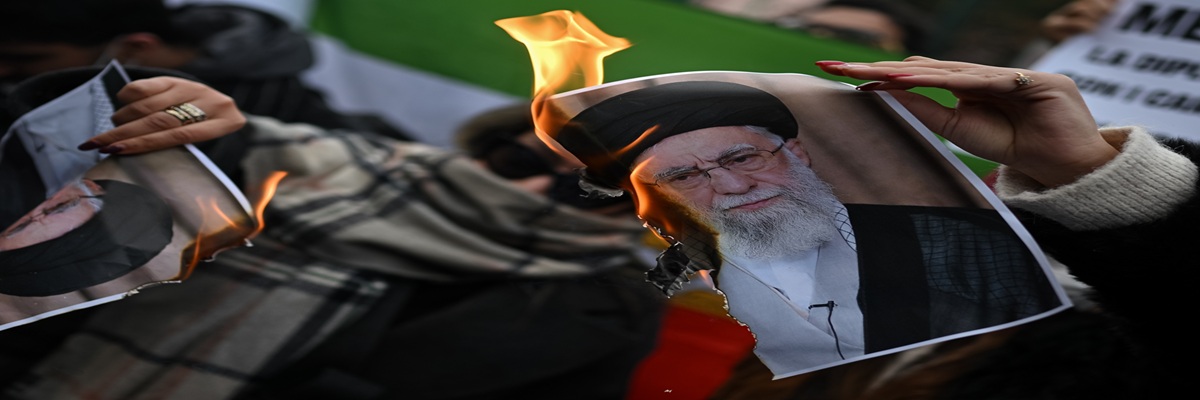
Image Source : Shutterstock
Subscribe to our weekly newsletters for free
If you want to subscribe to World & New World Newsletter, please enter
your e-mail


 Provider of in-depth & balanced analysis on hot issues around the world
Defense & Security
Image Source : Shutterstock
First Published in: Feb.03,2026
Feb.27, 2026
Share Article


In late December 2025, mass protests erupted across Iran, driven by public anger over the deepening economic crisis. Initially led by bazaar merchants and shopkeepers in Tehran, the demonstrations quickly spread to universities and major cities such as Shiraz, Isfahan, and Mashhad, becoming the largest unrest since the 2022 Mahsa Amini protests. Over time, the movement expanded beyond economic demands to include calls for freedom and, in some cases, the overthrow of the regime. Protesters chanted anti-government slogans such as “death to the dictator.” [1] In response, since late December 2025 Iranian state security forces have engaged in massacres of dissidents. The Iranian government has also cut off internet access and telephone services in an attempt to prevent protesters from organizing. The Iranian government has accused the US and Israel of fueling the protests, which analysts suggest may be a tactic to increase security forces’ willingness to kill protesters. A Sunday Times report, based on information from doctors in Iran, said more than 16,500 people were killed and more than 330,000 injured during the mass protests. The Interior Ministry in Iran verified 3,117 people had been killed in protests. [2] The Iranian protests, the largest in the Islamic Republic’s 46-year history, appear to have subsided for now in the face of a violent government crackdown. US President Donald Trump has threatened to “hit very hard” if the situation in Iran escalates, reigniting concerns about possible US intervention in the region. Even Trump called Iran’s Supreme Leader Ayatollah Ali Khamenei “sick man” in an interview with Politico on January 17th, 2026, and said, “It’s time to look for new leadership in Iran.” It appeared to be the first time Trump had called for the end of Khamenei’s rule in Iran. [3] Despite having repeatedly threatened to attack Iran if the regime were to start killing protesters, Trump has held off on any immediate military action against the Islamic Republic. While the US reportedly sent the USS Abraham Lincoln carrier strike group to the Middle East on January 15th, 2026, President Trump has not specified what he might do. However, on January 28th, 2026, Trump posted on social media: “A massive Armada is heading to Iran... It is a larger fleet, headed by the great Aircraft Carrier Abraham Lincoln, than that sent to Venezuela. Like with Venezuela, it is, ready, willing, and able to rapidly fulfill its mission, with speed and violence, if necessary.” Saying that time is running out, Trump demanded that Iran immediately negotiate a nuclear deal. He also suggested his country’s next attack on Iran could be worse than last year’s. In response, Iranian Supreme Leader Ali Khamenei has warned the US that any attack on his country would result in a “regional war” as US President Donald Trump has amassed military assets in the Middle East. With this tension between Iran and the US running high, Iran and the US held a nuclear talk on Friday on February 6th, 2026, in Oman. However, the deal was not reached, although both sides agreed to resume the talks. If the US and Iran fail to strike a deal and then the US carries out military strikes on Iran, what will happen? Does US military strikes make a democratic transition in Iran possible? This paper deals with this issue. It first introduces theory on democratic transition and then examines whether US military strikes against Iran makes a democratic transition in Iran possible.
There is a considerable body of literature on theories of democratic transition. These broadly fall into the following categories: [4] a. Structuralist approaches which see the emergence of democracy as tied to factors such as economic development (Lipsett, 1959; O’Donnell 1979), political culture (Almond and Verba, 1963), civil society and class conflict (Moore, 1966). b. Strategic choice approaches which focus on the calculations and decisions made by elites (Rustow, 1970; Bratton and van de Walle, 1997; Burton and Higley, 1987). c. Institutionalist approaches which stress the impact of institutions on policies and patterns of political actions (Leftwich, 2017). d. Political economic approaches which stress economic determinants of political change and democratization, in particular the impact of economic crises (Haggard and Kaufman, 1995; Guo, 1999). Empirical case studies (for example, Haggard and Kaufman, 1995) suggest that, rather than a single theory to explain democratic transitions, a combination of these theories is usually applicable. According to Idris (2016)’s study of the five case studies of South Africa (1986), Ghana (2000), the Philippines (1986), Indonesia (1999) and Ukraine (2004), enabling factors for the emergence of democracies are below: [5] - Unpopular incumbent: With the exception of Ghana, all the incumbent regimes were very unpopular, often characterized by human rights abuses, corruption, mismanagement and denial of democratic freedoms. A breakdown of the ‘authoritarian bargain’ in the Philippines and Indonesia, whereby growth and development were provided with limited democracy, fueled public opposition. - Economic development & situation: Economic development was a main factor in many democratic transitions, but the precise influence varied. Indonesia is the clearest example of democratic transition advanced by economic crisis (effects of the Asian financial crisis in 1997); in the Ukraine, in contrast, growth had been strong overall, but inequality and corruption fueled public frustration. However, the modernization theory (Lipsett, 1959) that economic growth and development is a prior condition/enabling factor for democratization rarely applied. - United opposition and strong leadership figures: The ability of the opposition to unite around a common goal, especially behind strong leaders, was an important factor in democratic transitions. Cory Aquino in the Philippines, Nelson Mandela in South Africa, and Viktor Yushchenko in Ukraine played this role. - Strong civil society: An organized civil society played a significant role in mass mobilization, monitoring government actions (e.g. election fraud) and countering government measures to suppress them. In Ukraine, for instance, many leaders of the 2004 Orange Revolution had taken part in anti-government protests in 2000-1; civil society groups in South Africa mounted a very effective civil disobedience campaign. - Mass mobilization: was a critical factor in successful democratic transitions, seen in South Africa, the Ukraine, the Philippines, and Indonesia. This came about because of information dissemination through television, radio, and the internet, as well as civil society groups. Mass protests created an irreversible momentum for change and led to defection or unwillingness to use force and violence against demonstrators on the part of the security forces. - International pressure/support: Military/Diplomatic/donor (e.g. IMF) pressure on an authoritarian regime could force it to make concessions where domestic factors alone would not. South Africa exemplifies this: without international sanctions and international condemnation of the apartheid regime, reform and democratization would not possible or likely have taken much longer. Ghana’s democratic transition arguably began mainly because of IMF pressure. External ‘democratic aid’, e.g. to raise public awareness of democratic values and build up the capacity of civil society groups, also made a difference. In Ukraine, a decade of such external support meant civil society groups were able to effectively monitor and document electoral fraud by the Kuchma government.
US military strikes on Iran is an international pressure/support that this paper explained as an enabling factor for the emergence of democracies. US military strikes on Iran are the most important element in facilitating a democratic transition in Iran. Thus, this paper first takes a look at current US military build-up to attack the Iranian regime and then explores whether US military strikes on Iran make a democratic transition in Iran possible.
1. US military build-upAs US President Donald Trump considers a major strike on Iran, the US military has accelerated a weeks-long buildup of military hardware in the Middle East, open-source data shows. As Figure 1 shows, the arrival of the Lincoln Carrier Strike Group, now in the northern Arabian Sea, represents the most dramatic shift in military positioning. The group includes the USS Abraham Lincoln along with three guided-missile destroyers and the carrier air wing which includes squadrons of F-35C Lightning II fighters, F/A-18E Super Hornet fighters, and EA-18G Growler electronic warfare jets. The US Navy also has three destroyers — the USS McFaul, USS Delbert D. Black, and USS Mitscher — in the region separate from the aircraft carrier strike group. Three littoral combat ships — USS Santa Barbara, USS Canberra, and USS Tulsa — based out of Bahrain could be called upon for minesweeping duties if Iran chooses to deploy such armaments.
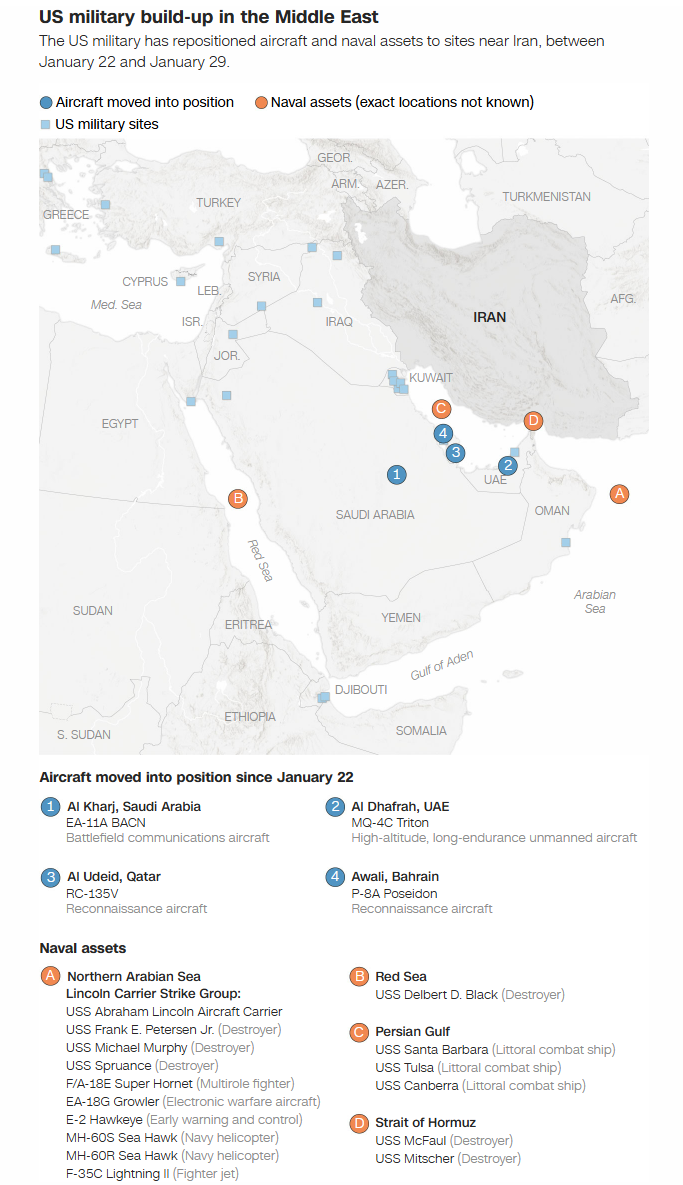
In recent days, the US has deployed various air defense systems to the region as well, including additional Terminal High Altitude Area Defense (THAAD) systems, and Patriot missile systems that appeared at Al Udeid Air Base in Qatar last week, Those systems would be key to combating retaliatory missile strikes of Iran by taking aim at either US military assets or US allies in the region. The guided-missile destroyers steaming with the Lincoln and elsewhere in the region offer significant strike potential. Each destroyer can carry dozens of Tomahawk Land Attack Missiles with a range of 1,000 miles and wielding a 1,000-pound conventional warhead. In addition, US Navy carrier strike groups usually operate with an attack submarine that can also launch Tomahawks, but the presence of submarines is almost never disclosed. While the aircraft carrier provides a floating base for military operations, the US has a number of permanent locations in the region where a slew of other aircraft have also been heading. As Figure 2 shows, according to the Council on Foreign Relations, the US has at least 19 military bases - eight of which are considered to be permanent - across the Middle East. The US has a major military presence in Israel, Qatar, Bahrain, Kuwait, Egypt, Iraq, Jordan, Saudi Arabia, Syria, Oman and the UAE. In Djibouti and Turkey, the US maintains large military bases that serve different regional commands, but contribute to activities in the Middle East. Currently, there are approximately 40,000 US troops in the Middle East, according to US defense officials. Around a quarter of them are in al-Udeid, Qatar, which hosts combat aircraft, tankers, aerial refueling and intelligence assets. Al-Udeid is the largest US military base in the region, hosting around 10,000 troops. The next biggest military base in terms of personnel is thought to be the naval base in Bahrain. Bahrain (hosting 9,000 American troops) is where the US Navy’s Fifth Fleet is headquartered, with responsibility over the Gulf, Arabian Sea, Red Sea, and some of the Indian Ocean. Kuwait hosts Camp Arifjan. That is the name of the tactical (or forward) headquarters of the US Army Central - a military formation that serves as the army component for Centcom. Ali al-Salem air base is also in Kuwait, along the Iraqi border. Another Kuwait base is Camp Buehring, which has been a staging post for units heading to Syria and Iraq. In total, around 13,500 US troops are stationed in Kuwait.
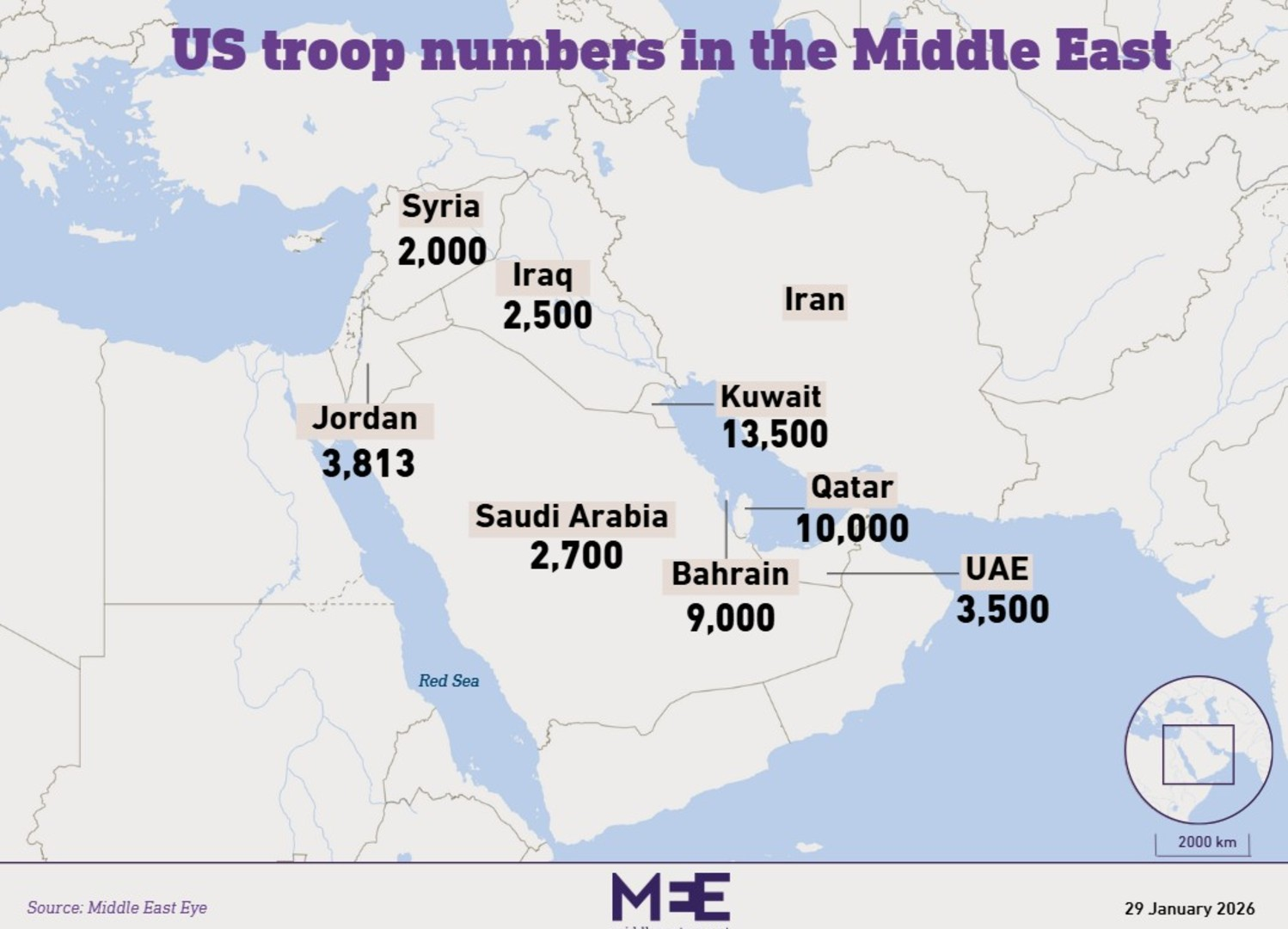
The UAE is home to 3,500 US troops, as well as Al-Dhafra Airbase, a site shared between the US and the Emiratis. It has been used during missions against the Islamic State group, as well as for reconnaissance missions in the region. The US military presence in Iraq includes the Ain al-Asad airbase in Anbar - a site that was targeted by Iranian missiles after the US assassinated Qassem Soleimani, the senior Iranian general. There’s also the Erbil airbase in the semi-autonomous Kurdistan region, which is used for training exercises. Approximately 2,700 US troops are stationed in Saudi Arabia, providing air and missile defense capabilities. The Prince Sultan Airbase, near Riyadh, is a major air force hub where its main assets include Patriot missile batteries. For its missions in the Levant, Muwaffaq Salti airbase in Jordan’s Azraq is the key hub. It hosts the US’s 332nd Air Expeditionary Wing. Further afield in Turkey, the major base run jointly with Turkish forces is the Incirlik Airbase in southern Adana. That base reportedly hosts US nuclear warheads. The size of US military bases, personnel, and equipment has fluctuated in recent years and months, reflecting shifting regional priorities. Early in President Trump’s second term, several warships departed the Middle East to support US international operations. However, naval and air power is now being bolstered in the region to attack Iran. On January 29th, 2026, an E-11A jet arrived at Al Udeid Air Base in Qatar. This is one of the last critical assets that the US needs to coordinate complex operations. On the same day, a transport aircraft modified for combat search and rescue operations arrived in the area of Operation. A squadron of F-15E Strike Eagle fighters, capable of carrying a variety of guided bombs and air-to-surface missiles, also recently deployed to the region as part of a planned troop rotation. Surveillance flights by US drones and reconnaissance aircraft have continued in the Strait of Hormuz and the Persian Gulf. Since last Monday, reconnaissance aircraft have been flying nonstop from US bases in Bahrain, Qatar, and even beyond the Middle East. Modified versions of the RC-135 reconnaissance aircraft, capable of detecting radioactive debris and interpreting electromagnetic signals, have also been deployed to the Middle East. On January 29th, 2026, at least eight aerial refueling tankers, used to provide aerial refueling for small military aircraft, crossed the Atlantic and landed at Morón Air Base in Spain. The six F-35 fighters were crossing the Atlantic and landed at Lages Air Base in Portugal. Amid high tensions over President Trump’s recent threats, US Central Command announced on January 27th, 2026 that it had conducted several days of training exercises across the Middle East to demonstrate its “ability to deploy, distribute, and sustain combat power.” [6]
2. Will US strikes on Iran bring about a democratic transition in Iran?Iran and the US held a nuclear talk on Friday on February 6th, 2026, in Oman. However, no last-minute deal with Iran was reached, although both sides agreed to resume the talks. If the US and Iran fail to strike a deal and then the US carries out military strikes on Iran, what will happen? Will US military strikes make a democratic transition in Iran possible? According to Idris (2016)’s study of South Africa (1986), Ghana (2000), the Philippines (1986), Indonesia (1999) and Ukraine (2004), enabling factors for the emergence of democracies are: [7] • Unpopular incumbent • International pressure/support • Bad economic situation (economic crisis) • Mass mobilization • United opposition and strong leadership figures: • Strong civil society
Table 1: presence or absence of six enabling factors for emergence of democracies in Iran
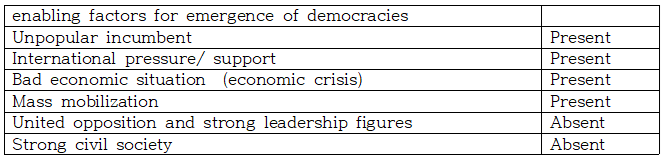
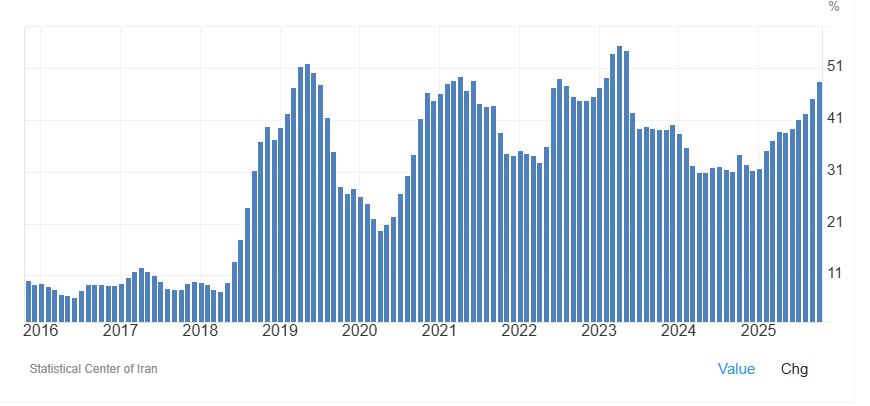
Among six preconditions for democratic transition, four conditions are present in Iran, while two are absent. The first condition (Unpopular incumbent) is present. Iranian regime or Iran’s Supreme Leader Ayatollah Ali Khamenei is very unpopular. He has faced recurring, intense public unrest (since 2017), indicating deep-seated unpopularity among significant segments of the population. Anti-government protests in Iran have continued since 2017, as seen below: • 2017–2018 Iranian protests • 2018–2019 Iranian general strikes and protests • 2019–2020 Iranian protests (economy, anti-government) • 2021–2022 Iranian protests (water shortages, economy) • 2022 Iranian food protests • 2022–23: Mahsa Amini protests • 2025 Iran water crisis protests (May–August) • 2025–2026 Iranian protests (anti-government, economy, human rights) Especially, according to Wikipedia, more than 3,000 anti-government protests took place in Iran each year in the 2020s. The second condition (International pressure/support) is present. US president Trump is ready to carry out military strikes on the Iranian regime to change Iran. The third condition (Bad economic situation) is present. The most serious economic problem of Iran is a skyrocketing inflation. As Figure 3 shows, inflation in Iran skyrocketed to over 48.6% in October 2025 and 42.2% in December 2025. This high inflation has been chronic in the 2020s, severely impacting household budgets.
Moreover, as Figure 4 shows, food prices have significantly increased in the 2020s. For instance, the price of rice has surged by 2.11 times between 2012 and 2023, while bread costs have risen 3.4 times from 2011 to 2023. Potatoes have tripled in price over the same period, and chicken fillets have seen a 2.06-fold increase from 2010 to 2023.
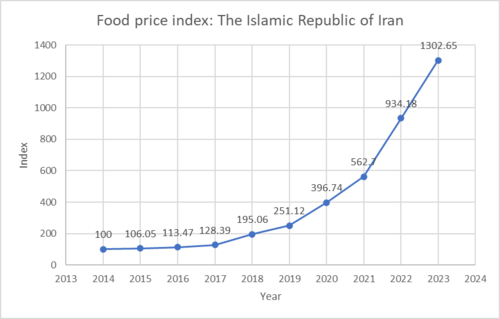
Figure 4: Food price index in Iran
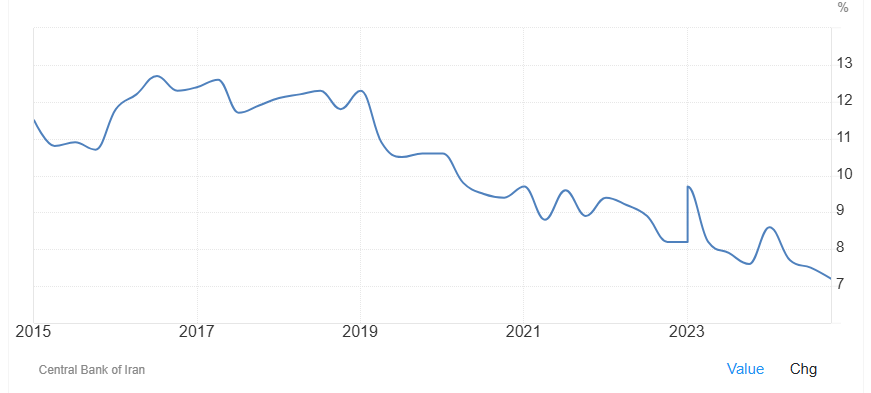
In addition, Iran faces a severe energy shortage, marked by rolling blackouts, gas cuts, and infrastructure strain, despite its massive oil and gas reserves. The Iranian energy crisis is a multifaceted problem that has been exacerbated by a combination of factors, including poor governance, foreign policy failures, and the dominance of industries under the Islamic Revolutionary Guard Corps (IRGC). As of November 2024, Iran faces its most severe energy crisis in decades, with frequent power outages and disruptions to natural gas supplies. The country’s energy infrastructure is outdated and in disrepair, with many refineries and power plants operating below capacity. Iran’s energy supply is unreliable, with frequent blackouts and shortages affecting daily life, industries, and essential services. The IRGC's control over key industries, including power generation and distribution, has hindered efficient management and strategic planning. The regime’s prioritization of political interests over efficient management and infrastructural development has exacerbated the crisis. A notable example is the extensive usage that the IRGC makes in electricity to mine cryptocurrency which leaves Iran in the dark.[8] Despite ongoing power shortages, Iran continues to export electricity, with a surge of nearly 92% in the first four months of 2023 compared to the same period in 2022. The crisis has put a stop to 50% of industry. In January and February 2025, constant power shutdowns were conducted with the schools as well as Iranian industries. Since February 2025, Iran has been suffering from daily blackouts, each lasting for 3-4 hours. The energy shortage does not equally affect all segments of the population. For example, in Teheran, rich northern neighborhoods experienced only 1% of outages while poorer southern districts endured 32%. [9] This energy crisis created deep public frustration and anger. With inflation running extremely high, a high unemployment rate hit Iran. The unemployment rate in Iran averaged 11.04 percent from 2001 until 2024, as Figure 5 shows. Fortunately, the unemployment rate in Iran decreased to 7.20 percent in the fourth quarter of 2024 from 7.50 percent in the third quarter of 2024, but the unemployment rate in Iran is still high.
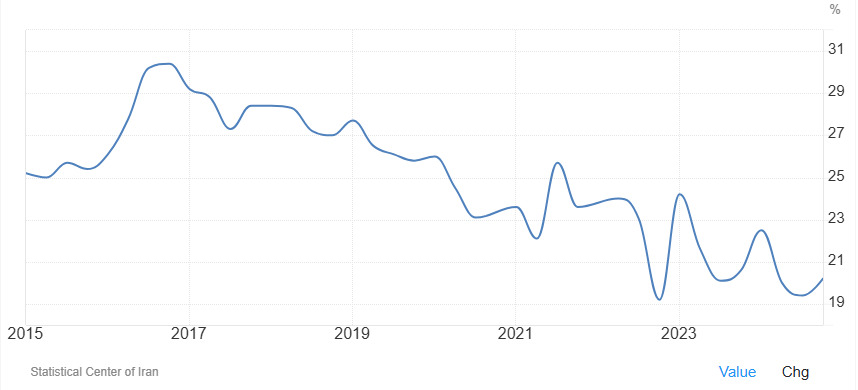
In particular, the youth unemployment rate has been very high. As Figure 6 shows, the youth unemployment rate in Iran averaged 25.01% from 2011 until 2024. Youth unemployment rate in Iran was very high at 20.2% in the fourth quarter of 2024, although it has declined. More seriously, according to Majlis reports, 50% of males between 25–40 are unemployed and not looking for employment. [10]
Under the situations of high inflation and high unemployment, in March 2025, estimates ranged from 22% to 50% of Iranians living under the poverty line — a stark increase from 2022. [11] As a result, the number of people that cannot afford a healthy diet increased substantially. As Figure 7 shows, the number of people in mal nourishment increased to over 14 million in 2022. The ministry of social welfare in Iran announced in 2024 that 57% of Iranians are having some level of mal nourishment.
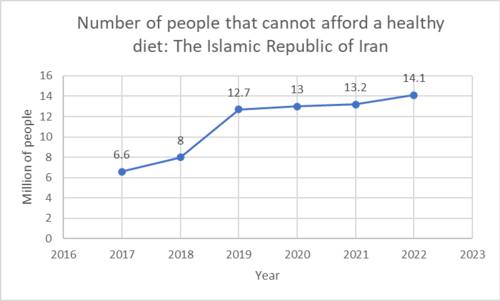
Figure 7: Number of people in mal nourishment in Iran.
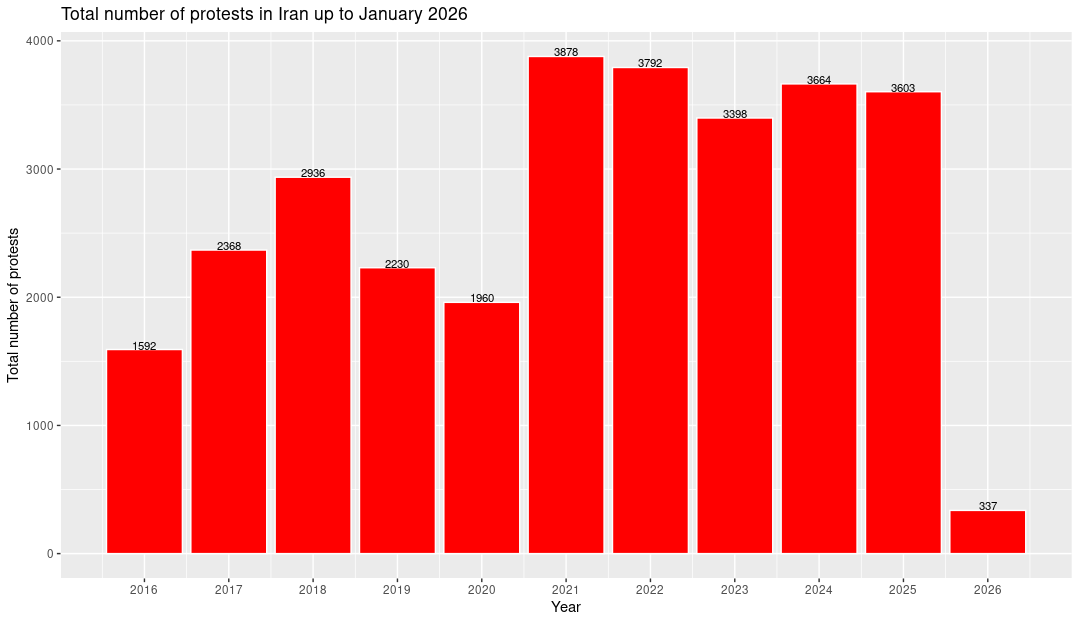
These economic crises have triggered nationwide protests in Iran in 2025-26. The fourth condition (Mass mobilization) is present. Anti-government protests in Iran triggered by the economic crisis are under way in 2025-26, although they have recently subsided. According to a Sunday Times report, more than 16,500 people were killed and more than 330,000 injured during the mass protests of 2025-26. Moreover, according to Wikipedia, anti-government protests in Iran have continued since 2017, as shown before. Figure 8 shows the number of anti-government protests in Iran since 2016. Over 3,000 protests took place in Iran each year in the 2020s.
However, the fifth and sixth conditions (United opposition and strong leadership figures & Strong civil society) are absent in Iran. According to Maryam Alemzadeh, a professor at the University of Oxford, the Iranian regime has effectively suppressed any attempt for organized opposition in Iran over the past decades and arrested and silenced its leaders. There is no main opposition organization and leader in Iran such as the ANC and Nelson Mandela in South Africa. Even non-political NGOs, student groups, labor unions, and anything that could resemble a bottom-up order has been quashed. As a result, neither leadership nor grassroots organization can be expected, and protests are left contingent on ad hoc individual or collective decisions of the protesters. [12]
3. Analysis of a democratic transition in IranAs this paper explained above, among six preconditions for democratic transition, four conditions are present in Iran, while two are absent. Therefore, it is not clear whether Iran can make a democratic transition. The most important factor for democratic transition in Iran is US military intervention. The democratic transition in Iran mainly depends on to what extent the US militarily intervenes in Iran and what military options US uses.
A. Scenario 1: US makes targeted, surgical strikesUS secretary of state Marco Rubio assessed that the Iranian regime was probably weaker than it had ever been. US naval and air forces may conduct limited, precision strikes targeting military bases of Iran’s Islamic Revolutionary Guards Corps (IRGC) and the Basij unit - a paramilitary force under the control of the IRGC - ballistic missile launch and storage sites as well as Iran’s nuclear program. An already weakened Iranian regime might be toppled, eventually making a transition to a genuine democracy where Iran can rejoin the rest of the world. This is a highly optimistic scenario but is highly unlikely. Western military intervention in both Iraq and Libya did not bring a smooth transition to democracy. Although brutal dictatorships ended in both countries, it ushered in years of chaos and bloodshed. A senior Israeli official said that Israel does not believe US airstrikes alone can topple the Islamic Republic, if that is Washington’s goal. A protracted US air campaign is considered unlikely, military experts say, citing Trump’s reported desire for a limited and decisive attack. Jason Brodsky, a member of the Atlantic Council’s Iran Strategy Project, said that President Trump has historically favored “quick, surgical, targeted, dramatic, and decisive military operations,” pointing to US airstrikes in Syria during his first term. But even a monthslong offensive would not guarantee the fall of the Iran regime. “A sustained US air campaign could severely degrade Iran‘s conventional military by ripping up command-and-control, and fixed infrastructure, but it is unlikely by itself to produce the collapse of Iranian security forces, which can disperse, hide, and shift to low-signature internal repression,” said Michael Horowitz, an independent defense expert in Israel. [13] “If you’re going to topple the Iran regime, you have to put boots on the ground,” he told Reuters, noting that even if the US killed Supreme Leader Ayatollah Ali Khamenei, Iran would “have a new leader that will replace him.” [14] Jason Brodsky also said any US military intervention could involve leadership decapitation alongside attacks on Iran’s military and security infrastructure. However, Brodsky cautioned that Iran’s political system is designed to survive even major leadership losses. [15] “The Islamic Republic is bigger than any one individual,” he said, noting that institutions and succession mechanisms exist to fill any vacuum — even if the removal of Supreme Leader Ayatollah Ali Khamenei could be temporarily destabilizing. Moreover, Iran’s leadership had been weakened by the massive protests but remained firmly in control despite the ongoing deep economic crisis that sparked the protests. Danny Citrinowicz, a former Israeli intelligence official now with the Atlantic Council, warned that US military strikes could actually strengthen hardliners. A US attack would more likely consolidate elite cohesion around the regime, marginalize protesters and reinforce Iran’s narrative of external siege,” he said. Alex Vatanka, director of the Iran Program at the Middle East Institute, said that without large-scale military defections, Iran’s protests remained “heroic but outgunned.” Only a combination of external pressure and an organized domestic opposition could shift Iran’s political trajectory, Vatanka said. However, opposition groups in Iran are ideologically diverse, including monarchists, republicans, secular nationalists, communists, socialists, ethnic separatists (e.g. Kurdish nationalists), supporters of Western liberal democracy, and Islamists (including Shia Muslims dissidents and Sunni Salafis and Kurdish Islamists). The opposition movement is currently fragmented and riddled with internal divisions over the future of a post-Islamic Republic Iran. [16] Moreover, US President Trump has notably avoided endorsing a successor to Ayatollah Ali Khamenei, and Iran’s exiled crown prince Reza Pahlavi lacks sufficient support within the country to immediately be installed as a leader. [17] While some Western media have pointed out Reza Pahlavi – the son of the ousted Shah of Iran – who had called on protesters to take to the streets against Khamenei’s rule, as a possible alternative, many analysts don’t see in him the ingredients of a true leader. Many people see Pahlavi as a figure too close to Israel’s Zionist Prime Minister Benjamin Netanyahu. “Reza Pahlavi, even himself, is not looking forward to coming back to Iran,” says Fatemeh Karimkhan, an Iranian journalist. Karimkhan says that while there are some pro-monarchy supporters in Iran, they are not as many as projected. Karimkhan claims that “they are much less in number and in ability.”
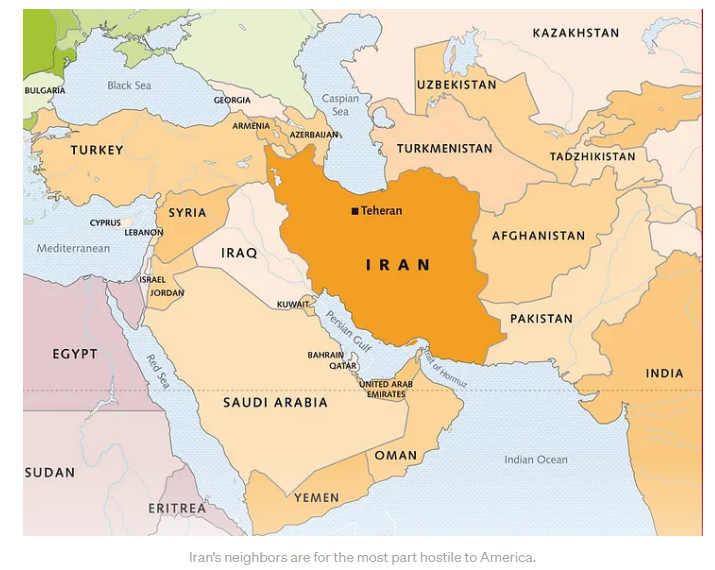
B. Scenario 2: Along with air strikes, the US send ground forces to Iran for a regime changeMany experts say it is unlikely that the US would send ground troops to Iran. “President Trump is not a nation builder. He does not believe in long-term commitments or building democracy. He gave up on Afghanistan. So, he is not going to commit to boots on the ground in Iran. It is simply way too costly,” Akbarzadeh said. [18] Under Trump, the US moved decisively towards ending its long war in Afghanistan, which began in 2001. In 2020, during Trump’s first term, US officials and Taliban representatives signed the Doha agreement after months of negotiations in Qatar to end the war. The actual withdrawal of troops took place in 2021, during the presidency of Joe Biden. More importantly, the US can't invade Iran. [19] This is because there is no place from which to launch an invasion. To invade a country, you need one of two things: You need to be able to invade it by land or you need to be able to invade it by sea (an amphibious invasion). The US can do neither. [20] No land invasion is possible because the US controls no land that borders Iran. As Figure 9 shows, Iran’s neighbors are for the most part hostile to the US. Iran shares land borders with eight nations (that is, if you count the disputed enclave of Nagorno-Karahakh). None of them agreed to be used for a land invasion of Iran. Moreover, the US lacks regional bases necessary to invade Iran, destroy its armed forces, and displace the revolutionary regime in Iran. Gulf allies such as Saudi Arabia do not want their soils and air spaces to be used for US attacks on Iran. Iraq has US troops stationed in the country, but Iraq has solid and good relations with the Iran regime at this point. There is basically no chance the Iraqis allow the US military to stage an invasion from there and neither Iraq nor Afghanistan are under direct US occupation any longer. [21]
Alternatively, the US could undertake an amphibious forced entry into Iran. This would be the largest amphibious invasion attempt since D-Day of World War II and would result in heavy US casualties on the beaches of Iran. As tens of thousands of US servicemen are dying in a war with Iran, this military option will not be popular domestically in the US. Iran has tons of ballistic and cruise missiles, as well as some of the largest stockpiles of artillery in the world. And Iran’s allies (China, Russia, and North Korea) can help arm the Iranian regime easily in the result of a full-scale US invasion. Simply put, it would be an incredibly difficult and costly military operation. Even if the US is willing to endure heavy casualties, then US troops would still need to traverse rugged and mountainous terrain in Iran in order to get to Tehran, conquer it, and remove the regime from power. This would be like fighting in the jungles of Vietnam only much worse. [22] More than 50,000 US servicemen died in roughly 8 years of fighting in Vietnam. In Iran, there would likely be tens of thousands of dead Americans a year. Is the US government and public willing to stomach losses like that? Such losses may be unheard of in the US since the Vietnam and Korean Wars, perhaps even World War II if it gets ugly enough as it has in the Russo-Ukrainian War where there have been hundreds of thousands of deaths in a little over 3 years. There would surely be a sizable level of resistance in the US if a war is launched against the Iranian regime, and the US government has to weigh these factors in when considering using military force for regime change operations. The Trump administration does not want to create the biggest anti-war movement in the country since the Vietnam War, which could also increase dissents regarding other issues like an immigration issue in the country. A war with Iran would radicalize a good amount of Americans. [23] Moreover, there are several geostrategic considerations to factor in as well with regional allies of the US. A war of any kind on Iran would not be supported by Saudi Arabia at this point and Iran can inflict severe damage onto US assets in the region which are stationed in places like Kuwait, Bahrain, Jordan, etc. These countries in the Gulf don’t want to be dragged into being a theater of the war, nor do they want their energy sectors attacked by Iran. In addition, there’s always the possibility that an American-Israeli war on Iran could metastasize into World War III. China gets roughly 40% of their oil from the Persian Gulf, which would surely be shut down for some time in the event of a US invasion of Iran. Will China sit idly by? Not likely. At the very minimum China would help arm Iran to defend itself, but there’s simply an inherent risk of global conflict given a third of world energy supplies come from this region. Middle East energy is existential to China right now as it stands. China has been expanding oil and gas imports from Russia, but these will take time to get China less reliant on Middle East resources. [24] Therefore, the deployment of US ground troops is highly unlikely, and a regime change and a transition to democracy in Iran are almost impossible.
This paper raised a question “Does US military strikes on Iran make a democratic transition in Iran possible? To address this question, this paper first examined theories and preconditions for a democratic transition and then evaluated whether US military attacks on Iran makes a democratic transition in Iran possible. As explained above, US military interventions in Iran can’t bring about a democratic transition in Iran.
[1] Barin, Mohsen (31 December 2025). "Iran's economic crisis, political discontent threaten regime". DW News. [2] https://www.timesofisrael.com/irans-president-warns-us-attack-on-supreme-leader-would-mean-full-scale-war/ [3] https://www.politico.com/news/2026/01/17/trump-to-politico-its-time-to-look-for-new-leadership-in-iran-00735528?_kx=LSFywwe4GSg_lcFWo5DyId8VKdphy2F0zhlZVneJnA97jKgVYFyty4cB80GJkTHR.U5D8ER&utm_id=01KF7GKF35MAAW8BRA143VFM9M&utm_medium=campaign&utm_source=Klaviyo [4] https://gsdrc.org/wp-content/uploads/2016/12/HDQ1349.pdf [5] https://gsdrc.org/wp-content/uploads/2016/12/HDQ1349.pdf [6] it had conducted several days of training exercises across the Middle East to demonstrate its “ability to deploy, distribute, and sustain combat power.” [7] https://gsdrc.org/wp-content/uploads/2016/12/HDQ1349.pdf [8] "Power Outages in Iran: The Rich Stay Lit, The Poor Go Dark". iranwire.com [9] "Power Outages in Iran: The Rich Stay Lit, The Poor Go Dark". iranwire.com [10] "تحلیل نشریه تایم از وضعیت ایران؛ آیا جمهوری اسلامی در آستانه فروپاشی است؟". euronews (in Persian). 18 December 2025. [11] Hafezi, Parisa. "Despite tough talk, economic woes may force Iran to bargain with Trump". Reuters. Retrieved 5 April 2025. [12] https://www.aljazeera.com/news/2026/1/12/which-are-irans-main-opposition-groups [13] https://www.bbc.com/news/articles/ce3kenge1k9o [14] https://www.bbc.com/news/articles/ce3kenge1k9o [15] https://www.independent.co.uk/news/world/middle-east/trump-iran-us-strikes-war-regime-change-nuclear-b2909957.html [16] https://www.aljazeera.com/news/2026/1/12/which-are-irans-main-opposition-groups [17] https://www.reuters.com/business/media-telecom/who-makes-up-irans-fragmented-opposition-2025-06-18/ [18] https://www.aljazeera.com/news/2026/1/14/what-are-trumps-military-options-for-an-attack-on-iran [19] https://medium.com/@markvmorgan/america-has-no-ability-to-attack-iran-4b5e51478542 [20] https://www.counterpunch.org/2025/06/17/why-america-wont-launch-a-war-on-iran/ [21] https://nationalinterest.org/blog/reboot/what-would-us-military-invasion-iran-look-209506 [22] https://www.counterpunch.org/2025/06/17/why-america-wont-launch-a-war-on-iran/ [23] https://www.counterpunch.org/2025/06/17/why-america-wont-launch-a-war-on-iran/ [24] https://www.counterpunch.org/2025/06/17/why-america-wont-launch-a-war-on-iran/
First published in :
World & New World Journal

Silence and shadows: The West’s Quiet Stance on Gaza’s Agony
What’s Driving Pakistan-Afghanistan War? Islamabad’s Never-Ending Cycle of Insecurity
Polycrisis in the Indo-Pacific Demands a Stronger Anzac Alliance
‘Destruction is not the same as political success’: US bombing of Iran shows little evidence of endgame strategy
Unlock articles by signing up or logging in.
Become a member for unrestricted reading!