

Defense & Security
The History of South Korea’s Space Development

Image Source : Wikimedia Commons
Subscribe to our weekly newsletters for free
If you want to subscribe to World & New World Newsletter, please enter
your e-mail


 Provider of in-depth & balanced analysis on hot issues around the world
Defense & Security
Image Source : Wikimedia Commons
First Published in: Feb.03,2026
Feb.27, 2026
Share Article


Space has evolved beyond being a domain of scientific exploration to become a crucial strategic asset that determines a nation's survival and prosperity. Whereas the space race during the Cold War was primarily a "pride competition" to showcase ideological superiority, space development in the 21st century has become a practical battlefield for controlling economic, security, and technological dominance. First, the importance of space in national security and military aspects. Modern warfare is fundamentally an "information war." Real-time surveillance through reconnaissance satellites, precision strike capabilities using GPS, and high-speed satellite communication networks form the backbone of contemporary military power. Nations that fail to secure space assets risk becoming "blind" in terms of information, which can lead to critical gaps in their defense capabilities. The global trend of establishing "space forces" is a direct result of space becoming firmly established as the 4th battlefield, after land, sea, and air. Second, the economic value and creation of new industries. With the onset of the "New Space" era, the private sector-led space industry is growing explosively. Building a global internet network using small satellite constellations, space tourism, and the manufacturing of ultra-precise semiconductors or new drugs in space are generating enormous value. Moreover, rare resources like rare earth elements and helium-3 found on the Moon or asteroids are seen as the final hope for solving Earth's resource depletion issues. Nations that secure these resources will likely control the future global economy. Third, the spillover effect on science and technology. Space development involves overcoming extreme environmental challenges, and the technologies developed — such as rocket propulsion, advanced materials engineering, artificial intelligence, and robotics — spill over into civilian industries, revolutionizing daily life. Technologies like water purifiers, microwaves, and cordless vacuum cleaners were all originally spin-offs from space exploration. In this way, investment in space development serves as a lever to elevate a nation's overall technological level. Lastly, international status and diplomatic influence. Countries that possess independent launch vehicle technology and satellite operations capabilities gain strong influence in the international arena. Space development requires significant capital and highly advanced technologies, and nations that succeed in this field acquire symbolic capital as "technological powerhouses." This helps them play a leading role in international cooperation frameworks and enhances national pride. In conclusion, space development is not merely a future investment but an essential national strategy to protect current security and secure future resources. As the saying goes, "He who controls space, controls the Earth," pioneering the path to space is a mission for sustainable national development in this era.
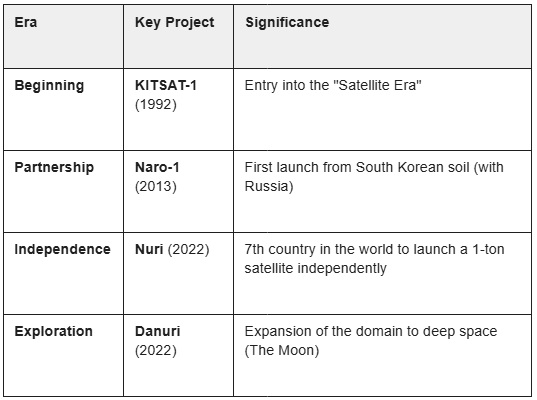
South Korea's journey in space development began later than that of many advanced nations, yet it has grown at an extraordinarily rapid pace — so much so that it is hard to find a parallel in the world. From laying the foundation in the early 1990s, South Korea has risen to become one of the top seven space-faring nations in just about 30 years. This journey marks the transformation from a "follower" to a "leader" in space development.
2.1. South Korea's SatellitesThe journey began in August 1992 with the launch of Arirang-1, South Korea’s first satellite. Built in collaboration with a British university, this small satellite was the first "eye" South Korea sent into space, making the country the 22nd nation in the world to have a satellite in orbit. Throughout the 1990s, South Korea focused on domestically producing satellite bodies and payload technology, notably through the Arirang series and multipurpose satellites, laying the foundation for the country’s space technology.
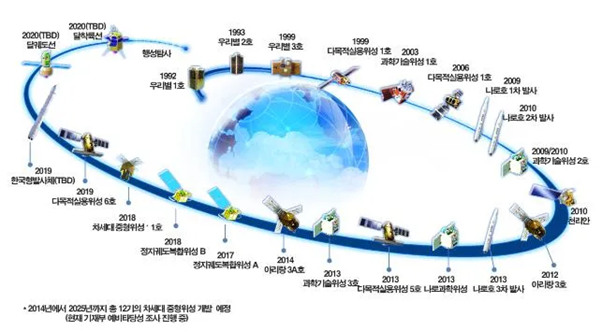
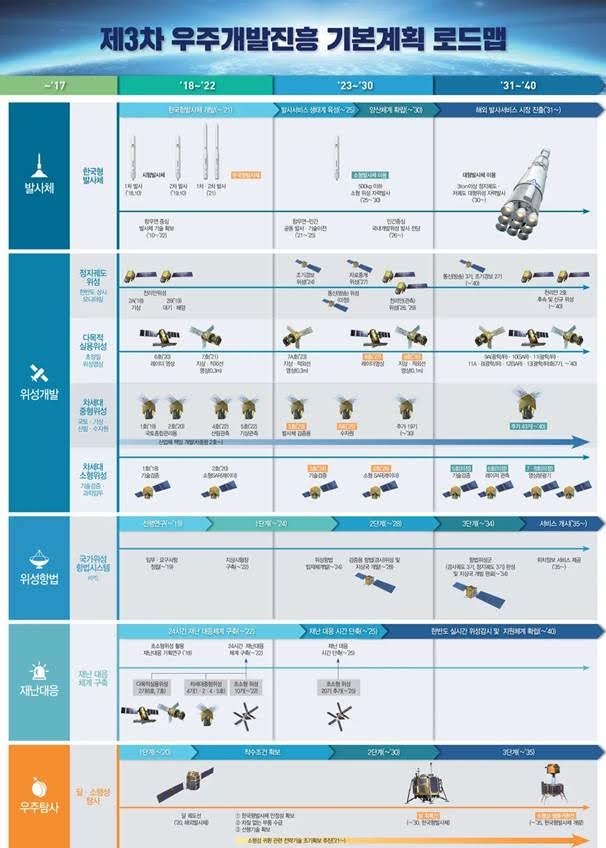
The development of launch vehicles began in earnest in the 2000s. In 2002, South Korea successfully launched its first liquid-propelled scientific rocket, KSR-III, which helped the country accumulate crucial rocket engine technology. This laid the groundwork for the construction of the Naro Space Center in 2009, the heart of South Korea's space development. However, the road to self-sufficiency in launch vehicles was challenging. The Naro rocket (KSLV-I), developed in cooperation with Russia, faced two failed launches, a painful setback. Despite these failures, South Korea achieved a historic milestone with the successful launch of Naro-3 in January 2013, sending a domestically built satellite into space for the first time. The success of Naro-3 became a springboard for the development of South Korea’s indigenous launch vehicle, the Nuri rocket (KSLV-II). Unlike the Naro rocket, which used Russian engines, the Nuri rocket had to be entirely designed, built, tested, and operated with South Korean technology — a monumental challenge. After an incomplete success in its first launch in 2021, South Korea achieved full success with the second launch of Nuri in June 2022. With this achievement, South Korea became the seventh country in the world to launch a practical satellite weighing over 1 ton using a domestically developed launch vehicle. The country's progress continues at an even faster pace. In August 2022, South Korea launched the Korea Pathfinder Lunar Orbiter (KPLO), the country’s first lunar orbiter, which successfully entered lunar orbit. This marks South Korea's first step beyond low Earth orbit and into deep space exploration. Additionally, South Korea’s Space Agency (KASA), responsible for overseeing space development, officially opened in May 2024 in Sacheon, Gyeongsangnam-do, aligning the country's space policies with specialized expertise and consistency. Currently, South Korea is following an ambitious “Space Economy Roadmap”, which includes plans to launch a lunar lander in 2032 and a Mars exploration mission by 2045. Moving past the phase of technology imitation, South Korea is now advancing its capabilities in cutting-edge reconnaissance satellites, small satellite constellations, and high-performance next generation launch vehicles, positioning itself as a leading player in the global exploration of humanity’s new frontiers. Here is the Timeline of South Korea’s Launch Vehicles (Source: Wikipedia). Note: KSR: Korea Sounding Rocket (Korean Scientific Observation Rocket). KSLV: Korea Space Launch Vehicle (Korean Space Launch Vehicle: I represents the Naro series, II represents the Nuri series) • 1377: During the 3rd year of King Uwang of the Goryeo Dynasty, Choi Mu-seon created the first Korean rocket, called "Juhwa" (走火), later known as "Shingijeon". • 1451: The 1st year of King Munjong of the Joseon Dynasty, Munjonghwacha (a fire-wheeled vehicle, a type of rocket). • 1958 January: Inha University establishes a Department of Weapons Engineering. • 1958: The Ministry of Defense establishes a rocket research organization at the Agency for Defense Development (ADD). • 1959 July: ADD successfully launches a two-stage rocket (67th rocket) and a three-stage rocket (556th rocket) from the coastal area of Gojan-dong, Incheon. • 1960 November 15: Inha University develops the IITO-1A rocket. • 1960 November 19: Inha University develops the IITO-2A rocket. • 1960 November 19: Test launch of the IITO-1A and IITO-2A rockets from the waters off Songdo, Incheon, at 3:50 PM. • 1961: ADD disbanded. • 1962 April: Inha University establishes the Inha Rocket Research Society. • 1964 May: Inha Rocket Research Society launches the IITO-1A from the coast of Gojan-dong, Incheon. • 1964 October: Inha Rocket Research Society launches the IIT-3A rocket, which fails. • 1964 December: Inha Rocket Research Society launches the two-stage rocket IITA-4MR. • 1964 December: Inha Rocket Research Society launches the largest three-stage rocket, IITA-7CR, using a solid propellant from Japan. • 1970: Air Force Academy's Park Gui-yong and Jo Ok-chan's team launch the AXR-55 rocket with asphalt propellant, supported by the Ministry of Science and Technology. • 1971: Air Force Academy launches the AXR-73 rocket with asphalt propellant. • 1972: ADD begins rocket research. • 1972 December: Air Force Academy launches the AXR-300 rocket, with a total of three launches. • 1978: ADD develops the domestic medium-range ballistic missile, Baekgom, modeled after the U.S. Nike Hercules. • 1986: Inha University begins the development of the IS-X rocket series under the Inha Rocket Research Society. • 1987: The Space Science Institute of the Korea Astronomy and Space Science Institute (KASI) is established to start developing scientific rockets. • 1988 February: Inha University launches IS-001 and IS-002 rockets. • 1988: Scientific rocket development project is selected as a specific research task by the Ministry of Science and Technology. • 1988 December: Inha Rocket Research Society presents the IS-X research report. • 1989 October: The Korea Aerospace Research Institute (KARI) is established. • 1993 June: KARI launches the solid rocket KSR-I (KSR-420) from the Anheung Test Site on the west coast. • 1993 September: KARI successfully launches KSR-I (KSR-420) for the second time from Anheung Test Site. • 1995: South Korea develops its first pressurized liquid-fueled rocket engine with a thrust of 13 tons. • 1996: South Korea establishes its Mid- and Long-Term National Space Development Plan, aiming to achieve the capability to launch low-earth orbit satellites independently by 2010. • 1997 July 9: KARI launches the two-stage solid scientific rocket KSR-II. • 1998: The 5th Science and Technology Ministers' Meeting approved the modification of the national space development plan, shortening the goal for independent satellite launches to 2005. • 2000: The second revision of the space development plan is approved, setting goals for securing small satellite launch vehicle technology by 2005, 1-ton practical satellite launch technology by 2010, and 1.5-ton practical satellite launch technology by 2015. • 2002: KARI launches South Korea's first liquid-propelled scientific rocket, KSR-III. • 2004: South Korea and Russia sign a space technology cooperation agreement. • 2006: South Korea and Russia sign a space technology protection agreement. • 2008: KARI develops a 30-ton rocket engine, completing prototype development and partial testing of the turbo pump-gas generator system. • 2008: KARI begins the development of a 75-ton rocket engine. • 2008: The Naro Space Center is completed. • 2009 August 25: KARI attempts the first launch of Naro-1 (KSLV-I), South Korea's first satellite launch vehicle. The launch fails due to fairing separation issues. • 2010 June 10: KARI attempts the second launch of Naro-2. The rocket explodes during flight, resulting in failure. • 2013 January 30: KARI successfully launches the Naro-3, sending the Naro Scientific Satellite into orbit and achieving successful communication. • 2015 July 30: South Korea announces the successful completion of the first phase of the Korean launch vehicle development program. • 2018 November 28: South Korea successfully launches the Nuri Rocket (KSLV-II) test vehicle. • 2018: South Korea successfully launches the Arirang 2 satellite. • 2021 October 21: South Korea attempts the first launch of the Nuri rocket. The launch fails. • 2022 June 21: South Korea successfully launches the Nuri rocket (KSLV-II) for the second time. • 2023 May 25: South Korea successfully launches the Nuri Rocket (KSLV-II) for the third time. • 2025 November 27: South Korea successfully launches the Nuri Rocket (KSLV-II) for the fourth time. Upcoming Launches: • 2026: The 5th launch of the Nuri rocket. • 2027: The 6th launch of the Nuri rocket. • 2030: Development of the next generation launch vehicle. • 2035: Development of a large geostationary launch vehicle.
The Nuri Rocket (KSLV-II) is the first space launch vehicle to be entirely developed using South Korea's independent technology, from design and production to testing and launch operations. This achievement is not just about launching a rocket; it represents a significant technological milestone in securing sovereign control over the "transportation vehicle" to space, marking immense technical value. The most critical technological achievement of the Nuri Rocket is the indigenous development of the 75-ton liquid rocket engine. The Nuri Rocket consists of three stages: the first stage contains four 75-ton engines clustered together to form a 300-ton engine; the second stage uses one 75-ton engine; and the third stage carries one 7-ton engine. The 75-ton engines, in particular, represent a complex technological achievement, as they must reliably burn extremely cold oxidizers at -183°C and high-pressure fuel — technologies that demand advanced precision. The Key Technical Features: 1. Engine Clustering Technology: The first stage of the Nuri Rocket uses four 75-ton engines arranged in a cluster. These engines must operate as though they were a single engine, requiring precise synchronization. To prevent combustion imbalances or vibrations between the engines, advanced synchronization technology has been applied. This ensures that the rocket achieves stable thrust. Even the slightest error in one of the four engines would cause the rocket to deviate from its flight path, making this clustering technology a central achievement of Nuri. 2. Lightweight Structure and Large-Scale Component Manufacturing: For efficient launch, the rocket structure needs to be both strong and as lightweight as possible. The fuel tanks of the Nuri Rocket are made with walls as thin as 2mm to 3mm, showcasing an advanced level of manufacturing. The large aluminum sheets used for the tanks are precisely welded, and high-pressure resistance is ensured through spinning and specialized welding techniques. These methods represent cutting-edge manufacturing capabilities in the aerospace field. 3. Cryogenic and High-Temperature Environment Control: The Nuri Rocket has to manage two extreme conditions simultaneously — cryogenic temperatures to store liquid oxidizers and high temperatures reaching thousands of degrees Celsius during engine combustion. To handle these conditions, specialized thermal insulation and heat-resistant materials are used. Additionally, the rocket's gimbaling system, which controls the angle of the engines to adjust the direction of flight, is designed to function perfectly even under high acceleration and in vacuum conditions. 4. Indigenous Flight Control and Guidance Software: The brain of the Nuri Rocket is its flight control computer, which automatically calculates and adjusts the trajectory from launch to orbit insertion. With algorithms developed entirely using domestic technology, this computer can precisely place satellites into their intended orbits without external assistance. This capability is crucial for national security, as it involves the precise and autonomous control of satellite launches. 5. Satellite Separation and Deployment Technology: As demonstrated during the third launch of Nuri, the ability to deploy multiple satellites at specific time intervals without causing collisions is a highly precise mechanism. This technology is essential for building large-scale satellite constellations in the future, laying the groundwork for future advancements in space. Overall, the Nuri Rocket's design and development represent a comprehensive mastery of advanced space technologies and mark South Korea’s leap into the forefront of space exploration. 4. Nuri Rocket (KSLV-II) Launch Achievements: Milestones in Expanding South Korea’s Space Territory The successful launch of Nuri Rocket (KSLV-II), South Korea’s domestically developed launch vehicle, is not just the achievement of putting a rocket into orbit; it represents a significant accomplishment in terms of national prestige and technological self-reliance. Through three major launches, South Korea has firmly joined the ranks of "space powers." The most notable achievement is South Korea's entry into the "Top 7 Space Powers." With the success of the Nuri Rocket, South Korea became the 7th country (after Russia, the U.S., Europe, China, Japan, and India) capable of independently launching a 1-ton or heavier practical satellite into low Earth orbit. This means South Korea has secured complete sovereignty over its "transportation vehicle" for space exploration and development, enabling the country to launch satellites at its desired time without relying on other countries. Examining the step-by-step launch achievements reveals a clear progression: 1st Launch (October 2021): South Korea successfully launched a satellite simulator to a target altitude of 700 km, proving the performance of the engine in flight. Although the rocket failed to reach orbit due to an early shutdown of the third-stage engine, the launch confirmed that most of the challenges in developing large liquid rockets had been overcome. 2nd Launch (June 2022): South Korea successfully deployed the performance verification satellite into its designated orbit. This moment proved the reliability of the launch vehicle, entirely built with 100% domestic technology, to the world. 3rd Launch (May 2023): The third launch successfully carried out a "real-world mission," deploying eight operational satellites, including Next-Generation Small Satellite 2. Notably, the technology to separate multiple satellites sequentially was successfully demonstrated, proving the launch vehicle’s operational capabilities. Industrial Achievements: The development of Nuri involved over 300 domestic companies. This collaboration allowed private companies to accumulate expertise in component design, assembly, and testing for large-scale scientific projects. This shift in expertise has accelerated the transition from Old Space (government-led space programs) to New Space (private-sector-led space ventures). Companies like Hanwha Aerospace have emerged, marking the start of a full-fledged aerospace industry ecosystem. National Security and Diplomatic Achievements: The technology behind launch vehicles has significant overlap with that of intercontinental ballistic missiles (ICBMs). Therefore, the success of Nuri symbolizes South Korea’s strong national deterrence and technological stature. Additionally, owning an independent launch vehicle has enhanced South Korea’s negotiating power in international space collaborations, such as the Artemis Program, enabling the country to participate as an equal partner in global space exploration initiatives. Public Sentiment and National Pride: Finally, Nuri has instilled a sense of pride and hope among the South Korean people. The journey from nothing to becoming a space power in 30 years has ignited a sense of ambition and a spirit of challenge in the younger generation. The ongoing 4th to 6th launch series will further increase the reliability of the rocket, laying a strong foundation for South Korea’s expanding space economy. Future missions, including the lunar lander launch, will help to further broaden South Korea's space economic territory. In conclusion, the successful launches of Nuri Rocket not only establish South Korea as a key player in space exploration but also highlight its technological self-sufficiency and the evolving space industry, setting the stage for continued advancements in space exploration.
In the past, space development was seen as a massive budget expenditure aimed at enhancing national prestige. However, we have now entered the era of the ‘Space Economy’, which generates tremendous added value. Particularly, the commercialization strategy led by private companies is fundamentally reshaping the space industry’s paradigm. First, Revolutionary Reductions in Launch Costs Have Opened the Doors to Commercialization: The "reusable rocket" technology introduced by SpaceX has lowered launch costs to a fraction of what they once were — about one-tenth of previous levels. Building on the success of the Nuri Rocket, South Korea is also working to enhance its economic competitiveness through the development of next generation launch vehicles. As launch costs decrease, more companies will be able to venture into space, leading to the diversification of commercial services in the space sector. Second, Miniature Satellite Constellations Are Opening New Markets for Commercial Services: Instead of a single large satellite, hundreds or thousands of small satellites in low Earth orbit are now being launched to create global, ultra-high-speed internet networks, as seen with the Starlink model. This approach targets underserved areas like remote islands, airplanes, and ships, generating significant revenue. South Korean companies such as Hanwha Systems and KAI are actively entering the satellite communications and Earth observation data markets to enhance their commercial competitiveness. Third, Space Resource Mining and Manufacturing Offer New Opportunities: Resources like helium-3 (a potential energy source) on the Moon, and rare minerals from asteroids, are expected to be at the heart of future resource wars. Additionally, In-space Manufacturing in zero-gravity environments allows us to produce ultra-pure fiber optics, large single-crystal semiconductors, and 3D-printed bioengineered organs — products that are impossible to create on Earth. These high-value products promise to offset transportation costs and generate substantial commercial profits. Fourth, Spin-offs and Technology Transfer to the Private Sector: The technology developed for the Nuri Rocket being transferred to integrated companies (such as Hanwha Aerospace) is an example of how public-sector-led technologies can be turned into commercial business ventures. By increasing domestic production rates and establishing mass production systems, South Korea can enter global supply chains, generating economic success through exports of launch vehicle components and subsystems to the international market. Finally, the Rise of the Space Tourism and Services Market: Private space travel, led by companies such as Blue Origin and Virgin Galactic, is already creating a premium market with ticket prices in the hundreds of thousands of dollars. This trend goes beyond mere tourism and is driving the growth of related industries, including space hotels, space funerals, and space insurance. In conclusion, the commercialization of the space industry goes beyond technological perfection and depends on the ‘sustainability of profit models’. South Korea, building on the technological foundation established by the Nuri Rocket’s success, must combine private creativity and capital to develop economic strategies aimed at increasing its share in the global space market. Space has now transitioned from being merely a domain of exploration to a highly competitive business arena.
South Korea's next-generation launch vehicle (commonly referred to as KSLV-III) plan can be summarized in one sentence: "After Nuri (1.5-ton class), develop a larger launch vehicle capable of sending a lunar lander into space with a focus on the private sector, and aim to launch a lunar mission (lander) in the early 2030s." Key Goals: • Development of a Next-Generation Launch Vehicle aimed at launching a lunar lander. • Nuri Rocket will undergo repeated launches and technology transfer to the private sector by 2027, after which the focus will shift to the next generation launch vehicle. Timeline (Overview): • The goal is to have the first launch of the next-generation vehicle by 2030. • The next generation launch vehicle for the lunar lander mission is expected to be ready by 2033. o Different documents may refer to these milestones as "first launch in 2030" and "lunar lander mission launch in 2033," but it’s generally understood as a staged process from initial flight testing to lunar mission deployment. Propulsion System (Direction): • The development emphasizes private sector leadership and public-private cooperation, enhancing the "industry-led" approach compared to the previous Nuri system. What About Reusability? • Officially, reusable launch vehicles haven’t been confirmed yet. However, discussions in space policy and industry circles often mention reusability as part of the next-generation vehicle's advancement, reflecting a trend toward incorporating modern launch technologies. Development Strategy: • The next generation launch vehicle is set to transition from Nuri (1.5-ton class) to larger launch vehicles capable of handling lunar lander missions. • The government and KARI (Korea Aerospace Research Institute) plan to achieve initial flight by 2030, with a lunar mission (lander launch) targeted for 2033. o The process will follow a step-by-step roadmap, from initial testing to deployment for lunar missions. Key Focus: • The development approach is shifting from state-driven initiatives to private sector-driven and public-private partnership models, aiming to expand industrial capabilities. • Reusability and other advanced technologies will likely be incorporated into the development process but are not yet finalized as the primary technical path. They remain a consideration under the broader goal of next generation launch vehicle refinement. Conclusion: South Korea's next generation launch vehicle plan is centered on industrialization and operational experience accumulated from the Nuri rocket. The long-term goal is to achieve lunar lander missions in the early 2030s, marked by larger, more advanced rockets, and a shift toward a private-sector-led space industry.
First published in :
World & New World Journal


Silence and shadows: The West’s Quiet Stance on Gaza’s Agony

What’s Driving Pakistan-Afghanistan War? Islamabad’s Never-Ending Cycle of Insecurity

Polycrisis in the Indo-Pacific Demands a Stronger Anzac Alliance

‘Destruction is not the same as political success’: US bombing of Iran shows little evidence of endgame strategy
Unlock articles by signing up or logging in.
Become a member for unrestricted reading!