Subscribe to our weekly newsletters for free

Subscribe to an email

If you want to subscribe to World & New World Newsletter, please enter
your e-mail

Diplomacy
Sofia, August 14, 2020. Bulgarian President Rumen Radev addressed the media with an appeal to the people.

Political crisis in Bulgaria: the resignation of President Radev and the structural crisis of representative power

by Vladislava Verzunova

On January 19, 2026, an unprecedented event in Bulgarian political history in the post-socialist period occurred: President of the Republic of Bulgaria Rumen Radev announced his early resignation. The resignation of the head of state fits into the logic of the country's long-standing crisis, in which European integration serves not so much as a factor in economic modernization but also as a catalyst for political instability and social alienation from traditional institutions. Radev served as president for nine years, from January 2017 to January 2026. During this period, the country underwent dramatic transformations: the collapse of the traditional bipolar party system (GERB-BSP), the formation of new political forces (especially the nationalist Vazrazhdane Party), the fragmentation of the parliamentary majority, and a wave of unprecedented government changes. Between 2021 and 2025, Bulgaria experienced ten government changes, including four technical cabinets appointed by President Radev himself. His resignation marked the eleventh change. This instability not only reflects a systemic crisis but also proves the inability of the country's political system to function and ensure governance. The July 2021 elections brought an end to decades of the two-party system between GERB and BSP. Although they remained major parties, their combined share of parliament fell from a historical 70% to 45%. The emergence of numerous new political actors for the following elections (ITN, PP-DB, Vazrazhdane, Sword, APS, and others) fragmented the political field and made it difficult to form stable coalitions. In the October 2024 elections, fragmentation reached new heights: nine parties won parliamentary representation, with the centrist GERB party winning 26.4% of the vote (66 seats), and the PP-DB coalition only 14.2% (36 seats). Turnout was 39%. Euro integration as a catalyst for political instability Radev's resignation takes on particular significance in the context of the Euro integration. Bulgaria's accession to the European Union in 2007 cemented European integration as a central vector of foreign policy and a key driver of domestic reform. However, this process has been characterized not only by the structural adaptation of institutions but also by growing socio-political polarization. Although more than half of the country's population opposed the introduction of the euro in February of last year, the transition to the single European currency was officially launched on January 1, 2026. In his final speech as president, Radev noted that during his tenure, the country had joined the Schengen Agreement and adopted the euro, but expressed doubt that these initiatives had brought stability and satisfaction. This rhetoric suggests that his resignation was a calculated move aimed at positioning Radev as an alternative center of political power capable of overcoming the crisis. Parallel to political instability, Bulgaria faced an unprecedented wave of mass protests. Beginning in November 2025 over a proposed budget that included tax and social security increases, the protests quickly escalated into a general expression of discontent with corruption and poor governance. According to the MYARA news agency, support for the protests stood at 71.3% of the population, indicating widespread alienation from traditional political institutions. Simultaneously, support for Rosen Zhelyazkov's government fell to 19.2%, while dissatisfaction reached 66%, just 100 days after its inauguration. Trust in the National Assembly was even lower: only 15.2%, compared to 75.1% of citizens who disapproved of its performance. Amid widespread dissatisfaction with political institutions, the only figure left with voter trust was former President Radev himself. According to the MYARA agency, 44.6% approved of his performance in September 2025, while only 37.9% dissatisfied, significantly higher than any other political figure. A paradoxical situation is emerging: a popular president is unable to resolve the crisis of a parliamentary system in which he has only limited powers; his resignation could be interpreted as a refusal to act as an arbiter of the parliamentary game and a transition to the role of an alternative leader capable of proposing a new political project. The strategic nature of Radev's resignation In Bulgaria's parliamentary system, the president has limited powers. His primary functions are essentially limited to appointing technical governments during parliamentary blockades, submitting laws for parliamentary review, and representing the country in international affairs. In practice, his role is to act as an "arbitrator" between the branches of government and various institutions. Real executive power rests in the hands of the prime minister and his government. During his nine years as president, Radev made the most of these limited powers – appointing seven technical governments was a record. His resignation allows the now-former president to move on to a new phase of his political career. There is active media speculation that the outgoing president will create his own political party and run in the upcoming parliamentary elections. If this happens, Radev will be able to assume the post of prime minister – a position that carries considerably more real power. The head of state's transition from institutional arbiter to active party leader has created a fundamentally new reality for all political forces, forcing them to urgently reassess their strategies. The ruling Euro-Atlantic coalition of GERB-SDS and PP-DB has suffered the most significant blow. For them, the emergence of Radev's political project is tantamount to a "black swan," disrupting the familiar bipolar model of confrontation. While the president could previously be used as a convenient lightning rod to excuse one's own failures, accusing him of exceeding his authority and blocking reforms, this tactic has now become meaningless. Radev has become a direct competitor, attacking the government's vulnerabilities in the socio-economic sphere. He is successfully attracting not only protest voters but also disillusioned moderate voters, tired of endless compromises within the government and the lack of tangible results. The conflict with Delyan Peevski's wing of the DPS has also entered a more acute phase. What previously looked like an institutional war between the branches of government has now evolved into a brutal, head-on clash on the electoral field. The former president now has a free hand to directly criticize corruption patterns, posing an existential threat to the "New Beginning" project, depriving its leader of the opportunity to position himself as the sole defender of parliamentarism from "presidential tyranny." Paradoxically, the new alignment poses the greatest electoral risks to forces ideologically aligned with Radev – the Vazrazhdane party and the BSP. The popular leader's emergence as a defender of national sovereignty threatens to "divvy up" their voter base. For the BSP, this could be a fatal blow, as their former candidate could completely absorb the remnants of the left-wing electorate, effectively relegating the party to the margins of history. Vazrazhdane, meanwhile, faces the loss of their monopoly on Eurosceptic rhetoric and the prospect of competing against a political heavyweight whose personal trust ratings significantly exceed those of their own party leaders. National minority parties (DPS, APS) have traditionally been crucial for the formation of majorities in Bulgarian politics, often determining the composition and viability of governing coalitions. Radev's resignation does not change their fundamental strategy – ensuring access to state resources for their communities and political representation of their interests. For them, his resignation could mark the end of a period in which they enjoyed disproportionate influence. If parliamentary elections result in a more stable majority (without the support of the DPS), these parties' influence could decline. However, given the fragmented nature of the Bulgarian parliament, it is unlikely that any coalition will be able to avoid the need for negotiations with national minority parties. Parliamentary elections in spring 2026: hope and risk The parliamentary elections planned for spring 2026 could either resolve the crisis or deepen it. On the one hand, new elections provide an opportunity for the electorate to express its will more clearly and create the basis for a more stable coalition. On the other hand, if voters continue to vote volatilely, as they did in 2021, 2023, and 2025, new elections will simply reproduce a fragmented parliament, and the crisis will continue. Moreover, if Radev creates a new political party and proves successful in the elections, this could lead to further fragmentation of parliament, as his new party will seek the votes of voters who currently support existing parties. During his nine years as president, Radev exhausted all constitutional tools available to him for managing the political crisis. The president's resignation could facilitate long-needed institutional reforms that could strengthen the Bulgarian political system. If new elections result in clearer political majorities, the former president could create a political party that positions itself as a reformist alternative to GERB and PP-DB. Or, if constitutional changes are made to strengthen executive power, this could usher in a new phase in the development of Bulgarian democracy.

Diplomacy
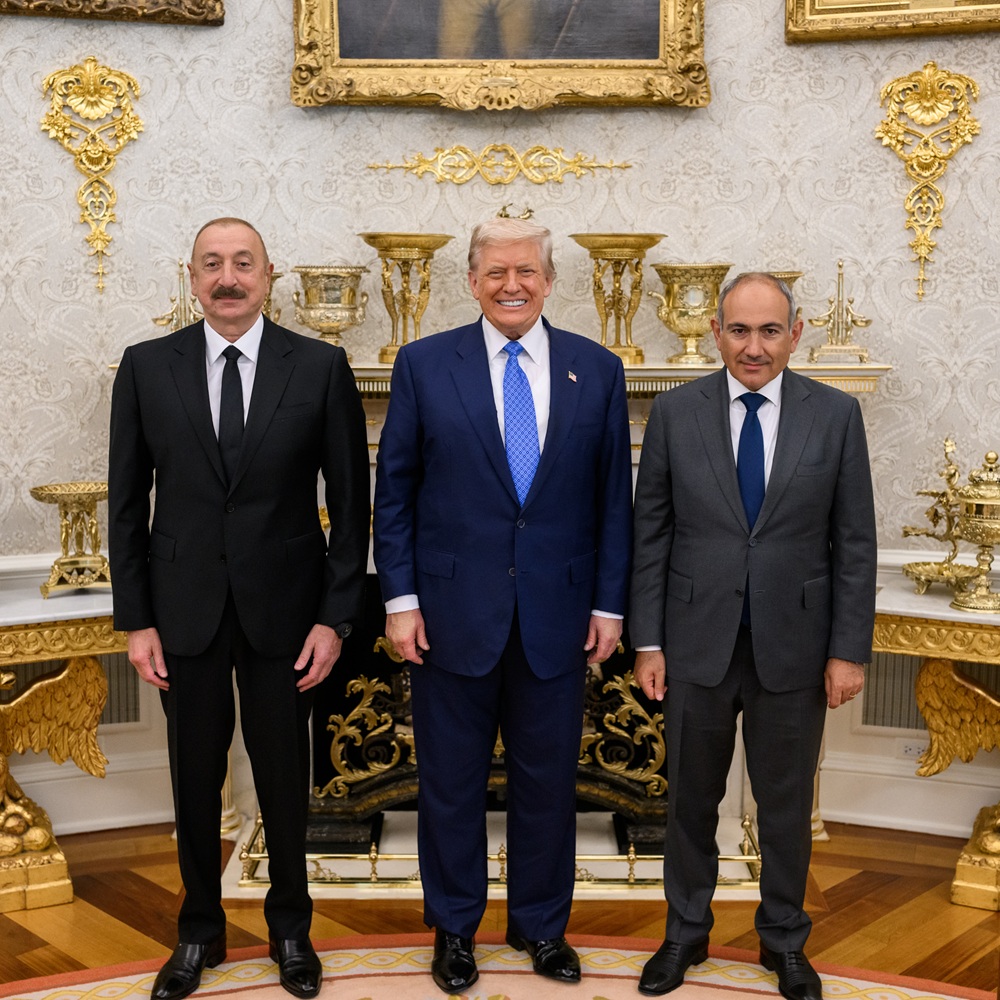
Washington DC, United States, August 9 2025: President Trump welcomes the Prime Minister of the Republic of Armenia to the White House for Bilateral and Trilateral meetings

“Move Fast and Break Things”. US opinions after the first year of Trump’s second term

by Hardy Ostry , Jan Bösche

Show strength, challenge traditions, put America’s interests — and its own — at the center: the first year of President Trump’s second term was a whirlwind of national and international change. In foreign policy in particular, he profoundly reshaped the role of the United States — and called the existing order into question. Opinion polls In recent years, it has become increasingly difficult for U.S. presidents to convince large majorities of Americans of their policies and to achieve high approval ratings. The situation is no different for President Trump: his approval ratings were last positive in March of last year. Since then, Trump has become increasingly unpopular. RealClearPolitics aggregates various polls and now sees a disapproval rate for Trump of almost 56 percent. [1] Only on the issue of border security does approval remain positive; for all other issues such as immigration, security, foreign policy, or the economy, disapproval is rising.[2] Inflation, healthcare, and jobs are the most important issues for the Americans surveyed, for which a majority now sees the competence with the opposing Democrats. Even Trump’s Republicans are rather dissatisfied with the president’s economic policies: according to an AP poll, only 16 percent of Republicans think he has done much to reduce the cost of living. In general, however, they still support Trump: eight out of ten Republicans surveyed give him a good rating. [3] Domestic Policy “Move fast and break things” – is the mantra of the Silicon Valley, that the Christian Science Monitor uses to describe the past year of the president. Trump made a lightning start: “He expanded the boundaries of presidential power and, in his first year after returning, issued more executive orders than in his entire first term. He bypassed Congress, challenged the courts, invaded Venezuela and arrested its head of state, took revenge on his supposed opponents, and redecorated the White House with gold fixtures and a large-planned ballroom.” Trump’s second term makes his first term look like a rehearsal: “It’s almost as if he spent his first four years in office figuring out how much power he really had and then came back determined to fully exercise that power.” According to an analysis by the progressive think tank the Center for American Progress, after the first year of Trump’s second administration, the American workforce is feeling the effects of misguided economic policies: “2025 was marked by chaotic tariff announcements, rising costs for everyday necessities, increasing unemployment, as well as historic cuts in healthcare, food assistance, and clean energy, which drove costs even higher.” The economic turbulence of the first year has left most Americans skeptical about the new year. The think tank cites a survey showing that nearly 70 percent of respondents expected 2026 to be a year of economic difficulties. “Despite Trump’s claim that 2025 was the ‘best first year in history’ for an American president, Americans’ perceptions of their economic security and the latest economic data tell a different story.” “Is Trump trying to lose the midterm elections for Congress?” asks former Republican presidential adviser Karl Rove in the Wall Street Journal: “It was a year full of rapid changes, controversies, and upheavals. It was also a year full of puzzles.” Why does the president repeatedly take actions that go against his political interests? “Trump misses the opportunity to win over key swing voters for the Republicans.” As an example, Rove cites immigration policy and Trump’s approach at the border: “He stopped the flow of illegal migrants. He was right. We didn’t need a new law, just a different president. But Trump did not capitalize on the success to publicize it.” Instead, the Trump team misplayed its hand by sending immigration officers to hardware stores to arrest day laborers without valid papers who had otherwise done nothing wrong. “Americans are increasingly unsettled by the president’s erratic appearances and late-night tirades. Whether it is his age or his advisers, who cannot rein in his worst instincts, Trump behaves differently from any American president before him.” Trump dominates many news cycles but drives no substantial political change, writes conservative analyst Yuval Levin in The Atlantic: “He has worked more around the formal powers of the presidency than with them, and his goal often seems less about governing and more about showing strength.” This approach appears attractive, especially to those on the political right who feel disadvantaged by the American elites. Trump has been able to extract real concessions from some institutions. However, this approach is short-sighted and reactive. Levin writes that in his first year in office, Trump signed fewer laws than any other modern president, and most of them were limited in scope and purpose. The only significant law was essentially an extension of existing tax policy. Otherwise, there were interventions like DOGE and deals. In doing so, the president’s discretionary powers are “used as a lever to influence behavior, rather than using the government’s administrative authority to set predictable, uniform rules for entire areas of society. In other words: they use arbitrariness as an instrument. This can be a source of real power in the short term, but it is ultimately very dangerous for public life in the United States.” Donald Trump will get a third term — by overshadowing his successor, analyzes John Harris of Politico. Trump is on the path to changing the character of the American government and the United States’ international relations more profoundly than any of his predecessors in recent decades: “The reach of Trump’s policies and his disruptive way of implementing them will almost inevitably dominate the campaign and the first term of his successor — perhaps even more so if that successor is a Democrat.” In this way, Trump gets a third term, even if he is not unconstitutionally trying to stay in office. “The task of repairing what Democrats and many others see as Trump’s vandalism means that the first day of the next president will be backward-looking — and probably also the first month and the first year.” Trump has expressed his mix of ideas, grievances, and vanities in a much more concrete, programmatic way than friends or opponents would have expected. He has become more radical and less restrained. “In his first term, his critics cried, ‘This is not normal!’ Only now, it is normal.” Foreign Policy Benn Steil from the Council on Foreign Relations analyzes “Trump’s new world order” and the contradiction between his campaign promise to focus on the U.S. and interventions such as in Venezuela: “The obvious contradiction reflects a fundamental shift in U.S. foreign policy thinking, which aligns with Trump’s preference but is independent of it: dominate what is easy to dominate, and appease or ignore what is not.” There is said to be a consensus within the administration, which is committed to maintaining the hemisphere’s dominance. There is an attempt to offset a withdrawal from persistent overseas conflicts with a simultaneous demonstration of strength closer to home. The goal is to restore the world order that existed before World War I, when America’s global ambitions were more restrained and its neighborhood was safer. What role will the United States play internationally this year? Leslie Vinjamuri of the Chicago Council on Global Affairs asks: “Will it be a stabilizing force? A peacemaker? Or will it continue to sow unrest?” Events at the start of the year have shown that Trump sees value in the latter. Trump does not feel bound by precedent, norms, or laws, and is not deterred by them. Neither allies, Congress, nor courts have so far given reason to believe that this could change. Trump is slowly changing public perception of sovereignty, territory, and national security: “There are already many people that look at maps of Greenland and think differently about its geography, significance, and proper place in the international order.” Whether Trump’s desire for public recognition will divert him from his pursuit of global power — or whether the public will be swept along by Trump — remains to be seen. William Alan Reinsch from the Center for Strategic and International Studies analyzes the president’s trade policy and constant new tariff threats. Whether these are economically sound steps is debatable, but they are undoubtedly politically savvy moves. The constant announcement of new “shiny objects” makes any detailed analysis of previous actions irrelevant: “When these decisions are announced, few facts are released, and by the time journalists, scholars, and other analysts have figured out what was actually decided and taken the time to assess its significance, the public has already moved on, captivated by the next shiny object.” The result is a lack of accountability. “When historians eventually write about this era, there will be accountability, but it will be too late.” The framers of the Constitution intended a government that acts prudently. Checks and balances were meant to ensure that no single branch of government holds disproportionate power over the others. When a president pursues so many political actions that they flood the space and undermine the oversight mechanisms, these accountabilities disappear. Donald Trump started 2026 as the true leader of Europe, writes Nile Gardiner of the Trump-friendly Heritage Foundation. In the first year of his second term, the Trump administration had already shaken the foundations of Europe to its core: “Trump may not be popular in Europe, but he is increasingly respected as a force to be reckoned with.” Trump is wrongly accused of being an isolationist. In reality, he cares far more about Europe than his predecessors: “He is the most transatlantic American president since Ronald Reagan and regards the salvation of Europe as a vital national interest of the United States. His approach to Europe is downright revolutionary. He is the first U.S. president to question the European project, and his ultimate goal is of great significance: the salvation of Western civilization itself.” The U.S. has every right to comment on the EU and Europe’s future because Americans have financed Europe’s security for decades. Whether President Trump actually has a plan is questioned by Thomas de Waal of the Carnegie Endowment. One version suggests he is trying to revive the Monroe Doctrine and govern the Western Hemisphere — a return “to an era of imperialism and spheres of influence”: “The threat he currently poses is primarily a threat of chaos. Calling the challenge a new Monroe Doctrine is only partly correct: it is more of a ‘Gone-Rogue Doctrine.’ However, it is no longer possible to establish spheres of influence in the 21st century in the old style. Trump needs to be reminded that he already has a modern variant: a friendly alliance stretching from Vancouver to Kiev, which he is now losing.” References [1] https://www.realclearpolling.com/polls/approval/donal d-trump/approval-rating [2] Beispielhaft bei Strength in Numbers: https://www.gelliottmorris.com/p/new-poll-trump-slipson-immigration [3] https://apnews.com/article/poll-trump-republicansimmigration-economy-inflation-costs634472fc2ee3b4477a7be997bbd0c69e

Diplomacy
Business people in searching opened the box European Union. Thinking of who what where when why and how. Asking questions for solution to solve problem, business analysis. Vector  illustration

Five ‘What to do’ for the European Union

by Ivan Timofeev

Rarely in the history of the European Union has it faced challenges comparable to the ones it faces today. Since the end of the Cold War, the EU has been on the rise. Its membership has expanded quantitatively and qualitatively. Pan-European institutions and European law have been strengthened. Diplomacy and security policy have been taking shape. The EU has gradually become more like a confederation or a federation. However, it has lacked the centralized security structures to truly become a full-fledged state or even a super-state — primarily the armed forces. The EU has remained a junior partner of NATO and part of Euro-Atlantic security architecture, where the US has played a leading role. However, the question of the EU's strategic autonomy has gradually departed from purely theoretical considerations. While maintaining its role as an economic giant, Brussels has long remained a political dwarf. The Ukraine conflict has become a powerful political stimulus for expanding political opportunities, although the preconditions for such a dynamic existed earlier. Similar incentives are emerging in other areas as well. The European Union has been forced to provide immediate answers to the eternal question of "what to do," playing on several chessboards at once. What to do with the United States? A year ago, such a question would have rarely occurred to anyone. Brussels and Washington were closely aligned on the issue of containing Russia. There was also common ground on the issue of growing competition with China. The level of economic ties remained high. Military-political integration has been revived. NATO has welcomed two new EU members — Finland and Sweden. Surprises were expected from Donald Trump. But the experience of his first term still served as an indicator of their predictability. Moreover, the European allies themselves had been moving toward Trump's demands during his previous term — increased defense spending, energy purchases from the US, a rejection of Russian raw materials and so on. However, the US president has exceeded expectations, disconcerting the EU on several fronts. These include a special position on Ukraine, territorial ambitions for Greenland (formally part of Denmark, a member of the EU and NATO), a trade war affecting EU countries, criticism of the Old World in doctrinal documents and speeches by senior officials, as well as an overt policy of force. A close ally and key guarantor of security has transformed, in a matter of months, into a cold, calculating, and unpredictable player. The EU's actions regarding the American issue have so far revealed a wait-and-see tactic. In the medium term, the plan is to "outlast" Trump. His term will expire in three years. With that, a shift in foreign policy can be expected from the new administration. That is, if the Democrats come to power. In the short term, the plan is to avoid angering the American leader, to play on his personality traits (praising his achievements, avoiding criticism), to concede on certain issues, or to present as concessions what is inevitable. These include arms and energy purchases from the US and a trade balance adjustment in Washington's favour. The Greenland issue could be resolved using the same logic. The US military has de facto controlled the island for decades. Moreover, the United States formally remains an ally of Denmark and other EU countries. Why not concede? Especially if the procedure is carried out democratically. Of course, the Danish king or prime minister is unlikely to be kidnapped by American special forces, and they are unlikely to face charges in a US federal court. But Denmark risks being outvoted in the democratic process. The EU's perception of Donald Trump could be compared to the perception of the Russian Emperor Paul I among the Russian aristocracy and nobility. Paul was renowned for his eccentricity and was extremely unpopular. He fell victim to an inevitable conspiracy by his inner circle. But the expectation that problems with the United States will be resolved after a change of leadership, similar to the case in Russian history, rests on a fragile foundation. Unlike the Russian emperor, who became a lone figure on the throne, the American president is backed by a vibrant and young team, widespread support, and a consistent ideology. Donald Trump's departure is unlikely to resolve the EU's American problem. Moreover, his young successors could cling to their ally with an even tighter grip. What to do with Russia? In EU political rhetoric, Russia occupies the position of its most important and dangerous adversary. This approach took hold after February 2022, but had been brewing since the events in Crimea in 2014. Compared to the United States, maintaining a confrontational approach to Russia in a semantic sense is easier, as the identity structures of both sides already contain established, centuries-old patterns of mutual perception as a "significant other." (Neumann, I. (1999) Uses of the Other: "The East" in European Identity Formation. University of Minnesota Press.) Regarding the United States, such patterns have either not yet been developed or have been lost. The EU's approach to Russia over the past four years has been characterized by a fairly active policy of containment. This includes the consistent severing of trade and economic ties, even at the cost of economic damage to itself; large-scale military and political support for Ukraine; remilitarization and the restoration of the military-industrial complex; and attempts to influence third countries in their trade with Russia, not to mention information and ideological warfare. The problem for the EU is that the results have largely been negative. Yes, Brussels is doing its part to keep Ukraine afloat. Yes, Russia has suffered economic damage. Yes, defense spending is rising and the military-industrial complex is slowly recovering. Yes, third countries are wary of secondary sanctions. Yes, the information machine is working. But Russia hasn't gone anywhere. Its economy has been reoriented towards other areas, and its market for EU companies has been lost. Hostilities with Ukraine continue. Russia's military-industrial complex has been deployed, and its nuclear potential makes any Yugoslavia – or Libya-style solutions futile. Russia has its own financial and informational network, which has become more difficult, or significantly more difficult to influence. The good news for the European Union is that Moscow is unlikely to be planning military expansion against the EU countries themselves. War with them makes neither political nor practical sense for Russia, although the issue of responding to hypothetical military aggression by NATO or individual member states against Russia is likely to be addressed. Moscow cannot harm the Union with trade wars, and it simply lacks the desire to seriously fight for public opinion support. Ultra-conservative forces may at first glance seem convenient for Russia. But experience shows that conservatives and populists in power are hardly helpful in close foreign policy circles. Poland is a paragon of traditional values, but it is at the forefront of Russia's adversaries. In other words, Russia is a convenient foe. It can be fought through Ukraine and pinned on it the answer to the question of "who is to blame?" But at the same time, doing all this is relatively safe for the Europeans. The tactic toward Russia is loud and wait-and-see. Loud in terms of rhetoric. Wait-and-see in the hope that the Russian side will not withstand and collapse. Fortunately, there are many who support the theory of Russia's imminent decline. The problem for the EU is that not only Donald Trump, but also Vladimir Putin differs from the aforementioned Emperor Paul I. While Brussels hopes for the fatal blow with the snuffbox, Russia lives its own life. Apparently, Washington was the first to realize this. What shall be done with Ukraine? The answer to the Ukraine question is also seemingly simple: support Kiev by all means possible. In the short term, the practical policy here is more or less clear: continue financial and military support for Ukraine in order to restore it and prevent military defeat. In the medium term, there is greater uncertainty. The key issue is resources. The confiscation of Russian sovereign assets is still theoretically possible. But even if Brussels bears the full costs of such confiscation, it will not fundamentally solve the problem. The EU faces the prospect of becoming the main donor to a large and warring state with a very specific political system. The benefits of its integration into the EU are ambiguous. Furthermore, the problem of security guarantees and the material backing of such guarantees remains. Unlike the US, the EU is unlikely to be able to demand that Kiev repay its debts through enslaving agreements and then quickly distance itself from the problem. Regarding the Ukrainian issue, the EU may try to leave things as they are, while simultaneously awaiting a change of power in the US and potential problems in Russia. Brussels apparently has sufficient resources to keep Kiev afloat for a couple of years. The EU is likely prepared to accept further material losses for the sake of political principles, just as it did when it severed economic ties with Russia. At the same time, an agreement on Ukraine would also be in the EU's interests. Yes, Kiev is losing territory, but Ukraine remains a fairly large state. It will inevitably remain within the EU's political and economic orbit. An end to hostilities with a ceasefire along the line of contact would likely be more acceptable to the EU than the large-scale, legally binding agreement Moscow is insisting on. If US policy changes and problems escalate in Russia, a ceasefire would be more convenient for a new round of the Ukraine conflict. However, experience shows that even such agreements can be violated, so a binding agreement in itself is not a major problem for Brussels. It is important for the EU that Ukrainian losses in the negotiations are minimized, and that security guarantees do not expose the EU to the threat of military escalation directly with Russia. In answering the question of what to do with Ukraine, the EU will likely have to acknowledge the "realities on the ground." If the US continues to distance itself from the Ukraine issue, and the Russian army continues to advance, delaying such recognition will increasingly devalue Brussels's course. However, a willingness to adhere to this course at any cost cannot be ruled out. What to do with China? Compared to the United States, Russia, and Ukraine, China hardly poses a pressing problem for the EU. China remains a major trading partner and market. Secondary sanctions against Chinese companies for their cooperation with Russia have not yet led to complications. On the Taiwan issue, the EU has avoided taking a leading role in anti-China mobilization. Attempts by individual member states (such as Lithuania) to assert themselves on the Taiwan issue have not found much support in Brussels, and Chinese sanctions have further dampened their efforts. The EU has generally supported the long-standing US policy of curbing China's global economic projects and Beijing's high-tech capabilities. But in reality, there is no rush to undermine the foundation of economic cooperation with China in the western part of Eurasia. Within China itself, there is a countermovement. They don't generalize the US and EU into a single West and, apparently, proceed from the idea that the interests of Washington and Brussels differ. This means that relations with the EU are not identical to relations with the US. The complexities of transatlantic relations are likely to contribute to a situational rapprochement between the EU and China. In the political sphere, this is unlikely to be excessive, but rivalry is still a long way off. Anti-Chinese voices in the EU are likely to become quieter in the near future, despite Beijing's active cooperation with Moscow. China, with its predictable political course in the current turbulent conditions, is becoming an attractive partner for the EU. There are no immediate threats from it, but the benefits are more than sufficient. It's possible that Donald Trump will pressure the EU to adopt a more coordinated course toward China. Brussels could use such demands as a trump card. However, EU diplomacy will be unable to influence Russian-Chinese relations, and the conflict with Russia will be secondary in answering the question "what to do with China." What to do with the EU? It appears that the issue of internal transformation, taking into account external challenges, remains paramount for the EU. The logic of relations with China allows for no changes for now. However, here too, the prospect of intense competition over technological security remains under the rug. This will likely require more stringent regulatory measures. Political consolidation was required in relations with Ukraine, and it has the potential to gain more ground if necessary, seeking additional reserves. In relations with Russia, even clearer demands for increased levels of control have come to the fore. The change in the procedure for applying sanctions against Russia's sovereign assets is symptomatic. Now, it will be more difficult for individual countries, such as Hungary or Slovakia, to use their veto power in EU Council votes with regards to this issue. Finally, the US maneuvers raise a fundamental question: how do Europeans ensure their own security? For now, NATO remains an ironclad structure. But NATO's mere existence is unlikely to block deeper defense cooperation within the EU. Brussels has incentives to play a more significant role in NATO, and in the long run, the alliance itself could become a US-EU pair, rather than a conglomerate of European allies centered on the US. Resolving security issues will inevitably require the EU to become increasingly centralized and directive in its decisions, and thus, to reduce the effective sovereignty of its member states. The big question is whether the EU itself and its member states are ready for such a scenario, especially given the disparity in their potential and capabilities. Could the Franco-German tandem, for example, serve as the framework for such centralization? Does Brussels have the resources and legitimacy to align member states around a unified and firm political line? Is Greece, for example, ready, and what is Estonia ready for? Will it be possible to controllingly package their approaches into a single policy line where defense and specific military risks, including the risk of a clash with a nuclear power, are at stake, not just in words but in deeds? To simplify the question even further, is the European Union ready to devolve from a confederation/federation into a de facto empire? The unification of disparate states for military-political purposes will sooner or later raise the question of an imperial component, despite the seeming impossibility of such a development, if judged through the eyes of the post-Cold War era. Moreover, beyond the US, Russia, Ukraine, and China, there are other areas of common policy. Such a structural evolution could have a far greater impact on relations with other centers of power than situational issues. "What to do with the EU" could become a fundamental question for other participants in international relations.

Diplomacy
Flag USA and China on Computer Chip . Global chip shortage crisis and China-United States trade war concept.

Leading States in the Race for Artificial Intelligence in the Current International System

by Danna Fernanda Mena Navarro

1. Introduction: AI as a Reconfiguration of the Global Order Artificial intelligence (AI) has become one of the most influential factors shaping the contemporary international system. Major powers are competing to lead the new technological revolution that impacts the economy, security, foreign policy, defense, communications, and scientific innovation. The development of AI depends on three strategic inputs: 1. Human talent (research, data engineering, mathematics, computer science). 2. Computational capacity and access to large volumes of data. 3. Robust innovation ecosystems, with companies, universities, and aligned industrial policies. Global spending on artificial intelligence is expected to exceed USD 52 billion over the next three years, consolidating AI as the central axis of the Fourth Industrial Revolution (IDC, 2023; Stanford AI Index Report, 2024). 2. Talent as a Global Strategic Resource More than 60% of top AI researchers work in the United States, and about half of them are immigrants, primarily from China, India, Europe, and Iran (Stanford AI Index Report, 2024). The so-called brain drain is not merely an academic issue, but a geopolitical one: • States compete to attract talent through visas, high salaries, and access to frontier laboratories. • Innovation in AI depends on who concentrates the largest amount of specialized human capital. The United States dominates due to its ability to attract international researchers, while China compensates through massive investment and domestic talent production. 3. The United States Leads the AI Race for Three Main Structural Reasons 1. Innovation, talent, and industry: The United States leads in high-impact research publications and AI startups (more than 50% worldwide). Private investment exceeded USD 350 billion in 2023 alone. Key companies include Google, Meta, Microsoft, OpenAI, NVIDIA, Tesla, and IBM, among others. 2. Computational infrastructure and chips: The country concentrates the most advanced computational infrastructure and controls cutting-edge chips (such as the NVIDIA H100), a resource that China cannot yet produce at the same level. 3. AI and national security: The United States allocates more than 16 federal agencies and billions of dollars annually to AI development for defense, cybersecurity, and intelligence (White House AI Budget, 2024). 4. China: The Emerging Superpower on the AI Path China ranks second globally in the AI race but follows a more aggressive, centralized, and ambitious strategy. • Massive investment as state policy: China has pledged to invest more than USD 150 billion by 2030 in AI under its Next Generation Artificial Intelligence Development Plan (AIDP) (Government of China, 2017). • Domestic talent production: China trains more AI engineers than any other country. Annual graduates in science and engineering reach 4.7 million, compared to 600,000 in the United States (UNESCO, 2023). However, a significant portion migrates to the U.S. due to better research conditions. • China’s role in the global AI industry: China leads in AI-based facial recognition, with generative AI startups such as Baidu, SenseTime, Alibaba Cloud, and Tencent AI Lab. It produces massive numbers of publications, although with lower scientific impact than those from the United States. AI is widely implemented in governance, security, and smart cities. • The chip dilemma: China depends on advanced semiconductors produced only by Taiwan (TSMC), South Korea (Samsung), and the United States/Netherlands (ASML). • Export controls: Export restrictions imposed on China since 2022 limit its ability to train frontier models, although the country is making radical investments to achieve chip sovereignty. 5. Europe, India, Israel, Canada, and Other Relevant Actors • Europe: The United Kingdom, Germany, France, and the Netherlands generate a solid ecosystem in algorithmic ethics, digital regulation (AI Act), and applied research. • India: The world’s main hub of engineering talent and a global provider of technological services. • Israel: A powerhouse in cybersecurity and military AI, with per-capita innovation comparable to Silicon Valley. • Canada: The birthplace of deep learning (Geoffrey Hinton, Yoshua Bengio) and a strong center for basic research. 6. Africa on the AI Chessboard: Intentions, Challenges, and Opportunities Although Africa does not lead the AI race, its geopolitical role is growing rapidly for four strategic reasons. Africa is a major producer of critical minerals. AI depends on lithium, cobalt, graphite, and rare earth elements, and Africa holds 70% of the world’s cobalt reserves (in the DRC), as well as other strategic minerals in Zambia, Namibia, South Africa, and Mozambique. This places the continent in a key position within the supply chains for batteries, computers, and data centers. There is also a rapid expansion of digital infrastructure. China, through Huawei and ZTE, has built around 70% of Africa’s 4G network, as well as Ethiopia’s first smart data center and technology innovation hubs in Egypt, Kenya, and South Africa. Africa is entering the AI space through fintech, digital health, smart agriculture, and biometric systems. In terms of AI policy, African countries with formal AI strategies include Egypt, Rwanda, Kenya, and South Africa. • Threats and challenges: limited computational infrastructure, a deep digital divide, the risk of dependence on external technological solutions, the use of AI for political surveillance (as seen in Ethiopia and Uganda), and a shortage of specialized talent. 7. China and Africa: The Intersection of AI, Data, and Geopolitics China combines its role in AI with its influence in Africa through investments in digital infrastructure, the sale of surveillance systems, the construction of data centers, and technical training programs. This creates interdependence but also raises concerns: Africa could become dependent on Chinese systems that are difficult to replace. Data may become centralized on foreign platforms, and the risk of a technological debt trap adds to existing financial dependence. 8. AI, Regulation, and Global Governance The rapid expansion of AI calls for international treaties on data use, security standards, limits on military automation, and ethical regulations to protect civil society. Governance will be decisive in determining not only who leads, but also how this technology will be used in the coming decades. In this context, global AI governance has become a new field of geopolitical competition. While the European Union promotes a regulatory approach based on human rights and risk prevention, the United States favors market self-regulation and innovation, and China advances a model of state control and technological sovereignty. Multilateral organizations such as the UN, the OECD, and the G20 have begun discussing common principles, but there is still no binding international regime. The absence of clear rules increases the risks of an algorithmic arms race, the use of AI for mass surveillance, and the deepening of global inequalities in access to and control over technology. 9. Conclusions The United States leads due to innovation, global talent attraction, and computational capacity. China follows closely with a comprehensive state-led strategy and dominance in global digital infrastructure. Europe, India, Israel, and Canada contribute key elements to the global ecosystem. Africa, while not a leader, occupies an increasingly strategic role due to its resources, data, markets, and alliances. The race for AI will define not only the global economy, but also the balance of power in the international system of the 21st century. References -Stanford University.(2024). AI Index Report 2024. Stanford Institute for Human-Centered Artificial Intelligence. https://hai.stanford.edu/ai-index/2024-ai-index-report?utm_source=chatgpt.com -International Data Corporation. (2023). Worldwide Artificial Intelligence Spending Guide. IDC. https://www.idc.com/data-analytics/spending-guide/ -State Council of the People’s Republic of China (2017). Next Generation Artificial Intelligence Development Plan. Government of China https://fi.china-embassy.gov -UNESCO. (2023). Global Education Monitoring Report: science, technology, engineering and mathematics. United Nations Educational, Scientific and Cultural Organization. https://www.unesco.org/en -The White House. (2024). Federal AI Budget and National AI Strategy. Executive Office of the President of the United States. https://www.whitehouse.gov/presidential-actions/2025/12/eliminating-state-law-obstruction-of-national-artificial-intelligence-policy/ -European Commission.(2023).Artificial Intelligence Act. Publications Office of the European Union. https://digital-strategy.ec.europa.eu/en/policies/regulatory-framework-ai -Organisation for Economic Co-operation and Development. (2023). OECD. Artificial Intelligence Policy Observatory. https://www.oecd.org/en/topics/artificial-intelligence.html

Diplomacy
Russia US Peace Plan as Russian American and Ukrainian deal to end the war as an agreement of Moscow and Washington Kyiv on the outside in negotiations.

Peace in Ukraine? Believe it when you see it, especially if demands are prioritized

by Oleksa Drachewych

The United States recently — and suddenly — announced a 28-point peace plan to end Russia’s war in Ukraine, seemingly jointly written with Russian delegates, and presented it to Ukraine. The leaked contents of the peace plan caused concerns for Ukrainian representatives, European leaders and some American politicians. Yet it has nonetheless led to “meaningful progress”, according to the White House, on a revised peace proposal drafted by Ukrainian and American delegates in Geneva. Ukraine has reportedly agreed to the deal, with minor tweaks, while Russia says it’s premature to say a resolution is close, even as Russian representatives met with U.S. delegates in Abu Dhabi to discuss the revised plan. What was in the first plan? The leaked initial 28-point plan was criticized for asserting many Russian demands that date back to the initial peace negotiations of March and April 2022: • It placed a limit of 600,000 troops on Ukraine’s military; • It prevented Ukraine from having long-range missiles; • It placed a permanent ban on Ukrainian membership in NATO; • It included protections of Russian language and the Russian Orthodox Church in Ukraine. It also explicitly gave the entire Donbas region of eastern Ukraine to Russia, and called on the international community to recognize full Russian control of the Donbas and Crimea and control of Kherson and Zaporizhzhia on the front lines. In return, there would be “reliable security guarantees” envisioned by U.S. President Donald Trump: a NATO-style “Article 5” for Ukraine. This would mean if Ukraine was purposefully attacked by Russia in the future, the U.S. and other parties involved would come to Ukraine’s defence through sanctions, diplomatic pressure and military support, if necessary. In many of the economic and security arrangements that could emerge from the agreement, Russia and the United States would manage them together under the terms of the 28-point plan. The original plan also offered amnesty to all parties for any crimes and atrocities committed during the war, meaning Russia would not be brought to justice for war crimes. It also called for Russia’s return to European and global affairs, ending its political isolation with the West by reforming the G8. In short, the agreement would essentially act as if the war in Ukraine never happened. Was this a joint U.S.-Russia plan? The origins of the peace plan have been widely debated. The stilted language in the English version has led some to speculate it was translated from Russian. American senators said U.S. Secretary of State Marco Rubio, when briefing them, called the deal a “Russian wish list.” The draft reportedly came as a result of meetings held in Florida between Trump’s son-in-law, Jared Kushner, special envoy Steve Witkoff and Russian envoy Kirill Dmitriev, a noted Putin supporter. Rubio has insisted it was a U.S.-crafted document while Russian President Vladimir Putin said Russia could accept the peace plan. The fact that the document tended to mirror many of Russia’s demands immediately put Ukraine, and Europe, on the defensive. Trump declared that Ukraine would have until American Thanksgiving — Thursday, Nov. 27 — to agree to the plan. He has since softened his stance. But he’s also lambasted Ukraine’s leadership for not showing sufficient “gratitude” for American efforts to bring peace to Ukraine. Details of Europe’s plan In response, European leaders offered their own peace plan. They largely removed some of Russia’s most egregious demands, keeping some of the 28 points, while placing sensitive issues like NATO membership as something to be determined by NATO members and Ukraine. But it also acceded to some Russian demands, including accepting a cap on Ukraine’s military and offering Russia re-entry into the G8. It included a provision for territorial swaps with negotiations starting from the current front lines instead of recognizing Russia’s annexations. European proposals include using frozen Russian assets as reparations for Russia’s aggression, eliminating any of the amnesty clauses and making the European Union and NATO the key players in any future political, economic and military security arrangements. The European deal also removes key qualifiers in the original 28-point plan that could be manipulated by Russian misinformation — namely that Ukraine would be forced to face Russia alone if it struck either St. Petersburg or Moscow with a missile or it failed to “de-Nazify”, a common and erroneous Russian line of attack against Ukraine. The Kremlin rejected the European counter-plan outright. Where does the deal stand now? Ukrainian and American officials recently met in Geneva to discuss the peace plan. Emerging from the meeting, European leaders were cautiously optimistic while insisting a lot more work needed to be done. Trump stated that “something good just may be happening.” So, what resulted from that meeting? Few details have been leaked. Sources have shared that the 28-point plan has now been pared down to 19. It has also been suggested that key issues like territorial swaps and NATO accession have been left for Trump and Ukraine’s Volodymyr Zelenskyy to discuss at a future meeting. Ukrainian officials have said the plan has been substantially revised and reflects Ukraine’s concerns. The Russian response has been cagey, to say the least. Since there’s been no formal presentation of any revised peace plan, they are electing to say nothing firm. But U.S. Army Secretary Dan Driscoll recently met with Russian delegates in Abu Dhabi. Russian sources, meanwhile, have restated their preference for the original 28-point plan. Seeing is believing While this appears to be the most notable progress in the peace process in months, expectations should be tempered until there’s a presidential summit between Zelenskyy and Putin and until their signatures are on a treaty. Such momentum for peace has happened in the past. And it has often been scuttled by the key sticking points of both nations. Ukraine has continued to demand extensive security guarantees, justice for Russian war crimes, and has rejected territorial swaps. Russia has wanted a pliable Ukraine and one that could remain in its orbit politically and economically. Fundamentally, these positions haven’t changed. At this point, it appears the Ukrainians have managed to bring the Americans to their side in the latest peace talks, which reflects the importance Ukraine places on U.S. support in their fight against Russia. Russia has elected to say little, but if it was to agree to the revised deal, it would represent a seismic shift. For those reasons, believe in success in the peace process when you actually see it.

Diplomacy
NEW YORK, USA - JUNE 21 2013 - United Nations security council hall headquartered in New York City, in a complex designed by architect Niemeyer open to public.

The UN in crisis: Justice without power, power without justice

by Francisco Edinson Bolvaran Dalleto

Abstract The United Nations (UN), eighty years after its creation, faces a structural crisis that reveals the tension between justice and power. This essay examines how the design of the Security Council, with its veto power, perpetuates an unequal order inherited from 1945 and limits the effectiveness of the collective security system. Through theoretical perspectives — Morgenthau, Schmitt, Habermas, Falk, and Strange — it is shown that international law remains subordinated to power interests, that proclaimed universality masks hegemonies, and that global economic dynamics lie beyond institutional reach. Cases such as Kosovo, Libya, Gaza, and Myanmar illustrate the paralysis and delegitimization of the Responsibility to Protect. Considering this scenario, two paths emerge: reforming multilateralism with limits on the veto and greater representativeness or resigning to a fragmented order. The conclusion is clear: without adaptation, the UN will become a symbolic forum, making chronic its inability to respond to current challenges. Dag Hammarskjöld, the second Secretary-General of the UN, warned: “The United Nations was not created to take us to heaven, but to save us from hell.” [1] Eighty years after its founding, that promise seems to falter in the face of multiple wars, such as those in Gaza, Ukraine, Sudan, or Myanmar, among many others, with a sense of ineffectiveness, loss of prestige, and collective impotence being perceived: does the UN no longer fulfill the role it once assumed? At first glance, blame falls solely on the nature of the institution itself. But the root of the problem seems to lie not only in New York, but also in the main capitals of the world. The UN is nothing more than what States allow it to be. Its effectiveness depends on the will of those who comprise it; and the uncomfortable truth is that the great powers prefer to limit its scope rather than cede parcels of sovereignty. As John Rawls pointed out, a just international system requires that peoples accept common principles of justice. [2] Today, by contrast, it is a constant that collective interest systematically gives way to particular interest. The Security Council is the most evident symbol of this contradiction. It remains anchored in post-war logic, with five permanent members clinging to the privilege of the veto. That power, already met with skepticism in San Francisco in 1945, turned into a tool of paralysis. As Canada denounced in 2022, the veto is “as anachronistic as it is undemocratic” and has prevented responses to atrocities. [3] Aristotle said that “justice is equality, but only for equals.” [4] In the UN, the Assembly proclaims sovereign equality, while the Council denies it in practice: some States remain “more equal” than others. The UN Charter articulates its backbone in a few luminous rules: the prohibition of the use of force (Art. 2.4), non-intervention in internal affairs (Art. 2.7), and, as a counterbalance, the collective security system of Chapter VII (Arts. 39–42), which grants the Security Council the authority to determine threats to peace and authorize coercive measures. In parallel, Art. 51 preserves the right of self-defense against an “armed attack.” [5] This normative triangle — prohibition, collective security, defense — is the promise of a world governed by law and not by force, but it must be put into practice. In the 1990s, a dilemma arose: what to do when a State massacres its own population or is unable to prevent it? The political-legal response was the Responsibility to Protect (R2P), affirmed at the 2005 World Summit (paras. 138–139). [6] Its architecture is sequential: (I) each State has the primary responsibility to protect its population against genocide, war crimes, ethnic cleansing, and crimes against humanity; (II) the international community must help States fulfill that responsibility; and (III) if a State manifestly fails, the international community, through the Security Council, may adopt collective measures — preferably peaceful ones; as a last resort, coercive — case by case and in accordance with the Charter. Properly understood, R2P is not a license to intervene; it is a duty to protect framed within International Law. The historical record shows both its necessity and its perverse effects. Kosovo (1999) inaugurated, without authorization from the Council, the narrative of “humanitarian intervention,” based on a supposed “legitimate illegality.” [7] The precedent left a dangerous standard: humanitarian purposes invoked to circumvent the hard core of the Charter. Libya (2011) seemed to be the “ideal case” of R2P: the Council authorized “all necessary measures” to protect civilians. [8] However, the shift toward regime change eroded the trust of Russia and China, which since then have blocked robust resolutions on Syria, hollowing out the effectiveness of R2P. [9] The lesson is bitter: when protection is perceived as a vehicle of hegemony, the norm is delegitimized, and the veto becomes reflexive. Gaza and Myanmar display the other face of paralysis. In Gaza, the Council’s inability to impose sustainable ceasefires — despite patterns of hostilities that massively impact the civilian population — has shifted the debate to the General Assembly and the International Court of Justice through interstate actions and provisional measures. [10] In Myanmar, the genocide of the Rohingya mobilized condemnations, sanctions, and proceedings before the International Court of Justice (hereinafter, ICJ), [11] but did not trigger a coercive response from the Council. R2P exists on paper; its implementation is captive to the veto. Thus, the “right to have rights” that Arendt spoke of still depends on geopolitics. [12] History teaches that international law has always been strained by force. Rousseau warned that the strong seek to transform their power into law. [13] That is what the winners of 1945 did by crystallizing their hegemony in the Charter. And so, what Kant dreamed of as perpetual peace remains chained to an unequal order. [14] The UN, more than a republic of law, still seems a field of power. That fragility has opened space for alternatives. The BRICS, for example, have emerged as a heterogeneous bloc that combines the cohesion of historically homogeneous powers such as China and Russia with the diversity of India, Brazil, and South Africa. Paradoxically, their strength lies in articulating that heterogeneity against a common enemy: the concentration of power in the Security Council. [15] In a multipolar world, heterogeneity ceases to be a weakness and becomes a driver of plurality and resistance. The UN crisis is not only about security; it is also economic and distributive. The universalist promise of the Charter (Arts. 1.3 and 55–56, on cooperation for development) coexists with a global financial architecture whose heart beats outside the UN: the IMF and World Bank, designed in Bretton Woods, project a structural power — in Susan Strange’s terms — that conditions public policies, access to liquidity, and investment capacity. [16] The sovereign equality proclaimed in New York becomes blurred when the asymmetry of weighted voting in financial institutions (and the conditionality of credit) makes some States more “equal” than others. This is not a recent claim. Since the 1960s, the United Nations Conference on Trade and Development and, later, the Declaration on a New International Economic Order (1974), sought to correct structural problems such as the deterioration of terms of trade and the dependence between “center” and “periphery” countries, as Prebisch had pointed out. [17] However, the results were limited: ECOSOC lacks teeth, UNDP mobilizes cooperation but fails to change the rules of the system, and the 2030 Agenda sets important goals but without mandatory enforcement mechanisms. [18] The pandemic and the climate crisis have further worsened these inequalities, highlighting problems such as over-indebtedness, the insufficiency in the reallocation of Special Drawing Rights (SDRs), and climate financing that often arrives late and under unsuitable conditions. In this scenario, the New Development Bank of the BRICS emerges, seeking to open a path toward greater financial autonomy for developing countries. [19] International economic justice is the reverse side of collective security. Without fiscal space or technological transfer, the Global South remains trapped between development promises and adjustment demands. The UN has political legitimacy to outline a Global Economic Council (as proposed by the Stiglitz Commission in 2009) [20] to coordinate debt, international taxation, and global public goods, but it currently lacks normative muscle. The result is fragmentation: fiscal minilateralism, climate clubs, and value chains that distribute risks to the South and rents to the North. The solution does not lie simply in “more aid,” but in prudent rules such as: (I) a multilateral debt restructuring mechanism under UN auspices; [21] (II) effective international taxation on intangibles and the digital economy; [22] (III) binding compliance with the loss and damage fund in climate matters; [23] and (IV) a reform of quotas in IFIs that reflects the real weight of emerging economies. [24] Without constitutionalizing — even gradually — this economic agenda, sovereign equality will remain an empty liturgy and the discontent of the Global South a political fuel that erodes the UN from within. The truth is that the United Nations of 1945 no longer responds to the challenges of 2025. As the president of Brazil recently said: “The UN of 1945 is worth nothing in 2023.” [25] If States do not recover the founding spirit — placing collective interest above particular ones — the organization will remain prisoner of the veto and the will of a few. The question, then, is not whether the UN works, but whether States really want it to work. Taking the above into account, this essay will analyze the UN crisis from three complementary dimensions. First, the theoretical and philosophical framework that allows us to understand the tension between power and law will be addressed, showing how different authors highlight the structural roots of this contradiction. Second, historical episodes and current examples will be reviewed to illustrate the paralysis and democratic deficit of the organization. Finally, possible scenarios for the future will be projected, engaging in the exercise of evaluating the minimum reforms that could revitalize multilateralism in contrast to the alternative of critical global fragmentation. Considering all together, the argument is that the UN finds itself trapped between justice without power and power without justice, and that its survival depends on its ability to adapt to an international order radically different from that of 1945. I. The contradiction between power and law: Hans Morgenthau and political realism To understand the paralysis of the UN, it is useful to turn to Hans Morgenthau, a pioneer of realism in international relations. In his work “Politics Among Nations” (1948), he warned that the international order is always mediated by the balance of power and that legal norms only survive to the extent that they coincide with the interests of powerful States. [26] His idea is provocative: international law is not an autonomous order, but a language that powers use so long as it does not contradict their strategic objectives. Applied to the UN, this analysis is clear: the institution reflects less universal ethical commitment and more correlation of historical forces. The Security Council is not a neutral body, but the mirror of the hegemony of 1945, crystallized in Article 27 of the Charter, which enshrines the right of veto. The supposed universality of the UN is subordinated to a mechanism designed precisely to ensure that no action contrary to the superpowers could be imposed. Contemporary critiques confirm Morgenthau’s intuition. When Russia vetoes resolutions on Ukraine, [27] or the United States does the same regarding Gaza, [28] it becomes evident that international justice is suspended in the name of geopolitics. The legal is subordinated to the political. In this sense, the UN crisis is not an accident, but the logical consequence of its design, and what Morgenthau pointed out seventy years ago remains valid: as long as there is no coincidence between law and power, international norms will remain fragile. Political realism helps explain why the UN fails when it is most needed. States continue to act according to their national interests, even when this contradicts the international norms they themselves have subscribed to. The Security Council has become a space where powers project their strategies of influence, blocking collective actions whenever these affect their geopolitical priorities. The war in Ukraine, the invasion of Iraq in 2003, and the inaction in the face of the Rwandan genocide show that international law is applied selectively, reinforcing the idea that rules are valid only when they do not interfere with the power of the strongest. This pattern evidently erodes the legitimacy of the UN in the eyes of societies, because it generates the perception that the organization is incapable of representing the collective interest and, instead, merely reflects the correlation of forces of each historical moment. II. Carl Schmitt and the Myth of Universal Order Another voice that resonates is that of Carl Schmitt, who in “The Nomos of the Earth” (1950) argued that every international legal order arises from a founding political decision, that is, an act of power. [29] For Schmitt, there is no “universal law” that imposes itself; what is presented as universal is, in reality, the crystallization of a particular domain. The UN perfectly embodies this diagnosis. The founding discourse of San Francisco in 1945 spoke of “we the peoples of the United Nations,” [30] but in reality the Charter was written under the predominance of the winners of the Second World War. What was presented as a universal order of peace and security was, in fact, the codification of the Allied hegemony. Schmitt helps explain why the UN has never escaped that original logic. Although the General Assembly proclaims sovereign equality in Article 2 of the Charter, the structure of the Council reproduces the privilege of a few. [31] The international law of the UN appears, in Schmittian terms, as a “nomos” imposed by the winners, not as a true universal community. The consequence is a legitimate deficit that has persisted until today and explains much of the perception of ineffectiveness. The original structure of the UN perpetuates an unequal design that remains in force. The veto privilege is not only a defensive mechanism for the winners of the Second World War, but it has also functioned as a lock — one without keys — that prevents any real evolution of the system. Over eight decades, demands for reform have clashed with the resistance of those who benefit from keeping the rules intact. The contradiction is evident: developing States, which today represent the majority in the General Assembly, lack effective power in the most important decisions on international security. The gap between the universalist discourse of sovereign equality and the hierarchical practice of the Council undermines the credibility of the multilateral order. As long as this tension persists, the UN will hardly be able to become the space of global governance that the world requires more urgently than ever in the 21st century. III. Habermas and the Need for a Deliberative Community In contrast to this pessimism, Jürgen Habermas offers a different perspective. In “The Inclusion of the Other” (1996) and in later essays, he proposed moving toward a “constitutionalization of international law,” understood as the creation of a global normative space in which decisions are not based on force, but on rational deliberation. [32] From this perspective, the UN would be an imperfect embryo of a community of world citizens. The impact of this idea is enormous: it suggests that, beyond current deadlocks, the UN embodies the possibility of transforming power relations into processes of public deliberation. Article 1 of the Charter, which speaks of “maintaining international peace and security” and of “promoting friendly relations among nations,” can be read not only as a political mandate but also as a normative ideal of cosmopolitan coexistence. [33] Criticism of Habermas is evident: his proposal errs on the side of idealism in a world where national security interests remain paramount. However, his contribution is valuable because it allows us to think of the UN not only as a paralyzed body but also as a field of normative struggle. The problem is not only the strength of the vetoes but also the lack of will to transform that space into a true deliberative forum. [34] Thinking of the UN as a deliberative community requires recognizing that its current procedures do not guarantee authentic dialogue. Debate in the General Assembly is often reduced to formal statements, while crucial decisions, as everyone knows, are taken in restricted circles. The lack of effective mechanisms for the participation of non-state actors, such as regional organizations or civil society, further limits the inclusive character of the institution. Genuine deliberation should open spaces where multiple voices can influence decision-making processes, not only through speeches but by building binding consensus. However, the most powerful States fear losing control over the international agenda, which generates a vicious circle: an elitist governance system is maintained that protects privileges, but at the cost of sacrificing legitimacy and effectiveness. Thus, the promise of a deliberative order is reduced to a normative horizon that has not yet been realized. IV. Richard Falk and the Global Democratic Deficit A more recent contribution comes from Richard Falk, jurist and former UN rapporteur, who has insisted on the “democratic deficit” of the international order. In his view, the UN suffers from a structural contradiction: while the Charter proclaims the sovereignty of peoples, in practice it concentrates power in a small club of States. [35] This not only limits its effectiveness but also erodes its legitimacy in the eyes of the peoples of the world. The case of Palestine is emblematic. The General Assembly has repeatedly recognized the right of the Palestinian people to self-determination, but the veto in the Council blocks any effective measure. [36] Falk interprets this as evidence that the UN operates under a “democracy of States” but not under a “democracy of peoples.” The impact is devastating: millions of people perceive the organization not as a guarantor of rights, but as an accomplice to inequality. This leads us to a brief analysis of the International Criminal Court (ICC), born from the Rome Statute (1998), which promised a civilizational breakthrough: that the most serious crimes (“which affect the international community as a whole”) would not go unpunished. [37] Its design is cautious: complementarity (it acts only if the State is unwilling or unable), restricted jurisdiction (genocide, crimes against humanity, war crimes, and — with limits — aggression), and jurisdiction based on territory, nationality, or referral by the Security Council. The two major milestones of the Council — referrals of Darfur (2005) and Libya (2011) —demonstrated both the potential and the limits. There were procedural advances and arrest warrants, but also contested operative clauses and very little cooperation for arrests. [38] The implicit message to the Global South was ambiguous: justice is universal, but its activation depends on the map of alliances in the Council. At the same time, key powers are not parties to the Statute (United States, China, Russia) and yet influence when the Court acts. The result fuels the argument of “winners’ justice” that several African foreign ministries have raised. The Court has tried to rebalance its map: investigations in Afghanistan, Palestine, and Ukraine, as well as arrest warrants against high-ranking authorities in cases of aggression or serious international crimes, have partly disproved the idea of a one-sided persecution. But the Achilles’ heel persists: without State cooperation, there are no executions of warrants; without the Council, there is no activation in key contexts; with the Council, there is a veto. In addition, Article 16 of the Statute allows the Council to suspend investigations for 12 renewable months, a political valve that subordinates the judicial to the geopolitical. [39] Integrating Falk’s critique into this essay makes it possible to highlight that the UN crisis is not only institutional but also democratic. Article 1.2 of the Charter proclaims respect for the principle of equal rights and the self-determination of peoples, but this ideal becomes empty when the veto power systematically contradicts it. [40] The democratic deficit of the UN is not limited to the Security Council but runs through the entirety of its institutional architecture. Developing countries have little influence on global economic governance, despite being the most affected by decisions on debt, trade, or climate financing. Unequal representation in bodies such as the IMF and the World Bank, together with dependence on international cooperation, reproduces relations of subordination that contradict the principles of equality and self-determination. Moreover, world citizenship lacks a real channel of influence: peoples see their demands diluted in state structures that do not always — or almost never — reflect their needs. This divorce between peoples and States turns the UN into an incomplete democracy, where the most vulnerable collective subjects fail to make their voices heard. Overcoming this limitation is essential to restoring the legitimacy of multilateralism. V. Susan Strange and the Geopolitics of the Economy Finally, Susan Strange adds another dimension: the economic one. In “The Retreat of the State” (1996), she argued that power in the contemporary world does not reside only in States, but also in transnational forces — financial markets, corporations, technologies — that escape institutional control. [41] The UN, designed in 1945 under the logic of sovereign States, lacks instruments to govern this new scenario. The impact is evident. While the Security Council is paralyzed in debates over traditional wars, global crises such as climate change, pandemics, or the regulation of artificial intelligence show that real power has shifted toward non-state actors. [42] Strange warns that if international institutions do not adapt to this reality, they risk becoming irrelevant. In this sense, the UN faces not only a problem of veto or representativeness, but also a historical mismatch: it was designed for a world of States and conventional wars, but today we live in a world of transnational interdependencies. The Charter, in its Article 2.7, continues to emphasize non-interference in the internal affairs of States, but this clause seems insufficient to govern global threats that transcend borders. [43] And it is vitally important to note that the global threats of the 21st century do not fit the traditional paradigm of interstate wars that has been preconceived. Challenges such as climate change, pandemics, and technological revolutions pose risks that no State can face alone. However, the UN lacks effective mechanisms to coordinate global responses in these areas. The fragmentation of climate governance, competition for vaccines during the pandemic, and the absence of clear rules to regulate large digital corporations illustrate the magnitude of the challenge. In this context, state sovereignty proves insufficient, and the principle of non-interference becomes obsolete. If the UN does not develop innovative instruments that integrate transnational actors and strengthen multilateral cooperation, it risks becoming a merely declarative forum, incapable of offering concrete solutions to the problems that most affect contemporary humanity — and it is important that these critiques be heard before it is too late. VI. Current Scenarios All the above opens up a momentous dilemma of our time: either we reform multilateralism so that law contains “force,” or we normalize “exception” forever. [44]Scenario A: A minimal but sufficient cosmopolitan reform. A critical group of States —supported by civil society and epistemic communities — agrees to self-limit the veto in situations of mass atrocities (ACT-type codes of conduct), promotes the expansion of the Council with some permanent presence of the Global South (India, Brazil, Germany, Japan, and one African seat, probably South Africa), and strengthens “Uniting for Peace” mechanisms to circumvent blockages. [45] The ICJ gains centrality with advisory opinions politically bound by prior compliance commitments, the ICC ensures interstate cooperation through regional agreements, and the UN creates a rapid civil deployment capacity for the protection of civilians, minimal cybersecurity, and climate response. [46] In the economic sphere, a Global Economic Council emerges within the orbit of the UN to coordinate debt, climate, and international taxation with common standards. [47] Scenario B: Ordered fragmentation of anarchy. Blockages become chronic. Security shifts to ad hoc coalitions and minilateralisms (NATO Plus, QUAD, expanded BRICS), economic governance is decided in restricted membership forums, and the UN remains a symbolic forum without decision-making capacity. [48] Exception becomes the rule: “preventive interventions,” widespread unilateral sanctions, proliferation of private military companies, opaque cyber-operations, and a data ecology controlled by a few platforms. [49] International law endures as a language, but its social force dissipates; incentives push toward strategic autonomy and legal security by blocs. In other words, the future of the UN will depend on its ability to balance justice and force in an international environment marked by multipolarity. I insist that one possible path is to advance toward gradual reforms that strengthen transparency, broaden the representativeness of the Council, and grant greater autonomy to the General Assembly and judicial bodies. Another, far more radical, is the consolidation of parallel mechanisms that de facto replace the role of the UN through regional alliances, ad hoc coalitions, and alternative economic forums. Both paths involve risks: reform may stagnate in the lowest common denominator, while fragmentation may deepen inequalities and conflicts. However, what seems clear is that maintaining the status quo will only prolong paralysis and further weaken the legitimacy of the multilateral system. The choice between reform or irrelevance will, ultimately, be the decisive dilemma of the 21st century. I believe that three milestones will indicate where we are headed: (1) effective adoption of commitments to abstain from vetoes in the face of mass atrocities; (2) funded and operational implementation of the climate loss and damage mechanism; (3) cooperation with the ICC in politically sensitive cases, without ad hoc exceptions. [50] VII. Conclusion: Between Disillusionment and Hope The UN marks eighty years caught in Pascal’s dilemma: “force without justice is tyranny, justice without force is mockery.” [51] The diagnosis is clear: the Security Council has turned justice into a mockery, while the great powers have exercised force without legitimacy. [52] The result is a weakened organization, incapable of responding to the most urgent tragedies of our time. However, it would be a mistake to fall into absolute cynicism. Despite its evident limitations and alongside all that has been mentioned, the UN remains the only forum where 193 States engage in dialogue, the only space where there exists even a minimal notion of common international law. [53] Its crisis should not lead us to abandon it, but rather to radically rethink it. Perhaps the path lies in what Habermas calls a “constitutionalization of international law,” as previously proposed, or in a profound reform of the Security Council that democratizes the use of force. [54] History teaches that institutions survive if they manage to adapt. [55] If the UN does not, it will be relegated to the status of a giant that humanity needs but that is paralyzed, a symbol of a past that no longer responds to the challenges of the present. [56] But if States recover something of the founding spirit of 1945, perhaps it can still save us from hell, even if it never takes us to heaven. [57] VIII. References [1] Dag Hammarskjöld. Hammarskjöld. Citado en Brian Urquhart. New York: Alfred A. Knopf, 1972.[2] John Rawls. The Law of Peoples. Cambridge, MA: Harvard University Press, 1999.[3] Permanent Mission of Canada to the United Nations. Statement on the Veto. UN General Assembly, 26 April 2022.[4] Aristóteles. Política. Traducido por Antonio Gómez Robledo. México: UNAM, 2000.[5] Naciones Unidas. Carta de las Naciones Unidas. San Francisco: Naciones Unidas, 26 de junio de 1945.[6] Naciones Unidas. World Summit Outcome Document. A/RES/60/1, 24 October 2005.[7] Jean-Jacques Rousseau. The Social Contract. New York: Penguin, 1968.[8] Immanuel Kant. Perpetual Peace: A Philosophical Sketch. 1795; repr., Indianapolis: Hackett, 2003.[9] Oliver Stuenkel. The BRICS and the Future of Global Order. Lanham: Lexington Books, 2015.[10] Susan Strange. States and Markets. London: Pinter, 1988. 11. Hedley Bull. The Anarchical Society: A Study of Order in World Politics. New York: Columbia University Press, 1977.[12] Kenneth Waltz. Theory of International Politics. Reading, MA: Addison-Wesley, 1979.[13] Martha Finnemore. National Interests in International Society. Ithaca: Cornell University Press, 1996.[14] Alexander Wendt. Social Theory of International Politics. Cambridge: Cambridge University Press, 1999.[15] Francis Fukuyama. The End of History and the Last Man. New York: Free Press, 1992.[16] Samuel Huntington. The Clash of Civilizations and the Remaking of World Order. New York: Simon & Schuster, 1996.[17] Joseph Nye. Soft Power: The Means to Success in World Politics. New York: Public Affairs, 2004.[18] Joseph Nye. The Future of Power. New York: Public Affairs, 2011.[19] Robert Keohane y Joseph Nye. Power and Interdependence. Boston: Little, Brown, 1977.[20] Robert Keohane. After Hegemony: Cooperation and Discord in the World Political Economy. Princeton: Princeton University Press, 1984.[21] Stephen Krasner. Structural Conflict: The Third World Against Global Liberalism. Berkeley: University of California Press, 1985.[22] Robert Cox. “Social Forces, States and World Orders: Beyond International Relations Theory.” Millennium: Journal of International Studies 10, no. 2 (1981): 126–55.[23] Robert Cox. Production, Power, and World Order: Social Forces in the Making of History. New York: Columbia University Press, 1987.[24] Charles Kindleberger. The World in Depression, 1929–1939. Berkeley: University of California Press, 1973.[25] John Ikenberry. After Victory: Institutions, Strategic Restraint, and the Rebuilding of Order after Major Wars. Princeton: Princeton University Press, 2001.[26] John Ikenberry. Liberal Leviathan: The Origins, Crisis, and Transformation of the American World Order. Princeton: Princeton University Press, 2011.[27] Paul Kennedy. The Rise and Fall of the Great Powers. New York: Random House, 1987.[28] Michael Doyle. Ways of War and Peace: Realism, Liberalism, and Socialism. New York: W. W. Norton, 1997.[29] Charles Beitz. Political Theory and International Relations. Princeton: Princeton University Press, 1979.[30] Andrew Moravcsik. “Taking Preferences Seriously: A Liberal Theory of International Politics.” International Organization 51, no. 4 (1997): 513–53[31] Peter Katzenstein, ed. The Culture of National Security: Norms and Identity in World Politics. New York: Columbia University Press, 1996.[32] Friedrich Kratochwil. Rules, Norms, and Decisions: On the Conditions of Practical and Legal Reasoning in International Relations and Domestic Affairs. Cambridge: Cambridge University Press, 1989.[33] Nicholas Onuf. World of Our Making: Rules and Rule in Social Theory and International Relations. Columbia: University of South Carolina Press, 1989.[34] Christian Reus-Smit. The Moral Purpose of the State: Culture, Social Identity, and Institutional Rationality in International Relations. Princeton: Princeton University Press, 1999.[35] Martha Finnemore y Kathryn Sikkink. “International Norm Dynamics and Political Change.” International Organization 52, no. 4 (1998): 887–917.[36] Michael Barnett y Martha Finnemore. Rules for the World: International Organizations in Global Politics. Ithaca: Cornell University Press, 2004.[37] Ian Hurd. After Anarchy: Legitimacy and Power in the United Nations Security Council. Princeton: Princeton University Press, 2007.[38] Allen Buchanan y Robert Keohane. “The Legitimacy of Global Governance Institutions.” Ethics & International Affairs 20, no. 4 (2006): 405–37.[39] Thomas Franck. The Power of Legitimacy among Nations. New York: Oxford University Press, 1990.[40] David Held. Democracy and the Global Order: From the Modern State to Cosmopolitan Governance. Stanford: Stanford University Press, 1995.[41] Ian Hurd. After Anarchy: Legitimacy and Power in the United Nations Security Council. Princeton: Princeton University Press, 2007.[42] Permanent Mission of Canada to the United Nations. Statement on the Veto. UN General Assembly, 26 April 2022.[43] Oliver Stuenkel. The BRICS and the Future of Global Order. Lanham: Lexington Books, 2015.[44] Naciones Unidas. World Summit Outcome Document. A/RES/60/1, 24 October 2005.[45] Corte Internacional de Justicia. Advisory Opinions. La Haya: CIJ, varios años.[46] Naciones Unidas. Report of the High-level Panel on Threats, Challenges and Change. A/59/565, 2 December 2004.[47] Samuel Huntington. The Clash of Civilizations and the Remaking of World Order. New York: Simon & Schuster, 1996.[48] Robert Keohane. After Hegemony: Cooperation and Discord in the World Political Economy. Princeton: Princeton University Press, 1984.[49] Thomas Franck. The Power of Legitimacy among Nations. New York: Oxford University Press, 1990.[50] Joseph Nye. The Future of Power. New York: Public Affairs, 2011.[51] Blaise Pascal. Pensées. París: Éditions Garnier, 1976.[52] Brian Urquhart. Hammarskjöld. New York: Alfred A. Knopf, 1972.[53] Naciones Unidas. Charter of the United Nations. San Francisco: Naciones Unidas, 1945.[54] Jürgen Habermas. The Postnational Constellation: Political Essays. Cambridge, MA: MIT Press, 2001.[55] John Ikenberry. Liberal Leviathan: The Origins, Crisis, and Transformation of the American World Order. Princeton: Princeton University Press, 2011.[56] Paul Kennedy. The Rise and Fall of the Great Powers. New York: Random House, 1987.[57] David Held. Democracy and the Global Order: From the Modern State to Cosmopolitan Governance. Stanford: Stanford University Press, 1995.

Diplomacy
Boy holding Europe or European(EU) Flag from the open car window on the parking of the shopping mall. Concept

Legitimacy of differentiated integration in the European Union

by Thomas Mehlhausen , Adrian Wagstyl , Robert Grzeszczak

ABSTRACT This article discusses the legitimacy of differentiated integration in the European Union (EU). By dovetailing three sources of legitimacy, i.e. legal, social and political justification, we plait various strands of literature in an interdisciplinary, multi-facetted and systematic approach. We distinguish between the two extreme ideal types of differentiation, i.e. multi-speed Europe and Europe à la carte. In our analysis, we take normative intergovernmentalism and supranationalism by considering the legitimacy effects of differentiation for EU citizens and member states. We plead for an interdisciplinary approach by hypothesising a virtuous and a vicious circle of differentiation for further EU integration. We argue that differentiation as such does not help to solve problems due to the heterogeneity of member states` preferences but tends to postpone conflicts, thereby prompting further challenges for European integration rather than easing them.KEYWORDS:Integration, disintegration, differentiation, interdisciplinary, Europe à la carte, multi-speed Europe 1. Introduction Differentiation has been vital to European integration in the previous decades. It served to reconcile disparate preferences among member states pertaining to the deepening European integration. Initially, differentiated integration (DI) was expected to be a temporary deviation from uniform integration, prompting other states to join later. And indeed, there have been rather unlikely cases of member states eventually attempting to join the vanguard, such as the Danish entry to the European Security and Defence Policy in June 2022 in response to Russia's attack on Ukraine. Despite some cases of continuous integration, DI proved to be a persistent feature of the EU´s evolving institutional architecture (see Radunz & Riedel, Citation2024). Even though DI constitutes a decision of member states to integrate further in small groups, it raises the question of whether it can provide for appropriate solutions for numerous common challenges in the EU. Should DI become the standard procedure for finding compromises, whereas uniform solutions remain rare exceptions? Is it fair for both the vanguard and the outsiders if deepening takes place asynchronously? In short, the article addresses the question of how legitimate is DI in the EU. The bulk of literature on the democratic legitimation of the EU has long paid little attention to differentiation (Moravcsik, Citation2002, Follesdal & Hix, Citation2006, Müller, Citation2016; Craig, Citation2021; but see De Witte et al., Citation2017; Heermann & Leuffen, Citation2020) while contributions to DI have been largely conceptual (Stubb, Citation1996, Holzinger & Schimmelfennig, Citation2015, Klose et al., Citation2023) or explanative (Lavenex & Krizic, Citation2022; Schimmelfennig et al., Citation2023a, Citation2023b Schimmelfennig & Thomas, Citation2020;). We do not contribute to this literature but seek to dovetail different existing strands of research by proposing a systematic approach to the legitimacy of DI in the European Union. We do not present primary sources but take stock of existing studies and develop a multifaceted heuristic to approach the phenomenon of DI legitimacy. Our approach complements existing analyses of DI by explicitly integrating legal, social and political dimensions in a single interdisciplinary framework. When studying legitimacy, we take an interdisciplinary perspective by distinguishing between legal, social and political sources to justify DI. In conclusion, we plead for more research into their interplay.Footnote1 We proceed as follows. First, we define DI and derive from a plethora of conceptions the two most disparate ideal types of multi-speed Europe and Europe à la carte. Second, we discuss differentiation along its legal, social and political sources for justification. Finally, we argue that differentiation needs to be vindicated based on all three sources. After all, differentiation as such does not help to solve problems due to the heterogeneity of member states preferences but tends to postpone conflicts, thereby prompting further challenges for European integration rather than easing them. 2. Models of EU differentiation In a basic understanding, European integration becomes differentiated as soon as at least one member state does not fully participate in a common policy field. The more policy fields this concerns, the more the EU is differentiated vertically, the more member states abstain from further deepening the more it is differentiated horizontally (Schimmelfennig et al., Citation2015). In the following, we focus on formal and internal DI, i.e. among EU member states, and neglect forms of external DI, which also embraces non-members (Cianciara & Szymanski, Citation2020) and informal DI (Genschel et al., Citation2023; Kovar & Katerina, Citation2022). Yet, DI remains a highly ambiguous term. Empirically, Frank Schimmelfennig and Thomas Winzen (Citation2020, p. 48) count as many as 230 cases of (primary law) differentiation in EU history. Conceptually, Alexander Stubb (Citation1996) observes more than 30 alternative labels for forms of asynchronous integration. To deal with this plethora of competing descriptions of various forms of differentiation, Stubb proposed in his seminal work three Weberian ideal types, which are by definition rarely fully matched in reality: In multi-speed Europe, a core group of member states pursues common objectives to be later caught up by other member states. In variable geometry, the EU irreversibly separates between a core and a periphery. In Europe à la carte, member states are free to pick-and-choose while pursuing a minimum number of common objectives. Katharina Holzinger and Frank (Citation2012) criticise this threefold conceptualisation as not being analytically distinct and incomplete given the lack of purely functional conceptions. They single out six dimensions, along which DI models may vary: (1) permanent v. temporary differentiation, (2) territorial v. purely functional differentiation, (3) differentiation across nation states v. multi-level differentiation, (4) differentiation within v. outside the EU treaties, (5) decision-making at EU v. regime level and (6) only for member states v. also for non-member states. They then assign ten models to these different categories. Although we acknowledge this categorisation is much more nuanced and consistent than Stubb’s ideal types, we will nonetheless restrict our discussion of the legitimacy of DI to the most extreme models, i.e. multi-speed Europe and Europe à la carte. First, they are associated with the most extreme finalité conceptions. Second, these two models differ with regard to four out of six categories (1, 4, 5 and 6) as proposed by Holzinger and Schimmelfennig. Third, they both appear to resonate well among political actors, as we show in a German-Polish case study (Mehlhausen et al., Citation2024). Multi-speed Europe: In this model, all member states must commit to common goals of further integration, which every may accomplish at individual speeds. Asynchronous integration would be merely temporary since every state is expected to catch up eventually. Due to its flexibility, this mode of constitutional transformation is likely to overcome deadlocks and propel further integration. It is why decisions would still be reached by the community method based on EU treaties and would apply to the entire EU, at least prospectively. Prime examples of multi-speed Europe would be the pre-ins in the European Monetary Union: All member states, which accessed the EU in 2004 and 2007 committed to introducing the Euro as soon as they meet the accession criteria. Europe à la Carte: In such an approach, any member state is entirely free to decide to cooperate with other member states more closely in selected policy fields. Given the heterogeneity of preferences among EU member states, such a pick-and-choose approach likely result in numerous islands of integration and, most likely, set free disintegrative dynamics. Due to membership incongruence across policy fields, supranational bodies are no longer representative. It fosters intergovernmental decision-making in coalitions of the willing within or beyond EU treaties. A prime example in the European Monetary Union is Danish opt-outs combined with prospective opt-ins at a later moment. 3. Legitimacy of differentiation integration Legitimacy is at the core of any political rule. The more legitimate a political order, the higher its efficacy and the lower its control and compliance costs, since citizens voluntarily follow collectively binding decisions. In short, legitimacy is the precondition of both efficient and liberal governance (Scharpf, Citation2004, p. 5). Many conceptions exist as to what legitimacy means. To take account of the multifaceted nature of this pivotal term, we propose to distinguish three sources of legitimacy (cp. Beetham, Citation1991, pp. 4–8; Føllesdal, Citation2004, pp. 8–9; Wimmel, Citation2009, pp. 192–194): a legal, a social and a political one. This especially resonates with Beetham’s (Citation1991, pp. 3–15) distinction of legitimacy as legal validity, moral justifiability and belief in legitimacy, but it does not overlap with it. Legal justification rests on the juridical basis applying to a specific legal entity. Political action is legally legitimate only insofar as it adheres to positively stated rules. In the context of the EU, it determines whether decisions taken by the EU institutions or member states have a legal basis in the Treaties. From this perspective, the EU law permits or does not permit a given action. Notably, an action must be clearly specified in EU primary law to be taken by EU institutions or member states, especially in the context of differentiated integration. Given the current state of EU law and CJEU case law, the doctrine of implied competence has no basis in this area. Social justification refers to the citizens’ belief in legitimacy (‘Legitimitätsglaube’) (Weber, Citation1964). The higher the support of a polity, its politics or single policies, the better political rule can be vindicated socially. In contrast to Føllesdal (Citation2004) and Wimmel (Citation2009), we restrict our analysis to the citizens´ attitudes in terms of opinion polls and neglect their compliance with political rules since we regard the cognitive level causally prior to the behavioural level. Compliance constitutes the link between citizens` attitudes and its effects on the political order. Political justification relies on shared values, the adherence to which is widely regarded as a duty for community members. The more these values resonate among community members, the more imperative their implications for political action are in following norms and principles. An unequivocal and repeated breach of such norms or principles has severe ramifications for the collective identity and its cohesion (Mehlhausen, Citation2015). In the context of European integration, the value arguably most debated has been the EU’s democratic nature. Moreover, any evaluation of legitimacy must state its legitimacy standard. Evaluating the EU`s democratic legitimacy depends on whether we compare it to international organisations, nation states or conceptions of democracy (Wimmel, Citation2009, pp. 192–194). We propose adopting two normative standards to analyse how far European integration can be justified. Normative intergovernmentalism rests on the notion of states` sovereignty being the foundation of international organisations. Its application to the European Union can be justified by the fact that member states are its constituents as ‘masters of the treaties’. Beyond the nation state, governments are seen as bearers of democratic legitimacy since public discourses, election campaigns and collective identities are predominantly shaped within nation states (Scharpf, Citation1999, Citation2004). Normative supranationalism considers citizens and, thus, popular sovereignty as the ultimate source of democratic legitimacy. European citizenship and the supremacy of EU law serve as arguments for applying such a cosmopolitan approach to the EU (Eriksen, Citation2019, pp. 163–186). In our analysis, we will adopt both standards to assess the legal, social and political justification of DI. We proceed in this order since European integration – in contrast to revolutionary constitutionalisation – has been initiated by EU treaties (legal dimension), instilling incrementally a weak European collective identity (social dimension) and eventually raising normative questions of its legitimation (political dimension). Although these three sources of legitimacy are presented separately for analytical clarity, they are interdependent in practice. 3.1. Legal sources of legitimacy When defining legal justification, we follow the concept of integration through law (ITL), according to which law is perceived both as an instrument and subject of European integration (Byberg, Citation2017; Mac Amhlaigh, Citation2012). In the first dimension, the EU legal system consists of the EU Treaties and the case-law developed by the Court of Justice of the European Union (CJEU). ITL propels European integration through common legal rules and fundamental principles, e.g. the principle of direct effect or the principle of primacy of EU law. In the second dimension, the emphasis is put on national legal systems subject to harmonisation coordinated by a central authority, e.g. the European Commission. We argue that if any mode of differentiation shall be justifiable within the EU legal order, it must be based on the EU primary law. Legal justification, defined as such, is inextricably intertwined with the notion of the uniformity of EU law. On the one hand, this principle envisions that the EU constitutes a new legal order, separate from international law (judgement of 5 Feb. 1963, C-26/62, EU:C:1963:1), establishing its basis for action. Accordingly, integration is governed by the EU Treaties and can only derive justification from them. On the other hand, the principle of uniformity obliges the national courts and the public administrations of member states to disapply any domestic provisions contrary to EU law (judgement of 9.03.1978, Simmenthal SpA., EU:C:1978:49). This is of profound significance for the existence of the EU as a legal system, which must be uniform and equally applied in all member states. In addition to guaranteeing the effectiveness of EU law, legal uniformity entails the principle of equality of member states, since all shall set aside national legislation, which might prevent EU law from having full force and effect. Accordingly, each member state has the same rights and obligations under the Treaties and cannot derogate from their enforcement. From a legal perspective, differentiation is thus justified only insofar it does not, in the long term, undermine the uniformity of EU law and equality of member states and EU citizens. Moreover – based on art. 20 (1) TEU – we claim that any differentiation instrument must aim to further the objectives of the Union, protect its interests and reinforce its integration process. The legal basis for DI is mainly contained in the primary law. In particular, the Treaties lay down clear conditions for member states that wish to pursue it through the mechanism of enhanced cooperation (art. 326-334 TFEU). First, it is permitted only within the shared competences of the EU. Second, it is approved by the EU institutions and must not undermine key EU policies (e.g. the competition law or the freedoms of the internal market). Third, to avoid long-term fragmentation, enhanced cooperation must remain open to all member states. On the other hand, primary law also recognises individual opt-outs, which exclude a member state from selected policy areas (e.g. the euro area). These are always subject to intergovernmental negotiations. As such, they should not be regarded as the guiding logic of European integration but are simply documenting the exceptions to the rule. The central tenets of a multi-speed Europe are legally justified within the current EU legal framework. In theory, forms of cooperation between member states based on this ideal type are permissible under the Treaties as long as they do not undermine the uniformity of EU law and the equality of member states. Regarding these principles, enhanced cooperation provides for temporary differentiation in the application of the laws established within its framework, provided that the project is inclusive and fosters uniform integration in the long term. Europe à la carte, on the other hand, stands in contrast to the principles of legal uniformity and equality of member states. First, it is difficult to imagine that a uniform application of EU law is upheld when the Union is divided into numerous islands of integration. Second, if member states are allowed to opt in and out of common policies, there is no equality before EU law between them, as each has different rights and obligations. Even though there is some manifestation of this vision in the primary law in the form of opt-outs, these should be merely regarded as a mechanism of last resort to break serious political stalemates during treaty negotiations. As all member states have agreed in the Treaties to continue the process of creating an ever-closer union, the pick-and-choose approach has no legal justification as a general instrument of differentiation. Adherence to the doctrine of uniform interpretation and application of EU law has a profound effect on the functioning of the EU and its member states, and on the legal status of their citizens. In general, the more uniform the application of EU law, the better the protection of citizens’ rights under it. Moreover, a common understanding of EU law in the member states increases legal certainty for EU citizens, as it is possible to predict how national authorities across Europe interpret it. Since the concept of a multi-speed Europe is based on the premise that uniform application of EU law is the ultimate goal, it has a much higher justification from the perspective of the legal status of EU citizens than Europe à la carte. Theoretically, even though the scope of application of EU law enshrining citizens’ rights may slightly differ across the EU due to the varying participation of member states in multi-speed projects, they all still participate in core EU policies (e.g. the internal market) and ultimately aim for a homogeneous EU. It does not mean, however, that the ideal type of a multi-speed Europe fits perfectly into the logic of the existing Treaties. Instead, its acceptance arises from the need to find a compromise between EU principles and political realities in the member states. In contrast, the completion of a Europe à la carte would arguably lead to a differentiation of the legal status of EU citizens depending on their country of origin, e.g. the freedom of movement applying only to nationals of certain member states. In addition, this finalité conception may significantly decrease the legal certainty of EU citizens, as there is little or no common denominator between member states in the application of EU law. It would, therefore, be difficult for citizens to anticipate the outcome of a legal dispute concerning their rights in different national jurisdictions within the EU. Therefore, the answer to the question of whether DI is legally justified is highly theoretical and speculative. Regarding Europe à la carte, we do not find any direct justification in the EU primary law for this finalité conception. It contradicts the EU principles of uniform integration, which guarantees a coherent legal system, ensuring equal rights and obligations of all member states and EU citizens. The pursuit of such an approach would entail a substantial revision of the Treaties. In contrast, the concept of a multi-speed Europe respects the uniformity of EU law and equality of member states and EU citizens in the long term. Nonetheless, even multi-speed Europe requires vigilant legal oversight to prevent permanent deviations from uniformity and to ensure compliance with Article 20 TEU objectives. In addition, some multi-speed projects have already been initiated under the Treaty-based procedure of enhanced cooperation (e.g. concerning the divorce law, patents and the financial transaction tax). On the other hand, any of the scenarios do not fit into the logic of the existing Treaties, as uniform integration is the preferred mode. 3.2. Social sources of legitimacy Social justification refers to the citizens’ approval of political rule by their democratically elected representatives. In a democracy, political decisions are expected to broadly reflect the citizens’ preferences by means of free and fair elections, channels of direct democracy, and a high responsiveness of political representatives. Further European integration is widely accepted to hinge on public support (Hobolt & de Vries, Citation2016 Leuffen et al., Citation2020;). The social justification of EU differentiation raises the question to what extent its citizens approve of differentiation. Nevertheless, we need to specify the model of differentiation we refer to and the exact group of people we address when speaking of citizens. On the one hand, outcomes of opinion polls vary considerably depending on the specific differentiation concept and wording applied (Schüssler et al., Citation2021, p. 19; Stahl, Citation2021). On the other hand, we might address either EU citizens, regardless of their national affiliation, or EU member citizens in terms of state people. In short, we may apply either normative intergovernmentalism on the attitudes of EU member states` citizens or normative supranationalism on the dispositions of EU citizens, each time distinguishing between the competing models of multi-speed Europe and Europe à la carte. Normative intergovernmentalism focuses on EU member states’ people, whose national representatives are held accountable by their electorate. Approval rates for multi-speed Europe vary across space and time. A positive perception of differentiation is consistently and substantially much higher among Northern than Southern member states. Based on Eurobarometer 86.1 fielded in September and October 2016 (Leuffen et al., Citation2020, p. 9; similar Schüssler et al., Citation2021, p. 17; Stahl, Citation2021, p. 10f.), we observe that support for DI among citizens in Southern Europe is about 21 percentage points lower than in Northern Europe and remains largely stable even when testing against individual-level covariates. The concept of Europe à la carte is more controversial among EU member states. Attitudes among citizens in EU member states vary considerably, with no apparent pattern between Southern and Northern member states and net contributors and recipients. For example, in their analysis of eight EU member states, Schüssler et al. (Citation2021, p. 12) find that in Germany and Ireland citizens disapprove of such a pick-and-choose approach while those in Denmark, Netherlands, Poland, Greece, France and Italy are supportive. Similarly, Anna Stahl (Citation2021, p. 10) sees Southern member states divided on the possibility of building coalitions of the willing. Which implications does this have for the social justification of differentiation? The regional cleavage regarding multi-speed Europe correlates with the divide between EU budget net contributors and recipients and is likely to be the result of the Eurozone crisis (Leuffen et al., Citation2020, p. 2). Should such tensions occur due to citizens’ anxiety about being left behind or permanently discriminated (Schüssler et al., Citation2021, p. 19), the EU could take appropriate measures to alleviate such concerns. If an asynchronous approach is taken simply due to economic asymmetries, redistributive funds could help those member states less off to swiftly catch up with the avant-garde. This could lead to higher public support for (differentiated) integration in these states. In contrast, Europe à la carte likely drive a wedge between member states. A systemically applied pick-and-choose approach would hardly be acceptable as a modus vivendi for European integration in key policy fields. Not only is it hard to discern any patterns regarding which political measures might be addressed to raise public support. Also, resistance appears to be of rather principled nature. Schüssler et al. (Citation2021, p. 13) argue that Germany’s disapproval seems to be the expression of ‘a greater normative-cultural preference towards a unified Europe’. And yet, if sparsely granted, opt-outs or pre-ins could serve as a (permanent or temporary) compromise between full membership and no membership and bring those in favour and against further integration closer again (Schraff & Schimmelfennig, Citation2020). Normative supranationalism considers EU citizens to be the only constituents of the EU (Eriksen, Citation2019). Most EU citizens are in favour of either model of differentiation. While approval rates for multi-speed Europe have mostly reached an absolute majority in the past years (Leuffen et al., Citation2020, p. 8), support for Europe à la carte remains only slightly short of such a majority, with 19 per cent more supporters than opponents (Schüssler et al., Citation2021, p. 13). Leuffen et al. (Citation2020) used Eurobarometer data from 2011 and 2017 and Schüssler et al. (Citation2021) present own data from early 2021. Schüssler et al. (Citation2021) use the term two-tier Europe but it does not differ semantically from our understanding of multi-speed Europe. Yet, this does not imply that differentiation is undisputed among EU citizens. On the one hand, every differentiation model is associated with diverging expectations regarding further integration. Proponents of multi-speed Europe display integrationist dispositions, while advocates of Europe à la carte take a nationalist stance and reject further integration (Schüssler et al., Citation2021, p. 15; De Blok & de Vries, Citation2023). The choice for specific forms of differentiation appear to mainly reflect integration preferences: Those critical of further integration endorse Europe à la carte as the model in which each member state is allowed to stay behind. Those favouring multi-speed Europe would see it as a compromise of deeper integration and a guarantee for a uniform structure in the long term. In other words, if differentiation is perceived as the only way forward, in a multi-speed Europe divisions would be only temporary. There is no broad majority for differentiation per se, but there are two camps opposed to each other with different finalité conceptions of European integration (De Blok & de Vries, Citation2023, p. 19). On the other hand, the support for each differentiation model is associated with certain ideological dispositions. Leuffen et al. (Citation2020, p. 11) argue that economic liberals, who prefer freedom of choice and autonomy over social equality and solidarity, tend to support differentiation, whereas economic egalitarians are generally more sceptical regarding an asynchronous approach. Schüssler et al. (Citation2021, p. 15) further qualify this by distinguishing between alternative models. They find that economic liberals prefer à la carte over multi-speed Europe. In contrast, economic egalitarians tend to endorse the latter. In sum, the high support of both models suggests that differentiation is generally accepted as an appropriate strategy to deal with stalemates in the EU. Nevertheless, EU citizens know the consequences of alternative forms of differentiation. In the long run, public support for differentiation will likely reflect opposing views on certain values and EU finalité notions. The answer to the question of which effects further differentiation would have on the attitude of citizens in the EU must be nuanced. Depending on their nationality and ideological beliefs, support for differentiation varies across the competing models. Regardless of the evaluation standard, multi-speed Europe is expected to cause less potential for conflict than Europa à la carte due to higher overall approval rates, smaller variance in public support and presumably merely temporal national divisions due to the Eurozone crisis. Even though there is a relative majority for both differentiation models when juxtaposed to uniform integration, it seems likely that any form of differentiation would deepen the frontlines between proponents and opponents of further integration. Therefore, differentiation is about to release centrifugal rather than centripetal effects for the future of European integration and may enhance politicisation regarding the future of the EU rather than reduce it (De Blok & de Vries, Citation2023, p. 5). 3.3 Political sources of legitimacy The political justification of differentiation raises the question of whether DI provides plausible arguments for justifying the political order of the European Union. The values it commits to are enshrined in article 2 of the Treaty on the European Union. In the following, we focus on democracy as one of the EU fundamental values. In line with Fritz Scharpf (Citation1999, Citation2004) we distinguish between an input and an output dimension of political justification (see also Schimmelfennig et al., Citation2023a). The input dimension indicates the extent to which the outcome of a political decision matches the citizens’ preferences. In a democracy, this is usually ensured by direct and indirect participation, i.e. through referenda and elections. In order to generate well-informed and reflected preferences in terms of an enlightened understanding of the consequences of a policy (Dahl, Citation1989, p. 307) citizens have to engage in public debates before they vote for the adoption of a policy or a representative. However, should individual preferences be disregarded through majority voting, only the prevalence of a collective identity might convince those being outvoted to accept the decision. For this, individual preferences need to aim at a collective good so that a willingness to act in solidarity evolves (Scharpf, Citation2004, p. 8). The output dimension concerns the requirements of those in power. First, in liberal democracies, the prevention of an abuse of power is guaranteed through checks and balances. Due to a high number of veto players involved, power concentration and, thus, the abolition of democracy itself becomes unlikely. Second, the elected representatives provide a problem-solving capacity to enhance security and welfare (Scharpf, Citation2004, p. 8). The effectiveness of decision-making in a political order indicates the number of social goods the political system can generate. So, what effects could differentiation have on the EU's input and output dimensions? At first glance, it enhances the EU’s political justification in both respects compared to a situation, where no differentiation is allowed. On the one hand, the renunciation from a uniform approach appears in specific policy fields to be a fair solution when the heterogeneity of collective preferences leads to stalemates (von Ondarza, Citation2013, p. 15). Differentiation could serve as a means to respect the preferences of both those member states, which want to move forward, and those, which do not. On the other hand, the output should increase for the avant-garde, which move ahead. It might convince those left behind to catch up in due time. Therefore, the effectiveness of a political order should increase due to differentiation as a mutually acceptable means to overcome stalemates, particularly in crises with high expectations of any agreement. Nonetheless, asynchronous integration comes at a price. Irrespective of the specific differentiation model, an asynchronous approach has its pitfalls. European integration can be understood as a means to manage externalities as a product of structural interdependence between its member states (Eriksen, Citation2019, Citation2022; Lord, Citation2015, Citation2021). From a club theoretical perspective, the European Union is meant to provide club goods to which only its members are entitled. In contrast to private goods, club goods are only partially rival but differ from pure public goods in that they are divisible and excludible (see Cornes & Sandler, Citation1986 Olson, Citation1965;). Producing club goods likely generate negative externalities for non-members who are denied access. With regard to the input dimension, asynchronous integration might thus cause a serious breach of democratic self-rule when negative externalities force member states, which do not participate in a differentiated policy field, to adopt rules they cannot shape. A politically differentiated EU deprives some of the citizens of their right to co-determine decisions, the effects of which they cannot avoid. Dominance occurs when the citizens do not have equal opportunity to wield political influence; when they are subjected to laws they cannot amend. (Eriksen, Citation2019, p. 122) If freedom means non-domination (Pettit, Citation1997; Mehlhausen, Citation2015, p. 144f.), an incongruence between those who are governed and those who govern violates the very core of modern democracy. Eriksen (Citation2019, p. 127; see also Keleman, Citation2021, p. 678) points out that dominance is twofold: Not only is there a lack of correspondence between citizens and decision-makers (input congruence), but also is there a gap between the territory that rules are made for and the territory within which they de facto apply (output congruence).Dominance is even more concerning if member states cannot join the avant-garde. Such ‘discriminatory differentiation’ can be deemed unfair in comparison to ‘exemptive differentiation’ (Schimmelfennig, Citation2014), when member states do not want to join: For John Rawls (Citation1971), claims can be deemed fair, if they are based on prior decisions and not circumstances (Kymlicka, Citation1990). Within the European Union, the unequal distribution of resources, particularly the structural interdependence, are sound arguments for mutual obligations including compensation (Beitz, Citation1979, pp. 141–142). For example, Romania and Bulgaria are not allowed to join Schengen as they are not seen as sufficiently prepared to fulfil the accession criteria (discriminatory differentiation). In contrast, the Danish population voted down the Maastricht Treaty in 1992 and accepted it a year later once Denmark opted out of the EMU (exemptive differentiation). It was their own volition to prefer the externalities of staying outside over EMU obligations. If member states even prefer multi-speed Europe to opt out (see Jensen and Slapin, Citation2012), however, negative externalities are justified. There are also dilemmas regarding the output dimension. European integration also causes positive externalities that allows non-members to avoid participation costs through free-riding, e.g. when not participating in punitive actions against third actors. For example, the decision of eleven member states to introduce a finance transaction tax as enhanced cooperation might be advantageous for member states staying outside since this increases their competitiveness in the capital market. Even more concerning are the consequences of the vicious circle of enhancing the output at the expense of the input dimension: The more the EU’s political structure is scattered due to vertical differentiation (polity), the less European citizens understand its decision-making process (politics) and develop a collective identity. This further reduces the chances of ambitious political projects (policies) such as Social Europe, which will produce winners and losers and necessitate solidarity among EU citizens. Beyond these considerations regarding the process of differentiation as such, each specific model of differentiation is linked to specific challenges of political justification. Multi-speed Europe ensures that divisions in the EU due to differentiation are merely temporary. It is the reason why the input dimension remains comparably high: Both elections to the European Parliament and forms of direct democracy, such as European Citizens Initiatives, are based on the premise of the equality of EU citizens. As long as the pre-ins catch up with the avant-garde in due time, differentiation should be a manageable obstacle to developing a European collective identity, since the eventual goal of unity remains. However, the postponement of the obligation to implement a certain policy leads with increasing time to a potential generational conflict among those states expected to catch up with the avant-garde. First, in these states future generations are deprived of the right of self-determination, since decisions of previous governments bind them. For example, the ‘pre-ins’ such as Poland, Czechia and Hungary accepted the full implementation of the EMU as a condition to enter the EU in 2003, but have not yet introduced the Euro. The agreement legally binds the younger generations in these countries, while those in other member states can stay outside (Denmark) or leave the Eurozone (Euro countries) without contradicting binding law. Second, the longer the temporal gap between the decision to join a particular policy and the moment of accession persists, the more severe becomes dominance by either the pre-ins or the avant-garde. On the one hand, if the avant-garde is allowed to deepen a policy further without the consent of the pre-ins (exclusive differentiation), those states later entering the policy must accept an institutional structure they had never had the opportunity to shape. In 2011, Poland, as a pre-in and rotating EU Presidency, was forced to leave the Ecofin Council when it was to decide how to deal in the Euro crisis (Gostyńska & Ondarza, Citation2012). On the other hand, entitling the pre-ins with the same rights as the avant-garde (inclusive differentiation) seems unfair as long as there is no guarantee that the pre-ins will eventually join the Eurozone. In Poland, for instance, neither the government nor the majority of the opposition plans to introduce the Euro soon (Mehlhausen et al., Citation2024). In such a scenario, the pre-ins’ full participation could eventually lead to their permanent control of the avant-garde. With regard to the output, the competences of EU institutions are not undermined through differentiation and provide a high level of checks and balances. The production of social goods is likely to be higher than in uniform integration since member states reluctant or unprepared to take part in the integration of a policy field might refrain from lodging a veto if they can postpone the costs of immediate accession into the distant future (see Plümper et al., Citation2007). Yet, unanimity on common goals is still likely to produce compromises based on the smallest common denominator, since the hesitant member states have to accept that they will adopt the policy at some time in the future and might face negative externalities in the meantime. Therefore, stalemates might not be as likely as in uniform integration in this model but are still probable. In sum, as long as the member states left behind catch up quickly with the avant-garde, this ideal type has little impact on the EU as a polity. However, the potential of differentiation to enhance the EU’s effectiveness in dealing with the heterogeneity of preferences in an EU-27 is limited by the requirement to find consensus among all EU member states on common integration goals. Europe à la carte: Due to its flexibility in forming coalitions of the willing to integrate any policy regardless of other member states, the main promise of this ideal type is to adjust the EU’s institutional structure to the individual preferences of its member states. Therefore, the key incentive is to maximise the EU’s output by enhancing the production of social goods as long as the political will for it among a number of member states prevails. This, in turn, allows for a high input by ensuring that any member state may stay outside to guarantee that the preferences of member states will be respected. Still, such a pick-and-choose approach severely affects the EU as a polity. Concerning its input dimension, participation in referendums and the elections to the European Parliament lose its justifying power, the lower the congruence between EU citizenry and the territory within which policies in such differentiation mode would apply. Moreover, the more scattered the institutional structure mirroring the heterogeneous preferences of EU member states, the less likely it is that EU citizens will develop a European collective identity. Regarding the EU’s output, cherry-picking limits the scope of integration and induces instability. On the one hand, the lack of European solidarity (Kleger & Mehlhausen, Citation2013) remains an obstacle to integrating ‘sensitive’ or redistributive policy fields, such as social, labour or tax policies. On the other hand, differentiation reduces checks and balances. The decreased representativeness of the European Parliament in a growing number of incongruent islands of integration facilitates intergovernmental decision-making and, thus, a dominance of member states’ preferences. Not only does this reduce the number of potential veto players, but it also undermines the stability of the EU when rival coalitions struggle over power in an increasingly fragmented EU (Eriksen, Citation2019, p. 152). In other words, the political structure of Europe à la carte tends to reproduce itself as it cements the trend towards a rather loose and regulative international organisation rather than a federal polity in the making. 4. Conclusions The article has aimed to unearth the legitimacy resources and deficits of DI from a legal, social and political perspective. Our findings have also implications for policymakers. Any form of DI must remain exceptional, treaty-based, and oriented toward eventual uniformity to safeguard the legal certainty of EU citizens and the integrity of EU law. In general, any differentiation allows compromises, which adjust the institutional structure to the disparate interests of EU member states. However, such deviations from uniform integration are likely to produce new challenges for European integration. From the legal vantage point, European integration can only be deemed legitimate if it respects the uniformity of EU law and the equality of member states and EU citizens. While multi-speed Europe generally satisfies these criteria in the long-term, Europe à la carte does not. From a sociological perspective, differentiation not only makes the EU more opaque but is also highly controversial. Even if an absolute or nearly absolute majority of EU citizens approve of multi-speed Europe and Europe à la carte respectively, citizens appear to be divided over the specific model rather than supportive of DI as general. We assume that ongoing DI will cause a growing rift among EU citizens. From a political perspective, the democratic legitimacy would only be enhanced with increasing differentiation at first glance due to a better match between national preferences and further integration as well as a provision of additional social goods. In the long run, however, Europe à la carte, would undermine European solidarity, prevent cooperation in more ambitious policy fields with substantive redistributive effects and entail free-riding and negative externalities. Even multi-speed Europe could cause such effects and severe intergenerational frictions within pre-in member states, the longer the delay prevails. From the perspective of normative intergovernmentalism, which assumes that the member states are the EU`s constituencies, Europe à la carte appears to be preferable. Such an approach to European integration would, par excellence, mirror the national preferences of EU member states. Given the decreasing representativeness of supranational bodies, intergovernmental decision-making would appear ever more legitimate in a loose and fluid confederation of European states. In the long run, however, it remains to be seen whether particular national interests can indeed be pursued in such a political setting with low legal certainty, little predictability due to high volatility of coalitions and shrinking bargaining power on the global scene. From the perspective of normative supranationalism, which considers the EU’s citizens as its constituencies, only multi-speed Europe would ensure legal certainty in the long term, the representativeness of supranational bodies and the perspective of continuous integration. A crucial prerequisite would be that the temporal deviation from uniform integration does not take decades but rather a few years at best and that the EU takes adequate measures to return as soon as possible to uniform integration by assisting member states to join in. Otherwise, social support might dwindle, undermining the implicit vision of a federal state in the making. In this regard, a promising approach represents the theory of demoicracy (Bellamy et al., Citation2022 Cheneval & Schimmelfennig, Citation2013;), which proposes a third, synthetic standard to assess the legitimacy of the European Union. Whichever model the EU adopts, it faces a dilemma: When aspiring multi-speed Europe, further integration might nurture the creation of a solid European identity, which is a prerequisite for substantial progress in European integration. However, negotiations among member states would be bound to be based on the smallest common denominator. The alternative of a Europe à la carte promises more flexibility and a growing number of multilateral initiatives. In the long run, however, this undermines the very basis for any ambitious initiatives. Moreover, even though we treat each strand of justification separately, we expect various spill-over effects. We hypothesise two scenarios. On the one hand, from the perspective of normative intergovernmentalism we might expect a virtuous circle: a better match of member states citizens (political legitimacy) could lead to their increasing support (social legitimacy), causing centripetal effects on increasing integration. On the other hand, from the vantage point of normative supranationalism, a vicious circle seems also possible: decreasing legal certainty (legal legitimacy) and transparency of decision-making (political legitimacy) might have an adverse influence on EU citizens’ support (social legitimacy) with centrifugal impact on increasing disintegration (Malang & Schraff, Citation2023). Unlike prior work focusing narrowly on legal permissibility or political feasibility, this article highlights the interplay of normative standards shaping the legitimacy of DI in EU law and practice. More empirical and interdisciplinary research is however needed to ascertain what dynamic DI unleashes in the EU in which policy fields (Schimmelfennig & Thomas, Citation2023; Vergioglou & Hegewald, Citation2023). The two extreme alternatives of multi-speed Europe and Europe à la carte constitute fragmented forms of traditional finalité conceptions, i.e. either a state-like polity (United States of Europe) or a flexible international organisation (Europe of Nations). Multi-speed Europe and federal visions share the political objectives and the need to subordinate national interests to European ones, with the former allowing for more flexibility. Europe à la carte and confederal finalité conceptions share the idea of intergovernmental decision-making based on national sovereignty and unanimity but differ in their horizontal extension. Consequently, pro-European parties favour multi-speed Europe, whereas Eurosceptics prefer Europe à la carte (Mehlhausen et al., Citation2024; Moland, Citation2024). DI seems to be unable to overcome profound discrepancies of finalité conceptions among member states as the tensions between national autonomy and European governance remains (see Lord, Citation2021). Rather, DI postpones them while creating new challenges such as an intergenerational democracy deficit. Even though allowing short-term solutions in deadlocked negotiations, further challenges arise from a legal, social and political perspective. In sum, DI should be regarded as a means of last resort and at best a temporary deviation from uniform integration. For those in favour of normative intergovernmentalism, Europe à la carte would be one among many forms of accepted international cooperation. In contrast, those preferring normative supranationalism might seek instruments to use multi-speed Europe to promote uniform integration, e.g. by introducing certain funds setting incentives and providing resources for those states, which are supposed to catch up. For further EU enlargements, DI has also significant implications. Candidate states are likely to prefer uniform integration since the full accession is associated with the complete set of rights. Whichever DI model prevails within the EU, candidate states have less incentives to adopt the acquis communautaire since they are excluded from a number of social goods. Multi-speed Europe entails the promise of joining these at a certain time, while Europe à la carte does not. Whichever DI model the EU promotes, it is certain to impact on the EU's own constitutional shape. AcknowledgementsThis paper is part of the research project ‘Germany and Poland in a Differentiated European Union’ funded by the German-Polish Science Foundation.Disclosure statementNo potential conflict of interest was reported by the author(s).Additional informationFundingThis work was supported by The German-Polish Science Foundation.Notes1 We use the terms legitimacy and justification interchangeably.References1. Beetham, D. (1991). The legitimation of power. Macmillan.2. Beitz, C. R. (1979). Political theory and international relations. Princeton University Press.3. Bellamy, R., Sandra, K., & Lorimer, M. (2022). Flexible Europe. Differentiated integration, fairness, and democracy.4. Byberg, R. (2017). The history of the integration through law project: Creating the academic expression of a constitutional legal vision for Europe. German Law Journal, 18(6), 1531–1556.5. Cheneval, F., & Schimmelfennig, F. (2013). The case for demoicracy in the EU. Journal of Common Market Studies, 51(2), 334–350. https://doi.org/10.1111/j.1468-5965.2012.02262.x6. Cianciara, A. K., & Szymanski, A. (2020). Differentiated integration: Towards a new model of European Union–Turkey relations?. Turkish Studies, 21(2), 254–273.7. Cornes, R., & Sandler, T. (1986). The theory of externalities, public goods, and club goods. Cambridge University Press.8. Craig, P. P. (2021). Integration, democracy and legitimacy. In P. P. Craig, & G. de Burca (Eds.), The evolution of EU Law, OUP, 3rd ed (pp. 12–45). Oxford University Press.9. Dahl, R. A. (1989). Democracy and its critics. Yale University Press.10. De Blok, L., & de Vries, C. E. (2023). A blessing or a curse? Examining public preferences for differentiated integration. European Union Politics, 24(1), 142–163. https://doi.org/10.1177/1465116522113367111. De Witte, B., Ott, A., & Ellen, V. (eds.). (2017). Between flexibility and disintegration: The trajectory of differentiation in EU Law. Elgar.12. Eriksen, E. O. (2019). Contesting political differentiation. European division and the problem of dominance. Palgrave Macmillan.13. Eriksen, E. O. (2022). On the legitimacy of differentiated integration. In B. Leruth, G. Stefan, & J. Trondal (Eds.), The Routledge handbook of differentiation in the European Union (pp. 34–49). Routledge.14. Føllesdal, A. (2004). Legitimacy theories of the European Union, ARENA Working Papers 04/15.15. Follesdal, A., & Hix, S. (2006). Why there is a democratic deficit in the EU: A response to Majone and Moravcsik. Journal of Common Market Studies, 44(3), 533–562.16. Genschel, P., Jachtenfuchs, M., & Migliorati, M. (2023). Differentiated integration as symbolic politics? Constitutional differentiation and policy reintegration in core state powers. European Union Politics, 24(1), 81–101. https://doi.org/10.1177/1465116522112829117. Gostyńska, A., & Ondarza, N. v. (2012). Bridging a differentiated union: The Polish-German Tandem in Euro-Plus Governance, PISM Policy Paper 48.18. Heermann, M., & Leuffen, D. (2020). No representation without integration! Why differentiated integration challenges the composition of the European Parliament. Journal of Common Market Studies, 58(4), 1016–1033. https://doi.org/10.1111/jcms.1301519. Hobolt, S. B., & de Vries, C. E. (2016). Public support for European integration. Annual Review of Political Science, 19(1), 413–432. https://doi.org/10.1146/annurev-polisci-042214-04415720. Holzinger, K., & Frank, S. (2012). Differentiated integration in the European Union. Many concepts, sparse theory. Few Data, Journal of European Public Policy, 19(2), 292–305. https://doi.org/10.1080/13501763.2012.64174721. Holzinger, K., & Schimmelfennig, F. (2015). Eurokrise und differenzierte Integration. Politische Vierteljahresschrift, 457–478.22. Jensen, C. B., Slapin, J. B. (2012). Institutional hokey-pokey: The politics of multispeed integration in the European Union. Journal of European Public Policy, 19(6), 779–795.23. Keleman, D. R. (2021). Epilogue: A note of caution on differentiated integration. Swiss Political Science Review, 27(3), 672–681. https://doi.org/10.1111/spsr.1247524. Kleger, H., & Mehlhausen, T. (2013). Unstrittig und doch umstritten. Europäische Solidarität in der Eurokrise. Politische Vierteljahresschrift, 54(1), 50–74. https://doi.org/10.5771/0032-3470-2013-1-5025. Klose, S., Elie, P., & Temizisler, S. (2023). Spot the difference: Differentiated Co-operation and differentiated integration in the European Union. Journal of Common Market Studies, 61(1), 259–276. https://doi.org/10.1111/jcms.1337026. Kovar, J., & Katerina, K. (2022). Informal differentiated integration in EU foreign and security policy: Perspectives of a small member state. EUIDEA Policy Brief. 5/2022.27. Kymlicka, W. (1990). Contemporary political philosophy. An introduction. Clarendon Press.28. Lavenex, S., & Krizic, I. (2022). Governance, effectiveness and legitimacy in differentiated integration: An analytical framework. The International Spectator, 57(1), 35–53. https://doi.org/10.1080/03932729.2022.203552929. Leuffen, D., Schuessler, J., & Díaz, J. G. (2020). Public support for differentiated integration: Individual liberal values and concerns about member state discrimination. Journal of European Public Policy, 29(2), 218–237. https://doi.org/10.1080/13501763.2020.182900530. Lord, C. (2015). Utopia or dystopia? Towards a normative analysis of differentiated integration. Journal of European Public Policy, 22(6), 783–798. https://doi.org/10.1080/13501763.2015.102083931. Lord, C. (2021). Autonomy or domination? Two faces of differentiated integration. Swiss Political Science Review, 27(3), 546–562. https://doi.org/10.1111/spsr.1247232. Mac Amhlaigh, C. (2012). Concepts of law in integration through law. In D. Augenstein (Ed.), 'Integration through Law' revisited: The making of the European Polity (pp. 69–84). Routledge.33. Malang, T., & Schraff, D. (2023). How differentiated integration shapes the constraining dissensus. Journal of European Public Policy, https://doi.org/10.1080/13501763.2023.222937734. Mehlhausen, T. (2015). European Union enlargement. In Material interests, community norms and anomie. Routledge.35. Mehlhausen, T., Adrian, W., Karolewski, I. P., & Grzeszczak, R. (2024). EU finalité conceptions after Brexit: A comparison of Polish and German parties. New Global Studies, 19(1), 1–23. https://doi.org/10.1515/ngs-2023-003436. Moland, M. (2024). Opting for Opt-outs? National identities and support for a differentiated EU. Journal of Common Market Studies, 62(1), 55–73. https://doi.org/10.1111/jcms.1347837. Moravcsik, Andrew. (2002). Reassessing legitimacy in the European Union. Journal of Common Market Studies, 40(4), 603–624.38. Müller, J.-W. (2016). The EU’s democratic deficit and the public sphere. Current History, 115(779), 83–88. https://doi.org/10.1525/curh.2016.115.779.8339. Olson, M. (1965). The logic of collective action: Public goods and the theory of groups. Harvard University Press.40. Pettit, P. (1997). Republicanism. A theory of freedom and government. Clarendon Press.41. Plümper, T., & Schneider, C. (2007). Discriminatory European Union membership and the redistribution of enlargement gains. Journal of Conflict Resolution, 51(4), 568–587. https://doi.org/10.1177/002200270730279342. Radunz, A., & Riedel, R. (2024). Differentiated integration beyond brexit: Revisiting cleavage perspective in times of multiple crises. Routledge.43. Rawls, J. (1971). A theory of justice Cambridge. Harvard University.44. Scharpf, F. (1999). Governing in Europe: Effective and democratic. Oxford University Press.45. Scharpf, F. (2004). Legitimationskonzepte jenseits des Nationalstaats, MPIfG Working Paper 04/6.46. Schimmelfennig, F. (2014). EU enlargement and differentiated integration: Discrimination or equal treatment? Journal of European Public Policy, 21(5), 681–698. https://doi.org/10.1080/13501763.2014.89774447. Schimmelfennig, F., Dirk, L., & Berthold, R. (2015). The European union as a system of differentiated integration: Interdependence, politicization and differentiation. Journal of European Public Policy, 22(6), 764–782. https://doi.org/10.1080/13501763.2015.102083548. Schimmelfennig, F., Leuffen, D., & De Vries, C. E. (2023a). Differentiated integration in the European Union: Institutional effects, public opinion, and alternative flexibility arrangements. European Union Politics, 24(1), 3–20. https://doi.org/10.1177/1465116522111908349. Schimmelfennig, F., Leuffen, D., & De Vries, C. E. (2023b). Differentiated integration in the European Union: Institutional effects, public opinion, and alternative flexibility arrangements. European Union Politics, 24(1), 3–20. https://doi.org/10.1177/1465116522111908350. Schimmelfennig, F., & Thomas, W. (2020). Ever looser union? Differentiated European integration. Oxford University Press.51. Schimmelfennig, F., & Thomas, W. (2023). Cascading opt-outs? The effect of the Euro and migration crises on differentiated integration in the European Union. European Union Politics, 24(1), 21–41. https://doi.org/10.1177/1465116522112172052. Schimmelfennig, F., & Winzen, T. (2020). Ever looser union?: Differentiated European integration. Oxford University Press.53. Schraff, D., & Schimmelfennig, F. (2020). Does differentiated integration strenghten democratic legitimacy of the EU? Evidence from the 2015 Danish opt-out referendum. European Union Politics, 21(4), 590–611. https://doi.org/10.1177/146511652094969854. Schüssler, J., Heermann, M., Leuffen, D., de Blok, L. d., & Vries, C. E. (2021). Differentiated integration – one or many? Public support for the varieties of differentiated integration. EU3D Research Papers, 13.55. Stahl, A. (2021). Public opinion on an ever more differentiated EU. EU IDEA Policy Papers, 15.56. Stubb, A. C-G. (1996). A categorization of differentiated integration. Journal of Common Market Studies, 34(2), 283–295.57. Vergioglou, I., & Hegewald, S. (2023). From causes to consequences: Investigating the effects of differentiated integration on citizens’ EU support. European Union Politics, 24(1), 206–224. https://doi.org/10.1177/1465116522113574258. von Ondarza, N. (2013). Strengthening the core or splitting Europe? Prospects and pitfalls of a strategy of differentiated integration, SWP Research Paper 2.59. Weber, M. (1964). The theory of social and economic organization. The Free Press.60. Wimmel, A. (2009). Theorizing the democratic legitimacy of European governance: A labyrinth with no exit? Journal of European Integration, 31(2), 181–199. https://doi.org/10.1080/07036330802642763

Diplomacy
Trump, Putin Alaska Arrival (9260680)

Why Peace in Ukraine Remains Elusive

by Nicholas Morieson , Ihsan Yilmaz

Donald Trump declared his Alaska summit with Vladimir Putin a success, despite contrasting evidence suggesting otherwise. On Truth Social, he said a peace agreement over Ukraine, not a mere ceasefire, was the right path, claims he echoed during follow-up talks in Washington with Volodymyr Zelensky and European leaders. “Potentially, millions of people’s lives will be saved,” Trump said. That optimism looks misplaced. For Putin, Ukraine is not merely a bargaining chip but a territory he views as part of a Russian “civilization-state.” When he meets with Western leaders, he is not negotiating over land; he frames the war as a defense of Russian civilization and its values. As a result, Putin cannot easily “make a deal” involving land swaps to end the conflict.  Russia’s civilisational project  In addition to civilisational rhetoric, other factors contribute to Putin’s intransigence. Strategic concerns about NATO, fears for regime security, and the material importance of Crimea and the Black Sea all shape Moscow’s stance. Yet the language of civilisation turns these into matters of identity and survival. It fuses practical interests with existential claims, making retreat even harder. Even if compromises were possible on security or economics, the civilisational frame casts them as betrayals of Russia’s destiny.  Some American policymakers have tended to read Russia as a state with interests that can be traded. However, Putin accounts for Russia not simply as a nation-state, but as a civilization rooted in Orthodoxy, empire, and the memory of Soviet power. Viewed through this prism, Ukraine is not a foreign neighbour, but an inseparable part of Russian history and identity, which must be defended against Western encroachment.  In his 2021 essay On the Historical Unity of Russians and Ukrainians, Putin claimed that Russians and Ukrainians are “one people,” and that Ukraine is “an inalienable part of our own history, culture, and spiritual space.” Whatever his private convictions, the function of this language is clear. It justifies annexation and occupation, and it raises the political cost of retreat by treating territorial issues as matters of civilisational survival.   Putin himself insists that “the West” does not understand that “the Ukraine crisis is not a territorial conflict … and not an attempt to establish regional geopolitical balance.” Instead, he says, it is rooted in “the principles underlying the new international order” he is building. Peace, in this new order, is possible only “when everyone feels safe and secure, understands that their opinions are respected” and when “no one can unilaterally force …others to live or behave as a hegemon pleases even when it contradicts the sovereignty …traditions, or customs of peoples and countries.”    This framing lets the Kremlin portray the West as the aggressor imposing alien norms on unwilling Ukrainians. Russia, by contrast, is said to be fighting for itself on behalf of all nations who wish to see western hegemony end and the birth of a new multipolar world. Moreover, it portrays Ukraine’s status as a civilisational question tied to identity and resistance to Western liberal norms. As a result, only a settlement that Putin present domestically as recognition of Russia’s civilisational standing is acceptable, which complicates compromise beyond what standard diplomatic formulas suggest.  Challenges to Trump’s pursuit of peace  Trump has made no secret of his desire to be remembered as a peacemaker. However, he also admires strong leaders and has shown sympathy for post-liberal arguments that liberal democracy is exhausted. These affinities bring him closer, at least rhetorically, to elements of Putin’s stance.  Admiration and aspiration alone are insufficient in bridging the gap between Putin and Trump’s positions on Ukraine’s independence. Putin frames the conflict as existential, defending Russian civilisation against Western encroachment. This  makes compromise especially difficult. If the war is understood in these terms, how can Moscow return occupied territories without undermining its own civilisational claim? How can it accept a Ukraine that leans towards the European Union, or tolerate an American presence on its soil?  Trump may want peace, but Putin has tied his legitimacy to a narrative that resists it. Unless that framing is abandoned, or radically reinterpreted, any settlement will remain elusive.  A wider trend  “Russia’s approach is part of a wider pattern in which civilisational claims have become central to how leaders justify power and resist compromise. Xi Jinping frames China as a five-thousand-year-old civilisation whose territory includes Taiwan and the South China Sea. He presents the Communist Party as the guardian of a civilisational tradition stretching back to Confucius, giving contemporary disputes an aura of timeless legitimacy. Narendra Modi portrays India as an ancient Hindu civilisation restoring its rightful place after centuries of foreign domination. Each case is distinct, but the message is similar: our civilisation is exceptional, our sovereignty absolute, and our values not up for negotiation.    A troubled summit  Against this backdrop, the Alaska meeting was never likely to produce more than gestures. Trump may genuinely want peace and to be remembered as the leader who ended the war. Yet he is dealing with a counterpart who has justified the invasion of Ukraine in civilisational and existential terms. For Putin, Ukraine is not only territory but a symbol of Russia’s identity and sovereignty, cast as a bulwark against Western encroachment. Within this frame, Russia would view restoring Ukraine’s borders, accepting its European orientation, or tolerating a long-term American presence in the region as defeats of principle rather than concessions of interest.  Trump’s ambition to end the war faces an almost insoluble dilemma. Europe will reject a settlement that rewards aggression, while Putin refuses to surrender territory he has cast as integral to Russian civilisation. Land swaps seem practical but please neither side. If the conflict were to remains frozen, Ukraine will be fractured and the deeper issues unresolved. Peace demands compromise, but compromise undermines the very narratives on which Moscow has built its legitimacy. As a result, unless Putin retreats from his civilisational framing of the war, any settlement will remain elusive and Ukraine’s future uncertain.  Dr Nicholas Morieson is a Research Fellow at the Deakin Institute for Citizenship and Globalisation, Deakin University, Melbourne. He is the author of three books, including Weaponizing Civilizationalism for Authoritarianism: How Turkey, India, Russia, and China Challenge Liberal Democracy (Palgrave 2025).  This article is published under a Creative Commons License and may be republished with attribution.

Diplomacy
President Donald Trump poses for a photo with President Ilham Aliyev of Azerbaijan and Prime Minister Nikol Pashinyan of Armenia, Friday, August 8, 2025, in the Oval Office. (Official White House Photo by Daniel Torok)

Historic Breakthrough for Peace in the South Caucasus?

by Jakob Wöllenstein

Pashinyan and Aliyev sign groundbreaking agreements with Trump on peace and infrastructure projects between Armenia and Azerbaijan On August 8, Armenian Prime Minister Nikol Pashinyan and Azerbaijani President Ilham Aliyev met with U.S. President Donald Trump at the White House for a “historic peace summit.” Both countries declared a permanent renunciation of war, endorsed 17 negotiated provisions of a future peace treaty, and formally withdrew from the OSCE Minsk Group. At the heart of the agreement lies the “Trump Route for International Peace and Prosperity” (TRIPP), an infrastructure initiative in Armenia’s Syunik region encompassing railways, pipelines, and fiber-optic networks. In exchange, the United States receives exclusive development rights for 99 years, while Armenia retains formal sovereignty over the territory. The deal diminishes Russia’s regional influence, strengthens Turkey’s strategic position, and provokes discontent in Iran. For Armenia, the agreement opens up new trade opportunities but also entails risks due to the rupture with traditional partners and domestic political criticism. Azerbaijan gains a direct land corridor to Turkey, access to new markets, and enhanced international prestige. For the United States, the deal offers economic and security benefits as well as a boost in global political standing. The European Union sees potential for regional stabilization and new trade routes but must acknowledge its diminished role as a mediator compared to Washington. If successfully implemented, the agreements could mark a historic turning point for the South Caucasus. Three-Way Summit at the White House While the world was watching the American tariff ultimatum to Putin, wondering whether a ceasefire in Ukraine might be imminent, an unexpected high-level meeting took place at the White House on August 8—one that could also make history and is at least indirectly linked to the larger conflict in Eastern Europe. Donald Trump personally received Armenian Prime Minister Nikol Pashinyan and Azerbaijani President Ilham Aliyev for what he—never shy of grand words—had announced as a “historic peace summit.” Against the backdrop of the nearly four-decade-long, geopolitically charged conflict between the two countries and the resulting blockade in the South Caucasus, this represented a breakthrough in efforts toward a peace treaty between Yerevan and Baku. Several agreements and contracts were signed. In addition to separate bilateral economic and investment deals with the U.S., and the official withdrawal of both capitals from the OSCE Minsk Group (a format established in 1992 to resolve the Nagorno-Karabakh conflict), two documents stand out in particular. Letter of Intent: Peace Treaty The first is a letter of intent in which both governments—under the symbolic mediation and patronage of the U.S.—reaffirm their commitment to finalize the ongoing peace treaty. The 17 points already negotiated are set as binding. Both parties declare their intention to end all wars permanently and renounce any acts of revenge. The core issue remains the Nagorno-Karabakh conflict, which since the late 1980s has claimed up to 50,000 lives and caused the displacement of hundreds of thousands. After more than thirty years of fruitless international mediation, Azerbaijan had created facts on the ground through its (re)conquest of Nagorno-Karabakh in two offensives in 2020 and 2023. Since then, Pashinyan’s government has sought a peace treaty, aiming to open borders not only with Azerbaijan but also with its close ally, Turkey. This effort entails effectively relinquishing claims to the Nagorno-Karabakh region, historically inhabited by Armenians for centuries. However, Baku had repeatedly made additional demands, such as amending the Armenian constitution or granting a corridor to its exclave of Nakhchivan through Armenian territory in the strategically sensitive Syunik/Zangezur region.[1] This long, narrow strip of land in southern Armenia—only about 30 km wide at its narrowest—separates Azerbaijan’s mainland from its western province and also forms Armenia’s direct border with Iran, a crucial lifeline for the historically beleaguered landlocked state. Granting the Azeris a “corridor” here had long been a red line for Yerevan. Mutual distrust remains high after decades of hostile propaganda, and Armenian society is deeply traumatized by the recent war’s displacement, cultural destruction, and fears of a potential annexation of the province by Baku. It is at this juncture that the U.S. steps in as a kind of “neutral” guarantor power for the so-called corridor. Trump Route for Peace and Prosperity In the second, and arguably most important, Washington agreement, the U.S. is granted 99-year exclusive special rights to develop infrastructure in the Syunik/Zangezur region. Through an Armenian-American joint venture, led by a consortium of private companies (including potential third-country partners), the so-called “Trump Route for International Peace and Prosperity” (TRIPP) is to be built. In addition to restoring a disused railway line for passenger and freight traffic, plans include new oil and gas pipelines and fiber-optic cables. Unlike some earlier proposals, the territory itself is not being leased to the U.S.—this is a commercial project in which Armenia retains full sovereign control. However, the use of private American security firms to protect the infrastructure is possible. After the meeting, all three leaders hailed the results as “historic,” and the European Union also voiced strong approval. But while the immediate participants stand to benefit significantly from implementing the deals, the likely losers are in Moscow and Tehran. Yerevan Distances Itself from Moscow Opening borders with long-hostile neighbors offers significant economic potential. Access to the Turkish market in particular could stimulate new growth. Geopolitically, it opens previously closed avenues for diversification; notably, the already ongoing strengthening of ties with the EU and the West could reach a new level. Since autumn 2023, Yerevan has been promoting its “Crossroads of Peace” project, a plan to expand cross-border infrastructure in the South Caucasus, in which the Syunik region is a crucial puzzle piece. The Washington deals also come with American investment commitments—not only in energy and infrastructure but also in fields such as semiconductor production and AI. Germany and the EU have also long pledged investments in Armenia’s transport links and regional connectivity. At the same time, bringing a U.S. presence into such a geostrategically vital chokepoint is a clear affront to both Russia and Iran, historically important partners for Armenia. Until recently, Moscow was considered Armenia’s indispensable security guarantor and still maintains a military presence in the country. Yet since 2023, Yerevan has been openly turning away from Russia. Until early 2025, Russian FSB forces still controlled Armenia’s border crossings to Turkey and Iran—a Soviet-era legacy—but Armenians have since taken over. In July, Pashinyan’s government even claimed to have foiled a Russian-backed coup attempt. At the end of August, Armenia will host joint military exercises with the U.S. for the third time under the name “Eagle Partner.” This is also unwelcome news for Tehran. Despite stark cultural and political differences, the Islamic Republic and Armenia share an interest in keeping trade routes open to Europe and Russia in light of their rivalry with Azerbaijan and Turkey. A U.S. presence right on its doorstep in Syunik would be a security nightmare for Iran and could disrupt this export route. For Yerevan, given Trump’s unpredictability in foreign policy, it is not without risk to damage relations with a friendly neighbor and openly break with Russia. Domestically, Pashinyan faces fierce criticism over the agreement. The opposition accuses him of having completely abandoned the Nagorno-Karabakh issue, failing to secure any prospect of return for the 100,000 displaced Armenians, and not holding Baku accountable for alleged war crimes. Voices from the Syunik region itself fear a sell-out of their land, new political tensions, and economic harm from a collapse in trade and tourism with Iran. Nevertheless, the Armenian Prime Minister hopes to benefit politically from the agreement. In the 2026 parliamentary elections, he aims for re-election, but his approval ratings recently stood at just over ten percent. A breakthrough in the peace process—which he has long declared the top priority of his foreign policy—could give him a vital boost, as the overwhelming majority of Armenians want peace. Baku’s Interests Critics had accused Baku of using a “salami tactic” of making ever-new demands to extract maximum concessions from Pashinyan’s government without genuine interest in a peace treaty—especially if it would bring economic growth and stability to its long-time enemy, and democratic, systemic rival, Armenia. But Azerbaijan’s own economic prospects are also a strong driving force. A direct land link from Azerbaijan’s heartland through Nakhchivan to Turkey offers major potential for trade and energy exports to Europe. At the same time, Aliyev wants to position his country for the post-fossil era as a hub for transit and trade. This requires open borders and international trust. With Pashinyan’s government seen as Baku’s “best chance” to secure a deal quickly and on favorable terms, Aliyev also has an interest in finalizing the agreement soon. For a government that has recently tightened the screws on what remains of a free press and democratic civil society, positioning itself on the world stage as part of a major peace initiative is a welcome image boost. Events like COP-29 (2024) and the Global Media Forum (2025) have already been used by Aliyev to polish his image and sideline human rights issues. Partners like Beijing have little concern for such matters, and Azerbaijan’s location on the “Middle Corridor” is already paying off: trade with China rose 25 percent in the first quarter of 2025. Relations with Moscow, however, have sunk to a new low since the downing of an Azerbaijani passenger plane in December 2024 and further escalations. By signing the Washington deal—paired with the lifting of U.S. arms export restrictions—Baku makes clear that it has finally emancipated itself from its former colonial power, Russia. U.S. Interests For the U.S. President, the “historic peace deals” are partly about business. Businessman Trump sees the opportunity and named as the goal of the route bearing his name “to fully unlock the potential of the South Caucasus region.” An American presence in such a geostrategically important area, right on Iran’s doorstep, is also a significant security move. Even if no state “boots on the ground” are planned to secure the project, joint military exercises are already taking place, and private security companies would still count as a U.S. presence. The new rapprochement between Washington and Baku also fits neatly into broader Middle East dynamics. While Baku’s relations with Tehran fluctuate between occasional cooperation and open rivalry, Azerbaijan is considered Israel’s most important partner among Muslim countries—particularly in security and intelligence cooperation. With Washington now lifting arms export restrictions for Baku, some observers see a possible new trilateral alliance between Washington, Tel Aviv, and Baku against Iran. Not least, the very name “TRIPP” suggests prestige plays a role for the U.S. President. With the “one day” in which Donald Trump said he would end the Russian war in Ukraine now in its eighth month, it suits the self-proclaimed Nobel Peace Prize candidate to claim that his genius has solved a nearly forty-year conflict through infrastructure projects (paid for by others) where the world’s major powers—and most recently Joe Biden—had failed. The White House promptly tweeted a photo after the summit captioned: “THE Peace President.” Europe’s Interests EU representatives and leading member states explicitly welcomed the Washington agreements. Not only German President Steinmeier and EU foreign policy chief Kallas had advocated for a peace treaty during visits to the region earlier this year, but Macron also expressed his support during a summer meeting with Pashinyan. The fact that the Europeans failed to take Washington’s place as guarantors of a peace deal—even though a similar offer involving a Swiss company was reportedly on the table—is as sobering as it is unsurprising. However, given that a qualitatively new U.S. presence could help stabilize this vital region in the EU’s neighborhood, weaken Putin’s war-waging Russia, diversify energy sources, and ultimately channel many of the new trade routes into the European heartland, the EU stands to gain much from the agreement. If the Armenians now get a boost to pursue their European ambitions, this offers an opportunity for greater engagement from Brussels and member states—especially through economic investments that expand the European footprint in the region and reduce Armenia’s painful dependence on Russia in trade and energy. Already Historic? Although Trump’s self-congratulatory statements after the meeting might have led some to believe the peace treaty was already a done deal, there are still hurdles to the final signing. Aliyev emphasized that Pashinyan’s government must first “do its homework,” referring primarily to the politically contentious constitutional amendment in Armenia. The planned “Trump Route” currently exists only on paper. Russia and Iran see their interests in the region directly threatened by the project, and although Russia’s weakness is largely self-inflicted—starting (at the latest) with its 2022 invasion of Ukraine, which has since tied up most of its resources—both countries can be expected to take steps to disrupt or even block TRIPP’s construction. Tehran has already declared it will “turn the project into a grave.” Turkey, by contrast, stands to benefit if it can use the new economic links to expand its role as a regional power in the Caucasus. It will also be interesting to see how the deal might indirectly affect Georgia, an EU candidate country that is rapidly drifting away from the West. The expansion of alternative transport routes could undermine Georgia’s current monopoly on direct overland links between the EU, Azerbaijan, and Central Asia—the overhaul of the key Baku–Tbilisi–Kars railway is nearly complete. The “businessman”-controlled Georgian Dream government might thus become more “receptive” to economic pressure aimed at steering it back toward a democratic, pro-European course. If both agreements—a peace settlement, an open border, and the comprehensive development of planned infrastructure projects in the Syunik region under U.S. patronage—are implemented, the label “historic” would be entirely appropriate, with significance far beyond the region. Economically, it would make an important contribution to boosting connectivity between Europe and Central and East Asia via the “Middle Corridor” and the Caspian Sea. [1] The official name of the Armenian province is Syunik. The term Zangezur, on the other hand, is mainly used by Azerbaijan and Turkey and refers to a historical region that extends beyond the present-day province of Syunik.

Diplomacy
President Donald Trump participates in a bilateral meeting with President Volodymyr Zelenskyy of Ukraine (54732021148)

Transatlantic unity at the White House disguises lack of progress towards just peace for Ukraine

by Stefan Wolff

At a high-stakes meeting at the White House on August 18, the US president, Donald Trump, and his Ukrainian counterpart, Volodymyr Zelensky, tried to hammer out the broad contours of a potential peace agreement with Russia. The tone of their encounter was in marked contrast to their last joint press conference in Washington back in February which ended with Zelensky’s humiliation by Trump and his vice president, J.D. Vance. The outcomes of the presidential get-together, and the subsequent, expanded meeting with leaders of the European coalition of the willing, were also a much more professional affair than Trump’s summit with his Russian counterpart, Vladimir Putin, on August 15. The results of the meetings in the White House were still far from perfect. But they are a much better response to the reality in which Ukrainians have lived for the past more than three-and-a-half years than what transpired during and after the brief press conference held by the two leaders after their meeting in Alaska. This relatively positive outcome was not a foregone conclusion. Over the weekend, Trump had put out a statement on his Truth Social platform that: “President Zelenskyy (sic) of Ukraine can end the war with Russia almost immediately”. But this came with the proviso that Zelensky would need to accept Ukraine’s loss of Crimea to Russia and forego his country’s future Nato membership. This, and similar ideas of land swaps between Russia and Ukraine, have already been roundly rejected by the Ukrainian president. Importantly, Kyiv’s position has been fully backed by Ukraine’s European allies. Leaders of the coalition of the willing issued a joint statement on August 16 to the effect that any territorial concessions were Ukraine’s to make or refuse. On Nato membership, their statement was more equivocal. European leaders asserted that Russia should not be allowed to have a veto on Ukraine’s choices. But the coalition’s reiteration of the commitment that it is “ready to play an active role” in guaranteeing Ukraine’s future security opened up a pathway to Trump to “Article 5-like protections” for Ukraine against future Russian aggression and promising “a lot of help when it comes to security”. Nato’s Article 5 guarantees that an attack on one member is an attack on all and commits the alliance to collective defence. A possibly emerging deal – some territorial concessions by Ukraine in exchange for peace and joint US and European security guarantees – appeared to become more certain during the televised meeting between Trump and his visitors before their closed-door discussions. In different ways, each of the European guests acknowledged the progress that Trump had made towards a settlement and they all emphasised the importance of a joint approach to Russia to make sure that any agreement would bring a just and lasting peace. As an indication that his guests were unwilling to simply accept whatever deal he had brought back with him from his meeting with Putin in Alaska, the US president then interrupted the meeting to call the Russian president. Signals from Russia were far from promising with Moscow rejecting any Nato troop deployments to Ukraine and singling out the UK as allegedly seeking to undermine the US-Russia peace effort. Peace remains elusive When the meeting concluded and the different leaders offered their interpretations of what had been agreed, two things became clear. First, the Ukrainian side had not folded under pressure from the US, and European leaders, while going out of their way to flatter Trump, held their ground as well. Importantly, Trump had not walked away from the process either but appeared to want to remain engaged. Second, Russia had not given any ground, either. According to remarks by Putin’s foreign policy advisor, Yuri Ushakov, posted on the Kremlin’s official website, Russia would consider “the possibility of raising the level of representatives of the Ukrainian and Russian parties”. His statement falls short of, but does not rule out, the possibility of a Zelensky-Putin summit, which Trump announced as a major success after the White House meetings yesterday. Such a meeting was seen as the next logical step towards peace by all the participants of the White House meeting and would be followed, according to Trump, by what he called “a Trilat” of the Ukrainian, Russian and American presidents. The lack of clear confirmation by Russia that such meetings would indeed happen raises more doubts about the Kremlin’s sincerity. But the fact that a peace process – if it can be called that – remains somewhat intact is a far cry from an actual peace agreement. Little if anything was said in the aftermath of the White House meeting on territorial issues. Pressure on Russia only came up briefly in comments by European leaders, whose ambitions to become formally involved in actual peace negotiations remain a pipe dream for the time being. And, despite the initial optimism about security guarantees, no firm commitments were made with Zelensky only noting “the important signal from the United States regarding its readiness to support and be part of these guarantees”. Peace in Ukraine thus remains elusive, for now. The only tangible success is that whatever Trump imagines as the process to a peace agreement did not completely fall apart. But as this process unfolds, its progress, if any, happens at a snail’s pace. Meanwhile the Russian war machine deployed against Ukraine grinds forward. At the end of the day, yesterday’s events changed little. They merely confirmed that Putin keeps playing for time, that Trump is unwilling to put real pressure on him and that Ukraine and Europe have no effective leverage on either side. Trump boldly claimed ahead of his meetings with Zelensky and the leaders of the coalition of the willing that he knew exactly what he was doing. That may be true – but it may also not be enough without knowing and understanding what his counterpart in the Kremlin is doing.