World Order Transformation: Economy, Ideology, Technology
by Aleksandr Dynkin
한국어로 읽기Leer en españolIn Deutsch lesen
Gap
اقرأ بالعربيةLire en françaisЧитать на русском
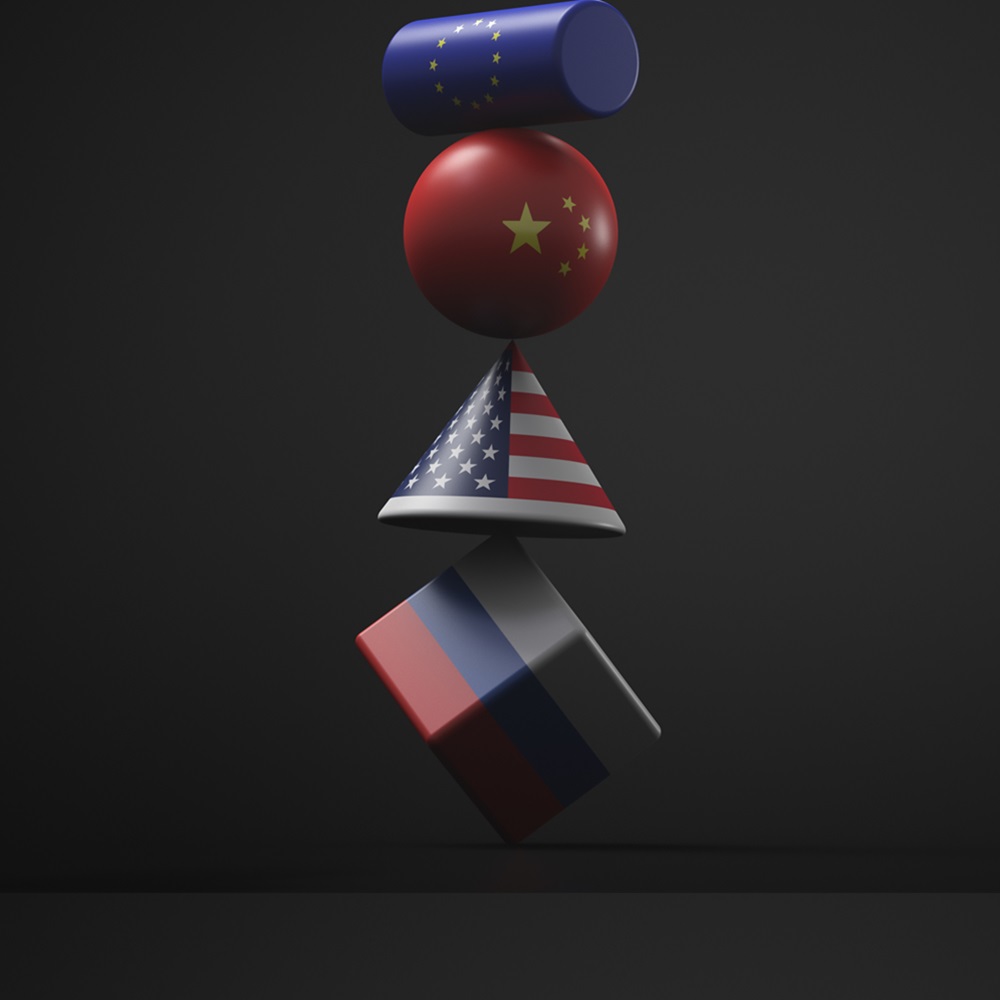
The concept of a multipolar (or polycentric) world order [1] was first coined by Academician Yevgeny Primakov in 1996 [Primakov 1996]. Like everything new, it was not immediately accepted, but ultimately became a significant contribution to both domestic and world theory of international relations, offering a compelling alternative to Western approaches, particularly the one proposed in Samuel Huntington’s The Clash of Civilizations [Huntington 1993]. It informed the idea of trilateral cooperation between Russia, China and India, implemented by Primakov and later embodied in the BRICS group. By now, the idea of multipolarity has been recognized in global political science, has entered the conceptual framework and the language of international diplomacy and is used in Russia’s doctrinal documents. In 2015, we proposed the scenario of a new bipolarity [2] as one of the possible trajectories for global development. Today, many scholars, both Chinese and American, [3] suggest that China-centric and U.S.-centric poles are emerging.
This article discusses the “multipolarity — new bipolarity” dichotomy.
Long Global Macro-Transformations
World history shows that a new world order typically emerges after the end of a major war (see Table 1).
Table 1. International system (world order)
Source: systematized by A.A. Dynkin, IMEMO RAS
Europe was usually the “kitchen” where the world order was cooked. Take the last 200 years. After the end of the Napoleonic Wars, the Concert of Europe emerged and lasted for 100 years. The century-long stability of that system could be explained by the homogeneity of the political organization of its guarantor states. All members of the Concert of Europe were monarchies. World War I produced the Versailles system, which lasted only 20 years. One of the reasons for its short life was the exclusion of the Soviet Union, Germany and China. The Yalta-Potsdam system was formed by the victors in World War II. Its guarantors were the “Big Three” powers—the Soviet Union, the U.S. and the UK—along with France and China. The three defeated powers—Germany, Japan and Italy—were discriminated and disenfranchised. This system existed for 45 years and was initially thought to be polycentric, but quickly degenerated into a bipolar order, and the Cold War commenced. With the collapse of the Soviet Union and dissolution of the Warsaw Pact, the system became unipolar, dominated by the West, primarily the U.S. It disregarded Russia’s interests and, from 2018 onward, began discriminating against China as well. February 2022 can be considered the formal date of the unipolar world’s demise. However, today’s predictions suggest it will take at least 10 years before the new post-unipolar system becomes stable.
The economic center of gravity is a spatial indicator of the economic strength of states, borrowed from physics. To put it simply, this is a geographical point of equilibrium for GDP, trade and investment flows of different countries. Figure 1 shows a map of how the world’s economic center of gravity shifted for over a thousand years. It appeared in Central Asia, on the territory of the Ghaznavid Empire (modern-day Afghanistan). The center then migrated northwest, while the devastation in post-war Europe forcefully pushed it (within just 10 years) to the West, toward Greenland. Then it turned east again. The sharpest shift, to the southeast, occurred in 2000–2010 and is associated with the rise of China. The economic center of gravity has almost returned to the same meridian but remained more than 2,000 km north of the starting point, which indicates a return to the millennial balance of economic power between the West and the East.
Figure 1. “Journey” of the three-dimensional economic center of gravity
Source: Dobbs R., Remes J., Manyika J. et al. Urban world: Cities and the rise of the consuming class. McKinsey Global Institute, 2012. https://www.mckinsey.com/featured-insights/urbanization/urban-world-cities-and-the-rise-of-the-consuming-class.
Statistic calculations by IMEMO RAS for 60 years of peace (1960–2021) indicate the stability of the center’s latitudinal (horizontal) position. This suggests a relatively consistent proportion of GDP production by the countries in the Global South and Global North, under the economic leadership of the Northern Hemisphere. The shift to the East has also been clearly confirmed.
According to our projections up to 2050, the future position of the globe’s center of economic activity will lie on the border of India and China. This method of analysis reveals a high level of inertia in time and geographic monotonicity of changes in the balance of economic power of states. It also shows that wars can drastically disrupt the natural course of events.
The center of gravity method can also be applied to the arsenals of strategic and tactical weapons (see Figure 2). For example, during the Cuban Missile Crisis, the U.S. had a huge advantage, but then there was a clear pivot to the northeast—the creation of superior nuclear capabilities in the Soviet Union. With the onset of arms control in 1993, a reversing loop emerged, heading southwest. This was followed by a curve to the east with an implied southward inclination, which reflects the growing nuclear stockpiles of India, Pakistan, North Korea, and the rapid buildup of strategic and tactical nuclear forces in China. The military center of gravity follows its economic peer with a lag of 20 years, reflecting the geopolitical ambitions of Asian powers. These interpretations also clearly demonstrate the end of unipolarity and point to the rise of multipolarity.
Figure 2. Movement of the nuclear center of gravity
Source: calculations by K.V. Bogdanov, Center for International Security at IMEMO RAS, based on the data from the Bulletin of the Atomic Scientists. https://thebulletin.org/nuclear-notebook/.
Technology. Politicians tend to be techno-optimists. Barack Obama predicted that 3D printing would transform the entire world. [4] George W. Bush promised that decoding the human genome would revolutionize medicine. [5] All false starts.
Economists traditionally measure the rate of technological progress (TP) using the total factor productivity (TFP) index. To put it simply, this is the part of economic growth driven not by an increase in inputs—labor and capital—but rather by improvements in the efficiency of their use. Technological progress means not only the generation of new scientific and technological ideas but also their mass replication. Without economic validation of the impact of wide dissemination of innovations, scientific or technological achievements remain in history as brilliant breakthroughs with only local economic effects, giving rise to journalistic generalizations at best, such as the “Fourth Industrial Revolution” or “the sixth techno-economic paradigm.”
Statistical metrics rely on data of technologically advanced nations, while catching-up countries have room for growth by approaching the TP frontier, i.e. adopting and improving existing ideas and technologies. Technological leaders spend more resources pushing the TP frontier, while those catching up can accelerate at lower costs, effectively staying in the “wind shadow” of the leaders. The TFP index growth rate has been steadily declining in developed countries for many years, but this has been especially conspicuous since the mid-2000s. Today, the growth is below 1.5% and even 1% per year (see Figure 3).
Figure 3. Average annual growth of total factor productivity, %
Source: calculations by IMEMO RAS based on the data from the International Productivity Monitor. No. 38, Spring 2020. http://www.csls.ca/ipm/ipm38.asp#:~:text=Martin%20Neil%20Baily%2C%20Barry%20P.%20Bosworth%20and
%20Siddhi%20Doshi%0ALessons%20from%20Productivity%20Comparisons%20 of%20Germany%2C%20Japan%2C%20and%20the%20United%20States%C2%A0; Innovative China: New Drivers of Growth. World Bank Group, and the Development Research Center of the State Council, P.R. China. 2019. Washington, DC: World Bank. https://doi.org/10.1596/978-1-4648-1335-1. License: Creative Commons Attribution CC BY 3.0. https://documents1.worldbank.org/curated/en/833871568732137448/pdf/Innovative-China-New-Drivers-of-Growth.pdf.
A similar pattern of dramatic TFP deceleration was observed in China. The consensus interpretation of these figures is that the main effects of the Third Industrial (i.e., computer) Revolution have largely been exhausted, and no new general-purpose breakthrough technologies (such as electricity, internal combustion engines, or computers and mobile communications) have emerged.
However, it seems that the intellectualization of technologies and approaches to project management, as well as informatization, simply do not fit into the traditional factor-based view of progress that was established many years ago. The scale of knowledge is growing, new professions are springing up, the role of emotional intelligence and cognitive functions is increasing. All this dramatically changes the structure of capital assets (see Figure 4). From the beginning of the 21st century and until the 2008 crisis (2000–2007), equipment accounted for over 50% of the increase in capital’s contribution (investment) to output growth, whereas in 2019–2021, almost 63% of this increase was attributable to intellectual property assets. This result of our research suggests a refocusing of technological progress from final products to intellectual technologies, enabling the production of a range of innovative goods and services tailored to highly segmented demand.
Figure 4. Transformation of the capital structure in the U.S. private sector
Source: Total Factor Productivity for Major Industries—2022. U.S. Bureau of Labor Statistics. https://www.bls.gov/news.release/archives/prod3_03232023.htm.
There are now hopes that the pace of technological progress may accelerate due to the development of artificial intelligence (AI) technologies, which will spark a new industrial revolution. An indirect sign of its imminence is the sharp rise in the rate of business births and deaths in the U.S. economy in 2020–2022. [6] The spillover of labor from companies that are losing efficiency to corporations with increasing market shares has also accelerated. These are some sort of leading indicators that suggest the structural results of TP are approaching. Similar developments occurred 30 years ago, on the cusp of the computer revolution. The above-mentioned intellectualization of fi ed capital, where trusted AI will be applied, adds credibility to these hopes. In addition, AI is one of the critical areas of technological sovereignty. It is no coincidence that Vladimir Putin described AI as “crosscutting, universal and essentially revolutionary technology.” [7] The Russian President announced the preparation of a new edition of the National AI Development Strategy and a respective decree. I believe that this prioritization is justified. China’s experience in the semiconductor race is a good model to be emulated (see Figure 5). Its distinguishing feature is the focus on companies as drivers of development, with massive, cumulatively growing state support.
Figure 5. Focusing on China’s priorities (nanometer chip race)
Source: Systematized by I.V. Danilin, IMEMO RAS
The U.S. strategy of curbing technological development of Russia (in all areas) and China (in semiconductors, artificial intelligence and quantum computing and electric cars) leads to stiff competition in high technology, which is fraught with fragmentation, diversification of technical standards, legal norms and rules. And this is another argument in favor of a new bipolarity.
Demographic processes. According to UN projections, by the middle of the 21st century, Russia will drop from its current 9th place to 14th in terms of population, while remaining the most populous country in Europe. [8] A more significant problem for Russia is population aging. The proportion of elderly people, who are typically not part of the labor force, is increasing. Japan, Spain and Italy are leading this process today, but neither China nor India will be spared. Nigeria appears to be the only major country where population and the share of young people will continue to grow until the end of the 21st century. As of December 2023, one in 10 people worldwide was aged 65 or over, with health spending taking up 10% of global GDP. [9]
In this context, the importance of medical technologies cannot be overstated, as they can extend not only people’s life expectancy but also the duration of their healthy and socially active life, thereby easing labor market pressures. Needs always steer technological progress toward overcoming economic growth constraints tied to the scarcest resource in any given historical period.
A serious risk associated with the problem of aging is a slowdown in innovation, since it is people under 40—the age group that will shrink throughout the 21st century—who are the primary drivers and consumers of innovation. So far, this risk has been mitigated by the large youth cohorts in China and India. This is why these two nations are experiencing almost exponential growth in patenting, massive reengineering and, consequently, in middle-class numbers. Demographics give India an edge until around 2060, which is already evident in the growth rates of Indian economy. Combined with the influx of hi-tech investments and the contribution of the Indian diaspora, India has good prospects, making its position crucial to the future architecture of the world order, regardless of how it evolves. The U.S. understands this and has been figuratively “clinging” to this nation for the past 20 years.
I believe that the Russian Academy of Sciences should significantly bolster scientific and educational ties with India and its dynamically developing neighbors in Southeast Asia—Vietnam, Malaysia and Indonesia. The anticipated tension in the global market of new generations of innovators aggravates inter-country competition for this scarcest resource. I think that the international reputation of the Russian Academy of Sciences is a powerful tool to attract and retain young people and foster their creative motivation. We should reassert this as we celebrate the 300th anniversary of the Academy of Sciences.
Ideology. Dirigisme [10], or statism, is the main trend in both economic theory and economic policy of the West. A pivot to a more state-controlled economy began with the disappointing outcomes of the Washington Consensus, which aimed to guide post-socialist countries from planned to market economies.
The 2008–2009 financial crisis cemented the trend toward statism, and the COVID-19 pandemic elevated it to unprecedented proportions. In the U.S., Democrats are among the most vocal proponents of greater government intervention in all spheres of life, but they are not alone. Republicans are also actively advocating industrial policy, repudiation of free trade, as well as strict control over Big Tech, among other measures.
The popularity of the so-called cultural Marxism is on the rise. [11] Its origins go back to the critical theory of the Frankfurt School (H. Marcuse, E. Fromm and others). These ideas are moving from the realm of ideological and theoretical confrontations into political activism. For example, the leaders of the BLM movement publicly self-identify as “trained Marxist organizers.” The essence of the strategy inspired by “cultural Marxism” is the rejection of direct political struggle on the barricades, since the proletariat has been “bought off by the bourgeoisie and is no longer capable of anything,” and the ranks of the classic proletariat are rapidly thinning. The direction of social change is set, on the one hand, by intellectuals with personal power and, on the other hand, by marginalized groups seeking to assert their “right to identity.” The strategy of activists who form this paradoxical combination of intellectuals and marginalized individuals is the creeping takeover of the main institutions of power and society by planting “correct” ideas in the mass consciousness. In the U.S., the fighters for political correctness have already hijaked the school system, university campuses, major media outlets and the entertainment industry (Hollywood). Civil servants are forced to take courses in critical race theory, which postulates not only the socially constructed nature of race and the recognition of systemic racism [Delgado, Stefancic 2017: 45] but also a sense of guilt in one part of society toward another. This, in turn, allegedly requires addressing moral and material injustices by organizing public life in line with such an ideology.
Similar concepts are being pushed into public discourse as well. It is already dominated by the ideas of radical feminism, cancel culture, anti-systemic racism and postcolonialism, the fight against global warming and the green agenda, which claims to be universal and non-negotiable. As a result, the energy transition is motivated more by ideology than by the comparative market efficiency of energy supplies. Different environmental-political discourses—eco-nationalism, eco-imperialism and green growth—are competing in shaping the green agenda, eroding the attractiveness of the dominant sustainable development model.
Another universal weapon in fighting any dissent is political correctness. Large corporations, government agencies and universities are developing and implementing strategies to promote DEI (Diversity, Equity, and Inclusion) principles, which are nothing but tools of ideological control over employees. Universities are required to fi reports on their compliance with such principles and efforts to promote them, which causes mounting criticism as they violate academic freedom and cultivate ideological conformity. [12] However, ideological censorship has already taken deep root in various spheres of public life, and questioning its compatibility with democracy is deemed politically incorrect.
Revising cultural norms has become a cultural norm in and of itself, deepening divisions in modern polarized societies, primarily in the U.S., but also in Old Europe [Semenenko 2023: 27-35].
Another curious phenomenon is associated with the new agenda. In the 20th century, the left championed progress, advocating faster economic growth, rapid technological advancement and better social welfare. Now the ideas of zero or even negative growth and post-growth are popular among them. [Buchs, Koch 2017: 218]. Such ideological narratives exacerbate the question of how to treat the poor countries of the South, but also their own poor: the welfare state for all no longer fit into this agenda. On the contrary, it becomes a selective tool of backing the “right” minorities. This creates a breeding ground for stronger positions of populist forces.
Such contradictory internal political processes distort public consciousness as well as domestic and foreign policy decision-making. The new elites are extremely ideologized. The U.S. political system is becoming less effective at regulating the economy. Two rating agencies, Standard & Poor’s and Fitch Ratings, have downgraded the U.S. credit rating to AA+ from the top mark of AAA. In November 2023, Moody’s lowered its outlook on the U.S. credit rating to “negative” from “stable.” All three agencies agree on the main reason for the downgrade: the growing dysfunctionality of the political system. In foreign policy, the U.S. has withdrawn from 16 major international treaties and agreements on arms control, global trade, climate and the Arctic since the beginning of the century [Dynkin 2020].
In other words, the unipolar world order with its unbridled appetite for expansion has brought the world into a zone of extra-high risks. And the paradigms that are dominant in the West have proven incompatible with either Russian or Chinese value-oriented political projects. Therefore, the ideological sphere will inevitably see increased confrontation, marking another step toward bipolarity.
IMEMO RAS researchers have repeatedly warned about the West’s miscalculated strategic hopes: 1) that Russia would face an economic catastrophe because of an unprecedented sanctions war in modern history; 2) that the unipolar world order would remain unchallenged; 3) that a global blockade of Russia’s export-oriented economy would be feasible. And we were not the only ones who made these warnings. In response, we only heard propagandistic clichés like “a gas station masquerading as a country,” “a regional power” and “Russia is isolated with its economy in tatters”. This kind of “expertise” led the Washington establishment to believe that Russia is a “declining power” whose strategic interests could be safely neglected. This “strategic lunacy” is a consequence of a universalist mindset—a product of the West’s political experience and culture, which tends to elevate Anglo-Saxon and European historical tradition to absolutes—and of a failure to understand the shifts in the balance of power in the 21st century.
Today, Russia is the world’s fourth-largest economy by purchasing power parity (PPP), while the top fi e global economic powers include three BRICS nations and none from the blooming “garden” of Josep Borrell, the EU foreign policy chief who has recently been fired. Now a new narrative has been launched into the propaganda orbit: “Russia is about to attack Eastern Europe.” The logical gap between the image of a declining power and that of an “aggressive bear” is conveniently ignored. This primitive, one-dimensional perception of complex non-linear processes can only lead to disappointment—just as it did when the West lulled itself into believing that Chinese reforms would eventually lead to political pluralism. As a result, the West has an inexhaustible stream of surprises. It appears that their experts are increasingly out of touch with Russian (and any other non-Western) realities. Figuratively speaking, they are staring into a distorting rearview mirror constructed by their own rhetoric and propaganda.
But the main real surprise was the fantastic resilience of the Russian economy. I dare say that no other economy in the world, not even China’s, could withstand such aggressive pressure.
The high resistance of the Russian economy to external shocks can be explained by three fundamental reasons.
First, it is the result of difficult, sometimes agonizing institutional and structural reforms. These efforts have ultimately produced a self-sufficient, adaptive and highly diversified market economy.
Second, the crisis of 2022 was the fifth (!) in the history of post-Soviet Russia. The government, federal regulators and the Bank of Russia have accumulated hard-earned professional experience in crisis management and counter-cyclical strategies. The same can be said about business. Our economic entities have demonstrated time and again that there are always more effective solutions than there are problems.
Finally, the West miscalculated its ability to isolate our economy. The dual containment of Russia and China, in fact, only strengthens ties between the BRICS member states.
Transformations of the 2020s. The first half of the 2020s has fi y buried what was once known as “European security.” It is impossible to glue this “broken cup” back together without Russia. The unwillingness of the Ukrainian side and the West to stop the armed conflict at its very beginning, the dangerous escalation, NATO’s constant violation of its own “red lines” and the accession of Sweden and Finland to the North Atlantic Alliance are all symptoms of the European security system transforming into a transatlantic one. Meanwhile, the Eurasian security system is taking shape. The outcomes of Russian President Vladimir Putin’s visit to China hint that the “political East” is starting to form, if not as an alternative to the long-standing “political West,” then at least as an equal partner. Without considering its interests, any debate about “rules-based” global security will be mere fantasy. Indian Prime Minister Narendra Modi’s first visit to Moscow after his recent reelection is in the same vein. Of course, geography cannot be changed, and Russia has been and will remain a European power. However, it is also the geographic center of Eurasia, providing the infrastructure backbone for the Eurasian partnership—from the Northern Sea Route and up to the Trans-Siberian Railway, Baikal–Amur Mainline, Trans-Asian Highway and cross-continental pipelines. The “post-Ukrainian” world seems to be moving toward a new, indivisible Eurasian security architecture, relying on existing institutions: the Union State, CSTO, EAEU, CIS, BRICS, SCO and ASEAN. Minsk has put forward an initiative to develop a Eurasian Charter for Diversity and Multipolarity—a strategic vision for a new system of international relations to replace the “rules-based” world order.
An important event of 2024 in this context is the expansion of the BRICS club (see Figure 6). Its combined economic power could potentially reach $67 trillion, surpassing the total GDP of the G7 countries.
Figure 6. Economic potential of BRICS countries
Source: calculations by A.A. Dynkin, IMEMO RAS, based on the data from the IMF, Food and Agriculture Organization, World Steel Association, Energy Transition Institute, Statistical Review of World Energy 2023, International Energy Agency.
And there are still 28 more countries on the “waiting list”. In several important markets such as metals, automotive industry, oil and mineral fertilizers, BRICS already matches or exceeds the potential of the G7 nations. Russia, which took over the BRICS rotating presidency in 2024, faces the task of energizing the harmonized economic and technological policies of the members. This approach is the institutional cornerstone of the future polycentric world.
What will the coming world order look like? It is difficult to say which of the two trends—bipolarity or polycentrism—will prevail in the end. It is more likely that they will coexist: for example, rigid bipolarity in the Global North and polycentrism in the Global South. Signs of military, economic and technological bipolarity are already visible in the North. Interestingly, New Delhi tends to categorize China as a country of the North [Jaishankar 2020: 240].
This viewpoint has substance, as China is far ahead of other countries of the Global South in terms of GDP per capita ($12,541). For comparison, India’s GDP per capita is $2,612. [13] The decoupling of the U.S. and Chinese economies has not affected trade flows yet, but only technology and investment. In 2023, China saw a reversal of foreign direct investment inflows, with funds previously invested being withdrawn. Negative trends took hold, and the outflow approached negative $1.5 trillion (see Figure 7). Meanwhile, the Asia-Pacific macro-region is gaining greater internal dynamics, unlike Europe or North America.
Figure 7. U.S.–China Economic Decoupling
Source: UN Comtrade Database. https://comtradeplus.un.org/; State Administration of Foreign Exchange (SAFE) of the People’s Republic of China. https://www.safe.gov.cn/en/.
Meanwhile, the trend toward political polycentricity persists. For example, New Delhi and Ankara were initially poles apart on the Palestinian–Israeli conflict. This is also the dawning of post-unipolarity, where the new centers of power are increasingly guided by their own interests in decision-making rather than by any “rules” or advice from Washington, Beijing or Moscow. It would be unrealistic to expect that the future world order will be free of conflict. The world will retain its diversity, with different potentials of countries and their competition. It is crucial that, despite their differences, the interests of larger and smaller nations are respected, and problems are solved through constructive dialogue.
Russia was the first to challenge the notorious unipolar world order. Today we can state that most countries in the Global South have responded to this challenge and refused to subscribe to the Western interpretation of the conflict in Ukraine . The future world order is taking shape right before our eyes. I am sure that a multipolar world is preferable for Russia as a developed, self-sufficient and sovereign nation. But this world also requires a new system of global governance, development and strengthening of its institutions, such as BRICS, G20, SCO and EAEU. For instance, the EAEU member states (Russia, Belarus, Kazakhstan, Armenia, Kyrgyzstan) are faring much better than the five other post-Soviet countries. In 2022, GDP per capita in the countries of the Eurasian Economic Union was 3.5 times higher than the average for the fi e other CIS states that are not part of the EAEU (Azerbaijan, Moldova, Tajikistan, Turkmenistan, Uzbekistan) (see Figure 8). Our strategy in these organizations requires a solid approach and “stereoscopic” vision from socio-economic, scientific, technological and political perspectives. Here, the Russian Academy of Sciences should play a major role as a leader of scientific and expert community.
Figure 8. Economic trends of EAEU and CIS countries
Source: EEC. https://eec.eaeunion.org/?ysclid=lr7rtdg7np631919243; IMF. https://www.imf.org/; World Bank. https://www.worldbank.org/.
Conclusion
In conclusion, there are compelling arguments both for multipolarity and for a new bipolarity. Leading U.S. experts are asking similar questions: “What order will replace the crumbling US-led system is far from certain. Will China push aside the United States as the global hegemon to lead a world according to rules written in Chinese characters? Will the world become bipolar, divided between two more or less rigidly defined blocs led by the United States and China? Will a genuinely multipolar world emerge based on several states or coalitions of more or less equal strength?” [Graham 2023: 272]. These questions are yet to be answered, and definitive conclusions in this case are premature. Given this high uncertainty, one should be prepared for any scenario. The essential prerequisite for such readiness is Russia’s strategic autonomy based on military-strategic parity with the U.S.
The fundamental question to which the author has no answer today is: how likely is the emergence of a new world order without a major war? In 2024, presidential or parliamentary elections will take place (or have already taken place) in 50 countries, which account for more than 45% of the world’s GDP and population. Perhaps their results will clarify our vision of the near future.
Dynkin A.A. (2024). World order transformation: economy, ideology, technology. Polis. Political Studies, 5, 8-23. https://doi.org/10.17976/jpps/2024.05.02
This article was prepared with the support of a grant from the Ministry of Science and Higher Education of the Russian Federation for major scientific projects in priority areas of scientific and technological development No. 075-15-2024-551 “Global and regional centers of power in the emerging world order”. The author expresses gratitude to his colleagues at IMEMO RAS R.I. Kapelyushnikov, V.D. Milovidov, I.S. Semenenko, I.V. Danilin, S.V. Zhukov, K.V. Bogdanov, A.P. Guchanova for consultations and assistance in preparing this article.
References
Büchs, M., & Koch, M. (2017). Critiques of growth. In M. Büchs, & M. Koch. Postgrowth and Wellbeing: Challenges to Sustainable Welfare (pp. 39-56). London: Palgrave Macmillan. https://doi.org/10.1007/978-3319-59903-8_4
Delgado, R.,& Stefancic, J. (2017). Critical race theory. Anintroduction. New York: New York University Press. Graham, T. (2023). Getting Russia right. UK: Polity Books.
Huntington, S.P. (1993). The clash of civilizations? Foreign Affairs, 72(3), 22-49. https://www.foreignaffairs.com/articles/united-states/1993-06-01/clash-civilizations
Jaishankar, S. (2020). The India way: strategies for an uncertain world. New Delhi; New York: Harper Collins Publishers India.
Kupchan, C. (2021). Bipolarity is back: why it matters. The Washington Quarterly, 44(4), 123-139. https://doi.org/10.1080/0163660X.2021.2020457
Yan Xuetong. (2016). Political leadership and power redistribution. The Chinese Journal of International Politics, 9(1), 1-26. https://doi.org/10.1093/cjip/pow002
Dynkin, A.A. (2020). International turbulence and Russia. Herald of the Russian Academy of Sciences, 90(2), 127-137. https://doi.org/10.1134/S101933162002001X.
Primakov, E.M. (1996). Mezhdunarodnye otnosheniya nakanune XXI veka: problemy, perspektivy [International Relations on the eve of 21st century: problems, prospects]. Mezhdunarodnaya zhizn’, 10, 3-13. (In Russ.)
Semenenko, I.S. (2023). Razdelyonnye obshchestva [Divided societies]. In I.S. Semenenko (Ed.), Identichnost’: lichnost’, obshchestvo, politika. Novye kontury issledovatel’skogo polya [Identity: The Individual, Society, and Politics. New Outlines of the Research Field] (pp. 27-35). Moscow: Ves’ Mir. (In Russ.) https://www.imemo.ru/files/File/ru/publ/2023/Identichnost-Semenenko-2023.pdf
Литература на русском языке
Дынкин А.А. 2020. Международная турбулентность и Россия. Вестник РАН. Т. 90. № 3. С. 208-219. https://doi.org/10.31857/S0869587320030032. EDN: WINCQO.
Примаков Е.М. 1996. Международные отношения накануне XXI в.: проблемы, перспективы.
Международная жизнь. № 10. С. 3-13.
Семененко И.С. 2023. Разделенные общества. Идентичность: личность, общество, политика. Новые контуры исследовательского поля. Отв. ред. И.С. Семененко. М.: Весь Мир. С. 27-35. https://www.imemo.ru/files/File/ru/publ/2023/Identichnost-Semenenko-2023.pdf. EDN: NTQYRB.
1. The world order or international system is a stable set of institutions and norms of military-political and economic relations, which is institutionalized and legitimate in the international legal sense. The world order remains stable during the active life of at least one generation—a universal measure of social time. However, in the wake of geopolitical macro-crises, illegitimate systems emerge, forcibly imposed by the winner. This was the case with the unipolar world order.
2. Dynkin A., Burrows M. Here’s the Playbook for Getting U.S.–Russian Cooperation Back on Track. The National Interest. 07.12.2015. https://nationalinterest.org/feature/heres-the-playbook-getting-us-russian-cooperation-back-track-14527.
3. For example, see: [Yan Xuetong 2016; Kupchan 2021].
4. Remarks by the President in the State of the Union Address. The White House. President Barack Obama. 12.02.2013. https://obamawhitehouse.archives.gov/the-press-office/2013/02/12/remarks-president-state-union-address.
5. President Bush Calls on Senate to Back Human Cloning Ban. Remarks by the President on Human Cloning Legislation. The East Room. The White House. President George W. Bush. 10.04.2002. https://georgewbush-whitehouse.archives.gov/news/releases/2002/04/20020410-4.html.
6. Private sector establishments birth and death, seasonally adjusted. U.S. Bureau of Labor Statistics. 25.10.2023. https://www.bls.gov/news.release/cewbd.t08.htm.
7. Artificial Intelligence Journey 2023 conference. President of Russia. Official website. 24.11.2023. http://www.en.kremlin.ru/events/president/transcripts/72811.
8. World Population Prospects 2024, Online Edition. United Nations, Department of Economic and Social Affairs, Population Division (2024). https://population.un.org/wpp/Download/Standard/MostUsed/.
9. Global Health Expenditure database. World Health Organization. https://apps.who.int/nha/database.
10. Dirigisme is a policy of active state intervention in the national economy, pursued by France and the UK in mid-1940s.
11. Mendenhall A. Cultural Marxism is Real. The James G. Martin Center for Academic Renewal. 04.01.2019. https://www.jamesgmartin.center/2019/01/cultural-marxism-is-real/.
12. AFA Calls for an End to Required Diversity Statements. Press Release. AFA. Princeton, NJ. 22.08.2022. https://academicfreedom.org/afa-calls-for-an-end-to-required-diversity-statements/.
13. World Economic Outlook Database (October 2023 Edition). International Monetary Fund. 10.10.2023. https://www.imf.org/en/Publications/WEO/weo-database/2023/October.