Subscribe to our weekly newsletters for free

Subscribe to an email

If you want to subscribe to World & New World Newsletter, please enter
your e-mail

Defense & Security
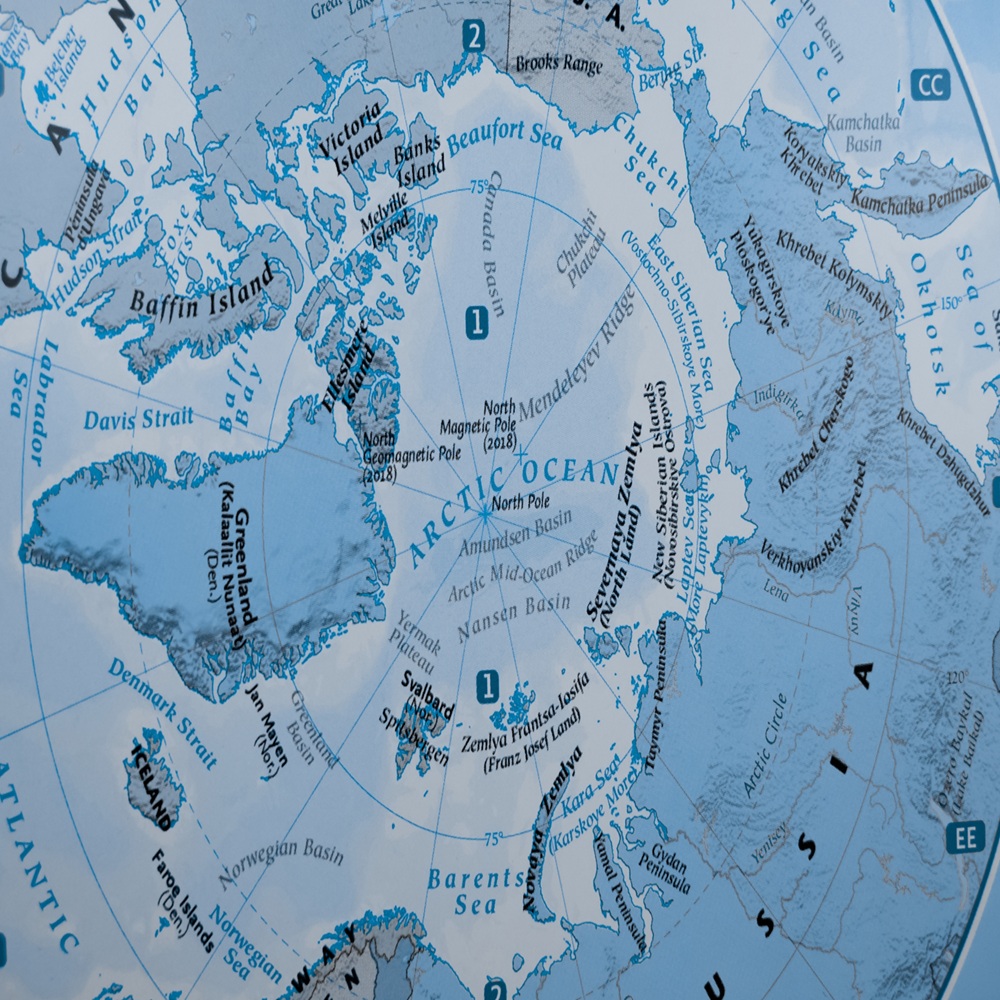
Map of Arctic Ocean styled in grey color. Selective focus on label, close-up view

Greenland at the Center of the Arctic Power: US NSS 2025, NATO Cohesion, and the New Geopolitics of the High North.

by World & New World Journal

In the chilling expanse of the Arctic, where ice and ocean frame the edges of the known world, a geopolitical drama has quietly gathered momentum. The world’s strategic gaze is no longer fixed solely on the traditional theatres of diplomacy in Europe, the Middle East, or the Indo-Pacific. Instead, the High North — and particularly Greenland, the vast Arctic territory within the Kingdom of Denmark — has emerged as a critical arena where great-power competition, national security priorities, global trade dynamics, and climate change converge. This transformation did not occur overnight. For decades, military planners, geographers, and strategic thinkers recognized the Arctic’s latent importance. Yet only in recent years have those projections translated into urgent geopolitical reality. At the center of this shift stands the United States’ National Security Strategy 2025 (NSS 2025), unveiled in late 2025, which redefines American priorities in a world shaped by renewed great-power rivalry. While the strategy addresses multiple global theatres, its emphasis on territorial security, critical resources, strategic geography, and adversarial competition underscores why Greenland has moved from the periphery to the heart of international geopolitics. Greenland today sits at the intersection of U.S. homeland defense, NATO cohesion, Arctic militarization, global trade transformation, and the accelerating race for critical minerals. The tensions surrounding the island reveal not only disputes among allies but also deeper structural changes in the international system. This article argues that Greenland is no longer a remote outpost but a strategic fulcrum of the Arctic, whose future will shape the balance of power in the High North and beyond. America’s Strategic Recalibration in the 2025 National Security Strategy The NSS 2025 marks a clear departure from post-Cold War doctrines centered on expansive multilateralism and global institution-building. Instead, it reflects a return to strategic realism, prioritizing the protection of core national interests, territorial security, and the prevention of adversarial dominance in critical regions. The strategy defines the United States’ primary objective as “the continued survival and safety of the United States as an independent, sovereign republic,” coupled with maintaining decisive military, technological, and economic power. Although the Indo-Pacific remains central, the strategy elevates the Western Hemisphere and adjacent strategic regions, emphasizing the need to prevent hostile encroachment on areas vital to U.S. security and economic resilience. Supply chains, critical minerals, missile defense, and strategic geography feature prominently throughout the document. Within this framework, Greenland has transitioned from a peripheral Arctic territory to a linchpin of U.S. strategic defense and resource security. While the NSS does not outline a standalone Arctic doctrine, its underlying logic — securing access to essential materials, protecting strategic approaches to the homeland, and denying adversaries positional advantages — aligns directly with the intensifying focus on Greenland. Latest developments: US position over Greenland. As already mentioned, the release of the NSS 2025 made one thing clear: US foreign policy is now defined by an assertive approach towards the entire Western Hemisphere – where Greenland is part of –. Moreover, this implies that the US might claim the right to intervene in other countries’ domestic affairs in order to guarantee its strategic and corporate interests. Therefore, after Venezuela – in addition to its rhetoric towards Cuba and Mexico – Greenland has become a hot topic, due its geopolitical, economical and strategical position and of course as part of the US “national security” and interest. The interest from the US over Greenland is not new, during Trump’s first administration an attempt to buy Greenland occurred and even at the beginning of his second administration there were comments to obtain the island. Next are presented the developments that occurred until January 22nd: - The US-Greenland-NATO crisis escalated when Trump’s desire to have Greenland either “by hook or by crook” sparked the global debate, while Europeans, Greenlanders and Danish rejected his ideas and showed support for Greenland and the Kingdom of Denmark itself. - A later diplomatic meeting between Danish, Greenlandic and US officials in Washington ended up in a “fundamental disagreement” over the sovereignty of the island on January 14th. - A joint statement of several European countries supporting the idea that “Greenland belongs to its people, and only Denmark and Greenland can decide on matters concerning their relations” was released on January 18th. - Launch of “Operation Arctic Endurance” and the initial deployment of a small number of troops from the European allies plus Danish soldiers. By January 18th there were over 100 troops in Nuuk and another 100 in Kangerlussuaq. (numbers could be increased in a short time). - Worries within Europe and the NATO allies. In addition, China urged the US to stop using the so-called “China threat” as a pretext for pursuing its own interest. - General concern for Greenlanders and several protest in Denmark, and Greenland against the US actions. - The imposition of 10% tariffs from the US over Denmark, Norway, Sweden, France, Germany, Finland, the UK and the Netherlands that would increase by 25% on June 1st if there is no deal reached. After Trump’s speech in the World Economic Forum, he confirmed that tariffs threats were off the table as there was a “framework of a future deal” for Greenland. In summary, in January 2026, Washington’s posture toward Greenland has sharpened into a high-profile mix of strategic urgency and political brinkmanship, framed publicly as an Arctic and homeland-security imperative. Recent reporting describes President Donald Trump repeatedly arguing the U.S. “needs” Greenland for security, while also signaling limits on how far he would go — saying at the World Economic Forum in Davos that he would not use military force to acquire it. At the same time, the episode has clearly strained allied politics: coverage indicates Denmark has insisted Greenland’s sovereignty is not negotiable even as the U.S. debate escalated, and Greenland’s own authorities have taken the moment seriously enough to urge practical preparedness at home. The most concrete “near-term” direction emerging in January 2026 is not annexation but a NATO – and alliance-linked security bargain. Multiple outlets report Trump backing away from threatened tariffs after announcing a “framework” tied to future Arctic security cooperation with NATO leadership — suggesting the administration is trying to convert its Greenland pressure campaign into expanded defense access, posture, or burden-sharing rather than an immediate territorial transfer. Even where details remain vague, the logic is consistent: Greenland’s geography — especially its role in Arctic air/sea lanes and missile-warning architecture — makes it a leverage point for U.S. deterrence and homeland defense planning, and U.S. officials appear to be testing what they can gain diplomatically inside the alliance system when outright sovereignty change is off the table. This posture also lines up with the 2025 National Security Strategy (NSS), which elevates the Western Hemisphere as the top priority region and argues the U.S. will “deny non-Hemispheric competitors” the ability to “own or control strategically vital assets” in the hemisphere, while calling for readjusting military presence and “establishing or expanding access in strategically important locations.” While the NSS text excerpt does not name Greenland in the lines above, its framework — reasserting hemispheric primacy, blocking external footholds, and expanding access — maps neatly onto a Greenland approach that treats the island as a critical node in Arctic security competition and infrastructure control. European Parliament analysis likewise characterizes the NSS as a “pivot” toward a Monroe Doctrine–style sphere-of-interest logic in the Western Hemisphere, reinforcing the idea that Greenland is being handled less as a narrow Denmark dispute and more as part of a broader hemispheric strategy. Greenland’s Geographic Centrality: The broader US security interest of the Island. Figure 1: Arctic states, counties and other administrative regions with capitals. Source: Map by Arto Vitikka, Arctic Centre, University of Lapland. Credit for the border data: Runfola, D. et al. (2020) geoBoundaries: A global database of political administrative boundaries. PLoS ONE 15(4): e0231866. https://doi.org/10.1371/journal.pone.0231866e. Figure 2: Arctic Population Centers. Map by Arto Vitikka, Arctic Centre, University of Lapland. When viewed from a polar perspective, the Arctic is not a distant fringe but the shortest connective space between North America, Europe, and Eurasia. The Arctic as seen in Figure 1 is composed of several administrative areas, including Canada, Alaska (USA), Russia, Norway, Sweden, Finland, Iceland and Greenland (Denmark). The latter can be said to be located at the center between North America and Europe and Eurasia, underscoring its geopolitical importance. In other words, Greenland occupies the central Atlantic–Arctic axis, the shortest air and missile trajectories between Russia and North America and a pivotal position between the Canadian Arctic Archipelago and the Russian Arctic coast. This geography carries deep strategic implications. First, Greenland is part of the so-called GIUK (Greenland-Iceland-UK) Gap, a crucial corridor for monitoring naval and air activity in the North Atlantic. The GIUK Gap played an important role during the Second World War and the Cold War and nowadays it has become crucial in securing air and sea surveillance through radar stations, while securing the sea lines of communication (SLOCs) as well as supply lines making them uninterrupted between NATO’s European members and the USA. The GIUK Gap can assist in ensuring maritime visibility and assist anti-submarine warfare (ASW) in case of conflicts. The presence of Russian submarines in the Arctic is a central pillar of Russia’s military strategy and nuclear deterrence, making the region one of the most militarized maritime spaces in the world. Russia views the Arctic as both a strategic sanctuary and a launch platform. In consequence, its Northern Fleet – headquartered on the Kola Peninsula –, is the most powerful of Russia’s fleets and operates a large share of its nuclear-powered ballistic missile submarines (SSBNs), such as the Borei and Delta IV classes. These submarines carry submarine-launched ballistic missiles (SLBMs) and are designed to remain hidden under Arctic ice, ensuring a second-strike capability in the event of a nuclear conflict. The ice cover, combined with Russia’s familiarity with Arctic waters, provides concealment and operational depth. In addition to SSBNs, Russia deploys nuclear-powered attack submarines (SSNs) and guided-missile submarines (SSGNs) in the Arctic. These vessels conduct intelligence gathering, protect ballistic missile submarines, and pose threats to NATO naval forces and undersea infrastructure, including communication cables. Russian submarines regularly transit through key chokepoints such as the GIUK Gap, bringing them into strategic relevance for Greenland, Iceland, and NATO’s anti-submarine warfare (ASW) posture. In addition, the Arctic also supports Russia’s broader bastion defense concept, which seeks to create heavily defended maritime zones where submarines can operate safely. Air defenses, surface ships, icebreakers, and coastal missile systems complement submarine operations. As climate change reduces sea ice and increases accessibility, Russian submarine activity in the Arctic is expected to remain intense, reinforcing the region’s importance for NATO surveillance, early warning systems, and transatlantic security — especially for locations like Greenland that sit astride critical Arctic–Atlantic routes. Second, Greenland’s high latitude makes it an ideal place for early detection of long-range missile launches. Russia has long-range intercontinental ballistic missiles (ICBMs), if ever launched from Russia toward the United States, the total flight time would be roughly between 25 to 35 minutes – depending on the launch location and target. But because of the Earth’s curvature, the shortest path from Russia to the continental US goes over the Arctic which is why Greenland is so strategically important for early detection and missile defense. In practical terms, US decision-makers would have only minutes to assess the threat and respond after a launch is detected. Establishments such as the U.S. Pituffik Space Base underscore how Greenland functions as a first line of surveillance against possible ballistic missile threats from the Eurasian landmass. Therefore, Greenland is indispensable to early-warning and missile-defense systems. Sensors, radars, and space-tracking infrastructure based on the island form a crucial layer of “U.S. homeland defense”. Finally, Greenland is the only large Arctic landmass under Western democratic control outside Eurasia. Russia dominates the Eurasian Arctic coastline, while Alaska and Canada anchor North America. Greenland bridges these spaces, serving as a keystone for transatlantic Arctic security. Its isolation does not diminish its importance; rather, it magnifies it. – making Greenland a linchpin of US homeland defense and NATO’s northern security architecture. Greenland and NATO: The Fragile Architecture of Arctic Security Figure 3: NATO’s and Russia’s militarization in the Arctic. Figure 3 exposes a stark asymmetry in the Arctic militarization between NATO and Russian. The latter maintains a dense, continuous network of military bases stretching from the Kola Peninsula to the Bering Strait. These installations support air defense, naval operations, missile forces, and surveillance — forming an integrated arc of control along Russia’s northern frontier. On the other hand, NATO’s Arctic posture is fundamentally different. It relies on discrete strategic nodes rather than territorial saturation, interoperability over mass and coordination among multiple sovereign states. Within this fragmented architecture, Greenland is NATO’s most critical node. Nonetheless, the US has presence in Greenland, specifically with the Pituffik Space Base (formerly Thule Air Base), which is located in northwest Greenland. This base – as mentioned before – is indispensable for early missile warning, space surveillance and tracking adversary launches across the polar region. While the UK has presence in Norway in the logistic Camp Viking site. Without Greenland, NATO’s Arctic posture would fracture into disconnected segments — North America on one side, Scandinavia on the other — with no central anchor. This reality explains the sharp European response in 2025–2026 to U.S. rhetoric suggesting unilateral action or coercive pressure regarding Greenland. The deployment of European troops under Operation Arctic Endurance was not merely symbolic; it was an assertion that Greenland is a collective NATO concern, not a bilateral bargaining chip. Greenland’s Resources: Strategic Minerals in a Fragmenting World Beyond military geography, Greenland’s subsoil wealth significantly enhances its geopolitical importance. The island holds substantial deposits of rare earth elements (REEs), lithium, graphite, niobium, titanium, uranium and zinc. As it is well known these strategic materials are indispensable and critical for renewable energy systems, electric vehicles, advanced electronics, missile guidance and radar technologies and space and defense infrastructure. Last but not least there is also oil and gas, but the conditions and viability to extract them make them an economic challenge. In the context of the control of natural resources, the NSS 2025 repeatedly stresses the need to reduce U.S. dependence on adversarial supply chains — an implicit reference to China’s dominance in rare-earth processing. Therefore, US eyes are on Greenland, as it represents one of the few politically aligned alternatives with large-scale potential reserves – ironically not under Chinese or Russian influence, but under US “allies” control. Yet resource abundance does not automatically translate into strategic advantage. Mining in Greenland faces severe challenges: extreme climate conditions, environmental risks, limited infrastructure, and strong local opposition to environmentally destructive projects. As a result, Greenland’s mineral wealth is strategically valuable but politically sensitive. Its development requires local consent and long-term cooperation, not coercion — a fact often overlooked in external strategic calculations. The Arctic Trade Revolution: Melting Ice, Shifting Routes Figure 4: Arctic Seaways (Northern Sea Route, Northwest Passage and Transpolar Sea Route). Source: Map by Arto Vitikka, Arctic Centre, University of Lapland. Climate change is transforming the Arctic faster than any other region on Earth. As sea ice recedes, new maritime routes are becoming seasonally viable, with potentially transformative consequences for global trade. The Northern Sea Route (NSR) along Russia’s Arctic coast already reduces transit times between Europe and Asia by up to 40%, even though some parts are free of ice for some months per year. On the other hand, a future transpolar route, cutting directly across the Arctic Ocean, could bypass traditional chokepoints such as: The Suez Canal, The Panama Canal or The Strait of Malacca. Therefore, Greenland importance relies on its geographic position that places it adjacent to these emerging corridors. Potential roles for the island include: the search-and-rescue hubs, refueling and logistics points, maritime surveillance and communications infrastructure. This elevates Greenland from a military asset to a potential gatekeeper of future Arctic trade, linking regional security directly to global economic flows. Icebreakers and Power Projection: Mobility as Sovereignty Figure 5: Major Icebreakers and Ice-Capable Patrol Ships highlight a decisive but underappreciated imbalance. Source: generated with Chat GPT using Routers Nov 2022 data. The transit in the Arctic can be defined by the possibility to move freely without any inconvenience due its extreme conditions – or at least with the least inconveniences. In consequence major ice breakers and ice-capable patrol ships became very important assets for the countries in the region. In a simple comparison, Russia possesses more icebreakers than NATO combined, as shown in Figure 5, including nuclear-powered vessels capable of year-round Arctic operations. These ships are instruments of sovereignty, enabling continuous military presence, escort of commercial shipping, enforcement of Arctic regulations and rapid crisis responses. By contrast, the United States has long underinvested in icebreaking capacity. NATO relies on a patchwork of national fleets, with Finland and Sweden contributing significantly but still lagging behind Russia’s scale. The strategic implication is clear: Russia controls mobility while NATO controls nodes. In such an environment, fixed strategic anchors like Greenland become even more critical. Competing Arctic Visions Russia Russia views the Arctic as a core strategic and economic priority, central to its national identity, security, and long-term development. Its Arctic vision emphasizes sovereignty, military security, and the exploitation of vast natural resources, particularly hydrocarbons and minerals. Moscow sees the Northern Sea Route as a critical shipping corridor that can enhance Russia’s control over Arctic navigation and generate economic revenues. To support this vision, Russia has invested heavily in Arctic infrastructure, icebreaker fleets, and military modernization, positioning itself as the dominant Arctic power and framing the region as vital to its great-power status. The Arctic is not an extension of Russian power; it is central to it. Figure 6: Cargo volume in Russia’s Northern Sea Route (1933-2023) China China approaches the Arctic as a “near-Arctic state,” framing its vision around scientific research, economic opportunity, and global governance. Beijing emphasizes participation in Arctic affairs through international law, particularly the UN Convention on the Law of the Sea, and promotes cooperation rather than territorial claims. Its strategy emphasizes long-term access to resources, influence over Arctic governance norms, and participation in future trade routes. Its concept of a “Polar Silk Road” reflects an interest in future shipping routes, energy projects, and digital connectivity, linking the Arctic to China’s broader Belt and Road Initiative. Even though China presents its Arctic engagement as peaceful and mutually beneficial, while gradually expanding its strategic and economic footprint in the region, it also has interest in Greenland’s mining sector, for example, which has heightened concerns about strategic leverage rather than direct control. Figure 7: Map of China’s Polar Silk Road. Source: Map by Arto Vitikka, Arctic Centre, University of Lapland. United States The U.S. approach, as reflected in the NSS 2025, is reactive but intensifying. Greenland crystallizes American concerns about strategic vulnerability, supply-chain dependence, and alliance credibility. Yet pressure tactics risk undermining the very alliances that make Arctic stability possible. The United States views the Arctic as an increasingly important region for national security, environmental stewardship, and economic opportunities. At the same time, it recognizes the strategic implications of growing Russian and Chinese activity in the region. Arctic States The European Arctic states emphasize sustainability, human security, and regional cooperation as the foundation of their Arctic vision. Their policies prioritize environmental protection, responsible resource management, and the rights and livelihoods of Indigenous peoples, while balancing economic development in sectors such as fisheries, renewable energy, and limited resource extraction. These states strongly support multilateral governance through institutions like the Arctic Council and stress adherence to international law. Collectively, they view the Arctic as a region where stability, cooperation, and climate leadership are essential, especially amid rising geopolitical tensions and accelerating environmental change. Canada Canada’s Arctic vision centers on sovereignty, Indigenous partnership, and sustainable development, reflecting the region’s importance to national identity and security. Ottawa emphasizes the protection of its northern territories and views the Northwest Passage as internal waters, while supporting a rules-based Arctic order. A core pillar of Canada’s approach is its collaboration with Indigenous peoples, recognizing their rights, knowledge, and role in governance and stewardship. Canada also prioritizes climate change adaptation, environmental protection, and responsible economic development, seeking to ensure that increased Arctic activity benefits northern communities while maintaining peace and stability in the region. India India’s Arctic vision is primarily science-driven and climate-focused, reflecting its broader emphasis on environmental security and multilateral cooperation. Through its Arctic research station, Himadri, and active participation in the Arctic Council as an observer, India seeks to understand the Arctic’s impact on global climate systems, particularly the Indian monsoon. New Delhi also recognizes the long-term economic and geopolitical significance of the Arctic but approaches the region cautiously, prioritizing sustainable development, international collaboration, and respect for Arctic states’ sovereignty. Strategic Futures: Cooperation or Fragmentation The future of Greenland and the Arctic more broadly will hinge on whether the region evolves toward structured cooperation or strategic fragmentation. In a cooperative scenario, Greenland becomes a stabilizing anchor within a renewed Arctic security framework, where the United States, Denmark, and NATO align their defense priorities with Greenlandic self-determination and environmental safeguards. Such an approach would emphasize multilateral governance, transparency in resource development, confidence-building military measures, and shared investment in infrastructure, search-and-rescue capabilities, and climate resilience. Cooperation would not eliminate competition, particularly with Russia and China, but it would establish rules, norms, and mechanisms to prevent escalation and miscalculation in an increasingly accessible Arctic. By contrast, a fragmented Arctic would be characterized by unilateral actions, coercive diplomacy, and the erosion of trust among allies. Pressure tactics aimed at securing access, influence, or control over Greenland could weaken NATO cohesion, fuel local resistance, and open political space for external actors to exploit divisions. In such a scenario, the Arctic risks becoming a patchwork of contested zones rather than a managed strategic commons. Therefore, fragmentation would increase the likelihood of militarization without coordination, resource development without legitimacy, and crisis dynamics without effective communication channels — conditions that historically precede instability rather than security. Conclusion Greenland’s transformation from a remote Arctic territory into a strategic fulcrum reflects deeper shifts in the international system. The United States’ National Security Strategy 2025 captures a world defined by renewed great-power rivalry, supply-chain vulnerability, and the reassertion of geography as destiny. In this context, Greenland sits at the intersection of homeland defense, NATO credibility, critical resource security, and emerging Arctic trade routes. Its importance is not a product of any single factor, but of the convergence of military, economic, and environmental dynamics reshaping the High North. Yet Greenland’s strategic value does not grant external powers unlimited leverage. Geography may confer importance, but legitimacy, consent, and alliance cohesion determine whether that importance translates into durable influence. Attempts to treat Greenland as a transactional asset risk undermining NATO unity, destabilizing Arctic governance, and alienating the very population whose cooperation is essential for security and development. The Arctic’s future must not be decided solely by military deployments or mineral deposits, but by the political relationships that sustain them. Ultimately, Greenland illustrates the central paradox of the new Arctic geopolitics: the region’s growing accessibility increases both opportunity and risk. Stability will depend not on dominance, but on restraint, not on unilateralism, but on partnership. Whether the Arctic becomes a zone of managed competition or strategic fragmentation will shape not only the balance of power in the High North, but the credibility of international order adapting to a rapidly changing world. Also, it is important to highlight Greenland’s voice – referring to sovereignty and identity. Usually under great-power maneuvering, Greenland’s own population has often been sidelined. Yet Greenland is not merely an object of strategy; it is a political community with a strong Indigenous identity, environmental concerns, and aspirations for greater autonomy. Therefore, it is important to keep in mind its constitutional status within the Kingdom of Denmark, their principle of self-determination and the political costs of alienating local consent. Paradoxically, the more external powers push, the more Greenlandic society resists — complicating both security arrangements and resource development. Finally, the Arctic is not only Greenland, the US or the NATO, there are other authors involved, Russia for instance appears as the main one, while, China and India are increasing their interests in the region Moreover, climate change seems to be game changer as new Arctic seaways gain importance in terms of trade and mobility, which in consequence are and will redefine sovereignty. For instance, either icebreakers or minerals would become as strategic as missiles. The Arctic transformation is already happening, and who will lead and what will happen in the region in the future are questions to be solved in the near future. References Agneman, G. (2025, February 04). Trump wants Greenland – but here’s what the people of Greenland want. Retrieved from The Conversation: https://theconversation.com/trump-wants-greenland-but-heres-what-the-people-of-greenland-want-248745 Aljazeera. (2026, January 15). European troops arrive in Greenland as talks with US hit wall over future. Retrieved from Aljazeera: https://www.aljazeera.com/news/2026/1/15/european-troops-arrive-in-greenland-as-talks-with-us-hit-wall-over-future Aljazeera. (2026, January 18). Trump announces new tariffs over Greenland: How have allies responded? Retrieved from Aljazeera: https://www.aljazeera.com/news/2026/1/18/trump-announces-new-tariffs-over-greenland-how-have-eu-allies-responded Arctic Centre University of Lapland. (n.d.). Arctic Region. Retrieved from https://arcticcentre.org/en/arctic-region/maps/polar-silk-road/ Bassets, M. (2026, Enero 11). “Por las buenas o por las malas”: así puede Trump conquistar Groenlandia. Retrieved from El País: https://elpais.com/internacional/2026-01-10/por-las-buenas-o-por-las-malas-asi-puede-trump-conquistar-groenlandia.html Bateman, T. (2026, January 14). Danish minister says 'fundamental disagreement' remains after 'frank' Greenland talks with US. Retrieved from BBC: https://www.bbc.com/news/live/cn824zzp670t BBC News. (2026, January 21). Trump drops threat of tariffs over Greenland after Nato talks in Davos. Retrieved from BBC News: https://www.bbc.com/news/live/cjrzjqg8dlwt Bierman, P. (2025, February 19). Greenland’s melting ice and landslide-prone fjords make the oil and minerals Trump is eyeing dangerous to extract. Retrieved from The Conversation: https://theconversation.com/greenlands-melting-ice-and-landslide-prone-fjords-make-the-oil-and-minerals-trump-is-eyeing-dangerous-to-extract-249985 Bierman, P. (2025, February 19). Greenland’s melting ice and landslide-prone fjords make the oil and minerals Trump is eyeing dangerous to extract. Retrieved from The Conversation: https://theconversation.com/greenlands-melting-ice-and-landslide-prone-fjords-make-the-oil-and-minerals-trump-is-eyeing-dangerous-to-extract-249985 Bierman, P. (2026, January 14). US military has a long history in Greenland, from mining during WWII to a nuclear-powered Army base built into the ice. Retrieved from The Conversatiion: https://theconversation.com/us-military-has-a-long-history-in-greenland-from-mining-during-wwii-to-a-nuclear-powered-army-base-built-into-the-ice-273355 Bonsoms, J. (2025, Dececmber 16). ‘Extreme melting’ episodes are accelerating ice loss in the Arctic. Retrieved from The Conversation: https://theconversation.com/extreme-melting-episodes-are-accelerating-ice-loss-in-the-arctic-272114 Brincat, S. (2026, January 18). Trump has threatened European countries with higher tariffs if he doesn’t get Greenland. Will it work? Retrieved from The Conversation: https://theconversation.com/trump-has-threatened-european-countries-with-higher-tariffs-if-he-doesnt-get-greenland-will-it-work-273698 Brincat, S., & Naranjo Cáceres, J. Z. (2026, January 07). Trump wants Greenland. Europe’s tepid response is putting NATO and global security at risk. Retrieved from The Conversation: https://theconversation.com/trump-wants-greenland-europes-tepid-response-is-putting-nato-and-global-security-at-risk-272819 Brooks, J. (2026, January 20). Pro-Greenland protesters mock Trump’s MAGA slogan with ‘Make America Go Away’ caps. Retrieved from AP: https://apnews.com/article/denmark-greenland-maga-trump-protest-cd1213dd73e9ea1e4da43285704c95ea Bryant, M., & Sabbagh, D. (2026, January 15). Greenland's defence is 'common concern' for Nato, Danish PM says as European troops fly in. Retrieved from The Guardian: https://www.theguardian.com/world/2026/jan/15/greenland-defence-nato-denmark-prime-minister-european-troops Burrows, E., Ciobanu, C., & Niemann, D. (2026, January 16). European troops arrive in Greenland as talks with US highlight 'disagreement' over island's future. Retrieved from AP: https://apnews.com/article/greenland-united-states-denmark-trump-vance-rubio-meeting-b10f5151008f1f18a788dc0751473c0e CNN. (2026, January 21). Trump says he’s formed a ‘framework of a future deal’ on Greenland. Retrieved from CNN: https://edition.cnn.com/politics/live-news/trump-administration-news-01-21-26 Davies, M. (2026, January 19). Starmer holds phone call with Trump over Greenland tariff threat. Retrieved from BBC: https://www.bbc.com/news/articles/cwyn90l1dneo Dodds, K. (2026, January 09). As the Arctic warms up, the race to control the region is growing ever hotter. Retrieved from The Conversation: https://theconversation.com/as-the-arctic-warms-up-the-race-to-control-the-region-is-growing-ever-hotter-273118 Dunbar, M. (2026, January 18). Trump's calls to seize Greenland ignite fresh criticism from Republican party. Retrieved from The Guardian: https://www.theguardian.com/us-news/2026/jan/18/trump-greenland-republican-party FitzGerald, J. (2026, January 19). Why does Trump want Greenland and what could it mean for Nato? Retrieved from BBC: https://www.bbc.com/news/articles/c74x4m71pmjo Fleck, A. (2025, January 24). NATO’s and Russia’s Militarization of the Arctic. Retrieved from statista: https://www.statista.com/chart/33824/military-bases-in-the-arctic-belonging-to-nato-and-russia/?srsltid=AfmBOoqwc5PmGe6_JB6mYjQSP9pr9fIZE_LcEtMOo_rtnCD86zMcQpwn Gjedssø Bertelsen, R. (2025). Divided Arctic in a Divided World Order. Strategic Analysis, 48(Issue 6: Changing Dynamics in the Arctic: Actors and Alliances), 568-577. doi:https://doi.org/10.1080/09700161.2025.2453322 Government Offices of Sweden. (2026, January 18). Statement by Denmark, Finland, France, Germany, the Netherlands, Norway, Sweden and the United Kingdom. Retrieved from Government Offices of Sweden: https://www.government.se/statements/2026/01/statement-by-denmark-finland-france-germany-the-netherlands-norway-sweden-and-the-united-kingdom/ Grillo, F. (2026, January 08). As the US eyes Greenland, Europe must turn a global problem into an opportunity. Retrieved from The Conversation: https://theconversation.com/as-the-us-eyes-greenland-europe-must-turn-a-global-problem-into-an-opportunity-272872 Gupta, P. (2024, September 18). Understanding the potential of the Northern Sea Route. Retrieved from ORF: https://www.orfonline.org/expert-speak/understanding-the-potential-of-the-northern-sea-route Harvey, L. (2026, January 16). European nations send additional troops to Greenland as US annexation threats escalate. Retrieved from CNN: https://edition.cnn.com/2026/01/15/world/europe-troops-greenland-trump-nato-intl-hnk Hastings Dunn MBE, D., Webber, M., & Wolff, S. (2026, January 07). US action against Greenland would undermine Nato, but now is not the time to panic. Retrieved from The Conversation: https://theconversation.com/us-action-against-greenland-would-undermine-nato-but-now-is-not-the-time-to-panic-272911 Holland, S., Mason, J., & Erickson, B. (2026, January 07). Trump discussing how to acquire Greenland, US military always an option, White House says. Retrieved from Reuters: https://www.reuters.com/world/trump-advisers-discussing-options-acquiring-greenland-us-military-is-always-an-2026-01-06/ huaxia. (2026, January 19). China urges U.S. to stop using so-called "China threat" as pretext for pursuing selfish gains. Retrieved from Xinhua: https://english.news.cn/20260119/57899ee8d43345ddbfa222828ec1d0a4/c.html Jakes, L., Tankersley, J., & Kanno-Youngs, Z. (2026, January 22). Trump Touts Greenland Framework as NATO Mulls U.S. Sovereignty Over Bases. Retrieved from The New York Times: https://www.nytimes.com/live/2026/01/21/us/trump-davos-greenland-news Karjee, M. (2025, August 20). Russia’s Arctic Corridor: Between Ice and Isolation. Retrieved from E-International Relations: https://www.e-ir.info/2025/08/20/russias-arctic-corridor-between-ice-and-isolation/ Katila, A. (2026, January 15). As US and Denmark fight, Greenland’s voices are being excluded once again. Retrieved from The Conversation: https://theconversation.com/as-us-and-denmark-fight-greenlands-voices-are-being-excluded-once-again-273131 Kennedy-Pipe, C. (2026, January 14). Whether or not US acquires Greenland, the island will be at the centre of a massive military build-up in the Arctic. Retrieved from The Conversation: https://theconversation.com/whether-or-not-us-acquires-greenland-the-island-will-be-at-the-centre-of-a-massive-military-build-up-in-the-arctic-273301 Khanna, M. (2025, March 19). China and the Arctic: An Overview. Retrieved from ORF: https://www.orfonline.org/research/china-and-the-arctic-an-overview Kirby, P. (2026, January 16). European military personnel arrive in Greenland as Trump says US needs island. Retrieved from BBC: https://www.bbc.com/news/articles/cd0ydjvxpejo Kotak, S. (2025, September 08). Leveraging India’s Arctic Observer Status: Scientific Diplomacy as a Lever for Climate, Resource and Security Advancement. Retrieved from World & New World Journal: https://worldandnewworld.com/india-arctic-observer-status/ Kottasová, I., & Edwards, C. (2026, Enero 19). Trump le dice a Noruega que ya no se siente obligado a "pensar únicamente en la paz" en carta sobre el Nobel y Groenlandia. Retrieved from CNN Español: https://cnnespanol.cnn.com/2026/01/19/eeuu/trump-paz-noruega-nobel-reux Kumar, A., & Haldar, S. (2024, October 2024). An evolving partnership in the Arctic between China and Russia. Retrieved from ORF: https://www.orfonline.org/expert-speak/an-evolving-partnership-in-the-arctic-between-china-and-russia L. Montgomery, S. (2026, January 14). 4 reasons why the US might want to buy Greenland – if it were for sale, which it isn’t. Retrieved from The Conversation: https://theconversation.com/4-reasons-why-the-us-might-want-to-buy-greenland-if-it-were-for-sale-which-it-isnt-246955 Lebowitz, M. (2026, January 18). Treasury secretary defends Greenland tariffs: 'The national emergency is avoiding the national emergency'. Retrieved from NBC News: https://www.nbcnews.com/politics/trump-administration/treasury-secretary-bessent-tariffs-national-emergency-greenland-eu-rcna254650 Levison, J., & Russell, L. (2026, January 19). Why Trump says the US 'needs' Greenland - and what the fallout could be. Retrieved from Sky news: https://news.sky.com/story/why-trump-says-the-us-needs-greenland-and-what-the-fallout-could-be-13285350 Lubold, G., Kube, C., Williams, A., & Alba, M. (2026, January 14). Buying Greenland could cost as much as $700 billion. Retrieved from NBC News: https://www.nbcnews.com/politics/white-house/buying-greenland-cost-much-700-billion-rcna253921 Manners, I. (2026, January 09). Four ways to understand what’s going on with the US, Denmark and Greenland. Retrieved from The Conversation: https://theconversation.com/four-ways-to-understand-whats-going-on-with-the-us-denmark-and-greenland-272873 Nicholas, P., & Smith, A. (2026, January 20). Trump won't say whether he would use force to seize Greenland. Retrieved from NBC News: https://www.nbcnews.com/politics/trump-administration/trump-greenland-use-of-force-nobel-norway-europe-tariffs-ukraine-rcna254786 Passi, R. (2018, February 21). One belt, one road, and now one circle. Retrieved from ORF: https://www.orfonline.org/expert-speak/one-belt-one-road-and-now-one-circle Paul, J. (2026, January 08). Greenland is rich in natural resources – a geologist explains why. Retrieved from The Conversation: https://theconversation.com/greenland-is-rich-in-natural-resources-a-geologist-explains-why-273022 Reuters. (2021, July 16). Greenland ends unsuccessful 50-year bid to produce oil. Retrieved from Reuters: https://www.reuters.com/business/energy/greenland-puts-an-end-unsuccessful-oil-adventure-2021-07-16/#:~:text=Naaja%20Nathanielsen%2C%20Greenland's%20minister%20of,profits%20or%20make%20a%20loss Rønberg, N., Gjerding Nielson, E., & Haugaard, M. (2026, January 06). Kampen om Grønlands fremtid. Retrieved from Nyheder: https://nyheder.tv2.dk/live/2025-01-06-kampen-om-groenlands-fremtid/over-200-soldater-i-groenland-lige-nu?entry=c342b2d3-e01d-4f60-b1dc-8df98fdac85b Sergunin, A., & Konyshev, V. (2025, April 21). The Arctic Great Game: The Need for Cautious Optimism. Retrieved from ORF: https://www.orfonline.org/expert-speak/the-arctic-great-game-the-need-for-cautious-optimism Sheftalovich, Z., & Jack, V. (2026, January 07). How Trump gets Greenland in 4 easy steps. Retrieved from Politico: https://www.politico.eu/article/donald-trump-greenland-easy-steps-nato-policy-deal-military/ Shetty, K. (2023, June 06). The Northern Sea route: A gamechanger or a road to hegemony? Retrieved from ORF: https://www.orfonline.org/expert-speak/the-northern-sea-route Slothuus, L. (2026, January 12). Why Greenland’s vast natural resources won’t necessarily translate into huge profits. Retrieved from The Conversation: https://theconversation.com/why-greenlands-vast-natural-resources-wont-necessarily-translate-into-huge-profits-273137 Soufi Burridge, T., Gardiner, C., & Pereira, I. (2026, January 16). France, other NATO countries send troops to Greenland for exercises after meeting with Vance and Rubio. Retrieved from ABC News: https://abcnews.go.com/Politics/france-nato-countries-send-troops-greenland-exercises-after/story?id=129241103 Talmazan, Y. (2026, January 15). European troops arrive in Greenland as Trump throws another curveball. Retrieved from NBC News: https://www.nbcnews.com/world/greenland/european-troops-arrive-greenland-trump-throws-curveball-rcna254166 Tanno, S., & Waldenberg, S. (2026, Enero 10). Trump dice que Estados Unidos tomará Groenlandia "por las malas" sino puede hacerlo por las buenas. Retrieved from CNN Español: https://cnnespanol.cnn.com/2026/01/10/eeuu/trump-groenlandia-malas-trax Testoni, M. (2026, January 16). US-Greenland negotiations have hit a wall. Here are three ways the crisis could end. Retrieved from The Conversation: https://theconversation.com/us-greenland-negotiations-have-hit-a-wall-here-are-three-ways-the-crisis-could-end-273629 tg24. (2026, January 16). Groenlandia, scattata la missione "Arctic Endurance": cosa sapere. Retrieved from tg24: https://tg24.sky.it/mondo/2026/01/16/groenlandia-arctic-endurance-esercitazione-militare The White House. (2025, November). National Security Strategy of the United States of America. Retrieved from The White House: https://www.whitehouse.gov/wp-content/uploads/2025/12/2025-National-Security-Strategy.pdf

Defense & Security
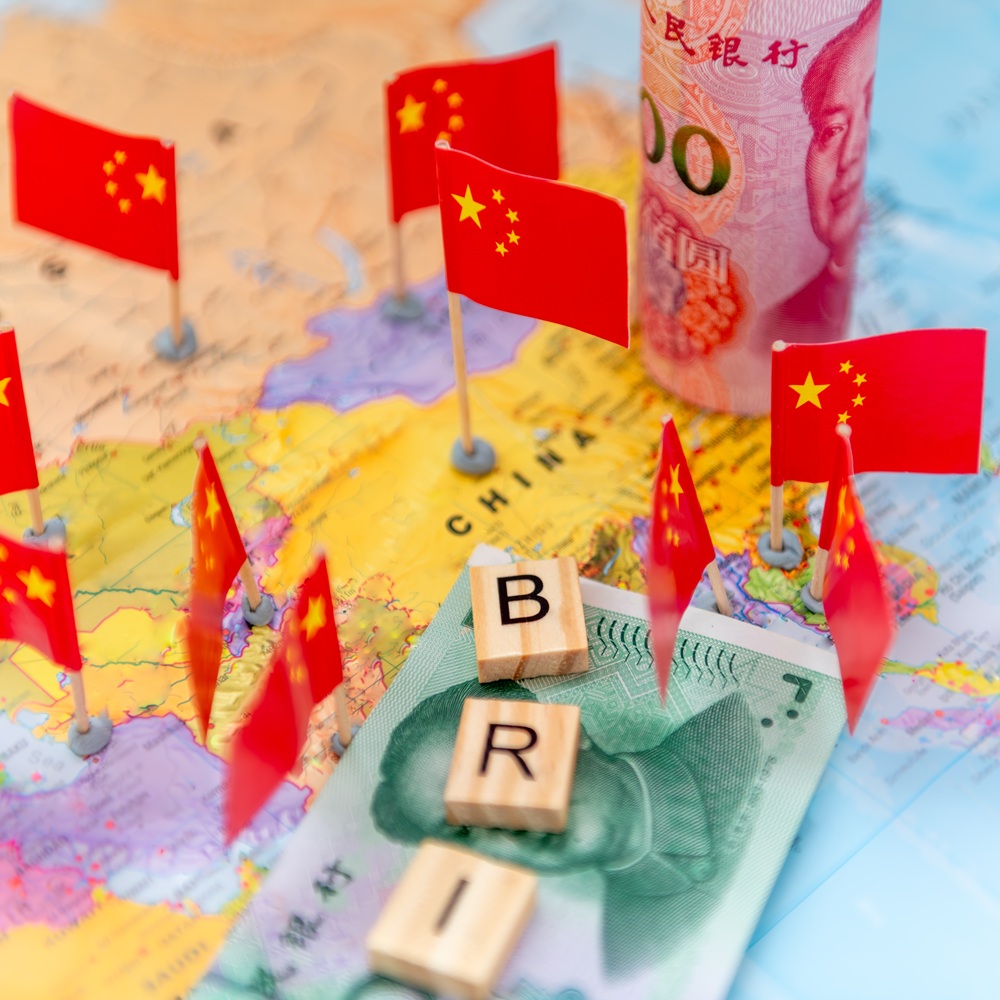
Letter tiles, Chinese Yuan bank notes and national flags on a word map. A Belt And Road Initiative concept.

Blocking the Belt and Road: Activation and deactivation of conflicts to contain China

by Alonso Ronald Ortiz García

Introduction Contemporary geopolitical competition has moved away from traditional paradigms of direct military conflict, giving way to more sophisticated forms of strategic rivalry. In this new landscape — where the lines between peace and war are increasingly blurred — the control of critical infrastructure and trade routes has emerged as a fundamental element of national power. The Belt and Road Initiative (BRI) — conceived by Beijing as the most ambitious geoeconomic project since the Marshall Plan — seeks to reshape the Eurasian trade architecture, positioning China as the central node of an integrated connectivity system. However, the events of 2025 reveal that this project does not operate in a strategic vacuum; rather, it faces a coordinated response from rival powers that have developed sophisticated strategies to limit, fragment, or condition its expansion. This article examines the indirect containment strategies directed against the BRI, focusing on one particular dimension: the deliberate activation and deactivation of conflicts as a tool of geoeconomic blockade. Through the analysis of two paradigmatic cases, it illustrates how rival powers can employ geoeconomic methods to block, fragment, or constrain large infrastructure projects by strategically manipulating regional conflicts. Two seemingly disconnected but strategically linked events will be examined — both of which have redefined the struggle for control over Eurasian trade routes. On one hand, the military escalation between India and Pakistan in the southern sector, specifically in the Rajasthan–Sindh–Southern Punjab Corridor; on the other, the peace agreement between Armenia and Azerbaijan, which revived the Zangezur Corridor Project, now under U.S. control. Both events represent concrete manifestations of a new form of great power rivalry centered on the instrumental use of conflicts to systematically obstruct the BRI. Geoeconomics as a Theater of War Geoeconomics, understood as an analytical discipline, examines how geographic, economic, and political factors intertwine to determine the relative power of states within the international system. Within this framework, connectivity infrastructures transcend their technical or commercial nature to become strategic assets capable of altering the regional balance of power. At its core, the BRI represents China’s attempt to create a network of economic dependencies that enables it to project political influence across Eurasia. This network includes both land and maritime corridors connecting East Asia with Europe, Africa, and the Middle East, establishing China as the central node of an integrated commercial system. However, the interconnected nature of this system also generates specific vulnerabilities: the disruption of critical segments can produce cascading effects that compromise the functionality of the entire network. Containment strategies, therefore, do not need to dismantle the BRI entirely to be effective. It is enough to introduce points of friction, uncertainty, or external control in key segments to alter participants’ cost-benefit calculations and reduce the overall attractiveness of the Chinese system. This logic of “selective blockade” allows rival powers to exert disproportionate influence with limited resources. In this context, the strategic activation and deactivation of conflicts emerge as a particularly refined tool. Unlike direct blockades — which require a permanent military presence and entail significant political costs — the manipulation of conflicts enables the introduction of instability indirectly, leveraging preexisting tensions to generate disruptions along critical BRI corridors. Thus, the temporal simultaneity of the India–Pakistan crisis and the resolution of the Caucasus conflict does not constitute a geopolitical coincidence but rather the manifestation of a deliberate geoeconomic containment strategy that employs the selective activation and deactivation of conflicts to block the fundamental pillars of the BRI. Case 1: Activation of the Indo-Pakistani Conflict The China–Pakistan Economic Corridor (CPEC) stands as the flagship project of the BRI in South Asia. With an estimated investment exceeding $60 billion, the CPEC aims to connect China’s Xinjiang region with the Port of Gwadar on the Arabian Sea, providing China with an alternative trade route that bypasses strategic straits controlled by rival maritime powers. The fundamental vulnerability of the CPEC lies in its dependence on Pakistan’s territorial stability—particularly in the southern provinces, where both critical infrastructure and the energy resources that sustain the project are concentrated. This is precisely where the strategy of conflict activation reaches its fullest expression. Following the escalation recorded in May 2025, intelligence analysts suggest that the timing and intensity of the Indo-Pakistani crisis indicate a deliberate activation of preexisting tensions with specific geoeconomic objectives. The impact of a hypothetical Indian incursion into the Rajasthan–Sindh–Southern Punjab belt would not necessarily aim for the permanent occupation of Pakistani territory, but rather for a demonstration of capability to disrupt the territorial continuity of the corridor. This interdiction strategy through conflict activation operates across multiple dimensions simultaneously. On the physical level, temporary control over this belt would effectively sever the connection between southern Pakistan and the routes leading to China, forcing costly detours or temporary suspensions of operations. On the economic level, the mere threat of disruption would significantly increase security and insurance costs for Chinese investments, thereby reducing the projected profitability of the corridor. More importantly, on the psychological level, a successful demonstration of interdiction capability through controlled escalation would create lasting uncertainty about the security of Chinese investments in the region. This uncertainty would not be limited to the CPEC, but would extend to other BRI projects that depend on the stability of strategic partners. The implicit message is clear: China cannot guarantee the security of its trade corridors against the strategic activation of conflicts by rival powers. The temporal dimension of this strategy is particularly sophisticated. The activation of conflicts makes it possible to generate immediate disruptions in the functioning of the corridors, while their eventual deactivation — once the strategic objectives have been achieved — avoids the long-term costs of a prolonged confrontation. This modulation of conflict intensity transforms regional tensions into precise instruments of geoeconomic policy. Access to the hydrocarbon reserves in southeastern Sindh adds an additional layer to this activation strategy. By temporarily controlling these resources during periods of escalation, India would not only obtain direct economic benefits but would also deny Pakistan and China the revenues that could otherwise be used to finance and expand the CPEC. This logic of “resource denial through conflict” is particularly effective in infrastructure projects that rely on sustained revenue flows to justify their initial investments. Case 2: Deactivation of the Armenian–Azerbaijani Conflict The second case illustrates the complementary side of this strategy: the use of conflict deactivation as a mechanism to gain control over critical infrastructure. The Zangezur Corridor, renamed the “Trump Corridor for Peace and International Prosperity” (TRIPP), represents a paradigmatic example of how a major power can insert control points into connectivity networks through the instrumental resolution of conflicts. In August 2025, U.S. mediation in the Armenian–Azerbaijani conflict allowed Washington to obtain exclusive development rights over this corridor for 99 years, effectively transforming what could have been a component of the BRI into an asset under Western control. This maneuver is particularly ingenious because it uses conflict resolution — seemingly a global public good — as a tool for broader geoeconomic objectives. The conflict deactivation strategy operates under a logic that is different but complementary to activation. While activation seeks to generate immediate disruptions in existing corridors, deactivation enables lasting control over critical segments of the connectivity network through the establishment of new contractual and regulatory frameworks that emerge from the peace process. The TRIPP occupies a crucial strategic position within the Eurasian connectivity network. As part of the Trans-Caspian Corridor (the so-called “Middle Corridor”), it provides a direct land route between Central Asia and Europe that bypasses both Russia and Iran. For China, this corridor represented a vital alternative to reduce its dependence on routes controlled by rival powers. However, by securing contractual control over the TRIPP segment through the instrumental deactivation of the conflict, the United States effectively introduced a strategic bottleneck in the middle of this network. The effectiveness of this strategy lies in its ability to condition the use of the corridor without explicitly prohibiting it. Washington can employ a variety of regulatory, tariff, and security instruments to make the transit of Chinese goods more expensive or cumbersome, rendering the route less attractive to traders and investors. This form of “administrative friction” can be as effective as a physical blockade, but with far lower political costs and reduced risks of escalation. Moreover, control over the TRIPP allows the United States to modulate its policy toward the BRI according to its broader strategic needs. During periods of bilateral tension, it can tighten restrictions on the corridor as a form of pressure; during periods of détente, it can ease such measures as a gesture of goodwill. This flexibility transforms the corridor into a permanent bargaining instrument in Sino–American relations. Integrated Logic: Activation and Deactivation of Conflicts as a Containment System The true sophistication of the analyzed cases becomes evident when one understands that the activation and deactivation of conflicts are not isolated tactics, but rather components of an integrated system of geoeconomic containment. The effectiveness of each element is amplified when they operate in coordination, creating a dynamic that maximizes pressure on the BRI while minimizing costs for the implementers. The activation of conflicts generates immediate disruptions and heightens the perception of risk associated with Chinese projects. Simultaneously, the selective deactivation of other conflicts allows rival powers to establish alternative control frameworks that channel trade flows toward systems under their own influence. This combination produces a “push-and-pull” effect: pushing trade away from routes controlled by China through the creation of instability, while pulling it toward alternatives managed by rival powers through the creation of selective stability. The temporal dimension of this integrated strategy is crucial to its effectiveness. Cycles of activation and deactivation can be calibrated to maximize the impact on long-term investment decisions, generating sufficient uncertainty to discourage future commitments — without creating levels of instability that would undermine the broader interests of the implementing powers. Systemic Dynamics The strategies of conflict activation and deactivation go beyond their immediate tactical objectives to generate broader systemic effects on the BRI and on global geopolitical competition. These effects operate across multiple levels and time scales, creating dynamics that can fundamentally alter the strategic calculations of all actors involved. First, these strategies introduce an element of structural uncertainty deeper than that produced by conventional forms of interference. While direct blockades or sanctions are predictable in their application, the manipulation of conflicts introduces elements of volatility that are far more difficult to anticipate and mitigate. International connectivity depends on the predictability and reliability of trade routes, but when those routes become subject to the unpredictable dynamics of strategically activated conflicts, investor and trader confidence in the system as a whole is eroded. Second, the alternation between activation and deactivation creates a pattern of cyclical instability that complicates long-term planning. Investors must consider not only the current state of stability in a region but also the likelihood that latent conflicts may be activated in the future for geoeconomic purposes. This additional consideration translates into demands for higher returns to compensate for perceived risk, thereby increasing the cost of capital for future BRI projects. Third, the strategy of activation and deactivation can generate demonstration effects that shape third countries’ perceptions of the BRI’s viability. When these countries observe that middle powers can effectively disrupt segments of China’s system by manipulating local conflicts, they may feel empowered to adopt more assertive positions in their own negotiations with Beijing. This dynamic can gradually erode China’s position as a preferred partner for infrastructure projects. Finally, these strategies create dangerous precedents for the stability of the international system. If the activation and deactivation of conflicts become normalized as tools of geoeconomic competition, other actors may adopt similar tactics, fostering a more volatile and unpredictable global environment. China’s Counterstrategies The strategies of conflict activation and deactivation do not operate in a strategic vacuum; rather, they generate adaptive responses from China that can alter their long-term effectiveness. Beijing has developed a variety of counterstrategies specifically designed to reduce the vulnerability of the BRI to this kind of indirect interference. One of the most important responses has been the development of mediation and conflict-prevention capabilities. Recognizing that many of the conflicts which can be strategically activated have roots in genuine, unresolved disputes, China has significantly expanded its involvement in international mediation. This approach seeks to address the underlying causes of instability that could otherwise be exploited by rival powers. At the same time, Beijing has intensified efforts to build early warning systems that enable it to anticipate the imminent activation of conflicts in regions critical to the BRI. These systems combine traditional intelligence with big data analysis and predictive modeling to identify patterns suggesting the external manipulation of local tensions. China has also pursued a more systematic geographic diversification of routes and corridors, developing multiple pathways to the same destinations to reduce dependence on any single segment of the network. This strategy of “planned redundancy” increases system costs but also enhances resilience against selective blockades caused by activated conflicts. A third line of response has been the development of specialized financial and insurance instruments for projects in high-risk regions. These tools allow China to maintain the economic viability of BRI projects even in unstable environments, thereby reducing the impact of conflict activation strategies. Future Projections The analysis of conflict activation and deactivation strategies directed against the BRI reveals the growing sophistication of contemporary geopolitical competition. The examined cases demonstrate that rival powers have developed effective methods to condition, fragment, or disrupt large-scale infrastructure projects without resorting to direct military confrontation, instead employing the strategic manipulation of conflicts as a tool of containment. These strategies represent an evolution of traditional forms of containment operating within the geoeconomic domain, using the interdependence of connectivity systems and their vulnerability to regional instability as vectors of strategic influence. Their effectiveness lies not necessarily in their ability to dismantle the BRI entirely, but in their capacity to introduce cyclical frictions and structural uncertainties that diminish the overall attractiveness of the Chinese system. However, the adaptive nature of geopolitical competition suggests that these activation and deactivation strategies will generate countermeasures and counter-countermeasures that continuously reshape the balance of advantages. China’s capacity to develop alternatives and redundancies, combined with its growing mediation and conflict-prevention capabilities, may eventually limit the effectiveness of these containment tactics. In the long term, competition surrounding the BRI will likely evolve into even more sophisticated forms of geoeconomic rivalry, where the ability to create, control, and protect connectivity networks — as well as to manipulate or resolve the conflicts that affect them — will become a fundamental measure of national power. This dynamic will have far-reaching implications not only for the main actors involved but also for the international system, which will need to adapt to an era in which the strategic activation and deactivation of conflicts has emerged as a central tool in great-power competition. The growing sophistication of these strategies suggests that the future of geopolitical competition will be marked by an increasing instrumentalization of regional conflicts for global geoeconomic objectives, creating new challenges for international stability and requiring the development of normative and institutional frameworks adapted to this new reality. References Chatham House. (2025). India-Pakistan ceasefire remains shaky; relations unlikely to return to status quo. https://www.chathamhouse.org/2025/05/india-pakistan-ceasefire-remains-shaky-relations-unlikely-return-status-quo Consejo Previsional Mundial (WPC). (2025). Informe sobre la brecha de infraestructura en Asia y el impacto de la BRI. La división de los BRICS y la guerra que estamos ignorando entre India y Pakistán. (2025, 8 de mayo). Navarra Confidencial. https://www.navarraconfidencial.com/espana/la-division-de-los-brics-y-la-guerra-que-estamos-ignorando-entre-india-y-pakistan/ La iniciativa de la Franja y la Ruta es un proyecto de cooperación internacional presentado por China en 2013, con enfoque en infraestructura, comercio y conectividad. (2025, 1 de septiembre). Lisanews. https://www.lisanews.org/internacional/iniciativa-franja-ruta-que-es-objetivos/ Le Grand Continent. (2025, 10 de agosto). Al firmar un acuerdo de paz entre Armenia y Azerbaiyán, EE.UU. desplaza a Rusia en el Cáucaso Meridional. https://legrandcontinent.eu/es/2025/08/10/al-firmar-un-acuerdo-de-paz-entre-armenia-y-azerbaiyan-ha-desplazado-trump-a-putin-del-caucaso-meridional/ Ministerio de Defensa de España. (2025). La visión estratégica de la República Popular China en la nueva era: Análisis del Libro Blanco sobre Seguridad Nacional. https://www.defensa.gob.es/ceseden/-/ieee/la_vision_estrategica_de_la_republica_popular_china_en_la_nueva_era_analisis_del_libro_blanco_sobre_seguridad_nacional_2025 Nedopil, C. (2025). Países de la Iniciativa del Cinturón y la Ruta (BRI). Green Finance & Development Center. https://greenfdc.org/countries-of-the-belt-and-road-initiative-bri/ Reuters. (2025, 7 de agosto). EE. UU. asegura un corredor de tránsito estratégico en el acuerdo de paz Armenia-Azerbaiyán. https://www.reuters.com/world/us-secures-strategic-transit-corridor-armenia-azerbaijan-peace-deal-2025-08-07/

Defense & Security
ISS052-E-37828 - View of Earth

Space in the international relations of Asia: a guide to technology, security, and diplomacy in a strategic domain

by Saadia M. Pekkanen

한국어로 읽기 Leer en español In Deutsch lesen Gap اقرأ بالعربية Lire en français Читать на русском ABSTRACT This essay brings space into the international relations of Asia. It orients readers to three unfolding trends that are shaping the evolution of the new space race at present – democratization, commercialization, and militarization (DCM). It surveys how these trends reflect, illuminate, or are connected to the theory and practice of international relations (IR) both in global and regional settings in Asia. Where possible, it brings in the space activities of the main independent and autonomous space powers in Asia – China, Japan, India, South Korea, North Korea – and probes what their activities signify for international and regional politics. It ends with some thematic takeaways for space policy, strategy, and diplomacy. Space is a strategic domain, meaning that its uses cut across civilian and military realities and will therefore long remain of vital interest to all states. Since its inception, space has drawn significant and long-standing attention in the fields of law and policy. Lawyers, legal scholars, diplomats, and policy analysts have covered the rise and interpretation of the space law regime in place today, which is centered on a set of space treaties, resolutions, and organized multilateral activities.Footnote1 Thanks to these efforts we have a good understanding of governance frameworks, the challenges they face, and how they may play out in constructing the peaceful uses of outer space. But studies that bring international relations (IR) theory and practice to bear on outer space affairs are far fewer in comparison to the voluminous law and policy literature. While IR scholars have generated works related to other emerging technologies, such as drones, cyberweapons, and artificial intelligence, space generally still remains understudied.Footnote2 This is surprising as the critical infrastructure of space anchors modern economies, militaries, and societies in a way no other technology does. It lies at the intersection of virtually all political, economic, and social forces that have been and will remain of concern to states. The space domain is not aloof from the “harsher realities of politics;”Footnote3 and, in fact, continues to reflect almost every feature of global politics in play – ideology, nationalism, aid, integration, division, and security, for example.Footnote4 Using the lens of states and their national interests, this symposium is among the first comprehensive efforts to combine IR perspectives, space studies, and the history, politics, and economics of Asia – a region with the most dynamic, ambitious, and competent sovereign space powers today. Alongside China, Japan, India, and North Korea, South Korea has risen rapidly as another determined player that is leveraging its industrial capabilities, alliances, and networks to position itself in the unfolding competition of the new space race. Australia and New Zealand, and other countries in South and Southeast Asia have also long been marked with emerging space activities and ambitions.Footnote5 These developments come at a time when both the United States and China are leading two different space regimes that extend beyond territorial matters to Low Earth Orbit (LEO) and celestial bodies.Footnote6 What states are doing in the IR of space, who with, why, and how affects prospects for war and peace. One indication of the importance of space nested in the contemporary geopolitical flux is reflected in The Camp David Joint Statement from August 2023, in which the U.S., South Korea, and Japan seek to enhance trilateral dialogues on space security.Footnote7 This essay guides readers to developments in the space domain, and the ways they connect to the theory and practice of IR. The first part interrogates the idea of the IR of space at the broadest level, and sets out the three principal trends that are shaping its evolution today – democratization, commercialization, and militarization (DCM). The second part then turns to asking where Asia fits in this tapestry, drawing on the intellectual lineage of key debates in the field as well as the findings from this symposium. The third part extracts some thematic takeaways that are likely to be of interest to makers of space policy, strategy, and diplomacy. What is the International Relations of Space? Space has always been – and will long remain – couched in IR theory that is centrally concerned with alternative explanations about competition and cooperation.Footnote8 The paradigmatic or theoretical approach analysts bring to space – such as realism, liberalism, constructivism, and so on – has consequences for relations among and within states.Footnote9 Political scientists are increasingly interested in the theory and practice of the IR of space, and in understanding the implications for real-world collaboration, competition, leadership, and diplomacy.Footnote10 This section provides a guide to the principal actors and the trends of the new space race in which they seek to position. The State in the International Relations of Space For the foreseeable future, outer space affairs will remain rooted in the geopolitics on Earth, and this will necessitate a focus on the makers of policy, strategy, and diplomacy. Nothing about this is new. Space could not escape the “political rivalries of this world” in the old space race; and the idea that U.S. leaders may well have had no option from the late 1950s onwards but to “allow for all possibilities by speaking of idealism and acting with realism” speaks with equal force to the complexities of decision-making in the present space race.Footnote11 The IR of space is about actors, their motivations, and the consequences of their actions for stability in, through, and at the nexus of space. This general framing of the IR of space draws attention away from unproductive and narrow theoretical debates, encourages analytical eclecticism, and privileges a pragmatic, policy-relevant, and problem-focused approach.Footnote12 Further, the approach locates actions and agency in known circumstances, remains deeply attentive to both material and ideational processes over time, is mindful of situational idiosyncrasies, and in sync with the inevitable ups and downs of geopolitics. Frankly, this kind of eclectic pragmatism is necessary in a dynamic domain in which scholars and practitioners want to grapple with visible challenges that need real-world solutions. As in other areas, a focus on states allows us to capture the “deeper political foundations, trajectory, centrality, and implications”Footnote13 of newer developments that can be consequential for the theory and practice of IR. Even when theoreticians are supportive of, opposed to, or merely agnostic about states as a unit of analysis, almost all of them have to grapple with interactive state actions at both the domestic and international levels.Footnote14 The idea of space policy analysis, which draws attention to sub-state actors and drivers of decision-making while crisscrossing levels of analysis, certainly enriches our understanding of major players beyond the West.Footnote15 But in many emerging space countries, and especially in the IR of Asia, the state remains the gatekeeper to the domestic-international nexus. Focusing on states also induces an equality in the IR of space, as many developing and emerging countries do not have the numerous legal, commercial, and nonprofit actors from the advanced industrial world who seek to influence outcomes across international forums and processes. This state-centricism is especially relevant in the strategic space domain − 95% of which comprises dual-use space technologies.Footnote16 In it, states are proactively seeking to position their countries vis-à-vis others because its very duality promises both civilian and military benefits. This reality is reinforced by the present legal space regime, which privileges the role of states as a matter of public international law. As on Earth so also for space, it is ultimately states that back and consume innovative space technologies, design strategies and policies, and construct or scuttle governance in line with their political and economic interests.Footnote17 None of this is to suggest that states are the only actors in the space domain, or that their preferences magically prevail in all matters of policy, strategy, or diplomacy. Rather, at the end of the day, it is states that possess both the ultimate and final authority over their citizens, thus regulating how this collective interacts with its counterparts.Footnote18 The Key Trends Shaping the IR of Space The new space race demands as well a new way of seeing the whole picture, which balances its principal trends without privileging any one of them. All states are presently navigating the intersections of three deeply intertwined trends in the new space race that pose novel questions and challenges for their own security – democratization, commercialization, and the slide from militarization to outright weaponization (DCM).Footnote19 While these trends may be analytically distinct, they are in reality fluid, nonlinear, and synergistic. They are interwoven into the fabric of the IR of space today, and if a problem-focused approach is to lend itself to real-world solutions it is meaningless to talk about strategy or policy concerning one or another in isolation. This has implications for IR theory more generally. A plethora of well-debated approaches, concepts, and constructs mark its two main subfields of international security and international political economy across all regions of the world – war, peace, balance of power, industrial policy, interdependence, governance, norms, diplomacy, for example. These theoretical constructs have to reconcile with the complexities of DCM. Doing so prevents hyperbole about a “knowable and certain future” for organizations, societies, and soldiers with stakes in space.Footnote20 It encourages vigilance about the commercialization-militarization axis fueling gray-zone ventures in space, where a commercial space actor operating for a rival could do what previously was the realm of only government military operations.Footnote21 It prevents naïve thinking that space commerce is unrelated to defense, or that private assets cannot become legitimate military targets in the fog of war.Footnote22 When it comes time to pass United Nations resolutions backed by a leading space power that can govern prospects for space safety how old and new actors in space align diplomatically on a normative basis is affected by their industrial and political interests in the context of DCM.Footnote23 The high-profile return of industrial policy in the U.S. stretches to the space industrial base, and includes efforts to strengthen the resilience of its supply chains with commercial space players and nongovernmental actors.Footnote24 As an analytical rubric, the trends in the DCM triumvirate, fleshed out below, help states see the many moving and equally important parts of the new space race, connect actions and technologies involving their counterparts spread around the world, and build a far more balanced awareness of the policies and strategies necessary to advance their own interests amid all the dynamism. The triumvirate, in short, is a powerful conceptual reminder for all states that “the church of strategy must be a broad one” in the space domain.Footnote25 One trend of the triumvirate stems from changes in manufacturing and accessibility, which have opened up — or “democratized” — the space domain to newcomers. Many of the newer state entrants have created space agencies, written national space legislation, targeted specific manufacturing or regulatory niches, and signed agreements with international partners and private companies. Alongside the rising number of nation-states, this democratization draw in nongovernmental entrants such as commercial startups, activist billionaires, criminal syndicates, and so on who could aid or thwart government objectives.Footnote26 New actors continue to proliferate across all regions and continents, with activities that crisscross the public and private spheres and that affect prospects for transnational collaboration in myriad ways. The year 2023 is illustrative of democratization in practice. In mid August, the SpaceX Crew Dragon spacecraft reached the International Space Station (ISS).Footnote27 This was the seventh crew rotation mission by SpaceX, a private U.S. company, and it carried four civilian agency astronauts from America, Europe, Russia, and Japan. In its previous mission to the ISS, SpaceX flew NASA astronauts, along with those from Russia and the United Arab Emirates. Earlier in May, SpaceX used its Dragon spacecraft and Falcon 9 rocket to launch an all-private astronaut mission to the ISS for a company called Axiom Space, which aims to build the world’s first commercial space station; it then carried passengers from the United States as well as both a male and female astronaut from the Kingdom of Saudi Arabia.Footnote28 Democratization extends to the moon. With India’s successful soft-landing on the moon in August, yet another Asian country after China now holds the distinction of being on the lunar surface.Footnote29 Private actors in Asia are also part of the tapestry. While a lunar lander attempt by a private Japanese company, ispace, was not successful in April, the company is persevering with bringing both governments and private payloads to the moon.Footnote30 More foundational for the purposes of enabling certainty for commercial transactions are some of the steps ispace took prior to the launch. It was granted a license by the Japanese government to engage in an “in-place” property transfer of ownership of lunar regolith to NASA. All these developments represent a dramatically varied landscape, which also raises challenges for building meaningful consensus in the years ahead.Footnote31 A second trend in the triumvirate is commercialization, driven by a whole new generation of space entrepreneurs. Chief among their unprecedented innovations are reusable rocketry and mega-constellations of satellites, driven by so-called newspace corporations such as SpaceX, Blue Origin, Rocket Lab, Amazon, Planet, ICEYE, Blacksky, Axelspace, and Synspective. Together these companies have not only changed prospects for frequent and cheaper access to space, but they have also changed the geospatial view of virtually all human activities on the planet, whether on land or the oceans.Footnote32 These newer entrants present competition for more established players like Boeing, Arianespace, Lockheed Martin, Raytheon, Mitsubishi Heavy Industries, Mitsui, and Thales Alenia, for example. All these corporations seek profitable niches in the global space economy, which one estimate puts at a minimum of $384 billion in 2022 and others put higher.Footnote33 Notably, the present satellite industry accounts for over 70% of the space economy. This indicates a “space-for-earth” economy, meaning space goods and services with direct use on Earth such as telecommunications and internet infrastructure, Earth observation satellites, military satellites, and so on.Footnote34 This reality accounted for 95% of the revenues earned in the space sector in 2019. Given the dependence of the global economy on space-based assets, some argue the commercial peace thesis may stay the hand of space-related conflict.Footnote35 This is good news also if the space market grows, as projected, to between $1.1 trillion and $2.7 trillion by the 2040s.Footnote36 But there is a healthy debate about what else may be scalable beyond just the satellite-enabled communications infrastructure that sustains the space economy at present. Further, despite all the rosy projections about the space economy, there is little information about which of the venture-backed private newspace entrants is or likely to be profitable anytime soon. After over two decades of operation, it is only recently that SpaceX, which leads with its rocket launches and internet-satellite business, has reported it generated $55 million in profits on $1.5 billion in revenue in the first quarter of 2023.Footnote37 In the non-satellite segment of the space economy, the search for new markets and customers certainty continues worldwide. But government budgets will matter to the survivability of many innovative technologies, products, and services where market prospects are nascent, emerging, or just plain uncertain. These include, for example, commercial human spaceflight, space stations, lunar landers and habitats, and space resources mining. The total governmental budgets for space programs worldwide is estimated to be between $92.4 billion to $107 billion.Footnote38 The U.S. government leads the world with the largest institutional budget at around $55 billion; setting aside the collective European budget at $14 billion, the single-country budgets that successively follow the U.S. are China (speculatively, $10 billion), Japan (over $4 billion), Russia ($3.5 billion), and India ($1.96 billion). More generally, the presence of government actors alerts us to a range of theoretical political economy considerations that cut across geopolitics and geoeconomics in the space domainFootnote39: the logic of state-centricism in and out of Asia in fostering innovation, the multifaceted drivers of space commercialization and privatization around the world, and the newspace business hype that needs to be reconciled with the dynamics of state interests in economic-security linkages. A final trend in the DCM triumvirate is militarization sliding into weaponization of a dual-use technology. But we may be returning to the historical roots of space technology because what we now think of as dual-use originated as military first.Footnote40 From rockets to satellites to missile defense, civilian and commercial space technologies can be morphed to serve military or national security ends. A state’s military space power can be measured not just by total space expenditures but also latent capabilities in existing commercial architecture.Footnote41 Many actors can access, or collaboratively develop, a wide spectrum of military capabilities while professing to pursue worthy civilian and commercial goals, such as launching rockets, enabling satellite communication, expanding Earth observation, developing GPS capabilities, or servicing malfunctioning satellites. These activities can be legitimized as peaceful and defensive, but their uses can also be converted to offensive purposes. As more actors join space activities and as commercial players spread space products and technologies around the world, the ambiguities of dual-use space technologies make it more and more difficult to distinguish a space asset from a weapon, or space control operations as defensive or offensive. This melding of the commercialization-militarization axis means that many advanced, emerging, and disruptive technologies that are significant for defense applications and for potentially gaining an edge over rivals are couched in commercial rather than military-industrial complexes; these technologies and capabilities are also spread unevenly across geopolitical lines.Footnote42 Depending on their financial and organizational capacities to adopt innovations, states may well face risky scenarios in an international system out of tune with power realities in which the actual balance of power diverges sharply from the distribution of benefits.Footnote43 Further, the problem is that all space assets are equally vulnerable to a range of both kinetic and non-kinetic threats, which can go from an irreversible missile hit to temporarily disabling electronic and cyber attacks on a space asset.Footnote44 Since it is hard to separate military and civilian space services, accidental or purposeful actions against those used by the military would inevitably also affect those used by civilian and commercial stakeholders. Protecting access to space and safeguarding operations within space are, therefore, a vital interest for all states interested in space for national advancement. Unfortunately, no orbit is safe or secure. This is especially concerning for the United States, which is the world’s most space-dependent power, and whose nuclear command-and-control operations worldwide rely on space assets. As of January 2023, roughly 67% of all operating satellites belonged to the U.S., with a significant part of them commercial.Footnote45 This dependence will only grow as U.S.-led mega constellations, as well as other in-space activities, proliferate. Accidents can happen, and this specter is rising as orbits become more and more crowded with civil, commercial, and military activities.Footnote46 Orbital debris, big and tiny leftovers from decades of space activities that whiz around at lethal speeds, already represent known hazards. The ISS often has to maneuver to get out of the way, and functioning satellites are also vulnerable. Satellites can collide accidentally, degrading or ending their operations; human beings can die. But it is the menace of purposeful and deliberate targeting of the space-enabled infrastructure that cannot be ruled out in the geopolitical turmoil today. There is an intensifying strategic competition between the U.S. and its allies, China, and Russia over the making of a new world order.Footnote47 This means also that there are ample incentives for U.S. adversaries to deny the heavily space-dependent United States use of its space assets in peacetime or wartime under cover of dual-use ambiguities; there are also incentives for the U.S. and its allies to do the reverse to adversaries.Footnote48 In all likelihood, every country would suffer under such scenarios, but the heavily space-dependent U.S. would suffer most. Kinetic anti-satellite (ASAT) tests have already been carried out by some of the top spacefaring powers – China (2007), the U.S. (2008), India (2019), and Russia (2021) – and have led to a U.S. declaration to ban them.Footnote49 In the non-kinetic realm, cyber attacks are a looming realistic threat for satellites and other space assets just as they for any another digitized critical infrastructure.Footnote50 Many key U.S. allies, such as Japan and Korea as well as members of NATO, see the same threats and, with extended deterrence in mind, have begun working closely with the U.S. to reshape security architectures and postures in the space domain. The war in Ukraine has also changed perceptions worldwide about the safety of the critical infrastructure of space, with Russia’s electronic and cyberattacks targeting satellite systems.Footnote51 Both the U.S. and its allies also understand that targeting U.S. space assets affects the great power status of the U.S. – the basis for its hard and soft power – which is why space will long remain a national and international imperative. Space is also pivotal because it is at the intersection of virtually all emerging and disruptive technology frontiers, such as AI, quantum computing, and cyber weapons, which can potentially affect a country’s military edge over others.Footnote52 One indication of the importance of U.S. space systems to the government for critical national and homeland security functions is reflected in institutional budgets. Worldwide, in 2021, an estimate is that civilian budgets were around $54 billion and military budgets at about $38 billion.Footnote53 The United States stands out relative to the rest of the world, irrespective of the actual size of these budgets, accounting for just under 60% of all government expenditures on space program on a global basis. The U.S. military space budget is estimated to be between roughly $30–34 billion dollars, significantly higher than its civilian budget at around $25–26 billion. With the formation of the U.S. Space Force, and the perceived growing threat to space, these patterns are unlikely to shift and will affect the evolution of U.S.-led space security architectures worldwide. Beyond orbital regimes, there are also concerns about celestial bodies, which include the moon, Mars, comets, and asteroids. The moon has become a prestigious prize. There is a race to put the next humans and outposts on it. While every state wants to be a space nation and to benefit from space-enabled prosperity and security all the way to the moon the simple point is that not all of them can be in the elite club of states who have the will and capabilities to do just that.Footnote54 Collaboration too is likely to remain divisive in the new lunar space race, whether intentional or not.Footnote55 54 countries have already signed the Artemis Accords led by the U.S. since 2020, which contain principles outlining civil exploration in space that are heralded for their openness, transparency, and predictability for all stakeholders.Footnote56 Meanwhile, China has entered into an MOU with Russia to establish an international lunar research station, with multiple scientific and exploration objectives, that is likely to be constructed on the south pole of the moon.Footnote57 The south pole on the moon is where both China and the U.S. have marked out potential landing sites as their new competing lunar programs get underway.Footnote58 It is also the region in which India, a signatory of the Artemis Accords, was instrumental in confirming the presence of water and where it has also soft-landed before anyone else.Footnote59 While no IR analyst can easily predict how the strategic culture of any state will affect its behavior in the context of space resources or space habitats it is foreseeable that such developments are significant for advancing national and relative power.Footnote60 The defense-industrial complex in the United States is paying attention to what all this will mean for the balance of power in space. The LunA-10 framework represents the next-generation quest for an integrated 10-year lunar architecture that could catalyze a commercial space economy with the U.S. in the lead.Footnote61 How competition and collaboration play out depends on how states choose to reconcile the trends of the DCM triumvirate with their own interests as they, and their counterparts, all set their sights on the moon. As technologies are always uncertain and the landscape of allies and rivals can shift, diplomacy for space security may be more necessary than ever as these lunar armadas set off.Footnote62 How Does Space Fit in the International Relations of Asia? The new space race is not going into some vacuum in the study and practice of the IR of Asia. Nor are the regional space politics divorced from the DCM trends that are reshaping prospects for all actors across all continents. There is history and intellectual precedent in how we can expect Asian states to engage with DCM trends, signifying also prospects for conflict and collaboration both in and out of the region. It is especially important to get this narrative right at a time when Asia can boast the greatest concentration of independent and autonomous space powers relative to every other region on the planet, making it pivotal for the future of space security. These are, to date, also the principal powers who have been central to shaping the dynamics of the IR of Asia in the world – China, Japan, India, North Korea, and South Korea. Caveats and Preexisting Works A few things first. This is not the place to get into polemics about what Asia is, a contested term that is perhaps most useful for differentiating it from the equally murky idea of the “West.”Footnote63 For the purposes of this essay the most useful broad category is the one from the United Nations which categorizes Member States into the regional group of the “Asia-Pacific.”Footnote64 This includes countries from Northeast, Southeast, South, Central, and Southwest Asia as well as those from the Pacific islands. This keeps us attuned to not just to the activities of the independent and autonomous space powers, but also others in the broader Asia-Pacific, such as Australia, New Zealand, and others in Southeast, Central, South, and West Asia, who are also making strides and positioning in the DCM triumvirate. This broad sweep is likely to be most useful for understanding the entanglements of the space domain in the years ahead. There is of course a substantial body of knowledge on the IR of Asia. This is also not the place to do justice to the painstaking works that have, over decades, improved our solid understanding of key aspects of the IR of Asia and allowed us to portray region-wide, sub-regional, and extra-regional interactions. A few broad works can only help us extract and reflect on the broad nature of the subject-matter involved in the making of IR of Asia to date, which continues to resonate in debates about whether or not Asia’s geography is “ripe for rivalry.”Footnote65 In very broad brushstrokes the subject-matter includesFootnote66: historical, political, and social forces that have shaped the region over time; the relevance or irrelevance of mainstream Western IR theories; the making and makeup of foreign economic or security policies; the drivers of integration or rivalries amid structural global shifts, the organizational and institutional patterns of governance, for example. More closely mirroring the IR concepts and constructs noted earlier, there are also in the IR of Asia prominent cross-cutting ideas, such as the role of states and industrial policy, economic-security linkages, technonationalism, economic regionalism and interdependence, regional organizations and institutions, balancing, bandwagoning, hedging, alliances and security architectures, and so on. But as in IR more generally, so also regionally there appears to be less of a focus on integrating space technologies into the broader fabric of changed global and regional politics. In terms of work on specific technologies in Asia, there has certainly been longstanding attention on conventional military capabilities, nuclear acquisitions, and ballistic missile defense, all of which can exacerbate security dilemmas. But there is less so on space in particular, though a number of works have contributed to our general understanding of individual space powers in Asia.Footnote67 The findings from this symposium, interwoven with IR themes below, also contributes to advancing these knowledge frontiers with implications for national interests, regional risks, and interstate stability. A cogent case for a space race in Asia back in 2012 did not prejudge any particular outcome for space security. Footnote68 In the broad sweep of space activities across Northeast, Southeast, and South Asian countries, one conclusion at the time was that Asia’s emerging space powers were keenly attuned to keeping score, following relative gains, and marking nationalist advantages vis-à-vis regional rivals. Footnote69 From the benchmark of that study, the question is what has changed in terms of Asian states and their motivations in a world returned to great power competition. Su-Mi Lee raises these questions at the start of this symposium focusing on the case of South Korea: Will South Korea and other Asian states take sides between great powers building competing blocs in the region? Or as a middle power, will South Korea recast itself as an agenda setter, rather than a passive follower, and expand its own network in space development, independently of great powers, and contribute to the peaceful uses of outer space? Jongseok Woo offers up a view on the impact of the ongoing Sino-U.S. rivalry in the Asia-Pacific region specifically on South Korea’s strategic choices in security and military affairs, as well as its space policies. There is a close connection between South Korea’s space policies and its broader economic, security, and military interests. He asserts that South Korea’s choice to align with the United States and China on trilateral cooperation in space development has arisen directly as a response to China’s assertive and aggressive policies in the Asia-Pacific region, which have also fostered negative perceptions about China among South Koreans. Material and Ideational Building Blocks There are also material and ideational building blocks that clue us into the ways space can be brought into the IR of Asia. They can guide work at a theoretical level, illuminate intersections with the politics and trends of the DCM worldwide, lead to distinctive expectations about collaboration and stability, and help us reflect on likely pathways for policy, strategy, and diplomacy in the new space race. There are three thematic clusters fleshed out below that might prove to be fruitful for these aims: (1) the state and industrial policy, intertwined with thinking on technology, economic-security linkages, and geoeconomics, (2) complex regional interdependence including economic integration, supply chains, and institutional governance, and (3) security architectures and alliances amid the changed geopolitical dynamics of the U.S.–China bipolar competition. All these clusters suggest that divorcing military and economic security for states in the region would be an analytical and policy blunder in the new space race. The Evolution of the State and Industrial Policy First, whatever the debates about its nature,Footnote70 the state in the IR of Asia is alive and well. Relative to other actors, it is unlikely to be displaced as the preeminent sovereign entity, particularly in matters of industrial and technological transformations. It has a distinguished pedigree in the region, finding its conceptual role at the center of huge theoretical and policy controversies about states and economic development.Footnote71 At one point, eight economies – Hong Kong, Indonesia, Japan, the Republic of Korea, Malaysia, Singapore, Taiwan, and Thailand – rose prominently in the international economy, a phenomenon that became known as the “East Asian miracle.”Footnote72 At the heart of the controversy was the role played by states, and whether their interventions in the market made the difference to their economic and industrial transformations. The domestic institutional configurations of the so-called newly industrializing countries (NICs) also drew attention to the reasons why states could manage to undertake industrial policies in the ways they did.Footnote73 All this came at a time of new thinking about the merits of free trade, in which activist trade policies were shown to possibly advantage some countries relative to their competitors especially in high-technology industries.Footnote74 As today, so then, high-technology industries, such as semiconductors, were at the epicenter of controversies about the fairness of then perceived Japanese activism.Footnote75 Asia is again center stage in these policy concerns, such as those about the foundational global value chain in semiconductors that fuel high-technology production and consumption. Between 2016 and 2020, 26 economies in Asia and the Pacific accounted for about 84% of total world integrated circuit exports.Footnote76 They also accounted for about 62% of total world electrical and optical equipment exports in 2021. Long mindful of their positions in the global political economy, all this suggests that for states of all stripes across Asia “developmentalism is not dead,” picking winners is still of interest, and, as in the past for other strategic sectors so also for the foreseeable future, Asian states will remain involved in shaping the frontiers of space technologies to their home advantage.Footnote77 Industrial policy motivations have clearly been a driver of South Korea’s expanding space program, and Kristi Govella points out the South Korean government has considered potential commercial opportunities when making decisions about how to structure its engagement with regional space institutions. The maxim of “rich country, strong army” pervades the intellectual landscape of prominent works, alerting us that for many countries in Asia the synergistic pathway to security comes through technology and the economy. These symbiotic economic-security fundamentals resonate in both regional and country-specific works.Footnote78 Japanese planners, for example, have long enhanced Japan’s technological edge by stimulating the interdiffusion of civil-military applications and the nurturance of a military-commercial axis.Footnote79 While not inattentive to the policy tradeoffs that must be made in practice, the Japanese state remains consistent in the twin goals maximizing both its military and its bargaining power through economic means.Footnote80 China is held up as a techno-security state – innovation-centered, security-maximizing – at a historic moment of bipolarity in world politics in which both China and the U.S. see the economic-security nexus as a pivotal peacetime battleground.Footnote81 These themes resonate also in the idea of geoeconomics – best thought of as “the logic of war in the grammar of commerce” – that would hold in a world of territorial states seeking technological innovation not just for its own sake but to explicitly maximize benefits within their own boundaries.Footnote82 With themes that echo seminal works on economic-security linkages,Footnote83 the practice of geoeconomics means the use of economic instruments in defense of national interests and geopolitical gain while being watchful of the impact on the home country of others doing exactly the same.”Footnote84 Whether geoeconomics is criticized or refined as an idea,Footnote85 is considered relevant or irrelevant to state conduct, or even goes in and out of fashion, its core continues to resonate in lively debates about the nature of statecraft in the IR of Asia.Footnote86 The case of space in South Korea is instructive along these themes. Given that the economics of the space industry require a long-term commitment with massive investments, Wonjae Hwang’s principal argument is in line with the idea of the developmental state. The South Korean government is taking a lead role in developing the space industry, and its core geoeconomic strategy in space manifests in the promotion of public–private partnerships. By building a strong governing structure within the public sector, coordinating with selective private partners, assisting them with financial support and technology transfer, the government has built strong partnerships with private firms in the space industry. There are plans to establish also a guiding public institution, which can make far-sighted plans for space development, implement the plans, and control associated institutions. As a latecomer to the space race but as a critical player in the global supply chains in the space industry, he also discusses how South Korea has promoted international partnerships with other space powers such as the U.S., EU, India, Australia, and the UAE. Complex Regional Interdependence Second, Asian economies and their integration into the international system makes them pivotal players. But indicators suggest that regional economic integration is important too.Footnote87 A regional cooperation and integration index, which tracks and meshes key dimensions across all principal regions of the world is noteworthy.Footnote88 In 2020, the index in which higher values mean greater regional integration, the EU was recorded at 0.59, North America at 0.49, and Asia and the Pacific at 0.43. This puts the Asian region on par with its peers in the global political economy. As concerns about supply chain vulnerabilities rise worldwide, less visible forces behind Asian economic fusion will also rise to shape strategies. In 2014, production networks were acknowledged as outlets for new modes of interstate friction such as between Japan and China but were still seen as reinforcing traditional commercial liberal arguments.Footnote89 Over time, despite the dramatic expansion of global supply chains involving all actors in the region over, the phenomenon remained underappreciated. But work on point finds that they may be more distinct, complex, and unique mechanisms of interdependence, and could well affect prospects for interstate conflict and cooperation in and out of the region.Footnote90 Their very presence complicates blustering proclamations of decoupling or derisking in both regional and global politics. States across Asia remain watchful about trade and investment agreements to enhance their regional and international economic prospects.Footnote91 Whatever the criticisms about this institutional proliferation, it draws attention to Asian standing and strategies relative to other regions. Among the most high-profile developments is the Regional Comprehensive Economic Partnership (RCEP), with 15 members including 10 ASEAN countries as well as Australia, China, Japan, New Zealand, and South Korea.Footnote92 China and Japan, respectively, account for around 48% and 19% of the RCEP GDP.Footnote93 RCEP’s comparative indicators put it ahead of its peer agreements, with 28% of global trade, 31% of the share of global GDP, and about 30% of world populationFootnote94 The agreement’s economic significance was deemed considerable, with one estimate suggesting it could generate over $200 billion annually to world income, and $500 billion to world trade by 2030.Footnote95 The duality of space technology also creates new dynamics for the IR of space in Asia. Even agreements that are technically about trade can be seen as opportunities to enhance alliances and alter the broader security context.Footnote96 This thinking should be borne firmly in mind in analyses of regional space governance, which is nested in broader international legal and normative frameworks. The degree of institutional density in an issue area, such as preexisting rules or regimes on point, may condition the type of diplomacy countries like China pursue in projects from space stations to lunar research stations.Footnote97 It also affects how countries like Japan can use institutional constructs for political reassurance in the region.Footnote98 At present, two markedly different Asian institutions, the China-led Asia Pacific Regional Space Organization (APSCO) and the Japan-led Asia-Pacific Regional Space Agency Forum (APRSAF) mark diplomatic prospects for the regional dynamics of collaboration and competition stretched over decades.Footnote99 Asia also leads other regions with two other space-centered institutions, the India-led Centre for Space Science Technology and Education in the Asia-Pacific (CSSTEAP) and the China-led Regional Centre for Space Science Technology and Education in the Asia-Pacific. Kristi Govella argues that these institutions have been shaped by broader geopolitical dynamics in the region, and that rising space players like South Korea carefully choose how to engage with these regional institutions on the basis of economic, security, and institutional factors. She further claims that diplomatic engagement with regional space institutions can complement states’ security alliances and bolster relationships with other like-minded strategic partners. Future patterns of regional cooperation will also continue to shape and be shaped by nonhierarchical international regime complexity in the space domain.Footnote100 Current trajectories suggest scenarios in which states’ à la carte approaches affect the integrity of existing cooperative multilateral space law and processes. Security Dynamics and Alliances Third, there is evidence for longstanding expectations that Asia’s economic rise would lead to increased military capacities and modernizationFootnote101 The grouping of Asia and Oceania stands out in this respect.Footnote102 In 2022, it accounted for about $575 billion in military spending, with China, Japan, and South Korea making up 70% of that. This figure is second only to North America with over $900 billion of military spending, the bulk of which is by the United States. Estimates between 2018 and 2022 also suggest that Asia and Oceania accounted for 41% of the total global volume of major arms, the largest compared to other regions; and, with 11% of the total, India is the largest arms importer of all countries. All this should be set against the politics of a region with the busiest sea lanes, nine of the ten largest ports, seven of the world’s largest standing militaries, and five of the world’s declared nuclear nations.Footnote103 The region is also marked by an intensifying bilateral security competition between the U.S. and China that increases the risk of inadvertent escalation of hostilities, entangling conventional, nuclear, and space capabilities.Footnote104 The U.S. has stated outright that it will consider the use of nuclear weapons in the event of any kind of a “significant” nonnuclear strategic attack on its or its allies’ nuclear forces as well as “their command and control, or warning and attack assessment capabilities” whose nodes run in and through space.Footnote105 In believing that the U.S. seeks to lower the threshold for nuclear use and so degrade its conventional strength China is responding by expanding and modernizing both its conventional and nuclear capabilities.Footnote106 A new arms race may well be underway, enmeshing old and new warfighting domains like space and affecting prospects for arms control and strategic stability. Amid these shifting military postures and perceptions, security architectures matter and have received significant attention for their origins, shapes, consequences, and transformations in the IR of Asia.Footnote107 If, prior to the 1990s, Asia was “infertile ground” for security institutions today it seems the opposite is true; new security institutions such as QUAD have come to stand alongside old ones like the ASEAN Regional Forum.Footnote108 The United States is prominent in the region for its creation of a network of bilateral alliances seen not just as instruments of containment against rivals but also as instruments of control over allies.Footnote109 As the view of space as a warfighting domain embeds itself in regional security architectures formal U.S. allies such as Japan and South Korea in the region are coalescing, connecting and responding in distinct ways.Footnote110 As well, they are motivated by other security threats and dynamics – territorial disputes and politics, North Korean missile threats and its other purported scientific missions into space – that have sobered prospects for stability in regional and global politics. Asia is leading the world in how some of these space-centric alliance transformations are coming about, and how they may affect military operations such as communication and intelligence gathering. In practice, the U.S.-led military alliances also serve as contracts in which, while one component is certainly a military commitment, there is also agreement about a continuous (and changing) exchange of space goods and services.Footnote111 The U.S.- Japan Alliance, with its attendant geoeconomic and geopolitical elements in play, is the first bilateral one in Asia to extend to the space domain.Footnote112 Although its legal foundations need far greater clarity in light of existing international space law and policy, as well as shifting nuclear postures, this extension is nevertheless becoming more concrete with the formation of a new subordinate command in Japan for the U.S. Space Force.Footnote113 But these pronounced changes on the military side sit alongside others; the Japanese state is also continuing to bargain to enmesh its civilian and commercial space interests under the umbrella of the alliance, such as those related to GPS or astronauts on the moon. A similar story is unfolding under the U.S.-Korea Alliance. As Scott Snyder notes in this symposium, the combination of South Korea’s entry into the space launch and satellite sectors and the emergence of the Sino-U.S. geostrategic competition have made it possible for both countries to pursue bilateral cooperation within the alliance. Space cooperation within the alliance brings South Korea on board to support U.S.-led development of international norms for use of space and strengthens the U.S. space-based military infrastructure to protect South Korea from adversary threats while also assisting South Korea’s long-term aspirations to gain a part of the commercial space sector. There are also implications for the hub-and-spoke model of U.S. alliances in Asia. It may not have originally encouraged trust and interactions between quasi-allies such as Japan and South Korea that are not directly allied but share the United States (hub) as a common ally. But this model may be transforming in the space domain. Tongfi Kim explains that South Korea–Japan relations, traditionally the weakest link in U.S.–Japan–South Korea trilateral cooperation, have made remarkable progress since the inauguration of South Korean President Yoon Suk Yeol in May 2022. Due to the three states’ increasing focus on space security and geopolitical development in East Asia, Kim argues, space cooperation is one of the most promising paths for institutionalizing the trilateral cooperation. What are the Thematic Takeaways? Asian states are not just passive recipients in the new space race but proactive and high-profile shapers of the DCM trends in it. They represent the new forces of democratization, which opens up diplomatic opportunities for new alignments in pursuit of material and normative quests. They know the unprecedented trends in space commercialization can boost their industrial base and position them for economic prosperity in the new frontier. They are attuned to how space militarization can give them a military edge and, carried to its extreme, how weaponization can dash prospects for strategic stability around and above us. A few takeaways stand out. The Gravity of the International Relations of Space Has Shifted to Asia Asia leads all other regions of the world with the highest concentration of independent and autonomous sovereign states – China, Japan, India, South Korea, North Korea – who possess some of the most advanced capabilities for civilian, commercial, and military space. They do not act in unison but are guided by their own national imperatives. Along with Australia and New Zealand, they are also joined by a wide variety of states in Southeast, South, and West Asia who aim for niche capabilities or capitalize on geographic locations. The State in Asia Will Be the Prime Decision-Maker in Shaping Space Activities Consistent with the state-centric nature of the IR of Asia, both the top and emerging spacefaring powers in Asia will seek to shape and balance the DCM trends in line with their own economic and political interests. They will not be dictated to, but can be persuaded through bargaining and communication. Many will try to take advantage of commercial trends abroad while reinforcing them at home, some will try to strike a balance in the commercialization-militarization axis, but a few will attempt to shift it toward offensive purposes. Dual-Use Space Technology is Another Means to Wealth and Security for Asian States All Asian states are interested in acquiring space technology, whether through direct or indirect means, to advance their prosperity and security. This is consistent with a historic intellectual lineage in the region about staying abreast of strategic high-technology sectors that crisscross civilian and military benefits, and that promise to pull other sectors along. The intersection of the space domain with emerging and disruptive technology frontiers – AI, quantum, cyber – is also of vital interest to all principal regional actors. New Patterns of Interconnectedness May Stay the Hand of Space Conflict Space nationalism drives the principal spacefaring states to compete with others in and out of the region. But continued economic integration – trade and investment flows, resilient supply chains, and space assets that facilitate them – also underpin prospects for continued engagement among all regional players. Its disruption is of concern to regional states, as in the U.S. bid to secure critical supply chains for semiconductors worldwide. As well, regional institutions that formally and informally govern relations, including those focused on space, routinize engagements, and information exchanges among all states. U.S.-Led Alliances in Asia are at the Forefront of Transforming into Space Alliances Security institutions in Asia are important for continued dialogue in the region, and for socializing emerging players into the realities of the new space race. But the designation of space as a warfighting domain — and of the U.S. declaration about the need to protect command-and-control structures that underpin extended deterrence — has put U.S.-led alliances with Japan and South Korea at the center of transformations into space alliances. This may affect the “hub and spoke” model, with the spokes also strengthening their relations in the distant future. Much however, depends on the continued domestic political support in the U.S., Japan, and Korea for alliances and such alliance transformations in the years ahead. Asian States Will Be Pivotal to Shaping or Scuttling Prospects for Peace - in Outer Space The capabilities of Asian states make them ideal candidates for large-scale collaboration in space, as well as on the moon and beyond. Diplomatically, they are being courted in the bipolar space competition between the U.S. and China. The rules on which they operate, and who gets to write and interpret them, will matter for patterns of polarity in the IR of space. Some Asian states have responded by signing up to U.S.-led interpretations of the Outer Space Treaty in practice, such as in the Artemis Accords. Other states from Asia may move to the China-led camp with Russia for an international lunar research station. How this soft power competition plays out will affect the rule of law in the peaceful exploration and uses of outer space. Disclosure Statement No potential conflict of interest was reported by the author(s). Additional information Notes 1. Francis Lyall and Paul B. Larsen, Space Law: A Treatise, 2nd ed. (New York, NY: Routledge, 2018); Tanja Masson-Zwaan and Mahulena Hofmann, Introduction to Space Law, 4th ed. (The Netherlands: Wolters Kluwer, 2019); Schrogl, Kai-Uwe, Peter L. Hays, Jana Robinson, Denis Moura, and Christina Giannopapa, eds., Handbook of Space Security: Policies, Applications and Programs (Volume 1 and 2) (New York, NY: Springer Reference, 2015); Ram S. Jakhu and Joseph N. Pelton, eds., Global Space Governance: An International Study (Cham, Switzerland: Springer, 2017); Frans von der Dunk and Fabio Tronchetti, eds., Handbook of Space Law (Northampton, MA: Edward Elgar, 2015); Cassandra Steer and Matthew Hersch, eds., War and Peace in Outer Space: Law, Policy, and Ethics (New York, NY: Oxford University Press, 2021). 2. Michael C. Horowtiz, “Do Emerging Military Technologies Matter for International Politics?” Annual Review of Political Science 23, (2020): 385–400. 3. Michael Sheehan, The International Politics of Space (New York, NY: Routledge, 2007), 1. 4. Sheehan, The International Politics of Space, 1–2. 5. James Clay Moltz, Asia’s Space Race: National Motivations, Regional Rivalries, and International Risks (New York, NY: Columbia University Press, 2012), 158–89. 6. Saadia M. Pekkanen, “Geopolitics Goes into Orbit with the US and China’s Space Ambitions,” East Asia Forum, December 7, 2022, https://www.eastasiaforum.org/2022/12/07/geopolitics-goes-into-orbit-with-the-us-and-chinas-space-ambitions/ (accessed August 27, 2023); Saadia M. Pekkanen, “Unbundling Threats: Alliances and Balancing in the Space Domain,” in The Oxford Handbook of Space Security, eds. Saadia M. Pekkanen and P. J. Blount (New York, NY: Oxford University Press, 2024), 172–203. (hereafter, The Oxford Handbook of Space Security). 7. The White House, “The Spirit of Camp David: Joint Statement of Japan, the Republic of Korea, and the United States,” Statements and Releases, The White House, last modified August 18, 2023, https://www.whitehouse.gov/briefing-room/statements-releases/2023/08/18/the-spirit-of-camp-david-joint-statement-of-japan-the-republic-of-korea-and-the-united-states/ (accessed August 26, 2023). 8. Robert L. Pfaltzgraff Jr., “International Relations Theory and Spacepower,” in Toward a Theory of Spacepower: Selected Essays, eds. Charles D. Lutes, Peter L. Hays, Vincent A. Manzo, Lisa M. Yambrick, and M. Elaine Bunn (Washington, DC: National Defense University Press, 2011), 37–56. 9. Darryl Roberts, “Space and International Relations,” The Journal of Politics 50, no. 4 (1988): 1075–90; Michael Sheehan, The International Politics of Space (New York, NY: Routledge, 2007); Dimitrios Stroikos, “International Relations and Outer Space,” International Studies, Oxford Research Encyclopedia of International Studies, last modified October 19, 2022, https://doi.org/10.1093/acrefore/9780190846626.013.699 (accessed August 27, 2023). 10. James Clay Moltz, The Politics of Space Security: Strategic Restraint and the Pursuit of National Interests (Stanford, CA: Stanford University Press, 2008); Natalie Bormann and Michael Sheehan, eds., Securing Outer Space (New York, NY: Routledge, 2009); Damon Coletta and Frances T. Pilch, eds., Space and Defense Policy (New York, NY: Routledge, 2009); Deganit Paikowsky, The Power of the Space Club (New York, NY: Cambridge University Press, 2017); John J. Klein, Understanding Space Strategy: The Art of War in Space (New York, NY: Routledge, 2019); Wendy N. Whitman Cobb, Privatizing Peace: How Commerce Can Reduce Conflicts in Space (New York, NY: Routledge, 2020); Daniel Deudney, Dark Skies: Space Expansionism, Planetary Geopolitics and the Ends of Humanity (New York, NY: Oxford University Press, 2020); Bleddyn E. Bowen, Original Sin: Power, Technology, and War in Outer Space (New York, NY: Oxford University Press, 2022); Mai’a K. Davis Cross and Saadia M. Pekkanen, “Space Diplomacy: The Final Frontier of Theory and Practice,” The Hague Journal of Diplomacy 18, no. 2–3 (2023): 193–217; Scott Pace, “A U.S. Perspective on Deterrence and Geopolitics in Space,” Space Policy (2023), https://doi.org/10.1016/j.spacepol.2023.101565; Dimitrios Stroikos, “Space Diplomacy? India’s New Regional Policy Under Modi and the ‘South Asia Satellite,’” India Review 23, no. 1 (2024): 46–70, https://doi.org/10.1080/14736489.2023.2295715; Saadia M. Pekkanen and P.J. Blount, eds., The Oxford Handbook of Space Security. 11. Walter A. McDougall, The Heavens and the Earth: A Political History of the Space Age (New York, NY: Basic Books, 1985), 178. 12. Peter J. Katzenstein and Rudra Sil, “Eclectic Theorizing in the Study and Practice of International Relations,” in The Oxford Handbook of International Relations, eds. Christian Reus-Smit and Duncan Snidal (New York, NY: Oxford University Press, 2008), 109–130 (hereafter, The Oxford Handbook of International Relations); Rudra Sil and Peter J. Katzenstein, Beyond Paradigms: Analytic Eclecticism in the Study of World Politics (New York, NY: Palgrave Macmillan, 2010); Rudra Sil and Peter J. Katzenstein, “Analytic Eclecticism in the Study of World Politics: Reconfiguring Problems and Mechanisms across Research Traditions,” Perspectives on Politics 8, no. 2 (2010): 411–31; Stroikos, “International Relations and Outer Space,” 15–17; Scott Pace, “U.S. Space Policy and Theories of International Relations: The Case for Analytical Eclecticism,” Space Policy, 65 (2023): 1–13, https://doi.org/10.1016/j.spacepol.2022.101538; Michael Byers, “Cold, Dark, and Dangerous: International Cooperation in the Arctic and Space.” Polar Record, 55, no. 1 (2019): 32–47, https://doi.org/10.1017/S0032247419000160; Dimitrios Stroikos,“Still Lost in Space? Understanding China and India’s Anti-Satellite Tests Through an Eclectic Approach.” Asropolitics, 21, nos. 2–3 (2023), 179–205, https://doi.org/10.1080/14777622.2023.2277253; and Saadia M. Pekkanen and P. J. Blount, “International Relations Theory and the Evolution of ‘Peaceful Purposes’ in Outer Space,” in The Oxford Handbook of Space Security, 3–21. 13. Etel Solingen, “Introduction: Geopolitical Shocks and Global Supply Chains,” in Geopolitics, Supply Chains, and International Relations in East Asia, ed. Etel Solingen (New York, NY: Cambridge University Press, 2021), 6. 14. David A. Lake, “The State and International Relations,” in The Oxford Handbook of International Relations, eds. Christian Reus-Smit and Duncan Snidal (New York, NY: Oxford University Press, 2008): 41–61. 15. Stroikos, “International Relations and Outer Space,” 15–17. 16. Joan Johnson-Freese, Space as a Strategic Asset (New York, NY: Columbia University Press, 2007), 6–7, 30–34. 17. Saadia M. Pekkanen, “Governing the New Space Race,” American Journal of International Law Unbound 113, (2019): 92, https://doi.org/10.1017/aju.2019.16 (accessed August 27, 2023). 18. Lake, “The State and International Relations,” 43. 19. Pekkanen, “Governing the New Space Race,” 92–97. 20. Klein, Understanding Space Strategy, 5. 21. Malcom Davis, “The Commercial Advantage in Space’s Grey Zone,” The Strategist, Australian Strategic Policy Institute (ASPI), last modified June 16, 2021, https://www.aspistrategist.org.au/the-commercial-advantage-in-spaces-grey-zone/ (accessed August 27, 2023). 22. Erwin Sandra, “SpaceX President Gwynne Shotwell: ‘We Would Launch a Weapon to Defend the U.S.,’” SpaceNews, September 17, 2018, https://spacenews.com/spacex-president-gwynne-shotwell-we-would-launch-a-weapon-to-defend-the-u-s/ (accessed September 2, 2020); “Russia Says U.S. Satellite Assisting Ukraine Are ‘Legitimate’ Targets,” Moscow Times, October 27, 2022, https://www.themoscowtimes.com/2022/10/27/russia-says-us-satellites-assisting-ukraine-are-legitimate-targets-a79208 (accessed August 27, 2023). 23. Theresa Hitchens, “UN Committee Endorses US Call for Moratorium on Destructive ASAT Missile Tests,” Breaking Defense, last modified November 3, 2022, https://breakingdefense.com/2022/11/un-committee-endorses-us-call-for-moratorium-on-destructive-asat-missile-tests/ (accessed August 27, 2023). 24. The White House, “United States Space Priorities Framework,” Statements and Releases, The White House, last modified December 1, 2021, https://www.whitehouse.gov/briefing-room/statements-releases/2021/12/01/united-states-space-priorities-framework/ (accessed August 27, 2023). 25. Hal Brands, “The Indispensable Art: Three Generations of Makers of Modern Strategy,” in The Makers of Modern Strategy: From the Ancient World to the Digital Age, ed. Hal Brands (Princeton, NJ: Princeton University Press, 2023), 9. 26. David Bauchi and William Wesler IV, “The Democratization of Space: New Actors Need New Rules,” Foreign Affairs 94, no. 3 (May/June 2015): 98–100. 27. Jeff Foust, “Crew-7 Docks with Space Station,” SpaceNews, August 27, 2023, https://spacenews.com/crew-7-docks-with-space-station/ (accessed August 27, 2023). 28. Axiom Space, “Ax-2: The Second Private Mission to the International Space Station,” Missions, Axiom Space, May 21–30, 2023, https://www.axiomspace.com/missions/ax2 (accessed August 27, 2023). 29. BBC News, “Chandrayaan-3: India Makes Historic Landing near Moon’s South Pole,” BBC News, August 23, 2023, https://www.bbc.com/news/world-asia-india-66594520 (accessed August 27, 2023). 30. Saadia M. Pekkanen, Setsuko Aoki, and Yumiko Takatori, “Japan in the New Lunar Space Race,” Space Policy 2023, https://doi.org/10.1016/j.spacepol.2023.101577 (accessed August 27, 2023). 31. Tanja Masson-Zwaan, “New States in Space,” American Journal of International Law Unbound 113 (2019): 98–102, https://doi.org/10.1017/aju.2019.13 (accessed August 27, 2023). 32. Saadia M., Pekkanen, Setsuko Aoki, and John Mittleman, “Small Satellites, Big Data: Uncovering the Invisible in Maritime Security,” International Security 47, no. 2 (2022): 177–216. https://doi.org/10.1162/isec_a_00445. 33. SIA, “The 2023 State of the Satellite Industry Report (Executive Summary),” News and Resources, SIA (Satellite Industry Association), last modified 2023, https://sia.org/news-resources/state-of-the-satellite-industry-report/ (accessed August 27, 2023). 34. Matthew Weinzierl and Mehak Sarang, “The Commercial Space Age is Here,” Harvard Business Review, February 12, 2021, https://hbr.org/2021/02/the-commercial-space-age-is-here (accessed August 27, 2023). 35. Whitman Cobb, Privatizing Peace, 11. 36. Jeff Foust, “A Trillion-Dollar Space Industry Will Require New Markets,” SpaceNews, July 5, 2023, https://spacenews.com/a-trillion-dollar-space-industry-will-require-new-markets/ (accessed August 27, 2023). 37. Micah Maidenberg, Corrie Driebusch, and Berber Jin, “Rare Look into Musk’s SpaceX Shows Slim Profit After Losses,” The Wall Street Journal, August 18, 2023, A1. 38. ESPI (European Space Policy Institute), ESPI Yearbook 2022 - Space Policies, Issues and Trends (Vienna, Austria: European Space Policy Institute, August 2023), 138, 15, https://www.espi.or.at/wp-content/uploads/2023/08/ESPI-Yearbook-2022.pdf (accessed August 27, 2023). 39. Howard E. McCurdy, Financing the New Space Industry: Breaking Free of Gravity and Government Support (Switzerland: Palgrave, 2019); James Clay Moltz,“The Changing Dynamics of Twenty-First Century Space Power.” Strategic Studies Quarterly, 13, no. 1 (2019): 66–94; Santiago Rementria, “Power Dynamics in the Age of Space Commercialisation.” Space Policy, 60 (2022): 1–13, https://doi.org/10.1016/j.spacepol.2021.101472; Bohumil Doboš, “Tortoise the Titan: Private Entities as Geoeconomic Tools in Outer Space” Space Policy, 60 (2022): 1–9, https://doi.org/10.1016/j.spacepol.2022.101487; Sarah Liberman “Commercial and Private Actors in Space: What Does This Mean for the International Political Economy?” in The Commercialisation of Space: Politics, Economics and Ethics, eds. Sarah Lieberman, Harald Köpping Athanasopoulos, and Thomas Hoerber, (Routledge, 2023), 15–32. 40. Bowen, Original Sin, 8. 41. Brad Townsend, Security and Stability in the New Space Age: The Orbital Security Dilemma (New York, NY: Routledge, 2020), 31. 42. Michael Raska, Katarzyna Zysk, Ian Bowers, and Richard A. Bitzinger, “Introduction,” Journal of Strategic Studies (Special Issue, Defence Innovation and the 4th Industrial Revolution: Security Challenges, Emerging Technologies, and Military Implications) 44, no. 4 (2021): 451–452. 43. Michael C. Horowitz, The Diffusion of Military Power: Causes and Consequences for International Politics (Princeton, NJ: Princeton University Press, 2010), 11. 44. Challenges to Security in Space: Space Reliance in an Era of Competition and Expansion (Washington, D.C.: United States Defense Intelligence Agency (DIA), 2022), 3–4, https://www.dia.mil/Portals/110/Documents/News/Military_Power_Publications/Challenges_Security_Space_2022.pdf (accessed August 27, 2023). 45. Union of Concerned Scientists, “UCS Satellite Database,” Resources, UCS (Union of Concerned Scientists), last modified January 1, 2023, https://www.ucsusa.org/resources/satellite-database (accessed August 27, 2023). 46. James Clay Moltz, Crowded Orbits: Conflict and Cooperation in Space (New York, NY: Columbia University Press, 2014). 47. ODNI, “Annual Threat Assessment of the U.S. Intelligence Agency” (ODNI (U.S. Office of the Director of National Intelligence), Washington, D.C., February 6, 2023), https://www.odni.gov/files/ODNI/documents/assessments/ATA-2023-Unclassified-Report.pdf. 48. Saadia M. Pekkanen, “Why Space Debris Cleanup Might be a National Security Threat,” The Conversation, November 13, 2018, https://theconversation.com/why-space-debris-cleanup-might-be-a-national-security-threat-105816 (accessed August 27, 2023); Saadia M. Pekkanen, “Thank You for Your Service: The Security Implications of Japan’s Counterspace Capabilities,” in Policy Roundtable: The Future of Japanese Security and Defense, eds. Jonathan D. Caverley and Peter Dombrowski (Austin, TX: Texas National Security Review, October 1, 2020), 70–89, https://tnsr.org/roundtable/policy-roundtable-the-future-of-japanese-security-and-defense/#essay5 (accessed August 27, 2023). 49. BBC News, “US Bans Anti-Satellite Missile Tests,” BBC News, April 19, 2022, https://www.bbc.com/news/technology-61151141 (accessed August 27, 2023). 50. David Livingstone and Patricia Lewis, “Space, the Final Frontier for Cybersecurity?” Research Paper, International Security Department, Chatham House, The Royal Institute of International Affairs, 1–44, September 2016, https://www.chathamhouse.org/sites/default/files/publications/research/2016-09-22-space-final-frontier-cybersecurity-livingstone-lewis.pdf (accessed August 27, 2023); P. J. Blount, “Space Cybersecurity and US Law,” in Routledge Handbook of Commercial Space Law, eds. Lesley Jane Smith, Ingo Baumann, and Susan-Gale Wintermuth (New York, NY: Routledge, 2023), 503–14. 51. Sandra Erwin, “U.S. Space Force Ramps Up Cybersecurity Spending,” SpaceNews, March 28, 2023, https://spacenews.com/u-s-space-force-ramps-up-cybersecurity-spending/ (accessed August 27, 2023). 52. Michael Raska and Malcom Davis, “The ‘AI Wave’ in Space Operations: Implications for Future Warfare,” in The Oxford Handbook of Space Security, 596–613. 53. ESPI, “ESPI Yearbook 2022,” 140. 54. Paikowsky, The Power of the Space Club, 5. 55. Xiaodan Wu, “The International Lunar Research Station: China’s New Era of Space Cooperation and its New Role in the Space Legal Order,” Space Policy 65, (2023). https://doi.org/10.1016/j.spacepol.2022.101537 56. Jeff Foust, “Argentina Signs Artemis Accords,” SpaceNews, July 27, 2023, https://spacenews.com/argentina-signs-artemis-accords/ (accessed August 27, 2023). 57. Andrew Jones, “China, Russia Enter MOU on International Lunar Research Station,” SpaceNews, March 9, 2021, https://spacenews.com/china-russia-enter-mou-on-international-lunar-research-station/ (accessed August 27, 2023). 58. Andrew Jones, “NASA and China are Eyeing the Same Landing sites Near the Lunar South Pole,” SpaceNews, August 31, 2022, https://spacenews.com/nasa-and-china-are-eyeing-the-same-landing-sites-near-the-lunar-south-pole/ (accessed August 27, 2023). 59. Kenneth Chang, “On the Moon’s South Pole, a Quest for Ice,” New York Times, August 23, 2023, https://www.nytimes.com/2023/08/23/science/on-the-moons-south-pole-a-quest-for-ice.html (accessed August 27, 2023). 60. Namrata Goswami and Peter A. Garretson, Scramble for the Skies: The Great Power Competition to Control the Resources of Outer Space (Lanham, Maryland: Lexington Books, 2020), 4–5. 61. DARPA, “A Framework for Optimized, Integrated Lunar Infrastructure,” News and Events, DARPA (Defense Advanced Research Projects Agency), August 15, 2023, https://www.darpa.mil/news-events/2023-08-15 (accessed August 27, 2023). 62. Nancy Riordan, Miloslav Machoň and Lucia Csajková, “Space Diplomacy and the Artemis Accords,” The Hague Journal of Diplomacy 18 nos. 2–3 (2023): 382. 63. David C. Kang, “Getting Asia Wrong: The Need for New Analytical Frameworks,” International Security 27, no. 4 (2003): 60. 64. United Nations, “Regional Groups of Member States,” Department for General Assembly and Conference Management, United Nations, https://www.un.org/dgacm/en/content/regional-groups (accessed August 27, 2023). 65. Aaron L. Friedberg, “Ripe for Rivalry: Prospects for Peace in a Multipolar Asia,” International Security 18, no. 3 (1993/94): 5–33. 66. Michael E. Brown, Sean M. Lynn-Jones, and Steven E. Miller, eds., East Asian Security (An International Security Reader) (Cambridge, MA: The MIT Press, 1996); Michael Yahuda, The International Politics of the Asia-Pacific, 1945–1995 (New York, NY: Routledge, 2000); Kang, “Getting Asia Wrong;” David Shambaugh and Michael Yahuda, eds., International Relations of Asia (Lanham, MD: Rowman and Littlefield, 2008 [2014]); Peter J. Katzenstein and Takashi Shiraishi, Beyond Japan: The Dynamics of East Asian Regionalism (Ithaca, NY: Cornell University Press, 2006); Amitav Acharya and Evelyn Goh, eds., Reassessing Security Cooperation in the Asia Pacific: Competition, Congruence, and Transformation (Cambridge, MA: The MIT Press, 2007); Evelyn Goh, “Great Powers and Hierarchical Order in Southeast Asia: Analyzing Regional Security Strategies,” International Security 32, no.3 (2008): 113–57; Mireya Solis, Barbara Stallings, and Saori N. Katada, eds., Competitive Regionalism: FTA Diffusion in the Pacific Rim (New York, NY: Palgrave Macmillan, 2009); Alice Ba, (Re)Negotiating East and Southeast Asia: Region, Regionalism, and the Association of Southeast Asian Nations (Stanford, CA: Stanford University Press, 2009); Michael J. Green and Bates Gill, eds., Asia’s New Multilateralism: Cooperation, Competition, and the Search for Community (New York, NY: Columbia University Press, 2009); Amitav Acharya and Barry Buzan, eds., Non-Western International Relations Theory: Perspectives on and Beyond Asia (New York, NY: Routledge, 2010); Thomas J. Christensen, Worse Than a Monolith: Alliance Politics and Problems of Coercive Diplomacy in Asia (Princeton, NJ: Princeton University Press, 2011); David C. Kang, East Asia Before the West: Five Centuries of Trade and Tribute (New York, NY: Columbia University Press, 2012); Avery Goldstein and Edward D. Mansfield, eds., The Nexus of Economics, Security, and International Relations in East Asia (Stanford, CA: Stanford Security Studies, 2012); T. J. Pempel, ed., The Economy-Security Nexus in Northeast Asia (New York, NY: Routledge, 2013); Vinod K. Aggarwal and Kristi Govella, eds., Linking Trade and Security: Evolving Institutions and Strategies in Asia, Europe, and the United States (New York, NY: Springer, 2013); Saadia M. Pekkanen, John Ravenhill, and Rosemary Foot, eds., The Oxford Handbook of the International Relations of Asia (New York, NY: Oxford University Press, 2014) (hereafter, The Oxford Handbook of the International Relations of Asia); Saadia M. Pekkanen, ed., Asian Designs: Governance in the Contemporary World Order (Ithaca, NY: Cornell University Press, 2016); Victor Cha, Powerplay: The Origins of the American Alliance System in Asia (Princeton, NJ: Princeton University Press, 2016). 67. Stroikos, “International Relations and Outer Space,” 15–17. 68. James Clay Moltz, Asia’s Space Race: National Motivations, Regional Rivalries, and International Risks (New York, NY: Columbia University Press, 2012). 69. Moltz, Asia’s Space Race, 7, 193. 70. Kang, “Getting Asia Wrong,” 84–86. 71. Chalmers Johnson, MITI and the Japanese Miracle: The Growth of Industrial Policy, 1925–1975 (Stanford, CA: Stanford University Press, 1982); Woo-Cumings, Meredith Woo-Cumings, eds., The Developmental State (Ithaca, NY: Cornell University Press, 1999). 72. Joseph E. Stiglitz, “Some Lessons from the East Asian Miracle,” The World Bank Research Observer 11, no. 2 (1996): 151–177. 73. Stephan Haggard, Pathways from the Periphery: The Politics of Growth in the Newly Industrializing Countries (Ithaca, NY: Cornell University Press, 1990). 74. Paul R. Krugman, “Introduction: New Thinking about Trade Policy” in Strategic Trade Policy and the New International Economics, ed. Paul R. Krugman (Cambridge, MA: The MIT Press, 1986), 1–22. 75. Laura D’Andrea Tyson, Who’s Bashing Whom? Trade Conflict in High-Technology Industries (Washington, DC: Peterson Institute for International Economics, 1992). 76. ADB (Asian Development Bank). Key Indicators for Asia and the Pacific 2022, 53rd ed. (Manila, Philippines: ADB, August 2022), 242–43, https://www.adb.org/sites/default/files/publication/812946/ki2022.pdf (accessed 27 August 2023). 77. Saadia M. Pekkanen, Picking Winners? From Technology Catch-up to the Space Race in Japan (Stanford, CA: Stanford University Press, 2003). 78. T. J. Pempel, “Conclusion: The Uneasy Dance of Economics and Security,” in The Economy-Security Nexus in Northeast Asia, ed. T. J. Pempel (New York, NY: Routledge, 2013), 194; Avery Goldstein and Edward D. Mansfield, “The Political Economy of Regional Security in East Asia,” in The Nexus of Economics, Security, and International Relations in East Asia, eds. Avery Goldstein and Edward D. Mansfield (Stanford, CA: Stanford Security Studies, 2012), 5. 79. Richard J. Samuels, “Rich Nation, Strong Army:” National Security and the Technological Transformation of Japan (Ithaca, NY: Cornell University Press, 1994), 3. 80. Keisuke Iida, “Linkages Between Security and Economics in Japan,” in The Oxford Handbook of Japanese Politics, eds. Robert J. Pekkanen and Saadia M. Pekkanen (New York, NY: Oxford University Press, 2022), 676. 81. Tai Ming Cheung, Innovate to Dominate: The Rise of the Chinese Techno-Security State (Ithaca, NY: Cornell University Press, 2022), 1. 82. Edward N. Luttwak, “From Geopolitics to Geo-Economics: Logic of Conflict, Grammar of Commerce,” The National Interest 20 (Summer 1990): 17–23. 83. Albert O. Hirschman, National Power and the Structure of Foreign Trade (Berkeley, CA: University of California Press, 1945); David A. Baldwin, Economic Statecraft (Princeton, NJ: Princeton University Press, 1985). 84. Robert D. Blackwill and Jennifer M. Harris, War by Other Means: Geoeconomics and Statecraft (Cambridge, MA: The Belknap Press of Harvard University Press, 2016), 20. 85. Sören Scholvin and Mikael Wigell, “Geo-economic Power Politics: An Introduction,” in Geo-Economics and Power Politics in the 21st Centure: The Revival of Economic Statecraft, eds. Mikael Wigell, Sören Scholvin, and Mika Aaltola (London and New York: Routledge, 2019): 1–13. 86. Nicholas Kitchen, ed., “China’s Geoeconomic Strategy” (IDEAS Special Report SR102, London School of Economics, London, UK, June 2012), 1–53; Keisuke Iida, Japan’s Security and Economic Dependence on China and the United States: Cool Politics, Lukewarm Economics (London and New York: Routledge, 2018); Saori N. Katada, Japan’s New Regional Reality: Geoeconomic Strategy in the Asia-Pacific (New York, NY: Columbia University Press, 2020); Philippe Le Corre, “Geoeconomic Influencer: Four European Case Studies,” Carnegie Endowment for International Peace, last modified October 15, 2018, https://carnegieendowment.org/files/WP_LeCorre_China_formatted_FINAL_WEB.PDF (accessed August 27, 2023). 87. ADB (Asian Development Bank), Asian Economic Integration Report 2023: Trade, Investment, and Climate Change in Asia and the Pacific (Manila, Philippines: ADB, February 2023), xvi-xix, https://aric.adb.org/pdf/aeir/AEIR2023_complete.pdf (accessed August 27, 2023). 88. ADB, “Dimensional Index,” ARIC (Asia Regional Integration Center), Asian Development Bank (ADB), https://aric.adb.org/database/arcii/dimensions (accessed August 27, 2023). 89. John Ravenhill, “Production Networks in Asia,” in The Oxford Handbook of the International Relations of Asia, 362. 90. Solingen, “Introduction: Geopolitical Shocks and Global Supply Chains,” 3. 91. Vinod K. Aggarwal and Ming Gyo Koo, “Designing Trade Institutions for Asia,” in Asian Designs: Governance in the Contemporary World Order, ed. Saadia M. Pekkanen (Ithaca, NY: Cornell University Press, 2016), 35. 92. Yen Nee Lee, “‘A Coup for China:’ Analysts React to the World’s Largest Trade Deal that Excludes the U.S.,” CNBC, November 15, 2020, https://www.cnbc.com/2020/11/16/rcep-15-asia-pacific-countries-including-china-sign-worlds-largest-trade-deal.html (accessed August 27, 2023); “RCEP: Asia-Pacific Countries Form World’s Largest Trading Bloc,” BBC News, November 16, 2020, https://www.bbc.com/news/world-asia-54949260 (accessed August 27, 2023). 93. UNCTAD (United Nations Conference on Trade and Development), Key Statistics and Trends in Trade Policy 2020: The Regional Comprehensive Economic Partnership (Geneva, Switzerland: UNCTAD, 2020), 1, https://unctad.org/system/files/official-document/ditctab2020d3_en.pdf (accessed August 27, 2023). 94. Cathleen D. Cimino-Isaacs, Ben Dolven, and Michael D. Sutherland, “Regional Comprehensive Economic Partnership (RCEP)” (IF11891, CRS (U.S. Congressional Research Service), October 17, 2020), Figure 2, https://crsreports.congress.gov/product/pdf/IF/IF11891 (accessed August 27, 2023). 95. Peter A. Petri and Michael Plummer, “RCEP: A New Trade Agreement that will Shape Global Economics and Politics,” Brookings, last modified November 16, 2020, https://www.brookings.edu/blog/order-from-chaos/2020/11/16/rcep-a-new-trade-agreement-that-will-shape-global-economics-and-politics/ (accessed August 27, 2023). 96. Vinod K Aggarwal and Kristi Govella, “Trade Linkages to Traditional and Non-Traditional Security: Lessons and Prospects,” in Linking Trade and Security: Evolving Institutions and Strategies in Asia, Europe and the United States, eds. Vinod K. Aggarwal and Kristi Govella (New York, NY: Springer, 2013), 223–44. 97. Kunhan Li and Maximilian Mayer, “China’s Bifurcated Space Diplomacy and Institutional Density,” The Hague Journal of Diplomacy 18, nos. 2–3 (2023): 255, https://doi.org/10.1163/1871191X-bja10155 98. Saadia M. Pekkanen, “Japan’s Space Diplomacy in a World of Great Power Competition,” The Hague Journal of Diplomacy 18, nos. 2–3 (2023): 282–316, https://doi.org/10.1163/1871191X-bja10157 99. Kazuto Suzuki, “The Contest for Leadership in East Asia: Japanese and Chinese Approaches to Outer Space.” Space Policy, 29, no. 2 (2013): 99–106, https://doi.org/10.1016/j.spacepol.2013.03.006; James Clay Moltz, “Asian Space Rivalry and Cooperative Institutions: Mind the Gap,” in Asian Designs: Governance in the Contemporary World Order, ed. Saadia M. Pekkanen (Ithaca, NY: Cornell University Press, 2016), 116–34; Ram S. Jakhu and Joseph N. Pelton, “Global Space Governance from Regional Perspectives,” in Global Space Governance: An International Study, eds. Ram S. Jakhu and Joseph N. Pelton (Cham, Switzerland: Springer, 2017)), 65–86; Dimitrios Stroikos, “Space Diplomacy? India’s New Regional Policy Under Modi and the ‘South Asia Satellite;’” Saadia M. Pekkanen, “China, Japan, and the Governance of Space: Prospects for Competition and Cooperation,” International relations of the Asia-Pacific 21, no. 1 (2021), 37–64. 100. Alter, Karen Alter and Sophie Meunier, “The Politics of International Regime Complexity,” Perspectives on Politics 7, no.1 (2009): 13–24. https://doi.org/10.1017/S1537592709090033 101. Saadia M. Pekkanen, John Ravenhill, and Rosemary Foot, “The International Relations of Asia,” in The Oxford Handbook of the International Relations of Asia, 7. 102. SIPRI (Stockholm International Peace Research Institute), SIPRI Yearbook 2023: Armaments, Disarmament and International Security (Summary) (Solna, Sweden: SIPRI, 2023), 8, 11, https://www.sipri.org/sites/default/files/2023-06/yb23_summary_en_1.pdf (accessed August 27, 2023). 103. US Indo-Pacific Command or USINDOPACOM, “USINDOPACOM Area of Responsibility,” About USINDOPACOM (U.S. Indo-Pacific Command), USINDOPACOM, last modified March 2022, https://www.pacom.mil/About-USINDOPACOM/USPACOM-Area-of-Responsibility/ (accessed August 27, 2023). 104. Richard Maher, “Bipolarity and the Future of U.S.-China Relations,” Political Science Quarterly 133, no. 3 (2018): 497–525; Øystein Tunsjø, “The New US–China Superpower Rivalry,” East Asia Forum, April 4, 2020, https://www.eastasiaforum.org/2020/04/04/the-new-us-china-superpower-rivalry/ (accessed August 27, 2023); Øystein Tunsjø, The Return of Bipolarity in World Politics: China, the United States, and Geostructural Realism (New York, NY: Columbia University Press, 2018); Suisheng Zhao, “The US–China Rivalry in the Emerging Bipolar World: Hostility, Alignment, and Power Balance,” Journal of Contemporary China 31, no. 134 (2022): 169–85; Pekkanen, “Unbundling Threats;” Jennifer Lind, “Half-Vicious: China’s Rise, Authoritarian Adaptation, and the Balance of Power” (unpublished manuscript, 2023). 105. James M. Acton, “Escalation Through Entanglement: How the Vulnerability of Command-and-Control Systems Raises the Risks of an Inadvertent Nuclear War,” International Security 43, no. 1 (2018): 56. 106. Henrik Stålhane Hiim, M. Taylor Fravel, and Magnus Langset Trøan, “The Dynamics of an Entangled Security Dilemma: China’s Changing Nuclear Posture,” International Security 47, no. 4 (2023): 147–151, https://doi.org/10.1162/isec_a_00457. 107. Christopher Hemmer and Peter J. Katzenstein, “Why is There no NATO in Asia? Collective Identity, Regionalism, and the Origins of Multilateralism,” International Organization 56, no. 3 (2002): 575–607, https://doi.org/10.1162/002081802760199890; Victor D. Cha, “American Alliances and Asia’s Regional Architecture,” in The Oxford Handbook of the International Relations of Asia, 737–757; Michael J. Green, “Strategic Asian Triangles,” in The Oxford Handbook of the International Relations of Asia, 758–774; Cha, Powerplay; Tongfi Kim, The Supply Side of Security: A Market Theory of Military Alliances (Stanford, CA: Stanford University Press, 2016); Jennifer M. Lind, “Keep, Toss, or Fix? Assessing US Alliances in East Asia,” in Sustainable Security: Rethinking American National Security Strategy, eds. Jeremy Suri and Benjamin Valentino (New York, NY: Oxford University Press, 2016), 297–331, https://doi.org/10.1093/acprof:oso/9780190611477.003.0012; UK Heo and Terence Roehrig, The Evolution of the South Korea-United States Alliance (New York, NY: Cambridge University Press, 2018); Wilhelm Vosse and Paul Midford, eds., Japan’s New Security Partnerships: Beyond the Security Alliance (Manchester, UK: Manchester University Press, 2018); Scott A. Snyder, South Korea at the Crossroads: Autonomy and Alliance in an Era of Rival Powers (New York, NY: Columbia University Press, 2018); Sheila A. Smith, Japan Rearmed: The Politics of Military Power (Cambridge, MA: Harvard University Press, 2019); Yasuhiro Izumikawa, “Network Connections and the Emergence of the Hub-and-Spokes Alliance System in East Asia” International Security 45, no. 2 (2020): 7–50, https://doi.org/10.1162/isec_a_00389; Patricia M. Kim, “China’s Search for Allies: Is Beijing Building a Rival Alliance System?” Foreign Affairs, last modified November 15, 2021, https://www.foreignaffairs.com/articles/china/2021-11-15/chinas-search-allies (accessed August 27, 2023); Iain D. Henry, Reliability and Alliance Interdependence: The United States and Its Allies in Asia, 1949–1969 (Ithaca, NY: Cornell University Press, 2022). 108. Alice D. Ba, “Asia’s Security Institutions,” in The Oxford Handbook of the International Relations of Asia, 667–89. 109. Cha, Powerplay, 5. 110. Raska, Zysk, Bowers, and Bitzinger, “Introduction,” 452. 111. Kim, The Supply Side of Security, 28. 112. Saadia M. Pekkanen, “Space and the US-Japan Alliance: Reflections on Japan’s Geopolitical and Geoeconomic Strategy,” Japanese Journal of Political Science 24, no. 1 (2023): 64–79, https://doi.org/10.1017/S1468109922000317; Saadia M. Pekkanen, “Repositioning the U.S.-Japan Alliance for Space,” Commentary, Center for Strategic Studies and International Studies (CSIS), June 22, 2023, https://www.csis.org/analysis/repositioning-us-japan-alliance-space (accessed August 27, 2023). 113. David Choi, “Space Force is Branching Out with New Subordinate Command in Japan,” Stars and Stripes, last modified August 30, 2023, https://www.stripes.com/branches/space_force/2023-08-30/space-force-new-command-japan-11211743.html (accessed September 2, 2023).

Defense & Security
The leaders of the Association of Southeast Asian Nations (ASEAN) pose for a family picture doing the signature

Sea of Cooperation: New Opportunities for the Development of China - ASEAN Relations

by Andrei Gubin

한국어로 읽기 Leer en español In Deutsch lesen Gap اقرأ بالعربية Lire en français Читать на русском Sea of Cooperation: New Opportunities for the Development of China — ASEAN RelationsSoutheast Asia (SEA) is gaining increasing importance with the changing global order. The region is once again experiencing a period of competition between the “great powers”. During the Cold War some countries managed to stay out of the Soviet-American confrontation, but today, integration into economic, technological, and humanitarian exchanges forces members of the Association of Southeast Asian Nations (ASEAN) to reshape their foreign policy in line with the prioritization of partnerships with various centers of power. SEA has significant economic growth potential, making cooperation beneficial and conflicts costly. Despite the tempting logic of harsh realism in contemporary geopolitical conditions, there remains space in this region for the traditions of idealism and complex interdependence as prerequisites for peaceful coexistence.When Profit Matters More than ClaimsThe ASEAN Summit-2024, held in October in Vientiane, clearly became a platform for a multidimensional dialogue between the “Great East Asian” countries, including India. Almost all participants tried to avoid raising contentious issues; in particular, the new Prime Minister of Japan, Shigeru Ishiba, emphasized Japan’s investments in Southeast Asian countries and avoided discussions about the possibility of forming an “Asian NATO”. Similar ideas about freedom from confrontations and unilateral attempts to change the balance of power were expressed by the President of South Korea, Yoon Suk Yeol. Narendra Modi focused on enhancing multilateral cooperation between Asian states in the fields of information technology, pharmaceuticals, and infrastructure modernization, which would help accelerate the recovery of production and distribution chains after the COVID-19 pandemic. Chairman of the State Council of China, Li Keqiang, firmly pointed to “external forces” as the main culprits of disrupting regional order.According to him, China is ready to work with each ASEAN country in the interest of establishing a common market and achieving sustainable development. The Prime Minister stated that China and Southeast Asian countries are opening up to each other, and this process inevitably contributes to mutual prosperity, which will have a positive impact on the entire world. Notably, in 2023, the trade turnover between China and ASEAN countries exceeded 900 billion USD for the second consecutive year, and has nearly doubled over the past 10 years. The greatest activity is observed in developing relations with Vietnam and Malaysia, which together account for 230 and 191 billion USD, respectively. This means that today, Southeast Asian countries are collectively a more important partner for Beijing (in terms of volume) than the United States or the European Union.It is not surprising that at the events within the framework of the ASEAN Summit, including numerous bilateral meetings, the focus was on mutually beneficial cooperation, including issues related to further removing barriers and optimizing transport routes. Li Keqiang's statement at the 27th China-ASEAN Summit regarding the update of the Free Trade Agreement with the Association highlights the clear dominance of the economic component of cooperation over security issues, ideological differences, and other disagreements. Of course, there are opinions that Laos, in its capacity as chair, deliberately separated political issues from economic ones, but what is wrong with that?Only Philippine President F. Marcos Jr. was left alone, accusing the Chinese Coast Guard of reckless and unjustified pressure in the «exclusive economic zone». This is despite the fact that in July, an agreement was reached allowing the Philippines to deliver supplies to the “Sierra Madre” ship, which had been intentionally grounded 10 years ago at the Ayungin Shoal as a forward post for a Marine Corps unit.Professionally and SafelyToday, the South China Sea (SCS) is home to some of the busiest maritime communication routes. At least 500,000 vessels pass through the region each year, accounting for approximately 40% of global cargo traffic, and more than a million civilian flights cross the airspace above the sea annually. This high intensity of exchanges increases the importance of ensuring the safety of transport amidst unresolved disputes over the delimitation of the exclusive economic zone, the ownership of parts of the Spratly and Paracel Islands, and the escalation of US-China geopolitical tensions in the Asia-Pacific region. Formally, the multilateral dispute over the islands and maritime areas between ASEAN member states and China remains unresolved.In September, the Beijing-based South China Sea Strategic Situation Probing Initiative published a report on the situation in the region. The authors of the document note that in recent years, the United States has pursued an offensive strategy to contain China, primarily using the “instability factor” in the South China Sea to escalate the multilateral dispute and fuel anti-China sentiments. Washington has also encouraged territorial claims by ASEAN countries against China, based on its own interpretation of the United Nations Convention on the Law of the Sea and the concept of a “rules-based order”. So far, these flare-ups of claims against Beijing, which are sometimes accompanied by incidents between coast guard vessels, have not resulted in significant disruptions to freedom of navigation and air traffic. Moreover, China notes that the majority of the contacts have been “professional and safe”. Undoubtedly, in the event of increased tensions—such as more active actions by the air force, navy, and coast guards of various countries toward Chinese aircraft and vessels—logistical routes would need to be reorganized, which could lead to significant losses not only for China but for the entire regional economy. However, despite attempts by the US and its allies to assign special geopolitical significance to the situation in Southeast Asia, the situation remains manageable. As a result, Beijing still believes that peaceful resolution is possible.China Daily cites the opinion of specialists from the China Institute of International Studies (CIIS), who believe that, in terms of ensuring the stability of international trade flows, freedom of navigation in the South China Sea is not under threat. However, in the military dimension, instability is growing, primarily due to excessive US interference.[1] The Institute argues that American activities, which involve sending military ships and aircraft to demonstrate power, only provoke disputes over sovereignty and borders. Such actions create a dangerous misconception among the leadership of several countries that Washington will intervene if necessary to contain China's expansion, thus assisting in resolving the dispute through pressure. The demonization and constant condemnation of China have already negatively affected bilateral relations with the Philippines, Vietnam, Indonesia, Malaysia, and Singapore, which requires significant diplomatic efforts from the Chinese leadership to normalize relations.Military activity is noticeably increasing in Southeast Asia, involving both regional and non-regional states. In addition to the United States, countries such as Japan, Australia, and European NATO members — Germany, France, the United Kingdom, and the Netherlands — are also becoming involved. In total, the US Navy conducts over 1,600 ship hours annually in the region, with at least 3,000 additional ship hours contributed by auxiliary forces. In the airspace above the South China Sea, approximately 30,000 sorties by combat aircraft and helicopters were recorded in 2023, a third of which involved non-regional states, with no fewer than 7,800 sorties conducted by the US Navy, Air Force, and Marine Corps.At CIIS, it is believed that through military actions, Washington is “inflating” its own importance in ensuring freedom of navigation, despite the fact that the US has no merit in this — China itself does not hinder shipping and views patrol and training missions from other countries with understanding. However, joint coast guard exercises between the two most outspoken opponents of China's activities in the South China Sea (the Philippines and Vietnam), as well as “ASEAN-wide” naval maneuvers, initiated by Indonesia, have attracted the attention of the PLA command. The main troublemaker in the region, according to Beijing, is the United States, which effectively ignores the “rules” it established for the safe passage of ships, vessels, and aircraft, constantly maintaining a military presence in the region where the greatest threat actually comes from US military forces. These actions are seen as an attempt to maintain hegemony in the face of “strategic retreat” and to push regional countries away from expanding cooperation with China by artificially creating an unsettled atmosphere and undermining multilateral confidence-building measures.The Chinese leadership's course of separating trade, economic, and investment cooperation from territorial disputes is generally understood by Malaysia, Indonesia, Brunei, and Singapore, which claim parts of the Spratly Islands. However, it has also become a target for criticism from radical circles in these countries, clearly incited by Washington. As negotiations have shown, China and Southeast Asian countries are capable of independently developing mutually acceptable rules of action in the South China Sea, based on international law principles and taking into account each other's interests and concerns. The main idea is to establish direct dialogue in any disputed situation, maintain a constant consultation mechanism, preserve constructive negotiations, and adhere to the principle of peaceful resolution.ASEAN countries clearly do not want confrontation with Beijing, but they are in urgent need of a reliable system for peacefully managing any activities in the waters and on the continental shelf, which still needs to be developed together, ensuring guarantees of unhindered access for exploitation. Peace and cooperation in the South China Sea are inseparable, and collective responsibility for security will invariably contribute to the development of multidimensional ties, further increase trade volume, and lead to the emergence of the Sea of Cooperation on the world map.Reference1. Jiang, Chenglong. South China Sea disputes still ‘manageable’. China Daily. September 28-29, 2024. P. 2.