Subscribe to our weekly newsletters for free

Subscribe to an email

If you want to subscribe to World & New World Newsletter, please enter
your e-mail

Defense & Security
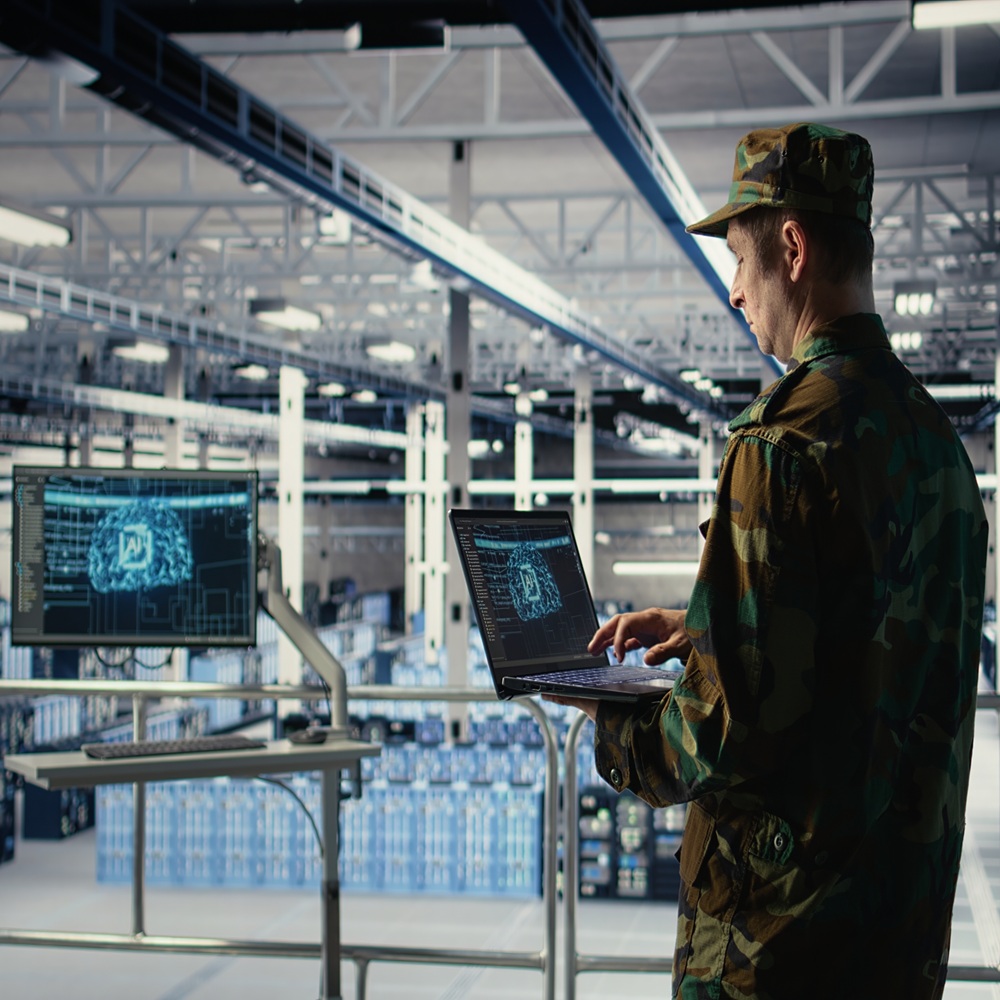
Soldier in engineering role uses AI application on laptop to manage server hub systems. Army commander reviews secret intelligence information using artificial intelligence in data center, camera A

Dual-Use AI Technologies in Defense: Strategic Implications and Security Risks

by Mayukh Dey

Introduction Artificial intelligence has become a critical technology in the 21st century, with applications spanning healthcare, commerce, and scientific research. However, the same algorithms that enable medical diagnostics can guide autonomous weapons, and the same machine learning systems that power recommendation engines can identify military targets. This dual-use nature, where technologies developed for civilian purposes can be repurposed for military applications, has positioned AI as a central element in evolving global security dynamics. The strategic implications are substantial. China views AI as essential for military modernization, with the People's Liberation Army planning to deploy "algorithmic warfare" and "network-centric warfare" capabilities by 2030 (Department of Defense, 2024). Concurrently, military conflicts in Ukraine and Gaza have demonstrated the operational deployment of AI-driven targeting systems. As nations allocate significant resources to military AI development, a critical question emerges: whether the security benefits of dual-use AI technologies can be realized without generating severe humanitarian consequences. The Reversal Commercial Innovation Driving Military Modernization Historically, military research and development drove technological innovation, with civilian applications emerging as secondary benefits, a phenomenon termed "spin-off." The internet, GPS, and microwave ovens all originated in defense laboratories. This dynamic has reversed. Commercially developed technologies now increasingly "spin into" the defense sector, with militaries dependent on technologies initially developed for commercial markets. This reversal carries significant implications for global security. Unlike the Cold War era, when the United States and Soviet Union controlled nuclear weapons development through state programs, AI innovation occurs primarily in private sector companies, technology firms, and university research institutions. Organizations like DARPA influence global emerging technology development, with their projects often establishing benchmarks for research and development efforts worldwide (Defense Advanced Research Projects Agency, 2024). This diffusion of technological capacity complicates traditional arms control frameworks based on state-controlled military production. The scale of investment is considerable. The U.S. Department of Defense's unclassified AI investments increased from approximately $600 million in 2016 to about $1.8 billion in 2024, with more than 685 active AI projects underway (Defense One, 2024). China's spending may exceed this figure, though exact data remains unavailable due to the opacity of Chinese defense budgeting. Europe is pursuing comparable investments, with the EU committing €1.5 billion to defense-related research and development through initiatives like the European Defence Fund. Dual-Use Applications in Contemporary Warfare AI's military applications span the spectrum of warfare, from strategic planning to tactical execution. Current deployments include: Intelligence, Surveillance, and Reconnaissance (ISR): AI systems process large volumes of sensor data, satellite imagery, and signals intelligence to identify patterns beyond human analytical capacity. In 2024, "China's commercial and academic AI sectors made progress on large language models (LLMs) and LLM-based reasoning models, which has narrowed the performance gap between China's models and the U.S. models currently leading the field," enabling more sophisticated intelligence analysis (Department of Defense, 2024). Autonomous Weapons Systems: Autonomous weapons can identify, track, and engage targets with minimal human oversight. In the Russia-Ukraine war, drones now account for approximately 70-80% of battlefield casualties (Center for Strategic and International Studies, 2025). Ukrainian officials predicted that AI-operated first person view drones could achieve hit rates of around 80%, compared to 30-50% for manually piloted systems (Reuters, 2024). Predictive Maintenance and Logistics: The U.S. Air Force employs AI in its Condition-Based Maintenance Plus program for F-35 fighters, analyzing sensor data to predict system failures before occurrence, reducing downtime and operational costs. Command and Control: AI assists military commanders in processing battlefield information and evaluating options at speeds exceeding human capacity. Project Convergence integrates AI, advanced networking, sensors, and automation across all warfare domains (land, air, sea, cyber, and space) to enable synchronized, real-time decision-making. Cyber Operations: AI powers both offensive and defensive cyber capabilities, from automated vulnerability discovery to malware detection and sophisticated social engineering campaigns. Gaza and Ukraine: AI in Contemporary Conflict Recent conflicts have provided operational demonstrations of AI's military applications and associated humanitarian costs. Israel's Lavender system reportedly identified up to 37,000 potential Hamas-linked targets, with sources claiming error rates near 10 percent (972 Magazine, 2024). An Israeli intelligence officer stated that "the IDF bombed targets in homes without hesitation, as a first option. It's much easier to bomb a family's home" (972 Magazine, 2024). The system accelerated airstrikes but also contributed to civilian casualties, raising questions about algorithmic accountability. The system's design involved explicit tradeoffs: prioritizing speed and scale over accuracy. According to sources interviewed by 972 Magazine, the army authorized the killing of up to 15 or 20 civilians for every junior Hamas operative that Lavender marked, while in some cases more than 100 civilians were authorized to be killed to assassinate a single senior commander (972 Magazine, 2024). Foundation models trained on commercial data lack the reasoning capacity humans possess, yet when applied to military targeting, false positives result in civilian deaths. Data sourced from WhatsApp metadata, Google Photos, and other commercial platforms created targeting profiles based on patterns that may not correspond to combatant status. Ukraine has implemented different approaches, using AI to coordinate drone swarms and enhance defensive capabilities against a numerically superior adversary. Ukrainian Deputy Defense Minister Kateryna Chernohorenko stated that "there are currently several dozen solutions on the market from Ukrainian manufacturers" for AI-augmented drone systems being delivered to armed forces (Reuters, 2024). Ukraine produced approximately 2 million drones in 2024, with AI-enabled systems achieving engagement success rates of 70 to 80 percent compared to 10 to 20 percent for manually controlled drones (Center for Strategic and International Studies, 2025). Both sides in the conflict have developed AI-powered targeting systems, creating operational arms race dynamics with immediate battlefield consequences. Civilian Harm: Technical and Legal Limitarions The integration of AI into lethal military systems raises humanitarian concerns extending beyond technical reliability. AI's inability to uphold the principle of distinction, which requires protecting civilians by distinguishing them from combatants in compliance with international humanitarian law, presents fundamental challenges. Current AI systems lack several capabilities essential for legal warfare:  Contextual Understanding: AI cannot comprehend the complex social, cultural, and situational factors that determine combatant status. A person carrying a weapon might be a combatant, a civilian defending their home, or a shepherd protecting livestock.  Proportionality Assessments: International humanitarian law requires that military attacks not cause disproportionate civilian damage. Human Rights Watch noted that it is doubtful whether robotic systems can make such nuanced assessments (Human Rights Watch, 2024).  Moral Judgment: Machines lack the capacity for compassion, mercy, or understanding of human dignity, qualities that have historically provided safeguards against wartime atrocities.  Accountability: With autonomous weapon systems, responsibility is distributed among programmers, manufacturers, and operators, making individual accountability difficult to establish. As one expert observed, "when AI, machine learning and human reasoning form a tight ecosystem, the capacity for human control is limited. Humans have a tendency to trust whatever computers say, especially when they move too fast for us to follow" (The Conversation, 2024). The risks extend to specific populations. Autonomous weapons systems trained on data predominantly consisting of male combatants in historical records could create algorithmic bias. In the case of Lavender, analysis suggests "one of the key equations was 'male equals militant,'" echoing the Obama administration's approach during drone warfare operations (The Conversation, 2024). Communities of color and Muslim populations face heightened risks given historical patterns of discriminatory force deployment. Export Controls and Technology Transfer Challenges Recognizing AI's strategic importance, governments have implemented export control regimes. The U.S. Bureau of Industry and Security now requires licenses for exports of advanced computing chips and AI model weights, imposing security conditions to safeguard storage of the most advanced models. These controls face inherent tensions. Overly broad restrictions risk hampering legitimate research and commercial innovation. Analysis suggests that if AI technology is too extensively controlled, American universities may face difficulties performing AI research, resulting in a less robust U.S. AI ecosystem. Insufficient controls enable adversaries to acquire cutting-edge capabilities. The effectiveness of export controls remains uncertain. In 2024, hundreds of thousands of chips, totaling millions of dollars, were smuggled into China through shell companies, varying distributors, and mislabeling techniques (Oxford Analytica, 2025). China's DeepSeek models, which achieved performance approaching U.S. systems, were reportedly trained on chips that circumvented export restrictions. International Governance: Fragmentation and Competing Frameworks The international community has struggled to develop coherent governance frameworks for dual-use AI. Rather than a cohesive global regulatory approach, what has emerged is a collection of national policies, multilateral agreements, high-level summits, declarations, frameworks, and voluntary commitments. Multiple international forums have addressed AI governance: ● The UN Secretary-General created an AI Advisory Board and called for a legally binding treaty to prohibit lethal autonomous weapons systems without human control, to be concluded by 2026 ● The Group of Governmental Experts on Lethal Autonomous Weapons Systems has held discussions under the Convention on Certain Conventional Weapons since 2013, with limited concrete progress ● NATO released a revised AI strategy in 2024, establishing standards for responsible use and accelerated adoption in military operations ● The EU's AI Act, adopted in 2023, explicitly excludes military applications and national security from its scope This fragmented landscape reflects geopolitical divisions. The perceived centrality of AI for competition has led the U.S. to position itself as leader of ideologically aligned countries in opposition to China, including for security purposes. China promotes its own governance vision through initiatives like the Belt and Road, exporting technology standards alongside infrastructure. Strategic Stability Implications AI creates strategic stability challenges. Autonomous weapons enable substitution of machines for human soldiers in many battlefield roles, reducing the human cost and thus political cost of waging offensive war. This could increase the frequency of conflicts between peer adversaries, each believing they can prevail without significant domestic casualties. For conflicts between non-peer adversaries, reduced casualties further diminish domestic opposition to wars of aggression. The implications extend beyond conventional warfare. Armed, fully-autonomous drone swarms could combine mass harm with lack of human control, potentially becoming weapons of mass destruction comparable to low-scale nuclear devices. The technical barriers to such systems are declining as components become commercially available. AI also complicates nuclear stability. Advances in AI-enhanced sensors and data processing could undermine second-strike capabilities by improving detection of mobile missile launchers and submarines. This erosion of assured retaliation could incentivize first strikes during crises. Simultaneously, AI systems managing nuclear command and control create risks of accidents, miscalculations, or unauthorized launches. Ethical Framework Limitations The integration of AI into warfare strains traditional ethical frameworks. Just War Theory requires that combatants maintain moral responsibility for their actions, possess the capacity to distinguish combatants from civilians, and apply proportionate force. Automation bias and technological mediation weaken moral agency among operators of AI-enabled targeting systems, diminishing their capacity for ethical decision-making. When operators interact with targeting through screens displaying algorithmic recommendations rather than direct observation, psychological distance increases. This mediation risks transforming killing into a bureaucratic process. The operator becomes less a moral agent making decisions and more a technician approving or rejecting algorithmic suggestions. Furthermore, industry dynamics, particularly venture capital funding, shape discourses surrounding military AI, influencing perceptions of responsible AI use in warfare. When commercial incentives align with military applications, the boundaries between responsible innovation and reckless proliferation become unclear. Companies developing AI for civilian markets face pressure to expand into defense contracting, often with insufficient ethical deliberation. Conclusion Dual-use AI technologies present both opportunities and risks for international security. One trajectory leads toward normalized algorithmic warfare at scale, arms races in autonomous weapons that erode strategic stability, and inadequate international governance resulting in civilian harm. An alternative trajectory involves international cooperation that constrains the most dangerous applications while permitting beneficial uses. The timeframe for establishing governance frameworks is limited. AI capabilities are advancing rapidly, and widespread proliferation of autonomous weapons will make policy reversal substantially more difficult. The challenge resembles nuclear non-proliferation but unfolds at greater speed, driven by commercial incentives rather than state-controlled programs. Because AI is a dual-use technology, technical advances can provide economic and security benefits. This reality means unilateral restraint by democratic nations would cede advantages to authoritarian competitors. However, uncontrolled competition risks adverse outcomes for all parties. Concrete action is required from multiple actors. States must strengthen multilateral agreements through forums like the UN Convention on Certain Conventional Weapons to establish binding restrictions on autonomous weapons without meaningful human control. NATO and regional security alliances should harmonize AI ethics standards and create verification mechanisms for military AI deployments. Military institutions must implement mandatory human-in-the-loop requirements for lethal autonomous systems and establish clear chains of accountability for AI-driven targeting decisions. Technology companies developing dual-use AI systems bear responsibility for implementing ethical safeguards and conducting thorough threat modeling before commercial release. Industry alliances should establish transparency standards for military AI applications and create independent audit mechanisms. Universities and research institutions must integrate AI ethics and international humanitarian law into technical training programs. Export control regimes require coordination between the United States, EU, and allied nations to prevent regulatory arbitrage while avoiding overreach that stifles legitimate research. Democratic governments should lead by demonstrating that military AI can be developed within strict ethical and legal constraints, setting standards that distinguish legitimate security applications from destabilizing weapons proliferation. As Austrian Foreign Minister Alexander Schallenberg observed, this represents the Oppenheimer moment of the current generation, recognizing that dual-use AI, like nuclear weapons, represents a technology whose military applications demand collective restraint. The policy choices made in the next few years will have long-term consequences. They will determine whether AI becomes a tool for human advancement or an instrument of algorithmic warfare. The technology exists; the policy framework remains to be established. The actors are identified; the question is whether they possess the political will to act before proliferation becomes irreversible. References 972 Magazine (2024) 'Lavender': The AI machine directing Israel's bombing spree in Gaza. https://www.972mag.com/lavender-ai-israeli-army-gaza/ Center for Strategic and International Studies (2024) Where the Chips Fall: U.S. Export Controls Under the Biden Administration from 2022 to 2024. https://www.csis.org/analysis/where-chips-fall-us-export-controls-under-biden-administration-2022-2024 Center for Strategic and International Studies (2025) Ukraine's Future Vision and Current Capabilities for Waging AI-Enabled Autonomous Warfare. https://www.csis.org/analysis/ukraines-future-vision-and-current-capabilities-waging-ai-enabled-autonomous-warfare Defense One (2023) The Pentagon's 2024 Budget Proposal, In Short. https://www.defenseone.com/policy/2023/03/heres-everything-we-know-about-pentagons-2024-budget-proposal/383892/ Department of Defense (2024) Military and Security Developments Involving the People's Republic of China 2024. https://media.defense.gov/2024/Dec/18/2003615520/-1/-1/0/MILITARY-AND-SECURITY-DEVELOPMENTS-INVOLVING-THE-PEOPLES-REPUBLIC-OF-CHINA-2024.PDF Foreign Policy Research Institute (2024) Breaking the Circuit: US-China Semiconductor Controls. https://www.fpri.org/article/2024/09/breaking-the-circuit-us-china-semiconductor-controls/ Human Rights Watch (2024) A Hazard to Human Rights: Autonomous Weapons Systems and Digital Decision-Making. https://www.hrw.org/report/2025/04/28/a-hazard-to-human-rights/autonomous-weapons-systems-and-digital-decision-making National Defense Magazine (2024) Pentagon Sorting Out AI's Future in Warfare. https://www.nationaldefensemagazine.org/articles/2024/10/22/pentagon-sorting-out-ais-future-in-warfare Queen Mary University of London (2024) Gaza war: Israel using AI to identify human targets raising fears that innocents are being caught in the net. https://www.qmul.ac.uk/media/news/2024/hss/gaza-war-israel-using-ai-to-identify-human-targets-raising-fears-that-innocents-are-being-caught-in-the-net.html Reuters (2024) Ukraine rolls out dozens of AI systems to help its drones hit targets. https://euromaidanpress.com/2024/10/31/reuters-ukraine-rolls-out-dozens-of-ai-systems-to-help-its-drones-hit-targets/

Diplomacy
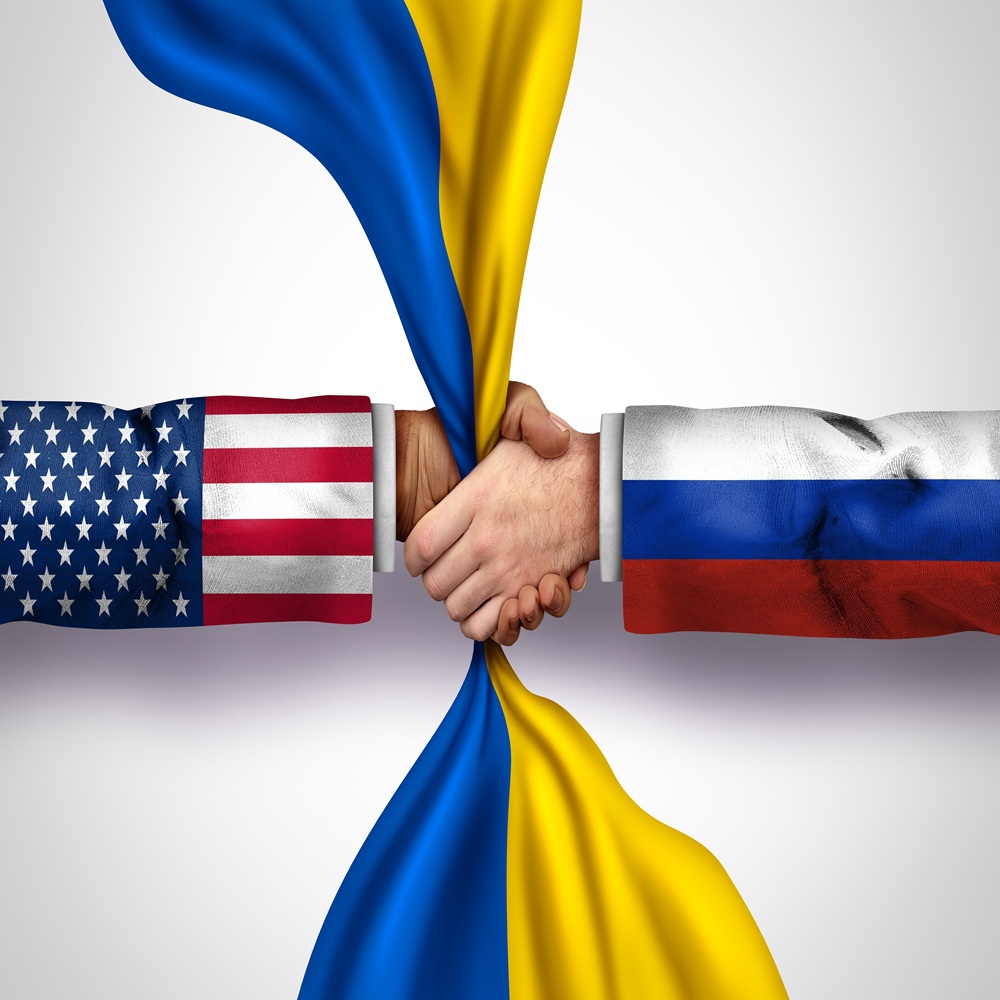
Russia US Peace Plan as Russian American and Ukrainian deal to end the war as an agreement of Moscow and Washington Kyiv on the outside in negotiations.

Peace in Ukraine? Believe it when you see it, especially if demands are prioritized

by Oleksa Drachewych

The United States recently — and suddenly — announced a 28-point peace plan to end Russia’s war in Ukraine, seemingly jointly written with Russian delegates, and presented it to Ukraine. The leaked contents of the peace plan caused concerns for Ukrainian representatives, European leaders and some American politicians. Yet it has nonetheless led to “meaningful progress”, according to the White House, on a revised peace proposal drafted by Ukrainian and American delegates in Geneva. Ukraine has reportedly agreed to the deal, with minor tweaks, while Russia says it’s premature to say a resolution is close, even as Russian representatives met with U.S. delegates in Abu Dhabi to discuss the revised plan. What was in the first plan? The leaked initial 28-point plan was criticized for asserting many Russian demands that date back to the initial peace negotiations of March and April 2022: • It placed a limit of 600,000 troops on Ukraine’s military; • It prevented Ukraine from having long-range missiles; • It placed a permanent ban on Ukrainian membership in NATO; • It included protections of Russian language and the Russian Orthodox Church in Ukraine. It also explicitly gave the entire Donbas region of eastern Ukraine to Russia, and called on the international community to recognize full Russian control of the Donbas and Crimea and control of Kherson and Zaporizhzhia on the front lines. In return, there would be “reliable security guarantees” envisioned by U.S. President Donald Trump: a NATO-style “Article 5” for Ukraine. This would mean if Ukraine was purposefully attacked by Russia in the future, the U.S. and other parties involved would come to Ukraine’s defence through sanctions, diplomatic pressure and military support, if necessary. In many of the economic and security arrangements that could emerge from the agreement, Russia and the United States would manage them together under the terms of the 28-point plan. The original plan also offered amnesty to all parties for any crimes and atrocities committed during the war, meaning Russia would not be brought to justice for war crimes. It also called for Russia’s return to European and global affairs, ending its political isolation with the West by reforming the G8. In short, the agreement would essentially act as if the war in Ukraine never happened. Was this a joint U.S.-Russia plan? The origins of the peace plan have been widely debated. The stilted language in the English version has led some to speculate it was translated from Russian. American senators said U.S. Secretary of State Marco Rubio, when briefing them, called the deal a “Russian wish list.” The draft reportedly came as a result of meetings held in Florida between Trump’s son-in-law, Jared Kushner, special envoy Steve Witkoff and Russian envoy Kirill Dmitriev, a noted Putin supporter. Rubio has insisted it was a U.S.-crafted document while Russian President Vladimir Putin said Russia could accept the peace plan. The fact that the document tended to mirror many of Russia’s demands immediately put Ukraine, and Europe, on the defensive. Trump declared that Ukraine would have until American Thanksgiving — Thursday, Nov. 27 — to agree to the plan. He has since softened his stance. But he’s also lambasted Ukraine’s leadership for not showing sufficient “gratitude” for American efforts to bring peace to Ukraine. Details of Europe’s plan In response, European leaders offered their own peace plan. They largely removed some of Russia’s most egregious demands, keeping some of the 28 points, while placing sensitive issues like NATO membership as something to be determined by NATO members and Ukraine. But it also acceded to some Russian demands, including accepting a cap on Ukraine’s military and offering Russia re-entry into the G8. It included a provision for territorial swaps with negotiations starting from the current front lines instead of recognizing Russia’s annexations. European proposals include using frozen Russian assets as reparations for Russia’s aggression, eliminating any of the amnesty clauses and making the European Union and NATO the key players in any future political, economic and military security arrangements. The European deal also removes key qualifiers in the original 28-point plan that could be manipulated by Russian misinformation — namely that Ukraine would be forced to face Russia alone if it struck either St. Petersburg or Moscow with a missile or it failed to “de-Nazify”, a common and erroneous Russian line of attack against Ukraine. The Kremlin rejected the European counter-plan outright. Where does the deal stand now? Ukrainian and American officials recently met in Geneva to discuss the peace plan. Emerging from the meeting, European leaders were cautiously optimistic while insisting a lot more work needed to be done. Trump stated that “something good just may be happening.” So, what resulted from that meeting? Few details have been leaked. Sources have shared that the 28-point plan has now been pared down to 19. It has also been suggested that key issues like territorial swaps and NATO accession have been left for Trump and Ukraine’s Volodymyr Zelenskyy to discuss at a future meeting. Ukrainian officials have said the plan has been substantially revised and reflects Ukraine’s concerns. The Russian response has been cagey, to say the least. Since there’s been no formal presentation of any revised peace plan, they are electing to say nothing firm. But U.S. Army Secretary Dan Driscoll recently met with Russian delegates in Abu Dhabi. Russian sources, meanwhile, have restated their preference for the original 28-point plan. Seeing is believing While this appears to be the most notable progress in the peace process in months, expectations should be tempered until there’s a presidential summit between Zelenskyy and Putin and until their signatures are on a treaty. Such momentum for peace has happened in the past. And it has often been scuttled by the key sticking points of both nations. Ukraine has continued to demand extensive security guarantees, justice for Russian war crimes, and has rejected territorial swaps. Russia has wanted a pliable Ukraine and one that could remain in its orbit politically and economically. Fundamentally, these positions haven’t changed. At this point, it appears the Ukrainians have managed to bring the Americans to their side in the latest peace talks, which reflects the importance Ukraine places on U.S. support in their fight against Russia. Russia has elected to say little, but if it was to agree to the revised deal, it would represent a seismic shift. For those reasons, believe in success in the peace process when you actually see it.

Defense & Security
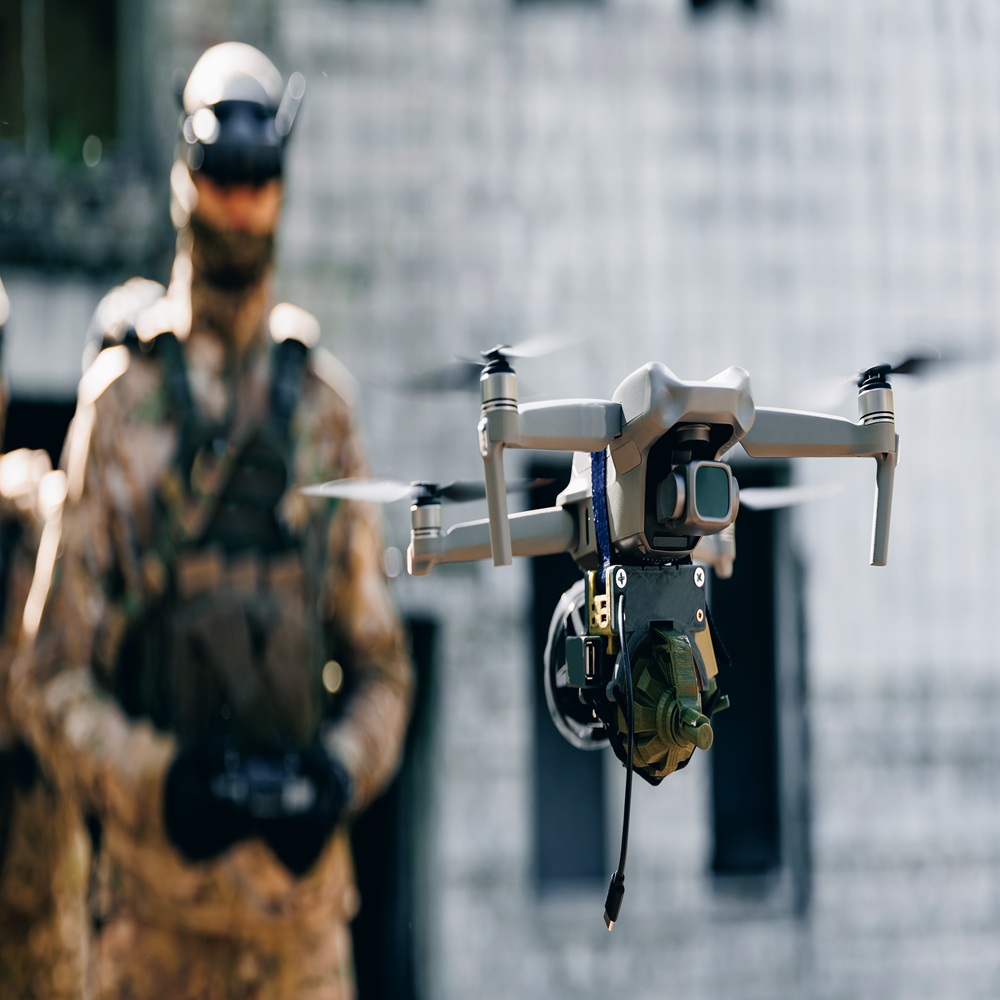
Soldier UAV operator launches army drone with bomb to drop into enemy fortifications and trenches. Concept using military robots in modern warfare.

Unmanned aerial vehicle: geopolitical influence, industrial potential and future perspectives

by World & New World Journal

Introduction An unmanned aerial vehicle (UAV) or unmanned aircraft system (UAS), commonly known as drone, is an aircraft without a human pilot, crew or passenger on board, but rather controlled remotely or autonomously. Drones can be seen as cutting-edge technologies with tremendous ramifications across various fields, including military, security, economics, and logistics – ranging from lightweight consumer drones to advanced autonomous combat platforms – that have transformed global security economics and technological developments. Their proliferation marks a shift in the conduct of warfare, industrial processes, and urban infrastructure design. In this context, this article aims to analyze these dynamics across three domains: geopolitical and security implications, economics and industrial processes, and future technological transformation. I. Geopolitical and Security Perspective: "Game Changers" The Dawn of the Unmanned Warfare Era The past decade — and especially during the conflicts in Ukraine, Gaza, and the Caucasus —has showcased an irreversible shift toward unmanned warfare. Low-cost drones have enabled nations and non-state actors to conduct reconnaissance, precision strikes, and electronic warfare at a fraction of traditional military costs. The democratization of drone warfare erodes conventional military hierarchies by giving smaller nations and even non-state groups asymmetric capabilities (Kania, 2020), (Vision of Humanity, 2024). Figure 1: Use of drones by type. A major consequence of this shift is the emergence of continuous aerial presence, which fundamentally alters operational rhythm and tempo. Previously, only major powers could afford persistent surveillance through manned aircraft or satellites. Today, even insurgent groups can deploy swarms of commercial drones to maintain near-constant observation of enemy movements. This constant presence of drones on the battlefield forces militaries to make decisions much faster and operate as if they are always being watched. As drone technology becomes cheaper and more widely available, it also becomes easier for states or groups to launch low-risk, hard-to-trace attacks without putting their own people in danger. This reduces the barrier to starting or escalating conflicts and makes the overall situation far more unpredictable. On the other hand, despite automation, drone warfare remains heavily dependent on human adaptation, moreover, in practice, drones’ use is constrained by weather, terrain, and limited night capability (Newton, 2025). Nonetheless, and as seen in the Ukraine War, the adaptation, development and improvement of the designs and systems have skyrocketed and shortened from months to weeks. A Paradigm Shift in Modern Warfare Traditional doctrines built around armored vehicles, manned aircraft, and centralized command structures are giving way to distributed, networked, and automated operations. Drones allow for constant ISR (intelligence, surveillance, reconnaissance), rapid kill chains, and battlefield transparency that reduces the effectiveness of concealment and mass maneuver (Biddle & Oelrich, 2016). Swarm technology further accelerates this shift by overwhelming air defenses through algorithmic coordination. On a broader strategic level, unmanned systems are transforming operational art, forcing militaries to rethink how they structure campaigns. Instead of relying on a small number of high-value manned platforms, modern forces must integrate thousands of expendable, semi-autonomous assets into a coherent command-and-control ecosystem. This shift elevates the importance of data fusion, algorithms, and electronic warfare, as success increasingly depends on which side can process information more effectively rather than which side has heavier armor or more firepower. Furthermore, the psychological effects of drone warfare — constant monitoring, unpredictable strikes, and the invisibility of operators — alter the morale and behavior of both soldiers and civilians. In this sense, unmanned warfare not only changes tactics but reshapes the human dimension of conflict. Evolution of Defense Strategies States now are prioritizing anti-drone systems (C-UAS), electronic warfare, and resilient supply chains. Defense strategies emphasize dispersion, decoys, deception, and multi-layered air defense, recognizing that the cost ratio favors attackers using cheap drones against expensive assets. Militaries increasingly incorporate AI-enabled targeting, autonomous perimeter defense, and drone-versus-drone combat (Mehta, 2022). The rapid evolution of offensive drone capabilities has forced governments to pursue a new generation of integrated counter-unmanned systems, blending kinetic interceptors, directed-energy weapons, radio-frequency jamming, and cyber tools. However, the challenge is not merely technological — it is organizational. Modern militaries must revise procurement cycles, adopt flexible doctrine, and restructure units to counter the fast-changing drone threat. For example, some nations are creating dedicated “drone defense battalions” or embedding electronic warfare teams at lower echelons of command. Once more the Ukraine War is a good example: Ukraine’s early-warning systems (so called, “drone walls”) use layered reconnaissance UAVs to identify threats and enhance battlefield visibility, unfortunately, these are highly vulnerable to electronic warfare and radar destruction. More examples include the fiber-optic FPV drones as countermeasure of jamming, or decoy drones to lure air defenses and absorb munitions. (Newton, 2025) The rise of drone warfare also places huge demand on secure communications and resilient digital infrastructure; adversaries increasingly target supply chains, software vulnerabilities, and satellite links that control unmanned systems. Thus, the evolution of defense strategies represents a multi-domain effort that spans hardware, software, organizational culture, and national-level industrial capacity. Major Countries' Competition in Drone Weapon Development The United States, China, Israel, Turkey, and Iran dominate the global drone arms race, while Russia and Ukraine deserve a special mention too. • USA: it focuses on high-tech autonomous systems, for example the MQ-25, Collaborative Combat Aircraft. In addition, according to the Federal Aviation Administration they have an estimated 822,039 drones registered as of July 2025. (FAA, 2025)• China: leads in export volume, offering cost-competitive platforms like the Wing Loong series (Fischer, 2020).• Turkey: gained strategic influence through the Bayraktar TB2, proven in multiple regional conflicts like the Nagorno-Karabakh in 2020 or its use for strategic communications for Ukraine during the ongoing conflict. (Péria-Peigné, 2023)• Israel: its research, development and production of innovative drone technology and exports roughly $500 million worth of UAV-related products per year, have positioned Israel as a world leader in the area. Israel is well known for its indigenous and competitive manufacturing UAVs like the Hermes 450, the Searcher Mk II and the Heron. (Sadot, s.f.)• Iran: their Shahed-136 drone is a low-cost drone that has gained attention internationally as it has shown affordability, precision, long-range, and cheapness during the Ukraine War – deployed by Russia. (Kesteloo, 2025)• Ukraine: has emerged as a leader in tactical warfare, including mass quantities of low-cost First-Person View (FPV) drones for frontline and deep-strike operations. But also, it has implemented “Spider’s Web” operations, which strike deep inside Russia, while using low-cost assets but with strategic and punctual strikes. Ukraine has also expanded into the maritime domain with unmanned surface vessels (USVs) using them with a kamikaze-style operation targeting ships and critical offshore infrastructure in the Black Sea. (Newton, 2025)• Russia: the war has institutionalized an UAV doctrine with mass deployment of FPV drones (Newton, 2025) and the creation – similar to Ukraine – of an Unmanned System Force (USF) aiming to encompass aerial, land and surface drones. (Altman, 2025) II. Economic & Industrial Perspective: “Flying Industrial Revolution” Future Logistics and Delivery Systems Beyond the battlefield, drones are reshaping global economies and enabling new industrial ecosystems. For instance, drones are rapidly transforming last-mile delivery by reducing transportation time, bypassing road congestion, and enabling access to remote or disaster-affected areas. Companies like Amazon, Wing, and Zipline have already demonstrated how unmanned aircraft can deliver medical supplies, parcels, and consumer goods more efficiently than traditional vehicles. As autonomous navigation, battery technology, and payload capacity continue to improve, drones are expected to become critical components of global supply chains, especially in regions where infrastructure is limited or demand for ultra-fast delivery is increasing. Global drone delivery is expected to reach multi-billion-dollar scale by 2030 (PwC, 2023). In the longer term, logistics networks are expected to evolve into hybrid ground–air systems, where drones work alongside autonomous ground vehicles and smart warehouses. These systems could drastically reduce operational costs by automating pickup, sorting, and delivery processes. Integrating drones with AI-driven inventory management and predictive delivery algorithms will allow companies to anticipate demand and route products dynamically. As eVTOL cargo aircraft mature, the concept of “airborne logistics hubs” may also emerge, enabling rapid long-distance transport between distribution centers without the need for airports. Together, these developments point toward a future where aerial logistics are not just an add-on, but a central pillar of modern supply chains. Improving Industrial Efficiency Across agriculture, energy, construction, and mining drones significantly improve efficiency by automating tasks that previously required expensive equipment or manual labor. By replacing manned inspection systems, drones can reduce labor costs, increase safety, and provide data of unprecedented detail (McKinsey, 2022). For example, farmers use drones for precision spraying and crop monitoring, reducing fertilizer and water usage. Energy companies deploy unmanned systems for pipeline inspections and powerline surveys, minimizing downtime and enhancing worker safety. Construction and mining firms rely on drones for site mapping, progress tracking, and 3D modeling, improving project accuracy while lowering operational costs. Beyond task automation, drones are becoming essential to data-driven industrial optimization. Equipped with thermal sensors, LiDAR, and multispectral cameras, unmanned systems can capture high-resolution data that feeds directly into AI analytics platforms. This allows companies to detect inefficiencies, predict equipment failure, and optimize resource allocation in real time. As industries move toward digital twins — virtual models of physical assets — drones will play a key role in continuously updating these systems with accurate spatial and environmental data. The result is a more responsive, efficient, and resilient industrial ecosystem that leverages aerial automation for competitive advantage. Regulatory Environment and Market Growth Regulation remains the single most influential factor shaping the global drone market. Governments are gradually introducing frameworks to enable Beyond Visual Line of Sight (BVLOS) operations, Remote ID tracking, and certification standards for commercial drones. Regions like the European Union have adopted unified risk-based rules through EASA, while the United States continues to refine its Part 107 and UTM integration policies through the FAA. These regulatory milestones are essential for scaling commercial drone usage, as they provide clarity to manufacturers, operators, and investors. As regulatory frameworks mature, they are also becoming a competitive advantage for regions that adopt them early. Countries that implement drone-friendly ecosystems — such as Singapore, the UAE, and Rwanda — are rapidly emerging as hubs for drone research, testing, and deployment. This regulatory momentum encourages multinational companies to establish operations in these markets, accelerating local innovation and talent development. Furthermore, harmonized international standards will make it easier for drone manufacturers to reduce production complexity and expand globally. Ultimately, the pace of market growth will depend not just on technological advancement but on how effectively governments balance innovation with safety, privacy, and public acceptance. Investment Trends Investment in drone-related technologies has surged, driven by the convergence of autonomy, artificial intelligence, and advanced manufacturing. Venture capital firms increasingly fund companies developing autonomous navigation systems, UTM software, battery technology, and specialized industrial drones. Defense investors continue to expand their portfolios into dual-use drone companies, reflecting growing geopolitical interest and national security incentives. Meanwhile, major tech firms and automotive companies are exploring opportunities in cargo drones, eVTOL aircraft, and autonomous mobility ecosystems. Beyond private investment, government funding and public–private partnerships are accelerating drone adoption globally. Many nations are launching test corridors, innovation hubs, and subsidies to attract drone startups and support local manufacturing. This trend is particularly strong in Asia and the Middle East, where governments see drones as strategic tools for digital transformation and economic diversification. As markets mature, investment is shifting from hardware-heavy startups toward software, analytics, and integrated airspace management solutions — reflecting a broader transition from drone manufacturing to drone ecosystems. This shift signals a long-term, sustainable evolution of the drone industry from early experimental phases to full-scale commercial and civil integration. III. Future Technologies The Need for Unmanned Traffic Management (UTM) As drones and future eVTOL air taxis multiply, low-altitude airspace will become increasingly crowded. To prevent collisions and maintain order, UTM frameworks — already being developed by NASA, the FAA, EASA, and ICAO — aim to coordinate autonomous flights using real-time tracking, automated route planning, and digital air corridors (Kopardekar, 2016). These systems will act as the “air-traffic control of the future,” but designed for far larger numbers of smaller, faster-moving vehicles. In addition, as demand grows, it is likely that UTM will evolve into a fully automated, AI-driven airspace ecosystem capable of managing thousands of simultaneous flights with minimal human oversight. Future systems could incorporate weather prediction, dynamic rerouting, and AI-powered detect-and-avoid features, which more than a technical upgrade, would transform the air mobility in the cities worldwide. Global Standardization Competition The need for standard UTM, drone certifications, communication systems, and detect-and-avoid technology is critical, but it also represents a geopolitical contest. The U.S., the European Union, and China are each developing distinct technological ecosystems, hoping their standards will dominate global markets. Whichever region’s standards become the international norm will shape supply chains, aircraft design, and regulatory practices for decades. This competition mirrors earlier battles over telecommunications and 5G. Nations that establish widely adopted drone standards will gain strategic advantages, including influence over global manufacturing, software ecosystems, and aviation governance. As a result, UTM and drone certification are no longer just technical debates — they have become instruments of national power, economic leverage and somehow geopolitical importance. Urban Safety and Privacy Issues In addition, another major concern for cities is the widespread adoption of drones itself, which translates into surveillance risks, noise pollution from frequent flights, and vulnerability to cyberattacks that could compromise flight controls. Therefore, urban areas need strict rules governing data collection, flight paths, and liability in case of accidents to maintain public trust and safety. In the future, cities will also require integrated emergency response protocols, stronger cybersecurity defenses, and digital identity systems for all unmanned aircraft. Public engagement and transparent oversight will play a major role in ensuring that drones enhance urban life without creating new forms of intrusion or risk. Managing these challenges will be essential for the successful adoption of unmanned urban mobility. Integration with Future Urban Infrastructure In line with the previous section, smart cities could incorporate drones into their core infrastructure. For example, vertiports, rooftop landing pads, sensor-equipped air corridors, and digital twins could enable efficient navigation and real-time monitoring. In addition, drones will become essential for urban mobility and public services – from medical or any goods deliveries to emergency response like fire unit responses. As cities evolve, this integration will create a hybrid transportation ecosystem, where ground vehicles, aerial drones, and automated control systems would operate in sync. Urban planning will increasingly consider airspace as a valuable layer of infrastructure, much like roads or power grids. Therefore, collaboration between governments, industry, and technology providers to design cities capable of supporting high-density autonomous air mobility is required. Conclusion Unmanned systems are redefining the global balance of power, transforming industrial processes, and reshaping urban futures. The convergence of autonomy, AI, and networked airspace introduces both unprecedented opportunity and profound risk. Geopolitically, drones dilute traditional military dominance; economically, they catalyze a new airborne industrial revolution; technologically, they push societies toward complex management of shared automated airspace. Future policy, regulation, and innovation will determine whether unmanned systems become drivers of prosperity or vectors of instability. References Altman, H. (2025, November 13). Russia Creates New Military Branch Dedicated to Drone Warfare. The War Zone (TWZ). https://www.twz.com/news-features/russia-creates-new-military-branch-dedicated-to-drone-warfare Amazon. (2023). Prime Air: The Future of Drone Delivery. Amazon Corporate Publications. Biddle, S., & Oelrich, I. (2016). Future Warfare in the Age of Drones. Council on Foreign Relations. Deloitte. (2022). Drones in Industrial Operations: Transforming Asset Inspection and Performance. Deloitte Insights. FAA (Federal Aviation Administration). (2023). Integration of Unmanned Aircraft Systems into the National Airspace System. U.S. Department of Transportation. FAA (Federal Aviation Administration). (2025). Drones. https://www.faa.gov/uas Fischer, S. (2020). China’s Military–Civil Fusion Strategy: A View from Washington. U.S.–China Economic and Security Review Commission. Kania, E. B. (2020). Learning Warfare from the Laboratory: China’s Progress in Military Innovation. Center for a New American Security (CNAS). Kesteloo, H. (2025, September 29). Global Military Drone Race Intensifies as Nations Rush to Copy Iran’s Shahed Design. Medium. https://medium.com/@hayekesteloo/global-military-drone-race-intensifies-as-nations-rush-to-copy-irans-shahed-design-404badf482fb Kopardekar, P. (2016). Unmanned Aircraft System (UAS) Traffic Management (UTM) Concept of Operations. NASA Ames Research Center. McKinsey & Company. (2022). The Commercial Drone Market Outlook: Insights on Market Growth, Industrial Adoption, and Regulation. McKinsey Robotics & Automation Practice. Mehta, A. (2022). Counter-Drone Systems and the Future of Air Defense. Defense News. Newton, M. (2025, November 3). How Are Drones Changing War? The Future of the Battlefield. Center for European Policy Analysis (CEPA). https://cepa.org/article/how-are-drones-changing-war-the-future-of-the-battlefield/ Péria-Peigné, L. (2023, April 17). TB2 Bayraktar: Big Strategy for a Little Drone. IFRI. https://www.ifri.org/en/memos/tb2-bayraktar-big-strategy-little-drone PwC. (2023). Clarity from Above: Global Drone Market Analysis. PwC Global. Roland Berger. (2022). Urban Air Mobility: The Rise of the Drone Economy. Roland Berger Strategy Consultants. Rwanda Civil Aviation Authority. (2021). Regulatory Framework for Drone Delivery and BVLOS Operations. Government of Rwanda. Sadot, U. (n.d.). Proliferated Drones: A Perspective on Israel. Center for a New American Security (CNAS). https://drones.cnas.org/reports/a-perspective-on-israel/ Schmidt, E., Work, R., & Clyburn, M. (2021). Final Report: National Security Commission on Artificial Intelligence. U.S. Government Printing Office. Singer, P. W. (2009). Wired for War: The Robotics Revolution and Conflict in the 21st Century. Penguin Books. Statista. (2023). Global Drone Market Value and Investment Trends. Statista Market Outlook. Vision of Humanity. (2024, June 13). How Drones Have Shaped the Nature of Conflict. https://www.visionofhumanity.org/how-drones-have-shaped-the-nature-of-conflict/ Wing (Alphabet). (2023). Autonomous Delivery Networks and Future Logistics. Wing Technical Publications. Zipline. (2022). Operational Impact of Automated Medical Delivery by Drone. Zipline International Case Studies.

Defense & Security
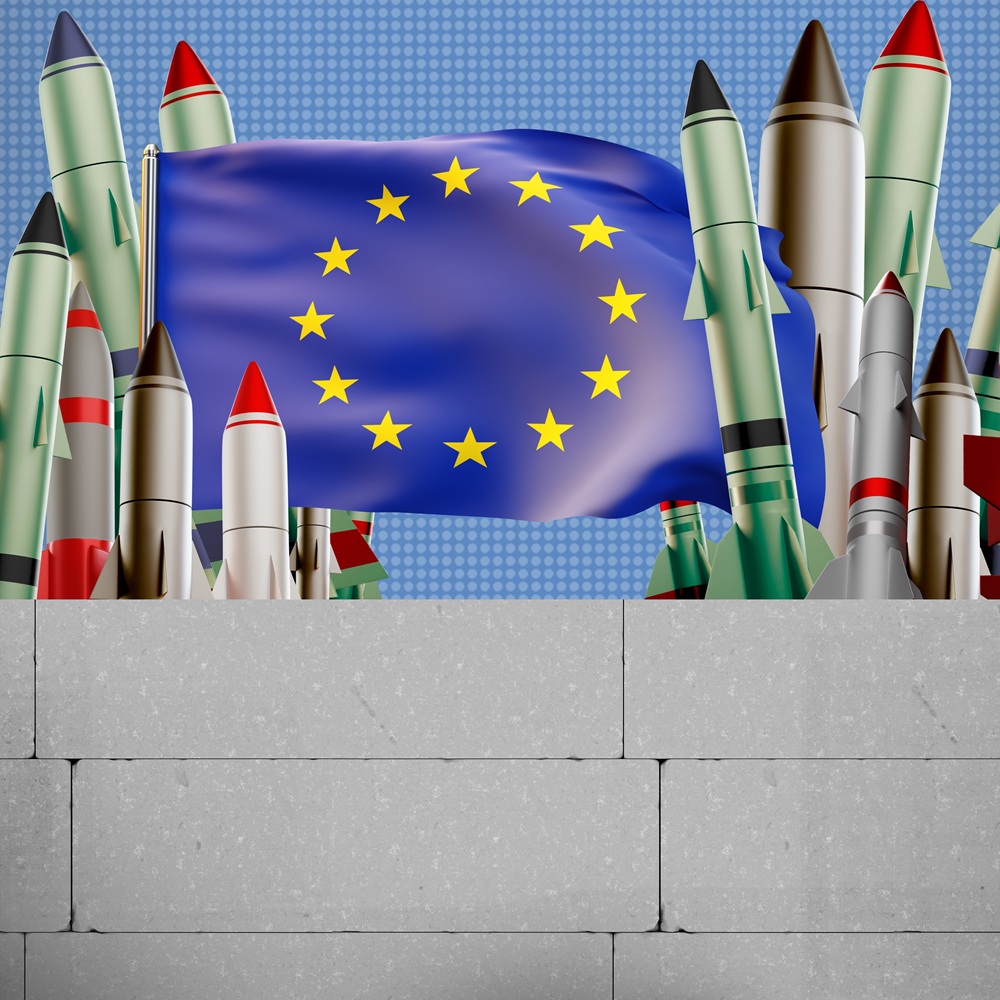
Missiles in front EU flag. Air defense systems European Union. Cruise missiles in Europe. Concept weapons development in Europe. Stockpiles strategic missiles. Concrete wall in foreground. 3d image

Nuclear Sharing Between the U.S. and the EU. Benefits and Challenges.

by Krzysztof Śliwiński

Abstract This paper examines the NATO nuclear sharing arrangement, focusing on its benefits and challenges within the U.S.-EU security framework. Nuclear sharing involves the U.S. deploying B61 nuclear bombs in select European NATO countries, with host nations providing delivery systems and infrastructure while the U.S. retains full control, ensuring compliance with the Treaty on the Non-Proliferation of Nuclear Weapons (NPT). The arrangement strengthens NATO's deterrence posture, promotes alliance cohesion, and supports non-proliferation by dissuading the development of independent nuclear arsenals. Recent geopolitical tensions, especially Russia's invasion of Ukraine, have intensified calls for expanding sharing to countries like Poland, enhancing deterrence on NATO's eastern flank. Exercises such as Steadfast Noon validate operational readiness and signal resolve. Critics, however, highlight legal and escalation risks, potential NPT violations, and domestic opposition in host countries. Despite these issues, nuclear sharing remains a crucial component of Euro-Atlantic security, adapting to evolving threats while balancing deterrence, alliance unity, and non-proliferation goals.  Key Words: International Security, Weapons of Mass Destruction, Nuclear Sharing, Alliances Introduction Nuclear sharing is a cornerstone of NATO's deterrence strategy, designed to distribute the benefits, responsibilities, and risks of nuclear deterrence across the Alliance. Under these arrangements, the United States deploys a limited number of B61 nuclear gravity bombs at bases in several European NATO member states. At the same time, those host countries provide the necessary infrastructure, security, and dual-capable aircraft (DCAs) to deliver weapons in a crisis. The weapons remain under full U.S. custody and control at all times, in compliance with the Treaty on the Non-Proliferation of Nuclear Weapons (NPT). A nuclear mission can only be authorised after explicit political approval from NATO's Nuclear Planning Group (NPG), which includes all NATO members, and the U.S. President (and potentially the UK Prime Minister). This setup ensures collective decision-making and underscores the U.S.'s extended deterrence commitments to its allies, helping prevent nuclear proliferation by giving non-nuclear states a stake in the Alliance's nuclear posture without independent arsenals.[1] The arrangements originated in the Cold War era, with the first U.S. atomic weapons arriving in Europe in 1954. By the 1960s, they were formalised through the NPG to allow non-nuclear allies input on nuclear policy. Today, approximately 100 B61 bombs are forward-deployed in Europe, hosted by five NATO countries: Belgium, Germany, Italy, the Netherlands, and Turkey. Seven NATO allies contribute DCA, including F-16s and F-35s, which serve dual roles in conventional operations and as potential nuclear delivery platforms. France and the UK maintain independent nuclear forces that complement the US-led sharing but operate outside the formal NATO structure. While the question references the EU, nuclear sharing is strictly a NATO framework; all host countries are EU members except Turkey, creating significant overlap but no direct EU-level involvement.[2] These arrangements serve multiple purposes: they enhance Alliance cohesion, provide tools for managing escalations in conflicts, and signal resolve to adversaries, such as Russia. Recent geopolitical tensions, including Russia's invasion of Ukraine, have prompted discussions about expanding sharing to strengthen deterrence on NATO's eastern flank.[3] Poland, a NATO member since 1999, has long advocated for a stronger role in the Alliance's nuclear mission amid heightened Russian threats, particularly following the 2022 invasion of Ukraine. In June 2023, Polish Prime Minister Mateusz Morawiecki first publicly expressed interest in hosting U.S. nuclear weapons under NATO's sharing policy, arguing it would bolster deterrence without violating the NPT. This push intensified in early 2025, driven by concerns over U.S. reliability under the second Trump administration and Russia's aggressive posture.[4]   On March 13, 2025, President Andrzej Duda explicitly urged the U.S. to deploy nuclear warheads on Polish territory, stating in interviews that NATO infrastructure—including nuclear assets — should "shift east" to match the eastward expansion of the Alliance's borders since 1999. He emphasised that such a move would enhance security guarantees and deter future Russian aggression, while also praising France's potential extension of its "atomic umbrella" as a complementary option. Duda's proposal carried domestic political weight, positioning Poland's conservative opposition as pro-U.S. ahead of the May 2025 presidential election, where candidates debated transatlantic ties versus European autonomy.[5] Proponents argue Poland is an ideal candidate: it spends 4.7% of GDP on defence (exceeding NATO's 2% target), has built one of Europe's strongest militaries, and hosts significant U.S. rotational forces. Analysts suggest that deployment could involve adapting Polish F-35s for DCA roles or constructing secure storage facilities. However, logistical and political hurdles remain, including a potential Russian backlash and the need for NPG consensus.[6] As of October 2025, however, no U.S. nuclear weapons have been deployed to Poland, and the proposal remains under discussion without a formal U.S. commitment. Instead, Poland has deepened integration through participation in NATO's annual Steadfast Noon nuclear exercise, which began on October 13, 2025, across Belgium, the Netherlands, and the North Sea — testing procedures for credibility and safety. Poland joined as a full participant alongside Finland, Germany, and the U.S., signalling growing involvement in nuclear planning but stopping short of hosting assets. Alternatives like a dedicated U.S. "nuclear umbrella" declaration for Poland have been floated to avoid escalation without physical deployment.[7] What academics say Academic experts agree that Nuclear sharing is a cornerstone of NATO's defence strategy. This arrangement refers to an agreement according to which the United States deploys non-strategic nuclear weapons on allied territory while maintaining ownership and peacetime custody.[8]This allows selected NATO members to participate in nuclear planning and provide delivery systems, creating a framework that extends American nuclear deterrence across the Alliance. The operational structure of nuclear sharing involves dual-key arrangements in which both U.S. and host-nation authorisation are required for weapon employment. The United States maintains absolute control and custody of its nuclear weapons forward-deployed in Europe, while Allies provide military support for the DCA mission with conventional forces and capabilities. Nuclear sharing arrangements play a vital role in the Alliance's interconnection and remain a key component of security guarantees and the indivisibility of security across the entire Euro-Atlantic area.[9] These arrangements are coordinated through NATO's Nuclear Planning Group, ensuring multilateral consultation on nuclear policy and targeting decisions. Currently, only five European NATO members have signed bilateral nuclear-sharing agreements with the U.S. These are: Belgium, Germany, Italy, the Netherlands, and Turkey, under which the U.S. stores B61 nuclear gravity bombs at their airbases and their dual-capable aircraft can deliver them in a NATO context. These arrangements, dating back to the Cold War and reaffirmed in subsequent treaties, involve approximately 100 U.S. warheads as of 2025.[10] Nuclear sharing serves multiple strategic purposes within the alliance framework. It strengthens extended deterrence by visibly integrating allied forces into NATO's nuclear posture, thereby reassuring front-line states of American commitment.[11] Experts claim that these arrangements helped prevent nuclear proliferation by reducing incentives for European allies to develop independent arsenals during the Cold War.[12] Additionally, nuclear sharing distributes the political and operational burdens of nuclear responsibility across participating members rather than concentrating them solely with the United States. However, nuclear sharing faces significant criticisms. Legal scholars argue that forward-deploying U.S. weapons on non-nuclear states potentially contravenes the Non-Proliferation Treaty's spirit, creating ongoing diplomatic tensions with Russia and other nations.[13] Domestic opposition within host countries and concerns about the escalation of crises further complicate these arrangements.[14] Despite these challenges, nuclear sharing remains integral to NATO's deterrence strategy, particularly as renewed great-power competition has reinforced alliance solidarity and commitment to collective defence in the contemporary security environment. Benefits of Nuclear Sharing Firstly, official sources from NATO and the U.S. government consistently highlight the benefits of their efforts in preserving peace, deterring aggression, fostering unity, and aligning with global non-proliferation norms. The primary official argument for nuclear sharing is its role in bolstering NATO's deterrence posture against evolving threats, particularly from nuclear-armed adversaries like Russia. NATO's 2022 Strategic Concept and related documents emphasise that the Alliance's nuclear capabilities, including U.S. forward-deployed weapons, serve to "preserve peace, prevent coercion and deter aggression". [15] The 2024 Washington Summit Declaration reaffirms this, stating that "nuclear deterrence is the cornerstone of Alliance security" and that NATO's capabilities provide the "supreme guarantee" for all members.[16] By integrating U.S. nuclear assets with European contributions, such as DCA from seven Allies, these arrangements complicate adversaries' planning and enhance crisis management. As noted in NATO's factsheet, "nuclear sharing provides military and political tools for deterrence and can be used to manage escalation in a crisis," with DCA serving as a "visible and valuable instrument for strategic communications" to signal resolve.[17] Accordingly, in a security environment marked by Russia's integration of nuclear forces into its military strategy and threats against Allies, nuclear sharing ensures credible deterrence without provoking conflict. NATO’s former Secretary General Jens Stoltenberg argued that "the purpose of NATO's nuclear weapons is not to provoke a conflict but to preserve peace, deter aggression and prevent coercion," underscoring that arrangements like those involving Germany are vital for the "security of the whole alliance".[18] The U.S. State Department echoes this rationale, claiming that with NATO "numerically outgunned on the central front," nuclear sharing maintains a "nuclear deterrent posture sufficient to deter the Soviet aggression," a logic that persists against modern threats.[19] Against this backdrop, exercises like Steadfast Noon[1] Further strengthen this by simulating nuclear scenarios, ensuring "the credibility, effectiveness, safety and security of the nuclear deterrent mission".[20] Overall, according to official sources, these mechanisms help preserve stability in the Euro-Atlantic area, reduce reliance on nuclear weapons, and adapt to challenges posed by actors such as China and North Korea. Secondly, nuclear sharing fosters unity and shared responsibility among NATO members, distributing the benefits, risks, and political burdens of deterrence more evenly among them. NATO's publications explicitly state that these arrangements "ensure that the benefits, responsibilities and risks of nuclear deterrence are shared across the Alliance," demonstrating "unity and cohesion amongst all Allies" through joint decision-making in the Nuclear Planning Group (NPG).[21] This shared approach, as NATO sources claim, reinforces the indivisibility of security, as outlined in NATO's nuclear policy: "Nuclear sharing arrangements play a vital role in the interconnection of the Alliance and remain one of the main components of security guarantees and the indivisibility of security of the whole Euro-Atlantic area".[22] The 2024 Summit Declaration commits to "modernising its nuclear capabilities" and "strengthening its nuclear planning capability," ensuring broader participation to "demonstrate Alliance unity and resolve".[23] By involving European Allies in Allied dual-capable aircraft (DCA) missions and infrastructure, nuclear sharing is intended to help mitigate disparities in capabilities, promote equitable burden-sharing, and prevent fragmentation within the Alliance. Thirdly, NATO posits that nuclear sharing supports non-proliferation efforts. Contrary to criticisms, official sources argue that nuclear sharing advances non-proliferation by reducing incentives for Allies to pursue independent nuclear programs. NATO's review of the NPT at 50 years notes that these arrangements "have contributed to security in Europe and non-proliferation as Allies under the U.S. nuclear umbrella have not felt pressure to develop their own weapons".[24] Codified during the 1960s negotiations, they comply fully with the Treaty, as both the U.S. and the USSR ensured that no prohibitions were placed on such setups.[25] The U.S. State Department details this compromise, which allowed for "wartime nuclear sharing" without requiring peacetime transfer, thereby reassuring allies like West Germany and dissuading proliferation.[26] Post-Cold War reductions — over 90% in NATO's nuclear stockpile — align with NPT Article VI disarmament goals while maintaining deterrence.[27] This balance facilitates peaceful nuclear cooperation under the IAEA (International Atomic Energy Agency) safeguards, thereby strengthening the global nuclear non-proliferation regime.[28] Finally, according to the U.S. State Department, nuclear sharing underscores the U.S. commitment to European security, countering fears of "decoupling" where allies doubt American resolve. The State Department describes it as addressing whether the U.S. would "sacrifice Chicago to save Hamburg," by making nuclear weapons available for Europe's defence.[29] NATO's policy affirms that U.S. strategic forces, supplemented by forward-deployed assets, provide the "supreme guarantee," with Allies contributing to ensure integration across domains.[30] To sum up, official arguments portray nuclear sharing as indispensable for deterrence, cohesion, non-proliferation, and transatlantic solidarity. These arrangements, according to Western policy-makers and experts, have sustained European stability for decades, with ongoing modernisation ensuring their relevance in an unpredictable world. Nuclear Sharing in the Face of an Ongoing War in Ukraine Nuclear sharing has allegedly bolstered NATO's overall deterrence posture, helping to prevent Russian escalation in Ukraine, including potential nuclear use. NATO's nuclear capabilities, including U.S. forward-deployed weapons in Europe, are described as essential to "preserve peace, prevent coercion and deter aggression" in the face of Russia's nuclear threats and integration of nuclear forces into its strategy.[31] This has indirectly supported Ukraine by signalling to Russia that any significant escalation — such as nuclear strikes or attacks on NATO territory — would invoke a collective response, thereby limiting Russia's options in the conflict. Russia's invasion has been accompanied by nuclear sabre-rattling to deter Western intervention, but nuclear sharing has helped counter this by maintaining credible deterrence without direct NATO involvement in Ukraine.[32] In that sense, the already mentioned exercises like Steadfast Noon simulate nuclear scenarios, reinforcing the "credibility, effectiveness, safety and security" of the deterrent, which has been crucial amid threats from Russia, China, and North Korea. Analysts note that this has made Russian nuclear signalling less credible over time, allowing the West to provide advanced weapons to Ukraine that were initially considered taboo.[33] However, Russia's threats have still delayed and limited the scale of Western aid, such as restrictions on long-range strikes into Russia, due to fears of crossing "red lines".[34] As mentioned before, nuclear sharing agreements have arguably fostered greater unity among NATO allies, enabling sustained military and economic support for Ukraine. By sharing the "benefits, responsibilities and risks of nuclear deterrence," nuclear sharing demonstrates Alliance solidarity and the "indivisibility of security" in the Euro-Atlantic area.[35] This has reassured European allies, particularly those near Russia, allowing them to commit resources to Ukraine without fearing abandonment. For example, Poland's push to join nuclear sharing reflects heightened threat perceptions from the war, aiming to strengthen deterrence and defence in a hostile environment. NATO's support, including intelligence sharing and strategic communications, has, at least in the eyes of Western policy-makers, deterred Russian use of chemical, biological, or nuclear weapons in Ukraine.[36] Without reassurance from nuclear sharing of U.S. commitment — countering fears of "decoupling" — it might have been harder for Europe to maintain this level of involvement.[37] From Russia's perspective, nuclear sharing exacerbates tensions, viewing it as part of NATO's eastward expansion that provoked the invasion.[38] Putin has used this to support claims behind "Russia's Special Military Operation" in Ukraine, framing Ukraine's potential NATO integration as a threat that could place U.S. nuclear weapons near Russia's borders, similar to the Cuban Missile Crisis in reverse. This rationale has fueled Russian nuclear threats, which aim to limit Western aid and prolong the conflict by raising escalation fears.[39] The war has heightened nuclear risks, with some analysts arguing it presents greater dangers than the Cuban Missile Crisis due to the potential for miscalculation.[40] Russia's deployment of tactical nuclear weapons in Belarus as a counter to NATO's sharing arrangements has further escalated postures.[41] Recent decisions by the U.S., UK, and France to allow Ukraine to use long-range missiles against Russian targets have prompted Putin to warn of a direct NATO-Russia war, indirectly tying into nuclear sharing's role in deterrence dynamics.[42] This has possibly complicated peace efforts, as Russia perceives Western escalation as existential, making negotiations harder. As mentioned earlier, nuclear sharing has arguably helped mitigate proliferation risks during the war. By providing a shared nuclear umbrella, it reduces the incentives for allies like Poland and Germany to pursue independent nuclear programs, thereby supporting the NPT.[43] Possibly then, the invasion has not sparked widespread proliferation, partly because NATO's deterrent reassures members. Interestingly, however, the debates over a "European nuclear deterrent" independent of the U.S. — spurred by uncertainties such as potential shifts in U.S. policy under Trump — could undermine this if not managed effectively.[44] The war has also renewed focus on modernising nuclear sharing, with NATO committing to enhancing capabilities at the 2024 Washington Summit.[45] This has indirectly affected Ukraine by diverting Russian resources and attention, though some argue it prolongs the stalemate without a decisive victory. In summary, nuclear sharing has possibly acted as a stabilising force for NATO, enabling robust support for Ukraine and deterring Russian nuclear escalation. However, it has also contributed to heightened tensions and Russian intransigence, complicating pathways to peace. As the war persists into 2025, proposals to expand sharing (e.g., to Poland) reflect its evolving role in countering ongoing threats. Conclusion The "Steadfast Noon" exercises are arguably a clear signal to any potential adversary, including Russia, that NATO is prepared to defend all its members against any threats, including nuclear ones. Such exercises involve the use of American non-strategic nuclear weapons stationed in Europe, although no real combat weapons are used during the drills. The exercises serve not only to practice deterrence against possible nuclear attacks but also to prepare for the potential use of nuclear weapons by NATO if necessary. The fact that these exercises involve nuclear deterrence indicates that NATO's defence strategy includes readiness to escalate to a nuclear response if provoked by a nuclear attack. The locations of these nuclear weapons are not publicly disclosed. Still, there is speculation about their presence in countries like Poland, particularly in light of recent secret agreements that allow foreign troops to enter Polish territory. On the other hand, one should also consider potential downsides, especially for countries in Central and Eastern Europe. Nuclear sharing for potential allied use in wartime poses significant risks despite its deterrence aims. One major downside is its incompatibility with the NPT, which violates Articles I and II.[2] Enabling the indirect transfer of control to non-nuclear states undermines global non-proliferation efforts and draws criticism from states such as China. This arrangement also heightens proliferation risks, as peacetime training and exercises normalise nuclear readiness, potentially inspiring similar setups in Asia-Pacific regions like Japan and South Korea, escalating regional tensions.[46] Security concerns include increased escalation dangers, where limited nuclear use could spiral into full-scale war, especially amid vulnerabilities at host bases like Incirlik in Türkiye during political instability. Expanding sharing, such as to Poland, fuels arms races with Russia and exposes more European sites to attacks, without adding credible deterrence given NATO's conventional superiority. Politically, it breeds divisiveness within NATO, fostering resentment among allies and diverting resources from conventional forces, while eroding U.S. control and complicating disarmament. Domestically, host nations face public backlash and moral burdens from anti-nuclear norms, straining alliance cohesion. Russia's objections in NPT forums further highlight how sharing provokes international backlash, risking broader conflicts. Notes [1] On Monday (October 13 2025), NATO began its annual nuclear deterrence exercise Steadfast Noon. The exercise is a long-planned, routine training activity and part of NATO’s broader efforts to maintain readiness and ensure transparency around its nuclear posture. It is not linked to any current world events, and no live weapons are used.[2] Article I - Each nuclear-weapon State Party to the Treaty undertakes not to transfer to any recipient whatsoever nuclear weapons or other nuclear explosive devices or control over such weapons or explosive devices directly, or indirectly; and not in any way to assist, encourage, or induce any non-nuclear-weapon State to manufacture or otherwise acquire nuclear weapons or other nuclear explosive devices, or control over such weapons or explosive devices. Article II - Each non-nuclear-weapon State Party to the Treaty undertakes not to receive the transfer from any transferor whatsoever of nuclear weapons or other nuclear explosive devices or of control over such weapons or explosive devices directly, or indirectly; not to manufacture or otherwise acquire nuclear weapons or other nuclear explosive devices; and not to seek or receive any assistance in the manufacture of nuclear weapons or other nuclear explosive devices. See more at: https://www.un.org/en/conf/npt/2005/npttreaty.html References [1] NATO’s Nuclear Sharing Arrangements. (2022, February). NATO. https://www.nato.int/nato_static_fl2014/assets/pdf/2022/2/pdf/220204-factsheet-nuclear-sharing-arrange.pdf[2] Kristensen, H. M., Korda, M., Johns, E., & Knight-Boyle, M. (2023, November 8). Nuclear weapons sharing, 2023. Bulletin of the Atomic Scientists. https://thebulletin.org/premium/2023-11/nuclear-weapons-sharing-2023/[3] Johns, E. (2025, October 10). Incomplete Upgrades at RAF Lakenheath Raise Questions About Suspected US Nuclear Deployment. Federation of American Scientists. https://fas.org/publication/incomplete-upgrades-lakenheath-questions-nuclear/[4] Johns, E. (n.d.). Poland’s bid to participate in NATO nuclear sharing. IISS. Retrieved October 14, 2025, from https://fas.org/publication/incomplete-upgrades-lakenheath-questions-nuclear/[5] Poland’s president urges U.S. to move nuclear warheads to Polish territory, FT reports. (2025, March 13). Reuters. https://www.reuters.com/world/polands-president-urges-us-move-nuclear-warheads-polish-territory-ft-reports-2025-03-13/[6] Poland’s president vows to spend 4.7% of GDP on defence this year. (2025, February 5). Euronews. https://www.euronews.com/my-europe/2025/02/05/polands-president-vows-to-spend-47-of-gdp-on-defence-this-year[7] NATO’s annual nuclear exercise Steadfast Noon begins. (2025, October 13). NATO. https://www.nato.int/cps/en/natohq/news_238367.htm[8] von Hlatky, S., & Lambert-Deslandes, É. (2024). The Ukraine war and nuclear sharing in NATO. International Affairs, 100(2), 467-485. https://academic.oup.com/ia/article-abstract/100/2/509/7617216?redirectedFrom=fulltext[9] NATO’s nuclear deterrence policy and forces. (2025, October 13). NATO. https://www.nato.int/cps/fr/natohq/topics_50068.htm?selectedLocale=en#:~:text=Nuclear%20consultation,are%20members%20of%20the%20NPG[10] NATO’s Nuclear Sharing Arrangements. (2022, February). NATO. https://www.nato.int/nato_static_fl2014/assets/pdf/2022/2/pdf/220204-factsheet-nuclear-sharing-arrange.pdf[11] von Hlatky, S., & Lambert-Deslandes, É. (2024). The Ukraine war and nuclear sharing in NATO. International Affairs, 100(2), 467-485. https://academic.oup.com/ia/article-abstract/100/2/509/7617216?redirectedFrom=fulltext[12] Khalessi, D. (2015). Strategic ambiguity: Nuclear sharing and the secret strategy for drafting articles I and II of the nonproliferation treaty. The Nonproliferation Review, 23(1-2), 81-103. https://doi.org/10.1080/10736700.2016.1155865 [13] Park, K. C., & Choo, J. (2022). NATO's nuclear sharing strategy and its implications for establishing a new strategy for strengthening extended deterrence on the Korean Peninsula. International Area Studies Review, 26(1), 51-78. https://doi.org/10.18327/jias.2022.1.26.1.51 [14] Smith, M. A. (2004). To neither use them nor lose them: NATO and nuclear weapons since the cold war. Contemporary Security Policy, 25(3), 485-514. https://doi.org/10.1080/1352326042000330637[15] NATO’s nuclear deterrence policy and forces. (2025, October 13). NATO. https://www.nato.int/cps/en/natohq/topics_50068.htm[16] Washington Summit Declaration. (2024, July 10). NATO. https://www.nato.int/cps/en/natohq/official_texts_227678.htm[17] NATO’s Nuclear Sharing Arrangements. (n.d.). NATO. Retrieved October 20, 2025, from https://www.nato.int/nato_static_fl2014/assets/pdf/2022/2/pdf/220204-factsheet-nuclear-sharing-arrange.pdf[18] Germany’s support for nuclear sharing is vital to protect peace and freedom. (2020, May 11). NATO. https://www.nato.int/cps/en/natohq/opinions_175663.htm[19] Ford, C. A. (2019, December 9). Challenges of Policymaking in Responsible Nuclear Weapons Stewardship. US Department of State. https://2017-2021.state.gov/challenges-of-policymaking-in-responsible-nuclear-weapons-stewardship/[20] NATO’s annual nuclear exercise Steadfast Noon begins. (2025, October 13). NATO. https://www.nato.int/cps/en/natohq/news_238367.htm[21] NATO’s Nuclear Sharing Arrangements. (n.d.). NATO. Retrieved October 20, 2025, from https://www.nato.int/nato_static_fl2014/assets/pdf/2022/2/pdf/220204-factsheet-nuclear-sharing-arrange.pdf[22] NATO’s nuclear deterrence policy and forces. (2025, October 13). NATO. https://www.nato.int/cps/en/natohq/topics_50068.htm[23] Washington Summit Declaration. (2024, July 10). NATO. https://www.nato.int/cps/en/natohq/official_texts_227678.htm[24] Durkalec, J. (2018, June 29). The Nuclear Non-proliferation Treaty at fifty: a midlife crisis. NATO. https://www.nato.int/docu/review/articles/2018/06/29/the-nuclear-non-proliferation-treaty-at-fifty-a-midlife-crisis/index.html[25] NATO’s Nuclear Sharing Arrangements. (n.d.). NATO. Retrieved October 20, 2025, from https://www.nato.int/nato_static_fl2014/assets/pdf/2022/2/pdf/220204-factsheet-nuclear-sharing-arrange.pdf[26] Ford, C. A. (2019, December 9). Challenges of Policymaking in Responsible Nuclear Weapons Stewardship. US Department of State. https://2017-2021.state.gov/challenges-of-policymaking-in-responsible-nuclear-weapons-stewardship/[27] See more at: https://www.iaea.org/sites/default/files/publications/documents/infcircs/1970/infcirc140.pdf[28] See more at: https://www.iaea.org/[29] Ford, C. A. (2019, December 9). Challenges of Policymaking in Responsible Nuclear Weapons Stewardship. US Department of State. https://2017-2021.state.gov/challenges-of-policymaking-in-responsible-nuclear-weapons-stewardship/[30]NATO’s nuclear deterrence policy and forces. (2025, October 13). NATO. https://www.nato.int/cps/en/natohq/topics_50068.htm[31] NATO’s nuclear deterrence policy and forces. (2025, October 13). NATO. https://www.nato.int/cps/en/natohq/topics_50068.htm [32] Nuclear Stability and Escalation Risks in Europe. (2023, September 1). Foreign Policy Research Institute. https://www.fpri.org/article/2023/09/nuclear-stability-and-escalation-risks-in-europe/[33] Ibidem.[34] Kimball, D., & Bugos, S. (2022, February 28). Russia’s War on Ukraine and the Risk of Nuclear Escalation: Answers to Frequently Asked Questions. Arms Control Association. https://www.armscontrol.org/issue-briefs/2022-02/FAQ-russia-ukraine[35] NATO’s support for Ukraine. (2025, October 14). NATO. https://www.nato.int/cps/en/natohq/topics_192648.htm[36] Dickinson, P., Arick, R., & Lander Finch, N. (2025, October 15). How the US and Europe can deter and respond to Russia’s chemical, biological, and nuclear threats. Atlantic Council. https://www.atlanticcouncil.org/in-depth-research-reports/report/how-the-us-and-europe-can-deter-and-respond-to-russias-chemical-biological-and-nuclear-threats/[37] Dalton, T. (2022, April 8). Nuclear Nonproliferation After the Russia-Ukraine War. Georgetown Journal of International Affairs. https://gjia.georgetown.edu/2022/04/08/nuclear-nonproliferation-after-the-russia-ukraine-war/[38] Magnier, E. J. POST. X. Retrieved October 21, 2025, from https://x.com/ejmalrai/status/1796511588465201374[39] Ukraine: how nuclear weapons continue to increase the risks, two years on. (n.d.). ICAN (International Campaign to Abolish Nuclear Weapons). Retrieved October 21, 2025, from https://www.icanw.org/ukraine_two_years_how_nuclear_weapons_increase_the_risks[40] Kimballl, D., & Bugos, S. (2022, February 28). Russia’s War on Ukraine and the Risk of Nuclear Escalation: Answers to Frequently Asked Questions. Arms Control Association. https://www.armscontrol.org/issue-briefs/2022-02/FAQ-russia-ukraine [41] Kayali, L., Jungholt, T., & Fritz, P. (2024, July 4). Europe Is Quietly Debating a Nuclear Future Without the US. POLITICO. https://www.politico.com/news/magazine/2024/07/04/europe-us-nuclear-weapons-00166070[42] Katchanovski, I. (n.d.). POST. X. Retrieved October 21, 2025, from https://x.com/I_Katchanovski/status/1858244090909127000[43] Dalton, T. (2022, April 8). Nuclear Nonproliferation After the Russia-Ukraine War. Georgetown Journal of International Affairs. https://gjia.georgetown.edu/2022/04/08/nuclear-nonproliferation-after-the-russia-ukraine-war/[44] Samuelki, O. (2025, March 11). Europe going nuclear would be a catastrophic mistake. https://www.aljazeera.com/opinions/2025/3/11/europe-going-nuclear-would-be-a-catastrophic-mistake[45] NATO’s support for Ukraine. (2025, October 14). NATO. https://www.nato.int/cps/en/natohq/topics_192648.htm[46] Analysis of the Incompatibility of NATO’s Nuclear Sharing Arrangements with the Treaty on the Non-Proliferation of Nuclear Weapons. (2024). China Arms Control and Disarmament Association China Institute of Nuclear Industry Strategy. https://www.cinis.com.cn/zhzlghyjzy/yjbg/1446912/2024072914514738359.pdf 

Diplomacy
Trump, Putin Alaska Arrival (9260680)

Why Peace in Ukraine Remains Elusive

by Nicholas Morieson , Ihsan Yilmaz

Donald Trump declared his Alaska summit with Vladimir Putin a success, despite contrasting evidence suggesting otherwise. On Truth Social, he said a peace agreement over Ukraine, not a mere ceasefire, was the right path, claims he echoed during follow-up talks in Washington with Volodymyr Zelensky and European leaders. “Potentially, millions of people’s lives will be saved,” Trump said. That optimism looks misplaced. For Putin, Ukraine is not merely a bargaining chip but a territory he views as part of a Russian “civilization-state.” When he meets with Western leaders, he is not negotiating over land; he frames the war as a defense of Russian civilization and its values. As a result, Putin cannot easily “make a deal” involving land swaps to end the conflict.  Russia’s civilisational project  In addition to civilisational rhetoric, other factors contribute to Putin’s intransigence. Strategic concerns about NATO, fears for regime security, and the material importance of Crimea and the Black Sea all shape Moscow’s stance. Yet the language of civilisation turns these into matters of identity and survival. It fuses practical interests with existential claims, making retreat even harder. Even if compromises were possible on security or economics, the civilisational frame casts them as betrayals of Russia’s destiny.  Some American policymakers have tended to read Russia as a state with interests that can be traded. However, Putin accounts for Russia not simply as a nation-state, but as a civilization rooted in Orthodoxy, empire, and the memory of Soviet power. Viewed through this prism, Ukraine is not a foreign neighbour, but an inseparable part of Russian history and identity, which must be defended against Western encroachment.  In his 2021 essay On the Historical Unity of Russians and Ukrainians, Putin claimed that Russians and Ukrainians are “one people,” and that Ukraine is “an inalienable part of our own history, culture, and spiritual space.” Whatever his private convictions, the function of this language is clear. It justifies annexation and occupation, and it raises the political cost of retreat by treating territorial issues as matters of civilisational survival.   Putin himself insists that “the West” does not understand that “the Ukraine crisis is not a territorial conflict … and not an attempt to establish regional geopolitical balance.” Instead, he says, it is rooted in “the principles underlying the new international order” he is building. Peace, in this new order, is possible only “when everyone feels safe and secure, understands that their opinions are respected” and when “no one can unilaterally force …others to live or behave as a hegemon pleases even when it contradicts the sovereignty …traditions, or customs of peoples and countries.”    This framing lets the Kremlin portray the West as the aggressor imposing alien norms on unwilling Ukrainians. Russia, by contrast, is said to be fighting for itself on behalf of all nations who wish to see western hegemony end and the birth of a new multipolar world. Moreover, it portrays Ukraine’s status as a civilisational question tied to identity and resistance to Western liberal norms. As a result, only a settlement that Putin present domestically as recognition of Russia’s civilisational standing is acceptable, which complicates compromise beyond what standard diplomatic formulas suggest.  Challenges to Trump’s pursuit of peace  Trump has made no secret of his desire to be remembered as a peacemaker. However, he also admires strong leaders and has shown sympathy for post-liberal arguments that liberal democracy is exhausted. These affinities bring him closer, at least rhetorically, to elements of Putin’s stance.  Admiration and aspiration alone are insufficient in bridging the gap between Putin and Trump’s positions on Ukraine’s independence. Putin frames the conflict as existential, defending Russian civilisation against Western encroachment. This  makes compromise especially difficult. If the war is understood in these terms, how can Moscow return occupied territories without undermining its own civilisational claim? How can it accept a Ukraine that leans towards the European Union, or tolerate an American presence on its soil?  Trump may want peace, but Putin has tied his legitimacy to a narrative that resists it. Unless that framing is abandoned, or radically reinterpreted, any settlement will remain elusive.  A wider trend  “Russia’s approach is part of a wider pattern in which civilisational claims have become central to how leaders justify power and resist compromise. Xi Jinping frames China as a five-thousand-year-old civilisation whose territory includes Taiwan and the South China Sea. He presents the Communist Party as the guardian of a civilisational tradition stretching back to Confucius, giving contemporary disputes an aura of timeless legitimacy. Narendra Modi portrays India as an ancient Hindu civilisation restoring its rightful place after centuries of foreign domination. Each case is distinct, but the message is similar: our civilisation is exceptional, our sovereignty absolute, and our values not up for negotiation.    A troubled summit  Against this backdrop, the Alaska meeting was never likely to produce more than gestures. Trump may genuinely want peace and to be remembered as the leader who ended the war. Yet he is dealing with a counterpart who has justified the invasion of Ukraine in civilisational and existential terms. For Putin, Ukraine is not only territory but a symbol of Russia’s identity and sovereignty, cast as a bulwark against Western encroachment. Within this frame, Russia would view restoring Ukraine’s borders, accepting its European orientation, or tolerating a long-term American presence in the region as defeats of principle rather than concessions of interest.  Trump’s ambition to end the war faces an almost insoluble dilemma. Europe will reject a settlement that rewards aggression, while Putin refuses to surrender territory he has cast as integral to Russian civilisation. Land swaps seem practical but please neither side. If the conflict were to remains frozen, Ukraine will be fractured and the deeper issues unresolved. Peace demands compromise, but compromise undermines the very narratives on which Moscow has built its legitimacy. As a result, unless Putin retreats from his civilisational framing of the war, any settlement will remain elusive and Ukraine’s future uncertain.  Dr Nicholas Morieson is a Research Fellow at the Deakin Institute for Citizenship and Globalisation, Deakin University, Melbourne. He is the author of three books, including Weaponizing Civilizationalism for Authoritarianism: How Turkey, India, Russia, and China Challenge Liberal Democracy (Palgrave 2025).  This article is published under a Creative Commons License and may be republished with attribution.

Diplomacy
Russia-Latin America parliament conference (2023-09-29)

Latin America’s Attitudes towards Russia’s War in Ukraine

by Maria Puerta Riera

In Latin America, Cuba, Nicaragua, and Venezuela are not alone in their support for Russia and its invasion of Ukraine. In many cases, support has been disguised as an interest in peace or a neutral stance towards the conflict, as seen in the cases of Colombia, Mexico, and Brazil. While we find manifold diplomatic approaches toward Russia and Ukraine in Latin America, the underlying motivations can be understood in terms of support or rejection. While a majority of nations reject the invasion, considering it a threat to territorial sovereignty and self-determination, others have been reluctant to place any blame on Russia. More broadly, there has been less of an ideological bloc and more of an anti-imperialist or anti-colonial sentiment, with a few exceptions, such as Gabrie Boric from Chile who has publicly repudiated Russia’s aggression against Ukraine. His opposition is a departure from other Latin American leftist leaders like Luiz Inácio Lula da Silva and Gustavo Francisco Petro who have been more critical of Volodymyr Zelensky than Vladimir Putin. However, we can still identify three distinctive approaches to the crisis: 1) geopolitical, 2) economic, and 3) historical. The region has a keen interest in keeping its doors open to Russia. BRICS members like Brazil have managed to maintain their alleged neutrality in the pursuit of peace—even as President Lula has explicitly supported  Putin—while simultaneously protecting their economic interests. Others like Colombia and Mexico have shielded their unwillingness to condemn Putin’s invasion of Ukraine in an apparent push for peace. On the economic front, attitudes towards Russia are more tenuous given that Russia’s capability for foreign direct investment has been significantly reduced by the brunt of the war, along with the impact of the economic sanctions that followed their aggression. To be sure, Russia’s investments in the region have been winding down for some time, with a decreasing profile in areas such as energy, oil, and gas, as well as software and IT. However, the economic ties are more significant in the cases of Cuba, Nicaragua, and Venezuela—where they are joined more by their subjection to economic sanctions, and therefore the necessity to evade the consequences of economic isolation. There are specific areas key to this alliance: Russian fertilisers, along with oil and diesel, are critical to bypassing Western sanctions. Meanwhile, historical ties are more consequential than is commonly understood. Misinterpretations of Russia’s Soviet past by leftist-governed Latin American countries and longstanding social and cultural commonalities partially explain the continued support from diverse leaders such as Lula and Jair Bolsonaro in Brazil. These ties, rooted in shared anti-colonial sentiments and cultivated over decades, and regardless of ideological shifts, illustrate Russia’s multifaceted regional influence. This context underscores the fact that Russia’s regional impact transcends ideological lines, with both left and right-wing governments either explicitly supporting Russia or criticising Ukraine’s NATO aspirations to justify Russia’s aggression. The return of Donald Trump to the White House has prominent leaders of the Latin American left aligning with the new administration, resulting in significant consequences for the region. The new US administration’s criticism of Kyiv resonates with positions held by Brazil, Mexico, Colombia, Cuba, and Nicaragua. Despite ideological differences, their alignment emerges from a mix of political affinities, geopolitical strategies, and historical connections. Putin’s explicit defiance of Donald Trump’s negotiation efforts raises questions about Latin America’s influence over the conflict, largely due to its initial reluctance to adopt a decisive stance against Putin. The lonely voice condemning Putin’s war of attrition continues to be Chilean President Gabriel Boric, in stark contrast to Lula DaSilva and Gustavo Petro, who remain in Putin’s corner, making it unlikely they can be viewed as honest brokers in a peace initiative. Trump’s policies have prompted Brazil and Colombia to voice limited concerns about US plans for Ukraine, although still refraining from outright condemnation of Russia. This stance appears less a genuine support for Ukraine and more an opposition to US involvement in peace processes, even blaming Ukraine as partially responsible. Meanwhile, ideology alone has proven insufficient to prompt unified condemnation of Russia or widespread support for Ukraine in Latin America. Previous efforts by the Biden administration to secure regional military assistance for Ukraine were met with firm rejection and reluctance. This distancing, interpreted as tacit support for Russia, contributes to concerns about increasing authoritarian tendencies in the region, reflecting a diminished commitment to emerging democracies in crisis. Effectively abandoned by the international community, Ukraine faces negotiations with nations seeking its valuable earth minerals in exchange for protection, essentially framing it within a debt relief context. The absence of significant Latin American critique of this neocolonial approach underscores a troubling shift where sovereignty and self-determination appear increasingly disposable, contingent upon geopolitical interests and contexts. Maria I. Puerta Riera is a Visiting Professor of Political Science at Valencia College in Orlando, FL., where she teaches U.S. Government and International Politics. She holds a PhD. in Social Sciences, with her research focusing on the crises of democracies in Latin America. She has a special interest in Venezuela, Cuba, and Nicaragua, and is currently working on the effects of the illiberal regimes of China and Russia and their use of sharp power in the region. This article is published under a Creative Commons License and may be republished with attribution.

Energy & Economics
Commodity and alternative asset, gold bar and crypto currency Bitcoin on rising price graph as financial crisis or war safe haven, investment asset or wealth concept.

Assessing Bitcoin and Gold as Safe Havens Amid Global Uncertainties: A Rolling Window DCC-GARCH Analysis

by Anoop S Kumar , Meera Mohan , P. S. Niveditha

Abstract We examine the roles of Gold and Bitcoin as a hedge, a safe haven, and a diversifier against the coronavirus disease 2019 (COVID-19) pandemic and the Ukraine War. Using a rolling window estimation of the dynamic conditional correlation (DCC)-based regression, we present a novel approach to examine the time-varying safe haven, hedge, and diversifier properties of Gold and Bitcoin for equities portfolios. This article uses daily returns of Gold, Bitcoin, S&P500, CAC 40, and NSE 50 from January 3, 2018, to October 15, 2022. Our results show that Gold is a better safe haven than the two, while Bitcoin exhibits weak properties as safe haven. Bitcoin can, however, be used as a diversifier and hedge. This study offers policy suggestions to investors to diversify their holdings during uncertain times. Introduction Financial markets and the diversity of financial products have risen in both volume and value, creating financial risk and establishing the demand for a safe haven for investors. The global financial markets have faced several blows in recent years. From the Global Financial Crisis (GFC) to the outbreak of the pandemic and uncertainty regarding economic policy measures of governments and central banks, the financial markets including equity markets around the world were faced with severe meltdowns. This similar behavior was observed in other markets including equity and commodity markets, resulting in overall uncertainty. In this scenario, the investors normally flock toward the safe-haven assets to protect their investment. In normal situations, investors seek to diversify or hedge their assets to protect their portfolios. However, the financial markets are negatively impacted when there are global uncertainties. Diversification and hedging methods fail to safeguard investors’ portfolios during instability because almost all sectors and assets are negatively affected (Hasan et al., 2021). As a result, investors typically look for safe-haven investments to safeguard their portfolios under extreme conditions (Ceylan, 2022). Baur and Lucey (2010) provide the following definitions of hedge, diversifier, and safe haven: Hedge: An asset that, on average, has no correlation or a negative correlation with another asset or portfolio. On average, a strict hedge has a (strictly) negative correlation with another asset or portfolio.Diversifier: An asset that, on average, has a positive correlation (but not perfect correlation) with another asset or portfolio. Safe haven: This is the asset that in times of market stress or volatility becomes uncorrelated or negatively associated with other assets or a portfolio. As was previously indicated, the significant market turbulence caused by a sharp decline in consumer spending, coupled with insufficient hedging opportunities, was a common feature of all markets during these times (Yousaf et al., 2022). Nakamoto (2008) suggested a remedy by introducing Bitcoin, a “digital currency,” as an alternative to traditional fiduciary currencies (Paule-Vianez et al., 2020). Bitcoin often described as “Digital Gold” has shown greater resilience during periods of crises and has highlighted the potential safe haven and hedging property against uncertainties (Mokni, 2021). According to Dyhrberg (2016), the GFC has eased the emergence of Bitcoin thereby strengthening its popularity. Bouri et al. (2017) in their study indicate that Bitcoin has been viewed as a shelter from global uncertainties caused by conventional banking and economic systems. Recent research has found that Bitcoin is a weak safe haven, particularly in periods of market uncertainty like the coronavirus disease 2019 (COVID-19) crisis (Conlon & McGee, 2020; Nagy & Benedek, 2021; Shahzad et al., 2019; Syuhada et al., 2022). In contrast to these findings, a study by Yan et al. (2022) indicates that it can function as a strong safe haven in favorable economic times and with low-risk aversion. Ustaoglu (2022) also supports the strong safe-haven characteristic of Bitcoin against most emerging stock market indices during the COVID-19 period. Umar et al. (2023) assert that Bitcoin and Gold are not reliable safe-havens. Singh et al. (2024) in their study reveal that Bitcoin is an effective hedge for investments in Nifty-50, Sensex, GBP–INR, and JPY–INR, at the same time a good diversifier for Gold. The study suggests that investors can incorporate Bitcoin in their portfolios as a good hedge against market volatility in equities and commodities markets. During the COVID-19 epidemic, Barbu et al. (2022) investigated if Ethereum and Bitcoin could serve as a short-term safe haven or diversifier against stock indices and bonds. The outcomes are consistent with the research conducted by Snene Manzli et al. (2024). Both act as hybrid roles for stock market returns, diversifiers for sustainable stock market indices, and safe havens for bond markets. Notably, Bhuiyan et al. (2023) found that Bitcoin provides relatively better diversification opportunities than Gold during times of crisis. To reduce risks, Bitcoin has demonstrated a strong potential to operate as a buffer against global uncertainty and may be a useful hedging tool in addition to Gold and similar assets (Baur & Lucey, 2010; Bouri et al., 2017; Capie et al., 2005; Dyhrberg, 2015). According to Huang et al. (2021), its independence from monetary policies and minimal association with conventional financial assets allow it to have a safe-haven quality. Bitcoins have a substantial speed advantage over other assets since they are traded at high and constant frequencies with no days when trading is closed (Selmi et al., 2018). Additionally, it has been demonstrated that the average monthly volatility of Bitcoin is higher than that of Gold or a group of international currencies expressed in US dollars; nevertheless, the lowest monthly volatility of Bitcoin is lower than the maximum monthly volatility of Gold and other foreign currencies (Dwyer, 2015). Leverage effects are also evident in Bitcoin returns, which show lower volatilities in high return periods and higher volatilities in low return times (Bouri et al., 2017; Liu et al., 2017). According to recent research, Bitcoins can be used to hedge S&P 500 stocks, which increases the likelihood that institutional and retail investors will build secure portfolios (Okorie, 2020). Bitcoin demonstrates strong hedging capabilities and can complement Gold in minimizing specific market risks (Baur & Lucey, 2010). Its high-frequency and continuous trading further enrich the range of available hedging tools (Dyhrberg, 2016). Moreover, Bitcoin spot and futures markets exhibit similarities to traditional financial markets. In the post-COVID-19 period, Zhang et al. (2021) found that Bitcoin futures outperform Gold futures.Gold, silver, palladium, and platinum were among the most common precious metals utilized as safe-haven investments. Gold is one such asset that is used extensively (Salisu et al., 2021). Their study tested the safe-haven property of Gold against the downside risk of portfolios during the pandemic. Empirical results have also shown that Gold functions as a safe haven for only 15 trading days, meaning that holding Gold for longer than this period would result in losses to investors. This explains why investors buy Gold on days of negative returns and sell it when market prospects turn positive and volatility decreases (Baur & Lucey, 2010). In their study, Kumar et al. (2023) tried to analyse the trends in volume throughout futures contracts and investigate the connection between open interest, volume, and price for bullion and base metal futures in India. Liu et al. (2016) in their study found that there is no negative association between Gold and the US stock market during times of extremely low or high volatility. Because of this, it is not a strong safe haven for the US stock market (Hood & Malik, 2013). Post-COVID-19, studies have provided mixed evidence on the safe-haven properties of Gold (Bouri et al., 2020; Cheema et al., 2022; Ji et al., 2020). According to Kumar and Padakandla (2022), Gold continuously demonstrates safe-haven qualities for all markets, except the NSE, both in the short and long term. During the COVID-19 episode, Gold’s effectiveness as a hedge and safe-haven instrument has been impacted (Akhtaruzzaman et al., 2021). Al-Nassar (2024) conducted a study on the hedge effectiveness of Gold and found that it is a strong hedge in the long run. Bhattacharjee et al. (2023) in their paper examined the symmetrical and asymmetrical linkage between Gold price levels and the Indian stock market returns by employing linear autoregressive distributed lag and nonlinear autoregressive distributed lag models. The results exhibit that the Indian stock market returns and Gold prices are cointegrated. According to the most recent study by Kaczmarek et al. (2022), Gold has no potential as a safe haven, despite some studies on the COVID-19 pandemic showing contradictory results. The co-movements of Bitcoin and the Chinese stock market have also normalized as a result of this epidemic (Belhassine & Karamti, 2021). Widjaja and Havidz (2023) verified that Gold was a safe haven asset during the COVID-19 pandemic, confirming the Gold’s safe-haven characteristic. As previously pointed out, investors value safe-haven investments in times of risk. Investors panic at these times when asset prices fall and move from less liquid (risky) securities to more liquid (safe) ones, such as cash, Gold, and government bonds. An asset must be bought and sold rapidly, at a known price, and for a reasonably modest cost to be considered truly safe (Smales, 2019). Therefore, we need to properly re-examine the safe-haven qualities of Gold and Bitcoin due to the mixed evidences regarding their safe-haven qualities and the impact of COVID-19 and the war in Ukraine on financial markets. This work contributes to and deviates from the body of existing literature in the following ways. We propose a novel approach in this work to evaluate an asset’s time-varying safe haven, hedge, and diversifier characteristics. This research examines the safe haven, hedging, and diversifying qualities of Gold and Bitcoin against the equity indices; S&P 500, CAC 40, and NSE 50. Through the use of rolling window estimation, we extend the methodology of Ratner and Chiu (2013) by estimating the aforementioned properties of the assets. Comparing rolling window estimation to other conventional techniques, the former will provide a more accurate representation of an asset’s time-varying feature. This study explores the conventional asset Gold’s time-varying safe haven, hedging, and diversifying qualities during crises like the COVID-19 pandemic and the conflict in Ukraine. We use Bitcoin, an unconventional safe-haven asset, for comparison. Data and Methodology We use the daily returns of three major equity indices; S&P500, CAC 40, and NSE 50 from January 3, 2018, to October 15, 2022. The equity indices were selected to represent three large and diverse markets namely the United States, France, and India in terms of geography and economic development. We assess safe-haven assets using the daily returns of Gold and Bitcoin over the same time. Equity data was collected from Yahoo Finance, Bitcoin data from coinmarketcap.com, and Gold data from the World Gold Council website. Engle (2002) developed the DCC (Dynamic Conditional Correlation)-GARCH model, which is frequently used to assess contagion amid pandemic uncertainty or crises. Time-varying variations in the conditional correlation of asset pairings can be captured using the DCC-GARCH model. Through employing this model, we can analyse the dynamic behavior of volatility spillovers. Engle’s (2002) DCC-GARCH model contains two phases; 1. Univariate GARCH model estimation2. Estimation of time-varying conditional correlation. For its explanation, mathematical characteristics, and theoretical development, see here [insert the next link in “the word here” https://journals.sagepub.com/doi/10.1177/09711023251322578] Results and Discussion The outcomes of the parameters under the DCC-GARCH model for each of the asset pairs selected for the investigation are shown in Table 1.   First, we look at the dynamical conditional correlation coefficient, ρ.The rho value is negative and insignificant for NSE 50/Gold, NSE 50 /BTC, S&P500/Gold, and S&P500/BTC indicating a negative and insignificant correlation between these asset pairs, showing Gold and Bitcoin as potential hedges and safe havens. The fact that ρ is negative and significant for CAC 40/Gold suggests that Gold can be a safe haven against CAC 40 swings. The asset pair CAC/BTC, on the other hand, has possible diversifier behavior with ρ being positive but statistically insignificant. Next, we examine the behavior of the DCC-GARCH parameters; α and β. We find that αDCC is statistically insignificant for all the asset pairs, while βDCC is statistically significant for all asset pairs. βDCC quantifies the persistence feature of the correlation and the extent of the impact of volatility spillover in a particular market’s volatility dynamics. A higher βDCC value implies that a major part of the volatility dynamics can be explained by the respective market’s own past volatility. For instance, the NSE 50/Gold’s βDCC value of 0.971 shows that there is a high degree of volatility spillover between these two assets, with about 97% of market volatility being explained by the assets’ own historical values and the remainder coming from spillover. Thus, we see that the volatility spillover is highly persistent (~0.8) for all the asset pairs except NSE 50/BTC. The results above show that the nature of the dynamic correlation between the stock markets, Bitcoin and Gold is largely negative, pointing toward the possibility of Gold and Bitcoin being hedge/safe haven. However, a detailed analysis is needed to confirm the same by employing rolling window analysis, and we present the results in the forthcoming section. We present the rolling window results for S&P500 first. We present the regression results for Gold in Figure 1 and Bitcoin in Figure 2   Figure 1. Rolling Window Regression Results for S&P500 and Gold.Note: Areas shaded under factor 1 represent significant regression coefficients. In Figure 1, we examine the behavior of β0 (intercept term), β1, β2, and β3 (partial correlation coefficients). The intercept term β0 will give an idea about whether the asset is behaving as a diversifier or hedge. Here, the intercept term shows significance most of the time. However, during 2018, the intercept was negative and significant, showing that it could serve as a hedge during geopolitical tensions and volatilities in the global stock market. However, during the early stages of COVID-19, we show that the intercept is negative and showing statistical significance, suggesting that Gold could serve as a hedge during the initial shocks of the pandemic. These findings are contrary to the results in the study by Tarchella et al. (2024) where they found hold as a good diversifier. Later, we find the intercept to be positive and significant, indicating that Gold could act as a potential diversifier. But during the Russia-Ukraine War, Gold exhibited hedge ability again. Looking into the behavior of β1, which is the partial correlation coefficient for the tenth percentile of return distribution shows negative and insignificant during 2018. Later, it was again negative and significant during the initial phases of COVID-19, and then negative in the aftermath, indicating that Gold could act as a weak safe haven during the COVID-19 pandemic. Gold could serve as a strong safe haven for the SP500 against volatility in the markets brought on by the war in Ukraine, as we see the coefficient to be negative and large during this time. From β2 and β3, the partial correlation coefficients of the fifth and first percentile, respectively, show that Gold possesses weak safe haven properties during COVID-19 and strong safe haven behavior during the Ukraine crisis. Next, we examine the characteristics of Bitcoin as a hedge/diversifier/safe haven against the S&P500 returns. We present the results in Figure 2.   Figure 2. Rolling Window Regression Results for S&P500 and Bitcoin.Note: Areas shaded under factor 1 represent significant regression coefficients. Like in the previous case, we begin by analysing the behavior of the intercept coefficient, which is β0. As mentioned earlier the intercept term will give a clear picture of the asset’s hedging and diversifier property. In the period 2018–2019, the intercept term is positive but insignificant. This could be due to the large volatility in Bitcoin price movements during the period. It continues to be minimal (but positive) and insignificant during 2019–2020, indicating toward weak diversification possibility. Post-COVID-19 period, the coefficient shows the significance and positive value, displaying the diversification potential. We see that the coefficient remains positive throughout the analysis, confirming Bitcoin’s potential as a diversifier. Looking into the behavior of β1 (the partial correlation coefficient at tenth percentile), it is positive but insignificant during 2018. The coefficient is having negative sign and showing statistical significance in 2019, suggesting that Bitcoin could be a good safe haven in that year. This year was characterized by a long list of corporate scandals, uncertainties around Brexit, and tensions in global trade. We can observe that throughout the COVID-19 period, the coefficient is showing negative sign and negligible during the March 2020 market meltdown, suggesting inadequate safe-haven qualities. However, Bitcoin will regain its safe-haven property in the coming periods, as the coefficient is negative and significant in the coming months. The coefficient is negative and shows statistical significance during the Ukrainian crisis, suggesting strong safe-haven property. Only during the Ukrainian crisis could Bitcoin serve as a safe haven, according to the behavior of β2, which displays the partial correlation coefficient at the fifth percentile. Bitcoin was a weak safe haven during COVID-19 and the Ukrainian crisis, according to β3, the partial correlation coefficient for the first percentile (coefficient negative and insignificant). According to the overall findings, Gold is a stronger safe haven against the S&P 500’s swings. This result is consistent with the previous studies of Triki and Maatoug (2021), Shakil et al. (2018), Będowska-Sójka and Kliber (2021), Drake (2022), and Ghazali et al. (2020), etc. The same analysis was conducted for the CAC 40 and the NSE 50; the full analysis can be found here [insert the next link in “the word here” https://journals.sagepub.com/doi/10.1177/09711023251322578]. However, it is important to highlight the respective results: In general, we may say that Gold has weak safe-haven properties considering CAC40. We can conclude that Bitcoin’s safe-haven qualities for CAC40 are weak. We can say that Gold showed weak safe-haven characteristics during the Ukraine crisis and good safe-haven characteristics for the NSE50 during COVID-19. We may say that Bitcoin exhibits weak safe haven, but strong hedging abilities to NSE50. Concluding Remarks In this study, we suggested a new method to evaluate an asset’s time-varying hedge, diversifier, and safe-haven characteristics. We propose a rolling window estimation of the DCC-based regression of Ratner and Chiu (2013). Based on this, we estimate the conventional asset’s time-varying safe haven, hedging, and diversifying properties during crises like the COVID-19 pandemic and the conflict in Ukraine. For comparison purposes, we include Bitcoin, a nonconventional safe-haven asset. We evaluate Gold and Bitcoin’s safe haven, hedging, and diversifier properties to the S&P 500, CAC 40, and NSE 50 variations. We use a rolling window of length 60 to estimate the regression. From the results, we find that Gold can be considered as a better safe haven against the fluctuations of the S&P 500. In the case of CAC 40, Gold and Bitcoin have weak safe-haven properties. While Bitcoin demonstrated strong safe-haven characteristics during the Ukraine crisis, Gold exhibited strong safe-haven characteristics during COVID-19 for the NSE 50. Overall, the findings indicate that Gold is the better safe haven. This outcome is consistent with earlier research (Będowska-Sójka & Kliber, 2021; Drake, 2022; Ghazali et al., 2020; Shakil et al., 2018; Triki & Maatoug, 2021). When it comes to Bitcoin, its safe-haven feature is weak. Bitcoin, however, works well as a diversifier and hedge. Therefore, from a policy perspective, investing in safe-haven instruments is crucial to lower the risks associated with asset ownership. Policymakers aiming to enhance the stability of financial portfolios might encourage institutional investors and other market players to incorporate Gold into their asset allocations. Gold’s strong safe-haven qualities, proven across various market conditions, make it a reliable choice. Gold’s performance during crises like COVID-19 highlights its potential to mitigate systemic risks effectively. Further, Bitcoin could also play a complementary role as a hedge and diversifier, especially during periods of significant volatility such as the Ukraine crisis. While Bitcoin’s safe-haven characteristics are relatively weaker, its inclusion in a diversified portfolio offers notable value and hence it should not be overlooked. Further, policymakers may consider how crucial it is to monitor dynamic correlations and periodically rebalance portfolios to account for shifts in the safe haven and hedging characteristics of certain assets. Such measures could help reduce the risks of over-reliance on a single asset type and create more resilient portfolios that can better withstand global economic shocks. For future research, studies can be conducted on the estimation of the rolling window with different widths. This is important to understand how the safe-haven property changes across different holding periods. Further, more equity markets would be included to account for the differences in market capitalization and index constituents. This study can be extended by testing these properties for multi-asset portfolios as well. We intend to take up this study in these directions in the future. Data Availability StatementNot applicable.Declaration of Conflicting InterestsThe authors declared no potential conflicts of interest with respect to the research, authorship, and/or publication of this article.FundingThe authors received no financial support for the research, authorship, and/or publication of this article.ReferencesAkhtaruzzaman M., Boubaker S., Lucey B. M., & Sensoy A. (2021). Is gold a hedge or a safe-haven asset in the COVID-19 crisis? Economic Modelling, 102, 105588. Crossref. Web of Science.Al-Nassar N. S. (2024). Can gold hedge against inflation in the UAE? A nonlinear ARDL analysis in the presence of structural breaks. PSU Research Review, 8(1), 151–166. Crossref.Barbu T. C., Boitan I. A., & Cepoi C. O. (2022). Are cryptocurrencies safe havens during the COVID-19 pandemic? A threshold regression perspective with pandemic-related benchmarks. Economics and Business Review, 8(2), 29–49. Crossref.Baur D. G., & Lucey B. M. (2010). Is gold a hedge or a safe haven? An analysis of stocks, bonds and gold. Financial Review, 45(2), 217–229. Crossref.Będowska-Sójka B., & Kliber A. (2021). Is there one safe-haven for various turbulences? The evidence from gold, Bitcoin and Ether. The North American Journal of Economics and Finance, Elsevier, 56, 101390. Crossref.Belhassine O., & Karamti C. (2021). Contagion and portfolio management in times of COVID-19. Economic Analysis and Policy, 72, 73–86. Crossref. PubMed. Web of Science.Bhattacharjee A., Das J., & Kumar S. (2023). Evaluating the symmetrical and asymmetrical linkage between gold price and Indian stock market in the presence of structural change. NMIMS Management Review, 31(4), 288–297. Crossref. Web of Science.Bhuiyan R. A., Husain A., & Zhang C. (2023). Diversification evidence of Bitcoin and Gold from wavelet analysis. Financial Innovation, 9(1), 100. Crossref. PubMed. Web of Science.Bouri E., Azzi G., & Dyhrberg A. H. (2017). On the return-volatility relationship in the Bitcoin market around the price crash of 2013. Economics, 11(1), 2. Crossref.Bouri E., Gupta R., Tiwari A. K., & Roubaud D. (2017). Does Bitcoin hedge global uncertainty? Evidence from wavelet-based quantile-in-quantile regressions. Finance Research Letters, 23, 87–95. Crossref. Web of Science.Bouri E., Shahzad S. J. H., Roubaud D., Kristoufek L., & Lucey B. (2020). Bitcoin, gold, and commodities as safe havens for stocks: New insight through wavelet analysis. The Quarterly Review of Economics and Finance, 77, 156–164. Crossref. Web of Science.Brenner M., & Galai D. (1989). New financial instruments for hedge changes in volatility. Financial Analysts Journal, 45(4), 61–65. Crossref.Capie F., Mills T. C., & Wood G. (2005). Gold as a hedge against the dollar. Journal of International Financial Markets, Institutions and Money, 15(4), 343–352. Crossref.Ceylan Ö. (2022). Hedging Effectiveness of the VIX ETPs: An analysis of the time-varying performance of the VXX. In Handbook of research on new challenges and global outlooks in financial risk management (pp. 384–401). IGI Global. Crossref.Cheema M. A., Faff R., & Szulczyk K. R. (2022). The 2008 global financial crisis and COVID-19 pandemic: How safe are the safe haven assets? International Review of Financial Analysis, 83, 102316. Crossref. PubMed. Web of Science.Conlon T., & McGee R. (2020). Safe haven or risky hazard? Bitcoin during the COVID-19 bear market. Finance Research Letters, 35, 101607. Crossref. PubMed. Web of Science.Demir E., Gozgor G., Lau C. K. M., & Vigne S. A. (2018). Does economic policy uncertainty predict the Bitcoin returns? An empirical investigation. Finance Research Letters, 26, 145–149. Crossref. Web of Science.Drake P. P. (2022). The gold-stock market relationship during COVID-19. Finance Research Letters, 44, 102111. Crossref. PubMed. Web of Science.Dwyer G. P. (2015). The economics of Bitcoin and similar private digital currencies. Journal of Financial Stability, 17, 81–91. Crossref. Web of Science.Dyhrberg A. H. (2015). Hedging capabilities of bitcoin. Is it the virtual gold? Finance Research Letters, 1–6. https://doi.org/10.1016/j.frl.2015.10.025Dyhrberg A. H. (2016). Hedging capabilities of bitcoin. Is it the virtual gold? Finance Research Letters, 16, 139–144. https://doi.org/10.1016/j.frl.2015.10.025 Web of Science.Engle R. (2002). Dynamic conditional correlation: A simple class of multivariate generalized autoregressive conditional heteroskedasticity models. Journal of Business & Economic Statistics, 20(3), 339–350. Crossref. Web of Science.Ghazali M. F., Lean H. H., & Bahari Z. (2020). Does gold investment offer protection against stock market losses? Evidence from five countries. The Singapore Economic Review, 65(02), 275–301. Crossref.Hasan M. B., Hassan M. K., Rashid M. M., & Alhenawi Y. (2021). Are safe haven assets really safe during the 2008 global financial crisis and COVID-19 pandemic? Global Finance Journal, 50, 100668. Crossref. PubMed.Hood M., & Malik F. (2013). Is gold the best hedge and a safe haven under changing stock market volatility? Review of Financial Economics, 22(2), 47–52. Crossref.Huang Y., Duan K., & Mishra T. (2021). Is Bitcoin really more than a diversifier? A pre-and post-COVID-19 analysis. Finance Research Letters, 43, 102016. Crossref.Ji Q., Zhang D., & Zhao Y. (2020). Searching for safe-haven assets during the COVID-19 pandemic. International Review of Financial Analysis, 71, 101526. Crossref. PubMed. Web of Science.Kaczmarek T., Będowska-Sójka B., Grobelny P., & Perez K. (2022). False safe haven assets: Evidence from the target volatility strategy based on recurrent neural network. Research in International Business and Finance, 60, 101610. Crossref. Web of Science.Kumar A. S., & Padakandla S. R. (2022). Testing the safe-haven properties of gold and bitcoin in the backdrop of COVID-19: A wavelet quantile correlation approach. Finance Research Letters, 47, 102707. Crossref. PubMed. Web of Science.Kumar M. A., Swathi J., Pallavi T. A., & Bavana S. (2023). Volume progression and price–volume relationship of commodity futures: Case of bullion and base metals. NMIMS Management Review, 31(4), 265–274. https://doi.org/10.1177/09711023241230463 Web of Science.Liu C. S., Chang M. S., Wu X., & Chui C. M. (2016). Hedges or safe havens—Revisit the role of gold and USD against stock: A multivariate extended skew-t copula approach. Quantitative Finance, 16(11), 1763–1789. Crossref.Liu R., Zhichao S., Wei G., & Wang W. (2017). GARCH model with fat-tailed distributions and Bitcoin exchange rate returns. Journal of Accounting, Business and Finance Research, 1(1), 71–75. https://doi.org/10.2139/ssrn.3666106 Crossref.Mokni K. (2021). When, where, and how economic policy uncertainty predicts Bitcoin returns and volatility? A quantiles-based analysis. The Quarterly Review of Economics and Finance, 80, 65–73. Crossref.Nagy B. Z., & Benedek B. (2021). Higher co-moments and adjusted Sharpe ratios for cryptocurrencies. Finance Research Letters, 39, 101543. Crossref. Web of Science.Nakamoto S. (2008). Bitcoin: A peer-to-peer electronic cash system. Bitcoin. https://bitcoin.org/bitcoin.pdfOkorie D. I. (2020). Could stock hedge Bitcoin risk(s) and vice versa? Digital Finance, 2(1), 117–136. Crossref.Paule-Vianez J., Prado-Román C., & Gómez-Martínez R. (2020). Economic policy uncertainty and Bitcoin. Is Bitcoin a safe-haven asset? European Journal of Management and Business Economics, 29(3), 347–363. Crossref.Ratner M., & Chiu C. C. J. (2013). Hedging stock sector risk with credit default swaps. International Review of Financial Analysis, 30, 18–25. Crossref. Web of Science.Salisu A. A., Raheem I. D., & Vo X. V. (2021). Assessing the safe haven property of the gold market during COVID-19 pandemic. International Review of Financial Analysis, 74, 101666. Crossref. PubMed. Web of Science.Saxena S., & Villar A. (2008). Hedging instruments in emerging market economies. Financial globalisation and emerging market capital flows. BIS Papers, 44, 71–87.Selmi R., Mensi W., Hammoudeh S., & Bouoiyour J. (2018). Is Bitcoin a hedge, a safe haven or a diversifier for oil price movements? A comparison with gold. Energy Economics, 74, 787–801. Crossref. Web of Science.Shahzad S. J. H., Bouri E., Roubaud D., Kristoufek L., & Lucey B. (2019). Is Bitcoin a better safe-haven investment than gold and commodities? International Review of Financial Analysis, 63, 322–330. Crossref. Web of Science.Shakil M. H., Mustapha I. H. M., Tasnia M., & Saiti B. (2018). Is gold a hedge or a safe haven? An application of ARDL approach. Journal of Economics, Finance and Administrative Science, 23(44), 60–76. Crossref.Singh V. V., Singh H., & Ansari A. (2024). Bitcoin as a distinct asset class for hedging and portfolio diversification: A DCC-GARCH model analysis. NMIMS Management Review, 32(1), 7–13. Crossref. Web of Science.Smales L. A. (2019). Bitcoin as a safe haven: Is it even worth considering? Finance Research Letters, 30, 385–393. Crossref. Web of Science.Snene Manzli Y., Alnafisah H., & Jeribi A. (2024). Safe haven ability of energy and agricultural commodities against G7 stock markets and banking indices during COVID-19, Russia–Ukraine War, and SVB collapse: Evidence from the wavelet coherence approach. Discrete Dynamics in Nature and Society, 2024(1), 2587000. Crossref.Syuhada K., Suprijanto D., & Hakim A. (2022). Comparing gold’s and Bitcoin’s safe-haven roles against energy commodities during the COVID-19 outbreak: A vine copula approach. Finance Research Letters, 46, 102471. Crossref. PubMed. Web of Science.Tarchella S., Khalfaoui R., & Hammoudeh S. (2024). The safe haven, hedging, and diversification properties of oil, gold, and cryptocurrency for the G7 equity markets: Evidence from the pre-and post-COVID-19 periods. Research in International Business and Finance, 67, 102125. Crossref. Web of Science.Triki M. B., & Maatoug A. B. (2021). The GOLD market as a safe haven against the stock market uncertainty: Evidence from geopolitical risk. Resources Policy, 70, 101872. Crossref. Web of Science.Umar Z., Bossman A., Choi S. Y., & Teplova T. (2023). The relationship between global risk aversion and returns from safe-haven assets. Finance Research Letters, 51, 103444. Crossref. Web of Science.Ustaoglu E. (2022). Safe-haven properties and portfolio applications of cryptocurrencies: Evidence from the emerging markets. Finance Research Letters, 47, 102716. Crossref. Web of Science.Widjaja M., & Havidz S. A. H. (2023). Are gold and cryptocurrency a safe haven for stocks and bonds? Conventional vs Islamic markets during the COVID-19 pandemic. European Journal of Management and Business Economics (ahead-of-print).Yan Y., Lei Y., & Wang Y. (2022). Bitcoin is a safe-haven asset and a medium of exchange. Axioms, 11(8), 415. Crossref.Yousaf I., Plakandaras V., Bouri E., & Gupta R. (2022). Hedge and safe haven properties of gold, US Treasury, Bitcoin, and Dollar/CHF against the FAANA companies and S&P 500 (Department of Economics, Working Paper Series No. 2022–27). University of Pretoria.Zhang Y., Zhu P., & Xu Y. (2021). Has COVID-19 changed the hedge effectiveness of bitcoin? Frontiers in Public Health, 9. https://doi.org/10.3389/fpubh.2021.704900

Defense & Security
flag country Europe defense army

European Union Strategic Autonomy. Necessary but potentially problematic?

by Krzysztof Śliwiński

Abstract This paper examines the evolving concept of European Union Strategic Autonomy (EU-SA) within the context of contemporary geopolitical challenges, with a particular focus on EU-Russia and EU-China relations. EU-SA reflects the EU's aspiration to act independently in foreign policy, security, defence, and economic affairs, moving from a rule-taker to a rule-maker in global politics. The study outlines the historical development of EU-SA from 2013 to the present, highlighting key milestones such as the Strategic Compass and the impact of the Ukraine War, which accelerated efforts toward defence collaboration, energy independence, and economic resilience. It explores the transatlantic dynamics, noting growing uncertainties in the U.S. commitment to NATO and the resulting push for a more autonomous European defence posture. Additionally, it addresses the complex EU-China relationship, marked by both cooperation and competition, as well as the strained EU-Russia ties amid ongoing conflict. The paper concludes by questioning the economic feasibility and political risks of deeper EU strategic autonomy, especially regarding security centralisation and Germany's leadership role. Key Words: EU, Strategic Autonomy, Security, Geopolitics, U.S, China, Russia Introduction At the 2025 North Atlantic Treaty Organisation (NATO) Summit in The Hague, member states (Allies) committed to investing 5% of their Gross Domestic Product (GDP) annually in core defence requirements and defence- and security-related spending by 2035. They will allocate at least 3.5% of GDP annually, based on the agreed-upon definition of NATO defence expenditure, by 2035 to resource core defence requirements and meet the NATO Capability Targets. Allies agreed to submit annual plans that show a credible, incremental path to achieving this goal.[1] At the same time, Spain secured a special compromise, committing to meet core requirements with just 2.1% of GDP, making it the only exception to the broader 5% target. Previously, in 2014, NATO Heads of State and Government had agreed to commit 2% of their national GDP to defence spending, to help ensure the Alliance's continued military readiness. This decision was taken in response to Russia's illegal annexation of Crimea, and amid broader instability in the Middle East. The 2014 Defence Investment Pledge was built on an earlier commitment to meeting this 2% of GDP guideline, agreed in 2006 by NATO Defence Ministers. In light of the increase in defence spending, given that 23 out of 32 NATO Allies are EU member states, the idea of European Union strategic autonomy (EU-SA) comes to mind. This paper will explore the issue of EU-SA with a specific reference to EU-Russia and EU-China relations.[2] A Brief History of EU Strategic Autonomy European Union strategic autonomy is an evolving concept that reflects its ambition to act independently in strategically important policy areas, including foreign policy, security, defence, and economic relations. Strong strategic autonomy, according to Barbara Lippert, Nicolai von Ondarza and Volker Perthes, means being able to set, modify and enforce international rules, as opposed to (unwillingly) obeying rules set by others. The opposite of strategic autonomy is being a rule-taker, subject to strategic decisions made by others, such as the United States, China, or Russia.[3] The concept was first prominently discussed in the context of defence in 2013 and has since expanded to encompass a broader range of policy areas. Historically speaking, one can identify numerous phases during which EU-SA evolved. - 2013-2016: During this period, EU-SA focused on security and defence, with initiatives like the Permanent Structured Cooperation (PESCO) and the European Defence Fund, aiming to strengthen the EU's defence capabilities.[4]  - 2017-2019: During this period, the EU-SA shifted its focus to defending European interests in a hostile geopolitical environment, influenced by events such as Brexit, the Trump presidency, and China's growing assertiveness.- 2020: The COVID-19 pandemic highlighted economic vulnerabilities, prompting a focus on mitigating dependence on foreign supply chains, particularly in critical sectors like health and technology.- Since 2021: The scope widened to virtually all EU policy areas, including digital, energy, and values, with terminology evolving to include "open strategic autonomy," "strategic sovereignty," "capacity to act," and "resilience".- 2022: The Ukraine War and Accelerated Implementation. Russia's invasion of Ukraine catalysed concrete actions toward EU-SA, notably in defence, energy independence, and economic resilience. The European Council's Versailles Declaration (March 2022) expressed strong political will to increase EU-SA, calling for collaborative investments in defence, phasing out dependency on Russian energy, and reducing reliance on critical raw materials, semiconductors, health, digital technologies, and food imports.[5] - The Strategic Compass for security and defence policy (endorsed March 2022) outlines a roadmap to 2030, emphasising strengthened EU defence capacities. Among others, it includes: o   Establishment of a strong EU Rapid Deployment Capacity of up to 5000 troops for different types of crises.o   Ready to deploy 200 fully equipped Common Security and Defence Policy (CSDP) mission experts within 30 days, including in complex environments.[6]o   Conducting regular live exercises on land and at sea.o   Enhanced military mobility.o   Reinforcement of the EU's civilian and military CSDP missions and operations by promoting a rapid and more flexible decision-making process, acting more robustly and ensuring greater financial solidarity.o   Making full use of the European Peace Facility to support partners.[7] According to the EU itself, the EU-SA is not a zero-sum game, but rather a sliding scale between complete autonomy and full dependency, with different results for different policy areas. What is more, when compared to the famous Maslow's hierarchy of needs (European Parliament briefing's language), the EU is not only perceived as an economic power, but it is also seen as a normative power. Therefore, the EU is recognised for its core values of democracy, human rights and the rule of law. Ultimately, Maslow's “self-actualisation” could mean the achievement of an EU in which citizens recognise their European identity and which has realised its full autonomous policy potential.[8]   As if this is not enough, the same source introduces the concept of the 360° strategic autonomy wheel, which reportedly illustrates policy areas in which the EU aims for greater strategic autonomy, as well as the connections between them. Mutual influence between policy areas can happen across the wheel, but is particularly strong in adjacent areas. Military action, for example, can cause migration, health is linked to food quality, energy policy influences the climate, and misinformation undermines democracy. The wheel can help to understand links, set priorities and view potential conflicts. More autonomy in the digital green economy will, for example, require vast quantities of “rare earth” materials, making the EU more (instead of less) dependent on imports. Reductions in energy consumption achieved through the digitalisation of the economy (for example, by reducing transport) will be partly offset by the increase in energy consumption by electronic devices and data centres.   Global Context The significance of EU-SA lies in ensuring the EU's political survival and global influence in a multipolar world where its relative power is diminishing. The EU's long-term economic outlook is bleak: its share of global GDP, now at 17% (at current prices), could nearly halve by 2050. According to the World Economic Forum, this economic backsliding not only threatens Europe's ability to fund its social model but also risks weighing on the bloc's global influence, leaving it even more dependent on the U.S. and China.[9] Moreover, the COVID-19 pandemic highlighted the conflictual nature of economic interdependence, as reliance on foreign supply chains for critical goods exposed vulnerabilities. Soft power has become an instrument of hard power, necessitating autonomy in trade, finance, and investment.  The U.S.'s strategic pivot to Asia, the exclusion of Europe in conflicts like Nagorno-Karabakh, Libya, and Syria (termed Astanisation[10], which favours Russia and Turkey), the sidelining of the EU in EU-Russia negotiations regarding the war in Ukraine, and China's state-led economic model have all pushed the EU towards the sidelines. Transatlantic divide Security is a critical dimension, with significant uncertainty surrounding the U.S. commitment to NATO under the Trump administration. Reports indicate Trump has questioned NATO's Article 5 guarantees, with actions like withdrawing military personnel from a Ukraine aid hub in Poland on April 8, 2025, and proposing to stand down 10,000 light infantry troops in Poland, Romania, and the Baltic states by 2025.[11] This has led to fears of a "NATO-minus" scenario, where the EU must fill security gaps without full U.S. backing. In response, the EU is pushing for greater strategic autonomy in defence. Initiatives like ReArm EU are mentioned, with calls for the EU to develop a stand-alone, integrated military capacity to stabilise the global economy. As Jean-Pierre Maulny, Deputy Director of the French Institute for International and Strategic Affairs (IRIS), adequately observes "The risk is now clear: a form of bilateral agreement between the United States and Russia, benefiting the interests of both countries, could leave Ukraine severely weakened and an easy prey for Moscow, thereby weakening other European countries consequently. As a consolation prize, we will have to ensure Europe's conventional security, as U.S. Secretary of Defence Pete Hegseth announced to Europeans at the opening of the NATO ministerial meeting held in Brussels on 12–13 February 2025. This situation will place Europeans in a terrible dilemma: Either they do not wish to provide security guarantees to Ukraine and risk completely discrediting themselves in the eyes of powers such as the United States, Russia, and China, as Europeans will have demonstrated that they are unable to defend the continent, while also creating a significant long-term risk to Europe's security. Alternatively, they could provide security guarantees to Ukraine, accepting the financial burden that would impact the European Union's long-term competitiveness. In light of this situation, some advocate for the establishment of a European pillar within NATO. If one considers that the United States is negotiating peace in Europe without and against the Europeans, and that they no longer wish to defend Europe with conventional military means (will they respect the NATO Defence Planning Process?), Europeans should take on Europe's security fully. This would mean taking control of NATO. It will also be easier to make NATO and the European Union work together with a more Europeanised organisation".[12] Economically, there are several issues that contemporary demand addresses, but the most pressing is, of course, the Tariffs. The U.S. and European Union are running out of time to strike a deal on trade tariffs. Negotiations have been slow since both the U.S. and EU temporarily cut duties on each other until July 9. If an agreement is not achieved by then, full reciprocal import tariffs of 50% on EU goods, and the bloc's wide-spanning countermeasures are set to come into effect.[13] According to Almut Möller, Director for European and Global Affairs and head of the Europe in the World programme (European Policy Centre), "for the first time in decades, Europeans can no longer rely on a benign partner on the other side of the Atlantic, leaving them dangerously exposed and acutely vulnerable, including on the very foundations of liberal democracy. Until recently, the U.S. dominated a world order that provided a favourable environment for the EU to extend its membership, further develop, and leverage its strengths, particularly as a trading power, without having to worry much about geopolitics. Suddenly, liberal Europe looks very lonely, and is struggling to keep up with a world of change".[14] Other problems arguably include digital regulation and data protection, antitrust policy and digital taxation, fiscal policy and social protection, geopolitical rivalries, China's rise, and competition and trade policy. EU–China conundrum Both the EU and the U.S. are concerned about China's growing economic and technological influence, but they have differing approaches to addressing this challenge. The EU has sought to maintain a balance between cooperation and competition with China, while the U.S. has adopted a more confrontational approach.[15] These differences have led to tensions in areas such as trade policy and technology regulation. For example, the EU has been critical of the U.S.'s unilateral approach to addressing China's trade practices, while the U.S. has accused the EU of being too lenient towards China. These disagreements have made it difficult to achieve a coordinated transatlantic response to China's rise.[16] According to German experts, the balance of power between China and the EU and its member states is developing increasingly asymmetrically to Europe's disadvantage. Only in trade policy – and partially in investment – can the EU maintain its position in a manner respected by China.[17] Europe holds significant importance for China across various dimensions: economically, as its top supplier and second-largest export destination; technologically, as a source of advanced technology; institutionally, as a model to emulate; politically, to advance its objectives concerning other nations, particularly the United States; and selectively, as a collaborator in areas like global health and regional stabilisation. Unlike Russia and the United States, China perceives a vital interest in the EU's continued existence and unity within a multipolar world; yet, it employs a "divide and rule" strategy. China selectively rewards or penalises individual EU countries based on their political and economic significance and their compliance with China's expectations on key issues. These issues include arms sales to Taiwan, meetings with the Tibetan Dalai Lama, and positions on the Uighurs, human rights in China, and the South China Sea. China engages with Europe on multiple levels — political, economic, technological, cultural, and academic — using various political channels (such as strategic partnerships with the EU and individual EU member states), dialogue formats (like the 16+1 format with sixteen Central and Eastern European countries), and high-level bilateral intergovernmental consultations with Germany, France, and the United Kingdom. China's hopes that the European Union would emerge as an independent and comprehensive player in global politics, serving as a counterbalance to the United States, have diminished. However, China would be supportive of any European efforts towards achieving strategic autonomy, provided it does not translate into a confrontational approach towards China itself. In contrast, Europe's political priorities—such as ensuring peace and stability in East Asia, China's role in global stability, development, environmental issues, climate change, and non-proliferation, as well as improving human rights in China — are often considered secondary and are not actively pursued by all EU member states. Europe lacks a unified and assertive foreign policy stance regarding the geopolitical rivalry between the United States and China for dominance in the Asia-Pacific region. There is also an absence of a clear position on China's authoritarian vision of order. Even in trade and investment disputes, Europe struggles to establish a unified approach to resolving these issues. The EU member states are too diverse in terms of size, profiles, and interests in their dealings with China: Economically, there is a divide between countries that are appealing industrial and technological partners for China and those that compete for favour in Beijing. Some nations have a clear interest in global governance. Additionally, the United Kingdom and France maintain their respective military presences in the Asia region. In this context, ReArm EU and its financial instrument SAFE (analysed here https://worldnewworld.com/page/content.php?no=5384 ) have the potential to provide the EU with meaningful strategic autonomy and invite genuine geopolitical actorness. EU–Russia conundrum Since Donald Trump took office as the U.S. president, the coordination of transatlantic policies regarding Russia has largely disintegrated. The White House's openness to a comprehensive "deal" with Russian President Vladimir Putin contrasts with Congress's attempts to limit Trump's foreign policy options with Russia, resulting in the marginalisation of coordination with European allies. This situation is further complicated by Washington's increasing reliance on extraterritorial sanctions, a trend that began before Trump's presidency. Consequently, according to European foreign and security experts, Europe must achieve greater strategic autonomy in its dealings with Russia. However, this relationship is particularly strained by significant conflicts of interest. Russia's invasion of Ukraine significantly disrupted the previously peaceful and liberal democratic relations among European nations. Putin's "special military operation" compelled the EU to introduce seventeen (so far) escalating economic sanction packages aimed at undermining the Russian economy and ultimately limiting Russia's capacity to continue the war. In a gesture of solidarity with Ukraine, the EU has also allocated billions of euros to both EU member states and Ukraine to avert a humanitarian disaster and ensure the provision of essential needs for Ukrainians fleeing the conflict.[18] After three and a half years from the outset of the war, Russia continues to pose a complex challenge that the EU and European nations cannot address independently in the foreseeable future. If the U.S. security guarantee weakens before Europe can bolster its own capabilities, the EU could face new vulnerabilities that Russia might exploit along its external borders, such as in the Baltic states, and elsewhere. Currently, the EU and its member states lack sufficient means to deter Russia from pursuing its interests aggressively and recklessly in the shared neighbourhood.[19] Critics, on the other hand, argue that calls for EU strategic autonomy, particularly the creation of a European Army and a significant increase in military spending, are a double-edged sword. First, the primary official rationale is that the EU must prepare itself for a possible attack on EU member states by Russia. The legacy media are full of European leaders claiming that Russia will sooner or later attack Europe.[20] Yet, this claim is not substantiated with much evidence. The proponents of the European army completely disregard numerous doubts surrounding the 2013/2014 "Euromaidan" and the role of the CIA in the events.[21] Second, according to the Office of the High Commissioner for Human Rights (OHCHR) 's estimations, the total number of conflict-related casualties in Ukraine from April 14, 2014, to December 31, 2021, stood at 51,000 – 54,000. These numbers are broken down as follows: 14,200 - 14,400 killed (at least 3,404 civilians, estimated 4,400 Ukrainian forces, and estimated 6,500 members of armed groups), and 37,000 - 39,000 injured (7,000 – 9,000 civilians, 13,800 – 14,200 Ukrainian forces and 15,800 - 16,200 members of armed groups).[22] In short, the situation was chaotic, with many casualties among civilians. Third, it was allegedly Europeans who torpedoed a first chance of peace negotiations as early as April 2014 in Istanbul.[23] Fourth, many European leaders seem to be utterly oblivious to the fact that the prolongation of the war adds to the destruction of Ukraine and Ukrainian society, deaths and emigration. Last but not least, given the fact that it is Germany that calls for both the European Army and the federalisation of Europe (with some assistance from France), one should be extra careful given the role of Germans during the WWII and the fact that neither has there been any official peace treaty with Germany nor have they recompensated countries such as Poland. Conclusion Strategic autonomy may be a necessity for Europe, given the dynamics of transatlantic relationships. The questions, however, that have to be pondered (and it does not seem that anyone in the legacy media or mainstream academia is ready to ask them) are numerous. Who will pay for that? Can Europeans afford such expenses under the current economic circumstances, and even worse economic prospects? Is the centralisation of security and military a Pandora's box? Should Europeans allow Germany (of all EU member states) to take special responsibility for this project? Isn't the pro-war rhetoric of Western political leaders making relations with Russia even more tense and dangerous, in other words, leading to escalation? History has solemnly proven that when left to their own devices, the Europeans inevitably create disastrous conflicts that have lasting consequences for generations. The American pivot to Asia and the consequent withdrawal from Europe may therefore have tragic ramifications for the European continent. References[1] Defence expenditures and NATO’s 5% commitment. (2025, June 27). North Atlantic Treaty Organization. https://www.nato.int/cps/en/natohq/topics_49198.htm[2] NATO and the EU have 23 members in common: Belgium, Bulgaria, Croatia, Czechia, Denmark, Estonia, Finland, France, Germany, Greece, Hungary, Italy, Latvia, Lithuania, Luxembourg, the Netherlands, Poland, Portugal, Romania, Slovakia, Slovenia, Spain and Sweden. See more at: https://www.consilium.europa.eu/en/policies/eu-nato-cooperation/#0[3] Lippert, B., von Ondarza, N., & Perthes, V. (2019, March). European Strategic Autonomy. Actors, Issues, Conflicts of Interests. Stiftung Wissenschaft Un Politic. Deutches Institut für Politik Und Sicherheit. https://www.swp-berlin.org/ doi:10.18449/2019RP04/#hd-d14204e263[4] Damen, M. (2022, July). EU strategic autonomy 2013-2023: From concept to capacity (EU Strategic Autonomy Monitor). European Parliamentary Research Service. https://www.eprs.ep.parl.union.eu[5] Informal meeting of the Heads of State or Government Versailles Declaration. (2022, March 10–11). Stiftung Wissenschaft Un Politic. Deutches Institut Fur Politik Und Sicherheit. https://www.consilium.europa.eu/media/54773/20220311-versailles-declaration-en.pdf[6] See more at: https://www.eeas.europa.eu/eeas/csdp-structure-instruments-and-agencies_en[7] See more at: https://fpi.ec.europa.eu/what-we-do/european-peace-facility_en[8] Damen, M. (2022, July). EU strategic autonomy 2013-2023: From concept to capacity (EU Strategic Autonomy Monitor). European Parliamentary Research Service. https://www.eprs.ep.parl.union.eu[9] Open but Secure:  Europe’s Path to Strategic Interdependence. INSIGHT REPORT. (2025). World Economic Forum. https://reports.weforum.org/docs/WEF_Open_but_Secure_Europe%E2%80%99s_Path_to_Strategic_Interdependence_2025.pdf[10] In reference to the Astana format on Syria) which leads to the exclusion of Europe from the settlement of regional conflicts in favour of Russia and Turkey. See more: https://www.eeas.europa.eu/eeas/why-european-strategic-autonomy-matters_en[11] Tilles, D. (2025, April 8). US to withdraw military from Ukraine aid hub in Poland. Notes from Poland. https://notesfrompoland.com/2025/04/08/us-to-withdraw-military-from-ukraine-aid-hub-in-poland/[12] Maulny, J.-P. (2025, February 13). United States – Europe: Our Paths Are Splitting. The French Institute for International and Strategic Affairs (IRIS). https://www.iris-france.org/en/united-states-europe-our-paths-are-splitting/[13] Kiderlin, S. (2025, June 18). These are the sticking points holding up a U.S.-EU trade deal. CNBC. https://www.cnbc.com/2025/06/18/these-are-the-sticking-points-holding-up-a-us-eu-trade-deal.html#:~:text=The%20EU%20and%20US%20flags,Poland%20on%20March%206%2C%202025.&text=Afp%20%7C%20Getty%20Images-,The%20U.S.%20and%20European%20Union%20are%20running%20out%20of%20time,($1.93%20trillion)%20in%202024?[14] Möller, A. (2025, February 26). Europe in the World in 2025: Navigating a perilous world with realism and ambition. European Policy Centre. https://www.epc.eu/publication/Europe-in-the-World-in-2025-Navigating-a-perilous-world-with-realism-625da4/#:~:text=2025%20will%20be%20a%20year,with%20a%20world%20of%20change[15] Bradford, A. (2023). When Rights, Markets, and Security Collide (pp. 221–254). Oxford University Press. https://doi.org/10.1093/oso/9780197649268.003.0007[16] Portanskiy, A. (2023). UE - US: new barriers to trade. Современная Европа. https://doi.org/10.31857/s020170832304006x[17] Lippert, B., von Ondarza, N., & Perthes, V. (2019, March). European Strategic Autonomy. Actors, Issues, Conflicts of Interests. Stiftung Wissenschaft Un Politic. Deutches Institut für Politik Und Sicherheit. https://www.swp-berlin.org/ doi:10.18449/2019RP04/#hd-d14204e263 [18] Klüver, L. (2025, April 18). Putin’s War on Ukraine: What can the EU actually do? European Careers Association. https://ecamaastricht.org/blueandyellow-knowyourunion/putins-war-on-ukraine-what-can-the-eu-actually-do#:~:text=Similarly%2C%20the%20Strategic%20Compass%2C%20the%20most%20recent,its%20interests%20and%20promote%20its%20values%20internationally.[19] Lippert, B., von Ondarza, N., & Perthes, V. (2019, March). European Strategic Autonomy. Actors, Issues, Conflicts of Interests. Stiftung Wissenschaft Un Politic. Deutches Institut für Politik Und Sicherheit. https://www.swp-berlin.org/ doi:10.18449/2019RP04/#hd-d14204e263 [20] ochecová, K. (2025, February 11). Russia could start a major war in Europe within 5 years, Danish intelligence warns. Politico. https://www.politico.eu/article/russia-war-threat-europe-within-5-years-danish-intelligence-ddis-warns/[21] Katchanovski, I. (2024). The Maidan Massacre in Ukraine The Mass Killing that Changed the World. Palgrave Macmillan. https://doi.org/https://doi.org/10.1007/978-3-031-67121-0[22] Office of the United Nations High Commissioner for Human Rights. (2022, January 27). Conflict-related civilian casualties in Ukraine: December 2021 update. United Nations Human Rights Monitoring Mission in Ukraine. https://ohchr.org[23] Johnson, J. (2022, May 6). Boris Johnson Pressured Zelenskyy to Ditch Peace Talks With Russia: Ukrainian Paper. Common Dreams. https://www.commondreams.org/news/2022/05/06/boris-johnson-pressured-zelenskyy-ditch-peace-talks-russia-ukrainian-paper

Diplomacy
European and US flags in European Council in Brussels, Belgium on April 4, 2023.

Navigating uncertainty: Where are EU–US relations headed?

by Ionela Maria Ciolan , Jason C. Moyer

Abstract The transatlantic relationship is undergoing a period of critical recalibration, marked by the return of a more transactional US administration and a world order moving towards multipolarity. The return of Donald Trump to the helm of the White House with an ‘America First’ doctrine raises serious questions about US involvement in the transatlantic alliance. President Trump’s repeated claims that the EU was set up to ‘screw’ the US reflect both that his administration is unwilling to engage productively with the EU and that it distrusts multilateral forums, preferring bilateral, nation-to-nation contacts. This article seeks to bring clarity to the future US–EU relationship by identifying some of the points of contention and offering a perspective on how the transatlantic partnership can move forward constructively. KeywordsTransatlantic relations, EU–US relations, Trump administration, EU, Bilateral relations, Multipolar world order Introduction Three years after Russia’s full-scale invasion of Ukraine, a new axis of power is taking form, led by Russia and China and supported by North Korea, Iran and Belarus. This shift brings a profound transformation within the global balance of power and is a direct threat to the liberal international world order. In the midst of this geopolitical recalibration, the return of Donald Trump to the helm of the White House with an ‘America First’ doctrine poses serious questions about US engagement with the transatlantic alliance. There are growing worries about the US’s willingness to continue to honour its Article 5 commitments within NATO and maintain an active role in the collective defence of Europe, but also about the role of the US as a supporter of Ukraine and the liberal multilateral rule-based system. State of play in the EU–US partnership During the first Trump administration, at the state funeral of former US president George H. W. Bush, the EU’s ambassador to the US, David O’Sullivan, was asked to stand at the back of the line-up to pay his respects, breaking diplomatic protocol (Knigge 2019). He politely acquiesced, but in the days that followed it came to light that during the first Trump administration, the US Department of State had downgraded the diplomatic status of the EU in the second half of 2018 without informing the EU Delegation in Washington (Smith 2019). Beyond the failure to communicate this important diplomatic status change, which was not well received in Brussels, and in addition to the protocol issue of having a long-serving foreign ambassador downgraded on the spot at a state funeral, this sent a clear message: the Trump administration does not respect the EU, and nor does it view the Union as an interlocutor. On many occasions during his first administration, Trump’s officials clashed with the EU. In a major foreign policy speech in Brussels, then–Secretary of State Mike Pompeo openly questioned the continued value of the EU and urged European countries to reassert their national sovereignty (Pompeo 2018). As the second Trump administration begins its work with unprecedented vigour, so far the EU has hardly featured as a consideration for the president or his top officials. At the time of writing, the nominated US ambassador to the EU, Andrew Puzder, has not yet testified (Singh and Jones 2025). In his early remarks as secretary of state, Marco Rubio has hardly mentioned the EU at all. On 29 January, the first call between High Representative Kaja Kallas and Rubio took place, alleviating some concerns about the distinct lack of US–EU dialogue taking place due to the change in administration (Liboreiro 2025). However, at the 2025 Munich Security Conference, the new US administration went beyond the usual call for European allies to spend more on defence. Vice-President JD Vance drove home the seismic shift underway in the US commitment to European defence and upended decades of policy (Quinville 2025). Moreover, on the European side, the attempts by some members of the Trump administration to support far-right candidates in Europe (as done by Elon Musk and Vance in Germany and Romania) bring a new level of discomfort and mistrust, as it looks like parts of the administration and Trump’s brand of conservatism, colloquially known as ‘Make America Great Again’ (MAGA), want to export their domestic cultural wars to Europe, thus attacking the core shared value of the transatlantic partnership: liberal democracy. A divorce or just a rough patch in transatlantic relations? Over the past seven decades, successful cooperation between the US and European institutions has helped to build the liberal multilateral world order and to uphold the UN Charter by promoting global stability and prosperity. With a combined population of nearly 800 million people, the US and the EU have the most integrated economic cooperation in the world, accounting for 43% of global GDP and 30% of global trade in goods and services (European Council 2025). President Trump’s repeated claims that the EU was set up to ‘screw’ the US reflect the Trump administration’s unwillingness to engage productively with the EU and its distrust of multilateral forums, and hence its preference for bilateral, nation-to-nation contact. The administration’s growing distrust of the EU also reflects the changing public perception of the EU among segments of the American public, such that 29% of Republicans view the EU as ‘unfriendly’ or ‘hostile’, up from 17% last year, and negative perceptions of Europe among Democrats are also slowly rising (The Economist 2025). This represents an inward turn in American society as politics becomes increasingly polarised. On the other hand, favourable attitudes among Europeans towards the US have fallen below 50%, with only around a third of Germans (32%) and the French (34%) having a positive view of the current American administration, with the least favourable views being held in Denmark, where only 20% approve (Britton 2025). Less than 100 days into his second term, at the time of writing, Trump has already broken long-standing norms and practices in US–European relations. Vance’s critical discourse at the Munich Security Conference, which harshly attacked European values, brought a major departure from traditional diplomatic language. The US vote alongside Russia and North Korea, and against traditional allies, on a UN resolution condemning Russian aggression in Ukraine and calling for the return of occupied territory to Kyiv further deepened concerns (Landale and Jackson 2025). Additional actions, such as the controversial Oval Office meeting between the Trump administration and Ukrainian President Volodymyr Zelensky, the temporary suspension of intelligence and military assistance to Ukraine, the exclusion of Europeans from Ukrainian peace negotiations, and the disproportionate and unjustified tariffs on the EU have heightened European anxiety. These moves have raised fears of a possible end to the transatlantic partnership and a wider US retreat from global leadership. For most Europeans, the second Trump administration appears to be strategically prepared, driven not only by revenge in domestic politics, but also by a sense of retribution in foreign policy. But while distrust has never been higher, it would be a mistake to take the path of severing the relations between the US and the EU. The Euro-Atlantic partnership has suffered similar lows in the past, from vastly different perspectives on the US invasion of Iraq, the Obama administration’s pivot to the Indo-Pacific and the botched withdrawal from Afghanistan. Points of tension and contentionTech On tech regulation, storm clouds are already gathering as Trump has lashed out at the EU for regulating big tech companies (Doan and Stolton 2025). During the transition, the new Trump administration has been noted for the active participation of several tech CEOs. This was most evidently on display during Trump’s inauguration, which saw the likes of Mark Zuckerberg (Meta), Jeff Bezos (Amazon) and Elon Musk (Tesla), as well as other billionaires from around the world (including TikTok’s CEO) gather to welcome in the new administration (Kelly 2025). These tech CEO supporters, not usually as prominently on display in American politics, are flocking to the new administration, which has pledged massive tax cuts for billionaires, the promotion and deregulation of cryptocurrencies, and the removal of restrictions on free speech and fact-checking (Samuel 2025). The EU’s attempts to regulate big tech companies under this new administration will be even more difficult, given their close proximity to and influence on the second Trump presidency. Energy Another likely area of divergence between the US and the EU is in their approaches to energy policy and climate policy. Trump has pledged to ‘drill baby drill’, promising to fund more fossil fuel extraction and curbing green and renewable projects. He has openly called climate change a hoax and ended US participation in the Paris Climate Agreement. Meanwhile, the EU and its member states continue to invest heavily in renewables, with clean energy sources accounting for 70% of the bloc’s electricity demand in 2024 (Vetter 2025). The US, already trailing in wind power and investment in renewables, now risks falling irrevocably behind most of the developing world in clean energy production. Trump might find less of a market for fossil fuels in the EU as a result of its heavy investment in renewables, instead having to turn to other markets. Trade and tariffs On the campaign trail, Trump vowed that as president he would impose tariffs on everyone from China to neighbours, Mexico and Canada, to allies such as the EU. Although the initial tariffs placed on Mexico and Canada were swiftly lifted, a new wave of tariffs of 25% on foreign steel and aluminium was announced on 11 February. This move mirrors that of his first administration (Wiseman 2025). The EU was swift to respond, announcing a slew of counter-measures targeting iconic US products such as jeans, bourbon, peanut butter, whiskey and motorcycles. European steel companies could see as much as 3.7 million tons of steel exports lost as a result of US-imposed tariffs. Together, as noted above, the US and the EU account for about 30% of global trade, with deeply intertwined production and supply chains. However, this does not appear to be part of the Trump administration’s reasoning behind its decision to impose ‘reciprocal’ tariffs of 20% on almost all other EU products as part of its Liberation Day plan. The proposed tariffs could affect around 70% of EU exports to the US, worth around €532 billion ($585 billion) in 2024, with potential tariffs on copper, semiconductors, pharmaceuticals and timber still on the cards (Blenkinsop 2025). As the trade wars begin again, US–EU trade and economic relations will undoubtedly face difficult times over the next four years and risk undermining or limiting cooperation in other areas as a result. Responding to Trump’s announcement, President of the European Commission Ursula von der Leyen, astutely summed up: ‘The global economy will massively suffer. Uncertainty will spiral and trigger the rise of further protectionism. The consequences will be dire for millions of people around the globe’ (European Commission 2025). The EU, in addition to planning and implementing counter-measures to Trump’s tariffs, has to walk a difficult tightrope to maintain its investment ties (Casert 2025). The Arctic Trump’s approach to the Arctic in the days leading up to the transition and in his first three months, most notably his refusal to promise not to invade Greenland by force, if deemed necessary (Kayali 2025), sparked widespread condemnation from European leaders. Trump raised the idea of purchasing Greenland from Denmark in 2019 during his first term, and reasserted his intention to acquire the vast island, rich with rare earth minerals, on a fiery phone call with Danish Prime Minister Mette Frederiksen. In response, the Danish premier garnered support among European heads of state. However, Trump’s focus on Greenland could have profound implications for the balance of power in the Arctic region. Although the Arctic is increasingly discussed in geopolitical terms, in part due to Russia’s and China’s interests in new shipping routes, it remains a zone of peace. The implications of potential NATO infighting over Greenland, and the possibility that this could accelerate Greenland’s independence, could work to China’s or Russia’s advantage and risk disrupting the balance of power in the Arctic region that has allowed peace to prevail. Defence spending The Trump administration’s renewed push for European NATO allies to spend at least 5% of their GDP on defence has reignited tensions over transatlantic burden-sharing. During his first visit to a NATO defence ministers’ meeting, US Secretary of Defense Hegseth made it clear that the US no longer sees an indefinite American presence in Europe as guaranteed (Erling 2025). While these pressures reflect Washington’s frustration over decades of unequal defence spending, they also risk undermining alliance cohesion by demanding an unrealistic increase in European defence budgets. Most European states have already significantly increased their military spending, jointly spending €326 billion on defence in 2024, an increase of 30% since 2021 (European Defence Agency 2024). And the European Commission’s recently launched ReArm Europe/Readiness 2030 initiative proposes an additional €800 billion to help EU member states fill their defence gaps and increase their military production and capacity (Gomez 2025). However, calling for a sudden escalation to 5% of GDP overlooks the political, economic and social constraints within Europe and could provoke backlash rather than cooperation. A more realistic target of 3% to 3.5% of GDP offers a more balanced and politically realistic path, consistent with strengthening NATO’s European pillar, and could be discussed as a new NATO defence commitment at the upcoming Hague Summit this summer. EU defence market The EU is developing its European Defence Technological and Industrial Base in response to the challenging new security and geopolitical reality. A key focus within the plan is strengthening the European internal market for defence, which remains heavily underdeveloped and dependent on non-EU suppliers, notably the US, which accounts for more than half of the EU’s defence procurement. The European Defence Industrial Strategy, launched in 2024 by the European Commission, proposes some ambitious objectives: by 2030, at least 50% of member states’ defence acquisitions should go to the European defence industry, rising to 60% by 2035, and 40% of these procurements should be through collaborative projects (European Commission 2024). Nevertheless, this strategy is not without challenges, as some EU member states, particularly the Eastern European countries, still favour US suppliers and see buying American defence systems as a way to foster security ties with Washington. The return of Trump, along with signs of US disengagement from Europe, has led to a renewed debate within the EU about reducing reliance on American defence capabilities and investing more in equipment ‘Made in Europe’. At the same time, the evolving US position has complicated transatlantic defence industrial cooperation. While Rubio has recently stressed the importance of continued American participation in European defence procurement, the latest EU proposals to prioritise the European defence industry have raised concern in Washington (Cook and Croucher 2025). Any move to limit access for American defence companies might provoke a political backlash, even as European leaders become increasingly worried about the credibility of the US defence commitments. Recent events such as the politicisation of US military aid to Ukraine and the unpredictability of future armament deliverables have further shaken European confidence. But despite the growing uncertainty, EU countries should remain interested in cooperation with the US, not exclusion. The challenge now is to strike a balance: to build a more autonomous and resilient European defence market while maintaining a constructive and cooperative relationship with the US. Ukraine peace negotiations The peace negotiations for Ukraine are becoming a major point of divergence between the US administration under Trump and its European allies. Trump’s main goal is to quickly end the conflict in Ukraine and position himself as a successful deal maker on the global stage. So far, his administration has shown a willingness to make significant concessions to Russia, often unilaterally and without securing reciprocal commitments from Moscow. This approach might be part of a broader strategy that includes weakening Russia’s alliance with China, securing American access to Ukrainian rare earth resources and continuing a larger US strategic pivot towards the Indo-Pacific (Mills 2025). So far, this conciliatory ‘deal making’ has caused anxiety among European leaders, who fear that a hasty or unbalanced peace agreement might lead to a forced Ukrainian capitulation and would undermine long-term European security and stability. Therefore, European countries are insisting on being part of the discussions on defining what a just, long-standing and sustainable peace should look like, a peace that secures Ukraine’s sovereignty and deters further Russian aggression on the country or continent. In parallel, European countries are formulating their own vision for a lasting peace, independent of American leadership. Recent discussions and meetings led by the UK and France are proposing a ‘coalition of the willing’ that would send 10,000 to 30,000 troops to Ukraine to enforce a future ceasefire (O’Sullivan and Khatsenkova 2025). But current plans face significant obstacles: disagreements among European states over troop commitments and mandate, fears of escalation in a direct conflict with Russia and a lack of critical defence enablers that only the US can provide. While countries such as the UK, France and Sweden are considering ‘boots on the ground’ in Ukraine, Eastern European states, notably Poland, remain reluctant, preferring to commit to logistical roles rather than direct engagement. Moreover, European allies are seeking explicit US backstop support (logistical, intelligence and political) to enhance the credibility of the deterrence of these peacekeeping forces against future Russian aggression. The way in which the Ukraine peace negotiations unfold could be a source of further tension between the US and European partners in the months and years to come. A way forward The transatlantic relationship is undergoing a period of critical recalibration, marked by the return of a more transactional US administration and a world order migrating towards multipolarity. A possible way forward in Euro-Atlantic relations is to adopt a pragmatic approach that preserves cooperation where possible while accepting a more interest-based partnership. Paradoxically, as the US pivots towards the Indo-Pacific to counterbalance China’s global rise, this may offer a new avenue for transatlantic rapprochement. Both the US and the EU increasingly recognise the need to address China’s more assertive economic and geopolitical behaviour, and both see the growing socio-political and security threats from the rise of this axis of upheaval formed of China, Russia, Iran and North Korea. For Europeans, navigating this increasingly unstable geopolitical landscape will require clarity, political maturity and a greater sense of strategic responsibility. The EU must continue to invest in its strategic autonomy—not to disengage from the US, but to become a more equal and reliable transatlantic partner. The coming months will be vital in charting a new course for transatlantic cooperation, one that emphasises increased European defence investment, a coordinated approach to the Russian and Chinese threats, the need for a deeper EU–NATO cooperation, a responsible resolution to the war in Ukraine, and a more balanced EU–US partnership. As such, European leaders will need to make a concerted effort to build bridges with the Trump administration by focusing on areas of convergence and mutual strategic interest. What lies ahead is a period of repositioning, a reordering of the transatlantic relationship from one rooted primarily in shared norms, values and principles towards a more pragmatic and transactional partnership based on common interests and careful management of differences. While challenging, this transformation could lead to a more resilient and mature transatlantic alliance, shaped by partners on an equal footing, capable of adapting to the demands of an unstable and unpredictable multipolar world order. ReferencesBlenkinsop P. (2025). EU seeks unity in first strike back at Trump tariffs. Reuters, 7 April. https://www.reuters.com/markets/eu-seeks-unity-first-strike-back-trump-tariffs-2025-04-06/. Accessed 7 April 2025.Britton H. (2025). European favourability of the USA falls following the return of Donald Trump. YouGov, 4 March. https://yougov.co.uk/international/articles/51719-european-favourability-of-the-usa-falls-following-the-return-of-donald-trump. Accessed 8 March 2025.Casert R. (2025). EU vows countermeasures to US tariffs. Bourbon, jeans, peanut butter, motorcycles are easy targets. The Associated Press, 11 February. https://apnews.com/article/eu-us-tariffs-trump-trade-war-leyen-0b23d25d30428eb288b79bfda4fa25e9. Accessed 16 February 2025.Cook E., Croucher S. (2025). Europe’s plan to ditch US weapons spooks Trump administration: Report. Newsweek, 2 April. https://www.newsweek.com/europes-plan-ditch-us-weapons-spooks-pentagon-report-2054087. Accessed 2 April 2025.Doan L., Stolton S. (2025). Trump blasts EU regulators for targeting Apple, Google, Meta. Bloomberg, 23 January. https://www.bloomberg.com/news/articles/2025-01-23/trump-blasts-eu-regulators-for-targeting-apple-google-meta. Accessed 5 February 2025.Erling B. (2025). Hegseth tells Europe to spend on defence as US presence may not last forever. Reuters, 14 February. https://www.reuters.com/world/europe/hegseth-tells-europe-spend-defence-us-presence-continent-may-not-be-forever-2025-02-14/. Accessed 17 February 2025.European Commission. (2024). The European Defence Industrial Strategy at a glance. https://defence-industry-space.ec.europa.eu/eu-defence-industry/edis-our-common-defence-industrial-strategy_en. Accessed 5 March 2025.European Commission. (2025). Statement by President von der Leyen on the announcement of universal tariffs by the US. 3 April. https://ec.europa.Eu/commission/presscorner/detail/mt/statement_25_964. Accessed 7 April 2025.European Council. (2025). EU relations with the United States. https://www.consilium.europa.eu/en/policies/united-states/. Accessed 25 March 2025.European Defence Agency. (2024). EU defence spending hits new records in 2023, 2024. 4 December. https://eda.europa.Eu/news-and-events/news/2024/12/04/eu-defence-spending-hits-new-records-in-2023-2024#. Accessed 22 January 2025.Gomez J. (2025). Readiness 2030: How is Europe planning to rearm and can it afford it? Euronews, 26 March. https://www.euronews.com/my-europe/2025/03/26/readiness-2030-how-is-europe-planning-to-rearm-and-can-it-afford-it. Accessed 27 March 2025.Kayali L. (2025). Trump doesn’t rule out military intervention in Greenland—again. Politico Europe, 30 March. https://www.politico.eu/article/usa-donald-trump-military-intervention-greenland-again-denmark/. Accessed 30 March 2025.Kelly S. (2025). Trump’s inauguration billionaires, CEOs: Ambani, Zuckerberg, Bezos attend church, ceremony. Reuters, 21 January. https://www.reuters.com/world/us/trumps-inauguration-billionaires-ceos-ambani-zuckerberg-bezos-attend-church-2025-01-20/. Accessed 12 February 2025.Knigge M. (2019). Washington downgrades EU mission to US. Deutsche Welle, 1 August. https://www.dw.com/en/trump-administration-downgrades-eu-mission-to-us/a-46990608?maca=en-Twitter-sharing. Accessed 14 January 2025.Landale J., Jackson P. (2025). US sides with Russia in UN resolutions on Ukraine. BBC, 25 February. https://www.bbc.com/news/articles/c7435pnle0go. Accessed 27 February 2025.Liboreiro J. (2025). In first call, Kaja Kallas and Marco Rubio agree to keep ‘maximum pressure’ on Russia. Euronews, 29 January. https://www.euronews.com/my-europe/2025/01/29/in-first-call-kaja-kallas-and-marco-rubio-agree-to-keep-maximum-pressure-on-russia. Accessed 3 February 2025.Mills C. (2025). Ukraine and Russia: A shift in US policy. House of Commons Library UK Parliament, 3 April. https://commonslibrary.parliament.uk/research-briefings/cbp-10218/. Accessed 3 April 2025.O’Sullivan D., Khatsenkova S. (2025). French President Macron announces plan for ‘reassurance force’ in Ukraine. Euronews, 27 March. https://www.euronews.com/my-europe/2025/03/27/coalition-of-the-willing-meets-in-paris-to-strengthen-support-for-ukraine. Accessed 27 March 2025.Pompeo M. R. (2018). ‘Restoring the role of the nation-state in the liberal international order’. Speech made to the members of the German Marshall Fund, Brussels, 4 December 2018. U.S. Department of State. https://2017-2021.state.gov/restoring-the-role-of-the-nation-state-in-the-liberal-international-order-2/. Accessed 20 January 2025.Quinville R. S. (2025). Making sense of the Munich Security Conference. Wilson Center, 18 February. https://www.wilsoncenter.org/article/making-sense-munich-security-conference. Accessed 22 February 2025.Samuel S. (2025). The broligarchs have a vision for the new Trump term. It’s darker than you think. Vox, 20 January. https://www.vox.com/future-perfect/395646/trump-inauguration-broligarchs-musk-zuckerberg-bezos-thiel. Accessed 7 February 2025.Singh K., Jones R. P. (2025). Trump nominates former CKE Restaurants CEO Puzder as US ambassador to EU. Reuters, 23 January. https://www.reuters.com/world/us/trump-nominates-former-cke-restaurants-ceo-puzder-us-ambassador-eu-2025-01-23/. Accessed 1 February 2025.Smith K. E. (2019). The Trump administration downgraded the E.U.’s diplomatic status in Washington. That’s going to hurt. The Washington Post, 8 January. https://www.washingtonpost.com/news/monkey-cage/wp/2019/01/08/the-trump-administration-is-downgrading-the-e-u-s-diplomatic-status-in-washington-thats-going-to-hurt/. Accessed 17 January 2025.The Economist. (2025). Schooled by Trump, Americans are learning to dislike their allies. 31 March. https://www.economist.Com/graphic-detail/2025/03/31/schooled-by-trump-americans-are-learning-to-dislike-their-allies. Accessed 1 April 2025.Vetter D. (2025). As Trump dumps clean energy, fossil fuels lose their grip on Europe. Forbes, 23 January. https://www.forbes.com/sites/davidrvetter/2025/01/23/as-trump-dumps-clean-energy-fossil-fuels-lose-their-grip-on-europe/. Accessed 13 February 2025.Wiseman P. (2025). Trump once again slaps taxes on foreign steel, aluminum, a move that proved costly in his first term. The Associated Press, 10 February. https://apnews.com/article/trump-tariffs-steel-aluminum-jobs-mexico-canada-89815eeb12ff28b83f5b855ca44f1820. Accessed 15 February 2025.Corresponding author(s):Ionela Maria Ciolan, Wilfried Martens Centre for European Studies, Rue du Commerce 20, 1000 Brussels Belgium. Email: iciolan@martenscentre.eu

Diplomacy
Main img

US backs Nato’s latest pledge of support for Ukraine, but in reality seems to have abandoned its European partners

by Stefan Wolff

Recent news from Ukraine has generally been bad. Since the end of May, ever larger Russian air strikes have been documented against Ukrainian cities with devastating consequences for civilians, including in the country’s capital, Kyiv. Amid small and costly but steady gains along the almost 1,000km long frontline, Russia reportedly took full control of the Ukrainian region of Luhansk, part of which it had already occupied before the beginning of its full-scale invasion of Ukraine in February 2022. And according to Dutch and German intelligence reports, some of Russia’s gains on the battlefield are enabled by the widespread use of chemical weapons. It was therefore something of a relief that Nato’s summit in The Hague produced a short joint declaration on June 25 in which Russia was clearly named as a “long-term threat … to Euro-Atlantic security”. Member states restated “their enduring sovereign commitments to provide support to Ukraine”. While the summit declaration made no mention of future Nato membership for Ukraine, the fact that US president Donald Trump agreed to these two statements was widely seen as a success. Yet, within a week of the summit, Washington paused the delivery of critical weapons to Ukraine, including Patriot air defence missiles and long-range precision-strike rockets. The move was ostensibly in response to depleting US stockpiles. This despite the Pentagon’s own analysis, which suggested that the shipment – authorised by the former US president Joe Biden last year – posed no risk to US ammunition supplies. This was bad news for Ukraine. The halt in supplies weakens Kyiv’s ability to protect its large population centres and critical infrastructure against intensifying Russian airstrikes. It also puts limits on Ukraine’s ability to target Russian supply lines and logistics hubs behind the frontlines that have been enabling ground advances. Despite protests from Ukraine and an offer from Germany to buy Patriot missiles from the US for Ukraine, Trump has been in no rush to reverse the decision by the Pentagon.   Another phone call with his Russian counterpart, Vladimir Putin, on July 3, failed to change Trump’s mind, even though he acknowledged his disappointment with the clear lack of willingness by the Kremlin to stop the fighting. What’s more, within hours of the call between the two presidents, Moscow launched the largest drone attack of the war against Kyiv. A day later, Trump spoke with Zelensky. And while the call between them was apparently productive, neither side gave any indication that US weapons shipments to Ukraine would resume quickly. Trump previously paused arms shipments and intelligence sharing with Ukraine in March, 2025 after his acrimonious encounter with Zelensky in the Oval Office. But the US president reversed course after certain concessions had been agreed – whether that was an agreement by Ukraine to an unconditional ceasefire or a deal on the country’s minerals. It is not clear with the current disruption whether Trump is after yet more concessions from Ukraine. The timing is ominous, coming after what had appeared to be a productive Nato summit with a unified stance on Russia’s war of aggression. And it preceded Trump’s call with Putin. This could be read as a signal that Trump was still keen to accommodate at least some of the Russian president’s demands in exchange for the necessary concessions from the Kremlin to agree, finally, the ceasefire that Trump had once envisaged he could achieve in 24 hours. If this is indeed the case, the fact that Trump continues to misread the Russian position is deeply worrying. The Kremlin has clearly drawn its red lines on what it is after in any peace deal with Ukraine. These demands – virtually unchanged since the beginning of the war – include a lifting of sanctions against Russia and no Nato membership for Ukraine, while also insisting that Kyiv must accept limits on its future military forces and recognise Russia’s annexation of Crimea and four regions on the Ukrainian mainland. This will not change as a result of US concessions to Russia but only through pressure on Putin. And Trump has so far been unwilling to apply pressure in a concrete and meaningful way beyond the occasional hints to the press or on social media. Coalition of the willing It is equally clear that Russia’s maximalist demands are unacceptable to Ukraine and its European allies. With little doubt that the US can no longer be relied upon to back the European and Ukrainian position, Kyiv and Europe need to accelerate their own defence efforts. A European coalition of the willing to do just that is slowly taking shape. It straddles the once more rigid boundaries of EU and Nato membership and non-membership, involving countries such as Moldova, Norway and the UK. and including non-European allies including Canada, Japan and South Korea. The European commission’s white paper on European defence is an obvious indication that the threat from Russia and the needs of Ukraine are being taken seriously and, crucially, acted upon. It mobilises some €800 billion (£690 billion) in defence spending and will enable deeper integration of the Ukrainian defence sector with that of the European Union. At the national level, key European allies, in particular Germany, have also committed to increased defence spending and stepped up their forward deployment of forces closer to the borders with Russia. US equivocation will not mean that Ukraine is now on the brink of losing the war against Russia. Nor will Europe discovering its spine on defence put Kyiv immediately in a position to defeat Moscow’s aggression. After decades of relying on the US and neglecting their own defence capabilities, these recent European efforts are a first step in the right direction. They will not turn Europe into a military heavyweight overnight. But they will buy time to do so.