Subscribe to our weekly newsletters for free

Subscribe to an email

If you want to subscribe to World & New World Newsletter, please enter
your e-mail

Defense & Security
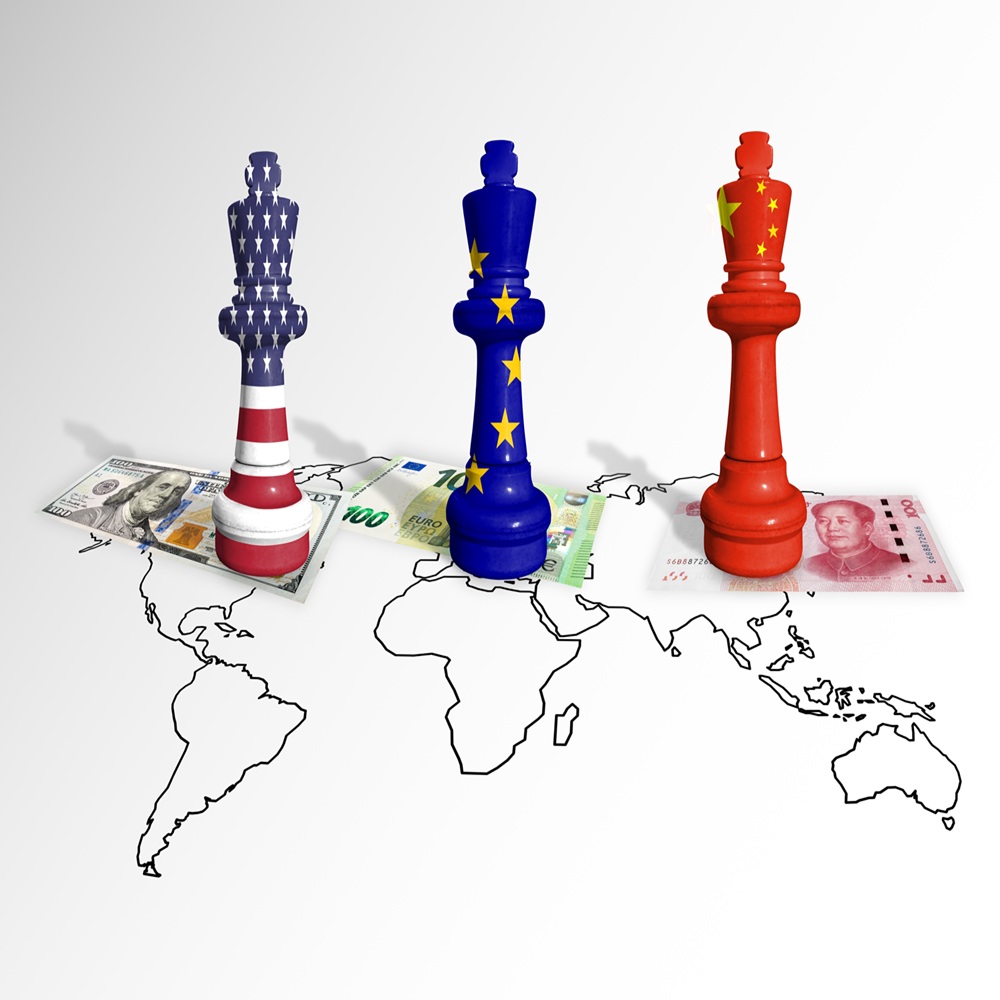
Chess made from USA, EU and China flags on a white background. Chess made from China, Europe Union and United States of America flags. Trade, tariffs, duty and customs war

Europe’s transatlantic China challenge

by Gesine Weber

Abstract European states currently lack a clear joint strategy on China and a coordinated approach to US–China competition. This article offers a novel perspective on the challenges for European approaches to this issue due to an omnipresent transatlantic component and the risk of an alliance dilemma. Illustratively focusing on France, Germany and the UK, it demonstrates that Europeans are facing a transatlantic alliance dilemma with the risks of abandonment and entrapment. It argues that Europe needs to strike a balance between its dependence on Washington, especially with regard to European security, while fearing entrapment by the US approach towards Beijing as it aims to maintain economic ties with China. The article concludes that the ramifications of this dilemma can be mitigated through a distinctly European approach to China, strengthening European coordination on China and bolstering European strategic autonomy. As a conceptual piece rather than a full empirical analysis, this article therefore unpacks the strategic challenge and lays the groundwork for further empirical works on the topic. Introduction Strategic competition between the US and China plays out in many realms of international affairs, ranging from global trade to security in the Indo-Pacific. European states are directly affected by this dynamic as they maintain critical ties with both sides. Albeit allies of the US through NATO, Europeans have been reluctant to align with the US on its approach to the Indo-Pacific and China, which is currently characterised by the quest to win the strategic competition with Beijing in all areas of international affairs (see Leoni 2023). Furthermore, Europe maintains close economic ties with Beijing, and imports from China to the EU have most recently increased (Lovely and Yan 2024). European governments certainly do not pursue an approach of maintaining equidistance between the US and China: not only do they regularly emphasise their strategic proximity to Washington, but more recent events, such as the willingness of European allies to publicly adopt the wording of the communiqué from NATO’s Washington summit (NATO 2024) describing China as an ‘enabler of Russia’s war effort in Ukraine’, clearly demonstrate that the tone is changing in European capitals (Politi 2023). However, Europeans still tend to emphasise China’s role in global affairs and the importance of including it in multilateral cooperation formats. With the re-election of Donald Trump as US president, European policy on China and its approach to US–China competition will increasingly be a focus of the US administration. While the exact approach of the new US government still remains to be defined, there are good reasons to anticipate a more hawkish China policy from Washington, through which the US might seek not only to further compete with China, but to actually win this competition (see Pottinger and Gallagher 2023). When designing their approaches towards China—which, among the key European states, only Germany has done so far, with the publication of its China strategy in 2023—Europeans always face a transatlantic elephant in the room. US–China competition, a structuring feature of international relations shaping the global order today through the increasing emergence of geopolitical blocs (see Leoni and Tzinieris 2024), and China’s rising global influence in almost all areas of international affairs—ranging from climate to economics, the rules-based order and security—are forcing European states to reflect on their approach vis-à-vis Beijing (for a full discussion, see Oertel 2023; García-Herrero and Vasselier 2024). As NATO members, European states also need to adapt their strategy in light of the partnership with the US as their key ally. This article argues that European approaches towards China, as shown in the examples of France, Germany and the UK, have a distinctly transatlantic component. It illustrates how these three European states find themselves in an alliance dilemma with the US, and how the risks associated with alliances also define European approaches to China and US–China competition more broadly. As the US administration regularly refers to China as a ‘challenge’ (US Department of Defense 2022), this article alludes to this formulation through the coining of the term ‘transatlantic China challenge’ to describe the strategic challenges Europeans are facing with regard to defining their approach vis-à-vis China and US–China competition more broadly. It offers a conceptual understanding of the strategic challenges for Europe in this context and thereby constitutes a basis for a more thorough empirical analysis. The alliance dilemma and European strategy in US–China competition Originating in realist international relations theory, the alliance dilemma generally describes a situation in which states face risks resulting from joining an alliance. As demonstrated by Snyder (1984), smaller allies especially face a parallel risk of abandonment and entrapment by a hegemon, that is, the dominating power, after joining an alliance. Abandonment, in these circumstances, implies that the hegemon has no further interest in defending or supporting the smaller allies, whereas entrapment refers to a situation in which a state is ‘dragged into a conflict over an ally’s interests that [it] does not share, or shares only partially’ (see Snyder 1984, 466–8). In the context of alliances, a small state is ‘the weaker part in an asymmetric relationship, which is unable to change the nature or functioning of the relationship on its own’ (Wivel et al. 2014, 9), and hence has more limited space for action than the great powers (Wivel and Thorhallsson 2018, 267). This definition arguably applies to Europe in its partnership with the US, as demonstrated by the excessive military and economic dominance of the US as compared to the European states (see Stockholm International Peace Research Institute n.d.; International Monetary Fund 2025). The re-election of Trump as US president now presents the risk of an increased alliance dilemma for Europeans. On the one hand, Trump has announced several times that he does not value the alliance commitments within NATO and potentially would not defend European allies (Sullivan 2024), threatening Europe with abandonment. This scenario is being taken seriously in European capitals, and reflections on how ‘defending Europe with less America’ (Grand 2024) could shape up have gained traction, especially in 2024. Similarly, defence initiatives within the EU to enhance the European contribution to the continent’s security have leapt forward in recent years (see Scazzieri 2025). On the other hand, even the Biden administration had pushed Europe to align with the US approach on China (see Lynch et al. 2023). However, France and Germany in particular, as the big EU member states, have been hesitant to do so, as reflected in France’s opposition to the opening of a NATO liaison office in Tokyo (McCurry 2023) and Germany’s vote against tariffs on Chinese electric vehicles, fearing reprisals from Beijing (Demarais 2024). Trump’s foreign policy might be strongly characterised by issue linkage, which means that policies in one area will be linked to those in another area. Through this strategy, the new US administration might force Europeans into alignment and thereby entrap them, making them accept policies they are not eager to support (see Barkin and Kratz 2025). The exact policies of the Trump administration vis-à-vis European allies remain to be seen, but it is not hard to imagine a scenario in which abandonment and entrapment could emerge or increase, namely when the threat of abandonment is used to entrap allies and force them to support certain policy decisions. The alliance dilemma could play out for Europeans specifically when designing their approaches towards China (see Barkin and Kratz 2025) and formulating their response to US–China competition more generally. As noted above, among the big European states, only Germany has formally adopted a strategy on China, in 2023 (The Federal Government of Germany 2023). However, China and the response to US–China competition takes a prominent place in France’s Indo-Pacific Strategy and its strategy review (Government of France 2021; Secrétariat général de la défense et de la sécurité nationale 2022), and the UK systematically included the dimension of strategic competition in its Integrated Review and its refresh (Government of the United Kingdom 2021, 2023) and has announced an ‘audit’ of its China policy under the new government (Taylor 2024). While these strategies emphasise their individual approaches towards China and the risks stemming from US–China competition, the US has increasingly pressured Europe to align with its approach (Lynch et al. 2023) and can be expected to continue this pressure (Barkin and Kratz 2025). Through the potential issue linkage of security (openly questioned by President Trump) and China policy, Europe therefore finds itself in a new form of alliance security dilemma. European approaches to US–China competition: strategic hedging How can Europe respond to the alliance dilemma of the risks of abandonment and entrapment when it comes to its approaches to China? Reviewing the theoretical literature on the alliance dilemma, one can imagine different strategies. According to Snyder, members of alliances can choose between strategies that strengthen or weaken their commitment to the alliance. To demonstrate commitment, actions could include reassurances for the ally or demonstrations of loyalty, whereas actions to weaken the commitment to the alliance could consist of restraining the ally (mostly to reduce the risk of entrapment in a conflict), increasing bargaining power over the ally or preserving options for realignment outside the existing alliance (for a full discussion, see Snyder 1984, 466–9). Alternative strategies include hiding from cooperation, that is, ‘seeking to maximize autonomy by opting out of specific aspects of the cooperation or by setting up “bastions” in the cooperation’, or bandwagoning, through which states pursue strategies of adaptation ‘to the more powerful actors in the cooperation’ (Pedersen 2023, 442). At the moment, it seems that France, Germany and the UK ‘drive on sight’ rather than approaching the question holistically. The following analysis aims to unpack how the three European states see US–China competition, the risk of the alliance dilemma and how these reflections have played out so far in their strategies. The strategies of France, Germany and the UK on China demonstrate that their approaches are influenced by a distinctly transatlantic component and reflect the transatlantic alliance dilemma. This is visible in their (1) high awareness of the risks stemming from great power competition, (2) approaches to managing the risk of short-term abandonment, and (3) hedging to mitigate the medium- and long-term risks of abandonment and entrapment. The empirical evidence for this analysis was gathered through a qualitative analysis of European strategic documents, statements and policy decisions taken mostly during the period of the Biden administration. However, in light of the risk of a scaling-up of the alliance dilemma under the Trump administration, sources and evidence accessible by the end of January 2025 were included to illustrate the European approaches. In addition to publicly available documents and the sources mentioned above, this paper draws on conversations with policymakers and experts under the Chatham House rule. Mitigating risks from US–China competition: multilateralism instead of alignment That France, Germany and the UK are close allies with the US is clearly visible in their respective strategies on China, not least because of references they make to the importance of the alliance and their descriptions of their own positions between the two great powers. Overall, France, Germany and the UK share the perception of US–China competition and the emergence of blocs as potentially harmful to their interests. As a consequence, all three call for an inclusive multilateral order instead of falling into a logic of blocs, as the increasing competition is seen as a risk for Europe (Secrétariat général de la défense et de la sécurité nationale 2022, 9–15; The Federal Government of Germany 2020, 24–6; Government of the United Kingdom 2023, 22–6). The response of all three European powers to the emergence of blocs is multilateralism: instead of clearly aligning with the US, the French, German and British strategies call for building broader multilateral coalitions, which should, eventually, also include China (The Federal Government of Germany 2020, 23–6; Government of the United Kingdom 2023). The tone in Paris, Berlin and London towards Beijing has clearly changed over recent years; accordingly, the European capitals were also willing to support strong wording on China in the 2024 NATO summit declaration, which describes China as a ‘critical enabler’ of Russia’s ongoing war against Ukraine (NATO 2024). Albeit also recognised as a critical partner for key issues such as climate policy and trade, European states openly describe China as a ‘systemic rival’ and occasionally call out China’s behaviour, as they did, for example, in the case of a note verbale on the South China Sea (UN 2020). Nevertheless, Europe has not (yet) given in to US pressure to align with Washington’s more confrontational approach towards China (Etienne 2024). Even if European states and Washington have moved closer to each other, especially on economic security (Meyers and Reinsch 2023), the European positions on US–China competition demonstrate that Europeans are not willing to fully endorse or follow Washington’s approach—not least because European imports from China have increased in recent years (Lovely and Yan 2024). Managing the risk of short-term abandonment Since Trump’s election, the risk of abandonment by the US has been seen as increasingly high in Paris, Berlin and London.1 This is not least because Trump has openly questioned his willingness to adhere to Article 5 of the North Atlantic Treaty in the case of an armed attack on Europeans (Sullivan 2024). Europeans are especially concerned about issue linkage in this context, meaning that demands in a policy area other than security could be used as a condition. Concretely, Trump could use the threat of abandonment as leverage to compel Europe to align with the US on China policy.2 Barkin and Kratz (2025) suggest that Europe adopt a ‘carrot and stick’ approach, whereby Europe could start with an offer to the US: buying more liquified natural gas, defence goods and agricultural products from the US could mitigate the risk of abandonment. However, there is awareness among European states that coercion from the US to align on US–China policy, especially when linked to the threat of abandonment, might best be mitigated through enhancing European military capabilities—which would still leave the continent exposed to these threats, though to a lesser extent.3 Addressing the risk of medium- and long-term abandonment and entrapment: transatlantic hedging However, the risk of at least partial abandonment is not a new challenge for European strategy, and had already infused earlier strategic thinking. The shift of US strategic priorities away from Europe and to the Indo-Pacific has already been demonstrated in the allocation of resources to the different theatres. Moreover, European states have increasingly become aware that US forces will be withdrawn from their territories in the future and have concluded that they will have to step up their own commitment to European security (see Grand 2024). In parallel, there is an awareness in European capitals that showing more interest in the Indo-Pacific and giving more importance to policy on China is also a way for Europeans to demonstrate an understanding of their ally’s strategic priorities.4 Accordingly, the approaches of France, Germany and the UK to China and the Indo-Pacific also have to be understood as a commitment to the priorities of the US in order to keep this ally engaged in the European theatre and mitigate the risk of abandonment; however, European states abstain from fully aligning with the US approach, as their capabilities and strategic goals are perceived as diverging from those of the US. In this way, Europe aims to avoid entrapment over the medium term through slightly distancing itself from US policy. While all three European states also call for de-risking from China and diversification of their supply chains, maintaining strong economic ties with Beijing is a key component of their respective approaches—which contrasts with the US calls for decoupling. Furthermore, these states have never formally endorsed the US policy on China (Etienne 2024). Nevertheless, enhancing European capabilities would not only send a signal to Washington, but also qualify as hedging, understood as an ‘insurance policy’ to avoid a deterioration in US–Europe relations if the US opted for abandonment, or even as part of a move towards emancipation to reduce strategic dependencies on Washington (see Fiott 2018, 4–6). Conclusion: a transatlantic China challenge Designing their approaches to China and to US–China competition more broadly constitutes a complex strategic dilemma for European states. Paris, Berlin and London do not fully align with Washington’s approach, and it remains to be seen whether they will be willing to do so under the second Trump administration. To manage the risk of abandonment and entrapment, European states pursue different individual approaches to strategic hedging: their strategies on China and US–China competition are designed in a way that allows them to mitigate the risk of abandonment which might stem from significant transatlantic divergence, and to avoid automatic entrapment through their slight distancing from the US approach. From a theoretical perspective, this article has demonstrated that the alliance dilemma, along with the parallel fear of abandonment and entrapment by the US, is a major factor accounting for Europe’s limited strategies on China and its hedging behaviour. This article offers a conceptual analysis of the structural forces explaining European strategies, but other strategic cultures and relationships with the US could offer important complementary insights. To further analyse how individual European states design their strategies vis-à-vis China in light of the alliance dilemma and potential domestic constraints and specificities, neoclassical realism could offer an interesting analytical concept. This approach posits that structural forces set the parameters for foreign policy and treats domestic factors, including strategic culture, as intervening variables (see Rose 1998). Accordingly, it appears well suited for foreign policy analysis, and has indeed gained popularity in the field in recent years (see, for example, Martill and Sus 2024; Meibauer et al. 2021; Weber 2024). Empirically, this article constitutes a conceptual starting point rather than an exhaustive analysis of the strategy-making processes of European states with regard to China and US–China competition and makes a more comprehensive assessment desirable. The findings of this article have broader implications for policymaking. First, they demonstrate the necessity for Europe to determine its place in the increasing US–China competition. European coordination on the respective approaches vis-à-vis the US—especially in light of potential coercion to align—and China is of paramount importance to ensure that foreign policy strategies are mutually reinforcing and not undermining European objectives. Second, the article demonstrates that Europe currently responds to the ‘transatlantic China challenge’ through transatlantic hedging: while this strategy seems to be promising in the short term, it is questionable to what extent the strategy is sustainable and could help European states to navigate the parallel challenges of abandonment and entrapment. Unless Europe decides to fully align with the US—and it is questionable whether this decision would be in its interest—European states would be well advised to develop a sustainable long-term approach to China. A transatlantic dialogue on China, in which Europe and the US openly discuss synergies and divergences, could help prevent misunderstandings and decrease the risk of coercion or issue linkage due to a misreading of European approaches in Washington. Third, as the risks of (at least partial) abandonment and entrapment are systemic challenges due to the current composition of the transatlantic alliance, a logical step for European states to decrease their dependence on the US as the hegemon in the alliance would be to significantly strengthen European capabilities. Stronger military capabilities could help mitigate the ramifications of abandonment, and the aforementioned distinctly European strategy could allow Europe to avoid strategic entrapment in relation to China imposed by Washington. As Europe remains the junior partner in the transatlantic alliance, the parallel risks of abandonment and entrapment, as well as issue linkage, are highly likely to influence its approaches towards China in the long term, but there are certainly ways to render this ‘transatlantic China challenge’ less challenging. ORCID iDGesine Weber https://orcid.org/0009-0008-2643-0400Footnotes1. Conversation with French, German and British experts in Berlin, January 2025.2. Conversation with French, German and British experts in Berlin, January 2025.3. Conversation with French, German and British experts in Berlin, January 2025; conversation with European experts and officials in Paris, January 2025.4. Conversation with officials from Germany and France in Paris, November 2024; conversation with French, German and British experts in Berlin, January 2025.ReferencesBarkin N., Kratz A. (2025). Trump and the Europe–US–China Triangle. Rhodium Group, 16 January. https://rhg.com/research/trump-and-the-europe-us-china-triangle/. Accessed 18 January 2025.Demarais A. (2024). Divided we stand: The EU votes on Chinese electric vehicle tariffs. European Council on Foreign Relations, 9 October. https://ecfr.eu/article/divided-we-stand-the-eu-votes-on-chinese-electric-vehicle-tariffs/. Accessed 25 January 2025.Etienne P. (2024). The European Union between the United States and China: Should we choose between equidistance and following? Fondation Robert Schuman, 8 October. https://www.robert-schuman.eu/en/european-issues/763-the-european-union-between-the-united-states-and-china-should-we-choose-between-equidistance-and-following. Accessed 22 December 2024.Fiott D. (2018). Strategic autonomy and the defence of Europe. European Union Institute for Security Studies, Brief 12/2018. https://www.iss.europa.eu/sites/default/files/EUISSFiles/Brief%2012__Strategic%20Autonomy.pdf. Accessed 25 January 2025.García-Herrero A., Vasselier A. (2024). Updating EU strategy on China: Co-existence while de-risking through partnerships. Mercator Institute for China Studies. https://merics.org/en/external-publication/updating-eu-strategy-china-co-existence-while-de-risking-through-partnerships. Accessed 30 January 2025.Government of France. (2021). France’s Indo-Pacific strategy. https://www.diplomatie.gouv.fr/IMG/pdf/en_dcp_a4_indopacifique_022022_v1-4_web_cle878143.pdf. Accessed 31 January 2025.Government of the United Kingdom. (2021). Global Britain in a competitive age: The integrated review of security, defence, development and foreign policy. London: The Stationery Office. https://www.gov.uk/government/publications/global-britain-in-a-competitive-age-the-integrated-review-of-security-defence-development-and-foreign-policy. Accessed 18 January 2025.Government of the United Kingdom. (2023). Integrated review refresh 2023: Responding to a more contested and volatile world. London: The Stationery Office. https://www.gov.uk/government/publications/integrated-review-refresh-2023-responding-to-a-more-contested-and-volatile-world. Accessed 18 January 2025.Grand C. (2024). Defending Europe with less America. European Council on Foreign Relations, 3 July. https://ecfr.eu/publication/defending-europe-with-less-america/. Accessed 18 January 2025.International Monetary Fund. (2025). World economic outlook: GDP data mapper [Map]. https://www.imf.org/external/datamapper/NGDPD@WEO/OEMDC/ADVEC/WEOWORLD. Accessed 23 January 2025.Leoni Z. (2023). Grand strategy and the rise of China: Made in America. Agenda Publishing.Leoni Z., Tzinieris S. (2024). The return of geopolitical blocs. Survival, 66(2), 37–54.Lovely M. E., Yan J. (2024). As the US has relied less on imports from China, the EU has imported more. Pederson Institute for International Economics, 24 August. https://www.piie.com/research/piie-charts/2024/us-has-relied-less-imports-china-eu-has-imported-more. Accessed 22 December 2024.Lynch S., Toosi N., Moens B., Banco E. (2023). The U.S. wants Europe to stand up to China. Europe says: Not so fast. Politico, 3 August. https://www.politico.com/news/2023/03/08/us-europe-china-00086204. Accessed 18 January 2025.Martill B., Sus M. (2024). Winds of change? Neoclassical realism, foreign policy change, and European responses to the Russia-Ukraine War. British Journal of Politics & International Relations.McCurry J. (2023). France opposed to opening of Nato liaison office in Japan, official says. The Guardian, 7 June. https://www.theguardian.com/world/2023/jun/07/france-opposed-to-opening-of-nato-liaison-office-in-japan-official-says. Accessed 25 January 2025.Meibauer G., Desmaele L., Onea T., Kitchen N., Foulon M., Reichwein A., Sterling-Folker J. (2021). Forum: Rethinking neoclassical realism at theory’s end. International Studies Review, 23(1), 268–95.Meyers E., Reinsch W. A. (2023). The push for U.S.–EU convergence on economic security policy. Center for Strategic and International Studies, 7 July. https://www.csis.org/analysis/push-us-eu-convergence-economic-security-policy. Accessed 26 January 2025.NATO. (2024). Washington Summit declaration. https://www.nato.int/cps/cn/natohq/official_texts_227678.htm. Accessed 18 January 2025.Oertel J. (2023). Ende der China-Illusion: Wie wir mit Pekings Machtanspruch umgehen müssen. Munich: Piper Verlag.Pedersen R. B. (2023). Small states shelter diplomacy: Balancing costs of entrapment and abandonment in the alliance dilemma. Cooperation and Conflict, 58(4), 441–59.Politi A. (2023). The paradigm shift in EU–China relations and the limits of the EU’s current strategy towards China: A relational perspective. Asian Affairs 54(4), 670–93.Pottinger M., Gallagher M. (2024). No substitute for victory: America’s competition with China must be strategic and ideological. Foreign Affairs, 10 April. https://www.foreignaffairs.com/united-states/no-substitute-victory-pottinger-gallagher. Accessed 18 January 2025.Rose G. (1998). Neoclassical realism and theories of foreign policy. World Politics, 51(1), 144–72.Scazzieri L. (2025). Towards an EU ‘defence union’? Centre for European Reform, 30 January. https://www.cer.eu/publications/archive/policy-brief/2025/towards-eu-defence-union. Accessed 30 January 2025.Secrétariat général de la défense et de la sécurité nationale. (2022). Revue nationale stratégique 2022. https://www.sgdsn.gouv.fr/publications/revue-nationale-strategique-2022. Accessed 18 January 2025.Snyder G. H. (1984). The security dilemma in alliance politics. World Politics, 36(4), 461–95.Stockholm International Peace Research Institute. (n.d.). SIPRI Military Expenditure Database.Sullivan K. (2024). Trump says he would encourage Russia to ‘do whatever the hell they want’ to any NATO country that doesn’t pay enough. CNN, 11 February. https://edition.cnn.com/2024/02/10/politics/trump-russia-nato/index.html. Accessed 29 January 2025.Taylor R. (2024). UK government policy towards China. https://lordslibrary.parliament.uk/uk-government-policy-towards-china/. Accessed 18 January 2025.The Federal Government of Germany. (2020). Policy guidelines for the Indo-Pacific. www.auswaertiges-amt.de/blob/2380514/f9784f7e3b3fa1bd7c5446d274a4169e/200901-indo-pazifik-leitlinien–1–data.pdf. Accessed 21 December 2024.The Federal Government of Germany. (2023). China-Strategie der Bundesregierung. Berlin: Auswärtiges Amt. https://www.auswaertiges-amt.de/blueprint/servlet/resource/blob/2608578/810fdade376b1467f20bdb697b2acd58/china-strategie-data.pdf. Accessed 18 January 2025.UN (2020). Note verbale, UK NV No. 162/20, 16 September. https://www.un.org/Depts/los/clcs_new/submissions_files/mys_12_12_2019/2020_09_16_GBR_NV_UN_001.pdf. Accessed 25 January 2025.US Department of Defense. (2022). National Defense Strategy of the United States of America. https://media.defense.gov/2022/Oct/27/2003103845/-1/-1/1/2022-NATIONAL-DEFENSE-STRATEGY-NPR-MDR.pdf. Accessed 25 January 2025.Weber G. (2024). Zeitenwende à la française: Continuity and change in French foreign policy after Russia’s invasion of Ukraine. British Journal of Politics & International Relations.Wivel A., Bailes A. J. K., Archer C. (2014). Setting the scene: Small states and international security. In Archer C., Bailes A. J. K., Wivel A. (eds.), Small states and international security: Europe and beyond (pp. 3–25). London: Routledge.Wivel A., Thorhallsson B. (2018). Brexit and small states in Europe: Hedging, hiding or seeking shelter? In Rosamond B., Nedergaard P., Diamond P. (eds.), The Routledge handbook of the politics of Brexit, 1st edn. (pp. 266–77). Abingdon-on-Thames: Routledge.
Defense & Security
flag country Europe defense army

European Union Strategic Autonomy. Necessary but potentially problematic?

by Krzysztof Śliwiński

Abstract This paper examines the evolving concept of European Union Strategic Autonomy (EU-SA) within the context of contemporary geopolitical challenges, with a particular focus on EU-Russia and EU-China relations. EU-SA reflects the EU's aspiration to act independently in foreign policy, security, defence, and economic affairs, moving from a rule-taker to a rule-maker in global politics. The study outlines the historical development of EU-SA from 2013 to the present, highlighting key milestones such as the Strategic Compass and the impact of the Ukraine War, which accelerated efforts toward defence collaboration, energy independence, and economic resilience. It explores the transatlantic dynamics, noting growing uncertainties in the U.S. commitment to NATO and the resulting push for a more autonomous European defence posture. Additionally, it addresses the complex EU-China relationship, marked by both cooperation and competition, as well as the strained EU-Russia ties amid ongoing conflict. The paper concludes by questioning the economic feasibility and political risks of deeper EU strategic autonomy, especially regarding security centralisation and Germany's leadership role. Key Words: EU, Strategic Autonomy, Security, Geopolitics, U.S, China, Russia Introduction At the 2025 North Atlantic Treaty Organisation (NATO) Summit in The Hague, member states (Allies) committed to investing 5% of their Gross Domestic Product (GDP) annually in core defence requirements and defence- and security-related spending by 2035. They will allocate at least 3.5% of GDP annually, based on the agreed-upon definition of NATO defence expenditure, by 2035 to resource core defence requirements and meet the NATO Capability Targets. Allies agreed to submit annual plans that show a credible, incremental path to achieving this goal.[1] At the same time, Spain secured a special compromise, committing to meet core requirements with just 2.1% of GDP, making it the only exception to the broader 5% target. Previously, in 2014, NATO Heads of State and Government had agreed to commit 2% of their national GDP to defence spending, to help ensure the Alliance's continued military readiness. This decision was taken in response to Russia's illegal annexation of Crimea, and amid broader instability in the Middle East. The 2014 Defence Investment Pledge was built on an earlier commitment to meeting this 2% of GDP guideline, agreed in 2006 by NATO Defence Ministers. In light of the increase in defence spending, given that 23 out of 32 NATO Allies are EU member states, the idea of European Union strategic autonomy (EU-SA) comes to mind. This paper will explore the issue of EU-SA with a specific reference to EU-Russia and EU-China relations.[2] A Brief History of EU Strategic Autonomy European Union strategic autonomy is an evolving concept that reflects its ambition to act independently in strategically important policy areas, including foreign policy, security, defence, and economic relations. Strong strategic autonomy, according to Barbara Lippert, Nicolai von Ondarza and Volker Perthes, means being able to set, modify and enforce international rules, as opposed to (unwillingly) obeying rules set by others. The opposite of strategic autonomy is being a rule-taker, subject to strategic decisions made by others, such as the United States, China, or Russia.[3] The concept was first prominently discussed in the context of defence in 2013 and has since expanded to encompass a broader range of policy areas. Historically speaking, one can identify numerous phases during which EU-SA evolved. - 2013-2016: During this period, EU-SA focused on security and defence, with initiatives like the Permanent Structured Cooperation (PESCO) and the European Defence Fund, aiming to strengthen the EU's defence capabilities.[4]  - 2017-2019: During this period, the EU-SA shifted its focus to defending European interests in a hostile geopolitical environment, influenced by events such as Brexit, the Trump presidency, and China's growing assertiveness.- 2020: The COVID-19 pandemic highlighted economic vulnerabilities, prompting a focus on mitigating dependence on foreign supply chains, particularly in critical sectors like health and technology.- Since 2021: The scope widened to virtually all EU policy areas, including digital, energy, and values, with terminology evolving to include "open strategic autonomy," "strategic sovereignty," "capacity to act," and "resilience".- 2022: The Ukraine War and Accelerated Implementation. Russia's invasion of Ukraine catalysed concrete actions toward EU-SA, notably in defence, energy independence, and economic resilience. The European Council's Versailles Declaration (March 2022) expressed strong political will to increase EU-SA, calling for collaborative investments in defence, phasing out dependency on Russian energy, and reducing reliance on critical raw materials, semiconductors, health, digital technologies, and food imports.[5] - The Strategic Compass for security and defence policy (endorsed March 2022) outlines a roadmap to 2030, emphasising strengthened EU defence capacities. Among others, it includes: o   Establishment of a strong EU Rapid Deployment Capacity of up to 5000 troops for different types of crises.o   Ready to deploy 200 fully equipped Common Security and Defence Policy (CSDP) mission experts within 30 days, including in complex environments.[6]o   Conducting regular live exercises on land and at sea.o   Enhanced military mobility.o   Reinforcement of the EU's civilian and military CSDP missions and operations by promoting a rapid and more flexible decision-making process, acting more robustly and ensuring greater financial solidarity.o   Making full use of the European Peace Facility to support partners.[7] According to the EU itself, the EU-SA is not a zero-sum game, but rather a sliding scale between complete autonomy and full dependency, with different results for different policy areas. What is more, when compared to the famous Maslow's hierarchy of needs (European Parliament briefing's language), the EU is not only perceived as an economic power, but it is also seen as a normative power. Therefore, the EU is recognised for its core values of democracy, human rights and the rule of law. Ultimately, Maslow's “self-actualisation” could mean the achievement of an EU in which citizens recognise their European identity and which has realised its full autonomous policy potential.[8]   As if this is not enough, the same source introduces the concept of the 360° strategic autonomy wheel, which reportedly illustrates policy areas in which the EU aims for greater strategic autonomy, as well as the connections between them. Mutual influence between policy areas can happen across the wheel, but is particularly strong in adjacent areas. Military action, for example, can cause migration, health is linked to food quality, energy policy influences the climate, and misinformation undermines democracy. The wheel can help to understand links, set priorities and view potential conflicts. More autonomy in the digital green economy will, for example, require vast quantities of “rare earth” materials, making the EU more (instead of less) dependent on imports. Reductions in energy consumption achieved through the digitalisation of the economy (for example, by reducing transport) will be partly offset by the increase in energy consumption by electronic devices and data centres.   Global Context The significance of EU-SA lies in ensuring the EU's political survival and global influence in a multipolar world where its relative power is diminishing. The EU's long-term economic outlook is bleak: its share of global GDP, now at 17% (at current prices), could nearly halve by 2050. According to the World Economic Forum, this economic backsliding not only threatens Europe's ability to fund its social model but also risks weighing on the bloc's global influence, leaving it even more dependent on the U.S. and China.[9] Moreover, the COVID-19 pandemic highlighted the conflictual nature of economic interdependence, as reliance on foreign supply chains for critical goods exposed vulnerabilities. Soft power has become an instrument of hard power, necessitating autonomy in trade, finance, and investment.  The U.S.'s strategic pivot to Asia, the exclusion of Europe in conflicts like Nagorno-Karabakh, Libya, and Syria (termed Astanisation[10], which favours Russia and Turkey), the sidelining of the EU in EU-Russia negotiations regarding the war in Ukraine, and China's state-led economic model have all pushed the EU towards the sidelines. Transatlantic divide Security is a critical dimension, with significant uncertainty surrounding the U.S. commitment to NATO under the Trump administration. Reports indicate Trump has questioned NATO's Article 5 guarantees, with actions like withdrawing military personnel from a Ukraine aid hub in Poland on April 8, 2025, and proposing to stand down 10,000 light infantry troops in Poland, Romania, and the Baltic states by 2025.[11] This has led to fears of a "NATO-minus" scenario, where the EU must fill security gaps without full U.S. backing. In response, the EU is pushing for greater strategic autonomy in defence. Initiatives like ReArm EU are mentioned, with calls for the EU to develop a stand-alone, integrated military capacity to stabilise the global economy. As Jean-Pierre Maulny, Deputy Director of the French Institute for International and Strategic Affairs (IRIS), adequately observes "The risk is now clear: a form of bilateral agreement between the United States and Russia, benefiting the interests of both countries, could leave Ukraine severely weakened and an easy prey for Moscow, thereby weakening other European countries consequently. As a consolation prize, we will have to ensure Europe's conventional security, as U.S. Secretary of Defence Pete Hegseth announced to Europeans at the opening of the NATO ministerial meeting held in Brussels on 12–13 February 2025. This situation will place Europeans in a terrible dilemma: Either they do not wish to provide security guarantees to Ukraine and risk completely discrediting themselves in the eyes of powers such as the United States, Russia, and China, as Europeans will have demonstrated that they are unable to defend the continent, while also creating a significant long-term risk to Europe's security. Alternatively, they could provide security guarantees to Ukraine, accepting the financial burden that would impact the European Union's long-term competitiveness. In light of this situation, some advocate for the establishment of a European pillar within NATO. If one considers that the United States is negotiating peace in Europe without and against the Europeans, and that they no longer wish to defend Europe with conventional military means (will they respect the NATO Defence Planning Process?), Europeans should take on Europe's security fully. This would mean taking control of NATO. It will also be easier to make NATO and the European Union work together with a more Europeanised organisation".[12] Economically, there are several issues that contemporary demand addresses, but the most pressing is, of course, the Tariffs. The U.S. and European Union are running out of time to strike a deal on trade tariffs. Negotiations have been slow since both the U.S. and EU temporarily cut duties on each other until July 9. If an agreement is not achieved by then, full reciprocal import tariffs of 50% on EU goods, and the bloc's wide-spanning countermeasures are set to come into effect.[13] According to Almut Möller, Director for European and Global Affairs and head of the Europe in the World programme (European Policy Centre), "for the first time in decades, Europeans can no longer rely on a benign partner on the other side of the Atlantic, leaving them dangerously exposed and acutely vulnerable, including on the very foundations of liberal democracy. Until recently, the U.S. dominated a world order that provided a favourable environment for the EU to extend its membership, further develop, and leverage its strengths, particularly as a trading power, without having to worry much about geopolitics. Suddenly, liberal Europe looks very lonely, and is struggling to keep up with a world of change".[14] Other problems arguably include digital regulation and data protection, antitrust policy and digital taxation, fiscal policy and social protection, geopolitical rivalries, China's rise, and competition and trade policy. EU–China conundrum Both the EU and the U.S. are concerned about China's growing economic and technological influence, but they have differing approaches to addressing this challenge. The EU has sought to maintain a balance between cooperation and competition with China, while the U.S. has adopted a more confrontational approach.[15] These differences have led to tensions in areas such as trade policy and technology regulation. For example, the EU has been critical of the U.S.'s unilateral approach to addressing China's trade practices, while the U.S. has accused the EU of being too lenient towards China. These disagreements have made it difficult to achieve a coordinated transatlantic response to China's rise.[16] According to German experts, the balance of power between China and the EU and its member states is developing increasingly asymmetrically to Europe's disadvantage. Only in trade policy – and partially in investment – can the EU maintain its position in a manner respected by China.[17] Europe holds significant importance for China across various dimensions: economically, as its top supplier and second-largest export destination; technologically, as a source of advanced technology; institutionally, as a model to emulate; politically, to advance its objectives concerning other nations, particularly the United States; and selectively, as a collaborator in areas like global health and regional stabilisation. Unlike Russia and the United States, China perceives a vital interest in the EU's continued existence and unity within a multipolar world; yet, it employs a "divide and rule" strategy. China selectively rewards or penalises individual EU countries based on their political and economic significance and their compliance with China's expectations on key issues. These issues include arms sales to Taiwan, meetings with the Tibetan Dalai Lama, and positions on the Uighurs, human rights in China, and the South China Sea. China engages with Europe on multiple levels — political, economic, technological, cultural, and academic — using various political channels (such as strategic partnerships with the EU and individual EU member states), dialogue formats (like the 16+1 format with sixteen Central and Eastern European countries), and high-level bilateral intergovernmental consultations with Germany, France, and the United Kingdom. China's hopes that the European Union would emerge as an independent and comprehensive player in global politics, serving as a counterbalance to the United States, have diminished. However, China would be supportive of any European efforts towards achieving strategic autonomy, provided it does not translate into a confrontational approach towards China itself. In contrast, Europe's political priorities—such as ensuring peace and stability in East Asia, China's role in global stability, development, environmental issues, climate change, and non-proliferation, as well as improving human rights in China — are often considered secondary and are not actively pursued by all EU member states. Europe lacks a unified and assertive foreign policy stance regarding the geopolitical rivalry between the United States and China for dominance in the Asia-Pacific region. There is also an absence of a clear position on China's authoritarian vision of order. Even in trade and investment disputes, Europe struggles to establish a unified approach to resolving these issues. The EU member states are too diverse in terms of size, profiles, and interests in their dealings with China: Economically, there is a divide between countries that are appealing industrial and technological partners for China and those that compete for favour in Beijing. Some nations have a clear interest in global governance. Additionally, the United Kingdom and France maintain their respective military presences in the Asia region. In this context, ReArm EU and its financial instrument SAFE (analysed here https://worldnewworld.com/page/content.php?no=5384 ) have the potential to provide the EU with meaningful strategic autonomy and invite genuine geopolitical actorness. EU–Russia conundrum Since Donald Trump took office as the U.S. president, the coordination of transatlantic policies regarding Russia has largely disintegrated. The White House's openness to a comprehensive "deal" with Russian President Vladimir Putin contrasts with Congress's attempts to limit Trump's foreign policy options with Russia, resulting in the marginalisation of coordination with European allies. This situation is further complicated by Washington's increasing reliance on extraterritorial sanctions, a trend that began before Trump's presidency. Consequently, according to European foreign and security experts, Europe must achieve greater strategic autonomy in its dealings with Russia. However, this relationship is particularly strained by significant conflicts of interest. Russia's invasion of Ukraine significantly disrupted the previously peaceful and liberal democratic relations among European nations. Putin's "special military operation" compelled the EU to introduce seventeen (so far) escalating economic sanction packages aimed at undermining the Russian economy and ultimately limiting Russia's capacity to continue the war. In a gesture of solidarity with Ukraine, the EU has also allocated billions of euros to both EU member states and Ukraine to avert a humanitarian disaster and ensure the provision of essential needs for Ukrainians fleeing the conflict.[18] After three and a half years from the outset of the war, Russia continues to pose a complex challenge that the EU and European nations cannot address independently in the foreseeable future. If the U.S. security guarantee weakens before Europe can bolster its own capabilities, the EU could face new vulnerabilities that Russia might exploit along its external borders, such as in the Baltic states, and elsewhere. Currently, the EU and its member states lack sufficient means to deter Russia from pursuing its interests aggressively and recklessly in the shared neighbourhood.[19] Critics, on the other hand, argue that calls for EU strategic autonomy, particularly the creation of a European Army and a significant increase in military spending, are a double-edged sword. First, the primary official rationale is that the EU must prepare itself for a possible attack on EU member states by Russia. The legacy media are full of European leaders claiming that Russia will sooner or later attack Europe.[20] Yet, this claim is not substantiated with much evidence. The proponents of the European army completely disregard numerous doubts surrounding the 2013/2014 "Euromaidan" and the role of the CIA in the events.[21] Second, according to the Office of the High Commissioner for Human Rights (OHCHR) 's estimations, the total number of conflict-related casualties in Ukraine from April 14, 2014, to December 31, 2021, stood at 51,000 – 54,000. These numbers are broken down as follows: 14,200 - 14,400 killed (at least 3,404 civilians, estimated 4,400 Ukrainian forces, and estimated 6,500 members of armed groups), and 37,000 - 39,000 injured (7,000 – 9,000 civilians, 13,800 – 14,200 Ukrainian forces and 15,800 - 16,200 members of armed groups).[22] In short, the situation was chaotic, with many casualties among civilians. Third, it was allegedly Europeans who torpedoed a first chance of peace negotiations as early as April 2014 in Istanbul.[23] Fourth, many European leaders seem to be utterly oblivious to the fact that the prolongation of the war adds to the destruction of Ukraine and Ukrainian society, deaths and emigration. Last but not least, given the fact that it is Germany that calls for both the European Army and the federalisation of Europe (with some assistance from France), one should be extra careful given the role of Germans during the WWII and the fact that neither has there been any official peace treaty with Germany nor have they recompensated countries such as Poland. Conclusion Strategic autonomy may be a necessity for Europe, given the dynamics of transatlantic relationships. The questions, however, that have to be pondered (and it does not seem that anyone in the legacy media or mainstream academia is ready to ask them) are numerous. Who will pay for that? Can Europeans afford such expenses under the current economic circumstances, and even worse economic prospects? Is the centralisation of security and military a Pandora's box? Should Europeans allow Germany (of all EU member states) to take special responsibility for this project? Isn't the pro-war rhetoric of Western political leaders making relations with Russia even more tense and dangerous, in other words, leading to escalation? History has solemnly proven that when left to their own devices, the Europeans inevitably create disastrous conflicts that have lasting consequences for generations. The American pivot to Asia and the consequent withdrawal from Europe may therefore have tragic ramifications for the European continent. References[1] Defence expenditures and NATO’s 5% commitment. (2025, June 27). North Atlantic Treaty Organization. https://www.nato.int/cps/en/natohq/topics_49198.htm[2] NATO and the EU have 23 members in common: Belgium, Bulgaria, Croatia, Czechia, Denmark, Estonia, Finland, France, Germany, Greece, Hungary, Italy, Latvia, Lithuania, Luxembourg, the Netherlands, Poland, Portugal, Romania, Slovakia, Slovenia, Spain and Sweden. See more at: https://www.consilium.europa.eu/en/policies/eu-nato-cooperation/#0[3] Lippert, B., von Ondarza, N., & Perthes, V. (2019, March). European Strategic Autonomy. Actors, Issues, Conflicts of Interests. Stiftung Wissenschaft Un Politic. Deutches Institut für Politik Und Sicherheit. https://www.swp-berlin.org/ doi:10.18449/2019RP04/#hd-d14204e263[4] Damen, M. (2022, July). EU strategic autonomy 2013-2023: From concept to capacity (EU Strategic Autonomy Monitor). European Parliamentary Research Service. https://www.eprs.ep.parl.union.eu[5] Informal meeting of the Heads of State or Government Versailles Declaration. (2022, March 10–11). Stiftung Wissenschaft Un Politic. Deutches Institut Fur Politik Und Sicherheit. https://www.consilium.europa.eu/media/54773/20220311-versailles-declaration-en.pdf[6] See more at: https://www.eeas.europa.eu/eeas/csdp-structure-instruments-and-agencies_en[7] See more at: https://fpi.ec.europa.eu/what-we-do/european-peace-facility_en[8] Damen, M. (2022, July). EU strategic autonomy 2013-2023: From concept to capacity (EU Strategic Autonomy Monitor). European Parliamentary Research Service. https://www.eprs.ep.parl.union.eu[9] Open but Secure:  Europe’s Path to Strategic Interdependence. INSIGHT REPORT. (2025). World Economic Forum. https://reports.weforum.org/docs/WEF_Open_but_Secure_Europe%E2%80%99s_Path_to_Strategic_Interdependence_2025.pdf[10] In reference to the Astana format on Syria) which leads to the exclusion of Europe from the settlement of regional conflicts in favour of Russia and Turkey. See more: https://www.eeas.europa.eu/eeas/why-european-strategic-autonomy-matters_en[11] Tilles, D. (2025, April 8). US to withdraw military from Ukraine aid hub in Poland. Notes from Poland. https://notesfrompoland.com/2025/04/08/us-to-withdraw-military-from-ukraine-aid-hub-in-poland/[12] Maulny, J.-P. (2025, February 13). United States – Europe: Our Paths Are Splitting. The French Institute for International and Strategic Affairs (IRIS). https://www.iris-france.org/en/united-states-europe-our-paths-are-splitting/[13] Kiderlin, S. (2025, June 18). These are the sticking points holding up a U.S.-EU trade deal. CNBC. https://www.cnbc.com/2025/06/18/these-are-the-sticking-points-holding-up-a-us-eu-trade-deal.html#:~:text=The%20EU%20and%20US%20flags,Poland%20on%20March%206%2C%202025.&text=Afp%20%7C%20Getty%20Images-,The%20U.S.%20and%20European%20Union%20are%20running%20out%20of%20time,($1.93%20trillion)%20in%202024?[14] Möller, A. (2025, February 26). Europe in the World in 2025: Navigating a perilous world with realism and ambition. European Policy Centre. https://www.epc.eu/publication/Europe-in-the-World-in-2025-Navigating-a-perilous-world-with-realism-625da4/#:~:text=2025%20will%20be%20a%20year,with%20a%20world%20of%20change[15] Bradford, A. (2023). When Rights, Markets, and Security Collide (pp. 221–254). Oxford University Press. https://doi.org/10.1093/oso/9780197649268.003.0007[16] Portanskiy, A. (2023). UE - US: new barriers to trade. Современная Европа. https://doi.org/10.31857/s020170832304006x[17] Lippert, B., von Ondarza, N., & Perthes, V. (2019, March). European Strategic Autonomy. Actors, Issues, Conflicts of Interests. Stiftung Wissenschaft Un Politic. Deutches Institut für Politik Und Sicherheit. https://www.swp-berlin.org/ doi:10.18449/2019RP04/#hd-d14204e263 [18] Klüver, L. (2025, April 18). Putin’s War on Ukraine: What can the EU actually do? European Careers Association. https://ecamaastricht.org/blueandyellow-knowyourunion/putins-war-on-ukraine-what-can-the-eu-actually-do#:~:text=Similarly%2C%20the%20Strategic%20Compass%2C%20the%20most%20recent,its%20interests%20and%20promote%20its%20values%20internationally.[19] Lippert, B., von Ondarza, N., & Perthes, V. (2019, March). European Strategic Autonomy. Actors, Issues, Conflicts of Interests. Stiftung Wissenschaft Un Politic. Deutches Institut für Politik Und Sicherheit. https://www.swp-berlin.org/ doi:10.18449/2019RP04/#hd-d14204e263 [20] ochecová, K. (2025, February 11). Russia could start a major war in Europe within 5 years, Danish intelligence warns. Politico. https://www.politico.eu/article/russia-war-threat-europe-within-5-years-danish-intelligence-ddis-warns/[21] Katchanovski, I. (2024). The Maidan Massacre in Ukraine The Mass Killing that Changed the World. Palgrave Macmillan. https://doi.org/https://doi.org/10.1007/978-3-031-67121-0[22] Office of the United Nations High Commissioner for Human Rights. (2022, January 27). Conflict-related civilian casualties in Ukraine: December 2021 update. United Nations Human Rights Monitoring Mission in Ukraine. https://ohchr.org[23] Johnson, J. (2022, May 6). Boris Johnson Pressured Zelenskyy to Ditch Peace Talks With Russia: Ukrainian Paper. Common Dreams. https://www.commondreams.org/news/2022/05/06/boris-johnson-pressured-zelenskyy-ditch-peace-talks-russia-ukrainian-paper

Energy & Economics
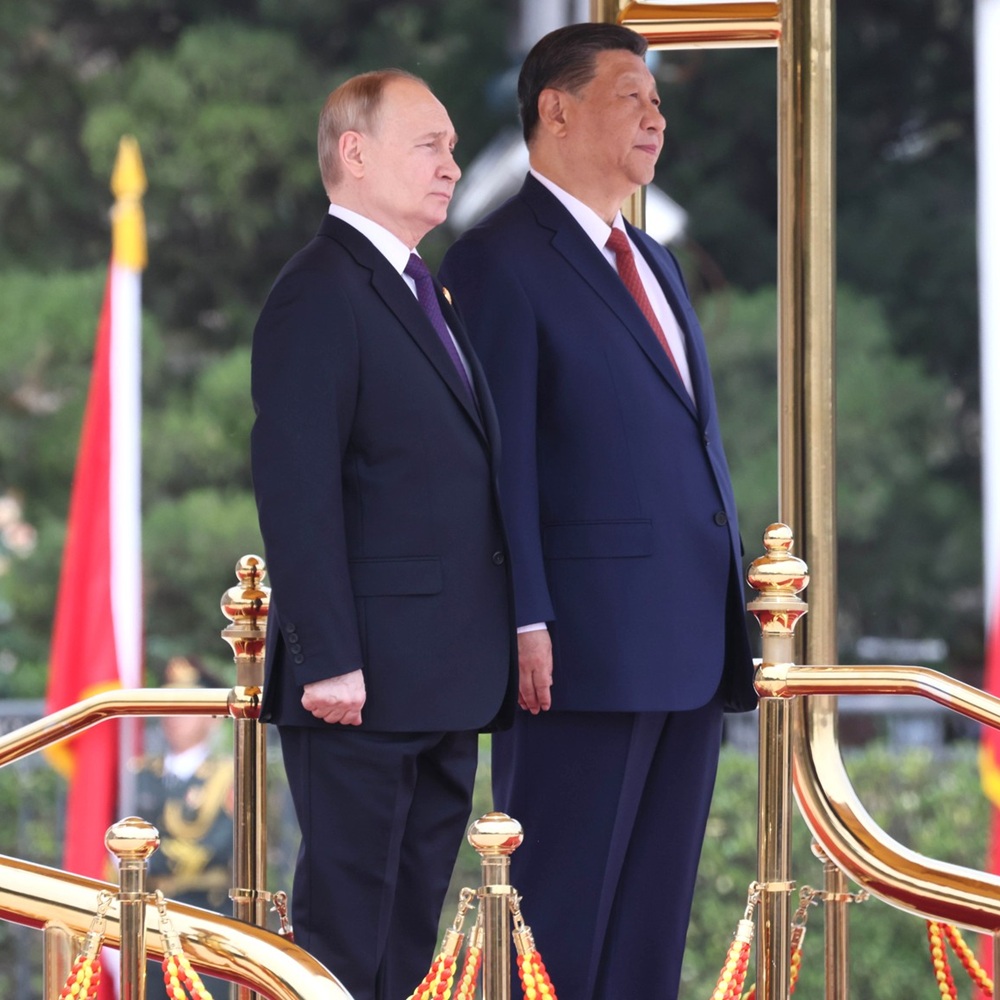
Xi Jinping and Vladmir Putin at welcoming ceremony (2024)

Russia and China in the Era of Trade Wars and Sanctions

by Ivan Timofeev

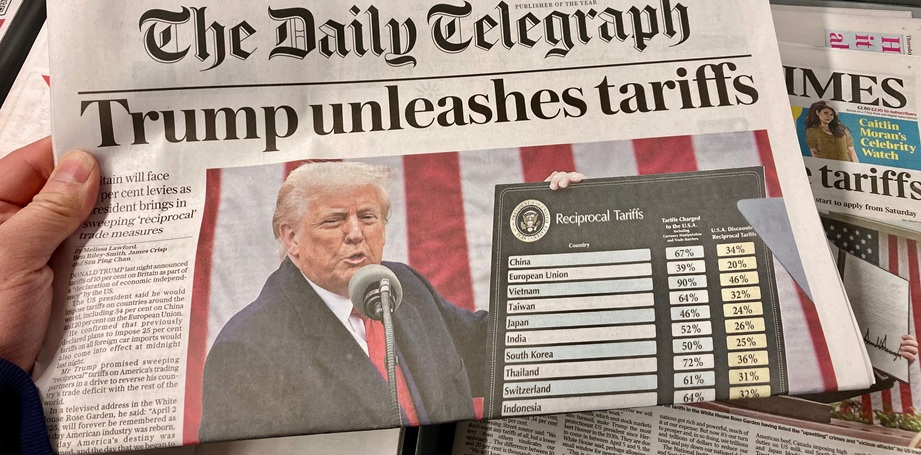
Economic relations between Russia and China remain high. Beijing has become Moscow's most important trading partner, and in the context of Western sanctions, it has also become an alternative source of industrial and consumer goods, as well as the largest market for Russian energy and other raw materials. At the same time, external political factors may have a growing influence on Russian-Chinese economic relations. These include the trade war between China and the United States, a possible escalation of US sanctions against Russia, and the expansion of secondary sanctions by the European Union against Chinese companies. The trade war, in the form of increased import duties on imported goods, has become one of the calling cards of Donald Trump's second term in office. The executive order he issued on April 2, 2025, provided a detailed conceptual justification for such a policy. The main goal is the reindustrialisation of the United States through the return or transfer of industrial production to the territory of the US, as well as an equalization of the trade balance with foreign countries. The basic part of Trump's order concerned all countries throughout the world and assumes a tariff increase of 10%. It goes on to determine individual duties on the goods of more than 70 countries, with its own sets for each. China became one of the few countries which decided to mirror the tariff increases. This led to a short-lived and explosive exchange of increases in duties. While it was suspended by negotiations between the two countries in Geneva, it was not removed from the agenda. In the US trade war “against the whole world”, China remains a key target. This is determined by the high level of the US trade deficit in relations with China, which has persisted for more than 40 years. Apparently, it remained comfortable for the US until China made a noticeable leap in the field of industrial and technological development. Such a leap allowed China to gradually overcome its peripheral place in the global economy, displace American and other foreign goods from the domestic market, and occupy niches in foreign markets. Despite the critically important role of American components, patents and technological solutions in a number of industries, China has managed to reduce its dependence on them. The growing industrial and technological power of the PRC is becoming a a political problem for the US. It was clearly identified during the first term of Trump's presidency. Even then, the US pursued a course toward the technological containment of China. Despite the temporary respite in the trade war, US pressure on China will remain. The tariff policy may be supplemented by restrictive new measures (sanctions) in the field of telecommunications and other industries. During the new term of Donald Trump's presidency, the politicisation of issues that the Biden administration avoided putting at the forefront of US-Chinese relations began again. These include the problem of Hong Kong autonomy and the issue of ethnic minorities in the Xinjiang Uyghur Autonomous Region of China. Both issues received a high level of politicisation during Trump's first term. The US-China trade war has so far had little effect on Russian-Chinese relations. The increase in US tariffs has had virtually no effect on Russia. Russia is already facing a significant number of restrictive measures, and the volume of trade with the United States has been reduced to near zero since the start of Moscow’s Special Military Operation in 2022. However, Russia may feel the effects of the trade war. For example, the United States may require China to purchase American energy resources as a measure to correct the trade balance. Obviously, such a measure is unlikely to solve the imbalance. However, it has the potential to affect the volume of Russian oil supplies to China in one way or another. In addition, the trade war as a whole may affect oil prices downwards, which is also disadvantageous for Russia. On the other hand, Russia is a reliable supplier of energy resources for China, which will not politicise them. Even in the context of new aggravations of the trade war, China is unlikely to refuse Russian supplies. Another factor is US sanctions against Russia. After the start of Russian-American negotiations on Ukraine in 2025, Washington avoided using new sanctions, although all previously adopted restrictive measures and their legal mechanisms are in force. However, Donald Trump failed to carry out a diplomatic blitzkrieg and achieve a quick settlement. The negotiations have dragged on and may continue for a long time. If they fail, the United States is ready to escalate sanctions again. Existing legal mechanisms allow, for example, for an increase in the list of blocked persons, including in relation to Chinese companies cooperating with Russia. This practice was widely used by the Biden administration. It was Chinese companies that became the key target of US secondary sanctions targeting Russia. They fell under blocking financial sanctions for deliveries of industrial goods, electronics and other equipment to Russia. However, there was not a single large company among them. We were talking about small manufacturing companies or intermediary firms. At the same time, the Biden administration managed to significantly complicate payments between Russia and China through the threat of secondary sanctions. US Presidential Executive Order 14114 of December 22, 2023 threatened blocking sanctions against foreign financial institutions carrying out transactions in favour of the Russian military-industrial complex. In practice, such sanctions against Chinese financial institutions were practically not applied, except for the blocking of several Chinese payment agents in January 2025. However, the very threat of secondary sanctions forced Chinese banks to exercise a high level of caution in transactions with Russia. This problem has not yet been fully resolved. New legal mechanisms in the field of sanctions, which are being worked on in the United States, may also affect Russian-Chinese relations. We are talking about the bill introduced by US Senator Lindsey Graham and several other senators and members of congress. Their bill assumes that in the event of failure of negotiations with Russia on Ukraine, the US executive branch will receive the authority to impose 500% duties on countries purchasing Russian raw materials, including oil. China may be among them. This threat should hardly be exaggerated for now. The passage of the bill is not predetermined. Even if it is signed into law, the application of 500% tariffs against China will be an extremely difficult matter. Recent rounds of the trade war have shown that China is ready for retaliatory measures. However, the emergence of such a norm will in any case increase the risks for business and may negatively affect Russian suppliers of raw materials. Another factor is EU sanctions policy. Unlike the US, the EU continues to escalate sanctions against Russia despite the negotiations on Ukraine. Brussels is expanding the practice of secondary sanctions, which also affect Chinese companies. In the context of a deepening economic partnership between China and the EU, this factor seems significant. However, in reality, it will play a peripheral role. The EU's practice of secondary sanctions is still significantly more limited than the American one. It does not affect any significant Chinese companies. Problems may be created by the expansion of EU bans on the provision of financial messaging services for Russian banks—this will affect their relations with Chinese counterparties. But such bans stimulate the acceleration of the use of the Chinese CIPS payment system by Russians, which has the functionality of transmitting financial messages. Compared to the US, the EU policy factor remains secondary. First published in the Valdai Discussion Club.

Diplomacy
China flag painted on a clenched fist. Strength, Power, Protest concept

The international reconfiguration's process towards multipolarity. The role of China as an emerging power

by Rachel Lorenzo Llanes

Abstract The international system is currently undergoing a process of reconfiguration that is having an impact on all areas of global development. In this process of reordering power relations, there is a tendency to move towards multipolarity, leaving behind the unipolar coalition established after the Second World War. In this context, several emerging powers are gaining increasing international power, which has led to changes in the hierarchy of power on the international geopolitical chessboard. Such is the case of the People's Republic of China, which has established itself not only as a power of great impact and relevance in the Asian region, but also in the entire international system. Namely, the management of the government and the Party in terms of innovation, industrialization, informatization, productivity, expansion and internationalization of its economic model, positions this country as the most dynamic center of the international economy. Evidencing that alternative models to the capitalist system are possible and viable, which strengthens the trend towards a systemic transition and multipolarity in the International System Introduction In the last two decades, a set of geopolitical and geoeconomic tensions and conflicts have become evident, with significant implications extending throughout the International System. As a result, we are currently experiencing a convulsion of the established order, giving way to a process of new global reconfigurations. In this context, several researchers and academics such as Jorge Casals, Leyde Rodríguez, Juan Sebastián Schulz, among others, have noted that these conditions have led to a crisis and hegemonic transition process, with a trend toward multipolarity in which the Asia-Pacific region is gaining increasing relevance. This article, titled "The International Reconfiguration’s Process Towards Multipolarity: The Role of China as an Emerging Power," is dedicated to analyzing the position of this country within the current international reconfiguration of power. Accordingly, the first section will systematize some essential guidelines to understand the current crisis and the decline of the hegemonic order established in the post-World War II period. The second section will address China's positioning amid the international reconfiguration of power. In this regard, it is important to note that China's rapid rise highlights how development management aligned with the Sustainable Development Goals can lead to a shift in the paradigm of international relations, as well as power reconfigurations that challenge the current balance of forces. Thus, it can be affirmed that China's rise constitutes a decisive element within the current trend toward multipolarity. DevelopmentNew International Order: Approaches to the Multipolar Reconfiguration of the International System The current international context is marked by a process of crisis. This crisis reflects the fact that the world order no longer aligns with the correlation of forces that gave rise to it during the post-World War II period. It is not a circumstantial crisis, but rather the interlinking of various interconnected crises that span across all sectors of life. That is to say, the effects of one crisis often become the causes of another, involving economic, political, social, cultural, ethical, moral, technological, commercial, and environmental components. In other words, it is a structural and systemic crisis—one that cannot be resolved unless a similarly systemic transformation occurs. To gain greater clarity, it is important to consider that the consolidation of the capitalist system brought about the process of globalization. This, in turn, introduced large-scale production and technological development capable of increasing output. This process, along with other characteristics of the system, has exponentially accelerated social inequalities between developed and developing countries. It has also led to strategic tensions over the control of resources, raw materials, and inputs, resulting in geopolitical conflicts. Furthermore, the capitalist system has imposed an extremely high environmental cost, demonstrating that it is exceeding both its own limits and those of the planet. Specifically, in its constant pursuit of profit and maximization of gains, negative environmental impacts are not factored into cost-benefit analyses, leading to widespread environmental degradation. Among other harms caused by the system, we observe a decline in investment rates, an increase in public debt, loss of autonomy in monetary policy, rising unemployment levels, reductions in real wages, and growing inequality, among others. In short, capitalism has become an unsustainable system whose primary concern is profit generation—something that is currently entirely incompatible with environmental preservation and the responsible use of natural resources. Therefore, it can be affirmed that some of its most alarming effects include: vast amounts of currency without backing, increasingly concentrated in fewer hands; acceleration of capital concentration in the West; rising military expenditures; and environmental pollution and destruction (Casals, J., 2023). On the other hand, it is necessary to clarify that, for a particular state to be considered hegemonic, it must not only exert its influence predominantly within the system of international relations; its hegemonic role must also be linked to the founding and establishment of a universally accepted concept of world order. That is, the majority of other states must recognize it as such and identify with the model promoted by the hegemon. Therefore, it is not merely a matter of a hierarchical order among states, but rather the adoption of a dominant model of production that involves those states. As a result, certain mechanisms or general rules of conduct are established for the participating states. For this reason, a hegemonic crisis involving the dominant actor in the system of international relations leads to a crisis in the social, economic, political, and institutional structures upon which that actor’s dominance was built. In light of these elements, we currently observe a set of powers within the International System that are vying to establish a new distribution of power—one that moves away from the unipolar coalition led by the United States following World War II. From this perspective, Juan Sebastián Schulz asserts: “A hegemonic crisis occurs when the existing hegemonic state lacks either the means or the will to continue steering the interstate system in a direction broadly perceived as favorable—not only for its own power, but also for the collective power of the dominant groups within the system.” (Schulz, J. S., 2022) As a result, strategic alliances have been formed and new power groups have emerged that influence international relations.These blocs are precisely what the new polarity is forming around, increasingly reinforcing the trend toward multipolarity. This is a system in which hegemonic influence is not determined by a single power, but by two, three, or more. In this regard, Juan Sebastián Schulz further notes that a process of insubordination is becoming evident, particularly in the Western peripheries. As a consequence, several countries have begun to criticize the configuration of the contemporary world order, initiating efforts to organize and propose alternative models (Schulz, J. S., 2022). This reveals the emergence of a new kind of power hierarchy, generating a global order in which a diversity of forces and actors prevails. In this context, China has experienced rapid growth, thereby contributing to the trend toward multipolarity. While this does not imply that the United States will cease to be one of the central powers in the system of international relations—given its considerable global influence—it is evident that there is a noticeable decline in the dominance it held during the unipolar era that emerged after the collapse of the USSR in 1991. This process of intersystemic transition unfolds in various phases. First, there is an observable economic transition marked by a shift in the center of gravity of the global economy toward emerging and developing economies. This shift is accompanied by a necessary technological transition, characterized by a new struggle—this time to lead the technological revolution. These changes, in turn, must be supported by a political transition. Currently, countries from the Global South have gained increasing prominence on the international stage [1]. From this foundation, a geopolitical transition is also underway, where the center of gravity and decision-making—once concentrated in the Anglo-Saxon West—is shifting toward the Asia-Pacific region. Finally, a cultural or civilizational transition is taking place, wherein the previously dominant value system is giving way to the rise of a new worldview. Based on this, the phases of the transition process can be outlined as follows: Existence of a stable order that brings together the majority of nation-states in the International System. - A crisis of legitimacy begins to affect the established global order. - A deconcentration and delegitimization of power emerges, impacting the hegemonic power. - An arms race and formation of alliances ensue in an attempt to preserve the hierarchical order by any means. This leads to a widespread crisis and the rise and emergence of new actors. - A necessary resolution of the international crisis. - Renewal of the system. (Schulz, J. S., 2022) In light of the above, it can be stated that a “new international order” is taking shape. Its manifestations are multifaceted, such as: - The rise of movements and associations of states that serve as alternatives to the neoliberal order. - Emerging powers like China and Russia are gaining strength in various sectors of the international geopolitical arena. - Russia's confrontation with NATO in the context of the conflict with Ukraine. - Sanctions imposed by the United States on various NATO and European Union countries have strengthened the BRICS nations. - The incorporation of new members into BRICS can be seen as an attempt to counterbalance the economic and political dominance of the United States and the European Union. - The expansion of anti-imperialist and anti-neoliberal integration mechanisms that promote South-South cooperation, such as the G-77 + China group. - The financial sanctions imposed by the West on Russia in the context of the Ukraine conflict have sparked a debate about the viability of the international monetary system and the role of the U.S. dollar as a reserve currency. - China and Russia conduct transactions in yuan and sell oil in this currency to Iran, Venezuela, and Gulf countries. China has increased its economic and political influence in the world, which can be seen as a challenge to U.S. hegemony. Its leadership within BRICS and its growing role in the global economy may be indicators of a shift in the balance of power. All these developments reflect a growing awareness within the International System of States regarding the importance of international cooperation to address global challenges such as the climate crisis, pandemics, and food security. They also serve as indicators that a transformation is underway in the way countries interact with each other, resulting in a shift in the economic, political, and strategic center of gravity. In this context, the United States has unleashed a global hybrid war as a desperate attempt to defend and maintain its hegemonic position, which once appeared unshakable in the postwar world. To this end, it has targeted China, as the latter represents its main threat in the economic and scientific-technological order. From this perspective, tensions between the United States and China have significantly deteriorated since the Republican administration of President Donald Trump. Beginning in 2017, his policy took on an aggressive stance toward China, manifesting through a trade war and economic attacks aimed at preserving U.S. global hegemony. This demonstrates that, in response to a process of decline already underway, nationalist and protectionist efforts intensified in the U.S., with policies targeting some of the emerging pillars of the crisis-ridden world order—China being a primary example. Under the administration of Joseph Biden, the focus shifted toward competition, emphasizing the commitment to protect U.S. sovereignty from potential Chinese threats. A significant shift in U.S. foreign policy toward Taiwan became evident with the approval of arms sales to Taiwan in August 2023, which escalated tensions in the region (Collective of Authors). Furthermore, in recent years, the United States has increasingly worked to generate geopolitical and geoeconomic motivations aimed at fostering tensions between China and Russia, potentially sparking conflict between the two. It has strengthened alliances with neighboring countries of these powers—most notably Taiwan and Ukraine—which has triggered concerns and tensions in both nations. A containment policy has also been deployed, including the imposition of trade barriers and tariffs on Chinese products; restricting Chinese companies’ access to U.S. technology and markets; and promoting the diversification of supply chains to reduce dependence on China. Nevertheless, the ongoing sanctions and restrictions have only served to reaffirm the shared survival interests of both powers, strengthening corporate ties and relations between them. These actions also reflect the growing concern among U.S. power groups over the decline of their hegemonic dominance. The Emergence of China and Its Role in the Transition Toward Multipolarity In a previous article titled "The Synergy Between Economy and Environment in China Through the Achievement of the Sustainable Development Goals," (‘La sinergia entre economía y medio ambiente en China mediante la consecución de los Objetivos de Desarrollo Sostenible’) the process of socioeconomic transformations experienced in the People's Republic of China over the past decade was discussed. These transformations have been primarily aimed at revitalizing the nation in preparation for its centenary in 2049. This strategy is rooted in aligning the Centenary Goals with the Sustainable Development Goals (SDGs) set for 2030, under the leadership of the Communist Party and the momentum driven by President Xi Jinping. The results of this strategy have had an impact not only on the Asian Giant itself—now a decisive actor in the Asian region—but also on the international order as a whole. As a result, China has emerged as a powerful rising power, with promising prospects for further elevating its development standards. This is backed by sustained GDP growth, averaging between 6% and 8% annually, indicating a robust economy. In addition, China holds vast foreign exchange reserves, granting it economic stability and the capacity to withstand potential external shocks. It also invests heavily in modern infrastructure and cutting-edge sectors such as artificial intelligence, 5G technology, and renewable energy—all of which enhance its competitiveness and lay the groundwork for long-term sustainable growth (Lagarde, CH). Nonetheless, China has also had to confront significant challenges in its gradual and progressive approach to the desired development model. Among these is the environmental cost associated with its rapid economic growth. For instance, China still experiences high levels of greenhouse gas (GHG) emissions, along with air, water, and soil pollution. In response, measures have been implemented such as the establishment of a national monitoring network and the replacement of coal heating systems in Beijing. Efforts have also been made to purify water resources polluted by industrial processes, and imports of solid waste have been reduced to help decontaminate soils affected by industrial and agricultural activities (González, R., 2023). In general, the development of renewable energy and a circular economy model is being promoted to enable a gradual transition toward a green economy, grounded in the concept of an ecological civilization. For this reason, China’s new era is committed to scientific and technological innovation as a means of driving economic growth that is both sustainable and capable of ensuring a higher quality of life for its population. This, in turn, leads gradually toward a new model of political leadership and economic management. In this regard, Jin Keyu, Professor of Economics at the London School of Economics and Political Science (LSE), has stated that “trillions of dollars of investment are needed for the global green transition, and China is going to play an essential role in that transformation” (Feingold, S., 2024). Based on the aforementioned elements, various authors such as Dr. C. Charles Pennaforte, Dr. C. Juan Sebastián Schulz, Dr. C. Eduardo Regalado Florido, among others, have indicated that the millenary nation represents a threat to the hegemony held by the United States since World War II. Consequently, it is recognized that a process of hegemonic crisis and transition is currently underway, with the Asia-Pacific region emerging as the center of gravity of the global power, thereby contributing to the multipolar transformation of the International System. The authors of “Is China Changing the World?” argue that “market socialism with “Chinese characteristics” must gradually and more clearly diverge from capitalism if it is to embody a genuinely alternative path for all of humanity.” In pursuit of this goal, China bases its policy of peaceful coexistence on five fundamental principles:Respect for sovereignty and territorial integrity, regardless of a country's size, power, or wealth. Mutual non-aggression Non-interference in the internal affairs of other countries, acknowledging that each nation has the right to freely choose its own social system and path of development. Equality and mutual benefit Peaceful coexistence. (Herrera, R.; Long, Z.; and Andréani, T., 2023) The rise of China as a major international power under these principles has been consolidating since 2012 under the leadership of Xi Jinping and the Communist Party of China (CPC), gaining particular momentum from 2020 to the present. Thus, China has not only become the leading power within the Asian regional balance but has also expanded its presence across Europe, Africa, and Latin America—primarily through loans, investments, and multilateral cooperation initiatives such as the Forum on China-Africa Cooperation (FOCAC) in Africa and the China-CELAC Forum in Latin America. In addition, China has positioned itself as a leader in several sectors, and it is projected that its economy may surpass that of the United States, increasing its Gross Domestic Product (Rodríguez, L., 2022). It has also undergone a process of opening up, energizing both its international trade and its overall foreign relations, all under the control of the Government and the Party. This, combined with its rise and development initiatives, has made China a focal point of interest for many countries within the International System seeking to jointly advance projects based on cooperation, the principle of shared advantage, and multilateralism. In this regard, the white paper "China and the World in the New Era," published by the Central Committee of the Communist Party of China in 2019, states: “The world is moving rapidly toward multipolarity, diverse models of modern development, and collaboration in global governance. It is now impossible for a single country or bloc of countries to dominate world affairs. Stability, peace, and development have become the common aspirations of the international community.” (People’s Republic of China, 2019. Quoted in Schulz, J. S., 2022) Undoubtedly, this rise has become a source of concern for U.S. power groups, which have increasingly applied geostrategic pressure. Notably, the United States has strengthened military alliances with India, Japan, and Australia in an effort to encircle China and attempt to control or obstruct its maritime routes—this also being a manifestation of the intensification of the imperialist arms race. Nonetheless, China has maintained its development strategy and, as part of it, has strengthened its diplomatic network and its relations with multiple countries across all world regions. For all these reasons, China has become the most dynamic center of the global economy. Notably, it went from representing 4% of global GDP in 1960 to 16% in 2020—undeniable evidence of rapid economic growth. Moreover, it has become the world’s largest exporter of goods and also the leading importer, establishing itself as a major industrial power. In this regard, United Nations data reveal that China leads global industrial production, accounting for 30% of the total. This figure surpasses other industrial powers such as the United States (16%), Japan (7%), Germany (5.7%), and South Korea (3.2%) (Schulz, J. S., 2022). In addition, China has remained the world’s leading manufacturing power for approximately 15 consecutive years, according to statements from the Ministry of Industry and Information Technology at the beginning of this year. This sector alone has contributed over 40% to overall growth. Likewise, in 2024, China experienced a significant increase in foreign investment, reflecting its interest in strengthening international cooperation for development. Efforts are also underway for urban renewal in 2024, with around 60,000 projects being implemented across various cities. These initiatives are primarily aimed at transforming underdeveloped neighborhoods and creating smarter urban areas (Embassy of the Republic of Cuba in the People's Republic of China, 2025). In this regard, the following graphs illustrate the value of China’s international trade during the 2016–2024 period, highlighting a strong presence of exports compared to imports. A second chart shows China's global export share, where it holds a dominant position.   Thus, China has risen as a center of power in the international system, with leadership not only in the economic domain but also in science and technology. At the same time, it has promoted a series of investments and a process of internationalizing its national currency. Accordingly, the Asian Giant offers an alternative model of development—one that is more comprehensive and sustainable—allowing it to propel the new phase of Chinese development. This phase aims not only to fulfill the dream of national rejuvenation but also to ensure the survival of its unique political, economic, and social model. Nevertheless, the significant challenges of sustaining growth cannot be overlooked. From this perspective, experts believe that new avenues of growth will be necessary for China to maintain the trajectory it has been experiencing. Specifically, the country must continue expanding its industrial sector while strengthening areas such as artificial intelligence, digital financial services, and green technologies (Feingold, S., 2024). It is also important to highlight the projected continuity and leadership of the Chinese government, with Xi Jinping identified as a key figure in the implementation of the Sustainable Development Goals (SDGs) in China, in conjunction with the socioeconomic transformation strategy toward the 2049 centenary. This has been pursued through the defense of multilateralism, economic openness, and international integration and cooperation in support of global development. Conclusions In light of the above, a decline in U.S. hegemony can be observed, even though this process is not linear—nor is it certain whether any single power or coalition has come to occupy a hegemonic position. What is clear, however, is the existence of a trend toward multipolarity, driven by emerging powers and the strategic ties they are establishing. This is giving rise to a non-hegemonic reconfiguration of power blocs, which are building a multilateral and multipolar institutional framework. It can also be affirmed that China has become the most dynamic center of the global economy. This has been supported by its growth strategy focused on industrialization, digitalization, innovation, productivity, expansion, and internationalization of its development model—while maintaining a strong emphasis on environmental sustainability. A range of key initiatives and development projects have been implemented to support the country's rise, consolidating its role in the multipolar reconfiguration of the International System. All of this has been essential in driving China’s new phase of development and contributing to the broader process of multipolar transformation. Undoubtedly, China’s rapid ascent represents a significant challenge to the International System, as it reflects a shift in international relations and a transformation in the distribution and hierarchy of global power. Notes [1] It is important to clarify that the so-called Global South should not be equated with the Third World, as the distinction between the First and Third Worlds is primarily based on economic and technological differences, which do not align with the current circumstances of the International System of States. In contrast, the term Global South emerges from a new geopolitical perspective that arose in the post–Cold War context, driven by the need to promote South-South cooperation. Moreover, it does not refer to a geographically defined region, as it includes nations from Latin America, the Caribbean, Africa, and the Asia-Pacific.Revista Política Internacional | Volumen VII Nro. 2 abril-junio de 2025. https://doi.org/10.5281/zenodo.15103898This is an open access article distributed under the terms of the Creative Commons Attribution-NonCommercial 4.0 International License (CC BY-NC 4.0). The opinions and contents of the published documents are solely the responsibility of their authors.ReferencesCasals, J. (2023). “El Nuevo orden global: amenazas y oportunidades”. Cuadernos de Nuestra América. Nueva época. No.5. RNPS: 2529.Colectivo de autores. “Crisis de hegemonía y ascenso de China. Seis tendencias para una transición”. Tricontinental. Instituto Tricontinental de Investigacion social. Buenoos Aires. Libro digital, PDF, Archivo Digital: descarga y online.Embajada de la República de Cuba en la República Popular China. (2025). Boletín informativo China-22 de enero de 2025. Oficina de Información y Análisis. Embajada de Cuba en República Popular China. Redacción y envío desde info3@embacuba.cn.Feingold, S. (2024). "¿Hacia dónde va la economía china?". World Economic Forum. Recuperado de: https://es.weforum.org/stories/2024/07/hacia-dondeva-la-economia-de-china/García-Herrero, A. (2024). "10 puntos y 18 gráficos sobre la política económica de Xi Jinping tras el tercer pleno". El Grand Continent. Recuperado de: https:// legrandcontinent.eu/es/2024/09/19/esta-china-estancada-10-puntos-y-18-graficos-sobre-la-politicaeconomica-de-xi-jinping-tras-el-tercer-pleno/González, R. (2023). " Medio ambiente en China: Impactos y respuestas del Partido y el Gobierno". CIPI. Recuperado de: www.cipi.cu/medio-ambiente- en-china-impactos-y-respuestas-del-partido-y-gobierno/Lagarde, CH. "Impulsar el crecimiento económico y adaptarse al cambio". Fondo Monetario Internacional. Discursos. Recuperado de: https://www.imf.org/ es/News/Articles/2016/09/27/AM16-SP09282016- Boosting-Growth-Adjusting-to-ChangePereira, CM (2022): “La reemergencia de China frente a la globalización neoliberal y el desafío de la conformación de un mundo multipolar”. Cuadernos de Nuestra America. Nueva Época. No. 05. RNPS: 2529.Schulz, J S. (2022). “Crisis sistémica del orden mundial, transición hegemónica y nuevos actores en el escenario global”. Cuadernos de Nuestra América. Nueva Época. No.03. RNPS: 2529. Bibliografía consultadaAmbrós, I. (2021). “ El Partido Comunista y los desafíos internos de China en el siglo XX”. Recuperado de: https://www.ieee.es/Galerias/fichero/cuadernos/ CE_212/Cap_1_El_Partido_C omunista_y_los_desafios_internos.pdfBanco Mundial (BM). (2023). Recuperado de: https:// datos.bancomundial.org/indicator/NY.GDP.PCAP. KD?locations=CNBBC News Mundo. (2021). "Cómo consiguió China erradicar la pobreza extrema (y las dudas que despierta ese triunfal anuncio del gobierno de Xi". Recuperado de: https://www.bbc.com/mundo/noticias-internacional-56205219Boy, M. (2020). “ Crisis económica y medio ambiente: ¿cómo promover un desarrollo sustentable?”. Recuperado de: https://culturacolectiva.com/opinion/crisis-economica-y-medio-ambiente- mariana-boy-columna-opinion/García, A. (2021). “La globalización neoliberal en crisis”. Recuperado de http://www.cubadebate.cu/opinion/2021/08/30/la-globalizacion-neoliberal-en- crisisGonzález, R. (2020). “El Quinto Pleno del XIX Comité Central del Partido Comunista abre una nueva etapa para China” en “Transiciones del Siglo XXI y China: China y perspectivas post pandemia II”. Libro digital.Herrera, R; Long, Z y Andréani, T. (2023). “¿Está China transformando el mundo?”. Revista Política Internacional. Volumen V. Nro. 1 enero-marzo de 2023.ISSN 2707-7330.Liu, X. y González G. (2021) “El XIV Plan Quinquenal 2021- 2025: reto para el nuevo modelo de desarrollo económico de China”. México y la Cuenca del Pacífico. Vol 10, núm. 30. Recuperado de https://www.scielo.org. mx/pdf/mcp/v10n30/2007-5308-mcp-10-30-57.pdfOtero, M (2022). “La prosperidad común y la circulación dual: el nuevo modelo de desarrollo de China”. Recuperado de: https://www.realinstitutoelcano.org/analisis/la-prosperidad-comun-y-lacirculacion-dual-el-nuevo-modelo-de-desarrollo-de-china/Regalado, E. y Molina, E. (Coord.) (2021). “China y sus relaciones internacionales”. Asociación Venezolana de Estudios sobre China (AVECH) / CEAA / ULA – Centro de Investigaciones de Política Internacional (CIPI, Cuba), Libro digital.Rodríguez, L. (2022). “Configuración multipolar del sistema internacional del siglo XXI”. Revista Política Internacional. Volumen IV Nro. 1 enero-marzo de 2022. ISSN 2707-7330.Weiss, A. (2024). "La frágil fortaleza económica de Estados Unidos". The Economist. Recuperado de: https:// www.lavanguardia.com/dinero/20240212/9516764/ economia-eeuu- fortaleza-fragil-ia-bolsa-mercados. htmlYang, W. (2015). "La Planificación y Recomendaciones del XIII Plan Quinquenal". Recuperado de: https:// politica-china.org/wp- content/uploads/6sei-yangweimin-ES.pdf .

Defense & Security
The flags of the Russia, United States, China and are drawn on a piece of ice in the form of an Arctic iceberg against a blue sky. Conflict of interests in the Arctic, Cold War, Arctic shelf

Divided Arctic in a Divided World Order

by Rasmus Gjedssø Bertelsen

한국어로 읽기 Leer en español In Deutsch lesen Gap اقرأ بالعربية Lire en français Читать на русском Introduction Arctic order historically, currently, and in the future reflects the world order. The idea of ‘Arctic exceptionalism’ is not valid and is a poor guide for policy. During Cold War bipolarity, the Arctic was divided between the Soviet Arctic and the Nordic and North American Arctic. US victory and Soviet defeat in the Cold War led to US unipolarity and hegemony which was the basis for a circumpolar (including Russia) liberal (as opposed to realist) Arctic order with organizations, such as the Arctic Council, International Arctic Science Committee, University of the Arctic, Barents and Bering regional cooperation, all on liberal topics such as science, environment, Indigenous rights, people-to-people cooperation.Footnote1 US unipolarity and hegemony are slipping away to world order characteristics of continued US unipolarity and hegemony, Sino-American bipolarity in economics and S&T and multipolarity illustrated by BRICS+. Sino-US competition and US-Russia conflict to the extent of proxy-war in Ukraine reflect these changes. The Arctic, which is de facto divided between the US-led NATO-Arctic and the Russian Arctic, where Russia reaches out to the BRICS+ in diplomacy, economics, and S&T, reflects these changes to world order. There is wishful thinking in the West of returning to post-Cold War US unipolar and hegemonic ‘liberal world order’ or ‘rules-based order’ and the circumpolar liberal Arctic order with it. This wish is probably unrealistic for global trends in demography, economics, S&T, legitimacy, etc. Significant conflict can be expected between the US/West and China and Russia on developments in world order, with the Global South standing by. The Arctic is likely to remain divided between the US-led NATO Arctic and the Russian Arctic seeking engagement with the BRICS+ world for the future with extremely limited cooperation and risk of spill-over from the Ukraine War and other US-Russia-China conflicts. The Arctic in international order There are two common, but invalid, narratives about the Arctic, which are poor guides for policy: First, ‘Arctic exceptionalism’, that the Arctic was apart from international politics and allowed for West-Russia cooperation unlike elsewhere, especially between the Russian annexation of Crimea in 2014 and the Russian full-scale invasion of Ukraine in 2022. Second, a presentist discourse, where international interests in the Arctic are seen as rising in the last 15 years, driven by climate change, the Russian flag planting on the seafloor of the North Pole in 2007, and the United States Geological Survey’s assessment of oil and gas resources in 2008, north of the Arctic Circle. Rather, the Arctic has for centuries closely mirrored the international system, whether multipolar with Western colonial empires before the World Wars, bipolar Cold War between the US and the USSR, post-Cold War US unipolarity and hegemony, or the current emerging Sino-American bipolarity and multipolarity. During 2014–2022, cooperation in the Arctic was not exceptional compared to US-Russia non-proliferation cooperation, most notably with the Iran nuclear deal in 2015, or removing chemical weapons from Syria. There was extensive US-Europe-Russia and wider collaboration around the International Space Station. There was extensive energy trade and investment between Russia and Europe, most notably with the Nord Stream 1 and 2 pipelines under the Baltic Sea. The bipolar Cold War Arctic in the bipolar Cold War order Bipolarity with two superpowers standing out from all other great powers due to their demographic, economic, science and technology, military, and ideological weight and global claims, the US and the USSR, shaped the the Cold War order. Bipolar logic shaped the international order. John Mearsheimer explains well the structural logic of a nuclear-armed bipolar superpower security competition, and he points out how each superpower formed ‘bounded orders’ of allies and clients to discipline them and mobilize their resources. These bounded orders were the West for the US with its institutions, and the East Bloc for the USSR.Footnote2 This bipolar logic was also clear in the Arctic, divided between the Nordic and North American Arctic of the West and the Soviet Arctic by the Iron Curtain in Europe and the Ice Curtain in the Bering Strait. Circumpolar Arctic cooperation was limited to the Polar Bear Treaty of 1973 between the USSR, Norway, Kingdom of Denmark, Canada, and the US, Norwegian Soviet joint fisheries management in the Barents Sea, and some Bering Strait cooperation. The Arctic was exceptionally militarized during the Cold War driven by the mutual nuclear deterrence between the US and the USSR, where the Arctic played a central role for geostrategic and technological reasons. The Arctic was the shortest flight path for bombers and missiles, and sea ice offered cover for nuclear ballistic submarines. This exceptional militarization of the Arctic harmed the human security of Arctic local and indigenous communities through forced displacement, security service surveillance, and pollution, including notable nuclear accidents, as the 1968 B52 bomber crash off Northwest Greenland with four H-bombs causing extensive radioactive contamination of much Soviet nuclear material in and around the Kola Peninsula, including sunken submarines with nuclear fuel or weapons on board.Footnote3 Circumpolar liberal Arctic order under US unipolarity The Cold War ended with US victory and Soviet defeat and dissolution, also caused by the US pressuring the USSR into a strategic nuclear arms race, that the Soviet economy could not support. US Navy operations near the Soviet Northern Fleet nuclear bastion around the Kola Peninsula were an important part of this pressure.Footnote4 The Arctic was also part of Mikhail Gorbachev’s attempt to save the USSR by reform and lowering external tension. Gorbachev called the Arctic as a zone of peace, environmental protection and scientific collaboration in his 1987 Murmansk speech, in contrast to being at the heart of a strategic nuclear arms race with the US, which the USSR could not sustain. Gorbachev’s reforms failed to avert the dissolution of the USSR and deep socio-economic, public health, and law and order crisis in Russian society during the 1990s. The Russian State withdrew to a significant extent from its Arctic, leaving military facilities and society behind. Sino-American bipolarity comes to the Arctic The relative distribution of comprehensive material and immaterial power of the strongest States shapes international order. States stay the predominant actors since the emergence of a state system, not denying powerful non-State actors historically and today. The US unipolarity after the Cold War was an exceptional time of international history and not the ‘End of History’ as believed by some quarters in the West (Fukuyama). History is returning to normal with the return of major centres of economic output and science and technology outside the West. Ironically, US unipolarity laid the foundation for the ‘Return of history’, rather than the ‘End of History’. Since the 1990s, the world experienced globalization with economic, science and technology, and cultural integration. The US as the sole superpower provided public goods and facilitated and coordinated many of these economic, scientific, and technological, and cultural flows. Globalization undermined US unipolarity, facilitating the faster relative growth of non-Western States. China’s export-oriented growth, returning it to its historical position as one of the world’s largest economies is the most important dimension for changes to world order. In parallel, other emerging markets have grown adding multipolar dimensions to international order. International Relations theory serves to think about how to respond to the return of China. About 20–25 years ago, Professor Joseph S. Nye (Harvard University) and Professor John Mearsheimer (University of Chicago) articulated two major approaches with coherent theoretical and strategic visions for the Sino-American relationship. Nye, as a liberal institutionalist scholar and policymaker in the Bill Clinton Administration, presented a vision of ‘integrate, but hedge’. China integrated in the US-led world economy as member state of the World Trade Organization, while the US hedged against the rise of China by reinforcing its alliance with Japan.Footnote5 There were strong US and Western liberal expectations of Chinese economic growth and openness leading to political openness and reform. These expectations proved to be belied and ethnocentric. Mearsheimer, in line with his offensive realist theory, clearly outlined how the US had to keep China from becoming a regional hegemon in East Asia through a containment strategy.Footnote6 The US’ China strategy has shifted from the Nye perspective to the Mearsheimer perspective, while Mearsheimer himself is ostracized for his valid, but politically unacceptable, analysis of the Ukraine War. Mearsheimer explains how Sino-American bipolarity works with realist great power State security competition, and how competing great powers form their ‘bounded orders’ of allies and clients to discipline and mobilize these.Footnote7 The US is shaping a NATO+ order of the NATO member states and Australia, New Zealand, Japan, and South Korea. The US is increasingly engaging in trade and technology wars with China to slow down its growth rate, clearly denying its access to fundamental technologies of future knowledge-based economies. A realist focus on relative gains explains US policy to reduce China’s growth rate. China has a population more than three times that of the US with an absolute economy approaching the US economy. The US cannot allow China to catch up relatively with it, as that would imply a much larger Chinese economy than that of the US. Liberals (politically and theoretically) would ascribe the US policy to different domestic political systems, but the logic of anarchy points out how domestic political systems are of secondary concern, and empirically the US firmly bypassed and disciplined the previous Anglo-Saxon superpower, Britain. US-India relations can be expected to deteriorate with India’s socio-economic development, where India has a much younger population than China with great economic growth potential. China predicted the US abandoning its own open and globalized international economic policy out of concern for China’s relative rise to the US. China pursued a domestic and international economic policy much less dependent on US benevolence. In the domestic sphere, China pursued an economy based on domestic demand. Externally, China built up a parallel international economic and science and technology system with the Belt and Road Initiative with the Asian Infrastructure Investment Bank. Other bodies, such as the Shanghai Cooperation Organization in security reflect parallel orders and institutions to the US-led Western institutions. Sino-American bipolarity also became clear in the Arctic about 10–15 years ago. China started to appear as a diplomatic, economic, science and technology actor in the Arctic. Western surprise and consternation to this development reflects the great difficulties many Westerners have in facing a world, where the Rest takes an interest in the West, and not only the West taking an interest in the Rest as during centuries of imperialism and colonialism. It should not be surprising that China as one of the world’s two largest national economies and science and technology systems (with the US) has interests in the Arctic, or anywhere else in the world. The US is globally present in politics, defence, diplomacy, economics, science and technology, culture, etc. The unfortunate Chinese term of ‘near-Arctic State’ to legitimize Chinese involvement in the Arctic drew much Western ridicule and opposition. In comparison, the US and the West seem to be ‘near-everywhere’ States. One place where the Sino-American bipolar logic appeared soon and clearly has been the Kingdom of Denmark with the North Atlantic and Arctic overseas autonomies of the Faroe Islands and Greenland. The US applies pressure on the Kingdom of Denmark to exclude Chinese investment, science and technology, in line with Mearsheimer’s argument of a superpower building bounded orders to mobilize and discipline allies and clients in security competition with a competing great or superpower. The Faroe Islands are located between Iceland, Norway, and Scotland. They are centrally placed in the Greenland-Iceland-UK Gap controlling North-South access and blocking the Soviet-Russian Northern Fleet going south for NATO or the US and NATO navies going north for USSR/Russia. The Faroe Islands are becoming increasingly independent from Denmark. Huawei has long been a partner for the Faroese telecom company, which planned to continue with Huawei for 5G. This partnership came under increasing scrutiny from Danish and US sides. The Chinese ambassador to Copenhagen during a visit to the Faroe Islands linked the Faroe Islands choosing Huawei with prospects for a Sino-Faroese free trade agreement (the Faroe Islands are outside the EU and pursue an independent trade policy).Footnote8 The US ambassador to Copenhagen publicly spoke strongly against the Faroe Islands collaborating with Huawei for 5 G.Footnote9 Greenland is geographically North American (remember the Monroe Doctrine), crucial to US (North American) homeland defence, and pursuing independence from the Kingdom of Denmark. Greenland and China have for some time eyed each other for investment and science and technology opportunities. Greenlandic independence primarily rests on economic independence from Denmark and human capital. The economic independence should be through, among other domains, mining, where China and Chinese companies were considered as very important likely investors. Copenhagen regarded Sino-Greenlandic mutual interest with great suspicion for a long time, which was evident from the report on Greenlandic mining from 2014.Footnote10 In 2014, the Royal Danish Navy abandoned Grønnedal, a small, remote old naval facility, established by the US during the Second World War, which was put up for sale. A Chinese mining company showed interest in the facility as a logistics hub for future operations in Greenland. The Danish government promptly took the facility off the market maintaining a token naval presence.Footnote11 Developing Greenlandic tourism requires upgrading the airport infrastructure, which is an enormous project for a nation of 57,000 on a 2 M km2 island. One of the finalists to an international tender was the China Construction Communication Company (4C), which might also have provided financing.Footnote12 The Danish government convinced the Greenlandic government to accept a Danish financing (with a Danish stake) of the renovated and new airports against choosing a Danish construction company.Footnote13 The Greenlandic government was reshaped over this intervention with a coalition party leaving in protest over accepting such Danish interference in Greenlandic affairs. In 2017, China publicly presented its interest in a research station in Greenland, including a satellite ground station, which the Government of Greenland might have been positive towards.Footnote14 This idea has never materialized, first probably delayed by the COVID-19 pandemic, but Denmark and the US would never accept a Chinese research station and/or satellite station in Greenland. The US government has made its pressure on the Danish government public, through former Secretary of Defense, General Jim Mattis.Footnote15 China and Iceland spearheaded Sino-Nordic Arctic research cooperation from the official visit of Chinese premier Wen Jiabao to Iceland in 2012. In 2013, the China Nordic Arctic Research Center was founded, a virtual centre of Chinese and Nordic institutions hosted by the Polar Research Institute of China in Shanghai. CNARC has hosted an annual symposium between China and a Nordic country as well as researcher exchange. Today, Sweden has withdrawn from CNARC, and Denmark does not participate, as the participating Nordic Institute of Asian Studies at the University of Copenhagen has been closed. PRIC and RANNÍS (The Icelandic Center for Research, equivalent to Research Council) held the groundbreaking ceremony for the construction of the China-Iceland Aurora Observatory, now China Iceland Arctic Observatory, at Kárhóll, Northeast Iceland, in June 2014, which I attended. The Observatory opened formally—although unfinished—in October 2018. This collaboration had been hampered by the COVID-19 pandemic and negligence from central authorities and research institutions in the capital, Reykjavik. Today, Iceland is under pressure from the US, including a recent visit by US Congressional staffers, to close CIAO.Footnote16 US-Russia Eastern European security competition divides the Arctic US-Russia security competition, especially in Eastern Europe, became increasingly clear from around 2007–2008. In 2007, Russian President Vladimir Putin delivered a speech at the Munich Security Conference, where he unsurprisingly denounced US unipolarity. Russia had rejected US unipolarity and called for multipolarity since the Primakov Doctrine of the 1990s calling for Russia, China, and India to balance the US. In spring 2008, at the initiative of the US—and with French and German reservations—the NATO Bucharest summit invited Georgia and Ukraine to become member states. In the autumn, fighting broke out between Georgia and Russian forces in the separatist enclaves of Abkhazia and South Ossetia leading to Georgia’s defeat. In autumn 2013, the EU proposed an agreement to Ukraine, which forced Ukraine to choose between Russia and the EU. The Ukrainian President rejected the EU’s proposal, leading to popular protests met with government violence and eventually the President fleeing the country. Russia intervened annexing Crimea and supporting an insurgency in the Donbas.Footnote17 In December 2021, Russia proposed a treaty to the US blocking former Soviet Republics from joining NATO and rolling back NATO troops and equipment in Central and Eastern Europe, which was rejected by the US and allies in January 2022. On 24 February 2022, Russia launched a full-scale invasion of Ukraine, which had led to a war of attrition between Russia and Ukraine. The West extends wide-ranging political, military, economic, and further support to Ukraine and tries to isolate Russia as much as possible. The Rest of the world follows Western policy of isolating Russia to a very limited extent. The Russian annexation of Crimea affected the Arctic in limited ways. The West stopped military dialogues with Russia in the Arctic Security Forces Roundtable and Arctic Chiefs of Defense Forum. The West imposed sanctions on Russian Arctic energy projects, as the US $27 billion Yamal LNG project, which initially had Russian Novatek (60 per cent), French Total (20 per cent), and China National Petroleum Cooperation (20 per cent) ownership. Sanctions forced Novatek to sell 9.9 per cent to the Chinese government’s Silk Road Fund and rely on Chinese bank funding. Russia responded to these sanctions with counter sanctions on Western food exports to Russia, which also affected some Arctic seafood export to Russia. Russia accepted Faroese salmon exports, which led to a boom in Faroese economy. In 2014, there was some protests in the Arctic Council from the Chair, Canada. Otherwise, Arctic Council and other scientific, people-to-people, cooperation continued between Russia and the seven other Arctic States. For Northern Norway, extensive regional cooperation in the Barents region continued. The Russian full-scale invasion of Ukraine led to an almost complete Western cessation of Arctic collaboration with Russia. The other seven Arctic countries refused to collaborate with Russia in the Arctic Council, chaired by Russia 2021–2023. The Seven—now all NATO member states—Arctic Council member states have since backed down significantly. The Arctic Council was always more important to them than to Russia, suggesting that this Western brinkmanship was poorly thought through. There are extensive Western sanctions against the Russian economy, including against Russian Arctic energy projects, which were a key basis for developing the Russian Arctic. Russia had sought to develop a Europe-Russia-East Asia energy system with Russian Arctic oil and gas being exported both West to Europe and East to East Asia and with balanced Western and East Asian investments.Footnote18 The West has almost completely cut science and technology relations with Russia, also in the Arctic. The rare exceptions to continued Arctic science collaboration between West and Russia are for instance, the Norway-Russia Barents Sea Fisheries Commission because Norway also depends on this collaboration. The US continues more academic collaboration with Russia than European countries allow themselves; for instance, receiving Russian Fulbright professors. Norway pursued an extensive regional cooperation policy with Russia, Finland, and Sweden in the Barents Region since 1993 with much support for cross-border people-to-people exchange for youth, in education, academia, culture, environment, business development, and further. This collaboration built extensive insight, experience, networks, and access in Russia at North Norwegian institutions, as UiT The Arctic University of Norway, UNN The University Hospital of Northern Norway, the Norwegian Polar Institute, the Arctic Frontiers Conference, businesses such as Akvaplan-Niva marine environmental consultancy, and in academia, civil society, education, and government. The border town of Kirkenes depended for about a third of its economic turnover on trade with Russia. These connections are now almost completely cut by Norwegian government policy. Russian society and politics did become much more closed and authoritarian during this period, but that was for internal political reasons and not directed against Norway. Personally, I had successful high-level academic cooperation with some of the key Russian academic institutions funded by Norwegian public funds until they were forbidden by Norwegian government policy after the Russian invasion of Ukraine. My last personal visit to Moscow was in December 2019, and I was planning to visit with a sizeable group of Norwegian faculty and PhD candidates in April 2020, postponed due to the COVID-19 pandemic. The rapid division of world order in a NATO+ and a BRICS++ world The world is separating into a NATO+ grouping of NATO countries and Australia, New Zealand, Japan, and South Korea, under clear US leadership, and the Rest. The Rest, I call BRICS++ for the BRICS+ grouping and many other countries. This separation is clear through demography, economy, and science and technology. Humanity is about 8 billion people, compared to the West, which is about 1 billion, making it a small minority. Humanity is expected to grow to 10 billion, where the West will remain at about 1 billion, a shrinking small minority. The dominance of the West has rested on economic development and science and technology, translated into military force, with a shrinking demographic share of the world economy, scientific and technological development and relative power shifts from the West to the Rest. Legitimacy and credibility divisions are also clearly visible between the NATO+ and the BRICS++ worlds concerning the war in Ukraine, where the West is astonished by its own isolation. To great surprise, the Rest of the world have not followed the West’s attempts to isolate Russia diplomatically and economically. This rejection of the West’s position was clear from the very first UN Security Council debate on the Russian invasion of Ukraine on 24 February 2022. Russian veto and Chinese and Indian abstentions were not surprising, but the abstention by the United Arab Emirates was remarkable considering the close security and other partnerships between the GCC countries and the US and historically the UK. The speech during the debate on 21 February 2022, a few days prior, by the Kenyan ambassador to the Security Council, condemning Russia’s recognition of breakaway regions but reminding that other UNSC permanent members had also violated international law, showed the lack of Western credibility and legitimacy on the issue.Footnote19 Western credibility and legitimacy have eroded further by supporting Israel’s genocide in Gaza since the 7 October 2023 Hamas attack on Israel. The Division of the Arctic in a NATO Arctic and Russian BRICS++ Arctic. The effects of world order on the Arctic are clear, applying the analytical lenses of unipolar, bipolar, and multipolar traits of world order to the Arctic. The world is increasingly becoming Sino-American bipolar, where the US seeks to maintain unipolarity through a global containment strategy of China. This struggle is also evident in the Arctic; for instance, US pressure on the Kingdom of Denmark to exclude Chinese investment, science and technology in the Faroe Islands and Greenland. The US keeps up an ever-stronger anti-Chinese Arctic discourse from Secretary of State Mike Pompeo’s 2019 speech in Rovaniemi, Finland, to US Senator Lisa Murkowski at the Arctic Circle Assembly in Reykjavik in 2024. Russia has opposed US unipolarity since the 1990s, seeking multipolarity. The conflict between US and Russian multipolarity ultimately escalated via the 2014 annexation of Crimea, the 2022 invasion of Ukraine and the proxy war in Ukraine. This conflict has led to an almost complete division of the Arctic into NATO-Arctic (collaborating with the wider NATO+ world and further) and the Russian Arctic. Russia reaches out all it can diplomatically, economically, and in science and technology to the BRICS++ world, especially China and India. The Rest of the World seems restrained from pursuing Russian Arctic opportunities by the risk of US and Western secondary sanctions and other NATO Arctic pushbacks. Conclusion: looking forward for world and Arctic order The world is—as usual for international history—marked by the struggle over the world order among the strongest State actors. This struggle was forgotten especially by European observers during the post-Cold War era, with the illusion of End of History and confounding globalization and modernization with Westernization. Instead, we have had the Return of History and the return of historically very large non-Western economic, science and technology actors as China, followed by others. The current struggle over the world order also shapes the Arctic, as was historically clear, especially during the Second World War and the Cold War. The US is determined to prolong post-Cold War unipolar dominance expressed as ‘rules-based order’, where the US defines the rules, to whom, and when they apply. Europe has found an apparently comfortable and completely dependent position in this US-led order. The Rest of the World less so, with China and Russia explicitly rejecting this US-led order. The conflict over world order between the US and its bounded order in the NATO+ world in Europe, Oceania, and East Asia and the Rest of the World, can only be expected to escalate. The US must either stop Chinese economic, science and technology development (and later other peer competitors), or demographics, economy, science and technology will lead to a more bipolar and multipolar world. Europe by its dependence on the US is forced to follow this US strategy. The war in Ukraine can lead to a frozen conflict, where the overall Russia-West relationship remains highly conflictual, including in the Arctic. Ukrainian defeat or a negotiated settlement with a neutralized Ukraine and cessation of territory to Russia will also probably lead to a decadal severance of economic, science and technology, people-to-people ties between Russia and the West, including in the Arctic. A Russian defeat is unlikely because of difference in Russian and Ukrainian manpower and resources. China is unlikely to allow Russia to succumb to the US, which would put defeated Russia on China’s Northern frontier in China’s own conflict with the US. All in all, world order seems highly conflictual and with increased separation between the NATO+ and the BRICS++ world, which will only bring humanity more conflict and less economic development and growth, unlike the age of post-Cold War globalization. This division will be replicated in the Arctic. Disclosure statementNo potential conflict of interest was reported by the author(s).Additional informationNotes on contributorsRasmus Gjedssø Bertelsen is Professor at UiT The Arctic University of Norway. Views expressed are personal. Notes 1. Rasmus Gjedssø Bertelsen, ‘Unipolarity and Order in the Arctic’. Nina Græger, Bertel Heurlin, Ole Wæver, Anders Wivel, (Eds.), Polarity in International Relations. Governance, Security and Development, Palgrave Macmillan, Cham, 2022 at https://doi.org/10.1007/978-3-031-05505-8_16. 2. John J. Mearsheimer, ‘Bound to Fail: The Rise and Fall of the Liberal International Order’, International Security, 43 (4), 2019, pp. 7–50 at https://doi.org/10.1162/isec_a_00342 3. George Lindsey, ‘Strategic Stability in the Arctic’, Adelphi Papers 241, International Institute for Strategic Studies, 1989. 4. Steven E. Miller, ‘The Return of the Strategic Arctic’, in The Arctic Yearbook, 2023 at https://arcticyearbook.com/images/yearbook/2022/Commentaries/6C_AY2022_Miller.pdf. 5. Joseph S. Nye, ‘The Challenge of China’, in Stephen Van Evera (Ed.) How to Make America Safe: New Policies for National Security, The Tobin Project, Cambridge, MA 2006 at https://tobinproject.org/sites/default/files/assets/Make_America_Safe_The_Challenge_Of_China.pdf. 6. John J. Mearsheimer, ‘The Rise of China Will Not Be Peaceful at All’, The Australian, 18 November 2005 at https://www.mearsheimer.com/wp-content/uploads/2019/06/The-Australian-November-18-2005.pdf. 7. John J. Mearsheimer, ‘Bound to Fail: The Rise and Fall of the Liberal International Order’, International Security, 43 (4), pp. 7–50, 2019 athttps://doi.org/10.1162/isec_a_00342. 8. Thomas Foght, ‘Hemmelig lydoptagelse: Kina pressede Færøerne til at vælge Huawei’ [Secret Sound Recording: China Pressured the Faroe Islands to Choose Huawei]. Danmarks Radio, 2019 at https://www.dr.dk/nyheder/indland/hemmelig-lydoptagelse-kina-pressede-faeroeerne-til-vaelge-huawei. 9. Adam Satariano, ‘At the Edge of the World, a New Battleground for the US and China’, New York Times, 2019 at https://www.nytimes.com/2019/12/20/technology/faroe-islands-huawei-china-us.html. 10. The Committee for Greenlandic Mineral Resources to the Benefit of Society, ‘To the Benefit of Greenland’. Ilisimatusarfik-University of Greenland; University of Copenhagen, 2014 at https://vbn.aau.dk/ws/files/208241864/To_the_benefit_of_Greenland.pdf. 11. Martin Breum, ‘Analyse: Stoppede Danmarks statsminister kinesisk opkøb i Grønland?’ [Analysis: Did the Danish Prime Minister Stop Chinese Acquisition in Greenland?]. High North News, 2018 at https://www.highnorthnews.com/nb/analyse-stoppede-danmarks-statsminister-kinesisk-opkob-i-gronland. 12. Teis Jensen, ‘Greenland shortlists Chinese company for airport construction despite Denmark’s concerns’, Reuters, 2018 at https://www.reuters.com/article/world/greenland-shortlists-chinese-company-for-airport-construction-despite-denmarks-idUSKBN1H32XG/. 13. Statsministeriet, ‘Aftale mellem regeringen og Naalakkersuisut om dansk engagement i lufthavnsprojektet i Grønland og styrket erhvervssamarbejde mellem Danmark og Grønland’ [Agreement Between the [Danish] Government and Naalakkersuisut [Government of Greenland] on Danish Involvement in the Airport Project in Greenland and Enhanced Business Collaboration Between Denmark and Greenland] Statsministeriet. Formandens Departement, 2018 at https://www.stm.dk/media/8148/10-09-2018_aftale_mellem_regeringen_og_naalakkersuisut.pdf. 14. Martin Breum, ‘Kina vil bygge kontroversiel forskningsstation i Grønland’. [China Wants to Build Controversial Research Station in Greenland], 2017 at https://www.information.dk/udland/2017/10/kina-bygge-kontroversiel-forskningsstation-groenland. 15. Damian Paletta and Itkowitz Colby, ‘Trump Aides Look into US Purchasing Greenland after Directives from President’. The Washington Post, 2019 at https://www.washingtonpost.com/business/2019/08/16/america-first-greenland-second-is-trumps-latest-white-house-directive/. 16. ‘Letter to Anthony Blinking and Lloyd Austin’, Select Committee on the Chinese Communist Party, United States Congress, 2017 at https://democrats-selectcommitteeontheccp.house.gov/sites/evo-subsites/democrats-selectcommitteeontheccp.house.gov/files/evo-media-document/10.16.24_PRC%20dual%20use%20research%20in%20the%20Arctic__.pdf. 17. John J. Mearsheimer, ‘Why the Ukraine Crisis is the West’s Fault: The Liberal Delusions That Provoked Putin’, Foreign Affairs, September/October, 2014 at https://www.mearsheimer.com/wp-content/uploads/2019/06/Why-the-Ukraine-Crisis-Is.pdf. 18. Mariia Kobzeva and Rasmus Gjedssø Bertelsen, ‘European-Russian-Chinese Arctic Energy System’,in Xing Li (Ed) China-EU Relations in a New Era of Global Transformation, London: Routledge, London, 2021, 22p. 19. Martin Kimani, ‘Statement by Amb. Martin Kimani, during the Security Council Urgent Meeting on the Situation in Ukraine’, The Permanent Mission of the Republic of Kenya, United Nations Security Council, February 2022 at https://www.un.int/kenya/sites/www.un.int/files/Kenya/kenya_statement_during_urgent_meeting_on_on_ukraine_21_february_2022_at_2100.pdf.

Diplomacy
Cyber Diplomacy Word Cloud. Key concepts and vocabulary in international digital cooperation and policy.

Cyber Diplomacy and the Rise of the 'Global South'

by André Barrinha , Arindrajit Basu

한국어로 읽기 Leer en español In Deutsch lesen Gap اقرأ بالعربية Lire en français Читать на русском On September 24, 2024, speaking from the gargantuan Kazan International Exhibition Centre during the BRICS Summit in Russia, Chinese President Xi Jinping emphatically extolled the “collective rise of the Global South [as] a distinctive feature of the great transformation across the world.” While celebrating “Global South countries marching together toward modernization [as] monumental in world history and unprecedented in human civilization,” the Chinese leader hastened to add that China was not quite a part of but at the Global South’s “forefront”; that “will always keep the Global South in [their] heart, and maintain [their]roots in the Global South. As emerging powers in the BRICS+ grouping thronged Kazan in a clear sign to the West that they would not unwittingly entrench Vladimir Putin’s full-scale diplomatic isolation, China’s message was clear: as a great power, they would not ignore or undermine the interests of the Global South.  The rise of the Global South as a central voice in world politics concurs with the emergence of cyber diplomacy as a diplomatic field. This is not a coincidence, as they are both intimately related to broader changes in the international order, away from a US-led liberal international order, toward a post-liberal one, whose contours are still being defined, but where informal groupings, such as the BRICS+ play a key role. One could even argue that it is this transition to a new order that has pushed states to engage diplomatically on issues around cyberspace. What was once the purview of the Global North, and particularly the US, is now a contested domain of international activity. In this text we explore how the Global South has entered this contestation, and how it articulates its ever-growing presence in shaping the agenda of this domain. However, as cyber diplomacy is mainstreamed across the Global South, it is unclear whether it will continue to be a relevant collective force in forging the rules and norms that govern cyberspace, or whether the tendency will be for each country to trace their own path in service of their independent national interests. The evolution of cyber diplomacy in a post-liberal world Cyber diplomacy is very recent. One could argue that its practice only really started in the late 1990s, with Russia’s proposal of an international treaty to ban electronic and information weapons. Cyber diplomacy, as “the use of diplomatic resources and the performance of diplomatic functions to secure national interests with regard to the cyberspace” (or more simply, to the “the application of diplomacy to cyberspace”  is even more recent, with the first few writings on the topic emerging only in the last 15 years.   To be sure, the internet was born at the zenith of the US-led liberal international order and was viewed as an ideal tool to promote based on liberalism, free trade and information exchange with limited government intervention and democratic ideals. Cyber libertarians extolled the virtues of an independent cyberspace, free from state control and western governments, particularly the US, did not disagree. They viewed the internet as the perfect tool for promoting US global power and maintaining liberal hegemony -“ruling the airwaves as Great Britain once ruled the seas.” The internet was ensconced in the relatively uncontested unipolar geopolitical moment. As the pipe dreams of a liberal cyberspace began to unravel with China and Russia pushing for an alternate state-centric vision of cyberspace, cyber diplomacy began to emerge both as a “response to and continuing factor in the continuing battle in and over cyberspace.” Explicitly, we can pin down its origin to two factors. First, is the perception that cyberspace was becoming an increasingly intertwined with geopolitics and geo-economics, with states starting to better understand its threats, but also its opportunities. Moonlight Maze, the 2007 attacks against Estonia or even Stuxnet were all cases that helped focus the mind of policymakers around the world. Second, the broader context of underlying changes in the international order necessitated cyber diplomacy as a bridge-building activity both to mitigate great power rivalry and to preserve the stability of cyberspace and the digital economy. Private companies, till then the beneficiaries of an open and de-regulated internet, also had to step in to ensure that their own interests and profit motives were safeguarded. These two intertwined factors dominated the discussions around cyber diplomacy for most of the 2000s. Initially, the predominant focus was arms control, reflected in the composition of the first few Group of Governmental Experts (GGE) iterations, the forum created by the UN General Assembly (UNGA) to discuss the role of information and communication technologies (ICTs) in international security. And although experts appointed by countries from the Global South were present since the first meeting in July 2004 the debate was very much framed as a discussion among great powers. As discussions progressed, and the GGE became a process in itself, some states outside the permanent members’ group started to engage more actively. This also coincided with the progressive creation of cyber diplomacy posts and offices in foreign ministries around the world. The field was becoming more professional, as more states started to realise that these were discussions that mattered beyond the restrictive group of power politics. Countries such as South Africa, Brazil, or Kenya started to push for the discussion of issues that affected a larger group of states, with a particular focus on cyber capacity building not just at the UN-GGE but also at other multilateral and multi-stakeholder processes and conferences including the World Summit on Information Society (WSIS), Internet Corporation for Assigned Names and Numbers (ICANN), Internet Governance Forum (IGF) and the International Telecommunications Union (ITU). The creation of a new Open-Ended Working Group (OEWG) at the UN First Committee (after an acrimonious diplomatic process) had an important effect in the diversification and democratisation of the discussions, as these were now open to the whole UN membership, and non-state actors were given the opportunity to observe and participate in these sessions. Further, in 2022, the UN set up an Ad Hoc Committee (AHC) to negotiate a cybercrime convention (adopted by consensus by UNGA members in December 2024) that also enabled all UN members to participate in the negotiations. The opening up of these processes exposed many states, particularly in the Global South, to the field, and it forced them to actively engage in discussions that until recently were seen as the dominion of great powers. The African Group and the G77 were now able to actively participate in the discussions, with frequent statements and contributions. Conceptualising the Global South in cyber diplomacy As cyber diplomacy progressed, policy-maker and academics alike understood global cyber governance to be divided along three main blocs of states. The status quo defenders were led by the US and (mostly Western) like-minded states, focused on the promotion of liberal values and non-binding norms shaped by a multi-stakeholder approach and adherence to existing tenets of international law but resisted significant changes in the governance of cyberspace. A revisionist group, led by Russia and China, advocated for a new binding international treaty and multilateral governance with the objective of guaranteeing security and order rather than necessarily promoting liberal values. Given this impasse, the role and influence of a group of states termed ‘swing states’ or ‘digital deciders’ has been recognized as critical to determining the future of cyberspace, most prominently in a detailed 2018 report by the Washington DC-based think-tank New America . This grouping that largely includes emerging powers from the Global South including India, Indonesia, Brazil, Mexico and South Africa, are understood as countries that are yet to “gravitate towards either end of the spectrum, some undecided and others seeking a third path.” Given these groupings, it is worth considering how the Global South fits in with present conceptualisations of cyber diplomacy, or whether it is a grouping at all. The term ‘Global South’ has come in for some criticism given the heterogeneity of countries it describes and its geographical inaccuracy (many Global South countries are not quite in the geographical South.) To be fair, the term never aspired for terminological accuracy and was instead coined to conceptually represent a group of countries during the Vietnam dissatisfied with the political and economic exploitation from the Global North. In that regard, Global South is a “mood,” a metaphor for developing countries aiming to find their way in an increasingly contested world. The war in Ukraine only augmented these fissures as the West were confounded by the Global South’s refusal to take a stand against brazen Russian aggression in Europe. The developing world saw it differently though: in an international order long-built on racism and inequality, expecting these countries to take a stand in their “petty squabbles” while they had also carried out “similarly violent, unjust, and undemocratic interventions—from Vietnam to Iraq” was a bridge too far. The Ukraine war helped clarify the combination of behaviours that countries within the Global South exhibit to attain this strategic goal: ideological agnosticism or neutrality; selective engagement with norms and rules; and finally, multi-pronged bilateral and minilateral groupings, with equidistance from the major powers. These three approaches helped illuminate the multiple different forms of agency that each developing country exercises vis-à-vis the international order based on their own interests and quest for strategic autonomy. However, what became evident as Russians bombs started to fall on the street of Kyiv, was already visible in these states’ interactions in cyber diplomacy. First, much of the Global South has refused to take an explicit stand on the controversial fissures that the leading powers have spent much of their time debating, including whether cyberspace governance should be state-centric or driven by new rules or existing international law.  Throughout the negotiating processes at the UN OEWG and AHC, as Russia and China clashed with the United States and its allies on the text of several controversial proposals, most developing countries took an agnostic approach, neither explicitly endorsing or opposing any of these potential treaty provisions. (There are naturally some exceptions: an analysis of voting patterns suggests that Iran and North Korea have firmly pegged themselves to the Russian and Chinese side of the aisle whereas some smaller developing countries have gravitated towards the US side of the aisle.) Second, there has been selective engagement when security or developmental interests are directly impacted. For example, in its joint submission to the UN’s Global Digital Compact (GDC), the G77+China asserted the need for equitable cross-border data flows that maximize development gains. The GDC is the UN’s first comprehensive framework for global digital cooperation. Long concerned about the misuse of the multi-stakeholder model by private actors for profit at the expense of developmental interests, the G77 also highlighted the need for “multilateral and transparent approaches to digital governance to facilitate a more just, equitable and effective governance system.” Finally, countries in  the Global South have entered into multiple technology partnerships across political and ideological divides. US efforts at restricting the encroachment of Chinese hardware providers like Huawei and ZTE into the core technological periphery of several Global South countries using allegations of surveillance were sometimes rebuked, given the Five Eyes’ proclivity and reputation for also conducting similar surveillance, including on top officials. By being agnostic on controversial ideological issues, countries in the Global South have been able to maintain ties with great powers on all sides of the political spectrum and foster pragmatic technological partnerships. Will the Global South rise? The Global South’s rise as a potent force in cyber diplomacy will, however, depend on three factors. Can it maintain ideological consistency on developmental and rights concerns, including on how the internet is governed at home? Can they continue to work with multiple partners without succumbing to pressure either from Washington or Beijing? Will emerging powers in the Global South (like India, Brazil and Indonesia) bat for the interests of the larger developing world, rather than simply orchestrating global governance to service their own interests or that of the regime in power? Given that cyber diplomacy emerged and developed as the playground of great powers, analysing it through the perspective of the Global South enables us to focus on cyber governance as an issue that goes beyond (cyber)security concerns – including economic development and identity (cutting across issues of race, gender, and colonialism) – and to see the world from a perspective that goes beyond the dynamics of great power competition. Analytically, it is useful to understand how these states position themselves and justify their actions on behalf of the whole. When looking inside the box, we see some collective movement but also a desire on part of the great powers, including China to incentivise the developing world to see the world as they do. The Global South remains relevant as a construct that captures the mood of the developing world on the geopolitics of technology of cyber issues. Its “great strength” will emerge not from swinging between Washington and Beijing or being orchestrated through New Delhi or Brasilia. It will instead come through standing their ground, in service of their own security and developmental interests in cyberspace. And as they progress, it remains to be seen whether the “Global South” retains its relevance as an analytical construct or whether it will give way to other denominations that better capture the developing world’s nuances and differences vis-à-vis the international cyber order. The text of this work is licensed under  a Creative Commons CC BY-NC 4.0 license.

Energy & Economics
 March 28, 2018, the US and Chinese flags and texts at a studio in Seoul, Korea. An illustrative editorial. trade war

International trade war - Spice Road against Silk Road

by Joon Seok Oh

한국어로 읽기 Leer en español In Deutsch lesen Gap اقرأ بالعربية Lire en français Читать на русском AbstractPurpose The purpose of this paper is to analyse the international political economy of Korea and its effects due to geopolitical tension between China and the USA. Design/methodology/approach Economic war between China and the USA has prolonged longer than expected. Aftermath of the COVID-19 pandemic, reforming the supply chain has been the centre of economic tension between China and the USA. Quite recently, with the rapid expansion of Chinese e-commerce platforms, distribution channels come upon a new economic tension between the two. And now is the time to pivot its pattern of conflict from competition into cooperation. In this end, economic diplomacy could be a useful means to give a signal of cooperation. From the view of economic diplomacy, this paper tries to analyse the projected transition of economic war between China and the USA with its implication on the trade policy of Korea. Findings As an implementation of economic diplomacy, China suggested the Belt and Road Initiative (BRI), enhancing trade logistics among related countries to gain competitiveness. In 2023, the Biden administration suggested the India-Middle East and Europe Economic Corridor as a counter to BRI, which will be a threshold for changing trade policy from economic war into economic diplomacy. As a result, it is expected China and the USA will expand their economic diplomacy in a way to promote economic cooperation among allied states, while the distribution channel war would continue to accelerate the economic tension between China and the USA. Korea has to prepare for and provide measures handling this geopolitical location in its trade policy or economic diplomacy. Originality/value This research contributes to the awareness and understanding of trade environments from the perspective of economic diplomacy. 1. Introduction The advent of globalisation has led to widespread economic integration, creating global production networks and markets. However, the COVID-19 pandemic has acted as a significant setback to this trend. In the wake of COVID-19, an economic war has arisen between China and the USA, centred on the restructuring of global supply chains following widespread disruptions. International political economy (IPE) examines the power dynamics between states and the structures of influence within regional economies. Consequently, economic diplomacy has gained unprecedented attention. Economic diplomacy focuses on government actions regarding international economic issues, distinct from political diplomacy through its market-oriented approach in foreign policy. Putnam (1988) categorises economic diplomacy into two levels: unilateralism and bilateralism. Unilateral economic diplomacy (or unilateralism) often relies on hard power, involving decisions on trade liberalisation or market protection without negotiation. Bilateral economic diplomacy (or bilateralism) or multilateral economic diplomacy (or multilateralism), by contrast, involves negotiation among trade partners, resulting in agreements such as regional or global free trade agreements (FTAs). A vast range of state or non-state actors engage in economic diplomacy, navigating the complex interplay between international and domestic factors. Defining economic diplomacy is extremely challenging, but one useful definition is “the broad concept of economic statecraft, where economic measures are taken in the pursuit of political goals, including punitive actions such as sanctions” (Blanchard and Ripsman, 2008).  Figure 1 Recent trend of economic diplomacy To exert influence internationally, ministers and heads of government strive to demonstrate their capacity for national security through two primary approaches, as shown in Figure 1 (above): economic war (or competition) and economic diplomacy (or international cooperation). In the context of global supply chain restructuring, the economic conflict between China and the USA has intensified, marked by threats of supply chain disruptions. This has led to emerging strategies aimed at “crowding out” the USA from global supply chains (去美戰略) or excluding China through alliances such as the Allied Supply Chain and Chip 4. While economic war is inherently “temporary” due to its painstaking nature, economic diplomacy or international cooperation offer a more “long-term” approach because it is gains-taking. This paper analyses the factors contributing to the prolonged nature of this economic war and explores potential outcomes of the supply chain tensions between China and the USA from the perspectives of IPE or geo-economics. In conclusion, it highlights the importance of preparing for trade policy adjustments and strategic economic diplomacy. 2. International trade war and strategic items2.1 Supply chain The supply chain encompasses a network of interconnected suppliers involved in each stage of production, from raw materials and components to the finished goods or services. This network can include vendors, warehouses, retailers, freight stations and distribution centres. Effective supply chain management is a “crucial process because an optimised supply chain results in lower costs and a more efficient production cycle” [1]. Within the supply chain, a leading company typically holds governance power, enabling it to coordinate scheduling and exercise control across the interconnected suppliers, resulting in reduced costs and shorter production times (Gereffi et al., 2005) [2]. Since the 2000s, forward and backward integration have been key strategies for managing time, cost and uncertainty in supply chains. For example, Toyota’s Just-In-Time (JIT) system demonstrated the efficiency of locally concentrated supply chains until disruptions from the 2011 East Japan Earthquake and the Thailand flood. Following supply chain shutdowns in 2020, many businesses shifted from local to global supply chains, utilising advancements of the information technology (IT) and transportation technologies to geographically diversify operations. As the need for a systematically functioning global supply chain has grown, a leading nation, much like a leading company, often assumes governance power in international trade and investment, as illustrated in Figure 2 (below), by aligning with the leadership of a dominant market competitiveness, which makes this leadership valuable.  Figure 2 Supply chain The COVID-19 pandemic dealt a severe blow to the global supply chain, causing sudden lockdowns that led to widespread supply chain disruptions. To mitigate the risks of future global disruptions, supply chains have begun restructuring to operate on a more regionally segmented basis. In this shift toward regional supply chains, China and the USA are at the centre, drawing allied countries within their spheres of influence. This alignment helps explain why the economic war between China and the USA has lasted longer than anticipated. 2.2 Strategic items China has restricted exports of two rare metals, gallium and germanium, which are critical to semiconductor production. Kraljic (1983) highlighted the importance of managing “strategic items” within the framework of supply chain management, as shown in Figure 3. Kraljic emphasises the need to strengthen and diversify critical items. The Kraljic matrix provides a valuable tool for identifying essential items that require focused management within the supply chain.  Figure 3 Kraljic matrix Kraljic identified the importance of managing “bottleneck items” in strategic supply chain management – items that present high supply risk but have relatively low business value. Due to the potential costs associated with non-delivery or compromised quality of strategic items, these must be closely monitored and controlled. From a risk management perspective, establishing medium-term business relationships and collaboration with suppliers is essential. For example, South Korea imports over 90% of its urea for agricultural and industrial purposes from China [3]. Heavily dependent on China for urea supplies due to pricing factors, Korea faced challenges when China imposed export controls on urea, underscoring Korea’s vulnerability within China’s sphere of influence. The European Union (EU) also faces challenges with critical raw materials (CRMs). China remains the EU’s sole supplier of processed rare earth elements, while Chile supplies 79% of its lithium. In response, the EU introduced the CRM Act (CRMA) to support projects aimed at increasing “the EU’s capacity to extract, process, and recycle strategic raw materials and diversify supplies from the third countries” [4]. 2.3 Resilient supply chain alliance In contrast to China’s approach of leveraging supply disruptions to strengthen its influence, the Biden administration in the USA has adopted a cooperative approach focused on building resilient supply chains (Pillar 2) through the Indo-Pacific Economic Framework (IPEF), which includes 14 member countries [5]. The need for resilient supply chains has been further underscored by the Russia–Ukraine crisis. The IPEF aims to address supply chain vulnerabilities by fostering global efforts to reduce risks associated with concentrated, fragile supply chains [6].  Figure 4 Resilient supply chain alliance In Figure 4, the EU Commission presented the Single Market Emergency Instrument (SMEI) in September 2022, a crisis governance framework designed to ensure the availability of essential goods and services during future emergencies. The SMEI operates on three levels: contingency planning, vigilance and emergency. The contingency planning phase focuses on collaboration among member states to mitigate supply chain disruption and monitor incidents. The vigilance phase can be activated when a significant disruption is anticipated, enabling specific measures such as mapping and monitoring supply chains and production capacities. Finally, the emergency phase is activated in cases of severe disruption to the functioning of the single market [7]. Establishing a resilient supply chain through international cooperation may be appealing, yet the reality often falls short of the ambition. In South Korea, the IPEF took effect on 17 April 2024, after an extended negotiation process, marking the first multilateral agreement on supply chains. As a result, during non-crisis periods, the 14 member countries will collaborate to strengthen international trade, investment and trade logistics. In times of crisis, member countries will activate a “crisis response network”. Conversely, opportunities for negotiation with China, South Korea’s largest trading partner, are essential for building supply chain resilience [8]. China has pursued an industrial policy focused on enhancing its supply chain management capabilities. In the semiconductor sector, the decoupling between China and the USA has become increasingly evident. Contrary to expectations, China has adopted a policy of internalising its supply chains, returning to the integration strategies of the 2000s rather than furthering globalisation. A promising opportunity for transformation between the two countries has emerged recently. Since 2015, China and South Korea have maintained bilateral FTA, and with the second phase of FTA negotiations currently underway, there is an opportunity to strengthen trade and investment ties, fostering positive progress through international cooperation. 2.4 China manufacturing exodus During the COVID-19 pandemic, China imposed sudden lockdowns without prior notice or preparation, halting production and logistics cycles. This “zero COVID” policy may have triggered a shift towards “de-risking” China from supply chain disruptions. Although China still offers significant advantages as “the factory of the world,” with vast market potential, prolonged trade tensions with the USA, intensified during the Trump administration, have prompted global manufacturers with substantial USA market bases to relocate operations amid rising geopolitical uncertainties. For example, Nike and Adidas have shifted much of their footwear manufacturing to Vietnam, Apple has begun iPhone production at a Foxconn in Chennai, India, and AstraZeneca has contracted production with India’s Serum Institute. In the pre-globalised era, defining the Rule of Origin (ROO) was straightforward, as a product’s components were usually manufactured and assembled within a single country. However, with the complexity of global supply chains, particularly since 2012, determining ROO has become a time-consuming and subjective process. ROO are classified as either non-preferential or preferential. The USA applies non-preferential ROO to restrict imports from countries like Cuba, Iran and North Korea, while offering trade preference programmes for others. Preferential ROO are used to determine duty-free eligibility for imports from approved countries [9], whereas non-preferential ROO play a crucial role in “country of origin labelling, government procurement, enforcement of trade remedy actions, compilation of trade statistics, supply chain security issues.” [10] China manufacturing exodus may negatively impact capital inflows into Hong Kong, traditionally seen as the Gateway to China. In 2023, Hong Kong’s initial public offering volume fell to a 20-year low of $5.9bn [11]. While China-oriented business remains in Hong Kong, which returns fully to Chinese control in 2047, non-China-oriented businesses have migrated to Singapore. As the certainty of contract and ownership rights forms the foundation of capitalism, this capital flight from Hong Kong is likely to persist. 3. Trade logistics and economic corridors Globalisation has allowed supply chains to leverage interdependence and interconnectedness, maximising efficiency. However, while these efficiencies have been beneficial, they have also created a fertile ground for friction between trade partners due to a “survival of the fittest” mindset and the principle of “winner takes all.” This interdependence has also highlighted vulnerabilities; the global supply chain struggled to manage the disruptions caused by COVID-19, prompting a shift towards regional integration initiatives, such as Association of Southeast Asian Nations, Regional Comprehensive Economic Partnership, United States–Mexico–Canada Agreement and Comprehensive and Progressive Agreement for Trans-Pacific Partnership. As the global economy seeks stability, collaboration over competition has become increasingly essential, with economic diplomacy emerging as a priority. The prolonged economic war between China and the USA arguably needs to shift towards economic diplomacy. The global supply chain is restructuring into regional supply chains, building resilience by operating in regional segments that can withstand crises. Michael Porter introduced the concept of value chain as “a set of activities that a firm performs to deliver a valuable product or service to the market.” [12] Complex finished goods often depend on global value chains, traversing multiple countries. As shown in Figure 5, the value chain consists of supply chain and trade channel components. While the focus has traditionally been on which country holds lead status within a regional supply chain, the emphasis is now shifting to how these regional segments can be interconnected and relayed. In this context, the supply chain competition may evolve into a “channel war” in international trade, where trade logistics will centre on the internal flow of goods, standardising channel processes and establishing authority over these channels.  Figure 5 Supply chain v. trade channel 3.1 Trade logistics It is natural for governments to seek environments that enhance competitiveness within in their countries. In terms of trade, effective trade logistics are essential for maintaining competitive advantage. As a prerequisite, a strong IT management infrastructure is indispensable. As shown in Figure 6, trade logistics encompass the internal flow of goods to market, integrating physical infrastructure with operating software – such as transport hubs, warehouses, highways, ports, terminals, trains and shipping vessels. Key areas of conflict in trade logistics involve the standardisation of channel processes and determining who holds governance over operation of these logistics systems. This is equally relevant within the digital economy. Recently, Chinese e-commerce – often referred to as C-commerce – has aggressively sought to gain control over digital distribution channels, interconnected delivery networks and trade logistics via digital platforms. Chinese platforms such as Taobao, Temu and AliExpress are actively working to increase their monthly active users (MAUs), positing themselves as counterweights to USA-based platforms such as Amazon and eBay in digital trade [13].  Figure 6 Trade logistics When the agenda of establishing international trade logistics is introduced to relevant trade members across various countries, initial progress and effective responses are often achieved. However, efforts soon encounter obstacles related to standardising logistics processes and establishing operational governance. Greater reliance on international institutions could help resolve these issues (Bayne, 2017). Yet governments frequently prioritise domestic interests, and after prolonged negotiations, the risk of international agreements failing increases. Amid the economic war between China and the USA, China launched a trade logistics initiative known as the Belt and Road Initiative (BRI), or One Belt One Road, in 2013. Often referred to as the New Silk Road, the BRI aims to establish economic corridors for trade logistics. The World Bank estimates that the BRI could boost trade flows by 4.1% and reduce trade costs by 1.1% [14]. In response, the Biden administration proposed the India-Middle East and Europe Economic Corridor (IMEC) in September 2023 to strengthen transport and communication links between Europe and Asia as a countermeasure to China’s BRI. IMEC has been well received by participating countries, with expectations of fostering economic growth, enhancing connectivity and potentially rebalancing trade and economic relations between the EU and China [15]. Both BRI and IMEC are ambitious projects aimed at boosting international trade through substantial investments in trade logistics infrastructure. Each seeks to assert governance over international trade channels, signalling that the supply chain war may soon evolve into a trade channel war between China and the USA. 3.2 Economic corridors Economic corridors are transport networks designed to support and facilitate the movement of goods, services, people and information. These corridors often include integrated infrastructure, such as highways, railways and ports, linking cities or even countries (Octaviano and Trishia, 2014). They are typically established to connect manufacturing hubs, high-supply and high-demand areas, and producers of value-added goods. Economic corridors comprise both hard infrastructure – such as trade facilities – and soft infrastructure, including trade facilitation and capacity-building measures. The Asian Development Bank introduced the term “economic corridor” in 1998 to describe networks connecting various economic agents within a region [16]. Economic corridors are integrated trade logistics networks, providing essential infrastructure for connecting regional segments of supply chains. As supply chains increasingly operate in regional “chunks,” linking these segments becomes ever more important. Economic corridors typically include a network of transport infrastructure, such as highways, railways, terminals and ports. Initiatives like the BRI and IMEC use economic corridors as instruments of economic diplomacy, shifting strategies from hard power to soft power, as shown in Figure 7. Because less-developed or developing countries often lack sufficient funding to invest in trade logistics, they tend to welcome these initiatives from developed countries, which offer international collaboration and support. However, these initiatives usually come with the condition that participating countries must accept standardised trade processes and governance led by the sponsoring developed country.  Figure 7 Economic corridor initiatives as economic diplomacy To succeed, economic corridors must meet three key conditions [17]. First, government intervention is essential, as economic corridor initiatives primarily involve public infrastructure investments beyond the scope of the private sector. In realising these projects, governments must reconcile three tensions to ensure their policies are mutually supportive: tensions between politics and economics, between international and domestic pressures and between governments and other stakeholders. Second, intermediate outcomes should be measured and demonstrated as results of economic corridors, allowing participants to experience tangible benefits throughout these longer-term projects. Finally, economic corridors should deliver broader benefits. Participants need incentives to utilise the infrastructure sustainably. These benefits may extend beyond economic welfare, such as wages and income, to include social inclusion, equity and environmental gains, which support the long-term viability of the infrastructure. 4. BRI vs IMEC4.1 Belt and Road Initiative (BRI) - Silk Road The BRI can be a modern-day realisation of the Silk Road concept, connecting Europe as a market base with China as a production base. Unlike the ancient Silk Road, which connected trade routes across Eurasia, the BRI poses potential challenges due to its extensive connectivity. Firstly, there are social and environmental externalities, such as increased congestion and accidents from concentrating traffic flows through limited links and nodes within trade networks. Secondly, while the connectivity may benefit the production and market bases at either end, regions situated between these hubs, through which highways and railways pass, may gain minimal advantage. Thirdly, there is often a mismatch between where costs and benefits are realised. Transit regions that facilitate network traffic often see fewer direct benefits compared to high-density nodes within the network. 4.2 India-Middle East and Europe Economic Corridor (IMEC) - The Spice Road The ancient Spice Roads once connected the Middle East and Northeast Africa with Europe, facilitating the exchange of goods such as cinnamon, ginger, pepper and cassia, which, like silk, served as a form of currency. The IMEC proposes a modern route from India to Europe through the United Arab Emirates (UAE), Saudi Arabia, Israel and Greece. Since its announcement in September 2023, some regional experts have expressed reservations about its feasibility, particularly regarding the connection between the Middle East and Israel. The project has faced delays due to the Israel–Hamas war. Despite these challenges, IMEC holds potential to drive economic growth and strengthen connectivity, especially as countries like Vietnam and India emerge as alternative manufacturing bases for companies relocating from China. For Saudi Arabia and the UAE, IMEC is not viewed as a challenge to China but rather as an opportunity to diversify their economies and solidify their roles within the Middle East region [18]. 5. Conclusion A new trade war between China and the USA has begun, with the Biden Administration’s introduction of IMEC as a counter to China’s BRI. This shift could soon transform the nature of economic war from a focus on supply chains to one on trade channels. The China manufacturing exodus was further accelerated by supply disruptions during the COVID-19 pandemic. Amidst the economic tensions between China and the USA, the restructuring of global supply chains into regional networks has made significant progress. With China maintaining its stance on export controls for strategic items, South Korea must prepare for resilient supply chain management. In relation to China–Korea FTA, which is currently undergoing its second phase of negotiation, South Korea should seek clarity on the transparency of China’s strategic item controls. The Committee on Foreign Investment in the United States (CFIUS) plays a key role in monitoring the quality of inbound investments; similarly, South Korea is experiencing increased inbound investment due to the manufacturing shift from China and should apply similar standards to evaluate investment quality. This emerging economic war between China and the USA is now marked by the competing initiatives of the BRI and IMEC. The BRI can be viewed as a modern Silk Road, linking China with Europe, while the IMEC seeks to establish a trade logistics corridor connecting Saudi Arabia, the UAE, Israel and Greece. The South Korean Government should take proactive steps to prepare for the evolving dynamics of the trade war between China and the USA. CitationOh, J.S. (2025), "International trade war - Spice Road against Silk Road", International Trade, Politics and Development, Vol. 9 No. 1, pp. 2-11. https://doi.org/10.1108/ITPD-06-2024-0031  Notes 1. https://www.investopedia.com/terms/s/supplychain.asp2. According to Gary Gereffi et al, 5 governance types of a lead company could be categorised as market, modular, relational, captive and hierarchy.3. Korea imports urea from 12 countries including Qatar, Vietnam, Indonesia and Saudi Arabia, in addition to China.4. https://single-market-economy.ec.europa.eu/sectors/raw-materials/areas-specific-interest/critical-raw-materials/strategic-projects-under-crma_en5. IPEF was launched on May 23,2022 at Tokyo. 14 member countries are Australia, Brunei, Fiji, India, Indonesia, Japan, Republic of Korea, Malaysia, New Zealand, Philippines, Singapore, Thailand, Vietnam and the USA. 4 Pillar of IPEF are Trade (Pillar 1), Supply Chain (Pillar 2),Clean Economy (Pillar 3) and Fair Economy (Pillar 4).6. Critics say “lack of substantive actions and binding commitments, instead focusing on process-driven framework building.” https://www.piie.com/blogs/realtime-economics/its-time-ipef-countries-take-action-supply-chain-resilience7. https://ec.europa.eu/commission/presscorner/detail/en/ip_22_54438. As of 2023, the first-largest trade partner of Korea is China (Trade volume of $267.66bn), the second is the US ($186.96bn) and the third is Vietnam ($79.43bn)9. As preferential ROO contain the labour value content requirement in the USMCA, it could increase compliance costs for importers. https://crsreports.congress.gov/product/pdf/RL/RL3452410. USITC(1996), Country of Origin Marking: Review of Laws, Regulations and Practices, USITC Publication 2975, July, pp. 2–411. https://www.barrons.com/articles/hong-kong-financial-center-china-46ba5d3612. Porter identifies a value chain broken in five primary activities: inbound logistics, operations, outbound logistics, marketing and sales and post-sale services. https://www.usitc.gov/publications/332/journals/concepts_approaches_in_gvc_research_final_april_18.pdf13. MAU is a metric commonly used to identify the number of unique users who engage with apps and website. MAU is an important measurement to the level of platform competitiveness in the digital trade logistics or e-commerce industry.14. https://home.kpmg/xx/en/home/insights/2019/12/china-belt-and-road-initiative-and-the-global-chemical-industry.html15. https://www.bradley.com/insights/publications/2023/10/the-india-middle-east-europe-economic-corridor-prospects-and-challenges-for-us-businesses16. The Asian Development Bank (ADB), which first used the term in 1998, defines economic corridors as important networks or connections between economic agents along a defined geography, which link the supply and demand sides of markets. http://research.bworldonline.com/popular-economics/story.php?id=350&title=Economic-corridors-boost-markets,-living-conditions17. Legovini et al. (2020) comments traditional cross border agreements of transport investment focuses only on a narrow set of direct benefits and cost. However, economic corridors can entail much wider economic benefits and costs such as trade and economic activity, structural change, poverty reduction, pollution and deforestation.18. Arab Centre Washington D.C. https://arabcenterdc.org/resource/the-geopolitics-of-the-india-middle-east-europe-economic-corridor/ References Bayne, N. (2017), Challenge and Response in the New Economic Diplomacy, 4th ed., The New Economic Diplomacy, Routledge, London, p. 19.Blanchard, J.M.F. and Ripsman, N.M. (2008), “A political theory of economic statecraft”, Foreign Policy Analysis, Vol. 4, pp. 371-398, doi: 10.1111/j.1743-8594.2008.00076.x.Gereffi, G., Humphrey, J. and Sturgeon, T. (2005), “The governance of value chain”, Review of International Political Economy, Vol. 12 No. 1, pp. 78-104, doi: 10.1080/09692290500049805.Kraljic, P. (1983), “Purchasing must be supply management”, Harvard Business Review, Vol. 61 No. 5, September.Legovini, A., Duhaut, A. and Bougna, T. (2020), “Economic corridors-transforming the growth potential of transport investments”, p. 10.Octaviano, B.Y. and Trishia, P. (2014), Economic Corridors Boost Markets, Living Conditions, Business World Research, Islamabad, October.United States International Trade Commission (USITC) (1996), “Country of origin marking: Review of Laws, Regulations, and Practices”, USITC Publication, Vol. 2975, July, pp. 2-4.Further readingPorter, M. (1985), Competitive Advantage: Creating and Sustaining Superior Performance, Free Press.Putman, R.D. (1988), “Diplomacy and domestic politics; the logic of two-level games”, International Organization, Vol. 42 No. 4, pp. 427-600.USITC (2019), “Global value chain analysis: concepts and approaches”, Journal of International Commerce and Economics, April, pp. 1-29.

Energy & Economics
The image displays mineral rocks alongside US currency and flags of Ukraine and the USA, highlighting the complex relationship involving economics, power, and resources.

Why Zelensky – not Trump – may have ‘won’ the US-Ukraine minerals deal

by Eve Warburton , Olga Boichak

한국어로 읽기 Leer en español In Deutsch lesen Gap اقرأ بالعربية Lire en français Читать на русском Last week, the Trump administration signed a deal with Ukraine that gives it privileged access to Ukraine’s natural resources. Some news outlets described the deal as Ukrainian President Volodymyr Zelensky “caving” to US President Donald Trump’s demands. But we see the agreement as the result of clever bargaining on the part of Ukraine’s war-time president. So, what does the deal mean for Ukraine? And will this help strengthen America’s mineral supply chains? Ukraine’s natural resource wealth Ukraine is home to 5% of the world’s critical mineral wealth, including 22 of the 34 minerals identified by the European Union as vital for defence, construction and high-tech manufacturing. However, there’s a big difference between resources (what’s in the ground) and reserves (what can be commercially exploited). Ukraine’s proven mineral reserves are limited. Further, Ukraine has an estimated mineral wealth of around US$14.8 trillion (A$23 trillion), but more than half of this is in territories currently occupied by Russia. What does the new deal mean for Ukraine? American support for overseas conflict is usually about securing US economic interests — often in the form of resource exploitation. From the Middle East to Asia, US interventions abroad have enabled access for American firms to other countries’ oil, gas and minerals. But the first iteration of the Ukraine mineral deal, which Zelensky rejected in February, had been an especially brazen resource grab by Trump’s government. It required Ukraine to cede sovereignty over its land and resources to one country (the US), in order to defend itself from attacks by another (Russia). These terms were highly exploitative of a country fighting against a years-long military occupation. In addition, they violated Ukraine’s constitution, which puts the ownership of Ukraine’s natural resources in the hands of the Ukrainian people. Were Zelensky to accept this, he would have faced a tremendous backlash from the public. In comparison, the new deal sounds like a strategic and (potentially) commercial win for Ukraine. First, this agreement is more just, and it’s aligned with Ukraine’s short- and medium-term interests. Zelenksy describes it as an “equal partnership” that will modernise Ukraine. Under the terms, Ukraine will set up a United States–Ukraine Reconstruction Investment Fund for foreign investments into the country’s economy, which will be jointly governed by both countries. Ukraine will contribute 50% of the income from royalties and licenses to develop critical minerals, oil and gas reserves, while the US can make its contributions in-kind, such as through military assistance or technology transfers. Ukraine maintains ownership over its natural resources and state enterprises. And the licensing agreements will not require substantial changes to the country’s laws, or disrupt its future integration with Europe. Importantly, there is no mention of retroactive debts for the US military assistance already received by Ukraine. This would have created a dangerous precedent, allowing other nations to seek to claim similar debts from Ukraine. Finally, the deal also signals the Trump administration’s commitment to “a free, sovereign and prosperous Ukraine” – albeit, still without any security guarantees. Profits may be a long time coming Unsurprisingly, the Trump administration and conservative media in the US are framing the deal as a win. For too long, Trump argues, Ukraine has enjoyed US taxpayer-funded military assistance, and such assistance now has a price tag. The administration has described the deal to Americans as a profit-making endeavour that can recoup monies spent defending Ukrainian interests. But in reality, profits are a long way off. The terms of the agreement clearly state the fund’s investment will be directed at new resource projects. Existing operations and state-owned projects will fall outside the terms of the agreement. Mining projects typically work within long time frames. The move from exploration to production is a slow, high-risk and enormously expensive process. It can often take over a decade. Add to this complexity the fact that some experts are sceptical Ukraine even has enormously valuable reserves. And to bring any promising deposits to market will require major investments. What’s perhaps more important It’s possible, however, that profits are a secondary calculation for the US. Boxing out China is likely to be as – if not more – important. Like other Western nations, the US is desperate to diversify its critical mineral supply chains. China controls not just a large proportion of the world’s known rare earths deposits, it also has a monopoly on the processing of most critical minerals used in green energy and defence technologies. The US fears China will weaponise its market dominance against strategic rivals. This is why Western governments increasingly make mineral supply chain resilience central to their foreign policy and defence strategies. Given Beijing’s closeness to Moscow and their deepening cooperation on natural resources, the US-Ukraine deal may prevent Russia — and, by extension, China — from accessing Ukrainian minerals. The terms of the agreement are explicit: “states and persons who have acted adversely towards Ukraine must not benefit from its reconstruction”. Finally, the performance of “the deal” matters just as much to Trump. Getting Zelensky to sign on the dotted line is progress in itself, plays well to Trump’s base at home, and puts pressure on Russian President Vladimir Putin to come to the table. So, the deal is a win for Zelensky because it gives the US a stake in an independent Ukraine. But even if Ukraine’s critical mineral reserves turn out to be less valuable than expected, it may not matter to Trump.

Energy & Economics
Nottinghamshire, UK 03 April 2025 : Attitudes of UK broadsheet newspaper after Trump unleashes Liberation Day Tariff announcement

The EU at the Crossroads of Global Geopolitics

by Krzysztof Sliwinski

한국어로 읽기 Leer en español In Deutsch lesen Gap اقرأ بالعربية Lire en français Читать на русском Abstract This study examines the short-term, medium-term, and long-term implications of recent "tariff wars" on the European Union (EU). The imposition of tariffs by the United States, particularly the "Liberation Day" tariffs announced by President Trump on April 2, 2025, led to significant disruptions in global supply chains, negatively impacted GDP growth, increased financial market volatility, and exacerbated geopolitical tensions. The EU faces challenges in navigating this shifting geopolitical landscape while maintaining its economic interests and influence. However, the EU has opportunities to leverage these conflicts to strengthen its internal market, foster international cooperation, and emerge as a more resilient global actor. The paper concludes by discussing the potential end of transatlanticism, the future of the EU, and the implications for globalisation in light of the current "tariff chaos." Keywords: Tariffs, Geopolitics, European Union, Trade Wars Introduction Before we examine the topic of tariffs, let us recall that the terms "tariff war" or "trade war" are not strictly academic. International Security scholars generally believe that the notion of war is reserved for military conflicts (both domestic and international) that involve at least a thousand casualties in any given year.[1] One of the most prominent sources in this regard is the Armed Conflict Dataset Codebook, published by the Uppsala Conflict Data Program at the Department of Peace and Conflict Research, Centre for the Study of Civil Wars, and the International Peace Research Institute at Uppsala University in Uppsala.[2] Therefore, "tariff war" or "tariff wars" are more journalistic and hyperbolic. Hence, they are used in this study with quotation marks. Journalists and commentators from various backgrounds often use inflated language to impress their readers. On the other hand, wars are cataclysmic events that have game-changing consequences. In this sense, some tools that state leaders use to achieve political and economic goals, such as tariffs, may have short- and long-term outcomes. Nonetheless, scholars who tend to be precise in their explanations will mainly discuss economic competition rather than "economic war" or "wars." This study investigates the short-, medium-, and possible long-term implications of "tariff wars" on the European Union. These implications appear multifaceted and encompass stability, political relationships, and a broader international order."Liberation Day" On April 2, US President Trump announced new tariffs under the banner of "Liberation Day" – a minimum baseline of 10 per cent tariffs on goods imported from all foreign countries and higher, reciprocal tariffs on nations that impose tariffs on US exports.[3]  Crucially, the White House claims that the new tariffs are reciprocal: "It is the policy of the United States to rebalance global trade flows by imposing an additional ad valorem duty on all imports from all trading partners except as otherwise provided herein. The additional ad valorem duty on all imports from all trading partners shall start at 10 per cent, and shortly thereafter, the additional ad valorem duty shall increase for trading partners enumerated in Annex I to this order at the rates set forth in Annex I to this order. These additional ad valorem duties shall apply until such time as I determine that the underlying conditions described above are satisfied, resolved, or mitigated".[4] We did not have to wait for strong reactions to occur worldwide. China vowed to retaliate against the 34 per cent tariffs imposed by the US on Wednesday (April 2 2025) and protect its national interests while condemning the move as "an act of bullying".[5] Doubling down, a few days later, Trump threatened a 50 per cent tariff on China on top of previous reciprocal duties,[6] to which Chinese President Xi Jinping already replied hawkishly.[7] In an equally hawkish response, the Trump administration declared that Chinese goods would be subject to a 145 per cent tariff.[8] In a twist of events, on April 9, the US  declared a 90-day-long pause for previously declared tariffs covering the whole world (keeping a minimum of 10 per cent, though) except against China.[9] The next couple of weeks will show whether the world will enter the "tariff arms race" or we will enter some "tariff détente". Importantly, as one can surmise, "Xi has sold himself domestically and internationally as the guy standing up to America, and people that want to stand up to America should get in line behind Chairman Xi".[10] For the EU, European Commission President Ursula von der Leyen described US universal tariffs as a significant blow to the world economy and claimed that the European Union was prepared to respond with countermeasures if talks with Washington failed. Accordingly, the EU was already finalising a first package of tariffs on up to 26 billion Euro ($28.4 billion) of US goods for mid-April in response to US steel and aluminium tariffs that took effect on March 12.[11] Consequently, on April 7, 2025, a meeting was organised in Luxembourg[12] regarding the EU's response to US tariffs on steel and aluminium and the preparation of countermeasures, which included a proposal to impose 25 per cent tariffs on US goods. Interestingly, the "Liberation Day" tariffs do not include Russia. According to numerous commentators, this indicates Moscow's importance as a future trade partner once the Ukrainian war is over. However, the official explanation issued by the White House suggests that the existing sanctions against Russia "preclude any meaningful trade."[13] Tariff imposition: short, medium and long-term consequences Several observable phenomena can be identified regarding their economic ramifications: First, the imposition of tariffs can lead to significant disruptions in global supply chains, thereby affecting industries that rely heavily on international trade. This disruption can lead to increased costs and reduced competitiveness for EU businesses, particularly in sectors such as agriculture and manufacturing.[14] While national measures may yield political and economic benefits in the short term, it is essential to note that global prosperity cannot be sustained without cooperative and stable international trade policies. Second, the Gross Domestic Product is likely to be impacted. The imposition of tariffs has been shown to negatively affect GDP growth. For instance, the US-China "trade war" decreased the GDP of both countries, which could similarly affect the EU if it becomes embroiled in similar conflicts.[15] Third, we examine volatility in the financial markets. "Tariff wars" contribute to financial market volatility, which can cause a ripple effect on EU economic stability. This volatility can deter investment and slow economic growth.[16] Fourth, political targeting and retaliation. "Tariff wars" often involve politically targeted retaliations, as seen in the US-China trade conflict. The EU has been adept at minimising economic damage while maximising political targeting, which could influence its future trade strategies and political alliances.[17] Fifth, global alliances are shifting. The EU may need to reconsider its trade alliances and partnerships in response to these shifting dynamics. This could involve forming new trade agreements or strengthening existing ones to mitigate the impact of "tariff wars."[18] Next, increased geopolitical competition and economic nationalism can exacerbate tensions between major powers, potentially leading to a crisis in globalization. As an aspiring global player, the EU must navigate these tensions carefully to maintain its influence and economic interests.[19] Social impacts should also be considered. "Trade wars" can lead to changes in employment and consumer prices, thus affecting the EU's social equity and economic stability. These changes necessitate policies that enhance social resilience and protect vulnerable populations.[20] Does Team Trump have a plan? The tariffs imposed by the Trump administration appear to be part of a broader strategy that Trump describes as a declaration of economic independence for the US, notably heralding them as part of the national emergency. The long-term effects of this strategy depend on how effectively the US can transition to domestic production without facing significant retaliation or trade barriers from other nations. Notably, the US dollar's status as the world's primary reserve currency has been supported by military power since the introduction of the Bretton Woods system. The US military, especially the US Navy, has helped secure trade routes, enforce economic policies, and establish a framework for international trade, favouring the US. dollar. The countries that subscribed to the system also gained access to the US consumer market. Importantly, what is explained by the Triffin Dilemma, back in the 1960s, the US had a choice: to either increase the supply of the US Dollar,  sought after by the whole world as a reserve currency and international trade currency and that way to upkeep global economic growth, which was pivotal for the US economy or to end the gold standard. In 1971, the US finished its Bretton Woods system. What followed was a new system primarily dictated by neoliberalism based on low tariffs, free capital movement, flexible exchange rates and US security guarantees.[21] Under that neoliberal system, reserve demand for American assets has pushed up the dollar, leading it to levels far in excess of what would balance international trade over the long run.[22] This made manufacturing in the US very expensive, and consequently, the deindustrialisation of the US followed. Therefore, it appears that Trump wants to keep the US dollar as the world's reserve currency and reindustrialise the US. According to Stephen Miran, chair of the Council of Economic Advisers (a United States agency within the Executive Office of the President), two key elements to achieve this goal are tariffs and addressing currency undervaluation of other nations.[23] The second element in that duo is also known as the Mar-a-Lago Accord.[24] Scott Bessent, 79th US Secretary of the Treasury, picked up this argument.[25] In a nutshell, the current "tariff chaos" is arguably only temporary, and in the long term, it is designed to provide an advantage for the US economy.A readjustment of sorts fundamentally reshapes the existing international political economy. Whether or not this plan works and achieves its goals is entirely different. As market analysts observe, "For the past two decades, the US has focused on high-tech services like Amazon and Google services, which have added to a service surplus. However, the real sustainable wealth comes from the manufacturing of goods, which, for the US, went from 17 per cent in 1988 to 10 per cent in 2023 of GDP. The entire process of building goods creates many mini ecosystems of production/capital value that stay in a country for many decades. […] Initially, the Chinese started in low-tech and low-cost labour manufacturing before 2001, but shifted towards becoming major manufacturers of high-tech products like robotics and EV automobiles. […] For President Trump to levy high tariffs on the Chinese in the current moment, he is doing everything that he can to resuscitate US manufacturing".[26] EU's options The EU and the US share the world's largest bilateral trade and investment relationship, with 2024 data showing EU exports to the US at 531.6 billion euros and imports at 333.4 billion euros, resulting in a 198.2 billion Euro trade surplus for the EU.[27] While the EU faces significant challenges due to "tariff wars," there are potential opportunities for positive outcomes. The EU can leverage these conflicts to strengthen its internal market and enhance its role in global trade. By adopting proactive trade policies and fostering international cooperation, the EU can mitigate the negative impacts of "tariff wars" and potentially emerge as a more resilient and influential global actor. However, this requires careful navigation of the complex geopolitical landscape and a commitment to maintaining open and cooperative trade relations. It seems likely that the EU can leverage recent US tariffs to strengthen ties with China and India, potentially reducing its dependency on US trade. China is the EU's second-largest trading partner for goods, with bilateral trade at 739 billion euros in 2023, though a large deficit favouring China (292 billion euros in 2023).[28] The EU's strategy is to de-risk, not decouple, focusing on reciprocity and reducing dependencies; however, competition and systemic rivalry complicate deeper ties. Meanwhile, India's trade with the EU was 124 billion euros in goods in 2023, and ongoing free trade agreement (FTA) negotiations, expected to conclude by 2025, could yield short-term economic gains of 4.4 billion euros for both.[29] India's fast-growing economy and shared interest in technology make it a potentially promising partner. EU and China: Opportunities and Challenges Economically, there are more opportunities than challenges. China remains the EU's second-largest trading partner for goods, with bilateral trade reaching 739 billion euros in 2023, down 14 per cent from 2022 due to global economic shifts.[30] The trade balance shows a significant deficit of 292 billion euros in 2023, driven by imports of telecommunications equipment and machinery, whereas EU exports include motor cars and medicaments. The EU's strategy, outlined in its 2019 strategic outlook and reaffirmed in 2023, positions China as a partner, competitor, and systemic rival, focusing on de-risking rather than decoupling. Recent actions, such as anti-dumping duties on Chinese glass fibre yarns in March 2025, highlight tensions over unfair trade practices. Despite these challenges, China's market size offers opportunities, especially if the EU can negotiate for better access. However, geopolitical rivalry complicates deeper ties, including EU probes, in Chinese subsidies. Politically, the EU and China differ significantly in this regard. Regarding human rights policies, the EU consistently raises concerns about human rights issues in China.[31] These concerns often lead to friction, with the European Parliament blocking trade agreements and imposing sanctions on them. Moreover, China's stance on the war in Ukraine has created tension, with the EU viewing Russia as a major threat, and China's support of Russia is a significant concern.[32] China is often perceived in Western European capitals as not making concessions on issues vital to European interests.[33] The understanding of the war's root causes, the assessment of implications, risks or potential solutions - in all these areas, the Chinese leadership on the one hand and the European governments and the EU Commission in Brussels on the other hand have expressed very different, at times even contrary, positions.[34] Finally, China's political model demonstrates that democracy is not a prerequisite for prosperity, challenging Western emphasis on democracy and human rights.[35] EU and India: Growing Partnership and FTA Prospects and Political Challenges Economically, it seems that there are more opportunities than challenges. India, ranked as the EU's ninth-largest trading partner, accounted for 124 billion euros in goods trade in 2023, representing 2.2 per cent of the EU's total trade, with growth of around 90 per cent over the past decade.[36] Services trade reached nearly 60 billion euros in 2023, almost doubling since 2020, with a third being digital services.[37] The EU is India's largest trading partner, and ongoing negotiations for a free trade agreement (FTA), investment protection, and geographical indications, initiated in 2007 and resuming in 2022, aim for conclusion by 2025.[38] A 2008 trade impact assessment suggests positive real income effects, with short-term gains of 3–4.4 billion euros for both parties. The EU seeks to lower Indian tariffs on cars, wine, and whiskey. Simultaneously, India has pushed for market access to pharmaceuticals and easier work visas for IT professionals. However, concerns remain regarding the impact of EU border carbon taxes and farm subsidies on Indian farmers. Politically, challenges to EU-India relations stem from several sources. Trade has been a persistent friction point, with negotiations for a free trade agreement facing roadblocks (Malaponti, 2024). Despite the EU being a significant trading partner for India,[39] differing approaches to trade liberalization have hindered progress. India's historical emphasis on autonomy and self-reliance can sometimes clash with the EU's multilateral approach.[40] Further, India's complex relationship with Russia, particularly its continued reliance on Russian defence technology, presents a challenge for closer EU-India security cooperation.[41] Finally, while the EU and India share concerns about China's growing influence, their strategies for managing this challenge may differ. These issues, if left unaddressed, could limit the potential for a deeper, more strategic partnership between the EU and India.[42] Conclusions "What does Trump want? This question is on the minds of policymakers and experts worldwide. Perhaps we are witnessing the opening salvo of a decisive phase of the US-China economic conflict - the most serious conflict since 1989. It is likely the beginning of the end of the ideology of Globalism and the processes of globalisation. It is arguably aggressive "decoupling" at its worst and the fragmentation of the world economy. For the EU, this is a new situation which dictates new challenges. Someday, probably sooner than later, European political elites will have to make a choice. To loosen or perhaps even end the transatlantic community and go against the US. Perhaps in tandem with some of the BRICS countries, such as India and China, or swallow the bitter pill, redefine its current economic model, and once again gamble with Washington, this time against the BRICS. It seems that the EU and its member states are at a crossroads, and their next choice of action will have to be very careful. In a likely new "Cold War" between the US and this time, China, the EU might not be allowed to play the third party, neutral status. One should also remember that Trump, like Putin or Xi, likes to talk to EU member states' representatives directly, bypassing Brussels and unelected "Eureaucrats' like Ursula Von der Leyen. In other words, he tends to leverage his position against the unity of the EU, which should not be surprising given the internal EU conflicts. More often than not, Hungary, Slovakia, Italy, or Nordic members of the EU clash on numerous Issues with Berlin, Paris and most importantly, Brussels. (I write more about it here: Will the EU even survive? Vital external and internal challenges ahead of the EU in the newly emerging world order. https://worldnewworld.com/page/content.php?no=4577).   References [1] See more at:  For detailed information, consult one of the most comprehensive databases on conflicts run by Uppsala Conflict Data Programme at: https://ucdp.uu.se/encyclopedia[2] Pettersson, Therese. 2019. UCDP/PRIO Armed Conflict Dataset Codebook, Version 19.1. Uppsala Conflict Data Program, Department of Peace and Conflict Research, Uppsala University, and Centre for the Study of Civil Wars, International Peace Research Institute, Oslo. https://ucdp.uu.se/downloads/ucdpprio/ucdp-prio-acd-191.pdf[3] Regulating Imports with a Reciprocal Tariff to Rectify Trade Practices that Contribute to Large and Persistent Annual United States Goods Trade Deficits. https://www.whitehouse.gov/presidential-actions/2025/04/regulating-imports-with-a-reciprocal-tariff-to-rectify-trade-practices-that-contribute-to-large-and-persistent-annual-united-states-goods-trade-deficits/[4] Regulating Imports with a Reciprocal Tariff to Rectify… op. cit.[5] Hanin Bochen, and Ziwen Zhao. "China vows to retaliate after 'bullying' US imposes 34% reciprocal tariffs". South China Morning Post. April 3 2025. https://www.scmp.com/news/us/diplomacy/article/3304971/trump-announced-34-reciprocal-tariffs-chinese-goods-part-liberation-day-package[6] Megerian, Chris and Boak, Josh. "Trump threatens new 50% tariff on China on top of 'reciprocal' duties". Global News. April 7, 2025. https://globalnews.ca/news/11119347/trump-added-50-percent-tariff-china/[7] Tan Yvette, Liang Annabelle and Ng Kelly. "China is not backing down from Trump's tariff war. What next?". BBC, April 8 2025. https://www.bbc.com/news/articles/ckg51yw700lo[8] Wong, Olga. “Trump further raises tariffs to 120% on small parcels from mainland, Hong Kong”. South China Morning Post, 11 April 2025. https://www.scmp.com/news/hong-kong/hong-kong-economy/article/3306069/trump-further-raises-tariffs-120-small-parcels-mainland-hong-kong?utm_source=feedly_feed[9] Chu, Ben. “ What does Trump's tariff pause mean for global trade?”, BBC, 10 April, 2025. https://www.bbc.com/news/articles/cz95589ey9yo[10] Wu, Terri. "Why US Has Upper Hand Over Beijing in Tariff Standoff". The Epoch Times April 7, 2025. https://www.theepochtimes.com/article/why-us-has-upper-hand-over-beijing-in-tariff-standoff-5838158?utm_source=epochHG&utm_campaign=jj  [11] Blenkinsop, Philip, and Van Overstraeten, Benoit. "EU plans countermeasures to new US tariffs, says EU chief." April 3, 2025. https://www.reuters.com/markets/eu-prepare-countermeasures-us-reciprocal-tariffs-says-eu-chief-2025-04-03/[12] Payne, Julia. The EU Commission proposes 25% counter-tariffs on some US imports, document shows". Reuters, April 8, 2025. https://www.reuters.com/markets/europe/eu-commission-proposes-25-counter-tariffs-some-us-imports-document-shows-2025-04-07/  [13] Bennett, Ivor. "US seems content to cosy up to Russia instead of imposing tariffs." Sky News, April 4, 2025. https://news.sky.com/story/us-seems-content-to-cosy-up-to-russia-instead-of-coerce-it-with-tariffs-13341300[14] Angwaomaodoko, Ejuchegahi Anthony. "Trade Wars and Tariff Policies: Long-Term Effects on Global Trade and Economic Relationship." Business and Economic Research, 14, no. 4 (October 27, 2024): 62. https://doi.org/10.5296/ber.v14i4.22185[15] Ilhomjonov, Ibrohim, and Akbarali Yakubov. "THE IMPACT OF THE TRADE WAR BETWEEN CHINA AND THE USA ON THE WORLD ECONOMY," June 16, 2024. https://interoncof.com/index.php/USA/article/view/2112[16] Angwaomaodoko, Ejuchegahi Anthony. "Trade Wars and Tariff Policies: Long-Term Effects on Global Trade and Economic Relationship." Business and Economic Research 14, no. 4 (October 27, 2024): 62. https://doi.org/10.5296/ber.v14i4.22185[17] Fetzer, Thiemo, and Schwarz Carlo. "Tariffs and Politics: Evidence from Trump's Trade Wars." Economic Journal 131: no. 636 (May 2021): 1717–41. https://doi.org/10.1093/ej/ueaa122[18] Angwaomaodoko, Ejuchegahi Anthony. "Trade Wars and Tariff Policies: Long-Term Effects on Global Trade and Economic Relationship …op. cit.[19] Mihaylov, Valentin Todorov, and Sławomir Sitek. 2021. "Trade Wars and the Changing International Order: A Crisis of Globalisation?" Miscellanea Geographica 25: 99–109. https://doi.org/10.2478/mgrsd-2020-0051[20] Wheatley, Mary Christine. "Global Trade Wars: Economic and Social Impacts." PREMIER JOURNAL OF BUSINESS AND MANAGEMENT, November 5, 2024. https://premierscience.com/wp-content/uploads/2024/11/pjbm-24-368.pdf[21] Money & Macro, https://www.youtube.com/watch?v=1ts5wJ6OfzA&t=572s[22] Miran, Stephen. "A User's Guide to Restructuring the Global Trading System." November 2024. Hudson Bay Capital. https://www.hudsonbaycapital.com/documents/FG/hudsonbay/research/638199_A_Users_Guide_to_Restructuring_the_Global_Trading_System.pdf[23] Miran, Stephen. "A User's Guide to Restructuring the Global Trading System"... op.cit.[24] Zongyuan Zoe Liu, "Why the Proposed Mar-a-Lago Accord May Not be the Magic Wand That Trump Is Hoping For", 9  April 2025. https://www.cfr.org/blog/why-proposed-mar-lago-accord-may-not-be-magic-wand-trump-hoping  [25] Treasury Secretary Scott Bessent Breaks Down Trump's Tariff Plan and Its Impact on the Middle Class. https://www.youtube.com/watch?v=zLnX1SQfgJI[26] Park, Thomas. https://www.linkedin.com/feed/update/urn:li:activity:7316122202846765056/[27] See more at: https://ec.europa.eu/eurostat/fr/web/products-eurostat-news/w/ddn-20250311-1[28] See more at: https://policy.trade.ec.europa.eu/eu-trade-relationships-country-and-region/countries-and-regions/china_en[29] Kar, Jeet. "The EU and India are close to finalising a free trade agreement. Here's what to know." World Economic Forum. March 7 2025. https://www.weforum.org/stories/2025/03/eu-india-free-trade-agreement/[30] See more at: https://policy.trade.ec.europa.eu/eu-trade-relationships-country-and-region/countries-and-regions/china_en[31] "The paradoxical relationship between the EU and China'. Eastminster: a global politics & policy blog, University of East Anglia. http://www.ueapolitics.org/2022/03/29/the-paradoxical-relationship-between-the-eu-and-china/[32] Vasselier, Abigaël. "Relations between the EU and China: what to watch for in 2024". January 25 2025. https://merics.org/en/merics-briefs/relations-between-eu-and-china-what-watch-2024 [33] Benner, Thorsten. "Europe Is Disastrously Split on China." Foreign Policy, April 12 2023. https://foreignpolicy.com/2023/04/12/europe-china-policy-brussels-macron-xi-jinping-von-der-leyen-sanchez/[34] Chen, D., N. Godehardt, M., Mayer, X., Zhang. 2022. "Europe and China at a Crossroads." 2022. https://thediplomat.com/2022/03/europe-and-china-at-a-crossroads.[35] Sharshenova, A. and Crawford. 2017. "Undermining Western Democracy Promotion in Central Asia: China's Countervailing Influences, Powers and Impact." Central Asian Survey 36 (4): 453. https://doi.org/10.1080/02634937.2017.1372364.[36] See more at: https://policy.trade.ec.europa.eu/eu-trade-relationships-country-and-region/countries-and-regions/india_en[37] See more at: https://digital-strategy.ec.europa.eu/en/news/key-outcomes-second-eu-india-trade-and-technology-council[38] Kar, Jeet. "The EU and India are close to finalising a free trade agreement. Here's what to know"… op. cit.[39] Malaponti, Chiara. 2024. “Rebooting EU-India Relations: How to Unlock Post-Election Potential.” https://ecfr.eu/article/rebooting-eu-india-relations-how-to-unlock-post-election-potential/.[40] Sinha, Aseema, and Jon P. Dorschner. 2009. “India: Rising Power or a Mere Revolution of Rising Expectations?” Polity 42 (1): 74. https://doi.org/10.1057/pol.2009.19.[41] Chandrasekar, Anunita. 2025. “It’s Time to Upgrade the EU-India Relationship.” https://www.cer.eu/insights/its-time-upgrade-eu-india-relationship.[42] Gare, Frédéric and Reuter Manisha. “Here be dragons: India-China relations and their consequences for Europe”. 25 May 2023. https://ecfr.eu/article/here-be-dragons-india-china-relations-and-their-consequences-for-europe/

Energy & Economics
Workers install an electric power windmill during the construction of a wind farm by the Kazakh company Samruk-Energo in cooperation with China's PowerChina Corporation. Kazakhstan, April 7, 2022.

Why is China investing in renewable energy in Kazakhstan?

by Nurbek Bekmurzaev , Brian Hioe

한국어로 읽기 Leer en español In Deutsch lesen Gap اقرأ بالعربية Lire en français Читать на русском China is simultaneously the world's biggest polluter and the global leader in renewables This article was submitted as part of the Global Voices Climate Justice Fellowship, which pairs journalists from Sinophone and Global Majority countries to investigate the effects of Chinese development projects abroad. Kazakhstan’s transition to renewable energy (RE) has seen a significant surge in recent years. This rapidly growing green transition has allowed the country to meet its interim RE targets. By 2030, the country aims to generate 15 percent of its total energy output through renewables and increase this share to 50 percent by 2050. Moreover, Kazakhstan has committed to reaching carbon neutrality by 2060.  The biggest partner in this endeavor has been China, whose role in the RE transition has grown and diversified over the years. For Kazakhstan, the benefits of this partnership are clear: industrialization of its economy and, more importantly, decreasing carbon emissions and improving air quality and public health. For China, the benefits go beyond mere lucrative investments and exporting its RE technology and include gaining soft power and offsetting its environmentally destructive footprint in Kazakhstan.  Harnessing renewable energy to combat air pollution In addition to rich oil and gas resources, Kazakhstan has vast renewable energy potential, thanks to its large territory and abundance of wind and sunny days. It is the ninth largest country by area and holds 77 percent of Central Asia’s solar potential and 90 percent of the regional wind potential.   The presence of wind corridors in vast Kazakh steppes with wind speeds of more than five miles per second, which is present in all regions, makes Kazakhstan ideal for the operation of wind turbines. Additionally, at least 50 percent of Kazakhstan's territory is suitable for installing solar panels.  Most of the RE potential remains untapped, with Kazakhstan still relying on Soviet-era energy infrastructure built to utilize fossil fuels. In 2024, 66 percent of the country’s electricity was generated through coal, 21 percent via natural gas, 6.6 percent from hydroelectricity, and only 6.4 percent from renewables.  Air pollution is a nationwide problem in Kazakhstan. In 2025, 35 cities spread across the country faced significant air pollution, according to the National Hydrometeorological Service of Kazakhstan. A major source of this pollution pandemic is coal burned by thermal power plants, industrial complexes, and households.  The list of adverse effects of air pollution is long. According to Kazakhstani doctor Denis Vinnikov, who has researched air pollution’s effects on health, long-term exposure to polluted air increases the risk of developing cardiovascular and respiratory diseases, such as Chronic Obstructive Pulmonary Disease (COPD). In addition, air pollution increases the likelihood of almost all types of cancer and tumors. One of the most polluted cities in Kazakhstan, Almaty, is one of the national leaders with the highest cases of COPD.  Kazakhstan’s recognition of the adverse effects of its coal-intensive energy sector on the environment and public health has pushed the government to ramp up renewable energy production in the last decade. China’s multiple roles in renewables The Kazakh-Chinese green energy endeavors are part of China's wider bilateral cooperation, covering energy, agriculture, machinery, and mining, among other areas. China is one of Kazakhstan’s largest trade and investment partners. In 2022, the countries signed a permanent comprehensive strategic partnership. Between 2005 and 2023, China invested over USD 25 billion in Kazakhstan.  The two sides also work closely within the Belt and Road Initiative (BRI), China’s global connectivity project focusing on energy, trade, and transport infrastructure in global majority states. Between 2013 and 2020, China invested USD 18.5 billion in Kazakhstan within the BRI framework. China has participated in Kazakhstan’s green transition from the very beginning. In an interview with Global Voices, Yunis Sharifli, a non-resident fellow at the China Global South Project, described China as the “first-comer” to Kazakhstan’s RE sector. Yana Zabanova, a research associate at the Research Institute for Sustainability, said in an interview with Global Voices: China has been the main technology supplier to Kazakhstan's renewable energy sector, both in the solar PV and increasingly in the wind sector, and Chinese companies have also served as important investors and EPC [engineering, procurement, and constuction] contractors for renewable energy projects in the country. China’s role grew exponentially starting in 2018 when the government launched renewable energy auctions, which gifted government contracts to the lowest bidder. Since 2018, a single private Chinese company, Universal Energy, has built 10 RE plants, three solar and seven wind, with a total capacity of 630 Megawatts by winning government tenders.   Additionally, state-owned Chinese companies have secured contracts via intergovernmental negotiations. There are several examples of this, such as the Zhanatas and Shelek wind power plants (WPP), which are already operational, and five more RE plants in the development stage with a total capacity of 2.6 GW.   In an interview with Global Voices, Ainur Sospanova, the Chairperson of the Board of Directors of the Qazaq Green RES Association, provided her expert assessment of China’s share in Kazakhstan’s RE sector: In the solar energy sector, it is almost 100 percent because it is impossible to compete against Chinese solar panels. In the wind energy sector, it is at least 70 percent and continues to grow. Thus, since 2018, China has expanded its role to project developer and financier through loans issued by Chinese banks and equity financing.  China's share in Kazakhstan’s renewable projects is set to grow even more upon the completion of two Chinese plants that will localize the production of energy storage systems and components for WPP. Gaining soft power and improving its image Paradoxically, China is simultaneously the biggest polluter in the world and the global leader in renewables. While China is constructing two-thirds of the world's wind and solar projects, 93 percent of global construction from coal power took place in China in 2024. This paradox is also present in BRI projects, including those in Kazakhstan.  China frequently touts its solar and wind energy projects as part of the BRI. At the same time, one-fourth of coal-fired power generation in the world is financed through the BRI. Though China Power International Holding and Kazakhstani Samruk Energy have agreed on solar and wind projects to develop renewables, deals are also inked to develop oil, gas, coal, cement, and steel industries in Kazakhstan, which adversely affect the environment and the well-being of local communities. Sharifli explained: When we look at the global discontent with China’s presence, we see two worries: debt trap and environmental pollution. So renewable energy is very important in this context. China’s investments in renewables are aimed at tackling these worries by gaining soft power and improving its reputation. This benefits not only China but also the BRI. Chinese companies that have invested in RE in Kazakhstan, such as Risen Energy, Universal Energy, and Power China, put the BRI at the heart of how they frame their companies. Chinese think tanks also suggest that the Chinese government welcome RE development overseas despite concerns.   In contrast to the Chinese-built oil processing, steel, and cement plants in Kazakhstan, RE projects have thus caused no controversy and helped China improve its reputation in Central Asia. Sharifli noted that since 2021, public attitudes towards China in Kazakhstan have started becoming more positive, partially due to Chinese investments in RE, according to a survey conducted by the Central Asia Barometer.  “Renewable energy plants are usually located in the steppe, far away from the settlements, they don’t interfere with the daily lives of people and look idyllic. There is no trash, there is no pollution, there is no dirty water or soil,” said Zabanova, who has visited multiple RE plants in Kazakhstan as part of her research.  China’s investments in renewables in Kazakhstan serve as an example of how solar and wind energy projects are used in diplomacy. They not only allow Chinese companies to export their excess capacities to profitable foreign markets but also help China mask its environmental damage and create a favorable perception abroad.