Subscribe to our weekly newsletters for free

Subscribe to an email

If you want to subscribe to World & New World Newsletter, please enter
your e-mail

Energy & Economics
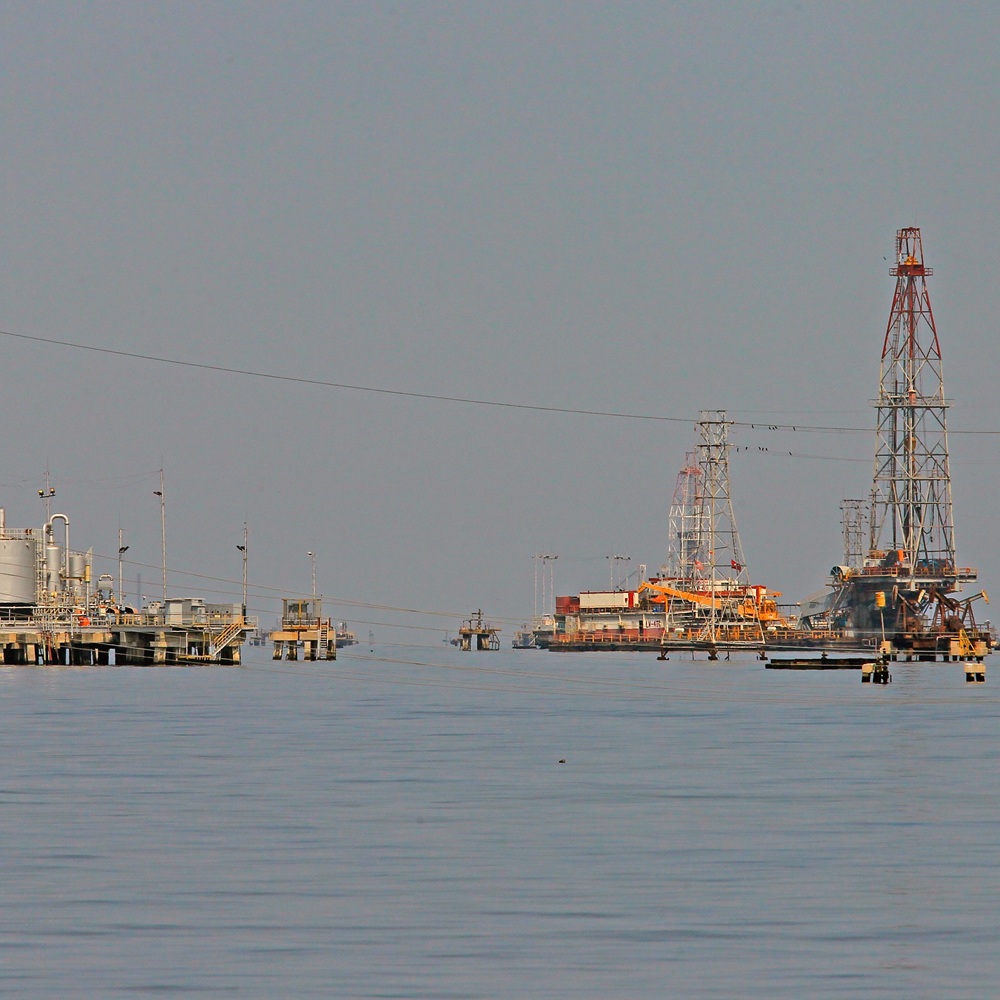
Lake Maracaibo, Venezuela. 18-03-2015.  An rig station are seen on Lake Maracaibo. Photo By: Jose Bula.

Energy Security as Hierarchy: Venezuelan Oil in the US-China-Russia Triangle

by Anya Kuteleva

On 3 January 2026, the US carried out a surprise military operation in Venezuela, capturing President Nicolás Maduro and his wife, Cilia Flores. The US has made little effort to cloak its operation in either solidarist language, such as appeals to democracy promotion, human rights, or liberal peacebuilding – or in pluralist rhetoric emphasizing the preservation of international order. Instead, Washington has presented the action in largely instrumental and strategic terms, signalling a willingness to sidestep both dominant justificatory traditions within international society. While Maduro and Flores are charged with narco-terrorism conspiracy and cocaine importation conspiracy, international debates focus on the future of Venezuela’s oil (Poque González 2026). On 7 January administration officials said the US plans to effectively assume control over the sale of Venezuela’s oil “indefinitely” (Sherman 2026) and President Donald Trump confirmed that he expected the US to run Venezuela, insisting that the country’s interim government was “giving us everything that we feel is necessary” (Sanger et al. 2026). Attention is fixed not only on Washington’s plans for Venezuela’s oil sector and control over its export revenues, but also on the replies from Moscow and Beijing, Maduro’s chief foreign backers and heavyweight players in energy politics. Consequently, this article asks two questions. First, to what extent does American control of Venezuelan oil threaten China’s and Russia’s energy interests? Second, what does the resulting US–China–Russia triangle imply for how energy security itself is being redefined? A constructivist perspective, recognizes that oil is an idea—valuable not only because it burns but because control over it symbolizes power and authority (Kuteleva 2021). Thus, when the US claims the right to supervise Venezuelan oil revenues, it is not only increasing leverage over barrels, but asserting the authority to define legitimate energy exchange itself. In this context, while the material threat is limited for China and already largely sunk for Russia, the symbolic, institutional and political threat is profound. A straightforward constructivist interpretation of the US–China–Russia triangle centres on status. China had cultivated Venezuela as an “all-weather strategic partnership” (Ministry of Foreign Affairs of PRC 2025b) and major debtor, only to watch Maduro captured days after senior Chinese officials visited Caracas (Ministry of Foreign Affairs of PRC 2025a). In constructivist terms, this is an obvious status injury: China appeared present but powerless. China’s energy diplomacy had functioned as proof of its global influence, and the nullification of China’s energy ties with Venezuela by US force undermines China’s narrative as a protective patron for the Global South. Beijing accused Washington of “hegemonic thinking” (Liu and Chen 2026), “bullying” (Global Times 2026a), and violating Venezuelan sovereignty and “the rights of the Venezuelan people” (Global Times 2026b). This strong pluralist language is not incidental—it is a bid to reclaim moral authority and redefine the event as norm-breaking rather than capability-revealing. Similarly, Russia’s involvement in Venezuela was never purely economic. Moscow saw the alliance with Venezuela as a way to advance its anti-American agenda and to signal that it could cultivate allies in Washington’s traditional backyard (Boersner Herrera and Haluani 2023; Gratius 2022; Herbst and Marczak 2019). It used Venezuela as leverage against the US, subsidised the regime during periods of domestic recession, and framed support as proof of great-power reliability. As senior Russian executives put it, “economic considerations took a back seat to political goals of taking swipes at the US” (Seddon and Stognei 2026). US control of Venezuelan oil thus removes a symbolic platform on which Russia enacted its identity as an energy superpower and geopolitical spoiler. While Russia continues loud sovereignty talk, its demonstrated incapacity to protect partners pushes it toward opportunistic bargaining (“concert” deals, see Lemke 2023) rather than overt defense of UN-pluralist restraint. As such, Dmitry Medvedev (2026) bluntly claimed that the US special military operation in Venezuela all but justifies Russia’s own actions in Ukraine. Venezuela is not a core supplier for China in volumetric terms. In 2025, Venezuelan exports to China averaged roughly 395,000 barrels per day—about 4% of China’s seaborne crude imports, according to Kpler data cited by the FT (Leahy and Moore 2026). China has diversified routes, strategic reserves covering at least 96 days of imports, and strong purchasing power in global markets (Downs 2025). Hence, from a narrow supply perspective, the loss of Venezuelan oil is manageable. That said, around one-fifth of China’s crude imports come from suppliers under US or western sanctions, primarily Iran, Venezuela and Russia, much of it disguised via transshipment near Malaysia (Downs 2025). Independent “teapot” refiners (Downs 2017)—who account for about a quarter of China’s refining capacity—are structurally dependent on this discounted, politically risky oil. Consequently, Trump’s seizure of Maduro alarmed China not mainly because of Venezuela itself, but because it demonstrated Washington’s capacity to escalate from sanctions to physical control of an energy sector, and thus potentially to Iran. Here, constructivism reveals the problem: “sanctioned oil” is not simply cheaper crude; it is a political category—oil marked as illegitimate by a dominant legal-financial order. The US move signals that this stigma can be converted into coercive authority, turning commercial vulnerability into geopolitical dependence. This reclassification transforms Chinese domestic actors into security subjects. “Teapot” refiners are no longer just businesses; they become strategic vulnerabilities whose survival depends on US tolerance. Analysis warn that a cutoff of Iranian oil could force many to shut down entirely (Leahy and Moore 2026). In this context, US control of Venezuelan oil reshapes Chinese energy security discourse from one of diversification and market access to one of hierarchy and exposure to political permission. Russia’s oil interests in Venezuela were largely written down years earlier. In 2020, Rosneft had sold most formal assets after pouring around $800m into loans and projects that produced little return (The Economist 2020). Much of the remaining exposure consisted of debts and shadow ownership arrangements. More important is the damage to Russia’s sanctions-evasion architecture. Russia had become the leading marketer of Venezuelan oil by trading crude as debt repayment and using banks partly owned by sanctioned Russian institutions, creating what the 2019 Atlantic Council report described as “a counter financial system to the one dominated by the West” (Herbst and Marczak 2019). The recent reporting on the US tracking a tanker linked to Venezuela, Russia and Iran illustrates how this counter-order is being contested operationally (Sheppard et al. 2026). The vessel sailed under false flags, was sanctioned for carrying Iranian oil, later re-registered under Russian jurisdiction, and became vulnerable to boarding under the UN Convention on the Law of the Sea because it was “without nationality.” Such episodes show that energy security is increasingly constituted by maritime law, insurance rules, and surveillance practices. US control over Venezuelan oil expands this regime of enforcement, making Russia’s informal trading networks less viable. A constructivist approach suggests that American control of Venezuelan oil is best understood not as a supply shock, but as an act of social stratification in the international system. Energy markets have always been hierarchical, but the hierarchy was largely implicit: reserve currencies, shipping insurance, futures exchanges, and contract law already privileged Western institutions. What is new is the explicit performance of hierarchy—the public demonstration that a great power can redefine ownership, legality, and access through coercion and administrative authority. This produces a stratified energy order: First, rule-makers – states whose legal systems, sanctions regimes, and corporate actors define what counts as legitimate oil (primarily the US and its allies). Second, rule-takers – states whose energy security depends on access to these institutions (most importers). And third, rule-evaders – states forced into informal networks (Russia, Iran, Venezuela) whose energy becomes socially “tainted.” China occupies an unstable middle category: economically powerful but institutionally dependent. Venezuela’s takeover publicly signals that material power is insufficient without normative control over legality. Referencias Boersner Herrera, Adriana, and Makram Haluani. 2023. ‘Domestic and International Factors of the Contemporary Russo–Venezuelan Bilateral Relationship’. Latin American Policy 14 (3): 366–87. Downs, Erica. 2017. The Rise of China’s Independent Refineries. Geopolitics. Global Energy Policy at Columbia University, School of International and Public Affairs. https://www.energypolicy.columbia.edu/publications/rise-chinas-independent-refineries/. Downs, Erica. 2025. China’s Oil Demand, Imports and Supply Security. Global Energy Policy at Columbia University, School of International and Public Affairs. https://www.energypolicy.columbia.edu/publications/chinas-oil-demand-imports-and-supply-security/. Global Times. 2026a. ‘China Condemns US Demands for Venezuela to Partner Exclusively on Oil Production as “Bullying,” Breaches of Intl Law: FM – Global Times’. Global Times, January 7. https://www.globaltimes.cn/page/202601/1352547.shtml. Global Times. 2026b. ‘China’s Legitimate Rights and Interests in Venezuela Must Be Safeguarded, Chinese FM Responds to Claim about US to Sell Venezuelan Sanctioned Oil – Global Times’. Global Times, January 7. https://www.globaltimes.cn/page/202601/1352555.shtml. Gratius, Susanne. 2022. ‘The West against the Rest? Democracy versus Autocracy Promotion in Venezuela’. Bulletin of Latin American Research 41 (1): 141–58. Herbst, John E., and Jason Marczak. 2019. Russia’s Intervention in Venezuela: What’s at Stake? Policy Brief. Atlantic Council. https://www.atlanticcouncil.org/in-depth-research-reports/report/russias-intervention-in-venezuela-whats-at-stake/. Kuteleva, Anna. 2021. China’s Energy Security and Relations with Petrostates: Oil as an Idea. Routledge. Leahy, Joe, and Malcolm Moore. 2026. ‘Donald Trump’s Venezuela Action Raises Threat for China’s Oil Supplies’. Oil. Financial Times, January 8. https://www.ft.com/content/f64826fa-5c36-4fb3-8621-ee0b9d9a1ff5. Lemke, Tobias. 2023. ‘International Relations and the 19th Century Concert System’. In Oxford Research Encyclopedia of International Studies. Liu, Xin, and Qingqing Chen. 2026. ‘US Reportedly Sets Demands for Venezuela to Pump More Oil; Experts Say “Anti-Drug” Claims a Pretext, Exposing Neo-Colonialism – Global Times’. The Global Times, January 7. https://www.globaltimes.cn/page/202601/1352544.shtml. Medvedev, Dmitry. 2026. ‘Год начался бурно’. Telegram, January 9. https://t.me/medvedev_telegram/626. Ministry of Foreign Affairs of PRC. 2025a. ‘Foreign Ministry Spokesperson Lin Jian’s Regular Press Conference on January 5, 2026’. January 5. https://www.fmprc.gov.cn/eng/xw/fyrbt/202601/t20260105_11806736.html. Ministry of Foreign Affairs of PRC. 2025b. ‘Xi Jinping Meets with Venezuelan President Nicolás Maduro Moros’. May 10. https://www.fmprc.gov.cn/eng/xw/zyxw/202505/t20250513_11619919.html. Poque González, Axel Bastián. 2026. ‘Energy Security and the Revival of US Hard Power in Latin America’. E-International Relations, January 12. https://www.e-ir.info/2026/01/12/energy-security-and-the-revival-of-us-hard-power-in-latin-america/. Sanger, David E., Tyler Pager, Karie Rogers, and Zolan Kanno-Youngs. 2026. ‘Trump Says U.S. Oversight of Venezuela Could Last for Years’. U.S. The New York Times, January 8. https://www.nytimes.com/2026/01/08/us/politics/trump-interview-venezuela.html. Seddon, Max, and Anastasia Stognei. 2026. ‘How Russia’s Venezuelan Oil Gambit Went Awry’. Venezuela. Financial Times, January 9. https://www.ft.com/content/e09a6030-325f-4be5-ace3-4d70121071cb. Sheppard, David, Chris Cook, and Jude Webber. 2026. ‘US Tracking Oil Tanker off UK Coast Linked to Venezuela, Russia and Iran’. Shipping. Financial Times, January 6. https://www.ft.com/content/a699169a-983a-4472-ab23-54bceb9dd2bd. The Economist. 2020. ‘Why Putin’s Favourite Oil Firm Dumped Its Venezuelan Assets’. The Economist, April 2. https://www.economist.com/leaders/2020/04/02/why-putins-favourite-oil-firm-dumped-its-venezuelan-assets.

Energy & Economics
Trade war policy in development.United States tariffs government import taxation for Europe,to increase the American economy.Industrial Tariffs growth.Import Trade Tariffs increase.

Why has Europe under-performed and fallen behind?

by World & New World Journal Policy Team

I. Introduction The European economy is in big trouble. Szu Ping Chan and Hans van Leeuwen, the economics editors of the Telegraph, a British daily newspaper, claim that the European Continent is stuck on a path of disastrous decline. [1] As Figure 1 shows, EU share of world GDP has continued to decline from 27% in 1990 to 17% in 2024.  Figure 1: EU share of World GDP (source: IMF) As a result, EU’s GDP in 2000 was six times larger than Chinese GDP, but EU’s GDP in 2025 is expected to reach the similar level of China’s GDP as Figure 2 shows. EU’s GDP in 2000 was $3 trillion smaller than US GDP, but EU’s GDP in 2025 is expected to be over $ 10 trillion smaller than US GDP.  Figure 2: EU, US, China, Japan GDP, 2000 & 2025 (source: Alcott Global) Moreover, the Ukraine war in 2022 brought more uncertainty to Europe by creating energy problems for the European economy. Europe’s reliance on external energy sources has been a long-standing issue. The energy crisis that began in 2021, fueled by the Ukraine war and climate change, has exposed how fragile the region’s energy infrastructure remains. Skyrocketing LNG prices, unreliable renewable energy production, and Russia’s strategic use of fossil fuels as leverage have left the European continent struggling with record-high energy costs. With this information in background, this paper explores why the European economy has under-performed and fallen behind. This paper first describes the current economic situation of Europe and explains why the European economy has failed. II. The Current Situation of European Economy Europe may be a great place to live with free health care, generous welfare, and great cities. However, when we compare the economy of three major economies, the US, Europe, and China, it is obvious that the European economy is in big trouble. Europe is being squeezed by the US and China. As Figure 3 shows, economic growth has been anemic across Europe. Germany has been its worst performer in recent years. The German economy is the same size today as it was in the fourth quarter of 2019. In other words, it has had five years of lost growth. But the rest of Europe has not fared much better. The French economy is only 4.1% larger than it was in the final quarter of 2019, while Italy’s economy is 5.6% bigger. (See Figure 3.) And while Spain’s GDP has increased by 6.6% since then, this has been helped greatly by an influx of immigration that meant that GDP per capita has increased by only 2.9% over the same period. By contrast, the US economy has grown by 11.4%.  Figure 3: Real GDP (Q4 2019 = 100) (Source: LSEG, Capital Economics) As Figure 4 shows, over the period 2020-2024, the EU’s total GDP growth was 12.2% compared to 23.4% for China, 15% for the US.  Figure 4: Growth, EU, US, China, and Japan, 2020-2024 As Figure 5 shows, the EU grew only 1.1% in 2024 compared to 2.8% for the US and 5.0% for China. Figure 5: GDP growth, EU, US, China, and Japan, 2024 Moreover, when we compare the economies of two Western rivals, the US and Europe, it is obvious that the EU has grown slower than the US, as Figure 6 shows.  Figure 6: US grow faster than EU countries, 2010-2024 (source: World Bank) As Figure 7 shows, Europe’s unemployment has been higher than the US.  Figure 7: EU unemployment is higher than US, 2000-2024 As Figure 8 shows, Europe’s LNG price has been higher than US price during the 2020-2024, and higher than Asian price immediately after Russia invaded Ukraine, thereby burdening the European economy.  Figure 8: LNG price, EU, US, Asia, January 2000-January 2024 Furthermore, when it comes to new engines of growth – big tech, AI, electric cars, Europe has slipped behind both the US and China. Europe is being squeezed by cheaper imports in China and better tech in America. III. Causes of the Failure of European Economy Why has the European economy failed? According to Neil Shearing, a chief economist of Capital Economics, Europe’s under-performance has been due in part to the effects of the energy crisis following Russia’s invasion of Ukraine as Figure 9 shows Europe’s skyrocketing gas prices. [2]  Figure 9: Natural gas prices, Europe, US, Japan, January 2021- end 2024 In addition, as Figure 10 shows, energy prices in the Euro area reached an all time high of 171.75 points in October of 2022 following the Ukraine war. It decreased to 145.49 points in November 2025, but it is still too high.  Figure 10: Energy price, Euro zone (source: Eurostat) As Table 1 shows, dependence on energy imports has shown divergent trends since 2000: The US has dramatically reduced its reliance on energy imports and become a net exporter, while the European Union has maintained a high level of energy dependence, and China’s dependence has generally increased along with its enormous economic growth. The US has undergone a remarkable transformation. Around 2005, US crude oil imports reached a peak at about 60% of their consumption. Thanks to the shale revolution and growing renewable energy use, US domestic production soared, and the US became a net energy exporter in 2019. By 2024, US energy imports made up only 17% of its energy demand. China’s rapid economic growth has driven a massive increase in energy demand. As a result, its dependence on energy imports has increased significantly since 2000. China is the world’s largest importer of crude oil. While China is also the leading investor in renewable energy, which meets a portion of its growing energy demand, the absolute need for fossil fuel imports to power its industrial sector remains high. In 2024, energy imports met around 25% of their total energy demand. Table 1: Dependence on Energy Imports, 2000–2025 As Figure 11 shows, the EU consistently shows high dependence on energy imports over the last three decades during the 1993-2024 period. The EU’s dependence on oil and gas imports have been much higher than the US and China. EU’s dependence on oil imports was over 90%, while EU’s gas import dependence reached over 90% in 2023 following the Ukraine war. While the EU has made progress in renewable energy, it remains heavily reliant on oil and gas imports, and has recently shifted its import sources from Russia to other partners such as the US and Norway. This high dependence on energy imports and energy crisis in Europe following the Ukraine war led to a deterioration in the region’s terms of trade that manifested itself in a large squeeze in real incomes and loss of competitiveness of energy-intensive industries, thereby lowering economic growth in Europe.  Figure 11: Dependence on energy imports, EU, US, and China, 1993-2024 In addition, European households have also become more reluctant to spend, thereby leading Europe to lower growth. The household saving rate in Europe is now three percentage points higher than it was before the Covid-19 pandemic in 2019, while the savings rate in the US is now lower than it was in 2019. (See Figure 12.) The tendency of Europeans to spend less leads to lower growth in Europe.  Figure 12: Euro-zone household savings rate (% of disposable income) However, the weakness of the European economy is fundamentally structural. There are several elements to this. The first key issue related to low growth in Europe is regulation in Europe that stifles competition and innovation. The EU has become increasingly protectionist, mainly through regulation. While convenient, this strategy proves counterproductive. It eliminates the incentives for creativity and efficiency. The Digital Services Act and increasingly narrow interpretations of the General Data Protection Regulation (GDPR) were intended to rein in US tech giants, but have instead held Europe back in these same sectors. The AI Act and supply chain laws are similarly damaging. It is perhaps no surprise that the major disruptive and innovative firms of the past two decades have come from the US and China rather than from the Euro-zone countries. Robot taxis are a good example. One in three taxi rides in California is already in a robot taxi. The growth has been exponential and they are set to overtake ordinary taxis. The market opportunity is huge; they will be cheaper than paying a driver. In Texas, Tesla charges just a dollar a mile. They are safer too – 90% fewer accidents. And that means cheaper car insurance. They will save income, decrease emissions and reduce the need to buy an expensive car. It’s not just America; 2,000 self-driving cars have already been transporting millions across the big cities in China. But, for Europeans, the idea of a self-driving car, is still the stuff of science fiction. Or more accurately, something blocked by the European love of regulation, risk-aversion, and a powerful car lobby still stuck in the combustion engine era. [3] Another example is the tech industry. Europe is hampered by fragmented and excessive regulation. A US start-up can launch a product under a single regulatory framework and immediately access a market of more than 330 million consumers. The EU has a population of about 450 million but remains divided among 27 national regulatory regimes. An IMF analysis shows that internal market barriers in the EU act like a tariff of around 44% for goods and 110% for services – far higher than the tariff levels that the US imposes on most imports. [4] True, Europe has some successes such as Revolut, Klarna and Spotify, but these are dwarfed by the US giants of Meta, Google, Microsoft and Apple. Today, approximately half of the world’s 50 largest technology firms are American, while only four are European companies. [5] Over the past five decades, 241 US firms have grown from start-ups into massive unicorn companies. The EU’s response has been to seek to regulate the murky world of big tech surveillance, but in a way, the sledgehammer of GDPR regulation has done more to increase costs for local European business and tech startups as Figure 13 shows. While California alone has produced a quarter of the world’s tech unicorns, Germany-a similarly sized economy-has produced just 2% of high-value start-ups. Without urgent reform, Europe risks being sidelined in the global technological race.  Figure 13: GDPR regulation and EU & US Venture capital There is an old saying: the US invents, China imitates, and Europe regulates. Harsh, but an element of truth. Though the big change is that China no longer imitates, but produces goods much cheaper than in Europe. But Europe is still stuck in a regulatory mind-set. The result is that productivity growth in Europe - which is the key determinant of economic growth over the long run - is substantially lower, averaging 0.3% a year over the past decade compared to 1.6% a year in the US. The second issue is Europe’s insufficient investment in new technologies (computers, artificial intelligence (AI), software, etc.) and the low level of spending on research and development (R&D). When we compare OECD countries, we see that these two components have a strong influence on productivity differences between countries. The econometric estimate leads to the following effects: a 1- point increase in the rate of investment in new technologies leads to a 0.8 point increase per year in productivity gains. In a similar way, a 1-point increase in GDP for research and development (R&D) expenditure leads to a 0.9 point increase per year in productivity gains. [6] The fear is that Europe will be drawn into a vicious circle By 2022, investment in new technologies represented 5% of GDP in the US and 2.8% of GDP in the Euro zone. The EU’s efforts in advanced technologies, such as AI and cloud computing, far from match those of the US. The main instrument available to the EU, the European Innovation Council, had a budget of 256 million euros in 2024, while the US allocated more than 6 billion dollars for this purpose. The situation is repeated when looking at venture capital investment. In 2023, they invested about $8 billion in venture capital in AI in the EU, compared to $68 billion in the US and $15 billion in China. The few companies that create generative AI models in Europe, such as Aleph Alpha and Mistral, need large investments to avoid losing the race to US firms. However, European markets do not meet this need, pushing European firms to look outside for funding. [7] As a result, for example, the EU has been losing the open model contest as Figure 14 shows.  Figure 14: Cumulative downloads, 2023-25 (source: ATOM project, Hugging Face) Moreover, the EU falls behind the US and China in terms of R&D spending. R&D spending in 2022 amounted to 3.5% of GDP in the US and 2.3% of GDP in the Euro zone. What’s more, from 2007 on, as Figure 15 shows, R&D spending in the US and China increased significantly compared to that of the Euro zone. The lag in technological investment and R&D explains a large part of Europe’s lag behind the US in terms of labor productivity and GDP. [8]  Figure 15: Gross domestic spending on R&D, 2007-2023 The third issue related to lower growth in Europe is the size of welfare states in Europe. The size of welfare states differs markedly across OECD countries. European countries have the largest welfare states in the OECD and among the highest in the World. As Figure 16 shows, European welfare states are significantly larger than in the US, with EU countries allocating approximately 27% of GDP to social benefits in 2024, compared to roughly 19.8% in the US. Some European countries like Austria, Finland, and France spend over 30% of GDP on social benefits in 2024. While the US spends 7% of GDP on public provision of pensions, it is 16% in Italy and it is 13% in France.  Figure 16: Public social spending as a % of GDP in 2024, EU countries & US Big welfare states have a complex, debated impact on economic growth, with evidence showing they can both impede growth through higher taxes and reduced work incentives, or foster it by boosting education, stability, and innovation. However, there has recently been a groundswell of opinion among economists that the scale of the welfare state is one of the elements responsible for slower economic growth and that a retrenchment in the welfare state is necessary if growth will be revived in Europe. The welfare state is indicted with the charge of becoming a barrier to economic growth in Europe through higher taxes and reduced work incentives. As Figure 17 shows, the tax burden is higher in the EU than in the US for most taxpayers. The overall tax-to-GDP ratio for the EU averages approximately 44%. By contrast, the US ranks as one of the lowest among developed countries, with a tax-to-GDP ratio 35% in 2022 approximately 9% lower than the EU average.  Figure 17: Tax burden, EU and US, 2022 (source: OECD Government at a glance, 2023) Figure 18 shows the total tax wedge for average single workers in each member country of EU. Belgium, Germany, Austria, and France confiscate more than half of their workers’ pre-tax compensation. Compared to the EU member countries, workers in the US face the lowest average tax wedge. This distorts work incentives for Europeans and renders everyone in Europe poorer. [9] High taxes and less work incentives make EU citizens spend less than US citizens, thereby lowering economic growth in Europe as Figure 19 shows.  Figure 18: EU workers pay more taxes than US workers, 2022 (source: OECD Government at a glance, 2023)  Figure 19: Americans spend 70% more on EU citizens (Average individual consumption per capita, 2020; United States indexed to 100). (source: National Accounts of OECD countries) In fact, Gwartney, Holcombe and Lawson (1998) showed empirically that as the size of general government spending has almost doubled on average in OECD countries from 1960 to 1996, their real GDP growth rates have dropped by almost two thirds on average (see Figure 20). According to them, the worst economic performers were some Southern European countries that increased the size of the government the most.  Figure 20: Big government spending reduces growth. At the height of the Euro-zone crisis in 2012, German Chancellor Angela Merkel tried to make the case that Europe’s welfare states were too large, as Europe accounted for 7% of the global population, for a quarter of global GDP and for 50% of global social spending. The situation has not improved since then. On September 9, 2024, Draghi presented his report “The Future of European Competitiveness,” a 400-page document, to deal with Europe’s sluggish economy, but he kept untouched Europe’s over-sized welfare state, while he strongly called for reforms and investments to reinforce productivity growth. [10] The fourth issue is the Euro. The Euro has been a mixed blessing for Europe. It lowers transaction costs but highlights an unbalanced EU economy. Germany runs a large current account surplus, fringe economies like Portugal and Greece running deficits. But there is no scope for Germany to appreciate, weaker countries to devalue. One size fits all. But, this can have disastrous effects. The Euro Debt Crisis of 2012, led to high bond yields and a response of austerity, which contributed to weak growth in the last decade. Mario Draghi’s intervention reduced bond yields, but the European Central Bank has been criticized for a deflationary bias, and it has certainly struggled since the Covid-19 era, with growth in Europe much less. IV. Conclusion This paper showed that the European economy is in big trouble with lower growth. This paper explained that Europe’s economic under-performance & sluggish economy can be attributed to energy crisis and high saving, as well as over-regulation, large size of welfare state & high taxation, and lack of innovation & low investment in new technology and R&D. Referencias [1] https://www.telegraph.co.uk/business/2025/12/14/rising-fear–europe-really-is-doomed-and -taking-britain-down/ [2] https://www.capitaleconomics.com/blog/its-not-just-france-europe–faces-ongoing-decline- without-fundamental-reform-its-core [3] https://www.capitaleconomics.com/blog/its-not-just-france-europe–faces-ongoing-decline- without-fundamental-reform-its-core [4] https://www.project-syndicate.org/commentary/europe-most-serious-problem-not-immigra tion-but-technological-backwardness-by-nouriel-roubini-2025-12 [5] https://www.project-syndicate.org/commentary/europe-most-serious-problem-not-immigra tion-but-technological-backwardness-by-nouriel-roubini-2025-12 [6] https://www.polytechnique-insights.com/en/columns/economy/economy-why-europe-is-falllling-behind-the-usa/ [7] https://www.polytechnique-insights.com/en/columns/economy/economy-why-europe-is-fall ing-behind-the-usa/ [8] https://www.polytechnique-insights.com/en/columns/economy/economy-why-europe-is-fall ing-behind-the-usa/ [9] https://mises.org/mises-wire/europes-economy-slows-its-welfare-state-grows [10] https://www.csis.org/analysis/draghi-report-strategy-reform-european-economic-model

Energy & Economics
Global business connection concept. Double exposure world map on capital financial city and trading graph background. Elements of this image furnished by NASA

Liaison countries as foreign trade bridge builders in the geo-economic turnaround

by Eva Willer

Introduction Geopolitical tensions are making global trade increasingly difficult. In order to reduce the associated risk of default, companies are shifting their trade relations to trading partners that are politically similar to them. In the course of the beginnings of geo-economic fragmentation, politically and economically like-minded countries are also gaining in importance for German and European decision-makers. Liaison countries1 in particular can form a counterforce to the trend towards polarization in foreign trade - especially between the USA and China: they are characterized by a pronounced economic and trade policy openness that overrides differences between geopolitical or ideological camps. Consequently, the question arises: How can relevant connecting countries for Germany and Europe be identified? What opportunities and risks do closer trade relations with these countries offer in order to strengthen foreign trade resilience in geopolitically uncertain times?  With a high degree of openness - defined as the sum of imports and exports in relation to gross domestic product - of over 80 percent2 , the German economy is strongly integrated into global trade. Accordingly, the disruptive effect of geo-economic fragmentation on the German economy would be above average. The defensive strategy to strengthen Germany's economic security by pushing for trade policy independence would only reinforce geo-economic fragmentation. Against the backdrop of comparatively high economic vulnerability, it is necessary to focus on those potential partner countries with which German and European foreign trade could be developed and expanded even under the condition of increasing fragmentation.  Geoeconomic Fragmentation  The term "geo-economic fragmentation" is used to describe the politically motivated reorganization of global goods and financial flows, in which strategic, economic and political interests primarily determine the choice of countries of origin and destination for trade flows.3 In the scenario of geo-economic fragmentation, the result would be the formation of a bloc within the global community of states, which would fundamentally change the regulatory structure of global economic networking. In this case, trade and investment would probably concentrate from a previously diverse range of economic partner countries - prior to the formation of the bloc - on those countries that now - since the formation of the bloc - belong to the same bloc.  The likelihood of this scenario occurring and leading to an increased fragmentation of the global economic order has increased again in the recent past. For example, Donald Trump's second term as US president is causing increasing geopolitical uncertainty worldwide.  Statements on the concrete form of a possible demarcation of potential blocs are subject to a great deal of uncertainty. However, the division of a large part of the global economy into a "US bloc" and a "China bloc" is a conceivable scenario for which German politics and business should prepare.  Data already shows that, at a global level, foreign trade openness has decreased in the recent past. Data from the World Trade Organization (WTO) illustrates the increasing hurdles in global trade in goods. While 3.1% of global imports were still affected by tariff or non-tariff barriers to trade in 2016 - including under WTO rules - this figure rose to 11.8% in 2024 over the following years.4 This development goes hand in hand with a noticeable loss of importance and enforcement of the WTO since the 2010s, which previously played a central role as the guardian of the rules-based global economic order.  Studies by the International Monetary Fund (IMF) have already found indications of an incipient geo-economic fragmentation along potential bloc borders. It shows that trade in goods and foreign direct investment between countries that would belong to the opposing camp in the event of a bloc formation declined on average in 2022 and 2023 - in contrast to foreign trade between countries that are geopolitically close.5  In this initial phase of geo-economic fragmentation, liaison countries are beginning to establish themselves as a counterforce, holding the fragmenting global community of states together with new trade and investment routes.  Identification of liaison countries Specifically, liaison countries have the following characteristics: a pronounced openness to foreign trade in the form of a high foreign trade quota and low tariff and non-tariff trade barriers, as well as pronounced economic relations with partner countries from different geopolitical camps. The geopolitical orientation of countries can be examined using data on voting behavior within the United Nations.6 This involves analyzing whether a country can be assigned to the US or Chinese camp - or whether there is no pronounced proximity and therefore political neutrality or "non-alignment" in the sense of ideological independence. The data-based identification of connecting countries is relatively new. Empirical analyses are also limited to connecting countries in the context of US-Chinese foreign trade - specifically US imports from China. In this case, the characteristics of a connecting country can be broken down into (1) "non-alignment" - i.e. a geopolitical distance to both a Western and an Eastern bloc - as well as (2) an increase in imports and foreign investment from China and (3) a simultaneous increase in exports to the United States. In a narrower sense, this is an evasive reaction to trade restrictions, i.e. circumventing trade. If the foreign trade indicators - specifically the trade and investment data relating to the US and China - of "non-aligned" countries for the period from 2017 to 2020 show corresponding characteristic-related changes compared to previous years, these can be identified as countries connecting the US and China.  The analysis of trade data shows that the value of direct exports from China to the USA fell during Donald Trump's first term in office. At the same time, both Chinese exports to some of the "non-aligned" countries and exports from these countries to the USA have increased significantly. These countries have presumably stepped in as a link on the export route from China to the US after the previously direct trade flow was interrupted by trade barriers and had to find a new route. Companies producing in China are therefore likely to have sought new, indirect ways to maintain access to the US sales market.  A certain statistical inaccuracy in the foreign trade data makes it difficult to draw a definitive conclusion in this context. It should be noted: No single commodity can be tracked across national borders in trade data collection. Whether the additional goods imported from China actually found their way to the United States can only be assumed approximately. However, if the trade flows are aggregated, a clearer picture emerges and the circumvention trade via selected connecting countries - including Vietnam and Mexico - becomes visible.  Data on foreign direct investment rounds off the analysis.7 "Non-aligned" countries in which an increase in Chinese investment can be seen between 2016 and 2020 in addition to trade flows can be identified as connecting countries. Here, too, available data suggests that the companies concerned either exported their goods to the United States via a stopover or even outsourced parts of their production destined for the US market to connecting countries. Five connecting countries between the US and China Based on the 2017-2020 study period, various connecting countries can be empirically identified that were used to indirectly maintain access to the US market. In terms of foreign trade volume, the economically most important connecting countries include Mexico, Vietnam, Poland, Morocco and Indonesia.8 All five countries are characterized by the fact that both their exports of goods to the US and their imports of goods from China increased significantly between 2017 and 2020. In addition, greenfield investments (foreign direct investment to set up a new production facility) have risen significantly compared to the period before 2017.  However, the five countries show different priorities in their development, which differentiate them in their role as connecting countries between the USA and China. In Vietnam, exports to the USA in particular have risen sharply. China has been the most important procurement market for Vietnamese companies for years. Poland, Mexico and Indonesia are characterized as connecting countries primarily by the significant increase in imports from China. Morocco, in turn, was able to attract more Chinese foreign investment in particular. Greenfield investments have almost tripled here since 2017. However, Poland - a rather surprising candidate for the role of liaison country, as it is intuitively assigned to the US-oriented bloc - is positioned fairly centrally between the US and China according to the analysis of voting behavior within the United Nations9. In addition, Poland qualifies primarily due to the sharp rise in greenfield investments from China, primarily in the expansion of domestic battery production.10  It cannot be concluded from the previous studies on the USA and China whether German companies are also circumventing trade barriers from the USA via the countries identified. As the trade policy conflicts between the US and China differ significantly from those between the EU and China, there has been a lack of comparable empirical data to analyze connecting countries in the EU context. Opportunities and challenges As the German economy is strongly oriented towards foreign trade and is closely networked with both the USA and China, German companies play a particularly exposed role in the area of tension between the USA and China. Increased economic exchange with potential connecting countries would offer German companies an opportunity to mitigate the expected shock of a geopolitical bloc. They could at least maintain international trade to a certain extent and thus secure some of the endangered sales and procurement markets. On the other hand, there are also costs associated with expanding foreign trade relations with potential connecting countries. The greater complexity also increases the risk in the value chains. Companies that position themselves wisely within this trade-off buy themselves valuable time in the event of a shock to reorganize themselves against the backdrop of changed foreign trade conditions.  From the perspective of foreign trade policy, it is also possible to examine the extent to which stronger foreign trade cooperation with (potential) connecting countries could have advantages. The trade-off between resilience and complexity must then be assessed at a macroeconomic level, beyond individual company interests. In order to make it easier for companies to connect to potential connecting countries and to create appropriate framework conditions, German and European policy can build on existing comprehensive strategies at national and European level. Both the China Strategy11 and the National Security Strategy12 focus foreign policy on connecting countries as part of a stronger economic and political risk diversification. There is also a similar framework at European level with the EU's Strategic Compass13 . Following on from this, the German government could create targeted incentives to open up new markets in liaison countries, which would diversify critical supply chains and reduce one-sided dependencies.  At the same time, connecting countries pose a challenge. These can be used to circumvent foreign trade measures such as sanctions if flows of goods can find alternative routes via connecting countries more easily than before.  In order to realize opportunities and overcome challenges, close cooperation between science, politics and companies is required. This first requires the identification of a selection of potential connecting countries through scientifically sound analysis. This creates the basis for the subsequent steps in which European and German policymakers work closely with companies to create attractive framework conditions for trade with potential connecting countries - for example through bilateral trade agreements.  Attractive foreign trade framework conditions can create the necessary incentive to actually expand trade relations with potential connecting countries. Companies need to weigh up individual cases and make forward-looking decisions: To what extent is there a risk of a loss of production triggered by geopolitical conflicts? And how much would the complexity of the value chain increase if more potential connecting countries were included? Ultimately, the actual choice of preferred sales and procurement markets lies with the individual companies. LicenseThis work is licensed under CC BY 4.0 References1. Verbindungsländer werden im Sinne von Connectors verstanden, vgl. Gita Gopinath/Pierre-Olivier Gourinchas/Andrea F Presbitero/Petia Topalova, Changing Global Linkages: A New Cold War?, Washington, D.C.: IMF, April 2024 (IMF Working Paper) <https://www.imf.org/en/Publications/WP/Issues/2024/04/05/Changing-Global-Linkages-A-New-ColdWar-547357/>. 2. Statistisches Bundesamt (Destatis), Außenwirtschaft. 2025, <https://www.destatis.de/DE/Themen/Wirtschaft/Globalisierungsindikatoren/aussenwirtschaft.html#246 078/>.  3. Shekahar Aiyar/Franziska Ohnsorge, Geoeconomic Fragmentation and ‚Connector’ Countries, Online verfügbar unter:  <https://mpra.ub.uni-muenchen.de/121726/1/MPRA_paper_121726.pdf>.4. WTO, WTO Trade Monitoring Report, Genf, November 2024, <https://www.wto.org/english/tratop_e/tpr_e/factsheet_dec24_e.pdf/>. 5. Gita Gopinath/Pierre-Olivier Gourinchas/Andrea F Presbitero/Petia Topalova, Changing Global Linkages: A New Cold War?, Washington, D.C.: IMF, April 2024 (IMF Working Paper) <https://www.imf.org/en/Publications/WP/Issues/2024/04/05/Changing-Global-Linkages-A-New-ColdWar-547357/>.  6. Michael A. Bailey/Anton Strezhnev/Erik Voeten, »Estimating Dynamic State Preferences from United Nations Voting Data«, Journal of Conflict Resolution, 61 (2017) 2, S. 430-456, <https://journals.sagepub.com/doi/10.1177/0022002715595700/>.7. Gita Gopinath/Pierre-Olivier Gourinchas/Andrea F Presbitero/Petia Topalova, Changing Global Linkages: A New Cold War?, Washington, D.C.: IMF, April 2024 (IMF Working Paper) <https://www.imf.org/en/Publications/WP/Issues/2024/04/05/Changing-Global-Linkages-A-New-ColdWar-547357/>. War-547357. 8. Enda Curran/Shawn Donnan/Maeva Cousin, »These Five Countries are Key Economic ‚Connectors‘ in a Fragmenting World«, in Bloomberg (online), 1.11.2023, <https://www.bloomberg.com/news/articles/2023-1102/vietnam-poland-mexico-morocco-benefit-from-us-china-tensions/>.9. Michael A. Bailey/Anton Strezhnev/Erik Voeten, »Estimating Dynamic State Preferences from United Nations Voting Data«, Journal of Conflict Resolution, 61 (2017) 2, S. 430-456, <https://journals.sagepub.com/doi/10.1177/0022002715595700/>.  10. Enda Curran/Shawn Donnan/Maeva Cousin, »These Five Countries are Key Economic ‚Connectors‘ in a Fragmenting World«, in Bloomberg (online), 1.11.2023, <https://www.bloomberg.com/news/articles/202311-02/vietnam-poland-mexico-morocco-benefit-from-us-china-tensions/>.11. Auswärtiges Amt, China‐Strategie der Bundesregierung, Berlin, Juli 2023, <https://www.auswaertigesamt.de/resource/blob/2608578/810fdade376b1467f20bdb697b2acd58/china-strategie-data.pdf/>.  12. Auswärtiges Amt, Integrierte Sicherheit für Deutschland: Nationale Sicherheitsstrategie, Berlin, Juni 2023, <https://www.bmvg.de/resource/blob/5636374/38287252c5442b786ac5d0036ebb237b/nationalesicherheitsstrategie-data.pdf/>.  13. Rat der Europäischen Union, Ein Strategischer Kompass für Sicherheit und Verteidigung, Brüssel, März 2022, <https://data.consilium.europa.eu/doc/document/ST-7371-2022-INIT/de/pdf/>.

Energy & Economics
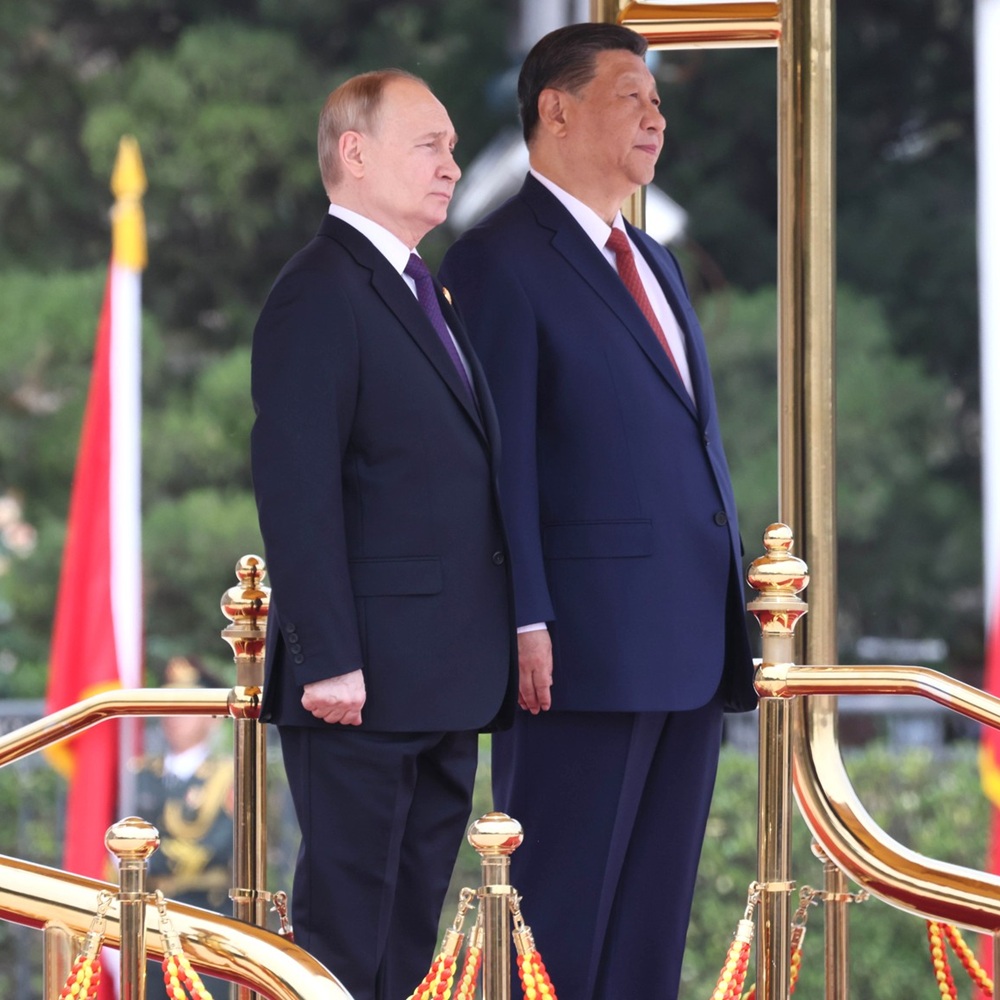
Xi Jinping and Vladmir Putin at welcoming ceremony (2024)

Russia and China in the Era of Trade Wars and Sanctions

by Ivan Timofeev

Economic relations between Russia and China remain high. Beijing has become Moscow's most important trading partner, and in the context of Western sanctions, it has also become an alternative source of industrial and consumer goods, as well as the largest market for Russian energy and other raw materials. At the same time, external political factors may have a growing influence on Russian-Chinese economic relations. These include the trade war between China and the United States, a possible escalation of US sanctions against Russia, and the expansion of secondary sanctions by the European Union against Chinese companies. The trade war, in the form of increased import duties on imported goods, has become one of the calling cards of Donald Trump's second term in office. The executive order he issued on April 2, 2025, provided a detailed conceptual justification for such a policy. The main goal is the reindustrialisation of the United States through the return or transfer of industrial production to the territory of the US, as well as an equalization of the trade balance with foreign countries. The basic part of Trump's order concerned all countries throughout the world and assumes a tariff increase of 10%. It goes on to determine individual duties on the goods of more than 70 countries, with its own sets for each. China became one of the few countries which decided to mirror the tariff increases. This led to a short-lived and explosive exchange of increases in duties. While it was suspended by negotiations between the two countries in Geneva, it was not removed from the agenda. In the US trade war “against the whole world”, China remains a key target. This is determined by the high level of the US trade deficit in relations with China, which has persisted for more than 40 years. Apparently, it remained comfortable for the US until China made a noticeable leap in the field of industrial and technological development. Such a leap allowed China to gradually overcome its peripheral place in the global economy, displace American and other foreign goods from the domestic market, and occupy niches in foreign markets. Despite the critically important role of American components, patents and technological solutions in a number of industries, China has managed to reduce its dependence on them. The growing industrial and technological power of the PRC is becoming a a political problem for the US. It was clearly identified during the first term of Trump's presidency. Even then, the US pursued a course toward the technological containment of China. Despite the temporary respite in the trade war, US pressure on China will remain. The tariff policy may be supplemented by restrictive new measures (sanctions) in the field of telecommunications and other industries. During the new term of Donald Trump's presidency, the politicisation of issues that the Biden administration avoided putting at the forefront of US-Chinese relations began again. These include the problem of Hong Kong autonomy and the issue of ethnic minorities in the Xinjiang Uyghur Autonomous Region of China. Both issues received a high level of politicisation during Trump's first term. The US-China trade war has so far had little effect on Russian-Chinese relations. The increase in US tariffs has had virtually no effect on Russia. Russia is already facing a significant number of restrictive measures, and the volume of trade with the United States has been reduced to near zero since the start of Moscow’s Special Military Operation in 2022. However, Russia may feel the effects of the trade war. For example, the United States may require China to purchase American energy resources as a measure to correct the trade balance. Obviously, such a measure is unlikely to solve the imbalance. However, it has the potential to affect the volume of Russian oil supplies to China in one way or another. In addition, the trade war as a whole may affect oil prices downwards, which is also disadvantageous for Russia. On the other hand, Russia is a reliable supplier of energy resources for China, which will not politicise them. Even in the context of new aggravations of the trade war, China is unlikely to refuse Russian supplies. Another factor is US sanctions against Russia. After the start of Russian-American negotiations on Ukraine in 2025, Washington avoided using new sanctions, although all previously adopted restrictive measures and their legal mechanisms are in force. However, Donald Trump failed to carry out a diplomatic blitzkrieg and achieve a quick settlement. The negotiations have dragged on and may continue for a long time. If they fail, the United States is ready to escalate sanctions again. Existing legal mechanisms allow, for example, for an increase in the list of blocked persons, including in relation to Chinese companies cooperating with Russia. This practice was widely used by the Biden administration. It was Chinese companies that became the key target of US secondary sanctions targeting Russia. They fell under blocking financial sanctions for deliveries of industrial goods, electronics and other equipment to Russia. However, there was not a single large company among them. We were talking about small manufacturing companies or intermediary firms. At the same time, the Biden administration managed to significantly complicate payments between Russia and China through the threat of secondary sanctions. US Presidential Executive Order 14114 of December 22, 2023 threatened blocking sanctions against foreign financial institutions carrying out transactions in favour of the Russian military-industrial complex. In practice, such sanctions against Chinese financial institutions were practically not applied, except for the blocking of several Chinese payment agents in January 2025. However, the very threat of secondary sanctions forced Chinese banks to exercise a high level of caution in transactions with Russia. This problem has not yet been fully resolved. New legal mechanisms in the field of sanctions, which are being worked on in the United States, may also affect Russian-Chinese relations. We are talking about the bill introduced by US Senator Lindsey Graham and several other senators and members of congress. Their bill assumes that in the event of failure of negotiations with Russia on Ukraine, the US executive branch will receive the authority to impose 500% duties on countries purchasing Russian raw materials, including oil. China may be among them. This threat should hardly be exaggerated for now. The passage of the bill is not predetermined. Even if it is signed into law, the application of 500% tariffs against China will be an extremely difficult matter. Recent rounds of the trade war have shown that China is ready for retaliatory measures. However, the emergence of such a norm will in any case increase the risks for business and may negatively affect Russian suppliers of raw materials. Another factor is EU sanctions policy. Unlike the US, the EU continues to escalate sanctions against Russia despite the negotiations on Ukraine. Brussels is expanding the practice of secondary sanctions, which also affect Chinese companies. In the context of a deepening economic partnership between China and the EU, this factor seems significant. However, in reality, it will play a peripheral role. The EU's practice of secondary sanctions is still significantly more limited than the American one. It does not affect any significant Chinese companies. Problems may be created by the expansion of EU bans on the provision of financial messaging services for Russian banks—this will affect their relations with Chinese counterparties. But such bans stimulate the acceleration of the use of the Chinese CIPS payment system by Russians, which has the functionality of transmitting financial messages. Compared to the US, the EU policy factor remains secondary. First published in the Valdai Discussion Club.

Energy & Economics
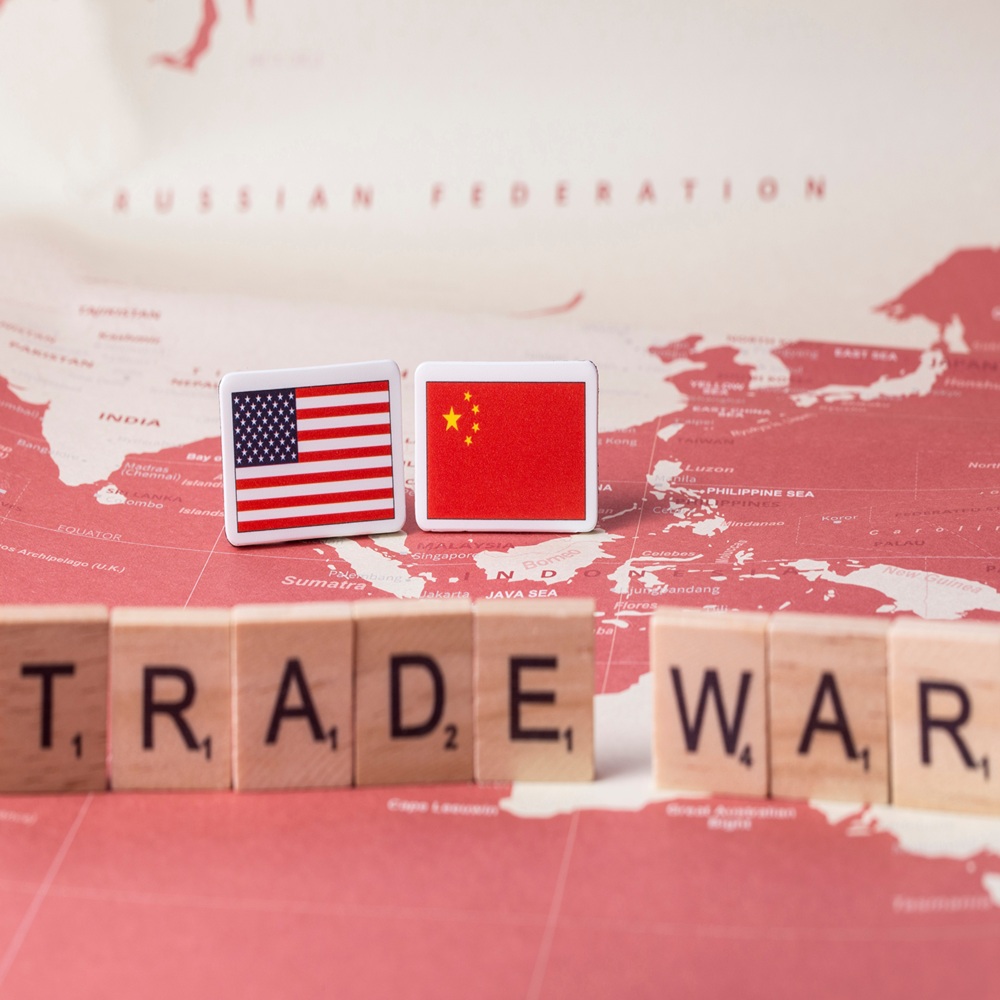
 March 28, 2018, the US and Chinese flags and texts at a studio in Seoul, Korea. An illustrative editorial. trade war

International trade war - Spice Road against Silk Road

by Joon Seok Oh

한국어로 읽기 Leer en español In Deutsch lesen Gap اقرأ بالعربية Lire en français Читать на русском AbstractPurpose The purpose of this paper is to analyse the international political economy of Korea and its effects due to geopolitical tension between China and the USA. Design/methodology/approach Economic war between China and the USA has prolonged longer than expected. Aftermath of the COVID-19 pandemic, reforming the supply chain has been the centre of economic tension between China and the USA. Quite recently, with the rapid expansion of Chinese e-commerce platforms, distribution channels come upon a new economic tension between the two. And now is the time to pivot its pattern of conflict from competition into cooperation. In this end, economic diplomacy could be a useful means to give a signal of cooperation. From the view of economic diplomacy, this paper tries to analyse the projected transition of economic war between China and the USA with its implication on the trade policy of Korea. Findings As an implementation of economic diplomacy, China suggested the Belt and Road Initiative (BRI), enhancing trade logistics among related countries to gain competitiveness. In 2023, the Biden administration suggested the India-Middle East and Europe Economic Corridor as a counter to BRI, which will be a threshold for changing trade policy from economic war into economic diplomacy. As a result, it is expected China and the USA will expand their economic diplomacy in a way to promote economic cooperation among allied states, while the distribution channel war would continue to accelerate the economic tension between China and the USA. Korea has to prepare for and provide measures handling this geopolitical location in its trade policy or economic diplomacy. Originality/value This research contributes to the awareness and understanding of trade environments from the perspective of economic diplomacy. 1. Introduction The advent of globalisation has led to widespread economic integration, creating global production networks and markets. However, the COVID-19 pandemic has acted as a significant setback to this trend. In the wake of COVID-19, an economic war has arisen between China and the USA, centred on the restructuring of global supply chains following widespread disruptions. International political economy (IPE) examines the power dynamics between states and the structures of influence within regional economies. Consequently, economic diplomacy has gained unprecedented attention. Economic diplomacy focuses on government actions regarding international economic issues, distinct from political diplomacy through its market-oriented approach in foreign policy. Putnam (1988) categorises economic diplomacy into two levels: unilateralism and bilateralism. Unilateral economic diplomacy (or unilateralism) often relies on hard power, involving decisions on trade liberalisation or market protection without negotiation. Bilateral economic diplomacy (or bilateralism) or multilateral economic diplomacy (or multilateralism), by contrast, involves negotiation among trade partners, resulting in agreements such as regional or global free trade agreements (FTAs). A vast range of state or non-state actors engage in economic diplomacy, navigating the complex interplay between international and domestic factors. Defining economic diplomacy is extremely challenging, but one useful definition is “the broad concept of economic statecraft, where economic measures are taken in the pursuit of political goals, including punitive actions such as sanctions” (Blanchard and Ripsman, 2008).  Figure 1 Recent trend of economic diplomacy To exert influence internationally, ministers and heads of government strive to demonstrate their capacity for national security through two primary approaches, as shown in Figure 1 (above): economic war (or competition) and economic diplomacy (or international cooperation). In the context of global supply chain restructuring, the economic conflict between China and the USA has intensified, marked by threats of supply chain disruptions. This has led to emerging strategies aimed at “crowding out” the USA from global supply chains (去美戰略) or excluding China through alliances such as the Allied Supply Chain and Chip 4. While economic war is inherently “temporary” due to its painstaking nature, economic diplomacy or international cooperation offer a more “long-term” approach because it is gains-taking. This paper analyses the factors contributing to the prolonged nature of this economic war and explores potential outcomes of the supply chain tensions between China and the USA from the perspectives of IPE or geo-economics. In conclusion, it highlights the importance of preparing for trade policy adjustments and strategic economic diplomacy. 2. International trade war and strategic items2.1 Supply chain The supply chain encompasses a network of interconnected suppliers involved in each stage of production, from raw materials and components to the finished goods or services. This network can include vendors, warehouses, retailers, freight stations and distribution centres. Effective supply chain management is a “crucial process because an optimised supply chain results in lower costs and a more efficient production cycle” [1]. Within the supply chain, a leading company typically holds governance power, enabling it to coordinate scheduling and exercise control across the interconnected suppliers, resulting in reduced costs and shorter production times (Gereffi et al., 2005) [2]. Since the 2000s, forward and backward integration have been key strategies for managing time, cost and uncertainty in supply chains. For example, Toyota’s Just-In-Time (JIT) system demonstrated the efficiency of locally concentrated supply chains until disruptions from the 2011 East Japan Earthquake and the Thailand flood. Following supply chain shutdowns in 2020, many businesses shifted from local to global supply chains, utilising advancements of the information technology (IT) and transportation technologies to geographically diversify operations. As the need for a systematically functioning global supply chain has grown, a leading nation, much like a leading company, often assumes governance power in international trade and investment, as illustrated in Figure 2 (below), by aligning with the leadership of a dominant market competitiveness, which makes this leadership valuable.  Figure 2 Supply chain The COVID-19 pandemic dealt a severe blow to the global supply chain, causing sudden lockdowns that led to widespread supply chain disruptions. To mitigate the risks of future global disruptions, supply chains have begun restructuring to operate on a more regionally segmented basis. In this shift toward regional supply chains, China and the USA are at the centre, drawing allied countries within their spheres of influence. This alignment helps explain why the economic war between China and the USA has lasted longer than anticipated. 2.2 Strategic items China has restricted exports of two rare metals, gallium and germanium, which are critical to semiconductor production. Kraljic (1983) highlighted the importance of managing “strategic items” within the framework of supply chain management, as shown in Figure 3. Kraljic emphasises the need to strengthen and diversify critical items. The Kraljic matrix provides a valuable tool for identifying essential items that require focused management within the supply chain.  Figure 3 Kraljic matrix Kraljic identified the importance of managing “bottleneck items” in strategic supply chain management – items that present high supply risk but have relatively low business value. Due to the potential costs associated with non-delivery or compromised quality of strategic items, these must be closely monitored and controlled. From a risk management perspective, establishing medium-term business relationships and collaboration with suppliers is essential. For example, South Korea imports over 90% of its urea for agricultural and industrial purposes from China [3]. Heavily dependent on China for urea supplies due to pricing factors, Korea faced challenges when China imposed export controls on urea, underscoring Korea’s vulnerability within China’s sphere of influence. The European Union (EU) also faces challenges with critical raw materials (CRMs). China remains the EU’s sole supplier of processed rare earth elements, while Chile supplies 79% of its lithium. In response, the EU introduced the CRM Act (CRMA) to support projects aimed at increasing “the EU’s capacity to extract, process, and recycle strategic raw materials and diversify supplies from the third countries” [4]. 2.3 Resilient supply chain alliance In contrast to China’s approach of leveraging supply disruptions to strengthen its influence, the Biden administration in the USA has adopted a cooperative approach focused on building resilient supply chains (Pillar 2) through the Indo-Pacific Economic Framework (IPEF), which includes 14 member countries [5]. The need for resilient supply chains has been further underscored by the Russia–Ukraine crisis. The IPEF aims to address supply chain vulnerabilities by fostering global efforts to reduce risks associated with concentrated, fragile supply chains [6].  Figure 4 Resilient supply chain alliance In Figure 4, the EU Commission presented the Single Market Emergency Instrument (SMEI) in September 2022, a crisis governance framework designed to ensure the availability of essential goods and services during future emergencies. The SMEI operates on three levels: contingency planning, vigilance and emergency. The contingency planning phase focuses on collaboration among member states to mitigate supply chain disruption and monitor incidents. The vigilance phase can be activated when a significant disruption is anticipated, enabling specific measures such as mapping and monitoring supply chains and production capacities. Finally, the emergency phase is activated in cases of severe disruption to the functioning of the single market [7]. Establishing a resilient supply chain through international cooperation may be appealing, yet the reality often falls short of the ambition. In South Korea, the IPEF took effect on 17 April 2024, after an extended negotiation process, marking the first multilateral agreement on supply chains. As a result, during non-crisis periods, the 14 member countries will collaborate to strengthen international trade, investment and trade logistics. In times of crisis, member countries will activate a “crisis response network”. Conversely, opportunities for negotiation with China, South Korea’s largest trading partner, are essential for building supply chain resilience [8]. China has pursued an industrial policy focused on enhancing its supply chain management capabilities. In the semiconductor sector, the decoupling between China and the USA has become increasingly evident. Contrary to expectations, China has adopted a policy of internalising its supply chains, returning to the integration strategies of the 2000s rather than furthering globalisation. A promising opportunity for transformation between the two countries has emerged recently. Since 2015, China and South Korea have maintained bilateral FTA, and with the second phase of FTA negotiations currently underway, there is an opportunity to strengthen trade and investment ties, fostering positive progress through international cooperation. 2.4 China manufacturing exodus During the COVID-19 pandemic, China imposed sudden lockdowns without prior notice or preparation, halting production and logistics cycles. This “zero COVID” policy may have triggered a shift towards “de-risking” China from supply chain disruptions. Although China still offers significant advantages as “the factory of the world,” with vast market potential, prolonged trade tensions with the USA, intensified during the Trump administration, have prompted global manufacturers with substantial USA market bases to relocate operations amid rising geopolitical uncertainties. For example, Nike and Adidas have shifted much of their footwear manufacturing to Vietnam, Apple has begun iPhone production at a Foxconn in Chennai, India, and AstraZeneca has contracted production with India’s Serum Institute. In the pre-globalised era, defining the Rule of Origin (ROO) was straightforward, as a product’s components were usually manufactured and assembled within a single country. However, with the complexity of global supply chains, particularly since 2012, determining ROO has become a time-consuming and subjective process. ROO are classified as either non-preferential or preferential. The USA applies non-preferential ROO to restrict imports from countries like Cuba, Iran and North Korea, while offering trade preference programmes for others. Preferential ROO are used to determine duty-free eligibility for imports from approved countries [9], whereas non-preferential ROO play a crucial role in “country of origin labelling, government procurement, enforcement of trade remedy actions, compilation of trade statistics, supply chain security issues.” [10] China manufacturing exodus may negatively impact capital inflows into Hong Kong, traditionally seen as the Gateway to China. In 2023, Hong Kong’s initial public offering volume fell to a 20-year low of $5.9bn [11]. While China-oriented business remains in Hong Kong, which returns fully to Chinese control in 2047, non-China-oriented businesses have migrated to Singapore. As the certainty of contract and ownership rights forms the foundation of capitalism, this capital flight from Hong Kong is likely to persist. 3. Trade logistics and economic corridors Globalisation has allowed supply chains to leverage interdependence and interconnectedness, maximising efficiency. However, while these efficiencies have been beneficial, they have also created a fertile ground for friction between trade partners due to a “survival of the fittest” mindset and the principle of “winner takes all.” This interdependence has also highlighted vulnerabilities; the global supply chain struggled to manage the disruptions caused by COVID-19, prompting a shift towards regional integration initiatives, such as Association of Southeast Asian Nations, Regional Comprehensive Economic Partnership, United States–Mexico–Canada Agreement and Comprehensive and Progressive Agreement for Trans-Pacific Partnership. As the global economy seeks stability, collaboration over competition has become increasingly essential, with economic diplomacy emerging as a priority. The prolonged economic war between China and the USA arguably needs to shift towards economic diplomacy. The global supply chain is restructuring into regional supply chains, building resilience by operating in regional segments that can withstand crises. Michael Porter introduced the concept of value chain as “a set of activities that a firm performs to deliver a valuable product or service to the market.” [12] Complex finished goods often depend on global value chains, traversing multiple countries. As shown in Figure 5, the value chain consists of supply chain and trade channel components. While the focus has traditionally been on which country holds lead status within a regional supply chain, the emphasis is now shifting to how these regional segments can be interconnected and relayed. In this context, the supply chain competition may evolve into a “channel war” in international trade, where trade logistics will centre on the internal flow of goods, standardising channel processes and establishing authority over these channels.  Figure 5 Supply chain v. trade channel 3.1 Trade logistics It is natural for governments to seek environments that enhance competitiveness within in their countries. In terms of trade, effective trade logistics are essential for maintaining competitive advantage. As a prerequisite, a strong IT management infrastructure is indispensable. As shown in Figure 6, trade logistics encompass the internal flow of goods to market, integrating physical infrastructure with operating software – such as transport hubs, warehouses, highways, ports, terminals, trains and shipping vessels. Key areas of conflict in trade logistics involve the standardisation of channel processes and determining who holds governance over operation of these logistics systems. This is equally relevant within the digital economy. Recently, Chinese e-commerce – often referred to as C-commerce – has aggressively sought to gain control over digital distribution channels, interconnected delivery networks and trade logistics via digital platforms. Chinese platforms such as Taobao, Temu and AliExpress are actively working to increase their monthly active users (MAUs), positing themselves as counterweights to USA-based platforms such as Amazon and eBay in digital trade [13].  Figure 6 Trade logistics When the agenda of establishing international trade logistics is introduced to relevant trade members across various countries, initial progress and effective responses are often achieved. However, efforts soon encounter obstacles related to standardising logistics processes and establishing operational governance. Greater reliance on international institutions could help resolve these issues (Bayne, 2017). Yet governments frequently prioritise domestic interests, and after prolonged negotiations, the risk of international agreements failing increases. Amid the economic war between China and the USA, China launched a trade logistics initiative known as the Belt and Road Initiative (BRI), or One Belt One Road, in 2013. Often referred to as the New Silk Road, the BRI aims to establish economic corridors for trade logistics. The World Bank estimates that the BRI could boost trade flows by 4.1% and reduce trade costs by 1.1% [14]. In response, the Biden administration proposed the India-Middle East and Europe Economic Corridor (IMEC) in September 2023 to strengthen transport and communication links between Europe and Asia as a countermeasure to China’s BRI. IMEC has been well received by participating countries, with expectations of fostering economic growth, enhancing connectivity and potentially rebalancing trade and economic relations between the EU and China [15]. Both BRI and IMEC are ambitious projects aimed at boosting international trade through substantial investments in trade logistics infrastructure. Each seeks to assert governance over international trade channels, signalling that the supply chain war may soon evolve into a trade channel war between China and the USA. 3.2 Economic corridors Economic corridors are transport networks designed to support and facilitate the movement of goods, services, people and information. These corridors often include integrated infrastructure, such as highways, railways and ports, linking cities or even countries (Octaviano and Trishia, 2014). They are typically established to connect manufacturing hubs, high-supply and high-demand areas, and producers of value-added goods. Economic corridors comprise both hard infrastructure – such as trade facilities – and soft infrastructure, including trade facilitation and capacity-building measures. The Asian Development Bank introduced the term “economic corridor” in 1998 to describe networks connecting various economic agents within a region [16]. Economic corridors are integrated trade logistics networks, providing essential infrastructure for connecting regional segments of supply chains. As supply chains increasingly operate in regional “chunks,” linking these segments becomes ever more important. Economic corridors typically include a network of transport infrastructure, such as highways, railways, terminals and ports. Initiatives like the BRI and IMEC use economic corridors as instruments of economic diplomacy, shifting strategies from hard power to soft power, as shown in Figure 7. Because less-developed or developing countries often lack sufficient funding to invest in trade logistics, they tend to welcome these initiatives from developed countries, which offer international collaboration and support. However, these initiatives usually come with the condition that participating countries must accept standardised trade processes and governance led by the sponsoring developed country.  Figure 7 Economic corridor initiatives as economic diplomacy To succeed, economic corridors must meet three key conditions [17]. First, government intervention is essential, as economic corridor initiatives primarily involve public infrastructure investments beyond the scope of the private sector. In realising these projects, governments must reconcile three tensions to ensure their policies are mutually supportive: tensions between politics and economics, between international and domestic pressures and between governments and other stakeholders. Second, intermediate outcomes should be measured and demonstrated as results of economic corridors, allowing participants to experience tangible benefits throughout these longer-term projects. Finally, economic corridors should deliver broader benefits. Participants need incentives to utilise the infrastructure sustainably. These benefits may extend beyond economic welfare, such as wages and income, to include social inclusion, equity and environmental gains, which support the long-term viability of the infrastructure. 4. BRI vs IMEC4.1 Belt and Road Initiative (BRI) - Silk Road The BRI can be a modern-day realisation of the Silk Road concept, connecting Europe as a market base with China as a production base. Unlike the ancient Silk Road, which connected trade routes across Eurasia, the BRI poses potential challenges due to its extensive connectivity. Firstly, there are social and environmental externalities, such as increased congestion and accidents from concentrating traffic flows through limited links and nodes within trade networks. Secondly, while the connectivity may benefit the production and market bases at either end, regions situated between these hubs, through which highways and railways pass, may gain minimal advantage. Thirdly, there is often a mismatch between where costs and benefits are realised. Transit regions that facilitate network traffic often see fewer direct benefits compared to high-density nodes within the network. 4.2 India-Middle East and Europe Economic Corridor (IMEC) - The Spice Road The ancient Spice Roads once connected the Middle East and Northeast Africa with Europe, facilitating the exchange of goods such as cinnamon, ginger, pepper and cassia, which, like silk, served as a form of currency. The IMEC proposes a modern route from India to Europe through the United Arab Emirates (UAE), Saudi Arabia, Israel and Greece. Since its announcement in September 2023, some regional experts have expressed reservations about its feasibility, particularly regarding the connection between the Middle East and Israel. The project has faced delays due to the Israel–Hamas war. Despite these challenges, IMEC holds potential to drive economic growth and strengthen connectivity, especially as countries like Vietnam and India emerge as alternative manufacturing bases for companies relocating from China. For Saudi Arabia and the UAE, IMEC is not viewed as a challenge to China but rather as an opportunity to diversify their economies and solidify their roles within the Middle East region [18]. 5. Conclusion A new trade war between China and the USA has begun, with the Biden Administration’s introduction of IMEC as a counter to China’s BRI. This shift could soon transform the nature of economic war from a focus on supply chains to one on trade channels. The China manufacturing exodus was further accelerated by supply disruptions during the COVID-19 pandemic. Amidst the economic tensions between China and the USA, the restructuring of global supply chains into regional networks has made significant progress. With China maintaining its stance on export controls for strategic items, South Korea must prepare for resilient supply chain management. In relation to China–Korea FTA, which is currently undergoing its second phase of negotiation, South Korea should seek clarity on the transparency of China’s strategic item controls. The Committee on Foreign Investment in the United States (CFIUS) plays a key role in monitoring the quality of inbound investments; similarly, South Korea is experiencing increased inbound investment due to the manufacturing shift from China and should apply similar standards to evaluate investment quality. This emerging economic war between China and the USA is now marked by the competing initiatives of the BRI and IMEC. The BRI can be viewed as a modern Silk Road, linking China with Europe, while the IMEC seeks to establish a trade logistics corridor connecting Saudi Arabia, the UAE, Israel and Greece. The South Korean Government should take proactive steps to prepare for the evolving dynamics of the trade war between China and the USA. CitationOh, J.S. (2025), "International trade war - Spice Road against Silk Road", International Trade, Politics and Development, Vol. 9 No. 1, pp. 2-11. https://doi.org/10.1108/ITPD-06-2024-0031  Notes 1. https://www.investopedia.com/terms/s/supplychain.asp2. According to Gary Gereffi et al, 5 governance types of a lead company could be categorised as market, modular, relational, captive and hierarchy.3. Korea imports urea from 12 countries including Qatar, Vietnam, Indonesia and Saudi Arabia, in addition to China.4. https://single-market-economy.ec.europa.eu/sectors/raw-materials/areas-specific-interest/critical-raw-materials/strategic-projects-under-crma_en5. IPEF was launched on May 23,2022 at Tokyo. 14 member countries are Australia, Brunei, Fiji, India, Indonesia, Japan, Republic of Korea, Malaysia, New Zealand, Philippines, Singapore, Thailand, Vietnam and the USA. 4 Pillar of IPEF are Trade (Pillar 1), Supply Chain (Pillar 2),Clean Economy (Pillar 3) and Fair Economy (Pillar 4).6. Critics say “lack of substantive actions and binding commitments, instead focusing on process-driven framework building.” https://www.piie.com/blogs/realtime-economics/its-time-ipef-countries-take-action-supply-chain-resilience7. https://ec.europa.eu/commission/presscorner/detail/en/ip_22_54438. As of 2023, the first-largest trade partner of Korea is China (Trade volume of $267.66bn), the second is the US ($186.96bn) and the third is Vietnam ($79.43bn)9. As preferential ROO contain the labour value content requirement in the USMCA, it could increase compliance costs for importers. https://crsreports.congress.gov/product/pdf/RL/RL3452410. USITC(1996), Country of Origin Marking: Review of Laws, Regulations and Practices, USITC Publication 2975, July, pp. 2–411. https://www.barrons.com/articles/hong-kong-financial-center-china-46ba5d3612. Porter identifies a value chain broken in five primary activities: inbound logistics, operations, outbound logistics, marketing and sales and post-sale services. https://www.usitc.gov/publications/332/journals/concepts_approaches_in_gvc_research_final_april_18.pdf13. MAU is a metric commonly used to identify the number of unique users who engage with apps and website. MAU is an important measurement to the level of platform competitiveness in the digital trade logistics or e-commerce industry.14. https://home.kpmg/xx/en/home/insights/2019/12/china-belt-and-road-initiative-and-the-global-chemical-industry.html15. https://www.bradley.com/insights/publications/2023/10/the-india-middle-east-europe-economic-corridor-prospects-and-challenges-for-us-businesses16. The Asian Development Bank (ADB), which first used the term in 1998, defines economic corridors as important networks or connections between economic agents along a defined geography, which link the supply and demand sides of markets. http://research.bworldonline.com/popular-economics/story.php?id=350&title=Economic-corridors-boost-markets,-living-conditions17. Legovini et al. (2020) comments traditional cross border agreements of transport investment focuses only on a narrow set of direct benefits and cost. However, economic corridors can entail much wider economic benefits and costs such as trade and economic activity, structural change, poverty reduction, pollution and deforestation.18. Arab Centre Washington D.C. https://arabcenterdc.org/resource/the-geopolitics-of-the-india-middle-east-europe-economic-corridor/ References Bayne, N. (2017), Challenge and Response in the New Economic Diplomacy, 4th ed., The New Economic Diplomacy, Routledge, London, p. 19.Blanchard, J.M.F. and Ripsman, N.M. (2008), “A political theory of economic statecraft”, Foreign Policy Analysis, Vol. 4, pp. 371-398, doi: 10.1111/j.1743-8594.2008.00076.x.Gereffi, G., Humphrey, J. and Sturgeon, T. (2005), “The governance of value chain”, Review of International Political Economy, Vol. 12 No. 1, pp. 78-104, doi: 10.1080/09692290500049805.Kraljic, P. (1983), “Purchasing must be supply management”, Harvard Business Review, Vol. 61 No. 5, September.Legovini, A., Duhaut, A. and Bougna, T. (2020), “Economic corridors-transforming the growth potential of transport investments”, p. 10.Octaviano, B.Y. and Trishia, P. (2014), Economic Corridors Boost Markets, Living Conditions, Business World Research, Islamabad, October.United States International Trade Commission (USITC) (1996), “Country of origin marking: Review of Laws, Regulations, and Practices”, USITC Publication, Vol. 2975, July, pp. 2-4.Further readingPorter, M. (1985), Competitive Advantage: Creating and Sustaining Superior Performance, Free Press.Putman, R.D. (1988), “Diplomacy and domestic politics; the logic of two-level games”, International Organization, Vol. 42 No. 4, pp. 427-600.USITC (2019), “Global value chain analysis: concepts and approaches”, Journal of International Commerce and Economics, April, pp. 1-29.

Energy & Economics
The image displays mineral rocks alongside US currency and flags of Ukraine and the USA, highlighting the complex relationship involving economics, power, and resources.

Why Zelensky – not Trump – may have ‘won’ the US-Ukraine minerals deal

by Eve Warburton , Olga Boichak

한국어로 읽기 Leer en español In Deutsch lesen Gap اقرأ بالعربية Lire en français Читать на русском Last week, the Trump administration signed a deal with Ukraine that gives it privileged access to Ukraine’s natural resources. Some news outlets described the deal as Ukrainian President Volodymyr Zelensky “caving” to US President Donald Trump’s demands. But we see the agreement as the result of clever bargaining on the part of Ukraine’s war-time president. So, what does the deal mean for Ukraine? And will this help strengthen America’s mineral supply chains? Ukraine’s natural resource wealth Ukraine is home to 5% of the world’s critical mineral wealth, including 22 of the 34 minerals identified by the European Union as vital for defence, construction and high-tech manufacturing. However, there’s a big difference between resources (what’s in the ground) and reserves (what can be commercially exploited). Ukraine’s proven mineral reserves are limited. Further, Ukraine has an estimated mineral wealth of around US$14.8 trillion (A$23 trillion), but more than half of this is in territories currently occupied by Russia. What does the new deal mean for Ukraine? American support for overseas conflict is usually about securing US economic interests — often in the form of resource exploitation. From the Middle East to Asia, US interventions abroad have enabled access for American firms to other countries’ oil, gas and minerals. But the first iteration of the Ukraine mineral deal, which Zelensky rejected in February, had been an especially brazen resource grab by Trump’s government. It required Ukraine to cede sovereignty over its land and resources to one country (the US), in order to defend itself from attacks by another (Russia). These terms were highly exploitative of a country fighting against a years-long military occupation. In addition, they violated Ukraine’s constitution, which puts the ownership of Ukraine’s natural resources in the hands of the Ukrainian people. Were Zelensky to accept this, he would have faced a tremendous backlash from the public. In comparison, the new deal sounds like a strategic and (potentially) commercial win for Ukraine. First, this agreement is more just, and it’s aligned with Ukraine’s short- and medium-term interests. Zelenksy describes it as an “equal partnership” that will modernise Ukraine. Under the terms, Ukraine will set up a United States–Ukraine Reconstruction Investment Fund for foreign investments into the country’s economy, which will be jointly governed by both countries. Ukraine will contribute 50% of the income from royalties and licenses to develop critical minerals, oil and gas reserves, while the US can make its contributions in-kind, such as through military assistance or technology transfers. Ukraine maintains ownership over its natural resources and state enterprises. And the licensing agreements will not require substantial changes to the country’s laws, or disrupt its future integration with Europe. Importantly, there is no mention of retroactive debts for the US military assistance already received by Ukraine. This would have created a dangerous precedent, allowing other nations to seek to claim similar debts from Ukraine. Finally, the deal also signals the Trump administration’s commitment to “a free, sovereign and prosperous Ukraine” – albeit, still without any security guarantees. Profits may be a long time coming Unsurprisingly, the Trump administration and conservative media in the US are framing the deal as a win. For too long, Trump argues, Ukraine has enjoyed US taxpayer-funded military assistance, and such assistance now has a price tag. The administration has described the deal to Americans as a profit-making endeavour that can recoup monies spent defending Ukrainian interests. But in reality, profits are a long way off. The terms of the agreement clearly state the fund’s investment will be directed at new resource projects. Existing operations and state-owned projects will fall outside the terms of the agreement. Mining projects typically work within long time frames. The move from exploration to production is a slow, high-risk and enormously expensive process. It can often take over a decade. Add to this complexity the fact that some experts are sceptical Ukraine even has enormously valuable reserves. And to bring any promising deposits to market will require major investments. What’s perhaps more important It’s possible, however, that profits are a secondary calculation for the US. Boxing out China is likely to be as – if not more – important. Like other Western nations, the US is desperate to diversify its critical mineral supply chains. China controls not just a large proportion of the world’s known rare earths deposits, it also has a monopoly on the processing of most critical minerals used in green energy and defence technologies. The US fears China will weaponise its market dominance against strategic rivals. This is why Western governments increasingly make mineral supply chain resilience central to their foreign policy and defence strategies. Given Beijing’s closeness to Moscow and their deepening cooperation on natural resources, the US-Ukraine deal may prevent Russia — and, by extension, China — from accessing Ukrainian minerals. The terms of the agreement are explicit: “states and persons who have acted adversely towards Ukraine must not benefit from its reconstruction”. Finally, the performance of “the deal” matters just as much to Trump. Getting Zelensky to sign on the dotted line is progress in itself, plays well to Trump’s base at home, and puts pressure on Russian President Vladimir Putin to come to the table. So, the deal is a win for Zelensky because it gives the US a stake in an independent Ukraine. But even if Ukraine’s critical mineral reserves turn out to be less valuable than expected, it may not matter to Trump.

Energy & Economics
Nottinghamshire, UK 03 April 2025 : Attitudes of UK broadsheet newspaper after Trump unleashes Liberation Day Tariff announcement

The EU at the Crossroads of Global Geopolitics

by Krzysztof Sliwinski

한국어로 읽기 Leer en español In Deutsch lesen Gap اقرأ بالعربية Lire en français Читать на русском Abstract This study examines the short-term, medium-term, and long-term implications of recent "tariff wars" on the European Union (EU). The imposition of tariffs by the United States, particularly the "Liberation Day" tariffs announced by President Trump on April 2, 2025, led to significant disruptions in global supply chains, negatively impacted GDP growth, increased financial market volatility, and exacerbated geopolitical tensions. The EU faces challenges in navigating this shifting geopolitical landscape while maintaining its economic interests and influence. However, the EU has opportunities to leverage these conflicts to strengthen its internal market, foster international cooperation, and emerge as a more resilient global actor. The paper concludes by discussing the potential end of transatlanticism, the future of the EU, and the implications for globalisation in light of the current "tariff chaos." Keywords: Tariffs, Geopolitics, European Union, Trade Wars Introduction Before we examine the topic of tariffs, let us recall that the terms "tariff war" or "trade war" are not strictly academic. International Security scholars generally believe that the notion of war is reserved for military conflicts (both domestic and international) that involve at least a thousand casualties in any given year.[1] One of the most prominent sources in this regard is the Armed Conflict Dataset Codebook, published by the Uppsala Conflict Data Program at the Department of Peace and Conflict Research, Centre for the Study of Civil Wars, and the International Peace Research Institute at Uppsala University in Uppsala.[2] Therefore, "tariff war" or "tariff wars" are more journalistic and hyperbolic. Hence, they are used in this study with quotation marks. Journalists and commentators from various backgrounds often use inflated language to impress their readers. On the other hand, wars are cataclysmic events that have game-changing consequences. In this sense, some tools that state leaders use to achieve political and economic goals, such as tariffs, may have short- and long-term outcomes. Nonetheless, scholars who tend to be precise in their explanations will mainly discuss economic competition rather than "economic war" or "wars." This study investigates the short-, medium-, and possible long-term implications of "tariff wars" on the European Union. These implications appear multifaceted and encompass stability, political relationships, and a broader international order."Liberation Day" On April 2, US President Trump announced new tariffs under the banner of "Liberation Day" – a minimum baseline of 10 per cent tariffs on goods imported from all foreign countries and higher, reciprocal tariffs on nations that impose tariffs on US exports.[3]  Crucially, the White House claims that the new tariffs are reciprocal: "It is the policy of the United States to rebalance global trade flows by imposing an additional ad valorem duty on all imports from all trading partners except as otherwise provided herein. The additional ad valorem duty on all imports from all trading partners shall start at 10 per cent, and shortly thereafter, the additional ad valorem duty shall increase for trading partners enumerated in Annex I to this order at the rates set forth in Annex I to this order. These additional ad valorem duties shall apply until such time as I determine that the underlying conditions described above are satisfied, resolved, or mitigated".[4] We did not have to wait for strong reactions to occur worldwide. China vowed to retaliate against the 34 per cent tariffs imposed by the US on Wednesday (April 2 2025) and protect its national interests while condemning the move as "an act of bullying".[5] Doubling down, a few days later, Trump threatened a 50 per cent tariff on China on top of previous reciprocal duties,[6] to which Chinese President Xi Jinping already replied hawkishly.[7] In an equally hawkish response, the Trump administration declared that Chinese goods would be subject to a 145 per cent tariff.[8] In a twist of events, on April 9, the US  declared a 90-day-long pause for previously declared tariffs covering the whole world (keeping a minimum of 10 per cent, though) except against China.[9] The next couple of weeks will show whether the world will enter the "tariff arms race" or we will enter some "tariff détente". Importantly, as one can surmise, "Xi has sold himself domestically and internationally as the guy standing up to America, and people that want to stand up to America should get in line behind Chairman Xi".[10] For the EU, European Commission President Ursula von der Leyen described US universal tariffs as a significant blow to the world economy and claimed that the European Union was prepared to respond with countermeasures if talks with Washington failed. Accordingly, the EU was already finalising a first package of tariffs on up to 26 billion Euro ($28.4 billion) of US goods for mid-April in response to US steel and aluminium tariffs that took effect on March 12.[11] Consequently, on April 7, 2025, a meeting was organised in Luxembourg[12] regarding the EU's response to US tariffs on steel and aluminium and the preparation of countermeasures, which included a proposal to impose 25 per cent tariffs on US goods. Interestingly, the "Liberation Day" tariffs do not include Russia. According to numerous commentators, this indicates Moscow's importance as a future trade partner once the Ukrainian war is over. However, the official explanation issued by the White House suggests that the existing sanctions against Russia "preclude any meaningful trade."[13] Tariff imposition: short, medium and long-term consequences Several observable phenomena can be identified regarding their economic ramifications: First, the imposition of tariffs can lead to significant disruptions in global supply chains, thereby affecting industries that rely heavily on international trade. This disruption can lead to increased costs and reduced competitiveness for EU businesses, particularly in sectors such as agriculture and manufacturing.[14] While national measures may yield political and economic benefits in the short term, it is essential to note that global prosperity cannot be sustained without cooperative and stable international trade policies. Second, the Gross Domestic Product is likely to be impacted. The imposition of tariffs has been shown to negatively affect GDP growth. For instance, the US-China "trade war" decreased the GDP of both countries, which could similarly affect the EU if it becomes embroiled in similar conflicts.[15] Third, we examine volatility in the financial markets. "Tariff wars" contribute to financial market volatility, which can cause a ripple effect on EU economic stability. This volatility can deter investment and slow economic growth.[16] Fourth, political targeting and retaliation. "Tariff wars" often involve politically targeted retaliations, as seen in the US-China trade conflict. The EU has been adept at minimising economic damage while maximising political targeting, which could influence its future trade strategies and political alliances.[17] Fifth, global alliances are shifting. The EU may need to reconsider its trade alliances and partnerships in response to these shifting dynamics. This could involve forming new trade agreements or strengthening existing ones to mitigate the impact of "tariff wars."[18] Next, increased geopolitical competition and economic nationalism can exacerbate tensions between major powers, potentially leading to a crisis in globalization. As an aspiring global player, the EU must navigate these tensions carefully to maintain its influence and economic interests.[19] Social impacts should also be considered. "Trade wars" can lead to changes in employment and consumer prices, thus affecting the EU's social equity and economic stability. These changes necessitate policies that enhance social resilience and protect vulnerable populations.[20] Does Team Trump have a plan? The tariffs imposed by the Trump administration appear to be part of a broader strategy that Trump describes as a declaration of economic independence for the US, notably heralding them as part of the national emergency. The long-term effects of this strategy depend on how effectively the US can transition to domestic production without facing significant retaliation or trade barriers from other nations. Notably, the US dollar's status as the world's primary reserve currency has been supported by military power since the introduction of the Bretton Woods system. The US military, especially the US Navy, has helped secure trade routes, enforce economic policies, and establish a framework for international trade, favouring the US. dollar. The countries that subscribed to the system also gained access to the US consumer market. Importantly, what is explained by the Triffin Dilemma, back in the 1960s, the US had a choice: to either increase the supply of the US Dollar,  sought after by the whole world as a reserve currency and international trade currency and that way to upkeep global economic growth, which was pivotal for the US economy or to end the gold standard. In 1971, the US finished its Bretton Woods system. What followed was a new system primarily dictated by neoliberalism based on low tariffs, free capital movement, flexible exchange rates and US security guarantees.[21] Under that neoliberal system, reserve demand for American assets has pushed up the dollar, leading it to levels far in excess of what would balance international trade over the long run.[22] This made manufacturing in the US very expensive, and consequently, the deindustrialisation of the US followed. Therefore, it appears that Trump wants to keep the US dollar as the world's reserve currency and reindustrialise the US. According to Stephen Miran, chair of the Council of Economic Advisers (a United States agency within the Executive Office of the President), two key elements to achieve this goal are tariffs and addressing currency undervaluation of other nations.[23] The second element in that duo is also known as the Mar-a-Lago Accord.[24] Scott Bessent, 79th US Secretary of the Treasury, picked up this argument.[25] In a nutshell, the current "tariff chaos" is arguably only temporary, and in the long term, it is designed to provide an advantage for the US economy.A readjustment of sorts fundamentally reshapes the existing international political economy. Whether or not this plan works and achieves its goals is entirely different. As market analysts observe, "For the past two decades, the US has focused on high-tech services like Amazon and Google services, which have added to a service surplus. However, the real sustainable wealth comes from the manufacturing of goods, which, for the US, went from 17 per cent in 1988 to 10 per cent in 2023 of GDP. The entire process of building goods creates many mini ecosystems of production/capital value that stay in a country for many decades. […] Initially, the Chinese started in low-tech and low-cost labour manufacturing before 2001, but shifted towards becoming major manufacturers of high-tech products like robotics and EV automobiles. […] For President Trump to levy high tariffs on the Chinese in the current moment, he is doing everything that he can to resuscitate US manufacturing".[26] EU's options The EU and the US share the world's largest bilateral trade and investment relationship, with 2024 data showing EU exports to the US at 531.6 billion euros and imports at 333.4 billion euros, resulting in a 198.2 billion Euro trade surplus for the EU.[27] While the EU faces significant challenges due to "tariff wars," there are potential opportunities for positive outcomes. The EU can leverage these conflicts to strengthen its internal market and enhance its role in global trade. By adopting proactive trade policies and fostering international cooperation, the EU can mitigate the negative impacts of "tariff wars" and potentially emerge as a more resilient and influential global actor. However, this requires careful navigation of the complex geopolitical landscape and a commitment to maintaining open and cooperative trade relations. It seems likely that the EU can leverage recent US tariffs to strengthen ties with China and India, potentially reducing its dependency on US trade. China is the EU's second-largest trading partner for goods, with bilateral trade at 739 billion euros in 2023, though a large deficit favouring China (292 billion euros in 2023).[28] The EU's strategy is to de-risk, not decouple, focusing on reciprocity and reducing dependencies; however, competition and systemic rivalry complicate deeper ties. Meanwhile, India's trade with the EU was 124 billion euros in goods in 2023, and ongoing free trade agreement (FTA) negotiations, expected to conclude by 2025, could yield short-term economic gains of 4.4 billion euros for both.[29] India's fast-growing economy and shared interest in technology make it a potentially promising partner. EU and China: Opportunities and Challenges Economically, there are more opportunities than challenges. China remains the EU's second-largest trading partner for goods, with bilateral trade reaching 739 billion euros in 2023, down 14 per cent from 2022 due to global economic shifts.[30] The trade balance shows a significant deficit of 292 billion euros in 2023, driven by imports of telecommunications equipment and machinery, whereas EU exports include motor cars and medicaments. The EU's strategy, outlined in its 2019 strategic outlook and reaffirmed in 2023, positions China as a partner, competitor, and systemic rival, focusing on de-risking rather than decoupling. Recent actions, such as anti-dumping duties on Chinese glass fibre yarns in March 2025, highlight tensions over unfair trade practices. Despite these challenges, China's market size offers opportunities, especially if the EU can negotiate for better access. However, geopolitical rivalry complicates deeper ties, including EU probes, in Chinese subsidies. Politically, the EU and China differ significantly in this regard. Regarding human rights policies, the EU consistently raises concerns about human rights issues in China.[31] These concerns often lead to friction, with the European Parliament blocking trade agreements and imposing sanctions on them. Moreover, China's stance on the war in Ukraine has created tension, with the EU viewing Russia as a major threat, and China's support of Russia is a significant concern.[32] China is often perceived in Western European capitals as not making concessions on issues vital to European interests.[33] The understanding of the war's root causes, the assessment of implications, risks or potential solutions - in all these areas, the Chinese leadership on the one hand and the European governments and the EU Commission in Brussels on the other hand have expressed very different, at times even contrary, positions.[34] Finally, China's political model demonstrates that democracy is not a prerequisite for prosperity, challenging Western emphasis on democracy and human rights.[35] EU and India: Growing Partnership and FTA Prospects and Political Challenges Economically, it seems that there are more opportunities than challenges. India, ranked as the EU's ninth-largest trading partner, accounted for 124 billion euros in goods trade in 2023, representing 2.2 per cent of the EU's total trade, with growth of around 90 per cent over the past decade.[36] Services trade reached nearly 60 billion euros in 2023, almost doubling since 2020, with a third being digital services.[37] The EU is India's largest trading partner, and ongoing negotiations for a free trade agreement (FTA), investment protection, and geographical indications, initiated in 2007 and resuming in 2022, aim for conclusion by 2025.[38] A 2008 trade impact assessment suggests positive real income effects, with short-term gains of 3–4.4 billion euros for both parties. The EU seeks to lower Indian tariffs on cars, wine, and whiskey. Simultaneously, India has pushed for market access to pharmaceuticals and easier work visas for IT professionals. However, concerns remain regarding the impact of EU border carbon taxes and farm subsidies on Indian farmers. Politically, challenges to EU-India relations stem from several sources. Trade has been a persistent friction point, with negotiations for a free trade agreement facing roadblocks (Malaponti, 2024). Despite the EU being a significant trading partner for India,[39] differing approaches to trade liberalization have hindered progress. India's historical emphasis on autonomy and self-reliance can sometimes clash with the EU's multilateral approach.[40] Further, India's complex relationship with Russia, particularly its continued reliance on Russian defence technology, presents a challenge for closer EU-India security cooperation.[41] Finally, while the EU and India share concerns about China's growing influence, their strategies for managing this challenge may differ. These issues, if left unaddressed, could limit the potential for a deeper, more strategic partnership between the EU and India.[42] Conclusions "What does Trump want? This question is on the minds of policymakers and experts worldwide. Perhaps we are witnessing the opening salvo of a decisive phase of the US-China economic conflict - the most serious conflict since 1989. It is likely the beginning of the end of the ideology of Globalism and the processes of globalisation. It is arguably aggressive "decoupling" at its worst and the fragmentation of the world economy. For the EU, this is a new situation which dictates new challenges. Someday, probably sooner than later, European political elites will have to make a choice. To loosen or perhaps even end the transatlantic community and go against the US. Perhaps in tandem with some of the BRICS countries, such as India and China, or swallow the bitter pill, redefine its current economic model, and once again gamble with Washington, this time against the BRICS. It seems that the EU and its member states are at a crossroads, and their next choice of action will have to be very careful. In a likely new "Cold War" between the US and this time, China, the EU might not be allowed to play the third party, neutral status. One should also remember that Trump, like Putin or Xi, likes to talk to EU member states' representatives directly, bypassing Brussels and unelected "Eureaucrats' like Ursula Von der Leyen. In other words, he tends to leverage his position against the unity of the EU, which should not be surprising given the internal EU conflicts. More often than not, Hungary, Slovakia, Italy, or Nordic members of the EU clash on numerous Issues with Berlin, Paris and most importantly, Brussels. (I write more about it here: Will the EU even survive? Vital external and internal challenges ahead of the EU in the newly emerging world order. https://worldnewworld.com/page/content.php?no=4577).   References [1] See more at:  For detailed information, consult one of the most comprehensive databases on conflicts run by Uppsala Conflict Data Programme at: https://ucdp.uu.se/encyclopedia[2] Pettersson, Therese. 2019. UCDP/PRIO Armed Conflict Dataset Codebook, Version 19.1. Uppsala Conflict Data Program, Department of Peace and Conflict Research, Uppsala University, and Centre for the Study of Civil Wars, International Peace Research Institute, Oslo. https://ucdp.uu.se/downloads/ucdpprio/ucdp-prio-acd-191.pdf[3] Regulating Imports with a Reciprocal Tariff to Rectify Trade Practices that Contribute to Large and Persistent Annual United States Goods Trade Deficits. https://www.whitehouse.gov/presidential-actions/2025/04/regulating-imports-with-a-reciprocal-tariff-to-rectify-trade-practices-that-contribute-to-large-and-persistent-annual-united-states-goods-trade-deficits/[4] Regulating Imports with a Reciprocal Tariff to Rectify… op. cit.[5] Hanin Bochen, and Ziwen Zhao. "China vows to retaliate after 'bullying' US imposes 34% reciprocal tariffs". South China Morning Post. April 3 2025. https://www.scmp.com/news/us/diplomacy/article/3304971/trump-announced-34-reciprocal-tariffs-chinese-goods-part-liberation-day-package[6] Megerian, Chris and Boak, Josh. "Trump threatens new 50% tariff on China on top of 'reciprocal' duties". Global News. April 7, 2025. https://globalnews.ca/news/11119347/trump-added-50-percent-tariff-china/[7] Tan Yvette, Liang Annabelle and Ng Kelly. "China is not backing down from Trump's tariff war. What next?". BBC, April 8 2025. https://www.bbc.com/news/articles/ckg51yw700lo[8] Wong, Olga. “Trump further raises tariffs to 120% on small parcels from mainland, Hong Kong”. South China Morning Post, 11 April 2025. https://www.scmp.com/news/hong-kong/hong-kong-economy/article/3306069/trump-further-raises-tariffs-120-small-parcels-mainland-hong-kong?utm_source=feedly_feed[9] Chu, Ben. “ What does Trump's tariff pause mean for global trade?”, BBC, 10 April, 2025. https://www.bbc.com/news/articles/cz95589ey9yo[10] Wu, Terri. "Why US Has Upper Hand Over Beijing in Tariff Standoff". The Epoch Times April 7, 2025. https://www.theepochtimes.com/article/why-us-has-upper-hand-over-beijing-in-tariff-standoff-5838158?utm_source=epochHG&utm_campaign=jj  [11] Blenkinsop, Philip, and Van Overstraeten, Benoit. "EU plans countermeasures to new US tariffs, says EU chief." April 3, 2025. https://www.reuters.com/markets/eu-prepare-countermeasures-us-reciprocal-tariffs-says-eu-chief-2025-04-03/[12] Payne, Julia. The EU Commission proposes 25% counter-tariffs on some US imports, document shows". Reuters, April 8, 2025. https://www.reuters.com/markets/europe/eu-commission-proposes-25-counter-tariffs-some-us-imports-document-shows-2025-04-07/  [13] Bennett, Ivor. "US seems content to cosy up to Russia instead of imposing tariffs." Sky News, April 4, 2025. https://news.sky.com/story/us-seems-content-to-cosy-up-to-russia-instead-of-coerce-it-with-tariffs-13341300[14] Angwaomaodoko, Ejuchegahi Anthony. "Trade Wars and Tariff Policies: Long-Term Effects on Global Trade and Economic Relationship." Business and Economic Research, 14, no. 4 (October 27, 2024): 62. https://doi.org/10.5296/ber.v14i4.22185[15] Ilhomjonov, Ibrohim, and Akbarali Yakubov. "THE IMPACT OF THE TRADE WAR BETWEEN CHINA AND THE USA ON THE WORLD ECONOMY," June 16, 2024. https://interoncof.com/index.php/USA/article/view/2112[16] Angwaomaodoko, Ejuchegahi Anthony. "Trade Wars and Tariff Policies: Long-Term Effects on Global Trade and Economic Relationship." Business and Economic Research 14, no. 4 (October 27, 2024): 62. https://doi.org/10.5296/ber.v14i4.22185[17] Fetzer, Thiemo, and Schwarz Carlo. "Tariffs and Politics: Evidence from Trump's Trade Wars." Economic Journal 131: no. 636 (May 2021): 1717–41. https://doi.org/10.1093/ej/ueaa122[18] Angwaomaodoko, Ejuchegahi Anthony. "Trade Wars and Tariff Policies: Long-Term Effects on Global Trade and Economic Relationship …op. cit.[19] Mihaylov, Valentin Todorov, and Sławomir Sitek. 2021. "Trade Wars and the Changing International Order: A Crisis of Globalisation?" Miscellanea Geographica 25: 99–109. https://doi.org/10.2478/mgrsd-2020-0051[20] Wheatley, Mary Christine. "Global Trade Wars: Economic and Social Impacts." PREMIER JOURNAL OF BUSINESS AND MANAGEMENT, November 5, 2024. https://premierscience.com/wp-content/uploads/2024/11/pjbm-24-368.pdf[21] Money & Macro, https://www.youtube.com/watch?v=1ts5wJ6OfzA&t=572s[22] Miran, Stephen. "A User's Guide to Restructuring the Global Trading System." November 2024. Hudson Bay Capital. https://www.hudsonbaycapital.com/documents/FG/hudsonbay/research/638199_A_Users_Guide_to_Restructuring_the_Global_Trading_System.pdf[23] Miran, Stephen. "A User's Guide to Restructuring the Global Trading System"... op.cit.[24] Zongyuan Zoe Liu, "Why the Proposed Mar-a-Lago Accord May Not be the Magic Wand That Trump Is Hoping For", 9  April 2025. https://www.cfr.org/blog/why-proposed-mar-lago-accord-may-not-be-magic-wand-trump-hoping  [25] Treasury Secretary Scott Bessent Breaks Down Trump's Tariff Plan and Its Impact on the Middle Class. https://www.youtube.com/watch?v=zLnX1SQfgJI[26] Park, Thomas. https://www.linkedin.com/feed/update/urn:li:activity:7316122202846765056/[27] See more at: https://ec.europa.eu/eurostat/fr/web/products-eurostat-news/w/ddn-20250311-1[28] See more at: https://policy.trade.ec.europa.eu/eu-trade-relationships-country-and-region/countries-and-regions/china_en[29] Kar, Jeet. "The EU and India are close to finalising a free trade agreement. Here's what to know." World Economic Forum. March 7 2025. https://www.weforum.org/stories/2025/03/eu-india-free-trade-agreement/[30] See more at: https://policy.trade.ec.europa.eu/eu-trade-relationships-country-and-region/countries-and-regions/china_en[31] "The paradoxical relationship between the EU and China'. Eastminster: a global politics & policy blog, University of East Anglia. http://www.ueapolitics.org/2022/03/29/the-paradoxical-relationship-between-the-eu-and-china/[32] Vasselier, Abigaël. "Relations between the EU and China: what to watch for in 2024". January 25 2025. https://merics.org/en/merics-briefs/relations-between-eu-and-china-what-watch-2024 [33] Benner, Thorsten. "Europe Is Disastrously Split on China." Foreign Policy, April 12 2023. https://foreignpolicy.com/2023/04/12/europe-china-policy-brussels-macron-xi-jinping-von-der-leyen-sanchez/[34] Chen, D., N. Godehardt, M., Mayer, X., Zhang. 2022. "Europe and China at a Crossroads." 2022. https://thediplomat.com/2022/03/europe-and-china-at-a-crossroads.[35] Sharshenova, A. and Crawford. 2017. "Undermining Western Democracy Promotion in Central Asia: China's Countervailing Influences, Powers and Impact." Central Asian Survey 36 (4): 453. https://doi.org/10.1080/02634937.2017.1372364.[36] See more at: https://policy.trade.ec.europa.eu/eu-trade-relationships-country-and-region/countries-and-regions/india_en[37] See more at: https://digital-strategy.ec.europa.eu/en/news/key-outcomes-second-eu-india-trade-and-technology-council[38] Kar, Jeet. "The EU and India are close to finalising a free trade agreement. Here's what to know"… op. cit.[39] Malaponti, Chiara. 2024. “Rebooting EU-India Relations: How to Unlock Post-Election Potential.” https://ecfr.eu/article/rebooting-eu-india-relations-how-to-unlock-post-election-potential/.[40] Sinha, Aseema, and Jon P. Dorschner. 2009. “India: Rising Power or a Mere Revolution of Rising Expectations?” Polity 42 (1): 74. https://doi.org/10.1057/pol.2009.19.[41] Chandrasekar, Anunita. 2025. “It’s Time to Upgrade the EU-India Relationship.” https://www.cer.eu/insights/its-time-upgrade-eu-india-relationship.[42] Gare, Frédéric and Reuter Manisha. “Here be dragons: India-China relations and their consequences for Europe”. 25 May 2023. https://ecfr.eu/article/here-be-dragons-india-china-relations-and-their-consequences-for-europe/

Energy & Economics
Workers install an electric power windmill during the construction of a wind farm by the Kazakh company Samruk-Energo in cooperation with China's PowerChina Corporation. Kazakhstan, April 7, 2022.

Why is China investing in renewable energy in Kazakhstan?

by Nurbek Bekmurzaev , Brian Hioe

한국어로 읽기 Leer en español In Deutsch lesen Gap اقرأ بالعربية Lire en français Читать на русском China is simultaneously the world's biggest polluter and the global leader in renewables This article was submitted as part of the Global Voices Climate Justice Fellowship, which pairs journalists from Sinophone and Global Majority countries to investigate the effects of Chinese development projects abroad. Kazakhstan’s transition to renewable energy (RE) has seen a significant surge in recent years. This rapidly growing green transition has allowed the country to meet its interim RE targets. By 2030, the country aims to generate 15 percent of its total energy output through renewables and increase this share to 50 percent by 2050. Moreover, Kazakhstan has committed to reaching carbon neutrality by 2060.  The biggest partner in this endeavor has been China, whose role in the RE transition has grown and diversified over the years. For Kazakhstan, the benefits of this partnership are clear: industrialization of its economy and, more importantly, decreasing carbon emissions and improving air quality and public health. For China, the benefits go beyond mere lucrative investments and exporting its RE technology and include gaining soft power and offsetting its environmentally destructive footprint in Kazakhstan.  Harnessing renewable energy to combat air pollution In addition to rich oil and gas resources, Kazakhstan has vast renewable energy potential, thanks to its large territory and abundance of wind and sunny days. It is the ninth largest country by area and holds 77 percent of Central Asia’s solar potential and 90 percent of the regional wind potential.   The presence of wind corridors in vast Kazakh steppes with wind speeds of more than five miles per second, which is present in all regions, makes Kazakhstan ideal for the operation of wind turbines. Additionally, at least 50 percent of Kazakhstan's territory is suitable for installing solar panels.  Most of the RE potential remains untapped, with Kazakhstan still relying on Soviet-era energy infrastructure built to utilize fossil fuels. In 2024, 66 percent of the country’s electricity was generated through coal, 21 percent via natural gas, 6.6 percent from hydroelectricity, and only 6.4 percent from renewables.  Air pollution is a nationwide problem in Kazakhstan. In 2025, 35 cities spread across the country faced significant air pollution, according to the National Hydrometeorological Service of Kazakhstan. A major source of this pollution pandemic is coal burned by thermal power plants, industrial complexes, and households.  The list of adverse effects of air pollution is long. According to Kazakhstani doctor Denis Vinnikov, who has researched air pollution’s effects on health, long-term exposure to polluted air increases the risk of developing cardiovascular and respiratory diseases, such as Chronic Obstructive Pulmonary Disease (COPD). In addition, air pollution increases the likelihood of almost all types of cancer and tumors. One of the most polluted cities in Kazakhstan, Almaty, is one of the national leaders with the highest cases of COPD.  Kazakhstan’s recognition of the adverse effects of its coal-intensive energy sector on the environment and public health has pushed the government to ramp up renewable energy production in the last decade. China’s multiple roles in renewables The Kazakh-Chinese green energy endeavors are part of China's wider bilateral cooperation, covering energy, agriculture, machinery, and mining, among other areas. China is one of Kazakhstan’s largest trade and investment partners. In 2022, the countries signed a permanent comprehensive strategic partnership. Between 2005 and 2023, China invested over USD 25 billion in Kazakhstan.  The two sides also work closely within the Belt and Road Initiative (BRI), China’s global connectivity project focusing on energy, trade, and transport infrastructure in global majority states. Between 2013 and 2020, China invested USD 18.5 billion in Kazakhstan within the BRI framework. China has participated in Kazakhstan’s green transition from the very beginning. In an interview with Global Voices, Yunis Sharifli, a non-resident fellow at the China Global South Project, described China as the “first-comer” to Kazakhstan’s RE sector. Yana Zabanova, a research associate at the Research Institute for Sustainability, said in an interview with Global Voices: China has been the main technology supplier to Kazakhstan's renewable energy sector, both in the solar PV and increasingly in the wind sector, and Chinese companies have also served as important investors and EPC [engineering, procurement, and constuction] contractors for renewable energy projects in the country. China’s role grew exponentially starting in 2018 when the government launched renewable energy auctions, which gifted government contracts to the lowest bidder. Since 2018, a single private Chinese company, Universal Energy, has built 10 RE plants, three solar and seven wind, with a total capacity of 630 Megawatts by winning government tenders.   Additionally, state-owned Chinese companies have secured contracts via intergovernmental negotiations. There are several examples of this, such as the Zhanatas and Shelek wind power plants (WPP), which are already operational, and five more RE plants in the development stage with a total capacity of 2.6 GW.   In an interview with Global Voices, Ainur Sospanova, the Chairperson of the Board of Directors of the Qazaq Green RES Association, provided her expert assessment of China’s share in Kazakhstan’s RE sector: In the solar energy sector, it is almost 100 percent because it is impossible to compete against Chinese solar panels. In the wind energy sector, it is at least 70 percent and continues to grow. Thus, since 2018, China has expanded its role to project developer and financier through loans issued by Chinese banks and equity financing.  China's share in Kazakhstan’s renewable projects is set to grow even more upon the completion of two Chinese plants that will localize the production of energy storage systems and components for WPP. Gaining soft power and improving its image Paradoxically, China is simultaneously the biggest polluter in the world and the global leader in renewables. While China is constructing two-thirds of the world's wind and solar projects, 93 percent of global construction from coal power took place in China in 2024. This paradox is also present in BRI projects, including those in Kazakhstan.  China frequently touts its solar and wind energy projects as part of the BRI. At the same time, one-fourth of coal-fired power generation in the world is financed through the BRI. Though China Power International Holding and Kazakhstani Samruk Energy have agreed on solar and wind projects to develop renewables, deals are also inked to develop oil, gas, coal, cement, and steel industries in Kazakhstan, which adversely affect the environment and the well-being of local communities. Sharifli explained: When we look at the global discontent with China’s presence, we see two worries: debt trap and environmental pollution. So renewable energy is very important in this context. China’s investments in renewables are aimed at tackling these worries by gaining soft power and improving its reputation. This benefits not only China but also the BRI. Chinese companies that have invested in RE in Kazakhstan, such as Risen Energy, Universal Energy, and Power China, put the BRI at the heart of how they frame their companies. Chinese think tanks also suggest that the Chinese government welcome RE development overseas despite concerns.   In contrast to the Chinese-built oil processing, steel, and cement plants in Kazakhstan, RE projects have thus caused no controversy and helped China improve its reputation in Central Asia. Sharifli noted that since 2021, public attitudes towards China in Kazakhstan have started becoming more positive, partially due to Chinese investments in RE, according to a survey conducted by the Central Asia Barometer.  “Renewable energy plants are usually located in the steppe, far away from the settlements, they don’t interfere with the daily lives of people and look idyllic. There is no trash, there is no pollution, there is no dirty water or soil,” said Zabanova, who has visited multiple RE plants in Kazakhstan as part of her research.  China’s investments in renewables in Kazakhstan serve as an example of how solar and wind energy projects are used in diplomacy. They not only allow Chinese companies to export their excess capacities to profitable foreign markets but also help China mask its environmental damage and create a favorable perception abroad.

Energy & Economics
US - 11.14.2024:

The Economic Impacts of Trump Administration's Tariffs

by World & New World Journal Policy Team

한국어로 읽기 Leer en español In Deutsch lesen Gap اقرأ بالعربية Lire en français Читать на русском I. Introduction  We are only two and a half months into the new Trump administration. However, President Donald Trump's long-threatened tariffs have plunged the country into a trade war abroad. On-again, off-again, new tariffs continue to escalate uncertainty around the world. Trump already launched a trade war during his first term in office, but he has more sweeping tariff plans right now. The second Trump administration has embarked on a new and more aggressive tariff policy, citing various economic and national security concerns. His administration has proposed, imposed, suspended, revoked, and then reimposed various new tariffs. It could be difficult for average citizens to keep up with all the proposals. As of March 19, 2025, there are ten proposed or active tariff initiatives. They range from broad-based tariffs that cover all goods from a certain country (China, Mexico, Canada) to tariffs that cover certain types of goods (aluminum & steel), promises of future tariffs (copper, lumber, automotive, semiconductor, and pharmaceutical), and promised retaliatory tariffs (European wine and other alcoholic beverages). Moreover, although we have seen more tariff announcements in the first two months of the second Trump administration than in the entire first Trump administration, "fair and reciprocal" tariff rollout will overpower the tariffs imposed until today. The ten tariff initiatives that are proposed or in play are as follows in Table 1.   This paper aims to evaluate economic impacts of tariffs imposed by the Trump administration. It first explains the effects of tariffs imposed by the first Trump administration and then forecasts the impacts of the second Trump administration's tariffs.  II. Literature on Tariff Effects A tariff is a type of tax that a government adds to imported goods. Companies importing goods pay the tariff to the government. If any part of a product arrives with a tariff, whether it is an imported avocado or a car built locally with imported steel, its cost is part of the price everyday consumers pay before sales tax.  Economists reject tariffs as an effective tool to improve the welfare of U.S. citizens or strengthen key industries. In a survey conducted during the first Trump administration, 93 % of economic experts did not agree that targeted tariffs on aluminium and steel would improve Americans' welfare. Recent research has strengthened economists' opposition to this policy instrument. Numerous studies demonstrate that American consumers entirely bear the burden of tariffs imposed during the first Trump administration, with disproportionately large impacts on lower-income U.S. households. A framework for analysing the impact of higher import tariffs on the economy is provided by Mundell and Fleming. Mundell (1961) claimed that the country that raised tariffs on imported products may benefit because more people choose domestically produced products over imported ones. Protection from foreign competition could also benefit domestic industries. Large countries can also benefit from improved terms of trade. However, increased tariffs on imported products are assumed to lead to an increase in the current account balance by increasing savings relative to investment. Higher savings dampen aggregate demand. The situation of households deteriorates because of rising consumer prices. Domestic industries are also negatively affected by lower household demand and the need to pay more for imported input products.  Over the years, Mundell and Fleming's model has been developed further by other scholars such as Eichengreen (1981), Krugman (1982), Obstfeld and Rogoff (1995) and Eichengreen (2018). Overall, the theoretical literature demonstrates that higher import tariffs could affect the economy through various channels. The impacts of tariffs on the economy differ between a nation imposing the tariffs and nations exporting to the nation raising the tariffs. However, nations that are not subject to the increased import duties are also affected. Main effects of higher tariffs are as follows: Higher inflation: Higher import tariffs lead to higher prices for imported products. Depending on which tariffs are increased, this could lead to higher prices for both consumers and companies. Domestic firms may also raise their prices because of reduced competition from foreign companies (Cavallo et al. (2021)).  Higher consumer prices lead to a decline in real disposable household income, which hampers private consumption. Higher business costs have impacts on companies' profits, which in turn dampen employment and companies' willingness to invest. Companies are also more likely to pass on some of their higher costs to consumers in the form of higher prices. The rise in imported prices might be smaller in large countries, as they are more able to influence the world price of products. Increased consumption of other products: Higher imported prices can lead companies and consumers to increasingly buy cheaper domestic products. But it can also lead to increased imports of products from countries not subject to higher import tariffs.  Domestic industries are protected: Higher import tariffs improve the competitive position of domestic companies. These benefits can lead to increased investment, production, and employment in protected industries. However, the longer-term effect of protecting some domestic industries from foreign competition can be negative, as it might reduce incentives to improve production efficiency, thereby dampening productivity and GDP.  Decreased trade: Increased tariffs usually lead to reduced trade. This can lead to reduced knowledge transfer between nations in the form of less direct investment, reduced technology transfer, and reduced access to skilled labour. These factors in turn can lead to companies moving further away from the technological frontier, thereby hampering productivity (Dornbusch (1992) and Frankel and Romer (1999)).  Stronger exchange rate: When demand changes from foreign to domestic production, the exchange rate tends to rise to balance it out. One reason is that higher inflation often leads to higher interest rates relative to other nations. The nominal exchange rate might appreciate if imports decline significantly and demand for foreign currency drops. An appreciation of the exchange rate hampers exports but keeps imports cheaper.  Global value chains: Higher tariffs can lead to disruptions in global value chains by making imported inputs from abroad pricier. If firms are part of global value chains, higher costs for firms facing higher import costs may also lead to higher costs for domestic firms further down the production chain.  Uncertainty and confidence: Higher import tariffs may increase uncertainty about future trade policy and lead to increased pessimism among households and companies. Such uncertainty may hamper household consumption and business investment (Boer and Rieth (2024)).  III. Tariffs under the first Trump administration The first Trump administration's tariffs involved protectionist trade initiatives against other nations, notably China.  In January 2018, the Trump administration-imposed tariffs on solar panels and washing machines of 30–50%. In March 2018, the administration-imposed tariffs on aluminium (10%) and steel (25%), which are imported from most countries. In June 2018, the Administration expanded these tariffs to include the EU, Mexico, and Canada. The Trump administration separately set and escalated tariffs on products imported from China, leading to a trade war between the U.S. and China.  In their responses, U.S. trading partners imposed retaliatory tariffs on U.S. products. Canada imposed matching retaliatory tariffs on July 1, 2018. China implemented retaliatory tariffs equivalent to the $34 billion tariff imposed on it by the U.S. In June 2019, India imposed retaliatory tariffs on $240 million worth of U.S. products.  However, tariff negotiations in North America were under way and successful, with the U.S. lifting steel and aluminium tariffs on Mexico and Canada on May 20, 2019. Mexico and Canada joined Argentina and Australia, which were the only countries exempted from the tariffs. But on May 30, Trump announced on his own that he would put a 5% tariff on all imports from Mexico starting on June 10, 2019. The tariffs would go up to 10% on July 1, and then by another 5% every month for three months, until illegal immigrants stopped coming through Mexico and into the U.S. Then the tariffs were averted on June 7 after negotiations between the U.S. and Mexico. U.S. tariffs on Chinese products had been applied as follows: On March 22, 2018, Trump signed a memorandum under Section 301 of the Trade Act of 1974 to apply tariffs of $50 billion on Chinese products. In response, China announced plans to implement its tariffs on 128 U.S. products. 120 of those products, such as fruit and wine, will be taxed at a 15% duty, while the remaining eight products, including pork, will receive a 25% tariff. China implemented their tariffs on April 2, 2018.  On April 3, 2018, the U.S. Trade Representative's office (the USTR) published an initial list of 1,300+ Chinese products to impose levies upon products like flat-screen televisions, medical devices, aircraft parts and batteries. On April 4, 2018, China's Customs Tariff Commission of the State Council decided to announce a plan to put 25% more tariffs on 106 U.S. goods, such as soybeans and cars.  In the response, On April 5, 2018, President Trump directed the USTR to consider $100 billion in additional tariffs. On May 9, 2018, China cancelled soybean orders exported from the United States to China. On June 15, 2018, President Trump released a list of Chinese products worth $34 billion that would face a 25% tariff, starting on July 6. Another list with $16 billion of Chinese products was released, with an implementation date of August 23.  On July 10, 2018, in reaction to China's retaliatory tariffs that took effect July 6, the USTR issued a proposed list of Chinese products amounting to an annual trade value of about $200 billion that would be subjected to an additional 10% in duties. During the G20 summit in Japan in June 2019, the U.S. and China agreed to resume stalled trade talks, with Trump announcing he would suspend an additional $300 billion in tariffs that had been under consideration. IV. Economic Effects of the Tariffs from the First Trump Administration Changes in tariffs affect economic activity directly by influencing the price of imported products and indirectly through changes in exchange rates and real incomes. The extent of the price change and its impact on trade flows, employment, and production in the United States and abroad depend on resource constraints and how various economic actors (producers of domestic substitutes, foreign producers of the goods subject to the tariffs, producers in downstream industries, and consumers) respond as the effects of the increased tariffs reverberate throughout the economy. According to the U.S. Congressional Research Service (CRS), the following six outcomes came out at the level of individual firms and consumers as well as at the level of the national economy. 1. Increased costs for U.S. consumers Higher tariff rates lead to price increases for consumers of products subject to the tariffs and for consumers of downstream products as input costs rise. Higher prices in turn lead to decreased consumption, depending on consumers' price sensitivity for a particular product. For example, consider the monthly price of U.S. laundry equipment, which includes washing machines subject to tariff increases as high as 50% since February 2018. The monthly price of this equipment increased by as much as 14% in 2018 compared to the average price level in 2017, before the tariffs took effect (see Figure 1).   Figure 1: U.S. laundry equipment prices According to Jin (2023), many companies passed the costs of the Trump tariffs on to consumers in the form of higher prices. Following impositions of the tariffs on Chinese products, the prices of U.S. intermediate goods rose by 10% to 30%, an amount equivalent to the size of the tariffs. An April 2019 working paper by Flaaen, Hortaçsu, and Tintel not found that the tariffs on washing machines caused the prices of washers to rise by approximately 12% in the United States. A Goldman Sachs analysis by Fitzgerald in May 2019 found that the consumer price index (CPI) for tariffed products had increased dramatically, compared to a declining CPI for all other core goods. According to the Guardian, the Budget Lab at Yale University found that American consumer prices could rise by 1.4% to 5.1% if Trump implemented his comprehensive tariff plan, which would amount to an additional $1,900 to $7,600 per household. 2. Decreased domestic demand for imported goods subject to the tariffs and less competition for U.S. producers of substitute goods: U.S. producers competing with the imported products subject to the tariffs (e.g., domestic aluminium and steel producers) may benefit to the degree they are able to charge higher prices for their domestic products and may expand production because of increased profitability. Since March 2018, U.S. imports of steel and aluminium have faced additional tariff charges of 25% and 10%, making foreign supplies of these products more expensive relative to domestic products. Because of these tariffs, U.S. imports of these goods went down in 2018 and 2019 compared to what they were usually like in 2017 before the tariffs, while U.S. production went up (see Figure 2 and Figure 3). By the first quarter of 2020, real U.S. imports of steel and aluminium (adjusted for price fluctuations) had decreased by more than 30% and 16%, respectively, from their average 2017 levels. The quarterly production of steel and aluminium in the U.S. during this period, however, increased by as much as 13.5% and 9.0%, respectively, above average 2017 levels.   Figure 2: Domestic production and imports: Steel  Figure 3: Domestic production and imports: Aluminium 3. Increased costs for U.S. producers in downstream industries, resulting in a decline in employment U.S. producers that use imported products subject to the additional tariffs as inputs ("downstream" industries, such as auto manufacturers in the case of the aluminium and steel tariffs) might be harmed as their costs of production increase. Higher input costs are more likely to lead to some combination of lower profits for producers, which in turn might dampen demand for these downstream products, leading to some contraction in these sectors.  A study (2019) by Federal Reserve Board economists Flaaen and Pierce, which examined effects on the manufacturing sector from all U.S. tariff actions in 2018, found that higher input costs from the tariffs were associated with higher prices, employment declines, and reductions in output for affected firms. Another study (2020) by Handley, Kamal, and Monarch found that the higher input costs associated with the tariffs might have led to a decrease in U.S. exports for firms reliant on imported intermediate inputs. Handley, Kamal, and Monarch suggested that export growth was approximately 2% lower for products made with products subject to higher U.S. tariffs, relative to unaffected products. Another study (2019) by Federal Reserve Board economists Flaaen and Pierce found that the steel tariffs led to 0.6% fewer jobs in the manufacturing sector than would have happened in the absence of the tariffs; this cut amounted to approximately 75,000 jobs. A study (2024) by Ma and David concluded that the United States lost 245,000 jobs because of the Trump tariffs.  4. Decreased demand for U.S. exports subject to retaliatory tariffs  Retaliatory tariffs place U.S. exporters at a price disadvantage in export markets relative to competitors from other countries, potentially decreasing demand for U.S. exports to those markets. Since Q3 2018, after Section 232 retaliatory tariffs took effect in China, the EU, Russia, and Türkiye, U.S. exports to these trading partners subject to the tariffs declined by as much as 44% below their 2017 average values (Figure 4). U.S. exports to China subject to retaliation during the same period declined even further from their 2017 levels, falling as much as 68% on a quarterly basis. By contrast, during this same period, overall U.S. exports were as much as 10% higher each quarter relative to 2017, suggesting the retaliatory tariffs played a role in the product-specific export declines.  Figure 4: Declines in U.S. exports subject to retaliation A study by Fajgelbaum, Goldberg, Kennedy, and Khandelwal published in the Quarterly Journal of Economics in October 2019 estimated that consumers and firms in the U.S. who buy imports lost $51 billion (0.27% of GDP) because of the 2018 tariffs. This study also found that retaliatory tariffs resulted in a 9.9% decline in U.S. exports. This study also found that workers in counties with a lot of Republicans were hurt the most by the trade war because agricultural products were hit the hardest by retaliatory tariffs.  5. U.S. National Economy In addition to industry- or consumer-level effects, tariffs also have the potential to affect the broader U.S. national economy. Quantitative estimates of the effects vary based on modelling assumptions and techniques, but most studies suggest a negative overall impact on U.S. GDP because of the tariffs.  The Congressional Budget Office (2020) estimated that the increased tariffs in effect as of December 2019 would reduce U.S. GDP by 0.5% in 2020, below a baseline without the tariffs, while raising consumer prices by 0.5%, thereby reducing average real household income by $1,277. From a global perspective, the International Monetary Fund estimated that the tariffs would reduce global GDP in 2020 by 0.8%. Dario Caldara et al. (2020) also found that in 2018, investment dropped by 1.5% because of the uncertainty caused by U.S. trade policy. Moreover, a study (2019) by Amiti, Redding, and David published in the Journal of Economic Perspectives found that by December 2018, Trump's tariffs resulted in a reduction in aggregate U.S. real income of $1.4 billion per month in deadweight losses and cost U.S. consumers an additional $3.2 billion per month in added tax. Furthermore, Russ (2019) found that tariffs, which Trump imposed through mid-2019, combined with the policy uncertainty they created, would reduce the 2020 real GDP growth rate by one percentage point.  6. Trade balance  The Trump administration repeatedly raised concerns over the size of the U.S. trade deficit, thereby making trade deficit reduction a stated objective in negotiations for new U.S. trade agreements. Broad-based tariff increases affecting a large share of imports may reduce imports initially, but they are unlikely to reduce the overall trade deficit over the longer period due to at least two indirect impacts that counteract the initial reduction in imports. One indirect effect is a potential change in the value of the U.S. dollar relative to foreign currencies. Another potential effect of U.S. import tariffs is retaliatory tariffs. Economists argue that while tariffs placed on imports from a limited number of trading partners may reduce the bilateral U.S. trade deficit with those specific nations, this is likely to be offset by an increase in the trade deficit or reduction in the trade surplus with other nations, leaving the total U.S. trade deficit largely unchanged.  Figure 5 shows the relative change in the U.S. goods trade deficit with the world as well as the bilateral U.S. deficits with three major partners, China, Mexico, and Vietnam, from 2017 to 2019. Since the U.S. tariffs took effect, the overall U.S. trade deficit has increased, rising 8% from 2017 to 2019. However, the U.S. trade deficit in goods with China declined by 8% from 2017 to 2019, while the U.S. trade deficit in goods with Vietnam and Mexico significantly increased by more than 40% during the same period.  Figure 5: Changes in the U.S. goods trade deficits with China, Mexico, and Vietnam According to Zarroli (2019), between the time Trump took office in 2017 and March 2019, the U.S. trade deficit increased by $119 billion, reaching $621 billion, the highest it had been since 2008. American Farm Bureau Federation data showed that agriculture exports from the U.S. to China decreased from $19.5 billion in 2017 to $9.1 billion in 2018, a 53% reduction.  V. What are the Potential Consequences of Trump's Tariff Plan? Last year, the Peterson Institute for International Economics examined the impact of President Trump's proposed tariffs based on his campaign promises, which would impose 10 % additional tariffs on US imports from all sources and 60 % additional tariffs on imports from China. The major outcomes were lower national income, lower employment, and higher inflation. McKibbin, Hogan, and Noland (2024) at the Peterson Institute for International Economics found that both of Trump's tariff plans—imposing 10% additional tariffs on U.S. imports from all sources and 60% additional tariffs on imports from China—would reduce both U.S. real GDP and employment by 2028. But the former proposal damages the U.S. economy more than the latter. If other nations retaliate with higher tariffs on their imports from the U.S., the damage intensifies.  Assuming other governments respond in kind, Trump's 10 % increase results in U.S. real GDP that is 0.9 % lower than otherwise by 2026, and U.S. inflation rises 1.3 % above the baseline in 2025.  The 10 % added tariffs hurt the economies of Canada, Mexico, China, Germany, and Japan—all major US trading partners that see a lower GDP relative to their baselines through 2040. Mexico and Canada take much larger GDP hits than the U.S. The 60 % added tariffs on imports from China reduce its GDP relative to its baseline, much more than that of other U.S. trading partners. Mexico, however, sees a higher GDP than otherwise as some production shifts to Mexico from China. This paper focuses on Trump's universal 10 % tariffs rather than 60 % tariffs on imports from China because extreme 60 % tariffs on Chinese imports are not expected. McKibbin, Hogan, and Noland (2024) assume the 10 % tariff increase is implemented in 2025 and remains in place through the forecast period. They also consider a second scenario in which U.S. trading partners retaliate with equivalent tariff increases on products they import from the U.S.  Figures 6–11 show the results for the uniform additional 10 % increase in the tariff on imports of goods and services from all trading partners.   Figure 6: Projected change in real GDP of selected economies from an additional 10 % increase in US tariffs on imports of goods and services from all trading partners, 2025-40 (Source: McKibbin, Hogan, and Noland, 2024) When tariffs go up by 10%, the U.S. real GDP goes down by 0.36 % by 2026, and it goes down even more in Mexico and Canada by 2027 (see Figure 6). Chinese GDP drops by 0.25 % below the baseline in 2025. After the initial demand-induced slowdown, U.S. GDP recovers as production shifts from foreign suppliers to U.S. suppliers, leading to a slightly lower long-term GDP of 0.1 % below baseline by 2030 in the U.S.   Figure 7: Projected change in employment (hours worked) in selected economies from an additional 10 % increase in US tariffs on imports of goods and services from all trading partners, 2025-40 (Source: McKibbin, Hogan, and Noland, 2024) The results for aggregate employment are like the GDP outcomes (see figure 7). Employment drops in the United States by 0.6 % by 2026 but recovers due to a supply relocation towards U.S. suppliers. U.S. employment returns to baseline eventually because real wages decline permanently to bring employment back to baseline by assumption.  Figure 8: Projected change in inflation in selected economies from an additional 10% increase in US tariffs on imports of goods and services from all trading partners, 2025-40 (Source: McKibbin, Hogan, and Noland, 2024) The imposition of higher tariffs increases prices of both consumer and intermediate goods, contributing to a rise in inflation of 0.6 % above baseline in 2025 (see figure 8).  The higher tariff is inflationary everywhere except in China due to the tightening of Chinese monetary policy to resist change in the exchange rate relative to the U.S. dollar.   Figure 9: Projected change in the trade balance in selected economies from an additional 10 % increase in US tariffs on imports of goods and services from all trading partners, 2025-40 (Source: McKibbin, Hogan, and Noland (2024)) Figure 9 shows the change in the trade balance as a share of GDP. In theory, the trade balance can worsen or improve due to changes in exports and imports. From 2025 to 2028, the U.S. trade deficit narrows slightly but then widens as capital flows into the U.S. economy, appreciating the U.S. real effective exchange rate. By 2030, the U.S. trade deficit will worsen by 0.1 % of GDP due to capital moving from Mexico and Canada into the U.S. Government savings rise due to additional tariff revenues.  VI. Conclusion  This paper showed that tariffs imposed by the first Trump administration had negative impacts on the U.S. economy, particularly inflation, incomes, and employment. It also demonstrated that tariffs which will be imposed by the second Trump administration are expected to have negative effects on the U.S. economy. Then a question arises: "Why does Trump attempt to impose tariffs on products from abroad?" Today, more people mention tariffs as tools to protect U.S. companies and farmers. They are discussed as a tool for bringing back manufacturing businesses into the U.S. as well as a bargaining tactic in negotiations over the flow of fentanyl and immigration. Trump has used and promised to increase tariffs for three purposes: to raise revenue, to bring trade into balance, and to bring rival countries to heel. It is unclear whether Trump will achieve his goals. However, President Donald Trump believes that tariffs are a panacea. Trump believes that his tariffs would bring hundreds of billions—trillions— into the US Treasury. Moreover, Trump is confident that he can force countries to give up something he believes is in America's best interest. For example, his tariffs on Canada and Mexico have led Mexico and Canada to agree to expand their border patrols. Reference  Amiti Mary, Redding Stephen, David E, “The Impact of the 2018 Tariffs on Prices and Welfare,” Journal of Economic Perspectives. 33 (Fall 2019): 187–210. Boer, L. and M. Rieth, “The Macroeconomic Consequences of Import Tariffs and Trade Policy Uncertainty,” IMF Working Paper 2024/013, International Monetary Fund. Cavallo, A., G. Gopinath, B. Neiman, and J. Tang (2021), “Tariff Pass-Through at the Border and at the Store: Evidence from US Trade Policy,” American Economic Review: Insights 3(1): 19-34.  Congressional Budget Office, The Budget and Economic Outlook: 2020 to 2030, January 28, 2020. https://www.cbo.gov/system/files/2020-01/56020-CBO-Outlook.pdf.  Dario Caldara et al., “The Economic Effects of Trade Policy Uncertainty,” Journal of Monetary Economics, vol. 109 (January 2020), pp. 38-59. Dornbusch, R. (1992), “The Case for Trade Liberalization in Developing Countries,” Journal of Economic perspectives 6 (1): 69-85.  De Loecker, J., P.K. Goldberg, A.K. Khandelwal and N. Pavcnik (2016), “prices, markups, and trade reform,” Econometrica 84(2): 445-510.  Eichengreen, B. (1981), “A Dynamic Model of Tariffs and Employment under Flexible Exchange Rates,” Journal of International Economics 11:341-359.  Eichengreen, B. (2018), “Trade Policy and the Macroeconomy,” Keynote address Mun dell-Fleming Lecture, International Monetary Fund, 13 March 2018.  Fajgelbaum, P.D., P.K. Goldberg, P.J. Kennedy and A.K. Khandelwal (2019), “The Return to Protectionism,” The Quarterly Journal of Economics 135(1): 1-55.  Fitzgerald, Maggie, “This Chart from the Goldman Sachs Shows Tariffs are Rasing Prices for Consumers and It could Get Worse.” CNBC. May 13, 2019. Flaaen, A. and J.R. Pierce (2019), “Disentangling the effects of the 2018-2019 tariffs on globally connected U.S. Manufacturing sector,” Working Paper, Finance Economic Discussion Series 2019-086, Board of Governors Federal Reserve System, Washington DC.  Flaaen, A., A. Hortacsu and F. Tintelnot (2020), “The production relocation and price effects of US trade policy: the Case of Washing Machines,” American Economic Review 110(7): 2103-2127.  Frankel, J.A. and D.H. Romer (1999), “Does Trade Cause Growth,” American Economic Review 89 (3): 379-399. Handley, K., F. Kamal, and R. Monarch (2020), “Rising Import Tariffs, Falling Export Growth: When Modern Supply Chains Meet Old-Style Protectionism,” NBER Working paper 26611. https://www.nber.org/papers/w26611. Handley, K. and N. Limao (2022), “Trade Policy Uncertainty,” NBER Working Paper 29672.  Handley, Kyle, Fariha Kamal, and Ryan Monarch, “Rising Import Tariffs, Falling Export Growth: When Modern Supply Chains Meet Old-Style Protectionism,” National Bureau of Economic Research, NBER Working Paper No. 26611, January 2020. Jin, Keyu (2023). The New China Playbook: Beyond Socialism and Capitalism. New York: Viking. Kreuter, H. and M. Riccaboni (2023), “The Impact of Import Tariffs on GDP and Consumer Welfare: A Production Network Approach,” Journal of Economic Modelling 126.  Krugman, P. (1982), “The Macroeconomics of Protection with a Floating Exchange rate,” Carnegie-Rochester Conference Series on Public Policy 16: 141-182.  Ma, Xinru; Kang, David C. (2024). Beyond Power Transitions: The Lessons of East Asian History and the Future of U.S.-China Relations. Columbia Studies in International Order and Politics. New York: Columbia University Press.  McKibbin, W., M. Hogan, and M. Noland (2024), “The International Economic Implications of a Second Trump Presidency,” Peterson Institute for International Economics, Working Paper 24-20.  Mundell, R. (1961), “Flexible Exchange Rates and Employment Policy,” Canadian Journal of Economics and Political Science 27: 509-517.  Obstfeld, M., and K. Rogoff (1995), “Exchange Rate Dynamics Redux,” Journal of Political Economy, 103: 624-660.  Russ, Katheryn (December 16, 2019). “What Unilateralism Means for the Future of the U.S. Economy,” Harvard Business Review. January 2, 2020.  Zarroli, Jim. “Despite Trump’s Promises, The Trade Deficit is Only Getting Wider,” NPR. March 6, 2019.

Energy & Economics
Growing chart against the background of the China flag candlestick graph Stock market exchange and graph chart business finance money investment on display board. vector design.

China’s Growing Role in Central Asia

by Akanksha Meena

한국어로 읽기 Leer en español In Deutsch lesen Gap اقرأ بالعربية Lire en français Читать на русском In response to its recent retaliatory tariffs on US energy imports, a delegation of major Chinese energy firms visited Kazakhstan in February 2025 to explore new trade opportunities. It was led by the China Council for the Promotion of International Trade (CCPIT), which focused on diversifying supply chains and reducing dependence on western markets. The visit highlights Beijing’s commitment to deepening economic ties in Central Asia through trade, infrastructure investment, and energy cooperation amidst the escalating tensions between China and the West. Traditionally, Russia exerted a dominant influence in Central Asian countries due to its Soviet-era legacy and security ties. However, China’s Belt and Road Initiative (BRI) and expanding economic partnerships with Central Asian nations have established Beijing as a key player in the region. As US presence has diminished, and Russia remains preoccupied with its conflict in Ukraine, China has leveraged economic partnerships, infrastructure projects, and strategic diplomacy. China has emerged as Central Asia’s primary trade partner, even surpassing Russia in economic influence. In 2023, trade between China and Central Asia reached $89.4 billion, reflecting a 27% increase from the previous year. This surge highlights China’s efforts to solidify its economic presence through investments, trade agreements, and infrastructure projects. Kazakhstan remains Beijing’s most significant economic ally in the region, with trade reaching $43.8 billion by the end of 2024, a 9% rise from 2023. Likewise, Uzbekistan has upgraded its ties with China to an “all-weather” comprehensive strategic partnership, aiming to boost trade from $14 billion to $20 billion. Chinese investments in Uzbekistan’s renewable energy sector have grown fivefold, underscoring Beijing’s focus on sustainable development. Infrastructure development is a cornerstone of China’s engagement in Central Asia. The China-Kyrgyzstan-Uzbekistan (CKU) railway is a flagship project designed to provide China with a direct access route into the region, reducing dependence on Russian transit networks. China, Kyrgyzstan, and Uzbekistan signed a trilateral agreement that will carry out the project in June 2024. This aligns with Beijing’s broader goal of diversifying trade routes, particularly amid global disruptions such as Houthi attacks in the Red Sea. China has expanded its influence and investments in the energy industry, extending its reach beyond transportation infrastructure. The China-Central Asia Gas Pipeline, spanning Turkmenistan, Uzbekistan, Kazakhstan, and China, is crucial to Beijing’s energy security strategy. This infrastructure ensures a steady supply of natural gas while providing Central Asian states with an alternative to Russian-controlled routes. In October 2023, KazMunayGas (KMG) and China National Chemical Engineering Group Corporation (CNCEC) agreed to construct a gas turbine power plant at the Atyrau oil refinery. This facility aims to enhance power supply reliability and support the energy needs of the Atyrau region.Similarly QazaqGaz and Geo-Jade Petroleum Corporation are set to develop the Pridorozhnoye gas field in Turkistan Region. China National Petroleum Corporation (CNPC) is implementing four oil and gas projects in collaboration with Kazakhstan’s Samruk-Kazyna. On a regional scale, PetroChina plans to resume construction of Line D of the Central Asia–China Gas Pipeline in 2025, pending the finalization of a gas supply contract with Turkmenistan, further strengthening China’s energy ties with the region. In Kyrgyzstan and Tajikistan, Beijing plays a dominant role in the extraction of essential minerals, while its economic ties with Kazakhstan continue to strengthen. China’s molybdenum imports from Kazakhstan increased to around $19.6 million in 2022, demonstrating the country’s reliance on Kazakh resources. Meanwhile, 1.5% of Tajikistan’s total exports to China were zinc, and 17.5% were copper, demonstrating China’s rising influence over Central Asia’s minerals and the potential for raw material exploitation in Central Asian countries. Despite China’s growing economic footprint, Central Asian states remain cautious about excessive dependence and actively seek to diversify their partnerships, including engagement with the United States. Beijing has heavily invested in Kyrgyzstan and Tajikistan, financing essential infrastructure projects such as roads, bridges, hospitals, and government buildings. These investments reflect China’s broader strategy of fostering economic development as a means to ensure regional stability. By funding key projects, Beijing not only stimulates economic growth but also deepens its political influence by cultivating relationships with local elites. Chinese direct investments in Kyrgyzstan reached $220.8 million in 2023. Specifically, China has been involved in the construction of roads and infrastructure, and Bishkek, China provides grants for the construction of interchanges to solve traffic jams. China and Kyrgyzstan have extended their Belt and Road Initiative (BRI) cooperation until 2026, aligning the infrastructure project with Kyrgyzstan’s national development strategy. China has been the largest national contributor to Tajikistan’s expanding transport infrastructure, accounting for 26 percent of the total value, or $570.2 million. Of this, $37 million has been provided in grants, while the remaining $533.2 million were loans. China has committed $230 million in funding to Tajikistan for the construction of a new parliament  building. The 2023 China-Central Asia summit in Xi’an marked a turning point in Beijing’s regional strategy. Historically, China engaged with Central Asian states through the Shanghai Cooperation Organization (SCO), where Russia played a significant role. However, the establishment of an independent China-Central Asia summit signals Beijing’s growing assertiveness in the region and a strategic shift toward reducing Russia’s traditional influence. In May 2023, President Xi Jinping hosted leaders from Kazakhstan, Kyrgyzstan, Tajikistan, Turkmenistan, and Uzbekistan for the inaugural  China Central Asia summit, which took place in Xi’an, Shaanxi Province. China announced during the summit that it would upgrade bilateral investment agreements, introduce more trade facilitation initiatives, speed up the construction of the D-line of the China-Central Asia gas pipeline, and give Central Asian countries 26 billion in financing support and non-reimbursable assistance. Kazakhstan will host the next summit in 2025–2026. At the summit, China pledged substantial development aid, expanded energy partnerships, and strengthened security cooperation, reflecting its broader commitment to regional stability and economic integration. Although China’s engagement in Central Asia remains primarily economic, it is increasingly asserting itself on political matters as well. Beijing has taken diplomatic stances that occasionally diverge from Moscow’s interests. For instance, China has openly supported Kazakhstan’s territorial integrity in response to Russian nationalist rhetoric, Chinese President Xi Jinping declared during his September 14, 2022 visit to Kazakhstan that his country backs Kazakhstan’s independence and territorial integrity and is against any meddling in its domestic affairs. However, despite these political maneuvers, China remains cautious about direct security involvement in the region. While Beijing maintains a military presence in Tajikistan and deploys private security firms to protect its investments, it continues to operate within Russia’s established security framework rather than attempting to supplant it. This cautious approach was particularly evident in China’s limited response to border clashes between Kyrgyzstan and Tajikistan, signalling its reluctance to assume a direct security guarantor role in the region. Meanwhile, Russia’s traditional dominance in Central Asia has weakened due to its ongoing war in Ukraine. Central Asian governments are distancing themselves from Moscow, with Kazakhstan’s President Tokayev openly rejecting Russia’s territorial claims in Ukraine. Moreover , the Eurasian Economic Union (EAEU), Moscow’s regional economic bloc, has struggled to compete with China’s Belt and Road Initiative (BRI), which provides more substantial investments and infrastructure development. As a result, China’s influence in Central Asia continues to expand, filling the gaps left by Russia’s declining geopolitical leverage. While China’s engagement in Central Asia has traditionally focused on economic investments, its security presence is steadily expanding. Beijing has increased arms sales, military cooperation, and counterterrorism efforts. Chinese military exports accounted for only 1.5% of Central Asia’s total arms imports, between 2010 and 2014,  but by 2019, this figure had surged to 18%. In a significant development, in 2021, Tajikistan approved the construction of a new base after an agreement between the country’s Interior Ministry and China’s Public Security Ministry or police force. The fact that the Public Security Ministry, not the Chinese military, signed the agreement indicates that counterterrorism is a priority in the face of growing concerns about instability in neighbouring Afghanistan. This facility enhances Beijing’s security footprint near Afghanistan, a region of strategic concern due to potential instability affecting Xinjiang. Unlike Russia, which maintains a direct military presence, China takes a different approach to security cooperation. Rather than deploying conventional troops, Beijing relies on Private Military and Security Contractors (PMSCs) to safeguard its economic interests and infrastructure projects. These contractors, often led by former Chinese military personnel, protect Chinese investments across Central Asia. While negotiating its non-interference policy’s limitations, these PMSCs handle security concerns ranging from terrorism to local unrest impacting Chinese workers and projects by offering a variety of services such as armed protection, intelligence collection, and military training. In line with its security diplomacy and larger Global Security Initiative, China uses PMSCs to strengthen security cooperation and increase its influence in the region. Companies such as Zhongjun Junhong Group and China Security and Protection Group have established branches in nations like Kyrgyzstan and Tajikistan. China launched the Global Security Initiative (GSI) in 2022, reinforcing its commitment to regional security. The GSI prioritizes sovereignty, noninterference, and counterterrorism collaboration, aligning with the security priorities of Uzbekistan and Tajikistan, which face domestic stability challenges. Beyond military engagement, China has intensified law enforcement cooperation with Central Asian states. Beijing has established intelligence-sharing agreements, police training programs, and cybersecurity initiatives aimed at combating organized crime and terrorism. These efforts serve China’s broader goal of maintaining regional stability while protecting its economic interests. Despite China’s growing economic and security ties with Central Asia, local resistance poses a significant challenge. Public opposition to Chinese investments has been fuelled by concerns over debt dependency, land acquisitions, job displacement, and environmental impact. In 2016, proposed land reforms in Kazakhstan sparked widespread protests across the country, as many citizens feared that the changes would allow Chinese investors to buy large tracts of Kazakh land. The government had introduced amendments to the Land Code, which included provisions for leasing agricultural land to foreign investors for up to 25 years. This led to public concerns about the potential for Chinese ownership of Kazakh land, given China’s increasing economic influence in the region. Demonstrations took place in major cities like Almaty, Atyrau, and Aktobe, drawing thousands of people. The scale of the protests forced the Kazakh government to suspend the reforms and impose a moratorium on land sales to foreigners, highlighting the deep-seated anxieties over national sovereignty and economic dependency on China. Protests occurred in several cities in 2019 including Astana, Almaty, and Zhanaozen in Kazakhstan. Demonstrators opposed Chinese industrial projects, fearing environmental harm and long-term economic dependence on China. There was also widespread suspicion that Chinese investments would lead to land leases or permanent settlements by Chinese workers, further fueling public discontent. In Naryn, Kyrgyzstan, violent protests erupted against a planned $280 million Chinese logistics and industrial project. Protesters were concerned about potential environmental damage, the loss of land to foreign companies, and a perceived lack of economic benefits for local communities. The unrest led to the cancellation of some Chinese-backed projects. China’s treatment of ethnic minorities of Uyghurs, Kazakhs, and Kyrgyz in Xinjiang has further complicated its relations with Central Asian populations. Protests against the mass detentions have mainly occurred in Kazakhstan and Kyrgyzstan. From 2018 to 2019, the activist group Atajurt Eriktileri organized frequent demonstrations in Almaty and Nur-Sultan (Astana), demanding the release of detained ethnic Kazakhs. Since January 2021, relatives of detainees have held weekly protests outside the Chinese Consulate in Almaty. In Kyrgyzstan, smaller protests took place in Bishkek in February and December 2019, where activists urged the government to act against China’s repression. China’s growing trade, security, and political influence in Central Asia is a key testing ground for its broader geopolitical ambitions. The future of this engagement will depend on China’s ability to balance its economic interests with local concerns, ensuring that its expanding role contributes to stability rather than fostering tensions. Beijing’s influence in Central Asia is steadily increasing, making it a dominant economic and security partner. Through initiatives like the Global Security Initiative (GSI), the Belt and Road Initiative (BRI), and the China-Central Asia (C+C5) mechanism, China has deepened its presence by offering financial investments, security cooperation, and diplomatic engagement. This approach has been well-received by Central Asian governments, which seek economic growth and stability. Although Russia remains a major geopolitical actor in the region, its influence is diminishing as China’s economic power continues to rise. Beijing’s emphasis on respecting sovereignty and promoting development has helped solidify its relationships with Central Asian states. However, challenges such as local resistance to Chinese investments and potential geopolitical tensions with Russia persist. The long-term success of China’s regional strategy will depend on its ability to manage these complexities while maintaining its strategic foothold. The text of this work is licensed under a Creative Commons CC BY-NC 4.0 license.