Subscribe to our weekly newsletters for free

Subscribe to an email

If you want to subscribe to World & New World Newsletter, please enter
your e-mail

Diplomacy
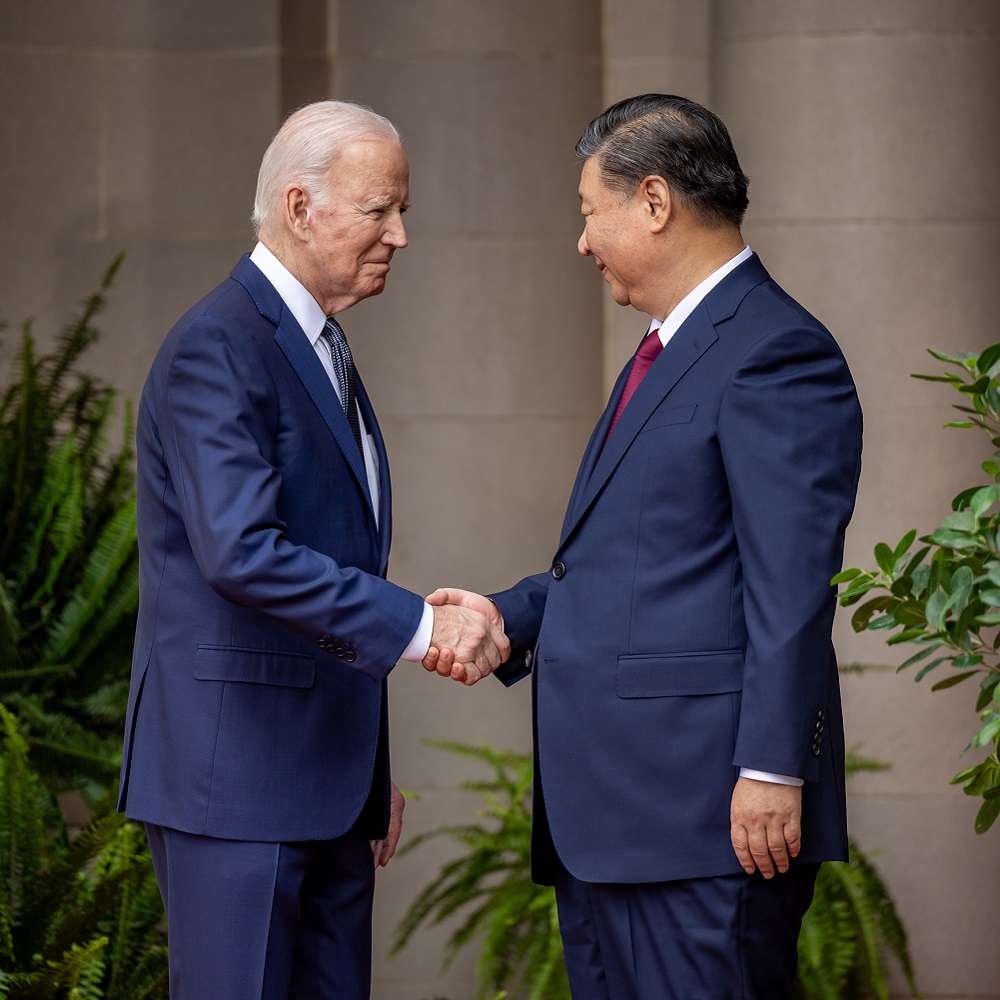
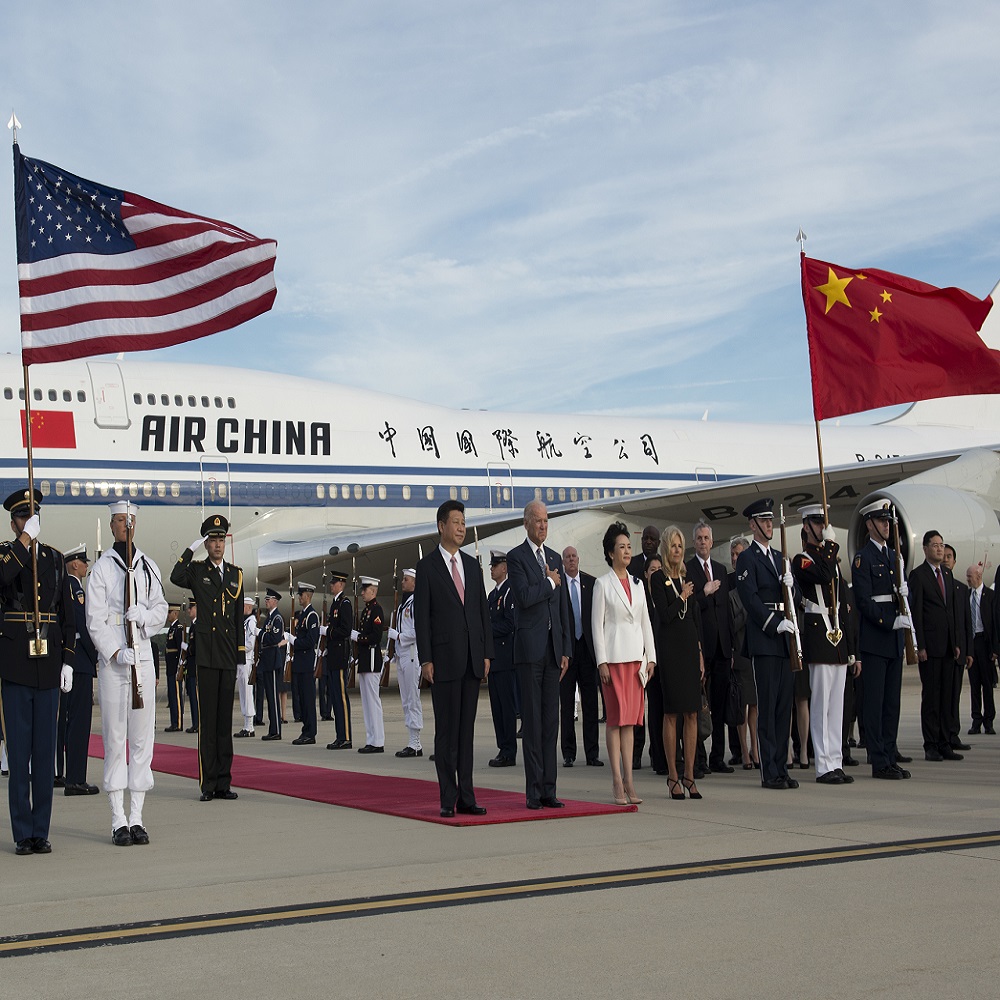
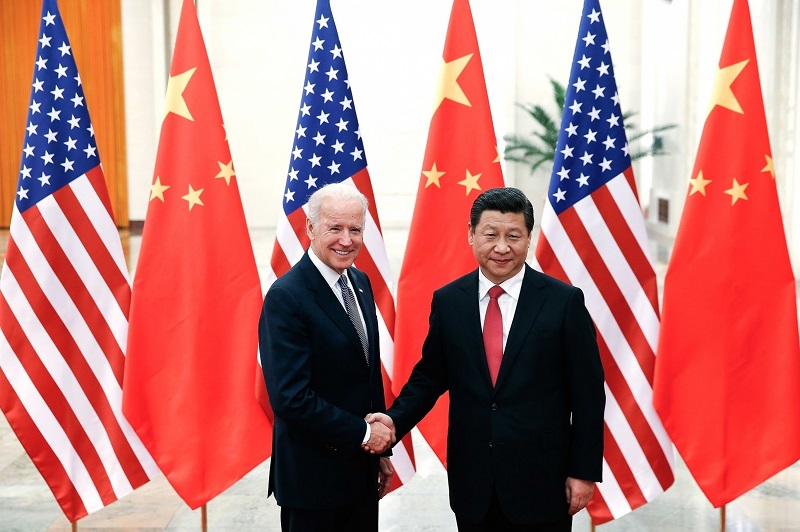
Joe Biden at the airport in China with President Xi Jinping

Can US and China Avoid the Thucydides Trap? The Structural Limits to a US-China Reset

by Dr. Stephen Nagy

The meeting at San Francisco between Presidents Joe Biden and Xi Jinping offers a short respite in the broader strategic conflict that both states have been waging since at least 2017. The friends and trade partners of both nations now have an opportunity to employ middle power diplomacy to advocate for their interests and also the moderation of competition. In his book Destined for War: Can America and China Escape Thucydides’s Trap?, Graham Allison provided historical examples of when a status quo power met a rising power and whether and why it resulted in war. Unlike his peer John Mearsheimer, author of the Tragedy of Great Power Politics, who concludes that competition and conflict between the US and China are inevitable due to the structure of the international system, Allison’s book provides a warning to both the US and China that the decisions they make could be positively or negatively consequential, leaving room for agency to be the final arbiter of the fate of bilateral relations. The pre-APEC meeting between President Joe Biden and President Xi Jinping was an invitro international relations experiment testing the premises of Allison and Mearsheimer as to whether US-China strategic competition will be shaped by the agency of leaders or the structure of the system. Superficially, the 15 November 2023 meeting allowed for an agreement limiting the precursors of fentanyl coming into the United States and, importantly, reviving regular talks under what is known as the military maritime consultation agreement. These modest but important agreements followed a throng of high-level cabinet visits to Beijing and reciprocal visits by Wang Yi, China’s foreign minister, that were meant to stabilise US-China relations. These agreements suggest that leaders in both countries can find diplomatic crosswalks to stabilise the relationship in functional areas. It also intimates that other window of cooperation such as climate change, anti-terrorism, transnational disease prevention, and poverty alleviation may be fertile ground for collaboration if leaders choose to move forward. While the modest takeaways from the meeting in San Francisco underscores that agency does have a role in bilateral relations, we should be realistic that they also reflect the deep structural challenges that exist between the United States and China. Moreover, they also represent the intractable nature of the structural challenges in the relationship, placing friends and allies of the United States and major trading partners of China, such as Australia, Japan, Canada, and Southeast Asian nations, with a difficult quandary: How to balance their economic prosperity and stability through a vibrant and beneficial trade relationship with China while maintaining a strong, comprehensive relationship with the United States as it deepens its strategic competition with China? In the US, there is bipartisan consensus that China represents a challenge to US leadership that needs to be dealt with comprehensively. Under the Biden administration, we have seen a systemic, sequential, and allied-first approach to competing with China. It has brought accolades from friends and allies and, predictably, criticism from China that Biden has not only adopted a continuation of policies towards China from the Trump administration, but that his policies are even more severe. The Biden administration has reinforced and reified its alliance partnerships with South Korea and Japan. It then enhanced its commitment to the Quadrilateral Security Dialogue (Quad) and demonstrated substantial leadership in terms of pushing back against Russia’s invasion of the Ukraine. More recently, the Biden administration forged a new trilateral partnership between South Korea, Japan, and the United States, under the so-called Camp David Principles. It also strengthened the quadrilateral security dialogue and its efforts to provide public goods to the Indo Pacific region. And we’ve gradually seen a more coherent AUKUS strategy that aims to create synergy between the UK, Australia, and the United States in the areas of AI research, quantum computing, hypersonic missiles, cyber, and importantly nuclear power submarines. Last, but not least, the adoption of the Chips Act, limiting the sale of sophisticated semiconductor chips to China and the associated technologies, suggests that the United States is not stepping down from its competition with China, but stepping up in the same way that the United States transformed every aspect of its governance following the 911 attacks. Similarly, there seems to be consensus in the Chinese political elite that the US and its allies are intent on containing China and attenuating its development. Xi Jinping’s 20th Workers Party Report at the 20th Party Congress highlighted the concerns China has about its external environment and advocated for strengthening the PLA to deal with separatist forces and external threats, while consolidating it political, social, economic, and ideological systems. Through the Belt and Road Initiative (BRI), the expansion of the BRICS and Shanghai Cooperation Organization, and the advocacy of the Global Development/ Security and Civilization Initiatives, China under the leadership of Xi Jinping is aiming to transform itself, its periphery, and the international system such that all are more conducive to China’s core interests, including preserving its political system. These realities suggest that rather than fostering a reset in bilateral relations, what we are seeing is both China and the United States taking a tactical pause in their strategic competition to amass the resources they need to compete successfully in the Mearsheimer world of great power politics and the maximisation of power. In closed-door discussions on China with Japanese, South Koreans, Australians, Canadians, Southeast and South Asians, as well as Europeans, we hear similar refrains: while China represents a “systemic challenge” in the case of the Europeans and NATO, or is a “disruptive power” in the case of Canada, or as Japan writes in its 2022 National Security Strategy, “the greatest strategic challenge in ensuring the peace and security of Japan and the peace and stability of the international community,” China is also an important and largely irreplaceable economic partner and essential player in dealing with global challenges such as climate change. The question for friends and allies of the United States is how to balance the increasingly difficult and competitive relationship between China and the United States in a way that ensures that they can continue to have strong economic relationships with China while building resilience into their economies and into their economic relationship, such that the economic weaponization of supply chains and the monopolisation of resources cannot negatively affect trading partners of China. Part of these states’ responses to protect their national interests from the structural realities of Sino-U.S. strategic competition will be a middle power diplomacy that aims to shape the competitive nature of the relationship between the US and China. This will be implemented through coordinating their diplomacy and proactively lobbying, insulating, and investing in rulemaking in the realms of security, trade, and international law alongside their like-minded ally the US, but at times also in opposition to the US. This will require investing in diplomatic resources in both the US and China, in the broader Indo-Pacific region, and at the subnational level to forge strong state to state relations to effectively lobby US policy makers to inculcate the interests of allies and friends of the US in their strategic rivalry with China. Similarly, through forging stronger relations with Chinese provincial leaders though trade and investment, middle powers and stakeholders in the US-China strategic competition may be able to have their interests reflected in a moderation of China’s approach to competition with the US.

Energy & Economics
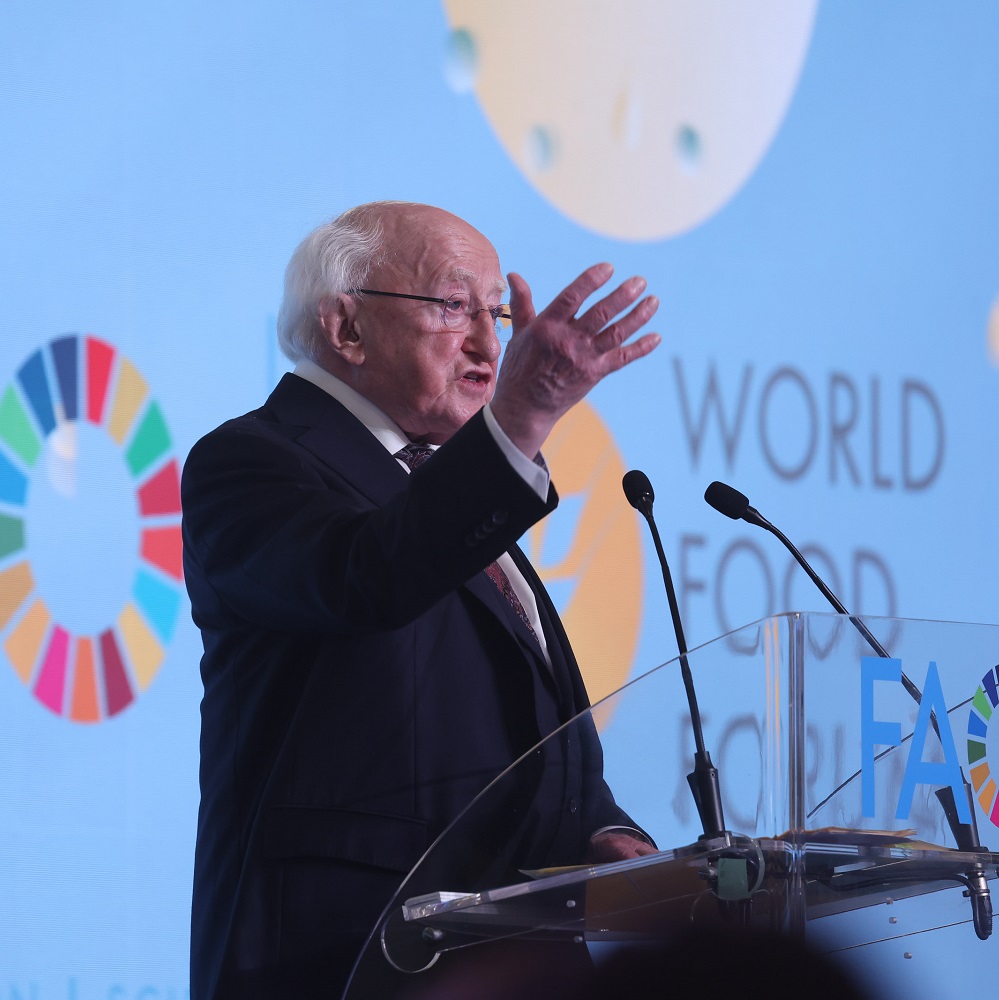
President of Ireland Michael D. Higgins giving speech at World Food Form

Keynote address the Closing Ceremony of the World Food Forum

by Michael D. Higgins

Director-General, Your Excellencies, Distinguished Guests, Dear Friends, Young and Old, This week, as we have gathered here at the World Food Forum in the headquarters of the Food and Agriculture Organisation of the United Nations in Rome to discuss the necessary transformation of our agri-food systems, we must not only be conscious of targets missed or imperfectly achieved, but of the need for courage, and to generate new capacity to move to new models of better connection between economy, social protection, social justice and ecology. We are confronted with a climate and biodiversity emergency that cannot be handled by the tools that produced it or by the architecture of how we made decisions before. We are called upon to, once and for all, tackle with alternatives and sustained effort and innovation, the vicious circle of global poverty and inequality, global hunger, debt and climate change, our interacting crises. That is the context in which sustainable food systems must be achieved. I ask you all gathered today to respond in the most meaningful way within your capacity, within your generation, in a way that includes all generations, to the challenge set out by United Nations Secretary-General António Guterres in his recent statements: This is how the Secretary-General put it: “The Sustainable Development Goals aren’t just a list of goals. They carry the hopes, dreams, rights and expectations of people everywhere. In our world of plenty, hunger is a shocking stain on humanity and an epic human rights violation. It is an indictment of every one of us that millions of people are starving in this day and age.” It can be put right but we must change and there is work involved in upskilling in such a way that we can not only identify and critique assumptions of failing models but be able to put the alternative models in place. We have had so many broken promises. Only 15 percent of some 140 specific targets to achieve the 17 UN Sustainable Development Goals are on track to be achieved. Many targets are going in the wrong direction at the present rate, and not a single one is expected to be achieved in the next seven years. However, we have some reasons to be hopeful. When I look around this room today, I see so many engaged and committed people, including young people who have the enthusiasm, energy and creativity needed to tackle the serious structural causes of food insecurity and global hunger. But it is important to acknowledge that young people are not alone in seeking authenticity of words delivered into actions that have an ethical outcome. There are those who have spent their lives seeking a fairer world, one in which hunger would be eliminated – as it can be. We must recognise their efforts. We must work together to harness this collective energy and creativity into strong movements that will deliver, finally, a food-secure world for all. This will require, I suggest, moving to a new culture of sharing information, experiences, insights. As the cuts have taken effect, we must take the opportunity of developing a view, post-silo culture, of sharing insights, and I see FAO as uniquely positioned for this. As Glenn Denning, Peter Timmer and other food experts have stated, achieving food security is not an easy task given how food hunger is “deeply entwined with the organisation of economic activities and their regulation through public policies”, given, too, how governments and markets must work together, how the private, public and third sectors must work together. All of our efforts must have the character of inclusivity. Each of us as global citizens has a responsibility to respond. To ignore it would be a dereliction of our duty of care to our shared planet and its life-forms including our fellow humans and future generations. The Secretary-General’s pleas in relation to the consequences of climate change are given a further terrible reality in the increased and spreading threat of hunger, a food insecurity which is directly affected by the impact of climate change. For example, figures published by the Food and Agriculture Organization of the United Nations show that 26.2 percent of Africa’s population experienced severe food insecurity in 2021, with 9.8 percent of the total global population suffering from undernourishment the same year. It is time for us all, as leaders and global citizens, to take stock of how words are leading to actions, to increase the urgency of our response to what is a grave existential threat and to achieve change. It is clear, as the Secretary-General’s powerful statement shows, that we need to begin the work of reform in our international institutional architecture, such as UN reform at the highest level, including the Security Council and the Bretton Woods institutions, if we are to achieve what the Secretary-General has suggested is the challenge to “turn a year of burning heat into a year of burning ambition”. Let us commit then to sharing purposes, projects, resources, seeking a new culture for sustenance solutions. Those of us who have spent much of our lives advocating UN reform believe that its best prospects are in the growing acknowledgement of the importance of the vulnerabilities and frustrated capacity of the largest and growing populations of the world being represented, not only nominally but effectively, through a reform that includes reform of the Bretton-Woods Institutions. As Secretary-General Guterres has said on a number of occasions, it is time to reform what are 1945 institutions, including the Security Council and Bretton Woods, in order to align with the “realities of today’s world”. We have to acknowledge too that the development models of the 1950s and 1960s were part of the assumptions that brought us to the crises through which we are living. New models are needed and the good news is that a new epistemology, our way of looking at the world, of sufficiency and sustainability, is emerging. We are seeing good work already occurring. Good development scholarship is available to us. I reference, for example Pádraig Carmody’s recent book, Development Theory and Practice in a Changing World. Such work builds important bridges from the intellectual work that is so badly needed and is welcome at the centre of our discourse on all aspects of interacting crises, including global hunger, and the need to link economy, ecology and a global ethics. What we must launch now is a globalisation from below. Replacing the globalisation from above that has given us a burning planet and threatened democracy itself, with a globalisation from below of the fullest participation, we can establish and indeed extend democracy, offering accountability and transparency of our work together. Writers such as Pádraig Carmody are not alone in suggesting that achieving the Sustainable Development Goals provides the opportunity for moving past the worst contradictions of failed models and dangerous undeclared assumptions. The demise of hegemonic development theory and practice may be a result of several factors, such as the rise of ultra-nationalism around the world, the increasing importance of securitisation where the most powerful insulate their lives from the actions of the excluded, and the existential threat posed by the climate crisis. Such research adds to the growing body of development literature that argues for a pro-active, structural-focused, tailored approach to development. The Hand-in-Hand Initiative of the FAO, details of which were discussed at this week’s parallel session, is a most welcome initiative, one that aims to raise incomes, improve the nutritional status and well-being of poor and vulnerable populations, and strengthen resilience to climate change. It heralds a belated recognition too of the insufficiency of a reactive emergency response to famine and hunger crises. It suggests a move towards one that tackles the underlying structural causes of hunger. Young people will need patience and to dig sufficiently deep to achieve these necessary changes. They are right in seeking to be partners, so much more than being allowed as attendees. Hand-in-Hand recognises the importance of tailor-made interventions to food security, using the best available evidence in the form of spatial data, validated on the ground through local diagnostics and policy processes, to target the most food insecure, the most hungry, the poorest. It recognises that context-specific employment and labour market policies are part of the sustainability challenge. I believe that evidence from below is crucial to achieving globalisation from below and that it can be achieved by a reintroduction of new re-casted anthropology guided by, among others, the new African scholars now available, whose work is empirical and peer-tested, can be invaluable in giving transparency on projects and investments – a strategy for fact-gathering for empowerment of rural people so like the 1955 fact-gathering with rural people of the FAO – first published in 1955 and used by me in 1969! Young people must be about upskilling to be able to critique all of the assumptions guiding the policies on to their lives. A key objective for us now must be to strengthen institutional capacity on the ground, not only at the strategic level, but also fundamentally, so that the public, farmers, and other stakeholders’ institutions are enabled to participate in territories-based agri-food systems. Such a move is fundamental to a successful food security strategy. Our institutional architecture and the multilateral bodies within it, must be made fit for purpose if we are to tackle effectively and meaningfully our contemporary food insecurity crisis which is worsening according to the 2023 Global Report on Food Crises, with 258 million people across 58 countries suffering acute food insecurity. Perhaps most crucially, we must acknowledge, as United Nations Programmes such as the Hand-in-Hand Initiative does, the critical importance of partnership and collaboration in addressing global hunger. We must do everything we can to ensure cross-sectoral co-ordination, foster coherent development actions, under a common, shared vision. We must end all wasteful competitive silo behaviours, create a culture of openness and co-operation. The FAO is well positioned to lead on this with its new invigorated partnerships with the World Food Programme (WFP) and the International Fund for Agricultural Development (IFAD). Co-operation in the development and implementation of new models will be key to the achieving of any targets that seek to be sustainable and inclusive. For example, I suggest it will achieve best results if funders, such as the African Development Bank, are enabled and funded to work closely with research institutes, both at the national and international level, but particularly take account of field studies conducted over time at local level in the new anthropology so as to ensure that findings from the latest research feed into the design and implementation of any financial supports and investments. By providing a platform, a shared interactive transparent space for national authorities and producers, national and global businesses, multilateral development banks and donors to discuss and advance ways and means to finance the supported national food programmes, initiatives such as Hand-in-Hand are proving to be an effective flagship programme of the Food and Agriculture Organisation of the United Nations. Co-operation must work both ways. For example, the parts of the so-called ‘developed’ world suffering from problems of high levels of obesity and food wastage must learn from the deep knowledge and wisdom existing in the most populated continents, as well as the science, which points to a new ecological revolution, one in which agroecology – the bringing of ecological principles to develop new management approaches in agroecosystems – can play a fundamental role, especially for the poorest of our global citizens. We have seen the destructive impact of colonial models of agronomy promoting an over-reliance on a small number of commodity crops, herders incentivised to become less mobile and store less grain in order to maximise commodity crop production, and increasing imports in conditions of near monopoly of seeds, pesticides and fertilisers. This had the deadly effect of opening up farmers not only to the full force of extended droughts, the ravages of variable climate conditions, and a reliance on non-indigenous inputs, but also to global spaces where they have insufficient influence. We must retreat from these dysfunctional food systems model, with their related dependencies, with urgency and embrace models of sufficiency and effective local markets and see the value of making our way too that includes agro-ecological models that promote food security and development opportunities for the poorest people on our fragile planet. Adaptation and responding to the already changing climate is crucial for all of us, and especially in the most food-insecure nations. We must restore degraded ecosystems, introduce drought-resistant crops, ensure accessible digital services for smallholder farms, while creating new, sustainable green jobs for young people so that we may forge a smart, sustainable, climate-resilient development path for the continent. This week we have to acknowledge the many challenges we face including, inter alia, the energy, climate and biodiversity crises, war and conflict which exacerbate food insecurity, ensuring enabling policy environments, and reaching the long-term goal of sustainable food system transformation. Any agri-food initiative, be it for Africa, the Middle-East, Central or South America, or other food-insecure regions, must place inclusivity at its core. Specifically, more vulnerable, smallholder farmers must be targeted for inclusion as programme beneficiaries, not just large-scale, industrial level farmers and ever-expanding commercial plantations. Research has shown that irresponsible agri-business deals are sometimes falsely legitimated by the promotion of alleged achievement of Sustainable Development Goal Number 2 at any cost, without care as to consequence, ignoring the reality that smallholders need enabling policies to enhance their role in food production; that food insecurity is linked to rights, processes, and unequal access to land resources; and that dispossession disproportionately affects women farmers. On this latter issue of gender, achieving zero hunger requires gender-inclusive land and labour policies. Actions must prioritise the inclusion of women and girls who are more food insecure than men in every region of the world. Women must have a right to land recognised and enshrined. The gender gap in food security has grown exponentially in recent years, and will only deteriorate further in the absence of targeted intervention. Women are obviously the most impacted victims of the food crisis, thus they must be a part of the solution. Women produce up to 80 percent of foodstuffs. Empowering women farmers can thus serve as a transformative tool for food security. However, female farmers have, research tell us, limited access to physical inputs, such as seeds and fertiliser, to markets, to storage facilities and this must be addressed. Climate change, and our response to it, addressing global hunger and global poverty, exposing and breaking dependency is a core theme of my Presidency. It is the most pressing existential crisis that our vulnerable planet and its global citizens face. Throughout the world, young people and the youth sector have been at the vanguard of efforts to tackle climate change. Young people have demonstrated, time and again, how well-informed and acutely aware they are of the threat that climate change poses, as well as its uneven and unequal impacts. May I suggest to all of you that, as young innovators and future leaders in your respective fields, you will be at your best, achieve the greatest fulfilment for yourself and others, when you locate your contribution within a commitment to be concerned and contributing global citizens. Take time to ask how is my energy in the tasks of hand and brain being delivered and for whose benefit. May I suggest, too, that you will be remembered and appreciated all the more if you work to ensure that the results of science, technology are shared and that all human endeavours are allowed to flow across borders for the human benefit of all and with a commitment to ecological responsibility and inclusivity. Offer your efforts where they can have the best effect for all. Locate yourselves in the heart of the populated world, as Nobel Laureate William Campbell did with his research on river blindness. Changing our food systems is, however, let us not forget, an intergenerational challenge that requires an inter-generational approach. We must now empower youth to be in the driver’s seat to build a new, better, transparent model of food security in a variety of different settings. Let us endeavour, together, in our diverse world, to seek to build a co-operative, caring and non-exploitative global civilisation free from hunger, a shared planet, a global family at peace with nature and neighbours, resilient to the climate change that is already occurring, one based on foundations of respect for each nation’s own institutions, traditions, experiences and wisdoms, founded on a recognition of the transcendent solidarity that might bind us together as humans, and reveal a recognition of the responsibility we share for our vulnerable planet and the fundamental dignity of all those who dwell on it. Thank you. Beir beannacht.

Diplomacy
Prime Minister of Italy Giorgia Meloni

President Meloni’s press statement with Speaker of the United States House of Representatives Kevin McCarthy

by Giorgia Meloni

Good morning.  I want to thank Speaker Kevin McCarthy, my friend Speaker Kevin McCarthy, for this occasion he gave me. I want to say that I’m very glad to be here in the heart of the American democracy and in the place that Thomas Jefferson, at the time Secretary of State of President George Washington, wanted to call Capitol Hill to commemorate the famous Temple of Giove on the Capitoline Hill, il Campidoglio - one of the seven hills of Rome. And I say it for it is another sign of the incredibly strong ties between Italy and the United States, ties that have become even deeper in recent times after the Russian war of aggression against Ukraine. More than ever, in this international juncture, our relations are essential. More than ever, we must be able to rely one on the other. Today we had the occasion to exchange views on many international issues, from the war in Ukraine and its effects worldwide, in particular regarding food security, to the stabilisation and development in the Mediterranean area, moreover in Africa, the Indo-Pacific, and Italy’s next Presidency of the G7. I was glad to have this debate with representatives of Congress because it gives me a complete picture of the foreign policy landscape from representatives elected by the American people. I’ve been in politics for most of my life and I’ve been a member of parliament for many, many years, so I perfectly know the importance of parliaments in democracies. That’s why I’m so grateful to Speaker Kevin McCarthy, whom I had the pleasure to meet already in Rome a few months ago, and to the representatives I met today, for the time they wanted to spend with me.  And last but not least, I’m happy to be here in a place decorated by these wonderful frescoes of Costantino Brumidi, another Italian, for this place represents and sums up also the stories of all the Italian-Americans who, with their lives, with their efforts, with their dreams, with their creativity, contributed to strengthening the bonds between our two peoples and contributed to make this democracy the great democracy it is. So, I want to say that I’m proud of these Italians, I’m proud of your grandfather too, Kevin, and I really want to thank them for the contribution they brought to the history and the culture and the identity of this nation. Many of them are today representatives and that shows the role Italy has had for the history of the United States, and that is one reason more to continue strengthening our relations, our cooperation, our friendship, particularly in this tough world, in this tough situation.  Many things are changing around us, but there is something others didn’t expect that we should perfectly prove: that the Western world is united and wants to defend the world based on rules, for without a world based on international law, we would live in a world of chaos, in which who is militarily stronger thinks he can invade his neighbour. That’s not the world we want to live in; we want to live in a world in which we can respect sovereignty and freedom. Thank you very much.

Diplomacy
Prime Minister of Israel Benjamin Netanyahu

PM Netanyahu's Remarks at an Event for US Independence Day at the Israel Museum in Jerusalem

by Benjamin Netanyahu

President Herzog, Mrs. Herzog, Ambassador Nides and Virginia,and Taylor, and Taylor's boyfriend,Senator Rick Scott,Speaker of the Knesset,Mayor of Jerusalem,and so many dear friends, Tom, you started your words by remembering an evocative moment, when you were 14 years old in Ein haShofet. Well, somewhat younger than that, I had an evocative moment right here, on this hill top. It was barren. There was no Israel Museum. There was the Monastery of the Cross, olive trees. A barren hilltop except one tree, a balut tree. And we, the Jerusalem kids, would band in the valley and we would try to reach, undetected, to the top, to the tree. Reach the target. I say that because right now, well, last night, Israeli soldiers tried to reach, undetected, the most legitimate target on the planet: people who would annihilate our country. And because this Fourth of July in this extraordinary place falls on an extraordinary moment, Ladies and gentlemen, on behalf of the Government and citizens of Israel, I wish to send my warmest greetings to President Biden and the American people as we join in celebrating their Independence Day. And as Prime Minister, I wish to express my deep appreciation and gratitude for America's enduring support for Israel. For 75 years, the United States has been our irreplaceable and indispensable ally. Irreplaceable. Indispensable. Eleven minutes after our birth, and at vital junctures throughout our history, America has provided Israel with moral and political backing against those committed to wiping us out, to wiping out the one and only Jewish state. No less important, for nearly half a century, America has given generous military assistance to Israel, helping provide us with the tools, the tools we need to defend ourselves by ourselves. Decade after decade, our two countries have moved closer together. I'm proud to say that today, security cooperation has never been better, intelligence sharing has never been deeper and our alliance has never been stronger. I have long said that Israel has no better ally than America, and I say to you, America has no better ally than Israel. I'm confident that Israel's importance to the United States will become even clearer in the years ahead, as we work together not only to protect our common security, but also to develop the most advanced technologies that will reshape the 21st century. They will decide who leads the world. And Israel is America's vital partner in that effort. Ladies and Gentlemen, on July Fourth, all democratic countries should remember that the decisive event that ensured the rise of freedom in modern times, has been the rise of the United States of America. Time and again, America defeated the forces of totalitarianism and terror. Yet we should also remember a basic truth: Freedom is precious, and it's never free. It often requires firm and decisive action against those seeking to spread terror and imperil free societies. I remember that truth every Fourth of July, because that is the day my brother Yoni fell, commanding the rescue force at Entebbe. Today, on the eve of another Fourth of July, Israel's soldiers, once again, find themselves fighting forces of terror. Late last night, the IDF launched a comprehensive action against terrorist strongholds in Jenin. In recent months, Jenin has become a safe haven for terrorists. From that safe haven, terrorists perpetrated savage attacks, murdering Israeli civilians, men, women and children, as many children as they could find. As I speak, our troops our battling the terrorists with unyielding resolve and fortitude, while doing everything, everything, to avoid civilian casualties. I have no doubt that as Israel exercises its inherent right of self-defense, the United States will stand firmly by our side. And I also believe that in the months ahead, Israel and America will work closely together to thwart the danger posed by Iran and seize the opportunity to expand the circle of peace. Ladies and gentlemen, tonight is also an opportunity to thank outgoing US Ambassador Tom Nides for his service and for his friendship towards Israel. Thank you Tom. During your tenure here, you've demonstrated that your support for Israel comes both from the head and from the heart. On a personal level, I will say I'll miss your candor, your wit, your humour and your friendship. No matter what you do, what you decide to do in the next chapter of your life, know that Israel will always be your home away from home. And as you've said many times, quoting President Biden, we are mishpuche. So on behalf of your Israeli family, let me wish you a happy Independence Day. Happy Independence Day America.  God bless America and God bless our valued and unshakable alliance. 

Diplomacy
Alberto Fernández, Former President of Argentina

Remarks by the President of Argentina, Alberto Fernández, at the transfer of the pro tempore presidency of the regional bloc to Brazil, at the LXLL Mercosur Summit, in Misiones

by Alberto Ángel Fernández

Very well, in these last words, I would like to thank all those who have participated in this meeting, those who have reflected with us, and those who have raised their concerns, worries, and proposals with a view to the future. I would just like to make one comment, which I do not want to overlook, because we have not been unaware of the issue, which is the issue of Venezuela. I would like to recall that Argentina - since I assumed the presidency - left the Lima Group because we understood that there was a clear policy of interference in Venezuela, which was not going to solve the problems that Venezuelans had. The number of exiles that Venezuela has today is mainly the result of the economic sanctions that Venezuela has suffered. Therefore, from the very first moment, we tried to be part of the Contact Group and to sit with the Venezuelan parties to dialogue so that they could find a way out towards a better democracy and a better institutional framework for Venezuela. When the United Nations - through a report by Michelle Bachelet - questioned the treatment of human rights in Venezuela, we put together that report by Michelle Bachelet and then we worked so that the High Commissioner for Human Rights could establish an office in Caracas and work towards guaranteeing full respect for human rights in Venezuela. That was done. We resumed the dialogue through a meeting we had with President Macron and President Gustavo Petro in Paris, and from there, we sat the parties down again to continue the dialogue. Afterwards, there was an extended meeting, in the city of Bogota, if I am not mistaken, where this dialogue continued advancing. What has happened now with María Corina Machado is something that we take into account and that we are raising at the dialogue table, which is where we believe it should be raised. Because the problem in Venezuela should be solved by Venezuelans through dialogue among themselves, without other countries meddling in their internal affairs. If we guarantee, as President Abdo has rightly said, that it will be respecting institutionality and human rights, we are convinced that the best way to do it, dear President and friend, is by recovering the dialogue among Venezuelans. Today, Venezuelans are suffering a very difficult situation as a result of these sanctions, which we believe only hurt the Venezuelan people. That is why, when someone reproached the idea that President Lula had put forward a few days ago about the need to have a broader and more complete view of the Venezuelan conflict, I vindicated it because I believe that what I am telling is the true story. I particularly lived and saw how the problems were being overcome, and problems like this one appear - I am not going to deny that - but it seems to me that the place to raise it is at the dialogue table. It would be very auspicious if all those who disappeared from the dialogue table joined the Venezuelan dialogue table: Mexico, Colombia, Brazil, and us. If we genuinely want to help the Venezuelans, let us sit at that table so that they may return to dialogue and once again have the necessary guarantees to recover the fullness of their rights and the fullness of their institutional quality. I say this because I did these things as President of Argentina, not as President Pro Tempore of MERCOSUR. These are things that we should do as Presidents of our respective countries: to guarantee the independence and autonomy of each country and to call for dialogue when democracy or dialogue breaks down in those countries. For me, it is not an issue that went unnoticed; at that table, I raised the problem, dear Marito. At this point, for Argentina and for me personally, it is an immense honor to hand over the Pro Tempore Presidency of MERCOSUR to the sister Federative Republic of Brazil. On this occasion, I would like to emphasize that I am handing over the MERCOSUR Hammer symbol to a great President, to a dear friend, a friend dear to all Argentine men and women, Luis Ignacio Lula Da Silva. I understand, my dear friend, that in your hands lies the responsibility of leading this period of MERCOSUR with the conviction and political lucidity that I have always recognized and that has always characterized you. I want you to know, dear friend, that your challenges are our challenges, your decisions are our decisions, and I will support you with courage in the leadership of MERCOSUR during this next semester of 2023. This is your hammer.

Defense & Security
Prime Minister of Norway Jonas Gahr Støre

Norway Prime Minister Jonas Gahr Støre's Speech on board the USS Gerald R. Ford

by Jonas Gahr Støre

Ambassador, Admiral, Excellencies, friends, It is a great honour to welcome the USS Gerald R. Ford and its crew to Norway and to Oslo. This is a historical event, nothing less. – A show of force. But just as important: A show of friendship – and a show of trust. And it is great to be back on the Ford! – Because I have been here before. Actually, I landed on the Ford outside Norfolk, Virginia last September. I experienced how it was to land – but even more memorable was to take off, being catapulted off the ship – I am still recovering. Today, we came by boat. – It is more relaxed, if I may say so. It is very good to be back. I would like to thank you for this extraordinary U.S. hospitality, we can all feel it, thank you, Captain for the superb Friday evening entertainment. Stepping onto the ship once again, on the Norwegian side of the Atlantic Ocean, reminds me of the obvious fact: The ocean does not divide us. It unites us. And the ocean, as we can see, is a gateway, a waterway, that makes us to what we are – we are neighbours and close friends across the Atlantic.  The Ford flies a battle flag which shows the compass rose. – This is an important tool, for centuries, and a powerful symbol – for staying on the right course. Navigating the Oslo fjord is no easy thing, and on your very first overseas visit I believe it proves that you master the tool – the compass, although – probably, the pilots also helped. Your skilled sailors have anchored the ship on a spot which is significant in many ways in my country. Because the Oslo Fjord tells an important part of the history of Norway: Merchants and rulers came this way, landed near Akershus Castle, which defended the city for centuries from invasions from outside. The famous explorer Roald Amundsen – whose name is, as you know, on the frigate – started his South Pole expedition from exactly where we are now, just ashore here. The Nazi German occupants came this way in 1940 – however, they struggled a lot more to get through the narrow parts of the fjord. The Norwegian king returned from his exile in Great Britain in 1945 on HMS Norfolk by this waterway. – War and peace. Shortly after, NATO was founded. Our two nations – founding fathers of NATO – are close allies, and – as you reminded, Admiral – the U.S. Navy is particularly important to Norwegian security. The U.S. Marine Corps equipment, stored in Mid-Norway, is proof of that commitment. The Norwegian Armed Forces appreciates, in numerous contexts, the opportunity to train with U.S. women and men in uniform. – And that is what we will do in the coming days, and we look forward to it. Well planned, joint exercises are essential. This is not new. It is about continuity. We know. Our neighbours know. And our allies know.  The USS Gerald R. Ford is now anchored in the heart of the five Nordic countries – coastwise towards the Atlantic Ocean. This region will now form the new northern flank of NATO – with Finland, its newest member – and just pending the acceptance of Sweden. So – a new security policy map is in the making. For the first time in centuries the Nordic countries will belong to the same security alliance, being U.S. partners and partners of a strong alliance for stability and peace.  Admiral, You are not just navigating a large ship; you are navigating a significant political and diplomatic tool: the U.S. at sea. This ship has the ability to enhance stability and security wherever you sail, whatever waters you travel. You demonstrate the U.S. commitment to NATO and to transatlantic security. To our security. For that we are truly grateful. Against the backdrop of the ongoing war in Ukraine, this is – to put it short – more important than ever. So, dear friends, on this beautiful Friday afternoon, we should be reminded that there have been dire times, wars in Europe, and we should prepare to avoid dire times in the future. Immediately after the attack on Pearl Harbour in December 1941, President Roosevelt wired Prime Minister Churchill the following words: “Today we are all in the same boat (…) and it is a ship which will not and cannot be sunk.”  A truly transatlantic message – and from this our transatlantic alliance emerged. Democracies decided on standing together. Like then, we are in the same boat – and in a big one this time, and it feels safe. So, friends, Welcome to Norway, welcome to Oslo. Welcome to come training with us. I wish you and your fantastic crew of this ship an excellent stay. You have been well received in Oslo. You are our friends. I wish you a good onward voyage. Thank you very much for your attention.

Energy & Economics
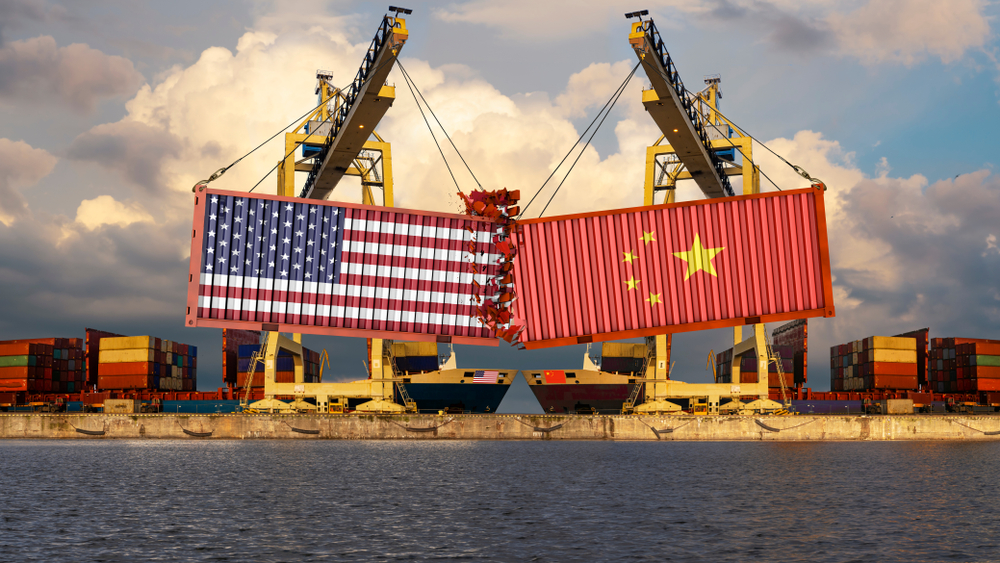
Collision of shipment containers with Chinese and US flags

Drivers of U.S.-China Strategic Competition

by Stephen R. Nagy

Understanding the Chinese Perspective The relationship between the United States and China is one of the most important and mutually beneficial bilateral relationships in the world. Nonetheless, it is also complex and contentious, with both countries vying for geopolitical influence and economic dominance. This brief examines drivers of U.S.-China strategic competition from the perspective of Beijing incorporating the prism of MarxistLeninist ideology, domestic politics in the U.S., China's needed alignment with Russia, nationalism, technological advancements such as AI, the role of regional players such as ASEAN, Japan, and the E.U., and Comprehensive National Power (CNP). Understanding this analytical lens contributes to deeper comprehension of China's security anxieties and world view that may provide insight to enhance engagement, resilience, and deterrence in bilateral relations with China. Introduction The relationship between the United States and China is one of the most important and mutually beneficial bilateral relationships in the world today. To illustrate, according to data published by the U.S. Bureau of Economic Analysis (BEA), total imports and exports grew 2.5 percent year-on-year to reach US$690.6 billion in 2022, breaking the previous record of US$658.8 billion set in 2018. This increase is despite the divisions associated with the COVID-19 pandemic and mutual unfavorable ratings. Nonetheless, the U.S.-China relationship is also complex and contentious, with both countries vying for geopolitical influence and economic dominance. Whether it is the rules-based Free and Open IndoPacific or the realization of Xi Jinping’s China dream, the competition for primacy between the U.S. and China will impact friends, partners, and foes of both states. Viewed from Beijing, Chinese scholars and analysts base their assessment of the trajectory of the U.S.-China strategic competition through several lens including the prism of Marxist-Leninist ideology, domestic politics in the U.S., China’s needed alignment with Russia, nationalism, technological advancements such as AI, the role of regional players such as ASEAN, Japan, and the EU, and Comprehensive National Power (CNP). Shaped by Marxist-Leninist Ideology Marxist-Leninist ideology has played a leading if not central role in shaping the Chinese Communist Party's (CCP) approach to governance and foreign relations. The CCP came to power in 1949 following a successful revolution led by Mao Zedong. Mao was heavily influenced by Marxist-Leninist thought. Since then, the CCP has maintained a commitment to Marxist-Leninist ideology, although its interpretation and application have evolved over time. Today, as former Australian Prime Minister Kevin Rudd and author of The Avoidable War: The Dangers of a Catastrophic Conflict between the US and Xi Jinping's China writes, Xi’s China leans left in terms of Marxist-Leninist socio-economic organization and right in terms of nationalism. Rudd’s analysis echoes President Xi’s speech on “Hold High the Great Banner of Socialism with Chinese Characteristics and Strive in Unity to Build a Modern Socialist Country in All Respects” in his report to the 20th National Congress of the CPC. In that speech, Xi stressed that “Marxism is the fundamental guiding ideology upon which our Party and our country are founded and thrive. Our experience has taught us that, at the fundamental level, we owe the success of our Party and socialism with Chinese characteristics to the fact that Marxism works, particularly when it is adapted to the Chinese context and the needs of our times.” At its core, Marxist-Leninist ideology emphasizes the importance of class struggle and the need for the working class to overthrow the ruling class to achieve a classless society. In the Chinese context, this has translated into a focus on creating a socialist society and promoting the welfare of the Chinese people under the umbrella term ‘Socialism with Chinese Characteristics’. In terms of China’s relationship with the U.S., Marxist-Leninist ideology has contributed to a view of the U.S. as a capitalist and imperialist power that seeks to undermine China’s socialist system. This view is rooted in the Marxist-Leninist belief that capitalist powers are inherently expansionist and seek to dominate other countries to secure their own economic and political interests. They see the U.S. as an imperialist power seeking to maintain its hegemony over the world, while China represents a rising power challenging the established order, as written by Graham Allison in his book Thucydides’ Trap. Chinese analysts believe that the U.S. is threatened by China’s rise and is seeking to contain it through various means, including economic sanctions, military posturing, and diplomatic pressure as evidenced by the Trump administration’s trade war, its network of alliances throughout the region, the advent of minilateral cooperation such as the Quad and AUKUS, and the perceived fomenting of independent movements in Hong Kong, Xinjiang, and Taiwan.  They argue that the U.S. is using its military alliances and partnerships with countries such as Japan, South Korea, and Australia to encircle China and limit its influence in the region. These perspectives ignore that the U.S. alongside with Japan and others openly supported China’s entry into the WTO, the 2008 Summer Olympics, and gave China a leadership position at the Paris Climate Accord. These initiatives demonstrated that the U.S. and other countries were willing to work with China on global issues and support its development. Destabilizing Influence of U.S. Domestic Politics While Marxist-Leninist perspectives of U.S.-China relations offer a macro-level understanding of how China views the inevitability of great power rivalry between Washington and Beijing, Chinese analysts also pay close attention to domestic politics in the U.S. and its impact on U.S.-China relations. Chinese analysts believe that the current political climate in the U.S. is highly polarized, and that these domestic political dynamics are affecting U.S. foreign policy, including its stance towards China. They see the Trump administration’s trade war with China as a reflection of this polarization, and argue that it has damaged the relationship between the two countries. They also note that the Biden administration has continued many of the same policies as the Trump administration, including maintaining tariffs on Chinese goods and pursuing a tough stance on technology transfer and intellectual property theft. The build-up to the 2024 presidential election for most will be one of intensifying securitization of relations with China. President Biden will not be in a position to show any weakness in his China policy. Equally so, the Republicans, whether it is former President Trump or an alternative GOP candidate will take an “All because of China” approach, when it comes to foreign policy, like advocating for a hard decoupling of the economies or even more provocatively, possibly migrating away or redefining the “One China” policy. Developing China-Russian Alignment Chinese analysts also view the relationship between China and Russia as an important factor in the trajectory of U.S.-China relations. They see the two countries as natural partners, sharing a common interest in challenging U.S. dominance of the world. They believe that the China-Russia all-weather partnership is growing stronger and that it poses a significant challenge to U.S. interests. For Russia, Pax Sinica would offer it a much more hospitable environment than the one provided by the Pax Americana, according to the authors of The Beijing-Moscow Axis: The Foundations of an Asymmetric Alliance published by the Centre for Eastern Studies (OSW). For China, a tightening of the alignment with Russia will be critical to ensuring that U.S. does not drive a wedge between China and Russia by pursuing a policy of containment against both countries, a policy that Chinese analysts view as unlikely to succeed. The invasion of Ukraine is a case in point. Despite Russia’s invasion violating the U.N. Charter and China’s Five Principles of Peaceful Co-existence, Beijing has taken a pro-Russian neutrality position refusing to condemn Russia. This is not an endorsement of the invasion or of Putin. It is a clear indication of the importance China places on the deepening Sino-Russian alignment and the reality that neither country can afford a geopolitical divorce. In fact, the recent paper ‘China’s Position on the Political Settlement of the Ukraine Crisis’ continues to echo President Xi’s Workers Report at the 20th Party Congress in October 2022, which explicitly used the expression that “no country’s security should come at the expense of another country’s security,” an explicit rejection of the U.S. and Western countries’ views that Russia has engaged in an unprovoked attack against the sovereign state of Ukraine.  Intensifying Nationalism Chinese nationalism is another important factor by which Chinese analysts understand the trajectory of U.S.-China relations. They view Chinese nationalism as a natural response to the country’s history of humiliation at the hands of foreign powers, including the U.S. Carefully curated since the Tiananmen Square incident in 1989, Zheng Wang writes in his book Never Forget National Humiliation: Historical Memory in Chinese Politics and Foreign Relations that Beijing has placed the century of humiliation at the center of China’s national building process and a nationalist movement in which victimhood, national rejuvenation, and a perineal sense of insecurity concerning the West and particularly the U.S. is the major pillar. These narratives have been meticulously manipulated and deployed to build a national identity in which China must resist anti-China forces and those states that wish to prevent “China’s rightful rise.” Events such as the 70th Anniversary of Victory of Chinese People’s War of Resistance Against Japanese Aggression and World Anti-Fascist War, 100th anniversary of the founding of the Chinese Communist Party, or national aspirations such as the China Dream are all constructed with the purpose of infusing into Chinese citizens a nationalism linked to the CCP’s selective understanding of history. Based on these selective views of history, scholars such as Qin Pang in their co-authored article on “China’s Growing Power Makes Its Youth Hawkish?” Evidence from the Chinese Youth’s Attitudes toward the U.S. and Japan’ find that Chinese citizens view the United States as seeking to contain China’s rise and limit its influence in the region, and that this is seen by many Chinese as an affront to their national pride. Chinese analysts believe that Chinese nationalism is a powerful force that will shape the country's foreign policy for years to come, and that it will continue to be a source of tension in U.S.-China relations. For the U.S. and other like-minded states, Chinese nationalism that is based on victimhood, national rejuvenation, and a perennial sense of insecurity concerning the West will not be a platform for stabilizing and creating constructive relations, especially if this nationalism drives territorial expansion in the South and East China Seas, the Himalayan plateau or across the Taiwan straits.  Dominating AI and Other Technologies  The rapid advancement of technology, particularly in the areas of AI and 5G, is another factor that Chinese analysts believe will shape the trajectory of U.S.-China relations. They see China as a leader in these areas, with the potential to surpass the United States in terms of technological innovation and economic growth. Chinese analysts argue that the U.S. is threatened by China’s technological progress and is seeking to limit its access to advanced technology, particularly in the areas of AI and 5G. They also believe that the United States is using national security concerns as a pretext for restricting Chinese access to these technologies. The U.S. Chips Act and the growing first tier semiconductor and technology firewall that is being erected around China by the U.S. in cooperation with Japan, South Korea, the Netherlands and Taiwan demonstrate the centrality the U.S places on dominating these spheres of technology. The consequence for China according to analysts in and out of China is that it will no longer have access to the most sophisticated semi-conductors, semiconductor producing machines and the associated expertise to keep up in the race to be the first mover when it comes to AI and other technologies that rely on first tier semi-conductor chips. In concrete terms, this means that as the U.S. and its allies will form a chips coalition among like-minded countries resulting in their collective abilities to generate scientific breakthroughs that can be translated into military and economic advantages that will preserve U.S. dominance and the existing rules-based order. Beijing is aware of this challenge and has attempted to reduce its reliance on the U.S. and Western states through its Made in China 2025 strategy and Dual Circulation Strategy. Whether these initiatives will be sufficient to outmaneuver U.S. initiatives to dominate semi-conductors and ultimately AI and other sensitive technologies is yet to be determined. Role of ASEAN, Japan, and the EU Chinese analysts also pay close attention to the role of regional players such as ASEAN, Japan, and the EU in the trajectory of U.S.-China relations. They believe that these countries have a significant influence on the balance of power in the region and that their relationships with the United States and China are critical. Japan’s release in December 2022 of three strategy documents—the National Security Strategy (NSS), National Defense Strategy (NDS), and Defense Buildup Program aims to uphold the current rules-based order and prevent the emergence of Chinese hegemony in the IndoPacific region. Meanwhile, the new Washington Declaration between the United States and the Republic of Korea (RoK) commits to engage in deeper, cooperative decision-making on nuclear deterrence, including through enhanced dialogue and information sharing regarding growing nuclear threats to the ROK and the region. The recent meeting between U.S. President Biden and Philippine President Marcos reaffirms the United States’ ironclad alliance commitments to the Philippines, underscoring that an armed attack on Philippine armed forces, public vessels, or aircraft in the Pacific, including in the South China Sea, would invoke U.S. mutual defense commitments under Article IV of the 1951 U.S.- Philippines Mutual Defense Treaty.”. These are explicit examples of how U.S. allies, through their cooperation and partnerships with the U.S., are aiming to preserve U.S. hegemony. In short, Chinese analysts argue that the United States is seeking to use its relationships with these countries to contain China’s rise, while China is seeking to build closer relationships with its neighbors and BRI partners to expand its influence and build win-win relationships based on its Five Principles of Peaceful Co-existence. Lastly, U.S. and ASEAN watchers in China believe that the United States is losing influence in the region, particularly with ASEAN countries, and that China is poised to fill the power vacuum owing to its extensive economic ties in the region, ties that many in Southeast Asia are dependent on for sustainable development despite reservations over the possible negative ramifications of increased Chinese economic and diplomatic influence in the region. Heft of Comprehensive National Power (CNP) Sensitive to the changing power balances and what this means for China’s ability to achieve its core national interests, China places enormous weight on Comprehensive National Power (CNP) as a key measure of a country’s overall strength and capability in all aspects of national development, including economic, military, technological, cultural, and diplomatic power as Hu Angang and Men Honghua write in their article title “The rising of modern China: Comprehensive national power and grand strategy”. The concept of CNP has been used by Chinese leaders since the 1980s to assess China’s relative strength compared to other countries, particularly the United States. In recent years, China has focused on increasing its CNP as part of its strategic competition with the U.S. Beijing aims to surpass the U.S. in terms of overall power and influence, believing that a higher CNP will enable the country to better protect its national interests, enhance its global influence, and achieve its long-term strategic goals. To increase its CNP, China has pursued a range of policies and initiatives. One of the key areas of focus has been economic development, with China becoming the world’s second-largest economy and a major player in global trade and investment. Through the Made in China 2025, the Belt Road Initiative (BRI), and the Dual Circulation Model, China has also invested heavily in science and technology, with a particular emphasis on emerging technologies such as artificial intelligence, quantum computing, and 5G networks.  In addition, China has modernized its military and expanded its global military presence based on the civil-military fusion (MCF), with the goal of becoming a world-class military power by the middle of the century. China has also pursued a more assertive foreign policy, seeking to expand its influence in key regions such as Southeast Asia, Africa, and the Middle East. Concurrently, China has also sought to promote its soft power, through initiatives such as the Belt and Road Initiative (BRI), which aims to enhance connectivity and economic cooperation between China and other countries. China has also sought to promote its culture and values through the Confucius Institutes and its latest Global Civilization Initiative calling for “called for respecting the diversity of civilizations, advocating the common values of humanity, valuing the inheritance and innovation of civilizations, and strengthening international people-to-people exchanges and cooperation.”  China’s focus on increasing its CNP is driven by its desire to become a major global power and to challenge the U.S.’ dominant position in the international system. While China’s rise has brought many benefits to the country and the world, it has also raised concerns among some countries, particularly the U.S., about the potential implications of China’s growing power and influence. This is especially true as we have seen a growing track record of economic coercion, grey zone tactics, and rejecting international law such as the Permanent Court of Arbitration’s July 2016 decision against its claims in the South China Sea.Conclusion Chinese analysts clearly view the relationship between the United States and China through a complex lens. They see the relationship with the United States as one of the most important in the world and believe that it will continue to shape the trajectory of global politics and economics for years to come. While there are significant challenges and tensions in the relationship between the two countries, Chinese analysts also see opportunities for cooperation and collaboration, particularly in areas such as climate change and global health.

Diplomacy
Joe Biden holding hands with Chinese President Xi Jinping

Biden’s ‘de-risk’ from China policy has a few flaws

by Nathaniel Sher

In order to ‘walk, chew gum, and play chess’ at the same time, the US will have to both invest at home and sign more trade deals. A speech late last month by Jake Sullivan, President Biden’s national security adviser, on “Renewing American Economic Leadership” clarified that the administration wants to build resilience to “de-risk” from China. But dealing with Beijing will require more than investing at home. Washington also needs to re-engage in negotiations with China to manage difficulties in the bilateral relationship. And to better compete, the United States should get back into the business of signing trade deals. As Trade Representative Katherine Tai quipped during her 2021 confirmation hearing, the United States can “walk, chew gum, and play chess” at the same time. The Biden administration should not only invest in domestic resilience, but also participate in new trade agreements and negotiate directly with Beijing. Over the past two years, China joined the Regional Comprehensive Economic Partnership (RCEP), began acceding to the Digital Economy Partnership Agreement (DEPA), and applied to the Comprehensive and Progressive Agreement for Trans-Pacific Partnership (CPTPP). China’s integration into these new frameworks will create efficiencies in its own economy, while binding Beijing closer to the rest of Asia. Meanwhile, the United States does not expect to see the first “real outcomes” from the Indo-Pacific Economic Framework (IPEF) until the end of 2023, more than one year after its announcement. IPEF, moreover, lacks the market-access agreements characteristic of other, more substantive economic agreements. It is not surprising, then, that the 2023 Lowy Institute Asia Power Index ranks China 100 out of 100 on its “economic diplomacy” index, while the United States receives a ranking of only 34.6. The 2023 State of Southeast Asia survey similarly shows that only 21.9 percent of respondents view the United States as a leader in championing free trade, down from 30.1 percent in 2022. To be fair, Beijing has significant ground to cover before its markets become as free and as open as those in the United States. What many trade partners care about, however, is not where China and the United States have been, but where they are going. To many, it appears as if Washington is turning inward while Beijing continues to open its markets. This leads to the second error in Jake Sullivan’s “new consensus” on international economic policy. He expresses fatalism about China’s economic trajectory without giving credence to the possibility that China may change, or that the United States can play a role in influencing Beijing’s behavior. Sullivan explains, when “President Biden came into office, we had to contend with the reality that a large non-market economy had been integrated into the international economic order in a way that posed considerable challenges.” In response, Sullivan focuses on building domestic “resilience” and “capacity” to reduce America’s dependence on China. Washington appears to have given up on addressing the non-market practices contributing to U.S. dependence on China in the first place, including state subsidies and dumping. The administration also seems to have forgotten that access to low-priced imports is an important factor in the competitiveness of U.S. firms and the standard of living of American consumers. Fatalism about China’s trajectory tracks with the Biden administration’s overall Indo-Pacific Strategy, which does not seek to “change the PRC but to shape the strategic environment in which it operates.” Fortunately, Treasury Secretary Janet Yellen has bucked the trend by stating that she hopes to “engage” with Beijing “in an important and substantive dialogue on economic issues.” Not trying to influence Beijing, on the other hand, would give up an essential element of any effective China policy. Of course, prior negotiations were by no means unqualified successes. The Trump administration’s “phase one” trade deal largely failed to change Beijing’s behavior, in part, because the bilateral purchase agreements effectively, as Yukon Huang and Jeremy Smith of the Carnegie  Endowment for International Peace put it, “prescribed state-managed trade over market forces.” Other negotiations, however, have seen more success. Former Treasury Secretary Hank Paulson was able to persuade Beijing to revalue its currency by more than 20 percent in the late 2000s, helping to level the trade relationship. China’s WTO accession negotiations also moved the needle on the country’s economic policy. While Beijing failed to carry out many of its WTO commitments, China did reform key aspects of its economy and, notably, slashed its average tariff level from 15.3 percent in 2001 to 9.8 percent over the next decade. U.S. policymakers should learn the lessons of past negotiations rather than standing by as U.S.-China economic relations deteriorate further. One way to pressure Beijing to continue along the path of reform and opening up would be to carry out negotiations in concert with U.S. friends and allies. The Trump administration gave up significant leverage by dealing with Beijing bilaterally, outside the parameters of the international trade system. Plurilateral negotiations with U.S. partners — many of whom share U.S. grievances — may be more effective at convincing China to change course. The consequences of not having an effective economic dialogue with Beijing will become more apparent over time. Despite Washington’s wishes, China is simply not going away. Beijing will continue to join new trade agreements and integrate itself deeper into the global economy, even as the United States focuses on building resilience at home.

Defense & Security
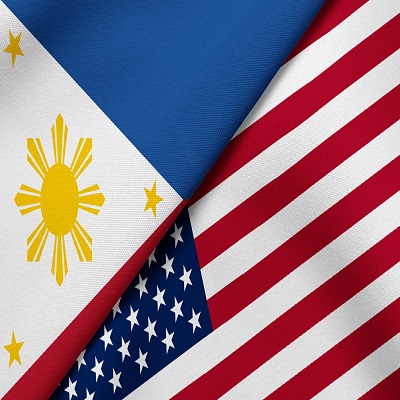
Flag of Philippines and USA

A look at the expanded ambit of the Washington-Manila MDT

by Pratnashree Basu

The further strengthening of ties between the US and the Philippines is indicative of the breadth and scope of maritime security arrangements in the region.Only four months into the year and 2023 has already been very busy in terms of United States (US) engagement in the Indo-Pacific, particularly in East Asia and the South China Sea. During Philippine President Ferdinand Marcos Jr’s recent visit to the US, alongside reaffirming the continuation of the broader ambit of bilateral partnership, the two countries established ‘ground rules’ on US-Philippine defence cooperation on 3 May. The US and the Philippines have a long-standing treaty partnership that dates back to the post-World War II era. The treaty partnership began with the signing of the Mutual Defense Treaty (MDT) in 1951, which established a framework for military cooperation and mutual defence between the two countries, making Manila the oldest ally of Washington in the region. Beijing, quite expectedly, has expressed its disapproval of this new development characterising it as Washington’s attempt at drawing Southeast Asian nations into a small clique to contain China. Beijing’s usual reaction whenever the US conducts outreach in the region comprises various versions of the narrative that Washington is forcing countries to sacrifice their sovereign identities by becoming pawns in the latter’s efforts to destabilise the region and turn countries against China. Mao Ning, a spokesperson for the Chinese Foreign Ministry stressed that the South China Sea is not a hunting ground for countries outside of it. Meanwhile, the state-run foreign-language news channel, CGTN, warned against President Marcos’s ‘dangerous courtship.’The reinforced scope of the US-Philippines defence partnershipInterestingly, in addition to reiterating US commitments as Manila’s treaty partner and referencing the strong need for maintaining peace and stability in the South China Sea, the joint statement noted that the two sides “affirm the importance of maintaining peace and stability across the Taiwan Strait” as an indispensable element of global peace and security. Defence ties between the US and the Philippines have indeed expanded to include, first the South China Sea and now, the Taiwan Strait. What this indicates is a steady consolidation of security frameworks in the region that would form bulwarks against Beijing’s repeated and expanding overtures into the South China Sea and pressures on Taiwan. Given that the Taiwan Strait lies at a distance of only 800 miles from Manila, it is not surprising that the security of the Strait has been included under the expanded purview of Washington and Manila’s treaty partnership. Under the basic framework of the MDT, the US and the Philippines agreed to come to each other’s aid in the event of an attack by an external aggressor. The MDT has been an important part of the US-Philippines relationship, providing a basis for close military cooperation and joint training exercises. The US has provided military aid and assistance to the Philippines, helping to modernise its armed forces and improve its capabilities in areas such as maritime security and counterterrorism. Despite episodic friction over issues such as human rights and the rule of law, the US-Philippines treaty partnership remains an important part of both countries’ foreign policy agendas. As the geopolitical landscape in Asia continues to evolve, the US-Philippines treaty partnership will likely remain an important pillar of stability and cooperation in the region. Now, the partnership includes a broadening of “information sharing on the principal threats and challenges” to the peace and security of the US and the Philippines. The upgraded ‘ironclad’ alliance commitments also make room for the inclusion of new sites which could contribute to the enhancement of Manila’s maritime security and modernisation efforts under the U.S.-Philippines Enhanced Defense Cooperation Agreement. It also creates a greater space for US involvement in the improvement of local and shared capacities in the delivery of humanitarian assistance and disaster relief.What this means for the Indo-PacificPresident Marcos’s visit comes close on the heels of South Korean President Yoon’s visit to Washington which resulted in the latter agreeing to send an Ohio-class nuclear ballistic missile submarine to Seoul to strengthen deterrence against Pyongyang’s recent nuclear flexing. Earlier in April, Manila allowed Washington access to four additional military bases for joint training, pre-positioning of equipment and building of facilities such as runways, fuel storage, and military housing. Access to these new locations is significant as two of them—Isabela and Cagayan—are positioned facing Taiwan while the Palawan base is in proximity to the Spratly Islands—a source of a long-standing dispute between China and the Philippines. The two countries have agreed to resume joint maritime patrols in the South China Sea and Manila is also assessing a trilateral security pact involving Japan. In mid-April, before President Marcos’s visit, the two countries participated in their largest-ever joint military drills, Exercise Balikatan, in the South China Sea. China is decidedly furious at the pace and scope of these new developments. Undoubtedly, steps like these are strategic and oriented towards boosting the defence postures of ‘like-minded’ countries in the region. But despite Beijing’s strong censure, these measures are indicative of the breadth and scope of maritime security arrangements in the region being on the course to be further strengthened.

Diplomacy
Flag of USA and China on a processor, CPU or GPU microchip on a motherboard. US companies have become the latest collateral damage in US - China tech war

What Exactly Does Washington Want From Its Trade War With Beijing?

by Yukon Huang , Genevieve Slosberg

With relations at an all-time low, punitive actions targeting China have become politically popular, even if they have no analytical basis. Five years ago, then president Donald Trump launched a tariff-fueled trade war with China designed to reduce the bilateral trade deficit. His successor, President Joe Biden, then added a decoupling focus by restricting high-tech exports and curtailing professional and financial links. Both wanted to reduce imports of manufactured goods and bring home more jobs. How should one judge the effectiveness of their policies? Back then, and even more so today, the logic of Trump’s fixation on trade deficits made little sense. But security concerns have now become the rationale for reducing America’s trade relations with China and undercutting China’s growth potential. Against these yardsticks, the results are mixed but on balance unconvincing, given the costs in the form of inflationary pressures, repressed export growth, and a projected decline in global output. But U.S. politicians from both parties strongly support these restrictive measures because the costs are not obvious to their constituents, while the benefits from appearing to be tough on China resonate well with voters. Rising trade deficits The recent U.S. Census Bureau data indicate that the politically sensitive U.S. merchandise trade deficit with China was larger in 2022 than when Trump became president, while America’s overall trade deficit hit an all-time high of $1.18 trillion. This reinforces the views of nearly all the economists surveyed at the launching of Trump’s trade war: that the tariffs would not reduce U.S. trade deficits and the costs would be paid largely by Americans. For the Trump administration, the wild card was the “phase one” purchase agreement, which called for an increase of $200 billion in China’s imports from the United States. But state-to-state purchase agreements have no logical basis when global trade is largely shaped by the market-driven decisions of firms and consumers and subject to unpredictable events such as the coronavirus pandemic. Economic principles tell us that how much a country saves and spends determines its trade balance. The combination of Trump’s large tax cuts and Biden’s huge expenditure initiatives has led to soaring budget deficits, which are mirrored in record trade deficits. All this has little to do with China. Yet the Biden administration still insists that China honor the purchase agreement and links the removal of tariffs to its fulfillment. Asking China to honor an agreement that made no sense to begin with as a condition for dropping another equally ineffective policy defies logic. Trade diversification but increasing import dependence on other countries But this focus on bilateral trade numbers overlooks the sharp decline in China’s share of trade with the United States. Whereas China accounted for 47 percent of the U.S. trade deficit in 2017, it accounted for only 32 percent last year, with most of this decline offset by the increasing shares of other East Asian economies. Europe’s share of America’s overall trade deficit also declined from 21 percent to 18 percent. Only Canada and Mexico, via the United States-Mexico-Canada Agreement (USMCA), were able to increase their share from 11 to 18 percent. More insights can be gleaned from looking at the components of trade. Although the value of U.S. imports from China was essentially the same in 2022 as it was in 2017, total U.S. imports increased by about $900 billion during this period. As a result, China’s share of the total, made up largely of manufactured goods, fell from 22 to 17 percent. This decline, however, did not reduce America’s dependency on imports of manufactured goods. The share of imports relative to overall expenditures on manufactured goods rose steadily to 34 percent in 2022 from 23 percent two decades ago. The decline in China’s share of U.S. imports of manufactured goods was more than offset by imports from other countries, notably Mexico and Vietnam. These two developing countries, more than others, were able to import heavily from the United States based on their locational advantages and free trade agreements. Vietnam and China share a border and are linked by the ASEAN-China trade agreement, while Mexico and the United States also share a border and are linked by the USMCA trade agreement. Less noticed, however, is the behind-the-scenes role that China plays in supplying the components and materials for these other countries’ exports to the United States. Most of Vietnam’s increased exports were in product lines where U.S. imports from China fell, such as computer accessories and telecommunication equipment. China’s exports to Vietnam have more than doubled since 2017, and its trade surplus nearly tripled by 2022. China’s exports to Mexico increased by nearly 30 percent last year, on top of a 50 percent increase in 2021. China may be exporting less to the United States directly, but it is now indirectly exporting more. This explains why China’s share of global manufacturing production has continued to increase from 26 percent in 2017 to 31 percent in 2021. As for U.S. exports, the total averaged about $1.5 trillion from 2017 to 2020 but then jumped to $1.9 trillion in 2022. But this increase was not in manufactured goods but in exports of energy products and chemicals to Europe, spurred by the Ukraine crisis. The trade war did little to expand U.S. exports to China, the share of which fell from 8.4 percent in 2017 to 7.5 percent in 2022. Costs and benefits of decoupling According to one study, U.S. firms were handicapped by tariff-related higher costs of their imported inputs, and coupled with China’s retaliatory tariffs, this resulted in U.S. exports to China being 23 percent lower than they would have been in the absence of the trade war. The consequence is that America’s trade war policies generated very little growth in exports of manufactured products, despite the priority given to those policies by both the Trump and Biden administrations. If the purpose of the U.S. punitive actions toward China was to weaken China economically, there is no clear evidence of that happening. By developing alternative export markets and tapping pandemic-driven demand in the West for manufactured goods, China pushed its share of global exports to record levels in recent years. Meanwhile, China’s imports as a share of its GDP have been declining steadily, from a high of 28 percent in the early 2000s to 17 percent in 2022. One could argue that the world has become more dependent on China in trade while China has become less dependent on the world. The benefits of decoupling—if any—should be weighed against the costs imposed on U.S. consumers and producers and damage done to the export competitiveness of U.S. firms. To counter such tendencies, the Biden administration is promoting domestic manufacturing with subsidies in the Inflation Reduction Act. Such actions can be justified for strategic reasons, but the rationale is weakened by protectionist Buy America conditions. U.S. policymakers often counter by pointing to China’s use of subsidies to promote strategic industries, but Chinese firms were keen to import key technologies and components to ensure that their products were globally competitive on cost and performance grounds. The recent semiconductor and other U.S. restrictions on China’s access to high-tech products are also problematic because these products are “dual use,” with a much larger commercial market relative to military applications. Such restrictions hurt the many U.S. firms that derive significant revenues from selling to China and may contravene World Trade Organization guidelines. The costs of trade-related distortionary policies can be substantial. One oft-cited study estimates that taxpayers end up paying about $250,000 for each job saved in typical Buy America programs. At a broader level, a recent International Monetary Fund study estimates that a combination of U.S. trade and technological decoupling measures could reduce global GDP by some 7 to 12 percent. Ultimately, the problem lies in the lack of clarity on U.S. policy objectives. What does it mean to undercut China, and how will the United States know if it has succeeded? With U.S.-China relations at an all-time low, punitive actions targeting China have become politically popular, even if they have no analytical basis. The reality is that the United States and China have no choice but to continue trading with each other. But with security overriding commercial considerations, the economic interdependence built up over decades is now being reversed, leaving everyone worse off.