Subscribe to our weekly newsletters for free

Subscribe to an email

If you want to subscribe to World & New World Newsletter, please enter
your e-mail

Diplomacy
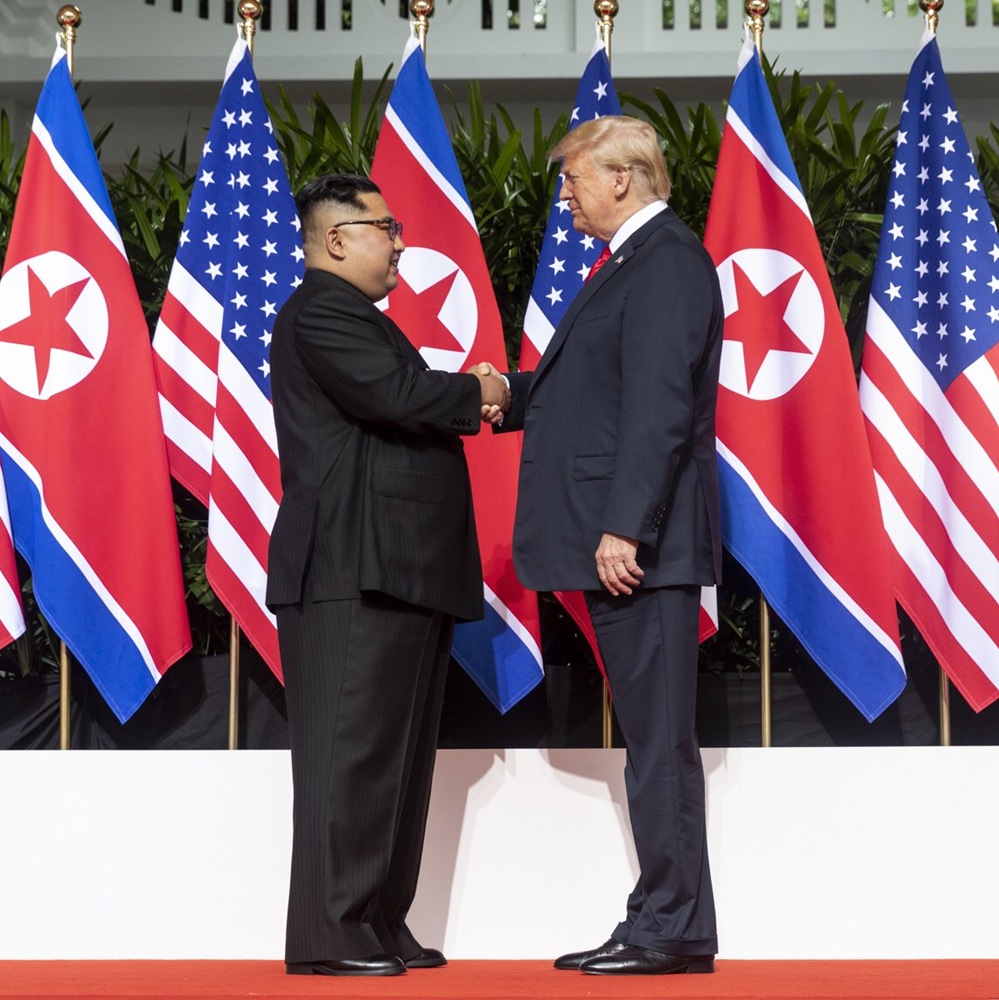
Kim and Trump shaking hands at the red carpet during the DPRK–USA Singapore Summit 2018

Democratic People's Republic of Korea and Trump 2.0: Another cycle with new attributes?

by Jesús de los Ángeles Aise Sotolongo

Abstract Never before had a sitting U.S. president managed relations with the DPRK as Donald Trump did, nor had any leader from Pyongyang sat face-to-face with a sitting U.S. president during their term as Kim Jong Un did. With Trump’s potential return, could there be another cycle of rapprochement? This paper seeks to address this question. The failure of the previous negotiating cycle, the DPRK’s advances in deterrence, and shifts in peninsular, regional, and global circumstances suggest that both leaders might bring new attributes to their interactions, potentially yielding surprising outcomes Introduction Except for a few moments of rapprochement, since the founding of the Democratic People’s Republic of Korea (DPRK), U.S. administrations have maneuvered with various forms and methods to destabilize its political and economic system. And since Pyongyang decided to develop nuclear weapons, Washington has labeled them illegal, demanding that they be abandoned, sponsoring United Nations Security Council (UNSC) sanctions, and implementing strict unilateral penalties. Meanwhile, successive DPRK leaders have persevered in a military doctrine based on the development of nuclear deterrence to guarantee national defense and security. Nevertheless, an unprecedented moment that broke with that persistent circumstance took place during Donald Trump’s previous term, when the relationship shifted from “fire and fury” to successive summits with Kim Jong Un in 2018 and 2019, in Singapore, Hanoi, and Panmunjom. The exchange of insults — Trump calling Kim “little rocket man” and Kim referring to Trump as a “dotard” — mutated into their approaching one another as “pen pals.” This surprising shift in U.S. policy toward the DPRK temporarily, though without the expected results, loosened the “Korean Gordian knot.” No U.S. president has managed relations with the DPRK as Donald Trump did, and in history, no North Korean leader had ever stood face-to-face, on equal footing, with a sitting U.S. president as Kim Jong Un did. Former President Barack Obama delivered several appealing speeches, but he seemed weak to many countries in East Asia, including U.S. allies and partners. For eight years, he did nothing about North Korea, calling it “strategic patience.” This eroded deterrence and allowed Pyongyang to advance its weapons and nuclear programs (Kausikan, 2025). For his part, at the beginning of his term, Joe Biden announced a “new strategy” toward the DPRK that never materialized; he pleaded for dialogue with Kim Jong Un while simultaneously increasing war threats; he grouped China, Russia, Iran, and North Korea into an ideological category that resurrected the Bush-era notion of the “axis of evil.” Biden’s simplistic binary categorization was not a policy. It ignored the differences in how these four countries define their interests, the degree of integration into the global economy, and the scope of their ambitions. These differences should be the starting point for U.S. diplomacy toward North Korea (Kausikan, 2025). The purpose of this article is to examine the circumstances, obstacles, and expectations for a new cycle of negotiations between Washington and Pyongyang with Donald Trump’s return to the U.S. presidency. Development This second term of President Donald Trump, more transactional and less predictable, seems to be raising expectations of reducing confrontational stress on the Korean Peninsula, and everything indicates that it brings with it a modification of Washington’s policy toward the DPRK. This is conditioned by the following radical changes in strategic circumstances compared to his previous term: DPRK’s nuclear and missile programs have undergone new and sophisticated advances. The DPRK has broken all ties and symbols of its relations with the Republic of Korea, which it classifies as its “principal and unchanging enemy.” Declaring that it has no intention of avoiding war, it has instructed the Korean People’s Army to accelerate preparations to “occupy, subdue, and completely reclaim” South Korea. There has been a tightening of ties between Pyongyang and Moscow. The two Kim Jong Un–Vladimir Putin summits, and Kim’s reference to Putin as his “closest comrade,” have shown the very high level of understanding and commitment between the parties. This is reflected in the DPRK’s unrestricted support for Russia’s special military operation in Ukraine and the signing of a Comprehensive Strategic Partnership Treaty, ratified by both legislatures, which includes a “mutual military assistance” clause. Meanwhile, Russia supports the DPRK diplomatically and economically, opposing multilateral and unilateral sanctions, and expanding its exports — essentially oil, raw materials, and food — as well as providing assistance in various fields. An emerging anti-U.S. and anti-Western axis has been taking shape among China, Russia, the DPRK, and Iran, which has become so significant that Washington and its allies describe it as a “new axis.” Within this interconnection, the DPRK holds important advantages in three strategic dimensions: economic, military, and diplomatic. The removal of President Yoon Suk Yeol over his irresponsible Martial Law is reinforcing the possibility of a new government led by the Democratic Party, with Lee Jae Myung as the clear favorite and, as of today, more likely to win. [1] This would open the door to a revival of North–South détente reminiscent of the Moon Jae In era. Trump’s foreign policy objectives are based on his “Make America Great Again” (MAGA) vision — now reinforced — which prioritizes U.S. strategic and economic interests over traditional alliance commitments (e.g., South Korea and Japan). At least these six factors seem to be significantly influencing Donald Trump’s decision to return to diplomacy with Kim Jong Un. While the DPRK occupies a relatively lower position on Trump’s list of priorities (with China and the Russia–Ukraine conflict taking precedence), and dialogue does not appear imminent, he has made it clear that he would like to reconnect with Kim Jong Un, seems willing to reopen negotiations, and is evaluating and discussing possible avenues of interaction that could lay the groundwork for a potential summit. It is said that Washington has been holding discreet conversations with Pyongyang, consulting external experts, and considering options to potentially restart dialogue. Meanwhile, Kim Jong Un — clearly more assertive and militarily more powerful in Washington’s eyes — has not publicly shown any willingness to renew his earlier offers related to denuclearization. In his own words: “the DPRK’s nuclearization is non-negotiable,” and he continues to exert pressure by showcasing the country’s missile–nuclear power. This has been illustrated unequivocally and consistently when Kim Jong Un visited nuclear material production facilities and the Nuclear Weapons Institute (NWI) in September 2024 and January 2025. For the DPRK, survival is an existential matter, and Pyongyang considers its nuclear–missile programs absolutely indispensable to secure it; there is nothing we can see that would persuade or force it to renounce them, as that would imply regime change. Everything indicates that the U.S. president is aware that his counterpart has not yet overcome the discouragement caused by the failure of the previous negotiation process, and for that reason, he is sending increasingly precise messages about the possibility of renewed talks, while boasting of his personal relationship with Kim Jong Un. At the same time, however, Pyongyang continues to issue contradictory signals of distrust toward Washington, in response to the confrontational attitude and the increasingly close military and intelligence ties with the DPRK’s immediate neighbors. It is worth noting that, this past February, the U.S. sent a nuclear submarine and several B-1B bombers to South Korea; U.S. military forces carried out multiple war exercises, including live-fire drills along the Demilitarized Zone, as well as heavy bombing maneuvers and even space force operations. In March, a large-scale scheduled exercise took place—70 percent larger than the one held the previous year. Nevertheless, it appears that by the end of 2024 the DPRK leadership decided to create a certain margin of diplomatic maneuver in anticipation of the incoming Trump administration. The coverage given to Trump’s inauguration on January 22 marked a shift from Pyongyang’s initial decision to remain silent on the outcome of the U.S. presidential elections in November. Moreover, this information was published in media outlets aimed at both domestic and international audiences, suggesting that North Korea has begun preparing its people for a new approach to Trump, when appropriate. Despite the steady flow of official statements and media commentary criticizing the United States, anti-American rhetoric has become somewhat less intense. Notably, the use of the expression “U.S. imperialists” has significantly decreased since then. This is also true of Kim’s public statements, which are considered the most authoritative in North Korea. For example, Kim’s speech at the Ministry of Defence on February 8 was the harshest and most detailed on the United States since his speech at a national defence exhibition in November 2024. However, unlike in many of his previous speeches at defence-related venues or events, he did not use derogatory terms such as “U.S. imperialists.” In fact, the last reported use by Kim of the term “U.S. imperialists” was in his defence exhibition speech last November. While there has been a rise in criticism of the United States since early February, as demonstrated by a series of “KCNA commentaries,” the broader trend since December still holds. The media have refrained from mentioning Trump by name, even when criticizing U.S. statements or actions. When issuing criticism, they have only referred to “the new U.S. administration,” “the current administration,” or the “U.S. ruler.” KCNA’s commentary on February 12 regarding the Gaza Strip, for example, blamed the “current U.S. administration” for the plan to take control of Gaza, omitting Trump’s name. All these articles were published in outlets aimed at domestic audiences, likely because they addressed foreign policy issues not directly relevant to North Korea. In contrast, the North Korean Ministry of Foreign Affairs’ criticism of Rubio’s statement about the “rogue state” was only published on external websites and not disseminated to the domestic audience. This allowed Pyongyang to register its rejection of the statement to external audiences while controlling the narrative about the Trump administration at home. Pyongyang also appears to be creating diplomatic space by attempting to influence Washington’s thinking while it awaits the new Trump administration’s policy toward North Korea. Its Ministry of Defence stated that the United States was “openly ignoring the DPRK’s security concerns” in reference to a U.S. nuclear-powered submarine that entered a South Korean port — an unusually direct accusation that the United States “ignores” its security concerns. If we consider the reverse side of this message (do not ignore North Korea’s security concerns), it is in fact a call from Pyongyang to the new administration to take its “security concerns” into account in its policy toward North Korea (Minyoung Lee, 2025). We can therefore see some Trumpist signals that could prove attractive to Pyongyang’s leadership: Repeated references by the U.S. president, describing the DPRK as a “nuclear power,” a concept recently reinforced when he qualified it as a “great nuclear power.” It is noteworthy that very recently U.S. Secretary of State Marco Rubio used the expression “nuclear-armed state” to refer to the DPRK, implicitly admitting Pyongyang’s possession of nuclear weapons. This comment suggests that the U.S. is unofficially considering the DPRK as a nuclear-armed nation, just as it does with India, Pakistan, and Israel. There are signs of a strategic shift aimed at overcoming deadlock and building trust by moving from denuclearization as the priority toward nuclear security. In other words, instead of demanding denuclearization, the focus would be on improving the safety of nuclear facilities — such as preventing accidents, leaks, or proliferation risks to third countries — through active bilateral technical cooperation that aligns reciprocal interests. The decisions that have shaken the peninsular geopolitical context and the Washington–Seoul alliance, when the U.S. classified South Korea as a “sensitive country,” as well as the so-called “strategic flexibility” that “modifies the mission of U.S. Forces Korea (USFK).” It is true that many officials in the Trump administration continue to officially reiterate their commitment to the DPRK’s denuclearization. However, statements by the U.S. president and his Secretary of State suggest that they recognize North Korea as a nuclear-armed state, generating a dual reaction: on one hand, surprise at an abrupt shift in policy toward the DPRK’s nuclearization, and on the other, uncertainty about what would happen to the security concerns of its allies — South Korea and Japan — as well as those of the U.S. itself. It should be noted that Trump stated — no less than in front of NATO Secretary General Mark Rutte — that he intended to re-establish relations with Kim Jong Un, that “he would do it,” that he has “…an excellent relationship with Kim Jong Un and we’ll see what happens.” And he declared: “But without a doubt, it is a nuclear power.” In that same setting, Trump also mentioned that India and Pakistan possessed nuclear weapons, effectively recognizing them as de facto nuclear-armed states, adding that Kim Jong Un “possesses numerous nuclear weapons” and that “others possess them as well.” Therefore, the statements by Trump and Rubio that tacitly recognize the DPRK as a “nuclear power” indicate a shift in Washington’s policy toward Pyongyang. It seems that interactions between the DPRK and the U.S. are moving toward a turning point: from denuclearization as the priority to nuclear security — a strategic change in U.S. policy aimed at overcoming deadlock and establishing trust, as a preliminary step toward a possible peace treaty. The repeated reference by U.S. President Donald Trump to the DPRK as a nuclear power could be an effort to draw Pyongyang back to the negotiating table, since North Korea seeks de facto recognition by the U.S. as a nuclear-armed state. Trump seems to be maintaining the perspective that the next negotiation should focus on reducing threats rather than denuclearization, despite his stated pursuit of “complete denuclearization.” Everything suggests that Trump is emphasizing the evident reality of Pyongyang’s progress in its nuclear program. It can also be considered that Trump’s remarks may imply that, as a result of the failure of his summit efforts to reach an agreement with Kim Jong Un to halt North Korea’s nuclear program, he may now be encouraging the consideration of an alternative strategy. However, Pyongyang is publicly and incessantly rejecting Trump’s attempts to restart dialogue; this stance has much to do with the recent history of U.S. negotiations and the president’s insufficient reciprocity to the concrete measures proposed by Kim Jong Un. In addition to the above, it is worth highlighting the latest developments that have shaken the peninsular geopolitical context and the Washington–Seoul alliance, which could, to some extent, influence a shift in Pyongyang’s perception and lead it to accept talks with Washington. We refer to the classification of South Korea as a “sensitive country” and the idea of “modifying the mission of U.S. Forces Korea (USFK).” The U.S. Department of Energy (DOE) designated South Korea as a “sensitive country,” a classification that significantly restricts collaboration in areas of advanced technology, including nuclear energy, artificial intelligence, quantum science, and advanced computing. This measure, which took effect on April 15, subjects South Korean researchers to stricter controls for collaborating or participating in research at DOE facilities or research centers and marks the first time South Korea has received such a designation from the U.S. government. In this regard, the “sensitive country” classification is based on unilateral criteria such as national security, nuclear non-proliferation, regional instability, threats to economic security, and alleged support for terrorism. This list, maintained by the DOE’s Office of Intelligence and Counterintelligence (OICI) along with the National Nuclear Security Administration (NNSA), already included countries such as India, Israel, Pakistan, Saudi Arabia, and Taiwan. Additionally, North Korea and Iran are designated as “state sponsors of terrorism,” while China and Russia are considered “countries of concern.” Such a designation suggests that the U.S. has growing concerns about the increasing voices among South Korean academics, politicians, and citizens who support the development of domestic nuclear weapons. Recent surveys reveal that popular support for nuclear armament has reached between 60% and 70%, apparently stemming from the belief that South Korea must take a bold defensive measure against North Korea’s growing nuclear threats. Although some who favor this idea believe that President Donald Trump’s skeptical view of alliances — focused on reducing the financial burden of protecting U.S. allies — might allow Seoul to develop nuclear weapons and thus reduce Washington’s responsibilities on the Korean Peninsula, the likelihood of this happening remains slim. However, the debate will not disappear in the short term due to growing skepticism about the so-called U.S. “extended deterrence,” which relies only on the deployment of strategic assets in the South of the peninsula. In the meantime, the DPRK is very likely to feel satisfied, as it sees its long-standing desire fulfilled: to witness cracks in the Washington–Seoul alliance. Another decision that would benefit the DPRK under the so-called “strategic flexibility” is the projection that the Trump administration may deploy U.S. troops stationed in South Korea in the event of a conflict in the Taiwan Strait, following the circulation of a purported Pentagon memorandum detailing its objective of deterring China from occupying Taiwan. As is well known, the primary mission of the 28,500 U.S. troops in South Korea is to deter threats from the DPRK. Should this decision materialize, their mission would then shift to countering China, considered a key component of the current administration’s foreign policy. This would create a security vacuum for Seoul and further strain its relations with Beijing. In such a circumstance, the Trump administration could pressure South Korea to handle conventional military actions from the DPRK independently, with the U.S. intervening only in the case of nuclear threats. Therefore, the best option for Seoul is to significantly strengthen its defensive capabilities, preparing for a scenario in which U.S. troops are not involved in a conventional war with the DPRK. The notion of “strategic flexibility” for the USFK reflects a shift in the main mission of U.S. forces abroad, moving from the defense of nations through their permanent presence to rapid deployment in other parts of the world where conflicts arise. As expected, unease is growing in Seoul in the face of Pyongyang’s increasing assertiveness, while the latter shows greater defiance. First, due to the possibility that Trump’s second administration may divert part of the USFK’s resources to a conflict in the Taiwan Strait, which would leave South Korea more vulnerable. Second, because South Korea is currently in open political turmoil over the impeachment of President Yoon Suk Yeol, and everything seems to indicate that the so-called South Korean democracy has failed to demonstrate itself as reliable in the eyes of Trump and his team. It is worth mentioning what Moon Chung In, emeritus professor at Yonsei University, stated in his most recent book, titled “Why American Diplomacy Fails”. The expert describes North Korea’s nuclear problem as an illustrative failure of U.S. diplomacy. His remarks are eloquent when he says: “In my conversations with members of the Trump administration during my trip to America, I had the impression that they firmly feel that Korea [South Korea] has been getting a free ride [on U.S. security] for far too long. South Korea’s excessive dependence on the United States could have serious consequences. The Korean government needs to develop autonomous strategic thinking. It needs to explore creative contingency plans for the worst-case scenario of a U.S. absence from the Korean peninsula.” We can see that Trump’s return is testing diplomatic limits and fueling a key question: Will Trump’s return to the White House open another cycle of engagement with Kim Jong Un, but with new attributes? The U.S. president always highlights his good personal relationship with the DPRK leader, something that, undoubtedly, could have a positive effect. But, as of today, Pyongyang seems to lack incentives to negotiate with Washington for four essential reasons: Military, it has achieved significant advances in its conventional weapons programs, strategic missiles, and nuclear arms, which provide it with a high deterrent capability. Economically, even under heavy sanctions, it is experiencing moments of economic expansion, it has made progress in import substitution, its local industry is reviving, and infrastructure construction is in full development. This makes negotiating the lifting of sanctions, in general and with Washington in particular, less urgent for Pyongyang. Its willingness to take political risks in exchange for economic benefits has clearly diminished. Geostrategically, its military alliance with Russia may generate new revenues, transfers of military technology, practical experience in modern warfare, and weaken the international sanctions regime. Geopolitically, the world is entering a period of dynamic geopolitical realignment that could eventually result in a multipolar order. The DPRK seems well positioned due to its ties with two key actors in the multipolarization process: Russia and China. At the same time, it observes the disruption of the traditional alliance structure with the United States and sees Washington distancing itself from its main allies, who are also DPRK’s adversaries in East Asia. Therefore, it appears willing to watch the evolution of events and their outcome. Donald Trump has stated that his administration has opened a line of communication with the DPRK and considered that, at some point, “something will probably happen,” emphasizing: “There is communication. I have a very good relationship with Kim Jong Un… I get along wonderfully with him… I think it is very important. It is a ‘great nuclear nation,’ and he is a ‘very smart guy.’ I got to know him very well… We will probably do something at some point.” It cannot be ruled out in this analysis that the DPRK is doubly leveraged. On one hand, with stable trade with China; on the other, with Russia’s reciprocity for its declared and materially sustained support for Russia’s special military operation in Ukraine. Therefore, additional incentives directly linked to DPRK’s comprehensive security must emerge. If the U.S. were to formally recognize the DPRK as a “de facto nuclear power,” which would represent a radical change in U.S. strategy, the prospect of future negotiations focused on threat reduction rather than denuclearization would open up. Despite Trump’s flattering words and the expectations they raise, it is not clear whether the U.S. president would be able to secure internal consensus within his administration to make such a decision without major obstacles, and, at the same time, manage to mitigate the suspicion and animosity of Kim Jong Un and the leadership around him. Conclusions The viability of negotiations between the U.S. and the DPRK under Trump’s new government remains uncertain, but it is possible that Trump will pursue a new “diplomatic victory” — similar to his 2018 Singapore summit with Kim Jong Un — through an alternative strategy that bilaterally satisfies Pyongyang’s aspiration to be recognized as a de facto nuclear state. However, it is unlikely that the international community would accept the U.S. unilaterally recognizing the DPRK as a nuclear-armed state. According to the Nuclear Non-Proliferation Treaty (NPT), a vote by the UN Security Council would be required, where the United Kingdom and France would surely veto it; and if it were brought to the General Assembly as a resolution, the number of opposing votes would probably be a majority. It is worth noting that the DPRK is doubly leveraged: it has stable trade with China and reciprocity from Russia for its material support, in addition to enjoying the diplomatic backing of both powers. Given its persistent distrust of Washington, it is to be expected that Pyongyang will maintain its close coordination with Beijing and Moscow and use it to strengthen its position vis-à-vis Washington. Thus, for the time being, it is not clear whether the U.S. president will be able to mitigate the suspicion and animosity of Kim Jong Un and the leadership surrounding him. Notes[1] Lee Jae Myung was elected as president of the Republic of Korea after the June 3rd, 2025 elections. References Aise Sotolongo, J. (2025). Return of Donald Trump: Continuity or change with the DPRK? World and New World Journal. https://worldnewworld.com/page/content.php?no=4082Chan-kyong, P. (2025, 12 de marzo). Kim Jong Un seeks negotiating leverage over Trump's new nuclear demands, analysts say. South China Morning Post. https://www.scmp.com/week-asia/politics/article/3296722/kim-jong-un-seeks-negotiating-leverage-over-trump-new-nuclear-demands-analystsChung-in, M. (2025, 15 de febrero). It's time Korea prepares itself for a peninsula without the US, expert advises. The Korea Herald. https://m.koreaherald.com/article/10455463Depetris, D. R. (2025, 9 de abril). Kim Jong Un is watching Trump's Ukraine diplomacy with interest. 38 North. https://www.38north.org/2025/04/kim-jong-un-iswatching-trump-ukranie-diplomacy-with-interestEFE. (2025a, 10 de enero). Pionyang dice que sus armas nucleares no son moneda de cambio para negociar. Swissinfo. https://www.swissinfo.ch/spa/pionyangdice-que-sus-armas-nucleares-no-son-moneda-decambio-para-negociar/88844909EFE. (2025b, 22 de marzo). Washington, Seúl y Tokio reafirman su compromiso para desnuclearizar a Corea del Norte. Swissinfo. https://www.swissinfo.ch/spa/washington%2C-se%C3%BAl-y-tokio-reafirman-su-compromiso-para-desnuclearizar-a-corea-del-norte/88881832EM Redacción. (2025, 12 de marzo). Estados Unidos califica a Corea del Sur como un "país sensible", limitando la cooperación en tecnología avanzada. Escenario Mundial. https://www.escenariomundial.com/2025/03/12/estados-unidos-califica-a-corea-del-sur-como-un-pais-sensible-limitando-la-cooperacion-en-tecnologia-avanzada/KBS WORLD. (2025, 5 de febrero). Seúl y Washington acuerdan limitar el término "desnuclearización" a Corea del Norte y no a toda la península. http://world.kbs.co.kr/service/news_view.htm?lang=s&Seq_Code=92262Kipiahov, O. (2025, 9 de febrero). Rossiian vstrechaiut s ulybkami posol RF v KNDR rasskazal kak zhivet severnaia koreia. Rossiyskaya Gazeta. https://rg.ru/2025/02/09/rossiian-vstrechaiut-s-ulybkami-posol-rf-v-kndr-rasskazal-kak-zhivet-severnaia-koreia.htmlKYODO NEWS. (2025, 18 de marzo). China eyes teaming up with Japan, South Korea to denuclearize N. Korea. https://english.kyodonews.net/news/2025/03/c5e26b7d5347-htmlLankov, A. (2025, 9 de febrero). Trump’s North Korea nuclear diplomacy: Between bad and worse. Asialink Diplomacy. https://asialink.unimelb.edu.au/diplomacy/article/trump-north-korea-diplomacy-between-bab-and-worse/McCartney, M. (2025, 17 de abril). Trump plans to disarm North Korea, but Kim wants more nuclear weapons. Newsweek. https://www.newsweek.com/us-north-korea-kim-jong-un-donald-trump-nuclear-weapons-2022678Minyoung Lee, R. (2025, 25 de abril). North Korea leaving maneuvering room with the US while preparing for long-term confrontation. 38 North. https://www.38north.org/2025/04/noth-koreas-acknowledgement-of-war-participation/Reddy, S. (2025, 9 de febrero). Russian envoy to DPRK says Moscow welcomes talks between US and North Korea. NK News. https://www.nknews.org/2025/02/russian-envoy-to-dprk-says-moscow-welcomestalks-between-us-and-north-korea/Sneider, D. (2025, 3 de abril). Is North Korea the next target of Trump’s search for a deal? Keia. https://wwwkeia.org/2025/04/north-korea-the-netx-target-oftrmps-search-for-a-deal/Sputnik. (2025, 31 de marzo). Trump valora su relación con líder norcoreano Kim Jong Un y planea un eventual contacto. El País CR. https://www.elpais.cr/2025/03/31/trump-valora-su-relacion-con-lidernorcoreano-kim-jong-un-y-planea-un-eventual-contacto/YONHAP. (2025, 8 de marzo). Trump appears to use 'nuclear power' label to lure N. Korea to dialogue: US expert. The Korea Times. https://m.koreatimes.co.kr/pages/article.asp?newsIdx=394200

Energy & Economics
Global business connection concept. Double exposure world map on capital financial city and trading graph background. Elements of this image furnished by NASA

Liaison countries as foreign trade bridge builders in the geo-economic turnaround

by Eva Willer

Introduction Geopolitical tensions are making global trade increasingly difficult. In order to reduce the associated risk of default, companies are shifting their trade relations to trading partners that are politically similar to them. In the course of the beginnings of geo-economic fragmentation, politically and economically like-minded countries are also gaining in importance for German and European decision-makers. Liaison countries1 in particular can form a counterforce to the trend towards polarization in foreign trade - especially between the USA and China: they are characterized by a pronounced economic and trade policy openness that overrides differences between geopolitical or ideological camps. Consequently, the question arises: How can relevant connecting countries for Germany and Europe be identified? What opportunities and risks do closer trade relations with these countries offer in order to strengthen foreign trade resilience in geopolitically uncertain times?  With a high degree of openness - defined as the sum of imports and exports in relation to gross domestic product - of over 80 percent2 , the German economy is strongly integrated into global trade. Accordingly, the disruptive effect of geo-economic fragmentation on the German economy would be above average. The defensive strategy to strengthen Germany's economic security by pushing for trade policy independence would only reinforce geo-economic fragmentation. Against the backdrop of comparatively high economic vulnerability, it is necessary to focus on those potential partner countries with which German and European foreign trade could be developed and expanded even under the condition of increasing fragmentation.  Geoeconomic Fragmentation  The term "geo-economic fragmentation" is used to describe the politically motivated reorganization of global goods and financial flows, in which strategic, economic and political interests primarily determine the choice of countries of origin and destination for trade flows.3 In the scenario of geo-economic fragmentation, the result would be the formation of a bloc within the global community of states, which would fundamentally change the regulatory structure of global economic networking. In this case, trade and investment would probably concentrate from a previously diverse range of economic partner countries - prior to the formation of the bloc - on those countries that now - since the formation of the bloc - belong to the same bloc.  The likelihood of this scenario occurring and leading to an increased fragmentation of the global economic order has increased again in the recent past. For example, Donald Trump's second term as US president is causing increasing geopolitical uncertainty worldwide.  Statements on the concrete form of a possible demarcation of potential blocs are subject to a great deal of uncertainty. However, the division of a large part of the global economy into a "US bloc" and a "China bloc" is a conceivable scenario for which German politics and business should prepare.  Data already shows that, at a global level, foreign trade openness has decreased in the recent past. Data from the World Trade Organization (WTO) illustrates the increasing hurdles in global trade in goods. While 3.1% of global imports were still affected by tariff or non-tariff barriers to trade in 2016 - including under WTO rules - this figure rose to 11.8% in 2024 over the following years.4 This development goes hand in hand with a noticeable loss of importance and enforcement of the WTO since the 2010s, which previously played a central role as the guardian of the rules-based global economic order.  Studies by the International Monetary Fund (IMF) have already found indications of an incipient geo-economic fragmentation along potential bloc borders. It shows that trade in goods and foreign direct investment between countries that would belong to the opposing camp in the event of a bloc formation declined on average in 2022 and 2023 - in contrast to foreign trade between countries that are geopolitically close.5  In this initial phase of geo-economic fragmentation, liaison countries are beginning to establish themselves as a counterforce, holding the fragmenting global community of states together with new trade and investment routes.  Identification of liaison countries Specifically, liaison countries have the following characteristics: a pronounced openness to foreign trade in the form of a high foreign trade quota and low tariff and non-tariff trade barriers, as well as pronounced economic relations with partner countries from different geopolitical camps. The geopolitical orientation of countries can be examined using data on voting behavior within the United Nations.6 This involves analyzing whether a country can be assigned to the US or Chinese camp - or whether there is no pronounced proximity and therefore political neutrality or "non-alignment" in the sense of ideological independence. The data-based identification of connecting countries is relatively new. Empirical analyses are also limited to connecting countries in the context of US-Chinese foreign trade - specifically US imports from China. In this case, the characteristics of a connecting country can be broken down into (1) "non-alignment" - i.e. a geopolitical distance to both a Western and an Eastern bloc - as well as (2) an increase in imports and foreign investment from China and (3) a simultaneous increase in exports to the United States. In a narrower sense, this is an evasive reaction to trade restrictions, i.e. circumventing trade. If the foreign trade indicators - specifically the trade and investment data relating to the US and China - of "non-aligned" countries for the period from 2017 to 2020 show corresponding characteristic-related changes compared to previous years, these can be identified as countries connecting the US and China.  The analysis of trade data shows that the value of direct exports from China to the USA fell during Donald Trump's first term in office. At the same time, both Chinese exports to some of the "non-aligned" countries and exports from these countries to the USA have increased significantly. These countries have presumably stepped in as a link on the export route from China to the US after the previously direct trade flow was interrupted by trade barriers and had to find a new route. Companies producing in China are therefore likely to have sought new, indirect ways to maintain access to the US sales market.  A certain statistical inaccuracy in the foreign trade data makes it difficult to draw a definitive conclusion in this context. It should be noted: No single commodity can be tracked across national borders in trade data collection. Whether the additional goods imported from China actually found their way to the United States can only be assumed approximately. However, if the trade flows are aggregated, a clearer picture emerges and the circumvention trade via selected connecting countries - including Vietnam and Mexico - becomes visible.  Data on foreign direct investment rounds off the analysis.7 "Non-aligned" countries in which an increase in Chinese investment can be seen between 2016 and 2020 in addition to trade flows can be identified as connecting countries. Here, too, available data suggests that the companies concerned either exported their goods to the United States via a stopover or even outsourced parts of their production destined for the US market to connecting countries. Five connecting countries between the US and China Based on the 2017-2020 study period, various connecting countries can be empirically identified that were used to indirectly maintain access to the US market. In terms of foreign trade volume, the economically most important connecting countries include Mexico, Vietnam, Poland, Morocco and Indonesia.8 All five countries are characterized by the fact that both their exports of goods to the US and their imports of goods from China increased significantly between 2017 and 2020. In addition, greenfield investments (foreign direct investment to set up a new production facility) have risen significantly compared to the period before 2017.  However, the five countries show different priorities in their development, which differentiate them in their role as connecting countries between the USA and China. In Vietnam, exports to the USA in particular have risen sharply. China has been the most important procurement market for Vietnamese companies for years. Poland, Mexico and Indonesia are characterized as connecting countries primarily by the significant increase in imports from China. Morocco, in turn, was able to attract more Chinese foreign investment in particular. Greenfield investments have almost tripled here since 2017. However, Poland - a rather surprising candidate for the role of liaison country, as it is intuitively assigned to the US-oriented bloc - is positioned fairly centrally between the US and China according to the analysis of voting behavior within the United Nations9. In addition, Poland qualifies primarily due to the sharp rise in greenfield investments from China, primarily in the expansion of domestic battery production.10  It cannot be concluded from the previous studies on the USA and China whether German companies are also circumventing trade barriers from the USA via the countries identified. As the trade policy conflicts between the US and China differ significantly from those between the EU and China, there has been a lack of comparable empirical data to analyze connecting countries in the EU context. Opportunities and challenges As the German economy is strongly oriented towards foreign trade and is closely networked with both the USA and China, German companies play a particularly exposed role in the area of tension between the USA and China. Increased economic exchange with potential connecting countries would offer German companies an opportunity to mitigate the expected shock of a geopolitical bloc. They could at least maintain international trade to a certain extent and thus secure some of the endangered sales and procurement markets. On the other hand, there are also costs associated with expanding foreign trade relations with potential connecting countries. The greater complexity also increases the risk in the value chains. Companies that position themselves wisely within this trade-off buy themselves valuable time in the event of a shock to reorganize themselves against the backdrop of changed foreign trade conditions.  From the perspective of foreign trade policy, it is also possible to examine the extent to which stronger foreign trade cooperation with (potential) connecting countries could have advantages. The trade-off between resilience and complexity must then be assessed at a macroeconomic level, beyond individual company interests. In order to make it easier for companies to connect to potential connecting countries and to create appropriate framework conditions, German and European policy can build on existing comprehensive strategies at national and European level. Both the China Strategy11 and the National Security Strategy12 focus foreign policy on connecting countries as part of a stronger economic and political risk diversification. There is also a similar framework at European level with the EU's Strategic Compass13 . Following on from this, the German government could create targeted incentives to open up new markets in liaison countries, which would diversify critical supply chains and reduce one-sided dependencies.  At the same time, connecting countries pose a challenge. These can be used to circumvent foreign trade measures such as sanctions if flows of goods can find alternative routes via connecting countries more easily than before.  In order to realize opportunities and overcome challenges, close cooperation between science, politics and companies is required. This first requires the identification of a selection of potential connecting countries through scientifically sound analysis. This creates the basis for the subsequent steps in which European and German policymakers work closely with companies to create attractive framework conditions for trade with potential connecting countries - for example through bilateral trade agreements.  Attractive foreign trade framework conditions can create the necessary incentive to actually expand trade relations with potential connecting countries. Companies need to weigh up individual cases and make forward-looking decisions: To what extent is there a risk of a loss of production triggered by geopolitical conflicts? And how much would the complexity of the value chain increase if more potential connecting countries were included? Ultimately, the actual choice of preferred sales and procurement markets lies with the individual companies. LicenseThis work is licensed under CC BY 4.0 References1. Verbindungsländer werden im Sinne von Connectors verstanden, vgl. Gita Gopinath/Pierre-Olivier Gourinchas/Andrea F Presbitero/Petia Topalova, Changing Global Linkages: A New Cold War?, Washington, D.C.: IMF, April 2024 (IMF Working Paper) <https://www.imf.org/en/Publications/WP/Issues/2024/04/05/Changing-Global-Linkages-A-New-ColdWar-547357/>. 2. Statistisches Bundesamt (Destatis), Außenwirtschaft. 2025, <https://www.destatis.de/DE/Themen/Wirtschaft/Globalisierungsindikatoren/aussenwirtschaft.html#246 078/>.  3. Shekahar Aiyar/Franziska Ohnsorge, Geoeconomic Fragmentation and ‚Connector’ Countries, Online verfügbar unter:  <https://mpra.ub.uni-muenchen.de/121726/1/MPRA_paper_121726.pdf>.4. WTO, WTO Trade Monitoring Report, Genf, November 2024, <https://www.wto.org/english/tratop_e/tpr_e/factsheet_dec24_e.pdf/>. 5. Gita Gopinath/Pierre-Olivier Gourinchas/Andrea F Presbitero/Petia Topalova, Changing Global Linkages: A New Cold War?, Washington, D.C.: IMF, April 2024 (IMF Working Paper) <https://www.imf.org/en/Publications/WP/Issues/2024/04/05/Changing-Global-Linkages-A-New-ColdWar-547357/>.  6. Michael A. Bailey/Anton Strezhnev/Erik Voeten, »Estimating Dynamic State Preferences from United Nations Voting Data«, Journal of Conflict Resolution, 61 (2017) 2, S. 430-456, <https://journals.sagepub.com/doi/10.1177/0022002715595700/>.7. Gita Gopinath/Pierre-Olivier Gourinchas/Andrea F Presbitero/Petia Topalova, Changing Global Linkages: A New Cold War?, Washington, D.C.: IMF, April 2024 (IMF Working Paper) <https://www.imf.org/en/Publications/WP/Issues/2024/04/05/Changing-Global-Linkages-A-New-ColdWar-547357/>. War-547357. 8. Enda Curran/Shawn Donnan/Maeva Cousin, »These Five Countries are Key Economic ‚Connectors‘ in a Fragmenting World«, in Bloomberg (online), 1.11.2023, <https://www.bloomberg.com/news/articles/2023-1102/vietnam-poland-mexico-morocco-benefit-from-us-china-tensions/>.9. Michael A. Bailey/Anton Strezhnev/Erik Voeten, »Estimating Dynamic State Preferences from United Nations Voting Data«, Journal of Conflict Resolution, 61 (2017) 2, S. 430-456, <https://journals.sagepub.com/doi/10.1177/0022002715595700/>.  10. Enda Curran/Shawn Donnan/Maeva Cousin, »These Five Countries are Key Economic ‚Connectors‘ in a Fragmenting World«, in Bloomberg (online), 1.11.2023, <https://www.bloomberg.com/news/articles/202311-02/vietnam-poland-mexico-morocco-benefit-from-us-china-tensions/>.11. Auswärtiges Amt, China‐Strategie der Bundesregierung, Berlin, Juli 2023, <https://www.auswaertigesamt.de/resource/blob/2608578/810fdade376b1467f20bdb697b2acd58/china-strategie-data.pdf/>.  12. Auswärtiges Amt, Integrierte Sicherheit für Deutschland: Nationale Sicherheitsstrategie, Berlin, Juni 2023, <https://www.bmvg.de/resource/blob/5636374/38287252c5442b786ac5d0036ebb237b/nationalesicherheitsstrategie-data.pdf/>.  13. Rat der Europäischen Union, Ein Strategischer Kompass für Sicherheit und Verteidigung, Brüssel, März 2022, <https://data.consilium.europa.eu/doc/document/ST-7371-2022-INIT/de/pdf/>.

Diplomacy
Indian Arctic Himadri station

Leveraging India’s Arctic Observer Status: Scientific Diplomacy as a Lever for Climate, Resource and Security Advancement

by Sneh Kotak

Introduction The Arctic region, located above 66.5° N latitude and spanning approximately 14.5 million square kilometers, includes the Arctic Ocean, surrounding seas, and the northern territories of eight Arctic states -Canada, Denmark (via Greenland), Finland, Iceland, Norway, Russia, Sweden, and the United States.1 With melting ice opening critical maritime routes like the Northern Sea Route (NSR) and unlocking access to vital resources, global interest in the region has intensified. Governance remains limited to Arctic states within the Arctic Council, while non-Arctic countries like India hold observer status without voting rights. India, despite its geographical distance, holds a strategic interest in the Arctic for scientific collaboration, climate research, and access to critical minerals. As a permanent observer since 2013, it has established the Himadri Research Station in Svalbard (78°55′N, 11°56′E) and the IndARC observatory in the Kongsfjorden fjord. Yet its influence is constrained by structural limitations and increasing competition from China, which actively seeks Arctic access through its Polar Silk Road. This paper argues that scientific diplomacy can serve as a key lever for India to deepen engagement, enhance its strategic presence, and align Arctic access with its broader energy and climate security goals. Strategic Importance The Arctic is no longer a distant, frozen periphery of global landmass, it has become a contention of resource politics, climate urgency and military escalation. Once defined by remoteness, the region today hosts an intensifying convergence of climate disruption, mineral access and geostrategic rivalry. As Arctic ice recedes at unprecedented rates, the region is unlocking new navigational routes and exposing valuable reserves of critical minerals such as lithium, cobalt, rare earth elements and copper2 which are resources crucial to the global green energy transition. Indian Involvement and Presence India’s official interest in the Arctic began with its first expedition in 2007 and has since matured with the establishment of the Himadri research station (2008),3 IndARC Observatory (2014)4  and a series of bilateral research collaborations. India’s Arctic Policy, released in 2022, formalized its intent to participate in scientific, economic and environmental cooperation across six thematic pillars: research, environmental protection, resource exploration, logistics, governance and capacity building. Despite these efforts, India’s observer status in the Arctic Council grants no voting rights and limited influence over policy formation. This structural limitation is exacerbated by the growing strategic assertiveness of China and Russia. Both nations have expanded dual-use infrastructure in the Arctic, including China’s self-declared “Near- Arctic State”5 status and Russia’s militarization of its northern flank. For India, this presents both challenges and opportunities. The Arctic’s emerging importance intersects with India’s national priorities in vital areas, such as:a) Securing climate-relevant data to understand and mitigate monsoon and GLOF (Glacial Lake Outburst Floods) patterns.b) Accessing critical minerals for its 2070 net-zero emissions goal and green industrialization.6 Strategic Importance of the Arctic for India The Arctic’s geo-environmental dynamics have profound consequences for India. The increased melting of the Greenland and Arctic ice sheets contributes to the rise in sea levels and fluctuations in monsoon variability through changing planetary wave patterns.7 The Himadri station in Ny-Alesund and IndArc mooring offer India unique insight into these processes, feeding long-range weather forecasting models via NCPOR-ISRO pipelines. On the diplomatic front, as the only Global South climate observer, India’s data-sharing from Arctic observatories strengthens its credibility within forums such as the Arctic Council’s Environment Protection Working Group and the Sustaining Arctic Observing Networks (SAON). Unlocking shipping corridors like NSR and CVMC could reduce Europe’s shipping time from Asia by approx. 40-50%, generating economic dividends. India’s Navy and Merchant Marine benefit from Arctic route familiarity, while India’s global positioning is enhanced through maritime cooperation. This demonstrates the importance of the Arctic for climate, economy and diplomacy. Navigating the shifting maritime architecture may redefine global trade through corridors like NSR and the Chennai-Vladivostok Maritime Corridor (CVMC).8 Indian Policy and Strategic Gaps India’s Arctic engagement is still relatively nascent in terms of international literature but is growing in strategic significance. The most foundational contributions include policy reviews by India’s Ministry of Earth Sciences (2022), Arctic Council science reports and multilateral white papers by think tanks and scholars. a) Scientific Infrastructure and Diplomacy – India’s Arctic science program, anchored by Himadri and IndARC, has contributed valuable data on atmospheric variability, Arctic monsoon linkages and glacial melting. According to Krishnan et al (2021)9 India’s participation in the Ny-Alesund Science Managers Committee has facilitated cross-national collaboration with Norway, Germany and the UK. The use of ISRO satellites to monitor climate interactions also reflects a techno-diplomatic layer of soft power. b) Policy and Strategic Gaps – India’s 2022 Arctic Policy was a milestone, but scholars critique its technocratic tone and lack of geopolitical urgency. Verma (2023)10 notes that the policy’s six pillars are too operational and overlook the need for a dedicated strategic or security component. With rising militarization of the Arctic by Russia and China, and NATO’s increased surveillance operations, India risks being a passive observer if strategy remains science-focused only. c) Moreover, India’s Arctic policy has yet to align with its Act East or Indo-Pacific strategies, thereby missing synergies in maritime infrastructure and regional partnerships Chaudhury (2025)11  d) Critical Minerals and Strategic Supply Chains – India’s net-zero targets by 2070 and the Green Hydrogen Mission depend on sustainable access to lithium, cobalt and REEs. However, nearly 90% of India’s lithium and cobalt are sourced via Chinese refineries (ICWA 2024).12 The Arctic, particularly Greenland, Canada and Russia holds untapped reserves. India’s MoUs with Chile and Australia represent important steps, but lack continuity in Arctic-focused supply diplomacy. e) Rising Security Competition – Russia’s reactivation of Soviet-era bases, introduction of hypersonic missile systems and increasing joint exercises with China in Arctic waters have altered the balance of power. According to the CSIS (2023), this militarization, while defensive in tone, is designed to deter NATO and non-Arctic encroachments. China, on the other hand, has institutionalized its Arctic ambitions via the Polar Silk Road, icebreaker fleets and joint resource ventures with Russia. Since India lacks comparable Arctic military presence or deep water capacity, a militarized response is not deemed appropriate.13 Instead, turning to diplomacy offers a non-threatening influential strategy, especially among neutral Arctic actors like Norway and Iceland. f) Moreover, India’s GLOF technology can be showcased in forums such as the Arctic Climate Change Forum and NATO’s emerging climate nodes, blending humanitarian outreach with scientific cooperation. This positions India as an active partner in Arctic climate resilience. Mineral Diplomacy and Green-Energy Autonomy India’s green energy ambitions hinge on reliable supplies of lithium, cobalt, nickel and rare-earth elements critical to battery-electric vehicles (BEVs) and renewable storage solutions. The 2023 National Critical Mineral Mission diagnoses India’s near total dependence on Chinese supply chains. To break this dependency, strategic focus has shifted to geologically stable Arctic reserves in Greenland, Canada and Siberia. However, access to these mineral reserves demands more than diplomatic prowess, it requires project level cooperation built on scientific triads. India-Greenland MoUs should exist to propose joint surveys for these minerals with the Greenland Institute of Natural Resources.14 SWOT Analysis An integrated SWOT analysis allows for a realistic assessment of India’s Arctic trajectory:   Recommendations Based on the preceding analysis, the following recommendations integrate scientific diplomacy, climate technology and strategic logistics to boost India’s Arctic influence. 1. Establish an Indian Arctic-Earth Diplomacy Corps: Hosted jointly by the MEA and the MoES, IAEDC should comprise scientists, diplomats, oceanographers and military linguists specialized in Arctic affairs. They will lead institutional relations and field missions. 2. Expand Scientific Infrastructure: Upgrade Himadri Station into a multilateral research hub by inviting partner scientists and enabling joint projects. Additionally, post a mobile Arctic-Himalaya GLOF Expedition Team, designed by IIT Roorkee-NCPOR, 16 to Arctic communities for pilot data assimilation. India could also launch open-access Arctic climate data portal harmonized with ISRO satellites to promote transparency and scientific collaboration. 3. Launch the Green Minerals Research Alliance: With NITI Aayog approval, form an R&D network with Greenland Institute of Natural Resources and Norwegian or Canadian universities to explore joint technology solutions for sustainable mineral extraction. 4. Develop Maritime-Climate Corridors: Repurpose CVMC agreements to include climate-monitoring science hubs and shared logistics facilities across Arctic ports during summer navigation seasons. 5. Engage in Climate Security Exercises: Participate in or lead Arctic humanitarian assistance and disaster relief (HADR) exercises, deploying India’s unique Himalayan HADR expertise to Arctic conditions. 6. Strengthen institutional capacity: Add an Arctic Mandate Cell to NITI Aayog/DMEO for integrated policy planning across relevant ministries. Additionally, begin an Annual India-Arctic Science Summit, facilitating policy dialogue, mineral-science collaboration, sharing climate technology and youth and student fellowships based mostly on Arctic research and education.  Conclusion and Scope for Further Research India’s Arctic observer status offers a unique but limited opening. By wielding scientific diplomacy as a central instrument, India can convert passive Arctic presence into strategic influence without seeking voting rights or military buildup. The science-driven strategy empowers India to: 1. Conduct climate resilient modeling and synchronization for both Himalayan and Arctic regions.2. Secure mineral access gradually through transparent and partner-driven resource diplomacy.3. Enrich maritime connectivity via CVMC/NSR corridors supported by joint data sharing.4. Preserve strategic autonomy while aligning climate and development objectives with global governance standards. Through case studies of GLOF modeling, joint mineral exploration and maritime climate corridors, India can operationalize sustainable soft power influence. These initiatives reinforce India’s green ambitions and help disconnect critical and military-driven inputs from dominant actors like China.Future research could examine legal frameworks underpinning India’s non-Arctic science based rights, economic evaluations of Indian-built ice class vessels and evaluation systems for policy success metrics in Arctic diplomacy. Overall, by framing Arctic engagement as an extension of climate-resilient and demilitarized diplomacy, India emerges as a critical stakeholder in polar governance which is determined by climate science, research, data exchange, transparency as well as mutually beneficial diplomatic relations with Arctic council members and observer members. References 1.    Arctic Portal. “Arctic Circle.” Arctic Portal Maps. https://arcticportal.org/maps/download/arctic-definitions/2418-arctic-circle 2.    Ollila, Mirkka Elisa. “The Triangle of Extraction in the Kola Peninsula.” The Arctic Institute, October 1, 2024. Accessed June 18, 2025. https://www.thearcticinstitute.org/triangle-extraction-kola-peninsula/ 3.    National Centre for Polar and Ocean Research. “Himadri Station.” NCPOR – Ministry of Earth Sciences, Government of India. Accessed June 18, 2025. https://ncpor.res.in/app/webroot/pages/view/340-himadri-station 4.    National Centre for Polar and Ocean Research. “IndARC.” NCPOR – Ministry of Earth Sciences, Government of India. https://ncpor.res.in/arctics/display/398-indarc 5.    Merkle, David. “The Self‑Proclaimed Near‑Arctic State.” International Reports (Auslandsinformationen),Konrad‑Adenauer‑Stiftung. https://www.kas.de/en/web/auslandsinformationen/artikel/detail/-/content/der‑selbsternannte‑fast‑arktisstaa 6.    Ministry of Science & Technology, Government of India. “India Is Committed to Achieve the Net Zero Emissions Target by 2070 as Announced by PM Modi, Says Dr. Jitendra Singh.” Press Information Bureau, Government of India, September 28, 2023.  https://www.pib.gov.in/PressReleaseIframePage.aspx?PRID=1961797 7.    Association of American Universities. “Ice Sheet Surface Melt Is Accelerating in Greenland and Slowing in Antarctica.” Featured Research Topics, Association of American Universities, May 26,  2025. https://www.aau.edu/research-scholarship/featured-research-topics/ice-sheet-surface-melt-accelerating-greenland-and 8. Korea Centre (Mahatma Gandhi University). “The Arctic and Northern Sea Route: A New Frontier for India–South Korea Cooperation.” Korea Centre, April 7, 2025. https://koreacentre.org/2025/04/07/the-arctic-and-northern-sea-route-a-new-frontier-for-india-south-korea-cooperation/ 9.    Krishnan, K.P., and S. Venkatachalam. “Chapter 2 – India’s Scientific Endeavors in the Arctic with Special Reference to Climate Change: The Past Decade and Future Perspectives.” In Understanding Present and Past Arctic Environments: An Integrated Approach from Climate Change Perspectives, 15–29. 2021. https://www.sciencedirect.com/science/article/abs/pii/B9780128228692000062 10. Kumar, Ashish, and Sudheer Singh Verma. “The Arctic Region: National Interests and Policies of India and China.” January 2023. PDF. https://www.researchgate.net/profile/Ashish-Kumar-591/publication/388222280_The_Arctic_Region_National_Interests_and_Policies  of_India_and_China/links/678fca07ec3ae3435a733a47/The-Arctic-Region-National-Interests-and-Policies-of-India-and-China.pdf 11. Observatory of Regional Transformations (ORF). “From Look East to Act East: Mapping India’s Southeast Asia Engagement.” Observer Research Foundation, 2025. Accessed June 19, 2025. https://www.orfonline.org/research/from-look-east-to-act-east-mapping-india-s-southeast-asian-engagement 12. Indian Council of World Affairs. “From Look East to Act East: Mapping India’s Southeast Asia Engagement.” ICWA. https://www.icwa.in/show_content.php?lang=1&level=3&ls_id=10458&lid=6669 13. Osho, Zerin, and Eoin Jackson. “The Polar Tiger: Why India Must Be Included in the New U.S. Arctic Defense Strategy.” High North News, November 28, 2023. https://www.highnorthnews.com/en/polar-tiger-why-india-must-be-included-new-us-arctic-defense-strategy 14. Greenland Institute of Natural Resources. Frontpage. Nuuk, Greenland. https://natur.gl/ 15. ThePrint, What Are Indian Researchers Doing in the Arctic Circle? YouTube video, 2:26, published https://youtu.be/WsZO0ZCTSyI?si=ysLbBnkAiqYzIlMp 16. Centre of Excellence in Disaster Mitigation & Management, Indian Institute of Technology Roorkee. Home. https://iitr.ac.in/Centres/Centre%20of%20Excellence%20in%20Disaster%20Mitigation%20and%20Management/Home.html 

Diplomacy
18th National Congress of the Communist Party of China

Leadership, Thought, and Succession in the CCP

by Jonathan Ping , Anna Hayes

As Xi Jinping tightens his grip on power amid economic headwinds and political uncertainty, questions of succession loom large. The path beyond Xi, marked by purges, rivalries, and competing visions for China’s future, remains shrouded in secrecy but carries global consequences. In October, the Chinese Communist Party (CCP) is scheduled to hold its annual plenary session where the Central Committee will meet to determine policy and the country’s general direction, including leadership. In China, the CCP and the leader hold immense, omnipotent power. The single-party state controls its population through SkyNet, a real-time urban surveillance system enforcing compliance; through the Great Firewall and Great Canon, which restrict information, encourage self-censorship, and spread disinformation; and through brutal oppression, particularly in remote regions such as Tibet and Xinjiang. At the top of the Party, the General Secretary imposes a narrative—leadership thought—often expressed as an aphorism. The leader’s thought guides behaviour and justifies sacrifices made for socialism. Mao Zedong’s anti-imperialist rhetoric and recasting of Marxism-Leninism devolved into a leadership cult, which ultimately resulted in the chaos of disrupted education and the madness of the Cultural Revolution. Subsequently, the Party attempted to limit the power of leaders by setting two-term limits. As leader, Deng Xiaoping prioritised economic reforms, famously asserting that the colour of a cat—its ideology—was irrelevant, so long as it could catch mice and function effectively in economic terms. While urging caution abroad under his “Hide and Bide” strategy (hide your strength, bide your time, never take the lead), he promoted bravery in domestic reform. His approach, expressed through the Chinese metaphor, “Cross the river by feeling for the stones,” was pragmatic, experimental, and gradualist. Jiang Zemin added his “Theory of Three Represents” to expand the Party’s base, while Hu Jintao emphasised a “Scientific Outlook for Development,” which aimed to reduce the widening inequalities within China to build a “Harmonious Socialist Society,” thereby lessening the chance for social conflicts to emerge. Within the leadership pantheon, the most consequential since Mao is Xi Jinping. Now 72 years old, Xi has enshrined his leadership role by removing the two-term limit and embedding his own thought— “Socialism with Chinese Characteristics for a New Era”—into the constitution. Xi’s thought is expansive and multifaceted, earning him the nickname “Chairman-of-Everything.” It is reinforced by the promise of fulfilling the “China Dream” of national rejuvenation: a long-held desire that China would reemerge as the global leader under a Sino-centric world order. Xi also side-stepped Deng’s “hide and bide” strategy, adopting a more assertive and aggressive foreign policy, believing China’s time had arrived. China’s economy is increasingly unstable, particularly in the property sector. Youth unemployment remains high, the Zero-Covid policy ended in failure, and the country is facing a demographic decline earlier than expected. More significantly, the leadership has retreated from consumption-led growth—a path that poses political risks Xi Jinping appears unwilling to confront. This shift has forced bankrupt provincial governments to sustain both real and superficial growth through the shadow economy and opaque financial instruments that merely circulate debt. These economic pressures are not just technical—they reflect deeper leadership challenges, raising questions about the resilience of Xi’s governance model, the fraying social contract between the Party and the people, and the viability of a fourth term for Xi amid growing internal and external scrutiny. At some point, China will have a new leader, but the path to that inevitable change is obscured and speculative. While Xi has not appointed a clear successor, discussions of potential replacements typically include Ding Xuexiang, Li Qiang, Cai Qi, Liu Jie, and, more recently, Wang Yang. Wang was Party Secretary of Guangdong and served as a member of the Politburo Standing Committee between 2017 and 2022. At 70 years old, he isn’t a young leader but has a reputation as a liberal reformer. Succession and the path to leadership in China can be difficult, if not horrific. Liu Shaoqi, who headed the PRC from 1959, was purged in 1968, publicly denounced, and beaten by Mao’s Red Guards before dying alone on a concrete floor. Xi was a member of the sent-down youth, experiencing the hardships of that time, and Deng was purged many times before his final rehabilitation, before becoming leader. Purge and renewal remain a Party tool for self-purification. For example, Bo Xilai was put on trial in 2011 shortly before his rival for power, Xi, took the leadership. Xi’s decades-long anti-corruption campaigns are widely viewed as purges of his political rivals, allowing him to cement his power. Of the more than 100 recently, Wang Renhua, Secretary of the Central Military Commission, Wang Chunning, Commander of the People’s Armed Police, and Zhang Jianchun, from the Central Propaganda Department, were caught up in Xi’s military purges. However, Xi’s Stalinist approach to purging, targeting allies and appointees alike, now leaves him in a precarious position. While the CCP leadership succession process has several negative elements, it does enable abrupt change and has built a leadership group with useful skill sets. China altered immensely from Mao to Deng and, subsequently, the world around it. Forty percent of new Politburo members since 2022 have a military-industrial background. These engineering skills and CCP dominance have shaped the Chinese domestic market, leading to global development prowess as the lead supplier of electric cars (70 percent of global production) and solar panels (exceeding 80 percent of global production). In comparison, most Ministers and Cabinet Members in the US and Australia have Law and Arts degrees. The question of what comes after Xi will have wide ranging implications. Given the trade war with the US, economic de-linking, and domestic turmoil, a Xi successor would attempt to quell and consolidate. The Party may seek short-term stability to consolidate Xi’s gains in the US conflict, awaiting the next US president, and focus on regional influence through soft power initiatives and structural power around the Nine-Dash Line and Taiwan. The new leader might echo the aphorism 固守阵地 (gù shǒu zhèn dì): “hold the fort” or “defend the position” as a basis for policy positions. Wang appears as likely a candidate as any. He holds a master’s in engineering, attended the Central Party School, and isn’t seen as a “rising star” but more of a seasoned politician.This article is published under a Creative Commons License and may be republished with attribution.

Diplomacy
5th August 2024. Dhaka, Bangladesh. The people of Bangladesh celebrate the resign of Prime Minister Sheikh Hasina and people honor the Bangladesh Army.

How Far Has Bangladesh Come One Year After Its 'Second Independence'?

by Tamanna Ashraf

Dr. Mohmmad Yunus, the Chief Advisor (CA) of Bangladesh’s interim government revealed the “July Declaration” on August 5th, 2025, to commemorate the 1-year anniversary of the student-led revolution that toppled former Prime Minister Sheikh Hasina’s 15-year Awami League (AL) regime. The essence of the July Declaration is to reflect the ambitions and goals of the Bangladeshi citizens for its future. The July Declaration highlights Bangladesh’s political struggles since its independence in 1971 and emphasizes how that struggle has culminated in the July Revolution and its vision for the future. More specifically, the Declaration outlines the suppression of Bangladeshi people’s political and human rights by Hasina’s regime, after 3 rigged elections, implicating the loss of the people’s mandate. The past year encapsulates a critical period in Bangladesh’s history and a stress-test of the Yunus administration. Although the July Declaration expresses the aspiration to build a country based on rule-of law, upholding human rights, and erasing corruption, the one-year tenure of Dr. Yunus reveals mixed levels of achievements. Since taking power, the interim government faced four crucial goals: to establish domestic security and stability, bring justice for the injured and deceased of the July Revolution, hold the corrupt members of the AL regime accountable, and to create a different economic and political vision for Bangladesh in the 21st century, especially for the young population. It is important to recall that the students, facing bleak job prospects, protested against the Hasina’s regime’s policy that allotted a disproportionate number of coveted government jobs to the descendants of freedom fighters of the 1971 war for independence. After more than a decade of corruption, mismanagement of government funds and bank reserves, Bangladesh was facing a dollar reserve crisis during the last years of the Hasina administration. From the beginning, the interim government’s challenge was to reverse the downward economic trajectory as part of new economic vision for Bangladesh. After Hasina’s fall, the former Governor of Bangladesh Bank also fled the country. The current governor’s policies, combined with increased remittance, have improved dollar reserves. External debts decreased in the fourth quarter of December 2024, compared to the third quarter as a result of the interim government’s cautious approach to foreign loans. The revival of the Chittagong Port and leasing part of the Port to a UAE-based company is intended to make Chittagong the economic heart of a new Bangladesh. The interim government’s initiatives to expand Bangladesh’s semiconductor industry also indicate an economic vision that is technology and youth centric. The underlying theme of the July Revolution was to reinvent the country and its engagement with global partners. There have been significant changes Bangladesh’s foreign policy since the 2024 revolution. One notable change is relationship with Western countries. The Biden administration , the European Union (EU), China, Pakistan, and India were prompt to congratulate Dr. Yunus. Such messages gave legitimacy to the interim government, the student’s revolution, while recognizing Hasina’s removal from power. UN Secretary General António Guterres’s visit during March 2025, brought renewed focus on the Rohingya refugee crisis, giving Bangladesh more agency on the issue. However, the UN (and therefore the U.S.) backed plan to establish a “humanitarian corridor” require tactful balancing between Chinese, American and Indian interests in the region. Admittedly, disagreements within the interim government, among the major political parties, and with the Bangladesh armed forces poses questions on whether the Yunus team can effectively carry out such a plan. Dr. Yunus’s engagement with Western and Asian partners centers on establishing Bangladesh’s autonomy. Meeting with 19 EU delegates, he pushed for moving the visa centers from New Delhi to Dhaka or another neighboring country. Signing a Memorandum of Understanding with China on the Teesta River crisis (after a 13-year stalemate with India) and creating medical facilities in China to treat Bangladeshi patients (after India curtailed medical visas) point to a deepening ties with China and to showcase a more assertive engagement with global partners. The previous examples also signal Bangladesh’s pivot away from India. The flood in August 2024 immediately after the revolution reinvigorated anti-India rhetoric and resurfaced frustration with perceived longstanding asymmetric hydro-diplomacy with India.  But, most importantly, Hasina’s continued presence in India remains a point of contention. Even after one year, India declines requests for Hasina’s extradition citing  safety concerns and whether she will receive a fair trial in Bangladesh. The current India-Bangladesh relationship presents a strategic challenge for India. Over the last few decades, India’s diplomatic relationship with Bangladesh has been limited to cooperative relationship with AL, neglecting maintaining diplomatic overtures with other political parties in Bangladesh. Consequently, significant portion of the Bangladeshi public perceived the AL party being overly friendly with India. Naturally, people’s dissatisfaction with Hasina’s policies were also transferred to grievances against India. The geographic reality implies that to address the persisting security concerns in the northeast Indian states (which includes Arunachal Pradesh, Assam, Manipur, Mizoram, Nagaland, Tripura, and Sikkim), the Indian government should pursue cooperative relationship with Bangladesh. In fact, Dr. Yunus connected the revival of the Chittagong Port and its significance for Indian northeastern states. Sheikh Hasina’s pro-India stance had allowed India to address security challenges in the northeastern states, without facing obstacles from Bangladesh. Political changes in Bangladesh necessitates the Indian government to realign its foreign policy and strive to form partnership with the people, instead of a singular political party. Domestic politics is one of the areas where the Yunus administration has shown weak progress. Since the onset, the administration faced frequent protests from garment workers, bureaucrats, and security forces. Even politically, reaching consensus on pressing issues is also becoming increasingly challenging. On the question of elections and electoral reforms, the divergence among the political parties and even splinters within the parties is becoming more visible. Pressure from leaders of the Bangladesh Nationalist Party (BNP) for earlier election raises doubts whether the interim government could accomplish its reform goals before the February 2026 general elections. Fifteen years of AL’s one-party rule has left BNP organizationally weak and divided. The newly created National Citizens Party (NCP) by the student leaders of the revolution is still consolidating its political base. Disagreements between the Chief of Army Staff General Waker-Uz-Zaman and the interim government point to a lack of partnership. General Waker’s insistence of the role of the Bangladesh Riffles (BDR) in the 2009 Pilkhana Massacre stands at odds with the families of the victims who demand justice and answering lingering questions about Awami League regime’s role. Such sentiments from families erode faith in the justice system. The interim government has taken steps to provide financial and medical support for the survivors of the July Revolution suffering from various injuries and permanent disabilities. Unfortunately, the July Declaration does not mention the continuing suffering of the survivors. The role of female students in the July Revolution is also not mentioned in the Declaration, despite being on the frontlines of the revolution. Such omissions do weaken the position of the domestic political reform agenda of the interim government and prevent it from giving these groups of people a sense of justice and inclusion in the new Bangladesh. Ensuring a safe and stable environment, while establishing the rule of law is the biggest shortcoming of the Yunus administration. Awami League has not expressed any remorse in its role in the violence of the revolution despite mounting evidence. The activities of Awami League and its student wing have been banned. Nonetheless, the disgraced political party continues to cast a large shadow. Hasina continues to make inflammatory statements from her exile in India that fuels new violence in Bangladesh. The arrest of Major Sadikul’s wife over allegations of plans to train AL ‘activists’ to destabilize the capital creates bleak prospects of the country’s security and the realization of the July Declaration. Furthermore, the alleged involvement of the spouse of an army major in such nefarious plans creates more questions about whether the armed forces are reliable partners to fulfill the promise of the 2024 revolution. At the one-year anniversary, the dream of the July Revolution remains unrealized. Dr. Yunus and his interim government have shown competence in addressing the economic challenges. Furthermore, changed engagement with Western and regional powers points to the desire to gain more agency over global and regional matters. Nonetheless, on the domestic political and security fronts, the interim government has shown problems with internal coordination and with other political stakeholders. Dr. Yunus has not proven himself to be a savvy politician. The utter corrosion of all institutions after 15-year corruption of Hasina’s regime requires mini revolutions within all political stakeholders. Political rhetoric must go beyond political disagreements for its own sake and making abstract ideological statements to rile up supporters. The political parties must discuss tangible problems faced by the people and offer feasible solutions. Otherwise, the promise of the July Revolution will remain unfulfilled.

Energy & Economics
The Belt and Road Initiative

Introduction to Special Issue: Belt and Road Initiative – 10 Years on

by Kerry Brown

Abstract It has been over a decade since the emergence of what is now best known as the “Belt and Road Initiative” (BRI). This Special Issue, a decade after the BRI was launched, highlights the immense complexity not only of the idea itself but also of China's global influence and the varied attitudes and responses towards it. We hope that these studies, with their diverse approaches and evidence bases, contribute to enriching the expanding literature on the BRI – a trend that is unlikely to wane anytime soon as China continues to be a major global force in the twenty-first century. It has now been over a decade since Xi Jinping first announced the “Silk Road Economic Belt” (丝绸之路经济带, sichou zhilu jingji dai) on land in Astana, the capital of Kazakhstan, in September 2013. Later that year, in October, he also announced a new “twenty-first century Maritime Silk Road” (21世纪海上丝绸之路, ershiyi shiji haishang sichou zhilu) in Indonesia. These announcements marked the beginning of what is now best known as the “Belt and Road Initiative” (BRI; 一带一路, yidai yilu). For several years in the early first decade of the twenty-first century, as China's economy grew exponentially in size following its entry into the World Trade Organisation in 2001, there were increasing calls for the country to clarify its global ambitions now that it was a genuinely global economic power. The short-lived notion – around the period between 2003 and 2005 – of China enjoying a “peaceful rise” (和平崛起, heping jueqi) didn’t help much in this regard, with the US and others calling on Beijing to state more clearly its commitment not just to multilateral trade agreements and arrangements, but to their underpinning values (Glaser and Medeiros, 2007). Hu Jintao's presidency from 2002 to 2012 coincided with a period of spectacular gross domestic product (GDP) growth and diplomatic silence. When China did indeed surpass Japan as the world's second-largest economy in overall GDP terms in 2010, the need to clearly articulate its view on its global role became more urgent. Since Xi Jinping took power in 2012, the era of the “China Dream” (中国梦, zhongguo meng) and of “telling China's story well” (讲好中国故事, jianghao zhongguo gushi), both internally and externally, has finally begun (Wang and Feng, 2016; Xue Er Shi Xi, 2021). The BRI, therefore, was a core part of the messaging that the country was now engaged in. The initial policy document jointly issued by three ministries of the State Council in 2015 talked of connectivity, a zone of free trade, people-to-people links, and greater cultural communication, all of which were predicated on win–win outcomes (National Development and Reform Commission, Ministry of Foreign Affairs and Ministry of Commerce, 2015). That was met increasingly, however, with external criticisms, which ranged from the general vagueness attributed to the BRI to its role in creating indebted partner countries as well as the suspicion that this was about attempting to acquire power, rather than being a cooperative, constructive member of the international community (Perlez and Huang, 2017). Former US Secretary of State Mike Pompeo, for instance, labelled the initiative something that did “harm” and framed it as the primary vehicle by which Beijing was extending its malign influence across the world to support authoritarianism and push back against democratic values (Murray-Atfield and Staff, 2020). With over a decade now in existence, this is a good time to reflect on and review what the BRI has meant to the world so far. In 2015, there was no real track record, beyond alluding to China's growing energy and economic interests in Africa, Latin America, and what became labelled as the “Global South.” Since then, a plethora of different treatments and studies have emerged, utilising various metrics, conceptual frameworks, and datasets (e.g. Garlick, 2020; Garlick and Havlová, 2020; Gerstl, 2020; Shakhanova and Garlick, 2020; Turcsanyi and Kachlikova, 2020; Vangeli, 2020). This Special Edition contributes to that literature with a set of contrasting approaches and geographical focuses regarding the BRI. This is a testament to the complexity of the phenomenon itself and its multidimensional character. The one thing that each contribution has, for all their differences, is a recognition of how complex the BRI is, and how it quickly evades straightforward frameworks and unilinear approaches. In Africa, as Ajah and Onuoha (2025) write in their study of Nigerian experiences with the BRI, the record shows that things are not as simple as to support the notion that China is using its newly acquired economic assets solely to assert its power in its own interests. Acknowledging the often critical analysis offered by subscribers to neocolonial, neo-realism and dependency prism theorists, they opt to use complex interdependence theory, stating that the BRI has “provided Nigeria with an opportunity to secure funds for rehabilitating and upgrading its railway infrastructure” (Ajah and Onuoha, 2025: 134). Based on detailed interviews and field research in the country, they show a situation in which the BRI, not just in railways, but in ports and airports, has “yielded tangible results in addressing Nigeria's infrastructural deficits” (Ajah and Onuoha, 2025: 137). That issue of tangibility is essential, with empirical data on both the amount Chinese partners have spent and the results they have achieved.  Recognising the issues around lack of transparency by Chinese partners at some points, and the problems around terms of funding and how these are negotiated and settled, the authors nonetheless conclude that the BRI offers Nigeria more opportunity than vulnerability, providing a cogent corrective to the blanket accusation of one-sided deals where “win–win” for China means that it gains twice. Comerma (2024) addresses the issue of values and frameworks in the differing context of the European Union, and in particular, how normative language emanating from the Chinese government appeared in the eighty Memoranda of Understanding (MOUs) issued between China and various European governments since 2018. To some, this was a clear attempt by China to gain validation more widely for its signature foreign policy initiative, and ultimately, for its own desire for influence, recognition, and status. It was linked, as Comerma argues, to a push for a form of soft power with Chinese characteristics, which was popular in the first decade of the twenty-first century and which lingered during the early Xi era. However, leaving aside those MOUs that were impossible to get hold of, in the two that she offers detailed analysis of – those with Italy and Hungary – the outcomes proved very different in the end. Despite adopting some of China's normative language, its soft power was limited, particularly with an audience that holds European values (Comerma, 2024: 242). As she concludes, even if governments did accept Chinese normative language, which overrode their subscription to market values and democratic principles, in implementation, things have not gone smoothly. This is further testified to by the fact that Italy allowed its agreement on the BRI to lapse in 2022. Lin's (2024) approach looks not at a region or territory and its experience and engagement with BRI, but at the issue of Corporate Social Responsibility (CSR). As this article shows, China has shown interest not so much in soft power, but in what is labelled as “soft connectivity,” recognising that there were issues and responsibilities in terms of engagement and management of its overseas interests through the BRI that needed to be considered. As Lin writes, historically, China has “found itself at the receiving end of norms diffusion” (Lin, 2024: 154). With its own celebrated “Five Principles of Peaceful Coexistence” adopted in the 1950s, China stands by a position of non-interference in the affairs of others. That should mean that its investments and engagements in the outside world do not seem to have overt social and political aims, despite the accusations made to the contrary by the country's critics. Lin argues that while China, of course, does not compromise on observing its own mode of doing things domestically, it has proven a “rational and pragmatic” actor externally (Lin, 2024: 172). In environmental issues, in particular, it has found at least a relatively non-contentious space by which to explore CSR-related actions in ways which are seen as mutually beneficial and acceptable, even as its stance on labour rights has been far fainter. The BRI land route was, as noted at the start of this introduction, initially announced in Kazakhstan. It is therefore timely that this volume includes a contribution by Primiano and Kudebayeva (2023) on how students at a university in Almaty view the BRI and Chinese influence generally. Their findings make sobering reading. Despite Central Asia being a key focus of BRI activity and often regarded as a region of largely positive relations with China, the views revealed through the surveys are largely negative and critical. Unsurprisingly, those with greater adherence to liberal and democratic values are the most critical of China, viewing the latter's investments as a threat to the country's oil and gas interests and displaying high levels of unease. At the same time, it is interesting and perhaps significant to note that the study also found a general lack of knowledge regarding the BRI and China's presence in Kazakhstan. Finally, shifting our attention to the sea, Schmitz (2024) offers an assessment of China's historical statecraft in the context of BRI, with a specific focus on the instrumentalisation of the Chinese notion of tianxia (天下, all under heaven) by the country's political and academic elites to narrate both China's past and present as a maritime power and legitimate its claims over various maritime territories. Drawing on textual materials sourced from the China National Knowledge Infrastructure, one of the largest databases of academic publications in the country, Schmitz analyses the resurrection of memories of the now-celebrated Ming-era eunuch admiral Zheng He, as well as the archaeological and historical records of Zheng's extensive explorations up to the coast of eastern Africa in the early fifteenth century. For Schmitz, the BRI embodies this expansive thinking of tianxia, which maps out a world where there are the “core region” and “surrounding, concentric zones of influence” (Schmitz, 2024: 215). Acknowledging that “[d]espite the ambitious narrative that frames it, in practice, BRI is a patchwork […],” Schmitz argues, the narrative of tianxia under the sea should be understood as “more than simply a strategy used to calm fears” (Schmitz, 2024: 214), but presenting a different notion of what international space might be, and of how, at least from China's perspective, it seeks to operate within that space. This Special Issue, a decade after the BRI appeared, shows the enormous complexity not only of the idea itself, but also of China's global influence and the range of attitudes and responses to it. That the contributions contain perspectives from Africa, Europe, Central Asia, and the Asian region itself proves how expansive the reach of the project is, as well as how many different issues, from values to CSR, notions of power and dependency, and intellectual frameworks, are involved with it. We hope that these studies, with their very different approaches and evidence bases, help to enrich the growing literature on the BRI – a trend that is unlikely to disappear anytime soon as China continues to be a global force in the twenty-first century. Declaration of Conflicting InterestsThe authors declared no potential conflicts of interest with respect to the research, authorship, and/or publication of this article.FundingThe authors received no financial support for the research, authorship, and/or publication of this article.ORCID iDsKerry Brown https://orcid.org/0000-0002-3472-2357Sinan Chu https://orcid.org/0000-0002-9518-1953ReferencesAjah Anthony Chinonso, Onuoha Jonah Isaac (2025) China’s Belt and Road Initiative and infrastructure development in Nigeria: unveiling a paradigm shift or repackaging of failed ventures? Journal of Current Chinese Affairs 54(2): 119–148. https://doi.org/10.1177/18681026251330645.Comerma Laia (2024) The normative influence of the Belt and Road Initiative in Europe. Journal of Current Chinese Affairs 54(2): 233–246. https://doi.org/10.1177/18681026241277215.Garlick Jeremy (2020) The regional impacts of China’s Belt and Road Initiative. Journal of Current Chinese Affairs 49(1): 3–13.Garlick Jeremy, Havlová Radka (2020) China’s “Belt and Road” economic diplomacy in the Persian Gulf: strategic hedging amidst Saudi–Iranian regional rivalry. Journal of Current Chinese Affairs 49(1): 82–105.Gerstl Alfred (2020) Malaysia’s hedging strategy towards China under Mahathir Mohamad (2018–2020): direct engagement, limited balancing, and limited bandwagoning. Journal of Current Chinese Affairs 49(1): 106–131.Glaser Bonnie S., Medeiros Evan S. (2007) The changing ecology of foreign policy-making in China: the ascension and demise of the theory of “peaceful rise.” The China Quarterly 190(June): 291–310.Lin Yue (2024) Evolving normative dynamics: understanding China’s varied approaches to overseas corporate social responsibility in the Belt and Road Initiative era. Journal of Current Chinese Affairs 54(2): 149–182. https://doi.org/10.1177/18681026241283916.Murray-Atfield Yara, and Staff (2020) Ambassador intervenes after Mike Pompeo warns US could “disconnect” from Australia over Victoria’s Belt and Road deal. ABC News, 24 May. Available at: https://www.abc.net.au/news/2020-05-24/mike-pompeo-warning-over-victoria-belt-and-road-deal/12280956 (accessed 01 July 2025).National Development and Reform Commission, Ministry of Foreign Affairs, and Ministry of Commerce (2015) Vision and actions on jointly building Silk Road Economic Belt and 21st-Century Maritime Silk Road. Ministry of Foreign Affairs, People’s Republic of China. March. Available at: https://www.mfa.gov.cn/eng/zy/jj/2015zt/xjpcxbayzlt2015nnh/202406/t20240606_11381659.html (accessed 01 July 2025).Perlez Jane, Huang Yufan (2017) Behind China’s $1 trillion plan to shake up the economic order. The New York Times, 13 May. Available at: https://www.nytimes.com/2017/05/13/business/china-railway-one-belt-one-road-1-trillion-plan.html (accessed 01 July 2025).Primiano Christopher B., Kudebayeva Alma (2023) A bumpy ride for China’s Belt and Road Initiative in Kazakhstan: findings from a university survey. Journal of Current Chinese Affairs 54(2): 183–211. https://doi.org/10.1177/18681026231211354.Schmitz Frederik (2024) Tianxia under the sea: China’s quest for maritime history. Journal of Current Chinese Affairs 54(2): 212–232. https://doi.org/10.1177/18681026241283070.Shakhanova Gaziza, Garlick Jeremy (2020) The Belt and Road Initiative and the Eurasian Economic Union: exploring the “greater Eurasian partnership.” Journal of Current Chinese Affairs 49(1): 33–57.Turcsanyi Richard, Kachlikova Eva (2020) The BRI and China’s soft power in Europe: why Chinese narratives (initially) won. Journal of Current Chinese Affairs 49(1): 58–81.Vangeli Anastas (2020) Belt and Road and China’s attempt at region building in central-east and southeast Europe. Journal of Current Chinese Affairs 49(1): 14–32.Wang Long 王龙, and Dapeng Feng 冯大鹏 (2016) 关于 “中国梦”, 习近平总书记是这样描绘的 [General secretary Xi Jinping describes “China Dream” as such]. 新华网 [Xinhua Net], 29 November. Available at: http://www.xinhuanet.com//politics/2016-11/29/c_1120016588.htm (accessed 01 July 2025)Xue Er Shi Xi 学而时习 (2021) 习近平:讲好中国故事,传播好中国声音 [Xi Jinping: Tell China’s story well, spread China’s voice well]. 求是网 [QSTheory], 02 June. Available at: http://www.qstheory.cn/zhuanqu/2021-06/02/c_1127522386.htm (accessed 01 July 2025). 

Diplomacy
24.01.2023 - Foto oficial da VII Cúpula da CELAC (52647149569)

Confederation of Latin American and Caribbean Nations as a strategy for integration with Asia and Africa

by Isaac Elías González Matute

Abstract This article analyzes the challenges and threats to global peace and stability, derived from the unipolar geopolitical vision of the United States and the application of the so-called “Donroe Doctrine”, promoted during the Trump administration and characterized by the “Maximum Pressure” strategy promoted by the America First Policy Institute. Through a methodology of documentary review of primary and secondary sources, together with a prospective analysis of risk trends, the strategic and leading role of CELAC in the defense of the interests of Latin America and the Caribbean is dimensioned, highlighting how this organization opens opportunities to strengthen trade relations with Asia and Africa, contributing to the construction of a multipolar world order by promoting initiatives such as China's Belt and Road as an alternative mechanism to the global economic war of the United States and its “US-CUM” project, framed in its foreign policy based on national security interests. Introduction 21st-century geopolitics has undoubtedly been characterized by strong pragmatism in the exercise of states’ foreign policy, balancing between two visions — specifically between the Unipolar Geopolitical Vision and the Multipolar Geopolitical Vision — which have categorized the praxis of international relations of the so-called Global North and Global South, respectively; a context that clearly shows a fervent struggle for political control of resources and for hegemony, where the United States competes for global supremacy with emerging poles of power such as Russia and China. Given the current international scenario, it becomes increasingly imperative to identify and understand both the needs and the challenges for the planet’s sustainable development, from a global perspective in all areas (economic, political, social, geographic, cultural, environmental, and military). In this regard, the present research prospectively analyzes the administration of President Donald Trump as part of the multidimensional threats that the U.S. represents not only for Latin America and the Caribbean but also for Africa and Asia, considering the impact of current U.S. foreign policy both on the American continent and for Africa and Asia. All of this is with a view to highlighting, through debate, the importance of rethinking CELAC as an international organization that systematically advances in a transition process from “Community” to “Confederation,” as an intergovernmental entity with the capacity to confront the threats of a unipolar geopolitical vision foreign policy, and in line with the goals established as development projects under the so-called “CELAC 360 Vision” [1], aligned with the Sustainable Development Goals (SDGs) of the 2030 Agenda, adopted by the United Nations (UN). Regarding the referred geopolitical transition, it is worth noting, as Guendel (2024) states: “The rising multipolarity will provoke, starting from this first decade of the 21st century, the emergence of historical events that mark the reaction to the expansion of Western geopolitical power to those old regions that were under another geopolitical influence. Among the most notable events, we must consider the processes of de-dollarization of the world economy, the war in Ukraine, the tension in the Taiwan Strait, and, of course, the war in Palestine. Under this reference, it is possible to characterize the current international geopolitical scenario as a moment of transition between the previous form of unipolar power and the new multipolar relations (123) [2]. Building on the above, the current geopolitical transition is a systemic process sustained by the multipolarity of international relations, driven by the struggle for power and the quest for economic dominance in both domestic and international markets. This has given rise to a growing trend in states’ foreign policy toward the construction of a multipolar world, where territorial governance over strategic resources forms part of the necessary geopolitical counterweight in regional dialogue, cooperation, and integration to face the challenges of the present century. The changes in the world order require Latin America and the Caribbean, Africa, and Asia to promote an idea of continental unity, framed within an anti-imperialist mindset, allowing progress toward Latin American, African, and Asian continentalism, compatible with the multipolar geopolitical vision, under the sustainable development approach put forward through the BRICS. Regarding this last international actor, Guendel (2024) notes: “In the development of a new phase of the globalization process after the end of the Cold War — what was geopolitically a new scenario for consolidating unipolar power relations — new lateral actors emerged, the so-called BRICS, which, by proposing alternative ways of thinking and economic relations favorable to Third World countries, would foster the emergence of a new global geopolitical scenario of multipolar relations (123). According to this scenario, the trend toward multipolarity in international relations —strengthened by globalization and technological advancements — will allow for the consolidation of a multipolar world, though not without first becoming a causal factor of various conflicts and challenges on a global scale, specifically in all spheres of power (economic, political, social, geographic, cultural, environmental, and military). Hence the importance of formulating a strategy for regional integration of Latin America, Asia, and Africa that aligns with global sustainable development plans — such as China’s Belt and Road Initiative — which, combined with the BRICS, constitute two fundamental pillars in strengthening the multipolar world. However, this will also accentuate the differences in geopolitical interests between the strategic agenda of the Global North (led by the U.S. through the G7) and that of the Global South (BRICS countries) regarding the projected economic growth of each. Having this in mind, the present research aims to analyze the challenges and threats to global peace and stability as a consequence of the U.S. unipolar geopolitical vision and the application of the so-called “Donroe Doctrine,” promoted by President Donald Trump and the policies advanced by his main think tank, the America First Policy Institute (AFPI), characterized by the “Maximum Pressure.” Development U.S.: Foreign policy oriented toward a new global fundamentalism The new White House administration, under the presidency of Donald Trump, challenges the so-called conservative Establishment [3] in the U.S., and according to Myriam Corte (2018), in her article on “Analysis of the U.S. ‘Establishment’” [4], the following statement is mentioned: “The residence of the current president is the site that houses political power, but at the same time reflects migratory power, since it is a construction built in the 18th century by African slaves, based on Irish architecture. As for the cabinet, it is made up of wealthy white men, who are responsible for administering power, but in the current administration some members have been accused of domestic abuse and misogynistic practices; therefore, it is important to identify whether Trump represents that old, conservative, and rigid establishment, or if there is any change” (1). According to what has been stated, there is undoubtedly a perception of a different stance associated with the “Deep State” Establishment in the U.S., with relevant structural changes that have a strong impact on both domestic and foreign policy. An example of this, according to Myriam Corte (2018), is represented in the very fact that: “Another variant is the Bible study group that was formed in the White House, as well as the group of fellows made up of 147 young people between the ages of 21 and 29, with a characteristic profile: all are wealthy individuals, among them the son of the president of the World Bank, who represent the new generation that will inherit power…” (1). In this context, the U.S.’s status as a major power revolves around a scenario of geopolitical conflict, even prioritizing its national interests over those of its main strategic allies, as a consequence of the systemic deterioration of its hegemony vis-à-vis Russia and China. This has generated hostile political actions as strategies to justify its territorial ambitions, in an attempt to counter the exponential growth of the BRIC and the crisis this represents for the global dollar system. A clear example of some hostile political actions is reflected in what happened with its European (NATO) partners recently, as well as with Canada, Mexico, and Greenland, becoming part of the geopolitical pragmatism promoted by the Donald Trump administration. Now, in direct relation to the unipolar geopolitical vision that characterizes U.S. foreign policy, it oscillates between defending the interests of the conservative Establishment and the postulates and ideals promoted by the AFPI [5], which maintain a clear influence in the conduct of U.S. foreign policy, acting as a think tank. Regarding this matter related to the influence of AFPI in the Donald Trump administration, it is worth mentioning some aspects associated with the practice of U.S. foreign policy for a better understanding of its current dynamics, which revolve around a new global fundamentalism with a marked unipolar geopolitical vision. Among them, we have the following: New global fundamentalism against the conservative national security establishment The AFPI serves as the main think tank for the Trump administration, according to Seibt (2024), who in his article “The America First Policy Institute, a discreet ‘combat’ machine for Donald Trump” [6], states the following: “America First” is often associated solely with Donald Trump’s isolationism. But behind the scenes, it is also linked to an ultra-conservative think tank with growing influence, the America First Policy Institute (AFPI)” (1); a fact that justifies the appointments made before and after Donald Trump’s swearing-in as President of the U.S., as he has been using an increasingly influential group in high-level decisions, subtly and systematically modifying changes in strategic agendas from the so-called “Deep State,” starting from what Seibt (2024) also refers to: “…the election of Brooke Rollins marks the consecration of AFPI’s influence, of which she is president, and which has been described by the New York Times as ‘a group as influential as it is little known’ in the orbit of Trumpism… Brooke Rollins is not the only person from AFPI that Donald Trump has chosen for his future government. Linda McMahon, chosen to be Secretary of Education, is the director of this think tank. And let us not forget Pam Bondi, who has been called to replace the too-controversial Matt Gaetz as Attorney General, and who oversees all the legal matters of the America First Policy Institute” (para. 5). In this context, there is clear evidence of AFPI’s influence within the Trump administration; therefore, to understand where the unipolar geopolitical vision recently adopted by the U.S. is headed — together with its prospective analysis — it is necessary to understand, from the very foundations of AFPI, how this organization envisions the path of what it calls, from a supremacist perspective, “America First.” To this end, it is enough to review the main AFPI website [7], where both its vision and analysis of what the U.S. should be, as well as how it should approach the exercise of foreign policy, are broken down and organized — with a curious detail that sets it apart: placing the interests of the American people above the interests of the conservative National Security establishment, stimulating the need to create a nation different from what they consider a “theoretical United States.” As AFPI (2025) states and describes: The Center for American Security at the America First Policy Institute defends Americans rather than a “theoretical United States” imagined by Washington’s national security establishment. The exercise of American power requires a clear justification, and an “America First” approach ensures that such power is used for the benefit of Americans. To promote this objective, the Center seeks to ensure the rigorous advancement of policies that constitute an authentically American alternative to the increasingly obsolete orthodoxy of Washington’s foreign and defense policy… (para. 2). As outlined, AFPI both promotes and warns about the exercise of power, prioritizing U.S. interests, as long as these remain distant from what it considers the “obsolete orthodoxy of foreign policy” that has characterized the U.S. for decades and centuries. In this sense, the likelihood increases of perceiving the presence or formation of a different establishment in the U.S., one that rivals the Anglo-Saxon conservatism rooted since the nation’s very founding. Domestically, the perception of a new global fundamentalism in U.S. foreign policy grows — one with an even more marked unipolar geopolitical vision of an imperialist nature — based on what AFPI (2025) doctrinally dictates in terms of foreign policy: The phrase “America First” refers to an approach rooted in the awareness of the United States’ unique role in the world and its unparalleled ability to do the most for others when its people are strong, secure, and prosperous. It means that any commitment of American lives or dollars abroad must bring concrete benefits to the American people. Every investment of U.S. resources must generate a substantial security benefit (para. 3). From this, it is possible to infer the direction of the U.S. strategic agenda under the current administration and doctrinally supported by AFPI as its main think tank. However, the deep changes that are occurring — both inside and outside the U.S. — and how the global economic and financial situation fluctuates because of these changes, in a certain way, compel major economies to reconsider new mechanisms for economic and financial coordination and cooperation. This includes strengthening regional integration frameworks that allow them to navigate the ongoing process of reconfiguring the current world order, laying the groundwork for the construction of a multipolar world. Proxy Control of Global Territorial Governance, Backed by the “Donroe Doctrine” The exercise of current U.S. foreign policy, characterized by a unipolar geopolitical vision under the new Trump administration, is the result of the application of a doctrine carefully designed and reformulated from its dogmas, supported by a strong religious fundamentalism and associated with racial supremacism; wherein the U.S. seeks to perpetuate its global hegemony by returning to its original imperialist character. All of this turns the exercise of U.S. power toward National Security, but with a practical approach different from the so-called “obsolete orthodoxy of conservative foreign policy.” As AFPI (2021) has emphasized since its founding: Religious freedom is a fundamental human right guaranteed not only in the Constitution of the United States but also in Article 18 of the United Nations Universal Declaration of Human Rights. It is a natural right inherent to all of humanity (para. 3). With the above, at first glance, AFPI appears to delineate its religious fundamentalism, oriented toward the promotion of a new global fundamentalism through the exercise of foreign policy that justifies its actions in favor of U.S. supremacist interests, in line with what AFPI (2021) reiterates as its mission on its platform: AFPI exists to promote policies that prioritize the American people. Our guiding principles are freedom, free enterprise, national greatness, U.S. military superiority, foreign policy engagement in the interest of the United States, and the primacy of American workers, families, and communities in all we do (para. 1). To this, we must add the disposition — regarding national security — of driving U.S. supremacism through the application of Hard Power [8], economic warfare, and the increased implementation of Unilateral Coercive Measures (UCMs) against any country that contravenes U.S. interests, by perpetuating interventionist policy in all spheres of power (economic, political, social, geographic, cultural, environmental, and military). An example of the above is referred to by AFPI (2025) on its website [9], as follows: The American victories in World War II and the Cold War established our country as “the last best hope for man on Earth.” The cause of freedom everywhere in the world depends on a strong United States. With our country secure, we can, with greater confidence, promote American security abroad. U.S. security is exemplified by a strong military, fair trade agreements, alliances that are equitable, aggressors who are isolated, and those who harm us, destroyed. The AFPI views American security abroad as a prerequisite for peace at home: always putting American interests first. This includes moving away from endless and unnecessary wars to rebuild the homeland, while also understanding our indispensable role in maintaining a peaceful world… (para. 4). With a brief reading of the above, it is possible to see at first glance the practical description of current U.S. foreign policy, starting from the fact of recent attempts to end the Ukrainian conflict; however, skepticism when addressing both the geopolitical feasibility and the reliability of the proposals made by the Trump administration reveals a hidden objective, particularly associated with proxy control of global territorial governance through hostile policies and the use of the government itself as a weapon. An example of this is the stimulation of a trade war by the U.S. against Canada, Mexico, and the European Union (NATO allies), all with the aim of establishing as a rule the use of Hard Power for political persuasion over strategic resources — an example of this being the recent (and forcibly) signed rare earths agreement by Ukraine — in favor of the United States. U.S.-CUM, a New Nation-State and Persuasive Technology: Utopia or Global Geopolitical Threat? Geopolitical changes in the 21st century are advancing in parallel with technology, the economy, and global energy interdependence. For this reason, the use of Persuasive Technologies [10], through various media and information channels, plays a fundamental role in creating opinion frameworks and the mass manipulation of perceptions on a global scale. In other words, in the Era of Disinformation, technology is the primary tool, stemming from the communication needs of modern society. In this regard, Tusa et al. (2019) state the following: “…fake news has always existed. What is happening now is a greater emergence on open and free access platforms, which causes this type of information to grow exponentially in a matter of seconds. Therefore, fake news creates a wave of disinformation, a fact that motivates academia and civil society to counter it, to achieve the return of good journalism and truthful information” (20). [11] In this context, current disinformation processes respond to pre-established objectives by power poles linked to fluctuating geoeconomic interests in the world order, in which the Global North with a unipolar geopolitical vision and the Global South with a multipolar geopolitical vision are in open confrontation. In relation to this, Valton (2022) points out: “…economic globalization, finance, and the development of new technologies have opened spaces for the new geoeconomy. Thus, geoeconomy as part of the process of change plays an essential role that affects international relations, with an impact on international trade, global markets, and conflicts in the quest for capital accumulation. Geopolitical interests are closely linked to the economic gains of major capitalist powers and transnational corporations in their eagerness to increase their revenues, maintain and expand their area of influence in other regions, at the expense of the indiscriminate exploitation of the natural resources of underdeveloped countries, with high poverty rates and environmental damage” (2). [12] Now, considering the unipolar geopolitical vision of U.S. foreign policy and the doctrinal influence of the AFPI in the new Trump administration, there is a curious growing communication campaign on different digital platforms, specifically associated with persuasive technologies, that fosters the perception of the creation of a new State called U.S.-CUM. While this corresponds to a very subtle disinformation campaign and somewhat utopian in nature, it is nonetheless surprising that, in the facts and actions of the new White House administration, they have not stopped flirting with certain ideas related to the mentioned State in question.   To be more specific, the U.S.-CUM is a utopian idea of a territorial expansion of the current United States, adding the territorial spaces of Canada and Mexico with the goal of increasing the economic, political, financial, and military capacities of the U.S., to counter emerging powers and prevent the consolidation of a multipolar world. An example of this can be found in some posts made on the Reddit platform, a social network popular among the U.S. population, similar to Instagram, X, TikTok, and Facebook, among others. The U.S.-CUM utopia has now moved from a mere concept to a possible threat to global geopolitics, the moment the foreign policy of the Trump administration suggests the possibility of territorially adding Canada, turning it into the 51st state of the United States. Colvin (2025), in his AP article titled “Trump says he is serious about making Canada the 51st U.S. state,” refers to the following: President Donald Trump said he was serious about wanting Canada to become the 51st state of the United States in an interview aired Sunday during the Super Bowl pregame show… The United States is not subsidizing Canada. Americans purchase products from the resource-rich nation, including raw materials such as oil. Although the goods trade deficit has grown in recent years to $72 billion in 2023, it largely reflects U.S. imports of Canadian energy… (paras. 1-4). [13] In relation to the same policy undertaken with Canada, the Trump administration began a very dangerous strategy against its territorial neighbors, with the following actions: declaring Mexican drug cartels as terrorist groups (knowing how the U.S. has manipulated the concept of terrorism to justify military interventions), implementing migrant deportation policies, waging a fight against fentanyl, and additionally launching a tariff war with both Mexico and Canada. It has also reiterated its intention to annex Greenland, accompanied by threats of tariffs and a trade war against Denmark and other EU countries, including undermining the existence of NATO. All the above is carried out under the close advice and influence of the AFPI, clearly reflected in its supremacist doctrinal positions and aspirations to create a large imperialist nation. An example of these ambitions has been openly published by various international media outlets, including the news channel FRANCE24. In this outlet, Blandón (2025) refers to the following: During a meeting with NATO Secretary General Mark Rutte, U.S. President Donald Trump reiterated that control of Greenland is necessary to improve international security, while once again confirming his interest in annexing this territory… Outgoing Greenland Prime Minister Mute Egede responded on the social network Facebook: “The U.S. president has once again raised the idea of annexing us. Enough is enough!”, and added that he will call on the leaders of all parties to convince them to prevent it… (paras. 1, 2).   In other words, it is appropriate to infer that the direction and intentionality of the foreign policy of the new Trump administration is aimed at territorial expansionism and the promotion of proxy control of global territorial governance, supported by the “Donroe Doctrine” and enhanced through the use and development of Persuasive Technology, aligned with a global strategic agenda (influenced by the AFPI), which seeks to counter the strengthening of a multipolar world and perpetuate U.S. imperialist hegemony under a global supremacy fundamentalism. CELAC as a Geopolitical Counterweight to the Real Threat of the U.S. and Its New Imperialist Format for Hegemonic Survival The Community of Latin American and Caribbean States (CELAC), as an intergovernmental organization, currently acquires strategic value for the entire continent and its sustainable development, within the framework of creating new mechanisms for coordination, cooperation, and regional integration with Africa and Asia — especially China — through the Belt and Road Initiative, considering the entire current geopolitical context where markets play a predominant role in defining internal policies and in directly influencing the strategic agendas of each nation's foreign policy, according to constantly changing global challenges, heightened by the stance adopted by the Global North, led by the U.S., against the Global South, led by BRICS countries. Once the real threat posed by the U.S. has been identified — based on the unipolar geopolitical vision that has characterized the exercise of its foreign policy — this is compounded by the supremacist trend in implementing Unilateral Coercive Measures (UCMs) [14] against free and independent nations that, upholding the principle of self-determination, do not submit to or share the interests of the Anglo-Saxon establishment, promoted by the new U.S. administration. Now then, conducting a prospective analysis of how and on what grounds the U.S. sustains and describes its current hegemonic behavior, it is possible to predict, with certain elements and data, what its courses of action will be — courses that Latin America and the Caribbean, as well as Africa and Asia (especially China), should consider. Among these, the following stand out: Territorial Expansion of the U.S. Trade War The current trade war declared between the U.S., Canada, and Mexico — initially through the reciprocal imposition of tariffs — considering the influence of the AFPI as a U.S. Think Tank, is clearly perceived as territorial expansion, in search of proxy control over territorial governance previously mentioned, of all strategic resources in Latin America and the Caribbean. This comes because of the fiscal, economic, and financial weakening the U.S. is experiencing through the increase of public debt, which is practically unsustainable. In this sense, the actions taken by the Trump administration in appointing certain cabinet positions can be understood to some extent. However, it is curious and at the same time causal that many appointments obey and are related — directly and indirectly — to the training of officials associated with and linked to the AFPI, as part of its strategic objective. An example of this are the words of Colonel Robert Wilkie, co-chair of the Center for American Security, member of the AFPI, quoted by King (2025) in his press article titled “AFPI Welcomes President Trump’s Renewal of the American Dream”, where the following was stated, making direct reference to peace through strength: President Trump proclaimed that America is back, which means our Armed Forces are back: the greatest force for peace in the history of the world. He has restored the highest combat standards so that our soldiers fight, win, and return home to their loved ones as soon as possible. President Trump has restored the place of honor our warriors hold in the hearts and minds of the American people. He has restored America’s deterrent power and told the world that the most powerful words in the language are: “I am an American citizen.” Our borders are stronger, our seas safer, and every wrongdoer knows that the eagle is watching them. (para. 6) The above statement does not set aside its imperialist and supremacist character, denoting the philosophical and doctrinal thinking deeply rooted in the officials who hold government functions at all decision-making levels, promoting pro-U.S. policies that disrespect international law and encourage the establishment of a rules-based world order, with full disregard for the international rule of law. This is, in fact, a very complex and dangerous geopolitical situation, which threatens not only the self-determination of peoples, but also the ability to advance in areas of coordination, cooperation, and integration to achieve the Sustainable Development Goals (SDGs) adopted in the United Nations 2030 Agenda, to which CELAC countries adhere through the implementation of development plans seeking mutual benefit. Now then, the world order is in permanent change, with a tendency toward the consolidation of a multipolar world because of the crisis of capitalism and the Anglo-Saxon economic model represented in the Bretton Woods System. This situation favors the opening of new mechanisms supported by the multipolarity of international relations, depending on the behavior of the world economy, as a result of the policies of both the U.S. and emerging powers—especially the BRICS countries. However, it is precisely the economic pulse that will redefine the hostile actions of the U.S. in defense of its global hegemonic power, equally and in parallel influenced by the energy capacities of the world powers in conflict — an element that is preponderant in geopolitical influence. An example in this chapter is Russia’s advantage in gas and oil during the Ukrainian conflict. The exponential economic growth of the BRICS compared to the G7 is the clearest expression of the multilateral influence trend of member countries, in line with the multipolarity of international relations, where the geopolitical positioning of both the Global North (G7) and the Global South (BRICS) can be clearly observed. This economic and financial disparity accelerates the weakening of the Bretton Woods System and, consequently, the collapse of the dollar system within the Anglo-Saxon economic model, leading to the loss of hegemonic influence of the Global North countries — especially the U.S. as its main exponent. Other data are relevant when conducting a prospective analysis, with the aim of identifying growth and sustainable development opportunities, as well as understanding the challenges to achieving strategic objectives for comprehensive development by nations. Among the data to consider in the prospective analysis, we have the following chart, associated with excessive global consumption in the 21st century compared to the 20th century:   According to the chart on excessive global consumption, in only six years of progress into the 21st century, modern society has exceeded more than half of what it consumed in the 20th century, with a 75% increase above the average recorded over the last 100 years — a truly alarming percentage with a tendency to increase, as a consequence of economic activity, technological advancement, and the increase of armed conflicts worldwide. Within this context, the U.S. will increasingly seek to influence countries that significantly represent an economic interest in terms of territory, population density, manufacturing and industrial capacity, and geographic position. Through proxy control of territorial governance, it will aim to increase its hegemonic capacity in the economic and financial spheres against its main geopolitical rivals in the struggle for global supremacy — namely Russia and China — whose multipolar geopolitical vision entirely rivals the unipolar geopolitical vision of U.S. foreign policy. Given this scenario, CELAC presents a fundamental characteristic that allows it to move forward as a geopolitical counterweight to the U.S., broken down as follows:Territorial extension: all member countries together cover an enormous territorial space rich in strategic resources, with common areas of influence and mutual interest for sustainable development. Shared future, based on history, language, customs, and other cultural expressions that strengthen Latin American and Caribbean identity, which can be leveraged in the processes of regional consultation, cooperation, and integration with Africa and Asia. The increase in the hostile trend of U.S. foreign policy worldwide will require greater effort from CELAC to advance in consolidating full regional integration. However, the current progress of the intergovernmental organization has been limited to certain and specific areas, namely the economic, cultural, social, and political spheres of its members. Transition toward the Confederation of Latin American and Caribbean States as a strategy for geopolitical counterbalance and sustainable development For CELAC to consolidate itself as a geopolitical counterweight to U.S. hegemonic ambitions in the region, it must be grounded in the exercise of a foreign policy with a multipolar geopolitical vision, compatible with the mutual sustainable development interests of the Global South. In this regard, Palacio de Oteyza (2004), in his essay "The Imperial Image of the New International Order: Is This Political Realism?" states the following: “The second realistic image of the international order, partially compatible with the geoeconomic image, consists of a return to a traditional multipolar system of balance of power, but with a decisive weight given to the military factor. The multipolar system is characterized by the absence of a hegemon and a flexibility of alliances among the great powers, aimed at restraining any potential challenger” [13]. In this context, the geopolitical counterweight that CELAC needs to confront the U.S.’s hegemonic ambitions in the region — and even globally — is regional integration in other areas not currently contemplated by the Community of Nations due to its nature. That is, increasing integration in the military, geographic, and social spheres through the transition toward a confederation of nations would enhance international relations capabilities, contributing to the adoption of deterrent measures for the prevention of armed conflicts and even facilitating its integration into other centers of power with a multipolar geopolitical vision, such as the Association of Southeast Asian Nations (ASEAN), to further strengthen relations with both Russia and China and their respective sustainable development plans. Economic opening and new formulas for regional integration with Africa and Asia An economic opening is the result of the globalization process, the advancement of new technologies, and the effects of the exercise of states’ foreign policies in accordance with their interests and the geopolitical vision they adopt, for geopolitical analysis that enables the identification of risks, threats, and opportunities in the international arena. That said, within the framework of regional integration, CELAC must also prioritize investment sectors for the establishment of common development interests among CELAC, Africa, and Asia. One of the most notable current realities is the fact that the Global South’s economy began systematically, setting challenges and then experiencing growth in less time compared to the growth of the G20, led by the U.S., with China taking the lead according to the percentage value recorded in 2024. In this scenario, CELAC, by reconsidering its transition toward a Confederation of Latin American and Caribbean States, would allow for greater autonomy in its integration into the global architecture implied by the strengthening and consolidation of the BRICS at the global level as an alternative system to the Bretton Woods System. In doing so, advances toward strengthening regional integration — embedded within a new multipolar world, with the combined capabilities of the Global South — can become, more than a reality, a necessity to confront the real threats posed by the U.S., serving as a geopolitical counterweight and a tool for insertion into the multipolar world through continental alliances between Latin America and the Caribbean, with Africa and Asia. Conclusions It was possible to assess the leading role of CELAC and its strategic nature in defending the regional interests of Latin America and the Caribbean, opening a world of opportunities in trade relations with Asia and Africa for the construction of a multipolar world through the promotion of China’s Belt and Road Initiative as an alternative mechanism to confront the U.S. economic war on a global scale and its project to create the so-called “U.S.-CUM”, as part of its foreign policy based on its national security interests. In this regard, in an environment of geopolitical changes and international crisis, as part of the transition process toward the consolidation of a multipolar world, CELAC can promote or drive significant advances aimed at the creation of a Confederation of Latin American and Caribbean Nations (CONLAC) as part of a strategy for integration with Asia and Africa, considering the multipolar geopolitical vision shared by the Global South, where the concept of shared development represents a key point for international dialogue and cooperation — specifically in the economic, social, political, geographic, cultural, environmental, and military spheres. All of this would serve to act as a geopolitical counterweight to the threats and global challenges promoted by the U.S., in the exercise of its unipolar geopolitical vision in foreign policy, of an imperialist, hegemonic, and supremacist nature. Notes [1] Fuente: https://celacinternational.org/projects/[2] Revista Comunicación. Año 45, vol. 33, núm. 1, enero-junio 2024 (pp. 120-133). Fuente: https:// www.scielo.sa.cr/scielo.php?script=sci_arttext&pid=S1659-38202024000100120[3] Conjunto de personas, instituciones y entidades influyentes en la sociedad o en un campo determinado, que procuran mantener y controlar el orden establecido. Fuente: https://dpej.rae. es/lema/establishment[4] https://gaceta.politicas.unam.mx/index.php/poder-estadounidense/[5] https://americafirstpolicy.com/issues/security/national-security-defense[6] https://www.france24.com/es/ee-uu-y-canad%C3%A1/20241126-el-america-first-policy-institute-una-discreta-m%C3%A1quina-de-combate-de-donald-trump[7] https://americafirstpolicy.com/centers/center-for-american-security[8] El poder duro se da cuando un país utiliza medios militares y económicos para influir en el comportamiento o los intereses de otras entidades políticas. Es una forma de poder político a menudo agresiva, es decir, que utiliza la coerción. Su eficacia es máxima cuando una entidad política la impone a otra de menor poder militar o económico. Fuente: https://www. jagranjosh.com/general-knowledge/what-isthe-difference-between-hard-power-and-softpower-1608095574-1[9] https://americafirstpolicy.com/centers/center-for-american-security[10] La tecnología persuasiva está concebida para permitir que los usuarios voluntariamente cambien sus actitudes o comportamientos por medio de la persuasión y la influencia social. Al igual que la tecnología de control, utiliza actuadores y un algoritmo de influencia para ofrecerle información eficaz al usuario. Fuente: https://osha.europa.eu/es/tools-and-resources/eu-osha-thesaurus/term/70213i#:~:text=Context:,ofrecerle%20informaci%C3%B3n%20eficaz%20al%20usuario[11] https://revistas.usfq.edu.ec/index.php/perdebate/article/view/1550/2661[12] Fuente: https://www.cipi.cu/wp-content/uploads/2022/09/1-elaynevalton.pdf[13] https://apnews.com/article/trump-canadagolfo-america-super-bowl-bret-baier-musk-cc8848639493d44770e60e4d125e5a62[14] Medidas Coercitivas Unilaterales.[15] Revista CIDOB d’Afers Internacionals, núm. 64, p. 7-28 References Colvin, J. (2025, 9 de febrero). Trump dice que habla en serio al afirmar que Canadá sea el estado 51 de EEUU. AP News. https://apnews.com/article/trump-canada-golfo-america-super-bowl-bret-baier-musk-cc8848639493d44770e60e4d125e5a62Corte, M. (2018, 7 de mayo). Análisis del ‘establishment’ estadounidense. Gaceta UNAM. https://gaceta.politicas.unam.mx/index.php/poder-estadounidense/Guendel Angulo, H. (2024). Escenarios de transición: De la geopolítica mundial unipolar a la multipolar. Revista Comunicación On-line. https://www.scielo.sa.cr/scielo.php?script=sci_arttext&pid=S1659-38202024000100120Palacio de Oteyza, V. (2003). La imagen imperial del nuevo orden internacional: ¿es esto realismo político? Revista CIDOB d’Afers Internacionals, (64), 7-28. https://www.cidob.org/publicaciones/la-imagen-imperial-del-nuevo-orden-internacional-es-esto-realismo-politicoSeibt, S. (2024, 26 de noviembre). El America First Policy Institute, una discreta máquina de "combate" de Donald Trump. France24. https://www.france24.com/es/ee-uu-y-canad%C3%A1/20241126-el-america-first-policy-institute-una-discreta-m%C3%A1quina-de-combate-de-donald-trumpTusa, F., & Durán, M. B. (2019). La era de la desinformación y de las noticias falsas en el ambiente político ecuatoriano de transición. Perdebate. https://revistas.usfq.edu.ec/index.php/perdebate/article/view/1550/2661Valton Legrá, E. (2022). La geopolítica de la tecnología: una visión sistémica. CIPI. https://www.cipi.cu/wp-content/uploads/2022/09/1-elaynevalton.pdfZelada Castedo, A. (2005). Perspectiva histórica del proceso de integración latinoamericana. Revista Ciencia y Cultura, (17), 113-120. Universidad Católica Boliviana San Pablo, La Paz, Bolivia.

Energy & Economics
Amsterdam, The Netherlands - Thursday, August 27, 2020 - Photo of early edition book, Adam Smith The Wealth of Nations

The Relationship Between Energy and Capital: Insights from The Wealth of Nations

by Simon Mair

Abstract To deliver low-carbon transitions, we must understand the dynamics of capital. To this end, I develop a theory of energy-capital relations by reading Adam Smith’s The Wealth of Nations from an energy-analysis perspective. I argue that, for Smith, capital is any resource used to support production with the intention of generating profits through market exchange. In The Wealth of Nations, capital enables access to new sources of energy and increases energy efficiency. This theory of energy-capital relations explains trends seen in historical energy data: because it is profit driven, capital does not save energy, it redirects it to new uses. This suggests that low-carbon investment can only enable a low-carbon transition if coupled to a systematic challenge to the profit drive.JEL Classification: B12, O44, P18, Q43, Q57Keywordseconomic growth, low-carbon transitions, Adam Smith, history of economic thought, capital, energy, capitalism 1. Introduction: Energy, Capital and Low-Carbon Transitions Under Capitalism To date, the green rhetoric of states and companies has not led to meaningful reductions in carbon emissions. In absolute terms, annual global carbon emissions from fossil fuels increased from ~6 gigatons of carbon per year in 1990 to ~10 gigatons of carbon per year in 2022 (Friedlingstein et al. 2023). Carbon emissions are largely driven by the energy system that supports the capitalist economy, and there is no evidence that this is decarbonizing at the global scale. In 2020, fossil fuels accounted for around 80 percent of total world energy supply, the same figure as in 1990 (IEA 2022). In 2022 carbon emissions from fossil fuels accounted for around 90 percent of total global carbon emissions, up from 80 percent in 1990 (Friedlingstein et al. 2023). Carbon emissions from energy and industrial processes hit an all-time high in 2023 (IEA 2024). To change this increasingly dire picture, it is essential that we understand the economic drivers of emissions, and what economic changes are needed to reverse current trends. There is disagreement over the extent and nature of economic change needed to facilitate a low-carbon energy transition. Radical economists agree that the global reliance on fossil fuels will require going beyond market-based solutions (Li 2011; Pianta and Lucchese 2020; Pollin 2019). But this still leaves us with a broad spectrum of options (Chester 2014). Can a low-carbon transition be implemented within a broadly capitalist framework if it is guided by an interventionist industrial strategy (Pollin 2015)? Or does it require changes to fundamental capitalist dynamics (Davis 2019; Riley 2023)? To cast new light on these debates, I take a step back from the immediate issues and take a history of economic thought approach. To this end, I explore the relationship between capital and energy in Adam Smith’s (1975) The Wealth of Nations. I use the resulting view of energy-capital relations to put forward an explanation of how energy use has developed under capitalism, and to explain why a low-carbon transition is unlikely without addressing core capitalist dynamics. The decision to develop the analysis of energy-capital relations from The Wealth of Nations is grounded in the more general epistemological claim that returning to older works of economic theory is a useful way to conduct economic analysis. Blaug (1990) reminds us that all current economic theory is built from seldom read historical texts, and historians of economic thought have argued that revisiting these texts offers the opportunity to uncover new ways of interpreting key ideas, providing theoretical context that may have been forgotten (Bögenhold 2021; Schumpeter 1954). Additionally, actively engaging with historical thought presents the possibility for moments of creativity as old and new ideas are brought together. For example, Mair, Druckman, and Jackson (2020) use an analysis of economic ideas in utopian texts from the twelfth to nineteenth centuries to develop a vision of work in a post-growth future, and Stratford (2020, 2023) develops a theory of rents and resource extraction grounded in an analysis of the historical evolution of the concept of rent. The general approach of critical engagement with history of thought is perhaps best developed in the Marxist literature, where a substantive body of work draws on Marx’s writings to critically explore environment-economy relationships (e.g., Malm 2016; Moore 2017; Pirgmaier 2021; Saitō 2022). On the other hand, relatively little attention has been paid to Adam Smith in the context of ecological or environmental economic analysis. Most recent interest in Smith’s environmental thought has come from environmental historians (see Steeds 2024 for a review). However, Steeds (2024), building on Jonsson (2014), has made the case for reading Smith as an ecological economist, arguing that Smith shares core ontological precepts of the discipline—notably that it is the environment that underpins all economic activity. Smith (1975) is particularly relevant to debates about low-carbon transitions because The Wealth of Nations is the starting point for an interpretation of capital theory that has become widely used in energy-economy analyses. Capital theory itself has a long and storied history, with analysts giving it a variety of characteristics (Cannan 1921; Kurz 1990; Mair 2022). Contemporary economic analyses of energy generally use a physical concept of capital. A common position for economists who focus on energy is that energy is important because energy use and capital are “quantity complements”: all else equal, when capital increases the energy used in production increases (Elkomy, Mair, and Jackson 2020; Finn 2000; Sakai et al. 2019). Conceived of as “representative machinery,” capital is seen as the physical stuff that channels energy use into production (Keen, Ayres, and Standish 2019: 41). Or as Daly (1968: 397) puts it, “physical capital is essentially matter that is capable of trapping energy and channeling it to human purposes.” This physical conception has its roots in the dominant interpretation of capital from The Wealth of Nations. Prior to The Wealth of Nations, capital was a predominantly monetary construct, but historians of economic thought argue that after The Wealth of Nations, capital is taken to be predominantly physical (Hodgson 2014; Schumpeter 1954). However, I argue that Smith’s view of capital is actually a long way from the almost purely physical views seen in much energy-economy work. Rather, Smith’s view of capital is proto-Marxist. As Evensky (2005: 141) puts it, “Whether or not it was from Smith that Marx developed his notion of capital as self-expanding value, the outlines of that conception were certainly available to him in Smith.” From Smith’s perspective, capital is defined primarily as a socio-physical construct (Blaug 1990; Evensky 2005; Meek 1954). Capital sometimes has physical forms, which enables it to interact with flows of energy, but these are always conditioned by the social dynamics of profit and exchange. Making a direct connection to energy requires reading Smith from the contemporary perspective of energy-economy analysis as developed by the subdisciplines of ecological, biophysical, and exergy economics (Brockway et al. 2019; Jackson 1996; Keen, Ayres, and Standish 2019; Smil 2017a). This is because, as a construct, “capital” pre-dates “energy,” and Smith was writing before the first recorded use of the term energy as we would understand it today (by physicist Thomas Young in 1807, see: Frontali 2014). So although work into energy—particularly among ecological economists and their forerunners in energy systems analysis (Cleveland et al. 1984; Odum 1973; Sakai et al. 2019)—uses a concept of capital that has its roots in an interpretation of Smith’s capital theory, explicit links are missing in Smith’s text. Despite this, Steeds (2024) argues that Smith’s analysis of agriculture shows an understanding of what contemporary analysts would call energy, a theme I develop here focusing on Smith’s conceptualization of capital. The rest of this article is structured as follows. In section 2, I set out an interpretation of Smith’s capital theory from The Wealth of Nations that emphasizes the way it sees physical elements of capital as defined by social forces. In section 3, I outline the ways that energy fits into Smith’s theory of capital. This is the first contribution of the article, as I make novel links between Smith’s capital theory and contemporary energy-economy analysis. In section 4, I apply this interpretation of energy-capital relations to the historical evolution of energy use under capitalism, and the question of low-carbon transitions. This is the second contribution of the article, as I argue that Smith’s capital theory highlights the importance of the social context of energy systems. Specifically, it provides compelling explanations for the phenomenon of “energy additions”—where past “transitions” under capitalism have been associated with the overall growth of energy use (York and Bell 2019). This implies that the challenge of a low-carbon transition is not only investment in low-carbon energy systems but in challenging the logic of capitalism such that low-carbon energy can replace, rather than add to, the use of high-carbon energy. 2. Capital as a Socio-physical Construct in The Wealth of Nations Interpretations of Smith’s capital theory generally emphasize its physical aspects (e.g., Cannan 1921; Hodgson 2014; Schumpeter 1954). These readings focus on Smith’s initial description of capital as a subset of the accumulation of the physical outputs of production (in Smith’s terminology “stock” [cf. Smith 1975: 279]), and the skills and abilities of workers (Smith 1975: 282). The focus on physical aspects of Smith’s capital theory makes sense from a history of ideas perspective. The physical aspects of Smith’s capital stand in contrast with earlier definitions that were primarily monetary (Hodgson 2014). There is also an intellectual lineage that can be traced in Smith’s views on capital, principally through Smith’s relationship with the French Physiocratic school whose own economic analysis emphasized physical flows (Meek 1954; Schumpeter 1954). However, the fact that Smith introduced a new role for physical goods within a broader concept of capital does not imply that Smith’s theory of capital was purely physical (Robinson 1962). Rather, Smith views capital as the accumulated monetary and physical resources that are brought into production to generate a profit. To see this, let us look first at Smith’s view of circulating capital. Smith splits capital into two forms, circulating and fixed, and he is explicit that circulating capital has both monetary and physical forms. For Smith, circulating capital is defined by the fact that to turn a profit from it, its owner must give it up in exchange for something else. Consequently, circulating capital takes multiple forms: it is the money that will be used to pay wages to a worker, the product produced by that worker, the money realized at the point of sale of the product, and the commodities purchased using the money realized. As Smith (1975: 279) puts it, circulating capital is continually going from the capitalist “in one shape, and returning to him in another. . . it is only by means of such circulation. . . that it can yield him any profit.” Circulating capital is a process of purchasing and selling resources, often with a monetary form, in order to make more money (Evensky 2005). Circulating capital has different forms (some physical, some not) at different points in its circulation, but it is consistently capital. Even when capital takes on its physical form, for Smith it is the underlying social dynamics of exchange and profit that define it as capital. In his opening to book 2, Smith argues that capital is an emergent property of exchange-based economies (Smith 1975: 276). In a society with no division of labor, he argues, people are self-sufficient, and there is very little exchange. But once you have a division of labor, you get exchange because each worker uses their labor to produce a subset of the goods needed to live. Other workers use their labor to produce a different subset of goods. The two then trade with one another to ensure all their needs are met. Drawing on the work of the Physiocrats, Smith then observes that production takes time (Schumpeter 1954). Consequently, in a market system, the purchasing of goods from other people “cannot be made till such time as the produce of his own labor has not only been completed, but sold” (Smith 1975: 276). This means that in either a monetary or barter economy, there has to be a stock of physical goods previously accumulated in order to enable work to happen before the products of that work have been sold (or are available for barter). For Smith, these goods are a form of capital. In this sense, capital can be physical commodities—but physical commodities accumulated in order to support exchange. For Smith, profits are also an essential part of the definition of capital (Meek 1954). Whether fixed or circulating, physical or monetary, what makes something capital is the desire of the capitalist to earn money from it (e.g., Smith 1975: 281, 332). Smith’s theory of profit is scattered through The Wealth of Nations and is not entirely comprehensive (Blaug 1990; Christensen 1979). However, Smith does identify a construct called profits with some core tendencies that are sufficient to group him in the classical approach to profit as surplus and deduction (Hirsch 2021; Kurz 1990; Meek 1977). For Smith, surplus is primarily derived from the value that labor adds to raw materials. This value then goes to pay the wages of the worker and other costs of production, one of which is “the profits of their employer” (Smith 1975: 66). So, Smith’s theory of profit is deductive. Profit is the money capitalists attempt to gain back from production after all costs—including wages—have been accounted for (Meek 1977). An important addition here is that the profit drive for Smith is speculative: capitalists bring capital to support production because they “expect” to generate more money (Smith 1975: 279, 332)—it is not guaranteed. The attempt to gain profit is because capitalists use this as their income (cf. Smith 1975: 69, 279). This attempt is central to the dynamics of capital because profit is the “sole motive” that a capitalist has for bringing their resources into the exchange cycle of the economy (Smith 1975: 374). To summarize, for Smith, capital is the accumulated resources (whether physical or monetary) brought to bear in support of exchange-based production, the ultimate aim of which is to provide the owner of capital with an income (profits). Consequently, it is not correct to view Smith’s capital theory as purely or even predominantly physical. Rather Smith’s capital is a socio-physical construct. This interpretation is not a refutation of other readings that emphasize the physical aspect of Smith’s theory. The physical elements are present, are important, and are relevant to our discussion of energy. However, the underlying premise is always that these physical elements are defined by social relations of profits and exchange. This analysis fits with readings of Smith that see his capital theory as proto-Marxist because of the way it frames capital in terms of social relations (Hodgson 2014; Pack 2013; Tsoulfidis and Paitaridis 2012). But it strongly cautions away from discussions of capital that abstract from these social relations in ways that leave capital as purely physical things. As with Marx (2013), when Smith talks about capital as physical things, his focus is on the way the physical interacts with social relations. 3. How Does Energy Fit into Smith’s Capital Theory? Having sketched an interpretation of Smith’s capital theory focusing on the interplay of profit, exchange dynamics, and monetary and physical resources, we can turn to the question of how energy fits into Smith’s capital theory. In this section, I draw on energy-economy analysis to suggest two key ways in which energy might fit into Smith’s capital theory: 1. Capital is used to bring new energy sources into production.2. Capital is used to make existing energy flows more efficient. 3.1. Accessing new energy sources For Smith, one of the key ways that capitalists aim to generate profits from capital is by using it to increase labor productivity (in Smith’s terms “abridging” labor, see: Smith 1975: 17, 282). Here we have a link to energy-economy analysis, where labor productivity is often described in terms of substituting human labor for other forms of energy—since the industrial revolution this has typically happened through some form of fossil fuel–powered machinery (Smil 2017a). Smith discusses machinery in a number of places across The Wealth of Nations. Indeed, Kurz (2010: 1188) writes that one of Smith’s key growth mechanisms is the replacement of “labor power by machine power.” In chapter 11 of book 1 of The Wealth of Nations (Smith 1975: 263), Smith discusses how cloth production in Italy was made more productive than in England by employing wind and water mills in the former, while the latter treaded it by foot. This is the same example pointed to by energy scientist Vaclav Smil (2017a), who argues that the introduction of waterwheels into industrial production were a source of substantive labor productivity growth. Energy-analysis allows us to say why the wind and water is more productive than the treading. Energy provides a variety of functions, known as “energy services,” which are essential for production processes (Grubler et al. 2012). These are intuitive when put in the context of everyday experiences: achieving a comfortable temperature in an office or workplace requires thermal energy. Transporting goods or people requires kinetic energy. In the case of cloth production, the fulling process requires kinetic energy to manipulate the fibers of the cloth. To deliver energy services, energy sources go through a series of transformations, known as the conversion chain (Brockway et al. 2019; Grubler et al. 2012). Energy is accessible to us through different carriers—known as primary energy sources (such as food, oil, or gas). In most use cases primary energy sources are then converted into other forms before delivering their service (Smil 2017b). This conversion is done by “conversion technologies.” Muscles are a “technology” that can be used to convert the chemical energy in food into mechanical energy. Oil or solar energy may be converted into electricity. Different economic processes may use multiple forms of energy with energy from multiple carriers requiring transformation multiple times. From the perspective of increasing labor productivity, what is important is having energy available to do “useful” work (meaning provide the specific energy services that serve the interests of the system) (Brockway et al. 2019). The more energy available to do useful work, the more economic activity can be carried out per person. One way to increase the amount of useful energy available is by adding new primary energy sources to the system. This process often requires new conversion processes that enable the energy in the primary energy sources to be accessed and converted into energy services. In the case of cloth production, the introduction of wind or water mills is an example of capital taking the form of a new conversion technology that enables access to a different primary energy source (Smil 2017b). In the human-powered treading process, solar energy is converted into chemical energy through the agricultural system. The chemical energy in food products acts as the primary energy source. People then eat this food, converting it to mechanical energy that manipulates the cloth as they tread it under foot. On the other hand, a wind or water mill introduces a new conversion technology that enables access to the energy available in wind and water by converting it into mechanical energy. Note that this process is not only about energy efficiency. Wind and water mills are typically more energy efficient than human-power, but just as crucially they are more powerful: they bring a greater quantity of energy into the process of cloth production (Smil 2017b). The importance of scale is seen across energy-economy analysis. Hall and Klitgaard (2012: 117) draw on Polyani’s (1944) substantive definition of an economy to argue that all economic activity is the application of work to transform natural resources into goods and services. In the past, most of the work of transformation was done through muscle-power, but today muscle-power is a much smaller proportion of total work carried out because of the development of machinery that allows us to supplement our muscles with the “‘large muscles’ of fossil fuels.” 3.2. Increasing energy efficiency There are places in The Wealth of Nations where we might hypothesize about energy efficiency gains explicitly. For instance, Smith tells an apocryphal tale involving a child and a fire engine, presented as an example of innovation leading to labor productivity growth. Smith writes that in the earliest fire engines a boy would be employed to open and shut different valves, until one such boy finds a way to connect the valves such that they “open and shut without his assistance” (Smith 1975: 20). Such an innovation adjusts capital in order to enable it to convert more of the primary energy source into useful energy. Prior to the boy’s innovation, the system required two primary energy inputs: the fossil energy to power the machine, and the food energy to power the boy. Once the boy innovates, the primary energy associated with his action is removed from the process and the machine uses only the fossil energy, thus increasing its overall energy efficiency. But machinery is not the only way in which humans’ access and turn energy flows toward growth of the economy in Smith’s capital theory. Smith considers the useful abilities of workers to be a form of capital and here we can see another place where energy efficiency may fit into Smiths capital theory. When defining the useful abilities of workers Smith refers to dexterity: the skills and abilities acquired by workers through the repetition and simplification of tasks. When defining dexterity Smith talks about it in terms of efficiency gains. For example, a worker specializing in the production of nails will become more skilled in their production, and hence more efficient (Smith 1975: 18). But nowhere does Smith imply that an increase in dexterity is miraculous. And although it is intimately bound up with social organization through the division of labor, we can see how energy may fit into the process. Specifically, the increase in dexterity can be understood as partly a function of the fact that energy flows are being used more efficiently. Workers learn the best way to stir the fire, to heat iron and shape the head of the nail. An increase in the skill of a worker enables them to use energy more efficiently. In this way, more efficient use of energy flows can be seen as one of the ways that the division of labor enables increases in productivity. 3.3. Summary of the energy-capital relation in The Wealth of Nations Smith views capital as the monetary and physical resources that are brought by capitalists into exchange processes with the intention of generating an income for themselves. Smith, like Marx, is clear that all production ultimately rests on inputs from the natural environment, so it is not surprising that in The Wealth of Nations we found examples of a subset of capital that generates profits by changing the way energy is used in production processes. Specifically, I presented two mechanisms that can be identified in The Wealth of Nations: bringing new energy sources into the economy (the transition from human power to wind and waterpower in the fulling process), and being made more energy efficient (through machinery innovations and specialization of labor). We can now apply this interpretation of Smith’s energy-capital theory to the question of low-carbon transitions. The examples I have elaborated support Steeds (2024: 35) notion that Smith has an “intuitive” understanding of energy. Some of the critical functions of Smith’s conception of capital can be explained in terms of how it mediates our relationship to energy. In this way, Smith’s reading is close to more modern accounts of the role of energy (Keen, Ayres, and Standish 2019, Sakai et al. 2019). But what differentiates Smith’s from these accounts is an explicit emphasis on the social context in which energy is used by capital. Some accounts of the energy-economy relationship effectively, or explicitly, reduce production to energy use. In Smith’s account by contrast, energy use is framed and shaped by social forces. Recalling Smith’s core understanding of capital from section 2, it is clear that energy is being harnessed by capital in an attempt to generate profits within a market process. In other words, in a capitalist economy where most production follows the logic of capital, the major driver of energy use will be the attempt to generate incomes for the owners of capital. This insight, though simple, is often overlooked and has profound implications for a low-carbon transition. 4. A Smithian Analysis of Low-Carbon Transitions Under Capitalism In this section, I apply the insights from the reading of Smith’s capital theory to historical data on energy use under capitalism. I argue that the theory provides a simple and compelling explanation for the constant expansion of energy use as new forms of energy have been added to the mix. Capitalists seek to use energy to grow their profits; therefore, they invest in efficiency measures or new energy sources in order to increase the total energy available to them. Energy is never saved in the sense of not being used. Rather, it is made available to new profit-seeking ventures. Across both mainstream and radical interventions into low-carbon transition debates, there is often a focus on the investment needed to grow low-carbon and energy efficiency programs (e.g., Hrnčić et al. 2021; Pollin 2015, 2019; Qadir et al. 2021). The central argument in these works is that low-carbon transitions require substantial but not unreasonable levels of investment in low-carbon energy and energy efficiency programs. Approaching this from the perspective of energy-capital relations developed in this article, we are looking at the need to transition capital from one conversion technology to another. Today, much capital takes the form of conversion technologies designed to access the energy in fossil fuels. For a low-carbon economy we need capital to take the form of conversion technologies that can access energy in wind, solar, or other low-carbon forms. It is tempting to think about this in terms of the transition described by Smith from labor power to wind power in the fulling process. However, there is a fundamental difference between the transition from one energy source to another as developed in The Wealth of Nations, and that needed in the low-carbon transition. Historically, transitions between dominant energy sources under capitalism have been consistent with Smith’s argument that capital is only motivated by the desire for profit. Past energy transitions under capitalism have been driven by a search for greater profits enabled by the new energy sources, not by pro-social or pro-ecological values. For example, Malm (2016) argues that the English transition from wood to water was driven by the desire of capitalists to concentrate and better control their workforce, simultaneously reducing losses from theft, making workers more efficient, and bringing a greater scale of energy into the production process. The consequence of the consistent searching for profits in capitalist energy transitions is that we have very few examples of energy sources declining under capitalism at the macro-scale. Under capitalism, energy transitions are better described as energy additions (York and Bell 2019). In recent decades, there has been a remarkable growth in the use of low-carbon energy sources, but at no point in this period has energy production from fossil fuels decreased (figure 1; Malanima 2022). Indeed, looking at the evolution of 9 categories of primary energy sources since 1820 (figure 1), only fodder has seen a prolonged decrease under capitalism. For instance, in absolute terms, energy from coal overtakes fuelwood as the largest primary energy carrier in the late 1800s. But after this point the energy supplied by fuelwood continues to grow. Even in the case of fodder, although it has been in decline for approximately sixty years it still provided more than twice as much energy in 2020 than it did in 1820. Looking specifically at low-carbon fuels, the charts for renewables and nuclear energy show dramatic spikes and rapid growth. But these spikes do not coincide with declines in any other fuel source, and the International Energy Agency (IEA 2023a, 2023b) reports that 2022 was an all-time high for coal production, and forecasts record oil production in 2024.   Figure 2 depicts global energy efficiency, the scale of global production, and the total primary energy use 1820–2018. Energy efficiency of the global capitalist economy has improved drastically over the two-hundred-year period covered: in 2018, producing one unit of output took only 40 percent of the energy it would have taken in 1820. But as energy efficiency has grown, so has total energy use and total output, and these changes dwarf the gains in energy efficiency. In 2018, 41 times as much energy was used as in 1820, while global production grew by 2 orders of magnitude over the same period.   From the lens of our interpretation of Smith’s capital theory, the constant expansion of fossil fuel use alongside renewables and energy efficiency gains is not surprising. The purpose of capital development and deployment in our Smithian lens is to increase income for capitalists by facilitating exchange. So, we would expect capitalists to invest in capital that enables them to access new sources of energy, like renewables, in order to bring a greater scale and quantity of energy into production. But we would also expect them to continue to invest in fossil fuels for the same reasons. More energy means more production means more profit. Likewise, we would expect capitalists to use their capital to increase energy efficiency: this reduces their costs. But we would also expect capitalists to take subsequent energy savings and use them to increase production further. As energy is used more efficiently in any given process, more energy is available to be used elsewhere in the economy or, as new energy sources are brought into production, the old sources are made available for new processes (Garrett 2014; Sakai et al. 2019; York and Bell 2019). As long as the capitalist appetite for greater incomes is present, they will seek to direct energy “savings” into new or expanded forms of production. The practical implication of this theoretical analysis is that investment in low-carbon energy sources and energy efficiency measures—no matter how bold the proposals—will not succeed without a change to the social dynamics of capitalist production. Achieving a low-carbon transition therefore requires the formidable task of coupling a large and sustained investment program in renewables and energy efficiency with a challenge to the structural logic of capital. This requires wide-ranging shifts within capitalist economies to build low-carbon energy infrastructure and develop ways of producing that disrupt the constant profit chasing of capital. The former is required to ensure action can begin now, while the latter is needed to ensure that low-carbon investments do not simply continue to expand the energy base of capitalist production. Elaborating on such possibilities is beyond the scope of this article. However, there are research programs that seek to understand alternatives to profit-driven capitalist production, notably work in post-capitalism and the post-growth/degrowth literatures that identify noncapitalist logics of production (Gibson-Graham 2014; Colombo, Bailey, and Gomes, 2024; Mair 2024; Vandeventer, Lloveras, and Warnaby 2024). A useful future direction for research lies in asking how such non-capitalist modes of production might be scaled and applied to the global energy system. 5. Conclusion In this article I have used a history of economic thought approach to analyze the relationship between energy and capital. Rereading The Wealth of Nations, I argued that Smith’s theory of capital is fundamentally socio-physical. Smith views capital as any accumulated resource that is used to support the exchange cycle of the market economy with the expectation that this will return a profit for the owner of the resource. Based on this reading, I argued that there are two ways in which energy might enter into Adam Smith’s capital theory: (1) capital is used to bring new energy sources into production; and (2) capital is used to make existing energy flows more efficient. Using this view of energy-capital relations, we can explain the major trends in historical energy-capital relations under capitalism. Over the last two hundred years, energy use has grown continuously, and the incorporation of new primary energy sources has not systematically led to reductions in older primary energy sources. This is consistent with the idea that capital is used to bring new energy sources into production. Investment in renewables is what we would expect: renewable energy technology allows capitalists to access new primary energy sources. They use this to generate more profits. They continue to invest in fossil fuel technology for the same reasons. Over the last two hundred years, there have been substantive gains in energy efficiency, and these have not led to reductions in energy use. This is consistent with the idea that capital is used to make energy use more efficient. The motivation of capitalists to make energy more efficient is to be more profitable. They then take energy savings from energy efficiency gains and use these to increase production, in an attempt to make more profits. The implication of this analysis is that investment in low-carbon technology and energy efficiency is the (relatively!) easy part of achieving a low-carbon transition. These dynamics are fundamentally compatible with the logics of capital. The barrier to achieving a low-carbon transition is that as long as this investment takes the form of “capital” (i.e., it chases profits and supports exchange processes), then it is unlikely that investment in renewables or energy efficiency programs will reduce energy use from fossil fuels. To achieve a low-carbon transition we must invest in low-carbon technology and energy efficiency, while simultaneously developing new organizational forms that challenge the capitalist dynamics of expansion and accumulation. AcknowledgmentsI would like to thank Christiane Heisse, Don Goldstein, and Robert McMaster, for their careful reviews and Enid Arvidson for her editorial work, all of which greatly improved the article. I would like to thank participants of the workshops Economic Theory for the Anthropocene (organized by the Centre for the Understanding of Sustainable Prosperity and the University of Surrey Institute for Advanced Studies) and The Political Economy of Capitalism (organized by the Institute for New Economic Thinking Young Scholar Initiative working groups on the Economics of Innovation and Economic History). Particular thanks to Richard Douglas, Angela Druckman, Ben Gallant, Elena Hofferberth, Tim Jackson, Andy Jarvis, Mary O’Sullivan, and Elke Pirgmaier for fruitful discussions. I would like to thank the Marxist Internet Archive for making The Wealth of Nations freely available.Declaration of Conflicting InterestsThe author declared no potential conflicts of interest with respect to the research, authorship, and/or publication of this article.FundingThe author disclosed receipt of the following financial support for the research, authorship, and/or publication of this article: This work was partly funded by the Economic and Social Research Council through the Centre for the Understanding of Sustainability, grant no. ES/M010163/1.ORCID iDSimon Mair https://orcid.org/0000-0001-5143-8668Note1 The full sources for the Maddison Project Database are Abad and Van Zanden (2016); Álvarez-Nogal and De La Escosura (2013); Baffigi (2011); Barro and Ursúa (2008); Bassino et al. (2019); Bértola et al. (2012); Bértola (2016); Broadberry et al. (2015); Broadberry, Custodis, and Gupta (2015); Broadberry, Guan, and Li (2018); Buyst (2011); Cha et al. (2022); Chilosi and Ciccarelli (2021); De Corso (2013); de la Escosura (2009); Díaz-Bahamonde, Lüders, and Wagner (2007); Eloranta, Voutilainen, and Nummela (2016); Fourie and Van Zanden (2013); Fukao et al. (2015); Fukao, Ma, and Yuan (2007); Gregory (2004); Grytten (2015); Herranz-Loncán and Peres-Cajías (2016); Ivanov (2008); Kostelenos et al. (2007); Krantz (2017); Malanima (2011); Malinowski and van Zanden (2017); Markevich and Harrison (2011); Milanovic (2011); Pamuk and Shatzmiller (2011); Pamuk (2006); Prados De la Escosura (2017); Ridolfi (2017); Santamaría (2005); Scheidel and Friesen (2009); Schön and Krantz (2016); Shah (2017); Smits, Horlings, and Van Zanden (2000); Stohr (2016); Sugimoto (2011); Van Zanden (2012); Van Zanden and Van Leeuwen (2012); Ward and Devereux (2012); Wu (2013); Xu et al. (2017).ReferencesAbad Leticia Arroyo, Luiten Jan, Zanden Van. 2016. Growth under extractive institutions? Latin American per capita GDP in colonial times. The Journal of Economic History 76 (4): 1182–215. Álvarez-Nogal Carlos, Prados De La Escosura Leandro. 2013. The rise and fall of Spain (1270–1850). The Economic History Review 66 (1): 1–37. Baffigi Alberto. 2011. Italian National Accounts, 1861-2011. Economic History Working Paper no. 18. Rome: Bank of Italy. https://www.bancaditalia.it/pubblicazioni/quaderni-storia/2011-0018/index.html?com.dotmarketing.htmlpage.language=1. Barro Robert J., Ursúa José F. 2008. Macroeconomic Crises Since 1870. NBER Working Paper no. 13940. Cambridge, MA: National Bureau of Economic Research. https://www.nber.org/papers/w13940 Bassino Jean-Pascal, Broadberry Stephen, Fukao Kyoji, Gupta Bishnupriya, Takashima Masanori. 2019. Japan and the great divergence, 730–1874. Explorations in Economic History 72: 1–22. Bértola Luis. 2016. El PIB per cápita de Uruguay 1870–2015: Una Reconstrucción. Programa de Historia Económica y Social Unidad Multidisciplinaria Working Paper no. 48. Montevideo, Uruguay: Universidad de la República. Accessed at https://www.colibri.udelar.edu.uy/jspui/handle/20.500.12008/27146.Bértola Luis, Antonio Ocampo José, Bértola Luis, Antonio Ocampo José. 2012. The Economic Development of Latin America Since Independence. Initiative for Policy Dialogue. Oxford: Oxford University Press. Blaug Mark. 1990. Economic Theory in Retrospect. Cambridge: Cambridge University Press.Bögenhold Dieter. 2021. History of economic thought as an analytic tool: Why past intellectual ideas must be acknowledged as lighthouses for the future. In Neglected Links in Economics and Society: Inequality, Organization, Work and Economic Methodology, ed. Dieter Bögenhold, 161–80. Cham, Switzerland: Springer International. Broadberry Stephen, Campbell Bruce M. S., Klein Alexander, Overton Mark, Van Leeuwen Bas. 2015. British Economic Growth, 1270–1870. Cambridge: Cambridge University Press.Broadberry Stephen, Custodis Johann, Gupta Bishnupriya. 2015. India and the great divergence: An Anglo-Indian comparison of GDP per capita, 1600–1871. Explorations in Economic History 55: 58–75. Broadberry Stephen, Guan Hanhui, Daokui Li David. 2018. China, Europe, and the great divergence: A study in historical national accounting, 980–1850. The Journal of Economic History 78 (4): 955–1000. Brockway Paul, Sorrell Stephen, Foxon Timothy, Miller Jack. 2019. Exergy economics—New insights into energy consumption and economic growth. In Transitions in Energy Efficiency and Demand: The Emergence, Diffusion, and Impact of Low-Carbon Innovation, eds. Kirsten E. H., Debbie Hopkins Jenkins, 133–55. Abingdon, UK: Routledge.Buyst Erik. 2011. Towards estimates of long-term growth in the southern low countries, ca. 1500–1846. Results presented at the Conference on Quantifying Long Run Economic Development, Venice, March 22–24.Cannan Edwin. 1921. Early history of the term capital. The Quarterly Journal of Economics 35 (3): 469–81 Cha Myung Soo, Nyeon Kim Nak, Park Ki-Joo, Park Yitaek. 2022. Historical Statistics of Korea. Singapore: Springer. Chester Lynne. 2014. To change or reform capitalism: Addressing the ecological crisis. Review of Radical Political Economics 46 (3): 406–12. Chilosi David, Ciccarelli Carlo. 2021. Southern and Northern Italy in the Great Divergence: New Perspectives from the Occupational Structure. Bank of Italy Economic History Working Paper no. 47. Rochester, NY: SSRN-Elsevier. https://ssrn.com/abstract=3852318.Christensen Paul P. 1979. Sraffian themes in Adam Smith’s theory. Journal of Post Keynesian Economics 2 (1): 94–109. Cleveland Cutler, Costanza Robert, Hall Charles, Kaufmann Ralph. 1984. Energy and the US economy: A biophysical perspective. Science 225 (4665): 890–97. Colombo Laura, Bailey Adrian, Gomes Marcus. 2024. Scaling in a post-growth era: Learning from Social Agricultural Cooperatives. Organization 31 (6): 907–28. Daly Herman. 1968. On economics as a life science. Journal of Political Economy 76 (3): 392–406. Davis Ann E. 2019. Salvation or commodification? The role of money and markets in global ecological preservation. Review of Radical Political Economics 51 (4): 536–43. De Corso Giuseppe. 2013. Venezuelan economic growth from the conservative oligarchy to the Bolivarian revolution (1830–2012). Revista de Historia Económica [Journal of Iberian and Latin American Economic History] 31 (3): 321–57.de la Escosura Leandro Prados. 2009. Lost decades? Economic performance in post-independence Latin America. Journal of Latin American Studies 41 (2): 279–307. Díaz-Bahamonde José, Lüders Rolf, Wagner Gert. 2007. Economía Chilena 1810–2000. Producto Total y Sectorial. Una Nueva Mirada. Working Paper no. 315. Santiago: Pontificia Universidad Católica de Chile. https://econpapers.repec.org/paper/ioedoctra/315.htm.Elkomy Shimaa, Mair Simon, Jackson Tim. 2020. Energy and Productivity: A Review of the Literature. CUSP Working Paper no. 21. Guildford, UK: Centre for the Understanding of Sustainable Prosperity. https://cusp.ac.uk/wp-content/uploads/pp-energy-report.pdf#ppem.Eloranta Jari, Miikka Voutilainen, Nummela Ilkka. 2016. Estimating Finnish Economic Growth Before 1860. Rochester, NY: SSRN-Elsevier. https://dx.doi.org/10.2139/ssrn.4706862.Evensky Jerry. 2005. Adam Smith’s Moral Philosophy. Cambridge: Cambridge University Press. Finn Mary. 2000. Perfect competition and the effects of energy price increases on economic activity. Journal of Money, Credit and Banking 32 (3): 400–16. Fourie Johan, Luiten Jan, Zanden Van. 2013. GDP in the Dutch Cape Colony: The national accounts of a slave-based society. South African Journal of Economics 81 (4): 467–90. Friedlingstein Pierre, O’Sullivan Michael, Jones Matthew W., Andrew Robbie M., Bakker Dorothee, Hauck Judith, Landschützer Peter, Le Quéré Corinne, Luijkx Ingrid T., Peters Glen. 2023. Global carbon budget 2023. Earth System Science Data 15 (12): 5301–69. Frontali Clara. 2014. History of physical terms: “Energy.” Physics Education 49 (5): 564. Fukao Kyoji, Bassino Jean-Pascal, Makino Tatsuji, Paprzycki Ralph, Settsu Tokihiko, Takashima Masanori, Tokui Joji. 2015. Regional Inequality and Industrial Structure in Japan: 1874–2008. Tokyo: Maruzen.Fukao Kyoji, Ma Debin, Yuan Tangjun. 2007. Real GDP in pre-war East Asia: A 1934–36 benchmark purchasing power parity comparison with the US. Review of Income and Wealth 53 (3): 503–37. Garrett Tim. 2014. Long-run evolution of the global economy: 1. Physical basis. Earth’s Future 2 (3): 127–51. Gibson-Graham J. K. 2014. Being the revolution, or, how to live in a “more-than-capitalist” world threatened with extinction. Rethinking Marxism 26 (1): 76–94. Gregory Paul R. 2004. Russian National Income, 1885–1913. Cambridge: Cambridge University Press.Grubler Arnulf, Johansson Thomas, Muncada Luis, Nakicenovic Nebojsa, Pachauri Shonali, Riahi Keywan, Rogner Hans-Holger, Strupeit Lars. 2012. Global Energy Assessment: Toward a Sustainable Future. Cambridge: Cambridge University Press and IIASA.Grytten Ola Honningdal. 2015. Norwegian Gross Domestic Product by Industry 1830–1930. Norges Bank Working Paper no. 19/2015. Rochester, NY: SSRN-Elsevier. https://papers.ssrn.com/abstract=2714378.Hall Charles, Klitgaard Kent. 2012. Energy and the Wealth of Nations: Understanding the Biophysical Economy. New York: Springer. Herranz-Loncán Alfonso, Alejandro Peres-Cajías José. 2016. Tracing the reversal of fortune in the Americas: Bolivian GDP per capita since the mid-nineteenth century. Cliometrica 10 (1): 99–128. Hirsch Roni. 2021. Risk and trouble: Adam Smith on profit and the protagonists of capitalism. American Journal of Political Science 65 (1): 166–79. Hodgson Geoffrey. 2014. What is capital? Economists and sociologists have changed its meaning: Should it be changed back? Cambridge Journal of Economics 38 (5): 1063–86. Hrnčić Boris, Pfeifer Antun, Jurić Filip, Duić Neven, Ivanović Vladan, Vušanović Igor. 2021. Different investment dynamics in energy transition towards a 100% renewable energy system. Energy 237: 121526. IEA (International Energy Agency). 2022. World Energy Statistics and Balances—Data Product. Paris: International Energy Agency. https://www.iea.org/data-and-statistics/data-product/world-energy-statistics-and-balances.IEA (International Energy Agency).2023a. Global Coal Demand Set to Remain at Record Levels in 2023—News. Paris: International Energy Agency. https://www.iea.org/news/global-coal-demand-set-to-remain-at-record-levels-in-2023.IEA (International Energy Agency). 2023b. Oil Market Report—October 2023—Analysis. Paris: International Energy Agency. https://www.iea.org/reports/oil-market-report-october-2023.IEA (International Energy Agency). 2024. CO2 Emissions in 2023. Paris: International Energy Agency. https://www.iea.org/reports/co2-emissions-in-2023.Ivanov Martin. 2008. Understanding economic and social developments in the periphery: Bulgarian national income 1892–1924. East Central Europe 34–35 (1–2): 219–44. Jackson Tim. 1996. Material Concerns: Pollution, Profit and Quality of Life. Abingdon, UK: Routledge. Jonsson Fredrik Albritton. 2014. Adam Smith in the forest. In The Social Lives of Forests, eds. Hecht Susanna B., Morrison Kathleen D., Padoch Christine, 45–54. Chicago, IL: University of Chicago Press. Keen Steve, Ayres Robert, Standish Russell. 2019. A note on the role of energy in production. Ecological Economics 157: 40–46. Kostelenos Georgios, Vasiliou Dimitrios, Kounaris Euua, Petmezas Socrates, Sfakianakis Michail. 2007. Gross Domestic Product 1830-1939. Sources of Economic History of Modern Greece, Quantitative Data and Statistical Series 1830–1939. Athens: Historical Archive of the National Bank of Greece and Centre for Planning and Economic Research. https://www.rug.nl/ggdc/historicaldevelopment/maddison/releases/maddison-project-database-2020.Krantz Olle. 2017. Swedish GDP 1300–1560: A Tentative Estimate. Lund Papers in Economic History no. 152. Lund: Lund University, Department of Economic History. https://ideas.repec.org//p/hhs/luekhi/0152.html.Kurz Heinz. 1990. Debates in capital theory. In Capital Theory, eds. John Eatwell, Milgate Murray, Newman Peter, 79–93. London: Palgrave Macmillan. Kurz Heinz. 2010 Technical progress, capital accumulation and income distribution in classical economics: Adam Smith, David Ricardo, and Karl Marx. The European Journal of the History of Economic Thought 17 (5): 1183–222. Li Minqi. 2011. The 21st century crisis: Climate catastrophe or socialism. Review of Radical Political Economics 43 (3): 289–301. Mair Simon. 2022. Writing our way to sustainable economies? How academic sustainability writing engages with capitalism. Environment and Planning A: Economy and Space 54 (7): 1460–74. Mair Simon. 2024. Language, climate change, and cities beyond capitalism. Journal of City Climate Policy and Economy 2 (2): 171–88. Mair Simon, Druckman Angela, Jackson Tim. 2020. A tale of two utopias: Work in a post-growth world. Ecological Economics 173. Malanima Paolo. 2011. The long decline of a leading economy: GDP in central and northern Italy, 1300–1913. European Review of Economic History 15 (2). 169–219. Malanima Paolo. 2022. World Energy Consumption: A Database 1820–2020. Cambridge, MA: Harvard University. https://histecon.fas.harvard.edu/energyhistory/DATABASE%20World%20Energy%20Consumption(MALANIMA).pdf.Malinowski Mikołaj, van Zanden Jan Luiten. 2017. Income and its distribution in preindustrial Poland. Cliometrica 11 (3): 375–404. Malm Andreas. 2016. Fossil Capital: The Rise of Steam Power and the Roots of Global Warming. New York: Verso.Markevich Andrei, Harrison Mark. 2011. Great war, civil war, and recovery: Russia’s national income, 1913 to 1928. The Journal of Economic History 71 (3): 672–703. Marx Karl. 2013. Capital: A Critical Analysis of Capitalist Production. Hertfordshire, UK: Wordsworth.Meek Ronald. 1954. Adam Smith and the classical concept of profit. Scottish Journal of Political Economy 1 (2): 138–53. Meek Ronald. 1977. Smith, Marx, and After: Ten Essays in the Development of Economic Thought. London: Chapman and Hall. Milanovic Branko. 2011. Maddison Project Database: Estimates Provided to the Maddison-Project. https://www.rug.nl/ggdc/historicaldevelopment/maddison/releases/maddison-project-database-2020.Moore Jason. 2017. The Capitalocene, part 1: On the nature and origins of our ecological crisis. The Journal of Peasant Studies. 44 (3): 594–630. Odum Howard. 1973. Energy, ecology, and economics. Ambio 2 (6): 220–27.Pack Spencer. 2013. Adam Smith and Marx. In The Oxford Handbook of Adam Smith, eds. Christopher Berry, Pia Paganelli Maria, Smith Craig, 523–538. Oxford: Oxford University Press.Pamuk Şevket. 2006. Estimating economic growth in the Middle East since 1820. The Journal of Economic History 66 (3): 809–28. Pamuk Şevket, Shatzmiller Maya. 2011. Real Wages and GDP per Capita in the Medieval Islamic Middle East in Comparative Perspective, 700–1500. Presented at the 9th Conference of the European Historical Economics Society, Dublin, September 2–3.Pianta Mario, Lucchese Matteo. 2020. Rethinking the European green deal: An industrial policy for a just transition in Europe. Review of Radical Political Economics 52 (4): 633–41. Pirgmaier Elke. 2021. The value of value theory for ecological economics. Ecological Economics 179. Polanyi Karl. 1944. The Great Transformation. Boston: Beacon Press.Pollin Robert. 2015. Greening the Global Economy. Cambridge, MA: MIT Press. Pollin Robert. 2019. Advancing a viable global climate stabilization project: Degrowth versus the Green New Deal. Review of Radical Political Economics 51 (2): 311–19. Prados De la Escosura Leandro. 2017. Spanish Economic Growth, 1850–2015. Basingstoke, UK: Springer Nature. Qadir Sikandar Abdul, Al-Motairi Hessah, Tahir Furqan, Al-Fagih Luluwah. 2021. Incentives and strategies for financing the renewable energy transition: A review. Energy Reports 7: 3590–606. Ridolfi Leonardo. 2017. The French economy in the Longue Durée: A study on real wages, working days and economic performance from Louis IX to the revolution (1250–1789). European Review of Economic History 21 (4): 437–8. Riley Dylan. 2023. Drowning in deposits. NLR Sidecar. https://newleftreview.org/sidecar/posts/drowning-in-deposits.Robinson Joan. 1962. Economic Philosophy. London: Penguin.Saitō Kōhei. 2022. Marx in the Anthropocene: Towards the Idea of Degrowth Communism. Cambridge: Cambridge University Press.Sakai Marco, Brockway Paul, Barrett John, Taylor Paul. 2019. Thermodynamic efficiency gains and their role as a key “engine of economic growth.” Energies 12 (1): 110. Santamaría Antonio. 2005. Las Cuentas Nacionales de Cuba, 1690–2005. Unpublished manuscript. Madrid: Centro de Estudios Históricos and Centro Superior de Investigaciones Científicas. https://www.rug.nl/ggdc/historicaldevelopment/maddison/releases/maddison-project-database-2020.Scheidel Walter, Friesen Steven. 2009. The size of the economy and the distribution of income in the Roman empire. The Journal of Roman Studies 99: 61–91. Schön Lennart, Krantz Olle. 2016. New Swedish Historical National Accounts Since the 16th Century in Constant and Current Prices. Lund Papers in Economic History, General Issues, No. 140. Lund, Sweden: Lund University, Department of Economic History. https://lucris.lub.lu.se/ws/files/5872822/8228142.pdf.Schumpeter Joseph. 1954. History of Economic Analysis. Abingdon, UK: Taylor and Francis.Shah Sultan Nazrin. 2017. Charting the Economy: Early 20th Century Malaya and Contemporary Malaysian Contrasts. Oxford: Oxford University Press South East Asia.Smil Vaclav. 2017a. Energy and Civilization: A History. Cambridge, MA: MIT Press. Smil Vaclav. 2017b. Energy Transitions: Global and National Perspectives, 2nd edition. Santa Barbara, CA: Praeger.Smith Adam. 1975. The Glasgow Edition of the Works and Correspondence of Adam Smith volume 2: An Inquiry into the Nature and Causes of the Wealth of Nations, ed. William Todd. Online: Oxford Scholarly Editions. https://www-oxfordscholarlyeditions-com.libproxy.york.ac.uk/display/10.1093/actrade/9780199269570.book.1/actrade-9780199269570-work-1.Smits Jan-Pieter, Horlings Edwin, van Zanden Jan Luiten. 2000. The Measurement of Gross National Product and Its Components, 1800–1913. Growth and Development Centre Monograph Series no. 5. Groningen, the Netherlands: Groningen University. https://www.rug.nl/ggdc/docs/mono5.pdf.Steeds Leo. 2024. Adam Smith as ecological economist. In Environment and Ecology in the History of Economic Thought, ed. Vitor Schincariol, 29–48. Abingdon, UK: Routledge. Stohr Christian. 2016. Trading Gains: New Estimates of Swiss GDP, 1851–2008. Economic History Working Paper no. 245/2016. London: London School of Economics and Political Science, Economic History Department. https://eprints.lse.ac.uk/67032/Stratford Beth. 2020. The threat of rent extraction in a resource-constrained future. Ecological Economics 169: 106524. Stratford Beth. 2023. Rival definitions of economic rent: Historical origins and normative implications. New Political Economy 28 (3): 347–62. Sugimoto Ichiro. 2011. Economic Growth of Singapore in the Twentieth Century: Historical GDP Estimates and Empirical Investigations. Singapore: World Scientific. Tsoulfidis Lefteris, Paitaridis Dimitris. 2012. Revisiting Adam Smith’s theory of the falling rate of profit. International Journal of Social Economics 39 (5): 304–13. Van Zanden, Luiten Jan. 2012. Economic Growth in Java 1815–1939: The Reconstruction of the Historical National Accounts of a Colonial Economy. Unpublished Maddison-Project Working Paper no. WP 3. Groningen, the Netherlands: Groningen University. https://www.rug.nl/ggdc/historicaldevelopment/maddison/releases/maddison-project-database-2020.Van Zanden, Luiten Jan, Van Leeuwen Bas. 2012. Persistent but not consistent: The growth of national income in Holland 1347–1807. Explorations in Economic History 49 (2): 119–30. Vandeventer James Scott, Lloveras Javier, Warnaby Gary. 2024. The transformative potential of everyday life: Shared space, togetherness, and everyday degrowth in housing. Housing, Theory and Society 41 (1): 69–88. Ward Marianne, Devereux John. 2012. The road not taken: Pre-revolutionary Cuban living standards in comparative perspective. The Journal of Economic History 72 (1): 104–32. Wu Harry X. 2013. China’s Growth and Productivity Performance Debate Revisited—Accounting for China’s Sources of Growth with a New Data Set. New York: The Conference Board. https://www.conference-board.org/publications/publicationdetail.cfm?publicationid=2690.Xu Yi, Shi Zhihong, van Leeuwen Bas, Ni Yuping, Zhang Zipeng, Ma Ye. 2017. Chinese national income, ca. 1661–1933. Australian Economic History Review 57 (3): 368–93. York Richard, Elizabeth Bell Shannon. 2019. Energy transitions or additions? Why a transition from fossil fuels requires more than the growth of renewable energy. Energy Research & Social Science 51: 40–43. 

Diplomacy
Chinese flag near port. Arrows of cranes from sea harbor. Deliveries to port of China. Deliveries of goods from PRC. Maritime logistics in China. Import of Chinese goods by sea. Export at China

Harbors of Power: How China’s African Ports Are Shaping India’s Ocean Strategy

by Amit Kumar Singh

A new maritime chessboard is emerging across the Indian Ocean. Over the past decade, China has transformed several African ports into strategic outposts. What began as trade-focused infrastructure under the Belt and Road Initiative has evolved into a network of dual-use facilities with both commercial and military potential. At the forefront is Djibouti, where China established its first overseas military base in 2017, located just a few miles from the US Camp Lemonnier. Positioned at the Bab el-Mandeb Strait, a chokepoint through which nearly ten percent of global oil flows, the base grants Beijing critical surveillance and logistical capabilities. Since its establishment, the base has supported PLA Navy operations, including anti-piracy missions and amphibious training exercises, signalling a shift toward power projection. Further south, Tanzania’s Bagamoyo Port and Kenya’s Lamu Port underscore China’s ambitions across the western Indian Ocean. Though Bagamoyo was suspended in 2019 amid sovereignty concerns, the project’s blueprint remains an ongoing strategic ambition for Beijing. China’s strategic ports in Africa: from commerce to control  China’s port investments along Africa’s eastern seaboard are part of a broader plan to embed influence at key maritime chokepoints. The Djibouti base enables far-seas naval operations and intelligence reach. Kenya’s Lamu Port, while not Chinese-controlled, holds strategic potential as a future logistics hub aligned with Beijing’s maritime ambitions. Other reports suggest interest in Equatorial Guinea’s Bata Port, Sudan’s Port Sudan, and Mozambique’s Nacala, indicating a westward expansion of China’s Indian Ocean footprint. These ports offer China access to vital transit routes and reinforce its capacity to sustain long-range naval deployments. The combination of civilian infrastructure with military potential—known as dual-use facilities—grants the PLA Navy flexibility in both peacetime and contingency operations. This growing footprint represents a subtle yet steady attempt to lock in strategic leverage across one of the world’s busiest maritime corridors. Together, these facilities provide China with a triangulated presence across the Red Sea, Horn of Africa, and Mozambique Channel—impacting vital Indian trade and energy routes. They also provide Beijing with the means to gather maritime intelligence, secure sea lines of communication, and possibly influence regional political calculations. India’s ocean strategy: recalibrating amid encirclement  India’s response is strategic and distributed. Under the SAGAR (Security and Growth for All in the Region) doctrine, India promotes inclusive maritime development and regional stability. Rather than build permanent bases, India pursues access agreements. It is upgrading Agalega Island (Mauritius), maintaining interest in Seychelles’ Assumption Island, and enjoying naval access to Oman’s Duqm Port. Since 2017, mission-based deployments have ensured near-continuous presence in the Gulf of Aden. These deployments allow the Indian Navy to maintain a forward presence in key hotspots while avoiding the political baggage of foreign bases. They also improve responsiveness to humanitarian assistance and disaster relief operations, anti-piracy missions, and regional crises. For example, during the 2023 Sudan crisis, the Indian Navy swiftly launched Operation Kaveri to evacuate over 3,800 Indian and foreign nationals. Similarly, India’s proactive anti-piracy patrols in the Gulf of Aden have ensured the safe passage of thousands of merchant vessels over the past decade. This mobile posture reinforces India’s reputation as a reliable first responder in the region. India also prioritises multilateral cooperation. It hosts the Milan naval exercise and participates in engagements like IBSAMAR (with Brazil and South Africa) and La Pérouse (with Quad plus navies). Coordination with France has deepened, with joint patrols near Réunion Island under a logistics agreement. Such engagements are not only tactical, they are political statements of alignment and trust. They underscore India’s growing capability to coordinate complex maritime missions and signal its intention to lead from within regional frameworks rather than dominate them. In 2023, India launched an expanded outreach through its Information Fusion Centre, Indian Ocean Region (IFC-IOR), collaborating with East African coastal states on maritime domain awareness, hydrography, and port call diplomacy. The IFC-IOR serves as a hub for sharing real-time data, boosting early warning capacity, and deterring illegal maritime activities such as trafficking, Illegal, Unreported and Unregulated (IUU) fishing, and piracy. While China’s approach emphasises large-scale infrastructure development, India is constructing a maritime presence that places greater emphasis on trust-building, transparency, and regional alignment. In a space increasingly shaped by port politics, India’s focus on utility over ubiquity signals a long-term commitment to maritime stability. Indo-African Arc: diplomatic realignment  India’s diplomatic vision is evolving into an Indo-African maritime arc. The Asia-Africa Growth Corridor (AAGC), co-developed with Japan, aims to offer transparent, locally owned alternatives to China’s model. Though still aspirational, it signals India’s strategic intentions. India’s engagement in the Indian Ocean Rim Association (IORA) further anchors its presence through initiatives on disaster relief, fisheries, climate resilience, and blue economy development. India’s hydrographic cooperation with Kenya—through naval surveys, nautical chart hand‑over, and personnel training—as well as similar support for EEZ surveillance in Tanzania, all reinforce a partnership‑driven maritime presence. In Madagascar, Comoros, and Mozambique, Indian assistance in capacity building and climate adaptation has strengthened India’s maritime diplomacy by projecting it as a credible development partner Beyond government initiatives, India’s increasing outreach through Track 1.5 and Track 2 dialogues demonstrates a broader understanding of strategic influence. Narratives of South-South cooperation, shared colonial histories, and inclusive development resonate deeply across African coastal nations. India’s strategy diverges from China’s in both intent and execution. While Beijing favours physical infrastructure, India offers capacity building and cooperative frameworks. This appeals to regional states increasingly wary of debt diplomacy. The emphasis on skill-sharing, maritime governance, and local ownership reflects India’s confidence in a more horizontal model of engagement. Should India opt for counterbalance or coexistence? As China deepens its Indian Ocean presence, India must remain agile. It is not matching China port-for-port but building coalitions, enhancing indigenous capability, and advancing a maritime order rooted in rules and reciprocity. Strategic cooperation with France, the US, Japan, and Australia—including the India-France-Australia trilateral—widens India’s operational theatre without hard alignments. Domestically, initiatives like Make in India and institutions like the Naval Innovation and Indigenization Organisation foster autonomy and modernisation. These reforms enhance India’s ability to sustain blue water operations and reduce dependency on foreign suppliers. Strategic horizons beyond the harbor  The evolving maritime landscape in the western Indian Ocean is more than a competition over ports; it is a contest over norms, access, and the architecture of regional security. China’s approach, anchored in infrastructural assertiveness and long-term presence, represents a significant shift in Indian Ocean geopolitics. India, in contrast, is building a decentralised yet durable framework of partnerships, access agreements, and institutional trust. India’s strategy is not merely reactionary; it is rooted in its vision of a free, open, and inclusive maritime space. By blending strategic realism with normative commitment, India offers coastal African states and island nations an alternative that emphasises sovereignty, sustainability, and shared development. This layered maritime engagement, ensures that India remains a credible and constructive player in the region. In the long run, strategic patience may prove more effective than infrastructural ambition. While China’s port-led strategy seeks control through presence, India is cultivating influence through principles. As regional nations assert agency and seek balanced partnerships, India’s maritime model could become not only preferable but indispensable. Moreover, the Indian Ocean’s future will not be determined solely by naval strength or economic muscle, but by who can foster the most resilient and inclusive partnerships. The contest is as much about ideas as it is about assets. India’s model, grounded in cooperation rather than coercion, is increasingly well-suited to the aspirations of coastal African nations navigating a multipolar maritime environment. If the Indian Ocean is to remain a space of peace, prosperity, and pluralism, it will require leadership anchored in legitimacy and cooperation. In choosing that path, India may well secure more than maritime advantage-it may shape the very character of the Indo-African seascape for decades to come. Dr Amit Kumar Singh is a researcher in International Relations with core specialisation in India’s foreign policy, Indo-Pacific studies, maritime security and geopolitics. This article is published under a Creative Commons License and may be republished with attribution.

Energy & Economics
Los Angeles, CA USA - May 23 2025 : Donald Trump on Climate Change, Drill Baby Drill

The temporal logic of Trump II’s climate denialism

by Heikki Patomäki

In a landmark advisory opinion, the International Court of Justice (ICJ) ruled on 23 July 2025 that all UN member states have legal obligations under international law to address climate change, which the court described as an existential threat to life on Earth. Powerful countries too must be held responsible for their current emissions and past inaction. Possibly in anticipation of such a ruling, Chris Wright, the US Secretary of Energy and former chief executive of Liberty Energy (an oilfield services company), published an article in The Economist a week earlier, arguing that “climate change is a by-product of progress, not an existential crisis”. Whereas the ICJ relied primarily on the IPCC reports, “which participants agree constitute the best available science on the causes, nature and consequences of climate change”, Wright’s view is based on a particular temporal logic.  According to the IPCC reports, most greenhouse gases come from burning fossil fuels, with additional emissions from agriculture, deforestation, industry, and waste. They drive global warming, which is projected to reach 1.5°C between 2021 and 2040, with 2°C likely to follow. Even 1.5°C is not considered safe for most nations, communities, and ecosystems, and according to IPCC, only deep, rapid, and sustained emission cuts can slow warming and reduce the escalating risks and damages. The 2024 state of the climate report, published in BioScience, presents even more worrying assessments. Among other things, the report cites surveys indicating that nearly 80% of these scientists anticipate global temperatures increasing by at least 2.5°C above preindustrial levels by the end of the century, and nearly half of them foresee a rise of at least 3°C.  Wright’s article suggests that the issue of amplifying doubt about climate change may have little to do with engagement with science but rather reflects a deeper temporal logic. This logic is rooted in a Whiggish account of progress to date, a resistance to the reality of the future and the desire for nostalgic restoration. I will explain these elements one by one. The first tier: Whiggism Wright disagrees with most scientific anticipations. His views are likely representative not only of the Trump II administration but also of conservative right-wing populism more generally. It is difficult to understand their climate denialism without an analysis of their views on time and temporality. The most important question concerns the reality of the future. At the first level, Wright provides a kind of textbook example of Whig history, portraying progress as linear, inevitable, and driven by liberal values. Herbert Butterfield introduced the idea of Whig history in his influential 1931 book The Whig Interpretation of History as a critique of a specific way of writing history that he regarded as flawed and intellectually dishonest. Focusing on inevitable progress distorts historical analysis by promoting simplified cause-and-effect reasoning and selective storytelling, emphasising present-day evaluation (and glorification) over understanding the real causes of historical change. In a Whiggish manner, Wright claims that the last 200 years have seen two big changes to the human condition: “human liberty” and affordable energy. As a result of these two things, life expectancy has nearly doubled, and the percentage of people living in extreme poverty has dropped from 90% to 10%. However, Wright’s argumentation is based on non-contextual and, in that sense, timeless representations of the world, despite its “progressivism”.  For example, consider the claim that extreme poverty has dropped from 90% to 10%. It is based on using a fixed dollar threshold, such as USD 2 per day, to measure poverty over 200 years. This is misleading because most people in the 19th century lived in largely non-monetised economies where subsistence needs were met outside of market exchange, and monetary income was minimal or irrelevant. These metrics also obscure shifting and context-bound definitions of basic needs; rely on incomplete historical data; and ignore the role of colonial dispossession and structural inequality in shaping global poverty. While it is true that life expectancy has doubled, largely due to improvements in hygiene and healthcare, the idea that extreme poverty has plummeted from 90% to under 10% also ignores the fact that the global population has grown eightfold, affecting the entire Earth system with devastating ecological and geological consequences. It further ignores that the rise in life expectancy and poverty reduction has come not only from liberalism or economic growth more generally but from ethical and political struggles and public health interventions. Often, these struggles have been fought in the name of socialism and won despite capitalist incentives, market mechanisms, and related political forces. The second tier: blockism At a deeper level, Wright’s views seem to presuppose what Roy Bhaskar calls “blockism”: the postulation of a simultaneous conjunctive totality of all events. This may sound abstract, but it has been a common assumption among many 20th-century physicists and philosophers that the universe forms a static, closed totality. This view stems from an atomist ontology, where individuals are seen as abstract, events follow regular patterns, time is viewed as spatial, and laws that can be expressed mathematically are considered reversible.  In such a conception, time appears as just another “spatial” dimension. According to the block universe model, the past, present, and future all exist equally and tenselessly. The universe is imagined as a four-dimensional geometric object, like a “block” of spacetime. Time is not something that “flows” or “passes”; instead, all moments are spatially extended points in a timeless whole. Blockism suggests that change and becoming are not truly real but are simply parts of our subjective experience.  The real challenge is to reconcile Whiggism and blockism. Wright is not a theorist and might not need to worry about the coherence of his ideas, but the issue is that Whiggism assumes movement, direction, and a normatively positive evolution of change, whereas the block universe denies real temporality: there is no becoming, no novelty, no agency – only timeless existence. Some versions of the block universe attempt to preserve development by proposing that the block grows. The “block” expands as new events are added to reality, but in this view, the present defines the upper boundary of the block, and the future is not truly real. This appears to be consistent with what Wright says about climate change. Everything he has to say about global warming is limited to one short paragraph: We will treat climate change as what it is: not an existential crisis but a real, physical phenomenon that is a by-product of progress. Yes, atmospheric CO2 has increased over time – but so has life expectancy. Billions of people have been lifted out of poverty. Modern medicine, telecommunications and global transportation became possible. I am willing to take the modest negative trade-off for this legacy of human advancement. From the ICJ’s perspective, this interpretation is dreadful, as the current impacts of climate change are already at odds with the rights of many groups of people. It also exhibits basic injustice, as many of the groups that suffer the most from these impacts have done next to nothing to cause the problem. However, here I am mostly concerned with the temporality of Wright’s claims. This temporality is a combination of Whiggism and blockism: so far, history has exhibited progress, but time and processes stop here, in our present moment. The third tier: nostalgia Wright’s view of time is not limited to an ultimately incoherent combination of Whiggism and blockism. There is also more than a mere hint of nostalgia. This is evident in the appeal of a Golden Age at the outset of his article: I am honoured to advance President Donald Trump’s policy of bettering lives through unleashing a golden age of energy dominance – both at home and around the world. The appeal to the Golden Age somewhat contradicts Whiggism. From a nostalgic perspective, it seems that society has been on a downward trajectory instead of progressing. In other words, regression must be possible. Within an overall Whiggish narrative, one can blame certain actors, such as the Democrats in the US political context, for causing moral and political decline.  A nationalist narrative of a “golden age” and a return to a better past (“making us great again”) is essentially connected to the denial of planetary-scale problems, such as climate change, that would clearly require novel global responses. Climate change from a real-time perspective By merging Whiggism with a block-universe ontology (either static or growing), one ends up with a pseudo-historicism that speaks of “progress” while erasing real time. In a way, such a view “performs change” through a highly selective historical narrative, while denying the ontological preconditions of real change. Real change – emergence, transformation, causation – requires a temporal ontology, where the future is real though not yet fully determined. Thus, there is no mention of global emissions that have continued to rise, their delayed effects, feedback loops, or emergent risks given multiple processes of intertwined changes. Are the basic IPCC models based on real historical time? IPCC models often treat the climate system as a bounded system with internally consistent and deterministic dynamics. The IPCC relies on modelling and uses Bayesian methods to assess uncertainties in climate projections. Bayesian statistics involve updating the probability of a hypothesis as more evidence becomes available, based on prior knowledge (priors) and new data (likelihoods). Such an approach tends to be conservative (based on moving averages, for example) and assumes the quantifiability of uncertainty. It may also convey illusory precision, especially when the underlying models or data are uncertain or incomplete. The IPCC models nonetheless indicate – in contrast to Wright – that the future is real, though the future is approached in a somewhat cautious and deterministic manner. However, many climate scientists go beyond the IPCC consensus by assuming that global heating may reach 2.5 °C or even above 3 °C degree warming by the end of the century.  From a critical scientific realist viewpoint, even such anticipations may be too circumspect. Assuming exponential growth (involving cascading events etc.) and given that recent data shows a rise from 1.0°C to 1.5°C in just 15 years (actual data taken on an annual basis, not moving averages), and using this as a basis for anticipating the future, we seem likely to reach the 2 °C mark in the 2040s and the 3 °C mark in the 2060s.  The plausibility of anticipations depends significantly on how the real openness of the future is treated. Anticipations are reflexive and can shape the future. Real time and historical change involves human freedom and ethics. The evolving universe, where time is real, is stratified, processual, and open-ended. Time involves genuine processes, real possibilities, agency, and emergent structures. Such characteristics indicate that the future is not predetermined but can be shaped by transformative agency.  To sum up, from a real historical time perspective, Wright’s combination of Whiggism, blockism, and nostalgia is a recipe for reactionary politics. Glorifying the present, thinking in a timeless way, and longing for a golden age of the past can play a major role in bringing about a dystopian planetary future.