Subscribe to our weekly newsletters for free

Subscribe to an email

If you want to subscribe to World & New World Newsletter, please enter
your e-mail

Diplomacy
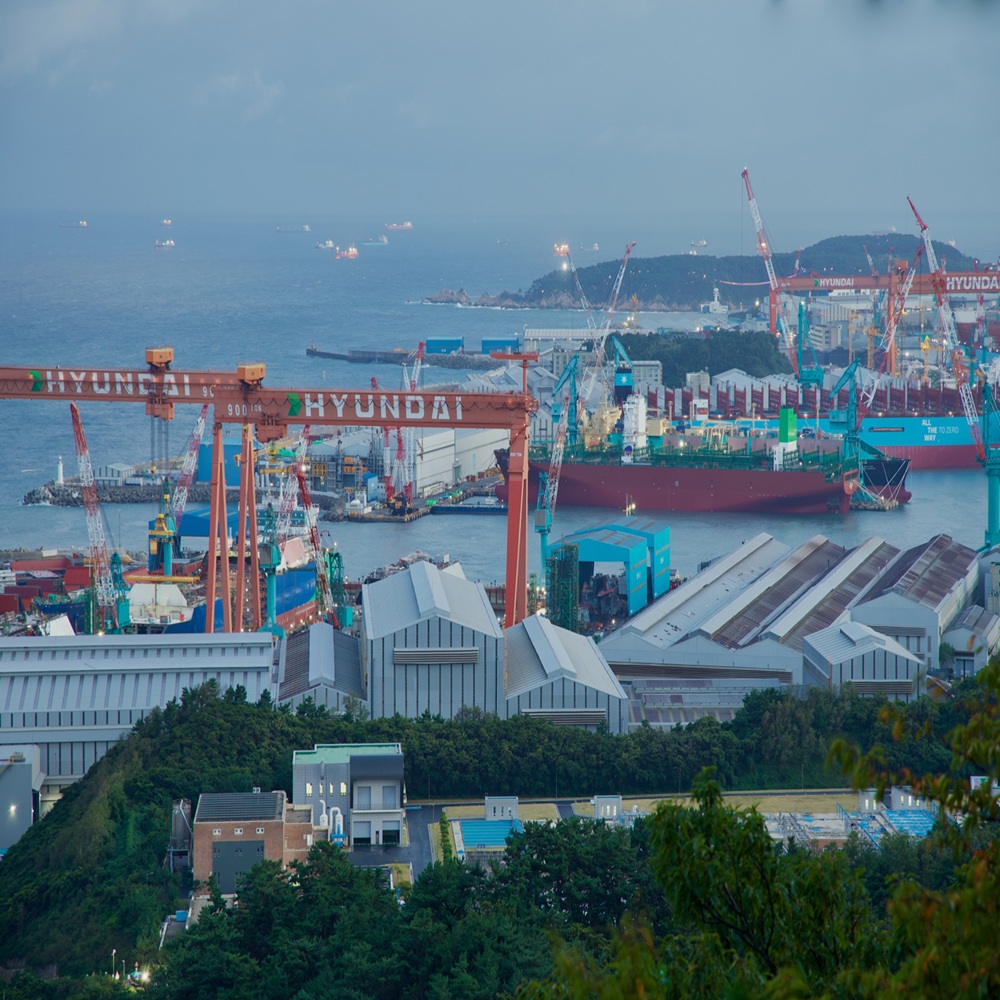
Ulsan, South Korea - September 28th, 2024: View of HD Hyundai Heavy Industries Ulsan Headquarters, South Korea. A key player in shipbuilding, this landmark facility.

South Korea, Taiwan and Vietnam show that economic statecraft is not just the preserve of great powers

by Robyn Klingler-Vidra

Make American shipbuilding great again (Masga) may sound like an effort by the US to bolster its economic strength and project power internationally, but Masga is not an American policy. It is a South Korean initiative that emerged following trade talks with the US in June. Rather than responding to the Trump administration’s tariff threats solely through trade negotiations, Korean officials saw an opportunity to show their American counterparts that South Korea deserved better treatment. They suggested that South Korea bring its shipbuilding prowess to the US. South Korea is perhaps most famous as an exporter of K-pop, cars and semiconductors. But it is also a global powerhouse in shipbuilding. The shipyard in the south-eastern Korean city of Ulsan alone produces roughly ten times more ships annually than the entire US shipbuilding industry. And as the US tries to counter China’s rapidly growing naval fleet, Korean assistance is something that is clearly needed. The US navy secretary, John Phelan, declared earlier in 2025 that US shipbuilding programmes “are a mess”. He added: “I think our best one is six months late and 57% over budget … That is the best one.” Masga was launched in August, with South Korean conglomerates HD Hyundai and Samsung Heavy Industries signing a US$150 billion (£112 billion) deal to modernise US shipbuilding capabilities. It is a clear example of a middle power, a term for countries that lack the dominance of great powers but matter because they possess distinctive industrial, resource or diplomatic capabilities, using economic statecraft to punch above its weight. Economic statecraft has largely been used to describe actions taken by great powers like the US and China to enable and restrict access to their consumer markets, investment coffers and production capabilities. The aim is to achieve foreign policy goals or national security objectives by inflicting damage on or beating the capabilities of a rival power. One classic example is the US government’s use of sanctions against Russia over its war in Ukraine and Iran over its nuclear programme. The overt linking of economic tools like sanctions and tariffs to defence objectives in Washington’s recent national security strategy is another striking illustration of this. Middle powers have traditionally not actively pursued economic statecraft to achieve their objectives. They have instead looked to secure a seat at key tables through cooperative participation in regional and multilateral forums. But some of these countries are now asserting their power more explicitly, through preemptive moves like Masga. Using economic statecraft Taiwan is perhaps the most obvious case of a middle power engaging in economic statecraft. The country has used its critical role in global semiconductor supply chains as leverage to protect itself against Chinese invasion. Former Taiwanese president Tsai Ing-wen referred to international reliance on the island’s chip industry as a “silicon shield” in 2021. Taipei imposes strict controls on tech sales and screens investment, particularly from China, to protect its position. And Taiwan’s industry-leading firms, such as TSMC, also invest heavily to maintain their technological edge. Vietnam offers another example. Consistent with its “bamboo diplomacy” foreign policy model, Hanoi hosts leaders from China, Russia and the US, seeking flexibility rather than rigid alignment. The aim is clear: to maximise Vietnam’s national interests pragmatically and with autonomy. With the world’s sixth-largest reserves of rare earths, Vietnam is now looking to use critical minerals as a tool of economic statecraft. The government voted to ban rare-earth exports on December 11, citing the need to reorient the sector towards domestic processing and higher-value manufacturing rather than merely the export of basic raw materials. Rare earths are essential components in numerous products that are central to our daily lives, including smartphones, semiconductors and electric vehicles. By restricting foreign access to these essential inputs, Vietnam is striving to secure its long-term position in the supply chains of highly in-demand resources. Together, these cases show how economic statecraft is not only the preserve of great powers. Middle power states are selectively granting and restricting access to their economic strengths to reshape markets and security relationships. Korea’s shipbuilding, Taiwan’s chip production and Vietnam’s rare earths illustrate this more assertive approach. They are no longer confined to reactive measures or behind-the-scenes diplomacy in regional forums or multilateral negotiations. These states are proposing economic and military partnerships, as seen in initiatives such as Masga and Tsai’s assertion that everyone needs to care about Taiwan, given how essential chips are to the world economy. Great powers are taking notice. In October, HD Hyundai and US defence contractor Huntington Ingalls Industries announced they are together building next-generation navy vessels. This marks the first time a South Korean firm will build a US navy ship. And Washington has also reportedly been courting Hanoi with elevated diplomatic status and promises of mining support. For other middle powers, the lesson is clear: identify and leverage the strategic economic strengths that other countries depend on.

Defense & Security
Philippines and China flags are waving in the sky. Double country Flag waving with mast. Philippines china national flag for agreement.

Geopolitical disputes: China and the Philippines in the South China Sea

by Eduardo García Torres

한국어로 읽기 Leer en español In Deutsch lesen Gap اقرأ بالعربية Lire en français Читать на русском The South China Sea (SCS) is a strategic region in international geopolitics and a hotspot of disputes involving sovereignty, economy, and security. This text analyzes the positions of two key actors in the region — China and the Philippines — whose growing tensions have been a defining factor in the evolution of the conflict. Located in Southeast Asia, the SCS borders China, Vietnam, the Philippines, Malaysia, Brunei, and Indonesia, and connects the Pacific to the Indian Ocean through the Strait of Malacca, one of the busiest maritime routes. Its wealth in fishery and energy resources has intensified disputes over the Pratas, Macclesfield, Paracel, and Spratly Archipelagos, which are claimed entirely or partially by China, the Philippines, Vietnam, and Malaysia. In this context, the SCS holds significant geopolitical importance. From the classical perspective of Alfred T. Mahan, maritime control is essential for a country to consolidate itself as a power, as it enables access to strategic resources, trade routes, and the projection of military power. Today, this remains a key factor of political, economic, and military influence in the macro-region that authors such as Ulises Granados (2022) refer to as the Indo-Asia-Pacific. On the other hand, from the perspective of critical geopolitics, the SCS conflict is a dispute rooted in the construction of geographic and political meanings. According to Gerard Toal, space is not fixed but rather a construction shaped by power relations and discourses. One example is its naming: China calls it the South Sea, the Philippines refer to it as the West Philippine Sea, and Vietnam calls it the East Sea. Each name not only reflects a territorial claim but also a geopolitical imaginary. Interests in the SCS date back to the late 19th and early 20th centuries, when Japan exerted control over some areas through the state and its corporations. However, after World War II, sovereignty over these territories remained undefined, leading to competing claims from neighboring countries. During the Cold War, the United States strengthened its alliance with the Philippines and other Southeast Asian nations to contain communism, while China consolidated its presence in areas like the Paracel Islands. This context has been key in shaping the current competition over the sea. The Chinese government claims sovereignty in the SCS based on historical precedents going back to the Han dynasty. Beijing argues it recovered the Spratly and Paracel Islands after World War II, invoking the Cairo Declaration (1943) and the Potsdam Declaration (1945), which called for the return of territories occupied by Japan. In 1958, China issued the Declaration on China’s Territorial Sea, incorporating the Pratas (Dongsha), Paracel (Xisha), Macclesfield (Zhongsha), and Spratly (Nansha) Islands into its sovereign territory. Later, in 2009, it reaffirmed its claim through the Nine-Dash Line (NDL), a delimitation drawn in 1947 that encompasses nearly 80% of the SCS. Although this line is not clearly defined in international law, Beijing maintains that it holds sovereign rights within it and that disputes should be resolved without intervention from extra-regional actors — a stance that contrasts with the Philippines’ actions, which have sought international support to strengthen their position. From China’s perspective, its claims in the SCS are essential to its sovereignty and national security. For this reason, it has increased its naval, paramilitary, and civilian presence. Maritime projection and control of trade routes are also key aspects of its strategy to advance initiatives such as the Belt and Road Initiative, which is fundamental to its regional and international economic growth. In contrast, the Philippines has claimed sovereignty over the Spratly Islands since the 1970s and has resorted to legal and media avenues to denounce China. In 1995, it protested China’s construction of structures on Mischief Reef, and in 1997, it stationed the Sierra Madre ship in the Spratlys. Today, the Philippine Navy maintains operations in the area. Moreover, in 2002, the Association of Southeast Asian Nations (ASEAN) and China signed the Declaration on the Conduct of Parties to promote the peaceful resolution of disputes. However, tensions escalated in 2009 when China reaffirmed the Nine-Dash Line. In response, in 2013, the Philippines brought the case before the Permanent Court of Arbitration (PCA), arguing that China was violating the 1982 United Nations Convention on the Law of the Sea and asserting its rights over exclusive economic zones. In 2016, the Permanent Court of Arbitration (PCA) ruled in favor of the Philippines, concluding that China's claims lacked legal basis under international law. However, China rejected the ruling, stating that it does not reflect its interpretation of territorial sovereignty based on its history and legal frameworks. Moreover, Beijing considered the Philippine complaint a unilateral action. In 2024, the Philippines enacted the “Maritime Zones Law” and the “Archipelagic Sea Lanes Act,” which define its maritime rights in the South China Sea. In response, China’s Ministry of Foreign Affairs rejected both laws, arguing they violate its sovereignty. From the Philippine perspective, China’s actions represent a challenge to its security, prompting it to seek support from ASEAN for a joint response in the SCS. However, the bloc’s positions are divided: the Philippines actively denounces China, Vietnam takes a more pragmatic approach, and Malaysia avoids confrontation. These differences have led ASEAN to adopt a moderate stance, prioritizing diplomacy over conflict. In summary, the Philippines is strengthening its alliance with the United States under the 1951 Mutual Defense Treaty, which ensures assistance in the event of an attack in the Pacific, including the SCS. This cooperation aligns with the U.S. geopolitical strategy in Asia, which has evolved from Obama’s “Asia Pivot” to the “Indo-Pacific” vision, focused on a “rules-based order” and the security of trade routes. However, the exclusion of China has led to perceptions that this strategy is a containment mechanism against the world’s second-largest economy. For example, China’s Foreign Minister Wang Yi argues that the U.S. strategy aims to “besiege and contain China” through alliances that promote confrontation. He also claims it undermines regional cooperation, while the Asian giant promotes a “community with a shared future in the Asia-Pacific” based on integration and stability. Thus, China employs the concept of the Asia-Pacific and, although it remains cautious in its rhetoric, insists that its approach prioritizes cooperation and avoids a bloc-based logic in the region. In this context, during Balikatan, a joint military exercise between the U.S. and the Philippines in April 2024, Washington deployed Typhon missile systems in the northern part of the country. By the end of the year, Manila expressed interest in acquiring them, which Beijing perceived as a threat. In 2025, Ferdinand Marcos Jr. stated he would reconsider the U.S. military presence if China ceased its territorial claims. China has not officially responded, and these remarks could be part of Philippine political rhetoric, reflecting its perception of threat in the region. Additionally, the Philippines has strengthened security cooperation with Japan, which also faces territorial disputes with China. In 2024, they signed a Reciprocal Access Agreement to facilitate military deployments, and Japan supported the modernization of the Philippine Navy. In 2025, both nations reaffirmed their commitment to a free and open Indo-Pacific. While Manila strengthens its position through strategic alliances, Beijing views this as an attempt to internationalize the conflict. Another point is that the Philippines’ approach varies depending on the administration in power. During Rodrigo Duterte’s presidency (2016–2022), Manila prioritized closer ties with Beijing, favoring economic cooperation. In contrast, the arrival of Ferdinand Marcos Jr. in 2022 strengthened the alliance with the United States, increasing defense and security cooperation, but also escalating tensions with China. On the other hand, while the U.S. has expanded its presence in the Asia-Pacific region, Trump’s first term (2017–2021) had a more isolationist approach compared to the Obama (2009–2017) and Biden (2021–2025) administrations. The Philippine government hopes to maintain the agreements reached in 2024, although their continuity will depend on how the new Trump administration (2025–) manages its Indo-Pacific strategy. Moreover, the Philippines cannot fully align with just one actor, as both China and the U.S. are essential to its economy. The United States is its main export market, according to the Philippine Statistics Authority, while China is its largest source of imported goods, top investor, infrastructure partner, and shares agreements such as the Regional Comprehensive Economic Partnership (RCEP). Therefore, while Manila strengthens its defense cooperation with the U.S. and maintains strategic interests in the South China Sea, its relationship with China remains crucial due to its economic importance. Final Considerations From a geopolitical perspective, cooperation between the Philippines and the United States seeks to counterbalance China's presence in the region, while China reinforces its position in the SCS for sovereignty and security reasons. In this context, the relationship between Manila and Washington, along with the stance of ASEAN members, will be decisive in the evolution of the conflict. Thus, the dispute in the South China Sea reflects a geopolitical competition between regional and extra-regional actors for control of strategic areas, where each defends its own interests. Although none of the parties appear to seek open conflict, increasing militarization and patrols have raised the risk of incidents that could escalate tensions. In this context, the future will depend on the willingness of actors to negotiate concessions, although the lack of consensus and divergent interests make a definitive solution unlikely in the short term. In this way, Alfred T. Mahan’s theories on maritime power remain relevant in the SCS, although their application is not absolute. Beyond the control of sea routes, the competition also unfolds through the construction of narratives by regional and external actors. The way these narratives shape alliances and perceptions will be key in defining power dynamics in the region.

Diplomacy
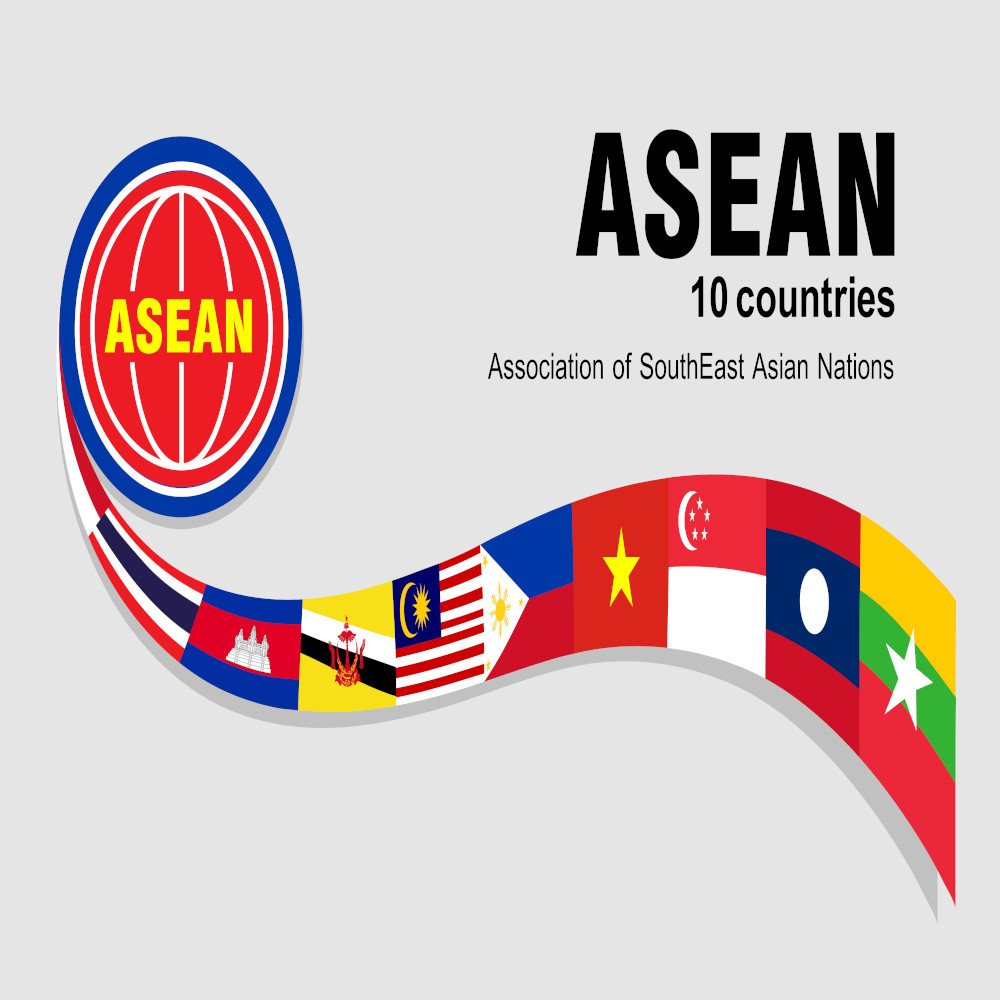
ASEAN Flags Ribbon , AEC (Asean Economics Community) Flags10 Countries , ASEAN Flags Waving Vector Illustration .

New U.S. strategy towards ASEAN: caution, info-colonialism!

by Ksenia Muratshina

한국어로 읽기 Leer en español In Deutsch lesen Gap اقرأ بالعربية Lire en français Читать на русском The implementation of yet another U.S. initiative may allow it to interfere in the information policy of ASEAN and control the cyberspace of all of Southeast Asia. Two sides of the same summit The annual summit of the Association of Southeast Asian Nations (ASEAN) and the United States was held in Vientiane in October. Meetings in this format are routine for ASEAN and are held with each of the non-regional powers, i.e. the dialogue partners of the association. They discuss plans for cooperation and exchange views on international issues. This time, the U.S., represented by A. Blinken, again tried to use dialogue to impose its vision of global issues. The statements of the US Secretary of State were anti-Russian, anti-Chinese and anti-North Korean in nature, and were aimed at increasing tensions vis-à-vis the South China Sea and the internal political situation in Myanmar. The timing of the meeting was no accident; it took place before the East Asia Summit (EAS), which is a platform for multilateral negotiations between ASEAN countries and external partners. In this way, Washington hoped to force representatives of Southeast Asian states to reconsider the agenda of the EAS and planned to use the upcoming event to provoke regional conflicts and consolidate their role as the ‘chief gendarme’ of the Asia-Pacific or Indo-Pacific region. However, as the EAS showed, the U.S. failed to do so: no one except U.S. allies supported the attempts to undermine the regional architecture of security and cooperation. Following the results of the US-ASEAN summit, the divergence of views was also notable. The parties did not adopt any joint document of a political nature. Such a result was natural; for ASEAN, any external imposition of views is traditionally unacceptable. In general, the ASEAN leaders’ talks with Anthony Blinken were held among other meetings with Russia, India, China etc., and they would not have attracted much attention if a very narrow joint statement (‘Statement on Promoting Safe, Secure and Trustworthy Artificial Intelligence’ (AI)) had not been adopted in the aftermaths. With good intention According to the terms of this statement, under the plausible pretext of ‘achieving the UN Sustainable Development Goals’, the United States intends to implement a whole range of plans together with ASEAN. Thus, it is planned to ‘discuss the further development of ASEAN’s AI projects’ (although, why should ASEAN discuss its plans with someone?), ‘interaction with the ASEAN Working Group on AI Governance (again, a direct intention to enter the decision-making process in the association), ‘creating an ASEAN roadmap for responsible AI’ (and, thus, inclusion in the internal planning process of its activities). In addition, the parties will ‘cooperate on approaches and standards in the field of AI’ (these approaches and standards will be based on similar U.S. ones), ‘knowledge exchange, technology transfer’ (the saying about ‘free cheese in a mousetrap’ is involuntarily recalled), ‘strengthening the collective digital and cyber potential’ (again based on the United States and built according to their rules), ‘the expansion of education in the field of AI’ (also according to U.S. norms) and ‘the development of interrelated approaches to AI management’ (AI management is a serious issue and it must be understood that external participation equals a direct threat to national sovereignty). Even more ambitious tasks include ‘supporting the development of national digital and AI strategies, discussing its management and regulation’ (for the United States, gaining access to national strategies will provide new tools for interfering in the internal affairs of others), ‘implementing initiatives in cooperation with the ministries of digital development of ASEAN countries’, as well as ‘ensuring information security support for the ASEAN Digital Economy Framework’ (its adoption is planned in 2025; here the U.S. is again interfering in intra-ASEAN affairs). We were not snubbed of the traditional American demagoguery in the field of ‘human rights’. The statement supposes ‘ensuring human rights and protection from all forms of discrimination and prejudice when using AI’ and  ‘ensuring the inclusiveness and accessibility of AI’ in the near future. Whether the mass use of AI will be safe for the population is a question the authors of the document are not considering, instead occupying themselves with other tasks. Another component is ‘dealing with foreign manipulation of information, disinformation and training in the field of technologies to counter this’ (of course, the U.S. initiators do not doubt their right to assign labels to information sources). Finally, it is expected to ‘stimulate the improvement of the population’s digital literacy via the private sector’, although, it would seem, in such sensitive areas as AI, digital technologies and cyberspace, only the state can protect the interests of its citizens. The name of the game When analysing these agreements, it becomes clear that the United States is aiming to take control not only of the economy or technology, but of the information space of Southeast Asia and the information policy of both ASEAN as a whole and individual members countries and their national sectoral departments. Such a radical deepening of interaction includes direct interference in the affairs of the association – unprecedented in its arrogance and openness – and searching for opportunities to reduce the role of states in controlling AI and the cyber sphere, as well as access to scientific and technological work of Southeast Asian countries in the field of AI and monopolisation of the Southeast Asian media sphere, which is absolutely a colonial approach of deciding which information people from ASEAN are allowed to read and see and which is declared ‘foreign manipulation’. The U.S. has already demonstrated its seriousness. On November 1, Rumman Chowdhury, an AI specialist and the U.S. Special Representative for Science, flew to the ASEAN secretariat in Jakarta to remind Southeast Asian countries of the need to implement the joint statement. Here it should be understood that U.S. sectoral cooperation with ASEAN will be executed by a system of highly specialised institutions that objectively does not depend on the change of the presidential administration. Agreements have been made, obligations have been established and the implementation mechanism has been launched. Moreover, the U.S. will have a separate and individual approach to each country in terms of fulfilling and implementing these agreements. It is planned to work with the sectoral ‘digital’ ministries of the Southeast Asian states, which is nothing more than the selection of loyal future agents of influence. However, the question is to what extent the political and expert circles in Southeast Asia understand the long-term risks of granting a foreign partner large-scale access to the sensitive cyber sphere – even one whose interests in the region have long been known to everyone: inciting conflicts, ‘dividing and ruling’, searching for and luring highly qualified specialists (brain drain), exclusively imposing their own view on international issues, linking countries and markets to their technologies with the transfer of all kinds of useful data to intelligence services. *  *  * It would seem that ASEAN has always opposed neo-colonialism and supported a multi-vector course, equidistant from any external interests of its dialogue partners. Most likely, the association could only allow the appearance of info-colonial encroachments from its U.S. counterpart due to hopes for disinterested financing of its development from the United States (which in itself sounds like an oxymoron) and counting on some kind of abstract technology transfer. However, the consequences of the adoption of U.S. policy by Southeast Asian countries (if they do not ‘hit the brakes’ on the commitments they have made) could be deplorable, disastrous for their digital sovereignty, technological development and their independent course in general.

Diplomacy
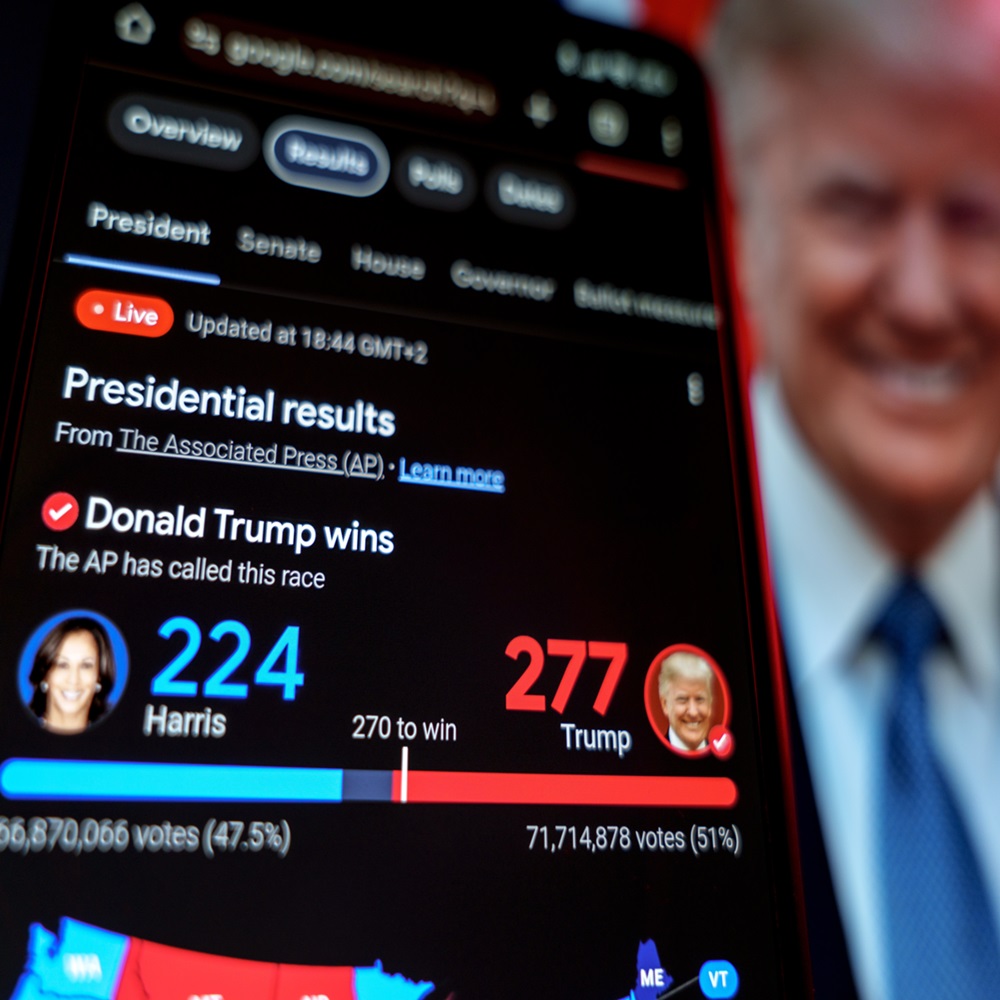
Donald Trump win in US president elections 2024. Washington DC, United Sates Of America - 2024 November 6

What Trump’s victory means for Ukraine, the Middle East, China and the rest of the world

by Stefan Wolff

한국어로 읽기 Leer en español In Deutsch lesen Gap اقرأ بالعربية Lire en français Читать на русском Donald Trump’s return to the White House in January 2025, combined with a Republican-led US Senate, was widely feared among international allies and will be cheered by some of America’s foes. While the former put on a brave face, the latter are finding it hard to hide their glee.  On the war in Ukraine, Trump is likely to try to force Kyiv and Moscow into at least a ceasefire along the current front lines. This could possibly involve a permanent settlement that would acknowledge Russia’s territorial gains, including the annexation of Crimea in 2014 and the territories occupied since the full-scale invasion of Ukraine in February 2022.  It is also likely that Trump would accept demands by the Russian president, Vladimir Putin, to prevent a future Ukrainian Nato membership. Given Trump’s well-known animosity to Nato, this would also be an important pressure on Kyiv’s European allies. Trump could, once again, threaten to abandon the alliance in order to get Europeans to sign up to a deal with Putin over Ukraine.  When it comes to the Middle East, Trump has been a staunch supporter of Israel and Saudi Arabia in the past. He is likely to double down on this, including by taking an even tougher line on Iran. This aligns well with Israeli prime minister Benjamin Netanyahu’s current priorities.  Netanyahu seems determined to destroy Iran’s proxies Hamas, Hezbollah and the Houthis in Yemen and severely degrade Iranian capabilities. By dismissing his defence minister, Yoav Gallant, a critic of his conduct of the offensive in Gaza, Netanyahu has laid the ground for a continuation of the conflict there.  It also prepares for a widening of the offensive in Lebanon and a potentially devastating strike against Iran in response to any further Iranian attack on Israel.  Trump’s election will embolden Netanyahu to act. And this in turn would also strengthen Trump’s position towards Putin, who has come to depend on Iranian support for his war in Ukraine. Trump could offer to restrain Netanyahu in the future as a bargaining chip with Putin in his gamble to secure a deal on Ukraine.  Pivot to China  While Ukraine and the Middle East are two areas in which change looms, relations with China will most likely be characterised more by continuity than by change. With Chinese relations being perhaps the key strategic foreign policy challenge for the US, the Biden administration continued many of the policies Trump adopted in his first term – and Trump is likely to double down on them in a second term.  A Trump White House is likely to increase import tariffs, and he has talked a great deal about using them to target China. But Trump is also just as likely to be open to pragmatic, transactional deals with Chinese president Xi Jinping. Just like in relations with his European allies in Nato, a serious question mark hangs over Trump’s commitment to the defence of Taiwan and other treaty allies in Asia, including the Philippines, South Korea, and potentially Japan. Trump is at best lukewarm on US security guarantees.  But as his on-and-off relationship with North Korea in his first term demonstrated, Trump is, at times, willing to push the envelope dangerously close to war. This happened in 2017 in response to a North Korean test of intercontinental ballistic missiles.  The unpredictability of the regime in Pyongyang makes another close brush of this kind as likely as Trump’s unpredictability makes it conceivable that he would accept a nuclear-armed North Korea as part of a broader deal with Russia, which has developed increasingly close relations with Kim Jong-un’s regime.  Doing so would give Trump additional leverage over China, which has been worried over growing ties between Russia and North Korea.  Preparing for a Trump White House  Friends and foes alike are going to use the remaining months before Trump returns to the White House to try to improve their positions and get things done that would be more difficult to do once he is in office.  An expectation of a Trump push for an end to the wars in Ukraine and the Middle East is likely to lead to an intensification of the fighting there to create what the different parties think might be a more acceptable status quo for them. This does not bode well for the humanitarian crises already brewing in both regions.  Increasing tensions in and around the Korean peninsula are also conceivable. Pyongyang is likely to want to boost its credentials with yet more missile – and potentially nuclear – tests.  A ratcheting-up of the fighting in Europe and the Middle East and of tensions in Asia is also likely to strain relations between the US and its allies in all three regions. In Europe, the fear is that Trump may make deals with Russia over the head of its EU and Nato allies and threaten them with abandonment.  This would undermine the longevity of any Ukrainian (or broader European) deal with Moscow. The relatively dismal state of European defence capabilities and the diminishing credibility of the US nuclear umbrella would not but help to encourage Putin to push his imperial ambitions further once he has secured a deal with Trump.  In the Middle East, Netanyahu would be completely unrestrained. And yet while some Arab regimes might cheer Israel striking Iran and Iranian proxies, they will worry about backlash over the plight of Palestinians. Without resolving this perennial issue, stability in the region, let alone peace, will be all but impossible.  In Asia, the challenges are different. Here the problem is less US withdrawal and more an unpredictable and potentially unmanageable escalation. Under Trump, it is much more likely that the US and China will find it hard to escape the so-called Thucydides trap – the inevitability of war between a dominant but declining power and its rising challenger.  This then raises the question of whether US alliances in the region are safe in the long term or whether some of its partners, like Indonesia or India, will consider realigning themselves with China.  At best, all of this spells greater uncertainty and instability – not only after Trump’s inauguration but also in the months until then.  At worst, it will prove the undoing of Trump’s self-proclaimed infallibility. But by the time he and his team come to realise that geopolitics is a more complicated affair than real estate, they may have ushered in the very chaos that they have accused Biden and Harris of. 

Defense & Security
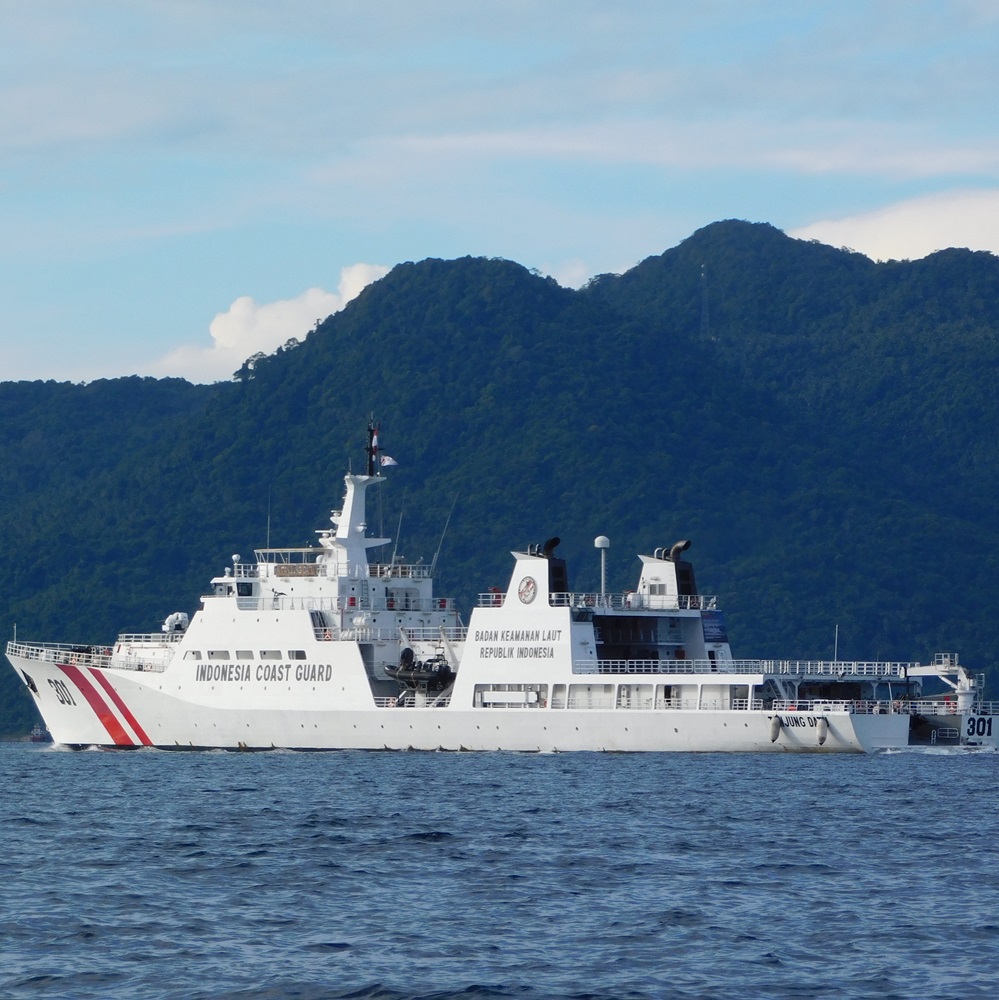
Natuna, Indonesia - June 15, 2024. Indonesian Coast Guard ships regularly patrol Natuna waters, as a form of the government's responsibility to protect Indonesian waters.

The 'Fatal Waters' of the Strait of Malacca: The Challenges of Combating Maritime Piracy in Southeast Asia

by Egor Sigauri-Gorsky

한국어로 읽기 Leer en español In Deutsch lesen Gap اقرأ بالعربية Lire en français Читать на русском The problem of piracy has cast a shadow over the maritime areas of Southeast Asia for many centuries. The waters of the Malacca and Singapore Straits, which hold tremendous economic significance for international trade, are particularly susceptible to pirate attacks. In the 2000s, ASEAN countries launched a comprehensive regional campaign to institutionalize measures for collective action against maritime piracy, and these measures proved to be effective. However, excessive concerns about intrusions into their sovereignty have led the Association's member states to "dilute" their efforts, resulting in a lack of true unity. This situation could result not only in losses for international trade but also in the loss of lives of ship crews.  Introduction to the History of Maritime Piracy in Southeast Asia  Despite the long and dark history of the ugly and inhumane activities of the "hostis humani generis" [1], the romanticized image of pirates continues to captivate the public's imagination, thanks to numerous literary and cinematic works. In these portrayals, pirates appear as free-spirited men and women, living outside the reach of legal and state institutions, driven by daring adventures. However, it is not only European privateers, Somali groups, and the inhabitants of Morocco's "pirate" Republic of Salé who have left their grim mark on the history of maritime trade routes. For many centuries, pirates in Southeast Asia have attacked trading vessels passing through the Straits of Malacca. As early as the 13th century, the Chinese traveler Zhao Rukuo described how the powerful maritime kingdom of Srivijaya controlled regional waters [2], sending boats to attack ships that did not dock at its ports. Trading hubs in Malacca, Johor, and the Riau Archipelago flourished under the rule of Muslim sultanates, with the support of the Orang Laut community — “the sea people” — whose culture was inextricably linked to maritime activities [3]. It is no coincidence that in 1856, the Scotsman John Crawfurd, considered a leading British authority on Malay history and culture, noted that many Malay rulers viewed piracy as an "honest and regular source of their income" [4].  The Economic Significance of Maritime Waters in Southeast Asia  However, in the 21st century, maritime piracy remains one of the most pressing issues for Southeast Asian countries. According to data from the International Maritime Bureau’s Piracy Reporting Center, from 1992 to 2006, Southeast Asia was the most "pirate-infested" region in the world. The situation is further complicated by the fact that the waters of the Malacca and Singapore Straits, which are most susceptible to pirate attacks, are crucial for trade in the Asia-Pacific region. These straits also serve as "superhighways" of global shipping, with over 120,000 vessels passing through them annually. In 2000, 39% of Japan's foreign trade (equivalent to $260 billion) and 27% of China's foreign trade ($65.6 billion) were conducted through Southeast Asia's maritime routes [5]. Annually, the Malacca Strait facilitates trade valued at $3.5 trillion, accounting for two-thirds of China's maritime trade and 40% of Japan's maritime trade.  Despite significant improvements in the security of Southeast Asia's maritime routes over the past 20 years, thanks to the joint efforts of ASEAN countries and their partners, as well as the development of the shipping industry, the threat of maritime piracy remains a pressing issue. In this context, it is crucial to examine the existing initiatives aimed at combating maritime piracy in the region.  Overview of Projects, Agreements, and Initiatives  In 1999, at the ASEAN+3 Ministers' Conference under the concept of "Maintaining Peace in the World Ocean" Japan proposed an initiative to establish a permanent regional naval force based on national contingents. However, the project did not receive the necessary support. Five years later, in 2004, the Regional Cooperation Agreement on Combating Piracy and Armed Robbery against Ships in Asia (ReCAAP) was signed, leading to the establishment of an Information Sharing Center to facilitate cooperation between stakeholders and coastal states in combating maritime piracy in Southeast Asia. These events marked the beginning of a new era of multilateral cooperation.  The activities of the Information Sharing Center (ISC) have been crucial in building operational links between member countries of the Agreement and coordination centers, enabling information exchange, incident reporting, and rapid response to threats. A key role in maintaining security in the region is played by the Trilateral Cooperative Agreement between Indonesia, Malaysia, and the Philippines, known as "INDOMALPHI" signed in 2017. Under this agreement, maritime security is ensured through coordinated surface patrols, combined aerial maritime patrols, and the operation of an Intelligence Exchange Group. These efforts collectively enhance regional capabilities to respond to piracy and strengthen the overall security of Southeast Asia's maritime routes.  Coordination efforts among Southeast Asian countries also take place through naval cooperation. For instance, the Singapore Navy works closely with Malaysian and Indonesian regional naval forces to combat maritime piracy through the Information Fusion Centre (IFC). The navies of Brunei, Indonesia, Malaysia, the Philippines, Singapore, Thailand, and Vietnam also actively participate in multilateral exercises conducted annually by the United States Navy. A key objective of these exercises is to strengthen regional measures against the threats of maritime terrorism and piracy in the Malacca and Singapore Straits, as well as in the South China Sea.  As a result of these efforts, the number of ship hijackings for ransom significantly decreased between 2007 and 2022. Representatives of Indonesia's Ministry of Defense noted that in the first six months of 2023, not a single incident of ship hijacking was recorded, whereas, in 2017, 99 cases of piracy and armed robbery at sea were reported in the patrol zone. Experts also highlight the potential benefits of Japan and India joining the "INDOMALPHI" initiative, which could further enhance regional security efforts against piracy.  Challenges to Regional Unity in Combating Maritime Piracy  Despite significant successes in consolidating the efforts of Southeast Asian countries in combating maritime piracy, there are still “gaps” in the “united front” of interested ASEAN countries that hinder individual and collective initiatives. Thus, Indonesia and Malaysia have not ratified the 2004 Agreement and are not de jure participants in the Information Exchange Centre, although they participate in some events under its auspices. The Centre itself receives information on cases of piracy and armed robbery at sea from the coordination centers of the participating countries, which inevitably entails a time lag that may prove critical in the event of a threat to a ship and its crew. It is noted that an appropriate clarification of the mechanism of its work would be the obligation of ships to send information directly to the Centre, which would immediately transmit it to the relevant operational units of the participating countries responsible for deploying patrol vessels on site.  The Downside of the "ASEAN Way"  The Russian researchers note that while ASEAN is discussing the possibility of creating a unified navy to combat piracy, the approaches of the "ten" countries to the problem differ [7]. It is the absence of full-scale consolidated institutions that significantly undermines the successes already achieved and may provoke an escalation of the problem after the "lull" of 2000-2022. ASEAN's traditional rigid orientation towards the rejection of any supranational institutions and concern about maintaining national sovereignty may play a "dirty joke" on the Association's states, since the existence of multiple regional initiatives duplicating each other's functions and goals, as well as the fact that the Information Exchange Center does not have a real operational status, slow down progress. Finally, it should be borne in mind that at stake in this case is not only the stability of international economic turnover along the maritime trade routes of Southeast Asia, but also the lives and safety of ship crews, fishermen and sailors, whose professions are already associated with risk.  References  1. "Enemies of the Human Race" - author's note.  2. See in particular: Berezin E.O. History of Thailand M. 1973. 320 pages. p. 35.   3. There are conflicting views regarding the true role of the Orang Laut in maritime piracy. While some researchers portray their culture as inherently linked to piracy in the conventional sense, others argue that the "sea people" were driven to piracy due to the actions of British colonial authorities who controlled the port of Singapore. See on this: Barnard T.P. Celates, Rayat-Laut, Pirates: The Orang Laut and Their Decline in History // Journal of the Malaysian Branch of the Royal Asiatic Society. Vol. 80. No. 2. 2007. P. 33-49.  4. Amirell S.E. Pirates of Empire. Colonisation and Maritime Violence in Southeast Asia. Cambridge University Press. 2019. 266 pp. P. 37.  5. Frécon E. The Resurgence of Sea Piracy in Southeast Asia. Institut de recherche sur l’Asie du Sud-Est contemporaine. 2008. 131 pp. P. 72-73.  6. Paramonov O.G. "Maritime Piracy in Southeast Asia: A Regional Perspective." // International Analytics. No. 1-2 (27-28), 2019, pp. 74-81, p. 77.  7. Paramonov O.G. "Maritime Piracy in Southeast Asia: A Regional Perspective," p. 78. 

Defense & Security
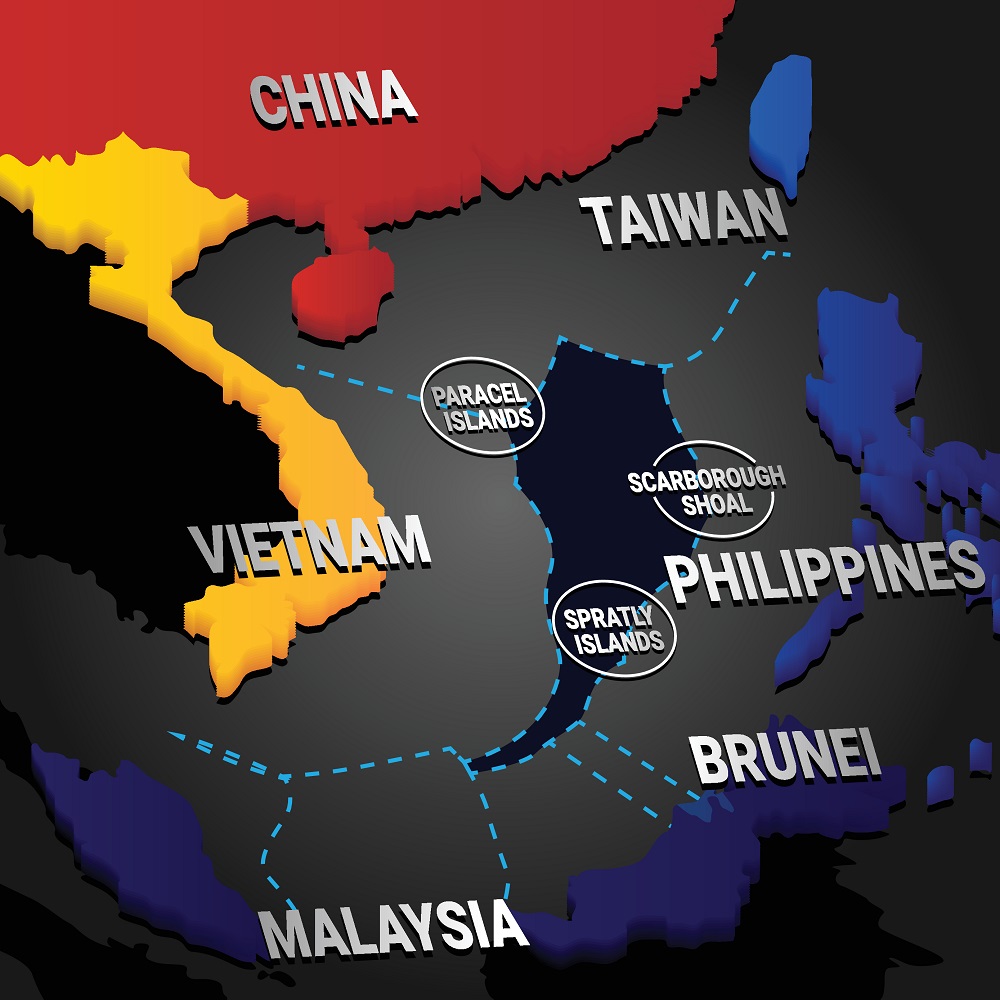
Disputed Claims In The South China Sea.

Africa’s delicate diplomacy in the South China Sea dispute

by Samir Bhattacharya

한국어로 읽기Leer en españolIn Deutsch lesen Gap اقرأ بالعربيةLire en françaisЧитать на русском The ongoing skirmishes in the South China Sea between China and regional states represent another severe threat to the world economy, directly affecting Africa. As China grows increasingly aggressive in its race for global hegemony and influence, and the United States (US) slowly plunges into the battle to prevent China’s rise, the world is watching the unfolding of this rivalry with unease. Although a few places have felt intense pressure from this alarming competition, the South China Sea (SCS) region is where a violent showdown looks increasingly probable. Unlike the war in Ukraine or Gaza, the US and China may start a direct war in the SCS. And amidst this multifaceted new Cold War 2.0, Africa remains cautious. The South China tinderbox On 23 April, another skirmish took place between China and the Philippines when two Filipino patrol boats approached the shallow turquoise waters of a disputed shoal around 194 km west of the Philippine Islands province of Palawan. The patrol boats were there for an underwater survey near the disputed shoal claimed by both China and the Philippines, thus prompting a Chinese response. A Chinese coast guard, via radio, instructed them to leave the area and threatened hostile measures. Following several radio exchanges, the Chinese coast guard damaged both the Philippine patrol boats by firing high-pressure water cannons at them. However, this was not the first time China’s assertion in this region has caused friction with other SCS neighbours, including Japan and South Korea. China has used an unconvincing U-shaped “nine-dash line” that crosses the exclusive economic zones, or EEZs, of Brunei, Indonesia, Malaysia, the Philippines, Taiwan, and Vietnam to demonstrate its claim in the region. Despite their low intrinsic value, the region lies along a vital trade and supply corridor that supports over US$3 trillion in yearly shipborne commerce. Oil, gas, and fishing sources abound in the area. Beijing has declined to acknowledge a 2016 decision from the Permanent Court of Arbitration that ruled Beijing’s broad claims invalid based on historical grounds. China and the Philippines have already fought many times over the Second Thomas Shoal and the Bashi Channel. China has become increasingly aggressive in the region in the last few years, putting regional stability at high risk. So far, these skirmishes will likely remain regional without the risk of any full-scale war. However, there are risks of casualties or even the vessel capsizing. Making of Cold War 2.0 over the SCS Washington’s response to the upcoming crisis is still modest. US President Biden raised concerns about China’s actions in the SCS , including efforts to impede the Philippines from resupplying its forces on the fiercely disputed Second Thomas Shoal. The US has repeatedly warned China that it’s obligated to defend the Philippines, its oldest treaty ally in Asia, if Filipino forces, ships or aircraft come under an armed attack. The US also conducted Balikatan drills (‘shoulder-to-shoulder’ in Tagalog) with the Philippines with more than 16,000 American and Philippines military personnel. Indeed, its resources are thinly stretched, and Beijing seems to be moving ahead. To deter China by stepping up regional defence diplomacy, Washington is exploring the possibility of a security alliance with Japan, Australia, and the Philippines, tentatively called SQUAD. This is in addition to two other existing groupings in the region, “Quad” and “AUKUS,” a defence pact among Australia, the United Kingdom and the US. While AUKUS is a defence pact, Quad is simply a dialogue platform. Africa’s tricky balancing act Even while the socioeconomic repercussions of the Russia-Ukraine war have not yet wholly subsided in Africa, the ongoing skirmishes in the SCS represent another severe threat to the world economy, directly affecting several African nations. Despite being geographically far, the conflict’s spillover effect would impact the continent’s food security in terms of both the availability and pricing of some food crops. In addition, the SCS region represents a crucial geographic sweet spot for Africa as a source of trade and investment, translating into growth and development for many African economies. The crisis can potentially fuel price rise, particularly for oil-importing countries. The prospect of a consequential price rise of essential commodities will have enormous ramifications for domestic stability in most African countries. Furthermore, many African economies heavily rely on trade, investment, and aid from South and Southeast Asia, the crisis will significantly hamper the development and growth of the continent. There are also strategic lessons for Africa to learn from the conflict. China’s principal interest in Africa consists of protecting its BRI investments and ensuring steady trade flow. Africa is also essential for China to fulfil its resource needs, maintaining industrial growth and energy security. Therefore, securing stability in countries where China has invested is in China’s interest, just like keeping a stable relationship with China is in the interest of those investment-starved countries. Further, since many investment projects in China are located in different African countries, these countries should be careful. China can become aggressively irredentist, even in Africa. Currently, China owns a naval base in Djibouti and a ballistic missile tracker Yuan Wang 5, off the coast of Durban. It has strong economic influence across the countries of Africa’s east coast thanks to its Belt Road Initiative (BRI). On the West Coast, China has many seaports financed or constructed by Chinese entities. If the national governments of these countries fail to pay, China would happily take control of these ports through lease as it did in Hambantota, Sri Lanka. In addition to Sri Lanka, other South Asian countries such as Pakistan, Nepal, Bangladesh, and Myanmar also faced dire consequences due to the failure of their BRI debt payment, leading to economic crises, and sometimes even political crises. Therefore, caution would be expected from these African governments. Conclusion China’s increasingly aggressive posture over the SCS raises concerns about the stability of the region. As the current uneasy détente between the US and China bears remarkable similarities to the Cold War, questions are raised regarding the possibilities of a new Cold War 2.0. Questions are also raised concerning the possible reactions from different African countries vis-á-vis Chinese aggression in the region. Undoubtedly, any serious conflict between China and the Philippines would be dangerous. These frequent skirmishes may not lead to a direct war between the US and China. Yet, the risk of vessel capsizing and casualties is high. Any such event would ultimately spark a crisis in Africa. So far, Africa is cautious and continues to balance its great power relationships. Undoubtedly, it is increasingly concerned with the aggressive posture of the Chinese in the region. On the other hand, it needs China for economic purposes. Therefore, Africa will continue to walk the tightrope where it would want US involvement in de-escalating the situation without ruffling any feathers with China. The views expressed above belong to the author(s).

Defense & Security
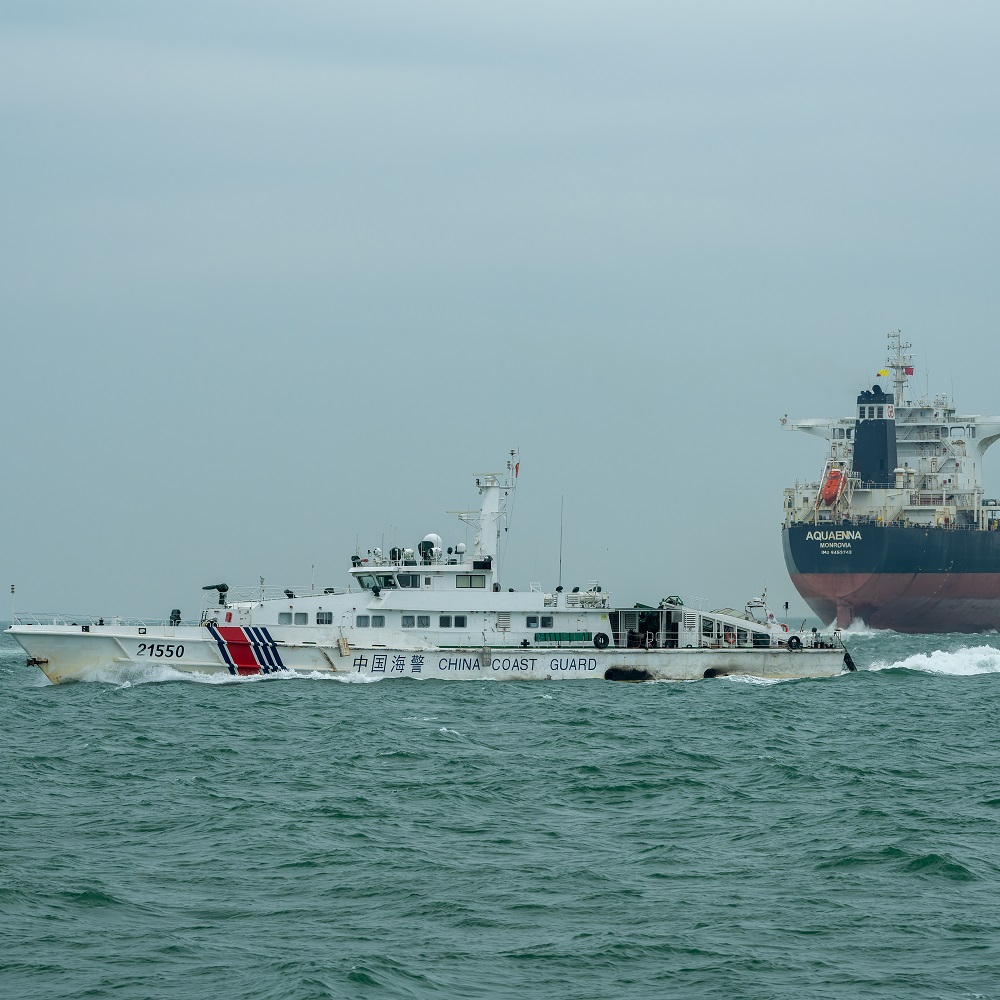
Shenzhen, Guangdong, China - Apr 27 2023: A China Coast Guard boat is cruising on the sea.

Philippines: Calming Tensions in the South China Sea

by International Crisis Group

한국어로 읽기Leer en españolIn Deutsch lesen Gap اقرأ بالعربيةLire en françaisЧитать на русском “This article was originally published here by the International Crisis Group”Tensions between China and the Philippines are increasing the risk of armed conflict in the South China Sea. In this excerpt from the Watch List 2024 – Spring Update, Crisis Group looks at how the EU can support regional diplomacy to mitigate maritime disputes. Rising maritime tensions between China and the Philippines have highlighted the risk of armed conflict in the South China Sea and the dangers it would pose to global trade. Several countries are implicated in the set of complex sovereignty disputes in the sea, which stem from rival claims to various features and the maritime entitlements they generate, but recent incidents involving Beijing and Manila have triggered the greatest concern. The Philippines controls nine outposts in the Spratlys, a contested group of land and maritime features at the heart of the South China Sea. A submerged reef known as Second Thomas Shoal has become a dangerous flashpoint, with Chinese boats continually trying to block Manila’s efforts to resupply the BRP Sierra Madre, a rusting ship housing a handful of soldiers that a former Philippine government purposely grounded in 1999 in a bid to assert sovereignty over the atoll. China, which also claims the shoal, first started interfering with these missions in 2014, but relations between the two countries in the maritime domain have never been as volatile as during the last seven months. Chinese boats have regularly rammed the Philippine supply vessels or doused them with water cannons, occasionally wounding the sailors on board. Manila has a Mutual Defence Treaty with Washington, making this burgeoning maritime dispute part of the geopolitical competition between the U.S and China. In effect, the South China Sea has become a zone where conflict risks are rife – and where Washington and Beijing could be drawn into direct confrontation. Considering these developments, the EU and its member states should: • Seek greater diplomatic engagement with both Beijing and Manila to keep tensions in check. They should also expand their diplomatic presence across South East Asia and, where relevant, establish reliable channels through which they could communicate with high-level authorities in China and other claimant states should disputes at sea escalate; • Work to promote respect for international law, particularly the law of the sea, as a source of neutral rules for dispute resolution and conflict prevention, for example by organising public events, roundtables and dialogues in Manila and elsewhere. While this measure may not bridge the divides between Manila and Beijing, it could at least help establish a level of mutual support and understanding among the other South China Sea claimant states; and • Strengthen coast guard cooperation with the Philippines, focusing on building capacity in areas such as environmental protection, safety and search-and-rescue procedures. Troubled Waters The sovereignty disputes that underpin the tensions between China and the Philippines in the South China Sea go back decades. But it was Beijing’s manoeuvres to take control of Mischief Reef (in the east of the Spratlys) from Manila in 1995 that altered the perceived balance of power between the two states and in the region, setting off the territorial dispute that has now taken a turn for the worse. China’s assertiveness in the sea has grown in the past few years, along with its military capabilities. The brewing territorial dispute made headlines in 2012 when Beijing in effect took control of Scarborough Shoal, an atoll 220km west of the Philippine mainland but within Manila’s exclusive economic zone (EEZ), after a maritime altercation. The incident prompted then-President Benigno Aquino to file a case challenging China’s territorial claims under the UN Convention on the Law of the Sea (UNCLOS). On 12 July 2016, the presiding arbitral tribunal ruled in favour of Manila, dismissing China’s claim to all the waters within its “nine-dash line”, which constitute almost the entire South China Sea. But it was a Pyrrhic victory. Beijing not only rejected the adjudication and the subsequent ruling, but it had also already undercut efforts to settle the dispute through legal channels by building and fortifying seven artificial islands in the Spratlys while the case was winding its way through the system. This move fundamentally changed the status quo, enabling Beijing to post permanent garrisons in the area for the first time. By many accounts, China has thus ensured itself control of the sea in any situation below the threshold of armed conflict. A short lull in the maritime dispute appeared to follow. After coming to power in 2016, Aquino’s successor, Rodrigo Duterte, pursued a pragmatic policy toward Beijing. Duterte downplayed the tribunal’s decision and cast sovereignty issues aside, hoping to benefit from Beijing’s economic largesse in exchange. Yet his ambitious gambit did not pay off. Tensions at sea continued in the form of regular standoffs between the country’s coast guard and Chinese vessels. Filipino fisherfolk struggled to reach their traditional fishing grounds, and Manila could not exploit the precious oil and gas reserves within its EEZ to which it is entitled under international law. In March 2021, Chinese ships massed around Whitsun Reef, an unoccupied feature in the sea, ringing alarm bells in Manila, where senior officials voiced public criticism of China’s behaviour for the first time in years. By the end of the Duterte administration, the Philippines had revived its ties with the U.S. and become more assertive still, filing several diplomatic protests with the Chinese government. Elected in 2022, President Ferdinand Marcos, Jr., Duterte’s successor, was initially disposed toward friendly relations with Beijing, but the relationship soured only a few months into his presidency. Although China remains the Philippines’ top trading partner, Marcos, Jr.’s meetings with President Xi Jinping did not achieve the desired results: Beijing neither agreed to make major new investments nor curtailed its “grey zone” tactics in the South China Sea, understood as coercive actions that remain below the threshold of armed conflict. These rebuffs have helped push Marcos, Jr. toward strengthening ties with Washington, and the Biden administration has, on several occasions, publicly committed that the countries’ Mutual Defence Treaty would be deemed triggered in the event of an armed attack on Philippine warships, aircraft or public vessels. In perhaps the most significant recent development, after a series of high-level visits by U.S. officials to Manila, the two countries agreed to scale up implementation of their Enhanced Defense Cooperation Agreement, which gives U.S. troops rotational expanded access to Philippine military bases, and which China perceives as a provocation, especially given these bases’ proximity not just to the South China Sea but also to Taiwan. Manila has also received defence and diplomatic support from a host of other countries, particularly Japan and Australia. Despite the dispute it has with Vietnam over parts of the South China Sea, it has engaged, more quietly, with Hanoi, and acquired maritime defence equipment from India, thus expanding its circle of partners. Joint naval exercises with various countries have included large-scale ones with the U.S. in April, which involved the deployment of missiles that can reach targets almost 1,600km away – something that was sure to draw Beijing’s attention – and took place just after Manila wound up its first-ever trilateral presidential summit with Washington and Tokyo. In the meantime, the Marcos, Jr. administration has pursued what it calls a “transparency initiative”, publicising information about maritime incidents by inviting journalists to join its coast guard ships or posting video recordings of events almost as they are happening. Dramatic footage of Chinese vessels blocking, ramming or attacking its resupply missions to Second Thomas Shoal with water cannons has generated widespread condemnation in the Philippines and abroad. Many consider these tactics to be bullying. For its part, and despite the 2016 ruling, Beijing asserts that Manila is intruding into its waters and maintains that it is demonstrating maximum restraint. China has also recently referred to a so-called gentleman’s agreement under former President Duterte that it says foresaw preserving a status quo in the South China Sea, with Manila ostensibly agreeing to supply only humanitarian goods and no construction materials to the BRP Sierra Madre; Manila denies that there was any such arrangement. Given the Philippines’ determination to continue resupplying its troops on the BRP Sierra Madre, Second Thomas Shoal will likely remain a flashpoint. Due to the constraints imposed at sea by the Chinese maritime militia and coast guard, Manila is starting to look into other means of provisioning its outpost, some of which are likely to irk Beijing even more, such as airdrops or closer U.S. naval escorts. In September 2023, a U.S. plane was in the shoal’s vicinity during a resupply mission, while a U.S. warship passed through waters nearby in December. But the shoal is not the only possible source of tension. Chinese vessels, both official and non-official, sail through many areas where Philippine fisherfolk traditionally work, while other features, such as Scarborough Shoal, are also points of friction. A large-scale encounter or accident at sea could be especially dangerous. Should a Filipino or Chinese national die during such a confrontation, it could stir nationalist sentiments in Manila and Beijing and heighten threat perceptions on both sides. In case of loss of life on the Philippine side, Manila would expect its U.S. ally to assist under the Mutual Defence Treaty, especially given the recent exchanges with Washington on that topic, although the U.S. has not said precisely how it would come to the Philippines’ aid. How such a dangerous situation would evolve depends in large part on Manila’s political decision to invoke the treaty and the choices Washington makes about how to fulfill its commitments. In principle, Beijing and Manila remain open to negotiations. But the bilateral consultative mechanism, a confidence-building measure designed in 2017 to manage maritime issues between the two countries, among other things, has generated no results of note. Meanwhile, efforts to create a Code of Conduct, which aims to reduce tensions at sea by setting up norms and rules between claimants and has been under discussion between China and the Association of Southeast Asian Nations (ASEAN) for over two decades, have stagnated. Why the Sea Matters The South China Sea is a vital waterway through which around one third of global shipping passes. Peace and stability in the sea are a prerequisite for safe trade and are demonstrably in the interest of the EU and its member states. At over 40 per cent, the share of the EU’s trade with the rest of the world transiting the sea is even higher than the global average. Instability in the area would deal a major blow to the European economy; even a slight disturbance of shipping routes could result in higher transport costs, shipping delays and acute product shortages. Should there be an escalation that pits China against the U.S. in a direct conflict, the consequences could be catastrophic and global. European positions toward South China Sea disputes have traditionally highlighted the importance of all parties respecting international law and the need for peaceful resolution, while being careful not to take sides. But over the last few years, China’s assertiveness and expanding military capabilities have driven a greater sense of urgency and something of a shift in European thinking. First, the EU and several of its member states have developed “Indo-Pacific” strategies, designed to guide and promote cooperation with countries throughout the region. Secondly, Brussels has increased its diplomatic support for the Philippine position following maritime altercations, offering supportive statements in December 2023 and March 2024. Brussels and several European capitals now back Manila in regularly underlining the importance of UNCLOS and maritime law in the South China Sea context. Meanwhile, Europe’s presence in the region is growing, if slowly and in part symbolically. In 2021, the EU appointed a special envoy for the Indo-Pacific for the first time, while European Commission President Ursula Von der Leyen visited Manila in July 2023, the first trip to the Philippines by someone holding that office and an opportunity to express, at the highest level, the EU’s readiness to strengthen cooperation with the government in maritime security, among other areas. A German frigate entered the South China Sea in 2021, and French and Italian ships made port calls in Manila in 2023. In March 2024, the EU and the Philippines agreed to resume negotiations over a free trade agreement, while a month later France announced talks regarding a Visiting Forces Agreement with the Philippines. While EU interest in the region is rising, European stances on the South China Sea are complex, with member states harbouring different views on maritime disputes in the region and, more broadly, on big-power competition. Some, such as France – which is the only EU member state to have overseas territories in the region (and which has significant EEZ interests there) – see themselves as having stakes higher than others and are keen to participate in the region’s discussions on security. Others, such as Greece and Hungary, are less concerned with maritime flare-ups so far away and tend to ascribe greater importance to maintaining good relations with Beijing. What the EU and Its Member States Can Do As the EU and its most powerful member states are drawn deeper into the South China Sea, they should raise their diplomatic game in the region – both to ensure awareness of mounting tensions and to look for ways to manage corresponding risks. As a practical matter, Brussels could leverage its status as an ASEAN Strategic Partner to seek more participation in that bloc’s security mechanisms and regional forums; the EU and member states could seek higher levels of engagement with regional powers such as Japan, Australia, and South Korea on matters concerning the South China Sea; and Europe could post more diplomats to the region, including permanent defence attachés who speak the language of naval diplomacy. Of particular importance will be maintaining strong lines of communication with Beijing, where Europe is seen as still having some distance from the U.S.-China strategic rivalry, which works to its diplomatic advantage. While to some extent this communication will be traditional bilateral statecraft, it may also mean looking for new opportunities and new channels for dialogue. For example, some member states could also seek to follow the precedent set by France and China in establishing a coordination and deconfliction mechanism between their militaries. Brussels should also continue raising the South China Sea in its engagement with Beijing as it did during the EU-China summit in 2023. Maintaining these channels will become both more difficult and more important if and when the EU and member states expand their operational presence in the region – for example, if they decide to establish a calibrated maritime presence in the South China Sea, as proposed by the EU envoy to the Indo-Pacific. Such a move is still deemed unlikely for now. As for public diplomacy, Brussels and EU member states should consider practical ways to promote principles of the law of the sea in the region, making the case that broader regional support for and adherence to these principles would provide neutral ground for peacefully avoiding and resolving disputes. While it is hard to see this approach appealing to Beijing, which has rebuffed the UNCLOS tribunal’s decision, there could still be benefits in forging closer cooperation among other claimant states. Convenings in Manila and other regional capitals could cover topics related to the continuing disputes but also to cross-cutting themes of regional interest such as fisheries. With negotiations over a regional Code of Conduct stuck, like-minded countries in the region could use these occasions to at least develop common positions on discrete issues that might be addressed by the Code or that could foster regional confidence-building in the South China Sea. Finally, in the realm of capacity building, European governments should continue to strengthen coast guard cooperation with South China Sea claimant states, helping them develop tools and protocols that might be used where appropriate to avoid confrontation and conflict. Since Aquino’s administration, Manila has tried to boost its coast guard capabilities. Given that many of the other claimant states’ vessels in the South China Sea are coast guard ships, and find themselves embroiled in maritime confrontations, a common approach on rules of engagement could help avoid misunderstandings at sea. Building on the EU’s integrated coast guard system, the EU could host or sponsor joint workshops to develop operating principles for the region’s law enforcement vessels and exchange best practices with Philippine authorities. Brussels could also fund agencies such as the UN Office on Drugs and Crime to strengthen coast guard expertise on issues such as environmental protection, safety and search-and-rescue procedures. European member states could also participate in joint activities with the Philippine and other ASEAN coast guards to strengthen fisheries control and maritime border protection and deter piracy or smuggling.

Defense & Security
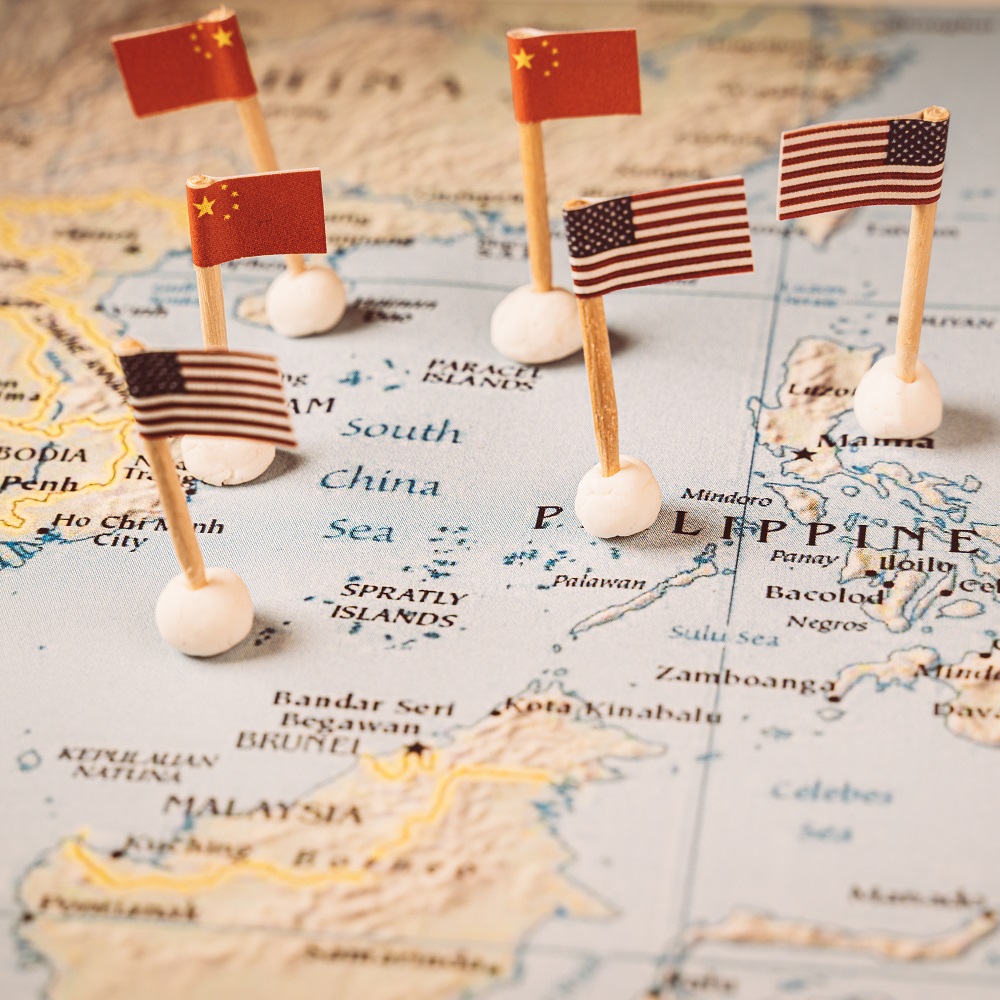
Flags of china and the united states on a map of the southern china sea.

War games risk stirring up troubled waters as Philippines − emboldened by US − squares up to Beijing at sea

by Fred H. Lawson

한국어로 읽기Leer en españolIn Deutsch lesen Gap اقرأ بالعربيةLire en françaisЧитать на русском U.S. Marines joined Filipino counterparts on May 5, 2024, for a mock battle at a telling location: a small, remote territory just 100 miles off the southern tip of the contested island of Taiwan. The combat drill is part of the weekslong Exercise Balikatan that has brought together naval, air and ground forces of the Philippines and the United States, with Australia and France also joining some maneuvers. With a planned “maritime strike” on May 8 in which a decommissioned ship will be sunk and exercises at repelling an advancing foreign army, the aim is to display a united front against China, which Washington and Manila perceive as a threat to the region. Balikatan is Tagalog for “shoulder to shoulder.” Joint Philippines-U.S. naval drills have become an annual event. But as an expert in international relations, I believe this year’s drills mark an inflection point in the regional politics of the South China Sea. For the first time, warships taking part in the exercise ventured outside the 12-mile boundary that demarcates the territorial waters of the Philippines. This extends military operations into the gray area where the Philippines’ exclusive economic zone rubs up against the territory claimed by China and designated by its “nine-dash line.”    Also for the first time, the U.S. deployed an advanced mobile launcher for medium-range ballistic and cruise missiles of a type that had been banned under the now-defunct Intermediate-Range Nuclear Forces Treaty. In addition, the Philippine navy is showing off its newest acquisition, a South Korean-built missile frigate. The South China Sea has long been the source of maritime disputes between China, which claims the vast majority of its waters, and nations including Vietnam, the Philippines, Malaysia and Indonesia. In addition, heightened tensions over the status of Taiwan – a territory that the Biden administration has pledged to defend militarily in the event of a Chinese invasion – have made the South China Sea even more strategically important. Containment at sea The latest joint maneuvers come amid two developments that could go some way to influence the future trajectory of tensions in the South China Sea. First, the Philippines has grown increasingly assertive in countering China’s claims in the region; and second, the U.S. is increasingly intent on building up regional alliances as part of a strategy to contain China. The Philippines-U.S. alignment is more robust than ever. After a brief interval during the 2016-22 presidency of Rodrigo Duterte, U.S. warships and military aircraft once again operate out of bases in the Philippines. Joint naval patrols resumed in early 2023. At the same time, Manila granted U.S. troops unprecedented access to facilities on the northern Batanes islands, which have become the focus of current joint operations. Meanwhile, Washington has become more vocal in condemning challenges to the Philippines from China. U.S. officials had carefully avoided promising to protect the far-flung islands, atolls and reefs claimed by Manila for seven decades following the signing of the Mutual Defense Treaty with the Philippines in 1951. Only in March 2019 did then-Secretary of State Mike Pompeo assert that the treaty covers all of the geographical area over which the Philippines asserts sovereignty. In February 2023, Presidents Ferdinand Marcos Jr. and Joe Biden doubled the number of bases in the Philippines open to the U.S. military. That May, the two leaders affirmed that the Mutual Defense Treaty applies to armed attacks that take place “anywhere in the South China Sea.” Causing waves, rocking the boat Firmer ties to the U.S. have been accompanied by more combative behavior on the part of the Philippines. In May 2023, the Philippines coast guard introduced demarcation buoys around Whitsun Reef – the site of an intense confrontation with China’s maritime militia a year earlier. Reports circulated three months later that Philippine marines planned to construct permanent outposts in the vicinity of the hotly contested Scarborough Shoal. And a Philippine coast guard ship, with the commander of the country’s armed forces aboard, approached Scarborough Shoal in November, before being forced to retreat by Chinese maritime militia vessels. Then in January 2024, the Philippines broke with its adherence to a prohibition on erecting structures on disputed territory, which was part of the 2002 Declaration on the Conduct of Parties in the South China Sea, by installing electronic surveillance equipment on Thitu Island, which sits beyond Scarborough Shoal in the heart of a cluster of disputed formations. This was followed by announced plans to put water desalination plants on Thitu, Nanshan Island and Second Thomas Shoal, making it possible to maintain permanent garrisons on these isolated outposts. Manila has continued to assert its maritime rights by announcing that armed forces would escort exploration and mining activities in the exclusive economic zone. Further acts that could be seen as provocative in Beijing followed, including the stationing of a Philippine navy corvette at nearby Palawan Island and a joint flyover by Philippine warplanes and a U.S. Air Force B-52 heavy bomber. A raft of Chinese responses It is clear that the deepening of Philippines-U.S. ties has given Manila the confidence to undertake a variety of combative acts toward China. The question is, to what ends? A more assertive Philippines may end up contributing to the U.S. strategy to deter Beijing from extending its presence in the South China Sea and launching what many in Washington fear: an invasion of Taiwan. But it is possible that heightened truculence on the part of the Philippines will goad Beijing into being more aggressive, diminishing the prospects for regional stability. As the Philippines-U.S. alignment has strengthened, Beijing has boosted the number of warships it deploys in the South China Sea and escalated maritime operations around Thitu Island, Second Thomas Shoal and Iroquois Reef – all of which the Philippines considers its sovereign territory. In early March 2024, two Chinese research ships moved into Benham Rise, a resource-rich shelf situated on the eastern coast of the Philippines, outside the South China Sea. Weeks later, a Philippines coast guard cutter surveying a sandbar near Thitu was harassed not only by Chinese coast guard and maritime militia ships but also by a missile frigate of the People’s Liberation Army Navy, which for the first time launched a helicopter to shadow the cutter. Washington has taken no public steps to dampen tensions between Manila and Beijing. Rather, Secretary of State Antony Blinken expressed full-throated support for “our ironclad defense commitments” during a mid-March 2024 stopover in Manila. Reassured of U.S. backing, Marcos has amped up the rhetoric, proclaiming that Manila would respond to any troublemaking on Beijing’s part by implementing a “countermeasure package that is proportionate, deliberate and reasonable.” “Filipinos,” he added, “do not yield.” Such an approach, according to Marcos, was now feasible due to the U.S. and its regional allies offering “to help us on what the Philippines requires to protect and secure our sovereignty, sovereign rights and jurisdiction.” The danger is that as the Philippines grows more assured by U.S. support, it may grow reckless in dealing with China. Rather than deterring China from further expansion, the deepening Philippines-U.S. alignment and associated Filipino assertiveness may only ramp up Beijing’s apprehensiveness over its continued access to the South China Sea – through which virtually all of its energy imports and most of its exports flow. And there is little reason to expect that Washington will be able to prevent an emboldened Manila from continuing down the path of confronting China in the South China Sea. To Beijing, the prospect of an emboldened Philippines forging active strategic partnerships with Australia, Japan, South Korea, Vietnam and – most troublesome of all – Taiwan makes the situation all the more perilous.

Defense & Security
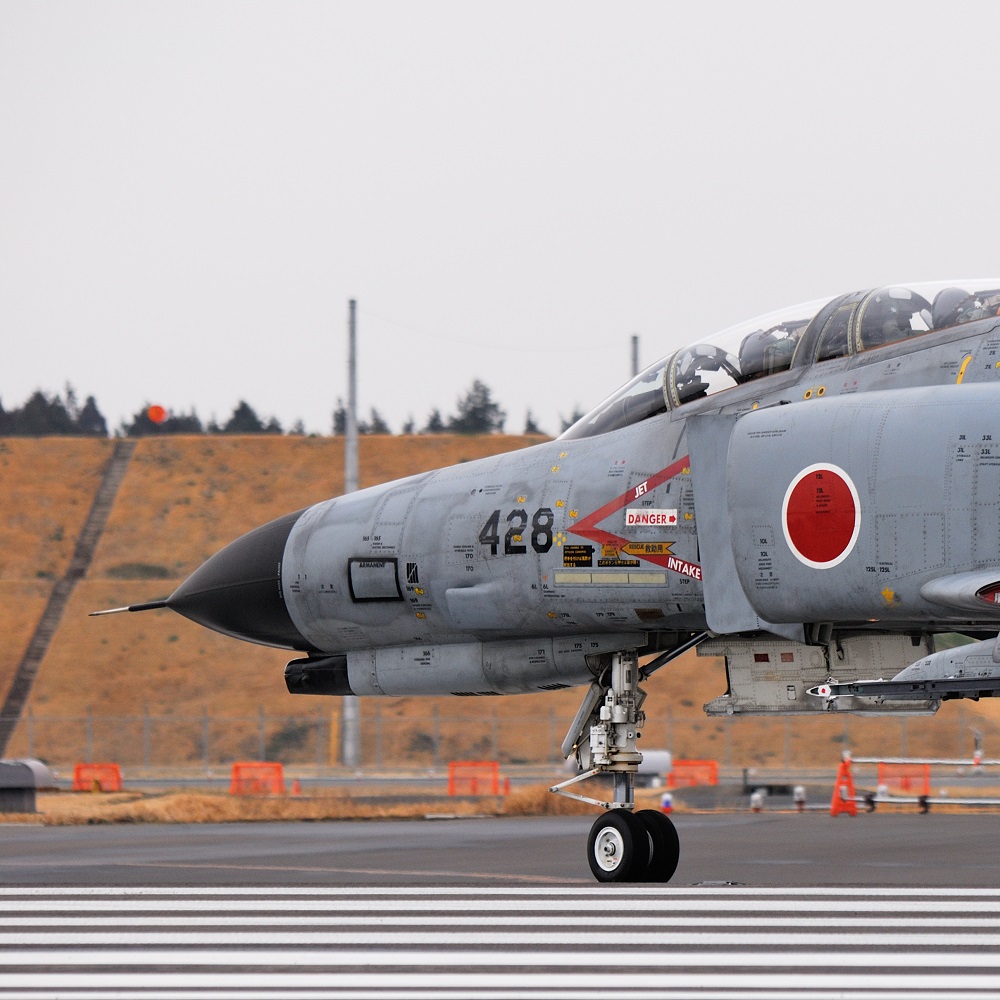
Japanese Fighter Jet

Japan’s Role in Shaping the Security Landscape of Southeast and East Asia

by Swati Arun

한국어로 읽기 Leer en español In Deutsch lesen Gap اقرأ بالعربية Lire en français Читать на русском Japan has embarked upon a transformative journey that signifies a departure from its conventional pacifist stance. Despite encountering pockets of domestic opposition, Japan’s vision of a free and open Indo-Pacific has received increasing support from neighbouring nations. Within a regional backdrop of countering China’s military modernisation and expansionism, Japan is now laying the groundwork for collective defence while working to institutionalise these efforts and ease concerns about remilitarisation. Japan has gradually undertaken various steps to enhance the role of self-defence forces and allow military partnerships. The three new requirements for exercising self-defence, adopted in 2014, expanded Japan’s right to self-defence in the “occurrence of an armed attack against Japan or another country with close ties to Japan”, a threat to national existence, with “no other means to ensure the survival of the country”, adding the use of “minimum amount of force necessary”. Japan broadened the definition of security to encompass any changes in its vicinity that may compromise its territorial integrity. Following these changes, on 16 Dec 2022, the Kishida administration formally approved three revised strategic documents – the National Security Strategy (NSS), the National Defense Strategy (NDS), and the Defense Buildup Program. These revisions reduced the limitations imposed on the Self Defense Forces and collective defence. Viewing these changes in today’s security conflict in East Asia, the first requirement effectively extended the parameters of self-defence to include Taiwan. In the NSS, Japan identified Taiwan as an “extremely important partner and a precious friend” while characterising China as “a matter of serious concern” and “the greatest strategic challenge.” The documents also designated North Korea as “a graver, more imminent threat” and Russia as “a serious security concern.” The documents revealed Japan’s acquisition of counterstrike capabilities, filling gaps in its defences, and broadening the second and third requirements for collective self-defence. Furthermore, Tokyo intends to upgrade the indigenous Type 12 surface-to-ship missile, with a range of approximately 200 km, to approximately 1,200 km, substantially increasing the cost of Chinese attacks in the region. In January 2024, Japan signed agreements with the US to acquire 400 Tomahawk cruise missiles, with a firing range of approximately 1,600 km. Reportedly, Japan aims to rectify its current ammunition reserves by constructing “70 ammunition depots within five years” and plans to construct up to 130 ammunition depots by 2035, drawing lessons from the conflict in Ukraine. Japan revised the Three Principles of Transfer of Defence Equipment and Technology overcoming the past restrictions on transfer of defence equipment and technology to other countries. These revisions marked the beginning of Japan’s evolving role as a security provider in the region. Together this amounts to the doubling of the defence spending from 1% to 2% of GDP by 2027 to speed up the advancement of Japan’s peacetime and immature military and bring it to NATO standards. The revisions are consistent with Japan’s understanding of its new security environment where Chinese assertions are reinforced by the largest naval force in Asia. The shift also underscores the limitation of the US power in the region to remain the sole security provider by enabling Japan to take a central role. Japanese people also resonated with the sentiments, as a poll conducted in 2022 revealed that 89% see China as a threat in 2022, and 49% of respondents supported an expanded role of Japan in the alliance while 46% were against it. In 2023, Japan’s Maritime Self-Defense Force conducted Indo-Pacific Deployment 2023 (IPD23) to “clearly demonstrate the intention that Japan will never tolerate unilateral changes to the status quo by force” as specified in NSS. The Japanese forces visited 17 countries and held 27 exercises with like-minded countries, highlighting Japan’s intention to expand security ties across the nations with territorial disputes in the South China Sea, and with the ASEAN. In the same year, Japan established a Permanent Joint Headquarters to oversee all three forces – the Ground, Maritime and Air Self-Defense Forces – to ensure effective joint operations. Acknowledging Japan’s growing ambition, in December 2023, Chinese President Xi Jinping instructed the coast guard to strengthen its activities to assert sovereignty over the East China islets. Japan has actively pursued collective defence in Southeast Asia with its introduction of “Official Security Assistance” in February 2023, under which the Philippines was the first to receive aid, followed by Malaysia. Japan also plans to include Vietnam, Indonesia, Thailand, Singapore, and Cambodia. These plans will allow Japan to establish a military-industrial complex, extending the nexus of partnership and interdependency between Japan and Southeast Asia. The changes when seen together with the U.S.-Japan Joint Leaders’ Statement mark a decisive shift in Japan’s strategy to counter China. In an upgrade to the US-Japan alliance, the two parties agreed to establish a unified Japanese-US command, enabling the US to make a headquarters in Japan for overseas military operations in the region. They also agreed upon the co-development and co-production of missiles and cutting-edge technologies in Japan, enhancing its defence industrial complex, and export to third parties. The statement noted Japan’s cooperation with AUKUS in its Pillar II advanced capability projects. The statement also relayed the “existential crisis” facing Japan making these efforts natural, conforming to Japan’s revisions to strategic policy documents. Previously, in 2022, Japan had announced a collaboration with the UK, and Italy to develop next-generation fighter jets and subsequently in March 2024, decided to authorise the export of jointly developed fighter jets to other nations. Cross-strait relations, once dealt with utmost precaution through the lens of the “One-China Policy” have now shifted to a more openly debated foreign and strategic policy surrounding Taiwan. Since 2021, Japanese leaders have made a series of statements and comments concerning Taiwan and the Taiwan Strait. In May 2022 a statement from US-Japan Summit reiterated that “peace and stability across the Taiwan Strait as an indispensable element in security”. In a January 2024 speech, former PM Aso Taro also reiterated that the Taiwan crisis constitutes “a threat of national existence” for Japan. China reacted to former US Speaker Nancy Pelosi’s visit to Taiwan in August 2022 with large-scale military exercises around the island. Four months later in December 2022, Japan released three new strategic documents. Taiwan’s importance to Japan’s security was cited seven times in NSS and NDS. Furthermore, Japan intends to enhance the defence of all of its 6,852 islands, focusing on the Ryukyu Island chains, the cornerstone of Japan’s defence against China, lying only 100 Km from Taiwan, which also tightens security around the island. The deployment of a surface-to-air guided missile unit is now under consideration on Yomaguni, home to a JSDF surveillance station adding to Japan’s understanding of Taiwan’s security tied closely to its own. China’s preferred military scenario of a “lightning war”, or a surprise attack to take over Taiwan within weeks or days, has increased the level of urgency and acted as a precursor for the military acceleration of the past several years. The history of Japanese aggression in East Asia and Chinese military support for North Korea diluted the possibility of a regional framework between Japan, South Korea and China. However, through years of efforts in August 2023, a rapprochement was reached between Japan and South Korea when they met at Camp David for a trilateral summit between US-Japan-South Korea. The trilateral took the first step in removing historical obstacles and proving trust in Japan’s new regional role. South Korea has remained averse to participating in major power competitions, but this trilateral institutionalised the effort, guarding the progress against changes in the political situation in either country. For South Korea, North Korea remains its primary security concern. For Japan, the North remains the second most crucial threat with its launch of an intermediate-range ballistic missile in the Sea of Japan in 2022, provoking cooperation on the same despite fractures. Through the joint statement of the trilateral summit, the US got support from South Korea in recognising the perils of not maintaining peace and security in the Taiwan Strait. South Korea got a much-needed boost in intelligence sharing on North Korea’s missile launches and cyber activities which will strengthen ballistic missile defence cooperation. However, it is unlikely that South Korea will endanger its security by interfering in a cross-strait crisis. It will still play a critical role in keeping North Korea at bay in the event of an armed conflict in the Taiwan Strait or East China Sea. Nevertheless, Taiwan thanked the support shown through the trilateral, while China warned against destabilising the region. Japan stands as one of the Philippines’ most trusted partners, second only to the US. Ties have grown deeper as the two have signed a series of agreements from Military and Capacity Building to Maritime Security and Intelligence Sharing in the Indo-Pacific. In 2023, under Japan’s Official Security Assistance, the Philippines received USD 4 million worth of coastal surveillance radars. The two parties are discussing signing a Reciprocal Access Agreement before the end of 2024. An April 2024 joint statement between Japan, the Philippines and the US prioritised advancing “multilateral maritime domain awareness cooperation”, and developing “an information communications technology ecosystem”. It also committed to trilateral defence cooperation and support for the Philippines’ defence modernisation priorities. The statement noted concerns about China’s aggressive behaviour, its “coercive use of Coast Guard and maritime militia vessels in the South China Sea”, conjoining it with the situation in the East China Sea. It also reiterated the importance of the Taiwan Strait in global security. Under this framework, reliance and trust in Japan have increased, setting it up for a larger security role and the collectivisation of security has brought new assurances for the smaller powers of the region. The Taiwanese President thanked the trilateral joint statement supporting peace and stability across the Taiwan Strait. China, however, slammed the anti-China gathering, accusing it of forming a NATO analogue in the region. China summoned Japanese and Philippine diplomats, expressing dissatisfaction and urging Japan to “take actions beneficial to regional peace”. Beyond South Korea and the Philippines, Japan has also maintained long military and diplomatic relations with Vietnam, having had 10 defence dialogues in the past. Furthermore, Vietnamese President Vo Van Thuong and Japanese Prime Minister Fumio Kishida announced the Vietnam-Japan Comprehensive Strategic Partnership on 27 November 2023. According to their joint statement, Kishida and Thuong reinforced the vision of a “free and open Indo-Pacific”. The US also upgraded its ties with Vietnam in September 2023. These developments led to President Xi Jinping’s visit to Vietnam in December 2023, culminating into an agreement to establish a hotline between the Chinese People’s Liberation Army’s Southern Theatre Command and the Vietnamese navy. But mistrust towards China runs deep in the Vietnamese public, which is furthered when China continues to lay new claims in Vietnamese waters. While Vietnam remains reluctant to participate in US-China conflict, its closeness with Japan is a sign that the latter is seen as a reliable regional partner with similar territorial problems. In a wider regional sense, Japan views ASEAN as its key partner in fulfilling the Indo-Pacific vision. The ASEAN centrality resonates in both the Indo-Pacific Strategy and the US-Japan-South Korea trilateral. Japan maintained close ties with the region through robust economic and defence cooperation. But the latter has gained momentum in the past few years. Beginning with the Philippines in 2016, Japan forged bilateral agreements for defence equipment and technology collaboration with multiple ASEAN nations (with Malaysia in 2018, Indonesia and Vietnam in 2021, and Thailand in 2022). In February 2023, the “Expert Panel for the 50th Year of ASEAN-Japan Friendship and Cooperation” issued a report emphasising that ASEAN has evolved from being primarily an aid recipient from Japan to a growing and influential partner. In December 2023, the ASEAN and Japan summit released a joint statement, committing to “strengthening security cooperation including maritime security” in the light of growing threats in the South China Sea. The statement highlighted the trust ASEAN has in Japan amid China’s growing claims in the South China Sea. This reflects a growing realisation among ASEAN members that collective defence is the answer to their security challenge – which China reacted negatively to. In the face of a major power conflict, the trust of Southeast Asian countries in Japan’s security guarantee has been increasing. A poll conducted in 2022 reflected these sentiments when 43.1% of Taiwanese confirmed their belief that Japan would defend Taiwan in the event of an invasion from China, while 42.8% of citizens felt that the US would be a security guarantor to Taiwan. Surveys undertaken in 2023 and 2024 substantiate the increasing affinity between ASEAN and Japan. While China surpassed the US as the preferred partner for ASEAN, Japan remained the most trusted partner, with 58.9% of respondents expressing faith in the country, surpassing levels for the US, China, India, and the European Union. This suggests that ASEAN is gradually transitioning its geopolitical alignment towards Japan as (at least part of) a viable alternative, rather than seeing things as a binary choice between China and the US. The predominant theme in the understanding of the current security environment in Southeast and East Asia is that, while US assistance and reliance on its security guarantee in the region are essential to counter the so-called China threat, the defence of the maritime nations ultimately rests with those nations themselves. This sentiment has served as a catalyst to address gaps in individual countries’ defence preparedness and work towards a collective approach to protect against potential changes in US strategy – which has evolved into one of enabling regional stakeholders by providing technology, skills, and assistance, while maintaining dominance through other platforms. This has necessitated a collective defence posture where a more interconnected network, involving Japan, can be more resistant to isolation and coercion.

Diplomacy
Toy train connecting Europa and China. Symbolizing the New Silk Road or one belt one road Chinese strategic investment in the 21st century. Economic project to connect EU, Central Asia and China

China’s Belt and Road Initiative at a crucial juncture

by Girish Luthra

With US-China rivalry and concerns over the long-term viability of the BRI growing, the third Belt and Road Forum will have much to manoeuvre should it take place this year  In July this year, total investments under China’s Belt and Road Initiative (BRI) crossed a significant landmark of US$1 trillion. The release of BRI data for the first half of 2023 was accompanied by reports that the third BRI forum is being planned to be held in China at the end of 2023. With the stature of being the highest-level gathering of participating countries, the forum is meant to showcase a collaborative approach towards implementation of the BRI, in addition to highlighting progress made and changes planned in its overall direction. The next forum will be the first in the post-pandemic period, after a gap of nearly four-and-a-half years. The road travelled The BRI rapidly gained momentum after its launch in 2013 (initially launched under the title One Belt One Road, which was changed to BRI in 2015 to stress collaboration and inclusivity). There was a sharp increase in the number of projects announced, total investments committed and executed, and the number of countries joining as partners (with the current number at over 150). The geographical scope of BRI also expanded significantly, transforming it from a regional to a near-global initiative, in both of its components—the continental Silk Road Economic Belt, and the maritime Silk Road. China stressed that BRI was a new model for partnership, trade and integration that was free from hegemonic pressures and conditions. In the second half of its decade-old existence, China started to highlight that the principles of multilateralism, environment and sustainability were embedded in the BRI. The importance of BRI for China has been such that it was included in the Chinese Communist Party’s (CCP) constitution in 2017 and in China’s 14th Five-Year Plan issued in 2021. Before the world was struck by the COVID-19 pandemic, the BRI appeared to be moving at a rapid pace, although numerous problems associated with it had already become evident. Headwinds for BRI  The BRI faced criticism for its underlying objectives of gaining strategic influence through developmental footprint, leveraging assistance for basing and access rights, aggressively linking different regions with Sino-centric value chains, inadequate attention to local needs, lack of transparency, disregard for sovereignty, adverse environmental impact, corruption, and lack of sound financial oversight. In some cases, like the port project in Sri Lanka and the rail project in Kenya, the utilisation and revenues turned out to be well below the initial estimates. The term ‘debt diplomacy’ became popular in reference to the BRI after cases of high debt risk in some partner countries, including Pakistan, Laos, Sri Lanka, Zambia, and Mongolia, became increasingly evident. In some cases, China provided additional lending, while in others, it offered currency swap lines for debt restructuring. Notwithstanding, negative perceptions about the BRI expanded slowly, with some partner countries becoming less enthusiastic about these projects, resulting in a changed stance. New connectivity and infrastructure projects launched by the United States (US), the European Union (EU), the G7, Japan, Australia, India, and others took time to gain cohesion and substance, and have started to take concrete shape post-pandemic. Partnership for Global Infrastructure and Investment (G7), the Global Gateway (EU), the Quality Infrastructure Investment Programme (Japan), and other such initiatives now offer alternatives to the BRI with different structures and processes. These and many linked initiatives have added to the challenges for the BRI, though their ability to rival the BRI in scale is yet to be established. The recent slowing down of the Chinese economy presents another key challenge to the BRI. In the face of high unemployment, a sticky consumer demand, lower trade and growth data, and concerns about the financial health of some big companies, China is being forced to look inwards.  This is also important from the point of view of the stated Chinese strategy of ‘dual circulation’, which links the domestic economy with external trade and investment. In the initial phase, China funded overseas projects under BRI through its policy banks, the China Development Bank, the Export-Import Bank of China, and specialised investment funds having the participation of public and private financing institutions. It adopted a new model of leveraging its foreign exchange reserves (currently at about US$3.2 trillion) to capitalise its state banks and sovereign funds. It subsequently diversified into other financing channels that include equity investment funds, sovereign development funds, private equity (PE) funds, and joint (with local investors) investment funds. As of October 2020, more than 70 percent of commitments undertaken by the Silk Road Fund were in the form of equity, with a medium- to long-term investment horizon akin to a PE firm. The capacity of many of these channels is linked with sustained economic growth and the overall health of the financial and banking sector. With very high levels of debt—some estimates suggest that the overall debt of China has crossed 300 percent of GDP—and new reports of bad loans, the BRI investments are likely to see increased scrutiny and lower risk appetite.  The BRI Forum The Belt and Road Forum for International Cooperation (BRF) was started by China as a platform for collaboration and networking that would periodically review the broad direction of the BRI, finalise its action agenda, and announce new frameworks and agreements. The first BRF was held in May 2017, and was attended by 29 heads of state, delegates from 30 countries, and representatives from 70 international organisations. The focus was to showcase cooperation and consultation. The Chinese President announced that China would allocate more resources and financial support, and several new agreements and projects were unveiled. The UN Secretary-General, addressing the first forum, praised the BRI as “rooted in a shared vision for global development” and linked it with the UN Sustainable Development Goals 2030. By all accounts, the first BRF was highly successful. The second BRF was held in April 2019 and attended by 37 heads of state, a higher number than the first BRF. However, the geopolitical environment had changed significantly, with the US having labelled China as a “revisionist power” and the EU having labelled it as a “systemic rival”. The trade and tariff friction between the US and China had started to evolve, and criticism of BRI projects—including on aspects related to financial terms, debt, local participation, and adverse environmental impacts—had started to grow. Accordingly, the second BRF emphasised consultative mechanisms, high quality and environmental standards, clean and green projects, and improved financial management. A debt sustainability framework, zero tolerance for corruption, and several documents outlining some key principles and deliverables were released. In addition to keeping up the momentum, the focus was also on image makeovers in response to various criticisms. China conveyed that the BRI was adaptive, and the broader assessments in different countries concluded that the BRI was here to stay for a long time. The Third BRI Forum amid a critical phase  The geopolitical and geo-economic shifts between the first two BRFs pale in comparison to those between the second and the anticipated third BRF. With the downward spiral in US-China ties and the unfolding strategic competition, the deterioration in the security environment, the precarious global trade and economic situation, the emergence of new partnerships and alliances, the focus on resilience related to technology and supply chains, and the new emphasis on ‘trust’, the third BRF faces a formidable challenge to reposition the BRI. The BRI itself has been facing some major headwinds, which have been exacerbated by China’s domestic economic problems. As 60 percent of China’s loans are in countries facing debt distress, there may be increased demands for waivers or restructuring at the forum. Given the new environment and re-evaluation by some partner countries, the participation—both in level and numbers—in the third BRF will be keenly watched. This will be a key input for China to schedule and conduct the event and to emphasise that the BRI continues to retain its appeal and enjoys widespread support, despite numerous challenges. For China, the BRI is too important to be allowed to move lower in its national priority. Some trimming of the number of projects and amount of investment is likely, and China may take up smaller projects overseas with enhanced scrutiny and oversight. China must, however, showcase the BRI as a success story whose continuation is in the interest of the entire global community. The third BRF will thus go ahead only if China is confident of a successful event and is able to put forward a plan and narrative that displays its resolve and ability to deal with some major headwinds at a very crucial juncture.