Subscribe to our weekly newsletters for free

Subscribe to an email

If you want to subscribe to World & New World Newsletter, please enter
your e-mail

Defense & Security
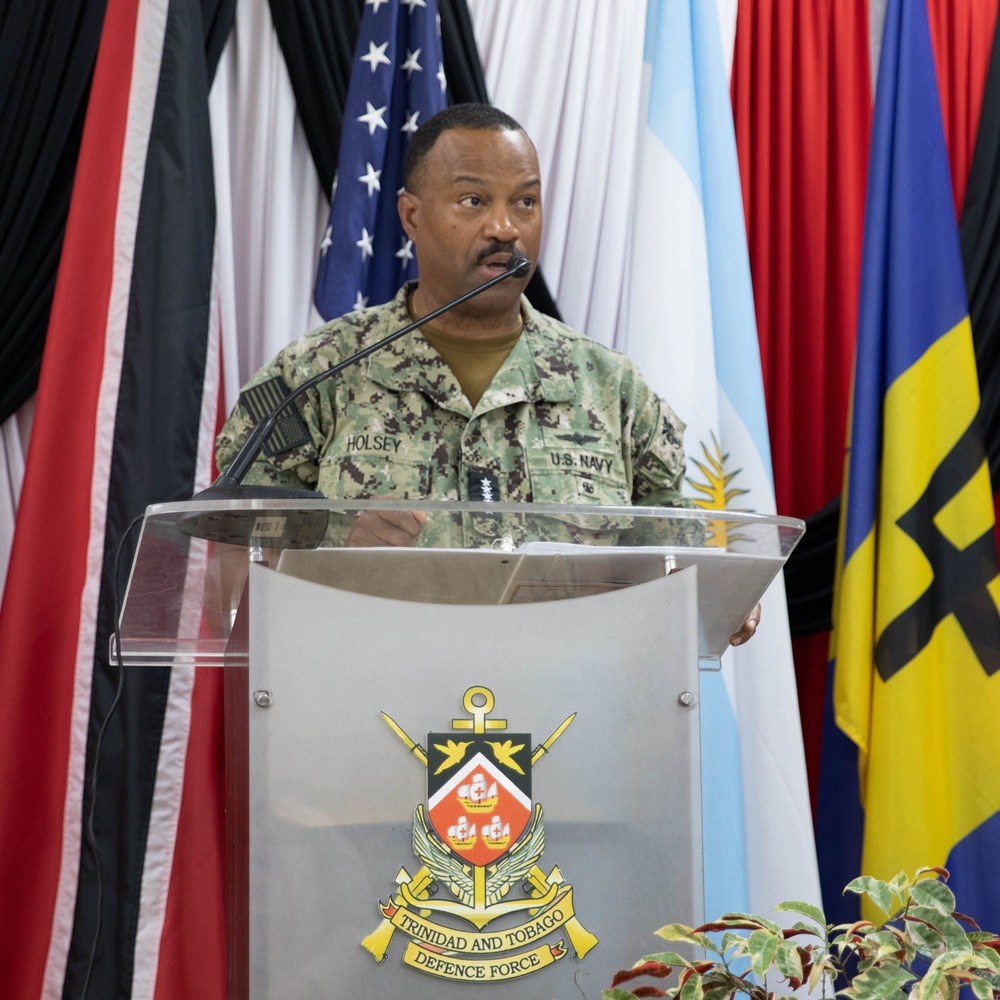
U.S. Navy Adm. Alvin Holsey, commander of U.S. Southern Command (USSOUTHCOM), provides remarks at the TRADEWINDS 25 (TW25) closing ceremony at Teteron Barracks in Teteron Bay, Trinidad and Tobago, May 8, 2025. U.S. Army National Guard photo by Spc. Astia

Imperialism by Invitation: Murder, Mafioso Politics and Caribbean-Venezuelan Futurity

by Zophia Edwards , Corey Gilkes , Tamanisha John

Amidst US bombs and lies about Venezuelan drug trafficking as a pretext for regime change, the subordinated position of Caribbean states’ economies plays a role in U.S. aggression. It is no exaggeration to say that for over half a millennium, the Caribbean has been a stage for imperial incursions. In the past two months, the US has increased its military presence in the Caribbean Sea, including carrying out an airstrike campaign, while claiming that these operations are necessary to protect US citizens from illicit drug trafficking allegedly occurring off the coast of Venezuela. As of November 15th, the US military has launched eleven deadly air strikes on small boats in Caribbean waters and eleven on South America’s Pacific Coast, killing over eighty people. In these operations, the US Navy also raided a tuna fishing boat, detaining the fisherfolk on board for several hours before releasing them.[1] To date, the US government has not provided any proof of its claims that the people it publicly executed are trafficking drugs. These extrajudicial killings have struck fear into the hearts of millions of ordinary people across the region, especially the fisherfolk who depend upon traversing the sea for their livelihoods. Meanwhile, Caribbean countries have either blatantly come out in support of the imperial violence at their doorsteps or been hesitant to respond. When these attacks began, Trinidad and Tobago (T&T) as well as Guyana expressed enthusiastic support for US militaristic incursions and extrajudicial murders.[2] As tensions escalated, the Guyanese government attempted to backpedal from its original position. However, the T&T Prime Minister, Kamla Persad Bissessar, has maintained a pro-US stance. PM Persad Bissessar is on record saying, “I have no sympathy for traffickers, the US military should kill them all violently.”[3] This position by the T&T government was reiterated even after the US murdered two of its citizens, Chad Joseph and Rishi Samaroo, in these airstrike campaigns. T&T allowed the US warship, USS Gravely, a guided-missile destroyer, to dock in the country’s capital between October 26-30 and for US military agents to “address shared threats like transnational crime and build resilience through training, humanitarian missions, and security efforts” on T&T soil.[4] The Caribbean Community (CARICOM) - the intergovernmental regional organization - has dragged its feet to take a position, waiting a whole month on October 18, to release a presser wherein it reaffirmed the region as a “zone of peace,” with Trinidad and Tobago excepting itself from this stance. The foot dragging is sinister when it is known for a fact that the US propaganda of conducting “anti-narcotics” operations is/are a ruse. These hostile US military aggressions in the Caribbean Sea and on South America’s Pacific Coast are part of a broader US imperial geopolitical strategy aimed at toppling the government of Venezuelan President, Nicolás Maduro. The aim, as Trump has publicly intimated,[5] is to get the Venezuelan government to grant the US more beneficial access to Venezuela’s resources. One might ask: Why are governments, like Trinidad and Tobago, enabling US imperial terror in the region? And why have CARICOM governments not taken an unequivocal anti-imperialist position? The answer lies in the subordinated position of these states’ economies within the global economy. Caribbean states are historically structured to be neoliberal, pro-imperial, and anti-democratic – while political elites are beholden to enacting external interests. Moreover, internal political dynamics – in terms of racial and class struggles – are also a factor, influencing the timing and intensity of these Caribbean governments’ responses to present US imperial terror. Debunking the Myth of the Venezuela Narco State The first order of business is dispelling the myth that Venezuela is a ‘narco-state.’ US officials have framed the current operations — boat strikes, deployments of destroyers and aircraft — as counter-narcotics efforts designed to stem the flow of illicit drugs from Venezuela to the US. However, the Caribbean route is not among the primary conduits for major volumes of cocaine and methamphetamines into the US. Most trafficking flows of narcotics to the US are overland, through Central America and via Pacific routes.[6] It is no surprise therefore that the US government has not provided any proof of its claims that the people it has extrajudicially murdered in the Caribbean Sea or on South America’s coast are engaged in drug trafficking. Additionally, the scale and nature of force being used are far beyond what traditional interdiction operations require – with the Trump administration claiming that interdiction has not worked, hence deadly air strikes are necessary. In addition to the lack of evidence of a Venezuelan route being key to drug trafficking into the US, there is also no credible proof linking the Maduro government to organized drug trafficking, despite the Trump regime’s claims, which are parroted uncritically by many Caribbean media and politicians. Within the US’s own intelligence establishment, one report explicitly states: “the Maduro regime probably does not have a policy of cooperating with TDA [Tren de Agua] and is not directing TDA movement to and operations in the United States.”[7] The report goes on to say: “Venezuelan intelligence, military, and police services view TDA as a security threat and operate against it in ways that make it highly unlikely the two sides would cooperate in a strategic or consistent way.” These facts stand out, especially given the evidentiary long and sordid history of the US’s leading role in drug trafficking in the Americas, and the US as the #1 supplier of weapons to those involved in the global drug trade in the region. The US government’s real motive is to destabilize and topple the Maduro government in Venezuela, in favor of a regime that undermines Venezuela’s sovereignty. Frantz Fanon, Walter Rodney and many others remind us that capitalist imperialism depends upon neocolonial puppet governments occupied by a predatory elite who facilitate accumulation by extractivism, dispossession, and exploitation. Positioned to usurp Maduro in Venezuela by imposition and not elections, is 2025 Nobel “Peace” Prize winner, María Corina Machado. Machado is a key US ally, Trump admirer, supporter of Israel and its bombing of Gaza, and an overall admirer of repressive regimes in Latin America – including El Salvador’s Nayib Bukele and Brazil’s former president, Jair Bolsonaro. Machado has been begging for foreign military intervention in Venezuela to remove the Maduro government while professing that her administration, if granted power through non-electoral means, intends to open up Venezuela’s doors to foreign exploiters. If the current iteration of US imperial antagonism in the region leads to regime change in Venezuela, the US is poised to have control over the resources in the southern Caribbean – namely Guyana and T&T – as well as on the South American Coast: again, namely Guyana and then Venezuela. This will give the US direct control over shipping routes in the region, as it prepares for a wider economic confrontation with China. Hence, these alleged “anti-narcotics” operations which have taken the lives of over eighty Caribbean and South American people, are just a smokescreen for deeper US geopolitical interests. Dependency and the Character of the State Caribbean states are disregarding the lives of the Venezuelan, Latin American, and their own Caribbean populations using external security narratives, largely because there is a true dictatorship of foreign capital in the region. As US Vice-President JD Vance let slip, places like the Caribbean countries were always intended to remain extractive workstations, not autonomous, functioning nations.…at all.[8] T&T, for example, has long been dependent on oil and gas extraction for the bulk of its national income. However, the country has been experiencing a decline in natural gas and crude oil production over the past decade and the country’s liquefaction complex and petrochemical plants producing ammonia, methanol, and other key exports – which depend upon gas input – have been suffering.[9] Combined with the collapse in energy prices in 2014, this situation has produced a decline in foreign exchange inflows and government revenues.[10] With the demand for US dollars far outstripping the supply, T&T is facing one of the most severe foreign exchange crises in the Caribbean, causing uproar across the working, middle, and upper classes of society alike.[11] As such, the T&T government is desperate for the resuscitation of its flailing oil and gas sector. The T&T government spent decades developing a “Dragon” gas deal, where Shell would lead operations that funnel gas located in Venezuelan waters to T&T, where it can be exported as LNG. This deal, considered by the T&T state to be the lifeline that would save the local economy from collapse, has become a weapon in Washington, DC’s arsenal against Venezuela. In the midst of the extra-judicial killings in the region, the US has revoked licenses approving the deal and re-approved them under new terms meant to ensure the involvement and profits of US companies. The continued structural dependency of T&T on foreign capital and imperial markets renders its misleaders susceptible to these coercive measures to ensure that Caribbean states align with US capitalist imperialist policies. Economic coercion is an important part of the context for Kamla Persad Bissessar’s support for imperialism, but her position cannot be traced to this alone. Persad Bissessar and the educated elite and comprador class she represents come out of some of the “best” primary, secondary, and tertiary educational institutions locally and internationally. Are these elites supposed to provide independent, critical thinkers who would decolonize “post” colonial societies? Are they only unwitting agents of imperialism or are they willing participants? From the time of many states' flag independence, foreign interventions have secured for the local Caribbean elites’ (or comprador classes) party longevity and/or political dominance, and/or visas and dual citizenships, and/or the ability to accumulate wealth for themselves by exploiting the people and land within their countries. As Frantz Fanon’s “Wretched of the Earth” and Walter Rodney’s “How Europe Underdeveloped Africa” detailed, these elites lack the sort of creativity and vitality to independently develop into an industrial bourgeoisie. They therefore turn to propping up foreign entities and dependent economic relations. Consequently, Caribbean state-making and the establishment of territorial statuses in the context of US and European imperialist capitalism has reproduced institutions that are unresponsive to Caribbean people. Whether through hopes of securing or acquiring foreign investment, or due to rank economic blackmail that threatens foreign investments elites through sanctions and other restrictions – many Caribbean states choose to serve US and Western imperialism as an almost “practical” strategy of economic “stability”. However, such imperial service only guarantees continued underdevelopment and economic beggary. Herein, T&T’s misleadership is positioning the country as a beggar to the US and reinforcing US sanctions on Venezuela, which makes it hard for Venezuela to sell its own oil and gas to states that need it, including T&T. Worse still, the US does not want China to remedy this situation between Venezuela and Trinidad. So not only are some Caribbean leaders and party supporters encouraging naked US imperialism cloaked in the deceptive language and rhetoric of “anti-drug trafficking” and “protecting the region,” they are also upholding a condition of dependency of the region on the US, advancing US attempts to subvert Chinese influence in the region, and in the process supporting direct attacks on states in the region’s right to self-determination and sovereignty. Moreover, local internal racial and class dynamics are also shaping the timing and intensity of Caribbean governments responses to US aggression in the region. In the post-WWII construction of party politics in T&T, middle-class parties carried forward the colonial divisions between the predominantly African and Indian segments of the population that multiracial worker movements had fought so hard to overcome. Kamla Persad Bissessar, as leader of the party popularly known as the one representing “Indian interests,” is advancing and exploiting this racial wedge to garner support for her pro-imperial policies. This party has actively engaged in criminalizing poor African communities as well as Venezuelan migrants, while downplaying the fact that the many poor and marginalized Indians are similarly caught in the net of US imperialism. Persad Bissessar and her party affiliates’ own ideas of “purity” mixed with class notions of entitlement merge with the supremacist foundations of US local and foreign politics. It’s bad enough that a Prime Minister — a lawyer — supports extra-judicial murders in violation of International Law, but how does one align with a political ideology that produced people like Senator James Reed, who, circa 1919, openly dismissed dealing with “a nigger from Liberia, a nigger from Honduras, a nigger from India…each (having) votes equal to that of the great United States.” Before one argues that this was long ago, consider what right-wing political commentator Ann Coulter told Vivek Ramaswamy why she’d never vote for him regardless of how his views match hers. We acknowledge that political leaders, seeking re-election, opt for the path of least resistance which in this case means not offending the mighty United States. But this cannot just be naïveté. It is in this context that Kamla Persad Bissessar has broken with even the basic understanding of what CARICOM is, and is astonishingly peddling the idea that each island seeking its own interest is somehow more progressive than banding together as one bloc! In other words, she and those who support her stance have embraced regional colonial divide-and-conquer tactics. The US has always stood in opposition to a unified body in the region. As then US diplomat Charles Whittaker put it: “A strongly federated West Indies might be detrimental to American interests.” As such, they undermined the West Indian Federation in the 1950s and sabotaged the New International Economic Order throughout the 1970s. The Caribbean misleaders proclaiming disunity as strength subscribe to political ideologies that interlock with a particular brand of politics in the West that has been openly Euro-nationalist and imperialist. Hence, at a time when many resource-rich countries are forming partnerships and alternative trading and security blocs, the political misleaders in the Caribbean calling for further fragmentation should warrant deeper investigation. Media, Political Misleadership, and How the State Weaponizes “Security” It is important to clarify that crime does exist in the Caribbean region, just as it exists elsewhere throughout the world. The size of Caribbean countries are also important to note, because though it is true that the amount of drugs flowing through the Caribbean are low relative to the global drug trade, the little that does pass through is indeed wreaking havoc, given the geographical and population sizes of these countries. The increase in guns and violent crime associated with the global drug trade in places like T&T has become a critical factor affecting everyday life for ordinary people there. This context has enabled the T&T government to justify and legitimate US military aggression in the name of “fighting” the drug trade in the region. Thus, most people cheering on the US military are simply desperate for a sense of safety. However, it is precisely this need for safety that is being weaponized — to increase unsafe conditions as new US-produced military weaponry and technologies become even more commonplace in the region. There is a direct and indirect connection between (geo)political and economic decisions made by successive generations of ruling elites in the Caribbean, and North American narratives of crime, which have – going back to the 19th century in some countries – allowed (and made space for) imperial aggression in the region. Over a number of decades, the United States has taken advantage of crises caused by rising violent crime to pursue its own security interests – even though rises in violent crime in the region is directly linked to US imported and manufactured weapons, and US consumer demands for items that the US state deems “illegal.” To establish and maintain US dominance — and the accompanying cheap labor[12] from the surplus populations which exist in a region notorious for high levels of unemployment and underemployment — the US has deployed constant applications of violence, packaged as maintaining “law and order” in the drive to “progress” and “catch up” with the West. It’s no coincidence that modern policing began in the Caribbean as militarized slave patrols in St Lucia.[13] Then, like now, the purpose is the same: protect wealth from the workers who created it. However, the real effectiveness lay in conditioning the exploited to adopt the values of the elites. To date, Western elite definitions of progress and development for the wider working people in the Caribbean region dominate, even as the dependent status of Caribbean economies make this impossible for the majority of the people in the region. Thus, US reliance on expanding its military apparatus for economic growth is justified through the construction of permanent threats that the US supposedly has to “defend” itself against. Another such narrative, like the need to “promote democracy” in Venezuela, is also within this vein of western imperialist propaganda. The US and western imperialists maintain that Venezuela is not a democracy, despite the presence of robust, active citizen’s assemblies and communes, as well as elections that occur under the presence of election observers – including from the US. Nonetheless, the western imperialist narrative maintains that Venezuela is not democratic and thus their people can be bombed for some purported “greater good.” Meanwhile, these same imperialist narratives call genocidal Israel a democracy deserving of “protection” and “defense,” as it exterminates Palestinians and decimates Palestinian land. This propaganda – not analysis based on any facts – readily frames western imperialism as “defensive,” “pro-security,” and “pro-safety” and those not in line with it as “aggressive” and “undemocratic.”[14] In lockstep with imperialists, local political figures too have long used or encouraged the use of dehumanizing language when discussing criminalized people and communities. When the T&T Prime Minister, Police Commissioner, and other influential authority figures refer to human beings as “carcasses,”[15] “pests,” “fleas” or “cockroaches,” the message sent is that these are not citizens or members of society and therefore, not worthy of certain basic courtesies and legal obligations, including the right to life. When this sort of thinking is widespread, issues of social justice fall by the wayside. Instead, heavy, often murderous attacks on real or alleged drug runners who come from poor, precarious, vulnerable communities become justified while the power brokers, bankers and their institutions[16] that launder money do not get so much as a paper weight dropped on them. Likewise, the local and international media is playing a significant role in the unfolding crisis. Save for a few columnists, the local media has been disgraceful, little more than sycophantic stenographers for egregious narratives coming from Washington. Initially, the local media conducted little to no critical research into the many available sources discrediting[17] false allegations connecting the Maduro administration to drug cartels. They parroted language that criminalized the victims of the attacks without presenting any evidence proving that they were guilty of violating any laws. They were silent on the voluminous literature connecting the CIA and the US military to colonial land and resource grabs that violate international and local laws.[18] They also proliferated the myth that Nicolas Maduro “lost” or “rigged” elections in Venezuela, contrary to information provided by election observers. The lack of critical and independent journalism is a clear dereliction of duty, supporting imperialist narratives and providing cover for extrajudicial murder. Conclusion The neoliberal era shortly after many states’ independence extended the life of bourgeois colonial thought in the Caribbean, interpreting the human “firstly, [as] a figure that is homo economics, and, secondly, a figure that can only operate within the field of white supremacy and capitalism.”[19] In this environment, Caribbean resistance weakened, having to establish itself alongside the intensification of neoliberal processes – foremost amongst them being state repression and militarist aggression supported by the US hegemon – so that Caribbean peoples could be definitively integrated into a Western capitalist system as “bottom labor-exporting economies,” whose labor commodification was masked by discourses on ‘growth’ and ‘development.'[20] It is in analyzing the characteristics of Caribbean states and governance within them – including how they interpret “development” – that helps us to answer why so many states elect to do imperial service: Caribbean neocolonial (puppet) states are fundamentally anti-democratic with no real regard for Caribbean life within them. The T&T government’s deliberate facilitation of US imperial aggression in the region mirrors the position of several African states. The post-genocide Tutsi-dominated regime of Paul Kagame in Rwanda, leveraging its image as a victim of colonialism and genocide, justifies domestic repression of Hutus and expansionist military ventures in neighboring states, notably the Democratic Republic of Congo in close alliance with the United States, France, and Israel. In exchange for U.S. and western military, financial, and political backing, Rwanda facilitates imperial access to Congo’s mineral wealth — coltan, gold, and tin — channeling profits both to Western capital and Rwandan elites. Thus, Rwanda functions as a pro-U.S. imperial proxy, advancing the global system of resource extraction and accumulation on behalf of Western powers. In addition, Rwanda along with a growing list of African states, including Ghana, Eswatini, and South Sudan have accepted the terms of bilateral agreements with the US government to receive people who have been criminalized and deported under the Trump regime’s attack on communities racialized as non-white in the US.[21] By enlisting themselves to be locations for the outsourcing of US racist incarceration policies, they are enabling the geographical expansion of the US military industrial prison complex to more and more corners of the world. These Caribbean and African misleaders will go down in history as active enablers and facilitators of the very imperial greed, oppression, and exploitation that the masses have been resisting since the days of direct colonial domination. Only invigorated mass resistance that takes power away from Caribbean neocolonial (puppet) elites engaged in imperial service can rectify these conditions. Global Africans in the Caribbean and around the world must claim power and reclaim movement histories that fought back against capitalist imperialism. Originally published in Pambazuka News and republished in Black Agenda Report References [1] https://www.pbs.org/newshour/world/venezuela-says-u-s-warship-raided-a-… [2] https://www.caribbeanlife.com/trinidad-guyana-us-moves-venezuela/ [3] https://newsday.co.tt/2025/09/03/kamla-says-kill-all-traffickers-as-tru… [4] https://www.cnn.com/2025/10/26/world/us-warship-docks-trinidad-venezeul… [5] https://www.theguardian.com/world/2025/oct/17/trump-maduro-venezuela [6] https://www.unodc.org/unodc/data-and-analysis/world-drug-report-2025.ht… [7] https://static01.nyt.com/newsgraphics/documenttools/32f71f10c36cc482/d9… [8] https://www.youtube.com/watch?v=U1bd-D1PIZg&pp=ygUZIGogZCB2YW5jZSBnbG9i… [9] https://www.finance.gov.tt/2020/03/16/effect-of-the-oil-price-collapse-… [10] https://www.imf.org/external/pubs/ft/scr/2014/cr14271.pdf; https://www.imf.org/en/Publications/CR/Issues/2024/06/04/Trinidad-and-T…. [11] Chamber of Industry and Commerce 2025; University of the West Indies Campus News 2024. [12] https://www.youtube.com/watch?v=BAJgGFtF44A [13] https://www.youtube.com/watch?v=kavkiH9YHag&pp=ygUaanVsaWFuIGdvIHBvbGlj… [14] See, for example, the Trilateral Commission’s “The Crisis of Democracy” in which influential thinkers who shaped US policy complained that decolonising countries were exercising too much democracy, which needed to be contained, leading to the proliferation of NGOs all over the peripheralized world. [15] https://trinidadexpress.com/news/local/kamla-state-resources-won-t-be-wasted/article_5d0c61fd-d633-4dd3-8e3e-6995a454c774.html [16] https://www.youtube.com/watch?v=kcpZPGOksp0 [17] https://www.dea.gov/sites/default/files/2025-07/2025NationalDrugThreatA…; https://static01.nyt.com/newsgraphics/documenttools/32f71f10c36cc482/d9… [18] https://www.goodreads.com/book/show/455652.Dark_Alliance; https://www.versobooks.com/en-gb/products/1628-whiteout?srsltid=AfmBOor…; https://www.betterworldbooks.com/product/detail/the-politics-of-heroin-…; https://www.youtube.com/watch?v=zxbW0CCuT7E [19] Bogues, Anthony. 2023. “Sylvia Wynter: Constructing Radical Caribbean Thought.” BIM: Arts for the 21st Century 11(1): 33–41, p.37. [20] Henry, Paget. 2000. “Caribbean Marxism: After the Neoliberal and Linguistic Turns.” In Caliban’s Reason: Introducing Afro-Caribbean Philosophy, Africana Thought, New York: Routledge, 221-46, p.228. [21] https://www.pbs.org/newshour/world/more-african-nations-are-receiving-t…

Diplomacy
Presidente da República, Luiz Inácio Lula da Silva, Sessão de abertura do IV Fórum CELAC-China. China National Convention Center II, Pequim - China. Foto - Ricardo Stuckert / PR Lula Oficial, CC BY-SA 2.0 <https://creativecommons.org/licenses/by-sa/2.0>,

China and the Trump corollary to the Monroe Doctrine

by Tings Chak

China’s policy paper supports the “Proclamation of Latin America and the Caribbean as a Zone of Peace” — a pointed contrast to US twenty-first century gunboat diplomacy. On December 10, 2025, US forces seized the oil tanker Skipper off the coast of Venezuela, carrying over a million barrels of crude. “Well, we keep [the oil],” President Trump told reporters. Venezuela’s foreign ministry called it “blatant theft and an act of international piracy,” adding: “The true reasons for the prolonged aggression against Venezuela have finally been revealed. It has always been about our natural wealth, our oil.” That same day, on the other side of the world, China released its third Policy Paper on Latin America and the Caribbean (the first since 2016) outlining a vision of partnership “without attaching any political conditions.” The timing captures the choice now facing Latin America. Two documents released within a week — Trump’s National Security Strategy (NSS) on December 5 and China’s policy paper five days later — lay bare fundamentally different approaches to the hemisphere. The Monroe Doctrine returns Trump’s NSS makes no pretense of diplomatic subtlety. It declares a ‘Trump Corollary’ to the Monroe Doctrine, asserting US opposition to “hostile foreign incursion or ownership of key assets” in the hemisphere. The Western Hemisphere is now America’s “highest priority”, with three threats requiring military response: migration, drugs, and China. Countries seeking US assistance must demonstrate they are “winding down adversarial outside influence” — a demand that Latin American nations cut ties with Beijing. The strategy promises “targeted deployments” and “the use of lethal force” against cartels. It states that Washington will “reward and encourage the region’s governments … aligned with our principles and strategies.” Unsurprisingly, the US Secretary of State Marco Rubio rushed to congratulate Chile’s Trump-inspired extreme right wing candidate José Antonio Kast, who won the presidency with 58% of the vote (the most right-wing leader since Pinochet). The tanker seizure shows what this doctrine looks like in practice. Since September, US strikes on boats have killed 95 people. The USS Gerald R. Ford carrier group patrols the Caribbean. As Colombian President Gustavo Petro observed, Trump is “not thinking about the democratization of Venezuela, let alone the narco-trafficking” — only oil. After declaring that a new phase of attacks could include “land strikes on Venezuela”, Trump threatened the Colombian president that “he’ll be next” as well as invasion of Mexico. China’s alternative China’s policy paper operates from an entirely different premise. Opening by identifying China as “a developing country and member of the Global South,” it positions the relationship as South-South cooperation and solidarity rather than great power competition. The document proposes five programs: Solidarity, Development, Civilization, Peace, and People-to-People Connectivity. What distinguishes this paper from its 2008 and 2016 predecessors is its explicit call for “local currency pricing and settlement’ in energy trade to “reduce the impact of external economic and financial risks” — new language directly addressing the weaponization of the dollar. This trend has been underway, as highlighted by the R$157 billion (USD 28 billion) currency swap agreement between Brazil and China, signed during Brazilian president Lula’s visit to the Asian country in May this year. China’s policy paper supports the “Proclamation of Latin America and the Caribbean as a Zone of Peace” — a pointed contrast to US twenty-first century gunboat diplomacy. And it contains a line clearly responding to Washington’s pressure: “The China-LAC relationship does not target or exclude any third party, nor is it subjugated by any third party.” The historical pattern Of course, the focus on the “China threat” to “US pre-eminence” in the region is not new. In August 1961, progressive Brazilian Vice President João Goulart visited China, the first high-ranking Latin American official to do so after the Chinese Revolution. At a mass rally in Beijing, he declared that China showed “how a people, looked down upon by others for past centuries, can emancipate themselves from the yoke of their exploiters.” The US response was swift. American media constructed a narrative linking Brazilian agrarian reform movements to a “communist threat from China.” On April 1, 1964 (less than three years after Goulart’s visit) a US-backed military coup overthrew him. Twenty-one years of dictatorship followed. The playbook remains the same. In the 1960s, the pretext was “communist threat”; today it’s “China threat.” And what’s at stake is Latin American sovereignty. What makes this moment different is economic weight. China-LAC trade reached a record US$518.47 billion in 2024, according to China’s Ministry of Commerce. China’s share of trade with Mercosur countries has grown from 2% to 24% since 2000. At the May 2025 CELAC-China Forum, Xi Jinping announced a USD 9 billion investment credit line. In 1964, Latin America had few alternatives. Today, China presents another option. The question before the Latin American people The right-wing surge across the continent is undeniable — Kast in Chile, Milei in Argentina, the end of MAS rule in Bolivia. These victories reflect the limitations of progressive governments when addressing crime, migration, and economic stagnation. But they also reflect how US-generated crises become the terrain on which the right wins. The question is whether Latin American governments (including right-wing ones) want to be subordinates in what Trump’s strategy calls an “American-led world.” Even Western liberal analysts are alarmed. Brookings describes the NSS as “essentially assert[ing] a neo-imperialist presence in the region.” Chatham House notes that Trump uses “coercion instead of negotiation”, contrasted with China, “which has been providing investment and credit … without imposing conditions.” That being said, China’s presence in Latin America is not without contradictions. The structure of trade remains imbalanced — Latin America exports raw materials and imports manufactured goods. Meanwhile, labor and environmental concerns linked to specific Chinese private enterprises cannot be ignored. Whether the relationship enables development or reproduces dependency depends on what Latin American governments demand: technology transfer, local production, industrial policy. This agenda for a sovereign national project must be pushed forward by the Latin American people and popular forces. At present, the differences between the two visions being presented of the “US-led world” and a “community with a shared future” have never been starker. This article was produced by Globetrotter. The original article is under a CC BY-SA license

Defense & Security
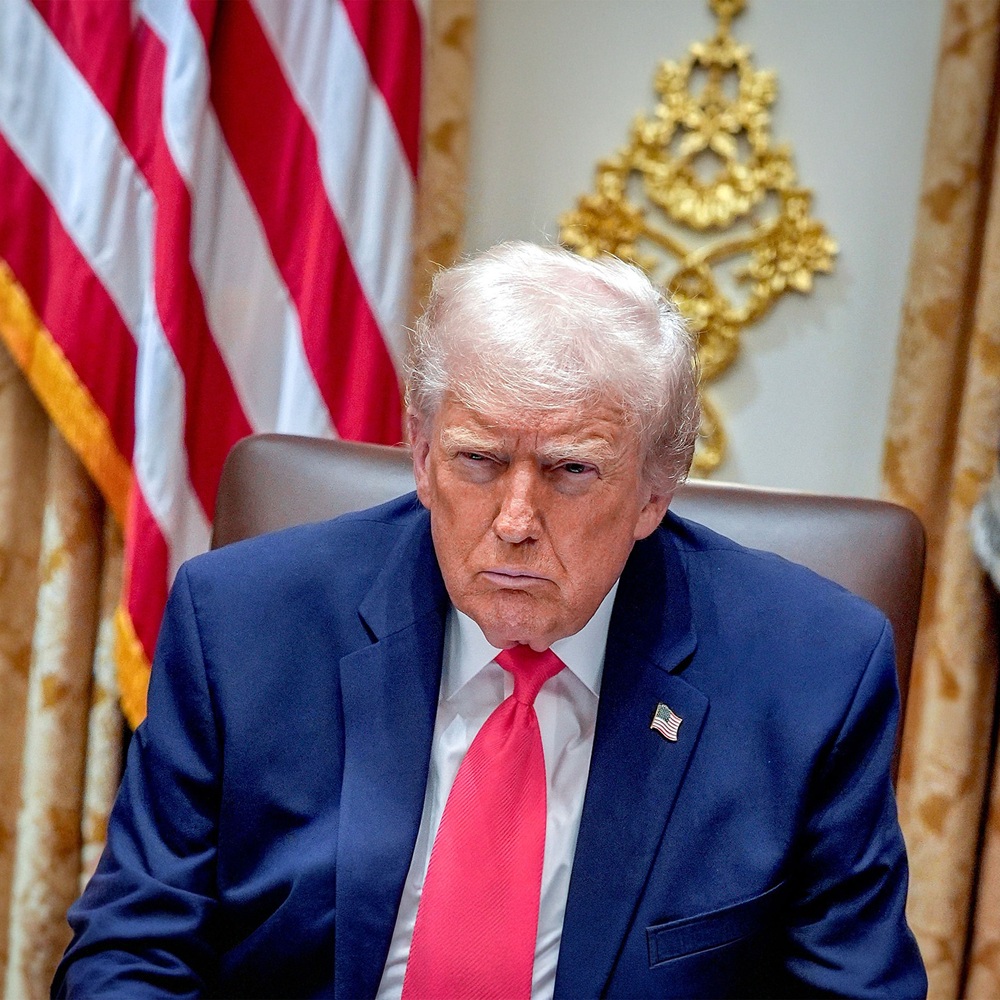
President Donald Trump Speaks During Cabinet Meeting in the Cabinet Room of the White House, Washington, DC on December 2, 2025

Opinion – The Mearsheimer Logic Underlying Trump’s National Security Strategy

by Mark N. Katz

The recently released Trump Administration’s National Security Strategy (NSS) has upended what had been the decades-long consensus about American foreign policy. Most notable in it is the Trump Administration’s prioritization of the Western Hemisphere as an American security concern, its deemphasis on defending America’s traditional European allies, its identification of China as far more of a threat than Russia, and its determination not to be drawn into conflicts in the Middle East and Africa. But while the 2025 Trump Administration National Security Strategy breaks with much of previous American foreign policy, the logic behind it is not something completely new. Even though the document makes no mention of him, the policy outlined in the NSS comports with what John Mearsheimer described in his influential book, “The Tragedy of Great Power Politics”, which was first published in 2001 and updated in 2014. In his book Mearsheimer declared that no nation has ever achieved global hegemony. According to Mearsheimer, America is the only country that has achieved predominant influence in its own region (the Western Hemisphere) and has also been able to prevent any other great power from dominating any other region. Mearsheimer wrote, “States that achieve regional hegemony seek to prevent great powers in other regions from duplicating their feat. Regional hegemons, in other words, do not want peers” (2014 edition, p. 41). Trump’s 2025 National Security Strategy has, whether knowingly or not, adopted these aims as well. It discusses the various regions of the world in the order of their priority for the Trump Administration: the Western Hemisphere first, followed by Asia (or Indo-Pacific), Europe, the Middle East, and lastly Africa. With regard to the Western Hemisphere, the NSS unambiguously calls for the restoration of “American preeminence in the Western Hemisphere,” and states, “We will deny non-Hemispheric competitors the ability to position forces or other threatening capabilities, or to own or control strategically vital assets, in our Hemisphere.” This is very much in keeping with what Mearsheimer described as America being a regional hegemon in the Western Hemisphere. As for the other four regions of the world, though, the Trump Administration seeks either to prevent any other great power from becoming predominant — or it doesn’t see this as a possibility that needs to be worried about. According to the NSS, the Middle East was a priority in the past because it was the world’s most important energy supplier and was a prime theater of superpower conflict. Now, however, there are other energy suppliers (including the U.S.) and superpower competition has been replaced by “great power jockeying” in which the U.S. retains “the most enviable position.” In other words: the Trump Administration does not see any other great power as able to become predominant in this region which is now less strategically important than it used to be anyway. Similarly, the NSS does not see any other great power as even seeking to become predominant in Africa. The NSS thus sees America’s main interests there as mainly commercial. By contrast, China is seen as a threat in the Indo-Pacific region. The NSS, though, discusses Chinese threats in the economic and technological spheres before turning to the military one. A continued U.S. military presence in the region is seen as important for preventing Chinese predominance. But Japan, South Korea, Taiwan, and Australia are all enjoined by the NSS to increase their defense spending in order to counter this threat. The NSS also identifies “the potential for any competitor to control the South China Sea” as a common threat that not only requires investment in U.S. military capabilities, “but also strong cooperation with every nation that stands to suffer, from India to Japan and beyond.” Unlike the Middle East and Africa, then, the NSS does identify a rival great power as striving for predominance in the Indo-Pacific region. Countering it, though, is not seen as just being America’s responsibility, but also that of other powerful states in the region. The strangest section in the 2025 NSS is the one on Europe. While acknowledging that “many Europeans regard Russia as an existential threat,” the NSS envisions America’s role as “managing European relations with Russia” both to “reestablish conditions of strategic stability” and “to mitigate the risk of conflict between Russia and European states.” This is very different from the decades-long U.S. policy of seeing America’s role as defending democratic Europe against an expansionist Soviet Union in the past and Putin’s Russia more recently. Indeed, the NSS’s claim that the European Union undermines “political liberty and sovereignty” and its welcoming “the growing influence of patriotic European parties” (in other words, anti-EU right wing nationalist ones) suggests that it is not Russia which the Trump Administration sees as a rival, but the European Union. The 2025 NSS does call for a “strong Europe…to work in concert with us to prevent any adversary from dominating Europe.” The NSS, though, seems to envision the European Union as either greater than or equal to Russia in threatening to dominate European nations. In his book, Mearsheimer did not envision the European Union as a potential great power rival to the U.S. Indeed, there isn’t even an entry for it in the book’s index. The way that the NSS envisions the world, though, comports with how Mearsheimer described America’s great power position: predominant in the Western Hemisphere and able to prevent any other great power from becoming predominant in any other region of the world. Mearsheimer, though, is a scholar who described the position in the world that he saw the U.S. as having achieved and which would seek to maintain. The 2025 NSS, by contrast, is a policy document laying out how the Trump Administration believes it can best maintain this position. And there is reason to doubt that it has done so realistically. Keeping non-Hemispheric great powers out of the Western Hemisphere will not be easy when there are governments there that want to cooperate with them. Further, devoting American resources to being predominant in Latin America when this will be resented and resisted could not only take away from America’s ability to prevent rival great powers from becoming predominant in other regions, but could counterproductively lead Latin American nations than have already done so to increase their cooperation with external great powers which the Trump Administration wants to avoid. Further, the Trump Administration’s efforts to reduce the influence of the European Union runs two risks: the first is that such an effort will succeed, but that the rise of anti-EU nationalist governments throughout the old continent results in a Europe less able to resist Russian manipulation and incursion. The second is that Trump Administration efforts to weaken the European Union backfire and result not only in a Europe united against American interference but unnecessarily emerging as a rival to the U.S. It would be ironic indeed if pursuing the NSS’s plan for upholding what Mearsheimer described as America’s ability to predominate over the Western Hemisphere combined with an ability to prevent any rival from predominating over any other region ended up undermining America’s ability to do either.

Defense & Security
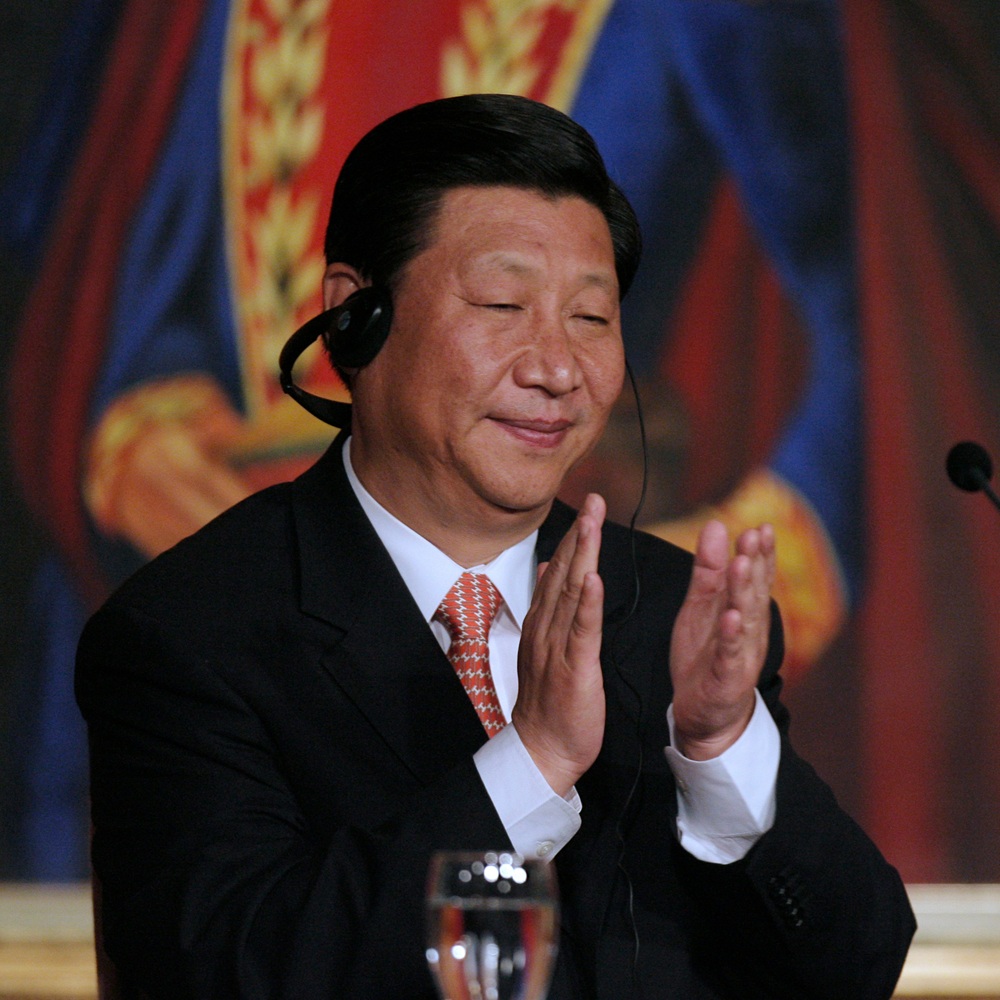
Caracas (Venezuela) Feb. 18, 2009. The President of the People's Republic of China, Xi Jinping, arrival to Caracas, Venezuela, on official visit in febraury 18, 2009.

Why China is watching Trump’s Venezuela campaign closely

by Tom Harper

Donald Trump’s campaign against Venezuela escalated recently with the US president announcing that the country’s airspace should be considered “closed”. This is a move that has preceded US military interventions in the past, perhaps most notably in Iraq in 2003. It remains to be seen whether Trump’s declaration will be followed by military action or is just a means of raising the pressure on the Venezuelan leader, Nicolás Maduro, in an attempt to force him from office. But regardless of what happens next, what has been notable is the reaction of China. In a December 3 briefing, Chinese foreign ministry spokesperson Lin Jian said that closing Venezuelan airspace would violate international norms and infringe on national sovereignty. Jian added that China rejects interference in Venezuela’s internal affairs “under any pretext” and called on all parties to keep Latin America a “zone of peace”. This stance is no great surprise. China has developed strong relationships with several Latin American countries, including Venezuela, as part of a broader strategy to expand its presence in regions long dominated by the US. Trump’s threats of military action could jeopardise the influence China has built there. China has been involved in Latin America for centuries. But its ties to the region have grown rapidly over the past 25 years or so, with China becoming an indispensable partner to many Latin American countries. Brazil is a clear example of this indispensability. The election of Jair Bolsonaro’s right-wing government in 2018 led to expectations that Brazil would tilt towards Washington. However, such expectations were soon dampened due to China’s role as a major consumer of Brazilian goods. By 2020, China was Brazil’s largest trading partner, accounting for over 30% of total exports from the country. Ties between Brazil and China have only deepened under Bolsonaro’s successor, Luiz Inácio Lula da Silva. This has been helped by the intensification of the US-China trade war, which has seen Brazil become a crucial alternative source of agricultural products such as soybeans that China has historically imported from the US. This relationship has enabled China to exert economic pressure on the US. Brazil’s large soybean exports to China have increased the global supply, which has suppressed prices for all suppliers – including those in US. China has been a similarly indispensable partner to Venezuela since the days of Maduro’s predecessor, Hugo Chávez, who took power in the Latin American state in 1999. Chávez was a keen advocate of a multipolar international order, a concept that has gained traction as Beijing’s political and economic power has grown. Over the years, China has become the main destination for Venezuelan oil. In 2024, China bought around 268,000 barrels of oil from Venezuela on average every day – a figure that, in reality, is likely to be higher as Venezuelan oil is routinely mislabelled to bypass US sanctions. Venezuelan oil is key for China. Beijing has been attempting to diversify its sources of natural resources in recent years as part of efforts to retain its global advantage in cheap manufacturing and wean itself off a dependency on Middle Eastern oil. Trump’s threats to intervene militarily in Venezuela may, at least in part, be aimed at challenging Chinese interests. Indeed, the White House issued an official statement on December 2 affirming the Trump administration’s commitment to the Monroe Doctrine. Signed in 1823, the doctrine said the US would reject other countries’ influence in Latin America. A new “Trump Corollary” to the doctrine states that “the American people – not foreign nations nor globalist institutions – will always control their own destiny in our hemisphere”. Challenging Chinese influence Any US military action in Venezuela will probably increase paranoia across the region. Trump warned recently that any country he believes is making illegal drugs destined for the US is vulnerable to a military attack, and singled out Colombia. On December 2, Trump told reporters at the White House that he “heard” Colombia was “making cocaine”. “They have cocaine plants”, he added. The Colombian president, Gustavo Petro, hit back immediately on social media, saying: “To threaten our sovereignty is to declare war”. But China is unlikely to step in militarily to defend countries in Latin America from US aggression. While China has used its developmental influence there to pursue some political objectives – most notably persuading El Salvador, the Dominican Republic and Honduras to renounce diplomatic recognition of Taiwan in recent years – its engagement with Latin America has largely been transactional. China’s strategy in Latin America is driven primarily by economic considerations, and Beijing has generally been reluctant to enter into formal alliances with states there. This hesitance to commit to defending its partners could strain relations with countries in the region that may expect Beijing to support them in the event of a crisis. However, Trump’s Latin America campaign does provide China with some opportunities. Just as European countries concerned about Russia’s expansionist intentions have become a key market for American arms, it’s possible that Latin America becomes a lucrative destination for Chinese weaponry. Venezuela is already buying Chinese arms, varying from riot control equipment to missiles and – possibly in the future – fighter jets. China has also sold military equipment to Argentina, Bolivia and Ecuador. The US appears to be taking an increasingly active interest in Latin America. As outlined in its recently published National Security Strategy, the Trump administration is looking to readjust the US’s “global military presence to address urgent threats” in the western hemisphere. Having carefully built up its influence in Latin America over many years, China’s leadership will be keeping a keen eye on how events unfold there in the months ahead.

Diplomacy
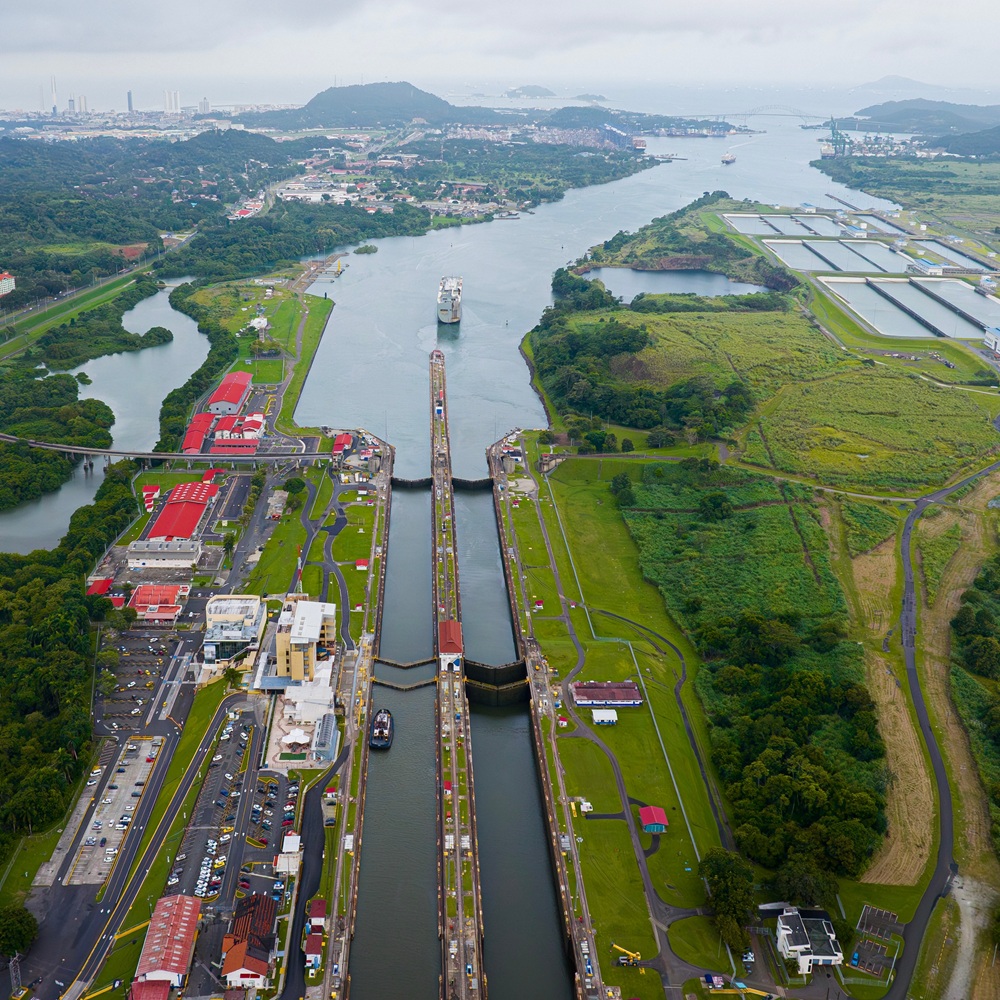
Aerial view Panama Canal, third set of locks, water shortages, maritime traffic, water reuse vats, summer drought.

What CK Hutchison told us in the Panama Case?

by Wallace Loo

The attempted sale of CK Hutchison’s Panama Canal operations to the US-based company BlackRock and Terminal Investment Limited was more than a commercial transaction. When Beijing publicly opposed the deal, branding it a betrayal of national interests, it transformed into a case study in how global business is being reshaped by strategic rivalry. The controversy illustrates a deeper question: Can Hong Kong’s leading conglomerates still operate on commercial logic alone, or are they inevitably drawn into the geopolitical contest between the United States and China? For Hutchison, the Panama case shows that the room for neutrality is shrinking. Why does it matter? Beijing’s intervention signals to Hong Kong businesses and foreign investors alike that commercial neutrality is no longer assured. Loyalty, alignment, and political sacrifice are emerging as expectations alongside profit and efficiency. For global decision-makers, this raises two critical issues: Why did Hutchison seek to exit its Panama Canal holdings in the first place? Why did Beijing judge it necessary to intervene in a transaction that, on the surface, was driven by corporate strategy? Why Hutchison sold its Panama Canal operations? 1. Strategic Realignment Toward Core Businesses CK Hutchison has steadily repositioned itself around two “twin engines”, i.e. real estate in Asia and infrastructure in Europe. While ports in Latin America once fit into its global footprint, they were never central to this model. By selling its Panama Canal operations, Hutchison freed resources to consolidate strengths where it sees long-term stability and growth. This is part of a deliberate shift visible over the past decade: acquiring the German infrastructure firm ISTA in 2017 and securing UK regulatory approval in 2024 for the £11 billion merger of Vodafone UK and Hutchison’s subsidiary Three. These moves point to a concentration of capital in Europe’s regulated infrastructure and Asia’s high-demand property markets, underscoring a deliberate pivot toward strengthening European operations and ensuring cash flow visibility. This implies that Hutchison is reducing its exposure and a systematic exit to regions marked by political uncertainty and doubling down on reinvesting into higher-yielding and strategically aligned assets, particularly in European infrastructure platform while deepening its Asian real estate footprint. For governments and investors, this suggests that Hong Kong conglomerates are not retreating from globalization but are planning to recalibrate toward safer, higher-visibility assets. 2. Capitalizing on Market Timing and Asset Valuation The divestment also reflected classic Hutchison discipline: Buying early and exiting when valuations reach the peak. With global demand for strategic infrastructure rising, the Panama Canal assets commanded a premium. The resulting HK$19 billion in proceeds and a sharp rise in share price underlined investor confidence. Such timing underscores Hutchison’s longstanding strategy of opportunistic repositioning. This divestment was both value-accretive and strategically well-timed. By crystallizing gains now, the group strengthens its balance sheet and cash-reserve, maintaining its flexibility to reinvest or return capital to shareholders. For policymakers, this implies that global infrastructure assets are increasingly financialized. Strategic nodes like the Panama Canal are no longer just trade arteries but high-value commodities in global capital markets. Governments must therefore view divestments not only as corporate decisions but as moves that can shift control of strategic assets between geopolitical actors. 3. Geopolitical Considerations and Risk Mitigation The Panama Canal is a corridor of strategic significance and what US-President Donald Trump calls Chinese ownership on the potential dual-use nature of port terminals there inevitably drew scrutiny in Washington. U.S. allies have already tightened the screening of Chinese-linked infrastructure deals and the EU’s 2019 FDI framework explicitly flagged ports as areas requiring “special oversight”. Against this backdrop, Hutchison sought to avoid being cast as a “Chinese state-backed actor”, an extension of Beijing’s Belt and Road Initiative. Hutchison has taken deliberate steps to present itself as a neutral and commercially driven multinational investor, rather than an extension of Chinese state policy. The company restructured in 2015 to a Cayman Islands base carefully positioning itself apart from state-linked Chinese enterprises, which creates an international legal identity rather than retaining a mainland Chinese or Hong Kong corporate domicile. By exiting Panama, Hutchison not only monetized assets but also reduced exposure to the intensifying Sino-U.S. rivalry in one of the world’s most contested trade chokepoints. For European and U.S. decision-makers, this implies that Hutchison’s move signals how Hong Kong firms navigate geopolitical pressure. It shows that even Chinese-origin conglomerates may prefer retreat to avoid being entangled in state rivalries. Hutchison pre-emptively mitigated the risk of being labelled a “Chinese state proxy” in a critical geopolitical theatre. This move not only alleviated Western concerns about Hutchison’s control of Panama’s ports but also demonstrated the group’s ability to act with commercial neutrality and flexibility, preserving its ability to operate, finance, and expand in Western markets without being constrained by the “Chinese capital” label. For Beijing, however, this retreat risks weakening China’s global port footprint. This highlights a potential divergence between the commercial logic of Hong Kong firms and China’s strategic ambitions. Why did Beijing intervened? 1. Loss of Chinese Strategic Assets and Diplomatic Advantage The Panama Canal is among the world’s most critical maritime chokepoints and control of its ports carries weight far beyond commerce. For China, investment in Latin American terminals has been part of a wider strategy to shape global shipping routes and enhance strategic reach. From Beijing’s perspective, CK Hutchison’s divestment was more than a business transaction. This was a strategic setback. The transfer of control to U.S.-linked interests was seen as a symbolic “recapture” of the terminals, which weakens China’s presence at a vital corridor. Within the Chinese leadership, the ports had been regarded as potential bargaining leverage in trade negotiations with Washington. But this loss reduced Beijing’s diplomatic toolkit at a time of rising frictions. The episode illustrates how Chinese policymakers increasingly view overseas ports as instruments of geopolitical positioning, not just commercial assets. Hutchison’s decision to sell underscored a broader reality: not all Chinese-affiliated enterprises act in alignment with state objectives. For Beijing, this implies that the Panama case highlighted the limits of relying on Hong Kong conglomerates to advance strategic interests abroad. For foreign governments and firms, it signalled both China’s heightened sensitivity to divestments in contested regions and the growing tension between corporate autonomy and state geopolitical expectations. 2. Absence of Beijing’s Prior Approval Sparked Political Backlash In the Panama Canal divestment, Beijing’s leadership reacted strongly against CK Hutchison’s “transaction first, then approval” approach. Beijing expressed dissatisfaction and even instructed state-owned enterprises to suspend new collaborations with the Li family, who serve as the controlling shareholders and principal decision-makers of Hutchison. Hutchison defended this sale as a “purely commercial and competitive process” by emphasizing Mediterranean Shipping Company as the principal buyer. Yet, in the context of intensifying Sino-U.S. rivalry, this stance was no longer acceptable. Regulatory pressure and political intervention from Beijing slowed negotiations, preventing the transaction from proceeding as planned. The broader precedent is clear: in strategically sensitive areas, Beijing now expects Hong Kong firms to align commercial decisions with state priorities. Neutrality is no longer an option. This marks a fundamental shift in the operating environment, binding the leading Hong Kong conglomerates more closely to state interests and constraining their room for independent strategic choices. For policymakers and investors, this implies that the Panama case shows how Beijing is extending political oversight into commercial domains once seen as autonomous. Hong Kong enterprises face increasing limits on their ability to separate business logic from state loyalty, particularly where Sino-U.S. rivalry is at stake. 3. Public Opinion as Strategic Pressure: Shaping a New Regional Order Beijing’s response to Hutchison’s Panama sale was not confined to official channels. Pro-Beijing media denounced the deal as disloyal and profit-driven, framing it as a matter of national honour. When the Hong Kong and Macao Affairs Office of the State Council, which is the Beijing central body responsible for overseeing Hong Kong and Macao affairs, amplified these narratives, they gained quasi-official status and exerted pressure on both Hutchison and other Hong Kong firms. This discourse resonated beyond China. The Panama Canal Authority warned that excessive concentration of terminal assets could undermine neutrality and competitiveness. This wording strikingly complies with Beijing’s “anti-hegemony” rhetoric. By shaping the terms of debate, Beijing positioned itself to argue for greater balance and competition in Panama’s port operations. Looking ahead, China advocates to leverage new concession tenders to advance its tactical objectives: strengthening the role of China Ocean Shipping Company, counterbalancing U.S. and European dominance and embedding Chinese capital in Latin America’s maritime infrastructure. More broadly, the case illustrates how Beijing integrates public opinion, regulatory narratives, and commercial strategy to shape a regional order more favourable to its interests. For policymakers, this implies that Panama demonstrates how Beijing transforms domestic media pressure into a tool of international influence. What begins as reputational discipline at home can translate into bargaining leverage abroad, particularly in contested regions where infrastructure and influence are intertwined. Points of Special Relevance: Beijing’s Strategic Signal Beijing’s intervention in the Panama Canal case should be read not as a single act but as a strategic signal. Its aims to prevent U.S. and European firms from consolidating control at a vital chokepoint and to avoid the appearance of “losing” strategic assets. At the same time, Beijing used this episode to remind Hong Kong conglomerates that in sensitive geopolitical contexts, commercial logic alone is no longer sufficient. The Panama case demonstrates how Beijing leverages commercial disputes as instruments of statecraft. The more plausible outcome is a conditional arrangement to encourage Panama to introduce mechanisms that limit Western influence in Latin America. China seeks structural adjustments that preserve its influence and reshape the regional order to its advantage. From Neutrality to National Loyalty As U.S. China tensions intensify, many multinational firms pursue de-risking strategies: not full decoupling as it is economically unviable, but carefully calibrated ambiguity that allows them to operate in both markets without explicit political commitments. This balancing act is becoming harder in Hong Kong. Since 1997, the influx of mainland state-linked enterprises has blurred the line between state and market. Benefiting from the “One Country, Two Systems” framework, these firms embedded political expectations into business norms. Ties to the National People’s Congress or the Chinese People's Political Consultative Conference are increasingly relevant in Hong Kong. By 2019, Beijing moved further, promoting patriotism in the business sector such as the Greater Bay Area Business Support Scheme, which channels funding toward firms demonstrating “patriotic entrepreneurship” or contributions to “national rejuvenation”. The result is a growing convergence of economic and political expectations. Commercial autonomy is increasingly contingent on political alignment, eroding the distinction between business logic and ideological loyalty. For investors and firms, this raises strategic concerns: - Will political loyalty requirements constrain the free flow of capital? - Could companies risk state intervention or even nationalization if perceived as acting against China’s interests? These questions remain unresolved, but Hutchison’s Panama case shows how quickly a commercial decision can be redefined as a matter of national loyalty. The broader uncertainty surrounding Hong Kong’s business environment will shape the city’s role as a financial hub in the decade ahead. This is my view on things: An Outlook on Hong Kong Looking ahead, the space for Hong Kong conglomerates to maintain commercial neutrality is narrowing. The rise of a nationalist business paradigm means companies must increasingly balance political conformity with economic self-interest. Two scenarios are emerging: 1. “Hong Kong, then China”: firms retain some operational autonomy and global credibility by prioritizing commercial logic, while carefully managing political sensitivities. 2. “China, then Hong Kong”: political loyalty takes precedence, with business priorities subordinated to national strategic goals of the Chinese Communist Party. Which path prevails will determine Hong Kong’s role as a financial hub. The tension between economic liberalism and political loyalty is no longer abstract. It is becoming the defining fault line for Hong Kong’s business landscape in the decade ahead.

Diplomacy
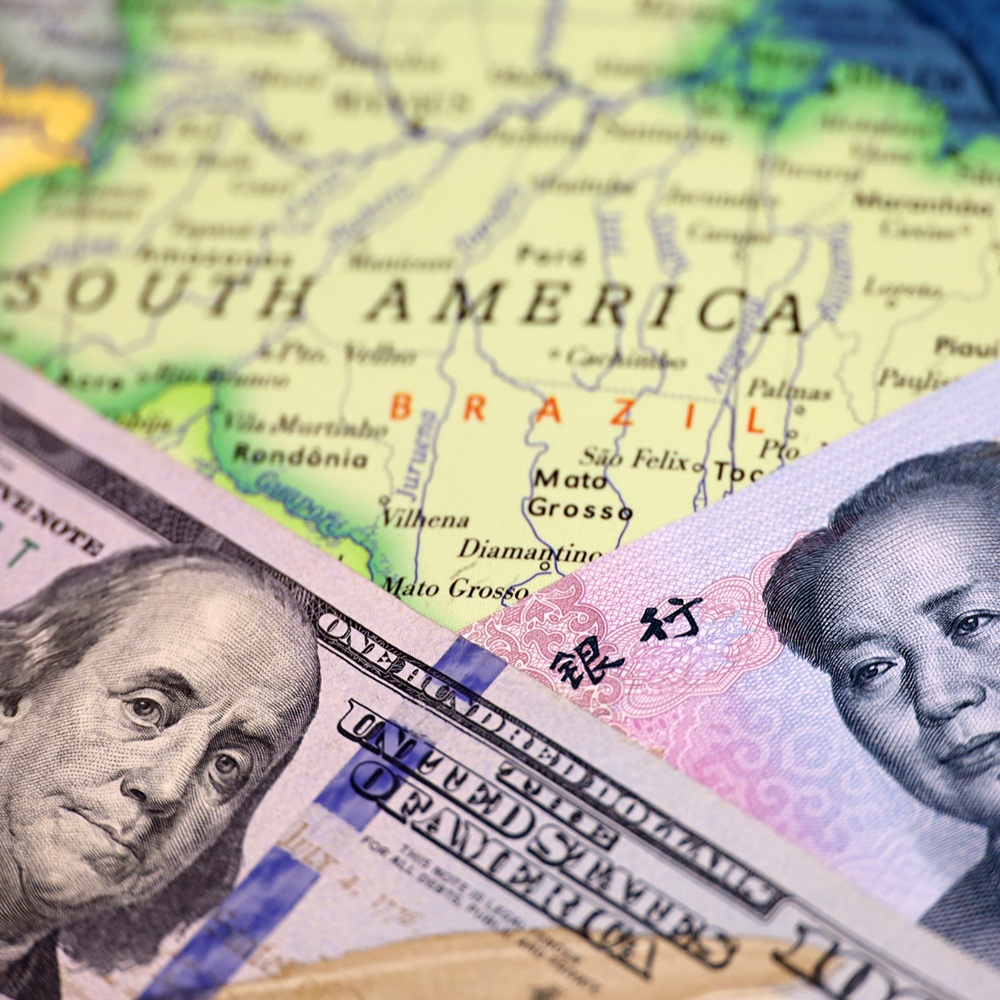
US dollar and Chinese yuan on the map of Brazil. Economic competition between the China and USA in Latin America countries

China Advances and the US Retreats in Latin America and the Caribbean

by Hyeran Jo , Nathalie Mendez

The BRICS meeting in Rio on July 6th and 7th gives a snapshot of the great power competition between China and the United States in different regions around the world, including Latin America. China has become the largest trading partner for many countries in Latin America, investing heavily in infrastructure and forging political alliances that further its strategic objectives. For its part, the Trump Administration of the United States issued the statement that those participating countries will face increased tariffs. The statement was the continuation of exercise and assertion of its authority for the past and present century. The positioning of various BRICS members and participating countries is particularly telling of what the great power competition means in the region and also globally. Brazil’s Lula hosted the meeting aiming to showcase its foreign policy leadership, not necessarily antagonizing the West. Russia is still going through the war in Ukraine, and Putin attended only online. India’s Modi was present as well as Ramaphosa from South Africa. No show of Xi Jinping was notable, although Premier Li Qiang was attending. Besides the BRICS core, other countries also showed promotion of their interests. Iran, for one, joined the group in 2024 and sent a ministerial level delegation to rebuke recent strikes on Iran. As the United States appears to be pulling back from its traditional leadership role in the world, China is seizing the opportunity to expand its influence and reshape global dynamics. Through a combination of state-driven development policies and active international engagement, Beijing has positioned itself as a major player in the Global South, extending its reach beyond Asia to regions such as Africa and Latin America. China’s increasing presence in the region has been mainly driven by the Belt and Road Initiative (BRI) and a surge in trade volumes, marking a major shift in the region’s economic landscape. Many experts point to China’s use of “infrastructure diplomacy”—financing ambitious, strategic infrastructure projects across the region—as a key factor in this rise. The numbers tell a compelling story. Trade data from the World Bank (Figure 1) shows that in the past ten years, China has overtaken the United States as the leading trading partner for much of the region, upending a dynamic that had held steady since the early 2000s. Beyond trade, China’s influence deepens through the 22 countries in Latin America and the Caribbean that have joined the Belt and Road Initiative. Chinese loans have poured in, funding major energy, infrastructure, and development projects that have reshaped local economies. China’s push isn’t just economic—it’s political too. Beijing has taken steps to strengthen cultural ties, increase academic exchanges and boost tourism in Latin America, including waiving visa requirements for travelers from some countries. This multi-faceted approach highlights China’s pragmatic mix of economic self-interest and strategic diplomacy as it works to secure resources, expand markets, and bolster its global standing. On the other hand, the United States has long been a strategic ally and key trading partner for Latin America. Agencies like USAID have funneled millions of dollars into economic and military initiatives across the region. With the recent changes in the aid policy, immigration policy, and tariff policy, Washington’s recalibration of its foreign policy are transforming the geopolitical balance in Latin America and the Caribbean. As both powers deploy their strategies — from deepening economic ties to defending national interests — the decisions of Latin American states remain critical in shaping their alignments with global powers. The ultimate outcome is still up in the air, but one thing is clear: power in the region is actively being renegotiated. The diverging approaches from China and the US have set the stage for a broader reconfiguration of power in Latin America and the Caribbean. Yet, it’s essential to recognize that each country’s internal decisions and policies also play a critical role in shaping this shifting landscape. Colombia provides a case in point. Historically, it has maintained close diplomatic ties with the United States while keeping China at arm’s length. Unlike countries like Brazil, Argentina, and Peru, Colombia has received relatively little Chinese infrastructure investment. However, with the election of president Gustavo Petro—the first left-wing president in the country’s history—Colombia has taken decisive steps to strengthen its relationship with China, presenting new challenges for the United States to maintain its strategic foothold in the country. We observe – both on political and economic dimensions – that the changes in China’s strategy, coupled with Colombia’s domestic policies, have reduced the country’s dependence on the US while increasing its desire to integrate with China. Politically, Colombia and the United States have long enjoyed a strong diplomatic relationship, as reflected in their shared memberships in international organizations, high-level dialogues, and multiple bilateral agreements. However, diplomatic tensions have emerged in recent years. Disputes between the two leaders, the change of course of USAID, and a significant drop in new bilateral agreements over the past four years have contributed to a shift in this traditionally stable partnership. Against this backdrop, diplomatic ties between China and Colombia have strengthened. In 2023 alone, both countries signed 12 cooperation agreements in trade, technology, and economic development, upgraded their relationship to a strategic partnership, and Colombia’s entry into the Belt and Road Initiative during recent China – CELAC Forum in May. Colombia also joined the BRICS New Development Bank a few weeks after that Forum. Economically, the US has traditionally been Colombia’s largest trading partner, backed by a free trade agreement and significant investment. Yet, in recent years, the share of US trade has steadily declined, while China’s footprint has grown (see figure 1). Although there’s no formal trade agreement, ties have strengthened during the current administration, including the opening of a Buenaventura-Shanghai trade route in 2025. Additionally, China’s “infrastructural diplomacy” has significantly grown: over 100 Chinese companies now operate in Colombia, and major infrastructure projects like Bogotá’s Metro Line 1 and the Regiotram are underway, along with investments in mobility, technology, and health. Latin America, and Colombia in particular, finds itself at the center of a geopolitical tug-of-war with China’s calculated investments and the US’s shifting policies. While Beijing leverages trade, infrastructure, and cultural diplomacy to expand its influence, Washington’s recalibration of its foreign policy leaves room for new alliances and opportunities. Our analysis shows that power reconfiguration is not merely a product of external rivalry. It is driven by the choices each Latin American nation makes. As Colombia’s case demonstrates, the region’s destiny hinges not just on global superpowers, but on its own internal political decisions and developments. The coming years will test how Latin America navigates these shifting currents. Disclaimer This article was made possible in part by a grant from the Carnegie Corporation of New York (G-PS-24-62004, Small State Statecraft and Realignment). The statements made and views expressed are solely the responsibility of the authors. Figure 1: China vs. US Import and Export TrendsDrawn by the authors using data from the World Bank.  

Energy & Economics
A dedollarisation concept with the BRICS on top of a pile of US dollar bills.

BRICS and De-Dollarization as a Geopolitical Industrial Policy: Implications for Cuba, Venezuela, and Argentina

by Alberto Maresca

ABSTRACT  This paper examines de-dollarization as a geopolitical industrial policy within the BRICS framework and its implications for Cuba, Venezuela, and Argentina. De-dollarization, a process aimed at reducing reliance on the US dollar, has gained momentum among BRICS nations as a response to economic sanctions, monetary sovereignty concerns, and external financial shocks, particularly following the 2008 global financial crisis. For Cuba and Venezuela, de-dollarization is necessary due to US sanctions, pushing them toward alternative  financial  mechanisms  through  BRICS  partnerships. Cuba’s  possible  de-dollarization  follows  increased ties with Russia, China, and Iran. Regarding Venezuela, despite its partial dollarization, Caracas seeks  to  strengthen  non-dollar  transactions  through  oil  trade. In  contrast,  under  President  Javier  Milei,  Argentina  has  rejected  BRICS  and  continues  to  debate  dollarization,  reflecting  the  country’s  historical  and economic ties to the US dollar. The study highlights that de-dollarization is a State-led, multilateral process influenced by external economic conditions and geopolitical alignments. While Cuba and Venezuela actively integrate with BRICS to reduce dollar dependence, Argentina’s approach remains uncertain, shaped by ideological and financial considerations. Keywords: De-dollarization, BRICS, Cuba, Venezuela, Argentina INTRODUCTION De-dollarization is almost a synonym of BRICS. The reduction  of  US  dollar  dominance  and  the  consequential dependence on it represent critical stakes for BRICS countries. Nonetheless, there are nuances and differences amongst BRICS members on monetary policies. Since the first summits (2009–2010), BRICS  asserted  the  Global  South’s  need  to  prioritize  trade  in  domestic  currency  and  refrain  from  US  dollar  pegging. For  initial  members  like  China  and  Russia,  as  well  as  newly  associated  countries  such  as  Iran  and  Cuba,  Western  sanctions  are  the  main  driver  for  de-dollarization. Instead,  for  Brazil,  India, and the majority of most recent BRICS partners  (primarily  from  Africa  and  Southeast  Asia),  de-dollarization  means  enhancing  their  monetary sovereignty,  fostering  domestic  currencies’  value,  and  avoiding  depending  on  US  institutions:  Treasury and Federal Reserve. De-dollarization pertains to  monetary  and  public  policies. Therefore,  it  is  a  state-led process. For this reason, it might be considered an industrial policy. It is necessary to outline that this article adopts the term geopolitical industrial  policy  for  a  State-led  economic  strategy  that,  unlike  inward-oriented  monetary  or  financial  policies, is deeply intertwined with the outward-looking dimension of foreign policy. Hence,  this  work  examines  de-dollarization  as  a  geopolitical  industrial  policy  within  the  BRICS  framework  and  its  implications  for  Cuba,  Venezuela,  and  Argentina. De-dollarization,  a  process  aimed  at  reducing  reliance  on  the  US  dollar,  has  gained momentum  among  BRICS  nations  as  a  response  to economic sanctions, monetary sovereignty concerns,  and  external  financial  shocks,  particularly  following the 2008 global financial crisis. For Cuba and  Venezuela,  de-dollarization  is  necessary  due  to  US  sanctions,  pushing  them  toward  alternative  financial  mechanisms  through  BRICS  partnerships. Cuba’s  possible  de-dollarization  follows  increased  ties  with  Russia,  China,  and  Iran. Regarding  Venezuela, despite its partial dollarization, Caracas seeks to  strengthen  non-dollar  transactions  through  oil  trade. In  contrast,  under  President  Javier  Milei,  Argentina has rejected BRICS and continues to debate dollarization, reflecting the country’s historical and economic ties to the US dollar. The study highlights that de-dollarization is a State-led, multilateral process  influenced  by  external  economic  conditions  and geopolitical alignments. While Cuba and Venezuela actively integrate with BRICS to reduce dollar dependence,  Argentina’s  approach  remains  uncertain,  shaped  by  ideological  and  financial  considerations. It is undebatable that there are differences between usual industrial policies and de-dollarization. Indus-trial policies look inward, are fashioned upon domes-tic  matters,  and  contradict, court,  multilateral  efforts. De-dollarization  is  a  geopolitical  industrial  policy that looks outward, focusing on the role of a given country in the world economy. Without multilateralism, a State pursuing de-dollarization would quickly become a pariah. As a geopolitical industrial policy,  de-dollarization  owes  its  rationale  to  external  shocks. It  is  safe  to  define  de-dollarization  as  exogenously  motivated. The  2008  global  financial  crisis (GFC) represented the critical external shock for  BRICS  members  to  escalate  their  de-dollarization objectives: “[E]specially  since  the  2008  global  financial  crisis,  central banks of many countries have been trying to diversify their portfolios to shift away from the US dollar through liquidating holdings of US Treasuries and increasing other assets including the euro, yen, renminbi and gold.” (Li, 2023, p. 9).  The 21st century wrought incentives to de-dollarization that finally sparked because of the GFC. However,  the  mainstream  doubts  surrounding  de-dollarization involve its feasibility. There are no tools to objectively  measure  the  status  of  de-dollarization  or its future outcomes. Notwithstanding limitations, de-dollarization  is  increasingly  attracting  Global  South economies. Specifically looking at Latin America,  this  work  outlines  how  de-dollarization  becomes  an  obligation  for  sanctioned  countries:  Cuba  and  Venezuela. The  two  ALBA  governments  mingled  with  BRICS  for  a  long  time,1  with  Havana  joining the forum in association and Venezuela almost on the same route, stopped by the Brazilian veto in the  Kazan  summit. Cuban  and  Venezuelan  de-dollarization finds in BRICS a multilateral opportunity.  The third country examined is Argentina since the government  of  Javier  Milei  refused  to  enter  BRICS  and  continuously  flirted  with  dollarizing  the  economy. From President Menem’s pegging to the US dollar (uno a uno) to the 2001 Corralito, Argentina’s recent economic history inevitably rests on currency issues (IMF, 2003). Unlike Venezuela, and on the contrary of Cuba (which is not part of the IMF), Argentina’s economic policies intertwine with Bretton Woods  institutions. That  might  be  the  reason  why  neoliberal Argentinian economists found in dollarization  a  solution  for  Buenos  Aires  (Cachanosky  et  al., 2023).  1. Force Majeure De-Dollarization for Cuba and Venezuela  Since  1999,  when  Fidel  Castro  and  Hugo  Chávez  coincided, de-dollarization meant an industrial foreign policy to antagonize US hegemony. In Cuba, de-dollarization  is  a  more  difficult  process  than  usual  assumptions  and  certainly  more  challenging  than  in  Venezuela. 2004  marked  the  year  when  the  US  dollar  was  officially  prohibited  on  the Caribbean Island, to reverse the dual currency  system  implemented  since  the  Special  Period  (Herrera  &  Nakatani,  2004). The  extra-territoriality  of  US  sanctions,  affecting  in  their  secondary effect  Cuba’s  trade,  led  Havana  to  a  de-dollarization fashioned upon the path that Deligöz (2024) identified  for  China  and  Russia. Besides  realpolitik  and  geopolitical  strategies,  Cuba’s  association  with  BRICS,  occurred  in  October  2024,  is  the  la-test  effort  to  de-dollarize. Venezuela’s  economic  crises and COVID-19 pushed Cuba into continuous indebtedness to survive, with US dollars reallowed but  still  at  limited  provision  due  to  Washington’s  restrictions  (Luis,  2020). To  give  account  of  its  urgencies,  in  a  few  months,  Havana  moved  from  apparent dollarization to initiatives for de-dollarization, thanks to BRICS. Over the summer, Primer Minister Manuel Marrero enabled USD payments in the  tourist  sector  (Gámez  Torres,  2024)  to  tackle  the balance of payments deficit with liquidity. For  a  country  obliged  to  rapidly  change  industrial  policies,  the  BRICS  opportunity  could  not  be  mis-sed. Cuba’s  reliance  on  Russia,  China,  and  Iran  may  materialize   a   complete   de-dollarization   that   can   favor  BRICS  projects  and  escape  US  sanctions. Of  course, the evident permanence of the bloqueo, regardless  of  who  runs  the  White  House,  is  the  main  driver for Cuba’s de-dollarization. A similar but quite nuanced situation applies to Venezuela as well. From the Bolivarian era inaugurated by President Chávez, de-dollarization  entangled  foreign  policy  objectives  even before US sanctions. The Sucre digital currency was  created  by  the  governments  of  Venezuela  and  Ecuador  as  the  main  ALBA  initiative  to  de-dollarize  commercial  transactions  among  Bolivarian  nations  (Benzi et al., 2016). ALBA-promoted Sucre was analogous to BRICS’ favoring of blockchains and digital currencies, limiting the USD to a reference value for the  bloc’s  transactions  (Mayer,  2024). US  sanctions  on Venezuela’s oil production, sparked under the first Trump Administration, meant a significant remotion of USD-denominated transactions for Caracas. Considering  ALBA’s  slow  progress  and  the  infeasibility  of fully adopting the Sucre, President Maduro had to look at BRICS for solutions. Despite  not  having  diplomatic  relations  with  Washington,  Venezuela  is  still  an  IMF  member. Ladasic points  out  that  “[a]s  Venezuela  joined  the  pack  of  countries  trading  oil  outside  of  USD  and  has  instead priced it in Chinese yuan, BRICS together with Venezuela  already  have  16%  needed  for  IMF  veto  power to use in a crisis” (2017, p. 100). The rentier characterization of the Venezuelan economy and its dependency  on  oil  exports  make  de-dollarization  a necessity. As per Cuba, unilateral policies are not enough. Venezuela’s  outcry  merged  with  inflation,  the  devaluation  of  the  bolívar,  and  a  paralysis  of  the  Venezuelan  Central  Bank  (BCV)  that  put  total  dollarization on the industrial-public policies’ table (Briceño  et  al.,  2019). Although  the  country  is  still  under  a  sort  of  de  facto  dollarization,  Venezuela’s  economic  resurrection  should  occur  together  with  a  de-dollarization  strategy. Failure  to  enter  BRICS  in the Kazan summit provides a temporary brake to Venezuela’s  de-dollarization,  but  the  prolific  trade  with China, Russia, Iran, and Türkiye will, in all cases, align Venezuela with BRICS policies. 3. Argentina: De-Dollarizing a Passion Economists  were  surely  interested  in  Javier  Milei’s  dollarization  claims. Less  than  a  year  into  his  government,  dollarization  seems  impossible  to  the  libertarian  president. Milei’s  negative  to  BRICS  demonstrates  that  de-dollarization  is  currently  not  considerable  for  Casa  Rosada. Nevertheless,  it  is  relevant to outline that Argentinian academia questioned  the  role  of  the  USD  and  studied  economic  policies  involving  de-dollarization. Corso  and  Sangiácomo (2023), in affiliation with the Central Bank of  Argentina  (BCRA),  argued  that  de-dollarization  might  help  in  relieving  the  extreme  inflation  saw  under  Alberto  Fernández’s  ruling. Other  authors  implied  that  the  Kirchners’  limitations  on  USD  access would lead to a gradual de-dollarization of the economy,  but  with  constraints  particularly  from  a  USD dominated housing market across Latin America  (Luzzi,  2013). If  under  the  Kirchners,  and  with  support of South American left-leaning geopolitics, de-dollarization  could  really  offer  a  pathway  for  the Argentine economy, with Milei that is barely an option. The  Argentine  relation  with  the  USD  does not hold a clear ideological cleavage. Argentinians’ passion for the dollar, as stressed by Bercovich and Rebossio (2013), embraced diverse political figures such as Perón, Aníbal Fernández (a prominent Kirchnerist politician), and Martínez de Hoz. The peso’s continuous  instability  legitimized  the  widespread  informal adoption of the USD, with first insight fore-seeable in the currency devaluation subsequent to the Great Depression (Díaz Alejandro, 1970). There is also a nationalistic meaning behind the peso, whose  national  heroes  imprinted,  from  Belgrano  to  Evita (Moreno Barreneche, 2023), portray a sentimental attachment to the banknotes that Argentinians do not want to erase. In sum, Argentina’s de-dollarization is as difficult as dollarization. Milei’s obsession for US hegemony inserts de-dollarization in a faraway scenario. Moreover,  Donald  Trump’s  victory,  who  promised  high tariffs to countries that unpeg from the USD (Butts,  2024),  constitutes  a  natural  barrier  to  de-dollarization. Its political viability might depend on an eventual Peronist succession to Milei. Argentina’s financial closeness  to  China,  and  a  possible  resume  of  BRICS  talks,  could  indicate  de-dollarization  as  a  future  last  resort. In this sense, de-dollarization within the BRICS framework might help Argentina in solving structural issues: Chronic external debt and dependency on Bretton Woods institutions. CONCLUSIONS De-dollarization is State-led and can be considered a  geopolitical  industrial  policy. Cuba,  Venezuela,  and  Argentina  show  that  de-dollarization  depends  on  geopolitical  calculus  and  economic  considerations. The incentives may be different, ranging from US sanctions to devaluation of the national currency. However,  unlike  dollarization,  de-dollarization  cannot  be  pursued  unilaterally. The  rise  of  BRICS  motivates  Global  South  countries  to  de-dollarize  under its guarantees. For Cuba and Venezuela, the association  with  BRICS  and  the  interdependence  with other sanctioned economies like Russia, China, and Iran, make de-dollarization an opportunity. Argentina’s  relation  with  the  USD  follows  its  turbulent  economic  history. Simultaneously,  there  is  passion  for  dollars and nationalism toward the peso banknotes. In this  context,  even  Milei  showed  that  dollarization  is  in  no way easier that de-dollarization. The currency issues affecting Argentina might not be resolved by neither of the two policies, but a future BRICS collaboration could bring de-dollarization again into the political debate. NOTES1  ALBA  references  the  Alianza  Bolivariana  para  los  Pueblos  de  Nuestra  América,  a  regional  organization  founded  by  Cuba  and  Venezuela,  including Bolivia, Honduras, Nicaragua, and several Caribbean islands. It was created in 2004 under the auspices of Hugo Chávez.REFERENCESBenzi,  D.,  Guayasamín,  T.,  &  Vergara,  M.  (2016). ¿Hacia  una  Nueva   Arquitectura   Financiera   Regional?   Problemas   y  perspectivas  de  la  cooperación  monetaria  en  el  AL-BA-TCP. Revista Iberoamericana de Estudios de Desarrollo, 5(1), 32–61. https://doi.org/10.26754/ojs_ried/ijds.193. Bercovich, A., & Rebossio, A. (2013). Estoy verde: Dólar, una pasión argentina. Aguilar.Butts, D. (2024, September 9). Trump’s vow of 100% tariffs on nations that snub the dollar is a lose-lose for China and U.S., economist says. CNBC. https://www.cnbc.com/2024/09/09/economist-calls-trumps-threat-to-tariff-countries-that-shun-the-dollar-a-lose-lose.html. Cachanosky, N., Ocampo, E., & Salter, A. W. (2023). Les-sons from Dollarization in Latin America. Free Market Institute  Research  Paper  No.  4318258,  AIER  Sound  Money  Project  Working  Paper  No.  2024-01.  https://doi.org/10.2139/ssrn.4318258. Corso, E. A., & Sangiácomo, M. (2023). Financial De-dollarization in Argentina: When the wind always blows from the East. BCRA Economic Research Working Paper No. 106. https://www.econstor.eu/handle/10419/297801.Deligöz, H. (2024). The Exorbitant Privilege of US Extra-territorial  Sanctions.  İnsan  ve  Toplum,  14(3),  29–52.  https://dergipark.org.tr/en/pub/insanvetoplum/is-sue/86942/1543025. Díaz Alejandro, C. F. (1970). Essays on the Economic His-tory of the Argentine Republic. Yale University Press.Gámez  Torres,  N.  (2024,  July  18).  Cuba  moves  to  ‘partially’  dollarize  economy  as  government  struggles  to  make  payments.  Miami  Herald.  https://www.mia-miherald.com/news/nation-world/world/americas/cuba/article290210784.html. Herrera,  R.,  &  Nakatani,  P.  (2004).  De-Dollarizing  Cuba.  International  Journal  of  Political  Economy,  34(4),  84–95. https://www.jstor.org/stable/40470915. Hurtado  Briceño,  A.  J.,  Zerpa  de  Hurtado,  S.,  &  Mora  Mora,  J.  U.  (2019).  Dollarization  or  Monetary  Independence?  Evidence  from  Venezuela.  Asian  Journal  of  Latin  American  Studies,  32(4),  53–71.  https://doi.org/10.22945/ajlas.2019.32.4.53. IMF. (2003, October 8). Lessons from the Crisis in Argen-tina. Ladasic,  I.  K.  (2017).  De-Dollarization  of  Oil  and  Gas  Trade.  International  Multidisciplinary  Scientific  Geo-Conference,    17,    99–106.    https://doi.org/10.5593/sgem2017H/15. Li,  Y.  (2023).  Trends,  Reasons  and  Prospects  of  De-Dollarization. South Centre Research Paper No. 181. https://www.econstor.eu/handle/10419/278680. Luis, L. R. (2020, October 7). Cuba: Dollar Crunch, Dollarization and Devaluation. Cuba Capacity Building Project. https://horizontecubano.law.columbia.edu/news/cuba-dollar-crunch-dollarization-and-deva-luation. Luzzi,  M.  (2013).  Economía  y  cultura  en  las  interpretaciones sobre los usos del dólar en la Argentina. In  A.  Kaufman  (Ed.),  Cultura  social  del  dólar  (pp.  11–19).  UBA  Sociales.  https://publicaciones.sociales.uba.ar/index.php/socialesendebate/article/view/3319.Mayer,  J.  (2024).  De-Dollarization:  The  Global  Payment  Infrastructure  and  Wholesale  Central  Bank  Digital  Currencies.  FMM  Working  Paper  No.  102.  https://www.econstor.eu/handle/10419/297865. Moreno  Barreneche,  S.  (2023).  El  dinero  como  soporte  material  de  la  disputa  por  el  sentido  de  la  nación:  Estudio  del  peso  argentino  desde  una  perspectiva  semiótica.  Estudios  Sociales:  Revista  Universitaria  Semestral,  64,  1–19.  https://doi.org/10.14409/es.2023.64.e0046. CONFLICT OF INTERESTThe  author  declares  that  there  are  no  conflicts  of  interest related to the article.ACKNOWLEDGMENTS Not applicable.FUNDING Not applicable.PREPRINT Not published.COPYRIGHT Copyright  is  held  by  the  authors,  who  grant  the  Revista  Política  Internacional  the  exclusive  rights  of  first  publication. Authors  may  enter  into  additional agreements for non-exclusive distribution of the  version  of  the  work  published  in  this  journal  (e.g.,  publication  in  an  institutional  repository,  on  a personal website, publication of a translation or as a book chapter), with the acknowledgment that it was first published in this journal. Regarding copyright, the journal does not charge any fee for the submission, processing, or publication of articles.

Diplomacy
China flag painted on a clenched fist. Strength, Power, Protest concept

The international reconfiguration's process towards multipolarity. The role of China as an emerging power

by Rachel Lorenzo Llanes

Abstract The international system is currently undergoing a process of reconfiguration that is having an impact on all areas of global development. In this process of reordering power relations, there is a tendency to move towards multipolarity, leaving behind the unipolar coalition established after the Second World War. In this context, several emerging powers are gaining increasing international power, which has led to changes in the hierarchy of power on the international geopolitical chessboard. Such is the case of the People's Republic of China, which has established itself not only as a power of great impact and relevance in the Asian region, but also in the entire international system. Namely, the management of the government and the Party in terms of innovation, industrialization, informatization, productivity, expansion and internationalization of its economic model, positions this country as the most dynamic center of the international economy. Evidencing that alternative models to the capitalist system are possible and viable, which strengthens the trend towards a systemic transition and multipolarity in the International System Introduction In the last two decades, a set of geopolitical and geoeconomic tensions and conflicts have become evident, with significant implications extending throughout the International System. As a result, we are currently experiencing a convulsion of the established order, giving way to a process of new global reconfigurations. In this context, several researchers and academics such as Jorge Casals, Leyde Rodríguez, Juan Sebastián Schulz, among others, have noted that these conditions have led to a crisis and hegemonic transition process, with a trend toward multipolarity in which the Asia-Pacific region is gaining increasing relevance. This article, titled "The International Reconfiguration’s Process Towards Multipolarity: The Role of China as an Emerging Power," is dedicated to analyzing the position of this country within the current international reconfiguration of power. Accordingly, the first section will systematize some essential guidelines to understand the current crisis and the decline of the hegemonic order established in the post-World War II period. The second section will address China's positioning amid the international reconfiguration of power. In this regard, it is important to note that China's rapid rise highlights how development management aligned with the Sustainable Development Goals can lead to a shift in the paradigm of international relations, as well as power reconfigurations that challenge the current balance of forces. Thus, it can be affirmed that China's rise constitutes a decisive element within the current trend toward multipolarity. DevelopmentNew International Order: Approaches to the Multipolar Reconfiguration of the International System The current international context is marked by a process of crisis. This crisis reflects the fact that the world order no longer aligns with the correlation of forces that gave rise to it during the post-World War II period. It is not a circumstantial crisis, but rather the interlinking of various interconnected crises that span across all sectors of life. That is to say, the effects of one crisis often become the causes of another, involving economic, political, social, cultural, ethical, moral, technological, commercial, and environmental components. In other words, it is a structural and systemic crisis—one that cannot be resolved unless a similarly systemic transformation occurs. To gain greater clarity, it is important to consider that the consolidation of the capitalist system brought about the process of globalization. This, in turn, introduced large-scale production and technological development capable of increasing output. This process, along with other characteristics of the system, has exponentially accelerated social inequalities between developed and developing countries. It has also led to strategic tensions over the control of resources, raw materials, and inputs, resulting in geopolitical conflicts. Furthermore, the capitalist system has imposed an extremely high environmental cost, demonstrating that it is exceeding both its own limits and those of the planet. Specifically, in its constant pursuit of profit and maximization of gains, negative environmental impacts are not factored into cost-benefit analyses, leading to widespread environmental degradation. Among other harms caused by the system, we observe a decline in investment rates, an increase in public debt, loss of autonomy in monetary policy, rising unemployment levels, reductions in real wages, and growing inequality, among others. In short, capitalism has become an unsustainable system whose primary concern is profit generation—something that is currently entirely incompatible with environmental preservation and the responsible use of natural resources. Therefore, it can be affirmed that some of its most alarming effects include: vast amounts of currency without backing, increasingly concentrated in fewer hands; acceleration of capital concentration in the West; rising military expenditures; and environmental pollution and destruction (Casals, J., 2023). On the other hand, it is necessary to clarify that, for a particular state to be considered hegemonic, it must not only exert its influence predominantly within the system of international relations; its hegemonic role must also be linked to the founding and establishment of a universally accepted concept of world order. That is, the majority of other states must recognize it as such and identify with the model promoted by the hegemon. Therefore, it is not merely a matter of a hierarchical order among states, but rather the adoption of a dominant model of production that involves those states. As a result, certain mechanisms or general rules of conduct are established for the participating states. For this reason, a hegemonic crisis involving the dominant actor in the system of international relations leads to a crisis in the social, economic, political, and institutional structures upon which that actor’s dominance was built. In light of these elements, we currently observe a set of powers within the International System that are vying to establish a new distribution of power—one that moves away from the unipolar coalition led by the United States following World War II. From this perspective, Juan Sebastián Schulz asserts: “A hegemonic crisis occurs when the existing hegemonic state lacks either the means or the will to continue steering the interstate system in a direction broadly perceived as favorable—not only for its own power, but also for the collective power of the dominant groups within the system.” (Schulz, J. S., 2022) As a result, strategic alliances have been formed and new power groups have emerged that influence international relations.These blocs are precisely what the new polarity is forming around, increasingly reinforcing the trend toward multipolarity. This is a system in which hegemonic influence is not determined by a single power, but by two, three, or more. In this regard, Juan Sebastián Schulz further notes that a process of insubordination is becoming evident, particularly in the Western peripheries. As a consequence, several countries have begun to criticize the configuration of the contemporary world order, initiating efforts to organize and propose alternative models (Schulz, J. S., 2022). This reveals the emergence of a new kind of power hierarchy, generating a global order in which a diversity of forces and actors prevails. In this context, China has experienced rapid growth, thereby contributing to the trend toward multipolarity. While this does not imply that the United States will cease to be one of the central powers in the system of international relations—given its considerable global influence—it is evident that there is a noticeable decline in the dominance it held during the unipolar era that emerged after the collapse of the USSR in 1991. This process of intersystemic transition unfolds in various phases. First, there is an observable economic transition marked by a shift in the center of gravity of the global economy toward emerging and developing economies. This shift is accompanied by a necessary technological transition, characterized by a new struggle—this time to lead the technological revolution. These changes, in turn, must be supported by a political transition. Currently, countries from the Global South have gained increasing prominence on the international stage [1]. From this foundation, a geopolitical transition is also underway, where the center of gravity and decision-making—once concentrated in the Anglo-Saxon West—is shifting toward the Asia-Pacific region. Finally, a cultural or civilizational transition is taking place, wherein the previously dominant value system is giving way to the rise of a new worldview. Based on this, the phases of the transition process can be outlined as follows: Existence of a stable order that brings together the majority of nation-states in the International System. - A crisis of legitimacy begins to affect the established global order. - A deconcentration and delegitimization of power emerges, impacting the hegemonic power. - An arms race and formation of alliances ensue in an attempt to preserve the hierarchical order by any means. This leads to a widespread crisis and the rise and emergence of new actors. - A necessary resolution of the international crisis. - Renewal of the system. (Schulz, J. S., 2022) In light of the above, it can be stated that a “new international order” is taking shape. Its manifestations are multifaceted, such as: - The rise of movements and associations of states that serve as alternatives to the neoliberal order. - Emerging powers like China and Russia are gaining strength in various sectors of the international geopolitical arena. - Russia's confrontation with NATO in the context of the conflict with Ukraine. - Sanctions imposed by the United States on various NATO and European Union countries have strengthened the BRICS nations. - The incorporation of new members into BRICS can be seen as an attempt to counterbalance the economic and political dominance of the United States and the European Union. - The expansion of anti-imperialist and anti-neoliberal integration mechanisms that promote South-South cooperation, such as the G-77 + China group. - The financial sanctions imposed by the West on Russia in the context of the Ukraine conflict have sparked a debate about the viability of the international monetary system and the role of the U.S. dollar as a reserve currency. - China and Russia conduct transactions in yuan and sell oil in this currency to Iran, Venezuela, and Gulf countries. China has increased its economic and political influence in the world, which can be seen as a challenge to U.S. hegemony. Its leadership within BRICS and its growing role in the global economy may be indicators of a shift in the balance of power. All these developments reflect a growing awareness within the International System of States regarding the importance of international cooperation to address global challenges such as the climate crisis, pandemics, and food security. They also serve as indicators that a transformation is underway in the way countries interact with each other, resulting in a shift in the economic, political, and strategic center of gravity. In this context, the United States has unleashed a global hybrid war as a desperate attempt to defend and maintain its hegemonic position, which once appeared unshakable in the postwar world. To this end, it has targeted China, as the latter represents its main threat in the economic and scientific-technological order. From this perspective, tensions between the United States and China have significantly deteriorated since the Republican administration of President Donald Trump. Beginning in 2017, his policy took on an aggressive stance toward China, manifesting through a trade war and economic attacks aimed at preserving U.S. global hegemony. This demonstrates that, in response to a process of decline already underway, nationalist and protectionist efforts intensified in the U.S., with policies targeting some of the emerging pillars of the crisis-ridden world order—China being a primary example. Under the administration of Joseph Biden, the focus shifted toward competition, emphasizing the commitment to protect U.S. sovereignty from potential Chinese threats. A significant shift in U.S. foreign policy toward Taiwan became evident with the approval of arms sales to Taiwan in August 2023, which escalated tensions in the region (Collective of Authors). Furthermore, in recent years, the United States has increasingly worked to generate geopolitical and geoeconomic motivations aimed at fostering tensions between China and Russia, potentially sparking conflict between the two. It has strengthened alliances with neighboring countries of these powers—most notably Taiwan and Ukraine—which has triggered concerns and tensions in both nations. A containment policy has also been deployed, including the imposition of trade barriers and tariffs on Chinese products; restricting Chinese companies’ access to U.S. technology and markets; and promoting the diversification of supply chains to reduce dependence on China. Nevertheless, the ongoing sanctions and restrictions have only served to reaffirm the shared survival interests of both powers, strengthening corporate ties and relations between them. These actions also reflect the growing concern among U.S. power groups over the decline of their hegemonic dominance. The Emergence of China and Its Role in the Transition Toward Multipolarity In a previous article titled "The Synergy Between Economy and Environment in China Through the Achievement of the Sustainable Development Goals," (‘La sinergia entre economía y medio ambiente en China mediante la consecución de los Objetivos de Desarrollo Sostenible’) the process of socioeconomic transformations experienced in the People's Republic of China over the past decade was discussed. These transformations have been primarily aimed at revitalizing the nation in preparation for its centenary in 2049. This strategy is rooted in aligning the Centenary Goals with the Sustainable Development Goals (SDGs) set for 2030, under the leadership of the Communist Party and the momentum driven by President Xi Jinping. The results of this strategy have had an impact not only on the Asian Giant itself—now a decisive actor in the Asian region—but also on the international order as a whole. As a result, China has emerged as a powerful rising power, with promising prospects for further elevating its development standards. This is backed by sustained GDP growth, averaging between 6% and 8% annually, indicating a robust economy. In addition, China holds vast foreign exchange reserves, granting it economic stability and the capacity to withstand potential external shocks. It also invests heavily in modern infrastructure and cutting-edge sectors such as artificial intelligence, 5G technology, and renewable energy—all of which enhance its competitiveness and lay the groundwork for long-term sustainable growth (Lagarde, CH). Nonetheless, China has also had to confront significant challenges in its gradual and progressive approach to the desired development model. Among these is the environmental cost associated with its rapid economic growth. For instance, China still experiences high levels of greenhouse gas (GHG) emissions, along with air, water, and soil pollution. In response, measures have been implemented such as the establishment of a national monitoring network and the replacement of coal heating systems in Beijing. Efforts have also been made to purify water resources polluted by industrial processes, and imports of solid waste have been reduced to help decontaminate soils affected by industrial and agricultural activities (González, R., 2023). In general, the development of renewable energy and a circular economy model is being promoted to enable a gradual transition toward a green economy, grounded in the concept of an ecological civilization. For this reason, China’s new era is committed to scientific and technological innovation as a means of driving economic growth that is both sustainable and capable of ensuring a higher quality of life for its population. This, in turn, leads gradually toward a new model of political leadership and economic management. In this regard, Jin Keyu, Professor of Economics at the London School of Economics and Political Science (LSE), has stated that “trillions of dollars of investment are needed for the global green transition, and China is going to play an essential role in that transformation” (Feingold, S., 2024). Based on the aforementioned elements, various authors such as Dr. C. Charles Pennaforte, Dr. C. Juan Sebastián Schulz, Dr. C. Eduardo Regalado Florido, among others, have indicated that the millenary nation represents a threat to the hegemony held by the United States since World War II. Consequently, it is recognized that a process of hegemonic crisis and transition is currently underway, with the Asia-Pacific region emerging as the center of gravity of the global power, thereby contributing to the multipolar transformation of the International System. The authors of “Is China Changing the World?” argue that “market socialism with “Chinese characteristics” must gradually and more clearly diverge from capitalism if it is to embody a genuinely alternative path for all of humanity.” In pursuit of this goal, China bases its policy of peaceful coexistence on five fundamental principles:Respect for sovereignty and territorial integrity, regardless of a country's size, power, or wealth. Mutual non-aggression Non-interference in the internal affairs of other countries, acknowledging that each nation has the right to freely choose its own social system and path of development. Equality and mutual benefit Peaceful coexistence. (Herrera, R.; Long, Z.; and Andréani, T., 2023) The rise of China as a major international power under these principles has been consolidating since 2012 under the leadership of Xi Jinping and the Communist Party of China (CPC), gaining particular momentum from 2020 to the present. Thus, China has not only become the leading power within the Asian regional balance but has also expanded its presence across Europe, Africa, and Latin America—primarily through loans, investments, and multilateral cooperation initiatives such as the Forum on China-Africa Cooperation (FOCAC) in Africa and the China-CELAC Forum in Latin America. In addition, China has positioned itself as a leader in several sectors, and it is projected that its economy may surpass that of the United States, increasing its Gross Domestic Product (Rodríguez, L., 2022). It has also undergone a process of opening up, energizing both its international trade and its overall foreign relations, all under the control of the Government and the Party. This, combined with its rise and development initiatives, has made China a focal point of interest for many countries within the International System seeking to jointly advance projects based on cooperation, the principle of shared advantage, and multilateralism. In this regard, the white paper "China and the World in the New Era," published by the Central Committee of the Communist Party of China in 2019, states: “The world is moving rapidly toward multipolarity, diverse models of modern development, and collaboration in global governance. It is now impossible for a single country or bloc of countries to dominate world affairs. Stability, peace, and development have become the common aspirations of the international community.” (People’s Republic of China, 2019. Quoted in Schulz, J. S., 2022) Undoubtedly, this rise has become a source of concern for U.S. power groups, which have increasingly applied geostrategic pressure. Notably, the United States has strengthened military alliances with India, Japan, and Australia in an effort to encircle China and attempt to control or obstruct its maritime routes—this also being a manifestation of the intensification of the imperialist arms race. Nonetheless, China has maintained its development strategy and, as part of it, has strengthened its diplomatic network and its relations with multiple countries across all world regions. For all these reasons, China has become the most dynamic center of the global economy. Notably, it went from representing 4% of global GDP in 1960 to 16% in 2020—undeniable evidence of rapid economic growth. Moreover, it has become the world’s largest exporter of goods and also the leading importer, establishing itself as a major industrial power. In this regard, United Nations data reveal that China leads global industrial production, accounting for 30% of the total. This figure surpasses other industrial powers such as the United States (16%), Japan (7%), Germany (5.7%), and South Korea (3.2%) (Schulz, J. S., 2022). In addition, China has remained the world’s leading manufacturing power for approximately 15 consecutive years, according to statements from the Ministry of Industry and Information Technology at the beginning of this year. This sector alone has contributed over 40% to overall growth. Likewise, in 2024, China experienced a significant increase in foreign investment, reflecting its interest in strengthening international cooperation for development. Efforts are also underway for urban renewal in 2024, with around 60,000 projects being implemented across various cities. These initiatives are primarily aimed at transforming underdeveloped neighborhoods and creating smarter urban areas (Embassy of the Republic of Cuba in the People's Republic of China, 2025). In this regard, the following graphs illustrate the value of China’s international trade during the 2016–2024 period, highlighting a strong presence of exports compared to imports. A second chart shows China's global export share, where it holds a dominant position.   Thus, China has risen as a center of power in the international system, with leadership not only in the economic domain but also in science and technology. At the same time, it has promoted a series of investments and a process of internationalizing its national currency. Accordingly, the Asian Giant offers an alternative model of development—one that is more comprehensive and sustainable—allowing it to propel the new phase of Chinese development. This phase aims not only to fulfill the dream of national rejuvenation but also to ensure the survival of its unique political, economic, and social model. Nevertheless, the significant challenges of sustaining growth cannot be overlooked. From this perspective, experts believe that new avenues of growth will be necessary for China to maintain the trajectory it has been experiencing. Specifically, the country must continue expanding its industrial sector while strengthening areas such as artificial intelligence, digital financial services, and green technologies (Feingold, S., 2024). It is also important to highlight the projected continuity and leadership of the Chinese government, with Xi Jinping identified as a key figure in the implementation of the Sustainable Development Goals (SDGs) in China, in conjunction with the socioeconomic transformation strategy toward the 2049 centenary. This has been pursued through the defense of multilateralism, economic openness, and international integration and cooperation in support of global development. Conclusions In light of the above, a decline in U.S. hegemony can be observed, even though this process is not linear—nor is it certain whether any single power or coalition has come to occupy a hegemonic position. What is clear, however, is the existence of a trend toward multipolarity, driven by emerging powers and the strategic ties they are establishing. This is giving rise to a non-hegemonic reconfiguration of power blocs, which are building a multilateral and multipolar institutional framework. It can also be affirmed that China has become the most dynamic center of the global economy. This has been supported by its growth strategy focused on industrialization, digitalization, innovation, productivity, expansion, and internationalization of its development model—while maintaining a strong emphasis on environmental sustainability. A range of key initiatives and development projects have been implemented to support the country's rise, consolidating its role in the multipolar reconfiguration of the International System. All of this has been essential in driving China’s new phase of development and contributing to the broader process of multipolar transformation. Undoubtedly, China’s rapid ascent represents a significant challenge to the International System, as it reflects a shift in international relations and a transformation in the distribution and hierarchy of global power. Notes [1] It is important to clarify that the so-called Global South should not be equated with the Third World, as the distinction between the First and Third Worlds is primarily based on economic and technological differences, which do not align with the current circumstances of the International System of States. In contrast, the term Global South emerges from a new geopolitical perspective that arose in the post–Cold War context, driven by the need to promote South-South cooperation. Moreover, it does not refer to a geographically defined region, as it includes nations from Latin America, the Caribbean, Africa, and the Asia-Pacific.Revista Política Internacional | Volumen VII Nro. 2 abril-junio de 2025. https://doi.org/10.5281/zenodo.15103898This is an open access article distributed under the terms of the Creative Commons Attribution-NonCommercial 4.0 International License (CC BY-NC 4.0). The opinions and contents of the published documents are solely the responsibility of their authors.ReferencesCasals, J. (2023). “El Nuevo orden global: amenazas y oportunidades”. Cuadernos de Nuestra América. Nueva época. No.5. RNPS: 2529.Colectivo de autores. “Crisis de hegemonía y ascenso de China. Seis tendencias para una transición”. Tricontinental. Instituto Tricontinental de Investigacion social. Buenoos Aires. Libro digital, PDF, Archivo Digital: descarga y online.Embajada de la República de Cuba en la República Popular China. (2025). Boletín informativo China-22 de enero de 2025. Oficina de Información y Análisis. Embajada de Cuba en República Popular China. Redacción y envío desde info3@embacuba.cn.Feingold, S. (2024). "¿Hacia dónde va la economía china?". World Economic Forum. Recuperado de: https://es.weforum.org/stories/2024/07/hacia-dondeva-la-economia-de-china/García-Herrero, A. (2024). "10 puntos y 18 gráficos sobre la política económica de Xi Jinping tras el tercer pleno". El Grand Continent. Recuperado de: https:// legrandcontinent.eu/es/2024/09/19/esta-china-estancada-10-puntos-y-18-graficos-sobre-la-politicaeconomica-de-xi-jinping-tras-el-tercer-pleno/González, R. (2023). " Medio ambiente en China: Impactos y respuestas del Partido y el Gobierno". CIPI. Recuperado de: www.cipi.cu/medio-ambiente- en-china-impactos-y-respuestas-del-partido-y-gobierno/Lagarde, CH. "Impulsar el crecimiento económico y adaptarse al cambio". Fondo Monetario Internacional. Discursos. Recuperado de: https://www.imf.org/ es/News/Articles/2016/09/27/AM16-SP09282016- Boosting-Growth-Adjusting-to-ChangePereira, CM (2022): “La reemergencia de China frente a la globalización neoliberal y el desafío de la conformación de un mundo multipolar”. Cuadernos de Nuestra America. Nueva Época. No. 05. RNPS: 2529.Schulz, J S. (2022). “Crisis sistémica del orden mundial, transición hegemónica y nuevos actores en el escenario global”. Cuadernos de Nuestra América. Nueva Época. No.03. RNPS: 2529. Bibliografía consultadaAmbrós, I. (2021). “ El Partido Comunista y los desafíos internos de China en el siglo XX”. Recuperado de: https://www.ieee.es/Galerias/fichero/cuadernos/ CE_212/Cap_1_El_Partido_C omunista_y_los_desafios_internos.pdfBanco Mundial (BM). (2023). Recuperado de: https:// datos.bancomundial.org/indicator/NY.GDP.PCAP. KD?locations=CNBBC News Mundo. (2021). "Cómo consiguió China erradicar la pobreza extrema (y las dudas que despierta ese triunfal anuncio del gobierno de Xi". Recuperado de: https://www.bbc.com/mundo/noticias-internacional-56205219Boy, M. (2020). “ Crisis económica y medio ambiente: ¿cómo promover un desarrollo sustentable?”. Recuperado de: https://culturacolectiva.com/opinion/crisis-economica-y-medio-ambiente- mariana-boy-columna-opinion/García, A. (2021). “La globalización neoliberal en crisis”. Recuperado de http://www.cubadebate.cu/opinion/2021/08/30/la-globalizacion-neoliberal-en- crisisGonzález, R. (2020). “El Quinto Pleno del XIX Comité Central del Partido Comunista abre una nueva etapa para China” en “Transiciones del Siglo XXI y China: China y perspectivas post pandemia II”. Libro digital.Herrera, R; Long, Z y Andréani, T. (2023). “¿Está China transformando el mundo?”. Revista Política Internacional. Volumen V. Nro. 1 enero-marzo de 2023.ISSN 2707-7330.Liu, X. y González G. (2021) “El XIV Plan Quinquenal 2021- 2025: reto para el nuevo modelo de desarrollo económico de China”. México y la Cuenca del Pacífico. Vol 10, núm. 30. Recuperado de https://www.scielo.org. mx/pdf/mcp/v10n30/2007-5308-mcp-10-30-57.pdfOtero, M (2022). “La prosperidad común y la circulación dual: el nuevo modelo de desarrollo de China”. Recuperado de: https://www.realinstitutoelcano.org/analisis/la-prosperidad-comun-y-lacirculacion-dual-el-nuevo-modelo-de-desarrollo-de-china/Regalado, E. y Molina, E. (Coord.) (2021). “China y sus relaciones internacionales”. Asociación Venezolana de Estudios sobre China (AVECH) / CEAA / ULA – Centro de Investigaciones de Política Internacional (CIPI, Cuba), Libro digital.Rodríguez, L. (2022). “Configuración multipolar del sistema internacional del siglo XXI”. Revista Política Internacional. Volumen IV Nro. 1 enero-marzo de 2022. ISSN 2707-7330.Weiss, A. (2024). "La frágil fortaleza económica de Estados Unidos". The Economist. Recuperado de: https:// www.lavanguardia.com/dinero/20240212/9516764/ economia-eeuu- fortaleza-fragil-ia-bolsa-mercados. htmlYang, W. (2015). "La Planificación y Recomendaciones del XIII Plan Quinquenal". Recuperado de: https:// politica-china.org/wp- content/uploads/6sei-yangweimin-ES.pdf .

Energy & Economics
Chinese yuan on the map of South America. Trading between China and Latin American countries, economy and investment

China-Latin America Green Cooperation and the Global Development Initiative

by Cao Ting

한국어로 읽기 Leer en español In Deutsch lesen Gap اقرأ بالعربية Lire en français Читать на русском Abstract The global development initiative proposed by China aims to promote global sustainable development and has received support from many Latin American countries. At present, green cooperation between China and Latin America has achieved positive results in multiple fields such as clean energy, green agriculture, and green transportation. Latin American countries can become important partners for China to promote the Global Development Initiatives. However, in terms of green cooperation, China and Latin America also face some challenges. Both sides must strengthen consensus and achieve coordinated development in various fields. Sustainable Development and the Global Development Initiative The current international situation is turbulent and constantly changing, with a global economy that remains stagnant, while challenges such as geopolitical conflicts, climate change, and the food crisis are becoming increasingly intertwined and exacerbated. In this context, all countries around the world face the important task of promoting sustainable development and maintaining healthy economic and social growth. On September 21, 2021, Chinese President Xi Jinping officially launched the Global Development Initiative at the United Nations, outlining a path toward a new stage of global development that is balanced, coordinated, and inclusive (Ministry of Foreign Affairs of China, 2021). The Global Development Initiative is aligned with the 2030 United Nations Sustainable Development Goals and places climate change and sustainable development as key areas of cooperation, emphasizing the idea of harmonious coexistence between humanity and nature. Its goal is to promote stronger, more sustainable, and healthier global development, and to build a global community for development. The 33 countries of Latin America and the Caribbean are a fundamental part of the Global South and, in general, place great importance on sustainable development, which has allowed them to achieve notable successes in the field of sustainable cooperation. In a context of great power competition and ongoing regional conflicts, the strengthening of sustainable cooperation between China and Latin American countries presents numerous opportunities, creating ample space to jointly advance in sustainable development. The concept of a sustainable economy evolved from the idea of sustainable development, with harmony between humanity and nature at its core and the goal of achieving long-term sustainability. This approach maintains that economic growth is not an unlimited or uncontrolled process but rather must be conditioned by the ecological environment’s capacities and the resource carrying capacity. The concept of a sustainable economy emerged in the late 1980s when British environmental economist David Pearce introduced it in his work “Blueprint for a Green Economy”, published in 1989. However, it was not until the United Nations Conference on Sustainable Development, held in Rio de Janeiro in 2012, that the sustainable economy began to receive greater attention and became a central concept in global development strategies. According to the United Nations Environment Programme (UNEP), a sustainable economy is driven by public and private investments that reduce carbon emissions and pollution, improve energy and resource efficiency, and prevent the loss of biodiversity and ecosystems. A sustainable economy has always promoted development goals that integrate economic, social, and environmental aspects. This respect for the environment and nature is closely linked to traditional Chinese worldviews. Since ancient times, the Chinese have developed ideas about following the laws of nature and protecting the ecological environment. In the classical text “Yi Zhou Shu Ju Pian”, it is recorded: "During the three months of spring, no axes are used in the mountains and forests, to allow plants to grow; during the three months of summer, no nets are placed in rivers and lakes." These ideas have been a fundamental part of the spiritual thought and culture of the Chinese people for over five thousand years, and through them, they have envisioned humanity and nature as an organic and indivisible whole. They represent the basic understanding of the relationship between humans and nature in ancient Chinese agricultural society, where coexistence and mutual promotion between people and the ecological environment reflected a dialectical relationship of unity. These ideas, full of deep wisdom, constitute an essential component of China’s rich cultural tradition. Consensus Base for Green Cooperation In 2021, the Global Development Initiative, aligned with the United Nations Sustainable Development Agenda, established eight key areas of cooperation: poverty reduction, food security, industrialization, connectivity, pandemic response, development financing, climate change, and the digital economy. It also proposed key principles such as “prioritizing development,” “people-centered focus,” “universal inclusion,” “innovation-driven efforts,” “harmony between humanity and nature,” and “action-oriented approaches.” Latin American countries also place great importance on sustainable development and share numerous points of consensus with China on these principles. Currently, several countries in the region, including Peru and Colombia, have joined the “Group of Friends of the Global Development Initiative.” This shared commitment to sustainable development between China and Latin America provides an important foundation for advancing sustainable cooperation. Particularly, China and Latin American countries have broad consensus in the following areas: 1. Prioritizing national development. Both China and many Latin American countries are developing nations and consider the promotion of sustainable development a crucial goal. President Xi Jinping emphasized in the report presented at the 19th National Congress of the Communist Party of China (CPC): “The fundamental fact that our country is still and will long remain in the primary stage of socialism has not changed; our international status as the largest developing country in the world has not changed.” (Xi, 2017) China’s fundamental national situation determines that its main task is to advance along the path of socialism with Chinese characteristics and to focus its efforts on socialist construction. The Global Development Initiative also highlights “prioritizing development” as one of its core pillars. Latin America, for its part, faces the challenge of progressing in development. Although it was one of the regions in the Global South to achieve national independence and begin economic development relatively early, some Latin American countries have experienced stagnation in their economic transformation and have not managed to overcome the so-called “middle-income trap.” Affected by factors such as low global economic growth, fiscal constraints, and limited policy space, Latin America’s economy has shown a weak recovery in recent years, with some countries facing serious inflation and debt problems. Therefore, promoting sustainable development has become a top priority for governments in the region. In 2016, Latin American countries promoted the creation of the Forum of the Countries of Latin America and the Caribbean on Sustainable Development, as a regional mechanism for implementing the 2030 Agenda for Sustainable Development (ECLAC, 2016). By the end of 2023, six successful conferences had been held, and the Latin America and the Caribbean Sustainable Development Report had been published annually to assess the region’s progress in meeting the Sustainable Development Goals (SDGs). 2. Addressing welfare issues as a central task Since the 18th National Congress of the CPC, the Party’s central leadership, led by Xi Jinping, has promoted a people-centered development approach, insisting that everything should be done for the people and depend on the people, always placing them in the highest position. During the centennial celebration of the CPC’s founding, General Secretary Xi emphasized: “To learn from history and forge the future, we must unite and lead the Chinese people in a tireless struggle for a better life.” In contrast, Latin America is one of the most unequal regions in the world. The unequal distribution of wealth, along with gender and racial discrimination, are persistent issues that have been worsened by the COVID-19 pandemic and the global economic slowdown. According to data from the Economic Commission for Latin America and the Caribbean (ECLAC), in 2023 the region’s poverty rate was 29.1%, and extreme poverty was 11.4%, both slightly higher than in 2022 (29% and 11.2%, respectively) (France24, 2023). As a response, many Latin American governments — such as those in Brazil, Mexico, Chile, and Cuba — have incorporated attention to welfare issues and improving their citizens’ quality of life as key pillars in their public policy agendas. 3. Embracing inclusion and shared benefits as a guiding principle Following the end of the Cold War, the world experienced a trend toward multipolarity and continued economic globalization. However, in recent years, there has been a resurgence of protectionism in various forms, accompanied by a rise in unilateralism and hegemonic policies. These “deglobalization” practices not only fail to resolve internal problems, but also disrupt global supply chains, hinder healthy economic development, and harm the interests of countries. In response, developing nations such as China and Latin American countries advocate for multipolar development and oppose unilateralism and power politics. In December 2023, China’s Central Conference on Foreign Affairs Work emphasized the importance of inclusive and mutually beneficial economic globalization. Similarly, Latin America has maintained a diversified foreign policy and has worked toward building a new, fair, and equitable international political and economic order. Amid rising tensions among major powers, most Latin American countries have chosen not to take sides, maintaining a non-aligned policy. Moreover, countries in Latin America are increasingly focused on inclusive development both within their nations and across the region, striving to address internal development imbalances. In 2010, the Andean Development Corporation (predecessor to the Development Bank of Latin America and the Caribbean) released the “Latin America Vision Plan 2040”, which highlighted the need to strengthen economic inclusion in order to achieve truly sustainable growth (CAF, 2010). In January 2023, the Community of Latin American and Caribbean States (CELAC) Summit in Argentina approved the “Buenos Aires Declaration,” which stressed the importance of promoting inclusive development in the region and fostering inclusive dialogue with other regions (CELAC, 2023). 4. Embracing innovation as a key driver Marx pointed out that “science is also part of the productive forces” and that “the development of fixed capital shows the extent to which the general knowledge of society has become a direct productive force.” In 1988, at the National Science Conference, Deng Xiaoping declared, “science and technology are the primary productive forces.” Since the 18th CPC Congress, China has firmly pursued innovation-led development. It launched the National Innovation-Driven Development Strategy, issued the Medium- to Long-Term Science and Technology Development Plan (2021–2035), and rolled out the Technological Innovation Blueprint under the 14th Five-Year Plan. Thanks to this framework, China has made significant progress in accelerating emerging technologies such as artificial intelligence, big data, quantum communication, and blockchain. Latin American countries are also intensifying their focus on technological innovation. In 2023, CELAC’s Buenos Aires Declaration underscored the importance of innovation for enhancing regional competitiveness and job quality, while encouraging scientific exchanges among nations and subregional organizations. Furthermore, the President of Brazil, Luiz Inácio Lula da Silva, committed to increasing investment in technological development. To that end, he announced at the 28th Conference of the Parties to the United Nations Framework Convention on Climate Change an investment of approximately 21 billion reais (around 4.28 billion U.S. dollars) in sustainable economy, innovative technologies, and low-carbon economy. In the 2023 Global Innovation Index, Brazil ranked 49th out of 132 countries, improving by five positions compared to the previous year. The President of Chile, Gabriel Boric, pledged to increase public funding for research and to finance the work of universities and research institutions. In 2019, the Colombian government established the “International Mission of Wise People,” a body composed of 46 national and international academic experts to promote production diversification and automation, with the goal of doubling the share of manufacturing and agriculture in the country’s Gross Domestic Product (GDP) by 2030. The current president of Colombia, Gustavo Petro, has committed to transforming the country into a “knowledge society” and to continuing this initiative. 5. Making harmony between humans and nature a central goal Developing countries — including China and Latin American nations — prioritize climate issues and actively contribute to global climate governance. Since ancient China during the Spring and Autumn and Warring States periods, philosophical schools such as Confucianism and Taoism had already proposed concepts about the “unity between Heaven and humankind.” Similarly, Indigenous cultures in Latin America also share related cultural traditions. The Quechua peoples of Peru, Ecuador, and Bolivia promote the concept of “’Buen Vivir’” (“Good Living”), which emphasizes harmony between human society and nature. The Aymara of Peru and Bolivia, the Guaraní of Brazil, Argentina, Paraguay, and Bolivia, the Shuar of Ecuador, and the Mapuche of Chile all have similar philosophical expressions. So far in the 21st century, China and Latin American countries have intensified their focus on sustainable development. In August 2005, during a visit to Anji in China’s Zhejiang Province, Xi Jinping, then Secretary of the Communist Party of China in Zhejiang, put forward the principle that “lucid waters and lush mountains are as valuable as mountains of gold and silver,” highlighting the idea that economic growth should not be achieved at the expense of the environment. China’s Global Development Initiative includes climate change and sustainable development as key cooperation areas, aiming for stronger, healthier global progress. Simultaneously, Latin American countries value sustainability highly. Ten nations in the region have officially submitted carbon-neutrality timelines and developed emissions-reduction plans. Several governments have taken significant measures to accelerate energy transition, restore ecosystems, and enhance international cooperation. Notably, Brazil, Chile, Costa Rica, and Uruguay have made substantial strides in renewable energy: in Q1 2023, more than 90 % of Brazil’s energy came from renewables — the highest level since 2011. Progress of Green Cooperation between China and Latin America 1. High-level design for sustainable cooperation between China and Latin American countries has been continuously strengthenedAs comprehensive cooperation between China and Latin America progresses, sustainable collaboration has also become integrated into the strategic high-level planning. At the third Ministerial Meeting of the China-CELAC Forum in 2021, the "Joint Action Plan for Cooperation in Key Areas between China and CELAC Member States (2022–2024)" was adopted. This plan emphasizes the continuation of cooperation in areas such as renewable energy, new energy, civil nuclear energy, energy technology equipment, electric vehicles and their components, as well as energy-related geological and mineral resources. It also outlines the expansion of cooperation in emerging industries related to clean energy resources, support for technology transfer between companies, and the respect and protection of the natural environment. Joint declarations between China and countries such as Brazil, Mexico, and Argentina on establishing and deepening comprehensive strategic partnerships mention strengthening cooperation in areas such as climate change and clean energy. During the sixth meeting of the Sino-Brazilian High-Level Commission for Coordination and Cooperation in May 2022, the Chinese Ministry of Commerce and the Brazilian Ministry of Economy agreed to sign a Memorandum of Understanding on Promoting Investment Cooperation for Sustainable Development, aimed at promoting investment in clean and low-carbon technologies in both countries. In April 2023, during Brazilian President Luiz Inácio Lula da Silva's visit to China, the two countries issued the “China-Brazil Joint Declaration on Combating Climate Change” and signed several cooperation agreements related to the sustainable economy. For example, Article 3 mentions “expanding cooperation in new fields such as environmental protection, combating climate change, the low-carbon economy, and the digital economy,” while Article 10 notes the aim to “strengthen cooperation on environmental protection, climate change, and biodiversity loss, promote sustainable development, and accelerate the transition to a low-carbon economy.” In the same month, the “China-Brazil Joint Declaration on Combating Climate Change,” the “Memorandum of Understanding on Research and Innovation Cooperation between the Ministries of Science and Technology of China and Brazil,” and the “Memorandum of Understanding on Promoting Investment and Industrial Cooperation between China and Brazil” identified key areas of future cooperation, including sustainable infrastructure, the development of sustainable industries, renewable energy, electric vehicles, sustainable technological innovation, and green financing. 2. Clean energy cooperation has deepened The development and use of clean energy are essential means for achieving green development. In recent years, clean energy cooperation between China and Latin America has shown the following main characteristics. The scope of clean energy cooperation is becoming increasingly broad. Currently, cooperation between China and Latin America in the fields of clean energy — such as hydropower, solar energy, wind power, nuclear energy, biomass energy, and lithium batteries — has reached a certain level of breadth and depth. At the same time, both sides have also initiated cooperation efforts in emerging areas such as green hydrogen and smart energy storage. China is constantly diversifying its target countries and modes of investment in clean energy in Latin America. In 2015, China began increasing its investment in the renewable energy sector in the region. Between 2005 and 2020, China’s main investment targets in renewable energy in Latin America included countries such as Brazil, Mexico, Peru, Argentina, and Bolivia. Investments in projects, mergers and acquisitions, and greenfield investments have gone hand in hand. 3. Green cooperation in the transportation sector has yielded outstanding results. Chinese companies continue to cooperate with Latin American countries in the field of public transportation infrastructure and electric vehicles, promoting the low-carbon development of the transport sector in Latin America. First, cooperation in public transportation infrastructure is advancing. In recent years, Chinese companies have actively participated in the construction of public infrastructure such as railways, roads, and bridges in Latin American countries, aiming to promote interconnectivity and green travel across the region. Bogotá Metro Line 1, in the capital of Colombia, currently under construction with Chinese investment, is to date the largest public-private partnership (PPP) project in individual transportation infrastructure in Latin America. Second, trade in electric vehicles is developing rapidly. China’s electric vehicle industry has extensive experience in large-scale production and a relatively complete industrial supply chain, making it a new growth area in China–Latin America trade. Electric buses and cars from independent Chinese brands such as BYD, JAC, and Dongfeng are favored in Latin America due to their good quality and low price. Third, cooperation in battery and tram production is also improving. China and Latin America have also begun bold attempts in green capacity cooperation within the manufacturing sector. Currently, BYD is carrying out a range of production activities in Brazil, including the assembly of bus chassis and the production of photovoltaic modules and batteries. 4. Green agricultural cooperation is on the rise. Latin America has vast and fertile land, and agricultural cooperation is an important component of China–Latin America trade. In recent years, Chinese companies have paid increasing attention to using advanced technologies to strengthen environmental protection and actively promote the green transformation of agricultural cooperation. COFCO (‘China National Cereal, Oil & Foodstuff Corporation’) and its Brazilian partners conducted risk assessments of more than 1,700 soybean suppliers in the Amazon and Cerrado ecological zones, and mapped over 1.1 million hectares of soybean fields using remote sensing satellites, which has raised farmers' awareness of sustainable development. By the end of 2021, COFCO had achieved 100% traceability for all direct soybean purchases in Matopiba, a major soybean-producing region in Brazil. At the same time, China and several Latin American countries are promoting cooperation in green agricultural research and development. The Chinese Academy of Tropical Agricultural Sciences has established cooperative relationships with nine Latin American countries, including Colombia, Panama, Ecuador, and Costa Rica. It has achieved progress in exchange and cooperation in areas such as the innovative use and protection of germplasm resources, efficient transformation and comprehensive utilization of biomass energy, green pest and disease prevention and control technologies, and efficient cultivation techniques. 5. Cooperation on green financing plays an important bridging role. The Global Development and South-South Cooperation Fund and the China-United Nations Peace and Development Fund are key financial platforms through which China supports project cooperation under the Global Development Initiative. In addition to the above-mentioned platforms, current green financial instruments between China and Latin America include the Asian Infrastructure Investment Bank, the China–Latin America Cooperation Fund, the China–Latin America Development Finance Cooperation Mechanism, and subsidies provided by China’s Ministry of Commerce and Ministry of Foreign Affairs. Currently, all three financing projects of the Asian Infrastructure Investment Bank in Brazil are related to the green economy. Challenges facing Sino–Latin American green cooperation Although green cooperation between China and Latin America has gradually achieved results and presents many development opportunities, the risks and challenges of cooperation should not be ignored. Most Latin Americans expect that foreign cooperation will promote social well-being, eliminate poverty, and reduce inequality in their countries. They place great importance on the social benefits of projects and pay close attention to the environmental impact of projects on local ecosystems. Currently, the process of extracting lithium from brine places high demands on water resources and carries the risk of air and water pollution. As a result, lithium mining has also faced opposition from Indigenous communities in some Latin American countries. In 2023, Indigenous peoples from Argentina’s Jujuy Province staged several protests against the exploitation of a lithium mine (Reventós, 2023). To reduce pollution in lithium extraction, further scientific and technological research is needed. The integration of Chinese companies into Latin America also faces many obstacles. The official languages of most Latin American countries are Spanish and Portuguese, which are deeply influenced by European and U.S. cultures. In addition to geographical distance, there is limited mutual understanding between the peoples of China and Latin America, and transportation and logistics costs are high. Most Chinese companies lack personnel fluent in Spanish or Portuguese and familiar with local laws and regulations. Currently, the U.S. government continues to view China as a strategic competitor. Latin America has also become a battleground for strategic competition between China and the United States. The U.S. has increasingly turned its attention to China’s cooperation with Latin American countries. In 2019, the U.S. House Committee on Foreign Affairs published an article stating that “China’s green investment in Latin America cannot offset local environmental damage” (Cote-Muñoz, 2019). In general, green cooperation between China and Latin America will face a more complex environment in the future. Final considerations In recent years, China has put forward the Global Development Initiative to promote international cooperation for sustainable development. Latin America, one of the regions with the most developing countries in the world, actively promotes the implementation of the Sustainable Development Agenda and has a solid green economic foundation. In this sense, the region can be an important partner for China in achieving the goals of the 2030 Agenda and building a shared future for humanity. China must continue to build consensus on development priorities with Latin American countries, plan key areas of cooperation according to their conditions and needs, promote connections between governments, businesses, universities, and media in China and Latin America, and jointly advance the green cooperation to a new level. China and Latin America have achieved multidisciplinary coverage in green cooperation. It is necessary to further improve the quality of cooperation in the future and achieve coordinated development across various sectors. For example, in the long term, the development of renewable energy will require greater energy storage capacity and wider electric grid coverage. Additionally, Chinese companies need to integrate more into local societies and generate greater social benefits while ensuring economic returns. They can strengthen cooperation with Latin American companies in order to quickly become familiar with local laws, regulations, and market conditions. Furthermore, more research — including environmental assessments and social consultations — should be conducted before launching projects. References CAF (2010). "Corporación Andina de Fomento, Visión para América Latina 2040 Hacia una sociedad más incluyente y próspera". https://scioteca.caf.com/bitstream/handle/123456789/496/latinamerica_2040_summary_esp.pdf?sequence=1&isAllowed=yCELAC (2023). "Declaración de Buenos Aires". https://www.cancilleria.gob.ar/userfiles/prensa/declaracion_ de_buenos_aires_-_version_final.pdf CEPAL (2016). "El Foro de los Países de América Latina y el Caribe sobre el Desarrollo Sostenible y el Seguimiento Regional de la Agenda 2030". https://www.cepal.org/es/temas/agenda-2030-desarrollo-sostenible/ foro-paises-america-latina-caribe-desarrollo-sostenible-seguimiento-regional-la-agenda-2030Cote-Muñoz, N. (2019). "China's Green Investments Won't Undo Its Environmental Damage to Latin America". Council on Foreign Relations. https://www.cfr.org/blog/chinas-green-investments-wont-undo-its-environmental-damage-latin-americaFrance24 (2023). "Tasa de pobreza se mantiene en 29 % en América Latina en 2023". https://www.france24.com/es/minuto-a-minuto/20231125-tasa-de-pobreza-se-mantiene-en-29-en-am%C3%A9rica-latina-en-2023-dice-cepalMinistry of Foreign Affairs of China (2021). "Global Development Initiative-Building on 2030 SDGs for Stronger, Greener and Healthier Global Development". https://www.mfa.gov.cn/eng/zy/jj/GDI_140002/wj/202406/ P020240606606193448267.pdfReventós, B. y N. Fabre (2023). "Los grupos indígenas en Argentina que se oponen a la extracción del litio". BBC. https://www.bbc.com/mundo/articles/cevzgv0elp9o Cuadernos de Nuestra América. No. 014 | Nueva Época 2025, Centro de Investigaciones de Política Internacional (CIPI). Under CC BY-NC 4.0

Diplomacy
Washington,DC, United States, April 14 2025, President Donald J Trump greets El Salvadors President Nayib Bukele outside the West Wing of the White House

Bukele at a Crossroads: Washington or Beijing?

by César Eduardo Santos

한국어로 읽기 Leer en español In Deutsch lesen Gap اقرأ بالعربية Lire en français Читать на русском Bukele appears to have the green light from the United States to deepen his authoritarian project with the help of Beijing. Recently, the ruling Salvadoran party, Nuevas Ideas, inaugurated a political training school in Nuevo Cuscatlán. The event was headlined by Félix Ulloa, Vice President of the Central American country, and China’s ambassador to El Salvador, Zhang Yanhui. According to the Central American news portal Expediente Público, the institute was reportedly sponsored by the Chinese Communist Party (CCP), following a previous visit to Beijing by Ulloa and Xavier Zablah Bukele – leader of Nuevas Ideas and cousin of the Salvadoran president – during which several interparty cooperation agreements were finalized. This event highlights the diversified strategies China employs to expand its influence in the Western Hemisphere. While public attention toward the Asian giant typically focuses on intergovernmental diplomacy, trade relations, or the Belt and Road Initiative (BRI), less consideration is given to the forms of cooperation carried out by various international outreach bodies tied to the CCP in Latin America. The Czech think tank Sinopsis, which specializes in Chinese studies, notes: “Unlike many other countries, China’s foreign affairs extend beyond the jurisdiction of the Ministry of Foreign Affairs (MoFA) and transcend official state-to-state diplomacy […] This system consists of various bodies and operates under the overarching concept of total diplomacy.” The CCP behind the scenes According to Central American and Chinese-language media, Zablah Bukele and Félix Ulloa held a meeting in April 2024 with Liu Jianchao, Minister of the International Liaison Department (ILD) of the CCP. On that occasion, representatives of bukelismo signed an agreement with the CCP’s cadre school, securing Chinese sponsorship for the newly inaugurated Political Training Institute of Nuevas Ideas. The ILD was established in 1951 to promote ties between the CCP and other communist parties across Asia, the Middle East, Africa, and Eastern Europe. Following the Sino-Soviet split in the 1960s, the organization turned its focus to cultivating relationships with leftist groups of all kinds, from European social democrats to liberation movements in the Global South. Under Hu Jintao’s leadership, the ILD began adopting a pragmatic approach, fostering good relations with both left- and right-wing parties. For instance, center-right organizations like Argentina’s Republican Proposal (PRO) have maintained ties with the CCP since 2009. Xi Jinping, while maintaining this approach, has made the ILD’s operations more assertive, turning it into a key instrument of Chinese foreign influence. Various think tanks and scholars of Chinese foreign policy have noted the quiet diplomacy exercised by the Asian giant through the ILD and other bodies. These include the United Front Work Department and the Chinese People’s Association for Friendship with Foreign Countries, which function as parallel bureaucracies to the MoFA and are characterized by opaque activities and a purported autonomy from Beijing. However, these organizations aim to connect various sectors of foreign politics and civil society with the CCP. In particular, the ILD builds influence networks by training foreign politicians. Beyond offering training courses funded in China, the department has promoted the construction of training centers in countries such as Tanzania. In this way, the ILD seeks to forge close ties with foreign elites who, in addition to promoting Chinese soft power narratives – such as the superiority of the one-party model or the primacy of development over democracy and civil liberties – can lobby on Beijing’s behalf in agencies, cabinets, and parliaments. In this sense, Chinese support for Nuevas Ideas’ Political Training Institute marks a significant step forward in cooperation between the CCP and El Salvador’s ruling party. The ILD’s training programs have also become spaces for transmitting authoritarian know-how. Researchers such as Lina Benabdallah and Christine Hackenesch point out that the CCP promotes the Chinese governance model to foreign elites – a model based on mass surveillance technologies, personal data storage, and internet censorship, typically provided by state-owned enterprises like Huawei. These practices are presented as alternatives for strengthening public security and internal stability, but in practice, they reinforce state control and restrict civil liberties in adopting countries. The paradoxes of Bukelismo The link between Nuevas Ideas and the CCP raises questions about the ideological leanings of Nayib Bukele. Just a few weeks ago, the Salvadoran president hosted U.S. Secretary of State Marco Rubio in San Salvador to seal, in Rubio’s words, “a historic agreement, the most extraordinary in the world” on migration. Suppose this event signaled El Salvador’s intent to become one of the United States’ most important regional partners. How should we now interpret the growing political cooperation with China, the U.S.’s main strategic rival? On one hand, it is understandable that El Salvador’s ruling party seeks alignment with the CCP. The inauguration of Nuevas Ideas’ Political Training Institute, with ILD’s blessing, is another episode of authoritarian cooperation in Latin America, where a regime well-versed in repression and control transfers knowledge and resources to another with similar aims. Similar patterns have been observed in the region with Cuba, Venezuela, and Nicaragua, which collaborate among themselves and with extra-regional autocracies like Russia, Iran, and China itself. Given this, it is not surprising that a self-proclaimed socialist regime and another linked to the Conservative Political Action Conference (CPAC) would cooperate beyond ideological differences. In fact, this has been the ILD’s hallmark in the 21st century: pragmatism in engaging with parties across the spectrum, ensuring long-term ties with various governments. This phenomenon reflects a central feature of our times: the erosion of the left-right divide in favor of a new tension between democracies and autocracies. On the other hand, the indoctrination of Nuevas Ideas’ cadres might even be tolerable to Trump, given that some CCP perspectives align with his political agenda. The pursuit of a multipolar order that secures spheres of influence for major powers – such as the South China Sea or Greenland – as well as the promotion of illiberal models of democracy – like China’s “whole-process democracy” or the unitary executive without checks and balances – are not foreign concepts to Make America Great Again. Based on this, Bukele may seem to have the green light to deepen his authoritarian project with Beijing’s help. As long as the PRC does not interfere with U.S. strategic interests in El Salvador – such as migration management or control of critical infrastructure – the 47th American president might remain content, regardless of China’s growing soft power in the hemisphere.