Subscribe to our weekly newsletters for free

Subscribe to an email

If you want to subscribe to World & New World Newsletter, please enter
your e-mail

Diplomacy
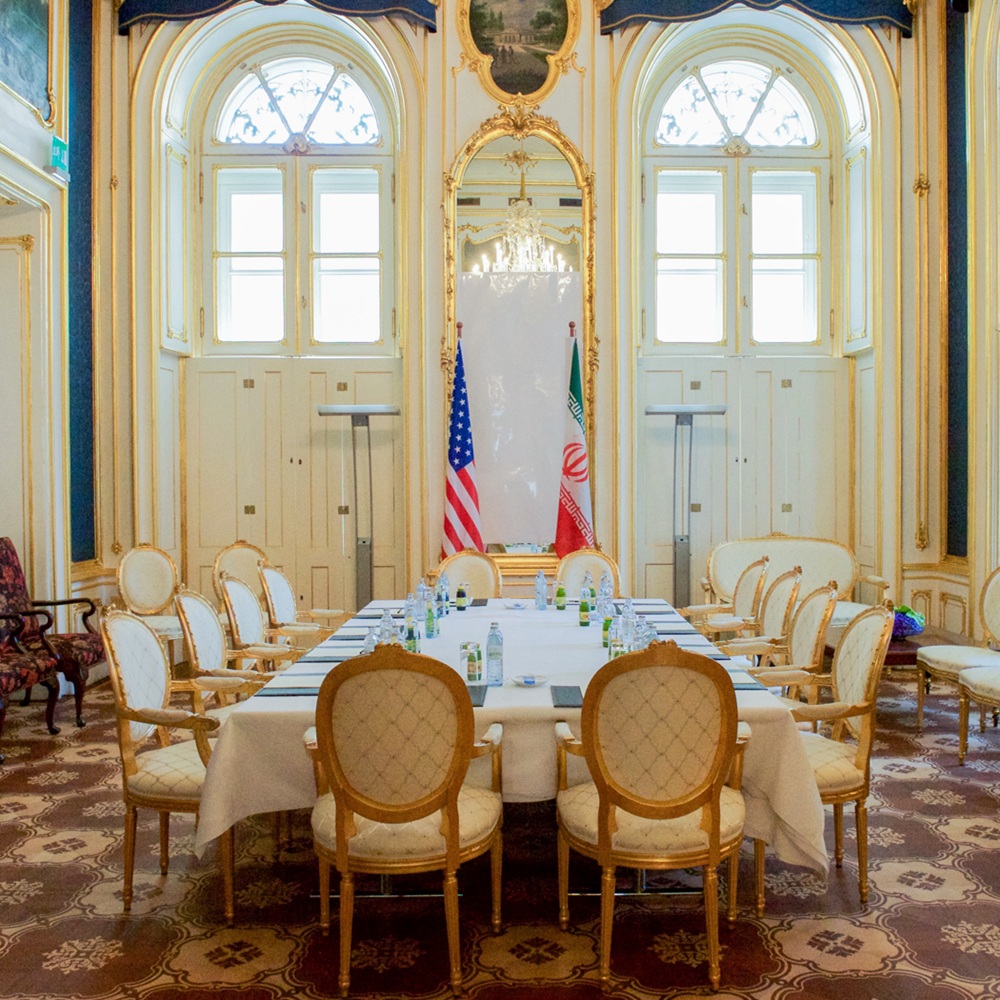
U.S. Nuclear Negotiations With Iran. U.S. Department of State, Public domain, via Wikimedia Commons

Us-Iran Peace Talks: Options and Outcomes

by Ian Dudgeon

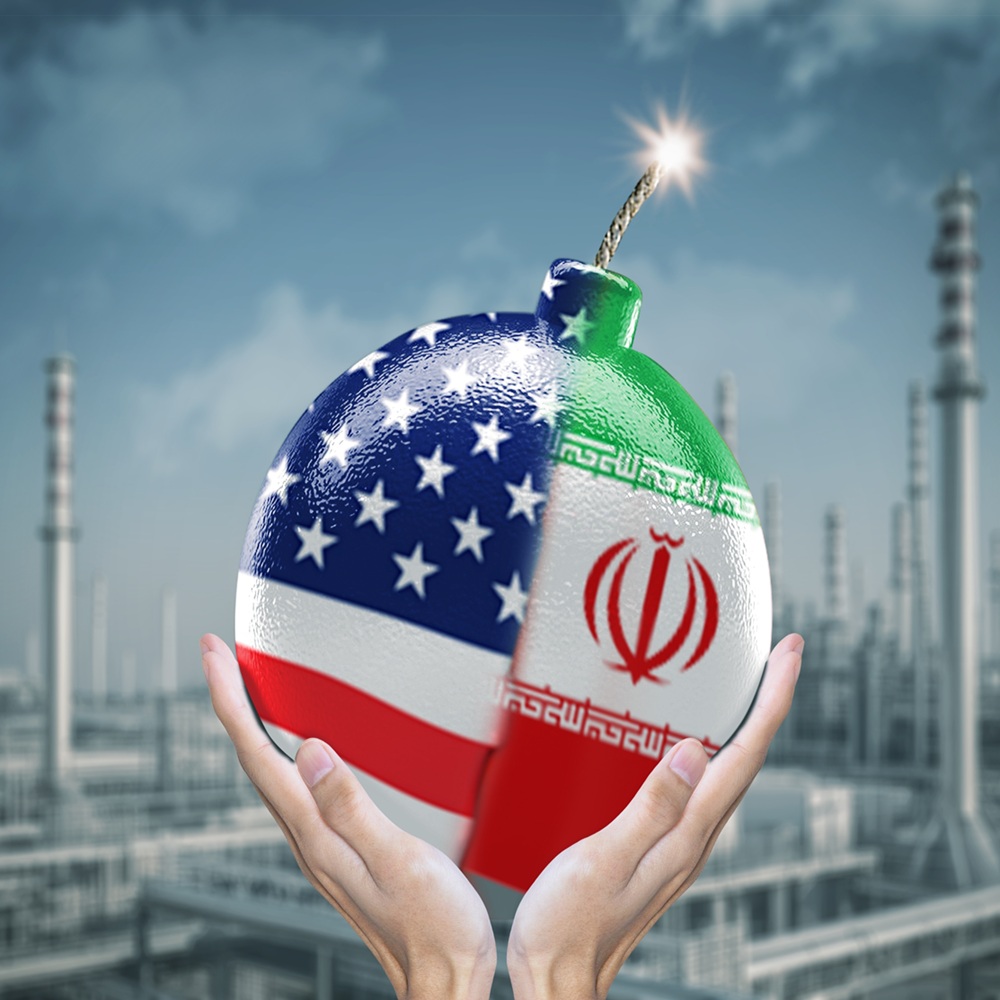
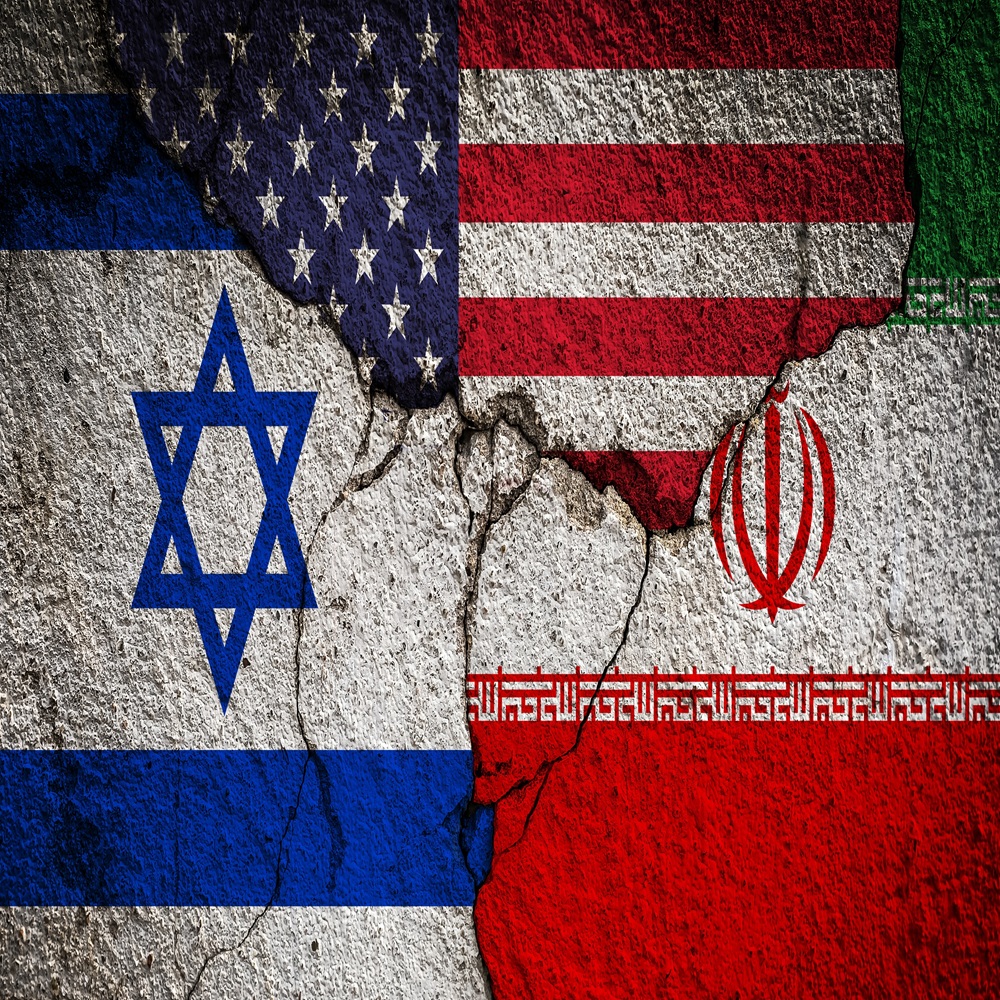
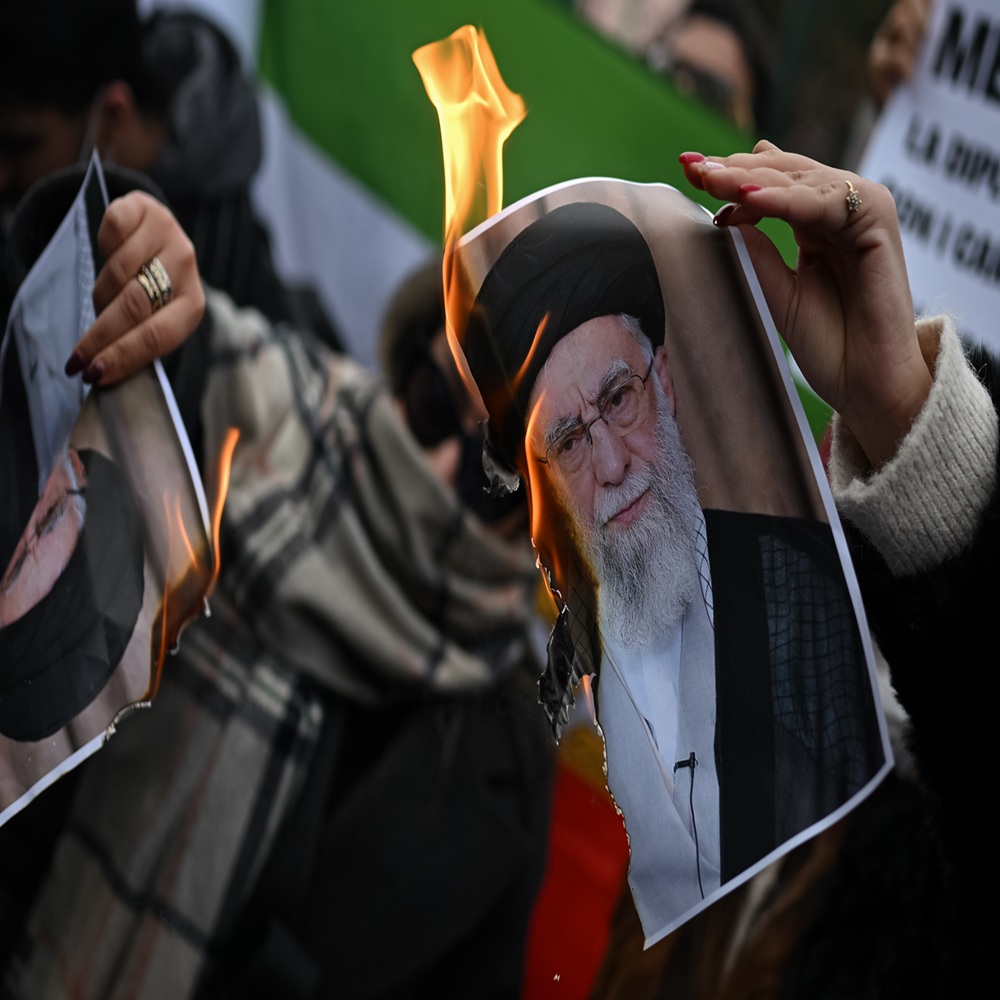
Will the US-Iran ‘peace talks succeed or fail? Given the mix of personalities and national interests involved, we just don’t know. Success would likely be a short-term, mutually face-saving compromise, leaving many major bilateral and regional issues still to be resolved. Failure is likely to lead to a US-initiated war with chaotic outcomes and perhaps no real winners. What does President Donald Trump want? In the short term, he wants a “peace deal” comprising multiple components. While not all details are public, the first and foremost goal is nuclear. Iran must not have the capability to make a nuclear weapon. While some reports suggest the US demands that Iran close down its whole nuclear program, most reporting claims US demands are limited to Iran ceasing the production of and giving up all enriched uranium beyond that needed for its domestic nuclear energy needs. US demands also include Iranian agreement to International Atomic Energy Agency (IAEA) inspections to verify they comply with this commitment. Other demands include limiting the range of all ballistic missiles to some 500 km (compared to some 2000 km at present), the cessation of all hostilities toward both regional countries, and support for other nations or proxies engaged in such hostilities. These terms would put all of Israel out of range and discourage further attacks from Iran on Israel, despite the term “hostilities” being left vague. It is difficult to see Iran agreeing to the former. A deal on the latter might be possible. One formula could be through recognizing Israel’s right to exit (as does the Palestine Authority - PA) and ceasing hostilities and support to proxies in the context of progress towards a two-state solution. Trump’s aim is ‘maximum pressure’, precipitating ‘regime change’— that is, the end of Iran’s conservative mullah-led autocracy and its military guardians, the Islamic Revolutionary Guard Corps (IRGC). This is a longer-term goal, but one he would pursue opportunistically in the short term if circumstances permit, such as in the event of an outbreak of war. Denials and Tricky Negotiations Iran has always denied its intention to develop nuclear weapons; most recently, this week, by the Iranian Foreign Minister, Abbas Araghchi. The international community generally believes Iran knows how to make a nuclear weapon and would do so if it could; however, Iran won’t because it could not hide the process, and external intervention in response could be horrendous. Therefore, Iran is willing to negotiate the nuclear issue. It did so before, as part of negotiations between Iran and the US, resulting in the signing of the Joint Comprehensive Plan of Action (JCPOA) in 2015 during the presidency of Barack Obama. The difference between Obama and Trump is that Obama understood the subtleties of negotiating with Iran, i.e. build trust through the JCPOA before moving on to missiles and issues of regional hostilities. Trump 1.0 trashed the JCPOA in 2018, remarking it was “the worst deal in history.” Although Iran continued to comply with its conditions for a further 12 months. President Joe Biden dropped the ball on this issue, and Trump 2.0, upon re-election, continued where he left off in 2021. The Iranians are certainly not easy to negotiate with. Relevant “subtilties” include being a proud, fiercely independent, well-educated people who seek to own/control their own resources (e.g., oil) and, to the extent possible, be self-sufficient. They do not like being bullied, and trust is a key part of relationships. They claim Trump has consistently bullied them with his threats and actions, and all trust has long gone, dating back to Trump 1.0. Iranian officials have argued privately that the policies and actions of both Trump 1.0 and Biden, including the heavy economic sanctions, forced Iran into the “axis of evil” for basic survival reasons. They claim they want their independence, and have no particular affinity for the Russians, Chinese and North Koreans. One conclusion from that any negotiations with the US will occur in an atmosphere of tension and distrust. So, who does Iran trust? Violence on the Streets of Tehran: Regime Change and Civil Unrest On the issue of regime change, US (and Israeli) exploitation of last month’s widespread demonstrations throughout Iran was both an opportunity and a challenge. But the regime survived. There are four basic criteria for the successful change of any regime: leadership, the reason for change, the will of the majority of the people, and the support of a significant element of the armed forces and security forces to facilitate and sustain change Discontent with the Iranian government has been evident among different groups in the country for some time. Mostly, this has been political, but this time the driver was economic, driven principally by the hard squeeze of external sanctions, coupled with mismanagement and corruption. The outreach of hardship and dissent was much broader than before. And despite targeted input from outside Iran, the regime did not topple. Demonstrators were strongly suppressed by the government, and Trump’s threat to help demonstrators did not eventuate. Would his military intervention have been the tipping point? We can only guess. But here was no apparent split within the armed or security forces – given their deep involvement in the economy, there were strong self-interest motives not to – and no leadership figure, civilian or military, emerged. Attempts to promote Reza Pahlavi, the Shah’s son, who was deposed in 1979, as a rallying figure, if only temporarily, failed. I doubt he has much appeal in-country due to the heavy suppression and corruption of his father. But the message was loud: there is disaffection, political and especially economic, which could ignite if the fuse is right. What to Expect Will Trump be tempted to use military force to try to facilitate regime change if he doesn’t get his way at the next round of nuclear negotiations, now due to be held in Oman late this week? He has the fleet in place, and comprehensive planning will be well underway, building on lessons learned from the Israeli-US 12-day war last June and recently in Venezuela. The planning focuses on key kinetic and non-kinetic targets, especially those requiring a preemptive strike. Israel will be part of this, with its own targets, which presumably will include key leadership, military and other persons. Iran will have done its planning also around its own lessons learned. Iranian early warning of an attack, even if measured in only minutes, will be critical in determining how quickly events unfold within and outside Iran, and how devastating they are. However, if this does force regime change, who will take over? Without the mullahs and lacking any civilian opposition infrastructure, the military (minus the IRGC?) would have to be the backbone of any new government. Civilian leadership is an unknown, though talented politicians and technocrats exist. Iran could become very fragmented and unstable as it sorts itself out. This article is published under a Creative Commons License and may be republished with attribution.

Defense & Security
Soldier in engineering role uses AI application on laptop to manage server hub systems. Army commander reviews secret intelligence information using artificial intelligence in data center, camera A

Dual-Use AI Technologies in Defense: Strategic Implications and Security Risks

by Mayukh Dey

Introduction Artificial intelligence has become a critical technology in the 21st century, with applications spanning healthcare, commerce, and scientific research. However, the same algorithms that enable medical diagnostics can guide autonomous weapons, and the same machine learning systems that power recommendation engines can identify military targets. This dual-use nature, where technologies developed for civilian purposes can be repurposed for military applications, has positioned AI as a central element in evolving global security dynamics. The strategic implications are substantial. China views AI as essential for military modernization, with the People's Liberation Army planning to deploy "algorithmic warfare" and "network-centric warfare" capabilities by 2030 (Department of Defense, 2024). Concurrently, military conflicts in Ukraine and Gaza have demonstrated the operational deployment of AI-driven targeting systems. As nations allocate significant resources to military AI development, a critical question emerges: whether the security benefits of dual-use AI technologies can be realized without generating severe humanitarian consequences. The Reversal Commercial Innovation Driving Military Modernization Historically, military research and development drove technological innovation, with civilian applications emerging as secondary benefits, a phenomenon termed "spin-off." The internet, GPS, and microwave ovens all originated in defense laboratories. This dynamic has reversed. Commercially developed technologies now increasingly "spin into" the defense sector, with militaries dependent on technologies initially developed for commercial markets. This reversal carries significant implications for global security. Unlike the Cold War era, when the United States and Soviet Union controlled nuclear weapons development through state programs, AI innovation occurs primarily in private sector companies, technology firms, and university research institutions. Organizations like DARPA influence global emerging technology development, with their projects often establishing benchmarks for research and development efforts worldwide (Defense Advanced Research Projects Agency, 2024). This diffusion of technological capacity complicates traditional arms control frameworks based on state-controlled military production. The scale of investment is considerable. The U.S. Department of Defense's unclassified AI investments increased from approximately $600 million in 2016 to about $1.8 billion in 2024, with more than 685 active AI projects underway (Defense One, 2024). China's spending may exceed this figure, though exact data remains unavailable due to the opacity of Chinese defense budgeting. Europe is pursuing comparable investments, with the EU committing €1.5 billion to defense-related research and development through initiatives like the European Defence Fund. Dual-Use Applications in Contemporary Warfare AI's military applications span the spectrum of warfare, from strategic planning to tactical execution. Current deployments include: Intelligence, Surveillance, and Reconnaissance (ISR): AI systems process large volumes of sensor data, satellite imagery, and signals intelligence to identify patterns beyond human analytical capacity. In 2024, "China's commercial and academic AI sectors made progress on large language models (LLMs) and LLM-based reasoning models, which has narrowed the performance gap between China's models and the U.S. models currently leading the field," enabling more sophisticated intelligence analysis (Department of Defense, 2024). Autonomous Weapons Systems: Autonomous weapons can identify, track, and engage targets with minimal human oversight. In the Russia-Ukraine war, drones now account for approximately 70-80% of battlefield casualties (Center for Strategic and International Studies, 2025). Ukrainian officials predicted that AI-operated first person view drones could achieve hit rates of around 80%, compared to 30-50% for manually piloted systems (Reuters, 2024). Predictive Maintenance and Logistics: The U.S. Air Force employs AI in its Condition-Based Maintenance Plus program for F-35 fighters, analyzing sensor data to predict system failures before occurrence, reducing downtime and operational costs. Command and Control: AI assists military commanders in processing battlefield information and evaluating options at speeds exceeding human capacity. Project Convergence integrates AI, advanced networking, sensors, and automation across all warfare domains (land, air, sea, cyber, and space) to enable synchronized, real-time decision-making. Cyber Operations: AI powers both offensive and defensive cyber capabilities, from automated vulnerability discovery to malware detection and sophisticated social engineering campaigns. Gaza and Ukraine: AI in Contemporary Conflict Recent conflicts have provided operational demonstrations of AI's military applications and associated humanitarian costs. Israel's Lavender system reportedly identified up to 37,000 potential Hamas-linked targets, with sources claiming error rates near 10 percent (972 Magazine, 2024). An Israeli intelligence officer stated that "the IDF bombed targets in homes without hesitation, as a first option. It's much easier to bomb a family's home" (972 Magazine, 2024). The system accelerated airstrikes but also contributed to civilian casualties, raising questions about algorithmic accountability. The system's design involved explicit tradeoffs: prioritizing speed and scale over accuracy. According to sources interviewed by 972 Magazine, the army authorized the killing of up to 15 or 20 civilians for every junior Hamas operative that Lavender marked, while in some cases more than 100 civilians were authorized to be killed to assassinate a single senior commander (972 Magazine, 2024). Foundation models trained on commercial data lack the reasoning capacity humans possess, yet when applied to military targeting, false positives result in civilian deaths. Data sourced from WhatsApp metadata, Google Photos, and other commercial platforms created targeting profiles based on patterns that may not correspond to combatant status. Ukraine has implemented different approaches, using AI to coordinate drone swarms and enhance defensive capabilities against a numerically superior adversary. Ukrainian Deputy Defense Minister Kateryna Chernohorenko stated that "there are currently several dozen solutions on the market from Ukrainian manufacturers" for AI-augmented drone systems being delivered to armed forces (Reuters, 2024). Ukraine produced approximately 2 million drones in 2024, with AI-enabled systems achieving engagement success rates of 70 to 80 percent compared to 10 to 20 percent for manually controlled drones (Center for Strategic and International Studies, 2025). Both sides in the conflict have developed AI-powered targeting systems, creating operational arms race dynamics with immediate battlefield consequences. Civilian Harm: Technical and Legal Limitarions The integration of AI into lethal military systems raises humanitarian concerns extending beyond technical reliability. AI's inability to uphold the principle of distinction, which requires protecting civilians by distinguishing them from combatants in compliance with international humanitarian law, presents fundamental challenges. Current AI systems lack several capabilities essential for legal warfare:  Contextual Understanding: AI cannot comprehend the complex social, cultural, and situational factors that determine combatant status. A person carrying a weapon might be a combatant, a civilian defending their home, or a shepherd protecting livestock.  Proportionality Assessments: International humanitarian law requires that military attacks not cause disproportionate civilian damage. Human Rights Watch noted that it is doubtful whether robotic systems can make such nuanced assessments (Human Rights Watch, 2024).  Moral Judgment: Machines lack the capacity for compassion, mercy, or understanding of human dignity, qualities that have historically provided safeguards against wartime atrocities.  Accountability: With autonomous weapon systems, responsibility is distributed among programmers, manufacturers, and operators, making individual accountability difficult to establish. As one expert observed, "when AI, machine learning and human reasoning form a tight ecosystem, the capacity for human control is limited. Humans have a tendency to trust whatever computers say, especially when they move too fast for us to follow" (The Conversation, 2024). The risks extend to specific populations. Autonomous weapons systems trained on data predominantly consisting of male combatants in historical records could create algorithmic bias. In the case of Lavender, analysis suggests "one of the key equations was 'male equals militant,'" echoing the Obama administration's approach during drone warfare operations (The Conversation, 2024). Communities of color and Muslim populations face heightened risks given historical patterns of discriminatory force deployment. Export Controls and Technology Transfer Challenges Recognizing AI's strategic importance, governments have implemented export control regimes. The U.S. Bureau of Industry and Security now requires licenses for exports of advanced computing chips and AI model weights, imposing security conditions to safeguard storage of the most advanced models. These controls face inherent tensions. Overly broad restrictions risk hampering legitimate research and commercial innovation. Analysis suggests that if AI technology is too extensively controlled, American universities may face difficulties performing AI research, resulting in a less robust U.S. AI ecosystem. Insufficient controls enable adversaries to acquire cutting-edge capabilities. The effectiveness of export controls remains uncertain. In 2024, hundreds of thousands of chips, totaling millions of dollars, were smuggled into China through shell companies, varying distributors, and mislabeling techniques (Oxford Analytica, 2025). China's DeepSeek models, which achieved performance approaching U.S. systems, were reportedly trained on chips that circumvented export restrictions. International Governance: Fragmentation and Competing Frameworks The international community has struggled to develop coherent governance frameworks for dual-use AI. Rather than a cohesive global regulatory approach, what has emerged is a collection of national policies, multilateral agreements, high-level summits, declarations, frameworks, and voluntary commitments. Multiple international forums have addressed AI governance: ● The UN Secretary-General created an AI Advisory Board and called for a legally binding treaty to prohibit lethal autonomous weapons systems without human control, to be concluded by 2026 ● The Group of Governmental Experts on Lethal Autonomous Weapons Systems has held discussions under the Convention on Certain Conventional Weapons since 2013, with limited concrete progress ● NATO released a revised AI strategy in 2024, establishing standards for responsible use and accelerated adoption in military operations ● The EU's AI Act, adopted in 2023, explicitly excludes military applications and national security from its scope This fragmented landscape reflects geopolitical divisions. The perceived centrality of AI for competition has led the U.S. to position itself as leader of ideologically aligned countries in opposition to China, including for security purposes. China promotes its own governance vision through initiatives like the Belt and Road, exporting technology standards alongside infrastructure. Strategic Stability Implications AI creates strategic stability challenges. Autonomous weapons enable substitution of machines for human soldiers in many battlefield roles, reducing the human cost and thus political cost of waging offensive war. This could increase the frequency of conflicts between peer adversaries, each believing they can prevail without significant domestic casualties. For conflicts between non-peer adversaries, reduced casualties further diminish domestic opposition to wars of aggression. The implications extend beyond conventional warfare. Armed, fully-autonomous drone swarms could combine mass harm with lack of human control, potentially becoming weapons of mass destruction comparable to low-scale nuclear devices. The technical barriers to such systems are declining as components become commercially available. AI also complicates nuclear stability. Advances in AI-enhanced sensors and data processing could undermine second-strike capabilities by improving detection of mobile missile launchers and submarines. This erosion of assured retaliation could incentivize first strikes during crises. Simultaneously, AI systems managing nuclear command and control create risks of accidents, miscalculations, or unauthorized launches. Ethical Framework Limitations The integration of AI into warfare strains traditional ethical frameworks. Just War Theory requires that combatants maintain moral responsibility for their actions, possess the capacity to distinguish combatants from civilians, and apply proportionate force. Automation bias and technological mediation weaken moral agency among operators of AI-enabled targeting systems, diminishing their capacity for ethical decision-making. When operators interact with targeting through screens displaying algorithmic recommendations rather than direct observation, psychological distance increases. This mediation risks transforming killing into a bureaucratic process. The operator becomes less a moral agent making decisions and more a technician approving or rejecting algorithmic suggestions. Furthermore, industry dynamics, particularly venture capital funding, shape discourses surrounding military AI, influencing perceptions of responsible AI use in warfare. When commercial incentives align with military applications, the boundaries between responsible innovation and reckless proliferation become unclear. Companies developing AI for civilian markets face pressure to expand into defense contracting, often with insufficient ethical deliberation. Conclusion Dual-use AI technologies present both opportunities and risks for international security. One trajectory leads toward normalized algorithmic warfare at scale, arms races in autonomous weapons that erode strategic stability, and inadequate international governance resulting in civilian harm. An alternative trajectory involves international cooperation that constrains the most dangerous applications while permitting beneficial uses. The timeframe for establishing governance frameworks is limited. AI capabilities are advancing rapidly, and widespread proliferation of autonomous weapons will make policy reversal substantially more difficult. The challenge resembles nuclear non-proliferation but unfolds at greater speed, driven by commercial incentives rather than state-controlled programs. Because AI is a dual-use technology, technical advances can provide economic and security benefits. This reality means unilateral restraint by democratic nations would cede advantages to authoritarian competitors. However, uncontrolled competition risks adverse outcomes for all parties. Concrete action is required from multiple actors. States must strengthen multilateral agreements through forums like the UN Convention on Certain Conventional Weapons to establish binding restrictions on autonomous weapons without meaningful human control. NATO and regional security alliances should harmonize AI ethics standards and create verification mechanisms for military AI deployments. Military institutions must implement mandatory human-in-the-loop requirements for lethal autonomous systems and establish clear chains of accountability for AI-driven targeting decisions. Technology companies developing dual-use AI systems bear responsibility for implementing ethical safeguards and conducting thorough threat modeling before commercial release. Industry alliances should establish transparency standards for military AI applications and create independent audit mechanisms. Universities and research institutions must integrate AI ethics and international humanitarian law into technical training programs. Export control regimes require coordination between the United States, EU, and allied nations to prevent regulatory arbitrage while avoiding overreach that stifles legitimate research. Democratic governments should lead by demonstrating that military AI can be developed within strict ethical and legal constraints, setting standards that distinguish legitimate security applications from destabilizing weapons proliferation. As Austrian Foreign Minister Alexander Schallenberg observed, this represents the Oppenheimer moment of the current generation, recognizing that dual-use AI, like nuclear weapons, represents a technology whose military applications demand collective restraint. The policy choices made in the next few years will have long-term consequences. They will determine whether AI becomes a tool for human advancement or an instrument of algorithmic warfare. The technology exists; the policy framework remains to be established. The actors are identified; the question is whether they possess the political will to act before proliferation becomes irreversible. References 972 Magazine (2024) 'Lavender': The AI machine directing Israel's bombing spree in Gaza. https://www.972mag.com/lavender-ai-israeli-army-gaza/ Center for Strategic and International Studies (2024) Where the Chips Fall: U.S. Export Controls Under the Biden Administration from 2022 to 2024. https://www.csis.org/analysis/where-chips-fall-us-export-controls-under-biden-administration-2022-2024 Center for Strategic and International Studies (2025) Ukraine's Future Vision and Current Capabilities for Waging AI-Enabled Autonomous Warfare. https://www.csis.org/analysis/ukraines-future-vision-and-current-capabilities-waging-ai-enabled-autonomous-warfare Defense One (2023) The Pentagon's 2024 Budget Proposal, In Short. https://www.defenseone.com/policy/2023/03/heres-everything-we-know-about-pentagons-2024-budget-proposal/383892/ Department of Defense (2024) Military and Security Developments Involving the People's Republic of China 2024. https://media.defense.gov/2024/Dec/18/2003615520/-1/-1/0/MILITARY-AND-SECURITY-DEVELOPMENTS-INVOLVING-THE-PEOPLES-REPUBLIC-OF-CHINA-2024.PDF Foreign Policy Research Institute (2024) Breaking the Circuit: US-China Semiconductor Controls. https://www.fpri.org/article/2024/09/breaking-the-circuit-us-china-semiconductor-controls/ Human Rights Watch (2024) A Hazard to Human Rights: Autonomous Weapons Systems and Digital Decision-Making. https://www.hrw.org/report/2025/04/28/a-hazard-to-human-rights/autonomous-weapons-systems-and-digital-decision-making National Defense Magazine (2024) Pentagon Sorting Out AI's Future in Warfare. https://www.nationaldefensemagazine.org/articles/2024/10/22/pentagon-sorting-out-ais-future-in-warfare Queen Mary University of London (2024) Gaza war: Israel using AI to identify human targets raising fears that innocents are being caught in the net. https://www.qmul.ac.uk/media/news/2024/hss/gaza-war-israel-using-ai-to-identify-human-targets-raising-fears-that-innocents-are-being-caught-in-the-net.html Reuters (2024) Ukraine rolls out dozens of AI systems to help its drones hit targets. https://euromaidanpress.com/2024/10/31/reuters-ukraine-rolls-out-dozens-of-ai-systems-to-help-its-drones-hit-targets/

Diplomacy
Flag of Israel and Palestine on the map. Events in Palestine and Israel. israel flag

Advancing Peace Between Israel and Palestine

by Saliba Sarsar

The Israel-Hamas War has calmed down. The events that preceded it – including the October 7, 2023 Hamas attack against Israel and the taking of Israeli and other hostages – and that resulted from it will be remembered for decades to come, especially the dead and wounded, the trauma and pain, the destruction of dreams and property. If there is any lesson to be learnt, it is that better ways must be found to resolve conflict. There is deep concern now that the West Bank is increasingly reaching a critical point. The weak governing structure of the Palestinian Authority, the contraction of the Palestinian economy, settler violence, and much more are causing serious distress and instability. What is preventing conditions from spiraling out of control are Israel’s strict security measures and Palestinian fear that the West Bank will turn into Gaza, even though both regions are different. Years of diplomatic inertia have been counterproductive. The status quo is untenable. Much is at stake and indecision is costly for all concerned. Why continued conflict? Israelis and Palestinians have become victims of their own exclusive national narratives and are speaking past each other. Many on each side are unable to go beyond their zero-sum mentality. They selectively highlight the rightness of their own cause, accuse the other side of bad intentions or misconduct, and fail to realize how their own rhetoric and acts cause aggravating conditions. While the obstacles in the way of progress to peace are numerous and real – power imbalance between Israel and the Palestinians, one state reality with Israel dominant over the Palestinians, hardening of attitudes in Israel and Palestine, relative weakness of the Israeli and Palestinian peace camps, Israeli settler radicalization, Palestinian anti-normalization stance, terrorism – these must not delay or prevent the search for opportunities and positive outcomes. In this regard, simple facts present themselves. First, Israelis and Palestinians are neighbors forever. Their present and future are intertwined whether they choose this reality or not. Second, the longer Israelis and Palestinians wait to negotiate, the more complicated the issues become and the less room there will be for an agreeable peaceful solution. Third, the core issues that separate Israelis and Palestinians – borders, the separation wall, security, Israeli settlements, Palestinian refugees, Jerusalem, water – are well-known, thoroughly debated, and resolvable. The challenge is to initiate negotiations and negotiate in good faith. Fourth, Israelis and Palestinians have proved to be both incapable and unwilling to restart negotiations on their own. The United States thus must go beyond managing the Israeli-Palestinian conflict to taking the lead to resolve it. It is indispensable for the promotion and sustenance of peace negotiations, as was recently shown in the diplomatic intervention to stop the Israel-Hamas War. Fifth, the inclusion of regional and international actors becomes key as peace requires assurances, follow-up, and support to take root and grow. As Gershon Baskin argues, “Protracted conflicts in which there is little or no trust and confidence require external mechanisms to verify implementation of the agreements, to ensure compliance, and to offer external dispute resolution” (Baskin, 2025). The prerequisites for peacemaking (e.g., context and timing, leadership and political will, societal strength and resilience, process, and content and creativity) are known (Kurtzer, 2020). US diplomacy must be credible, intentional, sustained, and transformative. This comprises not only making peace a priority, but also acting accordingly. The situation on the ground must change. A realistic plan and process of peacemaking must be prioritized. Israelis and Palestinians must be held accountable for their actions and inactions. The vital policies of Arab countries that have signed the Abraham Accords (especially United Arab Emirates, Bahrain, and Morocco) and others that mediated (that is, United States, Egypt, Qatar, and Turkey) or attended the Gaza “peace conference” in October 2025 should impel them to motivate Palestinians to make hard decisions to end conflict and reach a peaceful settlement. Israel needs to reciprocate. Circumventing the Palestinian issue or wishing it away will not advance Israel’s strategic goals, especially in the long run. Initiating unilateral moves and thinking of the Palestinian issue as a security matter only without addressing its political and territorial dimensions will not enhance Israel’s defense. If anything, they will continue to rile the Palestinians, particularly the youth among them. The two-state solution, the official United States policy since 2002, has become increasingly less viable. This is at a time when 157 out of 193 Member States of the United Nations have already recognized the State of Palestine. On July 28-30, 2025, a High-level International Conference for the Peaceful Settlement of the Question of Palestine and the Implementation of the Two-State Solution was held at the United Nations. The conference, co-chaired by France and Saudi Arabia, committed “not only to reaffirm international consensus on the peaceful settlement of the question of Palestine but [also] to catalyze concrete, timebound and coordinated international action toward the implementation of the two-state solution” (United Nations, 2025a). Follow-up work took place on September 22, and the commitment was made to continue the implementation of the conference’s outcomes. The US’s plan (Trump, 2025) to demilitarize the Gaza Strip and to reconstruct it for the benefit of its inhabitants is a good start, and the plan’s “Phase 2” was even endorsed by United Nations Security Council Resolution 2803 on November 17, 2025 (United Nations, 2025b). However, resolving all aspects of the Gaza issue will take years. Meantime, it is essential for the US to take a leading role in endorsing again the two-state solution, as it is in the best national interest of Israel, Palestine, and the US. Moreover, the US can facilitate the solution by urging Israel and the Palestinians to seriously consider the idea of confederation, which adjusts or introduces important modifications to the two-state solution. While there have been more than a dozen confederation models over the years – with some specific only to Israel and Palestine and others that encompass Jordan as well – a main goal of confederation, according to the proponents of the Holy Land Confederation (me included), is not to totally separate the Palestinians from the Israelis living in the Holy Land, i.e., “divorce,” but to empower them to “cohabitate” in the two respective sovereign states (Holy Land Confederation, 2025). This cohabitation would allow for greater cooperation and movement between them. “If properly implemented, confederation would enable Palestinians to advance their search for freedom, independence, and statehood without being anti-Israel, and it would enable Israelis to have their security and wellbeing without being anti-Palestinian” (Beilin and Sarsar, 2022). The Gaza crisis must be solved. However, the deadlock in Israeli-Palestinian relations must be broken as well. If past negotiations are any indication, there is middle ground between the positions of Israel and Palestine. The US possesses the vital capabilities to move both parties to take the necessary political risks by compromising and engaging in unavoidable tradeoffs on the path to peace. References - Baskin, Gershon. (2025) “Monitoring agreements and verifying implementation.” October 18, https://gershonbaskin.substack.com/p/monitoring-agreements-and-verifying. - Beilin, Yossi and Sarsar, Saliba. (2022) “Israeli-Palestinian confederation is a way forward for peace.” The Jerusalem Post, February 17, https://www.jpost.com/opinion/article-696830. - Holy Land Confederation. (2025) “The Holy Land Confederation as a Facilitator for the Two-State Solution.” Institute for Cultural Diplomacy, https://www.culturaldiplomacy.org/index.php?en_hlc. - Kurtzer, Daniel C. (2020) “The Ingredients of Palestinian-Israeli Peacemaking.” Journal of South Asian and Middle Eastern Studies, Vol. 43, No. 3 (Spring): 5-16. - Trump, Donald J. [@RapidResponse47]. (2025, September 29). “President Donald J. Trump’s Comprehensive Plan to End the Gaza Conflict.” X. https://x.com/RapidResponse47/status/1972726021196562494. - United Nations. (2025a) “High-level International Conference for the Peaceful Settlement of the Question of Palestine and the Implementation of the Two-State Solution,” July 28-30, https://www.un.org/unispal/high-level-conference-two-state-solution-july2025/. - United Nations. (2025b) United Nations Security Council, November 17, https://docs.un.org/en/s/res/2803(2025).

Diplomacy
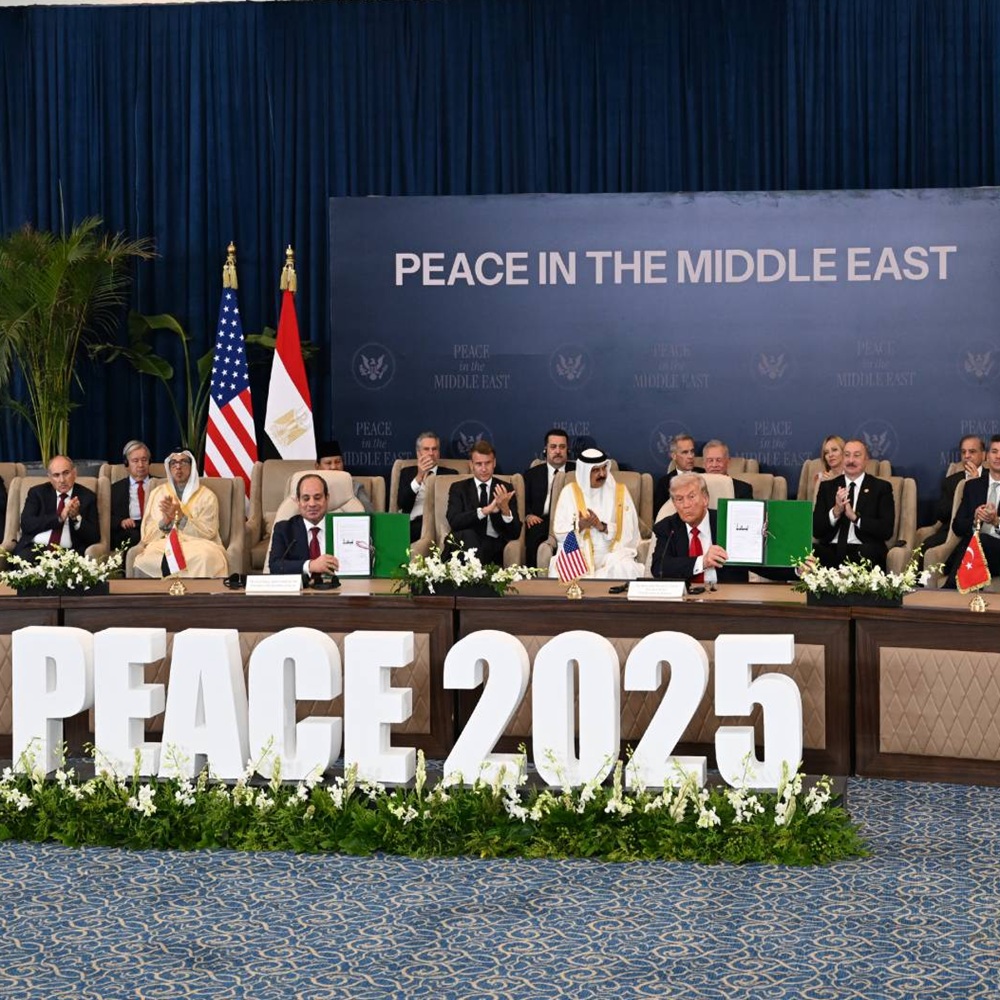
Sharm El Sheikh Summit for Peace: Agreement to End the War in Gaza, 13 October 2025. Photo by Roman Ismayilov. President.az, CC BY 4.0 <https://creativecommons.org/licenses/by/4.0>, via Wikimedia Commons

Gaza Peace Plan: End of war, or A beginning of occupation?

by Muhammad Abdullah

On 29 September 2025, President Trump held a press conference along with his counterpart, Prime Minister of Israel, Benjamin Netanyahu, and issued 20 Points detailed peace plan for the war-torn Gaza, though he claims that the plan was backed by prominent Muslim states, including Saudi Arabia, Turkey, Qatar, Pakistan and some other’s. By and large these Muslim states also welcomed the Plan, most importantly Palestinian political body which is Palestinian Liberation Organization also called the plan an opportunity to end the war on Gaza. Some significant points of the peace plan. Gaza will be a deradicalized terror-free zone that does not pose a threat to its neighbors. Gaza will be redeveloped for the benefit of the people of Gaza, who have suffered more than enough. If both sides agree to this proposal, the war will immediately end. Israeli forces will withdraw to the agreed upon line to prepare for a hostage release. During this time, all military operations, including aerial and artillery bombardment, will be suspended, and battle lines will remain frozen until conditions are met for the complete staged withdrawal. Within 72 hours of Israel publicly accepting this agreement, all hostages, alive and deceased, will be returned. (Gjevori, 2025)Role of ArabsSince the start of Trump’s tenure  and the new American administration Arabs were making efforts to stop the long running Gaza War, they propose alternatives to Trump’s Gaza Rivera plan and so on. (Jazeera, 2025) Now, when eventually Gaza Peace Plan announced by Trump, they (Arabs ) not only endorsed the Plan but also Nations like Qatar, Egypt and Türkiye take part in negotiations with Hamas and Israel, along with envoy to Middle East Steve Witkoff, and finally brought some relief for Gazans like (ceasefire and immediate supplies of aid) which is very crucial for the starving people Gaza. (Irish, 2025)Proposed Governance ModelGaza would be governed by technocrats, apolitical Palestinian committee responsible for day-to-day public services and municipal functions in Palestine. The committee would be composed of qualified Palestinian and International experts. They will be overseen by a body called the Board of Peace. There would be a temporary International Stabilization Force (ISF). To oversee security in Gaza during transition. (Walsh, 2025)Parties response to the plan.Hamas, which is the military body of Gaza has also issued a response to Trump’s Plan, in which they accepted the demands like hostage release, and to hand over the administration of Gaza to independent Technocrats, but they clearly stated that they want to negotiate over some points through mediators.PLO which is Political body of Palestine, welcomed the ceasefire but they are opposed to hand over Gaza’s governance to foreign actors, as Nasser al- Qudwa, a prominent Palestinian and Nephew of Yasser Arafat, has warned against foreign governance of Gaza post-Hamas, (Newspaper, 2025) stressing that leadership must be rooted locally rather than imposed from abroad. The statement highlights the potential opposition and undermines the credibility of the plan.The Israeli Prime Minister called the plan as their victory and fulfillment of their objectives, as they want to decommission Hamas, they will achieve this once the plan is implemented. The tunnels which were in Gaza and which caused Israel unbearable damage, especially in early days of war. (Bronner l., 2025) They are also going to get rid of them by Hamas exclusion and their deradicalization and development of infrastructure by independent actors. The most favorable point for Israel is Trump's statement that “if Hamas does not accept the plan then you [Netanyahu] are allowed to finish the job in Gaza and destroy Hamas completely”. (Griner, 2025) Which I think is a very provocative statement and can cause more bloodshed of innocent civilians. which may end up in complete occupation of the Strip.  Since the day Trump’s plan for Gaza was announced, the Israeli military did not slow down their advancement in the strip, instead they continued with their actions against civilians which reflect their intentions clearly.But for the implementation of the so-called peace plan and to further discuss over its terms both parties take part in negotiations in Egypt. With the mediation of Qatar and Egypt, these negotiations continued for days and then concluded with the statement made by Donald Trump that Israel and Hamas have agreed to his peace plan for Gaza. The Israeli military says that a ceasefire in Palestinian territory took effect on Friday 10th. And that it has begun to withdraw from parts of the Strip as per plan. The first phase of Trump's plan is expected to see the release of all 20 living Israeli hostages in exchange for around 250 Palestinian prisoners and 1,700 detainees from Gaza. Increased amounts of aid will also enter the Strip. (BBC, 2025). On October 13th, Hamas released the 20 living hostages and Israel began to release the Palestinian prisoners. (BBC, 2025) The same day, in Sharm El Shaikh, Egypt, an international peace summit was held, attended by representatives from various nations, - including Canada, France, Germany, Indonesia, Italy, Jordan, Oman, Pakistan, Palestine, Qatar, Saudi Arabia, Turkey, UAE, UK, among others – but notably excluding Hamas and Israel representatives. The summit focused on humanitarian access to Gaza and mechanisms to monitor the proposed ceasefire, aiming to end the two-year war. The outcome was the signing of a joint declaration by Egypt, US, Qatar and Türkiye. Despite these recent developments, the Plan gave the UN only a minimal role, limited to the supply of aid. Although the UN was created to maintain world peace and to resolve conflicts peacefully, when we see the plan, Trump did not assign any role to the peace keeping body, instead he appointed Tony Blair [former British PM, who invaded Iraq in 2003] as head of the Board of peace, which is an international Transitional body whose responsibility is to supervise the apolitical Palestinian committee (responsible for day to day running activities in Gaza). AnalysesThe future of the 20 Points Plan is quite uncertain because it neither has a security guarantee for Palestinian nor any durable provisions about the existence of Palestinian state. The plan calls for an ISF (International stabilization Force) which will be deployed in Gaza immediately for ensuring peace, but the fact is the world does not have a pool of experienced peacekeeping force for this purpose that can handle the situation.  Furthermore, the Israeli PM made it clear that there is no meaningful withdrawal of the IDF from Gaza anytime soon.Moreover, the Plan prohibits Israeli annexation of Gaza, but it does not address the issue of the West Bank. Annexation there is opposed by present and potential Abraham Accord States. But I think soft annexation there would be continued through expansion and establishment of settlement. (weller, 2025)ConclusionWhile the world is admiring Trump’s 20 Points Peace Plan, how can we think of peace anywhere, without an army, and most importantly without recognizing the place as a sovereign State with demarcated borders? Although the Plan has some appealing aspects like immediate ceasefire, entry of aid, development of infrastructure in Gaza and exchange of prisoners, it lacks in terms of security from future Israeli aggression, and it also has no provision about the Palestinian state with borders of before 1967 with East Jerusalem as its Capital. Furthermore, if the plan is implemented Palestinians will be governed by the people of other countries, who will govern them as per the policy devised by the committee, (whose members probably belong to West and other States) not according to the needs and opinion of Palestinians. Which may add more to their misery. So, for a short span of time the Plan may seem like the end of war, but in the long run if more reforms like the recognition of Palestinian statehood and its existence will not be made, then this is just a start of a new occupation. References BBC. (2025, october 9).  BBC: https://www.bbc.com/news/articles/cvgqx7ygq41o.ampBBC. (2025, october 14). BBC: https://www.bbc.com/news/articles/c740jx07vz0oBronner, L. (2025, september 30). Le Monde.  https://www.lemonde.fr/en/international/article/2025/09/30/netanyahu-accepts-trump-s-gaza-peace-plan-under-pressure-but-sets-conditions_6745930_4.html?utmGjevori, E. (2025, sep 29). al jazeera. https://www.aljazeera.com/amp/news/2025/9/29/heres-the-full-text-of-trumps-20-point-plan-to-end-israels-war-on-gazaGriner, A. (2025, oct 3). AL Jazeera. from https://www.aljazeera.com/news/2025/10/3/trump-issues-sunday-deadline-for-hamas-to-accept-gaza-peace-proposal?utm_sourceIrish, J. (2025, october 8). Reuters. from https://www.reuters.com/world/middle-east/europeans-arabs-meet-flesh-out-next-phase-trump-gaza-plan-2025-10-09/?utm_sourceJazeera, A. (2025, feb 21). Al Jazeera. Arab leaders hold a meeting and discuss alternatives to GazaNewspaper, T. T. (2025, october). the times.  https://www.thetimes.com/world/middle-east/article/nasser-al-qudwa-gaza-hamas-palestine-israel-news-vl7xmgct9?utm_sourceWeller, M. (2025, oct 2). Cathom house. https://www.chathamhouse.org/2025/10/can-trump-peace-plan-gaza-succeed?utm

Diplomacy
canada between Israel and Palestine.  Israel canada Palestine

Israel/Palestine and Canada’s Empty Support for International law

by Alex Neve

Abstract Canada has long maintained that international law must be central to resolution of the Israeli/Palestinian conflict. But has there been appropriate follow-through when international law has been violated? This policy brief examines Canada's positions and, importantly, actions, in the face of violations of international law by the Israeli government during its military offensive on Gaza following the 7 October 2023 attacks in southern Israel by Hamas and other armed Palestinian groups. The analysis makes it clear that Canada has rarely condemned those violations, let alone imposed sanctions or other consequences for them.Keywordshuman rights, Israel, Palestine, Gaza, Canada, Canadian foreign policy, international law, International Court of Justice, International Criminal Court, international humanitarian law Professed respect for international law “Israel has a right under international law to take the necessary measures, in accordance with human rights and international humanitarian law, to protect the security of its citizens from attacks by terrorist groups.” In many respects, this statement—taken from the section detailing “Support for Israel and its Security” in Global Affairs Canada's overview of “Canadian policy on key issues in the Israeli-Palestinian conflict”1—captures what is right in principle, but so terribly wrong in practice, when it comes to Canada's foreign policy regarding Israel and Palestine. As it should be, international law is lifted up and given a spotlight. Canada's position is grounded in an expectation that international human rights and international humanitarian law will be respected. But what the statement does not convey is that there is rarely an appropriate response by the Canadian government when it becomes clear that actions taken by Israel—particularly the Israel Defense Forces—to protect the security of its citizens consistently amount to grave, widespread, and systematic violations of both international human rights and international humanitarian law. International law and human rights also feature prominently in other key elements of Canada's policy regarding the conflict. Canada recognizes the “Palestinian right to self-determination.” The rights of Palestinian refugees are to be respected, “in accordance with international law.” Canada notes that the “Fourth Geneva Convention applies in the occupied territories” and consequently that Israeli settlements are in violation of that convention, as is the Israeli government's construction of the barrier inside the West Bank and East Jerusalem. Failure to uphold international law This is all good, in principle. But how does Canada react to the fact that the Palestinian right to self-determination and the rights of Palestinian refugees have undeniably been abrogated for decades? And what is Canada's response to the defiant expansion of the Geneva Convention–violating settlements throughout the West Bank and East Jerusalem? Rather than mount a robust defence (or any defence, for that matter) of the international legal principles at stake, Canada's policy more or less goes quiet at this point. There is no condemnation of the breaches of international law, and consideration of the possible implications under Canadian law is reluctant at best, with a bare minimum of legal, trade, or other consequences for these blatantly unlawful actions. The disconnect between rhetorical flourishes of support for the professed importance of international law but the failure and unwillingness to champion it when it is breached has, unfortunately but perhaps not surprisingly, dominated the key aspects of Canada's response to Israel's unrelenting assault on Gaza following the brutal attacks launched by Hamas and other armed Palestinian groups in southern Israel on 7 October 2023. It was evident from the outset. October 7th, Gaza, and Canada's empty resort to international law Reacting to the horror of the October 7th attack, Canada, like the United States, Australia, New Zealand, and many of its allies in Western Europe, almost immediately referenced the fact that Israel had a right to defend itself. Prime Minister Justin Trudeau's first statement, on October 8th, noted that Canada “reaffirm[ed] its support for Israel's right to defend itself.”2 But what, as a matter of international law, did that actually mean? The question as to whether Israel as a nation has the right to defend itself from attack is dictated by Article 51 of the United Nations (UN) Charter, International Court of Justice (ICJ) jurisprudence, and other public international law sources. As Marko Milanovic, professor of public international law at the University of Reading School of Law notes, “[M]any who think there is a single, clearly correct answer to the question whether Israel has a right to self-defence do so simply because the answer fits their prior narratives and worldviews.” Milanovic lays out the complexity and uncertainty in considerable detail and concludes that “the jus ad bellum is indeterminate on the question of whether non-state actors, whose conduct is not attributable to a state, can commit armed attacks in the sense of Article 51 of the Charter.”3 With the threshold question of whether an attack carried out by an armed group such as Hamas constitutes an armed attack of the nature that would trigger application of Article 51 being at best indeterminate, so too is the question as to whether a right of self-defence arises. As such, the Canadian government's simple assertion, without any further expansion or discussion, is clearly not without debate. Offering no qualification or explanation alongside that assertion, on a matter that is unsettled and complex within international law, is problematic. Article 51 states: “Nothing in the present Charter shall impair the inherent right of individual or collective self-defence if an armed attack occurs against a Member of the United Nations[.]”4 What emerges from a review of applicable international law, however, are differing views as to whether, and to what extent, a nation's right under Article 51 to resort to armed force in response to an attack—in other words, to go to war as a means of self-defence—arises when the attack is carried out by another state, not when the perpetrator is a non-state actor or armed group such as Hamas or the other Palestinian armed groups responsible for the October 7th attacks, operating within territory that is controlled by the state concerned. That is reflected in the conclusion of the ICJ in its 2004 Advisory Opinion, Legal Consequences of the Construction of a Wall in the Occupied Palestinian Territory: Article 51 of the Charter thus recognizes the existence of an inherent right of self-defence in the case of armed attack by one State against another State. However, Israel does not claim that the attacks against it are imputable to a foreign State. The Court also notes that Israel exercises control in the Occupied Palestinian Territory and that, as Israel itself states, the threat which it regards as justifying the construction of the wall originates within, and not outside, that territory. The situation is thus different from that contemplated by Security Council resolutions 1368 (2001) and 1373 (200 l), and therefore Israel could not in any event invoke those resolutions in support of its claim to be exercising a right of self-defence. Consequently, the Court concludes that Article 51 of the Charter has no relevance in this case.5 Having determined that Article 51 was not relevant, the Court also went on to consider whether Israel could more broadly rely on the customary international legal principle of a “state of necessity” to justify construction of the wall. The Court agreed that Israel had “the right, and indeed the duty, to respond in order to protect the life of its citizens” but noted that “measures taken are bound nonetheless to remain in conformity with applicable international law.”6 This is essentially where Canada's stated policy lands as well. For example, the now former prime minister's October 8th statement, referenced above, goes on to qualify that Israel's right to defend itself must be exercised “in accordance with international law.” This, in turn, echoes the numerous references to the need to respect international law noted above, which are scattered throughout Canada's overall Israel/Palestine policy—established long before October 7th. The phrase “in accordance with international law” has been repeated consistently in written statements, social media posts, and press comments by the prime minister,7 the minister of foreign affairs,8 and other ministers9 at various stages of the current conflict. But we do not find any further explanation as to what that entails-for instance, that regardless of whether or not a right of self-defence to an armed attack exists in these circumstances and legally justifies Israel launching a war against Hamas, fundamental principles from international humanitarian law, such as the requirements of necessity and proportionality, nevertheless always apply. That failure to have clearly acknowledged the applicable international humanitarian law framework is particularly problematic, because the evidence that those legal obligations have been systematically and gravely violated, to the extent of undeniably constituting war crimes, has become incontrovertible. Yet as Israel's full-scale assault on Gaza was launched and expanded—and as reports from the UN,10 humanitarian agencies,11 international12 and national13 human rights organizations, local human rights monitors,14and journalists15 made it clear that massive human rights violations and breaches of international humanitarian law were occurring—nothing more was said. Canada did not move from stating that international law must be respected to stating the obvious—that it was well-established that this was not happening. The Canadian government refused to criticize Israel for breaches of international law, let alone press for accountability and consequences for the violations. Canada and the ICJ's Genocide Convention case Nowhere has this been more apparent, or more consequential, than in Canada's response to announcements and rulings from the two international courts that have a key role in upholding international law in situations such as the Israeli-Palestinian conflict: the International Court of Justice and the International Criminal Court (ICC). Canada is often regarded as one of the world's most reliable champions of international courts. As such, its failure to show the expected support at this time has been widely noted with concern. The ICJ is actively engaged with the conflict through two separate cases. On 29 December 2023 South Africa launched proceedings16 against Israel, alleging violations of the Convention on the Prevention and Punishment of the Crime of Genocide (Genocide Convention) with respect to Israel's actions in Gaza. Given the gravity and urgency of the situation on the ground in Gaza, South Africa has applied to the Court on four separate occasions,17 seeking orders for interim provisional measures while the case proceeds. The Court consequently indicated a range of provisional measures in various orders18 issued between January and May 2024. The Court's provisional measures have been grounded in a finding that “at least some of the rights claimed by South Africa under the Genocide Convention and for which it was seeking protection were plausible, namely the right of the Palestinians in Gaza to be protected from acts of genocide and related prohibited acts mentioned in Article III, and the right of South Africa to seek Israel's compliance with the latter's obligations under that Convention.”19 The legal semantics of that ruling are nuanced, but nonetheless significant and with very real consequences. The Court has not reached any conclusion as to whether genocide has occurred in Gaza—or even whether it has possibly or potentially occurred—nor would it be expected to at this early stage of the case. But it is a clear statement that the Court considers the rights protected under the Genocide Convention to be plausibly pertinent to Israel's military operations in Gaza. Drawing on the Court's conclusion, many commentators,20 including legal experts and human rights organizations, now regularly reference plausible, potential, or prima facie genocide in Gaza. The Court's final ruling on whether Israel has in fact breached its obligations under the Genocide Convention is still some way off—likely late 2025, at the earliest. Among the provisional measures indicated by the Court to date are orders that Israel prevent the commission of all acts of genocide, prevent and punish incitement to genocide, enact immediate and effective measures to enable the provision of urgently needed basic services and humanitarian assistance in Gaza, and immediately halt its military offensive and any other action in Rafah that may inflict on Palestinians in Gaza conditions of life that could bring about their physical destruction as a group, in whole or in part. Canada's response to the ICJ rulings has been, at worst, tepid and incoherent, and at best, only supportive when consistent with Canada's already established positions. Following the first provisional measures indicated by the Court in January, Canada's foreign affairs minister, Mélanie Joly, issued a statement expressing support for the ICJ's “critical role … in upholding the international rules-based order,” but stressed that this support did “not mean that [Canada accepted] the premise of the case brought by South Africa.”21 There was not a word from the Canadian government calling on Israel to comply with the Court's order, which is what would have been expected from a self-declared champion of the Court. The response four months later to the Court's provisional measures concerning Rafah was stronger. Prime Minister Trudeau reiterated what was by then Canada's established position, calling for “no more military operations in Rafah by Israel, and certainly no escalation of military operations in Rafah.” The prime minister also underscored that the “ICJ's proposals are binding and we expect everyone to follow them as a matter of international law.”22 However, as is well established, Israel did not comply with the Court's ruling with respect to Rafah, and Canada has issued no express condemnation, let alone imposed any consequences, for that disregard of international law. Canada and the ICJ's advisory opinion The second ICJ case dealing with Israel-Palestine is an advisory opinion requested in January 2023,23 following a December 2022 UN General Assembly resolution seeking the Court's views on the legal consequences of Israeli practices in the Occupied Palestinian Territory (OPT), including East Jerusalem. The Court's Advisory Opinion24 was issued on 19 July 2024. The Court was unequivocal in concluding that “the sustained abuse by Israel of its position as an occupying Power, through annexation and an assertion of permanent control over the Occupied Palestinian Territory and continued frustration of the right of the Palestinian people to self-determination, violates fundamental principles of international law and renders Israel's presence in the Occupied Palestinian Territory unlawful.”25 Notably, the ICJ specifically addresses the question of the legal consequences of Israel's unlawful presence in the OPT for third states, which would obviously include Canada, and concludes that “all States are under an obligation not to recognize as legal the situation arising from the unlawful presence of Israel in the Occupied Palestinian Territory. They are also under an obligation not to render aid or assistance in maintaining the situation created by Israel's illegal presence in the Occupied Palestinian Territory.”26 This leads to a consideration of Canada's stance before and after the ICJ Advisory Opinion. Canada filed a written submission27 seven months in advance of the hearing, arguing that the Court should use its discretion and decline the General Assembly's request to issue an advisory opinion. Canada also initially requested an opportunity to make oral submissions during the hearing, and was one of fifty-four states and multilateral organizations slated to do so.28 However, as the hearing got underway on 19 February 2024, Canada withdrew its request to make an oral presentation29 and chose to rely solely on the earlier written submission—namely, that the Court should decline to issue an advisory opinion. The explanation offered for withdrawing from the oral hearing was that the government's position had not changed from the time of making its written submission. Apparently, that position was unchanged even though external circumstances had changed dramatically. After all, Canada's position had been formulated seven months earlier—before the October 7th attack in Israel, the subsequent Israeli offensive in Gaza, and the 26 January 2024 ICJ ruling on provisional measures in the case brought by South Africa under the Genocide Convention. Canada's response after the Advisory Opinion was issued was certainly lacking. The immediate reaction was limited to a statement that the government had “taken note” of the Advisory Opinion, stressing that it was “nonbinding.”30 Two weeks later, a passing reference to the Advisory Opinion appeared in a joint statement from Prime Minister Trudeau and the prime ministers of Australia and New Zealand reiterating their call for a ceasefire and expressing concern about the mounting hostilities between Israel and Hezbollah. The statement generically called on Israel “to respond substantively to the ICJ's advisory opinion,”31 but offered no examples as to what that substantive response should entail. Canada's response to the advisory opinion A resolution came before the UN General Assembly on 18 September 2024, following up on the ICJ Advisory Opinion, which had, after all. initially been sought by the General Assembly. Among other provisions, the resolution “[w]elcomes the Advisory opinion … [and] [d]emands that Israel comply without delay with all its legal obligations under international law, including as stipulated by the International Court of Justice.”32 The resolution passed with 124 votes in favour, 14 against, and 43 abstentions.33 Canada was one of the countries to abstain. Many of Canada's close allies, such as France, Ireland, Norway, and New Zealand, supported the resolution, while many others, including Australia, Germany, the Netherlands, and the United Kingdom, joined Canada in abstaining. Israel and the United States were among the fourteen states that opposed the resolution. In a statement, the government explained its decision to abstain rather than support the resolution, citing that it did not reference the “need to end terrorism, for which Israel has serious and legitimate security concerns” and that it contained “language that aligns with Boycott Divestment Sanctions, which Canada firmly opposes.”34 To a certain extent, the decision to abstain rather than oppose (which has tended to be Canada's voting record with UN General Assembly resolutions related to Israel/Palestine)35 the resolution may be seen as a small step forward. It was, however, sharply criticized by Canadian groups supportive of Israel.36 There has yet to be any acknowledgement of the steps that Canada is obliged to take—and therefore that it intends to take—in response to the ICJ's identification of a responsibility incumbent on third states not to “render aid or assistance in maintaining the situation created by Israel's illegal presence in the Occupied Palestinian Territory.” What implications might there be, for instance, for Canadian trade policy, the charitable status of Canadian organizations, the involvement of Canadians in real estate deals in the OPT, or the possibility that the actions of some Canadians with respect to settlements in the OPT might even be tantamount to criminal liability for war crimes? Canada designated Hamas a “terrorist entity” under Canadian law in 2002.37 Numerous other Palestinian armed groups, such as Palestinian Islamic Jihad and the Al-Aqsa Martyrs Brigades, have similarly been designated. Since the October 7th attack, there have been four rounds of sanctions, targeting thirty-nine individuals, including Hamas leadership.38 Canada has been slower to take action against individuals and groups responsible for violence and human rights abuses against Palestinians. After considerable pressure, in May, June, and September of 2024, the government imposed three rounds of sanctions against a total of fifteen individuals and seven groups deemed responsible for “extremist settler violence against Palestinian civilians in the West Bank.”39 These are the first ever sanctions of that nature. However, no sanctions have been imposed against Israeli political leaders who have been widely condemned for supporting, facilitating, and inciting that extremist settler violence—notably Finance Minister Bezalel Smotrich and Minister of Security Itamar Ben-Gvir.40 There have been repeated calls for Canada to impose a comprehensive arms embargo on any weapons, including parts and components, transferred either directly to Israel or indirectly through third countries, most notably the United States. While the government announced in January that no new export permits would be authorized, and later cancelled thirty existing permits, the ban is still far from comprehensive.41 For instance, Canadian-made parts are sold to companies in the United States, where they are used in the assembly of F-35 fighter jets destined for Israel. The Canadian Commercial Corporation, a Canadian Crown Corporation acting on behalf of General Dynamics Ordnance and Tactical Systems—Canada, also remains under contract to provide the US Department of Defense with artillery propellants that will be supplied to Israel.42 Reports indicate that C$95 million worth of military goods could be exported from Canada to Israel through to the end of 2025.43 It is also worth noting that the Canada–Israel Free Trade Agreement, which came into force in 1997 and was updated in 2019, extends its coverage to the “territory where [Israel's] customs laws are applied.”44 This means the trade deal includes Israeli settlements in the West Bank and East Jerusalem, which Canada considers to be unlawful. There was a concerted push by legal experts and human rights groups to exclude those unlawful settlements45—which, after all, constitute war crimes under international law—from the gamut of the trade deal when it was updated, but the government refused to make that change. Canada and the International Criminal Court Meanwhile, an announcement from Karim Khan, the chief prosecutor of the ICC, on 29 May 2024, raised further concerns about Canadian double standards regarding international law and institutions when it comes to Israel. Khan indicated that, as part of an ongoing investigation launched over three years ago, he was seeking arrest warrants for five key Israeli and Hamas leaders, including Israel's prime minister, Benjamin Netanyahu, and its then minister of defence, Yoav Gallant, on war crimes and crimes against humanity charges in connection with the October 7th attacks in southern Israel and the aftermath in Gaza.46 Canada, famously, was an ardent champion of the establishment of the ICC in 1998.47 Canada's foreign affairs minister at the time, Lloyd Axworthy, played a key leadership role, and a Canadian, Philippe Kirsch, served as the first ICC president. However, rather than express support and offer a commitment to cooperate with Khan and the Court as the case proceeds, Prime Minister Trudeau, Deputy Prime Minister Chrystia Freeland, and Foreign Affairs Minister Joly all pilloried the prosecutor for having sought the arrest warrants against Netanyahu and Gallant, decrying what they called an unhelpful “equivalence” between Hamas and the Israeli government.48 The government's position was criticized in an open letter to the prime minister from over 375 Canadian law professors, lawyers, legal scholars, academics, civil society, faith and labour movement leaders, and former diplomats and parliamentarians, including Axworthy and two former ambassadors to the United Nations, Allan Rock and Rosemary McCarney. The letter notes: The principles of equal treatment and access to justice in the field of international criminal justice do not, by any measure, amount to an equivalence of the nature you have decried. No country, no armed group, no corporation and no individual can be allowed to stand above or apart from the law. Nothing undermines justice more—at a national or international level—than double standards and exceptionalism. This commitment must be at the core of Canada's ICC position and foreign policy.49 Canada was among ninety-three states to subsequently endorse a joint statement on 14 June 2024 reaffirming that ICC officials and staff must be able to carry out their work “without intimidation.”50 While the statement does not explicitly mention the Israel/Palestine case, it is widely understood to be a response to threats that had been levelled at the Court by supporters of Israel, including the US House of Representatives.51 Beyond that, Canada's position regarding the application for the arrest warrants remained the same. On 21 November 2024, the ICC issued arrest warrants for Netanyahu, Gallant, and Mohammed Diab Ibrahim Al-Masri, more commonly known as Deif, commander-in-chief of the military wing of the Islamic Resistance Movement Hamas (known as the Al-Qassam Brigades). Warrants had initially been sought as well for Yahya Sinwar, then head of Hamas in the Gaza Strip, and Ismail Haniyeh, former head of the Hamas political bureau, but those applications were later withdrawn following evidence confirming their deaths.52 The arrest warrant issued for Deif was cancelled on 26 February 2025 after his death was also confirmed.53 In reaction to the news of the warrants against Netanyahu and Gallant being issued, Prime Minister Trudeau stated that Canada “will abide by all the regulations and rulings of the international courts.”54 Minister Joly, while declining to answer the “speculative” question about executing the Netanyahu and Gallant warrants if circumstances arose, confirmed that Canada must “abide by its treaty obligations.”55 While there is no explicit commitment to execute the warrants, the generic affirmations that Canada will abide by all rulings of the international courts, and by its treaty obligations, point in that direction. It is not as clear a statement of support as was made by many other governments, but at least it moves away from criticizing the prosecutor. Disregarding international law in Israel/Palestine weakens it everywhere And in the current volatile global context, with the United States, Russia, and China now regularly and flagrantly violating international law and disregarding—often contemptuously—international courts and human rights bodies, the need to vigorously and scrupulously reinforce international law has become imperative. The bottom line is that it is not enough, and is, in fact, dangerous hypocrisy, for the Canadian government to laud the important role of international law and international legal institutions in resolving the Israeli-Palestinian conflict if those legal standards and bodies are ignored, abandoned, or, at best, given lukewarm support by Canada when breached or disrespected. It is appropriate and necessary for international law to be at the heart of Canada's foreign policy with respect to the conflict. But that requires demonstrating, with decisive words and concrete measures, both internationally and nationally, that Canada means what it says in standing up for the rules-based international order that it has helped to shape since the 1940s. To do otherwise weakens the international legal framework at a time when it needs to be stronger than ever. Those consequences reverberate far beyond Israel and Palestine alone. Declaration of conflicting interestsThe author declared no potential conflicts of interest with respect to the research, authorship, and/or publication of this article.FundingThe author received no financial support for the research, authorship, and/or publication of this article.Notes1. Global Affairs Canada (GAC), “Canadian policy on key issues in the Israeli-Palestinian conflict,” https://www.international.gc.ca/world-monde/international_relations-relations_internationales/mena-moan/israeli-palestinian_policy-politique_israelo-palestinien.aspx?lang=eng (accessed 10 April 2025).2. Prime Minister of Canada, “Statement by the Prime Minister on attacks against Israel,” 8 October 2023, https://www.pm.gc.ca/en/news/statements/2023/10/08/statement-prime-minister-trudeau-attacks-against-israel (accessed 10 April 2025).3. Marko Milanovic, “Does Israel have the right to defend itself?,” EJIL: Talk!, 14 November 2023, https://www.ejiltalk.org/does-israel-have-the-right-to-defend-itself/ (accessed 22 April 2025).4. United Nations (UN), Charter of the United Nations, 26 June 1945, Article 51, https://www.un.org/en/about-us/un-charter/full-text (accessed 10 April 2025).5. International Court of Justice (ICJ), Legal Consequences of the Construction of a Wall in the Occupied Palestinian Territory, Advisory Opinion, ICJ Reports 2004, paragraph 139, https://www.icj-cij.org/sites/default/files/case-related/131/131-20040709-ADV-01-00-EN.pdf (accessed 20 April 2025).6. Ibid., paragraph 141.7. Prime Minister of Canada, “Prime Minister Justin Trudeau speaks with Israel War Cabinet member Minister Benny Gantz, 16 November 2023,” https://www.pm.gc.ca/en/news/readouts/2023/11/16/prime-minister-justin-trudeau-speaks-israel-war-cabinet-member-minister (accessed 10 April 2025).8. GAC, “Statement by Minister Joly on the International Court of Justice's decision on South Africa's request for provisional measures in its case against Israel,” 26 January 2024, https://www.canada.ca/en/global-affairs/news/2024/01/statement-by-minister-joly-on-the-international-court-of-justices-decision-on-south-africas-request-for-provisional-measures-in-its-case-against-is.html (accessed 10 April 2025).9. Bill Blair (@BillBlair), “Canada continues to support Israel's right to defend itself in accordance with international law, following the brutal terror attack by Hamas on October 7. Hamas must immediately release those being held hostage,” X, 4 November 2023, https://x.com/BillBlair/status/1720983221398069565 (accessed 10 April 2025).10. UN Human Rights Council, The Independent International Commission of Inquiry on the Occupied Palestinian Territory, including East Jerusalem, and Israel, https://www.ohchr.org/en/hr-bodies/hrc/co-israel/index (accessed 10 April 2025).11. International Committee of the Red Cross (ICRC), “ICRC president tells Gaza forum: civilians must be protected, hostages must be released unharmed,” 9 November 2023, https://www.icrc.org/en/document/icrc-president-tells-paris-conference-gaza-immediate-imperative-is-to-save-lives (accessed 10 April 2025).12. Amnesty International, “Damning evidence of war crimes as Israeli attacks wipe out entire families in Gaza,” 20 October 2023, https://www.amnesty.org/en/latest/news/2023/10/damning-evidence-of-war-crimes-as-israeli-attacks-wipe-out-entire-families-in-gaza/ (accessed 10 April 2025).13. B’Tselem—The Israeli Information Center for Human Rights in the Occupied Territories, “Manufacturing famine: Israel is committing the war crime of starvation in the Gaza Strip,” April 2024, https://www.btselem.org/publications/202404_manufacturing_famine (accessed 10 April 2025).14. Euro-Med Human Rights Monitor, “About 10 percent of the Gaza Strip's population killed, injured, or missing due to the Israeli genocide,” 25 July 2024, https://euromedmonitor.org/en/article/6420/About-10-percent-of-the-Gaza-Strip%E2%80%99s-population-killed,-injured,-or-missing-due-to-the-Israeli-genocide (accessed 10 April 2025).15. Bethan McKernan et al., “Palestinian prisoners describe systemic abuse in Israel's jails,” The Guardian, 5 August 2024, https://www.theguardian.com/world/article/2024/aug/05/palestinian-prisoners-describe-widespread-abuse-in-israels-jails (accessed 10 April 2025).16. ICJ, Application Instituting Proceedings Containing a Request for the Indication of Provisional Measures, Application of the Convention on the Prevention and Punishment of the Crime of Genocide in the Gaza Strip (South Africa v. Israel), 29 December 2023, https://www.icj-cij.org/sites/default/files/case-related/192/192-20231228-app-01-00-en.pdf (accessed 10 April 2025).17. ICJ, Application of the Convention on the Prevention and Punishment of the Crime of Genocide in the Gaza Strip (South Africa v. Israel) – Provisional Measures, https://www.icj-cij.org/case/192/provisional-measures (accessed 10 April 2025).18. ICJ, Application of the Convention on the Prevention and Punishment of the Crime of Genocide in the Gaza Strip (South Africa v. Israel) – Orders, https://www.icj-cij.org/case/192/orders (accessed 10 April 2025).19. ICJ, Application of the Convention on the Prevention and Punishment of the Crime of Genocide in the Gaza Strip (South Africa v. Israel) – Order, 24 May 2024, paragraph 32, https://www.icj-cij.org/sites/default/files/case-related/192/192-20240524-ord-01-00-en.pdf (accessed 10 April 2025).20. Alexandre Skander Galand and Wim Muller, “The ICJ's findings on plausible genocide in Gaza and its implications for the International Criminal Court, Opinio Juris,” 5 April 2024, https://opiniojuris.org/2024/04/05/the-icjs-findings-on-plausible-genocide-in-gaza-and-its-implications-for-the-international-criminal-court/ (accessed 10 April 2025).21. GAC, “Statement by Minister Joly,” 26 January 2024.22. Darren Major, “Trudeau says Israel needs to follow ICJ ruling and halt operations in Rafah,” CBC News, 24 May 2024, https://www.cbc.ca/news/politics/trudeau-icj-decision-rafah-1.7214231 (accessed 10 April 2025).23. ICJ, Request for Advisory Opinion pursuant to General Assembly Resolution 77/247 of 30 December 2022: Legal Consequences Arising from the Policies and Practices of Israel in the Occupied Palestinian Territory, including East Jerusalem, 17 January 2023, https://www.icj-cij.org/sites/default/files/case-related/186/186-20230117-REQ-01-00-EN.pdf (accessed 10 April 2025).24. ICJ, Advisory Opinion, Legal Consequences Arising from the Policies and Practices of Israel in the Occupied Palestinian Territory, including East Jerusalem, 19 July 2024, https://www.icj-cij.org/sites/default/files/case-related/186/186-20240719-adv-01-00-en.pdf (accessed 10 April 2025).25. Ibid., paragraph 261.26. Ibid., paragraph 279.27. ICJ, Request by the United Nations General Assembly for an Advisory Opinion on the Question of the “Legal Consequences Arising from the Policies and Practices of Israel in the Occupied Palestinian Territory, including East Jerusalem,” Written Statement of the Government of Canada, 14 July 2023, https://www.icj-cij.org/sites/default/files/case-related/186/186-20230724-wri-01-00-en.pdf (accessed 10 April 2025).28. ICJ, Legal Consequences arising from the Policies and Practices of Israel in the Occupied Palestinian Territory, including East Jerusalem (Request for Advisory Opinion), Public hearings to be held from Monday 19 to Monday 26 February 2024, Press Release, 9 February 2024, https://www.icj-cij.org/sites/default/files/case-related/186/186-20240209-pre-01-00-en.pdf (accessed 10 April 2025).29. Justice for All Canada, “Canada's absence from ICJ hearings is a blow to Palestinian justice,” 20 February 2024, https://www.justiceforallcanada.org/icj-canada-withdrawal-feb20-2024.html (accessed 10 April 2025).30. The Canadian Press, “Ottawa says it has ‘taken note’ of UN court call for end to Israeli settlements,” The Globe and Mail, 19 July 2024, https://www.theglobeandmail.com/canada/article-ottawa-says-it-has-taken-note-of-un-court-call-for-end-to-israeli/ (accessed 10 April 2025).31. Prime Minister of Canada, “Joint statement by the prime ministers of Australia, Canada and New Zealand,” 26 July 2024, https://www.pm.gc.ca/en/news/statements/2024/07/26/joint-statement-prime-ministers-australia-canada-and-new (accessed 10 April 2025).32. UN General Assembly, Resolution ES-10/24: Advisory opinion of the International Court of Justice on the legal consequences arising from Israel's policies and practices in the Occupied Palestinian Territory, including East Jerusalem, and from the illegality of Israel's continued presence in the Occupied Palestinian Territory, UN Document A/RES/ES-10/24, 9 September 2024, paragraphs 1 and 3, https://documents.un.org/doc/undoc/gen/n24/272/75/pdf/n2427275.pdf (accessed 10 April 2025).33. UN, “UN General Assembly demands Israel end ‘unlawful presence’ in Occupied Palestinian Territory,” 18 September 2024, https://news.un.org/en/story/2024/09/1154496 (accessed 10 April 2025).34. GAC, “Canada abstains from United Nations General Assembly resolution on the Advisory opinion of the International Court of Justice on the legal consequences arising from Israel's policies and practices in the Occupied Palestinian Territory,” 18 September 2024, https://www.canada.ca/en/global-affairs/news/2024/09/canada-abstains-from-united-nations-general-assembly-resolution-on-the-advisory-opinion-of-the-international-court-of-justice-on-the-legal-conseque.html (accessed 10 April 2025).35. Jeremy Wildeman, “Assessing Canada's foreign policy approach to the Palestinians and Israeli-Palestinian peacebuilding, 1979–2019,” Canadian Foreign Policy Journal 27 no. 1 (2021): 62–80.36. Centre for Israel and Jewish Affairs, “Canadian government breaks UN promise,” 18 September 2024, https://www.cija.ca/canadian_government_breaks_un_promise (accessed 10 April 2025).37. Public Safety Canada, “Currently listed entities,” https://www.publicsafety.gc.ca/cnt/ntnl-scrt/cntr-trrrsm/lstd-ntts/crrnt-lstd-ntts-en.aspx#25 (accessed 10 April 2025).38. GAC, “Canadian sanctions related to terrorist entities,” https://www.international.gc.ca/world-monde/international_relations-relations_internationales/sanctions/terrorists-terroristes.aspx?lang=eng (accessed 10 April 2025).39. GAC, “Canada imposes third round of sanctions on perpetrators of extremist settler violence against Palestinian civilians in West Bank,” 18 September 2024, https://www.canada.ca/en/global-affairs/news/2024/09/canada-imposes-third-round-of-sanctions-on-perpetrators-of-extremist-settler-violence-against-palestinian-civilians-in-west-bank.html (accessed 10 April 2025).40. Canadians for Justice and Peace in the Middle East, “Canada's sanctions on illegal settlers in the OPT,” August 2024, https://www.cjpme.org/fs_248 (accessed 10 April 2025).41. Steven Chase, “Mélanie Joly says Canada will block U.S.-bound ammunition sale destined for Israel,” The Globe and Mail, 10 September 2024, https://www.theglobeandmail.com/canada/article-canada-suspends-arm-sales-israel-through-united-states/ (accessed 10 April 2025).42. Kelsey Gallagher, “Canada under contract to supply the IDF with artillery propellant,” Project Ploughshares, 26 March 2025, https://www.ploughshares.ca/publications/canada-under-contract-to-supply-the-idf-with-artillery-propellant (accessed 22 April 2025).43. Emma Paling, “$95 million in new Canadian military goods could flow To Israel By 2025,” The Maple, 1 August 2024, https://www.readthemaple.com/95-million-in-new-canadian-military-goods-could-flow-to-israel-by-2025/ (accessed 10 April 2025).44. GAC, Canada-Israel Free Trade Agreement, 13 September 2019, article 1.7, https://www.international.gc.ca/trade-commerce/trade-agreements-accords-commerciaux/agr-acc/israel/fta-ale/text-texte/toc-tdm.aspx?lang=eng (accessed 10 April 2025).45. Canadians for Justice and Peace in the Middle East, “Annexing Palestine through trade: The Canada-Israel Free Trade Agreement and the Occupied Palestinian Territories,” September 2023, https://assets.nationbuilder.com/cjpme/pages/7341/attachments/original/1695662785/EN_-_Annexing_Palestine_Through_Trade_-_2023-010_-_FINAL.pdf?1695662785 (accessed 10 April 2025).46. International Criminal Court (ICC), “Statement of ICC prosecutor Karim A.A. Khan KC: Applications for arrest warrants in the situation in the State of Palestine,” 20 May 2024, https://www.icc-cpi.int/news/statement-icc-prosecutor-karim-aa-khan-kc-applications-arrest-warrants-situation-state (accessed 10 April 2025).47. Valerie Oosterveld, Canada and the Development of International Criminal Law: What Role for the Future?, Centre for International Governance Innovation (CIGI), Paper no. 16, March 2018, https://www.cigionline.org/static/documents/documents/Reflections%20Series%20Paper%20no.16web.pdf (accessed 10 April 2025).48. Marie Woolf, “Ottawa weighs in on ICC's warrant requests for Israeli, Hamas leaders,” The Globe and Mail, 21 May 2024, https://www.theglobeandmail.com/politics/article-ottawa-says-canada-respects-independence-of-icc-but-rejects-comparing/ (accessed 10 April 2025).49. Open Letter, “A call for Canadian support for the ICC's work with respect to Palestine/Israel,” 29 May 2024, https://static1.squarespace.com/static/5fc01c8f405d5340f3254abf/t/6657cdbfeebac657b722e956/1717030335790/Open+Letter+to+PM+Trudeau%2C+29.05.24+EN.pdf (accessed 10 April 2025).50. GAC, “Joint Statement in support of the International Criminal Court,” 14 June 2024, https://www.canada.ca/en/global-affairs/news/2024/06/joint-statement-in-support-of-the-international-criminal-court.html (accessed 10 April 2025).51. Harry Davies, “ICC must be allowed to carry out work ‘without intimidation,’ say 93 member states,” The Guardian, 15 June 2024, https://www.theguardian.com/law/article/2024/jun/15/icc-must-be-allowed-to-carry-out-work-without-intimidation-say-93-member-states (accessed 10 April 2025); Caitlin Yilek, “House votes to sanction International Criminal Court over potential warrants for Israeli officials,” CBS News, 4 June 2024, https://www.cbsnews.com/colorado/news/house-vote-international-criminal-court-sanctions-netanyahu/?intcid=CNM-00-10abd1h (accessed 10 April 2025).52. ICC, “Statement of ICC prosecutor Karim A.A. Khan KC on the issuance of arrest warrants in the situation in the State of Palestine,” 21 November 2024, https://www.icc-cpi.int/news/statement-icc-prosecutor-karim-aa-khan-kc-issuance-arrest-warrants-situation-state-palestine (accessed 10 April 2025).53. ICC, Decision terminating proceedings against Mr Mohammed Diab Ibrahim Al Masri (Deif), 25 February 2025, https://www.icc-cpi.int/court-record/icc-01/18-417 (accessed 10 April 2025).54. Robert Fife, “Trudeau says Canada would abide by ICC arrest warrants for Netanyahu, former defence minister,” The Globe and Mail, 21 November 2024, https://www.theglobeandmail.com/politics/article-trudeau-says-canada-would-abide-by-icc-arrest-warrants-for-netanyahu/ (accessed 10 April 2025).55. CBC News, “Canada needs to follow ICC obligations, Joly says,” 21 November 2024, https://www.cbc.ca/player/play/video/9.6571268 (accessed 10 April 2025).

Defense & Security
Main img

Gaza 2023-2025: Israel, Hamas and the shadow of the U.S.

by Javier Fernando Luchetti

한국어로 읽기 Leer en español In Deutsch lesen Gap اقرأ بالعربية Lire en français Читать на русском Introduction Strategically located on the eastern shore of the Mediterranean, the Gaza Strip is a crucially important enclave in the Levant. Its proximity to Israel and Egypt places it in an area of high strategic sensitivity, and it is deeply involved in the decades-long Israeli-Palestinian conflict. Territorial disputes, rooted in sovereignty claims, overlap with the involvement of international actors with different economic and strategic interests.This territory, which is no more than 12 kilometers wide and a little more than 40 kilometers long, has been the scene of a confrontation between the State of Israel and the political, military and social organization Hamas (Harakat al-Muqawama al-Islamiya, Islamic Resistance Movement) for the last two years. In this war scenario, three main actors can be mentioned. On the one hand, the State of Israel, created in 1948, which has a great military and technological capacity thanks to the help of the United States. Israel distinguishes that Hamas is a permanent threat to the Israelis, hence its policy of land, naval and maritime blockade, arguing that it must defend itself from the aggressions of this group which has repeatedly launched missiles in this century. Secondly, Hamas, an organization created in 1987 during the first Intifada (rebellion or uprising), which exercises control of the Gaza Strip and leads the resistance to the State of Israel seeking the creation of a Palestinian State. Hamas' capabilities range from military development with the launching of missiles, to public administration and social work in the area. Third, the United States is an external actor in the region, but one that wields considerable influence, for while it sees itself as an arbiter in the Israeli-Palestinian issue, it has done little more than deploy over the decades military, political and financial support for the State of Israel. The choice of the period of analysis from 2023 to early 2025 is due to the succession of events in the area that have demanded specific attention, since the military escalation has denoted a more radical change in the posture of the main actors. Given this situation, the central research question is the following: How have the power dynamics between Israel, Hamas and the United States manifested themselves in the Gaza Strip during the period 2023-2025, and what have been the main implications of their actions. Hence, the main objective of this paper is to analyze the interactions between these three main actors from 2023 to early 2025. Israel, founded in 1948 and with great military and technological power thanks to U.S. support. Hamas, established in 1987, controls the Gaza Strip and leads the resistance, seeking the creation of a Palestinian state that does not recognize Israel. The United States, while presenting itself as an arbiter, has historically provided substantial military, political and financial support to Israel. The October 7, 2023 Hamas's attack, "Operation Al-Aqsa Storm," provoked the Israeli "Iron Swords" counteroffensive. This response included heavy aerial and ground bombardment throughout Gaza, causing widespread destruction and a severe humanitarian crisis. Israel seeks to dismantle Hamas' military capability, eliminate its leadership and release hostages, in addition to the establishment of a security zone. The U.S. position under the administrations of Joseph Biden and Donald Trump has been supportive of Israel, justifying its right to defend itself. However, concerns about civilian casualties and the humanitarian crisis in Gaza have led to calls for "humanitarian pauses." The "cease-fire" that is announced from time to time has not served to definitively stop the fighting; on the contrary, after its termination, the Israeli Defense Forces continue to gain ground. The fighting between Israel and Hamas in the Gaza Strip Israel's blockade of the Gaza Strip has been imposed since 2007, and its level of intensity has varied over the years, but what has not changed is the justification for it, which is related to security issues, to prevent the entry of arms and supplies that could be used by Hamas to attack Israeli territory. According to the State of Israel, the air, naval and land blockade is a fundamental part of its defense to protect its people from rockets launched from the Gaza Strip. On the other hand, the Hamas takeover came after Fatah (Palestine National Liberation Movement, a Palestinian political and military organization founded in the late 1950s, and a leading member of the Palestine Liberation Organization, PLO) lost the 2006 parliamentary elections, and Hamas fighters fought against them. Both parties claim to represent the Palestinians. The battle won by Hamas meant the dissolution of the existing unity government and the division of the Palestinian territories: West Bank for Fatah and the Gaza Strip for Hamas. Hamas' stated goal is the creation of a Palestinian state occupying the entire territory of Palestine, which means non-recognition of the State of Israel. The region has been characterized by rocket fire from Gaza into Israel and Israeli military incursions into Gaza, all within the framework of the Israeli naval, land and sea blockade, although Hamas rearmament has continued due to tunnels linking Gaza to Egypt. Background to the escalation of Violence The escalation of violence between Palestinians and Israelis in 2023, has been a process of accumulation of facts between both parties for decades. One of them has been the stalemate of the Peace Process that has promoted a radicalization of the parties' positions encouraging armed struggle. Secondly, the increasing expansion of Israeli settlements in the West Bank, considered illegal by a large part of the international community, which causes, on the one hand, the fragmentation of Palestinian sovereignty in the territory due to the inability to establish a related communication infrastructure between Palestinian lands, and on the other hand, resentment towards the Israeli occupation, which manifests itself in an armed resistance that is seen as the only solution in the absence of a political settlement. Thirdly, the problem of Jerusalem and the Holy Places (Al-Aqsa Mosque, the Dome of the Rock and other mosques), where there are restrictions on entering the mosque area by Israeli security. This is seen as a violation of religious rights. Jerusalem is claimed to be the capital of the future Palestinian state. Israel denies this because it declared it as the eternal and indivisible capital in 1980 through a law passed by the Knesset (Assembly).Fourthly, the blockade of the Gaza Strip with the resulting humanitarian crisis has generated a lot of poverty, high unemployment, limited access to basic services such as water, electricity and health, which has increased the radicalization of the population.Fifth, the situation of Palestinian prisoners in Israeli jails, some of whom have no open criminal cases, whereby hunger strikes and the conditions in which they live are a cause for protest by Palestinians in Gaza and the West Bank. Finally, the competition between Hamas and Fatah, one in Gaza and the other in the West Bank, only encourages violence to see who represents the Palestinians more, i.e., to settle the representation of the Palestinian people, thereby increasing attacks on Israel, which in turn responds militarily: "Israeli forces need to wrest territorial control from Hamas to demonstrate to Palestinians in Gaza and the West Bank that they do not guarantee their security from Israel, just as Hamas's assault has called into question Israeli confidence in its Armed Forces" (Arteaga, 2023, 3). Israel may not need to occupy the entire Gaza Strip, but what it needs is to "dismantle as much of Hamas' military prestige as it can to challenge its Palestinian leadership, otherwise Hamas will increase its ability to influence the rest of the factions in Gaza and the West Bank to the detriment of the Palestine Liberation Organization (PLO)" (ibidem). Hamas attack on Israel in 2023 During 2023, incidents in the Jerusalem area in front of mosques increased, prompting Israeli security forces to intervene, with Palestinians considering it an attack on all Muslims. Simultaneously, Israeli attacks on the West Bank increased to dismantle cells considered terrorists hiding in refugee camps or villages. Israeli settlers living in the West Bank also attacked Palestinian communities, causing damage and casualties. Israeli targeted assassinations of militants in Gaza or the West Bank, leading to hunger strikes in prisons and rebellions by the Palestinian population, should be placed in this context.Faced with this situation, on October 7, 2023, Hamas developed the operation "Al-Aqsa Storm" which involved the infiltration and coordination of fighters using paragliders, attacking Israeli security posts and using boats to infiltrate Israeli communities near the Gaza Strip. The attacks were carried out on villages, military bases, including a music festival, resulting in an estimated death toll of more than 1,200 Israelis and 250 prisoners of whom more than 50 remain in Hamas hands. The release of the hostages has been a strategy to obtain the release of Palestinian prisoners in Israeli jails. Israel's response The Israeli counter-offensive, called "Iron Swords", included intensive aerial bombardments against Hamas military targets in the Gaza Strip, but affected thousands of Palestinian civilians who were killed or wounded and their homes destroyed. The Israelis mobilized reservists for an all-out offensive against the entire Gaza Strip to completely eliminate Hamas, while imposing a total blockade on the supply of water, food, medicine and fuel, increasing the already humanitarian crisis. The destruction reached Hamas military infrastructure and civilian infrastructure such as public buildings, through ground and naval artillery and aerial bombardment. The Israeli ground incursions reached the entire Gaza Strip, because they are aimed at dismantling Hamas' military capacity, tunnels, missile launcher bases, supply sites, arsenals, etcetera. They also aim to dismantle Hamas by eliminating its leaders and the militants responsible for the offensive, to rescue the Israeli hostages, and to establish a future security zone to prevent further Palestinian attacks. Israel has been criticized for the disproportionate response of the Israel Defense Forces (IDF) to the Hamas attack, the failure to distinguish between civilian and military targets and to plan the attacks in such a way as to avoid civilian casualties. Israel has responded that Hamas uses the civilian population as a shield, and that the territory is densely populated so that war casualties could not be avoided, however, despite having the advantage in war material, so far it has not been enough to defeat Hamas militarily. Guerrilla warfare is the tactic employed by Hamas and that has been a complication for Israel, as it had been for the United States in Afghanistan and Iraq. In addition, Hamas blends in among civilians making it even more difficult to locate its fighters, while the Israeli response causes collateral damage among civilians and what little infrastructure is left standing after nearly two years of conflict: "Gaza's demographic characteristics as a 'soft' factor are an advantage against Israel's 'hard' capabilities, where Hamas operatives can intrude into the population to set up ambushes against IDF armored columns" (Trujillo Borrego, 2025, 16). The government of Benjamin Netanyahu gained a great deal of public support for the military operation, however, the rising number of casualties along with the destruction caused in Gaza, brought down support. The families of the hostages are urging the government to enter into negotiations with Hamas to get them back, which clashes with the government's objectives. The mobilization of the reservists, together with the prolongation of the war, has generated social and economic problems, questioning the Netanyahu government, and also the intelligence agencies that were surprised by the preparation and the surprise of the Hamas attack. The position of the United States Historically, the United States has supported Israel economically, politically and militarily based on strategic and geopolitical interests. The Israeli lobby in the US Congress, the veto to UN Security Council Resolutions and the presidential statements, have strengthened the bond between both countries: "Israel remains the main recipient of US aid, an aid that has allowed it to transform its Armed Forces and maintain the "qualitative military edge" (QME) against its neighbors. It has always been guaranteed by the US Congress and has had the support of both major parties, in part thanks to the promotion at the domestic level of organizations in defense of Israel since the Yom Kippur War in 1973 (García Encina, 2023, 3). The US justification during the administration of President Joseph Biden (2021-2025), was that Israel had the right to defend itself by condemning Hamas in solidarity with its traditional ally. Support was maintained until the US administration began to worry about civilian casualties and the humanitarian crisis. Hence the calls for a "humanitarian pause" and a "cease-fire" for the hostage exchange. The position of current US President Donald Trump has been one of absolute support for Israel. While he has stated that "a lot of people are starving" and that "bad things are happening", his relationship with the Israeli Prime Minister has not changed despite mentioning that humanitarian aid is needed. In that sense, he has stated that Hamas has to be completely disarmed in order for the Gaza Strip to be a territory without weapons. Also, one of his proposals is that the United States take control of Gaza and relocate Palestinians to other countries because it is a pile of rubble, violating international law by the principle of self-determination of peoples and determining a forced displacement of Palestinians: “Despite its support for a two-state solution, the lack of effective pressure on Israel and the focus on Israeli security over justice for Palestinians have hindered significant progress toward peace. U.S. policy in the region has oscillated between attempts at mediation and unconditional support for Israel, making it impossible for the U.S. to act as an impartial mediator.” (Donoso, 2025, pp. 27–28) However, Trump has hinted at Israel's unwillingness to negotiate an end to the war, and has expressed that hunger should not be used as a weapon. In addition, he has lifted sanctions against a historical enemy of Israel, Syria, whose president Ahmed al-Sharaa, was linked to Al Qaeda, although he now belongs to another group called Hayat Tahrir al Sham (HTS) (Organization or Life for the Liberation of the Levant). Israel has opposed the lifting of sanctions and has bombed Syria. Trump’s tour of the Middle East this past May demonstrated that the Israeli-Palestinian conflict has taken a back seat due to the intransigence of both Hamas and Israel. For this reason, the U.S. president—who did not visit Israel—traveled to Saudi Arabia, Qatar, and the United Arab Emirates, seeking to invest in the oil sector and encouraging those countries to invest in the United States or purchase American products. For example, Saudi Arabia agreed to buy $142 billion worth of military equipment, including missiles, communication systems, and more. The total deal amounts to $600 billion, covering trade, investments, and arms purchases. Meanwhile, in contrast to the U.S. position of keeping control over the Gaza Strip, there is another initiative led by regional countries such as the United Arab Emirates to invest in Gaza’s reconstruction—without relocating Gazan residents to other countries in the region. Final Considerations The Gaza Strip, a narrow territory located on the eastern shore of the Mediterranean, stands as an epicenter of the Israeli-Palestinian conflict. Surrounded by Israel and Egypt, it represents a strategic geographic point in the region, and has witnessed violence, blockades and a complex interplay between local, regional and international actors, with Israel, Hamas and the United States playing crucial roles. Israel has exerted overwhelming influence with ground and aerial bombardments throughout the Strip to not only eliminate Hamas, but also to secure the release of the hostages. Although at the beginning Israeli society supported this campaign, the cost in lives is being negatively evaluated, in addition to the call for reservists. This call-up has damaged the Israeli economy by extracting more than 300,000 reservists, affecting the labor force in different sectors of the economy. Israel, supported by the United States, has so far declared that it will not end the operation until the elimination of Hamas, the latest [Hamas] has demonstrated a great defensive and organizational capacity, which has been beneficial to the international community that has begun to criticize the Israeli attack due to the high cost in Palestinian victims and the precarious situation of the Gazans. According to the Hamas-controlled Ministry of Health in the Gaza Strip, more than 50,000 Gazans had been killed and more than 100,000 wounded as of March this year, but Israel contradicts these figures, while not allowing impartial observers and journalists into the area. In addition, more than 70% of the infrastructure and homes have been destroyed by Israeli air, land and naval bombardments. This has been compounded by the collapse of industrial production, rising inflation due to food and manufactured goods shortages, and an increase in both overall                 and youth unemployment—factors that further fuel resentment toward those considered responsible, namely the Israelis. Likewise, both exports (such as scrap metal, tropical fruits, and olive oil) and imports (especially food) have declined as a result of the conflict. The United States supported Israel's position from the beginning, but President Trump is now calling for the opening of a humanitarian corridor for the residents of Gaza. While Israel has managed to dismantle most of Hamas’ operational infrastructure, it has not succeeded in defeating the organization, nor in freeing all the hostages, and now is facing mounting international condemnation and accusations of war crimes. At the same time, Israel's public spending has increased significantly, primarily due to military operations, while the country's economic development and employment rates have fluctuated over the past two years. Naturally, the Palestinian economy has suffered far more than Israel’s.The escalation of violence between Palestinians and Israelis since 2023 is the result of a series of long-standing events and processes. Rocket attacks from Gaza, assaults by Israeli settlers on Palestinians in the West Bank, Israeli responses to missile fire, incidents near the mosques in East Jerusalem, the deplorable health conditions in Gaza due to the Israeli blockade, and the destruction of Gazan infrastructure have all prolonged the conflict and deepened tensions. In short, the intransigence of both parties—along with unwavering U.S. support for Israel and diplomatic efforts that have so far failed—has prolonged the conflict, preventing the achievement of a fair and lasting political solution for both sides. This has caused a high number of civilian casualties in Gaza, where a collapsing health system struggles to respond and food is scarce. At the same time, Palestinians living in the West Bank continue to suffer from attacks and displacement by Israeli settlers expanding their areas of control. Bibliography Arteaga, F. (2023). The war between Hamas and Israel: long and hard. Real Instituto Elcano, pp. 1-5. https://media.realinstitutoelcano.org/wp-content/uploads/2023/10/la-guerra-entre-hamas-e-israel-larga-y-dura.pdfBBC News World (2020). West Bank: 6 questions to understand the situation and Israel's plans to annex part of this Palestinian territory. https://www.bbc.com/mundo/noticias-internacional-53142850BBC News World (2021). Israeli-Palestinian conflict: 6 maps showing how the Palestinian territory has changed over the past decades. https://www.bbc.com/mundo/noticias-internacional-54162476BBC News World (2025). "Bullets raining down on us like a deluge": Israel attacks southern Gaza and already over 50,000 dead. https://www.bbc.com/mundo/articles/c0l1r6xdl9koBBC News World (2025). The history of the Gaza Strip, the former territory of the Ottoman Empire destroyed by Israel and from which Trump wants to evict Palestinians. https://www.bbc.com/mundo/articles/c06r7nlr84koDonoso, C. (2025). The United States: a partial and weak mediator in the Israel-Hamas conflict. In, Velasco, C. M. Á., Saint-Pierre, H. L., Mei, E., Borrego, E. T., Donoso, C., & Botta, P. Central theme: Reflections on a year of conflict: Israel and Palestine in the spotlight. Instituto de Altos Estudios del Estado, Paralelo Cero, Estudios estratégicos, geopolíticos y de seguridad, n° 8, pp. 23-30. https://editorial.iaen.edu.ec/wp-content/uploads/sites/12/2025/01/PARALELO-0-Boletin-8-Final-1.pdfDoucet, L. (2025). What is the $53 billion plan for Gaza presented by Arab countries. BBC News World. https://www.bbc.com/mundo/articles/c5yx07841v9oGarcía Encina, C. (2023). USA and Israel: the strength of a relationship. Real Instituto Elcano, pp. 1-9. https://media.realinstitutoelcano.org/wp-content/uploads/2023/11/eeuu-e-israel-la-fortaleza-de-una-relacion.pdfGoldman, A., Bergman, R., Kingsley, P., Koplewitz, G., (2024). Israel's subway war against Hamas tunnels in Gaza. Infobae. https://www.infobae.com/america/the-new-york-times/2024/01/17/la-guerra-subterranea-de-israel-contra-los-tuneles-de-hamas-en-gaza/Gómez Díaz, L. (2023). Hamas and Fatah, rivals with different visions of Israel and the future of the Palestinians. Corporación de Radio y Televisión Española. https://www.rtve.es/noticias/20231020/hamas-fatah-rivales-politicos-palestinos-israel-diferencias/2458571.shtml.Hamdar, M., Razek, H. (2023). The aerial operation Hamas used to infiltrate Israel undetected. BBC News Arabic. https://www.bbc.com/mundo/articles/cv20n56p5ynoInfobae. (2025). With the flag flying in Damascus after 13 years the U.S. embassy in Syria was reopened. https://www.infobae.com/estados-unidos/2025/05/29/reabrieron-la-residencia-del-embajador-de-estados-unidos-en-damasco-mientras-washington-repara-los-lazos-con-siria/Infobae. (2025). Donald Trump spoke about the situation in the Gaza Strip: Many people are starving. https://www.infobae.com/estados-unidos/2025/05/16/donald-trump-hablo-sobre-la-situacion-en-la-franja-de-gaza-mucha-gente-esta-muriendo-de-hambre/Knickmeyer, E. (2025). Trump's Mideast trip highlights deals and diplomacy, but shuts up on human rights. Los Angeles Times. https://www.latimes.com/espanol/eeuu/articulo/2025-05-16/viaje-de-trump-a-oriente-medio-destaca-por-acuerdos-y-diplomacia-pero-calla-sobre-derechos-humanosMerino, A. (2023). The map of the Israeli blockade of Gaza or how to make a territory uninhabitable. https://elordenmundial.com/mapas-y-graficos/mapa-bloqueo-israeli-gaza-territorio-inhabitable/United Nations (2024). Gaza crimes, pollution deaths, Haiti...Wednesday's news. News United Nations. https://news.un.org/es/story/2024/06/1530656Radio France Internationale (2025). Hamas releases three hostages and defies Trump's Gaza plan. https://www.bbc.com/mundo/articles/c06r7nlr84koSaul, J., Farrell, S. (2023). The complex network of Hamas tunnels facing the Israeli army in Gaza. Infobae. https://www.infobae.com/america/mundo/2023/10/26/la-compleja-red-de-tuneles-de-hamas-de-cientos-de-kilometros-de-largo-a-la-que-se-enfrenta-el-ejercito-israeli-en-gaza/Seddon, S., Palumbo, D. (2023). How Hamas staged a blitz attack on Israel that no one thought possible. BBC News World. https://www.bbc.com/mundo/articles/c25we958pwqoTrujillo Borrego, E. (2025). The implicit goals of Israel in its war operations in the Gaza Strip. In, Velasco, C. M. Á., Saint-Pierre, H. L., Mei, E., Borrego, E. T., Donoso, C., & Botta, P. Central theme: Reflections on a year of conflict: Israel and Palestine in the crosshairs. Instituto de Altos Estudios del Estado, Paralelo Cero, Estudios estratégicos, geopolíticos y de seguridad, no. 8, pp. 13-22. https://editorial.iaen.edu.ec/wp-content/uploads/sites/12/2025/01/PARALELO-0-Boletin-8-Final-1.pdf

Defense & Security
Jerusalem, Israel-November 8, 2024. Banner with photo of Donald Trump congratulating on victory in US presidential election hangs on a building in Jerusalem

The Israeli State and Its influence on U.S. Foreign Policy

by Sebastián Calderón Céspedes

한국어로 읽기 Leer en español In Deutsch lesen Gap اقرأ بالعربية Lire en français Читать на русском The relationship between the United States and Israel has been described as one of the most enduring and strategic alliances in modern politics. Beyond shared cultural ties and democratic values, this alliance has been heavily sustained by the systematic influence of pro-Israel state and lobbying groups within U.S political institutions. In this context, the Israeli lobby, most notably represented by organizations such as the American Israel Public Affairs Committee (AIPAC), has played a central role in shaping key foreign policy decisions, from military aid assistance to diplomatic recognition of Israeli interests on the international stage (Mearsheimer & Walt, 2007).  While the presence of interest groups is a common feature of the U.S. democratic system, the Israeli lobby stands out due significant presence and impact on Middle East policy and America diplomacy. As some critics argue, this influence has at times, led to the subordination of U.S. strategic interest in favor of Israeli priorities (Pappé,2017). This article analyzes how the Israeli lobby operates, the mechanisms it employs, and the broader implications it holds for the independence of U.S. foreign policy. Mechanisms of Influence on U.S Foreign Policy         The Israeli state and lobby employs a wide array of tools to influence U.S foreign policy, combining financial, institutional, and narrative-based strategies. One of the most impactful methods is political funding. Pro-Israel Political Action Committees (PACs) have historically directed campaign contributions to congressional candidates who demonstrate unwavering support for Israel, in 2020 there a significant contribution of $30 million to federal campaigns. (OpenSecrest,2021). Lobbying efforts also extend to direct engagement with policy makers. AIPAC, for instance, organizes annual conferences that attract top U.S. officials, including presidents and congress members. Through strategic lobbying, the Israeli lobby has been instrumental in passing measures such as the US-Israel Strategic Partnership Act and ensuring continued military aid exceeding $3.8 billion annually (Mearsheimer & Walt, 2007).  While often presented as an independent force acting within the American political landscape, the Israeli lobby maintains close ties with the Israeli government, which allows it to act as a semi- official conduit for its foreign policy objectives. One clear example of his coordination was evident during the Obama administration’s negotiations of the Iran nuclear deal (JCPOA). During the Obama administration, to finalize the Iran nuclear deal (JCPOA), Israeli Prime Minister Benjamin Netanyahu addressed a joint session of Congress in 2015 without the White House´s approval. This unprecedented move coordinated with Republican congressional leaders highlighted how the Israeli lobby facilitated direct access to U.S. political institutions, effectively bypassing executive authority (Beauchamp, 2015).     Over decades, Israeli influence within U.S foreign policy decision making has moved beyond traditional lobbying, a structural element in how Washington approaches the Middle East. What initially began as advocacy in cultural and strategic alignment has gradually evolved into a form of embedded influence that often shapes policy trajectories before they reach public debate. In recent years, the influence has been reinforced by Israel´s growing military modernization and significant victories against their enemies such as Iranian proxies in Syria, Lebanon, and Gaza. These developments and Israeli momentum have not only bolstered Israel´s image as a capable regional power but also fueled a more assertive posture in its foreign relations. The confidence generated by these military gains has translated into hardened political positions and intensified pressure on allies, particularly the United States.                  These examples illustrate that the Israeli state and lobby does not operate in isolation but often reflects, channels, and amplifies the geopolitical agenda of the Israeli state. This dynamic complicates the notion of national interest within the U.S. foreign policy, especially when lobbying efforts coincide with foreign governmental objectives. From Influence to Entrapment: The U.S.- Israeli Alliance in the Iran Conflict               Despite initial promises of restraint under the renewed “America First” vision, the current U.S. administration finds itself increasingly entangled in a regional conflict it once sought to avoid. Under President Trump´s second term, American foreign policy was publicly framed around non-intervention, prioritizing domestic renewal over costly military initiatives and strategic assertiveness, which have steadily eroded Washington’s space for independent decision making.               Israel´s sustained rhetorical pressure and military assertiveness have shaped U.S. involvement in the ongoing war with Iran. Drawing on a momentum strengthened by recent strikes on Iranian nuclear infrastructure, Israeli leadership has framed Tehran as an imminent existential threat, pressuring Washington to intensify its military posture. As Froman (2024) observes, “Israel´s actions have fundamentally reshaped the security landscape of the Middle East.”  This situation highlights a concerning shift in how the United States is managing its foreign policy in the Middle East. Rather than settling the pace or leading diplomatically, Washington is now largely responding to events already set in motion by Israel. This reflects the long-standing nature of the U.S.-Israel relationship. America leaders now find themselves caught in a conflict they did not start but now must lead. With Iran already responding militarily and tensions rising across the region, the risk of a wider war is growing quickly. This mirrors past U.S experiences in Iraq and Afghanistan, where limited interventions turned into long, costly wars. As Israel continues to act from its position of strength, the U.S. faces danger of a new war.             With the collapse of the Joint Comprehensive Plan of Action (JCPOA) and the sidelining of multilateral diplomacy, there is little room left for negotiation. Institutions such as the United Nations or the International Atomic Energy Agency (IAEA) have been largely absent in terms of more action, also the intervention of the members of the security council of the United Nations, reflecting how hard power dynamics have overtaken diplomatic engagement. In this vacuum, the Israeli security narrative has become dominant. A War of Choice or a Path to Diplomacy The ongoing conflict has triggered a significant reconfiguration of the Middle East´s power structure. For now, Israel, strategically supported by the United States, has asserted its military and political dominance. Iran, weakened by the degradation of its proxy network and recent strikes on three nuclear facilities, finds itself momentarily contained. This alignment places the U.S.-Israel axis in a position of regional superiority.   However, this superiority could be temporary. If Iran succeeds in eventually acquiring a nuclear weapon, the balance may shift again, this time not through conventional power, but through nuclear deterrence. As seen during the cold war, deterrence is not about battlefield victory but about creating unacceptable costs for aggression.  A nuclear-armed Iran would no longer need to outmatch Israel or the U.S. militarily. This is precisely why diplomacy must be reviewed not as appeasement, but as a tool to prevent irreversible escalation. As Vaez (2025) states, “Washington and its partners should not give up on diplomacy with Iran not because it's not easy, but because it is the only sustainable way to prevent further escalation.” The current moments offer a fleeting opportunity: one where military success has bought time for diplomacy to reassert itself. Among the most urgent priorities               is re-engaging in serious negotiations surrounding the Joint Comprehensive Plan of Action (JCPOA), not simply to contain Iran´s nuclear ambitions, but to rebuild a broader framework of strategic dialogue. Failing to seize that opportunity could lock the region into a new war, one shaped not by diplomacy.             References:Beauchamp, Z. (2015, March 3). Why Netanyahu’s speech to Congress is one of the most controversial in history. Vox.  https://www.vox.com/2015/3/3/8142663/netanyahu-speech-congressMearsheimer, J. J., & Walt, S. M. (2007). The Israel Lobby and U.S. Foreign Policy. Farrar, Straus and Giroux.OpenSecrets. (2021). Pro-Israel PACs contributions to candidates, 2019–2020. Center for Responsive Politics.             https://www.opensecrets.org/political-action-committees-pacs/industry-detail/Q05/2020Pappé, I. (2017). Ten Myths About Israel. Verso Books.Vaez, A. (2025, June 16). Don’t Give Up on Diplomacy With Iran. Foreign Affairs. https://www.foreignaffairs.com/israel/dont-give-diplomacy-iran

Diplomacy
HAJJAH , YEMEN – October 26, 2020:Tribal mobilization to support government forces in northwest Yemen

Yemen’s Ansar Allah reaches ceasefire deal with US that excludes strikes on Israel

by Aseel Saleh

한국어로 읽기 Leer en español In Deutsch lesen Gap اقرأ بالعربية Lire en français Читать на русском While Trump declared the truce agreement a US victory, Ansar Allah said that Washington contacted them in order to “avoid drowning in the mountains of Yemen”. Yemen’s Ansar Allah movement reached a ceasefire deal with the United States on Wednesday, May 7, according to Oman, which mediated the negotiations. The deal stipulates the halt of Ansar Allah’s attacks on US ships in the Red Sea and Bab al-Mandab Strait, and an end to US aggression on Yemen. However, it does not prevent the Yemeni movement from launching attacks on Israel.  “Following recent discussions and contacts conducted by the Sultanate of Oman with the United States and the relevant authorities in Sana’a, in the Republic of Yemen, with the aim of de-escalation, efforts have resulted in a ceasefire agreement between the two sides,” Omani Foreign Minister, Badr Albusaidi, wrote on X. “In the future, neither side will target the other, including American vessels, in the Red Sea and Bab al-Mandab Strait, ensuring freedom of navigation and the smooth flow of international commercial shipping,” the minister added. Peoples Dispatch spoke to a member of the Communist Party of Jordan, Dr. Emad Al-Hatabeh, to discuss the ceasefire, which he described as a “sudden development in the war in the Red Sea.” Dr. Emad Al-Hatabeh indicated that “both the US and Oman didn’t comment on Ansar Allah’s missiles targeting Israel, especially that this agreement was reached shortly after a Yemeni missile reached Ben Gurion airport, near the occupied city of Lydda (also known as Lod).” As per Al-Hatabeh’s analysis, “important questions about this agreement are left without answers. Taking into consideration the Omani role in the American – Iranian negotiations, is the ceasefire in the Red Sea part of the deal? Another question will arise from this assumption, did America give up some of Israel’s interests in order to reach an agreement with Iran? Where does this agreement leave Netanyahu’s government, especially after Ansar Allah’s spokesman told Reuters that the agreement doesn’t include Israel.” Ansar Allah says the US contacted them seeking a truce One day before Oman announced that the deal was sealed, US President Donald Trump alluded that a ceasefire agreement was about to be reached, claiming that Ansar Allah agreed to stop the fight with the US because they “capitulated”.  “They just don’t want to fight, and we will honor that and we will stop the bombings, and they have capitulated,” Trump said from the White House on Tuesday, May 6. “They will not be blowing up ships anymore, and that’s what the purpose of what we were doing. So that’s just news. We just found out about that. So I think that’s very, very positive,” he added. Although Trump bragged about the deal, presenting it as a US victory, analysts suggest that it was Ansar Allah that forced the world’s greatest military superpower to the negotiating table, after paralyzing US naval traffic off the Yemeni coast.  Ansar Allah’s chief negotiator, Mohammed Abdulsalam, confirmed during an interview with Almasirah TV channel, that the movement “did not make any request to the Americans to hold ceasefire talks”. Abdulsalam asserted that, on the contrary, the movement recently received US requests and messages seeking a truce, via the Sultanate of Oman. The Yemeni official pointed out that US endeavors to reach a ceasefire with Ansar Allah were a great disappointment to Israel. “The Israelis have endured great disappointment after the stance of the US, which tried to walk away and avoid drowning in the mountains of Yemen,” he said. However, Abdulsalam clarified that Ansar Allah is still “assessing this US position so that the facts on the ground do not contradict its statements”. He further warned that in the event that the US “would not abide by the agreement in any way”, the movement “will respond”. Abdulsalam considered the deal “a success to be added to Yemen’s credit, as it enhances a situation that would leave the “usurper entity” [Israel] in a situation of loneliness, in confrontation with the great popular and military stance led by Yemen on behalf of the Arab and Islamic nation.” The ceasefire was announced two months after Trump ordered a large-scale aerial campaign against Yemen on the pretext of protecting US shipping, air, and naval assets and to restore “navigation freedom” from Ansar Allah’s attacks. Trump’s order followed Ansar Allah’s decision to resume a ban on Israeli ships due to Israel’s continuous blockade of humanitarian aid to Gaza. Yemen threatens Israel with a devastating and painful response for attacking Sana’a airport  While Ansar Allah agreed to a truce with the US, it vowed to escalate its operations against Israel as long as its blockade on humanitarian aid to Gaza is not lifted.  In response to Israel’s aggression on Sana’a International Airport on Tuesday, that destroyed terminal buildings and caused USD 500 million in damage, Yemen’s Supreme Political Council Chairman, Mahdi al-Mashat, threatened that “Sanaa’s response will be devastating, painful, and beyond what the Israeli enemy can endure.” “From this moment onward, stay in your shelters or leave for your homelands immediately. Your failed government will no longer be able to protect you,” Al-Mashat warned Israeli people.  Moreover, the Yemeni senior official reaffirmed that no aggression will deter Yemen from its “rightful decision” to support the people of Palestine “until the genocide ends and the siege on Gaza is lifted.” The Yemeni Armed Forces’ spokesman, Brigadier General Yahya Saree, also confirmed in a televised statement late Wednesday, that the movement will continue its ban on Israeli ships in the Red Sea and the Arabian Sea, alongside the comprehensive aerial blockade on Israel’s Ben Gurion Airport. Text under Creative Commons Attribution-ShareAlike 4.0 (CC BY-SA) license

Diplomacy
US of America and Iran relations. USA and Iranian flags wrecking balls swinging on blue cloudy sky background. 3d illustration

Iran-U.S. Relations: From Escalation to Dialogue?

by Lana Rawandi-Fadai

한국어로 읽기 Leer en español In Deutsch lesen Gap اقرأ بالعربية Lire en français Читать на русском From war threats to negotiations In the early months of 2025, Iran and the United States stood on the brink of open military conflict. The escalation was driven by several factors that coincided in time, heightening the effect of instability. It was one of the most dangerous periods in the history of their relations. Until very recently, Iran lived under a cloud of anxious expectation: would war erupt, or could the situation be contained? The first reason behind the sharp escalation is, without doubt, Donald Trump’s return to office. It is well known that during his first presidency in 2018, he withdrew from the Iran nuclear deal (the Joint Comprehensive Plan of Action, JCPOA), reinstated prior sanctions and introduced new, extremely severe ones against Tehran. Trump took a hardline stance toward the Islamic regime, viewing it as a threat to human rights and regional stability. By early February of this year, he had already issued strict demands to Iran: to drastically scale back—or possibly entirely dismantle—its nuclear program, relinquish nuclear weapons and intercontinental ballistic missiles, and cease support for allied groups in the region (Hamas, Hezbollah, the Houthis and Iraqi Shiite militias). He threatened large-scale bombings if Tehran disagreed, but also left room for negotiations. It is worth recalling that Trump personally authorized the assassination of Qasem Soleimani, the commander of the Quds Force of the Islamic Revolutionary Guard Corps (IRGC), accusing Shiite militias under Soleimani’s leadership of alleged mass killings of civilians in Syria. In contrast, Iranians see Soleimani as a noble warrior and a professional soldier, who saved the peoples of Syria and Iraq from terrorist atrocities, and were outraged by his extrajudicial killing. From an economic perspective, it was during Trump’s first term that Iranian oil exports plummeted nearly tenfold, from over 2.5 million barrels per day in April 2018 to 300,000 barrels per day in June 2019. Although sanctions remained in place under President Joe Biden, their enforcement became more lenient. As a result, by 2024, Iran had begun rapidly rebuilding its oil exports, which rose to 1.9 million barrels per day by the summer of last year. This sparked hopes for a gradual economic recovery. However, Trump’s return to the White House in January 2025 meant a new wave of threats. In his first month back in office, Trump gave Iran a two-month deadline to make concessions or face a firm response. The second reason is Israel’s aggressive and expansionist policy. Ayatollah Khomeini, the founder of the Islamic Republic, long described Israel as a colonial-settler project created by the West, inherently driven to expand by seizing territory from neighboring Muslim countries and committing crimes against their Muslim populations, all with the ultimate goal of forcibly establishing “Greater Israel” from the Nile to the Euphrates. In reality, there have been some differences between Israeli governments: under left-wing leadership, Israel tends to act more peacefully and moderately, while right-wing administrations pursue more aggressive and harsh policies. In recent years, however, Israel’s actions toward its neighbors have become especially aggressive—exactly as Khomeini had described—after the rise to power of the most radical ultra-right forces. The devastation that this government has brought upon the Gaza Strip, razing it to the ground, speaks for itself. After the fall of Bashar Assad’s strong leadership in Syria, Israel immediately seized the opportunity to destroy all of Syria’s heavy weaponry, effectively disarming the country. Israel then moved to capture more Syrian land beyond the annexed Golan Heights and committed new violations there. The Iran policy of the current Israeli government is focused on overthrowing the regime and installing puppet authorities. Israeli Prime Minister Benjamin Netanyahu, known for his uncompromising hostility toward the regime in Iran, has spoken openly of his desire to see its end. There were rumors in Iran’s media space suggesting that Israel might be considering Reza Pahlavi, the Shah’s son, as a symbolic leader for a future “secular Iran.” Within Iran, perceptions of the Pahlavi dynasty are overwhelmingly negative: it is seen as a pro-Western dynasty detached from traditional Islamic roots, which exploited national resources and oppressed Muslims and the Islamic clergy. Nonetheless, a portion of Iranian youth and some opposition commentators in the country hold radical views, harbor hostility toward Islam and Arabs, and support Trump, Netanyahu and the Pahlavi dynasty. This group would likely side with the enemy if hostilities broke out. Furthermore, Iran began to lose its regional influence. Israel carried out a series of successful operations against Iranian allies, primarily targeting Hezbollah in Lebanon and pro-Iranian militias in Syria. Key Hezbollah commanders and several IRGC officers were killed, and arms depots were destroyed. It is remarkable that some Syrian Islamists, who had previously been hostile to Israel, welcomed this development as a form of revenge for Hezbollah’s support of the Assad regime and thus became temporary tactical allies of Israel. Following the December 2024 coup that brought anti-Iranian Islamists to power, Syria—once a strategic ally of Iran—is now increasingly taking a negative stance toward Tehran. By the start of this year, a sense of pessimism had settled over Iran. Feelings of confusion, anxiety and the realization of diminished influence in the Middle East became widespread among many Iranians, especially conservative ones. At the same time, a different sentiment was growing in Tehran among Iranian patriots and supporters of the Islamic regime: if the U.S., Israel or both launched a military attack, Iran’s response would be as harsh as possible. IRGC officials and prominent religious figures have made this clear. A change within: tracing Iran’s path to negotiations After a long period of tough rhetoric, Iran has made a strategic shift in its foreign policy in recent weeks. Iranian Supreme Leader Ayatollah Ali Khamenei, who had firmly banned any negotiations with the U.S. on the nuclear program, suddenly changed course. What drove this decision? It is important to recognize that this shift resulted not only from an external threat but also from a deep internal reassessment, one that was rational, compelled by the circumstances, yet conscious. Until recently, Iran stuck to the principle of “no concessions under pressure.” Khamenei pointed to the collapse of the 2015 nuclear deal, which the U.S. exited during Trump’s presidency in 2018. From Khamenei’s perspective, new talks would be meaningless and dangerous because “the Americans will deceive again.” However, by April 2025, the situation had changed so much that Iran’s political and military elites began convincing the supreme leader of the need for dialogue. Reformist circles—especially the newly elected President Masoud Pezeshkian—played the leading role in this process. He insisted that without negotiations, Iran faced the risk of catastrophe: a major war, domestic unrest and even the fall of the regime. Reports from Tehran suggest he emerged as the main negotiator within the political establishment, persuading Khamenei to invoke the concept of maslahat (expediency)—a religiously sanctioned method for setting aside principles in order to save the Islamic regime. This decision was informed by several factors: - Economic crisis: according to official data, inflation between March 21 and April 20, 2025, reached 39%, while youth unemployment in the last quarter of 2024 stood at 20%. While Iran has seen worse in its recent past, these figures are nonetheless troubling. Furthermore, reserve funds were significantly depleted last year, investments have all but disappeared due to sanctions, and foreign currency reserves have declined. The country has also been hit by an energy crisis.- Erosion of ideology: satellite channels broadcasting from the U.S. and the UK have significantly expanded their reach. Outlets like Manoto, BBC Persian and Iran International have long championed secular, pro-Western views while criticizing the Islamic regime. What has particularly alarmed the authorities is the promotion of the legacy of the Pahlavi dynasty: despite its brutal rule and fight against traditional Iranian and Islamic values—still remembered by the older generation—some youths have begun to see the Pahlavis as a possible “alternative” to the ruling clerical establishment.- Risks in domestic politics: political analysts, military officials and intelligence agencies warned the leadership about the risk of a “nationwide uprising” that could be sparked by an external attack. The concern was not just about protests but the potential for pro-Western groups to cooperate with foreign aggressors. The Iranian Interior Ministry said that these elements had become more active amid the 2022 protests and were receiving support from abroad. All these signals from the army, the clergy, the administration and the intelligence agencies compelled the Iranian leadership to adopt a political survival strategy. Drawing on the experience from the Iran–Iraq War, Khamenei reasoned that “continued confrontation would lead to catastrophe.” This is why he allowed the talks to begin while keeping control over their scope and substance. The nuclear program: compromise is possible, surrender is not One of the key issues in the Iran–U.S. negotiations remains the future of the Iranian nuclear program. Despite years of mutual accusations and broken trust, Tehran appears open to tactical compromises but not to surrender. According to sources within Iranian political circles, Supreme Leader Ali Khamenei has agreed to discussions on all parameters of the nuclear program, including uranium enrichment levels and the terms for international inspectors’ access to nuclear facilities. However, a complete dismantling of the nuclear program is widely seen as out of the question, as it would be perceived as a national humiliation within Iranian political culture. Khamenei and top IRGC officials—guardians of the regime’s ideological foundations—have repeatedly reinforced this position in their public statements. The scenario under consideration in Tehran includes these possible concessions: - a temporary halt to uranium enrichment beyond 60%,- a reduction in the stockpile of highly enriched uranium,- broader IAEA access to selected nuclear sites,- a declaration affirming the peaceful purposes of the nuclear program with legal guarantees. In return, Iran will push for major sanctions relief—not only in the financial sector but also in technology, including the lifting of the ban on investments in the oil and gas industry. These restrictions, in force since the late 1990s, have been particularly damaging: former Iranian official Hossein Selahvarzi put the total economic loss to Iran since 2012 at over USD 1 trillion. Iran’s missile program remains a separate and highly sensitive issue. It is regarded as an untouchable symbol of national pride and strategic autonomy. The supreme leader has made it clear that Iran’s nuclear capabilities “ensure the country’s security” in the face of potential isolation or attack. As a result, Tehran is likely to reject any proposals for reducing its missile potential. All this means that negotiations are possible, but their scope is quite limited. The outcomes of the two latest rounds of indirect talks in Oman and Rome offer some optimism. Flexing muscles: a show of force as a negotiating tool The prospect of talks between Iran and the U.S. does not preclude military tensions. On the contrary, this year both countries carried out a series of shows of force to send a message: “We are approaching negotiations from a position of strength.” Iran, on the one hand, has stepped up military activity along its external borders. In April 2025, Tehran for the first time supplied its allies in Iraq with long-range ballistic missiles and drones, including the Shahed-136 and Mohajer-6. These moves were seen both as acts of support for Shiite militias and as a signal of Iran’s readiness to launch strikes in the event of major conflict. The military exercises in the Strait of Hormuz took on special significance, as Iran’s navy conducted a series of maneuvers with missile boats, mines and underwater drones. Up to 20% of the world’s sea-traded oil, or about 18 million barrels per day, passes through the strait. Its possible blockade was considered a measure of last resort to pressure international markets if another round of sanctions was imposed. In addition, Iran has increased its military footprint in the southern provinces, expanding bases in Bushehr, Bandar Abbas and Hormozgan. This builds operational depth in the event of a U.S. or Israeli attack and reinforces the internal narrative that “Iran will not surrender but stands ready to defend itself.” The U.S., in turn, responded by deploying six B-2 Spirit strategic bombers to the Diego Garcia base in the Indian Ocean, within striking range of key targets in Iran. These warplanes can carry both nuclear and precision-guided conventional weapons. The U.S. also sent a carrier strike group to the Persian Gulf and reinforced air defense systems at its bases in Kuwait, Qatar and Iraq. Thus, the military buildup in the region is not just preparation for a possible conflict but part of the diplomatic game. Tehran is demonstrating that it can deliver a firm response and that any concessions it makes are not a sign of surrender but a pragmatic step toward stability. Meanwhile, Washington is signaling its readiness for a military scenario in order to gain leverage in the talks. Russia as a mediator: interest in stability and strategic partnership Amid rising tensions between Iran and the U.S., Russia is emerging more clearly as a potential mediator and stabilizing force. Its role is shaped not only by current political dynamics but also by the deep structural ties built between Moscow and Tehran over the past years. In April, an Iranian delegation led by Foreign Minister Abbas Araghchi visited Moscow to discuss preliminary outcomes of consultations on a new nuclear deal with Russian Foreign Minister Sergey Lavrov. Beyond nuclear diplomacy, the parties addressed a broad range of regional issues, including Syria, the South Caucasus and Central Asia. This meeting was more than a diplomatic gesture; it reflects the genuine interests of both countries. Moscow is interested in the continuity of Iran’s current regime as a source of stability and a partner in the emerging multipolar world. Tehran, for its part, refrains from anti-Russian rhetoric, does not endorse resolutions against Russia at international platforms and shows respect for Moscow’s interests in the region. Russian–Iranian ties are strengthening not only politically but also infrastructurally. In 2023, both countries made significant progress in advancing the International North–South Transport Corridor, a project designed to link St. Petersburg with the Indian port of Mumbai via Iran. This initiative, backed by both Russia and Iran, offers an alternative to Western-centric logistics routes, and its success depends on the stability of the Iranian regime. Furthermore, Moscow has already shown itself to be an effective broker in regional conflicts. In 2023, Russian diplomats helped revive dialogue between Iran and Azerbaijan after a long period of hostility fueled by disputes over borders, religious matters and relations with Israel. This experience could be leveraged in the context of Iran–U.S. negotiations, especially given the deep mistrust and the lack of direct dialogue between Tehran and Washington. Russia’s position is clear: Moscow is opposed to any destabilization of Iran, as it threatens to undermine regional balance, strengthen Western influence and jeopardize the partnership with Iran. As Sergey Lavrov has emphasized, Russia will support any steps aimed at de-escalation and the lifting of sanctions from Iran, as long as sovereignty and international law are respected. Thus, Russia is more than just an ally of Iran; it is one of the few actors that maintains channels of trust-based communication with both Tehran and several Western nations. This makes Moscow a potentially successful mediator, especially at a time when the U.S. has limited options for direct dialogue with Iran, and European brokers have lost much of their former influence. Possible scenarios and a window of opportunity The situation around Iran has reached a critical juncture. Amid a deep internal crisis, sanctions pressure and rising external tensions, Tehran must choose between a limited deal with the West that preserves its strategic assets or a drawn-out standoff that risks plunging the region into broader instability. First scenario: moderate de-escalation If the U.S. and Iran reached a compromise on the nuclear dossier, even in a limited format, it would create a short-term opportunity for stabilization. Iran would benefit from partial sanctions relief, increased oil export capacity and attract investment in critical sectors. In return, Tehran would commit to transparency, lower uranium enrichment levels and IAEA oversight. This scenario could also partially ease tensions around Israel, reducing the risk of direct conflict. However, even this scenario does not remove several fault lines: - The ideological hostility between Iran and Israel,- Tehran’s unwavering position on the missile program,- U.S. military presence in Iraq and the Persian Gulf.This “frozen détente” could last for one to three years, assuming both sides show political will and avoid provocations. Second scenario: a new wave of escalation If the negotiations reach a deadlock—whether due to Washington’s excessive demands, Iran’s refusal to compromise on sensitive issues or outside interference—the situation could quickly spin out of control. In that case, possible outcomes include: - Direct strikes on Iran’s nuclear facilities (by Israel or the U.S.),- Retaliatory attacks on U.S. bases in Iraq and Qatar,- Blockade of the Strait of Hormuz,- More active operations by Shiite militias in the region. Inside Iran, this could trigger another major wave of protests, especially if the economy takes another hit from stricter sanctions. There is also a risk that some radical opposition groups could try to take advantage of the unrest to start an uprising with high casualties—something Iran’s counterintelligence has already warned about.

Diplomacy
Zipper separates or connects US and Iranian flags with radiation symbol

Does the Muscat Round Pave the Way for a Potential Deal Between Washington and Tehran?

by Sherif Haridy

한국어로 읽기 Leer en español In Deutsch lesen Gap اقرأ بالعربية Lire en français Читать на русском Does the Muscat Round Pave the Way for a Potential Deal Between Washington and Tehran? The US-Iranian talks held in Muscat concluded on Saturday, April 12, 2025, successfully addressing contentious issues between the two nations, particularly the Iranian nuclear program crisis. Foreign Minister Abbas Araqchi led the Iranian delegation, while Middle East envoy Steve Witkoff headed the US team, with Oman serving as mediator throughout the proceedings. Both delegations expressed satisfaction with the prevailing atmosphere during the discussions. President Donald Trump characterized the talks as "progressing very well," while Witkoff described the Oman negotiations as "very positive and constructive." According to Araqchi, all parties demonstrated their commitment to advancing discussions until reaching a mutually beneficial agreement. Upon conclusion of these productive negotiations, the Iranian Foreign Ministry announced a second round of indirect talks would be held on Saturday, April 19, again in Muscat with Omani mediation. Round One The US-Iran talks in Muscat hold significant importance as they represent the first diplomatic engagement since negotiations ceased between April 2021 and September 2022, which had occurred in a 4+1 format with indirect US participation. Notably, these Muscat discussions mark the first diplomatic exchange under both Iranian President Masoud Pezeshkian and US President Donald Trump. Several key implications emerge from these talks: 1- A face-saving negotiation format for both sides: Following the announcement of planned discussions, Washington consistently pressed for direct talks to expedite the process and quickly reach an agreement. Tehran, conversely, insisted on indirect engagement, at least initially, to build confidence in American sincerity. According to published reports, the American and Iranian delegations occupied separate rooms in Omani Foreign Minister Badr al-Busaidi's residence, exchanging written messages through Omani mediators—satisfying Iran's requirement for indirect negotiations. Reports also indicate that after the approximately two-and-a-half-hour session concluded, Araghchi met briefly with Uytkov, conversing for several minutes in the Omani Foreign Minister's presence before departing—thereby fulfilling Washington's desire for direct engagement. Beyond these procedural arrangements for the initial round, such compromises demonstrate both sides' willingness to overcome obstacles impeding an agreement, potentially foreshadowing solutions to other challenges expected during future negotiation rounds. 2- Disagreement over the framework for negotiations: A disagreement over the scope of negotiations has persisted between the two sides since the initial round of talks. Iran adamantly maintains that discussions should focus exclusively on nuclear matters, leaving out both the missile program and regional role concerns. Supporting this position, Iranian Foreign Ministry spokesman Esmail Baghaei stated on April 13 that an agreement had been reached to limit negotiations to the nuclear issue and sanctions relief, confirming these topics would constitute the agenda for upcoming talks. Meanwhile, Washington remains adamant about including additional issues in negotiations with Tehran, particularly arms programs, with the missile program at the forefront. Witkoff stated that any diplomatic agreement with Iran would depend on verification of its uranium enrichment programs and, ultimately, confirmation of the missile arsenal Iran has developed over the years. Tehran has repeatedly declared openness to measures verifying it does not possess nuclear weapons, often citing Supreme Leader Ali Khamenei's fatwa prohibiting such weapons. Such declarations may indicate willingness to reduce its nuclear program and potentially return to the 3.67% enrichment levels stipulated in the 2015 agreement—significantly lower than current levels exceeding 60%. However, Iran has firmly rejected completely dismantling its nuclear program (like the "Libyan model") or transferring highly enriched uranium to third countries, citing distrust of Washington and concerns about another withdrawal from agreements as occurred during Trump's presidency in 2018. Regarding the missile program, Revolutionary Guards spokesman Ali Mohammad Naeini responded to Witkoff's statement about including the missile arsenal in negotiations by declaring that Iran's military capabilities, including its missile program, represent a "red line" that remains non-negotiable under any circumstances. 3- Potential Iranian economic incentives: Some sources indicate that, in response to Trump's letter, Iran offered "economic benefits" that could advantage American companies if an agreement was reached between the two sides. These sources estimated potential benefits at $1 trillion or more. The proposal aligns with President Pezeshkian's April 9 statement that Supreme Leader Khamenei would not object to American investments entering Iran, "but without conspiring against Iran." Araghchi confirmed this position in his Washington Post article published that same day, calling on the United States to prefer diplomatic options when dealing with Iran and describing the Iranian economy as a "trillion-dollar opportunity" for American companies and businessmen. Tehran's attempts reveal a desire to motivate the Trump administration, which prioritizes trade and investment as key determinants of political engagement. One reason Trump withdrew from the 2015 nuclear agreement was Washington's lack of benefit from investment deals allowed by the opening to Iran, while Europeans gained advantages, particularly in oil and petrochemical sectors. Consequently, Tehran is strategically focusing on economic opportunities, potentially driving Iran toward diplomatic approaches with Washington and an agreement that would lift the burden of sanctions imposed on the country. 4- European exclusion: No European party participated in the Muscat negotiations, and Washington likely held no consultations with the "European Troika" (Britain, France, and Germany) that participated with Iran in the 2015 agreement. Sources indicate that the meeting between US Secretary of State Marco Rubio and the foreign ministers of the three European countries, on the sidelines of the NATO foreign ministers' meeting in Brussels on April 3, failed to produce any joint plan addressing contentious issues with Iran. The exclusion reflects tense relations between Washington and its European allies, stemming from numerous disagreements—most notably the current US administration's position on the Russian-Ukrainian war and the tariffs imposed on most countries, including European ones. Moreover, it highlights Trump's desire to engage with Iran unbound by other parties' interests. Europeans prefer a diplomatic approach to dealing with Tehran, an approach Trump does not see as entirely reliable. Instead, he considers the military option a viable alternative should negotiations fail or not yield an agreement with Tehran. Nevertheless, the "European Troika" maintains significant leverage over Tehran through the so-called "trigger mechanism." The mechanism enables automatic reinstatement of UN sanctions imposed on Iran prior to the 2015 agreement if any of these countries complains to the Security Council about Iran's violation of the agreement. Such leverage perhaps explains why the Iranian delegation in Muscat requested its American counterpart ensure Washington assumes responsibility for preventing activation of the "trigger mechanism" against Tehran. Consequently, the "European Troika" countries will remain parties to negotiations between the United States and Iran, regardless of their format. Potential Effects Following the initial US-Iran discussions in Muscat, several potential repercussions can be anticipated: 1- Postponing the military option: The positive atmosphere during the Muscat talks, coupled with the announcement of future rounds of discussions, suggests Washington may delay military action regarding the Iranian nuclear issue. Initially, the Trump administration advocated for military intervention as a pressure tactic to compel Tehran back to negotiations and secure a swift agreement on its nuclear program. Nevertheless, with ongoing dialogue between both parties, any military options might remain on hold until the results of these diplomatic exchanges become clearer. The escalating costs of military conflict may compel both sides to favor diplomatic negotiations and concessions. Tehran recognizes that American strikes on its nuclear facilities—whether conducted unilaterally or with Israeli cooperation—would present an overwhelming challenge to counter and manage. Similarly, Washington acknowledges that bombing Iran's nuclear installations could expose American forces and bases throughout the region to retaliatory attacks from Tehran or its armed proxies, while potentially disrupting vital maritime traffic. Given these high-stakes calculations, both nations may increasingly prioritize diplomatic solutions to resolve their differences, with Washington maintaining military action only as a final option should negotiations fail. 2- Supporting the chances of signing an agreement: Unlike previous negotiations during the Hassan Rouhani and Ebrahim Raisi administrations, realistic data suggests Tehran faces severe time constraints. Trump has imposed a temporary deadline for Iran to resolve its nuclear program, with military action serving as the alternative. The military option has gained momentum as Tehran lost substantial capabilities among its regional proxies, which would have increased the cost of any attack against it. Moreover, according to Israeli and American accounts, the Israeli strike on October 26, 2024, successfully destroyed critical defense systems within Iranian territory. The approaching October 18 expiration date of the 2015 nuclear agreement intensifies pressure on Iran. Urgency mounts as the nation seeks a solution before the European Troika countries activate the "trigger mechanism" prior to that deadline. Unlike negotiations during the Rouhani and Raisi administrations, current talks will likely proceed more rapidly. Trump's April 13 statement that he expects "a decision on Iran will be made very quickly" further suggests the possibility of an expedited agreement with Iran. 3- Internal Iranian opposition: The move to hold negotiations with Washington may face opposition from some hardline fundamentalist groups. Despite Tehran's negotiations with Washington receiving approval from Khamenei and influential institutions rather than originating from Pezeshkian's government, resistance to these discussions remains possible. Statements from hardline Islamic Consultative Assembly (parliament) member Hamid Rasaei suggest underlying opposition when he claimed "the current negotiations were conducted with the Supreme Leader's approval to prove their failure, and for some optimistic officials to discover once again that the Americans are not committed and that it is irrational to rely on them." Additionally, any potential deal allowing American investments into the Iranian market might trigger objections based on constitutional restrictions. Articles 81 and 153 specifically prohibit granting concessions to foreign companies and foreign control of resources. From this perspective, such diplomatic moves could encounter resistance from institutions controlling key economic sectors, including the Revolutionary Guard and the bazaar. Some hardliners may interpret these developments as "Westernization of the economy," viewing them as concerning repetitions of historical scenarios embedded in Iranian collective memory. 4- Strengthening the role of the Iranian Foreign Ministry: The information that preceded the Muscat round of talks claimed three figures had been appointed to represent the Iranian delegation: Ali Larijani, advisor to the Supreme Leader; Mohammad Foruzandeh, a member of the Expediency Discernment Council; and Mohammad Javad Zarif, former assistant to the Iranian president for strategic affairs. However, the actual Iranian delegation to Oman was headed by Foreign Minister Araghchi, and included his aides for political affairs, Takht-e Ravanchi; Kazem Gharibabadi, for legal and international affairs; and Ismail Baghaei, the Foreign Ministry spokesman, along with other negotiators and technical experts. The composition aligned with Araghchi's earlier assertion that responsibility for the negotiations would fall to the Ministry of Foreign Affairs. Such prioritization indicates the regime's desire to send diplomatic messages, similar to events following former Iranian President Rouhani's election in 2013, which ultimately led to the signing of the 2015 nuclear agreement. The diplomatic approach contrasted with periods when Tehran leaned toward hardline positions, during which broad powers were granted to the National Security Council to manage the nuclear issue, as seen during the terms of former presidents Mahmoud Ahmadinejad and Raisi. The regime's strategy appears inseparable from other domestic preparations made in anticipation of signing an agreement with the West. Notable examples include moving toward approval of conditions necessary for joining the Financial Action Task Force on Terrorism and Money Laundering (FATF), which would help Iranian banks access services provided by the SWIFT international financial transfer system. Some analysts attribute additional internal measures to this effort, including revisions to the strict provisions of the "chastity and hijab" law, the release of individuals under house arrest such as prominent reformist figure Mehdi Karroubi, and the easing of certain restrictions on internet use. 5- Russian and Chinese discontent: Negotiations between the United States and Iran may provoke discontent from Russia and China, fellow parties to the 2015 nuclear agreement. Both nations fear Tehran might forge an agreement with Washington that would undermine the coordination among Russia, China, and Iran. These concerns intensify amid severely strained Washington-Beijing relations following the announcement of historically high mutual tariffs between the two countries. Adding to the tension is Trump's apparent indifference resulting from Russian President Putin's delay regarding the US peace plan for Ukraine. Accordingly, Iranian Foreign Minister Araqchi's visit to Moscow was announced ahead of the second round of talks scheduled for April 19 to brief the Russian side on the progress of the talks with Washington. Additionally, Iranian Deputy Foreign Minister Kazem Gharibabadi met with his Russian counterpart, Sergey Vasilievich Vershinin, during a meeting of supporters of the UN Charter in Moscow. The diplomatic efforts represent an attempt to allay Russian concerns and send a message to Washington that Tehran has other international alternatives if the current negotiations fail. In conclusion, the Muscat negotiations served as an exploratory round for both American and Iranian delegations, allowing each side to clarify intentions and demonstrate commitment before proceeding to subsequent steps. Complex and difficult differences persist between the parties, yet both clearly favor diplomatic solutions, at least temporarily, with success hinging upon American demands and potential Iranian concessions. Future rounds will likely experience heightened tension, leaving all possibilities open regarding the ultimate outcome of these diplomatic efforts.