Subscribe to our weekly newsletters for free

Subscribe to an email

If you want to subscribe to World & New World Newsletter, please enter
your e-mail

Defense & Security
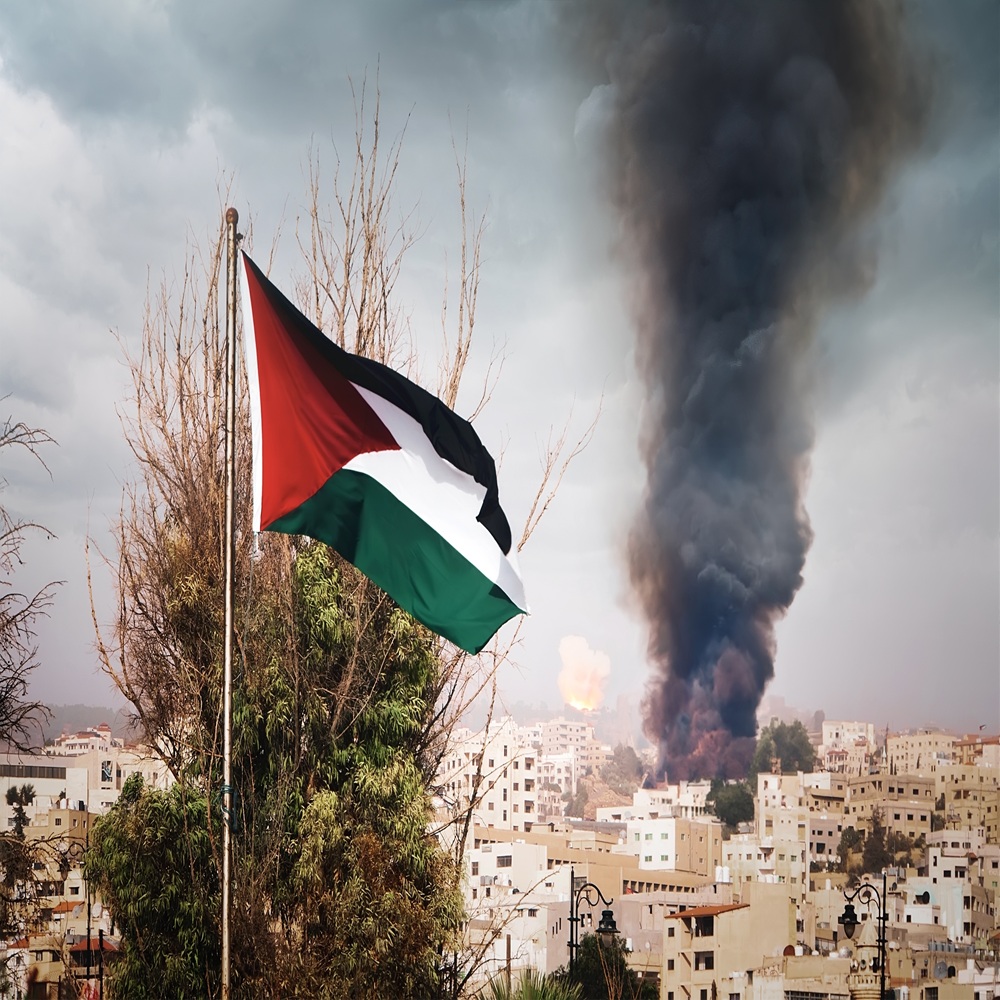
the flag of Palestine on the mountain on the background of the houses in the city. the war in the Middle East. explosion with black smoke in the city.

Silence and shadows: The West’s Quiet Stance on Gaza’s Agony

by Muhammad Younus , Bhimo Widyo Andoko , Bambang Irawan

In a world connected by the flicker of screens and the hum of digital voices, the silence of the West on the Gaza war echoes louder than any bomb that shatters the night sky. It is a silence heavy with the weight of choices unmade and words unsaid, a stillness that cloaks the suffering of people in the guise of political neutrality and strategic interests. This quiet complicity whispers louder than a roar, raising questions about morality, humanity, and the real cost of silence in the face of injustice. The Gaza Strip, a narrow enclave hemmed in by borders and blockades, has long been a crucible of pain and resilience. It is a place where life and death coexist in precarious balance, where every breath is a defiance of the suffocating conditions imposed by a siege that has lasted for decades. Here, children play among the rubble, their laughter a brittle thread of hope that stands in stark contrast to the backdrop of destruction. Families cling to each other amid the darkness of power cuts, their stories woven into the fabric of a daily struggle for survival. The people of Gaza are not merely statistics or headlines; they are fathers, mothers, sons, and daughters whose lives are marked by an enduring quest for dignity amid dehumanizing conditions. And yet, the West remains curiously quiet. The silence is not a lack of awareness—news outlets beam images of devastated buildings, grieving families, and wounded children into living rooms around the globe. It is not a lack of information—diplomatic channels are flooded with reports of humanitarian crises, violations of international law, and calls for action from activists and organizations. No, this silence is something more deliberate, a calculated choice that reveals as much about those who wield power as it does about those who suffer under it. This silence is layered and complex, often justified under the banners of political pragmatism and national interests. Governments in the West, whether by default or design, often tiptoe around the issue, their diplomatic language carefully crafted to avoid outright condemnation or clear support. Statements of concern are issued, and calls for restraint are made, but these words often fall short of genuine action or meaningful intervention. They echo through the chambers of power, hollow and unfulfilled, a reminder of the chasm between rhetoric and reality. For many, this muted response is not just a political stance but a moral failing. To remain silent in the face of clear and ongoing human suffering is to be complicit in that suffering. It is to prioritize strategic alliances and geopolitical calculations over the lives of innocent civilians. It is to turn a blind eye to the cries of those who have lost everything, to the pleas of a mother searching through rubble for her child, to the desperate hope of a father clinging to the belief that tomorrow might bring a semblance of peace. It is to allow the narrative of one side to dominate, to let the story of the oppressor drown out the voices of the oppressed. The West's silence on Gaza is also a reflection of broader global dynamics, where power often trumps principle and where the lives of some are deemed more valuable than others. It highlights the uneven scales of justice and the selective application of human rights, where the suffering of one group can be overshadowed by the strategic importance of another. This silence feeds into a cycle of despair and resentment, where each day of inaction deepens the wounds and hardens the hearts of those who feel abandoned by the very international community that claims to stand for justice and human dignity. Yet, amid this silence, there is a quiet but persistent call for change. It comes from the streets of cities around the world, where ordinary people march and rally, refusing to be silent themselves. It comes from the voices of activists, journalists, and humanitarians who risk much to bear witness to the truth. It comes from the survivors in Gaza who, despite everything, continue to hope and dream of a life beyond the siege, a life where their voices are heard, and their humanity recognized. The challenge before the West is not simply to break its silence but to confront the deeper questions that this silence raises. What does it mean to stand by in the face of suffering? How do we reconcile our values with our actions, our words with our deeds? And most importantly, what kind of world do we wish to build — a world where justice is selectively applied and where silence is a shield for the comfortable, or a world where every life, no matter how distant or different, is treated with the dignity it deserves? The answer lies not in grandiose statements or symbolic gestures but in a genuine commitment to empathy, equity, and accountability. It lies in the courage to listen, to speak, and to act in ways that honor the shared humanity of us all. For in the end, it is not the bombs or the bullets that define our world, but the choices we make in the face of them. And in the silence of the West on Gaza, there is a choice yet to be made — a choice between complicity and courage, between indifference and action. It is a choice that will echo far beyond the borders of Gaza, reverberating through the conscience of a world that must decide what it truly stands for.

Diplomacy

Opinion – As Israel Pushes for Annexation, Is There Hope for Palestinians?

by James Ron

Over the last two weeks, the Israeli website +972 reported, “Six ‘game-changing’ recent cabinet decisions may push the occupation past a tipping point toward permanent Israeli rule.” Many think this will spell political disaster by ending all hope for a negotiated two-state solution. I suggest a different, and perhaps overly optimistic perspective. Maybe – just maybe – these new moves could spark a long-term process ending in a more democratic, egalitarian, and peaceful Israeli-Palestinian space. The current government of Benjamin Netanyahu has been heavily influenced by its ultra-nationalist cabinet members, including Finance Minister Bezalal Smotrich, who leads the political party “Religious Zionism,” and whose responsibilities include administering the Palestinian West Bank (known to his supporters as “Judea and Samaria”). Another key right-wing government figure is National Security Minister Itamar Ben Gvir, head of the Israeli party, “Jewish Power,” who was handed control over the powerful national police. Under the influence of these and other right-wing coalition partners, the Netanyahu government – which won Israel’s national elections in late 2022 – wrote policy guidelines that committed itself to efforts aimed at ensuring the Jewish people’s full and exclusive rights over what they called the entire “Land of Israel.” These guidelines were interpreted by many as commitments to strengthening Israel’s legal and administrative hold over the West Bank in preparation for eventual annexation. In the last week or so, the government has passed new rules enhancing Israel’s ability to take over more West Bank land and tighten its administrative and legal grip over the area. These include: • Declassifying West Bank land ownership records, which would allow settler groups to place pressure on individual Palestinian owners to sell or abandon their property. • Striking down a Jordanian law, long applied to the West Bank, barring private land sales to foreigners, including Israelis. • Mandating a new land registration process, which might allow the government to register more West Bank property as “state land,” which could then be turned over to settlers, and opening the door to fraud during the registration process itself. • Eliminating the need for a special permit to register land sales, again expanding opportunities for skulduggery. • Expanding the Israeli military’s law enforcement role in the West Bank’s “A” and “B” zones, which are supposed to be under the control of the Palestinian Authority, to varying degrees. • Transferring control over some West Bank areas from Israeli military commanders to civilian agencies, normalizing their incorporation into the Israeli state. Until now, the West Bank has been legally defined as an object of “military rule,” although Israel’s civilian ministries have long crept into specific areas of jurisdiction. Taken together, according Ziv Stahl, director of the Israeli human rights organization, Yesh Din, these actions are accelerating processes of de facto West Bank annexation:l by Israel. “Legally speaking,” Stahl told +972, “I don’t know if we can still call it occupation. I think we have been shifting to a reality of annexation. It’s hard to determine where exactly the pivotal moment was, but the physical situation on the ground in the West Bank has completely changed in these three years of this government.” Many regard annexation as an absolutely disastrous political development that will permanently end all hope of a two-state solution. It is this solution, in turn, that is the desired outcome of most European states, the Palestinian Authority, most Arab countries, most UN members, and the US government. Under President Trump, of course, support for the two-state option has grown muddier; he hasn’t endorsed annexation, but hasn’t made any effort to promote the two-state idea either. Among some of Israel’s more moderate political parties – as well as left-of-center Jewish advocacy groups such as J Street or Peace Now – the idea of two separate, sovereign states is also sacrosanct. One would be for Palestinians living in the West Bank and Gaza, and another would be for Israeli Jews living in roughly 70% of Mandatory Palestine. For most international diplomats and many advocacy groups, the two-state option has long been regarded as the best possibility for long-term political stability, justice, and human rights for all. I’d like to offer a different perspective. If Israel were to annex the entire West Bank, the demographics of Israel’s official polity (as opposed to its hybrid ‘internationally recognized state plus militarily occupied Palestinian zones’) would include an additional three million Palestinians. This number includes some 2.8 million Palestinians living in the West Bank’s A and B zones (Palestinian Authority-controlled, in theory), and another 250,000 living in the West Bank’s C zones (controlled by the Israeli military). To these, add another roughly 1.6 million current Palestinian citizens of Israel, living chiefly in the country’s north, along with some 350,000 Palestinians who are permanent residents of Israel, living in East Jerusalem. This combined total of roughly 5 million Palestinians would represent just over 40% of the entire population under direct Israeli sovereignty, using today’s figures. It would not include the roughly 2.2 million Gazan Palestinians now living in utterly dire conditions. (I do not include them here because the Israeli cabinet’s new regulations do not refer to Gaza). Although only 1.6 million of these five million Palestinians currently have Israeli citizenship and the right to vote today in Israeli elections, there might be pressure, over time, to add more Palestinians living in sovereign Israeli territory to the voter rolls. Over the next few decades, newly enfranchised Palestinians could exert increasing influence on Israel’s legislature and governments. With a bit of luck, this pressure might eventually lead to a softening of Israel’s commitment to Jewish political, legal, and cultural supremacy, gradually leading to a more pluralistic and democratic space. Importantly, this could give desperate Palestinians a viable, non-violent alternative for shaping their political fate, relegating the Palestinian Authority’s moribund diplomatic efforts and the violence of Hamas and others to the back of the line. Several authors have discussed the possibility of a “one-state solution” to the Israeli-Palestinian conflict, including a 2010 volume by American academic Virginia Tilley, and the more recent book by Sarah Leah Whitson and Michael Omer-Man. These analysts have identified a fifth option that is distinct from the four possibilities currently on the table for Israelis and Palestinians. These five options include: • The Israeli radical right’s current plan for Jewish annexation and eternal Palestinian subordination. • The two-state solution promoted by the international community and other mainstream actors ever since the Oslo Peace Accords. • A new set of proposals for a political consociation of “two sovereign peoples living in a single land,” promoted, among others, by the Palestinian-Israeli NGO, A Land for All; • The violent status quo, in which the Palestinian Authority continues to crumble, Palestinian militant groups occasionally strike Israelis, and Jewish settlers, backed by the Israeli army, wield violence against Palestinians. • The “one-state solution,” which involves the creation of a single, unified state from the River Jordan to the Mediterranean Sea, in which all residents are lawful citizens, have the right to vote, are equal before the law, and share in the country’s internal and external defense. If Gaza were to be included in this single state, the new entity’s population would include roughly coequal ethnic populations, although divergent birth rates might, over time, lead to an Arab majority. If Gaza were to be excluded, Palestinians would make up just over 40% of the unified territory’s population, using contemporary numbers. If the Israeli cabinet’s recent annexation-enhancing efforts lead to the eventual annexation of the West Bank’s A, B, and C, this may prepare the ground for an eventual move towards political, cultural, and legal democratization. For West Bank Palestinians to become full-fledged voters would likely take years. It would require repeated cycles of social protest, and might include at least some violence from all sides. Still, the death toll could hardly rival today’s horrific conditions. The radical right is well aware of the one-state possibility. It has spoken of threading that needle by annexing only Area C. Although C includes the vast majority of the West Bank’s landmass, it has only a tiny fraction of the Palestinian population. C is also the zone where most Jewish colonies are currently situated. The radical Jewish right might try to devise a hybrid, “neither fully in, nor fully out” arrangement for Areas A and B, limiting the inclusion of millions of new Palestinians into their newly expanded Greater Israel. Still, the momentum for including all three West Bank areas into Israel’s sovereign territory would persist, both among settlers and Palestinians. A and B zones are small, isolated enclaves, and they will struggle to remain distinct from the C hinterland. The radical right and its associated settler movement, moreover, will continue to cast their eyes over A and B for religious, security, economic, and other reasons. Stripped of the “sea” of Area C, the “islands” of A and B could eventually be incorporated as well. In my optimistic reading, the Israeli radical right’s new turbo-charged efforts to annex more Palestinian land may include a silver lining, offering a more hopeful path forward. In the martial art of ju-jitsu, the weaker party seeks survival by using and redirecting their opponent’s strength. For almost a century, Palestinians have tried to blunt and even reverse the Jewish community’s encroachments by fighting fire with fire: guns, regional alliances, international diplomacy, and UN maneuvering. Those efforts have failed. Israel’s Jewish community is just too strong, too committed, too well-organized, and too capital-intensive. It cannot be overcome with the weapons that Palestinians and their dwindling circle of allies have at their disposal, or by economic boycotts, diplomacy, the International Criminal Court, or UN resolutions. International human rights reporting, after all, did nothing to prevent Gaza’s destruction, Hamas’ horrendous (if briefly successful) October 7 attack yielded nothing good, and the Oslo Peace Accords have, in the end, been spectacularly useless. The UN’s resolutions, moreover, have proved about as useless as everything else. Now, perhaps, the time has come to absorb and gradually metabolize the “blow” of West Bank annexation. Once Palestinians have been incorporated as subjects of the Israeli state, and not as mere objects of military occupation, they can try to transform their opponent’s kinetic energy into something new and more positive for both sides.

Energy & Economics
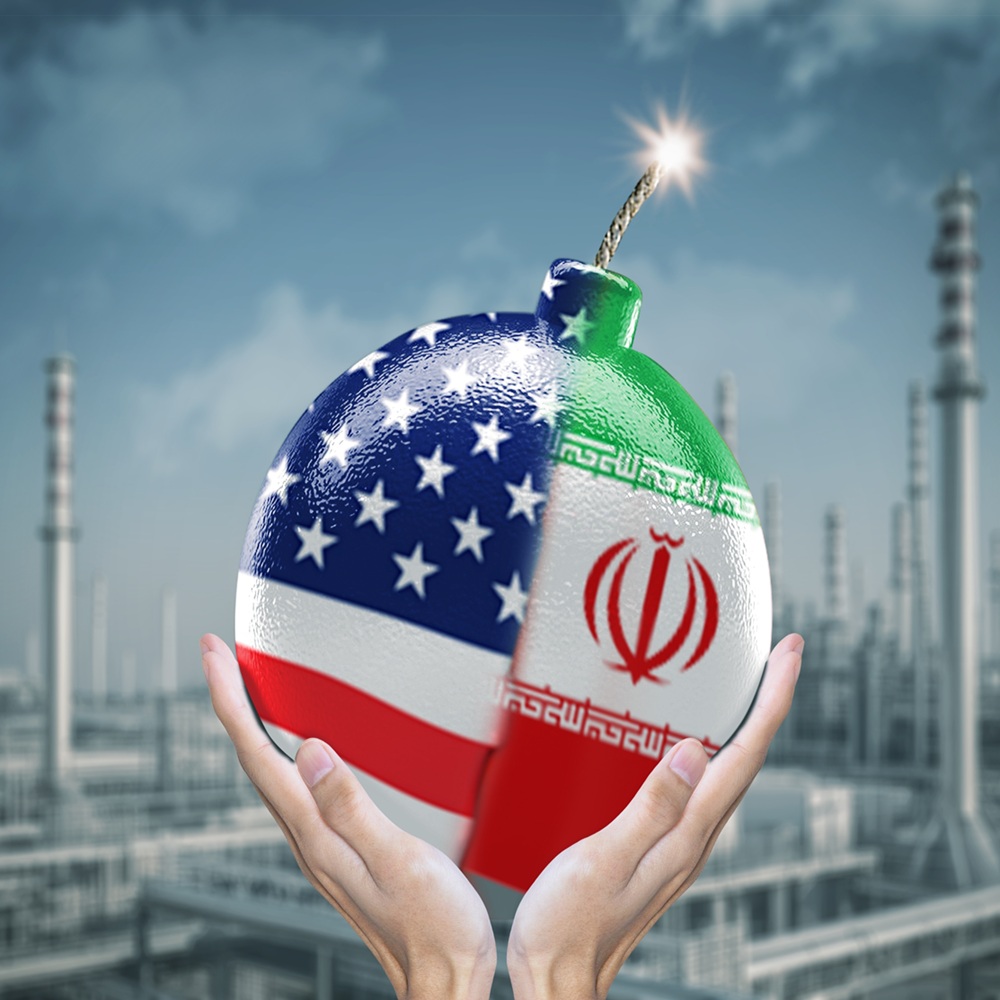
Geopolitical Tension Concept with USA and Iran Flag Bomb Over Oil Refinery

If the US carries out military strikes against Iran, what will happen to global oil supply and global oil price?

by World & New World Journal Policy Team

I. Introduction Oil prices are climbing amid signs that the US may plan to launch military strikes on Iran, raising questions about the potential economic fallout of heightened conflict in the Middle East. US President Trump has increased pressure on Iran, home to some of the world’s largest oil reserves, over the country’s disputed nuclear program. Open hostilities between the US and Iran could restrict global oil flows, raising US energy prices and driving up inflation, according to economists. While President Trump hasn‘t yet made a final decision about whether to strike Iran, top national security officials have told the president that the US military could be ready as soon as Saturday on February 21, 2026, sources familiar with the discussions have told CBS News. At the inaugural meeting for President Trump’s “Board of Peace” on Thursday, February 19, 2026, the president said that Iran has about 10 days to make a deal ending its nuclear program, or “bad things will happen.” [1] If the US carries out military strikes on Iran, it can create a lot of economic problems. This paper first examines the situations of US military build up around Iran and then explores the scenarios of oil supply disruption when the US carries out military strikes on Iran and its impact on global oil price. II. US Military Build-Up around Iran As US President Donald Trump considers a major military strike on Iran, US military has accelerated weeks-long buildup of military hardware in the Middle East. As Figure 1 shows, the arrival of the Lincoln Carrier Strike Group, now off the coast of Oman, about 700km (430 miles) from Iran, represents the most dramatic shift in military positioning. As Figure 2 shows, the Abraham Lincoln, a nuclear-powered Nimitz-class aircraft carrier, together with three Arleigh Burke-class destroyers forms a carrier strike group, plus two destroyers capable of conducting long-range missile strikes and three specialist ships for combat near to the shore that are currently positioned at Bahrain naval station in the Gulf. Figure 1: US military presence around Iran (Congressional Research Service, Airframes.io, Flightradar24, Planet Labs PBC, Airbus Figure 2: The USS Abraham Lincoln Strike Group (source: Al Jazeera) In addition, the USS Abraham Lincoln strike group includes the carrier air wing of squadrons of F-35C Lightning II fighters, F/A-18E Super Hornet fighters, and EA-18G Growler electronic warfare jets. According to BBC, two other destroyers have also been seen in the eastern Mediterranean near the Souda Bay US base, and one more in the Red Sea. Moreover, the world’s largest warship is heading towards the Middle East. As Figure 3 shows, the USS Gerald R Ford passed through the Strait of Gibraltar towards the Mediterranean on February 20, 2026 and is expected to arrive off Israel’s coast and dock in Haifa, Israel on Friday, February 27, 2026. BBC confirmed the USS Mahan, one of the destroyers in the USS Gerald R Ford’s strike group, passed through the Strait. The Gerald R Ford had briefly broadcast its location off Morocco’s Atlantic coast on last Wednesday. [2] Figure 3: The USS Gerald R Ford Strike Group (source: Al Jazeera) The arrival of two of the 11 aircraft carriers operated by US Navy adds to what we know about the military build-up in the Middle East over the past few weeks. Both Abraham Lincoln and Gerald R Ford lead strike groups with several guided missile destroyer warships. They are operated by over 5,600 crews and carry dozens of aircraft. Moreover, according to intelligence analysts and military flight-tracking data, the US appears to have deployed more than 120 aircraft to the region within the past few days – the largest surge in US airpower in the Middle East since the Iraq war in 2003. BBC confirmed the movements of large numbers of US aircraft to both Middle Eastern and European airbases, including: [3] • E-3 Sentry command and surveillance aircraft designed to coordinate large-scale operations • F-22 and F-35 fighter jets • KC-46 and KC-135 refueling tankers used to support the long-range movement of other aircraft • C-5M strategic transport aircraft, the largest in the US Air Force, used for cargo and personnel • C-17A heavy-lift military transport aircraft used for delivering troops and cargo • Navy P-8A patrol and reconnaissance jets used for long-range anti-submarine warfare Recently, attention has focused on Diego Garcia, the joint US-UK military base in the Indian Ocean’s Chagos Islands, which is capable of hosting long-range US strategic bombers, including B-2 aircraft. As Figure 4 shows, the remote base has historically served as a launch point for major US air campaigns in the Middle East. It could be used for US military attacks against Iran. However, Diego Garcia is a British sovereign territory leased to the US, meaning that UK must approve its use for offensive operations. According to reports in UK media, Prime Minister Keir Starmer has indicated to President Trump that the US cannot use British airbases – including Diego Garcia and RAF Fairford in the UK, which is home to the US’s heavy bomber fleet in Europe – for strikes on Iran, as this would violate international law. Figure 4: Diego Garcia (source: TheCradleCo) III. Scenarios of oil supply disruption Crude oil prices have fluctuated in recent days along with media headlines about potential US military strikes on Iran, as a second round of talks between US and Iranian representatives concluded on February 17, 2026 without resolving underlying disputes. Although US and Iran held a third round of nuclear talks in Geneva on February 26, 2026, the chances of a deal that could avert a war remain unclear. As Figure 5 shows, international benchmark WTI crude oil prices climbed to $66.618 (USD/Bbl) on February 20 and $66.30 on February 25, 2026. Figure 5: Crude oil WTI prices, 2026 (source: Trading Economics) On the other hand, Brent crude oil futures rebounded 2% to above $70 per barrel on February 25, 2026, reversing earlier losses. Figure 6: Brent crude oil future, 2026 (source: Trading Economics) During Twelve-Day War between Iran and Israel in June 2025, joined by the US in Operation Midnight Hammer, Gulf oil exports avoided major disruption. As the Twelve-Day War transpired, Iran perceived that it was not facing an existential crisis, as its oil exports continued unimpeded, and Iran made no attempt to target Arab Gulf oil assets or shipping. Fast forward to today-the Islamic Republic of Iran faces unprecedented vulnerability following the blows inflicted by Israel, including the degradation of Hezbollah’s capabilities, and more recently, the biggest wave of anti-government protests in its 47-year history. Meanwhile, US president Trump is publicly escalating rhetoric by assembling significant military assets in the Gulf region, pressuring the Iranian regime to accept US demands, and personally threatening Supreme Leader Ayatollah Ali Khamenei. Therefore, if hostilities between Iran and the US or Israel, resume, Iran may indeed perceive an existential threat, bringing its counterthreat against regional oil supplies into play. Six oil-producing countries in the Middle East depend on unimpeded shipping access via the Strait of Hormuz to reach world oil markets, as Figure 7 shows. Their relative dependency on the strategic waterway is shown in Table 1 below. Figure 7: Map of the Strait of Hormuz (source: BOE report) According to Table 1, Iran, Kuwait, and Qatar depend on the Strait of Hormuz 100 percent for the exports of their crude oil, while Iraq depends 97 percent and Saudi Arabia 89 percent. If there are problems with the Strait of Hormuz resulting from US-Iran conflicts, therefore, oil supply disruption could take place. Table 1: Middle East Gulf Oil Exporters’ Reliance on Strait of Hormuz   According to Clayton Seigle at CSIS, there are four oil supply disruption scenarios worth considering. [4] Scenario 1: Iran disrupts Arab Gulf oil shipping If the US strikes Iran, then Iran could disrupt oil shipping of Arab Gulf countries. This campaign would likely target Gulf export flows transiting the Strait of Hormuz, in which the outbound and inbound shipping lanes are only two miles wide. Iran could attempt to divert or seize control of oil tankers, or strike them outright using fast attack aircraft, anti-ship missiles, drones, or naval mines. Up to 18 million barrels per day-perhaps far less-of non-Iranian crude oil and refined petroleum products could be throttled or temporarily halted. This scenario might see several million barrels per day disrupted for a period of weeks until US naval forces could neutralize sea- and shore-based threats to energy cargo flows. Oil prices would initially spike with surging freight and insurance rates, and with some ship operators likely fleeing the region, further reducing export capacity. As traders assess the volume and duration of a physical disruption, crude oil prices could rise past $90 per barrel, pushing US retail gasoline prices well above $3 per gallon on a national average basis (some regions much higher). Fortunately, this chain of events is reversible; Iran could call off its disruptive activities at any time, or global forces could quell their attempts at interruption, enabling Gulf export volumes to rebound. Scenario 2: Iran directly attacks Arab Gulf oil facilities If the US strikes Iran, then Iran could directly attacks oil facilities in Arab Gulf countries. As Figure 8 shows, these attacks could include producing fields, gathering and processing nodes, or oil export terminals. Figure 8: Oil and Gas fields and Infrastructure in the Middle East (source: Javier Campos) In this scenario, a substantial portion of the 18 million barrels per day non-Iranian oil exports from the Gulf region, depending on which assets might be taken offline and for how long, could be at stake. Moreover, potentially millions more barrels per day in the affected countries’ domestic crude feedstocks and refined product supply would be at risk. This scenario could lead to a historically unprecedented oil price spike, potentially higher than the $130 per barrel that was touched in 2022 after Russia invaded Ukraine. The oil supply at risk at that time was approximately 5 million barrels per day. Like Scenario 3, this case could see oil facilities heavily damaged or even destroyed, removing export capacity for a protracted period. This is true not only for onshore infrastructure, but also for offshore loading platforms, which constitute a critical bottleneck in export capacity. One example of this vulnerability is that Iraq’s entire Gulf export flow of 3.5 million barrels per day depends on offshore loading facilities very close to Iranian territorial waters. These offshore loading points may take considerable time to repair - an Ukrainian attack on a similar offshore loading platform at the Black Sea’s Caspian Pipeline Consortium on November 29, 2025 terminal knocked 500 thousand barrels per day - a third of the terminal’s output - offline for several months. Onshore facilities are also vulnerable but may be repaired faster, depending on the repair resources available. For instance, the September 2019 attack on Saudi Aramco’s Abqaiq crude oil processing facility initially disrupted approximately 5 million barrels per day, but most of that volume was restored in less than two weeks after rapid repair efforts. Scenario 3: US or Israel directly attacks Iranian oil facilities If President Trump order the US military to attack Iran, then US (and with Israel) forces could attack not only Iranian military facilities, but also Iranian oil facilities. In this scenario, US naval and air forces would strike Kharg Island and its supply lines, offshore production platforms, and (less likely) Iran’s oil refineries. As Figure 9 shows, Iran’s export terminal at the Kharg Island accounts for nearly all of its 1.6 million barrels per day average export volume. Kharg could be taken offline in several ways, including destroying or disabling its ship loading equipment (pumps, hoses, and connecting hardware), damaging its oil storage tanks, or cutting off the flow of oil that reaches Kharg via subsea pipelines. Figure 9: Kharg Island (source: https://catalystias.org.in/english/Kharg-Island) Choke points for oil deliveries to the Kharg Island include the onshore Ghurreh booster station, the manifold station at Ganaveh, and the pipelines themselves. Not only are Iran’s 1.6 million barrels per day crude oil exports (if limited to Kharg) at stake, but also its additional 1.5 million barrels per day of domestic oil production (should platforms/fields be targeted) and its domestic supply of transportation fuels such as gasoline (if refineries are damaged). The oil price impacts would likely be greater than the $10–12 per barrel spike anticipated with scenario 1 for two reasons: (1) damage to or destruction of Iranian infrastructure could keep barrels off the oil market for a protracted period of time (potentially offset by activation of OPEC spare production capacity), and (2) anticipation of a further escalation by Iran with something like scenario 4 (described below). This track, therefore, might take oil prices above $100 per barrel. [5] Scenario 4: US or Israel Disrupts Iranian Crude Oil Shipments If President Trump order the US military to attack Iran, then US (and with Israel) forces could attack not only Iranian military facilities, but also Iranian oil facilities. This could take the form of blockading or seizing Kharg Island, the main facility for loading Iranian oil onto ships, and seizing oil tanker vessels transporting Iranian crude oil. This could disrupt up to 1.6 million barrels per day of Iranian crude oil exports, all of which go to China. However, since oil is a global, fungible commodity, a disruption anywhere influences prices everywhere. A loss of Iranian barrels might cause China to bid for substitute supplies, probably worth at least a $10–12 increase in the global price of crude oil. This scenario is reversible, meaning that the US or Israel could call off its campaign against Iranian shipments at any time with no permanent damage having been incurred and export volumes rebounding thereafter, like what was seen after the US quarantine on Venezuelan oil shipments. Insurance and war-risk premiums could keep prices elevated longer than any physical supply interruption. Limitation of Hormuz Bypass Potential Oil export routes that bypass the Strait of Hormuz handle only a fraction of daily Gulf exports. As Figure 10 shows, Saudi Aramco’s East-West Pipeline connects Saudi Arabia’s oil production centers in the Eastern Province with the Red Sea Yanbu Port. The pipeline could reroute some barrels from the Gulf to the Red Sea, but only in reduced volumes. The pipeline has a capacity of 5 million barrels per day. But it is already supplying Yanbu with close to 800 thousand barrels per day for export cargoes, and likely supplying six Saudi Aramco refineries in western and central Saudi Arabia with about 1.8 million barrels per day. That would leave only approximately 2.4 million barrels per day of spare capacity in the pipeline, compared to Saudi Arabia’s typical 6 million barrels per day from its Gulf terminals - enabling the rerouting of less than half of its Gulf exports. Figure 10: Saudi Aramco’s East-West pipeline (source: EIA) As Figure 11 shows, the United Arab Emirates (UAE) may reroute about half of its 2 million barrels per day of Gulf exports via pipeline to its port of Fujairah on the Gulf of Oman, bypassing the Strait of Hormuz. The port of Fujairah already accounts for approximately one-third of the UAE’s total 3.2 million barrel per day export volume, implying that the remaining third (1 million barrels per day) might remain stranded in a Hormuz closure. Other Gulf oil-exporting countries—Qatar, Kuwait, Bahrain, Iraq (5.7 million barrels per day total volume)—have no Hormuz bypass capacity; likewise, there’s no other outlet for Qatar’s 10 billion cubic feet per day of LNG exports. Figure 11: UAE’s oil pipeline (source: EIA) Evaluation of the Scenarios US President Trump faces a dilemma in how to confront Iran without incurring an unwanted oil supply disruption and gasoline price spike. In Operation Midnight Hammer and in the operation to capture Venezuela president Nicholas Maduro, Trump selected military options with low risk of negative consequences (in terms of US casualties and energy price increases). But scenarios 1 and 2, described in this paper, afford Iran leverage that could deter Trump from undertaking a major military operation against Iran. This is because in scenarios 1 and 2, Iran could disrupt the supply and export of crude oil of Gulf countries. Meanwhile, Israel, which launched the Twelve-Day War against Iran in summer of 2025, remains a wildcard. [6] The US certainly has a large list of Iranian targets for kinetic action, many of which may not involve energy. Insofar as oil leverage may be used as part of a pressure campaign against Iran, it is likely to start with scenario 1 (US or US/ Israel, disrupts Iranian crude oil shipments), and Iran will face a dilemma about how to respond. If Iran pursues Scenario 1 (Iran disrupts Arab Gulf oil shipping), the US will seek to neutralize Iran’s naval and shore-based anti-ship capabilities, leaving Iran with only scenario 2 (Iran directly attacks Arab Gulf oil facilities) left to employ—one that could cause the US to carry out scenario 3 (US/Israel directly attack Iranian oil facilities)—and seek the regime’s outright defeat or destruction. Iran’s “use it or lose it” dilemma could provoke a miscalculation in Iran, resorting to scenario 2 (Iran directly attacks Arab Gulf oil facilities) as its last card to play to stave off defeat. IV. Conclusion This paper examined the scenarios of oil supply disruption when the US carries out military strikes on Iran. In doing so, this paper first showed US military build-up around Iran and then proposed 4 scenarios of oil supply disruption and evaluated them. The largest oil supply disruption and the resulting highest oil price surge are likely to happen in scenario 2 when Iran attacks oil facilities in the Gulf region and scenario 3 when the US attacks oil facilities in the Kharg Island of Iran. References [1] https://www.cbsnews.com/news/iran-us-conflict-impact-on-oil-inflation/ [2] https://www.bbc.com/news/articles/c1d64p3q2d0o [3] https://www.bbc.com/news/articles/c1d64p3q2d0o [4] https://www.csis.org/analysis/if-trump-strikes-iran-mapping-oil-disruption-scenarios [5] https://www.csis.org/analysis/if-trump-strikes-iran-mapping-oil-disruption-scenarios [6] https://www.csis.org/analysis/if-trump-strikes-iran-mapping-oil-disruption-scenarios

Defense & Security
Concerns over US involvement in Israel-Iran conflict

‘Destruction is not the same as political success’: US bombing of Iran shows little evidence of endgame strategy

by Farah N. Jan

Shortly after the opening salvo of U.S.-Israeli attacks on Iran on Feb. 28, 2026 – with missiles targeting cities across the country, some of which killed Supreme Leader Ayatollah Ali Khamenei – President Donald Trump declared the objective was to destroy Iran’s military capabilities and give rise to a change in government. Framing the operation as a war of liberation, Trump called on Iranians to “take over your government.” In the first days alone, Israel dropped over 2,000 bombs on Iranian targets, equal to half the tonnage of the 12-day Israel-Iran conflict in June 2025. Heavy U.S. bombing, meanwhile, has targeted Iran’s Revolutionary Guard as well as ballistic missile and aerial defense sites. The destruction is real. But, as an international relations scholar, I know that destruction is not the same as political success. And the historical record of U.S. bombing campaigns aimed at regime change shows that the gap between the two – the point at which Afghanistan, Iraq and Libya campaigns all stalled – is where wars go to die. Destruction is not strategy Decades of scholarship dating back to World War I on using air power to force political change has established a consistent finding: Bombing can degrade military capacity and destroy infrastructure, but it does not produce governments more cooperative with the attacker. Political outcomes require political processes – negotiation, institution-building, legitimate transitions of power. Bombs cannot create any of these. Instead, what they reliably create is destruction, and destruction generates its own dynamics: rallying among the population, power vacuums, radicalization and cycles of retaliation. The American record confirms this. In 2003, the George W. Bush administration launched “Shock and Awe” in Iraq with the explicit aim of regime change. The military objective was achieved in weeks. The political objective was never achieved at all. The U.S. decision to disband the Iraqi army created a vacuum filled not by democratic reformers but by sectarian militias and eventually ISIS. The regime that eventually emerged was not friendly to American interests. It was deeply influenced by Iran. In 2011, the Obama administration led a NATO air campaign in Libya that quickly expanded from civilian protection into regime change. Dictator Moammar Gadhafi was overthrown and killed. But there was no plan for political transition. Chaos and political instability have endured since. Asked what his “worst mistake” was as president, Barack Obama said, “Probably failing to plan for the day after, what I think was the right thing to do, in intervening in Libya.” Libya remains a failed state today. The intervention also sent a powerful signal to countries pursuing nuclear weapons: Gaddhafi had dismantled his nuclear program in 2003. Eight years later, NATO destroyed his regime. Even Kosovo, often cited as the success story of coercive air power, undermines the case. Seventy-eight days of NATO bombing did not, by themselves, compel Slobodan Milosevic, president of the Federal Republic of Yugoslavia, to withdraw. What changed was the credible threat of a ground invasion combined with Russia’s withdrawal of diplomatic support. The political outcome – contested statehood, ongoing ethnic tensions – is hardly the stable governance that air power advocates promise. The pattern is consistent: The United States repeatedly confuses its unmatched capacity to destroy from the air with the ability to dictate political outcomes. Why this war? The recent U.S. attacks on Iran raise a fundamental question: Why is the United States fighting this war at all? The administration has declared regime change as its objective, justifying the campaign on the grounds of Iran’s nuclear program and missile capabilities. But that nuclear program was being actively negotiated in Geneva days before the strikes. And Iran’s foreign minister told NBC the two sides were close to a deal. Then the bombs fell. Iran did not attack America. And it currently does not have the capability to threaten the American homeland. What Iran challenges is Israel’s regional military dominance, and I believe it is Israel’s objective of neutralizing a rival that is driving this operation. Israel targeted 30 senior Iranian leaders in the opening strikes. Israeli officials described it as a preemptive attack to “remove threats to the State of Israel.” I see the strategic logic for these killings as Israel’s, and Americans are absorbing the costs. U.S. military bases in Bahrain, Qatar, Kuwait, the UAE, Jordan, and Saudi Arabia have taken Iranian missile fire. American service members are in harm’s way – three have already been killed – not because Iran attacked them, but I believe because their president committed them to someone else’s war without a clear endgame. Each coercive step in this conflict – from the 2018 withdrawal from the nuclear deal, to the 2020 assassination of Qasem Soleimani, Iran’s most powerful military commander, to the June 2025 strikes – was framed as restoring leverage. Each produced the opposite, eliminating diplomatic off-ramps, accelerating the very threats it aimed to contain. The regime is not one man Decapitation strikes assume that removing a leader removes the obstacle to political change. But Iran’s political system is institutional — the Guardian Council, the Assembly of Experts and the Revolutionary Guard have survived for four decades. The system has succession mechanisms, but they were designed for orderly transitions, not for active bombardment. The group most likely to fill the vacuum is the Revolutionary Guard, whose institutional interest lies in escalation, not accommodation. There is a deeper irony. The largest protests since 1979 swept Iran just weeks ago. A genuine domestic opposition was growing. The strikes have almost certainly destroyed that movement’s prospects. Decades of research on rally-around-the-flag effects – the tendency of populations to unite behind their government when attacked by a foreign power – confirms that external attacks fuse regime and nation, even when citizens despise their leaders. Iranians who were chanting “death to the dictator” are now watching foreign bombs fall on their cities during Ramadan, hearing reports of over 100 children killed in a strike on a girls school in Minab. Trump’s call for Iranians to “seize control of your destiny” echoes a familiar pattern. In 1953, the CIA overthrew Iran’s democratically elected prime minister in the name of freedom. That produced the Shah, the Shah’s brutal reign led to the Iranian Revolution in 1979, and the revolution produced the Islamic Republic now being bombed. What comes next? And what guarantee is there that whatever emerges will be any friendlier to Israel or the United States? What does success look like? This is the question no one in Washington has answered. If the objective is regime change, who governs 92 million people after? If the objective is stability, why are American bases across the Middle East absorbing missile fire? There is no American theory of political endgame in Iran — only a theory of destruction. That theory has been tested in Afghanistan, Iraq and Libya – and Iran itself over the preceding eight months. It has failed every time, not because of poor execution, but because the premise is flawed. Air power can raze a government’s infrastructure. It cannot build the political order that must replace it. Iran, with its sophisticated military, near-nuclear capability, proxy networks spanning the region and a regime now martyred by foreign attack, will likely not be the exception. U.S. law prohibits the assassination of foreign leaders, and instead Israel killed Iran’s supreme leader while American warplanes filled the skies overhead. Washington has called the result freedom at hand, but it has not answered the only question that matters: What comes next?

Diplomacy
Mini toy of action figure with blurred background. Business financial photography concept design. Minifigure of politician character with United of America and IRAN country flag. Miniature people.

Trump has given Iran a ten-day ultimatum – but chances of an agreement look slim

by Sanam Mahoozi

Donald Trump delivered an ultimatum to Iran at the first board of peace meeting in Washington on February 19. He told Tehran to reach a “meaningful” deal with the US within ten to 15 days, or “really bad things” will happen. White House press secretary Karoline Leavitt had earlier said there are many arguments for taking military action in Iran. These comments came as reports indicated that the latest round of indirect talks between the two countries in Switzerland on February 17 had made at least some headway. Iran’s foreign minister, Abbas Araghchi, emerged from the negotiations hailing what he saw as “good progress”. He added that the US and Iran had reached an understanding on “guiding principles”. The assessment of US representatives was less positive. Despite acknowledging that “in some ways” the talks went well, US vice-president J.D. Vance said Iran was refusing to acknowledge core US demands. The US wants Iran to dismantle its nuclear programme completely, reduce the number and range of its ballistic missiles and end its support for regional proxy groups. Following the talks, the US has continued to reinforce its military presence in the Middle East. Cargo planes, fighter jets, refuelling tankers and an aircraft carrier have been moved to the region, with a second aircraft carrier expected to arrive soon. According to the New York Times, the buildup of US forces in the Middle East is now sufficient for Trump to order military action at any moment. Iran appears to be gearing up for a confrontation. Its military held joint drills with Russia on February 19, days after the Strait of Hormuz was closed temporarily as Iran carried out live-fire exercises. And while emphasising that it “neither seeks tension nor war”, Iran has told the UN that if it were attacked it would consider “all bases, facilities and assets of the hostile force” in the region as “legitimate targets”. These developments come less than a week after hundreds of thousands of people, largely from the Iranian diaspora, demonstrated in cities worldwide. They did so in solidarity with protesters who took to the streets of Iran in January to demand regime change. In late December, protests that began over worsening economic conditions quickly spread nationwide in one of the most serious threats to Iran’s political establishment since the Woman, Life, Freedom protest movement of 2022. That protest wave began after the death of a 22-year-old women called Mahsa Amini in police custody. This time round, the Iranian authorities imposed a near-total internet shutdown, creating a nationwide communications blackout in an effort to suppress the unrest. Human rights groups say thousands of people were killed, while many more were injured, detained or remain missing, in what was one of the most severe crackdowns in Iran’s modern history. According to local police, around 250,000 people rallied on February 14 in the German city of Munich alone, where world leaders had gathered for Europe’s biggest security conference. Many of those in attendance waved flags bearing the lion and sun emblem of Iran that was used before the Islamic revolution in 1979 ended the Pahlavi dynasty. Israeli and American flags were also visible at many of the rallies. This has widely been seen as a call for foreign intervention against Iran’s clerical leadership. Trump had raised the prospect of US military action during the unrest, urging the Iranian people to continue protesting and telling them that help was “on its way”. Such action now appears likely. Brink of war Iran’s fate is hanging in the balance. The deployment of US military assets to the Middle East suggests Trump may be preparing for imminent military action. However, despite making no secret of his desire to topple the Iranian regime, there is still a chance that Trump settles for a diplomatic agreement with the country’s leadership. Iranian opposition voices, including exiled crown prince Reza Pahlavi, say such a deal would only prolong the survival of the Islamic Republic rather than address the demands of people in Iran for regime change. In an interview with American political commentator Glenn Beck on February 11, Pahlavi called the negotiations between the US and Iran “another slap in the face of the Iranian people”. But the prospects that any deal will be reached look slim. The US and Iran remain in fundamental disagreement over Tehran’s nuclear programme and have been unable to reach a deal since the Trump administration withdrew the US from a previous agreement in 2018 that had been negotiated by the Obama administration. Many people, including the US vice-president, are also sceptical that Iran’s authorities will budge on additional US demands around ballistic missiles and proxy groups like Hamas and Hezbollah – whether or not they are threatened with military action. Iran’s future is murky. But one thing is for certain: with war or without war, the Iranian people have started a revolution that has extended beyond their country’s borders.

Defense & Security
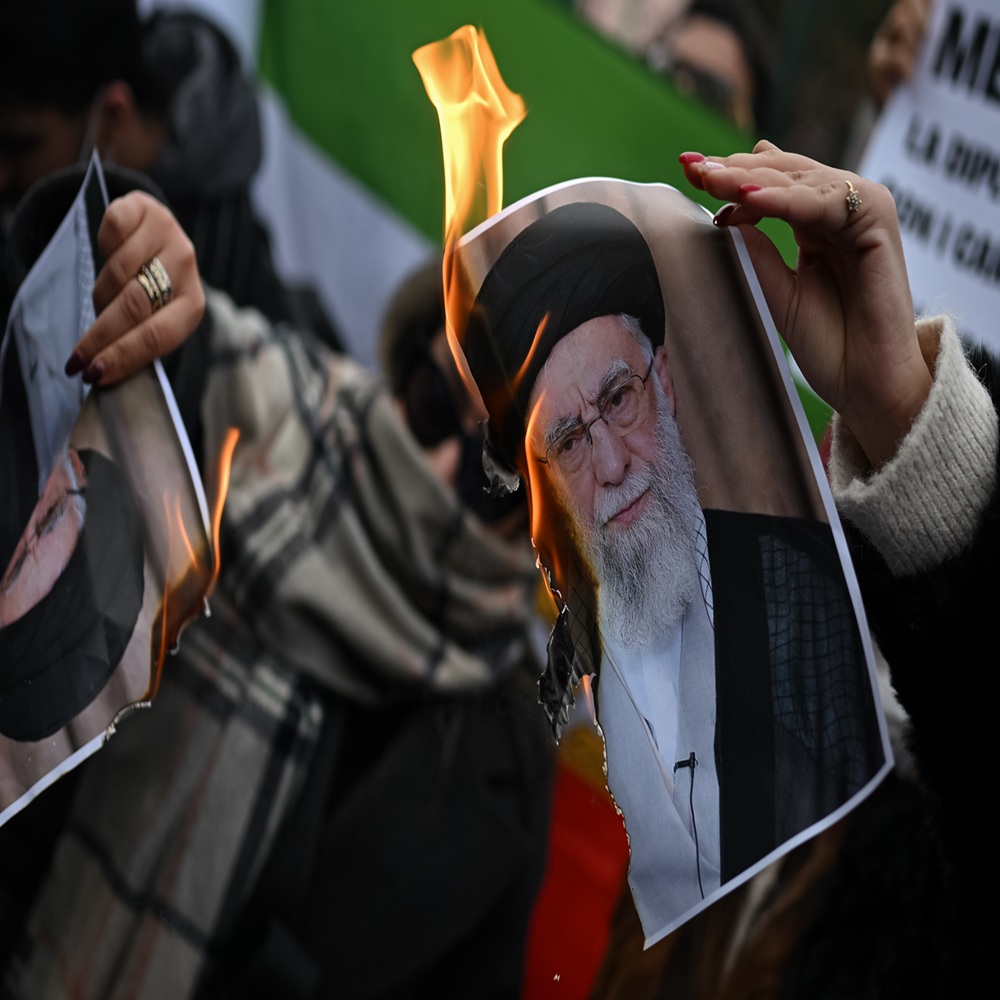
Milan, Italy - January 17, 2026: People burn a photo depicting Ali Khamenei, Supreme Leader of Iran during a demonstration in solidarity with Iranian protestors

Does US military strikes make a democratic transition in Iran possible?

by World & New World Journal Policy Team

I. Introduction In late December 2025, mass protests erupted across Iran, driven by public anger over the deepening economic crisis. Initially led by bazaar merchants and shopkeepers in Tehran, the demonstrations quickly spread to universities and major cities such as Shiraz, Isfahan, and Mashhad, becoming the largest unrest since the 2022 Mahsa Amini protests. Over time, the movement expanded beyond economic demands to include calls for freedom and, in some cases, the overthrow of the regime. Protesters chanted anti-government slogans such as “death to the dictator.” [1] In response, since late December 2025 Iranian state security forces have engaged in massacres of dissidents. The Iranian government has also cut off internet access and telephone services in an attempt to prevent protesters from organizing. The Iranian government has accused the US and Israel of fueling the protests, which analysts suggest may be a tactic to increase security forces’ willingness to kill protesters. A Sunday Times report, based on information from doctors in Iran, said more than 16,500 people were killed and more than 330,000 injured during the mass protests. The Interior Ministry in Iran verified 3,117 people had been killed in protests. [2] The Iranian protests, the largest in the Islamic Republic’s 46-year history, appear to have subsided for now in the face of a violent government crackdown. US President Donald Trump has threatened to “hit very hard” if the situation in Iran escalates, reigniting concerns about possible US intervention in the region. Even Trump called Iran’s Supreme Leader Ayatollah Ali Khamenei “sick man” in an interview with Politico on January 17th, 2026, and said, “It’s time to look for new leadership in Iran.” It appeared to be the first time Trump had called for the end of Khamenei’s rule in Iran. [3] Despite having repeatedly threatened to attack Iran if the regime were to start killing protesters, Trump has held off on any immediate military action against the Islamic Republic. While the US reportedly sent the USS Abraham Lincoln carrier strike group to the Middle East on January 15th, 2026, President Trump has not specified what he might do. However, on January 28th, 2026, Trump posted on social media: “A massive Armada is heading to Iran... It is a larger fleet, headed by the great Aircraft Carrier Abraham Lincoln, than that sent to Venezuela. Like with Venezuela, it is, ready, willing, and able to rapidly fulfill its mission, with speed and violence, if necessary.” Saying that time is running out, Trump demanded that Iran immediately negotiate a nuclear deal. He also suggested his country’s next attack on Iran could be worse than last year’s. In response, Iranian Supreme Leader Ali Khamenei has warned the US that any attack on his country would result in a “regional war” as US President Donald Trump has amassed military assets in the Middle East. With this tension between Iran and the US running high, Iran and the US held a nuclear talk on Friday on February 6th, 2026, in Oman. However, the deal was not reached, although both sides agreed to resume the talks. If the US and Iran fail to strike a deal and then the US carries out military strikes on Iran, what will happen? Does US military strikes make a democratic transition in Iran possible? This paper deals with this issue. It first introduces theory on democratic transition and then examines whether US military strikes against Iran makes a democratic transition in Iran possible. II. Theory on democratic transition There is a considerable body of literature on theories of democratic transition. These broadly fall into the following categories: [4] a. Structuralist approaches which see the emergence of democracy as tied to factors such as economic development (Lipsett, 1959; O’Donnell 1979), political culture (Almond and Verba, 1963), civil society and class conflict (Moore, 1966). b. Strategic choice approaches which focus on the calculations and decisions made by elites (Rustow, 1970; Bratton and van de Walle, 1997; Burton and Higley, 1987). c. Institutionalist approaches which stress the impact of institutions on policies and patterns of political actions (Leftwich, 2017). d. Political economic approaches which stress economic determinants of political change and democratization, in particular the impact of economic crises (Haggard and Kaufman, 1995; Guo, 1999). Empirical case studies (for example, Haggard and Kaufman, 1995) suggest that, rather than a single theory to explain democratic transitions, a combination of these theories is usually applicable. According to Idris (2016)’s study of the five case studies of South Africa (1986), Ghana (2000), the Philippines (1986), Indonesia (1999) and Ukraine (2004), enabling factors for the emergence of democracies are below: [5] - Unpopular incumbent: With the exception of Ghana, all the incumbent regimes were very unpopular, often characterized by human rights abuses, corruption, mismanagement and denial of democratic freedoms. A breakdown of the ‘authoritarian bargain’ in the Philippines and Indonesia, whereby growth and development were provided with limited democracy, fueled public opposition. - Economic development & situation: Economic development was a main factor in many democratic transitions, but the precise influence varied. Indonesia is the clearest example of democratic transition advanced by economic crisis (effects of the Asian financial crisis in 1997); in the Ukraine, in contrast, growth had been strong overall, but inequality and corruption fueled public frustration. However, the modernization theory (Lipsett, 1959) that economic growth and development is a prior condition/enabling factor for democratization rarely applied. - United opposition and strong leadership figures: The ability of the opposition to unite around a common goal, especially behind strong leaders, was an important factor in democratic transitions. Cory Aquino in the Philippines, Nelson Mandela in South Africa, and Viktor Yushchenko in Ukraine played this role. - Strong civil society: An organized civil society played a significant role in mass mobilization, monitoring government actions (e.g. election fraud) and countering government measures to suppress them. In Ukraine, for instance, many leaders of the 2004 Orange Revolution had taken part in anti-government protests in 2000-1; civil society groups in South Africa mounted a very effective civil disobedience campaign. - Mass mobilization: was a critical factor in successful democratic transitions, seen in South Africa, the Ukraine, the Philippines, and Indonesia. This came about because of information dissemination through television, radio, and the internet, as well as civil society groups. Mass protests created an irreversible momentum for change and led to defection or unwillingness to use force and violence against demonstrators on the part of the security forces. - International pressure/support: Military/Diplomatic/donor (e.g. IMF) pressure on an authoritarian regime could force it to make concessions where domestic factors alone would not. South Africa exemplifies this: without international sanctions and international condemnation of the apartheid regime, reform and democratization would not possible or likely have taken much longer. Ghana’s democratic transition arguably began mainly because of IMF pressure. External ‘democratic aid’, e.g. to raise public awareness of democratic values and build up the capacity of civil society groups, also made a difference. In Ukraine, a decade of such external support meant civil society groups were able to effectively monitor and document electoral fraud by the Kuchma government. III. The Case of Iran US military strikes on Iran is an international pressure/support that this paper explained as an enabling factor for the emergence of democracies. US military strikes on Iran are the most important element in facilitating a democratic transition in Iran. Thus, this paper first takes a look at current US military build-up to attack the Iranian regime and then explores whether US military strikes on Iran make a democratic transition in Iran possible. 1. US military build-up As US President Donald Trump considers a major strike on Iran, the US military has accelerated a weeks-long buildup of military hardware in the Middle East, open-source data shows. As Figure 1 shows, the arrival of the Lincoln Carrier Strike Group, now in the northern Arabian Sea, represents the most dramatic shift in military positioning. The group includes the USS Abraham Lincoln along with three guided-missile destroyers and the carrier air wing which includes squadrons of F-35C Lightning II fighters, F/A-18E Super Hornet fighters, and EA-18G Growler electronic warfare jets. The US Navy also has three destroyers — the USS McFaul, USS Delbert D. Black, and USS Mitscher — in the region separate from the aircraft carrier strike group. Three littoral combat ships — USS Santa Barbara, USS Canberra, and USS Tulsa — based out of Bahrain could be called upon for minesweeping duties if Iran chooses to deploy such armaments. Figure 1: US military presence in the Middle East (source: Congressional Research Service, Airframes.io and FlightRadar24) In recent days, the US has deployed various air defense systems to the region as well, including additional Terminal High Altitude Area Defense (THAAD) systems, and Patriot missile systems that appeared at Al Udeid Air Base in Qatar last week, Those systems would be key to combating retaliatory missile strikes of Iran by taking aim at either US military assets or US allies in the region. The guided-missile destroyers steaming with the Lincoln and elsewhere in the region offer significant strike potential. Each destroyer can carry dozens of Tomahawk Land Attack Missiles with a range of 1,000 miles and wielding a 1,000-pound conventional warhead. In addition, US Navy carrier strike groups usually operate with an attack submarine that can also launch Tomahawks, but the presence of submarines is almost never disclosed. While the aircraft carrier provides a floating base for military operations, the US has a number of permanent locations in the region where a slew of other aircraft have also been heading. As Figure 2 shows, according to the Council on Foreign Relations, the US has at least 19 military bases - eight of which are considered to be permanent - across the Middle East. The US has a major military presence in Israel, Qatar, Bahrain, Kuwait, Egypt, Iraq, Jordan, Saudi Arabia, Syria, Oman and the UAE. In Djibouti and Turkey, the US maintains large military bases that serve different regional commands, but contribute to activities in the Middle East. Currently, there are approximately 40,000 US troops in the Middle East, according to US defense officials. Around a quarter of them are in al-Udeid, Qatar, which hosts combat aircraft, tankers, aerial refueling and intelligence assets. Al-Udeid is the largest US military base in the region, hosting around 10,000 troops. The next biggest military base in terms of personnel is thought to be the naval base in Bahrain. Bahrain (hosting 9,000 American troops) is where the US Navy’s Fifth Fleet is headquartered, with responsibility over the Gulf, Arabian Sea, Red Sea, and some of the Indian Ocean. Kuwait hosts Camp Arifjan. That is the name of the tactical (or forward) headquarters of the US Army Central - a military formation that serves as the army component for Centcom. Ali al-Salem air base is also in Kuwait, along the Iraqi border. Another Kuwait base is Camp Buehring, which has been a staging post for units heading to Syria and Iraq. In total, around 13,500 US troops are stationed in Kuwait. Figure 2: US troops numbers in the Middle East (source: Middle East Eye) The UAE is home to 3,500 US troops, as well as Al-Dhafra Airbase, a site shared between the US and the Emiratis. It has been used during missions against the Islamic State group, as well as for reconnaissance missions in the region. The US military presence in Iraq includes the Ain al-Asad airbase in Anbar - a site that was targeted by Iranian missiles after the US assassinated Qassem Soleimani, the senior Iranian general. There’s also the Erbil airbase in the semi-autonomous Kurdistan region, which is used for training exercises. Approximately 2,700 US troops are stationed in Saudi Arabia, providing air and missile defense capabilities. The Prince Sultan Airbase, near Riyadh, is a major air force hub where its main assets include Patriot missile batteries. For its missions in the Levant, Muwaffaq Salti airbase in Jordan’s Azraq is the key hub. It hosts the US’s 332nd Air Expeditionary Wing. Further afield in Turkey, the major base run jointly with Turkish forces is the Incirlik Airbase in southern Adana. That base reportedly hosts US nuclear warheads. The size of US military bases, personnel, and equipment has fluctuated in recent years and months, reflecting shifting regional priorities. Early in President Trump’s second term, several warships departed the Middle East to support US international operations. However, naval and air power is now being bolstered in the region to attack Iran. On January 29th, 2026, an E-11A jet arrived at Al Udeid Air Base in Qatar. This is one of the last critical assets that the US needs to coordinate complex operations. On the same day, a transport aircraft modified for combat search and rescue operations arrived in the area of Operation. A squadron of F-15E Strike Eagle fighters, capable of carrying a variety of guided bombs and air-to-surface missiles, also recently deployed to the region as part of a planned troop rotation. Surveillance flights by US drones and reconnaissance aircraft have continued in the Strait of Hormuz and the Persian Gulf. Since last Monday, reconnaissance aircraft have been flying nonstop from US bases in Bahrain, Qatar, and even beyond the Middle East. Modified versions of the RC-135 reconnaissance aircraft, capable of detecting radioactive debris and interpreting electromagnetic signals, have also been deployed to the Middle East. On January 29th, 2026, at least eight aerial refueling tankers, used to provide aerial refueling for small military aircraft, crossed the Atlantic and landed at Morón Air Base in Spain. The six F-35 fighters were crossing the Atlantic and landed at Lages Air Base in Portugal. Amid high tensions over President Trump’s recent threats, US Central Command announced on January 27th, 2026 that it had conducted several days of training exercises across the Middle East to demonstrate its “ability to deploy, distribute, and sustain combat power.” [6] 2. Will US strikes on Iran bring about a democratic transition in Iran? Iran and the US held a nuclear talk on Friday on February 6th, 2026, in Oman. However, no last-minute deal with Iran was reached, although both sides agreed to resume the talks. If the US and Iran fail to strike a deal and then the US carries out military strikes on Iran, what will happen? Will US military strikes make a democratic transition in Iran possible? According to Idris (2016)’s study of South Africa (1986), Ghana (2000), the Philippines (1986), Indonesia (1999) and Ukraine (2004), enabling factors for the emergence of democracies are: [7] • Unpopular incumbent • International pressure/support • Bad economic situation (economic crisis) • Mass mobilization • United opposition and strong leadership figures: • Strong civil society Table 1: presence or absence of six enabling factors for emergence of democracies in Iran   Among six preconditions for democratic transition, four conditions are present in Iran, while two are absent. The first condition (Unpopular incumbent) is present. Iranian regime or Iran’s Supreme Leader Ayatollah Ali Khamenei is very unpopular. He has faced recurring, intense public unrest (since 2017), indicating deep-seated unpopularity among significant segments of the population. Anti-government protests in Iran have continued since 2017, as seen below: • 2017–2018 Iranian protests • 2018–2019 Iranian general strikes and protests • 2019–2020 Iranian protests (economy, anti-government) • 2021–2022 Iranian protests (water shortages, economy) • 2022 Iranian food protests • 2022–23: Mahsa Amini protests • 2025 Iran water crisis protests (May–August) • 2025–2026 Iranian protests (anti-government, economy, human rights) Especially, according to Wikipedia, more than 3,000 anti-government protests took place in Iran each year in the 2020s. The second condition (International pressure/support) is present. US president Trump is ready to carry out military strikes on the Iranian regime to change Iran. The third condition (Bad economic situation) is present. The most serious economic problem of Iran is a skyrocketing inflation. As Figure 3 shows, inflation in Iran skyrocketed to over 48.6% in October 2025 and 42.2% in December 2025. This high inflation has been chronic in the 2020s, severely impacting household budgets. Figure 3: Inflation in Iran (source: Statistical Center of Iran) Moreover, as Figure 4 shows, food prices have significantly increased in the 2020s. For instance, the price of rice has surged by 2.11 times between 2012 and 2023, while bread costs have risen 3.4 times from 2011 to 2023. Potatoes have tripled in price over the same period, and chicken fillets have seen a 2.06-fold increase from 2010 to 2023. Figure 4: Food price index in Iran In addition, Iran faces a severe energy shortage, marked by rolling blackouts, gas cuts, and infrastructure strain, despite its massive oil and gas reserves. The Iranian energy crisis is a multifaceted problem that has been exacerbated by a combination of factors, including poor governance, foreign policy failures, and the dominance of industries under the Islamic Revolutionary Guard Corps (IRGC). As of November 2024, Iran faces its most severe energy crisis in decades, with frequent power outages and disruptions to natural gas supplies. The country’s energy infrastructure is outdated and in disrepair, with many refineries and power plants operating below capacity. Iran’s energy supply is unreliable, with frequent blackouts and shortages affecting daily life, industries, and essential services. The IRGC's control over key industries, including power generation and distribution, has hindered efficient management and strategic planning. The regime’s prioritization of political interests over efficient management and infrastructural development has exacerbated the crisis. A notable example is the extensive usage that the IRGC makes in electricity to mine cryptocurrency which leaves Iran in the dark.[8] Despite ongoing power shortages, Iran continues to export electricity, with a surge of nearly 92% in the first four months of 2023 compared to the same period in 2022. The crisis has put a stop to 50% of industry. In January and February 2025, constant power shutdowns were conducted with the schools as well as Iranian industries. Since February 2025, Iran has been suffering from daily blackouts, each lasting for 3-4 hours. The energy shortage does not equally affect all segments of the population. For example, in Teheran, rich northern neighborhoods experienced only 1% of outages while poorer southern districts endured 32%. [9] This energy crisis created deep public frustration and anger. With inflation running extremely high, a high unemployment rate hit Iran. The unemployment rate in Iran averaged 11.04 percent from 2001 until 2024, as Figure 5 shows. Fortunately, the unemployment rate in Iran decreased to 7.20 percent in the fourth quarter of 2024 from 7.50 percent in the third quarter of 2024, but the unemployment rate in Iran is still high. Figure 5: Unemployment rate in Iran (source: Central Bank of Iran) In particular, the youth unemployment rate has been very high. As Figure 6 shows, the youth unemployment rate in Iran averaged 25.01% from 2011 until 2024. Youth unemployment rate in Iran was very high at 20.2% in the fourth quarter of 2024, although it has declined. More seriously, according to Majlis reports, 50% of males between 25–40 are unemployed and not looking for employment. [10] Figure 6: youth unemployment rate in Iran (source: Central Bank of Iran) Under the situations of high inflation and high unemployment, in March 2025, estimates ranged from 22% to 50% of Iranians living under the poverty line — a stark increase from 2022. [11] As a result, the number of people that cannot afford a healthy diet increased substantially. As Figure 7 shows, the number of people in mal nourishment increased to over 14 million in 2022. The ministry of social welfare in Iran announced in 2024 that 57% of Iranians are having some level of mal nourishment. Figure 7: Number of people in mal nourishment in Iran. These economic crises have triggered nationwide protests in Iran in 2025-26. The fourth condition (Mass mobilization) is present. Anti-government protests in Iran triggered by the economic crisis are under way in 2025-26, although they have recently subsided. According to a Sunday Times report, more than 16,500 people were killed and more than 330,000 injured during the mass protests of 2025-26. Moreover, according to Wikipedia, anti-government protests in Iran have continued since 2017, as shown before. Figure 8 shows the number of anti-government protests in Iran since 2016. Over 3,000 protests took place in Iran each year in the 2020s. Figure 8: the number of anti-government protests in Iran (source: Wikipedia) However, the fifth and sixth conditions (United opposition and strong leadership figures & Strong civil society) are absent in Iran. According to Maryam Alemzadeh, a professor at the University of Oxford, the Iranian regime has effectively suppressed any attempt for organized opposition in Iran over the past decades and arrested and silenced its leaders. There is no main opposition organization and leader in Iran such as the ANC and Nelson Mandela in South Africa. Even non-political NGOs, student groups, labor unions, and anything that could resemble a bottom-up order has been quashed. As a result, neither leadership nor grassroots organization can be expected, and protests are left contingent on ad hoc individual or collective decisions of the protesters. [12] 3. Analysis of a democratic transition in Iran As this paper explained above, among six preconditions for democratic transition, four conditions are present in Iran, while two are absent. Therefore, it is not clear whether Iran can make a democratic transition. The most important factor for democratic transition in Iran is US military intervention. The democratic transition in Iran mainly depends on to what extent the US militarily intervenes in Iran and what military options US uses. A. Scenario 1: US makes targeted, surgical strikes US secretary of state Marco Rubio assessed that the Iranian regime was probably weaker than it had ever been. US naval and air forces may conduct limited, precision strikes targeting military bases of Iran’s Islamic Revolutionary Guards Corps (IRGC) and the Basij unit - a paramilitary force under the control of the IRGC - ballistic missile launch and storage sites as well as Iran’s nuclear program. An already weakened Iranian regime might be toppled, eventually making a transition to a genuine democracy where Iran can rejoin the rest of the world. This is a highly optimistic scenario but is highly unlikely. Western military intervention in both Iraq and Libya did not bring a smooth transition to democracy. Although brutal dictatorships ended in both countries, it ushered in years of chaos and bloodshed. A senior Israeli official said that Israel does not believe US airstrikes alone can topple the Islamic Republic, if that is Washington’s goal. A protracted US air campaign is considered unlikely, military experts say, citing Trump’s reported desire for a limited and decisive attack. Jason Brodsky, a member of the Atlantic Council’s Iran Strategy Project, said that President Trump has historically favored “quick, surgical, targeted, dramatic, and decisive military operations,” pointing to US airstrikes in Syria during his first term. But even a monthslong offensive would not guarantee the fall of the Iran regime. “A sustained US air campaign could severely degrade Iran‘s conventional military by ripping up command-and-control, and fixed infrastructure, but it is unlikely by itself to produce the collapse of Iranian security forces, which can disperse, hide, and shift to low-signature internal repression,” said Michael Horowitz, an independent defense expert in Israel. [13] “If you’re going to topple the Iran regime, you have to put boots on the ground,” he told Reuters, noting that even if the US killed Supreme Leader Ayatollah Ali Khamenei, Iran would “have a new leader that will replace him.” [14] Jason Brodsky also said any US military intervention could involve leadership decapitation alongside attacks on Iran’s military and security infrastructure. However, Brodsky cautioned that Iran’s political system is designed to survive even major leadership losses. [15] “The Islamic Republic is bigger than any one individual,” he said, noting that institutions and succession mechanisms exist to fill any vacuum — even if the removal of Supreme Leader Ayatollah Ali Khamenei could be temporarily destabilizing. Moreover, Iran’s leadership had been weakened by the massive protests but remained firmly in control despite the ongoing deep economic crisis that sparked the protests. Danny Citrinowicz, a former Israeli intelligence official now with the Atlantic Council, warned that US military strikes could actually strengthen hardliners. A US attack would more likely consolidate elite cohesion around the regime, marginalize protesters and reinforce Iran’s narrative of external siege,” he said. Alex Vatanka, director of the Iran Program at the Middle East Institute, said that without large-scale military defections, Iran’s protests remained “heroic but outgunned.” Only a combination of external pressure and an organized domestic opposition could shift Iran’s political trajectory, Vatanka said. However, opposition groups in Iran are ideologically diverse, including monarchists, republicans, secular nationalists, communists, socialists, ethnic separatists (e.g. Kurdish nationalists), supporters of Western liberal democracy, and Islamists (including Shia Muslims dissidents and Sunni Salafis and Kurdish Islamists). The opposition movement is currently fragmented and riddled with internal divisions over the future of a post-Islamic Republic Iran. [16] Moreover, US President Trump has notably avoided endorsing a successor to Ayatollah Ali Khamenei, and Iran’s exiled crown prince Reza Pahlavi lacks sufficient support within the country to immediately be installed as a leader. [17] While some Western media have pointed out Reza Pahlavi – the son of the ousted Shah of Iran – who had called on protesters to take to the streets against Khamenei’s rule, as a possible alternative, many analysts don’t see in him the ingredients of a true leader. Many people see Pahlavi as a figure too close to Israel’s Zionist Prime Minister Benjamin Netanyahu. “Reza Pahlavi, even himself, is not looking forward to coming back to Iran,” says Fatemeh Karimkhan, an Iranian journalist. Karimkhan says that while there are some pro-monarchy supporters in Iran, they are not as many as projected. Karimkhan claims that “they are much less in number and in ability.” B. Scenario 2: Along with air strikes, the US send ground forces to Iran for a regime change Many experts say it is unlikely that the US would send ground troops to Iran. “President Trump is not a nation builder. He does not believe in long-term commitments or building democracy. He gave up on Afghanistan. So, he is not going to commit to boots on the ground in Iran. It is simply way too costly,” Akbarzadeh said. [18] Under Trump, the US moved decisively towards ending its long war in Afghanistan, which began in 2001. In 2020, during Trump’s first term, US officials and Taliban representatives signed the Doha agreement after months of negotiations in Qatar to end the war. The actual withdrawal of troops took place in 2021, during the presidency of Joe Biden. More importantly, the US can't invade Iran. [19] This is because there is no place from which to launch an invasion. To invade a country, you need one of two things: You need to be able to invade it by land or you need to be able to invade it by sea (an amphibious invasion). The US can do neither. [20] No land invasion is possible because the US controls no land that borders Iran. As Figure 9 shows, Iran’s neighbors are for the most part hostile to the US. Iran shares land borders with eight nations (that is, if you count the disputed enclave of Nagorno-Karahakh). None of them agreed to be used for a land invasion of Iran. Moreover, the US lacks regional bases necessary to invade Iran, destroy its armed forces, and displace the revolutionary regime in Iran. Gulf allies such as Saudi Arabia do not want their soils and air spaces to be used for US attacks on Iran. Iraq has US troops stationed in the country, but Iraq has solid and good relations with the Iran regime at this point. There is basically no chance the Iraqis allow the US military to stage an invasion from there and neither Iraq nor Afghanistan are under direct US occupation any longer. [21] Figure 9: Iran’s neighboring countries are for the most part hostile to the US Alternatively, the US could undertake an amphibious forced entry into Iran. This would be the largest amphibious invasion attempt since D-Day of World War II and would result in heavy US casualties on the beaches of Iran. As tens of thousands of US servicemen are dying in a war with Iran, this military option will not be popular domestically in the US. Iran has tons of ballistic and cruise missiles, as well as some of the largest stockpiles of artillery in the world. And Iran’s allies (China, Russia, and North Korea) can help arm the Iranian regime easily in the result of a full-scale US invasion. Simply put, it would be an incredibly difficult and costly military operation. Even if the US is willing to endure heavy casualties, then US troops would still need to traverse rugged and mountainous terrain in Iran in order to get to Tehran, conquer it, and remove the regime from power. This would be like fighting in the jungles of Vietnam only much worse. [22] More than 50,000 US servicemen died in roughly 8 years of fighting in Vietnam. In Iran, there would likely be tens of thousands of dead Americans a year. Is the US government and public willing to stomach losses like that? Such losses may be unheard of in the US since the Vietnam and Korean Wars, perhaps even World War II if it gets ugly enough as it has in the Russo-Ukrainian War where there have been hundreds of thousands of deaths in a little over 3 years. There would surely be a sizable level of resistance in the US if a war is launched against the Iranian regime, and the US government has to weigh these factors in when considering using military force for regime change operations. The Trump administration does not want to create the biggest anti-war movement in the country since the Vietnam War, which could also increase dissents regarding other issues like an immigration issue in the country. A war with Iran would radicalize a good amount of Americans. [23] Moreover, there are several geostrategic considerations to factor in as well with regional allies of the US. A war of any kind on Iran would not be supported by Saudi Arabia at this point and Iran can inflict severe damage onto US assets in the region which are stationed in places like Kuwait, Bahrain, Jordan, etc. These countries in the Gulf don’t want to be dragged into being a theater of the war, nor do they want their energy sectors attacked by Iran. In addition, there’s always the possibility that an American-Israeli war on Iran could metastasize into World War III. China gets roughly 40% of their oil from the Persian Gulf, which would surely be shut down for some time in the event of a US invasion of Iran. Will China sit idly by? Not likely. At the very minimum China would help arm Iran to defend itself, but there’s simply an inherent risk of global conflict given a third of world energy supplies come from this region. Middle East energy is existential to China right now as it stands. China has been expanding oil and gas imports from Russia, but these will take time to get China less reliant on Middle East resources. [24] Therefore, the deployment of US ground troops is highly unlikely, and a regime change and a transition to democracy in Iran are almost impossible. IV. Conclusion This paper raised a question “Does US military strikes on Iran make a democratic transition in Iran possible? To address this question, this paper first examined theories and preconditions for a democratic transition and then evaluated whether US military attacks on Iran makes a democratic transition in Iran possible. As explained above, US military interventions in Iran can’t bring about a democratic transition in Iran. References [1] Barin, Mohsen (31 December 2025). "Iran's economic crisis, political discontent threaten regime". DW News. [2] https://www.timesofisrael.com/irans-president-warns-us-attack-on-supreme-leader-would-mean-full-scale-war/ [3] https://www.politico.com/news/2026/01/17/trump-to-politico-its-time-to-look-for-new-leadership-in-iran-00735528?_kx=LSFywwe4GSg_lcFWo5DyId8VKdphy2F0zhlZVneJnA97jKgVYFyty4cB80GJkTHR.U5D8ER&utm_id=01KF7GKF35MAAW8BRA143VFM9M&utm_medium=campaign&utm_source=Klaviyo [4] https://gsdrc.org/wp-content/uploads/2016/12/HDQ1349.pdf [5] https://gsdrc.org/wp-content/uploads/2016/12/HDQ1349.pdf [6] it had conducted several days of training exercises across the Middle East to demonstrate its “ability to deploy, distribute, and sustain combat power.” [7] https://gsdrc.org/wp-content/uploads/2016/12/HDQ1349.pdf [8] "Power Outages in Iran: The Rich Stay Lit, The Poor Go Dark". iranwire.com [9] "Power Outages in Iran: The Rich Stay Lit, The Poor Go Dark". iranwire.com [10] "تحلیل نشریه تایم از وضعیت ایران؛ آیا جمهوری اسلامی در آستانه فروپاشی است؟". euronews (in Persian). 18 December 2025. [11] Hafezi, Parisa. "Despite tough talk, economic woes may force Iran to bargain with Trump". Reuters. Retrieved 5 April 2025. [12] https://www.aljazeera.com/news/2026/1/12/which-are-irans-main-opposition-groups [13] https://www.bbc.com/news/articles/ce3kenge1k9o [14] https://www.bbc.com/news/articles/ce3kenge1k9o [15] https://www.independent.co.uk/news/world/middle-east/trump-iran-us-strikes-war-regime-change-nuclear-b2909957.html [16] https://www.aljazeera.com/news/2026/1/12/which-are-irans-main-opposition-groups [17] https://www.reuters.com/business/media-telecom/who-makes-up-irans-fragmented-opposition-2025-06-18/ [18] https://www.aljazeera.com/news/2026/1/14/what-are-trumps-military-options-for-an-attack-on-iran [19] https://medium.com/@markvmorgan/america-has-no-ability-to-attack-iran-4b5e51478542 [20] https://www.counterpunch.org/2025/06/17/why-america-wont-launch-a-war-on-iran/ [21] https://nationalinterest.org/blog/reboot/what-would-us-military-invasion-iran-look-209506 [22] https://www.counterpunch.org/2025/06/17/why-america-wont-launch-a-war-on-iran/ [23] https://www.counterpunch.org/2025/06/17/why-america-wont-launch-a-war-on-iran/ [24] https://www.counterpunch.org/2025/06/17/why-america-wont-launch-a-war-on-iran/

Defense & Security
The war in Yemen between Yemeni armed forces and UAE-backed Southern Transitional Council. Soldiers of Saudi-backed Homeland Shield Forces are deployed in Seiyun city. Yemen - january 04, 2026

New Yemen, New Gulf

by Philipp Dienstbier , Nicolas Reeves

The War in Yemen and the Rift Between Riyadh and Abu Dhabi Amid the dramatic developments in the Yemeni civil war around the turn of the year, the regional power configuration between Saudi Arabia and the United Arab Emirates (UAE) has been fundamentally reshaped. The military offensive by Emirati-supported separatists and the counterstrike by the Yemeni government allied with Saudi Arabia are more than just another chapter in the war — they have caused the long-simmering tensions between the two Gulf monarchies to boil over. For the first time, the deep-rooted animosity between Riyadh and Abu Dhabi has come to the surface. This confrontation also makes a new round of conflicts in the Gulf more likely and raises fundamental questions about stability in the Middle East, a region where the Gulf states were once seen as guarantors of security. A new phase of Gulf politics could be emerging, with two opposing poles within the Gulf Cooperation Council (GCC) pursuing divergent regional visions through different coalitions. The break in the former Saudi-UAE alliance will also have consequences for European foreign policy in the Middle East, which has historically relied on both protagonists as anchors of stability. The Lightning Offensive in Eastern Yemen’s Hadramaut The rapid offensive in Yemen’s eastern province of Hadramaut came as a shock to Saudi Arabia and to the Yemeni government closely aligned with the Kingdom. The Southern Transitional Council (STC) – Yemeni separatists backed by the UAE – seized not only the oil-rich Hadramaut but also other regions in eastern Yemen within a few days. In the transitional capital Aden, the militia took over the presidential palace of the internationally recognized government – which the STC formally belongs to, but from which it has always sought to separate in pursuit of an independent state on the territory of the former South Yemen (until 1990). When the Yemeni government’s president, temporarily based in Aden, fled to Saudi Arabia, the STC’s dream of an independent state seemed within reach. Shortly afterward, the STC’s campaign dissolved like a mirage. The military advance had not only shifted the dynamics of Yemen’s twelve-year civil war but also threatened to alter the balance between regional power Saudi Arabia and its Emirati neighbor, both of which have been external actors in Yemen for over a decade. After years of restraint in the Yemeni conflict, the kingdom took a surprising stance against the STC: Saudi fighter jets first bombed a weapons shipment from the Emirati city of Fujairah at the STC-controlled port of Mukalla. Then the Yemeni government, with Saudi air support, launched a counteroffensive that led to the dissolution of the STC, the flight of its leader Aidarous Al-Zubaidi, and the withdrawal of Emirati troops from Yemen. These dramatic events over the turn of the year mark not just a new twist in Yemen’s convoluted civil war but also reveal deeper rifts between two key Gulf states, whose engagement – from Sudan to Gaza, Syria to Somalia – remains a major driver of regional stability (or instability). Less than five years ago, the Gulf Cooperation Council (GCC), an alliance of Saudi Arabia, the UAE, and their four neighboring monarchies on the Arabian Peninsula, was paralyzed by a dispute with the Emirate of Qatar. Is the Gulf now heading toward another conflict between fraternal states? Between Threat and Ambition, Control and Power Although Saudi Arabia and the United Arab Emirates intervened together in 2015 against the Houthi militia in the Yemeni civil war, the two Gulf powers had different and sometimes opposing priorities from the start. These differences repeatedly caused tensions and were often only mitigated through careful diplomatic maneuvering. Saudi Arabia views the war as a geostrategic threat on its doorstep. The kingdom shares a 1,300-kilometer porous land border with its southern neighbor. Access from Saudi ports on the Red Sea to the Indian Ocean passes through a narrow maritime bottleneck, the Bab al-Mandeb Strait, just off the Yemeni coast. Even before the Houthis took Sanaa in 2014, they—part of Iran-led “Axis of Resistance”—had launched attacks on Saudi territory. In light of these multiple threats on its southern flank, Saudi Arabia responded not only with military intervention but also with direct control over the Yemeni government—illustrated by the fact that from 2016 to 2022, former President Abd Rabbo Mansour Hadi carried out most of his duties from Riyadh rather than Aden. Although Abu Dhabi also perceived the Houthi threat, the UAE was less directly affected by Yemeni instability due to the geographic distance. This allowed the Emirates to focus on their strategic ambitions, especially controlling key ports and territories along the Gulf of Aden, the southern Red Sea, and the Socotra archipelago. To secure these zones of influence along international trade routes, the UAE relied on non-state actors of all kinds rather than the Yemeni government. These proxies, such as the STC founded in 2017 with Emirati support, not only fought the Houthis but also pursued their own specific interests. Deeply rooted internal Yemeni affairs thus intertwined with the UAE’s strategic actions. In addition, the UAE—the most powerful counterweight to extremism and political Islam in the region—prioritized fighting Yemen’s branch of Al-Qaeda and marginalizing the local branch of the Muslim Brotherhood, the Islah party, which was part of the Hadi government. Up to 2021, the STC’s main achievements were driving Islah out of Socotra and the southern provinces of Abyan and Shabwa. This gap between control and fear, ambition and power, continued to widen, forcing Saudi Arabia to make repeated diplomatic concessions to its Emirati partner. Riyadh mediated power-sharing agreements with the STC in 2019 and 2022, which even led to President Hadi’s resignation. Nevertheless, Saudi-Emirati differences escalated further, reaching a climax in late 2025 in Hadramaut. This oil-rich province in southeastern Yemen, with a 700-kilometer border with Saudi Arabia and serving as a strategic rear base, had long been divided between inland areas controlled by a Riyadh-backed coalition and coastal zones with the strategic port of Mukalla dominated by UAE-aligned forces. When a Riyadh-supported tribal coalition took control of the province’s largest oil field at the end of November, the STC struck back, first seizing the provincial town of Seiyun in the interior and, a few days later, the neighboring Al-Mahra region bordering Oman. Primacy of the State against Separatist Ambitions What might appear to be a new chapter in the civil war in Yemen is actually a facet of a complex regional game, marked by competing power claims and divergent political visions between Saudi Arabia and the United Arab Emirates (UAE). Not only in Yemen but beyond the borders of this southernmost state of the Arabian Peninsula, the foreign policies of the two Gulf powers are no longer complementary but often directly contradictory. The Kingdom acts in a conservative, cautious manner focused on the state. According to Riyadh, only the existence of a strong central state, with uncontested sovereignty over its territory, can guarantee stability. This approach is applied without compromise, particularly in its immediate neighborhood. Saudi Arabia thus supports not only the Yemeni government but also state structures in Syria, Lebanon, or Egypt, providing aid, equipment, and guidance. Riyadh also tolerates repressive or fragile regimes, as evidenced by its support for the Somali government in Mogadishu or General Abdulfattah Al-Burhan in Sudan. Furthermore, after years of ultimately unsuccessful confrontations with regional rivals such as Iran or Qatar in the late 2010s, Saudi Arabia is now trying to avoid getting involved in the conflicts and entanglements of its neighbors’ wars as much as possible. From ending the Qatar crisis in 2021 to the ceasefire with the Houthi militia in 2022 and the restoration of diplomatic relations with Tehran in 2023, Riyadh has sought de-escalation with its rivals and a disengagement from regional conflicts — in order to stabilize its neighborhood and secure the degree of regional calm it requires for the ambitious economic reform agenda to which the Kingdom has committed itself through 2030. The UAE’s regional strategy, on the other hand, seems to be the direct counter-model to Saudi centrism and de-escalation. From Mukalla to Berbera, and up to Benghazi, the UAE has created a "string of pearls" consisting of ports and zones of influence, relying on a network of non-state armed actors in contexts of weak states along the coasts of the Red Sea and the Mediterranean. Behind this "string of pearls" lie lucrative economic interests, such as access to gold mines in Sudan or Chad, as well as fertile land and strategic African markets. These areas also offer the UAE strategic depth and a pool of troops that can be deployed as mercenaries in other regional conflicts. Whereas the Emirati and Saudi approaches previously complemented each other, for example during the ousting of Mohammed Morsi in Egypt in 2013, the intervention in Yemen in 2015, the Qatar blockade in 2017, or even in Sudan until 2021, Abu Dhabi’s opportunism now disrupts Riyadh’s state-centric approach. The UAE continues to arm the Rapid Support Forces (RSF), engaged since 2023 against General Al-Burhan, supported by Saudi Arabia in the Sudanese civil war, while the extension of Emirati influence in Somalia has fueled separatism in Somaliland. In both cases, Emirati action weakens the central state and destabilizes the immediate neighborhood of the Kingdom, as is currently happening in Yemen. A guiding principle of the Emirati regional strategy is often the fight against political Islam, a struggle that, if necessary, is also waged with the help of non-state armed actors such as the RSF. The Kingdom, too, takes a critical view of the Muslim Brotherhood and other Islamist actors. However, the Saudi doctrine of a strong state relies on established regimes even when they include Islamist forces, as Riyadh’s support for Burhan in Sudan and for the Islah party in Yemen demonstrates. As a result, there is now little overlap left between what were once largely aligned regional approaches of the Gulf’s key powers, Saudi Arabia and the UAE. The Role of Israel as an Accelerating Factor Israel’s actions in the region, and the Gulf states’ handling of them, have also played a significant role in accelerating the shift in political relations between Riyadh and Abu Dhabi. Prior to the brutal Hamas attack on October 7, 2023, Saudi Arabia had been close to normalizing relations with Israel. In the two years since, however, the trajectory has reversed. Israel’s war in Gaza and its broader regional operations — especially its attack on Qatar in September 2025 — have contributed to a reversion in Riyadh to its traditional position vis-à-vis Israel and to a growing perception within the Kingdom that the current Israeli government is substantially destabilizing the region. In contrast, the UAE upheld its normalized relationship with Israel established under the January 2020 Abraham Accords. While Abu Dhabi has repeatedly condemned Israel’s actions in the Gaza Strip and shares the wider Gulf concern about the destabilizing impact of Israel’s regional military reach, its relatively even-handed approach toward Israel, its clear departure from the positions of other Gulf states on numerous disputes within the Israeli–Palestinian conflict, and the targeted expansion of economic cooperation between the Emirates and Israel since the Gaza ceasefire have, from Saudi Arabia’s strategic perspective, nourished the perception of a supposed “Emirati–Israeli axis.” The reciprocal recognition of Israel and the Emirati-backed Somaliland in December 2025 further cemented this view in Riyadh. The factor of Israel also played a role in Yemen. Shortly after the Houthi militia began its campaign against Israel and civilian shipping in the Red Sea in 2023, reports indicated that the Southern Transitional Council (STC) expressed its willingness to support Israel in the event of a potential Israeli counter-response. STC leader Al-Zubaidi also repeatedly expressed openness to the possibility of an independent South Yemen, controlled by the STC, joining the Abraham Accords. In the regional context, the consecutive events of the STC’s military campaign and Israel’s normalization with Somaliland led to growing concerns in Riyadh that a southern flank on the Arabian Peninsula, controlled by rivals, could strategically challenge the Kingdom, particularly along the opposite coast of the Gulf of Aden. Is a New Fratricidal Conflict Looming? As unusual as the Saudi counterreaction was, the Emirati concession is just as remarkable. Just before New Year's Eve 2025, Saudi bombings marked the beginning of a ground offensive by the Yemeni army and the Homeland Shield Forces, trained by the Kingdom. Within ten days, this combined effort not only reversed the recent territorial gains of the STC (Southern Transitional Council), but also led to the recapture of the previously STC-controlled transitional capital of Aden. Not only did the separatists dissolve afterward, but the Emiratis also complied with Saudi demands by withdrawing their remaining troops from the Yemeni southern coast and vacating their base on Socotra Island. Riyadh's first direct intervention against the proxies of its smaller neighbor caused Abu Dhabi's ten-year project in Yemen to collapse like a house of cards. Looking at Yemen, it is now clear that only one foreign power has the upper hand in Aden. This new position of power means that Riyad must now ensure stability in government-controlled areas, strengthen the anti-Houthi coalition, and push the internationally recognized leadership to provide services to its citizens. Moreover, the Kingdom will have to deal with separatist movements, which, despite the dissolution of the STC, continue to enjoy broad support. In this regard, the planned dialogue with representatives from various factions in the south, scheduled for February, will be a litmus test. Although Riyad, as a hesitant hegemon in recent years, tried to escape the deadlocked war in Yemen, the Kingdom is now fully back with responsibility. Replacing the previous Emirati support networks, which were crucial both militarily and economically, is no easy task. Beyond Yemen, the main question now is whether the publicly aired rift between Riyad and Abu Dhabi will challenge the unity of the GCC (Gulf Cooperation Council) states and provide a preview of future conflicts in the Gulf region. An increasing hypernationalism in both countries, particularly in Saudi Arabia, which has led to public mudslinging on social media and smear campaigns in state-affiliated newspapers, will be hard to contain through diplomatic damage control. However, it is not certain that this atmosphere of animosity will affect leadership figures in the power apparatus in Riyad and Abu Dhabi. In the short term, the Emirati-Saudi rift is leading to a clearer division among the fragile neighboring states in the Gulf region. The government in Aden declared in December that its defense agreement with the UAE was null and void, while Mogadishu also annulled all bilateral agreements with Abu Dhabi in January. The military rulers in Sudan had already suspended their diplomatic relations with the UAE in May 2025. However, it is unlikely that this division between states aligned with Riyad and those favorable to the Emiratis will spill over into the GCC or evolve into a regional crisis of the magnitude of the Qatar blockade. A full-scale bilateral conflict would cause too much damage to both countries, not least because of their close trade relations and Saudi Arabia’s reliance on billions of dollars in investments from the UAE and Dubai’s port infrastructure for its exports. Nevertheless, it appears that the era of joint Saudi-Emirati alliances, as seen in the 2010s, is likely over. Instead, Abu Dhabi and Riyad will probably act in opposing coalitions going forward. For example, Saudi Arabia and Turkey are increasingly finding themselves on the same side of regional issues, as evidenced by their support for the governments of Syria, Sudan, and Somalia. Similarly, the Saudi partnership with Pakistan, with which a bilateral defense pact was signed in September 2025, will gain relative importance in the future. The UAE, on the other hand, will continue to strengthen its relations with Israel and further expand security cooperation with India. However, most of these non-Arab states, such as India, Pakistan, and Turkey, will likely be unwilling to risk their (sometimes newly regained) relations with both countries and will seek to remain neutral wherever possible. Germany and Europe now face significant challenges due to the new status quo in the Gulf. Both Riyad and Abu Dhabi hold particular importance as anchors of stability in a volatile region, due to their economic weight, good relations with (almost) all sides, and political influence in neighboring countries. The growing rivalry between these Gulf powers not only destabilizes their relationship with each other but also means that two key European partners are no longer working in unison, and bilateral misunderstandings or confrontations can lead to crossing red lines and military escalation beyond the Arabian Peninsula. A fragmentation of the Middle East along the Riyad-Abu Dhabi fault line is not in Germany's interest, nor does a political rift within the Gulf Cooperation Council make strengthening the strategic partnership between the GCC and the EU any easier. Moreover, the turbulent events of recent weeks once again highlight the limits of European influence on the ground: Without real levers of power on the Arabian Peninsula and with minimal political attention to conflicts in seemingly unimportant countries like Yemen, neither Berlin nor Brussels were relevant (mediating) actors in the recent conflict. Instead, Europe must stand by as a mere spectator to the strategic shifts in the Gulf, even though these developments will ultimately have implications for its own interests.

Defense & Security
The flags of the United States and Iran are both made of textures. Concept illustration depicting the conflict war between the United States and Iran. Basemap and background concept. double exposure

If the US carries out military strikes against Iran, what will happen? Which scenarios will follow?

by World & New World Journal Policy Team

I. Introduction In late December 2025, mass protests erupted across Iran, driven by public anger over the deepening economic crisis. Initially led by bazaar merchants and shopkeepers in Tehran, the demonstrations quickly spread to universities and major cities such as Shiraz, Isfahan, and Mashhad, becoming the largest unrest since the 2022 Mahsa Amini protests. Over time, the movement expanded beyond economic demands to include calls for freedom and, in some cases, the overthrow of the regime. Protesters chanted anti-government slogans such as “death to the dictator.” [1] In response, since late December 2025 Iranian state security forces have engaged in massacres of dissidents. The Iranian government has also cut off internet access and telephone services in an attempt to prevent protesters from organizing. The Iranian government has accused the US and Israel of fueling the protests, which analysts suggest may be a tactic to increase security forces’ willingness to kill protesters. A Sunday Times report, based on information from doctors in Iran, said more than 16,500 people were killed and more than 330,000 injured during the mass protests. The Interior Ministry in Iran verified 3,117 people had been killed in protests. [2] The Iranian protests, the largest in the Islamic republic’s 46-year history, appear to have subsided for now in the face of a violent government crackdown. US President Donald Trump has threatened to “hit very hard” if the situation in Iran escalates, reigniting concerns about possible US intervention in the region. Even Trump called Iran’s Supreme Leader Ayatollah Ali Khamenei “sick man” in an interview with Politico on 17 January 2026, and said, “It’s time to look for new leadership in Iran.” It appeared to be the first time Trump had called for the end of Khamenei’s rule in Iran. [3] Despite having repeatedly threatened to attack Iran if the regime were to start killing protesters, Trump has held off on any immediate military action against the Islamic Republic. While the US reportedly sent the USS Abraham Lincoln carrier strike group to the Middle East on January 15, 2026, President Trump has not specified what he might do. However, on January 28, 2026, Trump posted on social media: “A massive Armada is heading to Iran... It is a larger fleet, headed by the great Aircraft Carrier Abraham Lincoln, than that sent to Venezuela. Like with Venezuela, it is ready, willing, and able to rapidly fulfill its mission, with speed and violence, if necessary.” Saying that time is running out, Trump demanded that Iran immediately negotiate a nuclear deal. He also suggested his country’s next attack on Iran could be worse than last year’s. In response, Iranian Supreme Leader Ali Khamenei has warned the US that any attack on his country would result in a “regional war” as US President Donald Trump has amassed military assets in the Middle East. “They should know that if they start a war this time, it will be a regional war,” the 86-year-old supreme leader, who has held absolute power for 37 years, said at an event in downtown Tehran on February 1, 2026. With this tension between Iran and the US running high, Iran and the US agreed to resume nuclear talks on Friday on February 6, 2026, in Oman. US Special Envoy Steve Witkoff and Iranian Foreign Minister Abbas Araghchi will meet in Oman in an effort to revive diplomacy over a long-running dispute about Iran’s nuclear program and dispel fears of a new regional war, However, experts expect that the deal will not be reached. Then the US will consider military strikes on Iran. Reflecting the pessimistic prospects, the US military on February 3, 2026 shot down an Iranian drone that “aggressively” approached the Abraham Lincoln aircraft carrier in the Arabian Sea. So if the US carries out military strikes against Iran, what will happen? Which scenarios will follow? This paper deals with this issue. It first describes the US military presence in the Middle East and then examines the scenarios if the US conducts military strikes on Iran. II. US military presence in the Middle East As President Donald Trump considers a major strike on Iran after discussions about limiting Iran’s nuclear program and ballistic missile production haven’t progressed, the US military has accelerated a weeks-long buildup of military hardware in the Middle East, open-source data shows. That includes near-constant surveillance flights and dozens of C-17 and C-5 military planes dropping off loads of cargo at US military bases across the region. As Figure 1 shows, the arrival of the Lincoln Carrier Strike Group, now in the northern Arabian Sea, represents the most dramatic shift in military positioning. The group includes the USS Abraham Lincoln along with three guided-missile destroyers and the carrier air wing which includes squadrons of F-35C Lightning II fighters, F/A-18E Super Hornet fighters, and EA-18G Growler electronic warfare jets. Figure 1: US military presence in the Middle East (source: Congressional Research Service, Airframes.io and FlightRadar24) The Navy also has three destroyers — the USS McFaul, USS Delbert D. Black, and USS Mitscher — in the region separate from the aircraft carrier strike group. Three littoral combat ships — USS Canberra, USS Santa Barbara, and USS Tulsa — based out of Bahrain could be called upon for minesweeping duties if Iran chooses to deploy such armaments. In recent days, the US has deployed various air defense systems to the region as well, including additional Terminal High Altitude Area Defense (THAAD) systems, and Patriot missile systems that appeared at Al-Udeid Air Base in Qatar last week, Those systems would be key to combating retaliatory missile strikes if Iran were to respond to a strike by taking aim at either US military assets or US allies in the region. The equipment has accumulated as Trump has repeatedly threatened military action, saying on Wednesday that if Iran doesn’t agree to a deal, “the next attack will be far worse” than last June’s attack on its nuclear facilities. “Like with Venezuela, it is, ready, willing, and able to rapidly fulfill its mission, with speed and violence, if necessary,” Trump said of the Abraham Lincoln. [4] The guided-missile destroyers steaming with the Lincoln and elsewhere in the region offer significant strike potential. Each destroyer can carry dozens of Tomahawk Land Attack Missiles with a range of 1,000 miles and wields a 1,000-pound conventional warhead. In addition, US Navy carrier strike groups usually operate with an attack submarine that can also launch Tomahawks, but the presence of submarines is almost never disclosed. While the carrier provides a floating base for military operations, the US has a number of permanent locations in the region where a slew of other aircraft have also been heading. As Figure 2 shows, according to the Council on Foreign Relations, the US has at least 19 military bases - eight of which are considered to be permanent - across the Middle East. The US has a major military presence in Qatar, Bahrain, Kuwait, Egypt, Iraq, Israel, Jordan, Saudi Arabia, Syria, Oman and the UAE. While in Djibouti and Turkey, the US maintains large military bases that serve different regional commands, but contribute to activities in the Middle East. Currently, there are approximately 40,000 American troops in the Middle East, according to US defense officials. Around a quarter of them are in Al-Udeid, which hosts combat aircraft, tankers, aerial refueling and intelligence assets. Al-Udeid airbase in Qatar, in the desert on the outskirts of Doha, is the tactical headquarters of the US Central Command, also known as Centcom. Centcom’s area of responsibility is not only the Middle East, but also parts of Central and South Asia. Al-Udeid is the largest American base in the region, hosting around 10,000 troops. The next biggest military base in terms of personnel is thought to be the naval base in Bahrain. Figure 2: US troops numbers in the Middle East (source: Middle East Eye) Bahrain (hosting 9,000 American troops) is where the US navy’s fifth fleet is headquartered, with responsibility over the Gulf, Arabian Sea, Red Sea, and some of the Indian Ocean. Kuwait hosts Camp Arifjan. That is the name of the tactical (or forward) headquarters of the US Army Central - a military formation that serves as the army component for Centcom. Ali al-Salem air base, known as “The Rock” for its isolated environment, is also in Kuwait, along the Iraqi border. Another Kuwait base is Camp Buehring, which has been a staging post for units heading to Syria and Iraq. In total, around 13,500 US troops are stationed in Kuwait. The UAE is home to 3,500 American troops, as well as al-Dhafra airbase, a site shared between the US and the Emiratis. It has been used during missions against the Islamic State group, as well as for reconnaissance missions in the region. The American presence in Iraq includes the Ain al-Asad airbase in Anbar - a site that was targeted by Iranian missiles after the US assassination of Qassem Soleimani, the senior Iranian general. There’s also the Erbil airbase in the semi-autonomous Kurdistan region, which is used for training exercises. Approximately 2,700 American troops are stationed in Saudi Arabia, providing air and missile defense capabilities. The Prince Sultan airbase, near Riyadh, is a major air force hub where its main assets include Patriot missile batteries. For its missions in the Levant, Muwaffaq Salti airbase in Jordan’s Azraq is the key hub. It hosts the US’s 332nd Air Expeditionary Wing. Further afield in Turkey, the major base run jointly with Turkish forces is the Incirlik airbase in southern Adana. That base reportedly hosts US nuclear warheads. The size of US military bases, personnel, and equipment has fluctuated in recent years and months, reflecting shifting regional priorities. Early in President Trump’s second term, several warships departed the Middle East to support US international operations. However, naval and air power is now being bolstered in the region to attack Iran. On January 29, 2026, an E-11A jet arrived at Al Udeid Air Base in Qatar. This is one of the last critical assets the US needs to coordinate complex operations. The E-11A, a converted business jet, serves as a high-altitude communications relay system, transmitting data to support air and ground forces. [5] On the same day, a transport aircraft modified for combat search and rescue operations arrived in the area of operation. A squadron of F-15E Strike Eagle fighters, capable of carrying a variety of guided bombs and air-to-surface missiles, also recently deployed to the region as part of a planned troop rotation. Surveillance flights by US drones and reconnaissance aircraft have continued in the Strait of Hormuz and the Persian Gulf. Since last Monday, reconnaissance aircraft have been flying nonstop from US bases in Bahrain, Qatar, and even beyond the Middle East. Modified versions of the RC-135 reconnaissance aircraft, capable of detecting radioactive debris and interpreting electromagnetic signals, have also been deployed to the region. On January 29, 2026, at least eight aerial refueling tankers, used to provide aerial refueling for small military aircraft, crossed the Atlantic and landed at Morón Air Base in Spain. Several of the tankers transmitted messages during the flight, suggesting they were supporting at least seven additional small aircraft ‘en route’, likely conducting electronic warfare or fighter missions. Messages sent by two tankers on Thursday night specifically referred to the F-35 Operations Center, and these were recorded on the flight tracking dashboard tbg.airframes.io, showing that the F-35 fighter was crossing the Atlantic. Both, aerial refueling tankers mentioned in the message took off from Homestead Air Force Base in Florida. Less than two hours after the message was sent, six F-35 fighter jets landed at Lages Air Base in Portugal. Amid high tensions over President Trump’s recent threats, US Central Command announced on January 27, 2026 that it had conducted several days of training exercises across the Middle East to demonstrate its “ability to deploy, distribute, and sustain combat power.” [6] Given the US military’s extensive aerial refueling tanker network, it is unclear what other assets from around the world will be deployed in the military operation against Iran. As a reminder, in June 2025, seven B-2 Spirit stealth bombers flew from Whiteman Air Force Base in Missouri to Iran for 37 hours, dropping over a dozen bombs on three Iranian nuclear sites. Furthermore, guided missile submarines were also used in the attack on Iranian nuclear facilities in June 2025. The U.S. Navy has four Ohio-class guided missile submarines, converted ballistic missile submarines whose locations are kept secret, that can carry up to 154 Tomahawk missiles. III. What could happen if the US strikes Iran? Seven scenarios. Iran and the US agreed to resume nuclear talks on Friday on February 6, 2026, in Oman. However, if no last-minute deal with Iran can be reached and President Donald Trump decides to order US forces to attack Iran, then what are the possible outcomes? Here are seven scenarios. [7] Scenario 1: Targeted, surgical strikes, minimal civilian casualties, a transition to democracy US naval and air forces conduct limited, precision strikes targeting military bases of Iran’s Islamic Revolutionary Guards Corps (IRGC) and the Basij unit - a paramilitary force under the control of the IRGC - ballistic missile launch and storage sites as well as Iran’s nuclear program. An already weakened Iranian regime is toppled, eventually making a transition to a genuine democracy where Iran can rejoin the rest of the world. This is a highly optimistic scenario but is highly unlikely. Western military intervention in both Iraq and Libya did not bring a smooth transition to democracy. Although it ended brutal dictatorships in both countries, it ushered in years of chaos and bloodshed. US secretary of state Marco Rubio assessed that the Iranian regime was probably weaker than it had ever been. However, a senior Israeli official said that Israel does not believe US airstrikes alone can topple the Islamic Republic, if that is Washington’s goal. A protracted US air campaign is considered unlikely, experts say, citing Trump‘s reported desire for a limited and decisive attack. But even a monthslong offensive would not guarantee the fall of the Iran regime. “A sustained US air campaign could severely degrade Iran‘s conventional military by ripping up command-and-control, and fixed infrastructure, but it is unlikely by itself to produce the collapse of Iranian security forces, which can disperse, hide, and shift to low-signature internal repression,” said Michael Horowitz, an independent defense expert in Israel. [8] “If you’re going to topple the Iran regime, you have to put boots on the ground,” he told Reuters, noting that even if the US killed Supreme Leader Ayatollah Ali Khamenei, Iran would “have a new leader that will replace him.” [9] Only a combination of external pressure and an organized domestic opposition could shift Iran’s political trajectory, the Israeli official said. The Israeli official said Iran’s leadership had been weakened by the massive protests but remained firmly in control despite the ongoing deep economic crisis that sparked the protests. Western diplomats and Arab officials also told Reuters that they were concerned that instead of bringing people onto the streets, US air strikes could weaken a movement already in shock after the bloodiest repression by Iranian authorities since the 1979 Islamic Revolution. Alex Vatanka, director of the Iran Program at the Middle East Institute, said that without large-scale military defections Iran’s protests remained “heroic but outgunned.” Trump has notably avoided endorsing a successor, and Iran’s exiled crown prince Reza Pahlavi lacks sufficient support within the country to immediately be installed as a leader. Jason Brodsky, a member of the Atlantic Council’s Iran Strategy Project, said President Trump has historically favored “quick, surgical, targeted, dramatic, and decisive military operations,” pointing to US airstrikes in Syria during his first term. He said any US military intervention could involve leadership decapitation alongside attacks on Iran’s military and security infrastructure. However, Brodsky cautioned that Iran’s political system is designed to survive even major leadership losses. [10] “The Islamic Republic is bigger than any one individual,” he said, noting that institutions and succession mechanisms exist to fill any vacuum — even if the removal of Supreme Leader Ayatollah Ali Khamenei could be temporarily destabilizing. Scenario 2: Regime survives but moderates its policies This could broadly be called the “Venezuelan model” whereby swift, powerful US military action leaves the regime intact but with its policies moderated. Some in Washington hope that US military pressure could force Iran to moderate its behavior — scaling back its nuclear ambitions, missile program and regional proxy network. In Iran’s case, this would mean the Islamic Republic survived, which won‘t satisfy large numbers of Iranians, but is forced to curtail its support for violent militias across the Middle East, curtail or cease its domestic nuclear and ballistic missile programs as well as easing up on its suppression of protests. Again, this is at the more unlikely end of the scale. The Islamic Republic leadership has remained defiant and resistant to change for 47 years and is unlikely to shift its course now. Danny Citrinowicz, a former Israeli intelligence official now with the Atlantic Council, warned that US military strikes could actually strengthen hardliners. “A US attack would more likely consolidate elite cohesion around the regime, marginalize protesters and reinforce Iran’s narrative of external siege,” he said. Scenario 3: Iran regime is replaced by military rule Many experts think that this is the most likely possible scenario. While the Iran regime is clearly unpopular with many, and each successive wave of protests over the years weakens it further, there remains a huge and pervasive security deep state with a vested interest in the status quo. The main reasons why the protests have so far failed to overthrow the Iran regime is because there have been no significant defections to their side, while those in control are prepared to use unlimited force and brutality to remain in power. At present, there is no credible alternative pathway to a stable and democratic Iran. Any attempt by the US to impose regime change by force, whether through the dismantling of the regime or the assassination of Khamenei, would almost certainly produce catastrophic outcomes. The most likely scenarios would be a full takeover by Iran's Islamic Revolutionary Guards Corps (IRGC) or a descent into civil war. Iran currently lacks a viable domestic opposition capable of governing the country. At the same time, the exiled opposition, including figures such as Reza Pahlavi, remains fragmented, weak, and organizationally unprepared to assume power. In the confusion of the aftermath of any US strikes it is highly likely that Iran ends up being ruled by a strong, military government composed largely of IRGC figures. One of the most likely scenarios, according to both Atlantic Council experts and BBC analysts, is a shift toward overt military rule. [11] If Iran’s current leadership gets weak but does not collapse, power could move fully into the hands of the IRGC — a force that already dominates Iran’s security network and large parts of its economy. Brodsky at the Atlantic Council said that an IRGC figure like parliamentary speaker Mohammad Bagher Ghalibaf could emerge as a central authority. But rather than bringing reform, such a transition could entrench a more hardline system. Scenario 4: Regime collapses, replaced by chaos This is a very real danger and is one of the major concerns of neighbors like Qatar and Saudi Arabia. The greatest danger now is that President Trump, having amassed powerful military forces close to Iran‘s borders, decides he must act, and a war starts with no clear end-state and with unpredictable and potentially damaging repercussions. Despite its Persian-speaking majority, Iran has a diverse population with at least 40% belonging to different non-Persian ethnic groups, which may play a significant role in the event of a US attack, according to several analysts. Perhaps the gravest risk, experts say, is the collapse of central authority in Iran. BBC analysis highlights the possibility of civil war, ethnic unrest involving Baluchis and Kurds, and a humanitarian crisis in a country of over 90 million people. Atlantic Council analysts warn that regime failure without an organized opposition could produce great instability rather than democracy. Citrinowicz, a former Israeli intelligence official, said that “Iran lacks a credible, organized opposition capable of governing the country.” He added that externally imposed regime change could lead to chaos. While some Western media have pointed out Reza Pahlavi – the son of the ousted Shah of Iran – who had called on protesters to take to the streets against Khamenei’s rule, as a possible alternative, many analysts don’t see in him the ingredients of a true leader. Many people see Pahlavi as a figure too close to Israel’s Zionist Prime Minister Benjamin Netanyahu. “Reza Pahlavi, even himself, is not looking forward to coming back to Iran,” says Fatemeh Karimkhan, an Iranian journalist. Karimkhan says that while there are some pro-monarchy supporters in Iran, they are not as many as projected. Karimkhan claims that “they are much less in number and in ability.” Scenario 5: Iran retaliates by attacking US forces and neighbors using missiles and drones Iran has vowed to retaliate against any US attack, saying that “its finger is on the trigger.” Specifically, on February 1, 2026, Iranian Supreme Leader Ali Khamenei warned the US that any attack on his country would result in a “regional war” as President Donald Trump has amassed US military assets in the Middle East. Iran is clearly no match for the might of the US Navy and Air Force but it could still lash out with its arsenal of ballistic missiles and drones, many concealed in caves, underground or in remote mountainsides. During the 12-day war in June 2025, Israel hit Iran’s military infrastructure, including missile-production centers. Israel struck sites around Tehran, including the Parchin military complex, the Khojir military base, the Shahrud missile site, and a factory in the Shamsabad Industrial Zone. The strikes took aim at Iran’s production of medium-range ballistic missiles that have threatened Israel and are “fairly potent,” said Sascha Bruchmann, a military analyst at the International Institute for Strategic Studies. [13] Even then, Iran was still capable of firing hundreds of ballistic missiles at Israel. Dozens of the missiles, aimed mostly at military sites, penetrated Israel’s formidable air defenses. Israel estimated that Iran had 1,000–1,500 missiles remaining after the 12-day war in June 2025, down from 2,500 held previously. But by the end of 2025, it assessed that Iran was rebuilding its inventory. As a result, Figure 3 shows, Iran “still has a large arsenal of short and medium range missiles that can easily hit US military bases in the Middle East, as well as cruise missiles and drones that it would likely use to target US ships,” said Michael Horowitz, an Israeli independent defense expert. [14] Figure 3: Iran’s ballistic missiles (source: IISS) Many of the medium-range ballistic missiles are “liquid-fueled and rely on infrastructure to be loaded, fueled, and launched,” said Bruchmann. Iran also possesses short-range ballistic missiles that are “often solid-fueled, much more flexible, and thus more difficult to detect before launch,” added Bruchmann, estimating that Iran has several thousand of the missiles. [15] Bruchmann said the short-range missiles “constitute a real threat, particularly for the smaller Gulf countries” like Bahrain and Qatar that house US bases and forces. There are US military bases and facilities dotted along the Arabian side of the Gulf, notably in Bahrain and Qatar. As Figure 4 shows, almost all US bases in the region fall within the range of Iran’s ballistic missile capabilities. But Iran could also, if it chose, target the critical infrastructures of any nation it considered was complicit in a US attack, such as Jordan or Israel. Moreover, Iran has had large-scale production of cheap short-range armed drones over the past decade. These drones have already been used to exert chilling effects in Ukraine by Russia. They are easily hidden and their manufacture can be readily dispersed into numerous small factories. Iran’s Shahed suicide drone, for example, has proved to be a destructive tool in Russia’s war in Ukraine. While few have the range to cause serious damage to Israel, many drones are well within range of plenty of US military forces, including its largest air base in the region, in Qatar, and the headquarters of the US Navy’s Fifth Fleet in Bahrain. Iran has prepared many drones after the US attack in June 2025. Iran’s Army Chief, General Amir Hatami, said Iran changed its military strategy after the 12-day conflict in June 2025. As part of this shift, Iran has prepared a large number of drones. Recently the IRGC received a batch of 1,000 new drones while Iran has prepared for a military confrontation with the US. [16] General Amir Hatami said these drones can be launched from both land and sea. The devastating missile and drone attack on Saudi Aramco’s petrochemical facilities in 2019, attributed to an Iranian-backed militia in Iraq, showed the Saudis just how vulnerable they were to Iranian missiles. Figure 4: Selected Iranian aerial weapons to target the middle East region (source: Center for Strategic and International Studies) Iran’s Gulf neighbors, all US allies, are understandably extremely jittery right now that any US military strike on Iran is going to end up rebounding on them. This is because Iran could use its arsenal of ballistic missiles and drones to hit infrastructures in Middle East countries it sees as complicit. Scenario 6: Iran retaliates by laying mines in the Gulf or closing the Strait of Hormuz Iran could disrupt global energy flows by laying sea mines in the Gulf or closing the Strait of Hormuz, a vital shipping route through which around a fifth of the world’s oil and gas exports pass, as Figure 5 shows. Laying mines in the Gulf has long loomed as a potential threat to global shipping and oil supplies ever since the Iran-Iraq war when Iran mined the shipping lanes in the Gulf. The narrow Strait of Hormuz between Iran and Oman is a critical chokepoint. Approximately 20% of the world‘s Liquified Natural Gas exports and between 20-25% of oil and oil byproducts pass through this strait each year. Iran has conducted military exercises in rapidly deploying sea mines. If it did so, then it would inevitably impact on world trade and oil prices. Figure 5: Iran may lay sea mines inside the Strait of Hormuz (source: BBC) Iran, one of the world’s biggest energy producers, sits on the Strait of Hormuz, a narrow waterway. The Iran regime has threatened to close it if it is attacked — a prospect that experts warn could send fuel prices soaring far beyond Iran’s borders and trigger a global economic recession. The Strait of Hormuz is one of the world’s very important shipping chokepoints connecting the oil-rich Persian Gulf to the rest of the world. Approximately 20% of global production flows through the waterway. Iran controls its northern side. Figure 6: The Strait of Hormuz (source: US Energy Information Administration) Experts say that targeting the global economy through the Strait of Hormuz may be one of Iran’s most effective options. However, it is also the most dangerous because of its widespread impact. A prolonged closure of the Strait would represent a “dangerous scenario,” said Umud Shokri, a senior fellow at George Mason University. “Even partial disruptions could drive sharp price spikes, disrupt supply chains and amplify inflation globally. In such a scenario, a global recession could be a realistic risk.” [17] Such an aggressive move would likely be a last resort for Iran, because it would severely disrupt its own trade and that of neighboring Arab states, many of which have lobbied President Trump against attacking Iran and pledged not to allow US access to their territory for an assault on Iran. The Iranian regime says that it has naval bases deep underground across the country’s coast with dozens of fast attack boats ready to deploy across Persian Gulf waters. The Iranian military has spent three decades building its own fleet of ships and submarines with production ramped up over the past years in anticipation of possible naval showdown. Retired Vice Adm. Robert Harward, a former deputy commander of US Central Command, said that Iranian naval capabilities and proxies present a challenge for shipping in the Strait of Hormuz that “can be addressed very quickly.” However, he said “asymmetric” tools such as drones and other tactics could prove challenging for shipping and oil flow. [18] Iran’s ability to disrupt global shipping and shock the global economy has historical precedent. In 2019, several oil tankers were hit in the Gulf of Oman during heightened tensions between Iran and Arab nations of the Persian Gulf following President Trump’s withdrawal from a nuclear agreement with Iran. Iran was widely believed to have been responsible. More recently, during the Israel-Hamas war, the Houthis disrupted commercial shipping at the Bab al-Mandab Strait in the Red Sea, through which approximately 10% of the world’s seaborne trade passes. Together with Iran’s ability to threaten traffic through the Strait of Hormuz, Iran wields outsize power to inflict global economic pain. The Houthi group in Yemen has been targeted by both Israel and the US, but it remains one of Iran’s most strong and destructive surrogates, and it has also indicated that it will defend Iran, its patron. Last weekend, the Houthis released a video showing images of a ship engulfed in flames, accompanied by the simple caption, “Soon.” With Iranian support over the past few years, the Houthi group has struck Saudi Arabia, the UAE, and Israel, as well as US ships in the Red Sea. Scenario 7: Iran retaliates, sinking a US warship A US Navy Captain onboard a warship in the Gulf claimed that one of the threats from Iran he worries about most is a “swarm attack.” [19] This is where Iran launches so many high explosive drones and fast torpedo boats at a single or multiple targets that even the US Navy’s formidable close-in defenses are not able to eliminate all of them in time. The IRGC Navy has long replaced the conventional Iranian Navy in the Gulf, some of whose commanders were trained at Dartmouth during the time of the Shah. Iran’s naval crews have focused much of their training on unconventional or “asymmetric” warfare, looking at ways to overcome or bypass the technical advantages enjoyed by their main adversary, the US Navy’s Fifth Fleet. As Figure 7 shows, the sinking of a US warship near Iran, accompanied by the possible capture of survivors among its crew, would be a massive humiliation for the US. Figure 7: US warships near Iran (source: TRTWorld) While this scenario is unlikely, the billion-dollar destroyer the USS Cole was crippled by an Al-Qaeda suicide attack in Aden harbor in 2000, killing 17 US sailors. [20] Before that, in 1987 an Iraqi jet pilot fired two Exocet missiles at a US warship, the USS Stark, killing 37 sailors. While considered unlikely, analysts warn that Iran has trained extensively for “swarm attacks” using drones and fast boats designed to overwhelm US naval defenses. A successful strike on a US warship would represent a major escalation and a symbolic blow to US military dominance in the region. IV. Conclusion This paper raised a question, “What would happen if the US carried out military attacks on Iran?” amidst escalating tensions between Iran and the US. To address this question, this paper first examined the US military presence in the Middle East, which is intended to attack Iran. It then analyzed seven scenarios that could arise if the US conducts military attacks on Iran and evaluated the feasibility of each scenario. The most likely scenarios currently are Scenario 3 (Iran’s regime transition to military rule), Scenario 4 (Iran’s regime collapses and chaos ensues), and Scenario 5 (Iran retaliates with missiles and drones against the US military and US allies in the Middle East). Referencias [1] Barin, Mohsen (31 December 2025). "Iran's economic crisis, political discontent threaten regime". DW News. [2] https://www.timesofisrael.com/irans-president-warns-us-attack-on-supreme-leader-would- mean-full-scale-war/ [3] https://www.politico.com/news/2026/01/17/trump-to-politico-its-time-to-look-for-new-lead ership-in-iran-00735528?_kx=LSFywwe4GSg_lcFWo5DyId8VKdphy2F0zhlZVneJnA97jKgVYFyty4cB80GJkTHR.U5D8ER&utm_id=01KF7GKF35MAAW8BRA143VFM9M&utm_medium=cam2paign&utm_source=Klaviyo [4] https://abcnews.go.com/Politics/trump-massive-armada-heading-iran-warns-time-running /story?id=129635685 [5] https://www.itamilradar.com/2026/02/02/usaf-e-11a-heads-back-to-the-united-states-as-a -second-bacn-aircraft-reinforces-the-gulf/ [6] It had conducted several days of training exercises across the Middle East to demonstrate its “ability to deploy, distribute, and sustain combat power.” [7] https://www.bbc.com/news/articles/ce3kenge1k9o [8] https://www.bbc.com/news/articles/ce3kenge1k9o [9] https://www.bbc.com/news/articles/ce3kenge1k9o [10] https://www.independent.co.uk/news/world/middle-east/trump-iran-us-strikes-war-regim e-change-nuclear-b2909957.html [11] https://gulfnews.com/world/mena/if-the-us-strikes-iran-what-could-happen-next-experts -warn-of-chaos-and-escalation-1.500424901 [12] https://www.bbc.com/news/articles/ce3kenge1k9o [13] https://www.rferl.org/a/iran-us-israel-strikes-war/33662293.html [14] https://www.rferl.org/a/iran-us-israel-strikes-war/33662293.html [15] https://www.rferl.org/a/iran-us-israel-strikes-war/33662293.html [16] https://www.jpost.com/middle-east/iran-news/article-884948 [17] https://caspianpost.com/analytics/if-u-s-strikes-iran-possible-scenarios-and-regional-fall out [18] https://edition.cnn.com/2026/01/29/middleeast/iran-response-options-trump-intl [19] https://www.bbc.com/news/articles/ce3kenge1k9o [20] https://www.bbc.com/news/articles/ce3kenge1k9o

Diplomacy
U.S. Nuclear Negotiations With Iran. U.S. Department of State, Public domain, via Wikimedia Commons

Us-Iran Peace Talks: Options and Outcomes

by Ian Dudgeon

Will the US-Iran ‘peace talks succeed or fail? Given the mix of personalities and national interests involved, we just don’t know. Success would likely be a short-term, mutually face-saving compromise, leaving many major bilateral and regional issues still to be resolved. Failure is likely to lead to a US-initiated war with chaotic outcomes and perhaps no real winners. What does President Donald Trump want? In the short term, he wants a “peace deal” comprising multiple components. While not all details are public, the first and foremost goal is nuclear. Iran must not have the capability to make a nuclear weapon. While some reports suggest the US demands that Iran close down its whole nuclear program, most reporting claims US demands are limited to Iran ceasing the production of and giving up all enriched uranium beyond that needed for its domestic nuclear energy needs. US demands also include Iranian agreement to International Atomic Energy Agency (IAEA) inspections to verify they comply with this commitment. Other demands include limiting the range of all ballistic missiles to some 500 km (compared to some 2000 km at present), the cessation of all hostilities toward both regional countries, and support for other nations or proxies engaged in such hostilities. These terms would put all of Israel out of range and discourage further attacks from Iran on Israel, despite the term “hostilities” being left vague. It is difficult to see Iran agreeing to the former. A deal on the latter might be possible. One formula could be through recognizing Israel’s right to exit (as does the Palestine Authority - PA) and ceasing hostilities and support to proxies in the context of progress towards a two-state solution. Trump’s aim is ‘maximum pressure’, precipitating ‘regime change’— that is, the end of Iran’s conservative mullah-led autocracy and its military guardians, the Islamic Revolutionary Guard Corps (IRGC). This is a longer-term goal, but one he would pursue opportunistically in the short term if circumstances permit, such as in the event of an outbreak of war. Denials and Tricky Negotiations Iran has always denied its intention to develop nuclear weapons; most recently, this week, by the Iranian Foreign Minister, Abbas Araghchi. The international community generally believes Iran knows how to make a nuclear weapon and would do so if it could; however, Iran won’t because it could not hide the process, and external intervention in response could be horrendous. Therefore, Iran is willing to negotiate the nuclear issue. It did so before, as part of negotiations between Iran and the US, resulting in the signing of the Joint Comprehensive Plan of Action (JCPOA) in 2015 during the presidency of Barack Obama. The difference between Obama and Trump is that Obama understood the subtleties of negotiating with Iran, i.e. build trust through the JCPOA before moving on to missiles and issues of regional hostilities. Trump 1.0 trashed the JCPOA in 2018, remarking it was “the worst deal in history.” Although Iran continued to comply with its conditions for a further 12 months. President Joe Biden dropped the ball on this issue, and Trump 2.0, upon re-election, continued where he left off in 2021. The Iranians are certainly not easy to negotiate with. Relevant “subtilties” include being a proud, fiercely independent, well-educated people who seek to own/control their own resources (e.g., oil) and, to the extent possible, be self-sufficient. They do not like being bullied, and trust is a key part of relationships. They claim Trump has consistently bullied them with his threats and actions, and all trust has long gone, dating back to Trump 1.0. Iranian officials have argued privately that the policies and actions of both Trump 1.0 and Biden, including the heavy economic sanctions, forced Iran into the “axis of evil” for basic survival reasons. They claim they want their independence, and have no particular affinity for the Russians, Chinese and North Koreans. One conclusion from that any negotiations with the US will occur in an atmosphere of tension and distrust. So, who does Iran trust? Violence on the Streets of Tehran: Regime Change and Civil Unrest On the issue of regime change, US (and Israeli) exploitation of last month’s widespread demonstrations throughout Iran was both an opportunity and a challenge. But the regime survived. There are four basic criteria for the successful change of any regime: leadership, the reason for change, the will of the majority of the people, and the support of a significant element of the armed forces and security forces to facilitate and sustain change Discontent with the Iranian government has been evident among different groups in the country for some time. Mostly, this has been political, but this time the driver was economic, driven principally by the hard squeeze of external sanctions, coupled with mismanagement and corruption. The outreach of hardship and dissent was much broader than before. And despite targeted input from outside Iran, the regime did not topple. Demonstrators were strongly suppressed by the government, and Trump’s threat to help demonstrators did not eventuate. Would his military intervention have been the tipping point? We can only guess. But here was no apparent split within the armed or security forces – given their deep involvement in the economy, there were strong self-interest motives not to – and no leadership figure, civilian or military, emerged. Attempts to promote Reza Pahlavi, the Shah’s son, who was deposed in 1979, as a rallying figure, if only temporarily, failed. I doubt he has much appeal in-country due to the heavy suppression and corruption of his father. But the message was loud: there is disaffection, political and especially economic, which could ignite if the fuse is right. What to Expect Will Trump be tempted to use military force to try to facilitate regime change if he doesn’t get his way at the next round of nuclear negotiations, now due to be held in Oman late this week? He has the fleet in place, and comprehensive planning will be well underway, building on lessons learned from the Israeli-US 12-day war last June and recently in Venezuela. The planning focuses on key kinetic and non-kinetic targets, especially those requiring a preemptive strike. Israel will be part of this, with its own targets, which presumably will include key leadership, military and other persons. Iran will have done its planning also around its own lessons learned. Iranian early warning of an attack, even if measured in only minutes, will be critical in determining how quickly events unfold within and outside Iran, and how devastating they are. However, if this does force regime change, who will take over? Without the mullahs and lacking any civilian opposition infrastructure, the military (minus the IRGC?) would have to be the backbone of any new government. Civilian leadership is an unknown, though talented politicians and technocrats exist. Iran could become very fragmented and unstable as it sorts itself out. This article is published under a Creative Commons License and may be republished with attribution.

Defense & Security
Down chart graph index.World economy and the crisis could affect the entire globe.Soldiers in shadow of flags.Terrible war between US and Iran.Iran and United States conflict,war crisis and bankruptcy

Why Sunni Arab countries in the Middle East oppose US military strikes against Iran?

by World & New World Journal Policy Team

I. Introduction In late December 2025, mass protests erupted across Iran, driven by public anger over the deepening economic crisis. Initially led by bazaar merchants and shopkeepers in Tehran, the demonstrations quickly spread to universities and major cities such as Isfahan, Shiraz, and Mashhad, becoming the largest unrest since the 2022 Mahsa Amini protests. Over time, the movement expanded beyond economic demands to include calls for freedom and, in some cases, the overthrow of the regime. Protesters chanted anti-government slogans such as “Death to the Dictator”. [1] In response, since late December 2025 Iranian state security forces have engaged in massacres of dissidents. The Iranian government has also cut off internet access and telephone services in an attempt to prevent protesters from organizing. The Iranian government has accused the United States and Israel of fueling the protests, which analysts suggest may be a tactic to increase security forces’ willingness to kill protesters. A Sunday Times report, based on information from doctors in Iran, said more than 16,500 people were killed and more than 330,000 injured during the unrest. The Interior Ministry in Iran verified 3,117 people had been killed in protests. [2] The Iranian protests, the largest in the Islamic republic’s 46-year history, appear to have subsided for now in the face of a violent government crackdown. US President Donald Trump has threatened to “hit very hard” if the situation in Iran escalates, reigniting concerns about possible American intervention in the region. Even Trump called Iran’s Supreme Leader Ayatollah Ali Khamenei “sick man” in an interview with Politico on January 17th, 2026, and said, “It’s time to look for new leadership in Iran.” It appeared to be the first time Trump had called for the end of Khamenei’s rule in Iran. [3] Despite having repeatedly threatened to attack Iran if the regime were to start killing protesters, Trump has held off on any immediate military action against the Islamic Republic. While the US reportedly sent the USS Abraham Lincoln carrier strike group to the Middle East on January 15th, 2026, President Trump has not specified what he might do. However, on January 28th, 2026, Trump posted on social media: “A massive Armada is heading to Iran... It is a larger fleet, headed by the great Aircraft Carrier Abraham Lincoln, than that sent to Venezuela. Like with Venezuela, it is, ready, willing, and able to rapidly fulfill its mission, with speed and violence, if necessary.” Saying that time is running out, Trump demanded that Iran immediately negotiate a nuclear deal. He also suggested his country’s next attack on Iran could be worse than last year’s. However, US allies in the Gulf are known to oppose such US attacks on Iran. On January 14th, 2026, the New York Times’s headline “Trump’s Gulf allies don’t want him to bomb Iran” caught people’s attention. Earlier, The Wall Street Journal also reported the previous day that Saudi Arabia, Qatar, and Oman are lobbying the Trump administration against attacking Iran. Those Sunni Muslim countries have long felt threatened by Shiite Iran. Particularly, Saudi Arabia is the leading country of Sunni Islam and has long competed with Iran, the leading nation of Shia Islam, for regional dominance in the Middle East. Then a question arises: Why Sunni Arab countries, which do not feel favorable toward Iran, oppose US military strikes against Iran? This paper deals with this puzzle. It first explains the relationship between Shiite Iran and Suni Arab countries and then examines why Suni Arab countries are against US military strikes on Shiite Iran. II. The relationships between Shiite Iran and Suni Arab countries Sunni and Shia Muslims have lived peacefully together for centuries. In many countries it has become common for members of the two sects to intermarry and pray at the same mosques. They share faith in the Quran and the Prophet Mohammed’s sayings and perform similar prayers, although they differ in rituals and interpretation of Islamic law. Shia identity is rooted in victimhood over the killing of Husayn, the Prophet Mohammed’s grandson, in the seventh century, and a long history of marginalization by the Islam’s dominant sect of Sunni majority, As Figure 1 shows, the Sunni majority, which approximately make up 85 percent of the world’s 1.6 billion Muslims, viewed Shia Islam with suspicion, and extremist Sunnis have portrayed Shias as heretics and apostates. Figure 1: Branches of Islam (source: CFR) Iran’s Islamic Revolution in 1979 gave Shia cleric Ayatollah Ruhollah Khomeini the opportunity to implement his vision for an Islamic government ruled by the “guardianship of the jurist”, a controversial concept among Shia scholars that is opposed by Sunnis, who have historically differentiated between religious scholarship and political leadership. Shia ayatollahs have always been the guardians of the faith. Khomeini claimed that clerics had to rule to properly perform their function: implementing Islam as God intended, through the mandate of the Shia Imams. [4] Under Khomeini, Iran began an experiment in Islamic rule. Khomeini tried to inspire further Islamic revival, preaching Muslim unity, but supported armed groups in Lebanon, Iraq, Bahrain, Afghanistan, and Pakistan that had specific Shia agendas. Sunni Islamists, such as the Muslim Brotherhood and Hamas, admired Khomeini’s success, but they did not accept his leadership, underscoring the depth of sectarian suspicions. The relationship between Shia Iran and Sunni Arab countries is largely defined by geopolitical rivalry and sectarian competition, primarily between Iran and Saudi Arabia, playing out in proxy conflicts (Syria, Lebanon, Yemen, and Iraq) and political influence, fueled by the 1979 Iranian Revolution and historical Sunni-Shia Islamic differences. This rivalry exploits religious narratives to gain regional hegemony, supporting opposing sides in regional conflicts and influencing domestic politics in countries such as Syria, Yemen, and Bahrain. For example, Saudi Arabia and Iran have deployed considerable resources to proxy battles, particularly in Syria, where the stakes are highest. Saudi Arabia closely monitors potential restlessness in its oil-rich eastern provinces, home to its Shia minority, and deployed its military forces, along with other Gulf countries, to suppress a largely Shia uprising in Bahrain. It also assembled a coalition of ten Sunni countries, backed by the US, to fight Shia Houthi rebels in Yemen. The war, fought mostly from the air, has exacted a high civilian toll. Saudi Arabia had provided hundreds of millions of dollars in financial support to the predominantly Sunni rebels in Syria, while Iran had allocated billions of dollars in aid and loans to prop up Shia Assad government in Syria and had trained and equipped Shia militants from Lebanon, Iraq, and Afghanistan to fight in Syria. [5] The relationship between Shia Iran and Sunni Arab countries is summarized as follows: A. Key players of Shia and Sunni Muslim world are as follows :  Iran (Shia): As a Shia-majority theocracy, Iran seeks regional influence.  Saudi Arabia (Sunni): As a key US ally and the leading Sunni nation, Saudi Arabia promotes Wahhabism.  Other Sunni nations: Egypt, UAE, and Jordan generally align with Saudi Arabia against Iran. B. Key drivers of tensions between Shia Iran and Sunni Arab countries are below:  Geopolitical struggle for dominance: Both Iran and Saudi Arabia vie for leadership in the Middle East, seeing the other as a main threat.  Religious divide (Sunni vs Shia): Iran’s Shia theocracy challenges Sunni-led countries, in particular Saudi Arabia, which sees itself as the leader of the Sunni Muslim world.  The Iranian Revolution in 1979: The Iranian revolution created a revolutionary Shia nation, alarming conservative Sunni monarchies and intensifying regional power struggles. C. The rivalry is expressed as follows:  Proxy wars: Iran supports Shia military groups (e.g., Houthis in Yemen, Hezbollah in Lebanon), while Saudi Arabia backs Sunni factions and governments, leading to conflicts in Yemen, Syria, and Iraq.  Sectarian polarization: Both Iran and Saudi Arabia use sectarian narratives to mobilize support, while Saudi Arabia marginalizes Shia minorities in Sunni countries and exacerbates internal conflicts.  Regional alliances: Sunni countries such as the United Arab Emirates (UAE) and Bahrain, facing a mutual threat from Iran, have increasingly normalized ties with Israel by signing the Abraham Accords for regional security. III. Why Sunni Muslim nations, which do not feel favorable toward Iran, oppose US military strikes against Iran? Sunni Muslim countries, such as Saudi Arabia and the UAE, oppose US military strikes against Iran due to fear of potential retaliatory attacks on their own soil by Iran and economic fallout & disruption, regional instability, and concerns about expanding Israeli influence. Despite geopolitical rivalry between Shia Iran and Sunni Arab countries, these Sunni countries prioritize national security, avoiding a full-scale conflict that could devastate the Gulf region. 1. The first reason why Sunni Arab countries oppose US military strikes on Iran is that they worry about potential retaliatory attacks on their own soil by Iran and economic fallout & disruption. A. Fear of Retaliation Sunni-majority nations fear that if the US attacks Iran, Iran will retaliate against them, damaging critical oil infrastructure and causing economic devastation. The Gulf states’ primary short-term concern is a potential Iranian retaliation targeting strategic infrastructure on their territory, including symbols of governance, oil and gas production facilities, desalination plants, and military bases, in particular those hosting US forces. Another major concern is Iranian action to disrupt shipping lines near the Strait of Hormuz, through which approximately a quarter of global oil and gas traffic passes. [6] In addition, any harm to Iran would also affect the economies of the Gulf states that maintain trade relations with it, particularly the United Arab Emirates, Iran’s principal trading partner in the Middle East. The Iranian strike on Qatar in June 2025 was a reminder of the vulnerability of infrastructure in the Gulf, even though Iran reportedly provided advance warning. Indeed, reports indicated that Iran conveyed messages to its Gulf neighbors urging them to persuade the US to refrain from attacking Iran, while warning that such an attack would trigger retaliation against military bases on their territory. Moreover, Iran could also activate its regional proxies - by putting pressure on the Houthis not only to target Israel but also to renew disruptions to freedom of navigation in the Red Sea and potentially even carry out strikes on the Gulf states themselves. [7] Unlike Israel, the Gulf states are geographically very close to Iran and have more limited military capabilities. Most of their population, economy, and infrastructure are concentrated along narrow coastal strips exposed to the Gulf shoreline. They experienced firsthand Iran’s drone and missile attack on Saudi Aramco oil facilities in 2019 and learn a simple lesson: Even a “limited” Iranian attack can be devastating. In line with this threat perception, several Gulf states reportedly are acting to prevent a US military strike on Iran through mediation and facilitation. [8] The Gulf states oppose a US strike on Iran not because they believe such a move is unjustified in principle but rather because they are convinced that they would bear the immediate cost. Their opposition may also reflect the concern that the attack plans would not, in their view, produce the desired results. Accordingly, behind the scenes, Saudi Arabia, together with Qatar and Oman, has led quiet efforts to persuade the US to avoid military intervention, warning that regime collapse or military escalation would shake oil markets and endanger their stability. Reports indicate that Saudi Arabia, Qatar, and Oman have focused on preventing the use of escalatory rhetoric and military steps that could lead to miscalculation and escalation. Strikes against the Gulf states using drones, missiles, maritime sabotage, or regional proxies are readily available and familiar options for Iran. For the Gulf states, an Iran-US confrontation constitutes a direct threat to their internal, economic, and security stability. Mediation, therefore, is a defensive tool from their perspective - an attempt to keep the battlefield away from Gulf territory, even if this does not resolve the root causes of the confrontation. It is also possible that reports about efforts to prevent a US strike are intended to allow time to improve defensive preparedness with US assistance, particularly against missile attacks. In any case, the image of the Gulf states as opposing a strike against Iran and seeking to prevent it serves their interest in reducing tensions between themselves and Iran. B. Economic fallout & disruption A violent confrontation between Iran and the Gulf states could prompt serious economic consequences. “If Iran decides to block trade routes, for example, this would have a significant effect on the economies of the Gulf states,” Pauline Raabe from the Middle East Minds think tank in Berlin said. [9] Iran could block passage in the Persian Gulf by closing the Strait of Hormuz. “We have already seen what this means to international shipping when the Houthi rebels, a proxy group of Iran, fired on vessels in the Red Sea,” she explained, referring to the attacks on shipping in what the Houthis claimed was in support of Hamas in Gaza. Such a development in the Persian Gulf would, of course, have enormous economic consequences “first for the Arab countries, but then for the global economy as a whole,” Raabe said. An economic shock wave with catastrophic global implications would have immediate impacts on the temporary or prolonged closure of the Strait of Hormuz, with global energy markets suffering the most from such repercussions, triggering a significant disruption in international gas and oil supplies worldwide. The economic damage would be especially significant for regional economies. As Figure 2 shows, the Gulf countries, whose economies heavily depend on gas and oil exports, would experience an immediate and significant decline in their main sources of income. As Figure 2 shows, in 2024, Saudi Arabia earned $237 billion in oil export revenue, while Iraq earned $110 billion, and the United Arab Emirates $98 billion. Figure 2: Net Oil Export Revenues 2024 Widespread economic contraction and hardship, severe budget deficits, and currency devaluations would be some of the immediate consequences of these revenue declines, potentially triggering widespread political and social instability. Ironically, Iran, the country most likely to consider such a closure of the Strait of Hormuz, would also suffer severe economic repercussions. As Figure 2 shows, in 2024, Iran earned $51 billion in oil export revenue. Its oil revenues, which are vital and driving forces for its fragile and struggling economy, would be halted, and its ability to import necessary goods, such as food and refined petroleum products, would be significantly restricted, thereby causing further instability for its regime. The top priority for the Arab Gulf states, without a doubt, is the uninterrupted export of their oil without the closure of the Strait of Hormuz or attacks on shipping in the Persian Gulf. Data from Kpler and Vortexa show that in recent months, Iran has accumulated about 166 million barrels of floating storage near Chinese waters. Even if Iran’s oil loadings were disrupted for a while, this stockpile could sustain sales to China for three to four months. By contrast, the closure of the Strait of Hormuz or any attack on tankers in the Persian Gulf would be extremely damaging for Arab producers, particularly because Saudi Arabia and the UAE, even with alternative pipelines, can protect only about half of their export volumes, while Qatar, Iraq, Kuwait, and Bahrain have no alternative export routes. Eckart Woertz, director of the German Institute of International and Security Affairs in Hamburg, also notes that the Gulf nations are keen to avoid any disruptions as they are currently focused on their economic transformation processes. “Saudi Arabia wants to reposition itself economically with its ‘Vision 2030’ and any unrest would be a major hindrance,” he told DW, a German television network. This also applies to more traditional industries, such as the extraction of natural resources, especially oil. “Any uncertainty is detrimental to these industries, as they depend on trust and functioning supply chains. Both are prerequisites for the economy in the Gulf states,” Woertz said. [10] 2. The second reason why Sunni Arab countries oppose US military strikes on Iran is that they worry about regional instability and insecurity caused by US military strikes. A. Regional instability and insecurity: There is a strong preference for diplomatic solutions to avoid a chaotic, uncontrollable conflict that could engulf the entire Middle East. Just as an Iranian strike against targets in the Gulf states constitutes a tangible threat, the Gulf states also fear that a US campaign in Iran could precipitate a rapid collapse of the regime in Tehran. They do not view the swift fall of the Islamic Republic as a desirable outcome as it could trigger widespread instability, including succession struggles within Iran, the disintegration of governing institutions, the empowerment of extremist actors, potential waves of refugees, and, above all, the loss of a clear address for crisis management. Dr Karim Emile Bitar, a lecturer in Middle East Studies at Sciences Po Paris noted that the Saudi leadership is particularly apprehensive about chaos and fragmentation in Iran, whether from a sudden collapse of the Iranian Islamic Republic or US-led war-induced regime change. Officials in Saudi Arabia are especially concerned about domestic security, including the potential for unrest among Shia communities in Saudi Arabia’s Eastern Province. “Any escalation might empower radical groups, embolden opposition movements throughout the region, and exacerbate sectarian polarization,” added Dr Bitar. [11] Such turmoil also raises the specter of separatist movements in Iran’s peripheral areas that are home to the country’s minority ethnic groups with their own histories of secessionist drives, such as ethnic Arabs, Kurds, or Baluch people. Such developments would pose acute security risks for countries like Pakistan and Turkey. From this perspective, the danger lies not only in Iran’s internal fragmentation but in the wider regional contagion that would follow. In turn, the Gulf states have a vested interest in maintaining stability in the region even though authoritarian structures continue. Woertz, director of the German Institute of International and Security Affairs, argues that “the leaders of the Gulf states apparently prefer to rely on the familiar old regime rather than getting involved with a new, potentially unknown faction,” although they still have strong reservations about the Iranian regime. [12] In simple words, most regional actors approach the prospect of escalation through a lens of risk aversion rather than ideological alignment. The prevailing judgment among leaders in most regional countries is that escalation is strategically irrational, while maintaining the status quo remains the least dangerous option. In recent years, the Gulf states have taken significant actions to improve relations with Iran as part of a policy of détente, which, in their view, has proven effective. “They don’t want to jeopardize that.” Woertz notes. From their perspective, “the devil they know” is preferable to the instability that could spill over into the Gulf, generate waves of refugees, and disrupt trade. The Arab Spring may also serve as a reference point, demonstrating that regime collapse does not necessarily bring clarity and stability but rather prolonged instability. [13] Iran is a known actor; its red lines, internal constraints, and regional patterns of behavior are familiar. By contrast, a post-Islamic Republic Iran-especially one emerging from a protest movement that is not monolithic-could be much less predictable. Moreover, the monarchies in the Gulf states fear a “contagion effect,” namely the possibility that the collapse of the Iranian regime and the emergence of a democratic-liberal political system in its place would inspire waves of protest in the region (as could have happened following the 2009 protests in Iran and the subsequent development of the Arab Spring). Finally, the collapse of the Iranian regime could also lead to a dramatic shift in the regional balance of power and a significant strengthening of Israel. Iranian hostility toward Israel, even at the rhetorical level, helps preserve a familiar equilibrium in the region. 3. The third reason why Sunni countries oppose US military strikes on Iran is that they worry about expanding Israeli influence: If Iran collapses or weakens, US-backed Israel’s influence in the Middle East could rapidly increase, posing a threat to Arab countries in the region. Arab governments that once tolerated the idea of US-led regime change in Iran now urge restraint, recognizing that Israeli expansionism has become the region’s main threat. Only a few years ago, many Arab countries, particularly in the Gulf, may have viewed a US attack on Iran for regime change favorably. For decades, they regarded Iran with deep suspicion, often treating it as the region’s main threat. But now, as US President Donald Trump reportedly mulls exactly such an attack, Arab leaders, including Gulf rulers long at odds with Iran, are lobbying the US administration not to carry out military strikes on Iran. Even Gulf governments that have engaged in indirect conflict with Iran — such as Iran’s regional rival, Saudi Arabia — do not support US military action there, according to analysts who study the region. That is partly because the monarchies of the Gulf worry that the ripple effects of escalating US-Iran tensions, or possible state failure in Iran, would harm their own security, undermining their reputation as regional safe havens for business and tourism. But it is also because some Gulf governments have come to see Israel, Iran’s archenemy, as a belligerent state seeking to dominate the Middle East. They believe that Israel could pose a greater threat to regional stability than an already weakened Iran does. In the wake of 7 October 2023 when the Hamas attacked Israel, Arab states have increasingly regarded Israel, not Iran, as the foremost threat to regional stability. “Ever since the US essentially lifted all restraints on Israel during the Biden administration, regional players have started to see Israel’s aggressive foreign policy as a direct and unmanageable threat. Israel has bombed seven countries in the region since 7 October 2023,” Dr Trita Parsi, Executive Vice President of the Quincy Institute for Responsible Statecraft, told TNA. “Bombing Iran goes against the calculus and interests of the Arab Gulf States,” said Bader al-Saif, a history professor at Kuwait University. “Neutralizing the current regime, whether through regime change or internal leadership reconfiguration, can potentially translate into the unparalleled hegemony of Israel, which won’t serve the Gulf States.” Yasmine Farouk, the Gulf and Arabian Peninsula project director at the International Crisis Group, argues that Gulf countries are worried about “the chaos that a regime change in Iran would cause in the region” and how Israel might use “that vacuum.” For 27 months since 7 October 2023, Arab leaders have watched Israel’s rampage throughout the region, in pursuit of its “Greater Israel” project, an expansionist biblical vision for territory spanning from the Euphrates River in Iraq to the Nile River in Egypt. To this end, Israel has significantly expanded its illegal occupation of Arab lands. Not only has Israel carried out genocide in Gaza and indicated its plans to take the territory over, but it has also deepened its hold in the West Bank, Syria and Lebanon. Perhaps most alarming for Arab leaders, after months of Netanyahu openly declaring his expansionist ambitions, was Israel’s unprecedented assault on Qatar, a US ally, in September 2025. That escalation had been preceded only a few months earlier, in June 2025, by Israel convincing the US to bomb Iran in an assault aimed at destroying Iran’s nuclear facilities and ensuring Israel remains the region’s sole nuclear power. The Israeli strike rattled Gulf governments not only because many have been courted by Israel as potential allies (signing the Abraham Accords) in recent years, but also because they, like Israel, had long regarded the US as their main security guarantor. “If the alliance with the US does not protect you from what these countries see as Israel’s designs for regional hegemony, then you will need a new coalition to balance against Israel,” Yasmine Farouk added. “Saudi Arabia, Turkey, and Pakistan have moved in this direction. Soon after the Israeli attack on Qatar, Saudi Arabia’s de facto ruler, Crown Prince Mohammed bin Salman, signed a security pact with nuclear-armed Pakistan. Though Iran is not officially part of this coalition, it does serve as a buffer against Israel. Chaos in Iran - or a pro-Israeli puppet being installed in Iran - is seen as a very dangerous blow to the effort to balance against Israel’s increasingly aggressive regional posture.” In short, Israel’s aim of absolute regional hegemony has never been clearer, and a US strike on Iran would represent both an extension of Israeli aggression and an expansion of its regional power. This is the structural shift at the heart of Arab opposition to a potential US attack on Iran. Moreover, it is also worth noting that Arab countries have themselves moved diplomatically closer to Iran in recent years, in part because of Israeli aggression and expansionism. The Saudi Arabia and Iran restored diplomatic relations in 2023 and moved closer after Israel’s attack on Qatar in September 2025. Iran’s relationship with Egypt has also improved. Recent events, and in particular Israel’s unchecked aggression and territorial expansion, have forced a structural shift in how Arab states assess regional threats. Gone, at least for now, are the days when Saudi Arabia viewed Iran as its foremost enemy, when Qatar saw Saudi Arabia as its principal threat, or when Egypt treated Qatar as the chief source of regional instability. Increasingly, Arab regimes, with perhaps the exception of the UAE, now view Israel as the region’s most destabilizing force. Israeli expansionism, its willingness to strike across borders without regard for accepted international norms, and its open pursuit of regional hegemony have fundamentally changed how Arab leaders assess risk. IV. The positions of major Gulf countries on US attack on Iran In early 2026, the strategic landscape of the Middle East is shaped by a striking convergence: while many regional governments deeply distrust Iran’s intentions and regional behaviors, there is a near-universal assessment that a US military intervention would be profoundly destabilizing. Across the Gulf, the Levant, and Turkey, leaders increasingly see war with Iran not as a solution to regional insecurity, but as a catalyst for economic shock, domestic unrest, and long-term strategic degradation. [14] The specific reason why a specific country opposes US military attacks on Iran is as follows. 1. Saudi Arabia Saudi Arabia’s position reflects a decisive shift from confrontation toward risk management. Saudi Arabia has signaled a refusal to facilitate US strikes, including denying the use of its airspace, driven primarily by vulnerability rather than sympathy for Iran. Iran maintains the capability to disrupt shipping through the Strait of Hormuz, and to target Saudi Arabia’s energy infrastructure — most notably Abqaiq, Khurais, and Ras Tanura — with missiles and drones, as demonstrated in 2019. Even limited retaliation would disrupt global energy markets and severely undermine ‘Vision 2030’, which depends on foreign investment, tourism, and the perception of internal stability. Saudi leadership also assesses that a regional war would divert financial and political capital from other priorities, including regional diplomacy and post-Gaza reconstruction efforts that Saudi Arabia increasingly frames as part of its leadership role rather than a purely humanitarian endeavor. 2. Qatar For Qatar, the risks are existential. Qatar shares the world’s largest natural gas field with Iran, making sustained stability in the Gulf essential to its economic model. Any conflict that disrupts production, shipping, or joint field management would directly threaten state revenues. Compounding this exposure is Qatar’s hosting of Al Udeid Air Base, which would almost certainly be viewed by Iran as a legitimate retaliation target. Qatari strategy has long relied on diplomatic mediation as a form of deterrence; a US intervention would collapse this posture and force Doha into a conflict it has consistently sought to avoid. 3. United Arab Emirates (UAE) The UAE maintains a public stance of strategic neutrality, but this reflects calculated self-interest rather than ambiguity. Abu Dhabi’s leadership is acutely aware that its global financial hub status, logistics networks, and tourism economy are predicated on regional calm. A conflict with Iran would endanger shipping through the Strait of Hormuz, threaten port infrastructure, and likely trigger capital flight from Dubai. Despite ongoing tensions with Iran and security coordination with Israel, Emirati planners judge that the economic costs of war would far exceed any prospective strategic benefit from weakening Iran. 4. Kuwait, Bahrain, and Oman The smaller Gulf states such as Kuwait, Bahrain, and Oman view US intervention in Iran primarily through the lens of exposure. Kuwait faces strong parliamentary and public resistance to involvement in another regional conflict. Bahrain, home to the US Fifth Fleet, recognizes that its territory would be among the first targets in any Iranian retaliation. Oman, which has long positioned itself as a neutral intermediary, sees military escalation as incompatible with its foreign policy identity and economic resilience. All three countries fear that war would inflame sectarian tensions, disrupt trade, and undermine already fragile domestic social contracts. 5. Egypt Egypt’s opposition is rooted in regime insecurity and economic fragility. The Suez Canal remains Egypt’s most critical source of foreign currency, and any regional conflict that disrupts Red Sea or Gulf shipping would have immediate fiscal consequences. Egyptian leaders also fear that war with Iran would energize domestic protest movements and Islamist networks, exploiting anti-US sentiment amid existing economic hardship. For Egypt, a US–Iran conflict represents a high-impact destabilizing event rather than a distant strategic concern. 6. Jordan Jordan’s position reflects chronic vulnerability. Jordan is already under severe economic strain and hosts a large refugee population relative to its size. Regional war could disrupt trade routes, risk spillover violence, and inflame public opposition to both Israel and the US. Jordanian authorities assess that even limited escalation could translate into disproportionate domestic instability, undermining the monarchy’s balancing act between internal legitimacy and external alignment. 7. Turkey Turkey’s concerns center on displacement and strategic autonomy. Turkey fears that conflict in Iran could generate large-scale refugee flows toward its eastern border, exacerbating domestic backlash against existing refugee populations. Turkey also relies on Iranian energy imports and has invested heavily in maintaining a flexible posture between Iran, NATO, and Russia. A US intervention would collapse this balancing strategy, impose economic costs, and complicate Ankara’s efforts to position itself as a regional diplomatic actor, including in post-Gaza reconstruction initiatives. 8. Israel Israel remains the sole regional actor publicly supportive of weakening or dismantling the Iranian regime. Privately, however, Israeli security assessments are more cautious. After prolonged military operations across multiple fronts, the Israeli Defense Force faces resource constraints, personnel fatigue, and growing concerns about air defense sustainability. Israeli planners increasingly judge that a US intervention would not be likely to produce rapid Iranian regime collapse and more likely to trigger a prolonged multi-front conflict involving Hezbollah, Iraqi militias, and other Iranian-aligned actors. There is also recognition that external attack could consolidate Iranian domestic support for the regime rather than fracture it. V. Conclusion This paper explained the relationships between Shiite Iran and Suni Arab countries and why those Sunni Muslim nations, which do not feel favorable toward Iran, oppose US military strikes against Iran. This paper explained that Sunni Muslim nations oppose US military strikes against Iran for three reasons: The first reason why Sunni Arab countries oppose US military strikes on Iran is that they worry about potential retaliatory attacks on their own soil by Iran and economic fallout and disruption. The second reason why Sunni countries oppose US military strikes on Iran is that they worry about regional instability and insecurity caused by US military strikes. The third reason why Sunni countries oppose US military strikes on Iran is that they worry about the Israeli influence expansion. References [1] Barin, Mohsen (31 December 2025). "Iran's economic crisis, political discontent threaten regime". DW News. [2] https://www.timesofisrael.com/irans-president-warns-us-attack-on-supreme-leader-would-mean-full-scale-war/ [3] https://www.politico.com/news/2026/01/17/trump-to-politico-its-time-to-look-for-new-leadership-in-iran-00735528?_kx=LSFywwe4GSg_lcFWo5DyId8VKdphy2F0zhlZVneJnA97jKgVYFyty4cB80GJkTHR.U5D8ER&utm_id=01KF7GKF35MAAW8BRA143VFM9M&utm_medium=campaign&utm_source=Klaviyo [4] https://www.cfr.org/photo-essay/sunni-shia-divide#:~:text=Saudi%20Arabia%20has%20a%20sizable,to%20Saudi%20and%20Iranian%20sources. [5] https://www.cfr.org/photo-essay/sunni-shia-divide#:~:text=Saudi%20Arabia%20has%20a%20sizable,to%20Saudi%20and%20Iranian%20sources [6] https://www.inss.org.il/publication/gulf-iran-usa/ [7] https://www.inss.org.il/publication/gulf-iran-usa/ [8] https://www.inss.org.il/publication/gulf-iran-usa/ [9] https://www.dw.com/en/why-the-gulf-states-are-wary-of-a-strike-on-iran/a-75593784 [10] https://www.dw.com/en/why-the-gulf-states-are-wary-of-a-strike-on-iran/a-75593784 [11] https://www.newarab.com/analysis/why-middle-east-fears-us-israel-attack-iran [12] https://www.newarab.com/analysis/why-middle-east-fears-us-israel-attack-iran [13] https://www.inss.org.il/publication/gulf-iran-usa/ [14] https://blogs.timesofisrael.com/why-middle-eastern-states-oppose-us-military-inter vention-in-iran/