Subscribe to our weekly newsletters for free

Subscribe to an email

If you want to subscribe to World & New World Newsletter, please enter
your e-mail

Diplomacy
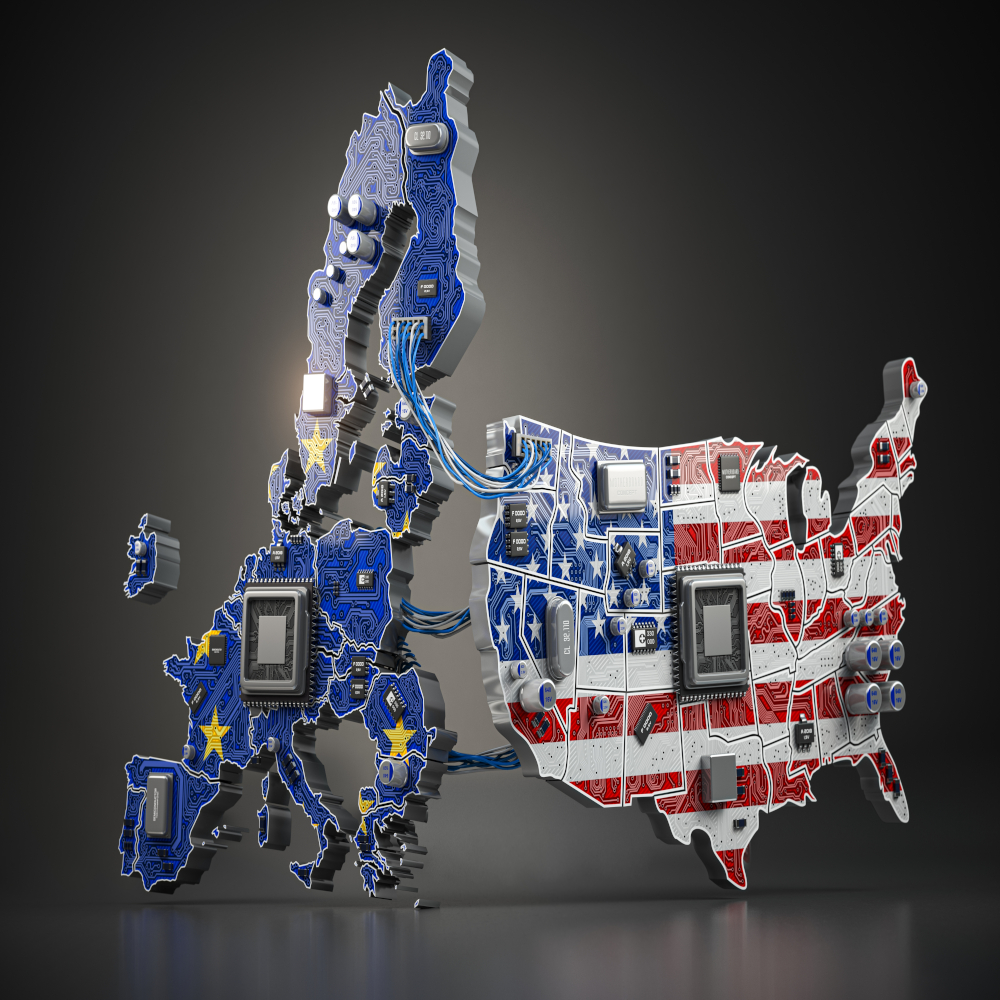
Semiconductor chip cooperation between the USA and the European Union concept.

EU and US continue strong trade and technology cooperation at a time of global challenges

by Margrethe Vestager , Valdis Dombrovskis

Today, the EU and the United States held the sixth meeting of the EU-US Trade and Technology Council (TTC) in Leuven, Belgium. The meeting allowed ministers to build on ongoing work and present new deliverables of the TTC after two and a half years of cooperation. The TTC is a key forum for close cooperation on transatlantic trade and technology issues. The Commission was represented by Executive Vice-Presidents Margrethe Vestager and Valdis Dombrovskis, joined by Commissioner Thierry Breton. On the US side, US Secretary of State Antony Blinken, US Secretary of Commerce Gina Raimondo and US Trade Representative Katherine Tai were present. The meeting took place in a challenging geopolitical context, including Russia's illegal war against Ukraine and global economic pressures. In addition, the acceleration of the digital and green transitions opens opportunities for growth and innovation but also requires transatlantic cooperation towards joint approaches. The meeting showed that there is a strong commitment to advance transatlantic leadership on emerging technologies and in the digital environment, facilitate bilateral trade and investment, cooperate on economic security and defend human rights and values. Transatlantic cooperation on artificial intelligence, quantum, 6G, semiconductors and standardisation The EU and US reaffirmed their common commitment to a risk-based approach to artificial intelligence (AI) and support for safe and trustworthy AI technologies. Both partners believe in the potential of AI to help find solutions to global challenges. A short overview document published today on AI for the Public Good identifies milestones on which the EU and US are cooperating in the areas of extreme weather, energy, emergency response and reconstruction. The partners also announced a new Dialogue between the EU AI office and the US Safety Institute on developing tools, methodologies and benchmarks for measuring and evaluating AI models. Since the launch of the TTC in 2021, the EU and US have worked on transparency and risk mitigation to reap the benefits of AI for their citizens and societies and continue to implement the Joint Roadmap for Trustworthy AI and Risk Management. The EU and US have adopted today a common 6G vision setting out a path for leadership on this technology, and have signed an administrative arrangement for research collaboration. This builds on the 6G outlook adopted in May 2023, and the industry roadmap on 6G of December 2023. In the semiconductors area, the EU and the US are extending for three years their two administrative arrangements, under which they have been cooperating fruitfully to identify early-on supply chain disruptions and ensure subsidies transparency. They will commit to cooperating on legacy semiconductors and join forces in research to find alternatives to per- and polyfluoroalkyl substances (PFAS) in chips, including by leveraging AI capacities. On emerging technology standards, the EU and US are releasing a Digital Identity Mapping Report with the aim of identifying use cases for transatlantic interoperability and the cross-border use of digital identities. In 2023, the EU and the US endorsed a common international standard on megawatt charging systems for the recharging of electric heavy-duty vehicles. The partners will continue to work on standards as enablers of the green transition. Boosting digital skills and talent is fundamental for the success of the digital transition. The Talent for Growth Task Force launched in April 2023 with a one-year mandate, has served as a platform for rich exchanges on innovative skills development and actionable solutions to address skills shortages in the technology sector in both the EU and the US. The Task Force presented the outcomes of these discussions in the margins of the TTC. Promoting easier, more sustainable and more secure trade on the transatlantic marketplace Promoting sustainable trade as part of the green transition is a priority for both parties and the TTC remains a key forum for the EU and the US to cooperate on this. Both sides reaffirmed the importance of the Transatlantic Initiative on Sustainable Trade (TIST), which since its inception in 2022 frames the TTC's work in this regard. At today's meeting, ministers took stock of the work taking place under TIST including on conformity assessment, to facilitate trade in goods and technologies that are vital for the green transition. They agreed to publish a Joint Catalogue of Best Practices on Green Public Procurement to help accelerate the deployment of publicly financed sustainability projects, and to advance their cooperation on solar supply chains. The EU and the US have declared their intention to make transatlantic trade easier and to continue growing their unique economic partnership. To this end, both sides have agreed to facilitate digital tools in trade. In particular, they have taken steps to ease digital trade for companies by coordinating and aligning their respective technical standards for e-invoicing systems, which should considerably cut down on time and red tape. This will also reduce paper usage and carbon emissions associated with traditional invoicing methods. Furthermore, both parties reaffirmed the importance of the EU-US Clean Energy Incentives Dialogue as a platform for exchange to avoid zero-sum competition and trade and investment distortions in the clean energy sector. They also welcomed the publication of recommendations for greater transatlantic e-vehicle charging infrastructure compatibility, which complement the previously published Transatlantic Technical Recommendations for Government Funded Implementation of Electric Vehicle Charging Infrastructure. Moreover, the EU and the US hold that sustainable trade is not only about cutting greenhouse gas emissions, but also about ensuring a fair transition for workers and firms up and down the supply chain. This aim is encapsulated by the work of the Trade and Labour Dialogue (TALD), which, building on the discussions during a workshop with social partners organised at the fifth TTC meeting in January 2024 held its third meeting at today's TTC ministerial meeting. In addition, the EU and US have intensively engaged on critical minerals, which are indispensable for a wide set of technologies needed for EU strategic sectors such as the net-zero industry, and the digital, space and defence sectors. The EU and the US are advancing negotiations toward a Critical Minerals Agreement This agreement aims to strengthen EU-US supply chains in critical minerals for electric vehicles batteries and to reinforce the protection of labour and environment in international critical minerals supply chains. The EU and the US also welcomed the launch of the Minerals Security Partnership Forum (more information will be available later here), which they will co-chair, and look forward to a fruitful future cooperation with a wide range of partners around the world. Ministers also discussed partnering on economic security. In this regard, the EU and the US reaffirmed their shared concerns over the challenges posed by economic coercion and non-market practices employed by third countries and resolved to continue their efforts to de-risk and diversify their trade and investment relations. They also recognised the important role that the TTC has consistently played to optimise EU-US work on export controls against Russia and Belarus. They resolved to further align their respective priorities in this regard and to continue work on facilitating secure high-technology trade while maintaining an effective export controls regime. The EU and the US have carried out joint work to identify and promote best practices on foreign investment screening and will continue to exchange information to address threats to security and public order. Both parties also agreed to continue to exchange information on how to respond to the risks posed by outbound investments in certain critical technologies. Defending human rights and values in a changing geopolitical digital environment The EU and the US concur that online platforms should exercise greater responsibility in ensuring a fair, transparent, and accountable digital environment including by addressing gender-based violence and protecting human rights defenders online. The partners have developed a set of joint principles on gender-based violence on online platforms which complement the list of high-level principles on the protection and empowerment of minors and data access for researchers, which are in line with the EU's Digital Services Act. Both partners are determined to support democracies across the world and to defend human rights, free and independent media and combat foreign information manipulation and interference, especially in a year when many elections take place in the world. Following suit, they have published joint Recommended Actions for Online Platforms on Protecting Human Rights Defenders Online. The EU and US committed to facilitating data access from online platforms and published a report on mechanisms for researcher access to such data, which builds upon efforts undertaken by the academic and research community. Moreover, the EU and the US reiterated their commitment to support secure and resilient digital infrastructure and connectivity projects in third countries and announced a joint support package for Tunisia. This adds to the implementation of projects underway in Costa Rica, Jamaica, Kenya, and the Philippines. Next Steps The wide-ranging fruits of the TTC's work since its launch in 2021 attest to the value of this transatlantic policy forum, and principals agreed on the need to continue this work. Therefore, as both sides enter their respective electoral processes, the EU and US will reflect on the lessons learned so far and possible ways forward. In the meantime, the technical work under the TTC will continue. Building on the lessons learnt from our cooperation so far, we intend to use the remainder of 2024 to engage with EU and U.S. stakeholders to gather their views on the future of the TTC. Background The EU and the US launched the EU-US Trade and Technology Council (TTC) at their summit in Brussels on 15 June 2021. It has served as a forum to discuss and coordinate on key trade and technology issues, and to deepen transatlantic cooperation on issues of joint interest. The inaugural ministerial meeting of the TTC took place in Pittsburgh on 29 September 2021. Following this meeting, ten working groups were set up covering issues such as technology standards, AI, semiconductors, export controls and global trade challenges. This was followed by a second meeting in Paris on 16 May 2022, a third meeting in College Park, Maryland, in December 2022, a fourth meeting in Luleå, Sweden, in May 2023 and a fifth meeting in Washington DC in January 2024. The EU and the US remain key geopolitical and trading partners. EU-US bilateral trade is at historical highs, with over €1.6 trillion in 2023 and with bilateral investment stocks topping €5 trillion. Quote(s) “In today’s fast-moving and uncertain world, our partnership with the United States on trade and technology allows us to deal with some of the most crucial challenges of our time. I am proud of the results delivered so far and we will keep working to enhance economic security and build a fair digital environment that reflects our values.” Margrethe Vestager, Executive Vice-President for a Europe Fit for the Digital Age “The TTC has injected new dynamism into transatlantic trade relations. It is the first forum of its kind that has allowed the world’s two largest economies to set new standards and cooperate on current challenges - such as sanctions against Russia - based on shared democratic values. The TTC has made important inroads in terms of bolstering our economic security and enhancing the resilience of supply chains. We have also made valuable progress in jointly forging the green transatlantic marketplace.” Valdis Dombrovskis, Executive Vice-President, and Commissioner for Trade

Diplomacy
Presidential election 2024 in the United States. Voting day, November 5.

Elections in USA: a fast-paced race

by Raquel López-Portillo

As rarely in history, elections in the United States have accelerated their tempo at a dizzying pace. The Triumpist tsunami that has swept through this initial primary election process is striking in terms of the acceleration of the process. In 2016, it was not until May that the former President Trump secured the Republican Party candidacy, while in the 2020 cycle it took Biden until June. This hastening has not only impacted domestically but has also put Mexico in a delicate position ahead of the general elections in both countries. It is nothing new that migration is a central topic of debate and dispute, even more so when its politicization increases in an electoral environment. However, the US electoral process has placed Mexico, literally and metaphorically, as a campaign stage. As evidenced by the visit of the two potential candidates for the US presidency to the Mexican border a few weeks ago, the importance of our country today takes a prominent place both in the priorities of the electorate and in the respective campaigns of Donald Trump and Joe Biden. This leaves the administration of President Andrés Manuel López Obrador in a tenuous position in an already complex scenario. The fact that the focus of the conversation has been set on the border so soon leaves at least eight months of a potential spike in tensions. Biden’s rhetoric is no longer the same as when he began his term, nor is it attached to the human rights-centered line that has traditionally characterized the Democratic Party. In contrast, Biden has insisted in recent days on the passage of a bipartisan initiative to allow for the deployment of more border agents and asylum officers, detection technology, and increased capabilities to close the border when it is overwhelmed. In this scene, it is possible to expect that the diplomacy and repeated high-level meetings that have been held in recent months will now come laden with even greater demands and ultimatums. In addition, our country is also expected to be at the center of the legislative debate. While the most radical wing of the Republican Party has been the main protagonist of the budget attacks, the immigration crisis has provoked some democrats to take tougher positions. Politically, this situation has become a thorn in President Joe Biden’s side. He is perhaps the most damaged between the pressures of his closest supporters and the Republican resistance to give him legislative victories, at a time when every message or decision could influence from the presidential race to the elections in the local legislature, where the Democrats seek to recover lost spaces. For the time being, everything points to the fact that the greater the chaos on the border with the country, the greater the political gains. Finally, the border with Mexico has also found a place in the electorate’s priorities. According to various polls, eight out of ten Americans (with or without party affiliation) place immigration as a priority issue. Likewise, at least 28 percent of the polled by the Gallup Agency stated that immigration is the most serious problem that faces the country, ahead of issues such as the economy, inflation, or crime. This also impacts Mexico because it is not only limited to a matter of perception but is inevitably reflected in everyday life. Considering that migration, drug trafficking and insecurity are generally considered as part of the same problem, this has a significant impact on the increase of xenophobic positions, particularly against Mexican nationals living in the United States. Regardless of how the electoral pace continues or who ends up in the White House, Mexico should pay special attention to the speeches, proposals and actions of other people competing at the local or federal level for a position in the next government, particularly on issues that concern our country, such as migration, security, or the fight against organized crime. It is precisely these people who will determine the future of our most important bilateral relationship.

Diplomacy
The High Commissioner for the 2030 Agenda, Cristina Gallach, during her speech at an event.

The growing discourse of rejection of the 2030 Agenda in Latin American governments

by Javier Surasky

In September 2015, the delegations of the 150 presidents participating in the Sustainable Development Summit were part of the 193 States preparing to adopt the outcome document of this meeting. This meeting represented the end of the most participatory negotiation process in the history of the United Nations: the adoption of the 2030 Agenda. The sense of optimism and of moving towards a common goal was palpable. Eight years later, the progress of the 2030 Agenda has fallen far short of expectations. Unfulfilled promises, lack of financing, the health crisis generated by COVID-19, the recent wars, and the global economy that has faced first recessionary and then inflationary pressures all have made the idea of finding common solutions to the problems afflicting the world lose momentum. Misinformation on the 2030 Agenda On this fertile soil, conspiracy theories sprout that see multilateralism as the origin of today’s problems. The 2030 Agenda is, in many cases, at the center of these distorted visions. Three conspiracy theories are being raised against the main global sustainable development agenda. Theory of the “New World Order”: This theory is based on the idea that an elite (Bilderberg Club style) formed by a small group of the most powerful people in the world governs the destinies of the planet for their benefit. The “Great Reboot” theory was proposed in Davos after the pandemic, and with the UN’s “build back better” vision, the theory focuses on the economic dimension. It suggests an orchestrated plan by the most powerful countries to appropriate all the world’s wealth. They claim the intentional creation of a pandemic to initiate their plan. “Trickle-down communism” theory: After the fall of the Soviet Union – and knowing that communism could never take over the West – the “left” began a worldwide campaign to slowly insert its ideas into Western societies so that by the time the plan was discovered, the West would have embraced the communist ideal without realizing it. All three conspiracies arrive at the same result: the 2030 Agenda is creating a group (an economic elite, a group of powerful countries, or international communism) aiming to appropriate the world’s wealth. These stories contradict reality and seek to misinform about this milestone for international cooperation, which, despite the difficulty of addressing it, is a renewal of the concept of international development. The disinformation of the 2030 Agenda happens, in most cases, through social networks, and their expressions claim, for example, that this is oriented to Forcing citizens to eat insects instead of meat. Confine the world’s population to neighborhoods where they cannot leave without permission under “15-minute cities”. Feminize men to reduce the world population. Despite the absurdity of the “arguments,” they have served as a basis for those who seek to debate the value of the 2030 Agenda in Latin America. José Luis Chilavert, former goalkeeper of the Paraguayan national soccer team, became a candidate for president of his country in the 2023 elections. He obtained 0.7% of the votes but explained his decision: “I got into politics to fight against Agenda 2030. They want to destroy us.” Sandra Torres, three-time presidential candidate for the Partido Nacional de la Esperanza (UNE by its acronym in Spanish) party, said in a video in the 2023 election campaign: “I will never let them impose an international agenda on us. We Guatemalans will set Guatemala’s agenda. I believe in life, family, and religious freedom. No to Agenda 2030.” In Chile, Congressman Cristóbal Urruticoechea Ríos, with an active mandate until 2026, stated in his country’s congress that “the dehumanization of human beings and the humanization of animals, the destruction of language, the destruction of the middle classes, the liquidation of the sovereignty of nations, the attack on families, life and roots. This is part of the 2030 Agenda.” After Jair Bolsonaro’s defeat in the last Brazilian elections, his son, Eduardo Bolsonaro, became the face of the Liberal Party. His position is forceful: “The more we fight against Agenda 2030, the greater our electoral success will be.” In Costa Rica, New Republic deputy David Segura said in a speech at the chamber that the 2030 Agenda was adopted to “confuse people and, of course, to impose little by little the great modern enemy of all families, which is the nefarious gender ideology,” and then added that Agenda 2030 “opens the door to promote nothing more and nothing less than abortion, financed by international capital giants that pursue their interests, which are far from being yours, mine.” At the level of presidents we have Nayib Bukele, recently reelected to govern El Salvador, maintains a cautious position: “On the issue of Agenda 2030, I am very suspicious of this type of international agendas of the UN, the World Economic Forum, or wherever they come from and their intentions”. Although undoubtedly, the greatest exponent of conspiracy theories in the region is Javier Milei, current president of Argentina, who, during his campaign, stated, “We are not going to adhere to Agenda 2030. We do not adhere to cultural Marxism. We do not adhere to decadence” (read in Spanish), and, already in office, he explained that he was traveling to the Davos Forum with the aim of “planting the ideas of freedom in a forum that is contaminated with the socialist agenda 2030 that will only bring misery to the world”. With such positions, one of the few well-established consensuses in the region during the last 10 years is cracking. The fact that the discussion is settled will be a setback that cannot be allowed. It is up to Latin America’s leaders to armor their support for the 2030 Agenda by being clearer in their positions and more active than before in their policies to implement the SDGs. The Regional Forum on Sustainable Development must make a strong statement in that direction. When the UN Secretary-General stated that we are facing a “breakdown or breakthrough” dilemma, it seemed a rhetorical question. For Latin America, it is no longer so.

Diplomacy
Demonstrators marching along Pennsylvania Avenue to the White House to encourage the Biden administration in ending its support of Haitian dictators

Haiti Mission Lacks Interlocutor Plus Peruvian Congress Purges Top Judges

by Shannon K. O'Neil , Will Freeman

No interlocutor for Haiti mission’s international troops. Haiti’s acting Prime Minister Ariel Henry announced he will resign. The timeline for his resignation is still unclear—it depends on the appointment of a transitional presidential council, jointly proposed by the United States, the Caribbean Community, and Henry’s administration. Henry’s announcement comes less than two weeks after he and Kenyan President William Ruto agreed to send 1,000 Kenyan police officers to Haiti as part of a Kenya-led multinational security mission (MSS). The mission’s aim is to support Haiti’s overwhelmed and outgunned national police force, less than 10,000-strong. The Bahamas, Bangladesh, Benin, among others, may join their mission, potentially adding thousands more troops and police officers. And donor nations, including the United States, Canada, Germany, France and Guyana, have pledged hundreds of millions of dollars in support. Yet the response looks to be too late and too little. Kenya’s promise to send officers is still in doubt, as courts have blocked government plans for over six months, and opposition lawmakers may mount a fresh challenge. Donor financial pledges total less than half the UN’s estimated need. And even if the troops arrive, they may not have a functioning government to work with. As the international community dithered, the situation on the ground deteriorated. Gangs now control over 80 percent of the capital, Port-au-Prince, and have attacked police stations, a port, Port-Au-Prince’s international airport, and two prisons, releasing some four thousand inmates. With Henry having agreed to resign—but no new government currently in place—it’s unclear who can play the role of interlocutor for the MSS. Without stability, more Haitians will flee. Already, over 126,000 Haitians have arrived as part of the Biden administration’s new humanitarian parole program that allows them to come and work for two years, outnumbering tens of thousands of Cuban, Nicaraguan, and Venezuelan migrants that also qualify. Mexico received more than 40,000 Haitian asylum requests in 2023 alone. And more look to join the hundreds of thousands of Haitians living across the Western Hemisphere if the Haitian state fails. Peru’s “pact of the corrupt” is succeeding where Guatemala’s failed without international pressure. Last year in Guatemala, an incongruous coalition of lawmakers from different parties earned the nickname the “pact of the corrupt” as they joined forces to erode the rule of law and overturn election results. Thanks in large part to sustained international pressure, including targeted U.S. sanctions against nearly 300 lawmakers, Guatemala’s “pact” failed to keep President Bernardo Arévalo, an anti-corruption reformer, from taking office. A group of far-right and far-left Peruvian lawmakers is conducting a similar move, passing laws to reduce judicial independence and undermine conditions for free and fair elections. On March 7, Peru’s “pact” fired two of the seven top magistrates from the National Justice Board, which names prosecutors and judges and helps choose election authorities. This could enable lawmakers to influence the selection of election authorities next year in the run-up to Peru’s 2026 general elections by threatening further purges. Last year, a coordinated joint statement from U.S., EU, and Latin American embassies in Peru forced lawmakers to back down from firing the National Justice Board magistrates. But this time around, similar democracy eroding moves triggered less unified international pushback. Senators Tim Kaine and Ben Cardin released statements in defense of the National Justice Board, and the State Department’s global anti-corruption coordinator met with the magistrates before the ouster. That could help explain why Peru’s congress fell short of the votes it needed to suspend more magistrates, including the National Justice Board president. But without more coordination and the threat of targeted sanctions, Peru’s “pact of the corrupt” seems to have won this round. This publication is part of the Diamonstein-Spielvogel Project on the Future of Democracy.

Diplomacy
A look at the massive protest march in Gaza at Freedom Plaza and the White House

Will Gaza Defeat President Joe Biden?

by Dennis Altman

Election prospects for Joe Biden are looking dimmer as the war in Gaza steadily worsens and the casualties of civilians increases. How will Americans vote on the Palestinian issue? Lyndon Johnson decided not to seek re-election because of opposition to his policies in Vietnam. Jimmy Carter’s chances of re-election were crushed when the attempt to rescue US hostages in Iran failed. Will the war in Gaza have the same effect on President Joe Biden? The United States is increasingly isolated internationally over its support for Israel. It has had to use its veto in the Security Council on three occasions to prevent calls for an immediate ceasefire, when not even the United Kingdom was prepared to do more than abstain. Biden has a long history of support for Israel, but even he has clearly lost patience with Prime Minister Benjamin Netanyahu. After the initial Hamas attacks he flew to Israel to express solidarity, but also to warn against over-reaction. He has repeated that warning consistently, both publicly and privately, but the United States continues to provide Israel with arms and to protect it in international fora. Until recently that was a position supported by most Americans. However the last few months have seen a major rift develop among Democrats, with increasing numbers criticising Biden for his unwillingness to put further pressure on Israel. Vice President Kamala Harris has publicly pressured Israel to halt its ongoing assault on Gaza. At the same time some of the most strongly pro-Israeli lobbyists have deep connections with Democratic politicians. It’s important to recognise that some of Israel’s strongest defenders are not Jewish, and particularly on the Republican side are often associated with fundamental Christians who accept the claims of the Israeli right to all of Palestine. Traditionally, American Jews have tended to vote Democrat at a higher rate than their economic status might suggest. But there are significant Republican connections with both right-wing Jews and the Israeli lobby, and Netanyahu made little secret of his preference for Donald Trump, who both recognised Jerusalem as Israel’s capital and brokered peace with some of the Gulf states. The Jewish population of the United States is less than three percent, but it is heavily concentrated in a few states and Jews tend to vote more often than other groups (the figures are rubbery, in part because many people with Jewish backgrounds are non-religious and not connected to organised community organisations). The Palestinian population is small, and even the Arab-American population is probably less than that of Jewish-Americans, unlike the situation in Australia. Not all Jews support Israel, and opposition to the Netanyahu government is larger and better organised than in Australia. But there are sufficient Jewish and Arab Americans for whom Gaza is an important enough issue to determine their vote. And here lies the problem for Biden. Trump, who has managed to combine friendship with anti-Semites and unwavering support for Israel, has little to lose through the unfolding tragedy in Gaza. Few of his supporters would be concerned with his closeness to Netanyahu, but he may well increase his support among former Democratic Jewish voters who like his support for Israel. Of the six states that are generally regarded as likely to swing the results of the presidential election only two, Arizona and Pennsylvania, have sufficient Jewish voters that even a slight decline in their support could cost Biden the state. The bigger problem for Biden is people on the left who are so outraged by his continuing support for Israel that they may choose to either not vote or vote for a third-party candidate. In the American system, with first past the post voting for president in all but a couple of states, a third-party candidate could erode Biden’s lead in a number of crucial states. Voters who feel they cannot support his policies can of course choose not to vote—or could vote for Greens Party leader Jill Stein, who has called for an immediate ceasefire, or Robert Kennedy Jr, who speaks more vaguely of peace and a less militaristic foreign policy. Neither of them is a potential winner, but they have the capacity to take left-wing votes away from Biden. The Biden campaign are clearly worried about this, particularly in Michigan which has a sizeable Arab-American population. The presidential election is over ten months away, and no-one can predict whether the war in Gaza will be over, although it would be absurdly optimistic to assume any realistic settlement. Domestic issues—the economy, immigration—will be more significant, as will the apparent health of the two men who are fighting to be the oldest US president in history. But there are enough Americans for whom the scars of Gaza are sufficiently traumatic to determine how they will vote—or not vote—in November. And on balance this can only help Donald Trump.

Diplomacy
Lula da Silva

Opinion – Lula’s Foreign Policy

by Rafael R. Ioris

A lot of saliva and lots of ink has been spent in recent days to criticize the behavior that President Lula da Silva has sustained on the international stage. In effect, even though one of the pillars of democratic rule of law, which is still in force in Brazil only due to Lula’s return to the presidency, is freedom of expression. Much of this criticism is grounded on a mistaken (or politicized) reading of the history of the country’s foreign policy, of what Lula actually did in his first two terms in office in the early 2000s, as well as what Lula is currently pursuing on the international stage. Brazil has historically supported multilateralism, the peaceful resolution of conflicts, and the right of self-determination of all peoples. While Lula may have caused some controversy in recent statements, or even on some diplomatic initiatives, none of this contradicts Brazil’s tradition of defending universal principles while also making use of foreign policy to promote the country’s development and positioning. Even before regaining the presidential seat, Lula was praised for his defense of multilateral and cooperative ways to tackle the climate crisis at 2022’s COP-27 in Egypt. Much in the same way, as his new government took office in January 2023, Lula sought to revive the foreign policy that bore so many fruits during his first time in office. He did this by maintaining an ambitious agenda of international trips, which balanced meetings with traditional partners while expanding on projects linked to the so-called Southern agenda. His tours began in neighboring Argentina to attend the 7th Summit of Heads of State and Government of the Community of Latin American and Caribbean States. This was followed by a visit to Washington, where he met Biden and jointly made a clear statement in defense of democratic values, which have been under threat in both countries in recent times. A few weeks later, Lula made a visit to China to deepen trade relations, but when there he also tried to promote a peace effort for Ukraine. This initiative did not yield results, something that more reflects the structural difficulties of today’s world rather than a misalignment of Lula’s foreign policy. Reproducing the great achievements of the so-called proud and activeforeign policy of 20 years ago, when Brazil reached an unprecedented level of relevance on the international scene, will be difficult. The world has changed, and Brazil has changed, generally in a negative sense. Liberal democracy faces a crisis as authoritarianism, and even (neo)fascism, present themselves as viable alternatives and political and ideological polarization are on the rise. It is in this rigidly fragmented and increasingly violent world where greater activism from Brazil is needed. Given its historical trajectory, economic weight, and diplomatic tradition, Brazil can serve as an interlocutor between the countries of the Western sphere, Latin America, the Russian-Asian bloc, and the so-called countries of the South. Lula’s international overtures are only likely to increase as it becomes ever more likely that Trump may return to the presidency in the US – while simultaneously the extreme right advances in Europe and xenophobic authoritarianism deepens in Russia, India, and China. During his first two terms in office, Lula did not strain relations with traditional partners, such as the USA and Europe. Rather, he sought to expand the range of connections with new countries, particularly those that shared Brazil’s history of colonialism and unfair treatment from established powers. This stance does not contradict what Brazil has sought to do since at least the beginning of the 1960s. Under very different types of political regimes, Brazil’s foreign policy has consistently sought to establish new global collaborations with an ever-larger number of nations so that Brazil’s weight within the international realm could be expanded. All of this was done without risking relations with powerful allies. Likewise, Brazil’s international actions recurrently sought to democratize, or at least expand, the spheres of international deliberation so that they could effectively become representative and legitimate multilateral spaces. Sustaining this course of foreign policy is more challenging in today’s global context. With multiple actors competing for hegemony, a country like Brazil may be able to bargain for even greater gains within the many ongoing disputes. But no success will be achieved if pundits and critics continue to be inspired by dogmatic or ideological positions, refusing to understand the rising international relevance of Brazil and Lula’s unique role in promoting dialogue and inclusion in an ever-more divided world.

Diplomacy
China and the USA wrestle over Taiwan

When Giants Wrestle: The End of Another Round of Tensions Between the United States and China?

by Ofir Dayan , Shahar Eilam

How are the fluctuating tensions between Washington and Beijing over Taiwan expected to affect Israel? On January 13, William Lai, the leader of the Democratic Progressive Party (DPP), was elected president of Taiwan. A few days earlier, for the first time in four years, the United States-China Defense Policy Coordination Talks took place in Washington, marking the end of a prolonged round of tension between the two powers, which had peaked in August 2022 when the speaker of the US House of Representatives visited Taiwan. Taiwan is a major point of friction in the already tense relations between the two powers. Managing the disagreements between them has broad implications, including for Israel. The ongoing strategic rivalry between the two superpowers—the United States and China—is the most important geostrategic factor of our time. The two countries are vying for technological dominance and control over resources, that will shape our future, and infrastructure that is critical for civilian, economic, and military purposes. The United States and China are also competing for global influence by forming partnerships and trying to influence world order, including its values, institutions, and mechanisms that regulate it. Can they shape the rules of the competition between them without spiraling into a military conflict that would have devastating global consequences? Taiwan may be the most volatile flashpoint in the complicated relationship between the two powers. For China, the “reunification” with Taiwan is one of its “core interests”—a top objective and a flagship issue in its foreign policy. Although the United States has repeatedly declared that it is committed to the “one China” policy, it is also an ally of Taiwan. The United States has warned China to refrain from making unilateral, aggressive moves vis-à-vis Taiwan, while supplying Taiwan with military resources to deter China and prevent a forceful takeover. Since assuming power in 2013, President Xi Jinping of China has repeatedly emphasized Taiwan’s unification with China as a key objective. During a meeting with President Joe Biden in November 2023, President Xi said that China “prefers” a peaceful unification, but he did not dismiss the use of force. On the eve of Taiwan’s 2024 elections, President Xi further stated that unification is “inevitable.” The tensions between the powers over Taiwan had escalated following the previous elections on the island in 2020. During this period, senior American officials visited Taiwan, and the United States and Taiwan signed weapons deals in August and September of that year, followed by a marked increase in Chinese military aircraft penetrating the island’s air defense identification zone and crossing the “midline” between the island and mainland China. China’s perception of encirclement was further heightened by the United States’ strengthening of its alliances and initiatives in the Indo-Pacific region (such as QUAD, AUKUS, and IPEF) and by the increased diplomatic pressure exerted on China, through boycotting the 2022 Winter Olympics and protesting its human rights record. But even during this period, despite rising tensions, the two nations maintained ongoing communications, including the Alaska talks in March 2021—although they were notably tense—and the meeting between the presidents in November of that year. The tension peaked in April 2022, when then Speaker of the US House of Representatives Nancy Pelosi announced her intention to visit Taiwan. China strongly protested, and the White House even recommended Pelosi to reconsider her visit due to concerns about potential military escalation. Pelosi refused and proceeded with her visit in August, delivering a speech at the Taiwanese legislature and advocating for increased American–Taiwanese cooperation. In an article published in the United States before her visit, Pelosi wrote that “at a time when the world faces a choice between autocracy and democracy . . . it is essential that America and our allies make clear that we never give in to autocrats.”   In response to Pelosi’s visit, China held a large-scale military exercise that disrupted air and maritime traffic in the region and released a white paper emphasizing “The Taiwan Question and China’s Reunification in the New Era.” Furthermore, as a countermeasure to Pelosi’s visit, the Chinese Ministry of Foreign Affairs announced that it was suspending all dialogue and cooperation with the United States, including dialogues between the military commands, the ministries of defense (DPCT), and the maritime military coordination (MMCA), and cooperation in the fields of illegal immigration, criminal legal assistance, transnational crimes, counternarcotics, and climate change. In November 2022, presidents Biden and Xi met in Bali, Indonesia, in an attempt to put the relations between the two powers back on track. After the meeting, the White House issued a statement announcing that the United States will continue to compete actively with China, but the two countries must manage their competition responsibly, without letting it escalate, while maintaining open channels of communication and continuing to cooperate on global issues such as climate change, counternarcotics, debt relief, health, and food security. Regarding Taiwan, the United States reiterated its commitment to the one China policy but strongly opposed China’s aggressive actions, which violate peace and stability in the Strait and in the entire region. The Chinese also released a statement, noting that President Xi highlighted that Taiwan is a core Chinese interest and constitutes a red line that is nonnegotiable in the relations between the two countries. It was anticipated that the year 2023 would begin on a more positive tone, with US Secretary of State Antony Blinken’s scheduled visit to China in February. The visit was canceled when a Chinese balloon was discovered floating over US territory for a week until the US Air Force intercepted it. Although the White House at first tried to downplay the incident, with President Biden initially referring to it as a “minor breach” and said that the Chinese government was unaware of the issue. China claimed that a weather monitoring and research balloon had strayed off course. Public pressure, however, led the administration to cancel Blinken’s visit. Subsequently, the US Department of Commerce imposed restrictions on six Chinese companies linked to balloon and aviation technologies that are used by the Chinese military, requiring that they receive special approval to access American technology. In April and May, China retaliated at a relatively low bar by imposing sanctions on a US member of Congress who visited Taiwan and sentenced an American citizen living in Hong Kong to life imprisonment, for alleged espionage for the United States. These actions reflect the efforts of both China and the United States to take focused, restrained measures, to avoid escalating tensions. The absence of a strong reaction from China to the establishment of a select committee within the US House of Representatives, focused on examining the US–China strategic competition, suggests that China sought to prevent further escalation of the conflict.   Efforts to end the crisis and restore talks were renewed in May 2023 when the head of the CIA met with his Chinese “counterparts.” In June, US Secretary of Defense Lloyd Austin and Chinese Minister of Defense Wei Fenghe met on the sidelines of the Shangri-La conference in Singapore. Secretary of State Blinken’s anticipated visit to China took place later that month. In July, US Special Envoy for Climate John Kerry and Secretary of the Treasury Janet Yellen traveled to China, followed by a visit of US Secretary of Commerce Gina Raimondo in August. These high-level meetings concluded on a note of cautious optimism, with both sides acknowledging “progress” but not a “solution,” as the purpose of the meetings was to stabilize relations rather than to resolve the issues in dispute. In September 2023, Secretary of the Treasury Yellen and Chinese Finance Minister He Lifeng launched two new working groups on economic and financial issues. Moreover, Pentagon officials and their Chinese counterparts met and discussed the US Department of Defense’s cyber strategy, followed by a meeting of the American and Chinese presidents in San Francisco in November. The American efforts to renew the military dialogue between the two countries was initially met with refusal by China until December, when General Brown, the chairman of the Joint Chiefs of Staff, spoke with his Chinese counterpart General Liu Zhenli. In early January 2024, a few days before the elections in Taiwan, the annual Defense Policy Coordination Talks between the two countries were held at the Pentagon for the first time in four years. These developments reflect China’s acute sensitivity toward the Taiwan issue and its willingness to take significant measures against perceived violations of its One China Policy, especially by the United States. Despite numerous disputes, the growing rivalry between them, the defiant measures, and the reciprocal sanctions, these events highlight that the two powers recognize the importance of keeping channels of communication open. This dialogue is crucial for pursuing shared interests, resolving disputes, and minimizing the risk of military escalation that could have far-reaching consequences for both nations as well as the global community. The ongoing tension between the United States and China over Taiwan also has implications for Israel. First, the increasing friction between the powers has accelerated the formation of two opposing camps and has limited Israel’s ability to maneuver between them. As demonstrated (again) since the outbreak of the war between Israel and Hamas, the United States is Israel’s greatest friend and its most important strategic ally. While China is an important economic partner of Israel, its policy is not that of a friend, and its oppositional stance toward Israel has the potential to cause significant damage. The United States expects its allies to stand by its side and to align more closely with its policies vis-à-vis China, especially concerning advanced technologies and critical infrastructure. Failing to meet US expectations could strain US–Israel relations. Second, a military escalation between the United States and China would also have global economic consequences, seriously disrupting supply chains of raw materials and essential goods crucial to Israel. Finally, the US administration recently linked the military aid granted to Israel to that of both Taiwan and Ukraine, framing them as three democracies under threat. While this linkage underscores the US commitment to its allies, it also creates constraints and interdependencies. The attention and resources that the United States currently allocates to Israel and to the broader challenges in the Middle East could be compromised if the United States faces serious military crises elsewhere in the world, and this could have far-reaching impacts on Israel.

Diplomacy
Chile Flags

Chile rejects second constitutional proposal

by Marcela Cubillos

Last Sunday, Chile made a U-turn in constitutional matters, that is to say, after four years of experimentation and going to the polls five times, it went back to square one. By 55.8% against 44.2%, citizens said no to the second constitutional proposal presented to them in little more than a year. In September 2022, the text of the first Convention had been rejected by 61.8%, with only 38% support. These are the six keys to understand the result: 1.- A process that started badly Last Sunday, the constituent process that began in November 2019 under the blackmail of violence came to an end. As a result of the outbreak that occurred in October of that year, the government of former President Piñera promoted a transversal agreement in Congress that began the replacement of the Constitution drafted during the Pinochet dictatorship, which had been extensively reformed in democracy. In fact, the last major reform to that text was in 2005 during the government of former President Lagos. The changes made there were so important that Lagos introduced a norm to replace Pinochet's signature and, when he promulgated the new text, he said that Chile finally had a fully democratic Constitution. Many say that if a plebiscite had been held there, the constitutional issue would probably have been settled. It was not done and, a few years later, the most extreme left began to demand a constituent assembly to draft a new Constitution made fully democratic. 2. The Constitution was never the problem, nor the solution. The first constitutional proposal was submitted to a plebiscite on September 4, 2022. The extreme left had the votes to draft a text as they wished and so they did. They put into it their refoundational political project, which destroyed liberal democracy, divided the Chilean nation, asphyxiated individual freedom, eliminated controls to political power and put an end to equality before the law. President Boric's government was its main promoter, and the text was rejected by a majority not only by the right but also by a large part of the center-left. Probably last Sunday's results can be explained by what happened there. Chileans, during the work of that convention and with the text proposed to them, understood that their problems were not constitutional as they had been led to believe for years. 3.- A hasty agreement Chile had approached the abyss and the triumph of the rejection of that first text was celebrated transversally by the democratic forces and by the citizens, who perhaps at one point agreed with a new Constitution, but not with a new country invented from scratch. A few days after that plebiscite, the opposition rushed to reach an agreement with the ruling party to initiate a second constituent process. It is true that this time limits were set to avoid the excesses of the first one, but the truth is that it was never understood that everything had to start all over again. It would have been more reasonable to redirect the constituent issue in the National Congress from where it should never have left. A Council was elected in which this time the Republican Party had a majority, the only one that left the agreement. That is to say, the people elected a majority of those who did not want to insist on the elaboration of a new proposal. Last Sunday, citizens were fed up with politicians from different parties who insisted, over and over again, that the constitutional issue was the problem. People felt, and rightly so, that they had already voted and never agreed with this second process. 4.- A plebiscite without drama Unlike last September's plebiscite in which Chile's democratic destiny was at stake, last Sunday people did not see drama or epic in what was being voted. That is to say, either a new text was approved, which for some updated and improved the current one (for the left it was a step backwards), or the same one was continued. After decades of attacks to the current Constitution, blaming it for all the injustices and claiming that they could not govern with it, the left arrived at last Sunday's plebiscite sunk in indignity. During the campaign, they went from talking about "Pinochet's Constitution" to "Ricardo Lagos' Constitution" and even declared to feel comfortable with it. 5.Government, relief rather than triumph Nobody would have imagined that this whole process would end with a leftist Government sleeping relieved because the current Constitution is still in force. The triumph of the proposed new Constitution would have meant its third consecutive electoral defeat. The first one was to the text of the Convention last year; the second one, in the election of councilors for the new process. A third one would have meant a very hard blow for a Government with scarce support and wide levels of popular rejection. On the other hand, there are no more excuses. Chile's most serious problems are not constitutional and the citizens seem tired of shouting without anyone listening to them. The Government, relieved, but with nothing to celebrate, must face a serious corruption scandal that has been installed at the doors of La Moneda; a country where nobody feels safe and authorities that lack credibility to face violence; a serious economic stagnation; an imminent crisis in the health system; and also face an education without an agenda and with thousands of children paying the costs of the bad reforms pushed and approved by those who govern today. 6.- Future of the opposition The right wing and the political forces of the center united to campaign in favor of this second constitutional proposal. Sunday's defeat does not change too much the configuration within the opposition. José Antonio Kast, former presidential candidate and leader of the Republican Party, who had the majority in this new constitutional council, obtains, in the end, the same percentage as in the last presidential second round. It is not enough for him to win, but he does not regress in popular support. And Republicans added to Chile Vamos (center-right coalition) maintain, practically, the same votes they obtained in the election of councilors. That is to say, the scenario remains open for the next presidential elections without any figure being irremediably damaged nor any particularly strengthened. President Boric, on Sunday night, wanted to take advantage of the result by forcing a wrong interpretation. He pointed out that people were asking for agreements and, therefore, he was calling the opposition to join his pension and tax reforms. The result of the plebiscite can be interpreted just the opposite, as the death of the last great political agreement, hasty, made with the people's back turned. That is to say, the Government hopes that the right wing has not learned anything from what happened; that to a bad constitutional agreement, which the people never supported, it will now add votes for a lousy tax and pension agreement. The right wing should devote itself to building a broad and coherent political project to solve the problems and not to aggravate them. Citizens seem to be fed up with ministers and parliamentarians signing agreements only because it suits them in the photo or they are uncomfortable to subtract themselves from it. Today there are many oppositions in Chile and it is essential that they have their own profile so that more citizens feel represented by them. It is necessary to add up and for that unity must be taken care of. It is not possible to disqualify them one day and the next morning try to close pacts with them. The opposition must be proportional to the damage that this Government is causing and, at the same time, it must quickly turn the page of the constitutional issue to build a recognizable political alternative. One cannot expect to win just because of how badly the left in power is doing. That is not enough. In what happened on Sunday there is also something to learn from that.

Diplomacy
Outlook 2024

Latin America and the Caribbean: outlook to 2024 and its potential impact on sustainable development

by Javier Surasky

Introduction The year 2024 will present new windows of opportunity and obstacles to the acceleration of the Sustainable Development Goals (SDGs) in Latin America and the Caribbean (LAC). Below we analyze some trends in the region for 2024 in each of the three dimensions of sustainable development, to which we add consideration of governance elements to help understand a framework that does not look easy and in which critical decisions will have to be made for the future. The social dimension In 2024 we will have presidential elections in six countries in the region. Polls indicate that the incumbent party will remain in power in Mexico, where Claudia Sheinbaum could become the first woman president in its history; El Salvador will renew the mandate of Nayib Bukele despite doubts about the constitutionality of his new candidacy. In Uruguay and the Dominican Republic, where Luis Lacalle Pou and Luis Abinader will seek to renew their mandates, the high levels of approval of their administrations point to a possible reelection. At the other extreme, polls point to a possible defeat of the ruling party in Panama, where former president Ricardo Martinelli (2009-2014) leads in voting intentions despite having been convicted in 2023 for a corruption and money laundering case, a sentence that is currently under appeal. In Venezuela, the only country on the list without a date for its electoral process, the controversies surrounding the government of Nicolás Maduro and the lack of transparency in information, added to the imprisonment of opposition leaders, prevent any analysis. The escalation towards an armed confrontation with Guyana over the border region of the Essequibo, rich in oil, minerals and gas, should be closely followed. The result of a long diplomatic and legal dispute between the two countries, its last chapter had taken place in 2018, when Guyana, with the backing of the current UN Secretary General, went to the International Court of Justice to request the reaffirmation of the international arbitration that fixed the border between the two countries in 1899. Maduro's government responded by ignoring the Court's authority to hear the case. Then, in 2020, the court declared itself competent to hear the case, but has not yet rendered its final judgment. The Community of Latin American and Caribbean States (CELAC), almost absent from the regional political map in recent years, reappears to mediate between the two countries, the end of which is now uncertain. All these processes are framed in a high level of citizen distrust towards the political sector, accompanied by weakened democracies, as reflected in The Economist's Democracy Index 2022. On the other hand, the arrival of Javier Milei, a political outsider, to the presidency of Argentina raises questions about its future regional positioning and will have far-reaching regional effects with changes in alliances on sensitive issues, from support for regional environmental policies to the redesign of the country's insertion in international trade, with potential major impacts on the Southern Cone. All of the above, together with the low growth and economic difficulties described in the following section, pose challenges for accelerating regional trajectories of poverty reduction, the fight against labor informality and unemployment, and the implementation of public policies to promote equity and gender equality, among others. For these reasons, there will be more pressure on regional environmental resources, which could lead to new protests and social unrest. The economic dimension Implementing actions to promote sustainable development requires financial resources. LAC has long been a low-priority region for international cooperation and foreign investment is limited, so generating its own resources, in a context of global economic restrictions, is essential. The average projected growth for the region in 2024 is 1.5%, distributed by subregion as follows: the Caribbean (excluding Guyana, which is in a special situation due to its recent entry into the "club" of oil-exporting countries), 2.8%; Central America and Mexico, 2.1%; and South America, 1.2%. As a result, employment growth is expected to slow down. In an attempt to recover employment growth, the countries of the region seem to be turning to flexible monetary policies to increase exports. Countries such as Brazil, Chile and Peru, for example, reduced rates in the third quarter of 2023 and Colombia and Mexico are expected to do so at the beginning of 2024, but the slowdown in growth in countries such as the United States and China is resulting in lower demand for primary products, the main export of LAC countries, in international markets. In addition, there are deficiencies in infrastructure for the transportation of goods throughout the region, creating an obstacle to its export capacity. The possible fall in demand for basic goods is accompanied by a forecast that their prices will continue to fall in 2024, with the exception of energy commodities, which will increase pressure on the trade balances of LAC countries. In terms of minerals, the boost to the extractive industry could lead to foreign currency inflows in countries such as Argentina, Chile and Bolivia (the lithium triangle), although the uncertainty regarding the arrival of investments is due to doubts about economic and business policies in those countries and the growing public demand for the regulation of mining activity to reduce its effects on the environment. However, a boost to mineral processing activity to accompany its extraction could come from the global competition between China, the United States and the European Union, as the latter two seek to reduce China's global weight in mineral processing. Finally, it should be noted that the relocation of supply chains that followed the Covid-19 crisis will bring income to only a few LAC countries, such as Mexico and Panama. The environmental dimension Climate change is already being felt strongly in the region: the average temperature in LAC for 2021-2040 is expected to be about 1°C higher than in the period 1985-2014. At the same time, LAC is key to finding solutions to the challenges of climate change: it is home to 40% of the planet's biodiversity and more than 25% of its forests. The region also plays a central role in the sustainable production of food and energy, where more than 30% of the energy production matrix is made up of "green energies", a percentage that for some countries exceeds 90%, and an export profile that is closely linked to potentially polluting extractive activities. Although it contributes less than 10% of global greenhouse gas emissions, LAC causes damage whose cost already exceeds 2% of its combined annual GDP as a result of the worsening and greater recurrence of extreme weather and environmental catastrophes. The region is the second most vulnerable to natural disasters, which have affected approximately 190 million people since 2000. The expected climatic effects of the "El Niño" current in the region, with increases in rainfall in some sectors paired with droughts in others, will translate into differentiated opportunities and risks for different countries in the region in 2024. In perspective, Argentina and Paraguay could benefit from more rainfall that will benefit the crop, while Colombia and Central America will be exposed to droughts and the Caribbean to extreme weather effects. It will be precisely the intensity of the climatic extremes that "El Niño" reaches that will define its impact on the production of basic goods, energy generation and transportation, but in any case it could contribute to the inflationary pressures that already exist in LAC. A key issue for the region is what happens at the 28th Conference of Parties to the United Nations Framework Treaty on Climate Change (COP 28), where the aim is to establish a "Loss and Damage Fund" to address the costs of climate change and increase funding for climate change mitigation. However, the central concern of the region will be the adoption of a new "global goal on adaptation to climate change" to guide and finance the actions required to adapt to the changes that climate change has already produced, and to accompany the mitigation goal established in the Paris Agreement. Defining that goal and creating channels to finance its achievement is one of the most complex issues at COP 28 and it is uncertain what the outcome will be. Chile, together with Australia, have been designated as co-facilitators of this negotiation. At the same time, what happens at the COP and the discussions on climate and financial issues that will take place in 2024 should find LAC as a leader around the Bridgetown Initiative, presented by Barbados in 2022, to modify the international financial system and urgently curb climate change, combining two concerns of deep regional significance Governance of sustainable development In 2024, two countries in the region, Jamaica and the Dominican Republic, are expected to adopt new national development strategies: In the case of Jamaica, the Medium-Term Socioeconomic Policy Framework 2021-2024 is coming to an end and work is already underway to prepare the document that will give it continuity. This framework guides the implementation, monitoring and evaluation of the country's main national planning instrument, Vision 2030 Jamaica, and should ensure its alignment with the SDGs. In the Dominican Republic, the National Multi-Year Public Sector Plan 2021-2024 defines the country's development policies and their financing, along with international cooperation priorities. Brazil, for its part, will once again have its commission for the implementation and monitoring of the SDGs active as of December 2023, after it was deactivated by the Jair Bolsonaro administration and replaced by the current government. In addition, the following countries in the region will submit Voluntary National Reports on SDG implementation: Argentina, Belize, Brazil, Colombia, Costa Rica, Ecuador, Honduras and Peru. It is possible, however, that the position of the recently elected president of Argentina, Javier Milei, against the 2030 Agenda, will lead the country to withdraw its offer. On the other hand, in 2024 the sixth forum of Latin American and Caribbean countries will be held in the city of Santiago de Chile, a meeting that will be of special importance for the region given that it will not only serve, as it traditionally does, as a regional preparatory meeting for the follow-up and evaluation process of the 2030 Agenda that concludes at the United Nations High Level Political Forum, but will also be a key moment in the regional path towards the Summit of the Future, which will meet in New York in September 2024. It is important to keep in mind that next year will find LAC countries and officials occupying positions of high capacity to influence global debates on the future of multilateralism: -The presidency of the UN General Assembly is held by Trinidad and Tobago, and that of the Economic and Social Council is held by Chile. -Brazil will chair the G21. -Colombia will host the World Data Forum. -Uruguay's Felipe Paullier has been appointed as the first Under-Secretary-General for Youth Affairs in the history of the UN. -The government of Mexico will be working with its Spanish counterpart in preparation for the Fourth United Nations -Conference on Financing for Development, to be held in 2025. In addition, there is growing activity surrounding the appointment of the person who will succeed the current UN Secretary General. In accordance with the practice of geographical rotation in the exercise of this responsibility, a person from LAC would occupy the position. However, Eastern Europe has pointed out that, in its opinion, its turn was "skipped", given that it was the Secretary General of the organization when Guterres, from Western Europe, was appointed for his first term. Should LAC's position prevail over that of Eastern Europe, we may see the first bids for candidates for the post in 2024. The pressure to have a woman head the UN for the first time in history was scorned when the current Secretary General was chosen, but it is unlikely that the same thing will happen again. Although it is too early to advance names, the current Prime Minister of Barbados, Mia Amor Mottley, appears to be an unavoidable reference, although there are several candidates in the running.

Diplomacy
Yellow sign stating,

2024: The electoral year that we will live in danger

by Luis Eugenio García-Huidobro

It is also possible that, in the face of the uncertainty that this 2024 will bring, there may be no other alternative than to tolerate the tense wait that each of these elections entails. But even if this attitude is adopted, we must remember the lessons that history provides us in a context like the current one. During a conversation with foreign academics, one of them joked that, in 2024, we should at best content ourselves with having a quieter year than the previous one. Most agreed on the perplexity of entering a new year while still processing much of what happened in 2023. One of them recalled the assault on the Congress and the Supreme Court in Brazil, or the democratic regressions seemingly consolidating in India, Turkey, or Hungary. Another lamented that the terrorist attack in Israel and the brutal occupation of Gaza had diverted attention from the occupation in Ukraine and obscured the growing tension in the Balkans, the Red Sea, or the Taiwan Strait. Throughout this conversation, the common thread is the same: many events in 2023 reflect a world that has become extremely unpredictable. From this perspective, however, 2024 hardly presents itself as auspicious. By chance, in different electoral calendars, nearly half of the world's population will go to the polls in every corner of the planet, with geopolitical and democratic consequences difficult to anticipate. During 2024, there will be general elections in the United States, the United Kingdom, India, Mexico, South Africa, Taiwan, Indonesia, Pakistan, El Salvador, Panama, the Dominican Republic, Rwanda, Mozambique, Uruguay, Namibia, North Macedonia, or Romania. In addition to this, there will be presidential elections in Russia, Venezuela, Finland, Azerbaijan, Iceland, Croatia, Algeria, or Slovakia. There will also be parliamentary elections in Portugal, South Korea, Iran, Bangladesh, Belgium, Austria, Mongolia, Botswana, Georgia, or Lithuania. There will also be regional or municipal elections in Australia, Germany, Canada, Turkey, Spain, Poland, Brazil, Chile, or Bosnia and Herzegovina. This combination represents an unprecedented electoral scenario since the introduction of universal suffrage in the late 18th century. This intricate electoral puzzle will undoubtedly have direct consequences on almost all ongoing or developing geopolitical conflicts. For example, this Saturday, presidential elections will take place in Taiwan, in which one of the three candidates in dispute advocates for a more favorable position towards reunification with China, and another has downplayed the importance of this conflict to focus on public policy issues. It is no coincidence, then, that in his New Year's speech, Chinese President Xi Jinping announced reunification with the island as inevitable, marking an escalation in the rhetoric used to address the issue compared to the same speech the previous year. Also in Asia, the border conflict between India and Pakistan could take a new turn after the escalation of violence in 2021 and 2022, as a result of the general elections both countries will have between February and May. From India, only a consolidation in its nationalist rhetoric can be anticipated, while from Pakistan, it is difficult to know what to expect, given the deep political crisis the country has been experiencing for almost two years and the political dynamics generated by the humanitarian crisis on its border with Afghanistan. Against all odds, the war in Israel and Palestine has not yet escalated into a regional armed conflict. However, the situation in the Middle East rests on a precarious balance whose pieces could be rearranged in the coming months. Even if Benjamin Netanyahu's government resists the pressure to call general elections, Israel's geopolitical position is likely to be weakened by the almost certain Labour shift in the UK government, a result of the division this conflict generates within the British left. Conversely, a Republican victory in the US elections in November would be a relief for Netanyahu, given the deference with which this party usually approaches the more problematic actions of the Israeli government. The importance of this support should hardly be underestimated, given Israel's increasing marginalization within the international community. This is evident not only in the adverse votes it has faced in the United Nations General Assembly but also in the genocide accusation that South Africa has filed against it before the International Court of Justice. This latter country is also heading for general elections in 2024 after a presidential term characterized by corruption scandals and, for the first time since the end of apartheid, could result in a change in parliamentary majorities that ends the political hegemony of Mandela's party. Finally, there are no major expectations of change in the parliamentary elections of a theocratic autocracy like Iran, even after suffering one of the worst terrorist attacks since the 1979 revolution and undergoing a deep economic crisis that has persisted for years. But attention must be paid to the election of the Assembly of Experts in March, as the resulting balances in it could impact the eventual appointment of the successor to an increasingly elderly Ayatollah Khamenei, with the regional ramifications that this may entail. Calls are growing in Ukraine for President Volodymyr Zelensky to call elections during this year, due to the widespread criticism his handling of the conflict has received. But even discounting this uncertainty, the country will have to face multiple external electoral variables that could compromise its position. For now, in the middle of the year, the election of five out of ten non-permanent positions on the United Nations Security Council will take place. More importantly, a possible Republican victory in the US presidential and parliamentary elections could severely weaken the Ukrainian military position, as indicated by recent debates in the House of Representatives and the Senate. While Vladimir Putin's position within Russia is weaker than before the invasion in 2022 (especially after the failed Wagner Group rebellion last June), everything suggests that the president will be re-elected for a fourth term in March. This geopolitical equation must also consider the election of the European Parliament, in which some predict unprecedented victories for the far right, which, if materialized, would also impact the composition of the European Commission. At the same time, there will be a renewal of the European Council, whose composition could also undergo changes due to new political balances in national governments. It should not be ruled out that Ursula von der Leyen could fail to be re-elected for a new term, despite her recent promise to prioritize aid to Ukraine. However, the advance of the far right may not entail significant changes in the European position toward this conflict. As a recent study suggests, the Russian invasion has marked a shift in sympathy that some populist or far-right parties previously expressed toward the Putin regime, which has now become a toxic association they deliberately seek to avoid. The geopolitical importance of the war in Ukraine, finally, has overshadowed other conflicts that are even brewing on European territory itself. Notably, the growing tension between Serbia and Kosovo - in which the former has threatened military interventions - has multiplied fears of the resurgence of a conflict that between 1998 and 1999 caused an estimated twelve thousand deaths and more than a million displaced. It is in this scenario that general elections will take place in Croatia and North Macedonia, as well as municipal elections in Bosnia & Herzegovina. All this also happens in a year that will be a critical juncture for global democratic development. As all available indicators suggest, the last two decades have witnessed a decline in democracy worldwide. Last year is indicative of this trajectory: in Africa alone, seven coups d'état occurred. And while many of these events also demonstrate the surprising democratic resilience of many countries, it is undeniable that 2024 could be a turning point for liberal democracy. Many of the main democracies show severe democratic erosions. Elections in India - which some question whether it can still be considered a democracy - could end up consolidating a competitive autocracy in that country, as everything indicates that Narendra Modi will remain as prime minister. In Mexico, polls anticipate that in June, the presidential candidate of the ruling coalition will be elected, suggesting that the state dismantling advanced by President López Obrador and his attacks on key institutional checks will continue. Moreover, the eventual election of Donald Trump - if not disqualified by the Supreme Court from running again as a candidate - would pose a serious threat to American democracy, as predicted by the contempt he repeatedly showed as president towards constitutional forms. Just remember his reaction to the Capitol assault or his efforts to subvert the electoral result in 2021. And it is needless to point out that his return to the White House would make any geopolitical balance as unstable as his temperament. There may be those who criticize the excessive pessimism of the outlined horizon. They may use the example of Poland, whose parliamentary election last October offered some optimism in the face of the democratic erosion that the country had experienced over the previous eight years. But even in this case, the path ahead for the Polish government to reverse this illiberal trajectory is long, and it will face multiple challenges. Perhaps the greatest of them in the short term is the municipal election in April, which populist parties could win. The same could be said of Brazil, which, after denying re-election to President Jair Bolsonaro, will return to the polls for the municipal elections in São Paulo. It is also possible that, in the face of the uncertainty that this 2024 will bring, there may be no other alternative than to tolerate the tense wait that each of these elections entails. But even if this attitude is adopted, we must remember the lessons that history provides us in a context like the current one. After all, we must not forget that in August 1914, the world's major powers believed that, in a context of great geopolitical instability, they would be perfectly capable of anticipating the reactions of their adversaries in case conflicts escalated.