Subscribe to our weekly newsletters for free

Subscribe to an email

If you want to subscribe to World & New World Newsletter, please enter
your e-mail

Defense & Security
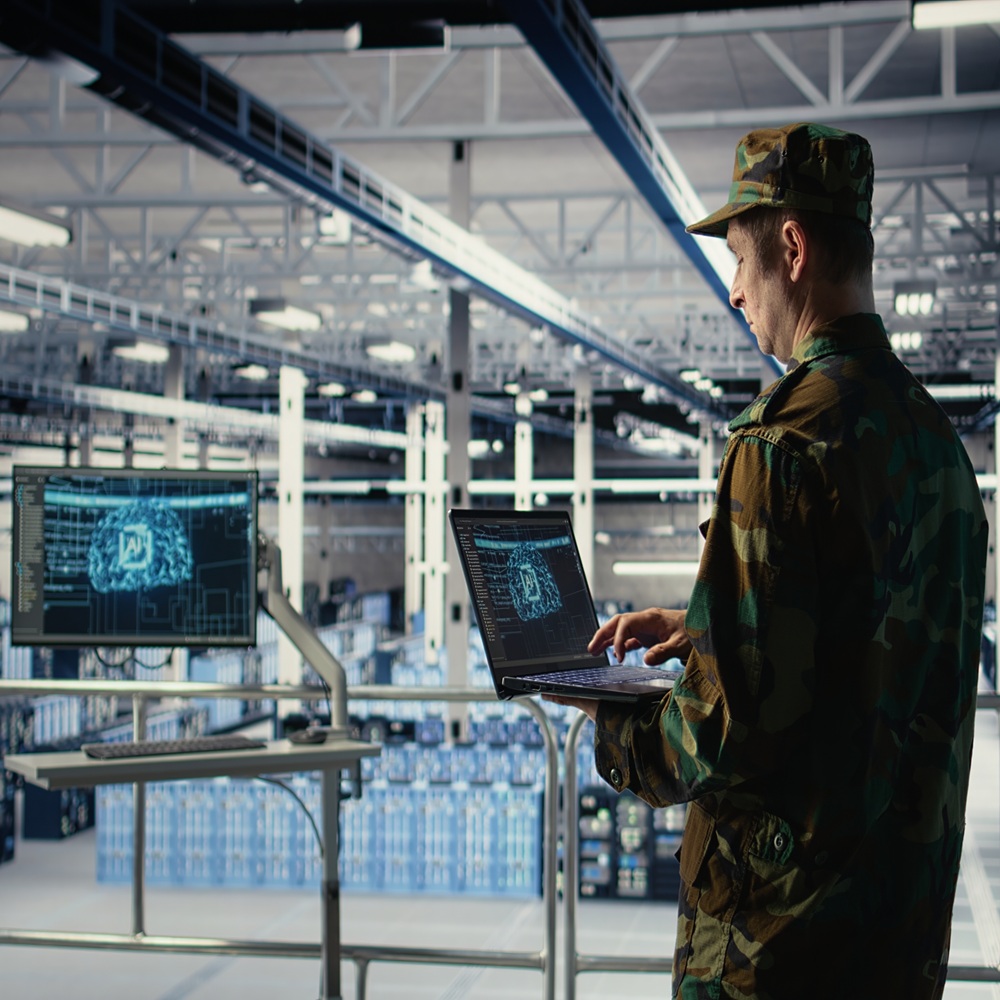
Soldier in engineering role uses AI application on laptop to manage server hub systems. Army commander reviews secret intelligence information using artificial intelligence in data center, camera A

Dual-Use AI Technologies in Defense: Strategic Implications and Security Risks

by Mayukh Dey

Introduction Artificial intelligence has become a critical technology in the 21st century, with applications spanning healthcare, commerce, and scientific research. However, the same algorithms that enable medical diagnostics can guide autonomous weapons, and the same machine learning systems that power recommendation engines can identify military targets. This dual-use nature, where technologies developed for civilian purposes can be repurposed for military applications, has positioned AI as a central element in evolving global security dynamics. The strategic implications are substantial. China views AI as essential for military modernization, with the People's Liberation Army planning to deploy "algorithmic warfare" and "network-centric warfare" capabilities by 2030 (Department of Defense, 2024). Concurrently, military conflicts in Ukraine and Gaza have demonstrated the operational deployment of AI-driven targeting systems. As nations allocate significant resources to military AI development, a critical question emerges: whether the security benefits of dual-use AI technologies can be realized without generating severe humanitarian consequences. The Reversal Commercial Innovation Driving Military Modernization Historically, military research and development drove technological innovation, with civilian applications emerging as secondary benefits, a phenomenon termed "spin-off." The internet, GPS, and microwave ovens all originated in defense laboratories. This dynamic has reversed. Commercially developed technologies now increasingly "spin into" the defense sector, with militaries dependent on technologies initially developed for commercial markets. This reversal carries significant implications for global security. Unlike the Cold War era, when the United States and Soviet Union controlled nuclear weapons development through state programs, AI innovation occurs primarily in private sector companies, technology firms, and university research institutions. Organizations like DARPA influence global emerging technology development, with their projects often establishing benchmarks for research and development efforts worldwide (Defense Advanced Research Projects Agency, 2024). This diffusion of technological capacity complicates traditional arms control frameworks based on state-controlled military production. The scale of investment is considerable. The U.S. Department of Defense's unclassified AI investments increased from approximately $600 million in 2016 to about $1.8 billion in 2024, with more than 685 active AI projects underway (Defense One, 2024). China's spending may exceed this figure, though exact data remains unavailable due to the opacity of Chinese defense budgeting. Europe is pursuing comparable investments, with the EU committing €1.5 billion to defense-related research and development through initiatives like the European Defence Fund. Dual-Use Applications in Contemporary Warfare AI's military applications span the spectrum of warfare, from strategic planning to tactical execution. Current deployments include: Intelligence, Surveillance, and Reconnaissance (ISR): AI systems process large volumes of sensor data, satellite imagery, and signals intelligence to identify patterns beyond human analytical capacity. In 2024, "China's commercial and academic AI sectors made progress on large language models (LLMs) and LLM-based reasoning models, which has narrowed the performance gap between China's models and the U.S. models currently leading the field," enabling more sophisticated intelligence analysis (Department of Defense, 2024). Autonomous Weapons Systems: Autonomous weapons can identify, track, and engage targets with minimal human oversight. In the Russia-Ukraine war, drones now account for approximately 70-80% of battlefield casualties (Center for Strategic and International Studies, 2025). Ukrainian officials predicted that AI-operated first person view drones could achieve hit rates of around 80%, compared to 30-50% for manually piloted systems (Reuters, 2024). Predictive Maintenance and Logistics: The U.S. Air Force employs AI in its Condition-Based Maintenance Plus program for F-35 fighters, analyzing sensor data to predict system failures before occurrence, reducing downtime and operational costs. Command and Control: AI assists military commanders in processing battlefield information and evaluating options at speeds exceeding human capacity. Project Convergence integrates AI, advanced networking, sensors, and automation across all warfare domains (land, air, sea, cyber, and space) to enable synchronized, real-time decision-making. Cyber Operations: AI powers both offensive and defensive cyber capabilities, from automated vulnerability discovery to malware detection and sophisticated social engineering campaigns. Gaza and Ukraine: AI in Contemporary Conflict Recent conflicts have provided operational demonstrations of AI's military applications and associated humanitarian costs. Israel's Lavender system reportedly identified up to 37,000 potential Hamas-linked targets, with sources claiming error rates near 10 percent (972 Magazine, 2024). An Israeli intelligence officer stated that "the IDF bombed targets in homes without hesitation, as a first option. It's much easier to bomb a family's home" (972 Magazine, 2024). The system accelerated airstrikes but also contributed to civilian casualties, raising questions about algorithmic accountability. The system's design involved explicit tradeoffs: prioritizing speed and scale over accuracy. According to sources interviewed by 972 Magazine, the army authorized the killing of up to 15 or 20 civilians for every junior Hamas operative that Lavender marked, while in some cases more than 100 civilians were authorized to be killed to assassinate a single senior commander (972 Magazine, 2024). Foundation models trained on commercial data lack the reasoning capacity humans possess, yet when applied to military targeting, false positives result in civilian deaths. Data sourced from WhatsApp metadata, Google Photos, and other commercial platforms created targeting profiles based on patterns that may not correspond to combatant status. Ukraine has implemented different approaches, using AI to coordinate drone swarms and enhance defensive capabilities against a numerically superior adversary. Ukrainian Deputy Defense Minister Kateryna Chernohorenko stated that "there are currently several dozen solutions on the market from Ukrainian manufacturers" for AI-augmented drone systems being delivered to armed forces (Reuters, 2024). Ukraine produced approximately 2 million drones in 2024, with AI-enabled systems achieving engagement success rates of 70 to 80 percent compared to 10 to 20 percent for manually controlled drones (Center for Strategic and International Studies, 2025). Both sides in the conflict have developed AI-powered targeting systems, creating operational arms race dynamics with immediate battlefield consequences. Civilian Harm: Technical and Legal Limitarions The integration of AI into lethal military systems raises humanitarian concerns extending beyond technical reliability. AI's inability to uphold the principle of distinction, which requires protecting civilians by distinguishing them from combatants in compliance with international humanitarian law, presents fundamental challenges. Current AI systems lack several capabilities essential for legal warfare:  Contextual Understanding: AI cannot comprehend the complex social, cultural, and situational factors that determine combatant status. A person carrying a weapon might be a combatant, a civilian defending their home, or a shepherd protecting livestock.  Proportionality Assessments: International humanitarian law requires that military attacks not cause disproportionate civilian damage. Human Rights Watch noted that it is doubtful whether robotic systems can make such nuanced assessments (Human Rights Watch, 2024).  Moral Judgment: Machines lack the capacity for compassion, mercy, or understanding of human dignity, qualities that have historically provided safeguards against wartime atrocities.  Accountability: With autonomous weapon systems, responsibility is distributed among programmers, manufacturers, and operators, making individual accountability difficult to establish. As one expert observed, "when AI, machine learning and human reasoning form a tight ecosystem, the capacity for human control is limited. Humans have a tendency to trust whatever computers say, especially when they move too fast for us to follow" (The Conversation, 2024). The risks extend to specific populations. Autonomous weapons systems trained on data predominantly consisting of male combatants in historical records could create algorithmic bias. In the case of Lavender, analysis suggests "one of the key equations was 'male equals militant,'" echoing the Obama administration's approach during drone warfare operations (The Conversation, 2024). Communities of color and Muslim populations face heightened risks given historical patterns of discriminatory force deployment. Export Controls and Technology Transfer Challenges Recognizing AI's strategic importance, governments have implemented export control regimes. The U.S. Bureau of Industry and Security now requires licenses for exports of advanced computing chips and AI model weights, imposing security conditions to safeguard storage of the most advanced models. These controls face inherent tensions. Overly broad restrictions risk hampering legitimate research and commercial innovation. Analysis suggests that if AI technology is too extensively controlled, American universities may face difficulties performing AI research, resulting in a less robust U.S. AI ecosystem. Insufficient controls enable adversaries to acquire cutting-edge capabilities. The effectiveness of export controls remains uncertain. In 2024, hundreds of thousands of chips, totaling millions of dollars, were smuggled into China through shell companies, varying distributors, and mislabeling techniques (Oxford Analytica, 2025). China's DeepSeek models, which achieved performance approaching U.S. systems, were reportedly trained on chips that circumvented export restrictions. International Governance: Fragmentation and Competing Frameworks The international community has struggled to develop coherent governance frameworks for dual-use AI. Rather than a cohesive global regulatory approach, what has emerged is a collection of national policies, multilateral agreements, high-level summits, declarations, frameworks, and voluntary commitments. Multiple international forums have addressed AI governance: ● The UN Secretary-General created an AI Advisory Board and called for a legally binding treaty to prohibit lethal autonomous weapons systems without human control, to be concluded by 2026 ● The Group of Governmental Experts on Lethal Autonomous Weapons Systems has held discussions under the Convention on Certain Conventional Weapons since 2013, with limited concrete progress ● NATO released a revised AI strategy in 2024, establishing standards for responsible use and accelerated adoption in military operations ● The EU's AI Act, adopted in 2023, explicitly excludes military applications and national security from its scope This fragmented landscape reflects geopolitical divisions. The perceived centrality of AI for competition has led the U.S. to position itself as leader of ideologically aligned countries in opposition to China, including for security purposes. China promotes its own governance vision through initiatives like the Belt and Road, exporting technology standards alongside infrastructure. Strategic Stability Implications AI creates strategic stability challenges. Autonomous weapons enable substitution of machines for human soldiers in many battlefield roles, reducing the human cost and thus political cost of waging offensive war. This could increase the frequency of conflicts between peer adversaries, each believing they can prevail without significant domestic casualties. For conflicts between non-peer adversaries, reduced casualties further diminish domestic opposition to wars of aggression. The implications extend beyond conventional warfare. Armed, fully-autonomous drone swarms could combine mass harm with lack of human control, potentially becoming weapons of mass destruction comparable to low-scale nuclear devices. The technical barriers to such systems are declining as components become commercially available. AI also complicates nuclear stability. Advances in AI-enhanced sensors and data processing could undermine second-strike capabilities by improving detection of mobile missile launchers and submarines. This erosion of assured retaliation could incentivize first strikes during crises. Simultaneously, AI systems managing nuclear command and control create risks of accidents, miscalculations, or unauthorized launches. Ethical Framework Limitations The integration of AI into warfare strains traditional ethical frameworks. Just War Theory requires that combatants maintain moral responsibility for their actions, possess the capacity to distinguish combatants from civilians, and apply proportionate force. Automation bias and technological mediation weaken moral agency among operators of AI-enabled targeting systems, diminishing their capacity for ethical decision-making. When operators interact with targeting through screens displaying algorithmic recommendations rather than direct observation, psychological distance increases. This mediation risks transforming killing into a bureaucratic process. The operator becomes less a moral agent making decisions and more a technician approving or rejecting algorithmic suggestions. Furthermore, industry dynamics, particularly venture capital funding, shape discourses surrounding military AI, influencing perceptions of responsible AI use in warfare. When commercial incentives align with military applications, the boundaries between responsible innovation and reckless proliferation become unclear. Companies developing AI for civilian markets face pressure to expand into defense contracting, often with insufficient ethical deliberation. Conclusion Dual-use AI technologies present both opportunities and risks for international security. One trajectory leads toward normalized algorithmic warfare at scale, arms races in autonomous weapons that erode strategic stability, and inadequate international governance resulting in civilian harm. An alternative trajectory involves international cooperation that constrains the most dangerous applications while permitting beneficial uses. The timeframe for establishing governance frameworks is limited. AI capabilities are advancing rapidly, and widespread proliferation of autonomous weapons will make policy reversal substantially more difficult. The challenge resembles nuclear non-proliferation but unfolds at greater speed, driven by commercial incentives rather than state-controlled programs. Because AI is a dual-use technology, technical advances can provide economic and security benefits. This reality means unilateral restraint by democratic nations would cede advantages to authoritarian competitors. However, uncontrolled competition risks adverse outcomes for all parties. Concrete action is required from multiple actors. States must strengthen multilateral agreements through forums like the UN Convention on Certain Conventional Weapons to establish binding restrictions on autonomous weapons without meaningful human control. NATO and regional security alliances should harmonize AI ethics standards and create verification mechanisms for military AI deployments. Military institutions must implement mandatory human-in-the-loop requirements for lethal autonomous systems and establish clear chains of accountability for AI-driven targeting decisions. Technology companies developing dual-use AI systems bear responsibility for implementing ethical safeguards and conducting thorough threat modeling before commercial release. Industry alliances should establish transparency standards for military AI applications and create independent audit mechanisms. Universities and research institutions must integrate AI ethics and international humanitarian law into technical training programs. Export control regimes require coordination between the United States, EU, and allied nations to prevent regulatory arbitrage while avoiding overreach that stifles legitimate research. Democratic governments should lead by demonstrating that military AI can be developed within strict ethical and legal constraints, setting standards that distinguish legitimate security applications from destabilizing weapons proliferation. As Austrian Foreign Minister Alexander Schallenberg observed, this represents the Oppenheimer moment of the current generation, recognizing that dual-use AI, like nuclear weapons, represents a technology whose military applications demand collective restraint. The policy choices made in the next few years will have long-term consequences. They will determine whether AI becomes a tool for human advancement or an instrument of algorithmic warfare. The technology exists; the policy framework remains to be established. The actors are identified; the question is whether they possess the political will to act before proliferation becomes irreversible. References 972 Magazine (2024) 'Lavender': The AI machine directing Israel's bombing spree in Gaza. https://www.972mag.com/lavender-ai-israeli-army-gaza/ Center for Strategic and International Studies (2024) Where the Chips Fall: U.S. Export Controls Under the Biden Administration from 2022 to 2024. https://www.csis.org/analysis/where-chips-fall-us-export-controls-under-biden-administration-2022-2024 Center for Strategic and International Studies (2025) Ukraine's Future Vision and Current Capabilities for Waging AI-Enabled Autonomous Warfare. https://www.csis.org/analysis/ukraines-future-vision-and-current-capabilities-waging-ai-enabled-autonomous-warfare Defense One (2023) The Pentagon's 2024 Budget Proposal, In Short. https://www.defenseone.com/policy/2023/03/heres-everything-we-know-about-pentagons-2024-budget-proposal/383892/ Department of Defense (2024) Military and Security Developments Involving the People's Republic of China 2024. https://media.defense.gov/2024/Dec/18/2003615520/-1/-1/0/MILITARY-AND-SECURITY-DEVELOPMENTS-INVOLVING-THE-PEOPLES-REPUBLIC-OF-CHINA-2024.PDF Foreign Policy Research Institute (2024) Breaking the Circuit: US-China Semiconductor Controls. https://www.fpri.org/article/2024/09/breaking-the-circuit-us-china-semiconductor-controls/ Human Rights Watch (2024) A Hazard to Human Rights: Autonomous Weapons Systems and Digital Decision-Making. https://www.hrw.org/report/2025/04/28/a-hazard-to-human-rights/autonomous-weapons-systems-and-digital-decision-making National Defense Magazine (2024) Pentagon Sorting Out AI's Future in Warfare. https://www.nationaldefensemagazine.org/articles/2024/10/22/pentagon-sorting-out-ais-future-in-warfare Queen Mary University of London (2024) Gaza war: Israel using AI to identify human targets raising fears that innocents are being caught in the net. https://www.qmul.ac.uk/media/news/2024/hss/gaza-war-israel-using-ai-to-identify-human-targets-raising-fears-that-innocents-are-being-caught-in-the-net.html Reuters (2024) Ukraine rolls out dozens of AI systems to help its drones hit targets. https://euromaidanpress.com/2024/10/31/reuters-ukraine-rolls-out-dozens-of-ai-systems-to-help-its-drones-hit-targets/

Defense & Security
Grunge abstract background. Background concept of the war in Ukraine. Sleeve flags dirt smoke.

The end of Great Illusions and the Revenge of Realism. The Case of the War in Ukraine – Part 1

by Krzysztof Sliwinski

Abstract This is the first part of an analysis examining the initial perceptions and evolving realities of the Russia-Ukraine war, which began in February 2022. Early Western media and political narratives were optimistic about Ukraine’s military resilience and potential victory, highlighting heroic resistance, Western support, and Russian operational failures. However, the reality has been more complex, as Ukraine faced significant challenges, including numerical and equipment inferiority, underfunding, limited combat brigades, and a lack of strategic reserves. Despite these hardships, Ukraine managed to resist Russia’s initial advances, as exemplified by symbolic events such as the defence of Snake Island. The article explores the human and economic costs of the ongoing war. Ukraine requires an estimated $524 billion in reconstruction funding, following a 30% drop in GDP in 2022 and ongoing economic hardships. Western aid has been substantial, exceeding €400 billion, but the conflict’s economic fallout also burdens donor countries, causing inflation and growth slowdowns. Key Words: Realism, War, Ukraine Introduction At the very beginning of the ‘Special Military Operation’ – an invasion of Ukraine by Russia - most academics, policymakers, political leaders, and media pundits were hugely impressed by Ukraine’s initial military response. Most were genuinely of the opinion that Russia was weak, economic sanctions would cripple its economy, President Putin had little to no public support, and that with enormous help from the U.S. as well as most EU Member states, Ukraine would not only resist the attack but ultimately win the war with Russia on its own territory and perhaps even facilitate the government change in Kremlin. Any skeptical views regarding the possible Ukrainian victory were swiftly silenced and dismissed as pro-Putin propaganda or even deliberate disinformation, therefore suggesting that any sceptics are more or less Putin’s agents. Let’s look at some media titles from March 2022 onward (the war started on 24 February, 2022). Overenthusiastic narrative At the outset of Russia's invasion of Ukraine in late February 2022, many initial media reports and analyses were pessimistic, predicting a swift Russian victory based on military disparities. However, by March 2022, as Ukrainian forces demonstrated unexpected resilience — repelling advances on Kyiv and inflicting significant losses on Russian troops—some Western media outlets began publishing more enthusiastic and optimistic pieces about Ukraine's potential to prevail. These often-highlighted Ukrainian morale, Western support, and Russian operational failures. Below, the reader will find several examples from that early period, drawn from a range of sources including news articles and opinion pieces. Admittedly, media coverage of this topic is inherently biased, with Western outlets generally favouring Ukraine's perspective. In contrast, Russian state media promoted the opposite narrative (e.g., RIA Novosti's premature victory declaration on February 28, 2022, which was quickly retracted). One of the events that genuinely inspired the world at the very beginning of the war was the so-called Snake-Island Campaign. Snake Island is a tiny (0.17 km²) Ukrainian outpost in the Black Sea, about 48 km off the coast of Odesa. Despite its size, the island is geostrategically vital: it hosts radar stations, enables missile launches, and controls maritime routes for grain exports from Odesa. Russian control threatened Ukraine's southern coast and Black Sea shipping.[1] On the invasion's first day, the Russian cruiser Moskva (Black Sea Fleet flagship) radioed: "Snake Island, this is a Russian warship. I repeat: put down your arms... or you will be bombed." The 13 Ukrainian border guards replied: "Russian warship, go f… yourself." Russians captured the island via helicopter assault; defenders were taken POW but later exchanged and awarded Ukraine's Hero of Ukraine title. Consequently, legacy media began painting a rather rosy picture of the Ukrainian campaign. Below, the reader will find several examples: - The Atlantic - "Ukraine Is Winning. Don't Let Up Now." (March 28, 2022). This opinion piece by Eliot A. Cohen expressed strong optimism about Ukraine's battlefield performance, crediting heroic resistance and Western aid while critiquing Russia's weaknesses. Key quotes: "Truly magnificent Ukrainian resistance — heroic and clever at once — backed by Western arms and intelligence accounts for much of this." and "If Ukraine prevails, its example will be at least a partial deterrent to further adventures by Russia, and perhaps by China." The article urged continued support to secure a Ukrainian victory. [2] - The Washington Post - "Ukraine-Russia talks stir optimism, but West urges caution" (March 29, 2022). This news report highlighted positive developments from peace talks in Istanbul, where Russia pledged to reduce military operations around Kyiv, fostering hope for a resolution favourable to Ukraine. It noted enthusiasm around Ukraine's proposals for neutrality with security guarantees, though tempered by skepticism. A key optimistic element: The talks "stirred a glimmer of hope" amid Ukraine's successful defence, with Ukrainian negotiators pushing for international backing to end the conflict on terms that preserved sovereignty. [3] - Associated Press (AP) - "Russia says it will cut back operations near Ukraine capital" (March 29, 2022). This wire report conveyed optimism following Russia's announcement of scaling back assaults on Kyiv and Chernihiv, interpreting it as a sign of Ukrainian leverage in negotiations. Key quote: "Russia announced Tuesday it will significantly scale back military operations near Ukraine’s capital and a northern city, as the outlines of a possible deal to end the grinding war came into view at the latest round of talks." It portrayed this as a potential turning point, with Ukraine's delegation outlining a framework for neutrality backed by guarantor nations.[4] - Deutsche Welle (DW) - "Ukrainians have won the information war" (March 7, 2022). While primarily focused on the information domain, this article by historian Margaret MacMillan extended optimism to the broader conflict, arguing that Ukraine's narrative success bolstered its military position. Key quote: "The Ukrainians have won the information war... This is helping them win support around the world, which in turn is translating into real help on the ground." It emphasized global sympathy, fuelling aid that could tip the scales toward Ukrainian victory.[5] - In a rather absurd tone, the Polish media reported that a Kiev female resident destroyed a Russian military drone with a jar of pickles when enjoying a cigarette on her balcony.[6] Reality on the ground was somewhat different, however. In fact, as Valerii Zaluzhnyi, Ambassador of Ukraine to the United Kingdom, ex-Commander-in-Chief of the Armed Forces of Ukraine, rightly observed, before the invasion by Russia, the Armed Forces of Ukraine faced several significant challenges: 1. Numerical and Equipment Inferiority: As of the end of 2021, the Russian army was about five times larger than the Ukrainian army, with four times more tanks and armoured combat vehicles, 3.4 times more artillery, and 4.5 times more attack helicopters. The Ukrainian Navy was notably weaker, lacking aircraft carriers, destroyers, corvettes, or submarines.[7] 2. Underfunding and Stagnation: Despite politicians declaring that more than 5% of GDP was allocated to security and defence, less than half of the allocated budget went to the Ministry of Defence. There was no increase in funding for developing and procuring weapons and equipment, with most money going to financial support for the military personnel. This led to stagnation, with a lack of finances for development and combat readiness, personnel outflow, and understaffed military units. 3. Limited Combat Brigades: At the time of appointment of the author as Commander-in-Chief in August 2021, there were only 24 combat brigades in the Armed Forces of Ukraine, with 12 already engaged in combat in the East and South. Only 12 combat brigades remained available for deployment in the event of aggression. 4. Insufficient Modern Weapons: Ukraine had very few modern weapons compared to Russia. The total need for funds to repel aggression, including replenishing missile and ammunition stocks, was estimated at hundreds of billions of hryvnias, which the Armed Forces did not have. 5. Lack of Strategic Reserves and Preparedness: The Armed Forces were unable to create sufficient strategic reserves, which are crucial in a strategy of defeat. Ukraine was significantly inferior in personnel, weapons, and military equipment, and lacked the preparation to meet the scale of the impending invasion. These challenges left Ukraine vulnerable and enabled Russia to pursue a strategy of defeat through swift, decisive military action. Reality on the ground – how much has the war cost so far? Russia's invasion has imposed staggering financial burdens on Ukraine and its Western allies through December 2025. Available reports evaluate these costs, encompassing direct damages, economic contractions, and international aid expenditures, drawing from economic assessments and aid trackers. Ukraine has endured profound economic devastation. According to the World Bank's February 2025 Rapid Damage and Needs Assessment, the country requires an estimated $524 billion for reconstruction over the next decade, reflecting cumulative physical damages from infrastructure destruction, housing losses, and disrupted industries.[8]     Source: UKRAINE FOURTH RAPID DAMAGE RDNA4 AND NEEDS ASSESSMENT. (2025, February). World Bank Group. https://documents1.worldbank.org/curated/en/099022025114040022/pdf/P180174-ca39eccd-ea67-4bd8-b537-ff73a675a0a8.pdf The war has apparently obliterated key sectors: agriculture, energy, and manufacturing suffered massively, with export routes like Black Sea ports blocked, leading to a 30% GDP contraction in 2022 alone. By mid-2025, Ukraine's GDP remained 25-30% below pre-war levels, with annual losses projected at $40-50 billion due to reduced output and trade.[9] Military expenditures have surged, consuming over 50% of the national budget, totalling around $100 billion since 2022, funded partly through domestic borrowing and inflation, which peaked at 26% in 2022. [10] Humanitarian costs, including the displacement of 6 million refugees and internal migrants, add billions in social support.[11] Overall, projections estimate Ukraine's total war-related economic harm at $2.4 trillion by 2025, though this likely understates indirect effects like human capital loss and environmental damage.[12] Western nations, primarily the United States and European Union members, have shouldered high costs through aid and indirect economic repercussions. Total bilateral aid from Western donors exceeded €400 billion ($430 billion) by June 2025, including military, financial, and humanitarian support.[13] The U.S. has committed $175 billion in appropriations, with $130.6 billion spent by August 2025, including $66.9 billion in military assistance like weapons and training.[14] EU institutions and member states provided nearly $197 billion, encompassing $63.2 billion from EU budgets and refugee support for 8 million arrivals.[15] The UK itself pledged £12.8 billion, with £7.8 billion for the military.[16] Beyond aid, the war triggered economic shocks in the West. Energy prices soared due to sanctions on Russian oil and gas, contributing to EU inflation averaging 8-10% in 2022-2023 and to a 0.5-1% reduction in annual GDP growth.[17] The U.S. faced similar inflationary pressures, with global growth slowing to 3.1% in 2022, partly from supply disruptions.[18] Proximity to the conflict amplified costs for Eastern EU states, with cumulative GDP shortfalls estimated at €200-300 billion across Europe by 2025.[19] All in all, the war's financial toll surpasses $3 trillion combined for Ukraine and its supporters, straining budgets and exacerbating global inequalities.[20] Sustained aid is vital for Ukraine's resilience, but escalating costs underscore the need for diplomatic resolutions to mitigate further economic fallout. To be continued… References [1] Colibășanu, A., Crowther, A., Hickman, J., & Scutaru, G. (2022, September 27). The Strategic Importance of Snake Island. CEPA. https://cepa.org/comprehensive-reports/the-strategic-importance-of-snake-island/ [2] Cohen, E. A. (2022, March 28). Don’t Let Up Now. The Atlantic. https://www.theatlantic.com/ideas/archive/2022/03/west-strategy-against-russia-ukraine-war/629387/ [3] Fahim, K., Stern, D. L., Lamothe, D., & Khurshudyan, I. (2022, March 29). Don’t Let Up Now. The Washington Post. https://www.washingtonpost.com/national-security/2022/03/29/ukraine-russia-turkey-negotiations/ [4] Jones, T. (2022, March 30). Optimism, pessimism or skepticism? News outlets focus on the right thing in Russia-Ukraine coverage. Poynter. https://www.poynter.org/commentary/2022/optimism-pessimism-or-skepticism-news-outlets-focus-on-the-right-thing-in-russia-ukraine-coverage/ [5] Haas, B. (2022, March 7). Ukrainians have won the information war. DW. https://www.dw.com/en/ukrainians-have-won-the-information-war-historian-margaret-macmillan/a-61022603 [6] Wawrzusiszyn, D. (2022, March 8). To były pomidory, a nie ogórki. Znaleziono Ukrainkę, która strąciła drona słoikiem. Na:Temat. https://natemat.pl/400859,znaleziono-ukrainke-ktora-stracila-drona-sloikiem-z-ogorkami [7] Zaluzhnyi, V. (2025, November 29). Politics and War. Reality vs Expectations. LIGA.Net. https://www.liga.net/en/politics/opinion/politics-and-war-reality-vs-expectations#comment-list-4601543 [8] Ukraine. (2025, December 9). World Bank Group. https://www.worldbank.org/ext/en/country/ukraine [9] Gorodnichenko, Y., & Vasudevan, V. (2025, July 27). The (projected) cost of Russian aggression. CEPR. https://cepr.org/voxeu/columns/projected-cost-russian-aggression [10] Samoiliuk, M. (2025, December 8). Ukraine War Economy Tracker. Centre For Economic Strategy. https://ces.org.ua/en/tracker-economy-during-the-war/ [11] Rogoff, K. (2025, December 9). The Long-lasting Economic Shock of War. International Monetary Fund. https://www.imf.org/en/publications/fandd/issues/2022/03/the-long-lasting-economic-shock-of-war [12] Gorodnichenko, Y., & Vasudevan, V. (2025, July 27). The (projected) cost of Russian aggression. CEPR. https://cepr.org/voxeu/columns/projected-cost-russian-aggression [13] Davis Jr., E., & Wolf, C. (2025, March 11). The Long-lasting Economic Shock of War. U.S.News. https://www.usnews.com/news/best-countries/articles/these-countries-have-committed-the-most-aid-to-ukraine [14] U.S. Security Cooperation with Ukraine. (2025, March 12). U.S. Department of State. https://www.state.gov/bureau-of-political-military-affairs/releases/2025/01/u-s-security-cooperation-with-ukraine [15] EU Assistance to Ukraine (in U.S. Dollars). (2025, November 19). Delegation of the European Union to the United States of America. https://www.eeas.europa.eu/delegations/united-states-america/eu-assistance-ukraine-us-dollars_en?s=253 [16] Mills, C. (2025, July 17). Military assistance to Ukraine (February 2022 to January 2025). UK Parliament. https://commonslibrary.parliament.uk/research-briefings/cbp-9477/ [17] The cost of EU Member States’ proximity to the war. (2025, November 17). European Commission. https://economy-finance.ec.europa.eu/cost-eu-member-states-proximity-war_en [18] Jenkins, B. M. (2023, March 7). Consequences of the War in Ukraine: The Economic Fallout. European Commission. https://www.rand.org/pubs/commentary/2023/03/consequences-of-the-war-in-ukraine-the-economic-fallout.html [19] The cost of EU Member States’ proximity to the war. (2025, November 17). European Commission. https://economy-finance.ec.europa.eu/cost-eu-member-states-proximity-war_en [20] Rogoff, K. (2025, December 9). The Long-lasting Economic Shock of War. International Monetary Fund. https://www.imf.org/en/publications/fandd/issues/2022/03/the-long-lasting-economic-shock-of-war

Defense & Security
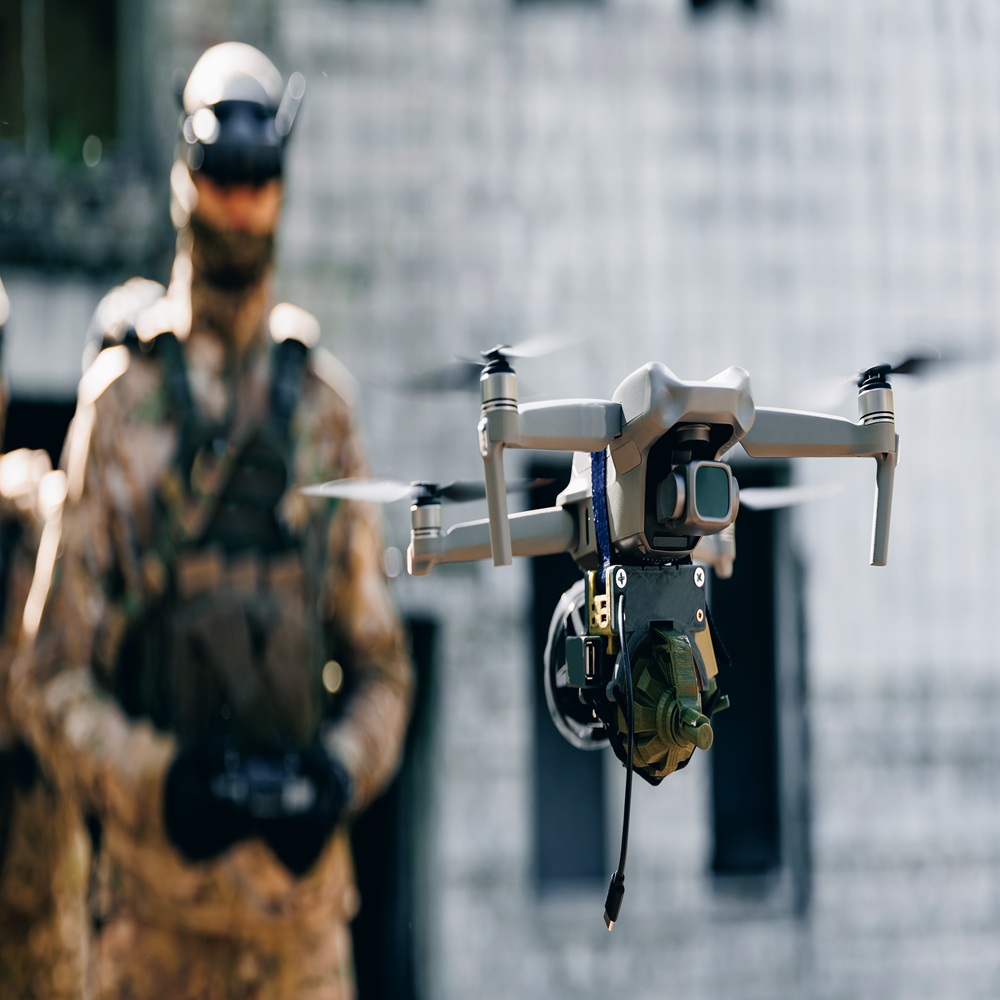
Soldier UAV operator launches army drone with bomb to drop into enemy fortifications and trenches. Concept using military robots in modern warfare.

Unmanned aerial vehicle: geopolitical influence, industrial potential and future perspectives

by World & New World Journal

Introduction An unmanned aerial vehicle (UAV) or unmanned aircraft system (UAS), commonly known as drone, is an aircraft without a human pilot, crew or passenger on board, but rather controlled remotely or autonomously. Drones can be seen as cutting-edge technologies with tremendous ramifications across various fields, including military, security, economics, and logistics – ranging from lightweight consumer drones to advanced autonomous combat platforms – that have transformed global security economics and technological developments. Their proliferation marks a shift in the conduct of warfare, industrial processes, and urban infrastructure design. In this context, this article aims to analyze these dynamics across three domains: geopolitical and security implications, economics and industrial processes, and future technological transformation. I. Geopolitical and Security Perspective: "Game Changers" The Dawn of the Unmanned Warfare Era The past decade — and especially during the conflicts in Ukraine, Gaza, and the Caucasus —has showcased an irreversible shift toward unmanned warfare. Low-cost drones have enabled nations and non-state actors to conduct reconnaissance, precision strikes, and electronic warfare at a fraction of traditional military costs. The democratization of drone warfare erodes conventional military hierarchies by giving smaller nations and even non-state groups asymmetric capabilities (Kania, 2020), (Vision of Humanity, 2024). Figure 1: Use of drones by type. A major consequence of this shift is the emergence of continuous aerial presence, which fundamentally alters operational rhythm and tempo. Previously, only major powers could afford persistent surveillance through manned aircraft or satellites. Today, even insurgent groups can deploy swarms of commercial drones to maintain near-constant observation of enemy movements. This constant presence of drones on the battlefield forces militaries to make decisions much faster and operate as if they are always being watched. As drone technology becomes cheaper and more widely available, it also becomes easier for states or groups to launch low-risk, hard-to-trace attacks without putting their own people in danger. This reduces the barrier to starting or escalating conflicts and makes the overall situation far more unpredictable. On the other hand, despite automation, drone warfare remains heavily dependent on human adaptation, moreover, in practice, drones’ use is constrained by weather, terrain, and limited night capability (Newton, 2025). Nonetheless, and as seen in the Ukraine War, the adaptation, development and improvement of the designs and systems have skyrocketed and shortened from months to weeks. A Paradigm Shift in Modern Warfare Traditional doctrines built around armored vehicles, manned aircraft, and centralized command structures are giving way to distributed, networked, and automated operations. Drones allow for constant ISR (intelligence, surveillance, reconnaissance), rapid kill chains, and battlefield transparency that reduces the effectiveness of concealment and mass maneuver (Biddle & Oelrich, 2016). Swarm technology further accelerates this shift by overwhelming air defenses through algorithmic coordination. On a broader strategic level, unmanned systems are transforming operational art, forcing militaries to rethink how they structure campaigns. Instead of relying on a small number of high-value manned platforms, modern forces must integrate thousands of expendable, semi-autonomous assets into a coherent command-and-control ecosystem. This shift elevates the importance of data fusion, algorithms, and electronic warfare, as success increasingly depends on which side can process information more effectively rather than which side has heavier armor or more firepower. Furthermore, the psychological effects of drone warfare — constant monitoring, unpredictable strikes, and the invisibility of operators — alter the morale and behavior of both soldiers and civilians. In this sense, unmanned warfare not only changes tactics but reshapes the human dimension of conflict. Evolution of Defense Strategies States now are prioritizing anti-drone systems (C-UAS), electronic warfare, and resilient supply chains. Defense strategies emphasize dispersion, decoys, deception, and multi-layered air defense, recognizing that the cost ratio favors attackers using cheap drones against expensive assets. Militaries increasingly incorporate AI-enabled targeting, autonomous perimeter defense, and drone-versus-drone combat (Mehta, 2022). The rapid evolution of offensive drone capabilities has forced governments to pursue a new generation of integrated counter-unmanned systems, blending kinetic interceptors, directed-energy weapons, radio-frequency jamming, and cyber tools. However, the challenge is not merely technological — it is organizational. Modern militaries must revise procurement cycles, adopt flexible doctrine, and restructure units to counter the fast-changing drone threat. For example, some nations are creating dedicated “drone defense battalions” or embedding electronic warfare teams at lower echelons of command. Once more the Ukraine War is a good example: Ukraine’s early-warning systems (so called, “drone walls”) use layered reconnaissance UAVs to identify threats and enhance battlefield visibility, unfortunately, these are highly vulnerable to electronic warfare and radar destruction. More examples include the fiber-optic FPV drones as countermeasure of jamming, or decoy drones to lure air defenses and absorb munitions. (Newton, 2025) The rise of drone warfare also places huge demand on secure communications and resilient digital infrastructure; adversaries increasingly target supply chains, software vulnerabilities, and satellite links that control unmanned systems. Thus, the evolution of defense strategies represents a multi-domain effort that spans hardware, software, organizational culture, and national-level industrial capacity. Major Countries' Competition in Drone Weapon Development The United States, China, Israel, Turkey, and Iran dominate the global drone arms race, while Russia and Ukraine deserve a special mention too. • USA: it focuses on high-tech autonomous systems, for example the MQ-25, Collaborative Combat Aircraft. In addition, according to the Federal Aviation Administration they have an estimated 822,039 drones registered as of July 2025. (FAA, 2025)• China: leads in export volume, offering cost-competitive platforms like the Wing Loong series (Fischer, 2020).• Turkey: gained strategic influence through the Bayraktar TB2, proven in multiple regional conflicts like the Nagorno-Karabakh in 2020 or its use for strategic communications for Ukraine during the ongoing conflict. (Péria-Peigné, 2023)• Israel: its research, development and production of innovative drone technology and exports roughly $500 million worth of UAV-related products per year, have positioned Israel as a world leader in the area. Israel is well known for its indigenous and competitive manufacturing UAVs like the Hermes 450, the Searcher Mk II and the Heron. (Sadot, s.f.)• Iran: their Shahed-136 drone is a low-cost drone that has gained attention internationally as it has shown affordability, precision, long-range, and cheapness during the Ukraine War – deployed by Russia. (Kesteloo, 2025)• Ukraine: has emerged as a leader in tactical warfare, including mass quantities of low-cost First-Person View (FPV) drones for frontline and deep-strike operations. But also, it has implemented “Spider’s Web” operations, which strike deep inside Russia, while using low-cost assets but with strategic and punctual strikes. Ukraine has also expanded into the maritime domain with unmanned surface vessels (USVs) using them with a kamikaze-style operation targeting ships and critical offshore infrastructure in the Black Sea. (Newton, 2025)• Russia: the war has institutionalized an UAV doctrine with mass deployment of FPV drones (Newton, 2025) and the creation – similar to Ukraine – of an Unmanned System Force (USF) aiming to encompass aerial, land and surface drones. (Altman, 2025) II. Economic & Industrial Perspective: “Flying Industrial Revolution” Future Logistics and Delivery Systems Beyond the battlefield, drones are reshaping global economies and enabling new industrial ecosystems. For instance, drones are rapidly transforming last-mile delivery by reducing transportation time, bypassing road congestion, and enabling access to remote or disaster-affected areas. Companies like Amazon, Wing, and Zipline have already demonstrated how unmanned aircraft can deliver medical supplies, parcels, and consumer goods more efficiently than traditional vehicles. As autonomous navigation, battery technology, and payload capacity continue to improve, drones are expected to become critical components of global supply chains, especially in regions where infrastructure is limited or demand for ultra-fast delivery is increasing. Global drone delivery is expected to reach multi-billion-dollar scale by 2030 (PwC, 2023). In the longer term, logistics networks are expected to evolve into hybrid ground–air systems, where drones work alongside autonomous ground vehicles and smart warehouses. These systems could drastically reduce operational costs by automating pickup, sorting, and delivery processes. Integrating drones with AI-driven inventory management and predictive delivery algorithms will allow companies to anticipate demand and route products dynamically. As eVTOL cargo aircraft mature, the concept of “airborne logistics hubs” may also emerge, enabling rapid long-distance transport between distribution centers without the need for airports. Together, these developments point toward a future where aerial logistics are not just an add-on, but a central pillar of modern supply chains. Improving Industrial Efficiency Across agriculture, energy, construction, and mining drones significantly improve efficiency by automating tasks that previously required expensive equipment or manual labor. By replacing manned inspection systems, drones can reduce labor costs, increase safety, and provide data of unprecedented detail (McKinsey, 2022). For example, farmers use drones for precision spraying and crop monitoring, reducing fertilizer and water usage. Energy companies deploy unmanned systems for pipeline inspections and powerline surveys, minimizing downtime and enhancing worker safety. Construction and mining firms rely on drones for site mapping, progress tracking, and 3D modeling, improving project accuracy while lowering operational costs. Beyond task automation, drones are becoming essential to data-driven industrial optimization. Equipped with thermal sensors, LiDAR, and multispectral cameras, unmanned systems can capture high-resolution data that feeds directly into AI analytics platforms. This allows companies to detect inefficiencies, predict equipment failure, and optimize resource allocation in real time. As industries move toward digital twins — virtual models of physical assets — drones will play a key role in continuously updating these systems with accurate spatial and environmental data. The result is a more responsive, efficient, and resilient industrial ecosystem that leverages aerial automation for competitive advantage. Regulatory Environment and Market Growth Regulation remains the single most influential factor shaping the global drone market. Governments are gradually introducing frameworks to enable Beyond Visual Line of Sight (BVLOS) operations, Remote ID tracking, and certification standards for commercial drones. Regions like the European Union have adopted unified risk-based rules through EASA, while the United States continues to refine its Part 107 and UTM integration policies through the FAA. These regulatory milestones are essential for scaling commercial drone usage, as they provide clarity to manufacturers, operators, and investors. As regulatory frameworks mature, they are also becoming a competitive advantage for regions that adopt them early. Countries that implement drone-friendly ecosystems — such as Singapore, the UAE, and Rwanda — are rapidly emerging as hubs for drone research, testing, and deployment. This regulatory momentum encourages multinational companies to establish operations in these markets, accelerating local innovation and talent development. Furthermore, harmonized international standards will make it easier for drone manufacturers to reduce production complexity and expand globally. Ultimately, the pace of market growth will depend not just on technological advancement but on how effectively governments balance innovation with safety, privacy, and public acceptance. Investment Trends Investment in drone-related technologies has surged, driven by the convergence of autonomy, artificial intelligence, and advanced manufacturing. Venture capital firms increasingly fund companies developing autonomous navigation systems, UTM software, battery technology, and specialized industrial drones. Defense investors continue to expand their portfolios into dual-use drone companies, reflecting growing geopolitical interest and national security incentives. Meanwhile, major tech firms and automotive companies are exploring opportunities in cargo drones, eVTOL aircraft, and autonomous mobility ecosystems. Beyond private investment, government funding and public–private partnerships are accelerating drone adoption globally. Many nations are launching test corridors, innovation hubs, and subsidies to attract drone startups and support local manufacturing. This trend is particularly strong in Asia and the Middle East, where governments see drones as strategic tools for digital transformation and economic diversification. As markets mature, investment is shifting from hardware-heavy startups toward software, analytics, and integrated airspace management solutions — reflecting a broader transition from drone manufacturing to drone ecosystems. This shift signals a long-term, sustainable evolution of the drone industry from early experimental phases to full-scale commercial and civil integration. III. Future Technologies The Need for Unmanned Traffic Management (UTM) As drones and future eVTOL air taxis multiply, low-altitude airspace will become increasingly crowded. To prevent collisions and maintain order, UTM frameworks — already being developed by NASA, the FAA, EASA, and ICAO — aim to coordinate autonomous flights using real-time tracking, automated route planning, and digital air corridors (Kopardekar, 2016). These systems will act as the “air-traffic control of the future,” but designed for far larger numbers of smaller, faster-moving vehicles. In addition, as demand grows, it is likely that UTM will evolve into a fully automated, AI-driven airspace ecosystem capable of managing thousands of simultaneous flights with minimal human oversight. Future systems could incorporate weather prediction, dynamic rerouting, and AI-powered detect-and-avoid features, which more than a technical upgrade, would transform the air mobility in the cities worldwide. Global Standardization Competition The need for standard UTM, drone certifications, communication systems, and detect-and-avoid technology is critical, but it also represents a geopolitical contest. The U.S., the European Union, and China are each developing distinct technological ecosystems, hoping their standards will dominate global markets. Whichever region’s standards become the international norm will shape supply chains, aircraft design, and regulatory practices for decades. This competition mirrors earlier battles over telecommunications and 5G. Nations that establish widely adopted drone standards will gain strategic advantages, including influence over global manufacturing, software ecosystems, and aviation governance. As a result, UTM and drone certification are no longer just technical debates — they have become instruments of national power, economic leverage and somehow geopolitical importance. Urban Safety and Privacy Issues In addition, another major concern for cities is the widespread adoption of drones itself, which translates into surveillance risks, noise pollution from frequent flights, and vulnerability to cyberattacks that could compromise flight controls. Therefore, urban areas need strict rules governing data collection, flight paths, and liability in case of accidents to maintain public trust and safety. In the future, cities will also require integrated emergency response protocols, stronger cybersecurity defenses, and digital identity systems for all unmanned aircraft. Public engagement and transparent oversight will play a major role in ensuring that drones enhance urban life without creating new forms of intrusion or risk. Managing these challenges will be essential for the successful adoption of unmanned urban mobility. Integration with Future Urban Infrastructure In line with the previous section, smart cities could incorporate drones into their core infrastructure. For example, vertiports, rooftop landing pads, sensor-equipped air corridors, and digital twins could enable efficient navigation and real-time monitoring. In addition, drones will become essential for urban mobility and public services – from medical or any goods deliveries to emergency response like fire unit responses. As cities evolve, this integration will create a hybrid transportation ecosystem, where ground vehicles, aerial drones, and automated control systems would operate in sync. Urban planning will increasingly consider airspace as a valuable layer of infrastructure, much like roads or power grids. Therefore, collaboration between governments, industry, and technology providers to design cities capable of supporting high-density autonomous air mobility is required. Conclusion Unmanned systems are redefining the global balance of power, transforming industrial processes, and reshaping urban futures. The convergence of autonomy, AI, and networked airspace introduces both unprecedented opportunity and profound risk. Geopolitically, drones dilute traditional military dominance; economically, they catalyze a new airborne industrial revolution; technologically, they push societies toward complex management of shared automated airspace. Future policy, regulation, and innovation will determine whether unmanned systems become drivers of prosperity or vectors of instability. References Altman, H. (2025, November 13). Russia Creates New Military Branch Dedicated to Drone Warfare. The War Zone (TWZ). https://www.twz.com/news-features/russia-creates-new-military-branch-dedicated-to-drone-warfare Amazon. (2023). Prime Air: The Future of Drone Delivery. Amazon Corporate Publications. Biddle, S., & Oelrich, I. (2016). Future Warfare in the Age of Drones. Council on Foreign Relations. Deloitte. (2022). Drones in Industrial Operations: Transforming Asset Inspection and Performance. Deloitte Insights. FAA (Federal Aviation Administration). (2023). Integration of Unmanned Aircraft Systems into the National Airspace System. U.S. Department of Transportation. FAA (Federal Aviation Administration). (2025). Drones. https://www.faa.gov/uas Fischer, S. (2020). China’s Military–Civil Fusion Strategy: A View from Washington. U.S.–China Economic and Security Review Commission. Kania, E. B. (2020). Learning Warfare from the Laboratory: China’s Progress in Military Innovation. Center for a New American Security (CNAS). Kesteloo, H. (2025, September 29). Global Military Drone Race Intensifies as Nations Rush to Copy Iran’s Shahed Design. Medium. https://medium.com/@hayekesteloo/global-military-drone-race-intensifies-as-nations-rush-to-copy-irans-shahed-design-404badf482fb Kopardekar, P. (2016). Unmanned Aircraft System (UAS) Traffic Management (UTM) Concept of Operations. NASA Ames Research Center. McKinsey & Company. (2022). The Commercial Drone Market Outlook: Insights on Market Growth, Industrial Adoption, and Regulation. McKinsey Robotics & Automation Practice. Mehta, A. (2022). Counter-Drone Systems and the Future of Air Defense. Defense News. Newton, M. (2025, November 3). How Are Drones Changing War? The Future of the Battlefield. Center for European Policy Analysis (CEPA). https://cepa.org/article/how-are-drones-changing-war-the-future-of-the-battlefield/ Péria-Peigné, L. (2023, April 17). TB2 Bayraktar: Big Strategy for a Little Drone. IFRI. https://www.ifri.org/en/memos/tb2-bayraktar-big-strategy-little-drone PwC. (2023). Clarity from Above: Global Drone Market Analysis. PwC Global. Roland Berger. (2022). Urban Air Mobility: The Rise of the Drone Economy. Roland Berger Strategy Consultants. Rwanda Civil Aviation Authority. (2021). Regulatory Framework for Drone Delivery and BVLOS Operations. Government of Rwanda. Sadot, U. (n.d.). Proliferated Drones: A Perspective on Israel. Center for a New American Security (CNAS). https://drones.cnas.org/reports/a-perspective-on-israel/ Schmidt, E., Work, R., & Clyburn, M. (2021). Final Report: National Security Commission on Artificial Intelligence. U.S. Government Printing Office. Singer, P. W. (2009). Wired for War: The Robotics Revolution and Conflict in the 21st Century. Penguin Books. Statista. (2023). Global Drone Market Value and Investment Trends. Statista Market Outlook. Vision of Humanity. (2024, June 13). How Drones Have Shaped the Nature of Conflict. https://www.visionofhumanity.org/how-drones-have-shaped-the-nature-of-conflict/ Wing (Alphabet). (2023). Autonomous Delivery Networks and Future Logistics. Wing Technical Publications. Zipline. (2022). Operational Impact of Automated Medical Delivery by Drone. Zipline International Case Studies.

Defense & Security
Missiles in front EU flag. Air defense systems European Union. Cruise missiles in Europe. Concept weapons development in Europe. Stockpiles strategic missiles. Concrete wall in foreground. 3d image

Nuclear Sharing Between the U.S. and the EU. Benefits and Challenges.

by Krzysztof Śliwiński

Abstract This paper examines the NATO nuclear sharing arrangement, focusing on its benefits and challenges within the U.S.-EU security framework. Nuclear sharing involves the U.S. deploying B61 nuclear bombs in select European NATO countries, with host nations providing delivery systems and infrastructure while the U.S. retains full control, ensuring compliance with the Treaty on the Non-Proliferation of Nuclear Weapons (NPT). The arrangement strengthens NATO's deterrence posture, promotes alliance cohesion, and supports non-proliferation by dissuading the development of independent nuclear arsenals. Recent geopolitical tensions, especially Russia's invasion of Ukraine, have intensified calls for expanding sharing to countries like Poland, enhancing deterrence on NATO's eastern flank. Exercises such as Steadfast Noon validate operational readiness and signal resolve. Critics, however, highlight legal and escalation risks, potential NPT violations, and domestic opposition in host countries. Despite these issues, nuclear sharing remains a crucial component of Euro-Atlantic security, adapting to evolving threats while balancing deterrence, alliance unity, and non-proliferation goals.  Key Words: International Security, Weapons of Mass Destruction, Nuclear Sharing, Alliances Introduction Nuclear sharing is a cornerstone of NATO's deterrence strategy, designed to distribute the benefits, responsibilities, and risks of nuclear deterrence across the Alliance. Under these arrangements, the United States deploys a limited number of B61 nuclear gravity bombs at bases in several European NATO member states. At the same time, those host countries provide the necessary infrastructure, security, and dual-capable aircraft (DCAs) to deliver weapons in a crisis. The weapons remain under full U.S. custody and control at all times, in compliance with the Treaty on the Non-Proliferation of Nuclear Weapons (NPT). A nuclear mission can only be authorised after explicit political approval from NATO's Nuclear Planning Group (NPG), which includes all NATO members, and the U.S. President (and potentially the UK Prime Minister). This setup ensures collective decision-making and underscores the U.S.'s extended deterrence commitments to its allies, helping prevent nuclear proliferation by giving non-nuclear states a stake in the Alliance's nuclear posture without independent arsenals.[1] The arrangements originated in the Cold War era, with the first U.S. atomic weapons arriving in Europe in 1954. By the 1960s, they were formalised through the NPG to allow non-nuclear allies input on nuclear policy. Today, approximately 100 B61 bombs are forward-deployed in Europe, hosted by five NATO countries: Belgium, Germany, Italy, the Netherlands, and Turkey. Seven NATO allies contribute DCA, including F-16s and F-35s, which serve dual roles in conventional operations and as potential nuclear delivery platforms. France and the UK maintain independent nuclear forces that complement the US-led sharing but operate outside the formal NATO structure. While the question references the EU, nuclear sharing is strictly a NATO framework; all host countries are EU members except Turkey, creating significant overlap but no direct EU-level involvement.[2] These arrangements serve multiple purposes: they enhance Alliance cohesion, provide tools for managing escalations in conflicts, and signal resolve to adversaries, such as Russia. Recent geopolitical tensions, including Russia's invasion of Ukraine, have prompted discussions about expanding sharing to strengthen deterrence on NATO's eastern flank.[3] Poland, a NATO member since 1999, has long advocated for a stronger role in the Alliance's nuclear mission amid heightened Russian threats, particularly following the 2022 invasion of Ukraine. In June 2023, Polish Prime Minister Mateusz Morawiecki first publicly expressed interest in hosting U.S. nuclear weapons under NATO's sharing policy, arguing it would bolster deterrence without violating the NPT. This push intensified in early 2025, driven by concerns over U.S. reliability under the second Trump administration and Russia's aggressive posture.[4]   On March 13, 2025, President Andrzej Duda explicitly urged the U.S. to deploy nuclear warheads on Polish territory, stating in interviews that NATO infrastructure—including nuclear assets — should "shift east" to match the eastward expansion of the Alliance's borders since 1999. He emphasised that such a move would enhance security guarantees and deter future Russian aggression, while also praising France's potential extension of its "atomic umbrella" as a complementary option. Duda's proposal carried domestic political weight, positioning Poland's conservative opposition as pro-U.S. ahead of the May 2025 presidential election, where candidates debated transatlantic ties versus European autonomy.[5] Proponents argue Poland is an ideal candidate: it spends 4.7% of GDP on defence (exceeding NATO's 2% target), has built one of Europe's strongest militaries, and hosts significant U.S. rotational forces. Analysts suggest that deployment could involve adapting Polish F-35s for DCA roles or constructing secure storage facilities. However, logistical and political hurdles remain, including a potential Russian backlash and the need for NPG consensus.[6] As of October 2025, however, no U.S. nuclear weapons have been deployed to Poland, and the proposal remains under discussion without a formal U.S. commitment. Instead, Poland has deepened integration through participation in NATO's annual Steadfast Noon nuclear exercise, which began on October 13, 2025, across Belgium, the Netherlands, and the North Sea — testing procedures for credibility and safety. Poland joined as a full participant alongside Finland, Germany, and the U.S., signalling growing involvement in nuclear planning but stopping short of hosting assets. Alternatives like a dedicated U.S. "nuclear umbrella" declaration for Poland have been floated to avoid escalation without physical deployment.[7] What academics say Academic experts agree that Nuclear sharing is a cornerstone of NATO's defence strategy. This arrangement refers to an agreement according to which the United States deploys non-strategic nuclear weapons on allied territory while maintaining ownership and peacetime custody.[8]This allows selected NATO members to participate in nuclear planning and provide delivery systems, creating a framework that extends American nuclear deterrence across the Alliance. The operational structure of nuclear sharing involves dual-key arrangements in which both U.S. and host-nation authorisation are required for weapon employment. The United States maintains absolute control and custody of its nuclear weapons forward-deployed in Europe, while Allies provide military support for the DCA mission with conventional forces and capabilities. Nuclear sharing arrangements play a vital role in the Alliance's interconnection and remain a key component of security guarantees and the indivisibility of security across the entire Euro-Atlantic area.[9] These arrangements are coordinated through NATO's Nuclear Planning Group, ensuring multilateral consultation on nuclear policy and targeting decisions. Currently, only five European NATO members have signed bilateral nuclear-sharing agreements with the U.S. These are: Belgium, Germany, Italy, the Netherlands, and Turkey, under which the U.S. stores B61 nuclear gravity bombs at their airbases and their dual-capable aircraft can deliver them in a NATO context. These arrangements, dating back to the Cold War and reaffirmed in subsequent treaties, involve approximately 100 U.S. warheads as of 2025.[10] Nuclear sharing serves multiple strategic purposes within the alliance framework. It strengthens extended deterrence by visibly integrating allied forces into NATO's nuclear posture, thereby reassuring front-line states of American commitment.[11] Experts claim that these arrangements helped prevent nuclear proliferation by reducing incentives for European allies to develop independent arsenals during the Cold War.[12] Additionally, nuclear sharing distributes the political and operational burdens of nuclear responsibility across participating members rather than concentrating them solely with the United States. However, nuclear sharing faces significant criticisms. Legal scholars argue that forward-deploying U.S. weapons on non-nuclear states potentially contravenes the Non-Proliferation Treaty's spirit, creating ongoing diplomatic tensions with Russia and other nations.[13] Domestic opposition within host countries and concerns about the escalation of crises further complicate these arrangements.[14] Despite these challenges, nuclear sharing remains integral to NATO's deterrence strategy, particularly as renewed great-power competition has reinforced alliance solidarity and commitment to collective defence in the contemporary security environment. Benefits of Nuclear Sharing Firstly, official sources from NATO and the U.S. government consistently highlight the benefits of their efforts in preserving peace, deterring aggression, fostering unity, and aligning with global non-proliferation norms. The primary official argument for nuclear sharing is its role in bolstering NATO's deterrence posture against evolving threats, particularly from nuclear-armed adversaries like Russia. NATO's 2022 Strategic Concept and related documents emphasise that the Alliance's nuclear capabilities, including U.S. forward-deployed weapons, serve to "preserve peace, prevent coercion and deter aggression". [15] The 2024 Washington Summit Declaration reaffirms this, stating that "nuclear deterrence is the cornerstone of Alliance security" and that NATO's capabilities provide the "supreme guarantee" for all members.[16] By integrating U.S. nuclear assets with European contributions, such as DCA from seven Allies, these arrangements complicate adversaries' planning and enhance crisis management. As noted in NATO's factsheet, "nuclear sharing provides military and political tools for deterrence and can be used to manage escalation in a crisis," with DCA serving as a "visible and valuable instrument for strategic communications" to signal resolve.[17] Accordingly, in a security environment marked by Russia's integration of nuclear forces into its military strategy and threats against Allies, nuclear sharing ensures credible deterrence without provoking conflict. NATO’s former Secretary General Jens Stoltenberg argued that "the purpose of NATO's nuclear weapons is not to provoke a conflict but to preserve peace, deter aggression and prevent coercion," underscoring that arrangements like those involving Germany are vital for the "security of the whole alliance".[18] The U.S. State Department echoes this rationale, claiming that with NATO "numerically outgunned on the central front," nuclear sharing maintains a "nuclear deterrent posture sufficient to deter the Soviet aggression," a logic that persists against modern threats.[19] Against this backdrop, exercises like Steadfast Noon[1] Further strengthen this by simulating nuclear scenarios, ensuring "the credibility, effectiveness, safety and security of the nuclear deterrent mission".[20] Overall, according to official sources, these mechanisms help preserve stability in the Euro-Atlantic area, reduce reliance on nuclear weapons, and adapt to challenges posed by actors such as China and North Korea. Secondly, nuclear sharing fosters unity and shared responsibility among NATO members, distributing the benefits, risks, and political burdens of deterrence more evenly among them. NATO's publications explicitly state that these arrangements "ensure that the benefits, responsibilities and risks of nuclear deterrence are shared across the Alliance," demonstrating "unity and cohesion amongst all Allies" through joint decision-making in the Nuclear Planning Group (NPG).[21] This shared approach, as NATO sources claim, reinforces the indivisibility of security, as outlined in NATO's nuclear policy: "Nuclear sharing arrangements play a vital role in the interconnection of the Alliance and remain one of the main components of security guarantees and the indivisibility of security of the whole Euro-Atlantic area".[22] The 2024 Summit Declaration commits to "modernising its nuclear capabilities" and "strengthening its nuclear planning capability," ensuring broader participation to "demonstrate Alliance unity and resolve".[23] By involving European Allies in Allied dual-capable aircraft (DCA) missions and infrastructure, nuclear sharing is intended to help mitigate disparities in capabilities, promote equitable burden-sharing, and prevent fragmentation within the Alliance. Thirdly, NATO posits that nuclear sharing supports non-proliferation efforts. Contrary to criticisms, official sources argue that nuclear sharing advances non-proliferation by reducing incentives for Allies to pursue independent nuclear programs. NATO's review of the NPT at 50 years notes that these arrangements "have contributed to security in Europe and non-proliferation as Allies under the U.S. nuclear umbrella have not felt pressure to develop their own weapons".[24] Codified during the 1960s negotiations, they comply fully with the Treaty, as both the U.S. and the USSR ensured that no prohibitions were placed on such setups.[25] The U.S. State Department details this compromise, which allowed for "wartime nuclear sharing" without requiring peacetime transfer, thereby reassuring allies like West Germany and dissuading proliferation.[26] Post-Cold War reductions — over 90% in NATO's nuclear stockpile — align with NPT Article VI disarmament goals while maintaining deterrence.[27] This balance facilitates peaceful nuclear cooperation under the IAEA (International Atomic Energy Agency) safeguards, thereby strengthening the global nuclear non-proliferation regime.[28] Finally, according to the U.S. State Department, nuclear sharing underscores the U.S. commitment to European security, countering fears of "decoupling" where allies doubt American resolve. The State Department describes it as addressing whether the U.S. would "sacrifice Chicago to save Hamburg," by making nuclear weapons available for Europe's defence.[29] NATO's policy affirms that U.S. strategic forces, supplemented by forward-deployed assets, provide the "supreme guarantee," with Allies contributing to ensure integration across domains.[30] To sum up, official arguments portray nuclear sharing as indispensable for deterrence, cohesion, non-proliferation, and transatlantic solidarity. These arrangements, according to Western policy-makers and experts, have sustained European stability for decades, with ongoing modernisation ensuring their relevance in an unpredictable world. Nuclear Sharing in the Face of an Ongoing War in Ukraine Nuclear sharing has allegedly bolstered NATO's overall deterrence posture, helping to prevent Russian escalation in Ukraine, including potential nuclear use. NATO's nuclear capabilities, including U.S. forward-deployed weapons in Europe, are described as essential to "preserve peace, prevent coercion and deter aggression" in the face of Russia's nuclear threats and integration of nuclear forces into its strategy.[31] This has indirectly supported Ukraine by signalling to Russia that any significant escalation — such as nuclear strikes or attacks on NATO territory — would invoke a collective response, thereby limiting Russia's options in the conflict. Russia's invasion has been accompanied by nuclear sabre-rattling to deter Western intervention, but nuclear sharing has helped counter this by maintaining credible deterrence without direct NATO involvement in Ukraine.[32] In that sense, the already mentioned exercises like Steadfast Noon simulate nuclear scenarios, reinforcing the "credibility, effectiveness, safety and security" of the deterrent, which has been crucial amid threats from Russia, China, and North Korea. Analysts note that this has made Russian nuclear signalling less credible over time, allowing the West to provide advanced weapons to Ukraine that were initially considered taboo.[33] However, Russia's threats have still delayed and limited the scale of Western aid, such as restrictions on long-range strikes into Russia, due to fears of crossing "red lines".[34] As mentioned before, nuclear sharing agreements have arguably fostered greater unity among NATO allies, enabling sustained military and economic support for Ukraine. By sharing the "benefits, responsibilities and risks of nuclear deterrence," nuclear sharing demonstrates Alliance solidarity and the "indivisibility of security" in the Euro-Atlantic area.[35] This has reassured European allies, particularly those near Russia, allowing them to commit resources to Ukraine without fearing abandonment. For example, Poland's push to join nuclear sharing reflects heightened threat perceptions from the war, aiming to strengthen deterrence and defence in a hostile environment. NATO's support, including intelligence sharing and strategic communications, has, at least in the eyes of Western policy-makers, deterred Russian use of chemical, biological, or nuclear weapons in Ukraine.[36] Without reassurance from nuclear sharing of U.S. commitment — countering fears of "decoupling" — it might have been harder for Europe to maintain this level of involvement.[37] From Russia's perspective, nuclear sharing exacerbates tensions, viewing it as part of NATO's eastward expansion that provoked the invasion.[38] Putin has used this to support claims behind "Russia's Special Military Operation" in Ukraine, framing Ukraine's potential NATO integration as a threat that could place U.S. nuclear weapons near Russia's borders, similar to the Cuban Missile Crisis in reverse. This rationale has fueled Russian nuclear threats, which aim to limit Western aid and prolong the conflict by raising escalation fears.[39] The war has heightened nuclear risks, with some analysts arguing it presents greater dangers than the Cuban Missile Crisis due to the potential for miscalculation.[40] Russia's deployment of tactical nuclear weapons in Belarus as a counter to NATO's sharing arrangements has further escalated postures.[41] Recent decisions by the U.S., UK, and France to allow Ukraine to use long-range missiles against Russian targets have prompted Putin to warn of a direct NATO-Russia war, indirectly tying into nuclear sharing's role in deterrence dynamics.[42] This has possibly complicated peace efforts, as Russia perceives Western escalation as existential, making negotiations harder. As mentioned earlier, nuclear sharing has arguably helped mitigate proliferation risks during the war. By providing a shared nuclear umbrella, it reduces the incentives for allies like Poland and Germany to pursue independent nuclear programs, thereby supporting the NPT.[43] Possibly then, the invasion has not sparked widespread proliferation, partly because NATO's deterrent reassures members. Interestingly, however, the debates over a "European nuclear deterrent" independent of the U.S. — spurred by uncertainties such as potential shifts in U.S. policy under Trump — could undermine this if not managed effectively.[44] The war has also renewed focus on modernising nuclear sharing, with NATO committing to enhancing capabilities at the 2024 Washington Summit.[45] This has indirectly affected Ukraine by diverting Russian resources and attention, though some argue it prolongs the stalemate without a decisive victory. In summary, nuclear sharing has possibly acted as a stabilising force for NATO, enabling robust support for Ukraine and deterring Russian nuclear escalation. However, it has also contributed to heightened tensions and Russian intransigence, complicating pathways to peace. As the war persists into 2025, proposals to expand sharing (e.g., to Poland) reflect its evolving role in countering ongoing threats. Conclusion The "Steadfast Noon" exercises are arguably a clear signal to any potential adversary, including Russia, that NATO is prepared to defend all its members against any threats, including nuclear ones. Such exercises involve the use of American non-strategic nuclear weapons stationed in Europe, although no real combat weapons are used during the drills. The exercises serve not only to practice deterrence against possible nuclear attacks but also to prepare for the potential use of nuclear weapons by NATO if necessary. The fact that these exercises involve nuclear deterrence indicates that NATO's defence strategy includes readiness to escalate to a nuclear response if provoked by a nuclear attack. The locations of these nuclear weapons are not publicly disclosed. Still, there is speculation about their presence in countries like Poland, particularly in light of recent secret agreements that allow foreign troops to enter Polish territory. On the other hand, one should also consider potential downsides, especially for countries in Central and Eastern Europe. Nuclear sharing for potential allied use in wartime poses significant risks despite its deterrence aims. One major downside is its incompatibility with the NPT, which violates Articles I and II.[2] Enabling the indirect transfer of control to non-nuclear states undermines global non-proliferation efforts and draws criticism from states such as China. This arrangement also heightens proliferation risks, as peacetime training and exercises normalise nuclear readiness, potentially inspiring similar setups in Asia-Pacific regions like Japan and South Korea, escalating regional tensions.[46] Security concerns include increased escalation dangers, where limited nuclear use could spiral into full-scale war, especially amid vulnerabilities at host bases like Incirlik in Türkiye during political instability. Expanding sharing, such as to Poland, fuels arms races with Russia and exposes more European sites to attacks, without adding credible deterrence given NATO's conventional superiority. Politically, it breeds divisiveness within NATO, fostering resentment among allies and diverting resources from conventional forces, while eroding U.S. control and complicating disarmament. Domestically, host nations face public backlash and moral burdens from anti-nuclear norms, straining alliance cohesion. Russia's objections in NPT forums further highlight how sharing provokes international backlash, risking broader conflicts. Notes [1] On Monday (October 13 2025), NATO began its annual nuclear deterrence exercise Steadfast Noon. The exercise is a long-planned, routine training activity and part of NATO’s broader efforts to maintain readiness and ensure transparency around its nuclear posture. It is not linked to any current world events, and no live weapons are used.[2] Article I - Each nuclear-weapon State Party to the Treaty undertakes not to transfer to any recipient whatsoever nuclear weapons or other nuclear explosive devices or control over such weapons or explosive devices directly, or indirectly; and not in any way to assist, encourage, or induce any non-nuclear-weapon State to manufacture or otherwise acquire nuclear weapons or other nuclear explosive devices, or control over such weapons or explosive devices. Article II - Each non-nuclear-weapon State Party to the Treaty undertakes not to receive the transfer from any transferor whatsoever of nuclear weapons or other nuclear explosive devices or of control over such weapons or explosive devices directly, or indirectly; not to manufacture or otherwise acquire nuclear weapons or other nuclear explosive devices; and not to seek or receive any assistance in the manufacture of nuclear weapons or other nuclear explosive devices. See more at: https://www.un.org/en/conf/npt/2005/npttreaty.html References [1] NATO’s Nuclear Sharing Arrangements. (2022, February). NATO. https://www.nato.int/nato_static_fl2014/assets/pdf/2022/2/pdf/220204-factsheet-nuclear-sharing-arrange.pdf[2] Kristensen, H. M., Korda, M., Johns, E., & Knight-Boyle, M. (2023, November 8). Nuclear weapons sharing, 2023. Bulletin of the Atomic Scientists. https://thebulletin.org/premium/2023-11/nuclear-weapons-sharing-2023/[3] Johns, E. (2025, October 10). Incomplete Upgrades at RAF Lakenheath Raise Questions About Suspected US Nuclear Deployment. Federation of American Scientists. https://fas.org/publication/incomplete-upgrades-lakenheath-questions-nuclear/[4] Johns, E. (n.d.). Poland’s bid to participate in NATO nuclear sharing. IISS. Retrieved October 14, 2025, from https://fas.org/publication/incomplete-upgrades-lakenheath-questions-nuclear/[5] Poland’s president urges U.S. to move nuclear warheads to Polish territory, FT reports. (2025, March 13). Reuters. https://www.reuters.com/world/polands-president-urges-us-move-nuclear-warheads-polish-territory-ft-reports-2025-03-13/[6] Poland’s president vows to spend 4.7% of GDP on defence this year. (2025, February 5). Euronews. https://www.euronews.com/my-europe/2025/02/05/polands-president-vows-to-spend-47-of-gdp-on-defence-this-year[7] NATO’s annual nuclear exercise Steadfast Noon begins. (2025, October 13). NATO. https://www.nato.int/cps/en/natohq/news_238367.htm[8] von Hlatky, S., & Lambert-Deslandes, É. (2024). The Ukraine war and nuclear sharing in NATO. International Affairs, 100(2), 467-485. https://academic.oup.com/ia/article-abstract/100/2/509/7617216?redirectedFrom=fulltext[9] NATO’s nuclear deterrence policy and forces. (2025, October 13). NATO. https://www.nato.int/cps/fr/natohq/topics_50068.htm?selectedLocale=en#:~:text=Nuclear%20consultation,are%20members%20of%20the%20NPG[10] NATO’s Nuclear Sharing Arrangements. (2022, February). NATO. https://www.nato.int/nato_static_fl2014/assets/pdf/2022/2/pdf/220204-factsheet-nuclear-sharing-arrange.pdf[11] von Hlatky, S., & Lambert-Deslandes, É. (2024). The Ukraine war and nuclear sharing in NATO. International Affairs, 100(2), 467-485. https://academic.oup.com/ia/article-abstract/100/2/509/7617216?redirectedFrom=fulltext[12] Khalessi, D. (2015). Strategic ambiguity: Nuclear sharing and the secret strategy for drafting articles I and II of the nonproliferation treaty. The Nonproliferation Review, 23(1-2), 81-103. https://doi.org/10.1080/10736700.2016.1155865 [13] Park, K. C., & Choo, J. (2022). NATO's nuclear sharing strategy and its implications for establishing a new strategy for strengthening extended deterrence on the Korean Peninsula. International Area Studies Review, 26(1), 51-78. https://doi.org/10.18327/jias.2022.1.26.1.51 [14] Smith, M. A. (2004). To neither use them nor lose them: NATO and nuclear weapons since the cold war. Contemporary Security Policy, 25(3), 485-514. https://doi.org/10.1080/1352326042000330637[15] NATO’s nuclear deterrence policy and forces. (2025, October 13). NATO. https://www.nato.int/cps/en/natohq/topics_50068.htm[16] Washington Summit Declaration. (2024, July 10). NATO. https://www.nato.int/cps/en/natohq/official_texts_227678.htm[17] NATO’s Nuclear Sharing Arrangements. (n.d.). NATO. Retrieved October 20, 2025, from https://www.nato.int/nato_static_fl2014/assets/pdf/2022/2/pdf/220204-factsheet-nuclear-sharing-arrange.pdf[18] Germany’s support for nuclear sharing is vital to protect peace and freedom. (2020, May 11). NATO. https://www.nato.int/cps/en/natohq/opinions_175663.htm[19] Ford, C. A. (2019, December 9). Challenges of Policymaking in Responsible Nuclear Weapons Stewardship. US Department of State. https://2017-2021.state.gov/challenges-of-policymaking-in-responsible-nuclear-weapons-stewardship/[20] NATO’s annual nuclear exercise Steadfast Noon begins. (2025, October 13). NATO. https://www.nato.int/cps/en/natohq/news_238367.htm[21] NATO’s Nuclear Sharing Arrangements. (n.d.). NATO. Retrieved October 20, 2025, from https://www.nato.int/nato_static_fl2014/assets/pdf/2022/2/pdf/220204-factsheet-nuclear-sharing-arrange.pdf[22] NATO’s nuclear deterrence policy and forces. (2025, October 13). NATO. https://www.nato.int/cps/en/natohq/topics_50068.htm[23] Washington Summit Declaration. (2024, July 10). NATO. https://www.nato.int/cps/en/natohq/official_texts_227678.htm[24] Durkalec, J. (2018, June 29). The Nuclear Non-proliferation Treaty at fifty: a midlife crisis. NATO. https://www.nato.int/docu/review/articles/2018/06/29/the-nuclear-non-proliferation-treaty-at-fifty-a-midlife-crisis/index.html[25] NATO’s Nuclear Sharing Arrangements. (n.d.). NATO. Retrieved October 20, 2025, from https://www.nato.int/nato_static_fl2014/assets/pdf/2022/2/pdf/220204-factsheet-nuclear-sharing-arrange.pdf[26] Ford, C. A. (2019, December 9). Challenges of Policymaking in Responsible Nuclear Weapons Stewardship. US Department of State. https://2017-2021.state.gov/challenges-of-policymaking-in-responsible-nuclear-weapons-stewardship/[27] See more at: https://www.iaea.org/sites/default/files/publications/documents/infcircs/1970/infcirc140.pdf[28] See more at: https://www.iaea.org/[29] Ford, C. A. (2019, December 9). Challenges of Policymaking in Responsible Nuclear Weapons Stewardship. US Department of State. https://2017-2021.state.gov/challenges-of-policymaking-in-responsible-nuclear-weapons-stewardship/[30]NATO’s nuclear deterrence policy and forces. (2025, October 13). NATO. https://www.nato.int/cps/en/natohq/topics_50068.htm[31] NATO’s nuclear deterrence policy and forces. (2025, October 13). NATO. https://www.nato.int/cps/en/natohq/topics_50068.htm [32] Nuclear Stability and Escalation Risks in Europe. (2023, September 1). Foreign Policy Research Institute. https://www.fpri.org/article/2023/09/nuclear-stability-and-escalation-risks-in-europe/[33] Ibidem.[34] Kimball, D., & Bugos, S. (2022, February 28). Russia’s War on Ukraine and the Risk of Nuclear Escalation: Answers to Frequently Asked Questions. Arms Control Association. https://www.armscontrol.org/issue-briefs/2022-02/FAQ-russia-ukraine[35] NATO’s support for Ukraine. (2025, October 14). NATO. https://www.nato.int/cps/en/natohq/topics_192648.htm[36] Dickinson, P., Arick, R., & Lander Finch, N. (2025, October 15). How the US and Europe can deter and respond to Russia’s chemical, biological, and nuclear threats. Atlantic Council. https://www.atlanticcouncil.org/in-depth-research-reports/report/how-the-us-and-europe-can-deter-and-respond-to-russias-chemical-biological-and-nuclear-threats/[37] Dalton, T. (2022, April 8). Nuclear Nonproliferation After the Russia-Ukraine War. Georgetown Journal of International Affairs. https://gjia.georgetown.edu/2022/04/08/nuclear-nonproliferation-after-the-russia-ukraine-war/[38] Magnier, E. J. POST. X. Retrieved October 21, 2025, from https://x.com/ejmalrai/status/1796511588465201374[39] Ukraine: how nuclear weapons continue to increase the risks, two years on. (n.d.). ICAN (International Campaign to Abolish Nuclear Weapons). Retrieved October 21, 2025, from https://www.icanw.org/ukraine_two_years_how_nuclear_weapons_increase_the_risks[40] Kimballl, D., & Bugos, S. (2022, February 28). Russia’s War on Ukraine and the Risk of Nuclear Escalation: Answers to Frequently Asked Questions. Arms Control Association. https://www.armscontrol.org/issue-briefs/2022-02/FAQ-russia-ukraine [41] Kayali, L., Jungholt, T., & Fritz, P. (2024, July 4). Europe Is Quietly Debating a Nuclear Future Without the US. POLITICO. https://www.politico.com/news/magazine/2024/07/04/europe-us-nuclear-weapons-00166070[42] Katchanovski, I. (n.d.). POST. X. Retrieved October 21, 2025, from https://x.com/I_Katchanovski/status/1858244090909127000[43] Dalton, T. (2022, April 8). Nuclear Nonproliferation After the Russia-Ukraine War. Georgetown Journal of International Affairs. https://gjia.georgetown.edu/2022/04/08/nuclear-nonproliferation-after-the-russia-ukraine-war/[44] Samuelki, O. (2025, March 11). Europe going nuclear would be a catastrophic mistake. https://www.aljazeera.com/opinions/2025/3/11/europe-going-nuclear-would-be-a-catastrophic-mistake[45] NATO’s support for Ukraine. (2025, October 14). NATO. https://www.nato.int/cps/en/natohq/topics_192648.htm[46] Analysis of the Incompatibility of NATO’s Nuclear Sharing Arrangements with the Treaty on the Non-Proliferation of Nuclear Weapons. (2024). China Arms Control and Disarmament Association China Institute of Nuclear Industry Strategy. https://www.cinis.com.cn/zhzlghyjzy/yjbg/1446912/2024072914514738359.pdf 

Defense & Security
Hybrid warfare concept. Illustration with information and icons. Notepad and stationery on an office desk.

Hybrid Warfare and the Gray Zone: Russia’s Strategy of Ambiguity in Europe

by World & New World Journal

Introduction In the past few years, international tensions have intensified across the globe, from Russia’s invasion of Ukraine to rising frictions between China and Taiwan. These conflicts cannot be fully explained through traditional military or diplomatic frameworks. Instead, they reveal the emergence of a new strategic model: hybrid warfare, a method that blends military, economic, technological, and informational tools to achieve political goals without open war. Closely related is the concept of the gray zone, a sphere of competition that exists between peace and full-scale conflicts, where states use ambiguity to avoid direct confrontation. The ongoing war in Ukraine demonstrates how hybrid warfare operates in practice. Russia’s combination of cyberattacks, disinformation, economic pressure, and drone warfare shows how modern conflicts blur the boundaries between combat and politics. Low-cost technologies such as drones have further revolutionized this form of warfare, enabling small actors to inflict significant damage and minimizing direct risk at the same time. What is a Hybrid warfare and gray zone Gray zone The concept of hybrid war is often covered in media as a synonym for the gray zone. However, within the academic field, the gray zone is considered more of a competing term2 It is suggested that the terms are not synonymous, and the gray zone is defined as a space of competition short of war. Hybrid warfare, in this context, is viewed as an operational solution to achieve political objectives in the gray zone, though it is not limited to it. Although both terms have a quite similar approach, the gray zone is considered more physical in comparison to hybrid war. A state’s operation in this area may clearly not cross the thresholds of war due to its ambiguity. For instance, an invasion of drones in the European Union might serve as an example of such a gray zone action. It is difficult to consider such actions as a threat of war, allowing the predatory state to operate near a border and keep itself safe through ambiguity. Simply put, the gray zone is a territory in politics where it is hard to clearly identify aggression, and the aggressor acts ambiguously, finding legal loopholes to gain advantages without necessarily provoking a military response. Historically, there are numerous examples of such gray zone tactics. Russia used these tactics multiple times before the full-scale invasion of Ukraine. This is one of the particular reasons why the world’s reaction to the Crimea annexation and Russian actions prior to 2022 was low-key and had little impact. A gray zone conflict demonstrates a fundamental change in the rules-based international order. By weaponizing ambiguity, one state seeks to undermine norms and erode democratic institutions from within. Interestingly, Philip Kapusta argues that the gray zone might be beneficial. The ambiguity that makes gray zones vexing also makes them useful to statesmen. It is crucial in international relations when one state tests the waters with gray zone activities to determine the potential strength of domestic or international commitments to an endeavor without resorting to the more lethal violence of war. Briefly saying, gray zone conflicts are an immensely better alternative to full-scale wars. [1] [2] What is a hybrid war? While gray zone competition describes the ambiguous environment between peace and war, hybrid warfare refers to the methods used within that environment to achieve political aims. In other words, the gray zone sets the stage, and hybrid warfare provides the playbook. The new concept of hybrid warfare and its correlating hybrid threats can be explained as a wide range of means, not necessarily violent, and a concept that is quite distant from traditional military power. Through non-violent means, a state can achieve a political effect without being embedded in an armed conflict. This term was introduced by Frank G. Hoffman, who described the warfare model as a collection of different strategies and models, including conventional capabilities, violence, coercion, terrorist acts, and criminal disorder. This definition stressed the importance of combining traditional military force with the use of new technologies. [5] However, several scholars question whether hybrid warfare truly represents a new paradigm. Analysts such as Michael Kofman and Lawrence Freedman argue that the term simply rebrands long-standing practices of covert and irregular warfare under a modern label. From this perspective, hybrid tactics—combining propaganda, subversion, and limited military action—were already evident in Soviet “active measures” and Cold War proxy conflicts. Still, the scale and technological sophistication of Russia’s recent operations suggest that hybrid warfare has evolved in scope and impact, even if its core logic is not entirely new. [13] Key characteristics and elements of hybrid warfare include: Fluidity and Ambiguity Debates on hybrid war in Ukraine in 2014 brought attention to the new term. The fluidity and ambiguity of hybrid threats and warfare helped Moscow to achieve a relatively non-violent political shift in Crimea. To escape a power balance, Russia used a creative underdog strategy. [4] Non-State Actors For some scholars, hybrid war and its actors are a new breed of non-state actors (likely sponsored by the state) who replaced the traditional concept of terrorists. They retain ties with the population and devote themselves to the propaganda of the deed. Diverse Definitions The definition of hybrid warfare differs between the West and Russia. For Russians, hybrid war is a new way of dealing with a conflict that avoids the traditional battlefield, utilizing economic, political, and socio-cultural methods. [6] Tactical Methods and Synchronization It is hard to clearly identify hybrid threats of warfare due to their ambiguous nature. However, most of the literature defines it by tactical methods. It is the synchronized use of several operation methods, and due to its unclear nature, the victim state may not be able to identify these multiple instruments. [5] Calculated Ambiguity Similarly to nuclear deterrence, hybrid warfare is full of calculated ambiguity. It is a key factor that makes it reasonable and effective; it is essential. [12] Thus, due to the gray zone's ambiguity, it is hard to indicate hybrid threats until they escalate into warfare. And even in such a case, one cannot necessarily say that hybrid warfare actually happened. Currently, there are high possibilities that Russia has used hybrid threats in several Baltic countries as well as Eastern Europe. So-called pro-Russian parties were critically close to winning presidential or parliamentary elections numerous times Comparison Hybrid war vs Gray zone Since gray zone conflict in its essence can incorporate traditional methods and unconventional tactics, and a complete reliance on unconventional techniques is likely to be less effective at fully and rapidly compelling a relatively strong opponent, states engaged in a gray zone conflict are likely to use hybrid techniques. To clearly illustrate the key notices from this comparison, the following table is provided. As Table illustrates, the primary difference lies in the level and ambition of each concept. The Gray Zone Conflict is a higher-level concept that operates at the strategic level and is directly tied to global and/or regional revisionist ambitions. Hybrid Warfare, conversely, generally pertains only to the operational and tactical levels. [3] Key distinctions between two concepts are Duration and Symmetry and Conventionality of Operations Duration and Symmetry Gray Zone Conflict is characterized by protracted engagement and is used under both symmetric and asymmetric conditions. Hybrid Warfare, however, may be protracted or short and is largely used under asymmetric conditions. Conventionality of Operations In Gray Zone Conflict, non-conventional military operations may be used standalone or alongside conventional operations8. In contrast, Hybrid Warfare treats non-conventional operations as auxiliary tactics used alongside conventional operations. This reinforces the idea that the Gray Zone is a large strategic territory of competition, while hybrid warfare is an operational solution frequently used within it. Drones as a tool of Hybrid warfare Drones' Impact on the Modern Battlefield Nowadays, conflict in Ukraine has proven the role of drones in modern battlefields. Drones now account for approximately 70% of total casualties from both sides. Moreover, it is hard to find actual troops in the war zones; most of the time, there are drone controllers rather than typical soldiers. Thus, in Ukraine, drones act as key actors in modern conflict. Throughout the war, it was clearly shown that drones are very useful against much more expensive and massive military equipment like tanks and planes. A drone that costs less than a thousand dollars can destroy a million-dollar tank, and what's even more terrifying, it is unmanned, meaning the fight will have fewer casualties. By using such drones, Ukraine was able to defend its borders without a further escalation of the conflict to the western part of the country. By using cheap and easy-to-use AI-powered technology, Kyiv was able to fight back against a state that is 28 times bigger. Drones in Ukraine and the Context of Russian Hybrid Warfare The role of Unmanned Aerial Vehicles (UAVs) remains complex: in direct combat, Ukraine uses drones not strictly as a hybrid weapon but as a fully powered kamikaze to destroy local goals, functioning as a conventional weapon. However, the nature of these drones is inherently dual use. Some drones used in war can be purchased through commercial websites. For instance, the drone previously used by Ukraine, the «DJI MAVIC», can be purchased online, with a price range starting at $500. Such drones are modified on the field and used as small bombs. In comparison to Russians, some Ukrainians have even spent their own money on new ammunition or drones, creating an emerging civilian-led military supply market in Ukraine. The conflict in Ukraine is multi-dimensional with blurred lines between the kinetic use of military force and the non-kinetic use of strategic assets. Through the simultaneous use of political, technological, and military measures in achieving its policy objectives to design an ambiguity, Russia deliberately exploited its power to secure consensus for subsequent military actions. Russia has employed all three parameters of ambiguity in hybrid warfare, leaving Ukraine no other option except to fight. Hybrid war in EU? Russia's Strategy: Hybrid Warfare and Grey Zone Tactics Since the US established its dominance in the global stage, Russian involvement in the Baltics, Crimea, and Eastern Ukraine since 2007 has been characterized as grey zone and hybrid warfare. Russia employs these tactics against EU and NATO participants, using several methods of cyber-warfare to challenge the military alliance. In Ukraine’s Crimea, for instance, Russia engaged in hybrid warfare by using non-state proxies to supplement a military deficit. In Eastern Europe, Russia relies on economic tools, cyberspace to harm infrastructure, as well as non-state actors. For example, Gazprom canceled a gas discount agreement with the Yanukovych administration. Subsequently, when Ukraine refused to accept Russian hegemony, the power grid was attacked and disabled a large portion of the country's infrastructure. Such incidents, includes alleged election interference in Romania, when in November 2024, Romania’s Constitutional Court annulled results of first-round presidential election. Romanian intellegence agencies presented that Russian-linked cyber operations (social media campaigns with AI-driven misinformation and alleged cyberattacks) distorted the electoral process in favour of the far right candidate. In March 2025, investigative reporting detailed pro-Russia groups using Telegram to recruit EU-based individuals for sabotage, vandalism, arson and influence operations across NATO countries. [14] As the Russian economy is strained, the frequency of similar incidents appears to increase. [7] Across the period, the lines between hacktivism, cybercrime and state-nexus activity continued to blur. Intrusion sets historically distinguished by TTPs’ level of advancement. conducted activities, or assessed objectives increasingly shared toolsets and modus operandi. This was notably exemplified by hacktivist-led DDoS waves by pro-Russia groups around electoral events, where increased activity was often observed as typical FIMI-aligned behavior to associate disruption with aspects of information operations. A prominent facet of this trend is faketivism, where state-aligned intrusion sets leverage hacktivist personas and activities. Notable examples include Cyber Army of Russia Reborn, associated to Russia-nexus Sandworm39, and the CyberAv3ngers group linked to Iran’s IRGC Hacktivists, seeking funding and visibility, embraced ransomware beyond DDoS and defacements. CyberVolk, operating in line with Russian interests, has used and promoted multiple strains—AzzaSec, HexaLocker, Parano, as well as LockBit and Chaos—since May 20244. KillSec, originally a pro-Russia hacktivist brand aligned with Anonymous, debuted its platform in June 2024. Drone Incursions: Testing Defenses and Undermining Support Russia has adapted new drone technologies and is now using them to test and threaten the European Union. For Europe, the usage of drones differs from the frontlines. Most incidents involve UAVs allegedly used for espionage or as a distraction mechanism. The possibility exists that drones sent into EU airspace are meant to frighten Europe and consequently pressure them to reduce military aid to Ukraine. Some argue that Russia uses this as a "carrot and stick" approach to force the EU to cut off military support. [8] Drones in the EU serve as one element of hybrid warfare: they are low-cost, deniable, and intentionally ambiguous. Russia's ambiguous attacks and hybrid threats, according to reports, might leave Europe's energy consumers vulnerable, especially during the winter. Economic Constraints and the Strategy of Exhaustion The financial strain on Russia does not diminish its ambitions. Such economic limitations directly shape Moscow’s strategic calculus. While the Central Bank attempts to manage the economy, the cumulative effect of sanctions and military expenditures is challenging the Kremlin's ability to cover its costs. Russian citizens and businesses are demonstrating creativity in navigating sanctions, but continued war and higher expenses are highly likely to destroy the economy. To maintain spending, the government is already seeking additional revenue sources by increasing taxes and fees on imports and making cuts to non-military budgets. [9] The consensus among experts is that a direct military conflict with NATO is highly unlikely, primarily due to Russian economic struggle. Russia simply cannot afford another large-scale war. [9] Even to sustain a major conflict with NATO, the state would first need to consolidate its forces by ending the war in Ukraine. Escalation Risk and European Resilience The latest drone attacks pose a severe threat to European energy and critical infrastructure. Even though recent drone incidents were relatively far away from key energy assets, they still represent a significant and deliberate risk. Reports suggest a potential disruption in energy supply, especially with winter approaching, could lead to price increases and higher heating costs, impacting not only the economy but also social stability. For instance, drone activity temporarily closed airports in Denmark, increasing the overall atmosphere of unease across EU countries. The Gray Zone attacks in Europe, including drone incursions, regular cyberattacks, and election interference, are part of a coherent hybrid warfare strategy aimed at testing Europe's resilience and preparedness. As international expert Christo Atanasov Kostov suggests, the Kremlin hopes to exhaust the West, not conquer it. This strategy aims to win in Ukraine by weakening the West—using hybrid tools to sow doubt over EU and NATO's ability to prevail and to cause domestic hardship that makes supporting Ukraine politically unattractive. [10] However, some scholars like Mark Galeotti argue that Russia’s hybrid campaigns have reached their limit: they can destabilize but not dominate resilient states. [15] It is very unlikely that Russia will cross the line of hybrid warfare and actually commit conventional forces against EU/NATO, as it is financially and politically untenable. The challenge for Europe is clear: to resist fatigue and demonstrate resilience, not fear. Moscow will likely continue its hybrid attacks, but Europe needs to be prepared through deterrence, technological and political autonomy, and collective defense. [11] Conclusion Hybrid warfare is a strategy that combines conventional military force and non-conventional forces to achieve a strategic political objective. Russia's campaign in Ukraine in 2014 successfully exploited the ambiguity of this hybrid warfare model to capture the initiative and secure political and military gains, particularly in Crimea and Donbas. Through drones, cyber operations, and economic pressure, Moscow continues to challenge European security while remaining below the traditional threshold of conflict. These actions show that hybrid warfare is not an alternative to war but a constant state of confrontation carried out through indirect means. For Europe, this reality creates serious strategic and financial challenges. Responding to low-cost and deniable attacks with expensive defense systems is unsustainable in the long term. Therefore, the main priority for the EU is to adapt its deterrence model, strengthen technological and informational resilience, and reduce dependence on external energy supplies. The evolution of hybrid warfare proves that modern conflicts no longer begin with formal declarations or visible invasions. They emerge through ambiguity, disinformation, and the silent use of technology. As Russia continues to exploit these gray areas, the stability of Europe will depend on its ability to recognize such operations early and respond collectively before the next stage of escalation begins. All we can conclude is that Putin himself is unlikely to stop the war until his maximalist ambitions are satisfied. He will continue to use any method, including the destruction of European stability through hybrid attacks, to exhaust the West. For the EU, the suggested course of action remains to diversify energy sources and demonstrate resilience against hybrid attacks to minimize security and economic challenges. References [1] Damien Van Puyvelde, ‘Hybrid Warfare – The Continuation of Ambiguity by Other Means’, European Journal of International Security, Cambridge University Press, 2019, https://www.cambridge.org/core/journals/european-journal-of-international-security/article/hybrid-warfare-the-continuation-of-ambiguity-by-other-means/1B3336D8109D418F89D732EB98B774E5 [accessed 17 October 2025]. [2] U.S. Special Operations Command, Operating in the Gray Zone: A Strategy for Success, 2015, https://info.publicintelligence.net/USSOCOM-GrayZones.pdf [accessed 17 October 2025]. [3] David Carment and Dani Belo, War’s Future: The Risks and Rewards of Grey-Zone Conflict and Hybrid Warfare, Webster University, October 2018, https://doi.org/10.13140/RG.2.2.25994.98249 [accessed 17 October 2025]. [4] Nathan K. Finney, ‘A Full Spectrum of Conflict Design: How Doctrine Should Embrace Irregular Warfare’, Irregular Warfare Initiative, 2023, https://irregularwarfare.org/articles/a-full-spectrum-of-conflict-design-how-doctrine-should-embrace-irregular-warfare/ [accessed 17 October 2025]. [5] Frank G. Hoffman, Hybrid Warfare and Challenges, Potomac Institute for Policy Studies, 2007, https://www.potomacinstitute.org/images/stories/publications/potomac_hybridwar_0108.pdf [accessed 17 October 2025]. [6] Steven Woehrel, Russia: Strategic Economic and Energy Interests, Congressional Research Service, 2011, https://sgp.fas.org/crs/row/R42006.pdf [accessed 17 October 2025]. [7] European Youth Portal, ‘How Romania’s Presidential Election Became the Plot of a Cyber Thriller’, 2024, https://youth.europa.eu/news/how-romanias-presidential-election-became-plot-of-cyber-thriller_en [accessed 17 October 2025]. [8] BBC Russian, ‘Как Россия готовится к выборам на фоне войны и цензуры’, 2024, https://www.bbc.com/russian/articles/cm2zp2xl62mo [accessed 17 October 2025]. [9] Reuters, ‘Imported Cars Face Higher Fees as Russia Plans Domestic Production Boost’, 30 September 2024, https://www.reuters.com/business/autos-transportation/imported-cars-face-higher-fees-russia-plans-domestic-production-boost-2024-09-30/ [accessed 17 October 2025]. [10] Stefan Wolff, ‘Russia’s Permanent Test Is Pushing Europe to the Brink of War – Here’s What Moscow Actually Wants’, The Conversation, 2024, https://theconversation.com/russias-permanent-test-is-pushing-europe-to-the-brink-of-war-heres-what-moscow-actually-wants-266826 [accessed 17 October 2025]. [11] Stefan Wolff, ‘Putin’s “Forever War” Against the West’, The Conversation, 2024, https://theconversation.com/putins-forever-war-against-the-west-267679 [accessed 17 October 2025]. [12] Frank G. Hoffman, ‘Countering Hybrid Warfare: So What for the Joint Force?’, PRISM – National Defense University Press, 2019, https://ndupress.ndu.edu/Media/News/News-Article-View/Article/1979787/countering-hybrid-warfare-so-what-for-the-joint-force/ [accessed 17 October 2025]. [13] Oscar Jonsson and Robert Seely, ‘Russian Hybrid Warfare and Other Dark Arts’, War on the Rocks, 11 March 2016, https://warontherocks.com/2016/03/russian-hybrid-warfare-and-other-dark-arts/ [accessed 17 October 2025]. [14] European Union Agency for Cybersecurity (ENISA), ENISA Threat Landscape 2025, 2025, https://www.enisa.europa.eu/publications/enisa-threat-landscape-2025 [accessed 17 October 2025]. [15] Mark Galeotti, Trouble at Home: Russia’s Looming Demobilization Challenge, Global Initiative Against Transnational Organized Crime, June 2025, https://globalinitiative.net/wp-content/uploads/2025/06/Mark-Galeotti-Trouble-at-Home-Russias-looming-demobilization-challenge-GI-TOC-June-2025.pdf [accessed 17 October 2025].

Defense & Security
This paper explores how Russians’ fears have evolved from 2014 to 2025—shifting from war and repression to economic hardship and social control. It reveals how political pressure, sanctions, and digital isolation have reshaped everyday anxiety and public

Fears and concerns of russians

by World & New World Journal

If you ask the average person in any country about their concerns, their answers would likely be very similar. Across the globe, people are generally most worried about the uncertainty of the future, particularly regarding their finances. This holds true whether you're in the United States, China, or elsewhere. However, does this trend remain the same for a country in a state of war?2014: The Sochi Olympics & The Annexation of CrimeaThe year 2014 was significant for Russia, both economically and politically. It was marked by two major events: the Sochi Winter Olympics and the annexation of Crimea.The 2014 Winter Olympics were held in Sochi, a Russian resort city. To host the games, the government spent an enormous amount of money, over $50 billion, on transportation infrastructure and new sports complexes. In recent decades, the Olympics have been seen as a way for nations to exert "soft power," and there were even speculations in 2010 that Russia may have paid its way to host the games. Despite the celebration of the event's successful conclusion, this period was immediately followed by a major political decision.During late 2013 and early 2014, Ukraine's internal political situation was highly unstable. Many Ukrainians were unhappy with their pro-Russian government's policies, believing that President Yanukovych was a "Russian puppet" who had denied the country a chance to join the European Union. Yanukovych's suspension of a key pact with the EU sparked mass protests and eventually a revolution.While the world's attention was focused on the Olympics and the political turmoil in Ukraine, Russia swiftly moved its troops into the Crimean Peninsula. With military and political pressure, the Crimean government held a referendum, after which the majority of citizens voted to join Russia. This move led to massive international sanctions against Russia, which put its rapidly rising economy under immense pressure.Russian Concerns in 2014This period of political and economic pressure was reflected in the concerns of ordinary Russians. According to a Levada Center survey from May 2014, the top concerns for Russians were:Illness or death of relativesPoverty or job lossWorld warCrimePolitical repressionPublic humiliationHealth threatsHowever, the trends in these fears showed some notable changes compared to the previous decade (1999–2014). Excluding health concerns, these trends indicate that Russians became increasingly worried about the country's political and economic situation. The fear of war also increased due to the instability in Ukraine and the repercussions of their president's actions on the lives of ordinary citizens.2018-2019: The World Cup, Pension Reform, and Shifting Public ConcernsThe period of 2018 to 2019 was a abundant in all the aspects time for Russia, marked by a contrast between a successful international event and a significant domestic political turmoil. The main events of this year were the presidential election, the FIFA World Cup, and a highly questionable reform.Political Discontent and Public ProtestsIn the run up to the 2018 presidential election, Vladimir Putin, in order to secure his presidential spot banned all possible candidates from joining the race. One of the prominent opponents of Putin was Alexey Navalny, who was massively supported by younger generation. Along with allegations of widespread election fraud and a controversial pension reform, it acted as a major catalyst for public protests. Critics argued that with a low average life expectancy (66 years for men), many Russians would not live long enough to collect their state pensions.These events, combined with a documentary by Navalny’s Anti-Corruption Foundation exposing government corruption, fueled significant public demonstrations and damaged government’s image. Tens of thousands of people across Russia joined in these protests, leading to a major surge in political anxiety. Authorities responded with a lockdown, arresting many participants and detaining even more people. Educational institutions reportedly pressured students to not participate, threatening them with dismissal. Navalny himself was repeatedly arrested.Despite the size of protest, there were no results, nothing has changed.The Impact of the FIFA World CupIn stark contrast to the domestic political turmoil, the 2018 World Cup provided the government with a platform for soft power and a temporary boost in national image. While not considered an economic success, and costing over $14 billion with a minor economic benefit, the tournament significantly increased global attention on Russia. This international spotlight, along with a more stable economic situation, created a sense of national pride and momentarily overshadowed the public's grievances.Changing Public Fears (2014 vs. 2019) Data from the Levada Center highlights how Russians' concerns shifted between 2014 - 2019. The two periods show a marked increase in fears related to political instability and government repression. The most significant changes were in political concerns. The fear of "abuse of power" saw the largest jump, increasing by 18 percentage points to 33%. Along with the fear of a "return to repression" and a "tightening of the political regime", which increased by 15 pp and 13 pp, respectively. These statistics underscore a growing public distrust and disbelief in the government, fueled by the 2018 pension reform, “rigged” election and protests. As an expert, Denis Volkov, explained, "People decided that the authorities violated their obligations, deceived them," which directly links the pension reform to the surge in political anxiety.Despite these growing fears, a different Levada poll from late 2019 showed a slight increase in confidence in the government. This could be attributed to the successful staging of the World Cup and a powerful state propaganda campaign aimed at "reconciling people with reality." However, the long-term trends clearly indicate a population increasingly concerned with their political rights, personal freedom and security.2025: Economic Struggles and New Public RestrictionsFollowing the full-scale invasion of Ukraine in February 2022, Russia has faced harsh sanctions and economic challenges. While the government has responded with tight control over public discourse, these policies and their consequences have significantly altered the concerns of ordinary citizens.Russian public opinion has evolved throughout the conflict. Initially, there was a surge of patriotic sentiment, but as the war continued, public anxieties have shifted. While the fear of war remains a concern, the focus has increasingly moved toward domestic issues, such as the economy and social tensions. 2025 polls indicated that a majority of Russians supported peace negotiations to end the war, rather than continuing military action. This change is likely correlated with a growing economic impact of the war, as well as drone attacks and their damage on Russian territory, which brought the conflict’s sclale closer to home for many of Russians.  Economic and Social ConcernsEconomic stability has long been a top concern for Russians, and the current situation has only amplified these fears. Since the invasion, government spending on the military has skyrocketed, leading to a massive budget deficit. In an effort to stabilize the economy and combat rapid inflation, the Central Bank, under the leadership of Elvira Nabiullina, implemented a policy of extremely high interest rates, at one point reaching 21%. While this was a logical, albeit painful, economic maneuver to slow down inflation, it had a harsh effect on ordinary citizens, making things like mortgages and loans prohibitively expensive. This has led to a major rise in public concern over the country's economic future, with a significant portion of the population now worried about the state of the "cold" or stagnant economy.Another major concern is the issue of immigrant labor. Russia's aging population and the war have created a severe labor shortage, which is being filled by migrant workers, primarily men from Central Asian countries. These migrants often take low-paying, difficult jobs that Russians are unwilling to do. Despite their essential role in the economy, particularly in industries like construction, their presence has led to social tensions. Public fear, often fueled by nationalist sentiment and concerns over crime, remains a major issue. While some younger Russians may be more tolerant, the general atmosphere is a complex mix of necessity and xenophobia.Public Restrictions and Digital IsolationThe government has also tightened its control over public life and information. Laws restricting dissent and free speech have escalated, with hundreds of people being jailed under new repressive measures. Many journalists and activists have fled the country, and critical discussion is now largely impossible.A major part of this ban has been on internet and digital communication. Following the 2022 invasion, many social media platforms left Russia, forcing users to rely on VPNs to access sites like Instagram and Facebook. Further restrictions have been implemented, including limitations on popular messaging apps like WhatsApp and Telegram. These measures were officially justified as a way to minimize fraud, but they have also been seen as a way to promote state-sponsored apps and control communication. For many Russians, especially the youth, this digital isolation has become a significant source of frustration, with reports of internet slowdowns and service outages becoming more common.How these concerns differ within age groups?While many fears are shared across generations, their intensity and focus vary significantly by age.  For all age groups, the fear of illness of loved ones remains the strongest emotional anchor, symbolizing the dominance of private, family-centered values in contemporary Russian life. Additionally, the fear of war unites all age brackets, suggesting a collective awareness of geopolitical instability and the lasting psychological effects of military conflict.Generational PatternsRecent data [1] reveals distinct generational patterns of fear and anxiety. While most citizens share concerns about security, stability, and well-being, the intensity and content of these fears vary sharply across age groups.Younger Russians (18–30) display the highest levels of anxiety about political instability and future uncertainty. Nearly one-third fear a civil war (32%), and about the same proportion express concern about migration (29%) and environmental threats (27%). These fears reflect their heightened sensitivity to social unrest and global crises, likely influenced by online political discourse.Middle-aged groups (31–60) tend to focus more on economic and social pressures. Concerns about rising prices and impoverishment (up to 29%), interethnic conflicts (29%), and terrorist threats (30%) dominate their worldview. This generation, responsible for families and careers, appears most affected by inflation, inequality, and the broader sense of insecurity in everyday life.In contrast, older respondents (60 and above) prioritize personal health and family safety over political or economic fears. For this group, the focus shifts inward, from collective or national threats to the vulnerabilities of aging and declining health.This progression from systemic to personal anxieties suggests that as individuals age, their fears become less ideological and more existential, mirroring the broader transformation of Russian society.ConclusionOver the past decade, Russian fears have evolved with political shocks, economic turbulence, and social change, yet in many ways, they remain strikingly universal. Like people in most countries, Russians fear illness, poverty, and war above all else. What distinguishes Russia is not the content of its fears, but the context that amplifies them: authoritarian governance, prolonged sanctions, and ongoing conflict.The 2014 annexation of Crimea, the 2018 protests, and the 2022-25 wartime restrictions each reshaped the emotional landscape of Russian society. Political repression and economic instability deepened existing anxieties, turning collective uncertainty into a defining feature of everyday life. Still, beneath these structural pressures, the same human concerns remain love for family, fear of loss, and hope for security.Ultimately, Russia is not an exception, but a reflection of the modern world: a nation where political fear overlays universal human vulnerability, and where personal and national uncertainty continues to define what it means to live in the 2020s.Note[1] It is important to acknowledge that the FOM is a state-funded organization, and the accuracy of its results may be subject to scrutiny.

Defense & Security
Warsaw, Poland - 14 January 2025 - Flags of NATO, the EU and Poland waving in the wind next to each other

The tongue of the Balance and the Tip of the Spear. The role of Poland in European Geopolitics

by Krzysztof Sliwinski

Abstract This paper examines Poland's pivotal role in European geopolitics amid escalating tensions following Russia's 2022 invasion of Ukraine. Highlighting the September 2025 Russian drone incursion into Polish airspace—marking NATO's first engagement with Russian assets within allied territory—it analyses Poland's military, diplomatic, and strategic responses, including border closures with Belarus and the NATO-led Iron Defender-25 exercise.The study contextualises Poland's historical significance from its 1918 independence through Cold War dynamics to its contemporary position as a key NATO and EU member. Poland's substantial support to Ukraine, encompassing military aid, humanitarian assistance, and political advocacy, underscores its role as both a regional security actor and a logistic hub.The paper also addresses challenges stemming from refugee influxes and bilateral tensions, while discussing broader implications for EU security and autonomy, particularly regarding Ukraine's potential membership in the EU. Through this lens, Poland emerges as both a bulwark against Russian aggression and a spearhead of European defence initiatives, navigating complex geopolitical pressures with strategic resolve. Key Words: Poland, Ukraine, Geopolitics, Security, Europe Introduction Between September 9 and 10, 2025, a contingent of 19 to 23 drones, alleged to be Russian, breached Polish airspace. This incident marked the first occasion since Russia's 2022 invasion of Ukraine that NATO forces engaged and neutralised Russian assets within allied airspace.[i] Allegedly, the drones were part of a massive Russian assault on Ukraine, involving over 400 drones and missiles. At least four drones were shot down, primarily by Dutch F-35 jets, with support from Polish F-16s, Italian airborne early warning aircraft, and a Belgian aerial tanker. German Patriot systems in Poland were also on high alert.[ii] The drones caused minor damage, and no casualties were reported. Four Polish airports, including Warsaw's Chopin Airport, were temporarily closed due to the incursion. Poland's Prime Minister, Donald Tusk, described the event as a "large-scale provocation" and the closest the country had come to open conflict since World War II. Poland invoked NATO's Article 4, prompting consultations among allies, and an emergency meeting of the UN Security Council was requested. Polish officials, including Foreign Minister Radosław Sikorski, assert the incursion was deliberate, citing the number of drones and their flight paths, some of which reached deep into Poland, including near Gdańsk. The drones, identified as Gerbera models (simplified versions of Iran-designed Geran drones), were unarmed, suggesting they might have been decoys to test NATO's air defences. Russia denied targeting Poland, claiming the drones veered off course due to Ukrainian jamming, a claim supported by Belarus but dismissed by Polish and European leaders. Intelligence officials are divided on whether the incursion was intentional or accidental, with some suggesting Russia aimed to probe NATO's response without escalating to direct conflict.[iii] NATO Secretary-General Mark Rutte condemned Russia's "reckless behaviour," and leaders from the US, UK, France, Germany, and others expressed solidarity with Poland, calling the incident a serious escalation. Ukrainian President Volodymyr Zelenskyy labelled it a "dangerous precedent" and offered Poland anti-drone training, leading to a Poland-Ukraine agreement on joint drone defence initiatives. The EU's foreign policy chief, Kaja Kallas, proposed a "drone wall" to protect Europe's eastern flank.[iv] The incident occurred amid heightened Russian attacks on Ukraine and joint Russia-Belarus military exercises (Zapad 2025), raising concerns about regional stability. Some analysts believe Russia was testing NATO's resolve, especially after failed US-brokered peace talks. NATO has since bolstered its eastern defences, and Poland has closed its border with Belarus, citing security threats. The Zapad (meaning "West" in the Russian language) series began in 2009 as part of the Union State agreement between Russia and Belarus, alternating with other drills, such as Union Shield. Previous exercises often raised alarms among NATO members due to their scale and proximity to alliance borders. For instance, Zapad 2017 involved scenarios with fictional states resembling the Baltic nations.[v] At the same time, Zapad 2021 reportedly included up to 200,000 troops and integrated Belarusian forces more deeply into Russian command structures, with elements simulating operations involving Ukraine. The 2023 Zapad exercise was cancelled, attributed to Russia's resource strain from the Ukraine conflict. Notably, similar drills like Union Resolve in early 2022 were used to mask troop buildups for Russia's invasion of Ukraine, fuelling suspicions around Zapad events. Zapad 2025 took place from September 12 to 16 across 41 land and maritime training areas in both Russia and Belarus. Around 100,000 military personnel participated in the exercise, which also involved up to 7,000 Belarusian soldiers and 10,000 pieces of military hardware.[vi] The operation explicitly framed itself as a defensive measure to protect the sovereignty and territorial integrity of the Union State. Still, it also incorporated high-intensity combat simulations, including the theoretical deployment of tactical nuclear capabilities and advanced missile systems. Despite the presence of military observers from NATO nations and other allied countries at the Zapad 2025 military exercises, the event has raised concerns about regional security, particularly among Poland and the easternmost members of NATO. According to the world's oldest and one of the most cited think tanks specialising in international security, the RUSI (Royal United Services Institute), "Zapad 2025 appears as a meticulously calibrated, scaled-down, and geographically-constrained exercise. This is a deliberate and rational adaptation to the immense human and material costs of the ongoing large-scale war in Ukraine and the persistent strain of international sanctions. The exercise worked as a multi-layered instrument of a state in wartime, even though not fully mobilised. Politically, it fostered a perception of resolve continuity to both domestic and international audiences, strengthening the Russian-Belarusian closeness and deploying calibrated, low-resource deterrent messaging. Militarily, it worked as a field laboratory where Russia stress-tested and refined its Initial Period of War (IPW) playbook, incorporating direct lessons from the Ukrainian battlefield. The focus this time was on high-leverage capabilities, such as long-range precision fires, integrated air and missile defence (IAMD), and electronic warfare (EW), while conserving mass and materiel that are critically needed in Ukraine."[vii]Polish reaction to ZAPAD 2025Poland responded resolutely to the joint Russia-Belarus Zapad 2025 military exercises, viewing them as a provocative threat due to their proximity to the Polish border, aggressive scenarios (including nuclear elements and targeting the strategic Suwałki Gap), and the broader context of Russia's ongoing war in Ukraine and recent incidents like Russian drone incursions into Polish airspace. The reactions encompassed military, border security, diplomatic, and intelligence measures, reflecting heightened tensions and a focus on deterrence.[viii] Poland closed all border crossings with Belarus, including railway lines, effective midnight on September 11-12, 2025 (local Polish time), for an indefinite period until the perceived threat subsided.[1] This decision, announced by Prime Minister Donald Tusk, was justified by the exercises' aggressive nature, their location near the border, and ongoing hybrid threats from Russia and Belarus, such as arson attacks, sabotage, propaganda, disinformation, and espionage. The closure impacted the transit of Chinese and Russian goods. Additional measures included heightened vigilance at the frontier, with Poland coordinating with allies like Lithuania, which also ramped up security at its borders with Belarus and Russia.[ix] Additionally, Poland deployed up to 40,000 soldiers to its eastern border with Belarus as a direct counter to the drills, emphasising preparedness amid the perceived escalation. In a pre-emptive move, Poland led the NATO-backed Iron Defender-25 exercise, starting on September 2, 2025, as its primary military response.[x] This was described as the largest NATO-led drill of the year, involving approximately 30,000 troops (including Polish Armed Forces, NATO battlegroups, Air Force, Navy, Territorial Defence Forces, and Special Forces) and over 600 pieces of heavy equipment, such as U.S.-made Abrams tanks, K9 howitzers, and Gladius drone systems. The multi-domain exercise (land, sea, air, cyberspace) incorporated lessons from the Ukraine war, testing combat effectiveness in realistic scenarios to enhance interoperability and demonstrate alliance unity. Poland's Defence Ministry framed it as non-targeted training but a clear signal of readiness against potential threats, including large-scale drone attacks and Russia's Iskander-M missile deployments in Kaliningrad. Concurrent NATO drills were also conducted along the border.[xi] Historical Context For a non-specialist, especially one from outside Europe, Poland may seem a big unknown. Let us then very briefly examine the role of Poland in European Politics from a historical perspective over the last one hundred years. Poland's role in European history since 1918 has been transformative, serving as both a symbol of national resilience and a catalyst for broader continental change. From regaining independence after 123 years of partition to becoming a cornerstone of modern European integration, Poland's journey reflects the complex dynamics of 20th and 21st century European politics. Poland re-emerged as an independent state in 1918 following the collapse of the German, Austro-Hungarian, and Russian empires. The newly reconstituted Second Polish Republic faced immediate challenges, including border conflicts with neighbouring states from 1918 to 1921 and internal struggles with multiethnic tensions and economic dislocation.[xii] The interwar period was characterised by political instability, debates over competing leadership visions, and the legacy of partitions that shaped Poland's regional ambitions and democratic consolidation efforts.[xiii] Poland became the epicentre of World War II, suffering devastating military occupation under both Nazi and Soviet policies. The country experienced unprecedented civilian trauma, displacement, and the systematic extermination of its population.[xiv] Historians still debate the numbers, but recent analyses suggest that the nation might have lost much more than initially was suggested. Instead of six million, some historians suggest that nine million would be a more realistic number, which would constitute almost 24% of the Polish population.[xv] This wartime destruction fundamentally reshaped Poland's demographics, political landscape, and postwar boundaries, leaving an indelible mark on European memory of the war. After 1945, Poland fell under the Soviet sphere, adopting a communist system that profoundly shaped its institutions, economy, and foreign policy throughout the Cold War. The Soviet-backed regime implemented state socialism, which combined industrialisation with political repression, resulting in periodic episodes of mass dissent.[xvi] Notably, as a member of the Warsaw Pact,[xvii] Poland occupied a central strategic position within the Central and Eastern European architecture, serving as both a critical forward staging area and a substantial contributor to the alliance's conventional forces throughout the Cold War period (1955 - 1989). As part of the "Northern Tier" alongside East Germany and Czechoslovakia, Poland's territory formed the primary staging ground for Soviet operational plans targeting Western Europe, providing essential buffer protection for Soviet rear areas while controlling crucial East-West transit routes across Central Europe.[xviii] The Polish People's Army constituted one of the largest non-Soviet contingents within the Warsaw Pact, with substantial ground forces integrated into Soviet-designed offensive operations that emphasised rapid cross-border campaigns and coalition warfare capabilities. Polish military doctrine was heavily subordinated to Soviet operational art, with force structures, equipment procurement, and training programs synchronised to complement Soviet General Staff concepts rather than independent national defence requirements.[xix] Poland's armed forces regularly participated in major Warsaw Pact exercises that rehearsed theatre-level offensive operations, serving as integral combat elements whose contributions were deemed necessary for the alliance's conventional surprise-attack options. However, this integration came at the cost of operational autonomy, as Soviet personnel and advisers maintained significant influence over Polish military leadership and strategic planning throughout much of the Cold War period. The relationship revealed inherent tensions between Polish national interests and Soviet strategic imperatives, particularly during political crises such as the 1980 - 1981 Solidarity period, when Moscow considered military intervention but ultimately relied on Polish authorities to maintain internal order. By the 1980s, while Poland remained formally committed to Warsaw Pact structures, domestic political changes increasingly undermined the reliability and willingness of Polish forces to serve Soviet strategic objectives, contributing to the gradual erosion of the alliance's military cohesion.[xx] The independent trade union Solidarity, born from mass strikes in 1980, became the primary catalyst for Poland's transition from communism. Despite the imposition of martial law in December 1981, the movement persisted and eventually led to the Round Table negotiations and the pivotal 1989 elections, which produced rapid systemic change.[xxi] Poland's peaceful transition initiated processes that reverberated across Eastern Europe, contributing to the end of the Cold War order. Poland's post-1989 trajectory transformed it from a transition exemplar to an active Euro-Atlantic partner. The country joined NATO in 1999 and acceded to the European Union in 2004, completing its integration into Western institutions.[xxii] Today, Poland serves as the largest economy in Central Europe. It plays multiple roles as a security actor countering Russian influence, a close US partner, and a significant voice in EU decision-making.[xxiii] Below, the reader will find a comprehensive table that contains key political and economic developments in Poland since 1918. Source: Grok – prompt: Create a table with the most important political and economic developments in Poland since 1918. Visualisation by gamma.app. The Role of Poland in the Ukrainian War As allegedly a Chinese saying goes, "one picture is worth a thousand words", one needs to look no further than at a map of contemporary Europe to understand the central and therefore strategically important location of Poland. Source: https://www.escape2poland.co.uk/poland-guide/poland-map From the very beginning of Russia's invasion of Ukraine on February 24, 2022, Poland has emerged as one of Kyiv's staunchest allies, providing multifaceted support amid escalating geopolitical tensions. This assistance has spanned military, humanitarian, political, and economic domains, reflecting Warsaw's strategic interest in countering Russian aggression while bolstering regional stability. By mid-2025, Poland's total aid to Ukraine has approached $9 billion, equivalent to about 4.91% of its GDP.[xxiv] In the military sphere, Poland has delivered 47 aid packages, positioning itself as Europe's primary logistics hub for defence supplies, with 80% of allied donations transiting through its borders. Cumulative military support has reached €4.5 billion by May 2025, including over 300 T-72 and PT-91 Twardy tanks, BWP-1 infantry fighting vehicles, air defence systems, reconnaissance drones, and 100 million rounds of ammunition. Poland also trained Ukrainian troops on NATO equipment and, in April 2024, offered to repatriate draft-eligible Ukrainian men residing in Poland to bolster Kyiv's forces. A July 2024 bilateral security agreement further commits Warsaw to ongoing defence cooperation.[xxv] Humanitarian efforts have been equally robust, with Poland hosting over 1.5 million Ukrainian refugees by 2025, after more than 7.57 million crossed its borders since the invasion's onset.[xxvi] Warsaw established nine reception points on day one and spent €40 billion (1.9% of GDP) on refugee and humanitarian aid from 2022 to 2024, including welfare, medical supplies, and integration programs.[xxvii] By 2024, Ukrainian refugees reportedly contributed a net 2.7% boost to Poland's GDP through employment, with rates rising from 61% to 69%. However, public support has waned, dropping to 45% for long-term stays by 2025, amid political debates over extending benefits.[xxviii] Politically, Poland condemned the invasion through a unanimous Sejm resolution on February 24, 2022, and has advocated for Ukraine's integration into the EU and NATO within forums like the Lublin Triangle. Leaders like President Andrzej Duda and Prime Minister Donald Tusk have emphasised "non-negotiable" solidarity, pushing for sanctions and intelligence sharing. Tensions flared in 2023 over grain imports, leading to temporary bans and border protests, but dialogue resumed with high-level meetings in 2024.[xxix] Economically, Poland's aid encompasses reconstruction involvement, energy interconnections, and trade facilitation, with refugees contributing to growth. As of September 2025, Warsaw has joined the "Coalition of the Willing" for sustained defence pledges, although domestic fatigue and the 2025 elections pose challenges to its long-term commitment. Overall, Poland's role has solidified its regional leadership, balancing altruism with security imperatives.[xxx] The overall picture regarding the actual situation in Poland regarding the costs and benefits of Ukrainian immigration is not all roses. The influx has triggered notable social, economic, and infrastructural strains. Public support for long-term refugee stays has declined amid growing fatigue and political debates. Key challenges include social tensions, housing pressures, welfare strains, and integration barriers. Rarely, but especially painful from a Polish perspective, are anti-Polish sentiments manifested by some Ukrainians, mostly on social media, which often refer to support for Stepan Bandera, seen as a founder of the modern Ukrainian State. Stephan Bandera, was a Ukrainian nationalist leader associated with the Organisation of Ukrainian Nationalists (OUN) and the Ukrainian Insurgent Army (UPA) — and a prominent instigator of Volhynia Massacre of 1943 - 1944. During the massacre, UPA forces killed up to 200,000 ethnic Poles in Volhynia and Eastern Galicia (civilians – mostly women and children) as part of ethnic cleansing efforts. Consequently, Bandera, viewed as a hero in Ukraine for resisting Soviet and Nazi occupations, is often equated in Poland with perpetrators of genocide. SAFE and European Autonomy As analysed here, the EU is in favour of Ukraine's integration into European defence cooperation through the SAFE fund, which highlights Ukraine's unique status as a semi-integrated security partner (SISP) despite not being an EU member. With its vast resources, Ukraine can potentially strengthen the EU and contribute to its economic and political growth, thereby enhancing European geopolitical influence. On the downside, Ukrainian semi- or full membership in the EU, which is likely to include membership in the postulated European Defence Union (EDU), will further stretch the EU dangerously to the East, shrinking the geographical distance between the EU and Russia. Consequently, Europe is likely to face an elevated strategic challenge posed by Russia, given its military potential and, most importantly, the historical and current context of political and economic adversary relations. Simply speaking, once Ukraine becomes an EU member, the EU will be exposed to constant security challenges to a degree much higher than before. The theory of escalation by Herman Kahn should therefore be studied in detail by European policymakers and military leaders to make sure that Europe does not find itself again drawn into a military conflict that may damage its societies for generations to come.[xxxi] Curiously, political leaders of Poland (such as Prime Minister Donald Tusk or Minister of Foreign Affairs Radek Sikorski), supported by Estonian, German, French and British leaders, strike somewhat risky poses and flex muscles verbally challenging the delicate status quo. For example, a recent Russian drone incursion into Polish airspace (8-9 September 2025) produced a lot of chaos and uncertainty. As a consequence, some damage was done to civilian infrastructure. Polish authorities were quick to declare that Russian drones had caused the damage. Only later did it transpire through media reports that the damage had, in fact, been caused by friendly fire. A Polish missile mistakenly hit the civilian infrastructure instead of a hostile drone.[xxxii] Similarly, on November 15, 2022, during a massive Russian missile barrage targeting Ukrainian infrastructure, a missile struck a grain drying facility in the Polish village of Przewodów (near the Ukraine border), killing two Polish civilians and causing an explosion.[xxxiii] Initial reactions from the Ukrainian and the Polish governments hinted at Russian agency. Later on, it turned out that it was, in fact, a Ukrainian missile that mistakenly hit the Polish territory.[2] Interestingly, in a recent interview, the former President of Poland, Andrzej Duda, admitted that the Ukrainian side clearly used the event as an attempt to force the Polish hand to join the war against Russia.[xxxiv]Poland, once again, finds itself at the forefront of the geopolitical border between the collective West and Russia, and once again, it serves as both a bulwark and a spearhead. A role that never really paid any dividends in the 20th century. A role that cost millions of lives, destruction and decades of servitude. Broader Geopolitical Context In a broader geopolitical context, the Polish government has recently taken a significant step by blocking the One Belt One Road (OBOR) initiative. The closure of the border with Belarus halted all road and rail traffic, including a critical rail route that handles about 90% of EU-China freight train shipments — part of China's Belt and Road Initiative — valued at around €25 - 30 billion annually. The disruption affected perishable goods, forced rerouting to less efficient paths, such as the Middle Corridor (via Kazakhstan, the Caspian Sea, Azerbaijan, Georgia, and Turkey), and led to potential losses for Chinese investors. Polish Foreign Minister Radosław Sikorski emphasised to Chinese Foreign Minister Wang Yi on September 16 that security took precedence over trade, rejecting the initial request to reopen. The border reopened on September 25, allowing rail trade to resume gradually, though short-term congestion and instability persisted.[xxxv]Initially, Poland was positive about OBOR, which was formally launched back in 2013. Poland's participation positioned it as a key European gateway, leveraging its central location for rail, port, and trade links. Chinese President Xi Jinping visited Poland in June 2016 and held a meeting with then-President Andrzej Duda and then-Prime Minister Beata Szydło. They signed a declaration elevating ties to a comprehensive strategic partnership, emphasising OBOR cooperation in trade, investment, and infrastructure. The next several years saw a focus on rail and port projects where Poland positions itself as a "hub" for the Silk Road Economic Belt, with investments in logistics and connectivity.[xxxvi] In June 2024, President Xi met Duda in Beijing to mark 75 years of diplomatic relations. They issued an Action Plan (2024–2027) for strengthening the partnership, including high-quality OBOR cooperation.Recent events show that the Polish leadership has reevaluated its role in global and European geopolitics. By doing so, it appears that the Polish political leadership is playing a high-stakes game in the current geopolitical arena — a picture all too familiar to anyone who has studied the history of World War II. We can only hope that this time the future will not bring an all-European war.  [1] The border was reopened at midnight 25 of September.[2] The Ukrainian side has issued no official acknowledgement nor any compensation.   [i] Easton, A., & Lukiv, J. (2025, September 11). Poland says it shot down Russian drones after airspace violation. BBC. https://www.bbc.com/news/articles/c147065pzdzo[ii] Charlish, A., Kelly, L., & Erling, B. (2025, September 11). Poland downs drones in its airspace, becoming first NATO member to fire during war in Ukraine. Reuters. https://www.reuters.com/business/aerospace-defense/poland-downs-drones-its-airspace-becoming-first-nato-member-fire-during-war-2025-09-10/[iii] Walker, S. (2025, September 15). Russian drone incursion into Poland ‘was Kremlin test on Nato.’ The Guardian. https://www.theguardian.com/world/2025/sep/14/russian-drone-incursion-poland-nato-ukraine-europe[iv] Emergency Briefing on Drone Incursion into Poland. (2025, September 12). Security Council Report. https://www.securitycouncilreport.org/whatsinblue/2025/09/emergency-briefing-on-drone-incursion-into-poland.php[v] Yeryoma, M. (2025, August 26). As Russia-Belarus Zapad military exercises begin, here’s everything you need to know. The Kyiv Independent. https://kyivindependent.com/everything-you-need-to-know-about-russia-belarus-zapad-2025-military-drills-set-for-september/[vi] Bifolchi, G. (2025, September 17). Russia-Belarus Joint Military Exercise “Zapad-2025”: Intel Briefing. The Kyiv Independent. https://www.specialeurasia.com/2025/09/17/russia-belarus-zapad-2025/[vii] Minniti, F. (2025, September 22). Wartime Zapad 2025 Exercise: Russia’s Strategic Adaptation and NATO. RUSI. https://www.rusi.org/explore-our-research/publications/commentary/wartime-zapad-2025-exercise-russias-strategic-adaptation-and-nato[viii] Query, A. (2025, September 20). Iron Defender-25: Is NATO Finally Ready to Shield Its Eastern Flank? UNITED24 MEDIA. https://united24media.com/world/iron-defender-25-is-nato-finally-ready-to-shield-its-eastern-flank-11795[ix] Poland to close Belarus border due to Russia-led military exercises, PM says. (2025, September 10). Reuters. https://www.reuters.com/world/europe/poland-close-belarus-border-due-russia-led-military-exercises-pm-says-2025-09-09/[x] Polska odpowiedź na “Zapad-2025”. “Unikamy eskalacji, nie boimy się.” (2025, August 9). Polskie Radio24.Pl. https://polskieradio24.pl/artykul/3562822,polska-odpowiedz-na-zapad-2025-unikamy-eskalacji-nie-boimy-sie[xi] Federation of Exercises codenamed IRON DEFENDER-25 - One Goal, Many Forces, Shared Readiness. (2025, August 26). Ministry of National Defence, Republic of Poland. https://www.gov.pl/web/national-defence/federation-of-exercises-codenamed-iron-defender-25--one-goal-many-forces-shared-readiness[xii] J. Lukowski and H. Zawadzki, "Independence regained and lost, 1914–1945," in A Concise History of Poland, Cambridge University Press, 2006. Also J. Böhler, Civil War in Central Europe, 1918-1921: The Reconstruction of Poland, 2018.[xiii] Górny, M. (2019). A Century of Selective Ignorance: Poland 1918–2018. Slavic Review, 78(3), 654–662. doi:10.1017/slr.2019.227  [xiv] A. J. Prazmowska, Poland: A Modern History, 2010. Also P. D. Stachura, Poland in the Twentieth Century, 1999.[xv] Davies, N. (n.d.). Europa walczy 1939-1945. Nie takie proste zwycięstwo. ZNAK.[xvi] A. Kemp‑Welch, Poland under Communism: A Cold War History, Cambridge University Press, 2008.[xvii] See more at: https://www.britannica.com/event/Warsaw-Pact[xviii] M. Sadykiewicz, "Organizing for Coalition Warfare The Role of East European Warsaw Pact Forces in Soviet Military Planning," RAND, 1988.[xix] Jones, C. D. (2003). Soviet military doctrine as strategic deception: An offensive military strategy for defense of the socialist fatherland. The Journal of Slavic Military Studies, 16(3), 24–65. https://doi.org/10.1080/13518040308430567[xx] Mastny, V. (1999). The Soviet Non-Invasion of Poland in 1980-1981 and the End of the Cold War. Europe-Asia Studies, 51(2), 189–211. http://www.jstor.org/stable/153609[xxi] A. Paczkowski and C. Manetti, Revolution and Counterrevolution in Poland, 1980–1989, 2015.[xxii] A. F. Tatham, "The Polish Constitutional Tribunal and European Law," in European Law and the Eastern Enlargement, Brill, 2013.[xxiii] R. Zięba, "The Evolution of Poland's International Roles," in Central Europe and the Changing International Order, 2020. Or A. Szczerbiak, "A model for democratic transition and European integration? Why Poland matters?" Geopolitics, History, and International Relations, 2016.[xxiv] Prochwicz Jazowska, M. (2025, September 8). Home and away: Why Poland is fighting a war on two fronts. European Council on Foreign Relations. https://ecfr.eu/article/home-and-away-why-poland-is-fighting-a-war-on-two-fronts/[xxv] Palowski, J. (2025, April 8). Poland delivered 100 million rounds of ammunition to Ukraine. Details on Germany and USA. Defence 24.Com. https://defence24.com/defence-policy/poland-delivered-100-million-rounds-of-ammunition-to-ukraine-details-on-germany-and-usa Also Słowański, M. T. (2025, January 13). Poland and Ukraine: A Partnership Forged in Resilience. Fair Observer. https://www.fairobserver.com/politics/poland-and-ukraine-a-partnership-forged-in-resilience/[xxvi] Fusiek, D. A. (2022, November 28). The needs of refugees. European Investment Bank. https://www.eib.org/en/stories/ukrainian-poland-infrastructure-refugees[xxvii] See more at: https://data.unhcr.org/en/situations/ukraine/location/10781[xxviii] See more at: UKRAINE EMERGENCY. (2025, September 25). UNHCR. https://www.unrefugees.org/emergencies/ukraine/[xxix] Prochwicz Jazowska, M. (2025, September 8). Home and away: Why Poland is fighting a war on two fronts. European Council on Foreign Relations. https://ecfr.eu/article/home-and-away-why-poland-is-fighting-a-war-on-two-fronts/[xxx] Ukrainian refugees give Poland big economic boost, report says. (2025, June 10). Reuters. https://www.reuters.com/world/ukrainian-refugees-give-poland-big-economic-boost-report-says-2025-06-10/[xxxi]https://www.amazon.com/Escalation-Metaphors-Scenarios-Herman-Kahn/dp/1412811627#:~:text=In%20this%20widely%20discussed%20and,closer%20to%20all%2Dout%20war.[xxxii] Kacprzak, I., & Zawadka, G. (2025, September 16). Polska rakieta uderzyła w dom na Lubelszczyźnie. Rzeczpospolita. https://www.rp.pl/wojsko/art43015001-polska-rakieta-uderzyla-w-dom-na-lubelszczyznie[xxxiii] Henley, J. (2022, November 16). Missile that hit Poland likely came from Ukraine defences, say Warsaw and NATO. The Guardian. https://www.theguardian.com/world/2022/nov/16/poland-president-missile-strike-probably-ukrainian-stray[xxxiv] Scheffer, J. (2025, September 5). Poland’s Ex-President Duda Exposes How Ukraine Tries to Pull Allies into War. Hungarian Conservative. https://www.hungarianconservative.com/articles/current/ukraine-war-andrzej-duda-allies-false-flag-drone-strike/[xxxv] Dean, J. D. (2025, September 23). Poland to China: So, You Want to Play Hybrid War? Hungarian Conservative. https://cepa.org/article/poland-to-china-so-you-want-to-play-hybrid-war/[xxxvi] Jakubowski, A., Komornicki, T., Kowalczyk, K., & Miszczuk, A. (2020). Poland as a hub of the Silk Road Economic Belt: is the narrative of opportunity supported by developments on the ground? Asia Europe Journal, 18, 367–396. https://doi.org/https://doi.org/10.1007/s10308-020-00571-6

Defense & Security
Flags of Ukraine and the European Union on flagpoles near the office of the President of Ukraine. Kyiv

Assessment of the Limitations of the EU's guarantees regarding Ukraine's security and territorial integrity

by Krzysztof Sliwinski

Abstract This analysis critically examines the European Union's security guarantees for Ukraine as of 2025, amid ongoing conflict and geopolitical tensions. Despite ambitious diplomatic efforts and increased defence spending, the EU faces significant economic and military challenges that undermine its capacity to ensure Ukraine's security and territorial integrity.Economically, the EU struggles with sluggish growth, structural inefficiencies, high public debt, and trade deficits, particularly with China, limiting resources for sustained military investment. Militarily, the EU's fragmented forces and reliance on NATO contrast sharply with Russia's extensive, war-driven military production and strategic nuclear capabilities.The war in Ukraine demonstrates the increasing prominence of drones and missiles, areas where the EU lags behind both Ukraine and Russia in production scale and innovation. Furthermore, the shifting global order towards multipolarity and the strategic alignment of Russia and China further constrain the EU's role as a formidable security actor beyond its borders. Key Words: EU, Ukraine, Security, Guarantees Introduction Russian President Vladimir Putin made a statement on September 5, 2025, warning that any foreign troops deployed to Ukraine — particularly in the context of the "coalition of the willing" led by France and the UK — would be considered legitimate targets for Russian forces. This was in direct response to a summit in Paris on September 4, where 26 countries pledged to contribute to a potential postwar security force for Ukraine, which could involve deploying troops on the ground, at sea, or in the air to deter future aggression after a ceasefire. Putin's exact words, as reported from his appearance at the Eastern Economic Forum in Vladivostok, included: "Therefore, if some troops appear there, especially now, during military operations, we proceed from the fact that these will be legitimate targets for destruction."[i] He further emphasised that even post-ceasefire, he saw no need for such forces if a long-term peace is achieved, adding, "If decisions are reached that lead to peace, to long-term peace, then I simply do not see any sense in their presence on the territory of Ukraine, full stop."[ii] The "coalition of the willing" refers to a group of primarily European and Commonwealth nations, co-chaired by France and Britain, formed in early 2025 to provide security guarantees for Ukraine amid ongoing peace efforts led by US President Donald Trump. Kremlin spokesperson Dmitry Peskov echoed Putin's stance, calling the presence of any foreign or NATO forces near Russia's border a threat and unacceptable.[iii] While Putin did not explicitly name the "coalition of the willing" in his quoted remarks, the timing and context—immediately following the Paris summit announcements—make it clear his warning targets their proposed deployments.[iv] As bold as President Putin's statement is, the EU has been making lots of noise in recent months regarding European guarantees for the future of Ukrainian security and its territorial integrity. This analysis aims to provide a "hard-eyed" assessment of the formidability of these claims, following a previous piece that analysed European diplomatic efforts to support Ukraine's territorial integrity, published here: An analysis of European Diplomatic Efforts to Support Ukraine’s Territorial Integrity. Challenges and Opportunities. EU Economic Stance and Prospects As of 2025, the European Union's economy remains sluggish, troubled by structural inefficiencies and mounting external pressures. Arguably, the EU bloc is increasingly uncompetitive on the global stage. Despite some stabilisation in inflation and resilient labour markets, the overall trajectory suggests a region struggling to keep pace with the United States and China, with GDP growth forecasts hovering around a dismal 1% — well below the global average of 3.2%. This underperformance is not a temporary hiccup but a symptom of deep-rooted issues, including overregulation, demographic decline, and dependency on volatile external factors.[v] Critics argue that the EU's adherence to rigid "globalist" policies, such as burdensome environmental regulations and fragmented fiscal strategies, has stifled innovation and exacerbated trade imbalances, leading to a €305.8 billion deficit with China in 2024 alone. It is pretty probable that without radical reforms, the EU risks sliding into prolonged stagnation or even collapse, as high energy costs erode competitiveness in export markets. State of the Union (2025,10 September ) openly admits that "In the trade of goods, the EU has long had a trade deficit with China. The deficit amounted to €305.8 billion in 2024, surpassing the €297 billion deficit of 2023, but lower than the record trade deficit of €397.3 billion reached in 2022. In terms of volume, the deficit increased from 34.8 million tons in 2023 to 44.5 million tons in 2024. In the period 2015-2024, the deficit quadrupled in volume, while it doubled in value.China is the EU's third-largest partner for exports and its biggest for imports. EU exports to China amounted to €213.3 billion, whereas EU imports from China amounted to €519 billion, indicating year-on-year decreases of 0.3% and 4.6% respectively. In 2024, EU imports of manufactured goods accounted for 96.7% of total imports from China, with primary goods comprising just 3%. The most important manufactured goods were machinery and vehicles (55%), followed by other manufactured goods (34%), and chemicals (8%). In 2024, EU exports of manufactured goods constituted 86.9% of total exports to China, with primary goods making up 11.5%. The most exported manufactured goods were machinery and vehicles (51%), followed by other manufactured goods (20%), and chemicals (17%).[vi] The EU's core metrics reveal an economy that is stable but uninspiring, to put it mildly, with persistent disparities across member states that undermine cohesion.   *Created by Grok – prompt: critical evaluation of the EU economic situation as of 2025. These figures highlight internal fractures: Southern Europe (e.g., Spain at 2.6%) outperforms the core (Germany at 0%), but overall, the bloc's growth is "stuck in first gear," with services stagnant and manufacturing barely registering. Household savings are rebuilding, but consumer confidence remains low amid trade disruptions and geopolitical noise. At its core, the EU suffers from endemic structural flaws that no amount of monetary tinkering can fix. An ageing population—projected to strain fiscal sustainability—exacerbates labour shortages and boosts welfare costs, while policies to increase participation among older workers and women remain inadequate.[vii] Productivity has lagged behind that of the US and Asia for over 15 years, hindered by fragmented regulations that impede innovation in AI and biotech.[viii] The much-touted Green Deal, while environmentally ambitious, imposes extreme costs on industries, with 44% of firms reporting trade disruptions from China (mostly dumping). Energy dependency, exposed by the Ukraine war, has led to sky-high costs that "erode competitiveness," pushing the EU toward deindustrialisation. Critics decry the EU as a "technocratic regime" where national sovereignty is eroded by Brussel’s alleged blackmail tactics, rendering parliaments mere puppets and stifling bold reforms. The EU's economy is dangerously exposed to global headwinds, with risks tilted firmly downward.[ix] Escalating US-China trade tensions, including potential Trump-era tariffs, threaten exports (over 50% of GDP), particularly in the automotive and machinery sectors.[x] Geopolitical conflicts in Ukraine and the Middle East disrupt supply chains and energy prices, while climate events add further volatility.[xi] The loss of the "peace dividend" forces a diversion of resources to defence, inflating costs and deterring investment. Capital outflows to a faster-growing US, driven by tax cuts, compound the issue, leaving Europe starved of investment. Politically, instability, such as France's government collapse over budget cuts (€44 billion), signals deeper fractures, risking social unrest and further eroding confidence.[xii] The analysis above only scratches the surface. To have a better picture, one should also look at current and projected budget deficits and public debts. For example, according to the EU-27, the total public debt was approximately €14.2 trillion in Q1 2025.[xiii] As for budget deficits, the aggregate EU-27 deficit stood at -2.9% of GDP in Q1 2025, according to Eurostat. [xiv] Looking forward, the situation does not seem to look much better. The prospects for public debt and budget deficits in the EU-27 over the next 5 to 10 years are characterised by gradual upward pressure on debt-to-GDP ratios due to persistent deficits, ageing populations, increased defence spending, and potential shocks like higher interest rates or geopolitical tensions. Based on the latest forecasts from the European Commission (Spring 2025), IMF (April 2025 World Economic Outlook and Fiscal Monitor), and other analyses as of September 2025, debt levels are expected to stabilise or edge higher in the short term (2025–2026), with longer-term sustainability risks emerging from megatrends like climate adaptation and demographic shifts. No comprehensive projections extend fully to 2035, but medium-term analyses (up to 2030) suggest debt could rise to 85–90% of GDP for the EU aggregate if fiscal consolidation is uneven. Deficits are projected to hover around -3% of GDP, testing the Maastricht 3% limit, with calls for prudent policies to avoid unsustainable paths.[xv] It is against this backdrop that the SAFE investments, of which I have written here, here, here and here will have to be somehow balanced against other public policies, including immigration, education, public healthcare or housing. The picture does not look good for the EU, to put it mildly. Current European Military Capabilities as Compared to Russia The EU The European Union's military and defence capabilities remain fragmented, relying on the collective forces of its 27 member states rather than a unified army. As of 2025, the EU and the UK boast approximately 1.4 million[xvi] active personnel, over 7,000 tanks, 1,300 combat aircraft, and a naval fleet including 18 submarines and multiple aircraft carriers, primarily from France and Italy. Combined defence spending has risen to approximately 2% of GDP, totalling €343 billion as of 2024, but gaps persist in strategic enablers, such as air defence, munitions, and cyber capabilities.[xvii] The EU's strengths include industrial bases in countries such as Germany and France, which support exports and innovation in areas like drones and AI. The Common Security and Defence Policy (CSDP) facilitate missions, while PESCO fosters joint projects. Recent initiatives, such as the White Paper for European Defence - Readiness 2030 and the ReArm Europe Plan, aim to mobilise €800 billion for investments, including €150 billion via the SAFE loan instrument, targeting two million artillery rounds in 2025, enhanced drone systems, and military mobility.[xviii] The EU's major weaknesses include a heavy reliance on NATO, particularly on US troops, with estimates suggesting that Europe needs an additional 300,000 soldiers and €250 billion annually to achieve independence. This includes addressing shortfalls in tanks (1,400 needed), artillery, and shells (one million for sustained combat). Challenges include political divisions, with Hungary blocking aid, and supply chain vulnerabilities amid climate threats.[xix] Overall, while progress toward a "European pillar" in NATO accelerates, achieving full strategic autonomy by 2030 hinges on member states' commitment to joint procurement and increased spending. The Russian Federation Russia's military capabilities in 2025 are formidable yet strained by the ongoing Ukraine war, with approximately 1.1 million active personnel, including 600,000 deployed near Ukraine.[xx] According to the US Defence Intelligence Agency, Russia's Defence spending reached 15.5 trillion roubles ($150 billion), or 7.2% of GDP, up 3.4% in real terms from 2024, funding war efforts and modernisation. Inventory includes roughly 5,000 tanks (after refurbishing Soviet stocks amid 3,000+ losses), 1,000 combat aircraft (down from pre-war due to 250 losses), and a navy with one aircraft carrier, 60 submarines, and 800 vessels total, emphasising submarine advancements.[xxi] Russia's strengths seem to lie in strategic nuclear forces (1,550 deployed warheads, up to 2,000 non-strategic), electronic warfare, drone production (over 100 daily), and global power projection via naval deployments. Adaptations include glide bombs and unmanned systems, enabling incremental gains in Ukraine despite 750,000 - 790,000 casualties.[xxii] According to experts, Russia's weaknesses include degraded conventional forces against NATO, stagnation in innovation, sanctions-driven dependencies on China/Iran/North Korea, labour shortages, and rising costs that hamper the development of advanced technology.[xxiii] Reforms prioritise nuclear deterrence, robotics, and force enlargement, but demographic/economic constraints may limit rebuilding over a decade. Overall, Russia sustains attrition warfare but faces sustainability challenges for broader threats.[xxiv] The Realities of the Current Wars – the case of the war in Ukraine The war in Ukraine is surprisingly static in a sense in which the First World War was static. We can observe numerous troops fighting a 21st-century version of a trench war, at least to an extent where the front lines seem pretty much fixed. Technological aspects of the Ukrainian war are, however, decidedly different from a hundred years ago. The war in Ukraine is marked by an extensive use of drones. The analysis of available data from the military, UN reports, and media, up to mid-2025, indicates that the weapons causing the highest number of casualties in the Russia-Ukraine war are primarily drones and artillery systems. These two account for most of both military and civilian losses, with a notable shift toward drones in recent years. Total casualties exceed 1.2 million (primarily military, including killed and wounded), though exact figures are estimates due to underreporting and classification issues.   *Generated by Grok. Prompt: What weapons cause the most significant number of casualties in the Ukrainian war? Multiple Sources. Please see below.[xxv] According to publicly available data, military casualties dominate, with around 1.2 million total for Russia and Ukraine combined.[xxvi] As for civilians, the estimates indicate around 50 thousand casualties, mostly from wide-area explosives.[xxvii] Can the EU be a Formidable Military Power of Tomorrow? The existing intel indicates that the drones are responsible for 70 to 80% of battlefield casualties. Exact numbers are naturally difficult to come by, but experts estimate that the total usage of drones likely exceeds production slightly due to imports/donations. Having said that, the production is probably the best indicator. Consequently, the cumulative totals since 2022 exceed 10 million, with 2025 projected to add 7-9 million drones to the battlefield.[xxviii] If this trajectory continues, it means that the future wars will increasingly be fought with drones and missiles, probably operated by AI systems. So how about the EU? The EU production is small-scale and high-value, with countries like France (Parrot SA, Thales) and Germany (Flyability) among the global top 10 manufacturers. No specific unit numbers, but the EU lags in mass production, urging scaling to millions annually for defence. The current output is likely in the tens to hundreds of thousands, primarily focused on (ISR) – Intelligence, Surveillance and Reconnaissance.[xxix] Tellingly, "Defence Data 2024-2025" from the European Defence Agency (EDA) does not even explicitly mention drones or unmanned aerial vehicles (UAVs). At best, the document alludes to the substantial increase in defence investment, procurement, and R&D in the EU Member States in the future, strongly suggesting that unmanned systems, including drones, are part of ongoing and future defence capability developments.[xxx] Interestingly, it is Ukraine that outpaces the EU in its own domestic production of drones. According to the Global Drone Industry 2025 Market Report, Ukraine produced over 2 million drones domestically in 2024 and, per President Zelensky in early 2025, has the capacity to build 4 million drones annually.[xxxi] Among other interesting information, one finds: 1. The global drone market was valued at about $73 billion in 2024 and is forecast to reach $163+ billion by 2030, with a 14%+ CAGR in the latter 2020s2. Military and defence end-use accounted for about 60% of the total drone market value in 2024.3. DJI (Chinese producer) held an estimated 70%+ share of the global drone market by 2024. One of the most promising developments in this respect appears to be the Eurodrone, officially known as the European Medium Altitude Long Endurance Remotely Piloted Aircraft System (MALE RPAS), a twin-turboprop unmanned aerial vehicle (UAV) designed for intelligence, surveillance, target acquisition, and reconnaissance (ISTAR) missions. It is being developed collaboratively by Airbus (leading the project), Dassault Aviation, and Leonardo, under the management of the Organisation for Joint Armament Cooperation (OCCAR), to meet the needs of Germany, France, Italy, and Spain. The program aims to provide a sovereign European capability that's affordable, operationally relevant, and certified for flight in non-segregated airspace, thereby reducing reliance on non-European systems, such as the U.S.-made Reaper drone.[xxxii] As of 2025, it's in the development phase, with the prototype assembly underway and a maiden flight targeted for mid-2027, followed by initial deliveries around 2029-2030. As such, it is still more of a project rather than any real formidable capability.   Source: https://www.statista.com/chart/20005/total-forecast-purchases-of-weaponized-military-drones/   Source: https://quasa.io/media/top-10-drone-manufacturing-countries-in-2025-global-leaders-trends-and-analysis Apart from drones and UAVs, it is missiles that feature prominently in the modern battlefield. Here, the EU's production capabilities seem equally modest. EU production has indeed tripled overall since 2022, driven by the war. Still, it remains defensive-oriented, with slower scale-up due to component shortages (e.g., rocket motors) and a reliance on U.S. partners. Offensive long-range strike capabilities are limited, with focus on air-defence interceptors under initiatives like the European Sky Shield Initiative (ESSI).[xxxiii] Key systems include U.S.-made Patriot (PAC-2 GEM-T and PAC-3 MSE) and European Aster 30 (via MBDA's Eurosam). Global Patriot production is 850 – 880 annually, but Europe receives only 400 – 500. Aster output is 190 – 225 in 2025, nearly all for Europe. Combined, EU availability is 600 – 700 interceptors per year. Under a 2:1 targeting ratio (multiple interceptors per incoming missile), this equates to defending against 235 – 299 ballistic missiles annually. Projections aim for 1,130 by 2027 and 1,470 by 2029, with licensed production in Germany (e.g., Rheinmetall).[xxxiv] Recent analyses indicate Russia has significantly boosted its missile manufacturing since 2022, shifting to a wartime economy with 24/7 operations and foreign inputs (e.g., from North Korea and Iran). Estimates for 2025 suggest an annual output in the thousands, far outpacing pre-war levels, though exact figures are classified and reliant on external intelligence.[xxxv] As for ballistic missiles, Russia's Production of short- and medium-range systems such as the 9M723 (Iskander-M) and Kh-47M2 (Kinzhal) has surged. Pre-war estimates pegged 9M723 at around 72 units per year, but by June 2025, this had risen to at least 720 annually, with monthly output at 60 – 70 units. Kinzhal production stands at 10 – 15 per month (120 – 180 annually). Combined, these yield 840 – 1,020 ballistic missiles per year, marking a 66% increase over the past year and a 15–40% jump in Iskander output alone during the first half of 2025. Regarding cruise missiles, Russia's output has similarly expanded, with the Kh-101 rising from 56 pre-war to over 700 annually. Total land-attack cruise missiles (including 3M-14 Kalibr, Kh-59, and P-800 Oniks adaptations) could reach up to 2,000 per year. Stocks are estimated at 300 – 600 units currently, with projections for 5,000 by 2035. All in all, most experts point to a significant "missile gap" favouring Russia, where its 840 – 1,020 annual ballistic missiles alone exceed the EU's defensive capacity (e.g., intercepting only 300 ballistic threats per year). Russia's total missile/drone output dwarfs EU efforts. However, that is not all; one should also examine the usage and development of AI and AI-driven and operated military systems. This limited analysis does not allow an in-depth look into the matter. I have written about it here, claiming that the current war in Ukraine is also a huge lab for testing AI and AI-driven military systems. Apparently, the "AI arms race" gives Russia's wartime AI applications (e.g., drone swarms) a practical edge, potentially outpacing the EU's ethical focus by 2–3 times in deployment speed. Russia's budget allocations (5–15%) exceed the EU's EDF share (4–8%), but EU venture surges (500% growth) and NATO ties provide qualitative advantages in reliable, regulated AI. Gaps include Russia's hands-on war experience versus the EU's potential lag, with calls for international law bans and more substantial EU investments to counter the risks of escalation. Optimistically, Europe's rearmament ($865 billion) could close the divide by 2030, but analysts warn of vulnerabilities without faster AI scaling.[xxxvi] Last but not least, similar arguments can be made about the munition production capabilities. To cut a long story short, the answer to the question presented in the title of this section has to be rather negative. For example, even NATO officials, including Secretary General Mark Rutte, claimed Russia produces three times as much ammunition in three months as the whole of NATO in a year," implying 9 – 12 million annually, or even 20.5 million for a 12 times advantage. However, analysts critique these as exaggerated, noting Russia's industrial limits make figures above 4 – 6 million unfeasible without full mobilisation. External supplies bolster output: North Korea delivered ~7 million rounds by mid-2025. Russia's $1.1 trillion rearmament plan through 2036 supports long-term growth, but 2025 estimates hover at 3 – 4 million new/refurbished shells.[xxxvii] The New World Order - Incoming!!! Importantly, if the EU were to offer security and territorial integrity guarantees to Ukraine outside NATO, it would not face Russia alone. It would, or should I instead say will, face Russia and China cooperating and supporting each other, with other members of BRICS, remaining negatively neutral, that is, informally supporting Russia. I suggest that, especially a European reader, carry out a little experiment. I propose that they take any map of the world that is printed in China and locate Europe. When looking at the map, the reader is advised to compare the sizes of the territories of the EU countries with those of Russia (and China combined). Apart from that the reader is advised to compare the GDP output of the EU as Against that of Russia and China, their GDP structures, the international trade vectors, structures and volumes, the number of people, natural resources (rare earths as well as gas and coal, the number and strength of TNCs (Trans-National Companies) with headquarters in Asia and Europe. In other words, carry out a simple geopolitical comparison. To say that the EU does not look impressive as compared to Russia and China is to say nothing. When carrying out such a comparison, the observer should swiftly realise that the EU is a small region in the upper left-hand corner of the map and that its relevance and importance regarding most, if not all, of the indicators mentioned above is diminishing. The fact of the matter is that we are witnessing an absolute overhaul of the international system towards a multipolar model with the centre of gravity away from the collective west. There does not seem to be much room for Berlin, Paris or Brussels for that matter to operate as a formidable security agent outside Europe perimeter not only by the virtue of the lack of capabilities and military tools but perhaps most importantly by the lack of international recognition by the three Great powers (USA., China and Russia) and global actors such as BRICS. References[i] Soldatkin, V. (2025, September 5). Putin says any Western troops in Ukraine would be fair targets. Reuters. https://www.reuters.com/business/aerospace-defense/putin-says-any-western-troops-ukraine-would-be-fair-targets-2025-09-05/[ii] Walker, S. (2025, September 5). Western troops in Ukraine would be ‘legitimate targets’, Putin says. The Guardian. https://www.theguardian.com/world/2025/sep/05/western-troops-ukraine-legitimate-targets-vladimir-putin-says[iii] Western troops in Ukraine would be ‘targets’ for Russian forces: Putin. (2025, September 5). Aljazeera. https://www.aljazeera.com/news/2025/9/5/western-troops-in-ukraine-would-be-targets-for-russian-forces-putin[iv] Putin says Russia would consider foreign troops deployed in Ukraine “legitimate targets.” (2025, September 5). CBS NEWS. https://www.cbsnews.com/news/russia-ukraine-war-putin-says-foreign-troops-legitimate-targets/[v] The Conference Board Economic Forecast for the Euro Area Economy. (2025, September 5). The Conference Board. https://www.conference-board.org/publications/eur-forecast[vi] China. EU trade relations with China. Facts, figures and latest developments. (2025, September 9). European Cmmission. https://policy.trade.ec.europa.eu/eu-trade-relationships-country-and-region/countries-and-regions/china_en#:~:text=Trade%20picture,%2C%20and%20chemicals%20(17%25).[vii] A Critical Juncture amid Policy Shifts. (2025, April). International Monetary Fund. https://www.imf.org/en/Publications/WEO/Issues/2025/04/22/world-economic-outlook-april-2025[viii] 3 priorities to boost Europe’s competitiveness in a changing world. (2025, February 20). World Economic Forum. https://www.weforum.org/stories/2025/02/europe-growth-competitiveness/[ix] A Critical Juncture amid Policy Shifts. (2025, April). International Monetary Fund. https://www.imf.org/en/Publications/WEO/Issues/2025/04/22/world-economic-outlook-april-2025[x] Barkin, N. (2025, September 2). Watching China in Europe—September 2025. German Marshall Fund. https://www.gmfus.org/news/watching-china-europe-september-2025[xi] Petersen, T. (2024, December 12). European Economic Outlook 2025: Multiple Crises Dampen the Upswing. Bertelsmann Stiftung. https://bst-europe.eu/economy-security-trade/european-economic-outlook-2025-multiple-crises-dampen-the-upswing/[xii] Experts react: The French government has collapsed again. What does this mean for France, the EU, and Macron? (2025, September 8). Atlantic Council. https://www.atlanticcouncil.org/blogs/new-atlanticist/experts-react/experts-react-the-french-government-has-collapsed-again-what-does-this-mean-for-france-the-eu-and-macron/[xiii] Public debt at 88% of GDP in the euro area. (2025, July 21). Eurostat. https://formatresearch.com/en/2025/07/21/debito-pubblico-all88-del-pil-nellarea-euro-eurostat/[xiv] Government finance statistics. (2025, October 21). Eurostat. https://ec.europa.eu/eurostat/statistics-explained/index.php?title=Government_finance_statistics[xv] International Monetary Fund. (2025). World economic outlook: A critical juncture amid policy shifts. International Monetary Fund. https://www.imf.org/en/Publications/WEO, Europe’s debt set to surge again in new era of uncertainty, IMF warns. (2025, April 24). POLITICO. https://www.politico.eu/article/europe-debt-surge-uncertainty-international-monetary-fund/, Global Economy Faces Trade-Related Headwinds. (n.d.). World Bank Group. Retrieved September 13, 2025, from https://www.worldbank.org/en/publication/global-economic-prospects , Euro Area: IMF Staff Concluding Statement of the 2025 Mission on Common Policies for Member Countries. (2025, June 19). International Monetary Fund. https://www.imf.org/en/News/Articles/2025/06/18/mcs-06182025-euro-area-imf-cs-of-2025-mission-on-common-policies-for-member-countries or Stráský, J., & Giovannelli, F. (2025, July 3). OECD Economic Surveys: European Union and Euro Area 2025. OECD. https://www.oecd.org/en/publications/2025/07/oecd-economic-surveys-european-union-and-euro-area-2025_af6b738a/full-report/repurposing-the-eu-budget-for-new-challenges_b90b1f1d.html[xvi] European Commission (2025, February 21). Defending Europe without the US: first estimates of what is needed. Brugel. https://www.bruegel.org/analysis/defending-europe-without-us-first-estimates-what-needed[xvii] European Commission, EU defence in numbers. European Council, Council of the European Union. Retrieved September 10, 2025, from https://www.consilium.europa.eu/en/policies/defence-numbers/[xviii] European Commission, Acting on defence to protect Europeans. Retrieved September 10, 2025, from https://commission.europa.eu/topics/defence/future-european-defence_en[xix] Mejino-Lopez, J., & Wolff, G. B. (2025). Boosting the European Defence Industry in a Hostile World. Interconomics, 60(1), 34–39. https://www.intereconomics.eu/contents/year/2025/number/1/article/boosting-the-european-defence-industry-in-a-hostile-world.html[xx] Carlough, M., & Harris, B. (n.d.). Comparing the Size and Capabilities of the Russian and Ukrainian Militaries. Retrieved June 3, 2025, from https://www.cfr.org/in-brief/comparing-size-and-capabilities-russian-and-ukrainian-militaries[xxi] Defense Intelligence Agency. (2025). 2025 worldwide threat assessment: Armed Services Subcommittee on Intelligence and Special Operations, United States House of Representatives. U.S. Department of Defense. https://www.dia.mil/Portals/110/Documents/News/2025%20Worldwide%20Threat%20Assessment.pdf[xxii] U.S. Naval Institute Staff. (2025, May 29). Report to Congress on Russian Military Performance. USNI News. https://news.usni.org/2025/05/29/report-to-congress-on-russian-military-performance[xxiii] Boulègue, M. (2025, July 21). Russia’s struggle to modernize its military industry. Chatham House. https://www.chathamhouse.org/about-us/our-people/mathieu-boulegue[xxiv] Foreman, J. (2025, July 9). Military lessons identified by Russia, priorities for reform, and challenges to implementation. New Eurasian Strategies Centre. https://nestcentre.org/military-lessons/[xxv] Adams, P. (2025, July 18). Kill Russian soldiers, win points: Is Ukraine’s new drone scheme gamifying war? BBC. https://www.bbc.com/news/articles/c80p9k1r1dlo, Drones become most common cause of death for civilians in Ukraine war, UN says. (2025, February 11). Reuters. https://www.reuters.com/world/europe/drones-become-most-common-cause-death-civilians-ukraine-war-un-says-2025-02-11/, Grey, S., Shiffman, J., & Martell, A. (2024, July 19). Years of miscalculations by U.S., NATO led to dire shell shortage in Ukraine. Reuters. https://www.reuters.com/investigates/special-report/ukraine-crisis-artillery/, Ukraine: AOAV explosive violence data on harm to civilians. (2025, August 1). Action on Armed Violence (AOAV). https://aoav.org.uk/2025/ukraine-casualty-monitor/, Court, E. (2025, February 13). What is the death toll of Russia’s war in Ukraine? Action on Armed Violence (AOAV). https://kyivindependent.com/a-very-bloody-war-what-is-the-death-toll-of-russias-war-in-ukraine/[xxvi] The Russia-Ukraine War Report Card, July 16, 2025. (n.d.). Harvard Kennedy School, Belfer Centre for Science and International Affairs. Retrieved September 11, 2025, from https://www.russiamatters.org/news/russia-ukraine-war-report-card/russia-ukraine-war-report-card-july-16-2025[xxvii] Number of civilian casualties in Ukraine during Russia’s invasion verified by OHCHR from February 24, 2022 to July 31, 2025. (2022, February 24). STATISTA. https://www.statista.com/statistics/1293492/ukraine-war-casualties/[xxviii] A Perspective on Russia, Facon, S. (n.d.). A Perspective on Russia. Centre for New American Security. Retrieved September 11, 2025, from https://drones.cnas.org/reports/a-perspective-on-russia/ See also: The Russia-Ukraine Drone War: Innovation on the Frontlines and Beyond. (2025, May 28). Centre for Strategic and International Studies. https://www.csis.org/analysis/russia-ukraine-drone-war-innovation-frontlines-and-beyond and Reeves, T. (2025, May 28). JUST IN: Russia Expands Drone Capabilities as Ukraine Conflict Continues. National Defence. https://www.nationaldefensemagazine.org/articles/2025/5/28/as-russia-ukraine-war-continues-so-does-drone-innovation[xxix] Top 10 Drone Manufacturing Countries in 2025: Global Leaders, Trends, and Analysis. (2025, July 19). QUASA. https://quasa.io/media/top-10-drone-manufacturing-countries-in-2025-global-leaders-trends-and-analysis[xxx] European Defence Agency. (2025). Defence Data 2024-2025. European Defence Agency. https://www.eda.europa.eu[xxxi] Global Drone Industry: 2025 Market Report. (2025, July 16). Tech Space 2.0. https://ts2.tech/en/global-drone-industry-2025-market-report/[xxxii] Global Drone Industry: 2025 Market Report. (n.d.). EUROPEAN MEDIUM ALTITUDE LONG ENDURANCE REMOTELY PILOTED AIRCRAFT SYSTEMS – MALE RPAS (EURODRONE). Retrieved September 15, 2025, from https://www.pesco.europa.eu/project/european-medium-altitude-long-endurance-remotely-piloted-aircraft-systems-male-rpas-eurodrone/[xxxiii] Casimiro, C. (2025, August 14). European Defense Production Triples Since Russia-Ukraine War: Report. WAR ON THE ROCKS. https://thedefensepost.com/2025/08/14/european-defense-production-tripled/[xxxiv] Hoffmann, F. (2025, July 6). Europe’s Missile Gap: How Russia Outcompetes Europe in the Conventional Missile Domain. MIssile Matters - with Fabian Hoffmann. https://missilematters.substack.com/p/europes-missile-gap-how-russia-outcompetes[xxxv] Hoffmann, F. (2025, September 8). Denial Won’t Do: Europe Needs a Punishment-Based Conventional Counterstrike Strategy. WAR ON THE ROCKS. https://warontherocks.com/2025/09/denial-wont-do-europe-needs-a-punishment-based-conventional-counterstrike-strategy/[xxxvi] Zysk, K. (2023, November 20). Struggling, Not Crumbling: Russian Defence AI in a Time of War. Royal United Services Institute (RUSI). https://www.rusi.org/explore-our-research/publications/commentary/struggling-not-crumbling-russian-defence-ai-time-war and Cohen, J. (2025, June 30). The Future of European Defense. Goldman Sachs. https://www.goldmansachs.com/insights/articles/the-future-of-european-defense[xxxvii] Lehalau, Y. (2025, July 25). Is Russia Outpacing NATO In Weapons Production? Radio Free Europe, Radio Liberty. https://www.rferl.org/a/russia-nato-weapons-production-us-germany/33482927.html

Defense & Security
Demonstrators protest against the war in front of the European Parliament after a special plenary session on the Russian invasion of Ukraine  in Brussels, Belgium on March 01, 2022.

An analysis of European Diplomatic Efforts to Support Ukraine’s Territorial Integrity. Challenges and Opportunities.

by Krzysztof Sliwinski

Abstract This analysis examines European diplomatic efforts to support Ukraine’s territorial integrity amid the ongoing Russia-Ukraine war, highlighting the EU’s evolving role as a security actor. The August 18, 2025, White House summit marked a key moment, with EU leaders pledging "ironclad" security guarantees modelled after NATO’s Article 5, without formal NATO membership for Ukraine, and proposing a "reassurance force" of European troops post-ceasefire. The EU commits to unrestricted Ukrainian military capabilities, sustained economic and military aid, and intensified sanctions against Russia. While the EU aims to bolster Ukraine’s self-defence and facilitate peace talks, challenges persist, including funding, coordination with the U.S., and Russia’s rejection of guarantees involving Western troops. The EU’s approach reflects a strategic shift toward a more assertive Common Foreign and Security Policy, though institutional limitations remain. The guarantees are intertwined with Ukraine’s EU accession ambitions, carrying significant geopolitical and financial implications for the European security architecture and regional stability.Key Words: Ukrainian War, European Security, EU, U.S., Russia Introduction The ongoing war in Ukraine likely marks the end of the post-Cold War security environment in Europe and the rest of the world. The old international system, based on the benign hegemony of the United States and its dominance in international institutions, is witnessing the vanishing of the pretence of the leading role of international law and international regimes before our eyes. What is emerging brings back memories of the 19th-century Concert of Europe, where the great powers of Europe— Austria, France, Prussia (later Germany), Russia, and the United Kingdom —came together to maintain the European balance of power, political boundaries, and spheres of influence. This time around, however, there are fewer players, and the gameboard is genuinely global. The U.S., China and Russia do not leave much space for other players, at least in the global context. The EU declares itself to be a global player, matching the influence of the big three, but in all honesty, it is not treated as such by them.  This analysis looks at the latest developments regarding the ongoing war between Russia and Ukraine (a proxy war between NATO and Russia) and specifically at the role of the EU and its proposed security guarantees offered to Ukraine. The August 18 Meeting On August 18, 2025, a meeting took place at the White House. It included U.S. President Donald Trump, Ukrainian President Volodymyr Zelenskyy, and leaders from Germany, France, Italy, the UK, Finland, the European Commission, the European Council, and NATO. They talked about ways to stop Russia's invasion of Ukraine. A key topic was security guarantees for Ukraine. The EU promised strong protection for Ukraine's independence and borders. This is intended to prevent future Russian attacks, even though Ukraine is unlikely to join NATO soon. These promises build on earlier security agreements but demonstrate a more unified European effort, with the U.S. providing support but not leading with troops or NATO membership.  Ironclad Security Guarantees Equivalent to NATO's Article 5 (Collective Defence) The EU promised to give firm, long-term security promises to Ukraine, similar to NATO's Article 5. This means an attack on Ukraine would be seen as an attack on those who promised to help. However, these promises would not be part of NATO to avoid upsetting Russia or requiring all NATO members to agree. European leaders, including those from the "Coalition of the Willing," are prepared to deploy a "reassurance force" or peacekeepers to Ukraine once the fighting ceases. This force would comprise troops from different European countries, taking turns to monitor and enforce any peace agreement, with a primary focus on preventing new attacks. EU officials stated that Russia cannot halt these plans or Ukraine's future aspirations to join the EU and NATO. Trump said the U.S. will work with Europe and might provide air support, but will not send American ground troops, making Europe the "first line of defence." Meanwhile, the U.S. will support by selling weapons.[1]  No Restrictions on Ukraine's Military Capabilities   EU leaders want Ukraine's military to have no limits on size, type, or actions. This means Ukraine can make weapons at home and get more from Western countries without Russia stopping them. The aim is for Ukraine to have a strong army for many years. Europe will also increase its own military production to help. Ukraine plans to buy $90 billion in U.S. weapons, mostly paid for by Europe. This includes planes, air defence systems, and drones. A formal agreement is expected within 10 days of the meeting.[2]  Sustained Economic and Military Support, Including Sanctions The EU has pledged to continue providing Ukraine with military, financial, and humanitarian assistance until a lasting peace is achieved. They will also increase sanctions and economic actions against Russia to maintain pressure. Leaders say they will support Ukraine as long as the fighting continues, and they will not force Ukraine to give up any land. Only Ukraine can decide about its territory. Europe is prepared to undertake most of this effort and may allocate an additional €40 billion for weapons if necessary. They will work with the U.S. to get support from Trump.[3]  Facilitation of Further Talks and Peace Efforts EU leaders aim to facilitate a meeting between Trump, Zelenskyy, and Putin. They say any agreement must include Ukraine's views and protect Europe's safety. They are glad Trump is pushing for peace, but say a ceasefire is not needed for security promises. Moscow's complaints, like those about NATO forces, will not stop their plans. This shows Europe is united. Leaders like Ursula von der Leyen and António Costa have stated that there will be no official changes to borders, and they fully support Ukraine's membership in the EU.[4] There were concerns that Trump might pressure Ukraine to make concessions during his meeting with Putin on August 15, 2025, in Alaska. European leaders quickly organised a meeting at the White House to influence Trump. This was seen as a way to win him over. Russia does not want NATO or Western troops in Ukraine, seeing it as a threat. Some experts argue that there is a "security guarantee paradox": if the protection is too weak, it will not benefit Ukraine; if it is too strong, Russia may not agree to any deal.[5] EU officials are hopeful, but they face several challenges. These include securing funding (Europe will cover most costs), managing rotating forces, and ensuring the U.S. remains committed after Trump's term.[6] Recent Military and Diplomatic Developments The Russia-Ukraine war started in February 2022. In August 2025, fighting and diplomatic talks increased. Russian troops are moving forward in eastern Ukraine, especially in Donetsk, with many attacks. Ukraine is hitting Russian targets. U.S. President Donald Trump is leading peace talks after meeting Russian President Vladimir Putin in Alaska on August 15. Ukrainian President Volodymyr Zelenskyy and European leaders are also involved. However, significant disagreements persist regarding land, security, and ceasefires. There is no quick solution yet. Russian Advances and Territorial Gains Russian forces have concentrated on Donetsk and taken more land. From July 8 to August 5, 2025, Russia gained 226 square miles, continuing its slow progress in the area.[7] By mid-August, Russia controls large parts of Donbas and continues to advance, even though Ukraine is fighting back.[8]   Source: https://www.russiamatters.org/news/russia-ukraine-war-report-card/russia-ukraine-war-report-card-aug-6-2025  On August 19, Russia launched its most significant attack of the month, using drones and missiles against Ukrainian targets, resulting in civilian casualties and infrastructure damage.[9] On August 18, there were similar long-range attacks. On August 19, Ukraine and Russia swapped the bodies of dead soldiers. Ukraine has increased attacks on Russian energy sites to cut off war funding.[10] After the Trump-Putin meeting in Alaska, Trump met with Zelenskyy and leaders from the EU and UK on August 18 to discuss peace. Trump seems to support giving some Ukrainian land, like parts of Donbas, to Russia for peace. He also suggests U.S. air support as a security promise. A U.S. envoy stated that there is progress: Putin has agreed to U.S. security guarantees for Ukraine and has relinquished some territory.[11] Plans for direct talks are being made. Putin suggested Moscow as the meeting place, but this has not been confirmed yet (as of August 20).[12] European leaders, including EU figures, seem to welcome these efforts but insist on continued sanctions against Russia and reject Budapest (Hungary) as a site due to past failed assurances.[13 ] In the meantime, Ukraine demands robust security guarantees (e.g., deterrence against future attacks) and $90 billion in aid.[14 ] Russia, however, rejects European guarantees, insists on territorial concessions, and maintains unchanged objectives. As of now, no ceasefire has been agreed upon; however, Russia claims to be open to one.[15 ] Where Does the EU Stand in General? EU leaders stress that a strong Ukraine is the best guarantee against Russia. According to the statement of 12 August, issued by the European Council and the Council of the European Union: “The European Union, in coordination with the U.S. and other like-minded partners, will continue to provide political, financial, economic, humanitarian, military and diplomatic support to Ukraine as Ukraine is exercising its inherent right of self-defence. It will also continue to uphold and impose restrictive measures against the Russian Federation. A Ukraine capable of defending itself effectively is an integral part of any future security guarantees. The European Union and its Member States are ready to further contribute to security guarantees based on their respective competences and capabilities, in line with international law, and in full respect of the security and defence policies of certain Member States, while taking into account the security and defence interests of all Member States. The European Union underlines the inherent right of Ukraine to choose its own destiny and will continue supporting Ukraine on its path towards EU membership”.[16]  According to EU top diplomat, Kaja Kallas (High Representative/Vice-President (2024-2029) responsible for Foreign Affairs and Security Policy),[17] the idea of letting Russia keep Ukrainian territories (proposal as signalled by Trump) was a "trap that Putin wants us [the EU] to walk into".[18] She stressed that Russia has offered no concessions and that credible security measures, such as bolstering Ukraine's military, are essential—though specifics on contributions remain up to individual member states. In a like-minded fashion, French President Emmanuel Macron rather hawkishly and not very diplomatically echoed this, describing Putin as a "predator, and an ogre at our [Europe] doorstep" and expressing "the greatest doubt" that he would be willing to work towards peace. In short, the foremost European leaders are still ready to challenge Russia. They enjoy peace at home while using Ukraine as a battleground. Their new ideas about Ukraine's safety and Europe's security are bold and raise concerns about possible problems. The “Devil Lies in Details” The European Union is part of the "Coalition of the Willing" due to its key members. According to Wikipedia, this group comprises 31 countries. They have promised to support Ukraine more strongly against Russia than the Ukraine Defence Contact Group. They are ready to join a peacekeeping force in Ukraine by sending troops or providing other forms of support.[19] The peacekeeping force is envisaged to be deployed only once Ukraine and Russia sign a "comprehensive ceasefire agreement" or "peace deal" to settle the ongoing Russo-Ukrainian War. The initiative, led by the United Kingdom and France, was announced by British Prime Minister Sir Keir Starmer on 2 March 2025, following the 2025 London Summit on Ukraine under the motto "securing our future".[20] The EU has been developing plans for Ukraine's security in the aftermath of the war. The primary goal is to stop future Russian attacks, short of offering NATO membership to Ukraine. Recent plans include military, diplomatic, and financial help, with the EU and U.S. working together. These plans are still changing due to ongoing talks, Russian objections, and questions about their enforcement. The focus is on helping Ukraine defend itself and providing additional support, including air and sea protection. The EU wants Ukraine to be able to defend itself. This is important for any promises they make. The EU and its member states are ready to provide assistance based on their capabilities. They will follow international law and their own defence rules.[21] This includes ongoing military aid but does not specify sending troops or creating new plans. In this context, European Council President Antonio Costa has called for faster work on "NATO-like" guarantees. These could be similar to Article 5, where an attack on Ukraine would lead to talks and actions from allies.[22] NATO and European leaders are discussing a new plan similar to "Article 5." This plan would prompt allies to discuss within 24 hours in the event of an attack. They would work together on responses, such as increasing military forces and providing aid for rebuilding. This idea is similar to agreements with countries like the UK and France, which focus on building strength and recognising borders.[23] EU accession for Ukraine could trigger the bloc's mutual defence clause, offering a "strong guarantee" in principle, although its practical enforcement is debated.[24] Air and sea security are important. A "sky shield" is planned to protect the air over western and central Ukraine, including Kyiv. European fighter jets, with possible U.S. support, will enforce this. The jets might be stationed in Poland or Romania. There will be rules for dealing with Russian actions, like missile attacks. In the Black Sea, measures will prevent Russian naval threats and keep shipping safe from ports like Odesa using intelligence and patrols.[25] Some countries, such as France and the UK, may deploy a small number of troops. These troops could help with training in cities like Kyiv or Lviv, or they might help secure ports and airbases.[26] Sending large numbers of troops is not feasible due to Ukraine's vast size and Russia's demands. Instead, the focus is on training, sharing information, managing supplies, and equipping Ukraine's military with weapons. Ukrainian President Volodymyr Zelenskiy said that guarantees might be ready by August 29, 2025. These include U.S. assistance, valued at $90 billion, which includes weapons such as planes and air defences. Europeans will be the "first line of defence," with the U.S. helping in other ways. However, there are concerns: Russia wants to be part of the talks and does not want foreign troops. Some reports also question the coalition's strength and clarity, particularly in the absence of firm U.S. promises. Possible Broader Geopolitical Ramifications First, supporting Ukraine’s borders could strengthen the EU’s role in European security. This would indicate a shift towards a stronger EU foreign and security policy, as well as a more unified European defence system. However, the EU’s current tools, such as Article 42(7) TEU and PESCO, are not particularly robust. They have limitations in how they operate and face financial and organisational problems. This makes it challenging for the EU to establish itself as a strong security force without assistance from NATO and the U.S.[27] Second, the EU’s security guarantee to Ukraine is likely to intersect closely with NATO’s role, as the EU’s defence efforts currently complement but do not replace NATO’s collective defence framework. The EU remains dependent on NATO (especially the U.S.) for significant military capabilities, and the guarantee could deepen cooperation but also create institutional competition or overlap. The transatlantic alliance’s unity and the U.S. continued engagement are critical factors in the guarantee’s effectiveness.[28] Third, an EU guarantee of Ukraine’s security could also send a strong geopolitical signal to Russia, potentially deterring further aggression and affirming the EU’s commitment to the European security order. However, it may also escalate tensions with Russia, which views such guarantees as a threat to its sphere of influence.[29] This dynamic affects not only Ukraine but also other countries in the EU’s neighbourhood, such as Georgia, which is vulnerable to Russian pressure and exclusion from security arrangements.[30] Fourth, guaranteeing Ukraine’s security is linked to its EU accession ambitions. While Ukrainians see EU membership as essential recognition of their sovereignty and security, many Europeans view it as a component of a future negotiated settlement with Russia. The EU’s guarantee thus has implications for the pace and nature of enlargement, potentially affecting the EU’s cohesion and its relations with neighbouring countries.[31] Fifth, the EU’s security guarantees would likely entail substantial financial commitments, including military aid, reconstruction support financed through mechanisms such as the European Peace Facility (EPF), and the utilisation of frozen Russian assets. These financial undertakings have implications for EU budgetary policies, fiscal solidarity, and the development of a European defence industrial base, which is currently fragmented and underfunded. Conclusion The EU declares itself to be a global player and consequently engages as a broker in preparing peace talks with Russia. Moreover, it envisions itself as a guarantor of peace on the European continent and Ukrainian security, as well as its territorial integrity.  Two important questions, however, remained unanswered.  First, given the EU's engagement against Russia alongside Ukraine, as well as its most prominent member states' support for the Ukrainian war effort, one would be correct to question the intentions of at least some European political leaders. On one hand, the openly adversarial stance against Russia may produce some deterrence-like effects (although, in all honesty, it is difficult to prove). On the other hand, it definitely does prolong the conflict at the expense of Ukraine and its people.  Second, the following analysis will examine the extent to which the EU's guarantees for Ukraine are in reality. Political declarations and paper documents can convey a wide range of statements, including the most hawkish and resolute. The real test, however, always involves actual acting in the face of challenges and dangers. Will Europeans actually be ready to back their words with actions? Will they be able to perform at the required level militarily and economically? The 20th-century experience would suggest otherwise. References1  Roth, A., & Sauer, P. (2025, August 19). Trump rules out sending US troops to Ukraine as part of security guarantees. The Guardian. https://www.theguardian.com/world/2025/aug/19/european-leaders-ukraine-russia-trump 2  Magramo, K., Kent, L., Lister, T., Edwards, C., Chowdhury, M., Sangal, A., Hammond, E., & Liptak, K. (2025, August 18). Trump meets Zelensky and European leaders at White House. CNN. https://edition.cnn.com/politics/live-news/trump-ukraine-zelensky-russia-putin-08-18-25 3  Europe must shoulder ‘lion’s share’ of Ukraine’s security, Vance says. (2025, August 21). AlJazeera. https://www.aljazeera.com/news/2025/8/21/europe-must-shoulder-lions-share-of-ukraines-security-vance-says 4  Mangan, D., Breuninger, K., Doherty, E., & Wilkie, C. (2025, August 18). Trump-Zelenskyy meeting paves the way for Ukraine security guarantees, trilateral talks with Putin. CNBC. https://www.cnbc.com/2025/08/18/trump-zelenskyy-ukraine-putin-live-updates.html 5  Rutland, P. (2025, August 22). The ‘security guarantee’ paradox: Too weak and it won’t protect Ukraine; too robust and Russia won’t accept it. The Conversation. https://theconversation.com/the-security-guarantee-paradox-too-weak-and-it-wont-protect-ukraine-too-robust-and-russia-wont-accept-it-263518 6  Schwartz, F., Barigazzi, J., & Webber, E. (2025, August 13). Trump tells European leaders US could provide security guarantees for Ukraine. Politico. https://www.politico.com/news/2025/08/13/trump-european-leaders-security-ukraine-00508598 7  The Russia-Ukraine War Report Card, Aug. 6, 2025. (n.d.). Russia Matters. Retrieved August 21, 2025, from https://www.russiamatters.org/news/russia-ukraine-war-report-card/russia-ukraine-war-report-card-aug-6-2025 8  A timeline of territorial shifts during Russia’s war on Ukraine. (2025, August 18). PBS News. https://www.pbs.org/newshour/world/a-timeline-of-territorial-shifts-during-russias-war-on-ukraine 9  Ukraine hit by multiple Russian strikes amid US-led push for end to war. (2025, August 19). Aljazeera. https://www.aljazeera.com/news/2025/8/19/ukraine-hit-by-multiple-russian-strikes-amid-us-led-push-for-end-to-war 10  Harvey, A., Mappes, G., Novikov, D., Sobieski, J., Young, J., Barros, G., Kagan, F. W., & Trotter, N. (2025, August 19). Russian Offensive Campaign Assessment, August 19, 2025. Institute for the Study of War. https://www.understandingwar.org/backgrounder/russian-offensive-campaign-assessment-august-19-2025 11  Smolar, P. (2025, August 19). War in Ukraine: Diplomatic efforts intensify ahead of possible Zelensky-Putin meeting. Le Monde. https://www.lemonde.fr/en/international/article/2025/08/19/war-in-ukraine-diplomatic-efforts-intensify-ahead-of-possible-zelensky-putin-meeting_6744508_4.html 12  Magramo, K., Yeung, J., Lau, C., Kent, L., Edwards, C., Chowdhury, M., Powell, T. B., Sangal, A., & Hammond, E. (2025, August 20). August 19, 2025: White House says Putin-Zelensky meeting plans are ‘underway’ following Trump meetings. CNN. https://edition.cnn.com/world/live-news/trump-ukraine-russia-zelensky-putin-08-19-25 13  European Union Leaders’ Statement on Ukraine. (2025, August 12). European Council, Council of the European Union. https://www.consilium.europa.eu/en/press/press-releases/2025/08/12/statement-by-european-union-leaders-on-ukraine/ 14  Hatton, B., & Davies, K. M. (2025, August 19). Despite a flurry of meetings on Russia’s war in Ukraine, major obstacles to peace remain. AP. https://apnews.com/article/russia-ukraine-war-trump-europe-next-steps-527983fab40e58208e9e18c943de696a 15  Westfall, S., & Ilyushina, M. (August 19). Here’s what Russia and Ukraine have demanded to end the war. The Washington Post. https://apnews.com/article/russia-ukraine-war-trump-europe-next-steps-527983fab40e58208e9e18c943de696a 16  European Union Leaders’ Statement on Ukraine. (2025, August 12). European Council, Council of the European Union. https://www.consilium.europa.eu/en/press/press-releases/2025/08/12/statement-by-european-union-leaders-on-ukraine/ 17  See more at: https://commission.europa.eu/about/organisation/college-commissioners/kaja-kallas_en 18  Wilson, T., & Lau, S. (2025, August 22). Proposed Ukraine land concessions are Putin’s trap, EU’s top diplomat tells BBC. BBC. https://www.bbc.com/news/articles/cp8zdezm507o 19  Coalition of the willing (Russo-Ukrainian War). (n.d.). Wikipedia, the Free Encyclopedia. Retrieved August 22, 2025, from https://en.wikipedia.org/wiki/Coalition_of_the_willing_(Russo-Ukrainian_War) 20  Martin, D. (2025, March 2). Britain and France to lead ‘coalition of the willing’ to save Ukraine. The Telegraph. https://www.telegraph.co.uk/politics/2025/03/02/britain-france-lead-coalition-willing-save-ukraine/ 21  European Union Leaders’ Statement on Ukraine. (2025, August 12). European Council, Council of the European Union. https://www.consilium.europa.eu/en/press/press-releases/2025/08/12/statement-by-european-union-leaders-on-ukraine/ 22  Tidey, A. (2025, August 19). EU and allies must “accelerate” work on Ukraine’s NATO-like security guarantees, Costa says. Euronews. https://www.euronews.com/my-europe/2025/08/19/eu-and-allies-must-accelerate-work-on-ukraines-nato-like-security-guarantees-costa-says 23  Webber, M. (2025, August 20). Ukraine war: what an ‘article 5-style’ security guarantee might look like. The Conversation. https://theconversation.com/ukraine-war-what-an-article-5-style-security-guarantee-might-look-like-263475 24  Is EU accession a security guarantee for Ukraine? (2025, August 22). The New Union Post. https://newunionpost.eu/2025/08/21/ukraine-security-guarantee-eu-accession/ 25  Gardner, F. (2025, August 19). What security guarantees for Ukraine would actually mean. BBC. https://www.bbc.com/news/articles/cx2qr08l1yko 26  Harding, L. (2025, August 19). What security guarantees might Ukraine get in return for a peace deal? The Guardian. https://www.theguardian.com/world/2025/aug/19/what-security-guarantees-might-ukraine-get-in-return-for-a-peace-deal 27  Genini, D. (2025). How the war in Ukraine has transformed the EU’s Common Foreign and Security Policy. Yearbook of European Law. https://doi.org/https://doi.org/10.1093/yel/yeaf003 28  Genini, D. (2025). How the war in Ukraine has transformed the EU’s Common Foreign and Security Policy. Yearbook of European Law. https://doi.org/https://doi.org/10.1093/yel/yeaf003 29  Beta, S., Hetherington, K., Contini, K., Zajda, M., Smyrnova, H., Bidnyi, I., Lipska, N., Bahno, M., Tsios, I., Lysenko, L., & Zimmerman, L. (2025, February 5). The Legal Basis for EU Security Guarantees for Ukraine. PILPG. https://www.publicinternationallawandpolicygroup.org/lawyering-justice-blog/2025/5/2/xebqjexqu8ccgsvbo2rmcv4w5an13q 30  Brotman, A. (2025, August 22). The Importance of Security Guarantees for Ukraine and Europe. Geopolitical Monitor. https://www.geopoliticalmonitor.com/the-importance-of-security-guarantees-for-ukraine-and-europe/ 31  Brotman, A. (2025, August 22). The Importance of Security Guarantees for Ukraine and Europe. Geopolitical Monitor. https://www.geopoliticalmonitor.com/the-importance-of-security-guarantees-for-ukraine-and-europe/  

Defense & Security
Kyiv, Ukraine - July 19, 2023 Thousands of flags have been planted at the makeshift memorial for fallen soldiers in Maidan Square. Each flag is a tribute to someone who was killed by Russia's war.

The Ukraine-Russia conflict: An international humanitarian law review of the involvement of foreign fighters

by Khoirunnisa Khoirunnisa , Brian Matthew , Didi Jubaidi , Agung Yudhistira Nugroho

AbstractThe increasing presence of foreign fighters in the armed conflict in Ukraine has posed significant challenges to the application of International Humanitarian Law (IHL). These foreign fighters, often motivated by political, ideological, or religious reasons, do not neatly fit into traditional legal categories such as lawful combatants, civilians, or mercenaries. Their involvement on both sides of the conflict between those supporting either Ukrainian forces or Russian-backed groups, presents a complex issue that requires careful consideration within the context of IHL, which currently lacks clear provisions for addressing their legal status. This study focuses on the research question: Does the involvement of foreign fighters in the armed conflict in Ukraine comply with the principles of International Humanitarian Law? This issue is particularly important as it exposes significant gaps in IHL, revealing its inability to adequately address the complexities of modern armed conflicts involving non-state actors. Employing a juridical-normative approach, this study examines the application of IHL to foreign fighters in the Russia-Ukraine conflict, focusing on their rights, responsibilities, and accountability. The findings show that IHL lacks specific provisions to regulate the legal status of foreign fighters, relying instead on general human rights principles that fail to address their unique circumstances. This creates a legal vacuum, undermining both their protection and the enforcement of accountability for violations. The study concludes that targeted reforms in IHL are urgently needed to establish clear legal standards for the classification, protection, and prosecution of foreign fighters, thereby strengthening the overall humanitarian framework for contemporary armed conflicts.KeywordsForeign fighters, Russia, Armed conflict, Humanitarian law, Ukraine 1. Introduction The Russia-Ukraine conflict, which has been ongoing since Russia's annexation of Crimea in 2014, has escalated into a complex and devastating war. This conflict, deeply rooted in geopolitical tensions, has drawn the attention of the international community, not only due to the implications for regional stability but also for the growing role of foreign fighters. The involvement of foreign fighters in the conflict adds a new layer of complexity to the already volatile situation. These individuals, who join armed conflicts in foreign territories, are often motivated by political, ideological, religious, or financial reasons, and their presence in Ukraine raises serious legal, political, and humanitarian questions (Asya et al., 2024). The role of foreign fighters has become increasingly significant in modern warfare, with their participation often blurring the lines between combatants, civilians, and mercenaries (Anjelika et al., 2024)The primary challenge posed by the involvement of foreign fighters in Ukraine lies in the legal uncertainty surrounding their status under International Humanitarian Law (IHL). IHL, which governs the conduct of armed conflicts and seeks to protect individuals who are not actively participating in hostilities, does not provide clear guidelines for foreign fighters. These fighters, who do not represent a state or recognized party to the conflict, do not neatly fall into categories such as lawful combatants or civilians, making their legal status ambiguous. This creates a gap in the legal framework, complicating the application of IHL to their actions and raising critical questions about accountability, rights, and protections under international law (Alexander, 2023) (see Table 1, Table 2).   The significance of this study stems from the need to address these legal uncertainties and to understand how IHL can be adapted to regulate the involvement of foreign fighters in modern conflicts. Despite the growing prevalence of foreign fighters in conflicts around the world, the existing body of IHL has not sufficiently addressed their status or the challenges they pose to the protection of human rights and the enforcement of accountability (Paulussen, 2021). By focusing specifically on the Ukraine conflict, this study aims to fill a significant gap in current legal scholarship by analyzing the implications of foreign fighters' participation through the lens of IHL. The involvement of foreign fighters in the Ukraine conflict has profound implications not only for the legal treatment of these individuals but also for the broader geopolitical context (Idris & Mu'tashim, 2023). Their participation exacerbates tensions between Russia and Western countries, as foreign fighters supporting Ukraine often come from nations with opposing political interests to Russia. This dynamic further complicates diplomatic efforts aimed at resolving the conflict and maintaining international peace. Additionally, the presence of foreign fighters contributes to the growing trend of non-state actors engaging in warfare, challenging traditional notions of state sovereignty and complicating international efforts to regulate armed conflict (Lekatompessy et al., 2024). From a humanitarian perspective, the presence of foreign fighters increases the risks of violations of IHL and human rights, as these individuals may not be subject to the same legal frameworks as state actors. The lack of clear legal provisions for foreign fighters leaves them vulnerable to exploitation, abuse, and violations of their rights, while also creating a situation in which accountability for violations becomes difficult to enforce (Akbar & Sadiawati, 2023). This not only undermines the protection of civilians but also weakens the enforcement of humanitarian norms, further complicating the efforts of international organizations and states to address violations of IHL. This study is particularly important because it seeks to address the legal vacuum that exists concerning foreign fighters in the Ukraine conflict. By examining the application of IHL to foreign fighters, this research contributes to the broader field of international law by proposing a more comprehensive framework for regulating their involvement. Through this examination, the study aims to provide concrete recommendations for legal reforms within IHL that would better address the challenges posed by foreign fighters in modern armed conflicts. The rationale for this study lies in the growing recognition that IHL, as it currently stands, is insufficient to address the complexities of modern warfare, particularly when it comes to the participation of non-state actors like foreign fighters. As the world witnesses an increasing number of foreign fighters engaging in conflicts worldwide, it is essential to adapt international legal frameworks to these new realities. This study not only contributes to the understanding of IHL's limitations but also proposes practical legal reforms that could enhance its effectiveness in protecting human rights and ensuring accountability in future conflicts. The involvement of foreign fighters in Ukraine represents a critical point at which the gaps in IHL are laid bare. As such, this study holds significant relevance for policymakers, international legal scholars, and human rights advocates, as it highlights the urgent need for reform and provides insights into how IHL can evolve to better respond to contemporary challenges. By addressing the legal status and accountability of foreign fighters, this study aims to contribute to the development of a more robust and responsive international legal system that can effectively address the complexities of modern warfare and uphold humanitarian principles in the face of emerging threats. 1.1. Literature review Previous research by Akbar and Sadiawati (2023), titled "Analysis of the Russian Invasion of Ukraine in Terms of Humanitarian Law", focuses on examining violations of the 1949 Geneva Conventions during the invasion and emphasizes the role of the United Nations in promoting global peace. The study provides a comprehensive analysis of the international legal framework, particularly humanitarian law, in addressing war crimes and violations committed during the conflict. Similarly, Nasution and Raudia (2022, pp. 361–374), in their article "Analysis of Russian War Violations in the 2022 Ukrainian Conflict Based on the Perspective of International Humanitarian Law", discusses the breaches of humanitarian law committed by Russia during the conflict. Their study highlights key violations under international legal standards and emphasizes the need for accountability based on humanitarian law principles. Masri et al. (2024), in their study titled "Implementation of International Humanitarian Law in the Russia-Ukraine Conflict", explore the application of international humanitarian law (IHL) within the context of the Russia-Ukraine war. Their research delves into how IHL has been enforced and its effectiveness in mitigating harm during the conflict. While these studies extensively analyze IHL violations in the Russia-Ukraine war, they focus primarily on state actors, with limited attention to the role of foreign fighters. This paper fills this gap by analyzing the participation of foreign fighters, their classification under IHL, and the legal protections afforded to them. 1.2. Theoretical framework1.2.1. Theories of state sovereignty and territorial integrity The theory of state sovereignty and territorial integrity originates from classical thinkers like Bodin (2009), Hugo Grotius (1964), and Kant (1991). Bodin defined sovereignty as supreme authority free from external interference, while Grotius emphasized its role as a cornerstone of international law. Kant argued that territorial integrity was vital for peaceful inter-state relations. These principles were codified in Article 2(4) of the UN Charter (1945), prohibiting threats or force against a state's territorial integrity or political independence. In the Russia-Ukraine conflict, these principles are acutely relevant. Russia's annexation of Crimea (2014), support for separatists in Donetsk and Luhansk, and the 2022 invasion breach sovereignty and international law. Moerdijat (2022) highlights these violations' severity, while Pisano (2022) examines their destabilizing effects on regional geopolitics. Thus, this theory offers a legal and analytical lens to assess the conflict's ramifications for the global order. 1.2.2. Theories of international humanitarian law (IHL) The development of IHL stems from contributions by scholars like Jean Pictet, who stressed protecting individuals in conflicts, and Hugo Grotius, whose De Jure Belli ac Pacis advocated for war regulation through moral and legal principles. J.F. Murphy (1982) linked IHL with human rights, Antonio Cassese (2013) explored IHL's role in mitigating human rights violations during war, and Theodor Meron (2006) advanced civilian protections and war crime regulations. These foundations emphasize protecting non-combatants, limiting warfare methods, and clarifying states' obligations. In Ukraine, IHL faces challenges like the ambiguous legal status of foreign fighters. Akbar and Sadiawati (2023) highlight gaps in their protections, while the BBC (2023) reports on the Wagner Group's role in exacerbating violations, such as civilian attacks and disproportionate force. These challenges underscore the need for stricter adherence to IHL to mitigate humanitarian crises and uphold legal standards. 1.2.3. Theories of globalization in modern warfare Theories on globalization's impact on warfare are shaped by thinkers like Mary Kaldor (2013), who contrasts traditional "old wars" with "new wars" involving non-state actors, and Zygmunt Bauman (1998), who links globalization to interconnected dynamics reshaping warfare. Robert D. Kaplan (1994) connects globalization to growing socio-economic inequalities and asymmetric conflicts. These theories argue that globalization's technological, economic, and communicative aspects have transformed war by introducing non-state actors and advanced technologies. The Russia-Ukraine conflict illustrates globalization's role in modern warfare. The participation of foreign fighters, whether aiding Ukraine's International Territorial Defense Legion or Russia's Wagner Group, reflects globalization's influence. Mehra and Thorley (2022) note motivations like ideology and economics, while Chakyan Tang (2022) highlights both solidarity and challenges introduced by non-state actors. Globalization expands conflicts' scope and complexity, complicating regulation while reshaping modern warfare's nature. 2. Methodology This research employs a juridical-normative method using a legal approach to examine the Ukraine-Russia conflict within the framework of International Humanitarian Law (IHL) (Gunawan et al., 2023). The primary objective is to explore how the actions of the parties involved align with the established principles and norms of international law. A juridical-normative approach is used to systematically analyze laws, regulations, and legal principles applicable to the conflict, particularly focusing on how these norms are implemented or potentially violated by the involved actors. The study relies on qualitative normative research methods, which involve document analysis of legal texts and secondary sources to gain a comprehensive understanding of the legal framework governing the conflict. This includes examining court decisions, legal doctrines, international treaties (such as the 1949 Geneva Conventions), and other relevant international instruments. Secondary sources, such as legal theories and expert opinions, also form a key part of the analysis. Through this approach, the research offers a comprehensive analysis of compliance with, or violations of, the principles of International Humanitarian Law (IHL) in the conflict. The document analysis process, as the primary data collection method, incorporates legal hermeneutics to interpret and clarify the meaning of legal texts, ensuring an accurate understanding of their application in the context of the Ukraine conflict. Comparative analysis is also employed to examine how IHL principles have been applied in similar conflicts, providing a benchmark for evaluating their implementation or breach in this case. The analysis focuses on primary legal materials, including treaties, conventions, official communications, and resolutions from international organizations, to establish a foundational understanding of the legal framework. These are complemented by secondary legal materials, such as academic literature, legal commentaries, and expert opinions, which provide critical insights and context. This methodological combination ensures a robust and nuanced evaluation of how IHL principles are being upheld or violated, strengthening the validity and reliability of the findings. 3. Results and discussion3.1. Legal framework for foreign fighters The status of foreign fighters under International Humanitarian Law (IHL) remains contentious and ambiguous. While the Geneva Conventions and their Additional Protocols primarily regulate the conduct of state actors and recognized combatants, they offer limited guidance for non-state participants, such as foreign fighters. These individuals find themselves in a legal gray area, as the Geneva Conventions focus mainly on the protection of civilians and combatants who are part of a state's armed forces or organized resistance groups. Common Article 3 of the Geneva Conventions and Additional Protocol II extend limited protections to non-state actors involved in non-international armed conflicts, emphasizing humane treatment and prohibiting acts like torture or degrading treatment (M, 2001). However, these provisions do not explicitly address the legal status, rights, or obligations of foreign fighters who may not be formally part of an organized state or non-state armed force. Additional Protocol I further complicates this issue. For example, Article 47 of Protocol I explicitly excludes mercenaries from the status of combatants or prisoners of war (POWs), effectively denying them the legal protections afforded to lawful combatants (Geraldy Diandra Aditya, Soekotjo Hardiwinoto, 2017). This exclusion raises questions regarding the legal status of foreign fighters who may not fit neatly into the categories of lawful combatant, civilian, or unlawful belligerent. As a result, the legal position of foreign fighters in modern armed conflicts, such as the Ukraine-Russia conflict, remains unclear and potentially subject to exploitation or abuse. A table listing key international treaties, conventions, and resolutions relevant to foreign fighters could illustrate the legal tools available for regulating their conduct and holding them accountable. The table could include categories such as. 3.1.1. Legal status and responsibilities of foreign fighters Foreign fighters have become a notable element of modern conflicts, including in Ukraine, where individuals from various countries have joined both sides of the conflict. Their participation raises significant legal and ethical questions, particularly regarding their status under International Humanitarian Law (IHL) and the accountability for their actions. IHL, as defined by the Geneva Conventions and the Hague Conventions, does not explicitly mention "foreign fighters" but provides a legal framework for determining their status based on their activities and allegiance. Foreign fighters are typically categorized as either lawful combatants, unlawful combatants, or civilians, and their rights and responsibilities are governed by the laws of war (Hasan & Haque, 2023). a. Lawful Combatants, foreign fighters who join the armed forces of a state party to the conflict (e.g., Ukraine in the context of the Russian invasion) may be considered lawful combatants. As lawful combatants, they are entitled to the protections of IHL, including protection from being targeted and humane treatment if captured. They are subject to the laws of armed conflict, particularly the Geneva Conventions, and must adhere to principles such as distinction, proportionality, and the prohibition of unnecessary suffering. However, this status is contingent upon them being members of an organized military force that follows IHL regulations.b. Unlawful Combatans, foreign fighters who join non-state armed groups, such as mercenaries or irregular militias not recognized under IHL, are considered unlawful combatants. They are not entitled to the same protections as lawful combatants and may be prosecuted for violations of IHL, including acts that could constitute war crimes. The status of unlawful combatants often leads to challenges in terms of legal accountability, as their actions may not be adequately covered by state-based military tribunals or national courts. International efforts to hold foreign fighters accountable for violations such as the targeting of civilians or the use of prohibited weapons can be complicated by the lack of a clear framework for prosecuting non-state actors.c. Civilians, foreign nationals who participate in the conflict but do not take a direct part in hostilities are considered civilians and are protected by IHL. Their involvement in combat can alter their status, and they may lose their protection from direct targeting once they engage in hostilities. This creates a complex dynamic for the prosecution and accountability of foreign fighters, as their status may change based on their activities in the field. A table that compares the legal status of foreign fighters in different contexts could help clarify the varying rights and responsibilities under International Humanitarian Law (IHL). The table could include categories such as: Here is the map illustrating the geographical origins of foreign fighters in the Ukraine conflict, showing their involvement with either the Ukrainian or Russian side. This visual provides a global context to their participation. 3.2. Ukraine's historical struggle: Russia's colonialism and imperialistic attitudes The relationship between Russia and Ukraine stretches back for centuries, characterized by a complex and often turbulent history. From the medieval period to modern times, Ukraine has faced numerous instances of Russian dominance and interference, which has shaped its national identity and its ongoing struggle for independence. This historical context is essential to understanding Ukraine's motivations to fight, as it reflects a long-standing resistance to Russian colonialism and imperialism. In the 17th and 18th centuries, Russia began consolidating its control over Ukrainian territories, particularly after the Treaty of Pereyaslav in 1654, which marked the beginning of Ukrainian subordination to the Tsarist empire (Britannica, 2025). Over the centuries, Ukraine's autonomy was eroded, and it became an integral part of the Russian Empire, with many Ukrainians subjected to harsh policies of Russification. The suppression of Ukrainian culture, language, and national identity under Tsarist rule set the stage for future tensions. The most devastating chapter of this colonial history came under Soviet rule, which exacerbated the sense of Russian imperialism. The Holodomor, a man-made famine in the early 1930s, is one of the darkest episodes in Ukrainian history. Millions of Ukrainians perished as a result of Stalin's policies, which sought to enforce collectivization at the cost of the Ukrainian people. This tragedy has left a lasting scar on the collective memory of Ukraine, fueling a deep-seated distrust of Russia and reinforcing the narrative of Ukrainian victimhood under Russian imperialism. Even after the collapse of the Soviet Union in 1991 and Ukraine's declaration of independence, Russia has continually sought to exert influence over Ukraine, often invoking its imperial past to justify intervention. Russia's annexation of Crimea in 2014 and its ongoing military actions in eastern Ukraine are seen by many as a continuation of the imperialistic attitude that has defined Russia's relationship with Ukraine for centuries. Ukraine's motivation to fight in the current conflict is deeply rooted in its desire to protect its sovereignty and preserve its cultural and political independence from Russian influence. This struggle is not just a response to Russia's aggression but a continuation of a centuries-long fight for self-determination, dating back to the period of Tsarist colonialism and reinforced by the Soviet era. The ongoing war represents Ukraine's determination to break free from the chains of Russian imperialism and secure its future as an independent, sovereign nation. 3.3. International humanitarian law review of Russia's armed attack in Ukraine After the Russian annexation of Crimea, tensions in relations between Russia and Ukraine continued until February 2022. These tensions began when NATO sought to expand its membership into Eastern Europe by inviting Ukraine to join as a member (Andi Antara Putra & Dantes, 2022). NATO has expressed its commitment to Ukraine's future membership, stating: "We reaffirm that we will be in a position to extend an invitation to Ukraine to join the Alliance when Allies agree and conditions are met (NATO, 2024b)." This position underscores NATO's openness to Ukraine's membership, contingent upon unanimous agreement among current member states and Ukraine's fulfillment of specified criteria. While NATO has not issued a formal invitation to Ukraine, it acknowledges Ukraine's aspirations and is actively supporting its progress toward potential membership. This support includes enhancing interoperability and implementing democratic and security sector reforms (NATO, 2024a). This represents an escalation of tensions between Russia and Western countries, especially NATO, as Eastern Europe has become a critical arena for competing geopolitical interests. NATO's post-Cold War expansion, which saw the inclusion of former Eastern Bloc countries such as Poland, Hungary, and the Baltic states, has been interpreted by Russia as a direct encroachment on its sphere of influence and a threat to its security. This tension was further amplified by NATO's 2008 declaration that Ukraine and Georgia would eventually become members, which Russia perceived as a red line. The strategic importance of Eastern Europe, both as a buffer zone and as a transit corridor for energy resources, adds to the stakes for both NATO and Russia. Russia's aggressive actions, including the 2014 annexation of Crimea and its ongoing involvement in Eastern Ukraine, can be seen as attempts to counterbalance NATO's growing presence in the region. Conversely, NATO's military support to Eastern European nations underscores its commitment to collective defense and the deterrence of Russian aggression, further fueling the geopolitical rivalry. Geopolitical influence and efforts to strengthen military presence in the region are important factors in the dynamics of the ongoing conflict between Russia and Ukraine. Russia's insistence that it will not allow Ukraine to "break away," viewing it as a threat to its interests and security (Mamfaluthy, 2014), raises significant tensions with international law principles, particularly the respect for national sovereignty. The United Nations Charter guarantees every state the right to sovereignty, territorial integrity, and political independence, which includes Ukraine's right to determine its domestic and foreign policies without external interference. While Russia argues that Ukraine's potential NATO membership or Western alignment threatens its security, such concerns do not justify actions that violate Ukraine's sovereignty, such as the annexation of Crimea or support for separatist movements in Eastern Ukraine. Although international law permits states to take measures to protect legitimate security interests, these must align with legal norms and avoid infringing on the sovereignty of other states. Russia's actions contravene these principles, as reaffirmed by UN General Assembly resolutions recognizing Ukraine's territorial integrity. This tension highlights a clash between Russia's realpolitik approach to securing its strategic interests and the international legal obligation to respect the sovereignty and independence of other nations. In Putin's view, all countries that are members of NATO have the full right to organize and protect their territories from all threats, both from within and outside the country (Pradana & Ramadhoan, 2022). Putin's opinion reflects the view that NATO membership by countries surrounding Russia, including Ukraine, is perceived as a threat to Russia's security. This is reflected in concerns over the deployment of NATO military infrastructure near Russia's borders, which could be perceived as a direct threat to Russia's strategic interests. Putin has therefore insisted on taking measures he deems necessary to protect Russia's interests and sovereignty. This has led to increased tensions between Russia and Western countries that support Ukraine's membership in NATO. Russia's response to Finland's NATO membership contrasts sharply with its actions toward Ukraine, mainly due to the differing historical and cultural ties with each country. Finland views its NATO membership primarily as a defensive strategy, while Ukraine's relationship with Russia has deep historical and cultural roots. Finland's strong military, combined with NATO's collective defense principles, serves as a deterrent to Russian aggression, whereas Russia, already heavily engaged in Ukraine, avoids provoking NATO. This difference highlights that Russia's actions toward Ukraine are driven by regional dominance ambitions, rather than NATO expansion. Russia's intervention in Ukraine violates the principle of non-intervention, which is a fundamental tenet of international law. Non-intervention asserts that each state has the right to manage its internal affairs without external interference (Octavia & Husniyah, 2023). Article 2, paragraph 4 of the UN Charter emphasizes the importance of peaceful dispute resolution and the avoidance of armed conflict. Russia's actions also contravene the Declaration on Principles of International Law (A/RES/25/2625, 1970), which upholds the national sovereignty, territorial integrity, and political independence of states, emphasizing that disputes should be resolved peacefully and without violence (Mahfud, 2015; Rudy, 2011). Furthermore, Article 38 of the Statute of the International Court of Justice broadens the sources of international humanitarian law (IHL), allowing for inclusion of legal principles recognized by civilized nations, international organizations, and expert opinions, not limited to international treaties (Budisantosa, 2021). This further underscores the importance of respecting IHL and the sovereignty of states in the global legal framework. While the international treaties that are the main foundation of IHL are the Hague Conventionand the Geneva Convention (Pasorong et al., 2023). The Hague Convention regulates the laws of war governing the treatment of individuals and property in armed conflicts, while the Geneva Convention sets minimum standards for the treatment of war victims, including the protection of civilians, prisoners of war, and medical personnel. These two conventions form an important legal framework for safeguarding humanity during armed conflicts and have been the main basis for the formation of further IHL rules. IHL cannot cover all actions in international wars, but parties to armed conflicts are obliged to respect and uphold the basic principles of IHL these include (Danial, 2017). a. The Humanitarian Principle: Demands that actions in armed conflict should take into account the interests of humanity and avoid unnecessary suffering of individuals not involved in the conflict.b. Military Interests: Recognizes that military actions taken should be proportionate to the military objectives to be achieved and should minimize unnecessary losses.c. Proportionality: States that military actions must be in accordance with legitimate military interests and must be proportionate to the threat faced.d. Distinction: Stipulates that parties to a conflict must distinguish between individuals participating in the conflict (military) and those not participating (civilians), as well as between military and non-military objects.e. Prohibition of Unnecessary Suffering: Prohibits acts that cause unnecessary suffering or that are incompatible with legitimate military objectives.f. Separation of Ius ad Bellum and Ius in Bello: Distinguishes between the law governing the authority to use military force (Ius ad Bellum) and the law governing the behavior of the parties to the conflict (Ius in Bello). Russia's armed attack on Ukraine violated several fundamental principles of international humanitarian law (IHL). First, it breached the principle of state sovereignty by violating Ukraine's territorial integrity and political independence, contravening Article 2, paragraph 4 of the UN Charter, which prohibits the use of force against another state's territorial integrity. Second, the attack violated the principle of distinction, as there have been reports of civilian casualties from Russian military strikes, which should have been targeted at combatants and military objectives. Third, the strikes caused unnecessary suffering to the civilian population and infrastructure, violating the prohibition against unnecessary suffering in IHL. Overall, Russia's actions are considered serious violations of IHL and universally recognized humanitarian principles. 3.4. Foreign fighters in the context of international humanitarian law The conflict in Ukraine has brought attention to the complexities of international law, particularly regarding foreign fighters in armed conflicts. According to Common Article 3 of the Geneva Conventions, the conflict qualifies as a Non-International Armed Conflict (NIAC), which involves non-state armed groups like insurgents or separatists against state forces (Brits, 2017; Mehra & Thorley, 2017; Mehra & Thorley, 2022). However, the involvement of Russia complicates this classification, leading some to argue the conflict may be an International Armed Conflict (IAC) governed by the Geneva Conventions and the First Additional Protocol, which set standards for the protection of civilians and prisoners of war (Susetio & Muliawan, 2023). The Second Additional Protocol (APII) further outlines protections for civilians and individuals not directly participating in hostilities, providing essential legal instruments for the Ukraine conflict (Ismail, 2018). Despite the ongoing debate over the conflict's classification, IHL standards, including protections against torture and inhumane treatment, apply. These standards include principles such as proportionality and distinction, aiming to safeguard civilians and regulate military conduct (Gisel et al., 2020; Murray, 2019). The classification of the conflict is crucial in determining the application of IHL, especially regarding civilian protection, and distinguishing between military targets and non-combatants (Diakonia, 2022). The influx of foreign fighters, particularly through the International Territorial Defense Legion initiated by Ukrainian President Volodymyr Zelensky, has further complicated the conflict. Since 2014, thousands of foreign fighters from 55 nations have joined the conflict, which could escalate tensions and potentially violate IHL if human rights abuses occur (Egle E. Murauskaite, 2022; Nigel Walker, 2023). The presence of foreign fighters raises significant questions regarding their legal status and responsibilities within the conflict. The term "Foreign Fighters" lacks a universally accepted definition in international law. The most authoritative definition originates from UN Security Council Resolution 2178, which references "foreign terrorist fighters." A foreign terrorist fighter is defined as an individual who travels to a country other than their own to engage in activities that support terrorism, including (Bramantyo, 2023). a. Committing acts of terrorism, characterized by violence or threats aimed at instilling fear or causing harm to civilians for political objectives.b. Planning or preparing acts of terrorism, such as target surveillance, recruitment, or weapon acquisition.c. Participating directly in acts of terrorism, providing logistical support, or harboring perpetrators.d. Receiving or providing terrorism-related training, which includes the use of weapons, explosives, or guerrilla tactics. The UN Security Council's approach to foreign fighters emphasizes counterterrorism, evident in the focus of Resolution 2178 on their roles in terrorism. However, this counterterrorism perspective has been adopted at the national level by various member states, shaping their responses to foreign fighters. Various definitions of "foreign combatants" have emerged in academic literature, with one prevalent definition describing individuals motivated by ideology, religion, or kinship to leave their country to join an armed conflict abroad (Van Poecke & Cuyckens, 2023). Key aspects of this definition include. 1) Motivation, foreign combatants are driven by ideological, religious, or familial factors rather than personal gain.2) Movement, they travel from their home country to engage in conflict in another nation.3) Active involvement, their participation extends to combat or related activities. The classification of "foreign combatants" specifically refers to individuals joining non-state armed groups in conflicts abroad, often motivated by ideological, religious, or kinship ties (Baker-Beall, 2023). This classification excludes mercenaries or volunteers driven by other factors. While national security and counterterrorism are frequently the focus of discussions about foreign fighters, categorizing them as terrorists does not negate the application of International Humanitarian Law (IHL), which applies equally to all belligerents, including foreign fighters. Their actions in armed conflicts should be evaluated according to IHL principles (Ho, 2019). The term "foreign terrorist fighters" may complicate legal proceedings by focusing primarily on counterterrorism rather than recognizing the nuances of foreign fighter involvement in armed conflicts. These individuals often participate in both non-state armed conflicts and terrorist activities (Karska & Karski, 2016). The distinction between "foreign fighters" and "mercenaries" is also important, as foreign fighters typically join armed groups for ideological reasons, whereas mercenaries are financially motivated (Floress, 2016; Dano, 2022). Russia's use of the term "mercenaries" may be intended to influence public perception and emphasize the economic aspects of their participation.  Article 47 of the 1977 First Additional Protocol (API) to the Geneva Conventions outlines the legal status of foreign fighters and the limitations on applying the Convention's provisions to individuals from non-signatory states. However, Article 47(2) reinforces that human rights protections remain in effect for foreign fighters, and the responsibilities of conflict parties under IHL are unaffected (Gregorious, 2023). As foreign fighter involvement in conflicts like Ukraine increases, challenges arise regarding their legal status and protections under IHL, necessitating careful consideration of both legal and humanitarian aspects in addressing these issues. 3.5. Human rights of foreign fighters in the context of international humanitarian law The ongoing conflict between Ukraine and Russia has resulted in severe material and psychological consequences for both the civilian population and combatants. Amidst this turmoil, the participation of foreign fighters has garnered significant attention, raising questions about their status and human rights within the framework of International Humanitarian Law (IHL). Despite their involvement in armed conflict, foreign fighters retain certain rights and protections under IHL, necessitating a thorough assessment of their legal status, actions during the conflict, and involvement in armed groups. Thus, the protection of their human rights must be carefully considered in accordance with the principles of IHL, which guarantee fair and humane treatment for all parties involved. 3.5.1. Concerns regarding due process and human rights violations The recent sentencing of three foreign fighters to death by the Supreme Court of the Donetsk Republic has raised serious concerns about adherence to international legal standards. These sentences were issued after proceedings criticized for being swift and unfair, raising alarms about violations of the right to a fair trial, including access to legal counsel and the right to present a defense. The United Nations Commission on Human Rights has previously reported violations in the region, indicating a troubling disregard for internationally recognized human rights norms. In response, the European Court of Human Rights (ECHR) intervened, directing Russia to halt the use of the death penalty and to respect the rights of foreign fighters. This underscores the critical need to uphold fundamental human rights, even amidst armed conflict, and to ensure that individuals engaged in hostilities receive basic protections recognized by international law. 3.5.2. The issue of citizenship and nationality The citizenship status of foreign fighters in the Ukraine conflict is complex due to varying national legal frameworks and policies regarding participation in foreign armed conflicts. Some countries have enacted laws revoking citizenship for involvement in terrorist activities or foreign conflicts, citing national security concerns, though critics argue these measures often lack transparency and due process, risking arbitrary deprivation of nationality. The revocation of citizenship leaves individuals in a legal limbo, vulnerable to prosecution or ill-treatment in other states. Statelessness, a common outcome of citizenship loss, exacerbates vulnerability by denying individuals access to basic rights like education, healthcare, and employment. This issue has significant implications for international human rights. The UN plays a key role in addressing these challenges by facilitating dialogue, monitoring compliance with international law, and advocating for human rights protections. Regional organizations, such as the EU, are also critical in promoting unified approaches and adherence to human rights standards in the treatment of foreign fighters. 3.5.3. Human rights protections under IHL The Geneva Conventions, particularly the Fourth Geneva Convention, emphasize the humane treatment of all individuals in conflict, including civilians and those detained. Article 3 requires non-participants in hostilities, such as civilians and prisoners, to be treated humanely, ensuring respect for basic human rights regardless of nationality or political affiliation. In light of citizenship revocation, states involved in armed conflict must assess their obligations under International Humanitarian Law (IHL) to avoid human rights violations. Revoking citizenship can undermine protections for prisoners of war (POWs), who are entitled to humane treatment, a fair trial, and protection from torture. Arbitrary revocation of nationality risks violating due process, leaving individuals stateless and vulnerable to ill-treatment. States must ensure that national security policies do not compromise fundamental rights. Upholding human rights is not just a legal requirement but a reflection of a state's commitment to justice. International organizations, such as the United Nations and regional bodies, have a crucial role in monitoring compliance and advocating for the rights of those affected by armed conflict. 3.5.4. Obligations of states and international accountability The right to return is a fundamental principle in international law, safeguarding individuals from arbitrary state actions that could lead to statelessness or human rights violations. This right is especially relevant for foreign fighters, who may face citizenship revocation upon returning from conflict zones, further exacerbating their vulnerabilities. The International Committee of the Red Cross (ICRC) stresses that states are obligated to investigate war crimes committed by their nationals and ensure accountability. Revoking citizenship and transferring legal responsibility to other states can create a culture of impunity and hinder accountability for war crimes. Denying the right to return can lead to further human rights abuses, including inhumane detention or exposure to violence in conflict zones. Article 12 of the ICCPR affirms that all individuals have the right to return to their own country, emphasizing that this right is not contingent on actions or affiliations. States must avoid arbitrary deprivation of nationality, particularly in conflict contexts, to preserve these rights. Adhering to International Humanitarian Law (IHL) and human rights standards is crucial to maintaining trust and accountability within the international community. A balanced approach that considers both security and humanitarian principles is necessary in addressing modern conflicts. 4. Research limitations While this study provides valuable insights into the legal frameworks surrounding foreign fighters in the context of the Russia-Ukraine conflict, it is important to acknowledge several limitations. First, the study is limited to a normative analysis of IHL, focusing primarily on the legal aspects of Russia's military aggression against Ukraine, without delving deeply into the political and social dynamics that also play a significant role in shaping the conflict. Second, the sources of data utilized are predominantly drawn from international legal documents and reports issued by international organizations, which may not fully capture the perspectives of all parties involved, particularly those who are underrepresented in global discourse. Third, while the study adheres to established international legal approaches, it faces challenges in assessing the practical application of IHL in the field, due to difficulties in obtaining sensitive or potentially biased information from diverse sources. Fourth, the research does not specifically address the role of third-party states supporting one of the conflicting parties, a dimension that could significantly complicate the interpretation of IHL. In light of these constraints, it is recommended that future research adopt a more holistic and inclusive approach to explore these complexities in greater depth. 5. Conclusion The ongoing conflict between Russia and Ukraine involves direct military engagements between Russian and Ukrainian forces, along with the participation of pro-Russian separatist groups in eastern Ukraine. Foreign combatants have also become a significant factor on both sides of the conflict. Individuals from various countries have joined the Ukrainian side, either as volunteers or part of organized military units, while Russia has provided support to pro-Russian factions, including involvement of Russian foreign combatants. The legal status of foreign combatants is unclear under International Humanitarian Law (IHL), which primarily addresses the rights and obligations of states, military forces, and civilians, leaving ambiguous the status of foreign combatants, whether they act on behalf of non-state armed groups or as independent volunteers. There is a need to avoid misusing terrorism laws that do not differentiate between foreign volunteers, combatants, and mercenaries, as this could undermine the core objectives of IHL, which include ensuring humane conduct in war. IHL's primary goal is to mitigate human suffering during war, not to prevent conflict. It aims to make warfare more humane, ensuring that all combatants, including foreign ones, enjoy the same human rights as nationals. Violations of these rights, such as deprivation of citizenship or the right to life, cannot be justified under any circumstances. As the conflict persists, all parties must respect IHL to safeguard the dignity of individuals and ensure justice and accountability in the conflict. CRediT authorship contribution statementKhoirunnisa Khoirunnisa: Conceptualization. Brian Matthew: Resources. Didi Jubaidi: Conceptualization. Agung Yudhistira Nugroho: Conceptualization.Data availability statementThe data used in this study were obtained from publicly available sources such as the Open Access Library, DOAJ (Directory of Open Access Journals) and , as indicated in the Data section of the article.Funding statementThis research was supported by a grant from xxxxxxxx which had no role in study design, data collection, analysis, interpretation of results, or writing of this article.Declaration of competing interestThe authors declare that there are no conflicts of interest associated with this publication. No financial, personal, or professional relationships with other individuals or organizations have influenced or could potentially influence the work presented in this manuscript.AcknowledgementsThe authors would like to thank all those who have provided technical support and valuable input during this research process.Khoirunnisa Khoirunnisa, Brian Matthew, Didi Jubaidi, Agung Yudhistira Nugroho, The Ukraine-Russia conflict: An international humanitarian law review of the involvement of foreign fighters, Social Sciences & Humanities Open, Volume 11, 2025, 101340, ISSN 2590-2911, https://doi.org/10.1016/j.ssaho.2025.101340.ReferencesAkbar and Sadiawati, 2023, M.N. Akbar, D. Sadiawati, Analysis of the Russian invasion of Ukraine in terms of humanitarian law, Jurnal Ilmiah Mizani: Wacana Hukum, Ekonomi, Dan Keagamaan, 10 (1) (2023), p. 160, 10.29300/mzn.v10i1.10760Alexander, 2023, A. Alexander, Filling the gaps: The expansion of international humanitarian law and the juridification of the free-fighter, Journal of International Humanitarian Legal Studies, 14 (2) (2023), pp. 274-303, 10.1163/18781527-bja10075Andi Antara Putra and Dantes, 2022, I.K. Andi Antara Putra, K.F. Dantes, Analysis of war crimes in the 2022 Russian-Ukrainian armed conflict according to international humanitarian law, Jurnal Pendidikan Kewarganegaraan Undiksha, 10 (3) (2022), pp. 260-268Anjelika et al., 2024, F. Anjelika, J. Rahayu, T.P. Sari, N. Ratmaningsih, Analisis perang modern pada perang ukrain, Jurnal Ilmu Sosial Politik Dan Humaniora, 6 (2) (2024), pp. 39-48, 10.36624/jisora.v6i2.100Asya et al., 2024, J. Asya, S. Rahayu, A.P. Widianto, Analisis yuridis terjadinya peristiwa konflik bersenjata ukraina dan rusia ditinjau Dari perspektif hukum humaniter internasional, Unes Law Review, 6 (3) (2024), pp. 9421-9433, 10.31933/unesrev.v6i3Baker-Beall, 2023, C. Baker-Beall, The concept of the foreign terrorist fighter: An immanent critique, European Journal of International Security, 8 (1) (2023), pp. 25-46, 10.1017/eis.2022.30Bauman, 1998, Z. Bauman, Globalization: The Human Consequences, University Press, United Kingdom: Columbia (1998)BBC, 2023, BBC, What is the Wagner group in Russia, and what happened to its leader? Bbc, Com (2023), https://www.bbc.com/news/world-60947877Bodin, 2009, J. Bodin, On sovereignty: Six Books of the commonwealth (reprint)Seven Treasures publications (2009), https://books.google.co.id/books/about/On_Sovereignty.html?id=5ELtQQAACAAJ&redir_esc=yBramantyo, 2023, M.H. Bramantyo, Pemahaman tentang munculnya pejuang teroris asing Indonesia : Ekonomi politik , analisis pasar , dan pendekatan teori perubahan,Journal Anti Money Laundring, 2 (1) (2023), pp. 83-99, 10.59593/amlcft.2023.v2i1.147Britannica, 2025, E. Britannica, Pereyaslav Agreement, Britannica (2025), Retrieved January 5, 2025, from, https://www-britannica-com.translate.goog/event/Pereyaslav-AgreementBrits, 2017, P. Brits, When history no longer suffices: Towards uniform rules for armed conflicts, Scientia Militaria, 45 (2) (2017), 10.5787/45-1-1210Budisantosa, 2021, K. Budisantosa, Studi komparatif konflik bersenjata non-internasional dalam hukum humaniter internasional (comparative study on non-international armed conflict in IHL), TerAs Law Review: Jurnal Hukum Humaniter Dan HAM, 2 (2) (2021), pp. 1-32, 10.25105/teras-lrev.v2i1.9051Cassese, 2013, A. Cassese, Cassese's international criminal law, Oxford University Press, USA (2013)Danial, 2017, D. Danial, Efektifitas konsep prinsip pembedaan hukum humaniter internasional sebagai upaya perlindungan korban dalam konflik bersenjata modern, Jurnal Media Hukum, 23 (2) (2017), pp. 200-208, 10.18196/jmh.2016.0080.200-208Dano, 2022, D. Dano, Analysis of the impact of the Russia-Ukraine conflict on material prices, Journal of Science, 2 (3) (2022), pp. 261-269, 10.51878/cendekia.v2i3.1494Diakonia, 2022, Diakonia, Prinsip dasar HHI. IHL center, https://www.diakonia.se/ihl/resources/international-humanitarian-law/basic-principles-ihl/ (2022)Egle, 2022, E.M. Egle, Foreign Fighters in Ukraine: What concerns should really Be on the agenda? Russia matters, https://www.russiamatters.org/analysis/foreign-fighters-ukraine-what-concerns-should-really-be-agenda (2022)Floress, 2016, M. Floress, Foreign fighters involvement in national and international wars: A historical survey, Foreign fighters under international law and beyond, T.M.C. Asser Press (2016), pp. 27-47, 10.1007/978-94-6265-099-2_3Geraldy and Soekotjo Hardiwinoto, 2017, D.A. Geraldy, J.S. Soekotjo Hardiwinoto, Peran dan status private military companies dalam konflik bersenjata ditinjau Dari hukum humaniter internasional, Diponegoro Law Journal, 6 (1) (2017), pp. 1-18Gisel et al., 2020, L. Gisel, T. Rodenhäuser, K. Dörmann, Twenty years on: IHL and the protection of civilians against the effects of cyber operations during armed conflicts, International Review of the Red Cross, 102 (913) (2020), pp. 287-334, 10.1017/S1816383120000387Gregorious, 2023, Gregorious, Perlindungan terhadap instalasi nuklir dalam wilayah konflik bersenjata internasional berdasarkan hukum internasional, Mataram Journal of International Law, 1 (1) (2023), 10.29303/majilGunawan et al., 2023, Y. Gunawan, G.A. Wibowo, M.H. Arumbinang, Foreign fighters in the Ukrainian armed conflict: An international humanitarian law perspective, Volksgeist: Jurnal Ilmu Hukum Dan Konstitusi, 6 (2) (2023), pp. 145-157, 10.24090/volksgeist.v6i2.9315Hasan and Haque, 2023, M.A. Hasan, M.I. Haque, Should unlawful combatants be considered as prisoners of war when captured?, Journal of Law and Legal Reform, 4 (1) (2023), pp. 123-140, 10.15294/jllr.v4i1.64276Ho, 2019, H. Ho, Penerapan hukum humaniter internasional dalam konflik bersenjata antara palestina dan Israel, Lex Et Societatis, 7 (2) (2019), p. 394, 10.35796/les.v7i2.24668Hugo Grotius, 1964, Hugo Grotius, De jure Belli Ac Pacis libri tres, Oceana Publications (1964), https://lib.ui.ac.id/detail.jsp?id=20133345Idris and Mu’tashim, 2023,  F.N. Idris, M.R. Mu’tashim, Sanksi uni eropa terhadap rusia atas pelanggaran teritorial ukraina: Pendekatan multi-tujuan, Jurnal Dinamika Global, 8 (1) (2023), pp. 16-38, 10.36859/jdg.v8i01.1543Ismail, 2018, I. Ismail, Penerapan konvensi jenewa 1949 dan protokol tambahan 1977 dalam hukum nasional Indonesia (studi tentang urgensi dan prosedur ratifikasi protokol tambahan 1977), Jurnal Dinamika Hukum, 13 (3) (2018), pp. 367-378, 10.20884/1.jdh.2013.13.3.243Kaldor, 2013, M. Kaldor,  New and old wars: Organised violence in a global era, John Wiley & Sons (2013)Kant, 1991, I. Kant, Perpetual peace: A philosophical sketch, H.S. Reiss, H.B. Nisbet (Eds.), Kant: Political writings, Cambridge University Press, Cambridge (1991), pp. 93-130 chapterKaplan, 1994, R.D. Kaplan, The coming anarchy, Atlantic Monthly, 273 (2) (1994), pp. 44-76Karska and Karski, 2016, E. Karska, K. Karski, Introduction: The phenomenon of foreign fighters and foreign terrorist fighters, International Community Law Review, 18 (5) (2016), pp. 377-387, 10.1163/18719732-12341337Lekatompessy et al., 2024, L.G. Lekatompessy, J. Augustina, Y. Wattimena, H.U. Pattimura, Tanggung kelompok bersenjata non negara pada wilayah konflik yang di kendalikan dan pertanggung jawabannya, PATTIMURA Law Study Review, 2 (1) (2024), pp. 62-68M, 2001, G. M, Notes and comments common article 3 of Geneva convention, 1949 in the era of international criminal tribunals, http://www.worldlii.org/int/journals/ISILYBIHRL/2001/11.html (2001)Mahfud, 2015 ,Mahfud, Identifikasi jenis konflik bersenjata suriah menurut ketentuan hukum humaniter internasional, Kanun: Jurnal Ilmu Hukum, 17 (2) (2015), pp. 233-245Mamfaluthy, 2014, Mamfaluthy, Legalitas intervensi militer rusia terhadap the autonomous republic of Crimea, ukraina, Al-Ijtima’i, 1 (1) (2014), pp. 29-40Masri et al., 2024, S. Masri, S. Surjaatmadja, S. Anwar, Implementation of IHL in the Russia-Ukraine conflict, International Journal of Progressive Sciences and Technologies (IJPSAT), 42 (2) (2024), pp. 98-104Mehra and Thorley, 2022, T. Mehra, A. Thorley, Foreign fighters, foreign volunteers and mercenaries in the Ukrainian armed conflict ICCT (2022), https://www.icct.nl/publication/foreign-fighters-foreign-volunteers-and-mercenaries-ukrainian-armed-conflictMoerdijat, 2022, L. Moerdijat, Kedepankan Pertimbangan Kemanusiaan untuk Upayakan Perdamaian pada Krisis Rusia-Ukraina, Sekretariat Jenderal MPR RI (2022), https://www.mpr.go.id/berita/Kedepankan-Pertimbangan-Kemanusiaan-untuk-Upayakan-Perdamaian-pada-Krisis-Rusia-UkrainaMurphy, 1982, J.F. Murphy, Human rights and state sovereignty. By richard falk. New York and London: holmes & meier publishers, inc., 1981., paper, American Journal of International Law, 76 (4) (1982), pp. 897-899, 10.2307/2201580Murray, 2019, D. Murray, Organizing rebellion: Non-state armed groups under IHL, human rights law, and international criminal law, International Review of the Red Cross, 101 (910) (2019), pp. 1-6, 10.1017/S1816383119000493Nasution and Raudia, 2022, E.N.D. Nasution, Z. Raudia, Analysis of Russian war violations in the 2022 Ukrainian conflict based on the perspective of IHL, Proceedings of the international conference on sustainable innovation on humanities, education, and social sciences (ICOSI-hess 2022) (2022), 10.2991/978-2-494069-65-7NATO, 2024a, NATO, Relations with Ukraine, https://www.nato.int/cps/en/natohq/topics_37750.htm (2024)NATO, 2024b, NATO, Washington summit declaration, https://www.nato.int/cps/ar/natohq/official_texts_227678.htm (2024)Octavia and Husniyah, 2023, A. Octavia, A. Husniyah, Penyelesaian konflik rusia-ukraina dalam perspektif hukum internasional, Tirtayasa Journal of International Law, 2 (2) (2023), p. 109, 10.51825/tjil.v2i2.21726Pasorong et al., 2023, R. Pasorong, D. Sondakh, F. Karisoh, Implementasi hukum humaniter dalam konflik bersenjata antara rusia dan ukraina, Lex Privatum, 9 (4) (2023)Paulussen, 2021, C. Paulussen, Stripping foreign fighters of their citizenship: International human rights and humanitarian law considerations, International Review of the Red Cross, 103 (916–917) (2021), pp. 605-618, 10.1017/S1816383121000278Pisano, 2022, J. Pisano, How Zelensky has changed Ukraine, Journal of Democracy, 33 (3) (2022), https://www.journalofdemocracy.org/articles/how-zelensky-has-changed-ukraine/Pradana and Ramadhoan, 2022, H.A. Pradana, R. Ramadhoan, Strategi Konfrontatif NATO Terhadap Rusia di Negara-Negara Baltik dan Polandia, Jurnal Ilmiah Hubungan Internasional Fajar, 1 (1) (2022), pp. 1-14, 10.47354/jiihif.v1i1.438, https://www.researchgate.net/publication/366505578_Strategi_Konfrontatif_NATO_Terhadap_Rusia_di_Negara-Negara_Baltik_dan_PolandiaRudy, 2011, T.M. Rudy, International law book 1 (1st printing), Refika Aditama (2011)Susetio and Muliawan, 2023, W. Susetio, A. Muliawan, Pelanggaran hukum internasional dalam perang rusia-ukraina, Lex Jurnalica, 20 (1) (2023), p. 77Theodor Meron, 2006, Theodor Meron, The humanization of international law, Brill | Nijhoff (2006)Van Poecke and Cuyckens, 2023, T. Van Poecke, H. Cuyckens, The qualification of the activities of (returned) foreign fighters under national criminal law, Returning Foreign Fighters: Responses, Legal Challenges and Ways Forward, February (2023), pp. 143-173, 10.1007/978-94-6265-571-3-8Walker, 2023, N. Walker, Conflict in Ukraine: A timeline (2014 - eve of 2022 invasion), House of Commons Library (2023), https://commonslibrary.parliament.uk/research-briefings/cbp-9476/