Subscribe to our weekly newsletters for free

Subscribe to an email

If you want to subscribe to World & New World Newsletter, please enter
your e-mail

Diplomacy
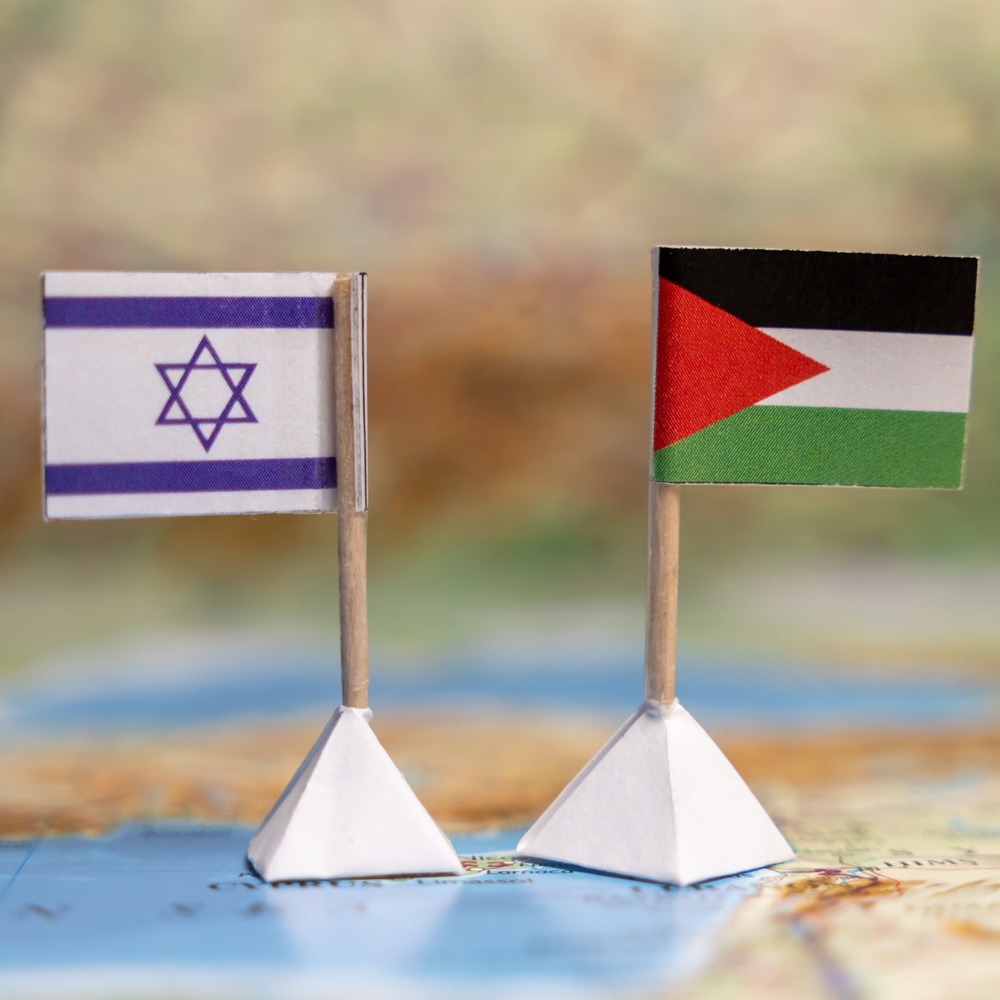
Flag of Israel and Palestine on the map. Events in Palestine and Israel. israel flag

Advancing Peace Between Israel and Palestine

by Saliba Sarsar

The Israel-Hamas War has calmed down. The events that preceded it – including the October 7, 2023 Hamas attack against Israel and the taking of Israeli and other hostages – and that resulted from it will be remembered for decades to come, especially the dead and wounded, the trauma and pain, the destruction of dreams and property. If there is any lesson to be learnt, it is that better ways must be found to resolve conflict. There is deep concern now that the West Bank is increasingly reaching a critical point. The weak governing structure of the Palestinian Authority, the contraction of the Palestinian economy, settler violence, and much more are causing serious distress and instability. What is preventing conditions from spiraling out of control are Israel’s strict security measures and Palestinian fear that the West Bank will turn into Gaza, even though both regions are different. Years of diplomatic inertia have been counterproductive. The status quo is untenable. Much is at stake and indecision is costly for all concerned. Why continued conflict? Israelis and Palestinians have become victims of their own exclusive national narratives and are speaking past each other. Many on each side are unable to go beyond their zero-sum mentality. They selectively highlight the rightness of their own cause, accuse the other side of bad intentions or misconduct, and fail to realize how their own rhetoric and acts cause aggravating conditions. While the obstacles in the way of progress to peace are numerous and real – power imbalance between Israel and the Palestinians, one state reality with Israel dominant over the Palestinians, hardening of attitudes in Israel and Palestine, relative weakness of the Israeli and Palestinian peace camps, Israeli settler radicalization, Palestinian anti-normalization stance, terrorism – these must not delay or prevent the search for opportunities and positive outcomes. In this regard, simple facts present themselves. First, Israelis and Palestinians are neighbors forever. Their present and future are intertwined whether they choose this reality or not. Second, the longer Israelis and Palestinians wait to negotiate, the more complicated the issues become and the less room there will be for an agreeable peaceful solution. Third, the core issues that separate Israelis and Palestinians – borders, the separation wall, security, Israeli settlements, Palestinian refugees, Jerusalem, water – are well-known, thoroughly debated, and resolvable. The challenge is to initiate negotiations and negotiate in good faith. Fourth, Israelis and Palestinians have proved to be both incapable and unwilling to restart negotiations on their own. The United States thus must go beyond managing the Israeli-Palestinian conflict to taking the lead to resolve it. It is indispensable for the promotion and sustenance of peace negotiations, as was recently shown in the diplomatic intervention to stop the Israel-Hamas War. Fifth, the inclusion of regional and international actors becomes key as peace requires assurances, follow-up, and support to take root and grow. As Gershon Baskin argues, “Protracted conflicts in which there is little or no trust and confidence require external mechanisms to verify implementation of the agreements, to ensure compliance, and to offer external dispute resolution” (Baskin, 2025). The prerequisites for peacemaking (e.g., context and timing, leadership and political will, societal strength and resilience, process, and content and creativity) are known (Kurtzer, 2020). US diplomacy must be credible, intentional, sustained, and transformative. This comprises not only making peace a priority, but also acting accordingly. The situation on the ground must change. A realistic plan and process of peacemaking must be prioritized. Israelis and Palestinians must be held accountable for their actions and inactions. The vital policies of Arab countries that have signed the Abraham Accords (especially United Arab Emirates, Bahrain, and Morocco) and others that mediated (that is, United States, Egypt, Qatar, and Turkey) or attended the Gaza “peace conference” in October 2025 should impel them to motivate Palestinians to make hard decisions to end conflict and reach a peaceful settlement. Israel needs to reciprocate. Circumventing the Palestinian issue or wishing it away will not advance Israel’s strategic goals, especially in the long run. Initiating unilateral moves and thinking of the Palestinian issue as a security matter only without addressing its political and territorial dimensions will not enhance Israel’s defense. If anything, they will continue to rile the Palestinians, particularly the youth among them. The two-state solution, the official United States policy since 2002, has become increasingly less viable. This is at a time when 157 out of 193 Member States of the United Nations have already recognized the State of Palestine. On July 28-30, 2025, a High-level International Conference for the Peaceful Settlement of the Question of Palestine and the Implementation of the Two-State Solution was held at the United Nations. The conference, co-chaired by France and Saudi Arabia, committed “not only to reaffirm international consensus on the peaceful settlement of the question of Palestine but [also] to catalyze concrete, timebound and coordinated international action toward the implementation of the two-state solution” (United Nations, 2025a). Follow-up work took place on September 22, and the commitment was made to continue the implementation of the conference’s outcomes. The US’s plan (Trump, 2025) to demilitarize the Gaza Strip and to reconstruct it for the benefit of its inhabitants is a good start, and the plan’s “Phase 2” was even endorsed by United Nations Security Council Resolution 2803 on November 17, 2025 (United Nations, 2025b). However, resolving all aspects of the Gaza issue will take years. Meantime, it is essential for the US to take a leading role in endorsing again the two-state solution, as it is in the best national interest of Israel, Palestine, and the US. Moreover, the US can facilitate the solution by urging Israel and the Palestinians to seriously consider the idea of confederation, which adjusts or introduces important modifications to the two-state solution. While there have been more than a dozen confederation models over the years – with some specific only to Israel and Palestine and others that encompass Jordan as well – a main goal of confederation, according to the proponents of the Holy Land Confederation (me included), is not to totally separate the Palestinians from the Israelis living in the Holy Land, i.e., “divorce,” but to empower them to “cohabitate” in the two respective sovereign states (Holy Land Confederation, 2025). This cohabitation would allow for greater cooperation and movement between them. “If properly implemented, confederation would enable Palestinians to advance their search for freedom, independence, and statehood without being anti-Israel, and it would enable Israelis to have their security and wellbeing without being anti-Palestinian” (Beilin and Sarsar, 2022). The Gaza crisis must be solved. However, the deadlock in Israeli-Palestinian relations must be broken as well. If past negotiations are any indication, there is middle ground between the positions of Israel and Palestine. The US possesses the vital capabilities to move both parties to take the necessary political risks by compromising and engaging in unavoidable tradeoffs on the path to peace. References - Baskin, Gershon. (2025) “Monitoring agreements and verifying implementation.” October 18, https://gershonbaskin.substack.com/p/monitoring-agreements-and-verifying. - Beilin, Yossi and Sarsar, Saliba. (2022) “Israeli-Palestinian confederation is a way forward for peace.” The Jerusalem Post, February 17, https://www.jpost.com/opinion/article-696830. - Holy Land Confederation. (2025) “The Holy Land Confederation as a Facilitator for the Two-State Solution.” Institute for Cultural Diplomacy, https://www.culturaldiplomacy.org/index.php?en_hlc. - Kurtzer, Daniel C. (2020) “The Ingredients of Palestinian-Israeli Peacemaking.” Journal of South Asian and Middle Eastern Studies, Vol. 43, No. 3 (Spring): 5-16. - Trump, Donald J. [@RapidResponse47]. (2025, September 29). “President Donald J. Trump’s Comprehensive Plan to End the Gaza Conflict.” X. https://x.com/RapidResponse47/status/1972726021196562494. - United Nations. (2025a) “High-level International Conference for the Peaceful Settlement of the Question of Palestine and the Implementation of the Two-State Solution,” July 28-30, https://www.un.org/unispal/high-level-conference-two-state-solution-july2025/. - United Nations. (2025b) United Nations Security Council, November 17, https://docs.un.org/en/s/res/2803(2025).

Diplomacy
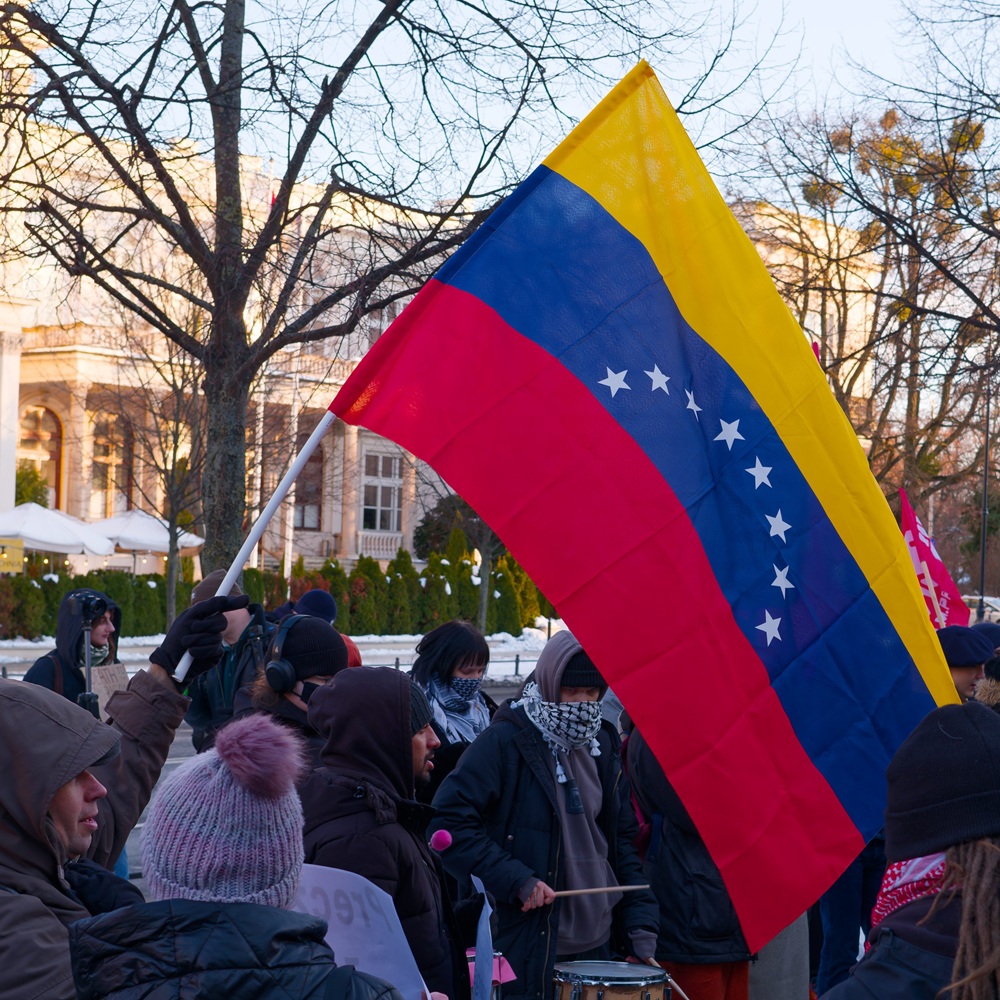
Warsaw, Poland - January 04 2026: Venezuelan flag waved during protest against U.S. intervention in Venezuela.

Venezuela at a Critical Juncture (Part II): The Capture of Maduro and the Debate over Sovereignty, Intervention, and Power

by World & New World Journal

In Part I of this article, a brief historical overview was presented, spanning from the Venezuelan presidential crisis of 2019 to the tensions in the Caribbean — between the United States and Venezuela — and the total economic blockade imposed on Venezuela. The article also left several questions open, which, considering recent events, have now been resolved, although at the same time new ones have emerged. U.S. Operation in Venezuela and the Capture of Maduro The situation between the United States and Venezuela ended in 2025 with a total U.S. economic blockade and the “seizure” of a Venezuelan oil tanker. However, the situation changed dramatically when, on January 3, 2026, Nicolás Maduro was captured in Caracas by U.S. forces. Preceded by threats and sustained military and economic pressure on Venezuela, the President of the United States, Donald Trump, carried out an operation to capture and remove Maduro and his wife from Venezuela. The operation was surgical — lasting approximately two hours — and although successful, it also resulted in human losses (80 fatalities according to The New York Times — an unofficial figure — including 32 Cuban combatants confirmed by Havana) and damage to military infrastructure in Caracas, as well as in Miranda, Aragua, and La Guaira. As was already known, the U.S. government had classified Maduro as a member or leader of the Cartel of the Suns. In addition, a reward of $50,000 had been offered for his capture, and since 2020 the U.S. Attorney’s Office for the Southern District of New York had charged Maduro with drug trafficking and conspiracy to import cocaine into the United States. In this context, Maduro’s capture was followed by his transfer to New York, where he will face trial. Venezuela: an uncertain present? Following Maduro’s detention, Venezuela’s Supreme Tribunal of Justice ordered Vice President Delcy Rodríguez to assume the role of head of state due to Maduro’s “temporary” absence. After the U.S. attacks, Rodríguez spoke out strongly against what she called “foreign aggression,” describing Maduro’s capture as an “illegal and illegitimate kidnapping.” However, after being sworn in, she softened the tone of her statements and even invited the Trump administration to “work jointly on an agenda of cooperation, aimed at shared development, within the framework of international legality and to strengthen a lasting community coexistence.” Rodríguez likewise emphasized the principles of sovereignty and non-interference. All of this stems from the imperialist rhetoric of Trump and Rubio. Trump made it very clear that he will “govern” Venezuela “until we can achieve a safe, appropriate, and prudent transition.” Everything indicates that, although under the threat of “doing the right thing,” Trump plans to give Rodríguez an opportunity; if it does not work or if she fails to meet Trump’s expectations, the United States will intervene again. On the other hand, both Edmundo González — who on January 4 released a video declaring himself the “president of Venezuela” and calling for a “peaceful and clear” transition — and María Corina Machado have been practically sidelined by the U.S. government, citing a lack of internal support, referring to the fact that those who support them are “outside” Venezuela. On the social front, reactions have been mixed, ranging from celebrations over Maduro’s capture to demonstrations against U.S. interventionism. The current situation is very delicate: with Rodríguez’s appointment and no clear short-term roadmap — plus the threat of U.S. intervention and interference — and the snubbing of the opposition, Venezuela’s social reality appears not to have changed, nor is it likely to change much in the near future. However, Rodríguez’s stance — her invitation to the United States to work together, albeit under threat, practically placing oil and resources on a silver platter — could become the social fuel capable of generating real change in Venezuela in the near future. International reactions The events in Venezuela took many by surprise, and international reactions were quick to follow. South Africa issued a press release stating that the actions of the United States constituted “a violation of the United Nations Charter,” and called on the UN Security Council to urgently address the situation. Indonesia also underscored the importance of “respect for international law and the principles of the United Nations Charter.” Similar statements were issued by Japan, India, South Korea, Malaysia, Pakistan, Thailand, Vietnam, New Zealand, and Australia. China’s Ministry of Foreign Affairs likewise emphasized the violation of “Venezuelan sovereignty and the threat posed to peace and security in Latin America and the Caribbean.” It also called for the release of Maduro and his wife. With a stronger tone, Iran condemned the U.S. attacks and likewise appealed to the United Nations. In a very similar vein, North Korea’s Ministry of Foreign Affairs also condemned the U.S. attack, denouncing acts of U.S. hegemony and calling on the international community to recognize the “catastrophic” situation in Venezuela and to denounce the United States’ “habitual acts of violating the sovereignty of other countries.” On the other hand, Israel’s Minister of Foreign Affairs, Gideon Sa’ar, posted on X: “Israel praises the United States operation, led by President Trump. […] Israel stands with the freedom-loving Venezuelan people, who have suffered under Maduro’s illegal tyranny. Israel celebrates the removal of the dictator […].” Prime Minister Benjamin Netanyahu stated that Israel supported the actions of the United States in Venezuela. In Europe, most countries supported the decision behind the actions of the United States, underscoring the illegitimacy of Maduro’s government and the importance of de-escalation and dialogue, always within the framework of international law. When asked about Maduro, Ukrainian President Volodymyr Zelensky responded that the United States “knows what to do now,” referring to dictators. Other countries such as Norway, Serbia, Slovenia, and Spain also expanded their criticism of the U.S. military operation, arguing that it was not in accordance with international law. On the opposite end of the spectrum, Belarus and Russia, in varying tones, condemned the U.S. attacks, describing them as “direct threats” to international peace and security. For his part, Slovak Prime Minister Robert Fico strongly criticized U.S. actions and the UN, emphasizing that “international law is not applied, military force is used without the consent of the UN Security Council, and whoever is big and powerful will do whatever serves their interests…” In the Americas, Mexico condemned and rejected the U.S. military intervention and urged the United States to adhere to international law. Honduras did the same, describing the capture of Maduro as an act of kidnapping. Cuba condemned the “criminal act,” calling it “state terrorism against the brave Venezuelan people and against our America.” Nicaragua also condemned the U.S. intervention and expressed its support for Delcy Rodríguez. Argentine President Javier Milei posted, “Freedom advances, long live freedom, damn it!” celebrating the capture of Maduro and his wife. In Bolivia, Rodrigo Paz also referred to freedom, stating that “the only way out for Venezuela is respect for the vote.” Ecuadorian President Daniel Noboa stated that “for all narco-Chavista criminals, their time has come. Their structure on the continent will completely collapse.” Paraguay and Peru also celebrated Maduro’s removal. In contrast, Brazilian President Luiz Inácio Lula da Silva condemned the attacks and Maduro’s capture, describing them as “very serious […] and extremely dangerous as precedents for the international community.” Chilean President Gabriel Boric also criticized the attacks and called for a peaceful resolution under international law, while President-elect Antonio Kast said that Maduro’s capture “is good news for the region.” Colombian President Gustavo Petro also rejected the “aggression against the sovereignty of Venezuela and Latin America,” while calling for a meeting at the UN and the OAS. Finally, Uruguay’s Ministry of Foreign Affairs also condemned the U.S. intervention in Venezuela and called for respect for the UN Charter. The UN, the OAS, and the EU also issued statements, using more cautious rhetoric and emphasizing respect for international law. The Don-roe Doctrine and the future of Venezuela In Part I of the article, Venezuela’s significance in terms of oil, biodiversity, water resources, rare earths, and more was presented. Based on this, and as mentioned earlier, the attack on alleged drug boats and the fight against drug trafficking became a pretext to promote the new Donald Trump–Monroe Doctrine, the “Don-roe Doctrine / Monroe Doctrine 2.0.” In December 2025, the United States published its new National Security Strategy, which emphasizes and promotes the United States as the sole actor or hegemon in the Americas, making any foreign presence outside of the United States unwelcome. The results of the application of this doctrine were immediate — and there is more. It is not only Venezuela: the Trump administration — particularly Secretary of State Marco Rubio — has already set its sights on Cuba, in addition to repeatedly raising the possibility of carrying out military activities against drug trafficking in Mexico and Colombia, and more recently, engaging in a dispute with Denmark over strategically important Greenland. Discussion The implications for Venezuela stemming from these events are profound. First, there is a crisis of legitimacy: although Delcy Rodríguez has assumed the presidency, Edmundo González has also raised his voice, leading to both internal and external questioning. Likewise, there are institutional challenges. In the end, only the head of the regime was removed; Maduro’s inner circle remains in power. Therefore, regardless of the change at the top, a transition toward a more democratic or stable system appears distant given the current conditions. This is independent of the existing social discontent — once again, the regime retains control, making a drastic change unlikely in the near term. Regarding the U.S. side, the Trump administration has been clear — and consistent with its foreign policy — in always prioritizing its national interests over those of any other country. The example is clear: by acting unilaterally and without adherence to international law, the United States has once again undermined the sovereignty of a state. The U.S. government could justify its actions in legal terms — Maduro is accused in the United States of drug trafficking and conspiracy — on health and security grounds — the Venezuelan regime facilitates drug trafficking into the United States — or even on geopolitical grounds — weakening an administration perceived as allied with rival powers and holding interests contrary to those of the United States. However, the validity of these arguments must be examined. Moreover, as Robert Fico pointed out, there was an absence of authorization from the UN Security Council or even from the U.S. Congress itself, which, for experts in the field, renders the operation legally unlawful. Ultimately, the debate remains open. Countries’ positions are divided, and, more importantly, this could become a dangerous precedent for national sovereignty and for the conduct of great powers toward independent states. There are also the potential consequences for the region: the act alters the balance of power in Latin America and redefines the narrative surrounding U.S. influence in the region. On the other hand, there is oil and what its control represents as a long-term strategic factor. Finally, there is the global tension over control and influence in regions — one in which Russia and China are far from pleased. Finally, Fico’s statements and the following quote from Mexican lawyer José Mario de la Garza are worth analyzing in order to understand the importance of international law and why we must live in a rules-based world — even if several reforms may be needed to improve it: “Overthrowing a dictator sounds morally right. No one mourns a tyrant. But international law was not built to protect the good, but to restrain the powerful. That is why it prohibits the use of force almost without exception: not because it ignores justice, but because it knows that if every country decides whom to ‘liberate’ at gunpoint, the world returns to the law of the strongest.” References @josemariodelagarza. (04 de January de 2026). @josemariodelagarza. Obtenido de Instagram: https://www.instagram.com/p/DTDmcSNgPmK/?hl=en&img_index=1 Caro, I. (05 de January de 2026). "Vengo con dolor, pero también con honor": Delcy Rodríguez juramenta como presidenta encargada de Venezuela tras la captura de Maduro. Obtenido de BBC News: https://www.bbc.com/mundo/articles/cd9exjjkvw8o Holcman, T. (05 de January de 2026). Maduro's rival in Venezuelan elections demands presidency, 'freedom to all political prisoners'. Obtenido de The Jerusalem Post: https://www.jpost.com/international/article-882323 Lozano, D. (05 de January de 2026). Delcy Rodríguez jura como presidenta de Venezuela "por Maduro y por Chávez". Obtenido de El Mundo: https://www.elmundo.es/internacional/2026/01/05/695be102fc6c8323518b45a0.html Muggah, R. (03 de January de 2026). 5 scenarios for a post-Maduro Venezuela — and what they could signal to the wider region. Obtenido de The Conversation: https://theconversation.com/5-scenarios-for-a-post-maduro-venezuela-and-what-they-could-signal-to-the-wider-region-272675 Página 12. (06 de Enero de 2026). Aseguran que son más de 80 los muertos tras el ataque de Estados Unidos a Venezuela. Obtenido de Página 12: https://www.pagina12.com.ar/2026/01/05/aseguran-que-son-mas-de-80-los-muertos-tras-el-ataque-de-estados-unidos-a-venezuela/ Reuters. (04 de January de 2026). Trump says U.S. will run Venezuela after U.S. captures Maduro. Obtenido de Reuters: https://www.reuters.com/world/americas/loud-noises-heard-venezuela-capital-southern-area-without-electricity-2026-01-03/ Urrejola, J. (06 de January de 2026). Venezuela tras Maduro: por qué el chavismo sigue en el poder. Obtenido de DW: https://www.dw.com/es/venezuela-tras-maduro-por-qu%C3%A9-el-chavismo-sigue-en-el-poder/a-75400562 Walia, G. (03 de January de 2026). Venezuela's President Nicholas Maduro captured by US forces: Where has he been taken? What we know so far. Obtenido de The Economic Times: https://economictimes.indiatimes.com/news/international/us/venezuelas-president-nicholas-maduro-captured-by-us-forces-where-has-he-been-taken-what-we-know-so-far-caracas/articleshow/126321249.cms?from=mdr "South Africa urges UN Security Council Session following unilateral military action in Venezuela" (Press release). Pretoria, South Africa: Department of International Relations and Cooperation. 3 January 2026. Archived from the original on 4 January 2026. Retrieved 4 January 2026. "Dirco slams US efforts to 'run' Venezuela". TimesLIVE. 3 January 2026. Retrieved 4 January 2026 "Foreign Ministry Spokesperson's Remarks on the U.S. Military Strikes on Venezuela" (Press release). Chinese Ministry of Foreign Affairs. 3 January 2026. Archived from the original on 4 January 2026. Retrieved 4 January 2026. "World reacts to US strikes on Venezuela". Reuters. 3 January 2026. Archived from the original on 3 January 2026. Retrieved 4 January 2026. 'Matter of deep concern': MEA reacts to US strikes on Venezuela; urges restraint, calls for dialogue". The Times of India. 4 January 2026. Retrieved 4 January 2026. "Iran strongly condemns US attack on Venezuela". Iran International. 3 January 2026. Archived from the original on 4 January 2026. Retrieved 4 January 2026. "Iran Condemns U.S. Attack on Venezuela". Foreign Policy. West Asia News Agency. 3 January 2026. Archived from the original on 3 January 2026. Retrieved 4 January 2026. Halpern, Sam (3 January 2026). "Israel commends US operation that led to capture of Venezuela's Maduro". The Jerusalem Post. Sa'ar, Gideon [@gidonsaar] (4 January 2026). "Israel commends the United States' operation, led by President Trump, which acted as the leader of the free world. At this historic moment, Israel stands alongside the freedom-loving Venezuelan people, who have suffered under Maduro's illegal tyranny. Israel welcomes the removal of the dictator who led a network of drugs and terror and hopes for the return of democracy to the country and for friendly relations between the states. The people of Venezuela deserve to exercise their democratic rights. South America deserves a future free from the axis of terror and drugs" (Tweet). Retrieved 4 January 2026 – via Twitter. "Netanyahu says Israel supports 'strong' US action in Venezuela". Al Arabiya English. 4 January 2026. Retrieved 4 January 2026. Sokolin, Anton (4 January 2026). "North Korea condemns the U.S.' military intervention in Venezuela". NK News. Retrieved 4 January 2026. "North Korea sends tough message to US after Venezuela attack, fires multiple ballistic missiles". Wion. Retrieved 4 January 2026. "Malaysia stands firm on UN principles, opposes foreign intervention in Venezuela". Malay Mail. 4 January 2026. Retrieved 4 January 2026. "Pakistan urges restraint, peaceful resolution in Venezuela". The Express Tribune. 4 January 2026. Retrieved 4 January 2026. "Thailand urges US to settle conflict with Venezuela peacefully". Bangkok Post. 4 January 2026. Retrieved 4 January 2026 "Vietnam deeply concerned about reports on situation in Venezuela: spokesperson". Vietnamlawmagazine.vn. 4 January 2026. Retrieved 5 January 2026. "Venezuela latest: Trump says US is going to 'run' Venezuela after capturing President Maduro". BBC News. 3 January 2026. "World reactions to US operation in Venezuela". Le Monde. 3 January 2026 "Sviluppi sulla situazione in Venezuela, nota di Palazzo Chigi". www.governo.it (in Italian). 3 January 2026. Retrieved 3 January 2026. "Statement from Minister Eide on the Situation in Venezuela". Ministry of Foreign Affairs (Norway). 3 January 2026. Retrieved 3 January 2026. "Russia Condemns U.S. Military Strikes Against Venezuela". The Moscow Times. 3 January 2025. Retrieved 3 January 2025. Vlasova, Svitlana; Stockwell, Billy (3 January 2026). "Russia reaffirms solidarity with Venezuela after "act of armed aggression" by US, calls for dialogue". CNN. Retrieved 4 January 2026. "Вучић: После акције у Венецуели јасно је да међународни правни поредак не функционише; сачуваћемо мир али својом снагом". Radio-Television of Serbia. 4 January 2025. Retrieved 4 January 2025. "Slovakian Prime Minister Fico condemns US attack". Yahoo News. 3 January 2026. Retrieved 4 January 2026. Fico, Robert (3 January 2026). "STATEMENT BY THE PRIME MINISTER OF THE SLOVAK REPUBLIC". Facebook (in Slovak). Archived from the original on 4 January 2026. Retrieved 4 January 2026. "Spain will not recognize US intervention in Venezuela, PM says". Reuters. 3 January 2026. Retrieved 3 January 2026. "Zelenskyy reacts to US operation in Venezuela and hints at Putin". RBC-Ukraine. 4 January 2025. "Starmer won't be drawn on whether US strikes on Venezuela broke international law". BBC News. 3 January 2026. "Cuba's president denounces strikes on Venezuela as a "criminal attack by the U.S."". CBS News. 3 January 2026. Retrieved 3 January 2026. Alvarez, Carolina (3 January 2026). "Honduran President condemns US "military aggression" and "kidnapping" of Nicolás Maduro". De Último Minuto. Retrieved 4 January 2026. "Mexico Says Venezuela Strikes Breach U.N. Charter, International Law". The Wall Street Journal. 3 January 2026. Retrieved 3 January 2026. "Gobierno de Nicaragua exige liberación de Nicolás Maduro y defiende soberanía de Venezuela". SwissInfo. 1 March 2026. Retrieved 4 January 2026. Godsell, Oscar (3 January 2026). "Prime Minister Anthony Albanese responds to US President Donald Trump's attack on Venezuela". Sky News. Retrieved 3 January 2026. "Venezuela attack: New Zealand 'concerned', expects everyone to follow international law – Winston Peters". RNZ. 4 January 2026. Archived from the original on 4 January 2026. Retrieved 4 January 2026. Romero, Juan (3 January 2026). "Intervención militar en Venezuela: así reaccionaron en América Latina a la operación militar de EE.UU. para extraer a Maduro y su mujer". Fobes (in Spanish). Retrieved 3 January 2026. "Rodrigo Paz dice que «salida para Venezuela es respetar el voto», tras captura de Maduro". SwissInfo. 5 January 2026. Retrieved 1 March 2026. Durães, Marina (3 January 2026). "Lula diz que ataques à Venezuela e prisão de Maduro são 'inaceitáveis'". UOL. Retrieved 3 January 2026 "World reacts to US bombing of Venezuela, 'capture' of Maduro". Al Jazeera. 3 January 2026. Retrieved 3 January 2026 "Kast califica la detención de Maduro como "una gran noticia para la región"". Diario y Radio Universidad Chile (in Spanish). 3 January 2026. Retrieved 3 January 2026. Taylor, Harry; Rogero, Tiago (3 January 2026). "Global outcry after US launches strikes on Venezuela and captures president". The Guardian. ISSN 0261-3077. Retrieved 3 January 2026. Pannell, Alfie; Glade, Jim. "Colombia braces with alarm after Maduro's removal in Venezuela by US". Al Jazeera. Retrieved 3 January 2026 Quilca Catacora, Mariana (3 January 2026). "José Jerí se pronuncia tras captura de Maduro y situación de venezolanos en Perú: "Daremos las facilidades para su regreso"". infobae (in European Spanish). Retrieved 3 January 2026. "Uruguay rechazó la intervención militar en Venezuela y llamo a buscar una "solución positiva"" [Uruguay rejected military intervention in Venezuela and called for a "positive solution".]. Ámbito Financiero (in Spanish). 3 January 2026. Retrieved 3 January 2026. "Statement attributable to the Spokesperson for the Secretary-General – on Venezuela | Secretary-General | United Nations". United Nations. 3 January 2026. Retrieved 3 January 2026. "US actions in Venezuela 'constitute a dangerous precedent': Guterres". Peace and Security. United Nations News. 3 January 2026. Archived from the original on 4 January 2026. Retrieved 4 January 2026 "Statement by OAS Secretary General Albert R. Ramdin on recent developments in Venezuela". Press Release E-001/26. Organization of American States. 3 January 2026. Hayden, Jones (3 January 2026). "EU urges respect for international law after US capture of Maduro". POLITICO. Retrieved 3 January 2026.

Defense & Security
Soldier in engineering role uses AI application on laptop to manage server hub systems. Army commander reviews secret intelligence information using artificial intelligence in data center, camera A

Dual-Use AI Technologies in Defense: Strategic Implications and Security Risks

by Mayukh Dey

Introduction Artificial intelligence has become a critical technology in the 21st century, with applications spanning healthcare, commerce, and scientific research. However, the same algorithms that enable medical diagnostics can guide autonomous weapons, and the same machine learning systems that power recommendation engines can identify military targets. This dual-use nature, where technologies developed for civilian purposes can be repurposed for military applications, has positioned AI as a central element in evolving global security dynamics. The strategic implications are substantial. China views AI as essential for military modernization, with the People's Liberation Army planning to deploy "algorithmic warfare" and "network-centric warfare" capabilities by 2030 (Department of Defense, 2024). Concurrently, military conflicts in Ukraine and Gaza have demonstrated the operational deployment of AI-driven targeting systems. As nations allocate significant resources to military AI development, a critical question emerges: whether the security benefits of dual-use AI technologies can be realized without generating severe humanitarian consequences. The Reversal Commercial Innovation Driving Military Modernization Historically, military research and development drove technological innovation, with civilian applications emerging as secondary benefits, a phenomenon termed "spin-off." The internet, GPS, and microwave ovens all originated in defense laboratories. This dynamic has reversed. Commercially developed technologies now increasingly "spin into" the defense sector, with militaries dependent on technologies initially developed for commercial markets. This reversal carries significant implications for global security. Unlike the Cold War era, when the United States and Soviet Union controlled nuclear weapons development through state programs, AI innovation occurs primarily in private sector companies, technology firms, and university research institutions. Organizations like DARPA influence global emerging technology development, with their projects often establishing benchmarks for research and development efforts worldwide (Defense Advanced Research Projects Agency, 2024). This diffusion of technological capacity complicates traditional arms control frameworks based on state-controlled military production. The scale of investment is considerable. The U.S. Department of Defense's unclassified AI investments increased from approximately $600 million in 2016 to about $1.8 billion in 2024, with more than 685 active AI projects underway (Defense One, 2024). China's spending may exceed this figure, though exact data remains unavailable due to the opacity of Chinese defense budgeting. Europe is pursuing comparable investments, with the EU committing €1.5 billion to defense-related research and development through initiatives like the European Defence Fund. Dual-Use Applications in Contemporary Warfare AI's military applications span the spectrum of warfare, from strategic planning to tactical execution. Current deployments include: Intelligence, Surveillance, and Reconnaissance (ISR): AI systems process large volumes of sensor data, satellite imagery, and signals intelligence to identify patterns beyond human analytical capacity. In 2024, "China's commercial and academic AI sectors made progress on large language models (LLMs) and LLM-based reasoning models, which has narrowed the performance gap between China's models and the U.S. models currently leading the field," enabling more sophisticated intelligence analysis (Department of Defense, 2024). Autonomous Weapons Systems: Autonomous weapons can identify, track, and engage targets with minimal human oversight. In the Russia-Ukraine war, drones now account for approximately 70-80% of battlefield casualties (Center for Strategic and International Studies, 2025). Ukrainian officials predicted that AI-operated first person view drones could achieve hit rates of around 80%, compared to 30-50% for manually piloted systems (Reuters, 2024). Predictive Maintenance and Logistics: The U.S. Air Force employs AI in its Condition-Based Maintenance Plus program for F-35 fighters, analyzing sensor data to predict system failures before occurrence, reducing downtime and operational costs. Command and Control: AI assists military commanders in processing battlefield information and evaluating options at speeds exceeding human capacity. Project Convergence integrates AI, advanced networking, sensors, and automation across all warfare domains (land, air, sea, cyber, and space) to enable synchronized, real-time decision-making. Cyber Operations: AI powers both offensive and defensive cyber capabilities, from automated vulnerability discovery to malware detection and sophisticated social engineering campaigns. Gaza and Ukraine: AI in Contemporary Conflict Recent conflicts have provided operational demonstrations of AI's military applications and associated humanitarian costs. Israel's Lavender system reportedly identified up to 37,000 potential Hamas-linked targets, with sources claiming error rates near 10 percent (972 Magazine, 2024). An Israeli intelligence officer stated that "the IDF bombed targets in homes without hesitation, as a first option. It's much easier to bomb a family's home" (972 Magazine, 2024). The system accelerated airstrikes but also contributed to civilian casualties, raising questions about algorithmic accountability. The system's design involved explicit tradeoffs: prioritizing speed and scale over accuracy. According to sources interviewed by 972 Magazine, the army authorized the killing of up to 15 or 20 civilians for every junior Hamas operative that Lavender marked, while in some cases more than 100 civilians were authorized to be killed to assassinate a single senior commander (972 Magazine, 2024). Foundation models trained on commercial data lack the reasoning capacity humans possess, yet when applied to military targeting, false positives result in civilian deaths. Data sourced from WhatsApp metadata, Google Photos, and other commercial platforms created targeting profiles based on patterns that may not correspond to combatant status. Ukraine has implemented different approaches, using AI to coordinate drone swarms and enhance defensive capabilities against a numerically superior adversary. Ukrainian Deputy Defense Minister Kateryna Chernohorenko stated that "there are currently several dozen solutions on the market from Ukrainian manufacturers" for AI-augmented drone systems being delivered to armed forces (Reuters, 2024). Ukraine produced approximately 2 million drones in 2024, with AI-enabled systems achieving engagement success rates of 70 to 80 percent compared to 10 to 20 percent for manually controlled drones (Center for Strategic and International Studies, 2025). Both sides in the conflict have developed AI-powered targeting systems, creating operational arms race dynamics with immediate battlefield consequences. Civilian Harm: Technical and Legal Limitarions The integration of AI into lethal military systems raises humanitarian concerns extending beyond technical reliability. AI's inability to uphold the principle of distinction, which requires protecting civilians by distinguishing them from combatants in compliance with international humanitarian law, presents fundamental challenges. Current AI systems lack several capabilities essential for legal warfare:  Contextual Understanding: AI cannot comprehend the complex social, cultural, and situational factors that determine combatant status. A person carrying a weapon might be a combatant, a civilian defending their home, or a shepherd protecting livestock.  Proportionality Assessments: International humanitarian law requires that military attacks not cause disproportionate civilian damage. Human Rights Watch noted that it is doubtful whether robotic systems can make such nuanced assessments (Human Rights Watch, 2024).  Moral Judgment: Machines lack the capacity for compassion, mercy, or understanding of human dignity, qualities that have historically provided safeguards against wartime atrocities.  Accountability: With autonomous weapon systems, responsibility is distributed among programmers, manufacturers, and operators, making individual accountability difficult to establish. As one expert observed, "when AI, machine learning and human reasoning form a tight ecosystem, the capacity for human control is limited. Humans have a tendency to trust whatever computers say, especially when they move too fast for us to follow" (The Conversation, 2024). The risks extend to specific populations. Autonomous weapons systems trained on data predominantly consisting of male combatants in historical records could create algorithmic bias. In the case of Lavender, analysis suggests "one of the key equations was 'male equals militant,'" echoing the Obama administration's approach during drone warfare operations (The Conversation, 2024). Communities of color and Muslim populations face heightened risks given historical patterns of discriminatory force deployment. Export Controls and Technology Transfer Challenges Recognizing AI's strategic importance, governments have implemented export control regimes. The U.S. Bureau of Industry and Security now requires licenses for exports of advanced computing chips and AI model weights, imposing security conditions to safeguard storage of the most advanced models. These controls face inherent tensions. Overly broad restrictions risk hampering legitimate research and commercial innovation. Analysis suggests that if AI technology is too extensively controlled, American universities may face difficulties performing AI research, resulting in a less robust U.S. AI ecosystem. Insufficient controls enable adversaries to acquire cutting-edge capabilities. The effectiveness of export controls remains uncertain. In 2024, hundreds of thousands of chips, totaling millions of dollars, were smuggled into China through shell companies, varying distributors, and mislabeling techniques (Oxford Analytica, 2025). China's DeepSeek models, which achieved performance approaching U.S. systems, were reportedly trained on chips that circumvented export restrictions. International Governance: Fragmentation and Competing Frameworks The international community has struggled to develop coherent governance frameworks for dual-use AI. Rather than a cohesive global regulatory approach, what has emerged is a collection of national policies, multilateral agreements, high-level summits, declarations, frameworks, and voluntary commitments. Multiple international forums have addressed AI governance: ● The UN Secretary-General created an AI Advisory Board and called for a legally binding treaty to prohibit lethal autonomous weapons systems without human control, to be concluded by 2026 ● The Group of Governmental Experts on Lethal Autonomous Weapons Systems has held discussions under the Convention on Certain Conventional Weapons since 2013, with limited concrete progress ● NATO released a revised AI strategy in 2024, establishing standards for responsible use and accelerated adoption in military operations ● The EU's AI Act, adopted in 2023, explicitly excludes military applications and national security from its scope This fragmented landscape reflects geopolitical divisions. The perceived centrality of AI for competition has led the U.S. to position itself as leader of ideologically aligned countries in opposition to China, including for security purposes. China promotes its own governance vision through initiatives like the Belt and Road, exporting technology standards alongside infrastructure. Strategic Stability Implications AI creates strategic stability challenges. Autonomous weapons enable substitution of machines for human soldiers in many battlefield roles, reducing the human cost and thus political cost of waging offensive war. This could increase the frequency of conflicts between peer adversaries, each believing they can prevail without significant domestic casualties. For conflicts between non-peer adversaries, reduced casualties further diminish domestic opposition to wars of aggression. The implications extend beyond conventional warfare. Armed, fully-autonomous drone swarms could combine mass harm with lack of human control, potentially becoming weapons of mass destruction comparable to low-scale nuclear devices. The technical barriers to such systems are declining as components become commercially available. AI also complicates nuclear stability. Advances in AI-enhanced sensors and data processing could undermine second-strike capabilities by improving detection of mobile missile launchers and submarines. This erosion of assured retaliation could incentivize first strikes during crises. Simultaneously, AI systems managing nuclear command and control create risks of accidents, miscalculations, or unauthorized launches. Ethical Framework Limitations The integration of AI into warfare strains traditional ethical frameworks. Just War Theory requires that combatants maintain moral responsibility for their actions, possess the capacity to distinguish combatants from civilians, and apply proportionate force. Automation bias and technological mediation weaken moral agency among operators of AI-enabled targeting systems, diminishing their capacity for ethical decision-making. When operators interact with targeting through screens displaying algorithmic recommendations rather than direct observation, psychological distance increases. This mediation risks transforming killing into a bureaucratic process. The operator becomes less a moral agent making decisions and more a technician approving or rejecting algorithmic suggestions. Furthermore, industry dynamics, particularly venture capital funding, shape discourses surrounding military AI, influencing perceptions of responsible AI use in warfare. When commercial incentives align with military applications, the boundaries between responsible innovation and reckless proliferation become unclear. Companies developing AI for civilian markets face pressure to expand into defense contracting, often with insufficient ethical deliberation. Conclusion Dual-use AI technologies present both opportunities and risks for international security. One trajectory leads toward normalized algorithmic warfare at scale, arms races in autonomous weapons that erode strategic stability, and inadequate international governance resulting in civilian harm. An alternative trajectory involves international cooperation that constrains the most dangerous applications while permitting beneficial uses. The timeframe for establishing governance frameworks is limited. AI capabilities are advancing rapidly, and widespread proliferation of autonomous weapons will make policy reversal substantially more difficult. The challenge resembles nuclear non-proliferation but unfolds at greater speed, driven by commercial incentives rather than state-controlled programs. Because AI is a dual-use technology, technical advances can provide economic and security benefits. This reality means unilateral restraint by democratic nations would cede advantages to authoritarian competitors. However, uncontrolled competition risks adverse outcomes for all parties. Concrete action is required from multiple actors. States must strengthen multilateral agreements through forums like the UN Convention on Certain Conventional Weapons to establish binding restrictions on autonomous weapons without meaningful human control. NATO and regional security alliances should harmonize AI ethics standards and create verification mechanisms for military AI deployments. Military institutions must implement mandatory human-in-the-loop requirements for lethal autonomous systems and establish clear chains of accountability for AI-driven targeting decisions. Technology companies developing dual-use AI systems bear responsibility for implementing ethical safeguards and conducting thorough threat modeling before commercial release. Industry alliances should establish transparency standards for military AI applications and create independent audit mechanisms. Universities and research institutions must integrate AI ethics and international humanitarian law into technical training programs. Export control regimes require coordination between the United States, EU, and allied nations to prevent regulatory arbitrage while avoiding overreach that stifles legitimate research. Democratic governments should lead by demonstrating that military AI can be developed within strict ethical and legal constraints, setting standards that distinguish legitimate security applications from destabilizing weapons proliferation. As Austrian Foreign Minister Alexander Schallenberg observed, this represents the Oppenheimer moment of the current generation, recognizing that dual-use AI, like nuclear weapons, represents a technology whose military applications demand collective restraint. The policy choices made in the next few years will have long-term consequences. They will determine whether AI becomes a tool for human advancement or an instrument of algorithmic warfare. The technology exists; the policy framework remains to be established. The actors are identified; the question is whether they possess the political will to act before proliferation becomes irreversible. References 972 Magazine (2024) 'Lavender': The AI machine directing Israel's bombing spree in Gaza. https://www.972mag.com/lavender-ai-israeli-army-gaza/ Center for Strategic and International Studies (2024) Where the Chips Fall: U.S. Export Controls Under the Biden Administration from 2022 to 2024. https://www.csis.org/analysis/where-chips-fall-us-export-controls-under-biden-administration-2022-2024 Center for Strategic and International Studies (2025) Ukraine's Future Vision and Current Capabilities for Waging AI-Enabled Autonomous Warfare. https://www.csis.org/analysis/ukraines-future-vision-and-current-capabilities-waging-ai-enabled-autonomous-warfare Defense One (2023) The Pentagon's 2024 Budget Proposal, In Short. https://www.defenseone.com/policy/2023/03/heres-everything-we-know-about-pentagons-2024-budget-proposal/383892/ Department of Defense (2024) Military and Security Developments Involving the People's Republic of China 2024. https://media.defense.gov/2024/Dec/18/2003615520/-1/-1/0/MILITARY-AND-SECURITY-DEVELOPMENTS-INVOLVING-THE-PEOPLES-REPUBLIC-OF-CHINA-2024.PDF Foreign Policy Research Institute (2024) Breaking the Circuit: US-China Semiconductor Controls. https://www.fpri.org/article/2024/09/breaking-the-circuit-us-china-semiconductor-controls/ Human Rights Watch (2024) A Hazard to Human Rights: Autonomous Weapons Systems and Digital Decision-Making. https://www.hrw.org/report/2025/04/28/a-hazard-to-human-rights/autonomous-weapons-systems-and-digital-decision-making National Defense Magazine (2024) Pentagon Sorting Out AI's Future in Warfare. https://www.nationaldefensemagazine.org/articles/2024/10/22/pentagon-sorting-out-ais-future-in-warfare Queen Mary University of London (2024) Gaza war: Israel using AI to identify human targets raising fears that innocents are being caught in the net. https://www.qmul.ac.uk/media/news/2024/hss/gaza-war-israel-using-ai-to-identify-human-targets-raising-fears-that-innocents-are-being-caught-in-the-net.html Reuters (2024) Ukraine rolls out dozens of AI systems to help its drones hit targets. https://euromaidanpress.com/2024/10/31/reuters-ukraine-rolls-out-dozens-of-ai-systems-to-help-its-drones-hit-targets/

Defense & Security
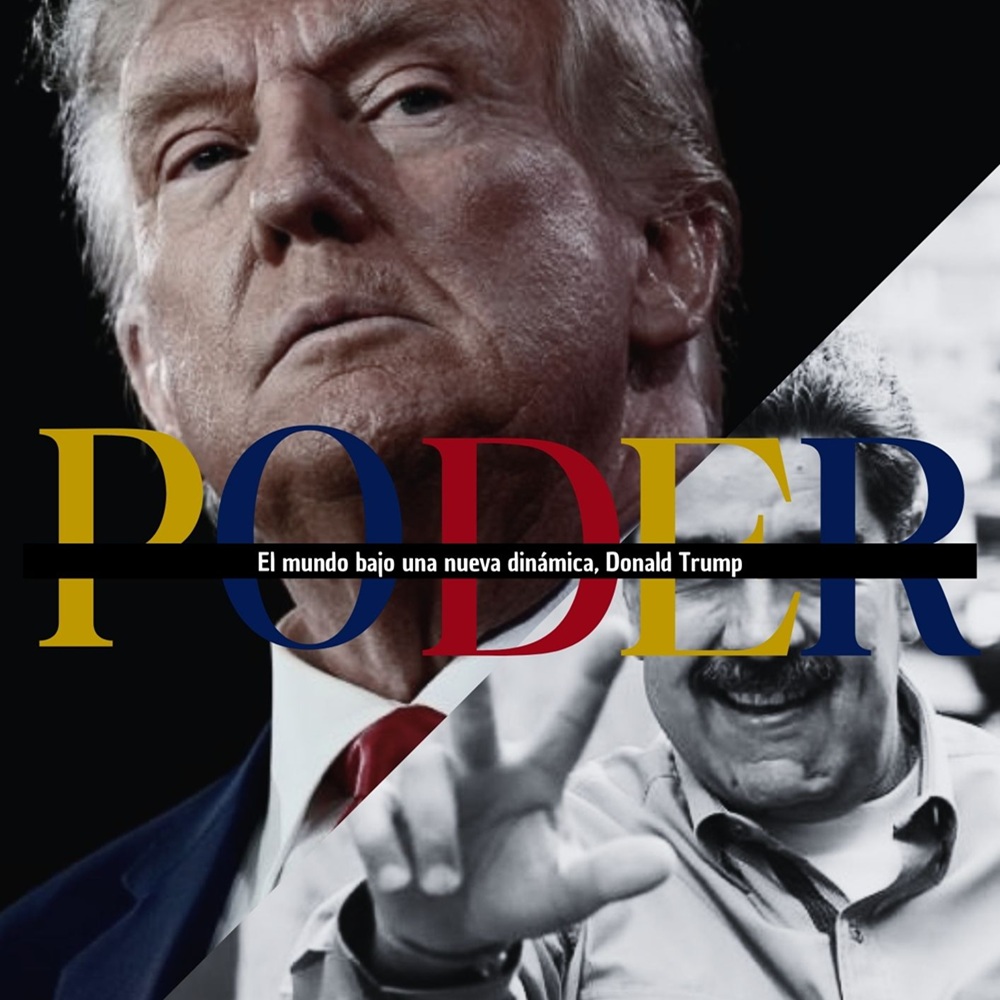
la palabra PODER destacada con el fondo de Trump y Maduro. Imagen del autor.

The New Constitution of Power: The World Under the Dynamics of Donald Trump

by Máximo Gonzalez Cabañas

On January 3, 2026, in a surgical operation in the early hours of the morning, just days after the New Year celebrations, the Delta Force special unit successfully carried out a raid capturing Nicolás Maduro, who had held power uninterruptedly for 13 years. The first images showed him aboard the USS Iwo Jima, being taken to the courts in New York to finally face trial — a scene that, along with the operation itself, will provide Hollywood with material for years to come. We are left to wait and see how long the sentence will take. Beyond the immediate event, the message and worldview it conveys for the rest of the world are far broader and more significant. What happened can be read in multiple ways, beyond the basic explanations of oil, resources, or the threat to the United States. Reality is much more complex, full of twists and intersections that enrich the events. We have an opportunity to see beyond the obvious, to reflect on things even the protagonists themselves may not fully understand. This event invites us, like few others, to reflect on one of the central axes of humanity: power. How is it understood now? How is it interpreted? Is power something one possesses, demonstrates, or enacts? Or perhaps all of the above? We can debate not only these questions but also the legality of Maduro’s overthrow, yet it is also true: what else could have been done? This is where the issue of power comes into play — not only through the act of detention itself, but through the operation designed to remove it. However, underlying this is a fragile topic: the institutions themselves, their weaknesses, and whether they will ever fulfill their function, if they even have one. Both Venezuela and the United States have become central actors in international anarchy, yet the latter, in exercising its power, raises the question of why, while the former is left with the uncertainty of what. Beyond them, one must ask: what happens with the rest? How is the global geopolitical board now positioned? How does this influence other actors, and how does it affect us? Each aspect could merit an in-depth analysis, but the aim of this piece is to open these questions for discussion. To go beyond what happened, to invite thought and debate, and not to let ourselves be swayed by media narratives that seek to extinguish the most human thing we have: our voice. The Trump Corollary: Power and the New Paradigm. U.S. Decisions, “The Why.” Since the end of the First World War, and with greater emphasis after the Second, the United States consolidated its global image not only as a great power but as a defender of democratic ideals. During the Cold War, it dispersed its forces to contain the Soviet Union while always ensuring what once again resonates strongly today: the American hemisphere. Years after that bipolar confrontation, the world shows new arrangements. There is no longer direct rivalry with a single power, but the unipolar dominance of the United States seems to have given way. Are we facing a multipolar reality? Do actors have true autonomy in the continuum of political decisions? It is difficult to answer definitively, but the fact is that the capture of Maduro completely changes these perceptions. It is no secret that Venezuela was a historic target sought after by Donald Trump. Ever since he was first president, he tried through various means to remove Maduro; however, now he has succeeded with a shrewdness and forcefulness he lacked in his prior four years. From this arises the first questions for analysis: Why now? Why Venezuela? The speed of the operation is surprising. It is not just the audacity of the command, but the authority with which it was carried out: without calls for interrogation, freely using the instruments of power at Trump’s disposal. The interpretation centered on oil is the most obvious: the president himself does not hide that between 30 and 50 million barrels will be transported to the U.S. But the background is more complex. Facing weak economic foundations in his administration, volatility with the Federal Reserve, and the spectacular failure of his tariff policy against China, Trump needed a show of authority. In his early days in charge, Donald Trump began threatening various countries with tariff increases until April 2, 2025, the so called “Day of Liberation,” on which he announced dozens of taxes. Whether to negotiate or actually implement them, this proved to be a spectacular failure, far from what Trump believed. Not only did he have to renegotiate most of them without securing concessions or beneficial agreements for the United States — with some simply maintaining the status quo — but his main “rival,” China, ended the year in a stronger position. This made two things clear: commercially, China is at least very difficult to match, and Trump lost authority. This authority — or, more precisely, negotiation power and credibility — was lost on the ground and under the rules of agreements and dynamics we believed would prevail from the American side. What Trump did in Venezuela not only enhances his figure and empowers him, but also shows that his comments on social media (the new form of political communication) are serious. He left both allies and enemies in uncertainty: those who believed in his decline because of tariff issues and those who counted on them, because in order to exercise power, he can go beyond what was thought to be “fantastical” or “crazy.” The warnings to Colombia and its president, Gustavo Petro — who, knowing his position of weakness, has already communicated with the White House — as well as to Mexico — where a ground operation against cartels has already been announced and whose president, Sheinbaum, according to Trump, is worried — or Cuba make this evident. But even more striking is his obsession with Greenland: without directly attacking NATO, he frames it as a matter of hemispheric security. All of this is part of the new dynamic imposed by Trump; the one people fear is him and his persona, positioning himself as the figure that even Russia or China watches closely, understanding that, beyond commerce, they have little real influence in the hemisphere. Trump’s ambition for power blossomed at the beginning of this year, and we do not know if it will end. Ignoring Africa, keeping the Middle East and Europe in view, and knowing that beyond Japan or South Korea there is little he can do, he elevates the American continent. In fact, he speaks of a new Monroe Doctrine, rebranded as the “Donroe,” making clear the question of power: how he exercises it and how he now uses it to construct his own narrative. The “why” behind this desire will likely remain unknown; beyond the good of the United States, we are entering a new reality of leaders who place themselves above all else, like Putin in Russia and Xi Jinping in China: figures who shape the board to their liking. Perhaps the reason is more human than we think, perhaps the most human fear: death. From being a successful businessman to becoming president, in his latest term he seeks to leave a mark in history and thus ensure that he does not “die” in a spiritual sense. Or perhaps it is a unilateral decision made at random; the truth only he will know. It cannot be ignored that this is his last term, and in addition to criticism, he is already experiencing electoral setbacks, as in New York, where Zohran Mamdani of the Democratic Party won as mayor, representing a clear challenge to his use of power. Even political scientist Andrés Malamud argued that the Republican base rejects foreign interventions, so Trump must justify to them that this action will bring a concrete economic benefit. The internal dynamics seemingly unfolding within the party between J.D. Vance and Marco Rubio — the architect of the operation — also invite reflection on how this move is being positioned. Rubio emerges as a prominent figure, enhancing his stature, drawing a parallel to Kissinger during the Cold War. In his analysis of classical realism, Rubio acts similarly in a different world: seeking to centralize instruments to build that sphere of influence and diversify the tools that become the American directives for countries in the Americas. Completely leaving aside institutions or democratic legality — a topic I will address later — Donald Trump demonstrates how, under the new dynamics and the new multipolar order, the old artifice of power must still be maintained. As if following Machiavelli, this move makes one thing clear: what he does is, and will remain, Power. The Venezuelan “What,” the Drift of the Apeiron: What Remains for the Rest of the Hemisphere? That Maduro was a dictator who perpetuated himself in power through fraudulent actions is a fact. Each person will decide whether he was a good ruler for his people or not; despite cases of corruption or political censorship, making a definitive judgment about his governance inevitably leads to confrontation between those who supported his ideology and those who opposed it. Here, what happened left a vacuum in the Chavista apparatus of the ousted leader. Despite the low standard of living endured by Venezuelans, the reality is that Maduro’s certainty — negative as it was from that perspective — was exactly that: certainty. Delcy Rodríguez, who assumes the presidential role, is a strong figure within Chavismo who has held very important positions within the apparatus and was supposed to constitute a solid axis to confront Donald Trump. Contrary to expectations, she now responds to the U.S. as a partner in the so-called stabilization process, or phase one. An equation that becomes mutually beneficial for both the United States and Rodríguez. For his part, Trump cannot be challenged for directly imposing or controlling Venezuela through any of his men; while it is clear that Caracas now aligns with American interests, aside from Maduro’s removal, the names remain the same: the change occurs in the responsibilities and alignment. Rodríguez herself seeks the same as Trump, but from a subordinate position: power. Here, this new arrangement — or the image projected to the world — is demonstrated once again: that in order to ensure one’s continuity, one is capable of anything, including changing historical positions within a party or reinterpreting theories of betrayal. It is also clear that, in the case of the Venezuelan leader, there are no options, as she is already threatened by Trump with worse consequences. Yet it is evident that the entire apparatus that answered to Maduro complies and collaborates without resistance, at least in practice, to maintain their positions. This image reinforces the idea that there are no values or ideals to uphold — only power to wield. For the people, the worst part remains. From Maduro’s perspective, those who suffered under his rule, while confident that he will face some form of punishment, know that he will not be held accountable for the crimes committed in his own country — or at least not judged for them — but rather for what he did against the United States. This leaves, at least symbolically, a form of penalty — not in legal terms — for the Venezuelan people. The internal situation is also unclear: the apparatus has already begun releasing political prisoners, but it is uncertain how this process will continue. The United States has not issued clear directives for the population, only specifying the concessions that must be made to the nation and how the U.S. will now deal with it and with countries it considers hostile. It remains to be seen whether there will be elections, or whether Edmundo González Urrutia or María Corina Machado will respond to those who declare them winners, despite Trump’s dismissal of them. The return of a clear system is far off, and under the decision and judgment of the United States, the question remains: Does the U.S. truly care about Venezuela and its people, in human and institutional terms? Or do they only respond to material interests, regardless of the power figures involved? There is also an unfinished path in terms of the hemisphere. The Donroe Doctrine no longer guarantees the complete freedom and autonomy of countries within the system; they remain at the mercy of their subservience to the United States, or at least to what the U.S. deems necessary. Events like those in Argentina, where Trump himself claimed that Milei’s legislative victory was thanks to him, or Nasry Asfura in Honduras during the presidential elections, demonstrate that, despite minor gestures, the President of the United States is beginning to pull the strings across the Americas. This shift — or turn — toward the right in the Americas is perhaps less a change in mindset than a product of dependency and the condition of being tied to the United States. Countries like Brazil are the main exception: through their links with other multipolar actors (China, Russia, India, as part of BRICS), they secure at least some autonomy and maneuverability in this process of change. Even with unresolved issues like Cuba or the dictatorship in Nicaragua, there remain theoretical aspects of the Donroe Doctrine to clarify: Who does it apply to? Under what cases? What distinguishes it from its predecessor? What can be said with certainty is that the doctrine fluctuates and evolves according to Trump’s decisions, which may be designed to prepare for a confrontation with other global actors, justifying why the Americas do not ally with China and remain aligned with the United States, creating unity under a single mandate and exercising that power. What remains to be seen are the consequences of Trump’s Greenland issue, which sooner or later will become his next international victory. Tensions with Denmark are already difficult to manage, and Europe is unlikely to oppose U.S. decisions. Trump has stated that he will not dismantle NATO by any means, but considers the lack of control over the island a national security risk. With little economic or resource potential, the issue is more symbolic, as previously discussed: the Donroe Doctrine, national security, and Trump’s ambitions, in addition to the strictly geopolitical concerns and the strategic position it would provide in a confrontation with China or Russia. As the latter is the goal closest to the top of the president’s agenda, time will reveal how events unfold. What is certain is that every aspect, which could be analyzed from a particular lens, is conditioned by Trump — by his logic, perspective, and desires — demonstrating the exercise of his power. The International Conception: From the Periphery to the Power From an international perspective, and positioned on the periphery, what best aligns with the world ahead is what Argentine political scientist Carlos Escudé described with his concept of peripheral realism. The parallels with this theory are clear: we see states that set the rules — in this case, the United States for our hemisphere, but also China within its sphere; states that follow the rules, such as countries that align due to Trump’s influence and end up gravitating toward Washington; and rebellious states, like Venezuela, which paid the price. Faced with the new logics introduced by the U.S. president, Escudé provides a theoretical framework to understand the behavior of countries. He shows how we can, even without full freedom (if Latin America ever truly had it), use our autonomy and take advantage of what a great power can offer. Avoiding confrontations and maintaining “close relations” allows us, even under the oversight of being in their hemisphere, to make progress. Accepting our role as a peripheral actor serves as a starting point to build more domestically than internationally, understanding that we lack sufficient autonomy to set new rules of the game. American scholar John Mearsheimer also offers insight into Trump’s stance, which, together with Escudé’s perspective, clarifies the reasoning behind these events in the system’s anarchy. Mearsheimer’s offensive realism makes it clear that Trump’s proposals on national security and hemispheric defense align with the idea that states only seek security, and the only way to achieve it is by having more power than others. This frames Trump’s logic within the dynamics of a multipolar world. The goal pursued by the United States is the same as Mearsheimer describes: to be the regional hegemon. Uncertainty about what other actors can do represents a threat; therefore, security through power is fundamental, and this power is unlimited: the more, the better. These theories, framed within a realist perspective, define the current international system and will likely describe events to come while the Trump administration is in charge and exercising hard power. Soft power actions, while important in various areas, are set aside, as they cannot match what is gained through the use of hard power. While these situations could be analyzed through other lenses, this analysis is centered on the axis of power. How Trump is handling it creates a scenario that, far from idealism, forces us to operate within realist frameworks. This moves us away from idealized global perspectives and confirms that the system, anarchic as always, functions through power relations — and it is precisely these that the President of the United States is targeting. The Meaning of Institutions and the Anticipatory Future Finally, without going into detail — since the topic itself would warrant a full analysis —the role of institutions, both international and democratic, deserves at least a mention. Not only because they form the foundations of what we know as society, but also to reflect on their functionality and effectiveness: are they truly necessary? Should they be modified? On the international side, it is clear that they seem outdated. UN meetings often function merely as spaces for presentations or speeches that lack real results. From its flawed composition to its limited capacity for action, one would not expect years to pass before resolving situations like the recent case in Venezuela. The United States has withdrawn from 66 UN bodies; other countries that do not participate raise the same question: what is the UN really for? Does it need restructuring? How? One might accuse Trump of violating international law regarding the legality of his action, but what can really be said? He addressed a problem in his own way, defending his nation against offenses related to drug trafficking. Which organization could realistically sanction the United States for this move when the UN itself cannot provide solutions to even larger problems? The legality of the act is debatable, but no resolution could realistically be reached; once again, we are left to consider how decisions might be made without producing confrontations in the legal realm, which, rightly or wrongly, operate within the territory of power. Other bodies, such as MERCOSUR — which recently approved its agreement with the European Union after 25 years — demonstrate that essential or basic issues can take decades to resolve. The fragility of NATO regarding Greenland further shows that even in defense organizations, rules are unclear; naturally, interests collide, which has even contributed to conflicts like that between Russia and Ukraine. What remains for these institutions in terms of power and organization if their own interpreters override them? Democracy is also called into question: how can Trump transgress the institutional legal procedures of his country to achieve his goals? Various world leaders celebrate such violations — like Emmanuel Macron, President of France — while supporting Paul Biya’s regime in Cameroon. So, what is truly being defended? What constitutes a dictatorship? What represents a breach of democracy? Rather than speaking strictly of democracy, we could refer to the concept of polyarchy, introduced by American political scientist Robert Dahl. However, even with democracy as an ideal, its meaning loses moral or practical weight when we see that major actions must occur outside institutional channels, and support shifts depending on each actor’s geopolitical convenience. Discussing democracy and international organizations invites broader analyses and alternative proposals, which must go beyond the specific case of Venezuela. But it is worth mentioning them, because they form part of the daily workings of power; although power can override them, these institutions are supposed to act as brakes, yet they lack solid foundations and rely on tools that are themselves imperfect. On the international level, we are left to rethink the role of institutions: do they genuinely act as participants in the system, or are they merely observers with minimal influence? The unfolding of events will show how they develop under the new logics of a multipolar world and how the geopolitical board is configured. Are we witnessing a new paradigm? Should this be understood as an isolated case, or merely as the result of Trump’s actions? Surely Xi Jinping and Vladimir Putin also have their national security ambitions. Outcomes like the conflict in Russia and Ukraine, Middle East tensions, and the fragile or developing institutions in Africa are the key areas to monitor this year. What happened in Venezuela demonstrates that international affairs affect us closely; we are not far removed from these events and must attempt to understand them. The new dynamics of power present different scenarios, which we may never fully know, but one thing is clear: despite everything, history and decisions are ultimately grounded in a single reality —power.

Defense & Security
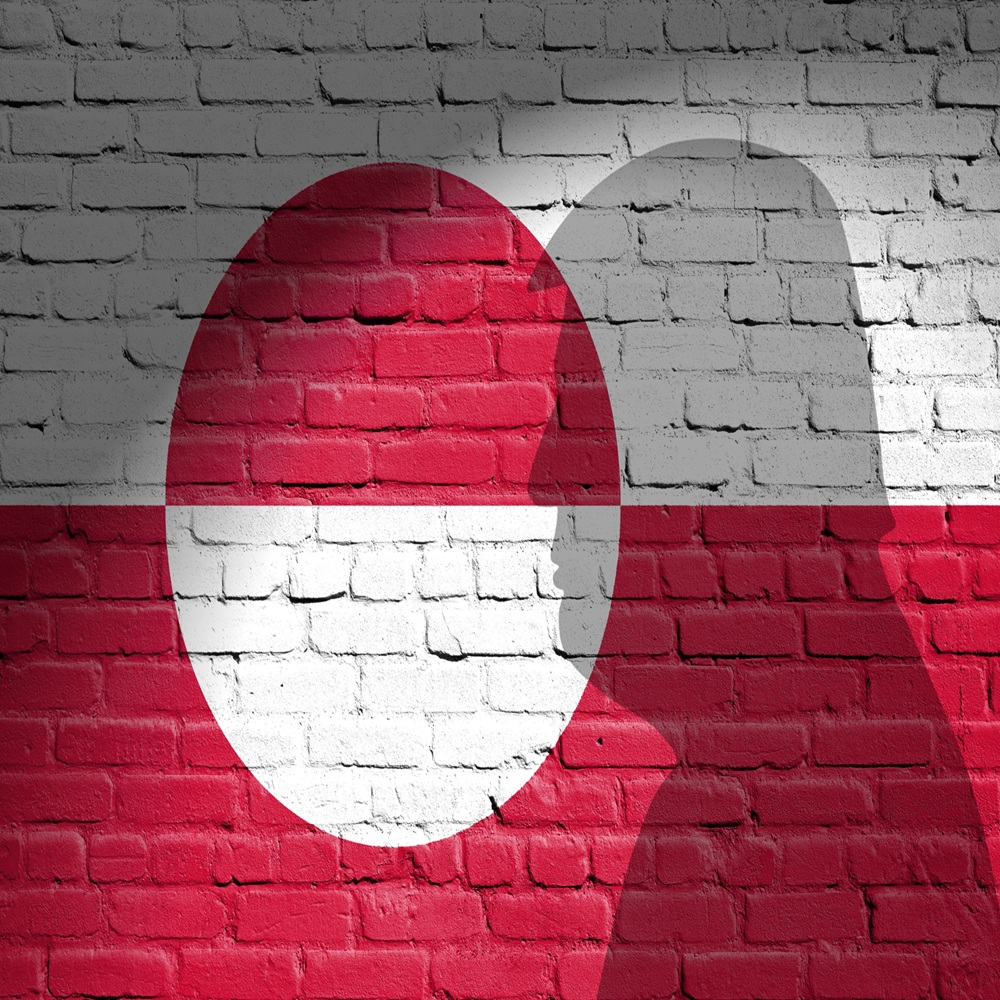
Flag of Greenland painted on the brick wall

Trump wants Greenland. Europe’s tepid response is putting NATO and global security at risk

by Shannon Brincat , Juan Zahir Naranjo Cáceres

Europe stands at a precipice. Following the US military operation in Venezuela, President Donald Trump and his close advisers have reiterated that Greenland – currently an autonomous territory of Denmark – will be next. “We need Greenland from the standpoint of national security, and Denmark is not going to be able to do it,” Trump told reporters this week. “Let’s talk about Greenland in 20 days.” The threat is not mere hyperbole. Trump has appointed Louisiana Governor Jeff Landry, who publicly supports US annexation, as special envoy to Greenland. And Katie Miller, wife of top Trump adviser Stephen Miller, recently posted an image of Greenland in US flag colours with the caption “SOON”. These are not random provocations but coordinated pressure tactics against a sovereign territory. Greenland’s Prime Minister Jens-Frederik Nielsen responded by saying “That’s enough now. No more pressure. No more insinuations. No more fantasies of annexation.” Danish leaders have warned a US attack on Greenland would signal “the end of NATO” and of post-second world war security. Threats against NATO members (such as Denmark) could also embolden Russia even more and lead to more uncertainty for Europe. So why are European leaders not more forcefully calling out Trump’s threats against Greenland – as well as his government’s shocking intervention in Venezuela? And what’s at stake? Europe’s weak response NATO’s Article 5 commits members to treat an attack on one as an attack on all. If the US were to attack Greenland, Denmark would expect NATO’s collective defence mechanisms to activate against the US. European leaders have been forced to confront a reality they hoped to avoid: the US, NATO’s founding member, may become the alliance’s gravest threat. But so far, the response across the continent to both the Greenland threats and the US’ actions in Venezuela has been feeble and confused. British Prime Minister Keir Starmer admitted he wanted to speak to President Trump before he condemned the attacks, epitomizing Europe’s subordination. A letter signed by the Danish prime minister and the leaders of France, Germany, Spain, the UK, Italy, and Poland, has affirmed only Greenland and Denmark should determine Greenland’s future. The European Union has pledged to defend members’ territorial integrity. But they didn’t articulate any solid counter-threat to Trump’s comments about Greenland. They could, for instance, have reiterated their long-term partnership, the potential collapse of the biggest alliance in human history, or the costs in losing cooperation (both economic and security) with Europe that directly benefits the US. And such vague declarations about Greenland ring hollow when the same governments hesitate to condemn US violations of international law in Venezuela. German Chancellor Friedrich Merz said the “legal classification of the US intervention [in Venezuela] is complex” and that Germany needed time to consider this. Such equivocation on the most basic, foundational concept of international law not only signals incredible weakness. It also undermines Europe’s credibility when invoking the “rules-based order” against Russia and its actions in Ukraine, making it near impossible to mobilise Global South support, sustain sanctions coalitions, or claim principled restraint. When European leaders respond so cautiously to the Venezuela operation – stressing respect for international law while avoiding direct criticism of Washington – their principles are exposed as highly selective. Russia benefits Russia understands this dynamic perfectly. Moscow has already characterised US actions as “armed aggression” while pointing to Western hypocrisy. Moscow benefits from this in fundamental ways. First, Western hypocrisy validates Russia’s narrative that international law is merely a tool the powerful use against the weak. The vacillation on condemning US action in Venezuela or threats against fellow NATO members contradicts the European narrative against Putin’s war. Second, NATO’s potential collapse or paralysis would hand Moscow a strategic victory that Russian military power alone has been unable to secure. If the United States annexes Greenland, Denmark would face an existential choice: accept the violation and remain in a compromised NATO or leave an alliance that no longer protects its members. All other members would face the same choice. The NATO alliance cannot function if its members no longer share fundamental values about sovereignty and law. Trump has forced Europe to confront whether it will defend these principles universally or accept a world where might makes right. Appeasement all over again? This moment recalls Europe’s crisis of the Munich agreement. In 1938, Britain and France sacrificed Czechoslovakia’s sovereignty to appease Nazi Germany, excluding Prague from negotiations over its future while negotiating away its territory. Only later would the democratic powers discover that appeasing aggression – however politically convenient at the time – would only invite yet more aggression. Today, Europe faces a parallel dilemma: how to respond when its most powerful ally directly threatens an EU and NATO member state. Europe is edging toward another Munich agreement moment, with concessions dressed up as stability and peace a euphemism for appeasement. The events in the coming weeks will largely determine the very future of Europe. The continent faces a choice between political expediency or rules-based international order built on the prohibition of aggressive war, respect for sovereignty, and collective security. Will its leaders be prepared to confront their own hypocrisy or timidly accept the erosion of the rules they claim to defend?

Diplomacy
Presidente de la República, Gabriel Boric Font, asiste a la asunción del Presidente de Bolivia, Rodrigo Paz. Gobierno de Chile, CC BY 3.0 CL <https://creativecommons.org/licenses/by/3.0/cl/deed.en>, via Wikimedia Commons. Dirección de Prensa, Presidencia

From MAS to Reopening: Bolivia, International Relations, and Economic Prospects

by World & New World Journal

Bolivia, an Andean country, historically battered by economic, social, and political tensions, has experienced one of its most decisive moments in recent decades. The victory of Rodrigo Paz, the Christian Democratic Party candidate, has brought an end to a political cycle lasting nearly 20 years, initiated by Evo Morales, which resulted in the hegemony of the Movement for Socialism (MAS). Paz's victory has not only changed Bolivia's course but also opens a new phase, signaling a clear shift to the right, a rearrangement of its international relations, and a rethinking of its foreign policy in a volatile American context. The Decline of MAS and the Rise of Paz To understand the magnitude of this change, it is necessary to look back. Since Evo Morales came to power in 2006, MAS consolidated itself as the dominant force in Bolivia, promoting a nationalist, statist agenda and strong state intervention in strategic sectors such as hydrocarbons and natural resources. Furthermore, during the MAS period, an anti-imperialist discourse marked Bolivia's foreign policy. In this tone, Bolivia aligned itself with left-wing governments in Latin America, notably Venezuela, Cuba, and Nicaragua, within the ALBA framework, and distanced itself significantly from Washington. However, after two decades in power, internal divisions and power struggles within MAS caused deep wear within the party and its supporters. Bolivia's economy faced its worst crisis in decades: a recession marked by a decline in gas production — a key source of fiscal income and exports for the country — high inflation levels, and a shortage of foreign currency that limited the functioning of the state apparatus. Faced with this scenario, and with a frustrated citizenry over economic and social management, the Bolivian electorate opted for a radical change in October 2025. Rodrigo Paz, a centrist politician with a pragmatic message, secured a surprising 54.5% of the votes in the second round, ultimately defeating rival candidate Jorge Quiroga, marking the end of almost two decades of MAS governments. Although Paz was considered a less significant candidate by polls and analysts, he comes from a more orthodox and moderate political tradition, and his rhetoric has been seemingly conciliatory toward social sectors. His father, Jaime Paz Zamora, was president of the country, and Paz has a solid political career, making him no stranger to the responsibilities of leadership. His campaign slogan, loosely translated as "capitalism for all," aimed to inspire some economic openness while still addressing the social demands traditionally favored by MAS. A Shift to the Right... but with Nuances Although it is referred to as a “shift to the right,” Bolivia’s reality is not monolithic. It could be more accurately described as a shift toward a pragmatic center-right, seeking to balance economic openness with the protection of certain social programs. MAS was defeated not so much due to a complete rejection of its ideological proposals, but because of an economic crisis that weakened and divided its political base and its dominant discourse. This nuance is key. Paz's victory was not solely due to a traditional conservative vote but also to the mobilization of sectors disillusioned by MAS's unmet promises. In this sense, his proposal positioned itself as a hybrid fusion: a moderate economic liberalization, while maintaining a minimal social protection network. However, although MAS has become an almost irrelevant opposition — receiving very low support and reduced to a symbolic presence in the first round — Paz's new government inherits a fragmented internal political landscape, which will require negotiating alliances with various legislative blocs in order to govern. Relations with Neighbors: Rebuilding What Had Been Dismantled Bolivia's foreign policy over the past two decades was marked by its alignment with left-wing governments and regional movements such as ALBA, which included Venezuela, Cuba, Nicaragua, and other governments with anti-U.S. or at least skeptical stances toward Washington. Under Evo Morales, Bolivia strengthened ties with China, Iran, and Russia, diversifying alliances outside of the traditional Western bloc. With Paz’s victory, this framework seems to have been dismantled. The president-elect has been explicit in not inviting leaders from Cuba, Venezuela, or Nicaragua to his presidential inauguration, citing differences concerning democracy and governance. This gesture, although symbolic, signals a shift in foreign policy: moving away from pre-configured ideological positions and prioritizing relations based on democratic criteria and economic cooperation. Bolivia’s exit from the ALBA bloc and its suspension by the organization for “anti-Bolivarian and pro-imperialist behavior” reflects the diplomatic impact of this shift. Furthermore, the presence of leaders such as Javier Milei, president of Argentina, at Paz's inauguration ceremony consolidated Latin American representations more aligned with free-market economic policies and oriented toward cooperation with the United States and Europe. Another relevant factor is the relationship with traditional South American neighbors such as Brazil, Argentina, and Chile. Although political orientation may vary regionally, there is consensus on the need to strengthen trade and cooperation in infrastructure and energy, especially considering Bolivia’s economic challenges. Paz himself mentioned that Bolivia’s “cooperation” with its “five borders” — Argentina, Brazil, Chile, Paraguay, and Peru — “will be essential” for his new administration. He has even already held meetings and encounters with Boric (Chile), Milei (Argentina), and Noboa (Ecuador). The Relaunch of Relations with the United States Perhaps the most symbolic and geopolitically significant element of Bolivia's new direction is the resumption of relations with the United States. Bilateral relations had been fractured since the expulsion of the U.S. ambassador in 2008 under Evo Morales’ presidency, following years of tensions over mutual accusations of interference and conspiracy. Paz's announcement to restore diplomatic ties and reopen the U.S. embassy in La Paz represents a drastic shift in approach. This reopening not only restores formal political dialogue but also opens opportunities for cooperation in trade, investment, and security — especially at a time when Bolivia faces currency problems, a fiscal deficit, and a fuel shortage. In addition, the United States and several Latin American countries issued a joint statement of support for Paz after the elections, emphasizing the willingness to collaborate in stabilizing the economy, strengthening democratic institutions, and boosting international investment. This relaunch is not without political conditions. Cooperation could focus on the fight against drug trafficking, corruption, and other transnational challenges, areas in which Washington has shown strategic interest. The involvement of agencies like the DEA and other security organizations could intensify once again. The DEA issue has been controversial, with both former presidents Evo Morales and Luis Arce expressing concerns, as they consider both the DEA and U.S. cooperation agencies to be conspirators, something the White House has always denied. The openness to cooperation with the United States may also have a tangible economic component: investment flows, access to international financing, and support for macroeconomic stabilization. Given the foreign currency crisis that has suffocated Bolivia, these relations could translate into crucial financial relief. The Stance on Venezuela and the New Regional Context Another geopolitical axis that has changed drastically with the rise of Paz is his stance on Venezuela and its political crisis. Under the MAS, Bolivia historically maintained close ties with Nicolás Maduro’s regime, aligning itself with anti-imperialist rhetoric and supporting governments considered ideological allies. However, Paz has adopted a critical stance toward the Venezuelan government, especially after recent events — including the capture of Maduro by U.S. forces in January 2026. In his public statements, the Bolivian president has emphasized that the way out for Venezuela is to "respect the vote and democracy," positioning Bolivia alongside a narrative of democracy and institutionalism that contrasts with the country’s previous alignment with Chavismo. This approach places Bolivia on the opposite side of traditional left-wing governments in the region, such as Brazil under Luiz Inácio Lula da Silva, Gustavo Petro in Colombia, or Mexico under Claudia Sheinbaum, who have condemned the U.S. military intervention in Venezuela and called for peaceful solutions based on international law. In contrast, Paz has preferred to emphasize the importance of democracy as the guiding principle of Bolivia's foreign policy. The invitation to Venezuelan opposition leader María Corina Machado to the Bolivian inauguration also underscores this renewed focus on democracy and human rights, marking a clear break with La Paz's previous political ties to Caracas. Economic Implications and Future Prospects The new Bolivian phase faces enormous economic challenges. The transition to a more market-oriented model and the opportunities to attract foreign investment offer prospects for recovery, but they are not without risks. The country is dealing with high inflation, fuel shortages, a fiscal crisis, and an urgent need for foreign currency. In this context, the opening to the United States and international markets could boost key sectors like lithium, where Bolivia holds some of the world’s largest reserves. Bolivia's mining sector could also benefit from the country's opening. Cooperation with external investors, including Americans and European allies, could transform Bolivia’s productive capacity and position it as a strategic player in the global critical minerals supply chain. In fact, recently, the Inter-American Development Bank (IDB) visited Bolivia, and with a message to the nation, Paz announced “[…] 7 billion dollars for infrastructure works, employment, and labor, which we need so much in Bolivia.” At the same time, Paz’s government will need to carefully manage internal tensions. Social sectors traditionally aligned with MAS may feel displaced or fear the loss of social assistance programs, posing challenges for internal cohesion — a critical issue is the elimination of fuel subsidies. On the other hand, although the legislative situation is not as complicated, the need to form legislative alliances and engage in political dialogue will be crucial to avoid institutional conflicts that could weaken his ability to implement necessary economic reforms. Conclusion Rodrigo Paz’s victory not only symbolizes the end of MAS's dominance after nearly two decades, but it also represents a profound reconfiguration of Bolivia’s political, economic, and diplomatic course. This new chapter is characterized by pragmatism focused on the economy, a shift towards strategic relations with the United States and other Western partners, and a stance based on defending democracy in the face of regional crises such as the Venezuelan one. However, this path is not without internal tensions and structural challenges that could determine whether Bolivia manages to consolidate a sustainable development model or if social and political fractures reappear on the horizon. The country's contemporary history, in this sense, continues to be written with the uncertainty of whether this pragmatic center-right experiment will be a definitive solution or a prelude to new turns in the future. From a broader geopolitical perspective, Bolivia finds itself on a new hemispheric stage where the competition between the United States and China, as well as tensions between right-wing and left-wing governments in the region, shape the agenda. Paz's election can be seen as part of a broader trend in Latin America towards governments that prioritize macroeconomic stability, diplomatic pragmatism, and international cooperation beyond rigid ideological alignments.

Defense & Security
A boxing match between the USA and Cuba

Donroe Doctrine: The risk of Military Intervention in Cuba, Mexico, and Beyond

by World & New World Journal

The Foreign Policy of the United States in Latin America continues to be influenced by a doctrine that, although formulated in the 19th century, still resonates in the geopolitical dynamics of the 21st century, albeit with a Trump-style update. This adaptation of Trump to the Monroe Doctrine — hereinafter the Trump Corollary to the Monroe Doctrine or simply the Donroe Doctrine — while maintaining its origin, now describes the perception of the second Trump administration's desire to reaffirm U.S. dominance in the Western Hemisphere, specifically in the Americas, not only against European intervention — as it was originally — but against any power that is neither the United States nor native to the region. These ideas were captured in the new U.S. National Security Strategy of 2025. Since its formulation, this principle has been reinterpreted and used to justify military interventions and actions in Latin America, often under the premise of defending "democracy" or confronting the threat of regimes considered authoritarian or ideological enemies. In this context, recent events — the surgical military operation and subsequent capture of Maduro in Caracas in January 2026 — demonstrate the relevance of this modern reinterpretation of the Donroe Doctrine. What’s more, it opens the door to new scenarios and tensions with other countries in the region such as Cuba or Mexico. Recent statements about the possibility of military interventions in Cuba and Mexico, along with the reconfiguration of international relations in countries like Colombia, highlight how geopolitical dynamics in Latin America are influenced by a mix of historical factors and new economic and political realities. The Case of Mexico: The Precariousness of Peace and National Security Mexico, a key actor in Latin America, has been at the center of various international debates due to its proximity to the United States and its role as a regional leader. However, violence and drug trafficking have been chronic problems that have deeply affected the country’s internal security and stability. Since Trump returned to the presidency, he has frequently declared the possibility of U.S. military interventions on Mexican soil, under the pretext of drug trafficking, primarily fentanyl, which enters the United States through its southern border. The rhetoric that has emerged from some political sectors in the United States, particularly from conservative figures, has suggested direct intervention in Mexico to combat drug trafficking and organized crime. These proposals arise in a context of increasing violence related to drug cartels, a rise in murders and kidnappings, and the inability of Mexican security forces to contain this phenomenon. This same rhetoric even claims that Mexico is “governed by narcos,” prompting Trump to mention that “we have to do something” about it, following the Venezuela situation. However, the possibility of foreign military intervention in Mexico raises a series of complex geopolitical questions. Since the signing of the USMCA, Mexico has sought to balance its relations with the United States and has been a close ally, particularly regarding trade and cooperation on security issues. However, the autonomy of its foreign policy and its ability to handle its internal problems have always been central to Mexican diplomacy. Mexican President Claudia Sheinbaum has repeatedly emphasized that Mexico’s sovereignty and independence are non-negotiable and that Mexico “doesn’t need anyone from the outside,” while stressing that the relationship with the United States must be based on collaboration and respect for national sovereignty, not subordination. Her stance is a clear message of rejection for any attempt at foreign military intervention on Mexican soil. Therefore, the possibility of an attack of this nature could have negative repercussions on the international image of the United States, particularly in the context of bilateral cooperation that both countries need to face shared challenges like climate change and migration crises. On a regional level, the possibility of military intervention in Mexico could also have effects on Latin American diplomacy. Countries like Colombia, Brazil, and other members of the Community of Latin American and Caribbean States (CELAC) might view an increase in U.S. intervention in the region with concern. However, in terms of internal security, the debate over the use of force in Mexico is likely to remain more of an internal political issue and a battle against organized crime rather than an event that leads to large-scale armed conflict. The Case of Cuba: The Rebirth of the Cold War? It is well known that relations between Washington and Havana have not been optimal since the victory of the Cuban Revolution in 1959. Although there were rapprochements during the Obama administration (2015), the U.S. embargo and pressure on the island have remained constants in recent years. After the capture of Nicolás Maduro in Venezuela and recent statements about the possibility of direct military intervention — Trump recently refrained from referring to intervention, saying Cuba was "about to fall" — tensions escalated on the island. The accusations against Cuba are related to its support for authoritarian regimes in Latin America and its closeness to actors like Russia and China, as well as a memorandum — signed in June 2025 — to harden U.S. policy towards Cuba, which includes prohibiting direct or indirect financial transactions and reinforcing the ban on tourism to the island, among other economic measures. The Cuban government, led by Miguel Díaz-Canel, has firmly responded to these threats, recalling decades of resistance to the embargo and U.S. regime-change policies. For Cuba, any attempt at military intervention would not only be a violation of its sovereignty but also a return to an era of direct confrontation with the global superpower. From a geopolitical perspective, Cuba remains a stronghold of political influence in the Caribbean, which grants it a key role in regional security. On the other hand, the island also faces a deep economic and energy crisis, leading to a massive exodus of Cubans to the United States and other countries. While Venezuela, like Mexico, has become a major supplier of oil for the Cuban regime, the crisis is so profound that the oil is insufficient. Moreover, Cuba ended 2025 with an annual inflation rate of 14.07%. Finally, the fall of Maduro's regime and the “alignment” of the new government of Delcy Rodríguez — under threat — with the United States is a rather unfavorable scenario for Díaz-Canel’s regime. Maduro's Venezuela provided oil and was an economic source for the Caribbean state. However, it seems that with Venezuela's new alignment, Cuba's prolonged internal economic crisis, and the endless U.S. embargo, it’s only a matter of time before Miguel Díaz-Canel is completely suffocated. Trump himself, via Truth Social, suggested — in his style — that Cuba “reach an agreement before it’s too late.” Hours later, Trump claimed that “he is talking to Cuba.” The Case of Greenland: The Race for Arctic Resources Greenland, a strategic island with abundant mineral resources and critical metals, has also become a global geopolitical focal point. Its location in the Arctic and the opening of new maritime routes due to melting ice make it relevant both for the economy and for international security. The United States has shown particular interest, considering the island a key point for regional surveillance and defense, as well as access to strategic minerals for technology and the energy transition. Following the Donroe Doctrine, President Trump has been explicit in his statements about Greenland, claiming that the United States will do something to "control" the island, "by fair means or foul." Obviously, these statements have raised international alarm and speculation about potential scenarios, ranging from economic and defense cooperation agreements with Denmark and the Greenlandic autonomous government to more direct actions to secure critical infrastructure. This has led to dissatisfaction and concern primarily from Denmark, the European Union, and NATO members themselves, who have even questioned the continuity of NATO. U.S. interest is not new; there have been several attempts of all kinds to take control of the island in the past. However, the current context of growing global competition is worrying, as it is not only the United States; China and Russia are also seeking a presence in the Arctic, though mainly with economic and scientific approaches. Trump's rhetoric reflects how Greenland's strategic resources and geopolitical position have become a point of friction among powers, forcing Denmark and Greenland to reinforce their diplomacy and seek a balance between foreign investment and territorial sovereignty. In this case, diplomacy has been prioritized. Denmark has requested a meeting with Marco Rubio, the U.S. Secretary of State, and both Danish and Greenlandic officials have expressed their rejection of both a purchase and military intervention. It is important to highlight that Greenland has active agreements with the United States regarding national security and mineral extraction, so the meeting with U.S. officials could simply reaffirm and highlight these agreements. However, the argument and "need" or "desire" of Trump for the island will continue to cause concern for the Danes, Greenlanders, and the world in general. The Case of Colombia: De-escalation of Tension and the Future Petro-Trump Meeting The relationship between Colombia and the United States, traditionally one of the strongest alliances in Latin America, entered one of its worst crises in decades with the beginning of Donald Trump's second term. What began as diplomatic tensions over immigration policies and deportations quickly escalated into public accusations, sanctions, and open threats of military intervention. The turning point came when Trump accused Colombian President Gustavo Petro — a former guerrilla fighter and the country’s first left-wing leader — of allowing the proliferation of drug trafficking. At various points, Trump even called him “a sick man” and “a co-conspirator in drug trafficking,” rhetorically linking him to organized crime without clear judicial evidence. This rhetoric led to concrete actions, including U.S. sanctions against Colombian officials, revocation of diplomatic visas, and suspension of intelligence cooperation on security matters. These tensions triggered a strong internal response in Colombia: mass protests, Petro’s calls to defend national sovereignty, and debates about the possible violation of the principles of non-intervention and respect for international law. Even the Colombian government stated that its military should be prepared to defend the country in the event of a hypothetical foreign military action, underscoring the confrontational climate generated by the regional threats. In this extreme context of tension, a phone call between Trump and Petro on January 7, 2026, following the capture of Maduro, marked a significant turning point. After months of cross accusations, the two leaders spoke for over an hour to discuss issues such as drug trafficking and other bilateral disagreements. Trump called the call “a great honor” and expressed that he valued the tone of the conversation, while Petro, after the dialogue, spoke to his followers in Bogotá, emphasizing the importance of resuming diplomatic talks and avoiding further escalation. Colombian officials, such as Ambassador García Peña, described the exchange as an opportunity to ease tensions and strengthen cooperation, especially in the fight against drugs — an area that has historically been central in the relations between the two countries. The conversation also paved the way for a future meeting at the White House, which both Bogotá and Washington view as a step toward normalizing relations after months of confrontation. Although the specific issues to be discussed and the date of the meeting were still pending confirmation, this represented an important de-escalation between the two countries. Conclusion This article provides a comprehensive analysis of how the Donroe Doctrine, an adaptation of the Monroe Doctrine during Trump's second term, has shaped U.S. foreign policy in Latin America. It highlights how this modern interpretation, while rooted in a historical context, is driving interventions in the region with a focus on reaffirming U.S. dominance. By exploring the potential military interventions in countries like Cuba, Mexico, and Colombia, it demonstrates the continuation of U.S. interventionist trends, now with particular emphasis on national security concerns such as drug trafficking, authoritarian regimes, and geopolitical interests. The article also discusses the specific challenges each country faces in responding to these pressures, from Cuba's historical resistance to U.S. policies to Mexico's firm stance on its sovereignty. In conclusion, the article paints a picture of a geopolitically tense and increasingly fragmented Latin America, where the United States is exerting pressure both directly and indirectly. While regional dynamics suggest that the Donroe Doctrine could lead to greater instability and conflict, it is also clear that Latin American countries are seeking to assert their sovereignty and balance their relationships with both the United States and other global powers. As countries like Colombia and Mexico try to manage these tensions, there remains a delicate balance between cooperation and resistance, with both local and international consequences that will shape the future of U.S.-Latin American relations. The trajectory of these relations will likely depend on how these nations navigate sovereignty, security, and the evolving global order. References Ámbito. (11 de Enero de 2026). Donald Trump va por la intervención de EEUU en Cuba: "Que llegue a un acuerdo antes de que sea demasiado tarde". Obtenido de Ámbito: https://www.ambito.com/mundo/donald-trump-va-la-intervencion-eeuu-cuba-ya-no-tiene-mas-petroleo-ni-dinero-venezuela-n6232907 Atwood, K., & Bertrand, N. (08 de Enero de 2026). Diplomáticos de Groenlandia y Dinamarca se reunieron con funcionarios de la Casa Blanca mientras Trump impulsa la adquisición. Obtenido de CNN: https://cnnespanol.cnn.com/2026/01/08/eeuu/diplomaticos-groenlandia-dinamarca-reunion-casa-blanca-trax Bassets, M. (11 de Enero de 2026). “Por las buenas o por las malas”: así puede Trump conquistar Groenlandia. Obtenido de El País: https://elpais.com/internacional/2026-01-10/por-las-buenas-o-por-las-malas-asi-puede-trump-conquistar-groenlandia.html Beth Sheridan, M. (09 de Enero de 2026). Trump quiere que México ‘elimine a los cárteles’. Estas son las razones por las que eso es tan difícil. Obtenido de CNN: https://cnnespanol.cnn.com/2026/01/09/mexico/trump-eliminar-cartales-mexico-complejo-sheinbaum-orix Blanco, U. (09 de Enero de 2026). Un año de relaciones entre Trump y Petro: de las amenazas y el odio a una llamada de teléfono y la distensión. Obtenido de CNN: https://cnnespanol.cnn.com/2026/01/09/colombia/trump-petro-amenazas-tension-llamada-orix Cubanet. (11 de Enero de 2026). Donald Trump: “Se está hablando con Cuba”. Obtenido de Cubanet: https://www.cubanet.org/trump-afirma-que-ya-se-esta-hablando-con-cuba/ DW. (19 de February de 2025). Trump dice que México está "gobernado por los carteles". Obtenido de DW: https://www.dw.com/es/trump-dice-que-m%C3%A9xico-est%C3%A1-gobernado-por-los-carteles/a-71666187 Fouda, M. (11 de Enero de 2026). Trump lanza un ultimátum a Cuba: "No habrá más petróleo ni dinero de Venezuela". Obtenido de Euro News: https://es.euronews.com/2026/01/11/trump-ultimatum-cuba-petroleo-dinero-venezuela France 24. (11 de Enero de 2026). Trump dice a Cuba que alcance "un acuerdo, antes de que sea demasiado tarde". Obtenido de France 24: https://www.france24.com/es/minuto-a-minuto/20260111-trump-dice-a-cuba-que-alcance-un-acuerdo-antes-de-que-sea-demasiado-tarde Hernando, C. (08 de Enero de 2026). ¿Va Trump a invadir Groenlandia? Cuatro escenarios sobre el futuro de la isla. Obtenido de El Orden Mundial: https://elordenmundial.com/trump-invadir-groenlandia-cuatro-escenarios/ Infobae. (12 de Enero de 2026). Donald Trump advirtió que EEUU controlará Groenlandia “de una forma u otra”. Obtenido de Infobae: https://www.infobae.com/estados-unidos/2026/01/12/donald-trump-advirtio-que-eeuu-controlara-groenlandia-de-una-forma-u-otra/ M., C. M. (06 de Enero de 2026). ‘En México resolvemos los mexicanos’: Sheinbaum frena intervención extranjera. Obtenido de Vanguardia MX: https://vanguardia.com.mx/noticias/en-mexico-resolvemos-los-mexicanos-sheinbaum-frena-intervencion-extranjera-GF18846312 Martínez, M. (05 de Enero de 2026). MÉXICO ESTÁ GOBERNADO POR EL NARCO: ACUSA DONALD TRUMP Y AMENAZA CON ACCIONES TERRESTRES CONTRA CÁRTELES. Obtenido de Péndulo Informativo: https://www.penduloinformativo.com/%F0%9F%87%BA%F0%9F%87%B2%F0%9F%87%B2%F0%9F%87%BDimportante-mexico-esta-gobernado-por-el-narco-acusa-donald-trump-y-amenaza-con-acciones-terrestres-contra-carteles/ Medina, D. A. (10 de Enero de 2026). Sheinbaum: La independencia y la soberanía no se negocian. Obtenido de Imer Noticias: https://noticias.imer.mx/blog/sheinbaum-afirmo-que-la-independencia-y-la-soberania-no-se-negocian-asevero-que-mexico-y-eu-son-paises-iguales-y-no-hay-subordinacion/ Milenio. (03 de Enero de 2026). Trump dice que habrá que hacer algo con México al hablar sobre cárteles de la droga. Obtenido de Milenio: https://www.milenio.com/internacional/trump-reaviva-tension-con-mexico-narcotrafico-controla-al-pais Peralta, P. (06 de Enero de 2026). De aliados a enemigos: crece la distancia en la relación entre Colombia y Estados Unidos. Obtenido de France 24: https://www.france24.com/es/am%C3%A9rica-latina/20260105-de-aliados-a-enemigos-crece-la-distancia-en-la-relaci%C3%B3n-entre-colombia-y-estados-unidos Ronald, I. (06 de Enero de 2026). ¿Por qué Trump quiere Groenlandia y por qué es tan importante? Obtenido de CNN: https://cnnespanol.cnn.com/2026/01/06/mundo/por-que-trump-groenlandia-seguridad-nacional-trax RTVE.es. (10 de Enero de 2026). Trump asegura que Estados Unidos hará "algo" con Groenlandia "por las buenas o por las malas". Obtenido de RTVE.es: https://www.rtve.es/noticias/20260110/trump-asegura-estados-unidos-hara-algo-groenlandia-buenas-por-o-malas/16889356.shtml Sana (Syrian Arab News Agency). (11 de Enero de 2026). Trump insta a Cuba a un acuerdo antes de que sea demasiado tarde. Obtenido de Sana (Syrian Arab News Agency): https://sana.sy/es/world/2288904/ Swissinfo.ch. (08 de Enero de 2026). Trump reitera que el Gobierno cubano «está muy cerca» de caer tras captura de Maduro. Obtenido de swissinfo.ch: https://www.swissinfo.ch/spa/trump-reitera-que-el-gobierno-cubano-%22est%c3%a1-muy-cerca%22-de-caer-tras-captura-de-maduro/90746448 Ventas, L. (19 de Febrero de 2025). El gobierno de Trump designa a los carteles mexicanos y al Tren de Aragua como "organizaciones terroristas": qué significa y qué consecuencias puede tener. Obtenido de BBC News: https://www.bbc.com/mundo/articles/c805kp4eke5o