Subscribe to our weekly newsletters for free

Subscribe to an email

If you want to subscribe to World & New World Newsletter, please enter
your e-mail

Energy & Economics
Graph Falling Down in Front Of Germany Flag. Crisis Concept

Why has the German economy underperformed and fallen behind?

by World & New World Journal Policy Team

I. Introduction As Figure 1 shows, Germany’s share of world GDP has declined from 6.99% in 1980 to 2.89% in 2025. Germany, which had been considered to be Europe’s economic powerhouse in previous decades, became the worst-performing major economy in 2023 with a 0.9% contraction, followed by another 0.5% contraction in 2024, leading to a recession. Several economists and business figures expressed concerns that Germany’s economic downturn could cause the country to reclaim its reputation as the “sick man of Europe” from the 1990s. [1] Economists argue that the German economy was in a permanent crisis mode, while the Handelsblatt Research Institute declared that it was in its “greatest crisis in post-war history” after projecting a third consecutive year of recession in 2025. [2]  Figure 1: Germany’s share of world GDP (based on PPP)  As Figure 2 shows, GDP in the United Kingdom in Q3 2025 was 5.2% above its pre-pandemic level of Q4 2019. This compares with Euro-zone GDP being 6.5% higher, with GDP in Germany up by 0.1% (the lowest among G7 economies). The United States has the highest GDP growth among G7 economies over this period at 13.3% (as of Q2 2025).  Figure 2: G7 nations’ GDP growth (source: OECD) With this information in background, this paper explores why the German economy has underperformed and fallen behind. This paper first describes the current economic situation of Germany and explains why the German economy has failed. II. Current economic situations of Germany The German economy has been sluggish. As Figure 3 shows, the average GDP growth rate in Germany during the 2013-2023 period was only 1.1%. And Germany experienced a 0.9% contraction in 2023 and a 0.5% contraction in 2024.  Figure 3: Average GDP growth rate in Germany, 2013-2024 In addition, as Figure 4 shows, the unemployment rate in Germany has recently increased following the Ukraine war. The unemployment rate dropped from 6.2% in January 2016 to 5% in January 2020, but then it rose following the Ukraine war in 2022. Unemployment rate increased from 5% in March 2022 to 5.6% in March 2023 and 6.3 % in December 2025.  Figure 4: Unemployment rate in Germany, 2016-2025 (source: Bundesagentur für Arbeit) Rising energy prices have been a main factor causing serious problems for the German economy. As Figure 5 shows, gasoline price in Germany has increased following the Ukraine war. Gasoline price in Germany averaged 1.73 USD/Liter from 1995 until 2025, but it reached an all-time high of 2.36 USD/Liter in May 2022. Gasoline price declined to 2.05 USD/Liter in December 2025, but it is still higher compared to the previous decade.  Figure 5: Gasoline price in Germany (source: Trading Economics) Moreover, fiscal imbalance has been a big problem for Germany. As Figure 6 shows, consolidated fiscal balance in Germany recorded a huge deficit in the 2020s. The deficit recorded $49,542 billion in January 2023 and $46,923 billion in September 2025, compared with an average of $13,425 billion from March 1991 to September 2025. Figure 6: Germany’s consolidated fiscal balance (source: CEIC Data) As a result, as Figure 7 shows, the German government’s debt as a % of GDP significantly increased in the 2020s. The German government’s debt reached an all-time high of 81% in December 2010 and then declined until 2019, but it started to increase from 2020. The German government’s debt as a % of GDP increased to 65.2% in October 2022.  Figure 7: Government debt in Germany: % of GDP (source: CEIC Data) Investment is a key to economic growth in every country. As Figure 8 shows, overall private investment in Germany has declined in the 2020s, particularly during the period of 2022-2024 after the Ukraine War. In addition, as Figure 9 shows, total government net investment in Germany has declined in the 2020s.  Figure 8: Private investment in Germany, 2010-2024 (Source: ECB, Eurostat, Destatis and European Commission calculations)  Figure 9: Government net investment in Germany, 2010-2024 (Source: ECB, Eurostat, Destatis and European Commission calculations) Reflecting Germany’s recent sluggish economy, as Figure 10 shows, the German manufacturing industry’s business expectation has been negative over the period of 2022-2025 after the Ukraine war.  Figure 10: German manufacturing industry’s business expectation III. Causes of the failure of German economy Why has the German economy failed? Germany’s economic decline can be attributed to multiple factors. The first factor is the energy crisis or energy policy in Germany. Economists cited Germany’s overreliance on cheap Russian gas as one of many primary factors for Germany’s economic stagnation. Prior to Russia’s invasion of Ukraine, as Figure 11 shows, 56% of Russia’s gas exports went to Germany. This caused German industry and the broader economy to become dependent on cheap Russian energy.  Figure 11: Russia’s gas exports in 2021 Germany’s phasing out of its established network of nuclear power, a process initiated and led by the Greens and ultimately enforced by the second Merkel government, increased Germany’s dependency on Russian energy. The German government’s decision to phase out its nuclear power was influenced by the high-profile Fukushima nuclear accident in 2011. Until March 2011, Germany obtained one-quarter of its electricity from nuclear energy, using 17 reactors. The following gap after phasing out of its established network of nuclear power was primarily filled by Russian natural gas, inadvertently increasing dependency on Russian energy. Despite early leadership in renewable energy adoption, Germany’s transition has been hampered by antiquated bureaucratic obstacles, complicated and slow processes for approving projects for renewable energy, and local resistance to infrastructure projects, each discouraging further investment in renewable sectors. As of 2024, renewable sources accounted for just over 52% of the country’s electricity supply, insufficient to meet industrial demands. Germany’s dependency on Russian gas became a vulnerability following the Ukraine War in 2022. The abrupt disruption of Russian energy forced Germany to rapidly diversify its energy sources, leading to a 32.6% reduction in gas imports by 2023. The subsequent sanctions against Russia and supply disruptions led to a 32% increase in Germany’s energy prices, contributing to economic instability and decline. As Figure 12 shows, energy consumer price in Germany skyrocketed in the 2020s following the Ukraine War. Energy consumer price in Germany increased 32% in September 2022 compared to the previous year.  Figure 12: Energy consumer price in Germany (source: OECD) Although energy consumer price in Germany significantly dropped in 2024 and has stabilized afterwards, the damage to industrial competitiveness has been lasting. Energy-intensive industries such as chemicals and metals have shrunk, forcing businesses to either cut production or relocate abroad, thereby contributing to economic decline. The second factor related to the sluggish economy of Germany is the under-development of the tech industry in Germany. Some experts argued that Germany’s economic troubles were partly due to its slow adaptation to technological advancements and shifting to low-productivity sectors, contributing to declining productivity. [3] This issue is about Germany’s insufficient investment in new technologies (computers, artificial intelligence (AI), software, etc.) and the low level of spending on research and development (R&D), compared to other advanced countries such as the US. When we compare OECD countries, we see that these two components have a strong influence on productivity differences between countries. The econometric estimate leads to the following effects: a 1-point increase in the rate of investment in new technologies leads to a 0.8 point increase per year in productivity gains. In a similar way, a 1 point increase in GDP for R&D expenditure leads to a 0.9 point increase per year in productivity gains. [4] As Figure 13 shows, gross domestic spending on R&D as a % of GDP in Germany in 2023 was higher than in many EU countries, but lower than in its Western rivals such as the US, Israel, Japan, Taiwan, South Korea, Sweden, and Switzerland.  Figure 13: Gross domestic spending on R&D as a % of GDP, 2023 Moreover, weak investment in public infrastructure and digitalization has further weakened Germany’s IT sectors. As Figure 14 shows, Germany has long underinvested in public infrastructure, ranking near the bottom among advanced economies in public investment levels.  Figure 14: gross public investment in OECD countries, 2018-2022 (source: IMF) As a result, as Figure 15 shows, there are no German tech firms among the global top 10 most valuable unicorns. The US and China lead the category of global tech unicorns.  Figure 15: Global top 10 Unicorns (source: https://www.hurun.co.uk/hurun-global-unicorn-index-2025#:~:text=In%20contrast%20to%20the%20UK's,the%20US%20and%20China%2C%20including The third factor related to the sluggish economy of Germany is the demographics. As Figure 16 shows, the working-age population in Germany has declined, while old people over 65 have significantly increased.  Figure 16: Age group in Germany (source: UN, World Population Prospects & Financial Times) The IMF posited that the fundamental structural challenges for Germany are accelerating population aging. The country’s working-age population, which had been declining over the three decades, was projected to decline sharply as baby boomers retired. As Figure 17 shows, Germany’s working-age population growth is the lowest among G7 countries. This demographic shift in Germany is expected to decrease GDP per capita, further hinder productivity growth, and cause increased demand for healthcare, potentially forcing workers to go into healthcare away from other sectors.  Figure 17: Working-age population growth, G7 economies (source: IMF) Under this circumstance, shorter working hours increasingly constrain Germany’s labor supply, thereby reducing economic growth. As Figure 18 shows, employees in Germany work shorter hours on average than in any other OECD country.  Figure 18: Employees in Germany work shorter hours on average than in any other OECD country Another issue related to the demographics is the size of the welfare state in Germany. As Figure 19 shows, Germany’s public social spending has expanded and is now at record level. As Figure 20 shows, Germany spent around 30% of its GDP on welfare and social benefits in 2024, placing it among the largest welfare states in Europe, as well as in the world.  Figure 19: German social welfare spending is at record levels, excluding the Covid-19 pandemic (source: OECD, Financial Times)  Figure 20: Welfare and social spending as a % of GDP in 2024 (Source: Eurostat (2024) Gwartney, Holcombe and Lawson (1998) showed empirically that as the size of general government spending has almost doubled on average in OECD countries from 1960 to 1996, their real GDP growth rates have dropped by almost two thirds on average (see Figure 21). According to them, as public social spending goes up, GDP growth goes down.  Figure 21: High government spending reduces growth Moreover, any increase in welfare costs automatically leads to an increase in non-wage labor costs for employers. Under German law, employers are obliged to cover half of their employees’ insurance contributions. Since the end of the Covid-19 pandemic, as Figure 22 shows, non-wage labor costs have risen at a faster rate than total wages, eating into companies’ profits and reducing the room for wage increases, thereby lowering economic growth.  Figure 22: Costs other than wages have started to make up a greater share of employers’ labor spending (source: Bundesbank & Financial Times) The fourth factor related to the sluggish economy of Germany is exports. Exports have been a driving force for Germany for a long time, but the year-on-year (YoY) exports growth rate indicates a decline over the 2023-25 period after the Ukraine War, as Figure 23 shows.  Figure 23: Year-on-year (YoY) exports growth rate in Germany (source: MacroMicro) In addition, German export performance against global competitors has not been so good, as Figure 24 shows. It was so bad in the 2020s.  Figure 24: Germany’s export performance against global competitors (source: Deutsche Bank Research & OECD) IV. Conclusion This paper showed that the German economy has been in big trouble with sluggish economic growth. This paper explained that the failure of the German economy can be attributed to an energy crisis, as well as underdevelopment of tech industry, a shrinking working-age population and shortest working hours of employees, a large size of welfare state, and sluggish exports. References [1] Germany, which had been considered to be Europe’s economic powerhouse in prior decades, became the worst-performing global major economy in 2023 with a 0.9% contraction, followed by further 0.5% contraction in 2024 leading to recession. [2] Partington, Richard (15 January 2024). "Germany on track for two-year recession as economy shrinks in 2023". The Guardian. [3] Fletcher, Kevin; Kemp, Harri; Sher, Galen (27 March 2024). "Germany's Real Challenges are Aging, Underinvestment, and Too Much Red Tape". International Monetary Fund. [4] https://www.polytechnique-insights.com/en/columns/economy/economy-why-europe-is-falling-behind-the-usa/

Energy & Economics
Trade war policy in development.United States tariffs government import taxation for Europe,to increase the American economy.Industrial Tariffs growth.Import Trade Tariffs increase.

Why has Europe under-performed and fallen behind?

by World & New World Journal Policy Team

I. Introduction The European economy is in big trouble. Szu Ping Chan and Hans van Leeuwen, the economics editors of the Telegraph, a British daily newspaper, claim that the European Continent is stuck on a path of disastrous decline. [1] As Figure 1 shows, EU share of world GDP has continued to decline from 27% in 1990 to 17% in 2024.  Figure 1: EU share of World GDP (source: IMF) As a result, EU’s GDP in 2000 was six times larger than Chinese GDP, but EU’s GDP in 2025 is expected to reach the similar level of China’s GDP as Figure 2 shows. EU’s GDP in 2000 was $3 trillion smaller than US GDP, but EU’s GDP in 2025 is expected to be over $ 10 trillion smaller than US GDP.  Figure 2: EU, US, China, Japan GDP, 2000 & 2025 (source: Alcott Global) Moreover, the Ukraine war in 2022 brought more uncertainty to Europe by creating energy problems for the European economy. Europe’s reliance on external energy sources has been a long-standing issue. The energy crisis that began in 2021, fueled by the Ukraine war and climate change, has exposed how fragile the region’s energy infrastructure remains. Skyrocketing LNG prices, unreliable renewable energy production, and Russia’s strategic use of fossil fuels as leverage have left the European continent struggling with record-high energy costs. With this information in background, this paper explores why the European economy has under-performed and fallen behind. This paper first describes the current economic situation of Europe and explains why the European economy has failed. II. The Current Situation of European Economy Europe may be a great place to live with free health care, generous welfare, and great cities. However, when we compare the economy of three major economies, the US, Europe, and China, it is obvious that the European economy is in big trouble. Europe is being squeezed by the US and China. As Figure 3 shows, economic growth has been anemic across Europe. Germany has been its worst performer in recent years. The German economy is the same size today as it was in the fourth quarter of 2019. In other words, it has had five years of lost growth. But the rest of Europe has not fared much better. The French economy is only 4.1% larger than it was in the final quarter of 2019, while Italy’s economy is 5.6% bigger. (See Figure 3.) And while Spain’s GDP has increased by 6.6% since then, this has been helped greatly by an influx of immigration that meant that GDP per capita has increased by only 2.9% over the same period. By contrast, the US economy has grown by 11.4%.  Figure 3: Real GDP (Q4 2019 = 100) (Source: LSEG, Capital Economics) As Figure 4 shows, over the period 2020-2024, the EU’s total GDP growth was 12.2% compared to 23.4% for China, 15% for the US.  Figure 4: Growth, EU, US, China, and Japan, 2020-2024 As Figure 5 shows, the EU grew only 1.1% in 2024 compared to 2.8% for the US and 5.0% for China. Figure 5: GDP growth, EU, US, China, and Japan, 2024 Moreover, when we compare the economies of two Western rivals, the US and Europe, it is obvious that the EU has grown slower than the US, as Figure 6 shows.  Figure 6: US grow faster than EU countries, 2010-2024 (source: World Bank) As Figure 7 shows, Europe’s unemployment has been higher than the US.  Figure 7: EU unemployment is higher than US, 2000-2024 As Figure 8 shows, Europe’s LNG price has been higher than US price during the 2020-2024, and higher than Asian price immediately after Russia invaded Ukraine, thereby burdening the European economy.  Figure 8: LNG price, EU, US, Asia, January 2000-January 2024 Furthermore, when it comes to new engines of growth – big tech, AI, electric cars, Europe has slipped behind both the US and China. Europe is being squeezed by cheaper imports in China and better tech in America. III. Causes of the Failure of European Economy Why has the European economy failed? According to Neil Shearing, a chief economist of Capital Economics, Europe’s under-performance has been due in part to the effects of the energy crisis following Russia’s invasion of Ukraine as Figure 9 shows Europe’s skyrocketing gas prices. [2]  Figure 9: Natural gas prices, Europe, US, Japan, January 2021- end 2024 In addition, as Figure 10 shows, energy prices in the Euro area reached an all time high of 171.75 points in October of 2022 following the Ukraine war. It decreased to 145.49 points in November 2025, but it is still too high.  Figure 10: Energy price, Euro zone (source: Eurostat) As Table 1 shows, dependence on energy imports has shown divergent trends since 2000: The US has dramatically reduced its reliance on energy imports and become a net exporter, while the European Union has maintained a high level of energy dependence, and China’s dependence has generally increased along with its enormous economic growth. The US has undergone a remarkable transformation. Around 2005, US crude oil imports reached a peak at about 60% of their consumption. Thanks to the shale revolution and growing renewable energy use, US domestic production soared, and the US became a net energy exporter in 2019. By 2024, US energy imports made up only 17% of its energy demand. China’s rapid economic growth has driven a massive increase in energy demand. As a result, its dependence on energy imports has increased significantly since 2000. China is the world’s largest importer of crude oil. While China is also the leading investor in renewable energy, which meets a portion of its growing energy demand, the absolute need for fossil fuel imports to power its industrial sector remains high. In 2024, energy imports met around 25% of their total energy demand. Table 1: Dependence on Energy Imports, 2000–2025 As Figure 11 shows, the EU consistently shows high dependence on energy imports over the last three decades during the 1993-2024 period. The EU’s dependence on oil and gas imports have been much higher than the US and China. EU’s dependence on oil imports was over 90%, while EU’s gas import dependence reached over 90% in 2023 following the Ukraine war. While the EU has made progress in renewable energy, it remains heavily reliant on oil and gas imports, and has recently shifted its import sources from Russia to other partners such as the US and Norway. This high dependence on energy imports and energy crisis in Europe following the Ukraine war led to a deterioration in the region’s terms of trade that manifested itself in a large squeeze in real incomes and loss of competitiveness of energy-intensive industries, thereby lowering economic growth in Europe.  Figure 11: Dependence on energy imports, EU, US, and China, 1993-2024 In addition, European households have also become more reluctant to spend, thereby leading Europe to lower growth. The household saving rate in Europe is now three percentage points higher than it was before the Covid-19 pandemic in 2019, while the savings rate in the US is now lower than it was in 2019. (See Figure 12.) The tendency of Europeans to spend less leads to lower growth in Europe.  Figure 12: Euro-zone household savings rate (% of disposable income) However, the weakness of the European economy is fundamentally structural. There are several elements to this. The first key issue related to low growth in Europe is regulation in Europe that stifles competition and innovation. The EU has become increasingly protectionist, mainly through regulation. While convenient, this strategy proves counterproductive. It eliminates the incentives for creativity and efficiency. The Digital Services Act and increasingly narrow interpretations of the General Data Protection Regulation (GDPR) were intended to rein in US tech giants, but have instead held Europe back in these same sectors. The AI Act and supply chain laws are similarly damaging. It is perhaps no surprise that the major disruptive and innovative firms of the past two decades have come from the US and China rather than from the Euro-zone countries. Robot taxis are a good example. One in three taxi rides in California is already in a robot taxi. The growth has been exponential and they are set to overtake ordinary taxis. The market opportunity is huge; they will be cheaper than paying a driver. In Texas, Tesla charges just a dollar a mile. They are safer too – 90% fewer accidents. And that means cheaper car insurance. They will save income, decrease emissions and reduce the need to buy an expensive car. It’s not just America; 2,000 self-driving cars have already been transporting millions across the big cities in China. But, for Europeans, the idea of a self-driving car, is still the stuff of science fiction. Or more accurately, something blocked by the European love of regulation, risk-aversion, and a powerful car lobby still stuck in the combustion engine era. [3] Another example is the tech industry. Europe is hampered by fragmented and excessive regulation. A US start-up can launch a product under a single regulatory framework and immediately access a market of more than 330 million consumers. The EU has a population of about 450 million but remains divided among 27 national regulatory regimes. An IMF analysis shows that internal market barriers in the EU act like a tariff of around 44% for goods and 110% for services – far higher than the tariff levels that the US imposes on most imports. [4] True, Europe has some successes such as Revolut, Klarna and Spotify, but these are dwarfed by the US giants of Meta, Google, Microsoft and Apple. Today, approximately half of the world’s 50 largest technology firms are American, while only four are European companies. [5] Over the past five decades, 241 US firms have grown from start-ups into massive unicorn companies. The EU’s response has been to seek to regulate the murky world of big tech surveillance, but in a way, the sledgehammer of GDPR regulation has done more to increase costs for local European business and tech startups as Figure 13 shows. While California alone has produced a quarter of the world’s tech unicorns, Germany-a similarly sized economy-has produced just 2% of high-value start-ups. Without urgent reform, Europe risks being sidelined in the global technological race.  Figure 13: GDPR regulation and EU & US Venture capital There is an old saying: the US invents, China imitates, and Europe regulates. Harsh, but an element of truth. Though the big change is that China no longer imitates, but produces goods much cheaper than in Europe. But Europe is still stuck in a regulatory mind-set. The result is that productivity growth in Europe - which is the key determinant of economic growth over the long run - is substantially lower, averaging 0.3% a year over the past decade compared to 1.6% a year in the US. The second issue is Europe’s insufficient investment in new technologies (computers, artificial intelligence (AI), software, etc.) and the low level of spending on research and development (R&D). When we compare OECD countries, we see that these two components have a strong influence on productivity differences between countries. The econometric estimate leads to the following effects: a 1- point increase in the rate of investment in new technologies leads to a 0.8 point increase per year in productivity gains. In a similar way, a 1-point increase in GDP for research and development (R&D) expenditure leads to a 0.9 point increase per year in productivity gains. [6] The fear is that Europe will be drawn into a vicious circle By 2022, investment in new technologies represented 5% of GDP in the US and 2.8% of GDP in the Euro zone. The EU’s efforts in advanced technologies, such as AI and cloud computing, far from match those of the US. The main instrument available to the EU, the European Innovation Council, had a budget of 256 million euros in 2024, while the US allocated more than 6 billion dollars for this purpose. The situation is repeated when looking at venture capital investment. In 2023, they invested about $8 billion in venture capital in AI in the EU, compared to $68 billion in the US and $15 billion in China. The few companies that create generative AI models in Europe, such as Aleph Alpha and Mistral, need large investments to avoid losing the race to US firms. However, European markets do not meet this need, pushing European firms to look outside for funding. [7] As a result, for example, the EU has been losing the open model contest as Figure 14 shows.  Figure 14: Cumulative downloads, 2023-25 (source: ATOM project, Hugging Face) Moreover, the EU falls behind the US and China in terms of R&D spending. R&D spending in 2022 amounted to 3.5% of GDP in the US and 2.3% of GDP in the Euro zone. What’s more, from 2007 on, as Figure 15 shows, R&D spending in the US and China increased significantly compared to that of the Euro zone. The lag in technological investment and R&D explains a large part of Europe’s lag behind the US in terms of labor productivity and GDP. [8]  Figure 15: Gross domestic spending on R&D, 2007-2023 The third issue related to lower growth in Europe is the size of welfare states in Europe. The size of welfare states differs markedly across OECD countries. European countries have the largest welfare states in the OECD and among the highest in the World. As Figure 16 shows, European welfare states are significantly larger than in the US, with EU countries allocating approximately 27% of GDP to social benefits in 2024, compared to roughly 19.8% in the US. Some European countries like Austria, Finland, and France spend over 30% of GDP on social benefits in 2024. While the US spends 7% of GDP on public provision of pensions, it is 16% in Italy and it is 13% in France.  Figure 16: Public social spending as a % of GDP in 2024, EU countries & US Big welfare states have a complex, debated impact on economic growth, with evidence showing they can both impede growth through higher taxes and reduced work incentives, or foster it by boosting education, stability, and innovation. However, there has recently been a groundswell of opinion among economists that the scale of the welfare state is one of the elements responsible for slower economic growth and that a retrenchment in the welfare state is necessary if growth will be revived in Europe. The welfare state is indicted with the charge of becoming a barrier to economic growth in Europe through higher taxes and reduced work incentives. As Figure 17 shows, the tax burden is higher in the EU than in the US for most taxpayers. The overall tax-to-GDP ratio for the EU averages approximately 44%. By contrast, the US ranks as one of the lowest among developed countries, with a tax-to-GDP ratio 35% in 2022 approximately 9% lower than the EU average.  Figure 17: Tax burden, EU and US, 2022 (source: OECD Government at a glance, 2023) Figure 18 shows the total tax wedge for average single workers in each member country of EU. Belgium, Germany, Austria, and France confiscate more than half of their workers’ pre-tax compensation. Compared to the EU member countries, workers in the US face the lowest average tax wedge. This distorts work incentives for Europeans and renders everyone in Europe poorer. [9] High taxes and less work incentives make EU citizens spend less than US citizens, thereby lowering economic growth in Europe as Figure 19 shows.  Figure 18: EU workers pay more taxes than US workers, 2022 (source: OECD Government at a glance, 2023)  Figure 19: Americans spend 70% more on EU citizens (Average individual consumption per capita, 2020; United States indexed to 100). (source: National Accounts of OECD countries) In fact, Gwartney, Holcombe and Lawson (1998) showed empirically that as the size of general government spending has almost doubled on average in OECD countries from 1960 to 1996, their real GDP growth rates have dropped by almost two thirds on average (see Figure 20). According to them, the worst economic performers were some Southern European countries that increased the size of the government the most.  Figure 20: Big government spending reduces growth. At the height of the Euro-zone crisis in 2012, German Chancellor Angela Merkel tried to make the case that Europe’s welfare states were too large, as Europe accounted for 7% of the global population, for a quarter of global GDP and for 50% of global social spending. The situation has not improved since then. On September 9, 2024, Draghi presented his report “The Future of European Competitiveness,” a 400-page document, to deal with Europe’s sluggish economy, but he kept untouched Europe’s over-sized welfare state, while he strongly called for reforms and investments to reinforce productivity growth. [10] The fourth issue is the Euro. The Euro has been a mixed blessing for Europe. It lowers transaction costs but highlights an unbalanced EU economy. Germany runs a large current account surplus, fringe economies like Portugal and Greece running deficits. But there is no scope for Germany to appreciate, weaker countries to devalue. One size fits all. But, this can have disastrous effects. The Euro Debt Crisis of 2012, led to high bond yields and a response of austerity, which contributed to weak growth in the last decade. Mario Draghi’s intervention reduced bond yields, but the European Central Bank has been criticized for a deflationary bias, and it has certainly struggled since the Covid-19 era, with growth in Europe much less. IV. Conclusion This paper showed that the European economy is in big trouble with lower growth. This paper explained that Europe’s economic under-performance & sluggish economy can be attributed to energy crisis and high saving, as well as over-regulation, large size of welfare state & high taxation, and lack of innovation & low investment in new technology and R&D. Referencias [1] https://www.telegraph.co.uk/business/2025/12/14/rising-fear–europe-really-is-doomed-and -taking-britain-down/ [2] https://www.capitaleconomics.com/blog/its-not-just-france-europe–faces-ongoing-decline- without-fundamental-reform-its-core [3] https://www.capitaleconomics.com/blog/its-not-just-france-europe–faces-ongoing-decline- without-fundamental-reform-its-core [4] https://www.project-syndicate.org/commentary/europe-most-serious-problem-not-immigra tion-but-technological-backwardness-by-nouriel-roubini-2025-12 [5] https://www.project-syndicate.org/commentary/europe-most-serious-problem-not-immigra tion-but-technological-backwardness-by-nouriel-roubini-2025-12 [6] https://www.polytechnique-insights.com/en/columns/economy/economy-why-europe-is-falllling-behind-the-usa/ [7] https://www.polytechnique-insights.com/en/columns/economy/economy-why-europe-is-fall ing-behind-the-usa/ [8] https://www.polytechnique-insights.com/en/columns/economy/economy-why-europe-is-fall ing-behind-the-usa/ [9] https://mises.org/mises-wire/europes-economy-slows-its-welfare-state-grows [10] https://www.csis.org/analysis/draghi-report-strategy-reform-european-economic-model

Energy & Economics
Ex KGB FSB secret police agent using mass propaganda technology tools on laptop to influence population minds. Russian spy silencing online opposition voices using notebook device

Life of youth in sanctioned Russia: VPN, rebranding and copycats

by World & New World Journal

Will sanctions create a more inward-looking generation, or will VPNs and parallel imports keep Russia’s youth plugged into global culture anyway? 2010s in Russia – The “Peak of Freedom” After the collapse of the Soviet Union, Russia underwent severe economic, political, and cultural changes. Previously blocked by the iron curtain, Russians suddenly found themselves exposed to Western influence. In the early 2000s’, Russia was culturally and economically thriving. Nowadays, it is hard to imagine controversial artists such as drag artists, t.A.T.u. and others performing on the national stage, when back then all of this was broadcast across the country. For citizens of border cities such as Saint Petersburg and Kaliningrad, this was a period of frequent travelling abroad. Trips to neighboring countries to buy products or visit relatives have become part of normal life. Russia seemed more democratic, integrated, and culturally alive. The 2010s’ marked the beginning of sanctions. Yet for most Russians, daily life hardly changed. Even after the annexation of Crimea in 2014, people continued to travel, buy “sanctioned” goods, and enjoy global events. Russia even hosted the FIFA World Cup in 2018, which was a moment of international recognition that contrasted with the West’s growing political distance. Сергей Ильницкий / EPA This changed drastically in 2022, when Moscow launched a full-scale invasion of Ukraine. This time, the sanctions were sweeping and deeply felt in everyday life. Major international companies announced their departure from the Russian market. According to Russian claims, U.S. companies lost more than $300 billion as a result, while the Financial Times reported that European firms lost over $100 billion in just 18 months. It has now been more than three years since major international brands officially “left” Russia. McDonald’s, Adidas, Zara, IKEA, and many others appeared to vanish from Russian market. On paper, they exited what many call a rogue state. In reality, most of them never truly left. Adaptation Under Sanctions By early 2023, Russia’s consumer market was full of “new-old” brands. While some companies left outright, the majority transferred stocks to local managers, often at discounts of up to 70%. As a result, there was a strange marketplace with familiar stores but unfamiliar names. At the same time, Ukrainian observers note a different reality. Forbes reported that many foreign revenue leaders in Russia, including Philip Morris, Pepsi, Mars, Nestlé, Leroy Merlin, and Raiffeisen Bank never left Russia at all. According to B4Ukraine, these companies together paid over $41.6 billion in taxes, equivalent to roughly one-third of Russia’s annual military budget. Back in 2023 Philip Morris International confirmed that it would “rather keep” its Russian holdings than sell them at a discount to local investors. For example, L’Occitane simply transliterated its name into Cyrillic, while Spanish corporation Inditex sold its stocks to Daher, and brands like ZARA, Pull&Bear, Bershka were replaced by alternative brands like Maag, Ecru, Dub. Thus, authentic ZARA’s clothing still can be easily found on internet marketplaces, such as Lamoda. Food and beverage: Starbucks transformed into Stars Coffee, McDonald’s into Vkusno i Tochka. Coca-Cola was sold to a Russian businessman and rebranded as Dobryi Cola. Yet, many shops still sell original Coca-Cola imported from neighboring countries such as Belarus, Kazakhstan, or Poland. Finnish company Fazer Group sold Khlebniy Dom (major bread and pastry company) to “Kolomenskyi” holding, keeping the same legal structure, representatives, and recipes. Consumer goods and toys: Lego returned as Mir Kubikov (“Cubic World”), offering identical products under a new name. German holding Henkel became Lab Industries, selling the same products under Cyrillic labels. Earlier this year Daher Group claimed that Adidas would reopen stores by November 2025, though details remain unclear. Nike, meanwhile, continues to operate in Russia under the abbreviation NSP — Nike Sport Point. For Russian youth, these “copycat” and alternative have a mixed reaction. On social media platforms like Telegram, Instagram and TikTok memes mocking the awkward logos and uninspired renamings were circulating. Young consumers still crave original products, especially iPhones, brand clothes and cosmetics, which are often purchased through parallel imports, friends, albeit at inflated prices. Polls confirm such trend. According to the Russian Public Opinion Research Center (RPORC), 94% of Russians believe that Western brands will eventually return, and 68% think it is only a matter of time. About 60% of the population continues to buy sanctioned goods; for 28%, it has become a habit. Two-thirds of respondents say they would prefer national brands only if the price were equal. This dual reality for young Russians means living in a consumer world that is both familiar and fractured. Economic Challenges Despite adaptation, Russia’s economic outlook remains mixed. Polling by RPORC suggests that while many Russians believe the economy is worsening, a growing number also describe it as “stabilizing.” As RPORC explained: “Businesses and people were able to adapt to new conditions. Not everyone succeeded, but economic catastrophe did not happen.” © Тимур Ханов/ПГ The Levada Center found similar resilience. Half of respondents said their lives had not changed in recent years, or that they had even found new opportunities. One in five, however, admitted to abandoning their old lifestyle or struggling to adapt. Two-thirds reported feeling confident about the future, most of them relying on wages and pensions, with fewer depending on savings or secondary income. Economic indicators, however, tell a more fragile story. The Consumer Sentiment Index fell to 110 points in August 2025, down from 117 in June. Assessments of current living conditions dropped sharply, while expectations for the future also declined. Businesses face ongoing challenges. According to the Bank of Russia’s September monitoring, companies reported weaker demand, especially in manufacturing, alongside persistent cost pressures from labor shortages and rising expenses. Inflation has moderated to 8.2% year-on-year, but expectations of higher prices remain. In response, the central bank cautiously lowered its interest rate from 18% to 17%. While this move was intended to encourage funding and investment, it came with warnings. High rates had already limited capital investment and strained both households and firms. For younger Russians, this translates into expensive loans, delayed purchases of homes or cars, and fewer stable jobs. Small firms are especially vulnerable, and larger companies hesitate to commit to long-term investment in Russia. The October 24 monetary policy meeting is expected to clarify whether further rate cuts will follow, but for now, the message remains one of “cautious easing amid a fragile economy.” For Russian youth entering the workforce, the environment is uncertain. Jobs in international firms are disappearing, wages struggle to keep pace with inflation, and credit is harder to access. Their career paths are increasingly shaped by state-owned companies or sanctioned industries rather than by global opportunities. Government Restrictions Sanctions are only half the story. Alongside them, the Russian government has tightened internal restrictions, from healthcare to social media, touching nearly every aspect of citizens’ lives. On September 1, 2025, a wave of new restrictions and laws came into force. In healthcare, paramedics and obstetric nurses were legally authorized to provide emergency care in the absence of doctors, while health and dietary supplements (“БАДы”) became subject to stricter regulation. Additionally, a new federal list of Strategically Significant Medicinal Products was introduced to encourage full domestic production of essential drugs. This move aims to reduce Russia’s dependence on imported medicine and support local firms. Beyond healthcare, other laws targeted digital life and education. Advertising VPNs was banned, along with advertising in prohibited apps. While internet users faced growing difficulties with messaging platforms, the government launched a new app called Max, a Russian equivalent of China’s WeChat, while simultaneously restricting access to competitors such as Telegram, WhatsApp, and Viber. Although text communication remains possible, audio and video calls are increasingly blocked. According to the Levada Center, 71% of Russians recently reported problems accessing the internet on mobile phones, and 63% experienced issues with messaging apps. Public opinion is split: 49% support Roskomnadzor’s decision to block voice calls on WhatsApp and Telegram, while 41% oppose it. Support varies by age and education level: younger people and the highly educated are far more likely to oppose restrictions, disapprove of Putin’s presidency, and favor a ceasefire in Ukraine. Education has also come under tighter state control. New quotas for universities, stricter graduation requirements, and the exit from the Bologna education system are expected to make it harder to pursue higher education abroad. For Russian youth, this means growing up in a system where schools and universities serve not only as centers of learning but also as instruments of political loyalty. Closing Reflection Older generations of Russians remember both the Iron Curtain and the sudden openness of the 2000s. Today’s youth, Gen Z and Gen Alpha, are growing up in a very different environment. Born into a Russia that once promised travel, global brands, and open media, they now face a country of copycat stores, patriotic lessons, and state-controlled apps. Their world is paradoxical: connected through VPNs, Telegram, and imported iPhones, yet isolated by censorship, propaganda, and restricted travel. They can mock “Vkusno i Tochka” on Telegram but cannot easily study abroad or see global TikTok trends without additional tools. This contradiction defines Russian youth today. They adapt quickly to new changes and even mock fake brands, find ways around bans, and stay tuned to global culture. But they are also growing up in a system that narrows horizons, imposes loyalty, and tries to shape them into a generation of compliance. Thus, the question remains. Will sanctions and state policies succeed in creating a more conservative, obedient generation? Or will Russian youth continue to find creative ways to remain connected to the wider world? Their choices will shape not only the future of Russian consumer culture, but the political and cultural direction of the country itself. References https://www.vedomosti.ru/business/articles/2025/02/18/1092830-amerikanskii-biznes-poteryal https://b4ukraine.org/what-we-do/corporate-enablers-of-russias-war-report https://www.ft.com/content/656714b0-2e93-467b-92d6-a2d834bc0e2b

Energy & Economics
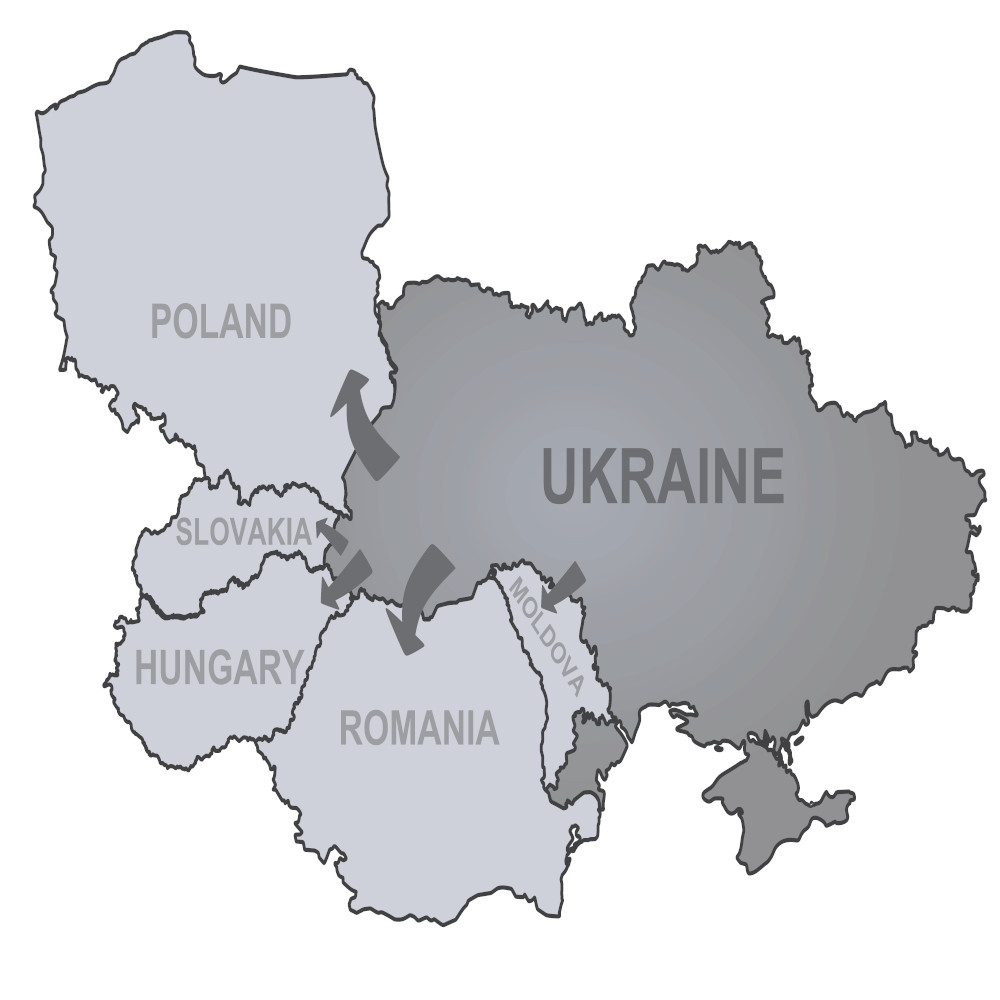
Ukraine refugees map to neighbors countries. vector

The Economic impacts of the Ukraine war on Eastern European countries with a focus on inflation and GDP growth

by World & New World Journal Policy Team

I. Introduction Russia invaded Ukraine in February 2022. As the Russian invasion of Ukraine enters its fourth year, its most immediate and visible consequences have been loss of life and large numbers of refugees from Ukraine. However, given the interconnected structure of the international political, economic, and policy systems, the ramifications of the Ukraine conflict can be felt well beyond Ukraine and Russia. Much of the recent literature and commentaries have focused on the military and strategic lessons learned from the on-going Ukraine conflict (Biddle 2022; 2023; Dijkstra et al. 2023). However, there are not many quality analyses of economic effects of the Ukraine war on Eastern European countries, including Russia and Ukraine. This paper focuses on the economic effects of the Ukraine war on nine Eastern European countries, including Russia and Ukraine. This is because although Eastern European countries are neighbors of Russia and Ukraine and have had significant negative economic outcomes from the Ukraine war, these countries were mainly ignored by researchers. II. The Economic Effects of the Ukraine war The impacts of war are far-reaching and devastating. War causes immense destruction of property and loss of life. It also creates psychological trauma for those who have experienced it firsthand. War can also have long-term economic impacts, such as higher unemployment and increased poverty. War can also lead to the displacement of people, as we have seen the millions of refugees who had been forced to flee their homes due to conflicts. War can also have political effects, such as creating new states or weakening existing nations. It can also lead to the rise of authoritarian regimes in many post-war nations. War can also lead to increased militarization as nations seek to protect themselves from future conflicts. The Ukraine war might have broader economic consequences. The supply chains may be affected because of the destruction of infrastructures and resources. War mobilization may affect the workforce and economic production. Actors in the economy may also act strategically to deploy resources elsewhere or to support the war effort because the war has affected incentive structures of workers and business. These effects can be local to geographical areas engulfed in conflict but also cause ripple effects to a wider regional area and to the global economy. Trade, production, consumption, inflation, growth and employment patterns may all be influenced. Peterson .K. Ozili.(2022) claimed that the scale of the Ukraine war had its negative impact on the economies of almost all countries around the world. According to Ozili, the main effects of the Ukraine war on the global economy are several, but this paper focuses on two below: Rising Oil Gas Prices  and inflation – European countries import a quarter of their oil and 40% of their natural gas from the Russian Federation. The Russian Federation is the second largest oil producer in the world and the largest supplier of natural gas to Europe, and after the invasion, European oil companies will have problems getting these resources from the Russian Federation. Even before the Russian invasion, oil prices were rising because of growing tensions between countries, the COVID-19 pandemic, and other factors, but remained in the $80–95 per barrel range. After the invasion, this price reached the value of $100. Natural gas prices rose 20% since the war began. Rising gas & oil prices can drive high inflation and increase public utility bills. Decline in production and economic growth. Rising oil and gas prices lead to high inflation and, therefore, a decline in consumption, supply and demand, thereby causing decline in growth and production. This paper focuses on inflation and GDP growth of nine Eastern European countries regarding the economic effects of the Ukraine war. Ozili (2022) claimed that very high inflation was a perceived negative consequence of the Russian invasion of Ukraine. As Figure 1 shows, inflation in the EU jumped in the first month of the invasion, and the increasing trend continues. EU inflation in 2022 peaked in October and amounted to 11.5% that was a historical record. However, inflation has slowly declined as energy prices have gone down. This higher inflation in Europe basically resulted from energy price increase. As Figures 2, 3, and 4 show, energy prices in Europe skyrocketed in 2022. As Figure 2 shows, energy prices have been the most important component of high inflation in the EU.  Figure 1: Average inflation rate in the EU (%). Source: EurostatCreated with Datawrapper     Figure 2: Main components of inflation rate in the Euro areas.  Figure 3: Natural gas prices in Europe, January 2021- end 2024  Figure 4: Crude oil price, January 2020-January 2025 Source: Eurostat Created with Datawrapper Inflation skyrocketed not only in the EU member countries, including Eastern European countries, but also in Russia and Ukraine.  Figure 5: Inflation rate in Russia, 2021-2025 As Figure 5 shows, inflation rate in Russia averaged 8.16 % from 2003 until 2025, but it reached an all time high of 20.37 % in April of 2022 just after the Russian invasion of Ukraine. In 2022, Russia experienced high inflation, with the average annual rate reaching approximately 13.75%. This surge in inflation was largely attributed to the economic impact of Western sanctions and increased government spending related to the war in Ukraine. From end of 2022 and throughout 2023, however, inflation was brought under control, but in 2024 inflation started to climb again. The inflation rate in Russia has been moderately high in 2024 and 2025, reaching to 9.5% in 2024 and 9.9% in May 2025 and 9.4% in June 2025.   Figure 6: Inflation rate in Ukraine, 2021-2025 The Ukrainian economy has undergone harsh conditions with the onset of Russia’s full-scale invasion of Ukraine in 2022. Following the start of the invasion, inflation skyrocketed to 26.6% in October 2022 from 10.0% in 2021. Inflation in Ukraine started to slow down from the end of 2022 throughout 2023, reaching 5.1% in November 2023. However, inflation began to rise from early 2024 and then grew to 12% in December 2024. As Figure 5 & 6 shows, inflation rates in Russia and Ukraine do not follow the pattern of EU countries in which inflation skyrocketed in 2022 and then has slowly declined over time. Rather inflation in Russia and Ukraine skyrocketed in 2022 and then slowed down in 2023 and started to climb again in 2024 and 2025. As Figure 7 shows, inflation in Eastern European countries has been also very high just after Russia invaded Ukraine. Hungary’s annual inflation rate surged in 2022, reaching a peak of 26.2 % in January 2023. By mid-2023, it began to decline, and by 2024, it showed a gradual decline trend, reaching 3.7 % in 2024. And inflation in Hungary slightly increased in 2025, reaching 4.6% in June 2025 and 4.4% in May 2025.  The Czech Republic(Czechia) experienced a significant surge in inflation in 2022, with the average inflation rate reaching 15.1%. This marked the second-highest inflation rate since the Czech Republic’s independence in 1993.  Two factors mainly contributed to this surge: High energy prices:The global energy crisis, exacerbated by the war in Ukraine, significantly impacted energy prices in the Czech Republic.  Increased food prices: The rising energy costs also led to higher food prices, with some sectors experiencing inflation rates as high as 26%.  The inflation rate in the Czech Republic in 2023 was relatively high, reaching 10.7%. However, inflation significantly declined in 2024 and 2025. The average annual inflation rate in the Czech Republic for 2024 was 2.4%. The inflation rate in 2025 was also low, recording 2.7% in July 2025. Poland also experienced a significant increase in inflation in 2022, with the average inflation rate reaching 14.2%. The inflation was down to 11.47% in 2023, but it was still high. The rate continued to fall, reaching 3.72% in 2024. In July 2025, inflation dropped to 3.1%. Similarly, Bulgaria experienced a significant surge in inflation in 2022, reaching a peak of 18.7 % in September 2022. However, Bulgaria’s annual inflation rate continued to decline from 13.02% in 2022 to 8.6% in 2023 and 2.6% in 2024. The inflation in June 2025 was 3.1%.  Romania experienced a significant surge in inflation in 2022, reaching a peak of 14.6 in November 2022. However, the annual inflation rate in Romania declined from 13.8% in 2022, recording 10.4% in 2023 and 5.58% in 2024. The inflation rate reached a more moderate rate of 5.8% in June 2025.  Slovakia experienced a significant surge in inflation in 2022, reaching a peak of 15.4 % in November 2022. However, the annual inflation rate in Slovakia declined to 10.96% in 2023, and 3.15% in 2024. The inflation rate in Slovakia reached a more moderate rate of 4.3% in June 2025.  Slovenia had much lower inflation rate than other Eastern European countries. The annual inflation rate in Slovenia was 8.83% in 2022, 7.45% in 2023, and 1.97% in 2024. The inflation rate in Slovenia reached a relatively low rate of 2.2% in June 2025.  Unlike Russia and Ukraine, these Eastern European countries followed the pattern of EU countries in which inflation skyrocketed in 2022 and then has slowly declined over time.   Figure 7: Inflation rate in Eastern Europe during the Ukraine war Very high inflation in Europe during the early stage of Ukraine war basically resulted from energy price increase as Figures 2, 3, and 4 show. It is because European countries were heavily dependent on Russian energy. Figure 8 shows that a number of Eastern European countries were significantly dependent on Russian energy in 2020 before the Ukraine war. For example, Slovakia and Hungary depended on Russia for more than 50 % of their energy use. Moreover, Europe was the largest importer of natural gas in the world. Russia provided roughly 40% and 25% of EU’s imported gas and oil before the Russian invasion of Ukraine. As Figure 9 shows, major gas importers from Russia in 2021 were European countries.  Figure 8: EU member country’s dependence on Russia energy  Figure 9: Major EU importers from Russian Gas in 2021. However, since the Russian invasion of Ukraine in 2022, more than 9,119 new economic sanctions have been imposed on Russia, making it the most sanctioned country in the world. At least 46 countries or territories, including all 27 EU nations, have imposed sanctions on Russia. EU trade with Russia has been strongly affected by the sanctions, resulting in a 58% decline in exports to Russia and an 86% drop in imports from Russia between the first quarter of 2022 and the third quarter of 2024. In the response, as Figure 10 shows, Russia cut its gas exports to the EU by around 80% since the Russian invasion, resulting in higher gas price in Europe.  Figure 10: Monthly Russia-EU pipeline gas flows, 2022-2025 Nonetheless, Figure 11 show that Hungary, Slovakia, and Czech Republic have been major  importers of Russian gas and oil after Russia’s invasion of Ukraine, while Figure 12 shows that Hungary, Bulgaria, Slovenia, Slovakia, and Czech Republic have been major importers and consumers of Russian gas after the Ukraine war. Figure 11: Largest importers of Russian fossil fuels (January 1, 2023 to February 16, 2025)  Figure 12: Selected European countries’ imports of Russian natural gas as shares of total consumption. As energy prices in Europe skyrocketed, inflation, including food price also skyrocketed in Europe. As a result, consumption in Europe was down and GDP growth declined in Europe after the Russian invasion of Ukraine. As Ozili claimed, lower growth rate was also a perceived negative consequence of the Russian invasion of Ukraine. As Figure 13 shows, GDP in EU was down to 3.5 % in 2022 compared to 6.3% in 2021, and it was further down to 0.8 % in 2023 because of economic stagnation and high inflation caused by the Ukraine war.  Figure 13: Average annual GDP growth rate in EU, 1996-2025. Like EU countries, Russia, Ukraine and some Eastern European countries experienced negative growth rates in 2022 & 2023 after Russia’s invasion of Ukraine in February 2022. Russia’s economy has undergone significant transformation since its full-scale invasion of Ukraine in February 2022. As Figure 14 shows, Russia GDP growth rate for 2022 was -2.07%, a 7.68% decline from 2021. This decline in GDP was due to international sanctions, the withdrawal of foreign companies and overall economic uncertainty. However, the impact was largely offset by a favourable terms-of-trade from higher commodity prices and support from third countries – especially China, Turkey, the UAE and countries bordering Russia – which have served as conduits for sanctions evasion.  Figure 14: Russia GDP Growth Rate By 2023, the Russian economy had increasingly shifted to a war footing. As Figure 15 shows, military spending significantly increased after the Russian invasion of Ukraine. Surge in government spending such as military spending, counter-sanctions measures and credit growth boosted investment, construction and overall economic activity in Russia. The military-industrial sector benefitted the most, as did private consumption driven by war-related payments and high real wage growth resulting from the tight labor market. Meanwhile, sectors reliant on Western markets or foreign companies continued to struggle. As a result, Russia’s GDP grew by 3.6 percent in 2023 and 4.3 percent in 2024. Economic expansion resulted from rising government expenditure and investment in its military as it continues its war against Ukraine.  Figure 15: Russia military spending By the end of 2024 and in early 2025, however, signs of economic stagnation had become evident. Even the military-industrial sector began to stagnate. The economy had butted up against its supply-side constraints. In the first quarter of 2025, annual growth slowed to an estimated 1.4 % (from 4.5 % in the last quarter of 2024. Economic contraction was driven by falling activity in trade, mining, real estate and leisure, which growth in agriculture, manufacturing and public administration were not able to offset.  Figure 16: Ukraine GDP growth rate Russian invasion of Ukraine in February 2022 significantly affected Ukraine economy. As Figure 16 shows, Ukraine’s GDP growth rate for 2022 was -28.76%, a 32.08% decline from 2021. GDP growth rate in Ukraine averaged 1.33% from 2000 until 2025, reaching a record low of -36.60 % in the second quarter of 2022. Ukraine’s economy started to bounce back in 2023 and the GDP growth rate in Ukraine for 2023 was 5.32 %, a 34.08 increase in 2022. GDP growth rate reached an all time high of 19.30% in the second quarter of 2023. The GDP growth for 2024 was down to 2.9%. In the first quarter of 2025, Ukraine’s GDP grew 0.9%. However, the Ukrainian economy has been propped up by financial support from Western countries, including military and humanitarian aid, as well as loans from frozen Russian assets. Financing from abroad has been essential in sustaining Ukraine’s ability to survive. Ukraine’s 2024 public sector deficit rose to a record 1.832 trillion hryvnia, or almost 24 % of GDP. Over 60 % of spending went to defense and domestic security. Ukraine’s foreign partner countries provided approximately $42 billion in direct budget support in 2024, of which a large chunk ($17.5 billion) was provided via the EU’s Ukraine Facility. In 2025, Ukraine’s financing situation looks brighter compared to the beginning of 2024, when the EU’s 50-billion-euro Ukraine Facility and America’s over-60-million-dollar Ukraine aid package were blocked due to legislative intransigence. The structure of 2025 deficit financing in Ukraine represents a big change from 2024 as a substantial part of the deficit will be covered out of the yield on Russia’s frozen assets. Last summer, G-7 leaders agreed on an Extraordinary Revenue Acceleration (ERA) arrangement allowing for the use of 183 billion Euro of frozen Russian assets (end-2024) in the EU area to help Ukraine. The ERA program does not draw on the Russian assets directly but uses its proceeds to finance payments and costs of a $50 billion loan. As Figure 17 shows, ERA disbursements allocated to Ukraine will come to nearly $22 billion in 2025 and $11 billion in 2026. The new Trump administration has yet to withdraw from the ERA program, even if substantial cuts have already been made in e.g. USAID financing to Ukraine. The US remains the ERA program’s largest supporter, accounting for a total disbursement commitment of $20 billion. Figure 17: ERA program for Ukraine from Western countries, 2023-2026 Moreover, according to the Ukraine Support Tracker from Kiel University, Ukraine has received 267 billion euros in aid over the past three years. Half of this has been in weapons and military assistance, with 118 billion euros in financial support and 19 billion euros for humanitarian aid. European countries contributed more than the US: 62 billion euros in arms and 70 billion euros in other aid from Europe, compared with 64 billion euros in arms and 50 billion euros in other aid from the US. On the other hand, the Ukraine war caused a massive refugee crisis to Eastern European countries. The Ukraine war made millions of Ukraine people cross the border into neighboring countries in Eastern countries, affecting the economy of each nation. Table 1 shows the number of Ukraine refugees settled in Europe. Most of the Ukraine refugees settled in Poland and the Czech Republic, followed by Romania, Slovakia, and Moldova. These Ukraine refugees had significant impacts on Eastern European economy, in particular on Poland and Czech Republic. Table 1: Number of refugees from Ukraine settled in EuropeSource: UNHCR Operational Data The Ukraine war affected Poland’s economy in several ways, creating both difficulties and opportunities. First, there were problems with energy supplies that could threaten Poland’s access to power. The conflict in Ukraine has shaken up Poland’s energy market quite a bit, affecting its gas and oil supplies and leading to a spike in prices. Right after the conflict began, gasoline prices in Poland jumped by more than 40% as Figure 18 shows. This is mainly because Poland used to get a lot of its energy from Russia, and now, because of the Ukraine war and the sanctions that followed, there’s been a big disruption. As Figure 19 shows, food prices also skyrocketed just after the Ukraine war.  Figure 18: Gasoline price in Poland Figure 19: Food inflation in Poland Food inflation in Poland averaged 4.11 % from 1999 until 2025, reaching an all time high of 24.00 % in February of 2023. Moreover, there has been the arrival of more than 1 million Ukraine refugees, which put pressure on jobs and public services in Poland. The Polish government has had to increase its public spending significantly to provide housing, healthcare, and social services for the newcomers. This sudden increase in spending seemed overwhelming at first, but it also brought potential economic benefits in the long run. For example, the influx of Ukraine refugees boosted demand for local goods and services, which in turn stimulated the Polish economy. Despite both difficulties and opportunities that the Ukraine war brought to Poland, Poland’s GDP growth rate in 2022 was 5.3%. This indicates a strong economic performance, although it was slightly lower than the 6.9% growth rate in 2021. However, Poland's GDP growth rate in 2023 was down to 0.2%. This signifies a significant slowdown compared to the 5.3% growth in 2022. The slowdown was attributed to factors like energy inflation-induced decline in household spending and stagnant consumption. Poland’s real GDP grew by 2.9% in 2024, exceeding initial expectations, which were set at 2.8%. As inflation was down, it allowed for consumer spending and contributed to economic expansion. The Polish economy continues to grow by 3.2% in the first quarter of 2025. Figure 20: annual GDP growth rate in Poland, 2016-2024 The Czech economy has experienced significant impacts from the Ukraine war due to supply chain disruptions and rising energy & food prices. As Figure 21 and 22 show, gasoline and food prices in Czech Republic skyrocketed just after the Russian invasion of Ukraine. Gasoline prices in Czech Republic skyrocketed in June 2022 at 2.05 USD/Liter from 1.12 USD/Liter in May2020. Gasoline prices in Czech Republic averaged 1.48 USD/Liter from 1995 until 2025, reaching a high of 2.05 USD/Liter in June of 2022 and a record low of 0.72 USD/Liter in December of 1998. Figure 21: Gasoline price in the Czech Republic  Figure 22: Food inflation in the Czech Republic As a result, after a solid recovery from Covid-19 pandemic in 2021 with 4.0% growth rate, economic activity slowed down in 2022-2023 as a result of the consequences of the war in Ukraine, including EU sanctions on Russia and rising energy & food prices. Nonetheless, the Czech achieved a moderate growth in 2022 with a growth rate of 2.8% but the Czech economy contracted by -0.1% in 2023 and has been weak with a growth rate of 1.1% in 2024 and 0.7 % in the first quarter of 2025. Figure 23: annual GDP growth rate in Czech Republic, 2016-2024 Hungary’s economy has faced significant challenges due to the war in Ukraine, including increased energy costs, inflation, and disruptions to trade and supply chains. Hungary economy grew by 4.6 % in 2022, but declined to -0.91% in 2023 due to the extremely high inflation and weak consumptions. The consumer price in Hungary rose to a peak of 25.7% in January 2023, the highest rate in the EU. High inflation was driven by surging energy and food prices as Figures 24 and 25 show. The Hungary economy has been weak with the growth rate of 0.5 % in 2024. The GDP expanded by 0.1% in the second quarter of 2025. Figure 24: Gasoline price in Hungary Figure 25: Food inflation in Hungary  Figure 26: annual GDP growth rate in Hungary, 2016-2024 Bulgaria’s economy has faced challenges from the Ukraine ware, due to increased energy prices and disruptions in trade. As Figure 27 shows, the initial economic recovery was stronger than anticipated, with a 4.0% GDP growth in 2022, but the Ukraine war’s impact, coupled with inflation and global economic headwinds, led to a slowdown. Bulgaria’s economy expanded by 1.89 % in 2023. Then Bulgaria GDP bounced back to 2.8 % in 2024 and by 3.1% in the first quarter of 2025. Figure 27: annual GDP growth rate in Bulgaria, 2016-2024 Romania’s economy has experienced both positive and negative impacts from the Ukraine war. As Figure 28 shows, the Romanian economy displayed unexpected strength in 2022, with a 4.8% growth rate thanks to strong private consumption and investment. However, the Ukraine war’s effects, particularly on energy prices and supply chains, dampened Romanian growth. Romanian growth rate for 2023 was 2.2%, but it moderately rebound in 2024 with a 2.8% growth rate. The Romanian GDP increased by 0.3% in the first quarter of 2025. Romania faced challenges related to fiscal deficits, public debt, and inflation. Romania’s ability to navigate these challenges and capitalize on opportunities, such as EU support and its strategic geographic location, will be crucial for its long-term economic prosperity.  Figure 28: annual GDP growth rate in Romania, 2016-2024 Slovakia’s economy has faced significant challenges due to the war in Ukraine, mainly through energy & food price shocks and disruptions to trade and supply chains. As Figure 29 and 30 show, gasoline and food price in Slovakia significantly increased. Slovakia’s economy grew by 0.45% in 2022, a 5.28% decline from 2021. GDP growth rate for 2023 was 1.38 %. GDP growth in Slovakia moderately bounced back in 2024 with a growth rate of 2.0. In the first quarter of 2025, Slovakia economy grew by 0.2 %.  Figure 29: Gasoline price in Slovakia Figure 30: food inflation in Slovakia Figure 31: annual GDP growth rate in Slovakia, 2016-2024 In 2022, Slovenia experienced a slow economic growth with 2.7%, a 5.69% decline from 2021. due to the Ukraine war and subsequent energy price hikes and supply chain disruptions. Slovenia’s economy has been hurt by the Ukraine war and subsequent flooding in 2023 and 2024 with a 2.1 % and 1.5 % growth rate, respectively. Slovenia’s GDP growth was down to -0.7 % in the first quarter of 2025.   Figure 32: annual GDP growth rate in Slovenia, 2016-2024 III. Conclusion  This paper analyzed the economic effects of the Ukraine war on Russia, Ukraine, and Eastern European countries with a focus on inflation and GDP growth. The paper showed that after the Russian invasion of Ukraine in February 2022, inflation skyrocketed not only in the EU member countries, including Eastern European countries, but also in Russia and Ukraine. However, the pattern of inflation was different. Inflation in Russia and Ukraine did not follow the inflation pattern of EU member countries in which inflation skyrocketed in 2022 and then has slowly declined over time. Rather inflation in Russia and Ukraine skyrocketed in 2022 and then slowed down in 2023 and started to climb again in 2024 and 2025. Inflation in Eastern European countries followed the pattern of EU member countries in which inflation skyrocketed in 2022 and has then slowly declined over time. On the other hand, the pattern of GDP growth was different, depending on the individual conditions of each nation, although most countries experienced economic decline in 2022 relative to 2021. Some countries such as Ukraine and Russia experienced negative growth in 2022 and then recovered from 2023. Other countries such as Hungary, Romania, Bulgaria, and Czech Republic experienced moderate growth in 2022 and then slowed down over time. Still other countries like Slovakia and Slovenia experienced very low GDP growth over the period of 2022-2025.  References Biddle, Stephen D. 2022. “Ukraine and the Future of Offensive Maneuver.” War on the Rocks. November 22. https://warontherocks.com/2022/11/ukraine-and-the-future-of-offensive-maneuver/.Biddle, Stephen D. 2023. “Back in the Trenches: Why New Technology Hasn’t Revolutionized Warfare in Ukraine.” Foreign Affairs 102 (5): 153–164.Dijkstra, Hyllke, Myriam Dunn Cavelty, Nicole Jenne, and Yf Reykers. 2023. “What We GotWrong: The War Against Ukraine and Security Studies.” Contemporary Security Policy 44(4): 494–496. https://doi.org/10.1080/13523260.2023.2261298Ozili, P.K., 2022, Global Economic Consequence of Russian Invasion of Ukraine. Available online at: https://ssrn.com/abstract=4064770(open in a new window)

Energy & Economics
Commodity and alternative asset, gold bar and crypto currency Bitcoin on rising price graph as financial crisis or war safe haven, investment asset or wealth concept.

Assessing Bitcoin and Gold as Safe Havens Amid Global Uncertainties: A Rolling Window DCC-GARCH Analysis

by Anoop S Kumar , Meera Mohan , P. S. Niveditha

Abstract We examine the roles of Gold and Bitcoin as a hedge, a safe haven, and a diversifier against the coronavirus disease 2019 (COVID-19) pandemic and the Ukraine War. Using a rolling window estimation of the dynamic conditional correlation (DCC)-based regression, we present a novel approach to examine the time-varying safe haven, hedge, and diversifier properties of Gold and Bitcoin for equities portfolios. This article uses daily returns of Gold, Bitcoin, S&P500, CAC 40, and NSE 50 from January 3, 2018, to October 15, 2022. Our results show that Gold is a better safe haven than the two, while Bitcoin exhibits weak properties as safe haven. Bitcoin can, however, be used as a diversifier and hedge. This study offers policy suggestions to investors to diversify their holdings during uncertain times. Introduction Financial markets and the diversity of financial products have risen in both volume and value, creating financial risk and establishing the demand for a safe haven for investors. The global financial markets have faced several blows in recent years. From the Global Financial Crisis (GFC) to the outbreak of the pandemic and uncertainty regarding economic policy measures of governments and central banks, the financial markets including equity markets around the world were faced with severe meltdowns. This similar behavior was observed in other markets including equity and commodity markets, resulting in overall uncertainty. In this scenario, the investors normally flock toward the safe-haven assets to protect their investment. In normal situations, investors seek to diversify or hedge their assets to protect their portfolios. However, the financial markets are negatively impacted when there are global uncertainties. Diversification and hedging methods fail to safeguard investors’ portfolios during instability because almost all sectors and assets are negatively affected (Hasan et al., 2021). As a result, investors typically look for safe-haven investments to safeguard their portfolios under extreme conditions (Ceylan, 2022). Baur and Lucey (2010) provide the following definitions of hedge, diversifier, and safe haven: Hedge: An asset that, on average, has no correlation or a negative correlation with another asset or portfolio. On average, a strict hedge has a (strictly) negative correlation with another asset or portfolio.Diversifier: An asset that, on average, has a positive correlation (but not perfect correlation) with another asset or portfolio. Safe haven: This is the asset that in times of market stress or volatility becomes uncorrelated or negatively associated with other assets or a portfolio. As was previously indicated, the significant market turbulence caused by a sharp decline in consumer spending, coupled with insufficient hedging opportunities, was a common feature of all markets during these times (Yousaf et al., 2022). Nakamoto (2008) suggested a remedy by introducing Bitcoin, a “digital currency,” as an alternative to traditional fiduciary currencies (Paule-Vianez et al., 2020). Bitcoin often described as “Digital Gold” has shown greater resilience during periods of crises and has highlighted the potential safe haven and hedging property against uncertainties (Mokni, 2021). According to Dyhrberg (2016), the GFC has eased the emergence of Bitcoin thereby strengthening its popularity. Bouri et al. (2017) in their study indicate that Bitcoin has been viewed as a shelter from global uncertainties caused by conventional banking and economic systems. Recent research has found that Bitcoin is a weak safe haven, particularly in periods of market uncertainty like the coronavirus disease 2019 (COVID-19) crisis (Conlon & McGee, 2020; Nagy & Benedek, 2021; Shahzad et al., 2019; Syuhada et al., 2022). In contrast to these findings, a study by Yan et al. (2022) indicates that it can function as a strong safe haven in favorable economic times and with low-risk aversion. Ustaoglu (2022) also supports the strong safe-haven characteristic of Bitcoin against most emerging stock market indices during the COVID-19 period. Umar et al. (2023) assert that Bitcoin and Gold are not reliable safe-havens. Singh et al. (2024) in their study reveal that Bitcoin is an effective hedge for investments in Nifty-50, Sensex, GBP–INR, and JPY–INR, at the same time a good diversifier for Gold. The study suggests that investors can incorporate Bitcoin in their portfolios as a good hedge against market volatility in equities and commodities markets. During the COVID-19 epidemic, Barbu et al. (2022) investigated if Ethereum and Bitcoin could serve as a short-term safe haven or diversifier against stock indices and bonds. The outcomes are consistent with the research conducted by Snene Manzli et al. (2024). Both act as hybrid roles for stock market returns, diversifiers for sustainable stock market indices, and safe havens for bond markets. Notably, Bhuiyan et al. (2023) found that Bitcoin provides relatively better diversification opportunities than Gold during times of crisis. To reduce risks, Bitcoin has demonstrated a strong potential to operate as a buffer against global uncertainty and may be a useful hedging tool in addition to Gold and similar assets (Baur & Lucey, 2010; Bouri et al., 2017; Capie et al., 2005; Dyhrberg, 2015). According to Huang et al. (2021), its independence from monetary policies and minimal association with conventional financial assets allow it to have a safe-haven quality. Bitcoins have a substantial speed advantage over other assets since they are traded at high and constant frequencies with no days when trading is closed (Selmi et al., 2018). Additionally, it has been demonstrated that the average monthly volatility of Bitcoin is higher than that of Gold or a group of international currencies expressed in US dollars; nevertheless, the lowest monthly volatility of Bitcoin is lower than the maximum monthly volatility of Gold and other foreign currencies (Dwyer, 2015). Leverage effects are also evident in Bitcoin returns, which show lower volatilities in high return periods and higher volatilities in low return times (Bouri et al., 2017; Liu et al., 2017). According to recent research, Bitcoins can be used to hedge S&P 500 stocks, which increases the likelihood that institutional and retail investors will build secure portfolios (Okorie, 2020). Bitcoin demonstrates strong hedging capabilities and can complement Gold in minimizing specific market risks (Baur & Lucey, 2010). Its high-frequency and continuous trading further enrich the range of available hedging tools (Dyhrberg, 2016). Moreover, Bitcoin spot and futures markets exhibit similarities to traditional financial markets. In the post-COVID-19 period, Zhang et al. (2021) found that Bitcoin futures outperform Gold futures.Gold, silver, palladium, and platinum were among the most common precious metals utilized as safe-haven investments. Gold is one such asset that is used extensively (Salisu et al., 2021). Their study tested the safe-haven property of Gold against the downside risk of portfolios during the pandemic. Empirical results have also shown that Gold functions as a safe haven for only 15 trading days, meaning that holding Gold for longer than this period would result in losses to investors. This explains why investors buy Gold on days of negative returns and sell it when market prospects turn positive and volatility decreases (Baur & Lucey, 2010). In their study, Kumar et al. (2023) tried to analyse the trends in volume throughout futures contracts and investigate the connection between open interest, volume, and price for bullion and base metal futures in India. Liu et al. (2016) in their study found that there is no negative association between Gold and the US stock market during times of extremely low or high volatility. Because of this, it is not a strong safe haven for the US stock market (Hood & Malik, 2013). Post-COVID-19, studies have provided mixed evidence on the safe-haven properties of Gold (Bouri et al., 2020; Cheema et al., 2022; Ji et al., 2020). According to Kumar and Padakandla (2022), Gold continuously demonstrates safe-haven qualities for all markets, except the NSE, both in the short and long term. During the COVID-19 episode, Gold’s effectiveness as a hedge and safe-haven instrument has been impacted (Akhtaruzzaman et al., 2021). Al-Nassar (2024) conducted a study on the hedge effectiveness of Gold and found that it is a strong hedge in the long run. Bhattacharjee et al. (2023) in their paper examined the symmetrical and asymmetrical linkage between Gold price levels and the Indian stock market returns by employing linear autoregressive distributed lag and nonlinear autoregressive distributed lag models. The results exhibit that the Indian stock market returns and Gold prices are cointegrated. According to the most recent study by Kaczmarek et al. (2022), Gold has no potential as a safe haven, despite some studies on the COVID-19 pandemic showing contradictory results. The co-movements of Bitcoin and the Chinese stock market have also normalized as a result of this epidemic (Belhassine & Karamti, 2021). Widjaja and Havidz (2023) verified that Gold was a safe haven asset during the COVID-19 pandemic, confirming the Gold’s safe-haven characteristic. As previously pointed out, investors value safe-haven investments in times of risk. Investors panic at these times when asset prices fall and move from less liquid (risky) securities to more liquid (safe) ones, such as cash, Gold, and government bonds. An asset must be bought and sold rapidly, at a known price, and for a reasonably modest cost to be considered truly safe (Smales, 2019). Therefore, we need to properly re-examine the safe-haven qualities of Gold and Bitcoin due to the mixed evidences regarding their safe-haven qualities and the impact of COVID-19 and the war in Ukraine on financial markets. This work contributes to and deviates from the body of existing literature in the following ways. We propose a novel approach in this work to evaluate an asset’s time-varying safe haven, hedge, and diversifier characteristics. This research examines the safe haven, hedging, and diversifying qualities of Gold and Bitcoin against the equity indices; S&P 500, CAC 40, and NSE 50. Through the use of rolling window estimation, we extend the methodology of Ratner and Chiu (2013) by estimating the aforementioned properties of the assets. Comparing rolling window estimation to other conventional techniques, the former will provide a more accurate representation of an asset’s time-varying feature. This study explores the conventional asset Gold’s time-varying safe haven, hedging, and diversifying qualities during crises like the COVID-19 pandemic and the conflict in Ukraine. We use Bitcoin, an unconventional safe-haven asset, for comparison. Data and Methodology We use the daily returns of three major equity indices; S&P500, CAC 40, and NSE 50 from January 3, 2018, to October 15, 2022. The equity indices were selected to represent three large and diverse markets namely the United States, France, and India in terms of geography and economic development. We assess safe-haven assets using the daily returns of Gold and Bitcoin over the same time. Equity data was collected from Yahoo Finance, Bitcoin data from coinmarketcap.com, and Gold data from the World Gold Council website. Engle (2002) developed the DCC (Dynamic Conditional Correlation)-GARCH model, which is frequently used to assess contagion amid pandemic uncertainty or crises. Time-varying variations in the conditional correlation of asset pairings can be captured using the DCC-GARCH model. Through employing this model, we can analyse the dynamic behavior of volatility spillovers. Engle’s (2002) DCC-GARCH model contains two phases; 1. Univariate GARCH model estimation2. Estimation of time-varying conditional correlation. For its explanation, mathematical characteristics, and theoretical development, see here [insert the next link in “the word here” https://journals.sagepub.com/doi/10.1177/09711023251322578] Results and Discussion The outcomes of the parameters under the DCC-GARCH model for each of the asset pairs selected for the investigation are shown in Table 1.   First, we look at the dynamical conditional correlation coefficient, ρ.The rho value is negative and insignificant for NSE 50/Gold, NSE 50 /BTC, S&P500/Gold, and S&P500/BTC indicating a negative and insignificant correlation between these asset pairs, showing Gold and Bitcoin as potential hedges and safe havens. The fact that ρ is negative and significant for CAC 40/Gold suggests that Gold can be a safe haven against CAC 40 swings. The asset pair CAC/BTC, on the other hand, has possible diversifier behavior with ρ being positive but statistically insignificant. Next, we examine the behavior of the DCC-GARCH parameters; α and β. We find that αDCC is statistically insignificant for all the asset pairs, while βDCC is statistically significant for all asset pairs. βDCC quantifies the persistence feature of the correlation and the extent of the impact of volatility spillover in a particular market’s volatility dynamics. A higher βDCC value implies that a major part of the volatility dynamics can be explained by the respective market’s own past volatility. For instance, the NSE 50/Gold’s βDCC value of 0.971 shows that there is a high degree of volatility spillover between these two assets, with about 97% of market volatility being explained by the assets’ own historical values and the remainder coming from spillover. Thus, we see that the volatility spillover is highly persistent (~0.8) for all the asset pairs except NSE 50/BTC. The results above show that the nature of the dynamic correlation between the stock markets, Bitcoin and Gold is largely negative, pointing toward the possibility of Gold and Bitcoin being hedge/safe haven. However, a detailed analysis is needed to confirm the same by employing rolling window analysis, and we present the results in the forthcoming section. We present the rolling window results for S&P500 first. We present the regression results for Gold in Figure 1 and Bitcoin in Figure 2   Figure 1. Rolling Window Regression Results for S&P500 and Gold.Note: Areas shaded under factor 1 represent significant regression coefficients. In Figure 1, we examine the behavior of β0 (intercept term), β1, β2, and β3 (partial correlation coefficients). The intercept term β0 will give an idea about whether the asset is behaving as a diversifier or hedge. Here, the intercept term shows significance most of the time. However, during 2018, the intercept was negative and significant, showing that it could serve as a hedge during geopolitical tensions and volatilities in the global stock market. However, during the early stages of COVID-19, we show that the intercept is negative and showing statistical significance, suggesting that Gold could serve as a hedge during the initial shocks of the pandemic. These findings are contrary to the results in the study by Tarchella et al. (2024) where they found hold as a good diversifier. Later, we find the intercept to be positive and significant, indicating that Gold could act as a potential diversifier. But during the Russia-Ukraine War, Gold exhibited hedge ability again. Looking into the behavior of β1, which is the partial correlation coefficient for the tenth percentile of return distribution shows negative and insignificant during 2018. Later, it was again negative and significant during the initial phases of COVID-19, and then negative in the aftermath, indicating that Gold could act as a weak safe haven during the COVID-19 pandemic. Gold could serve as a strong safe haven for the SP500 against volatility in the markets brought on by the war in Ukraine, as we see the coefficient to be negative and large during this time. From β2 and β3, the partial correlation coefficients of the fifth and first percentile, respectively, show that Gold possesses weak safe haven properties during COVID-19 and strong safe haven behavior during the Ukraine crisis. Next, we examine the characteristics of Bitcoin as a hedge/diversifier/safe haven against the S&P500 returns. We present the results in Figure 2.   Figure 2. Rolling Window Regression Results for S&P500 and Bitcoin.Note: Areas shaded under factor 1 represent significant regression coefficients. Like in the previous case, we begin by analysing the behavior of the intercept coefficient, which is β0. As mentioned earlier the intercept term will give a clear picture of the asset’s hedging and diversifier property. In the period 2018–2019, the intercept term is positive but insignificant. This could be due to the large volatility in Bitcoin price movements during the period. It continues to be minimal (but positive) and insignificant during 2019–2020, indicating toward weak diversification possibility. Post-COVID-19 period, the coefficient shows the significance and positive value, displaying the diversification potential. We see that the coefficient remains positive throughout the analysis, confirming Bitcoin’s potential as a diversifier. Looking into the behavior of β1 (the partial correlation coefficient at tenth percentile), it is positive but insignificant during 2018. The coefficient is having negative sign and showing statistical significance in 2019, suggesting that Bitcoin could be a good safe haven in that year. This year was characterized by a long list of corporate scandals, uncertainties around Brexit, and tensions in global trade. We can observe that throughout the COVID-19 period, the coefficient is showing negative sign and negligible during the March 2020 market meltdown, suggesting inadequate safe-haven qualities. However, Bitcoin will regain its safe-haven property in the coming periods, as the coefficient is negative and significant in the coming months. The coefficient is negative and shows statistical significance during the Ukrainian crisis, suggesting strong safe-haven property. Only during the Ukrainian crisis could Bitcoin serve as a safe haven, according to the behavior of β2, which displays the partial correlation coefficient at the fifth percentile. Bitcoin was a weak safe haven during COVID-19 and the Ukrainian crisis, according to β3, the partial correlation coefficient for the first percentile (coefficient negative and insignificant). According to the overall findings, Gold is a stronger safe haven against the S&P 500’s swings. This result is consistent with the previous studies of Triki and Maatoug (2021), Shakil et al. (2018), Będowska-Sójka and Kliber (2021), Drake (2022), and Ghazali et al. (2020), etc. The same analysis was conducted for the CAC 40 and the NSE 50; the full analysis can be found here [insert the next link in “the word here” https://journals.sagepub.com/doi/10.1177/09711023251322578]. However, it is important to highlight the respective results: In general, we may say that Gold has weak safe-haven properties considering CAC40. We can conclude that Bitcoin’s safe-haven qualities for CAC40 are weak. We can say that Gold showed weak safe-haven characteristics during the Ukraine crisis and good safe-haven characteristics for the NSE50 during COVID-19. We may say that Bitcoin exhibits weak safe haven, but strong hedging abilities to NSE50. Concluding Remarks In this study, we suggested a new method to evaluate an asset’s time-varying hedge, diversifier, and safe-haven characteristics. We propose a rolling window estimation of the DCC-based regression of Ratner and Chiu (2013). Based on this, we estimate the conventional asset’s time-varying safe haven, hedging, and diversifying properties during crises like the COVID-19 pandemic and the conflict in Ukraine. For comparison purposes, we include Bitcoin, a nonconventional safe-haven asset. We evaluate Gold and Bitcoin’s safe haven, hedging, and diversifier properties to the S&P 500, CAC 40, and NSE 50 variations. We use a rolling window of length 60 to estimate the regression. From the results, we find that Gold can be considered as a better safe haven against the fluctuations of the S&P 500. In the case of CAC 40, Gold and Bitcoin have weak safe-haven properties. While Bitcoin demonstrated strong safe-haven characteristics during the Ukraine crisis, Gold exhibited strong safe-haven characteristics during COVID-19 for the NSE 50. Overall, the findings indicate that Gold is the better safe haven. This outcome is consistent with earlier research (Będowska-Sójka & Kliber, 2021; Drake, 2022; Ghazali et al., 2020; Shakil et al., 2018; Triki & Maatoug, 2021). When it comes to Bitcoin, its safe-haven feature is weak. Bitcoin, however, works well as a diversifier and hedge. Therefore, from a policy perspective, investing in safe-haven instruments is crucial to lower the risks associated with asset ownership. Policymakers aiming to enhance the stability of financial portfolios might encourage institutional investors and other market players to incorporate Gold into their asset allocations. Gold’s strong safe-haven qualities, proven across various market conditions, make it a reliable choice. Gold’s performance during crises like COVID-19 highlights its potential to mitigate systemic risks effectively. Further, Bitcoin could also play a complementary role as a hedge and diversifier, especially during periods of significant volatility such as the Ukraine crisis. While Bitcoin’s safe-haven characteristics are relatively weaker, its inclusion in a diversified portfolio offers notable value and hence it should not be overlooked. Further, policymakers may consider how crucial it is to monitor dynamic correlations and periodically rebalance portfolios to account for shifts in the safe haven and hedging characteristics of certain assets. Such measures could help reduce the risks of over-reliance on a single asset type and create more resilient portfolios that can better withstand global economic shocks. For future research, studies can be conducted on the estimation of the rolling window with different widths. This is important to understand how the safe-haven property changes across different holding periods. Further, more equity markets would be included to account for the differences in market capitalization and index constituents. This study can be extended by testing these properties for multi-asset portfolios as well. We intend to take up this study in these directions in the future. Data Availability StatementNot applicable.Declaration of Conflicting InterestsThe authors declared no potential conflicts of interest with respect to the research, authorship, and/or publication of this article.FundingThe authors received no financial support for the research, authorship, and/or publication of this article.ReferencesAkhtaruzzaman M., Boubaker S., Lucey B. M., & Sensoy A. (2021). Is gold a hedge or a safe-haven asset in the COVID-19 crisis? Economic Modelling, 102, 105588. Crossref. Web of Science.Al-Nassar N. S. (2024). Can gold hedge against inflation in the UAE? A nonlinear ARDL analysis in the presence of structural breaks. PSU Research Review, 8(1), 151–166. Crossref.Barbu T. C., Boitan I. A., & Cepoi C. O. (2022). Are cryptocurrencies safe havens during the COVID-19 pandemic? A threshold regression perspective with pandemic-related benchmarks. Economics and Business Review, 8(2), 29–49. Crossref.Baur D. G., & Lucey B. M. (2010). Is gold a hedge or a safe haven? An analysis of stocks, bonds and gold. Financial Review, 45(2), 217–229. Crossref.Będowska-Sójka B., & Kliber A. (2021). Is there one safe-haven for various turbulences? The evidence from gold, Bitcoin and Ether. The North American Journal of Economics and Finance, Elsevier, 56, 101390. Crossref.Belhassine O., & Karamti C. (2021). Contagion and portfolio management in times of COVID-19. Economic Analysis and Policy, 72, 73–86. Crossref. PubMed. Web of Science.Bhattacharjee A., Das J., & Kumar S. (2023). Evaluating the symmetrical and asymmetrical linkage between gold price and Indian stock market in the presence of structural change. NMIMS Management Review, 31(4), 288–297. Crossref. Web of Science.Bhuiyan R. A., Husain A., & Zhang C. (2023). Diversification evidence of Bitcoin and Gold from wavelet analysis. Financial Innovation, 9(1), 100. Crossref. PubMed. Web of Science.Bouri E., Azzi G., & Dyhrberg A. H. (2017). On the return-volatility relationship in the Bitcoin market around the price crash of 2013. Economics, 11(1), 2. Crossref.Bouri E., Gupta R., Tiwari A. K., & Roubaud D. (2017). Does Bitcoin hedge global uncertainty? Evidence from wavelet-based quantile-in-quantile regressions. Finance Research Letters, 23, 87–95. Crossref. Web of Science.Bouri E., Shahzad S. J. H., Roubaud D., Kristoufek L., & Lucey B. (2020). Bitcoin, gold, and commodities as safe havens for stocks: New insight through wavelet analysis. The Quarterly Review of Economics and Finance, 77, 156–164. Crossref. Web of Science.Brenner M., & Galai D. (1989). New financial instruments for hedge changes in volatility. Financial Analysts Journal, 45(4), 61–65. Crossref.Capie F., Mills T. C., & Wood G. (2005). Gold as a hedge against the dollar. Journal of International Financial Markets, Institutions and Money, 15(4), 343–352. Crossref.Ceylan Ö. (2022). Hedging Effectiveness of the VIX ETPs: An analysis of the time-varying performance of the VXX. In Handbook of research on new challenges and global outlooks in financial risk management (pp. 384–401). IGI Global. Crossref.Cheema M. A., Faff R., & Szulczyk K. R. (2022). The 2008 global financial crisis and COVID-19 pandemic: How safe are the safe haven assets? International Review of Financial Analysis, 83, 102316. Crossref. PubMed. Web of Science.Conlon T., & McGee R. (2020). Safe haven or risky hazard? Bitcoin during the COVID-19 bear market. Finance Research Letters, 35, 101607. Crossref. PubMed. Web of Science.Demir E., Gozgor G., Lau C. K. M., & Vigne S. A. (2018). Does economic policy uncertainty predict the Bitcoin returns? An empirical investigation. Finance Research Letters, 26, 145–149. Crossref. Web of Science.Drake P. P. (2022). The gold-stock market relationship during COVID-19. Finance Research Letters, 44, 102111. Crossref. PubMed. Web of Science.Dwyer G. P. (2015). The economics of Bitcoin and similar private digital currencies. Journal of Financial Stability, 17, 81–91. Crossref. Web of Science.Dyhrberg A. H. (2015). Hedging capabilities of bitcoin. Is it the virtual gold? Finance Research Letters, 1–6. https://doi.org/10.1016/j.frl.2015.10.025Dyhrberg A. H. (2016). Hedging capabilities of bitcoin. Is it the virtual gold? Finance Research Letters, 16, 139–144. https://doi.org/10.1016/j.frl.2015.10.025 Web of Science.Engle R. (2002). Dynamic conditional correlation: A simple class of multivariate generalized autoregressive conditional heteroskedasticity models. Journal of Business & Economic Statistics, 20(3), 339–350. Crossref. Web of Science.Ghazali M. F., Lean H. H., & Bahari Z. (2020). Does gold investment offer protection against stock market losses? Evidence from five countries. The Singapore Economic Review, 65(02), 275–301. Crossref.Hasan M. B., Hassan M. K., Rashid M. M., & Alhenawi Y. (2021). Are safe haven assets really safe during the 2008 global financial crisis and COVID-19 pandemic? Global Finance Journal, 50, 100668. Crossref. PubMed.Hood M., & Malik F. (2013). Is gold the best hedge and a safe haven under changing stock market volatility? Review of Financial Economics, 22(2), 47–52. Crossref.Huang Y., Duan K., & Mishra T. (2021). Is Bitcoin really more than a diversifier? A pre-and post-COVID-19 analysis. Finance Research Letters, 43, 102016. Crossref.Ji Q., Zhang D., & Zhao Y. (2020). Searching for safe-haven assets during the COVID-19 pandemic. International Review of Financial Analysis, 71, 101526. Crossref. PubMed. Web of Science.Kaczmarek T., Będowska-Sójka B., Grobelny P., & Perez K. (2022). False safe haven assets: Evidence from the target volatility strategy based on recurrent neural network. Research in International Business and Finance, 60, 101610. Crossref. Web of Science.Kumar A. S., & Padakandla S. R. (2022). Testing the safe-haven properties of gold and bitcoin in the backdrop of COVID-19: A wavelet quantile correlation approach. Finance Research Letters, 47, 102707. Crossref. PubMed. Web of Science.Kumar M. A., Swathi J., Pallavi T. A., & Bavana S. (2023). Volume progression and price–volume relationship of commodity futures: Case of bullion and base metals. NMIMS Management Review, 31(4), 265–274. https://doi.org/10.1177/09711023241230463 Web of Science.Liu C. S., Chang M. S., Wu X., & Chui C. M. (2016). Hedges or safe havens—Revisit the role of gold and USD against stock: A multivariate extended skew-t copula approach. Quantitative Finance, 16(11), 1763–1789. Crossref.Liu R., Zhichao S., Wei G., & Wang W. (2017). GARCH model with fat-tailed distributions and Bitcoin exchange rate returns. Journal of Accounting, Business and Finance Research, 1(1), 71–75. https://doi.org/10.2139/ssrn.3666106 Crossref.Mokni K. (2021). When, where, and how economic policy uncertainty predicts Bitcoin returns and volatility? A quantiles-based analysis. The Quarterly Review of Economics and Finance, 80, 65–73. Crossref.Nagy B. Z., & Benedek B. (2021). Higher co-moments and adjusted Sharpe ratios for cryptocurrencies. Finance Research Letters, 39, 101543. Crossref. Web of Science.Nakamoto S. (2008). Bitcoin: A peer-to-peer electronic cash system. Bitcoin. https://bitcoin.org/bitcoin.pdfOkorie D. I. (2020). Could stock hedge Bitcoin risk(s) and vice versa? Digital Finance, 2(1), 117–136. Crossref.Paule-Vianez J., Prado-Román C., & Gómez-Martínez R. (2020). Economic policy uncertainty and Bitcoin. Is Bitcoin a safe-haven asset? European Journal of Management and Business Economics, 29(3), 347–363. Crossref.Ratner M., & Chiu C. C. J. (2013). Hedging stock sector risk with credit default swaps. International Review of Financial Analysis, 30, 18–25. Crossref. Web of Science.Salisu A. A., Raheem I. D., & Vo X. V. (2021). Assessing the safe haven property of the gold market during COVID-19 pandemic. International Review of Financial Analysis, 74, 101666. Crossref. PubMed. Web of Science.Saxena S., & Villar A. (2008). Hedging instruments in emerging market economies. Financial globalisation and emerging market capital flows. BIS Papers, 44, 71–87.Selmi R., Mensi W., Hammoudeh S., & Bouoiyour J. (2018). Is Bitcoin a hedge, a safe haven or a diversifier for oil price movements? A comparison with gold. Energy Economics, 74, 787–801. Crossref. Web of Science.Shahzad S. J. H., Bouri E., Roubaud D., Kristoufek L., & Lucey B. (2019). Is Bitcoin a better safe-haven investment than gold and commodities? International Review of Financial Analysis, 63, 322–330. Crossref. Web of Science.Shakil M. H., Mustapha I. H. M., Tasnia M., & Saiti B. (2018). Is gold a hedge or a safe haven? An application of ARDL approach. Journal of Economics, Finance and Administrative Science, 23(44), 60–76. Crossref.Singh V. V., Singh H., & Ansari A. (2024). Bitcoin as a distinct asset class for hedging and portfolio diversification: A DCC-GARCH model analysis. NMIMS Management Review, 32(1), 7–13. Crossref. Web of Science.Smales L. A. (2019). Bitcoin as a safe haven: Is it even worth considering? Finance Research Letters, 30, 385–393. Crossref. Web of Science.Snene Manzli Y., Alnafisah H., & Jeribi A. (2024). Safe haven ability of energy and agricultural commodities against G7 stock markets and banking indices during COVID-19, Russia–Ukraine War, and SVB collapse: Evidence from the wavelet coherence approach. Discrete Dynamics in Nature and Society, 2024(1), 2587000. Crossref.Syuhada K., Suprijanto D., & Hakim A. (2022). Comparing gold’s and Bitcoin’s safe-haven roles against energy commodities during the COVID-19 outbreak: A vine copula approach. Finance Research Letters, 46, 102471. Crossref. PubMed. Web of Science.Tarchella S., Khalfaoui R., & Hammoudeh S. (2024). The safe haven, hedging, and diversification properties of oil, gold, and cryptocurrency for the G7 equity markets: Evidence from the pre-and post-COVID-19 periods. Research in International Business and Finance, 67, 102125. Crossref. Web of Science.Triki M. B., & Maatoug A. B. (2021). The GOLD market as a safe haven against the stock market uncertainty: Evidence from geopolitical risk. Resources Policy, 70, 101872. Crossref. Web of Science.Umar Z., Bossman A., Choi S. Y., & Teplova T. (2023). The relationship between global risk aversion and returns from safe-haven assets. Finance Research Letters, 51, 103444. Crossref. Web of Science.Ustaoglu E. (2022). Safe-haven properties and portfolio applications of cryptocurrencies: Evidence from the emerging markets. Finance Research Letters, 47, 102716. Crossref. Web of Science.Widjaja M., & Havidz S. A. H. (2023). Are gold and cryptocurrency a safe haven for stocks and bonds? Conventional vs Islamic markets during the COVID-19 pandemic. European Journal of Management and Business Economics (ahead-of-print).Yan Y., Lei Y., & Wang Y. (2022). Bitcoin is a safe-haven asset and a medium of exchange. Axioms, 11(8), 415. Crossref.Yousaf I., Plakandaras V., Bouri E., & Gupta R. (2022). Hedge and safe haven properties of gold, US Treasury, Bitcoin, and Dollar/CHF against the FAANA companies and S&P 500 (Department of Economics, Working Paper Series No. 2022–27). University of Pretoria.Zhang Y., Zhu P., & Xu Y. (2021). Has COVID-19 changed the hedge effectiveness of bitcoin? Frontiers in Public Health, 9. https://doi.org/10.3389/fpubh.2021.704900

Energy & Economics
The image displays mineral rocks alongside US currency and flags of Ukraine and the USA, highlighting the complex relationship involving economics, power, and resources.

Why Zelensky – not Trump – may have ‘won’ the US-Ukraine minerals deal

by Eve Warburton , Olga Boichak

한국어로 읽기 Leer en español In Deutsch lesen Gap اقرأ بالعربية Lire en français Читать на русском Last week, the Trump administration signed a deal with Ukraine that gives it privileged access to Ukraine’s natural resources. Some news outlets described the deal as Ukrainian President Volodymyr Zelensky “caving” to US President Donald Trump’s demands. But we see the agreement as the result of clever bargaining on the part of Ukraine’s war-time president. So, what does the deal mean for Ukraine? And will this help strengthen America’s mineral supply chains? Ukraine’s natural resource wealth Ukraine is home to 5% of the world’s critical mineral wealth, including 22 of the 34 minerals identified by the European Union as vital for defence, construction and high-tech manufacturing. However, there’s a big difference between resources (what’s in the ground) and reserves (what can be commercially exploited). Ukraine’s proven mineral reserves are limited. Further, Ukraine has an estimated mineral wealth of around US$14.8 trillion (A$23 trillion), but more than half of this is in territories currently occupied by Russia. What does the new deal mean for Ukraine? American support for overseas conflict is usually about securing US economic interests — often in the form of resource exploitation. From the Middle East to Asia, US interventions abroad have enabled access for American firms to other countries’ oil, gas and minerals. But the first iteration of the Ukraine mineral deal, which Zelensky rejected in February, had been an especially brazen resource grab by Trump’s government. It required Ukraine to cede sovereignty over its land and resources to one country (the US), in order to defend itself from attacks by another (Russia). These terms were highly exploitative of a country fighting against a years-long military occupation. In addition, they violated Ukraine’s constitution, which puts the ownership of Ukraine’s natural resources in the hands of the Ukrainian people. Were Zelensky to accept this, he would have faced a tremendous backlash from the public. In comparison, the new deal sounds like a strategic and (potentially) commercial win for Ukraine. First, this agreement is more just, and it’s aligned with Ukraine’s short- and medium-term interests. Zelenksy describes it as an “equal partnership” that will modernise Ukraine. Under the terms, Ukraine will set up a United States–Ukraine Reconstruction Investment Fund for foreign investments into the country’s economy, which will be jointly governed by both countries. Ukraine will contribute 50% of the income from royalties and licenses to develop critical minerals, oil and gas reserves, while the US can make its contributions in-kind, such as through military assistance or technology transfers. Ukraine maintains ownership over its natural resources and state enterprises. And the licensing agreements will not require substantial changes to the country’s laws, or disrupt its future integration with Europe. Importantly, there is no mention of retroactive debts for the US military assistance already received by Ukraine. This would have created a dangerous precedent, allowing other nations to seek to claim similar debts from Ukraine. Finally, the deal also signals the Trump administration’s commitment to “a free, sovereign and prosperous Ukraine” – albeit, still without any security guarantees. Profits may be a long time coming Unsurprisingly, the Trump administration and conservative media in the US are framing the deal as a win. For too long, Trump argues, Ukraine has enjoyed US taxpayer-funded military assistance, and such assistance now has a price tag. The administration has described the deal to Americans as a profit-making endeavour that can recoup monies spent defending Ukrainian interests. But in reality, profits are a long way off. The terms of the agreement clearly state the fund’s investment will be directed at new resource projects. Existing operations and state-owned projects will fall outside the terms of the agreement. Mining projects typically work within long time frames. The move from exploration to production is a slow, high-risk and enormously expensive process. It can often take over a decade. Add to this complexity the fact that some experts are sceptical Ukraine even has enormously valuable reserves. And to bring any promising deposits to market will require major investments. What’s perhaps more important It’s possible, however, that profits are a secondary calculation for the US. Boxing out China is likely to be as – if not more – important. Like other Western nations, the US is desperate to diversify its critical mineral supply chains. China controls not just a large proportion of the world’s known rare earths deposits, it also has a monopoly on the processing of most critical minerals used in green energy and defence technologies. The US fears China will weaponise its market dominance against strategic rivals. This is why Western governments increasingly make mineral supply chain resilience central to their foreign policy and defence strategies. Given Beijing’s closeness to Moscow and their deepening cooperation on natural resources, the US-Ukraine deal may prevent Russia — and, by extension, China — from accessing Ukrainian minerals. The terms of the agreement are explicit: “states and persons who have acted adversely towards Ukraine must not benefit from its reconstruction”. Finally, the performance of “the deal” matters just as much to Trump. Getting Zelensky to sign on the dotted line is progress in itself, plays well to Trump’s base at home, and puts pressure on Russian President Vladimir Putin to come to the table. So, the deal is a win for Zelensky because it gives the US a stake in an independent Ukraine. But even if Ukraine’s critical mineral reserves turn out to be less valuable than expected, it may not matter to Trump.

Energy & Economics
Economic growth in Russia, uptrend market, concept. 3D rendering on blue dark background

Russia’s economic growth model amid the crisis in Ukraine

by Alexander A. Dynkin

한국어로 읽기 Leer en español In Deutsch lesen Gap اقرأ بالعربية Lire en français Читать на русском Amid the economic downturn of the global economy during the early 2020s, Russia’s economy has demonstrated notable resilience and growth. Despite a brief period of GDP decline by 1.2 percent in 2022 on account of Western sanctions, Russia’s economy grew by an estimated 4.1 percent in 2023 and 2024. This exceeded the growth rates witnessed in the European Union (EU) and the United States (US). During these years, Russia faced a cascade of more than 16,000 financial, trade, sectorial, logistical, personal and other punitive sanctions, unprecedented in world history. Moreover, financial assets abroad were frozen/stolen, and export pipelines were physically attacked. The Russian economy’s resilience in the face of external shocks can be explained by three reasons: 1) the result of 30 years of market reforms; 2) accumulation over these years of heavy experience in stress-resistant and anti-shock strategies; and 3) miscalculations of the West in its ability to isolate Russia’s economy. Due to the market institutions, the Russian economy is not only highly adaptive but also diversified. Russia is self-sufficient in energy, minerals, food, crops and water resources. It has a developed and stable domestic market and a stress-resistant banking system, cleared of major problem banks. The national innovation system provides a sound technological base, from vaccine creation to hypersonic technologies and the simultaneous competing development of two AI models. Streamlined healthcare regulations during the COVID-19 pandemic permitted the entry of targeted therapy medicines for autoimmune diseases in the market. The 2022 economic crisis is the fifth one in the history of modern Russia. Over time, the government, federal regulators, and the Central Bank have gained unique professional experience in crisis management and counter-cyclical policies. The same applies to businesses and even households, with the Russian middle class becoming adept at techniques of asset allocation across bank deposits, real estate, currency, and gold. Oil producers made a dramatic redirection of export flows. While in 2021, almost 100 percent of crude oil exports went to Europe, by the end of 2022, 80 percent went to Asian markets. If in 2021, the top three leading trade partners of Russia were China, Germany, and the Netherlands, then in 2023, it was China, India, and Tükiye. Russia is now Europe’s top trade partner with China and is one of the few countries with which China has a trade deficit. Paradoxically, Russia remains the second LNG supplier to the EU. Sanctions sharply stimulated domestic production. Since 2014, agriculture, food production, and manufacturing have been included in the import substitution sphere, which has proven to be quite successful. Today, without cancelling the efforts in manufacturing, the focus of industrial policy is shifting to services: first, medicine, education, and tourism. This transition relies heavily on large-scale digitalisation and Artificial Intelligence (AI) integration. Key areas such as taxation, customs, government, banking, and educational services have been digitised, increasing efficiency, easing demographic constraints, and reducing white-collar corruption. Macro policy instruments have also undergone another anti-crisis transformation: budget rules have been relaxed; the fiscal impulse has increased revenues and consequently demand, including credit demand. Economic expectations have improved. The intention is to manage inflation not only through demand compression but also through supply growth and the liberalisation of entrepreneurship. Formulated by Vladimir Putin, he said “Restraining price growth today is not only the task of the Bank of Russia, but also an assessment of the quality of the RF Government's work on stimulating supply growth”. The Russian government is simultaneously completing “de-offshorisation”—bringing key companies under Russian jurisdiction to special administrative districts created in advance.. At the same time, foreign holdings that acted as intermediaries and asset holders are being dismantled. Collectively, these can be called the Russian version of supply-side economics. What are its preliminary results? The Russian economy, by most indicators, including the level of consumption in 2023, has returned to the level of the end of 2021. The main economic problems of the Russian Federation remain labour shortage (at full employment) and closed export markets. According to the latest estimates of the World Bank, Russia has become one of the five largest economies in the world in terms of GDP in purchasing power parity. This result is attributed not only to the abovementioned factors, but also to the fact that for a long time, the depreciation of the ruble has been significantly outpacing the price growth. Therefore, the equivalent value of the consumer basket of goods in dollar terms has declined. Russia's support for the Global South is an expected reaction to the “unipolar world order”. Russia was the first to challenge it. Ten years ago, Kurt Campbell, warned that “dual containment of Russia and China is a nightmare for U.S. national security”, which by 2019 has become a reality. Sanctions against Russia strengthen ties between the Eurasian Economic Union (EAEU) and BRICS countries, and these organisations themselves are an obstacle to the fragmentation of the global economy. By 2025, Russia's supply-side economy will have reached a sustainable trajectory. The task of the current year is to eliminate imperfections of this model, including inflation (9.5 percent in 2024), labour market constraints (unemployment 2.3 percent in 2024), and high budget expenditures. Price pressure is a classic consequence of ultra-high defence spending. In addition, the government sees a downside risk to oil prices. Therefore, the goal for 2025 is to reduce overheating of the economy. The expected growth rate is around 1.5-2 percent of GDP. This can be pursued through fiscal consolidation and a tight monetary policy. However, inflation expectations and foreign trade conditions are still pro-inflationary. Therefore, inflation will have a “long braking path”. In 2025, the Central Bank expects inflation to fall only to 7-8 percent on an annual basis; however, by the end of 2024, the cooling of credit activity as a result of high lending rates became noticeable. They also overinflated the population's inclination to save. At the same time, the total volume of Russian budget revenues in December 2024 increased by 28 percent compared to the same month of the previous year. To summarise, it can be stated that the Russian economy, having successfully navigated the COVID-19 crisis, was well-prepared for the shock from the sanctions of 2022. After a slight holdback, it has entered the growth trajectory. The immediate effects of the sanctions have been borne, but they have come with “boomerang” consequences, both economic and political, especially in Germany. Russia could manage, not without certain difficulties, to increase defence production and at the same time maintain and even improve the living standards of the population.

Energy & Economics
The oil industry of Russia. Oil rigs on the background of the Russian flag. Mining in Russia. Russian oil export. Russia in the global fuel market. Fuel industry.

The Economic Impacts of the Ukraine War: focus on Russian Energy

by World & New World Journal Policy Team

한국어로 읽기 Leer en español In Deutsch lesen Gap اقرأ بالعربية Lire en français Читать на русском I. Introduction Russia invaded Ukraine in February 2022. As the invasion enters its third year, its most immediate and visible consequences have been loss of life and large numbers of refugees from Ukraine. However, given the interconnected structure of the international political, economic, and policy systems, the ramifications of the conflict can be felt well beyond Ukraine and Russia.Much of the recent literature and commentaries have focused on the military and strategic lessons learned from the ongoing Ukraine conflict (Biddle 2022; 2023; Dijkstra et al. 2023). However, the conflict has potentially much wider global consequences for various policy areas. Robert Jervis noted that the international system is not only interconnected but also often displays nonlinear relationships and that “outcomes cannot be understood without adding together the units or their relations.” (Jervis 1997, 6).  This article focuses on the economic effects of the Ukraine war, emphasizing the energy issue, because Russia has been a major player in the global energy market.  II. Literature on the effects of wars Wars have the potential to alter the parties and “transform the future” of belligerents (Ikle 1991), they also bring about fundamental changes to the international system (Gilpin 1981).  Scholars in Economics have provided considerable analysis of the macroeconomic effects of a conflict across spatial levels: locally, nationally, regionally and internationally. Studies have examined the effects of specific wars such as the Syrian civil war (Kešeljević and Spruk, 2023) or the Iraq war (Bilmes and Stiglitz 2006). They have also examined the effects of war in general. For instance, Reuven Glick and Alan Taylor (2010) examine bilateral trade relations from 1870 to 1997 and find “large and persistent impacts of wars on trade, and hence on national and global economic welfare.” Similarly, Vally Koubi (2005) investigates the effects of inter- and intrastate wars on a sample of countries and finds that the combined pre-war contemporaneous and postwar effects on economic growth are negative.  A “war ruin” school emphasizes that the destruction caused by wars is accompanied by higher inflation, unproductive resource spending on the military, and war debt (Chan 1985; Diehl and Goertz 1985; Russett 1970). By contrast, a “war renewal” school argued that there could be longer-term positive economic effects from war because war can lead to increased efficiency in the economy by reducing the power of rent-seeking special interests, triggering technological innovation, and advancing human capital (Olson 1982; Organski and Kugler 1980). Early analysis estimated that the Russian invasion of Ukraine had an economic cost of 1% of global GDP in 2022 (Liadze et al. 2023)Some political scientists focused on the domestic consequences of war. For example, Electoral political scientists have often examined the effects of war on public opinion. A key concern has been whether war produces a “rally around the flag effects” to bolster the support of incumbent leaders – or whether war weariness can contribute to declining support for governments, including those governments committed to conflicts abroad. John Mueller (1970) was the first scholar to develop the concept of the “rally-round-the-flag”, with later scholars identifying some of the factors that may shape or mitigate the effect (Dinesen and Jaeger 2013). Kseniya Kizilova and Pippa Norris (2023) considered any rally effects during the first few months of the Ukraine war. They claim that the reason that motivated Putin’s military invasion was an attempt to boost popular support among the Russian electorate. They show evidence of a surge in support for Putin following the invasion, which persisted longer than usual in democratic systems. However, Kizilova and Norris question whether this will likely be sustained as the economic costs of the war increase.   III. Brief Summary of the Ukraine War The roots of the Ukraine war go back to the early 1990s when Ukraine declared independence from the Soviet Union. While the Ukrainian economy was still firmly tied to the Russian economy, the country shifted its political focus towards the EU and NATO. This shift culminated in the Orange Revolution 2004 and the “Euromaidan” demonstrations in 2013. Portraying the “Euromaidan” protests as a Western-backed coup, Russia invaded Crimea and declared the annexation of Crimea into Russia in March 2014. Conflict soon erupted in the Eastern regions of Donetsk and Luhansk, where Russia supported pro-Russian separatist forces (Walker 2023a). Despite attempts to negotiate a ceasefire through the Minsk Agreement I and II, the conflict in the Eastern part of Ukraine had continued (Walker 2023a), resulting in over 14,000 deaths between 2014 and 2021. Against this backdrop, on 21 February, 2022, Russia recognized the independence of Donetsk and Luhansk. Three days later, confounding most Western observer’s expectations, Russia launched a full-scale invasion of Ukraine, calling it a “special military operation”. During the initial weeks, Russia made substantial advances (CIA Fact-book 2024) but failed to take Kyiv in the face of strong Ukrainian resistance supported by Western allies. In October 2022, Russia declared the annexation of Donetsk, Luhansk, Kherson and Zaporizhzhia (even though they were not entirely under Russian control) (Walker 2023b). As of February 2025, the meeting between the US and Russia to end the war is underway. IV. The Effects of the Ukraine war The impacts of war are far-reaching and devastating. War causes immense destruction of property and loss of life. It also creates psychological trauma for those who have experienced it firsthand. War can also have long-term economic impacts, such as increased unemployment and poverty. War can also lead to the displacement of people, as we have seen the millions of refugees who have been forced to flee their homes due to conflicts. War can also have political effects, such as creating new states or weakening existing nations. It can also lead to the rise of authoritarian regimes in many post-war nations. War can also increase militarization as nations seek to protect themselves from future conflicts.  Regarding the effects of the Ukraine war, Bin Zhang and Sheripzhan Nadyrov (2024) claimed that in addition to inexpressible human suffering and the destruction of infrastructure, the economic and financial damage inflicted on European countries would be profound, especially in the context of rising inflation. The positive changes due to the conflict may occur in four areas: acceleration of the Green Deal, increased European attention to defense, improved prospects for individual countries to join the European Union (EU), and the unfolding of broader Eurasian economic integration.  The Ukraine war might have broader economic consequences. The supply chains may be affected because of the destruction of infrastructures and resources. War mobilization may affect the workforce and economic production. Actors in the economy may also act strategically to deploy resources elsewhere, to support the war effort or because the war has affected incentive structures or decide to cease production altogether because of expected losses. These effects can be local to geographical areas engulfed in conflict but also cause ripple effects to a broader regional area and the global economy. Trade, production, consumption, inflation, growth and employment patterns may all be influenced.  Figure 1: Global implications of the Russian invasion of Ukraine for the European and World Economies. Source: Peterson K. Ozili. (2022)  Ozili (2022) claimed that the scale of the Ukraine war had a negative impact on the economies of almost all countries around the world. As Figure 1 shows, the main effects of the Ukraine war on the global economy are: Rising Oil and Gas Prices – European countries import about a quarter of their oil and 40% of their natural gas from the Russian Federation. The Russian Federation is the second largest oil producer in the world and the largest supplier of natural gas to Europe. After the invasion, European oil companies will have problems getting these resources from the Russian Federation. Even before the Russian invasion, oil prices rose because of growing tensions between countries, the COVID-19 pandemic, and other factors, but remained in the $80–95 per barrel range. After the invasion, this price reached $100 and could reach $140. Natural gas prices have risen 20% since the war began. Rising gas prices can drive high inflation and increase public utility bills.  Decline in production and economic growth, rising global inflation, and the cost of living are more related to the consequences of the above-mentioned factors, especially rising oil and gas prices, which lead to high inflation and, therefore, a decline in supply and demand.  Impact on the global banking system: This factor’s negative effect will be felt more strongly by Russian banks and is associated with international financial sanctions. Foreign banks that will suffer significant damage from sanctions are those that have conducted large operations in the Russian Federation.  The Russian Federation’s export ban and its own counter-ban on imports of foreign products disrupted the global supply chain, resulting in shortages and higher prices for imported commodities. As Ozili (2022) claimed, higher inflation is a perceived negative consequence of the Russian invasion of Ukraine. As Figure 2 shows, inflation in the EU jumped in the first month of the invasion, and the increasing trend continues. EU inflation in 2022 peaked in October and amounted to 11.5%, a historical record. However, inflation has slowly declined as energy prices have gone down.  This higher inflation in Europe resulted from an increase in energy prices. As Figures 3, 4, and 5 show, energy prices in Europe skyrocketed in 2022. As Figure 3 shows, energy prices have been the most important component of inflation in the EU. Figure 2: Average inflation rate in the EU (%). Source: EurostatCreated with Datawrapper   Figure 3: Main components of inflation rate in the Euro areas.  Figure 4: Natural gas prices in Europe, January 2021- end 2024  Figure 5: Crude oil price, January 2020-January 2025 Source: Eurostat Created with Datawrapper As Figure 6 shows, the inflation rate in major EU countries such as Germany and France followed the pattern of EU countries in which inflation skyrocketed in 2022 and then slowly declined over time. Figure 6: Inflation rate in major EU countries. Source: Eurostat Created with Datawrapper  As Ozili claimed, a lower growth rate was also a perceived negative consequence of the Russian invasion of Ukraine. As Figure 7 shows, GDP in the EU was down to 3.5 % in 2022 compared to 6.3% in 2021, and it was further down to 0.8 % in 2023 because economic stagnation and high inflation caused by the Ukraine war impacted European economies. The European Commission forecasts that the European economy will grow by 0.9 % in 2024 and 1.5% in 2025.  Figure 7: Average annual GDP growth rate in EU, 1996-2025. Following the pattern of entire EU countries, growth rates in four big European countries declined in 2022 & 2023 after Russia invaded Ukraine in February 2022 and are expected to grow moderately in 2024. The growth rates in four big European countries are in Table 1 and Figures 8-11.    Figure 8: Growth rate in Germany  Figure 9: Growth rate in France  Figure 10: Growth rate in the UK   Figure 11: Growth rate in Italy    Regarding the effect of the Ukraine war on the global banking system, the effect was minimal because most international financial sanctions targeted Russian banks. The sanctions, including the ban of selected Russian banks from SWIFT, only affected foreign banks with significant operations in Russia. Many foreign banks experienced losses after several Western countries imposed financial sanctions on Russian banks, the Russian Central Bank, and wealthy Russian individuals. The most affected banks were Austria’s Raiffeisenbank, Italy’s Unicredit, and France’s Société Générale. Other foreign banks recorded huge losses when they discontinued their operations in Russia. The losses were significant for small foreign banks and insignificant for large foreign banks.  After almost 20 months into the full-scale war, Ukraine’s banking sector continued demonstrating remarkable resilience and functioning as the backbone of the real economy. No bank runs have occurred, and access to cash was maintained. In addition to crucial reforms since 2014, comprehensive measures by the National Bank of Ukraine and a strong level of digitalization are key reasons for the observed stability. However, a significant liquidity buffer is not only a sign of resilience. It also reveals a lack of lending. The bank loan portfolio declined by around 30% compared to pre-war levels in real terms.  Regarding the impact of the Russian invasion of Ukraine on European stock markets, Figures 12 and 13 show the movement of the FTSE 100 and Euro Area Stock Market Index (EU50). As seen from Figures 12 & 13, after the Russian invasion of Ukraine in February 2022, both indices showed a noticeable decline in 2022, particularly early 2022. However, both indexes showed a noticeable rise after late 2022. Although there were ups and downs in both indices in 2023 and 2024, they show upward movement from 2023 to 2025.  Figure 12: The FTSE 100 index in Europe  Figure 13: Euro Area Stock Market Index (EU50)   Regarding the global supply chain, military operations during the Russian invasion of Ukraine disrupted multiple sectors. In particular, Russia’s ban on exports and retaliatory ban on imports, including its refusal to allow foreign cargoes to pass through its waterways and airspace during the early phase of the invasion, disrupted the global supply chain.  Regarding global supply chain disruption, this article focuses on Russian oil and gas because they are the most important Russian products that affect not only Europe but also the world.  Figures 14 and 15 show a world map of the countries that exported oil and gas to Europe: the color of the country corresponds to the percentage share of the country’s exports (indicated below the Figure). In 2021, around a third of Europe’s energy came from gas (34%) and oil (31%), according to Al Jazeera’s data analysis from BP’s Statistical Review of World Energy. Europe was the largest importer of natural gas in the world. Russia provided roughly 40% and 25% of the EU’s imported gas and oil before the Russian invasion of Ukraine. As Figure 16 shows, major gas importers from Russia in 2021 were European countries. Figure 14: EU oil import sources in 2021. Figure 15: EU natural gas import sources in 2021. Source: Eurostat  Figure 16: Major EU importers from Russian Gas in 2021.  However, since the Russian invasion of Ukraine in 2022, more than 9,119 new economic sanctions have been imposed on Russia, making it the most sanctioned country in the world. At least 46 countries or territories, including all 27 EU nations, have imposed sanctions on Russia or pledged to adopt a combination of US and EU sanctions. The sanctions have strongly affected, resulting in a 58% decline in exports to Russia and an 86% drop in imports from Russia between the first quarter of 2022 and the third quarter of 2024 (see Figure 17). Figure 17: EU trade with Russia  Russia has blamed these sanctions for impeding routine maintenance on its Nord Stream I gas pipeline which is the single biggest gas pipeline between Russia and Western Europe. In response, Russia cut its gas exports to the EU by around 80% since the Russian invasion, resulting in higher gas price in Europe, as Figure 18 shows. As a result, many European countries had to rethink their energy mix rapidly. The ripple effects of higher natural gas prices were felt in Europe and around the world. One of the most immediate consequences of Russia’s cut in gas delivery and sanctions on Russia, as well as sanctions on Russian was a sharp increase in European demand for LNG imports: in the first eight months of 2022, net LNG imports in Europe rose by two-thirds (by 45 billion cubic meters compared with the same period a year earlier).  Russia’s pipeline gas share in EU imports dropped from over 40% in 2021 to about 8% in 2023. Russia accounted for less than 15% of total EU gas imports for pipeline gas and LNG combined. The drop was possible mainly thanks to a sharp increase in LNG imports and an overall reduction in gas consumption in the EU. Figure 18: Natural gas price in Europe, January 2021- December 2024  Figure 19 shows how gas supply to the EU changed between 2021 and 2023. Import from Russia declined from over 150 billion cubic meters (bcm) in 2021 to less than 43 bcm. This was mainly compensated by a growing share of other partners. Import from US grew from 18.9 bcm in 2021 to 56.2 bcm in 2023. Import from Norway grew from 79.5 bcm in 2021 to 87.7 in 2023. Import from other partners increased from 41.6 bcm in 2021 to 62 bcm in 2023. Source: https://www.consilium.europa.eu/en/infographics/eu-gas-supply/#0) Figure 19: Major EU import sources of Gas.  However, as Figure 20, shows the EU’s import from Russian gas increased in volume in 2024.  Figure 20: EU trade of natural gas with Russia     EU imports of Russian petroleum oil also dropped. Russia was the largest provider of petroleum oil to the EU in 2021. After Russia's invasion of Ukraine, a major diversion in the trade of petroleum oil took place. In the third quarter of 2024, the volume of petroleum oil in the EU imported from Russia was 7% of what it had been in the first quarter of 2021 (see Figure 21) while its value had dropped to 10% in the same period.  The EU’s share of petroleum oil imports from Russia dropped from 18% in the third quarter of 2022 to 2% in the third quarter of 2024 (see Figure 22). The shares of the United States (+5 pp), Kazakhstan (+4 pp), Norway (+3 pp), and Saudi Arabia (+2 pp) increased in this period. The U.S. and Norway became the EU’s no.1 and no.2 petroleum oil providers, respectively. Figure 21: EU trade of petroleum oil with Russia    Figure 22: EU’s leading petroleum oil providers  The EU’s de-Russification policy has successfully reduced the EU’s dependence on Russian energy. However, the EU’s de-Russification policy allowed Russian fossil fuels to flow into other regions. The Centre for Research on Energy and Clean Air (CREA), a think-tank in Finland, compiles estimates of the monetary value of Russian fossil fuels procured by each country and region (Figure 23). Figures 23 & 24 show the countries that imported Russian coal, oil and gas since Russia’s invasion of Ukraine. China has been no. 1 country that imported Russian fossil fuels most, followed by India, Turkey, and the EU. Asian countries such as Malaysia, South Korea, Singapore, and Japan are among the major importers of Russian fossil fuels.  Figure 23: Value of Russian fossil fuels purchase (January 1, 2023 to January 24, 2024)  Figure 24: Largest importers of Russian fossil fuels (January 1, 2023 to February 16, 2025)  Moreover, according to Statista, value of fossil fuel exports from Russia from February 24, 2022 to January 27, 2025, by country and type is as follows as Figure 25 shows. China have been no. 1 country that imported Russian fossil fuels most, followed by India, Turkey, Germany, Hungary, Italy, and South Korea. Figure 25: value of fossil fuel exports from Russia from February 24, 2022 to January 27, 2025, by country and type.  However, Figures 23, 24, and 25 show some differences among major importers of Russian fossil fuels. China, India, and Turkey imported more Russian oil than gas or coal, while EU imported more Russian gas than oil or coal. Interestingly, South Korea imported more Russian coal than oil or gas. If we focus on Russian oil, we know that China and India’s imports of Russian oils significantly increased, as shown in Figures 26, 27, and 28. Since the EU imposed its embargo on Russian crude oil shipments, China purchased the most from Russia, at EUR 82.3 billion, followed by India and Türkiye, at EUR 47.0 billion and EUR 34.1 billion, respectively. The EU came in fourth, with oil and gas imports continuing mainly through pipelines to Eastern Europe. Notably, the oil-producing countries of Saudi Arabia and the United Arab Emirates (UAE) purchased oil (crude oil and petroleum products) from Russia.  Figure 26: Russian Oil Exports, by country and region, 2021-2024. (Navy blue: EU, Blue: US & UK, Light green: Turkey, Green: China, Yellow: India, Orange: Middle Eastern nations) Since the advent of the Ukraine crisis, China and India have been increasing the amount of crude oil they imported from Russia. According to statistics compiled by China’s General Administration of Customs, as Figure 27 shows, monthly imports increased from 6.38 million tons in March 2022 to 10.54 million tons in August 2023. Annual imports in 2023 exceeded 100 million tons for the first time.  Figure 27: China’s monthly crude oil imports from Russia (2021 to 2023)   As Figure 28 shows, India, which historically imported little crude oil from Russia, rapidly increased its imports partly due to the close geographical distance since the Russian invasion of Ukraine. According to statistics compiled by India’s Ministry of Commerce and Industry, its imports of Russian crude oil increased from March 2022 onward, with the total amount imported during 2022 exceeding 33 million tons. Crude oil imports from Russia grew into 2023, with monthly imports in May 2023 reaching a record-high level of 8.92 million tons. Annual crude oil imports from Russia in 2023 were expected to be at least 80 million tons. Figure 28: India’s monthly crude oil imports from Russia (January 2021 to November 2023)  In conclusion, after EU ban on Russia until January, 2025, the biggest buyers of Russia’s fossil fuels are as follows as Figure 29 shows: China has been no. 1 country that imported Russian coal, and crude oil the most, while the EU has been the largest importer of Russian Gas, both pipeline and LNG. Figure 29: Which country bought Russia’s fossil fuels after EU ban until January 2025 Still, although the EU has significantly reduced gas imports from Russia since Russia’s invasion of Ukraine, the EU still is no. 1 importer of Russian gas. However, China replaced EU as the biggest buyer of Russian crude oil. China is also the biggest buyer of Russian coal. Data from January 1, 2022 to January 1, 2025 show how Russian fossil fuels have flowed by geography as Figure 30 shows. The flows of Russian energy to EU have significantly declined, while the supply of Russian energy to China, India, and Turkey has significantly increased.  Figure 30: The flows of Russian energy to regions    Despite the EU’s restrictions on Russian-sourced energy, Russia has maintained a substantial revenue level by selling it to other countries. As Figure 31 shows, Russian energy revenues have somewhat declined between January 2022 and January 2025. Russian energy export revenue was a little less than 750 million Euro in January 2025 compared to 1000 million Euro in January 2022 just before the Russian invasion of Ukraine. However, considering that Russia’s total oil and gas revenues were 72.6 billion dollars in 2020, 122.9 billion in 2021, 169.5 billion in 2022, and 102.8 billion in 2023 and that 2022 was the best year for energy revenues in recent years, Russian energy revenues after the Russian invasion of Ukraine in February 2022 was not insufficient. This in turn has blunted the effectiveness of the sanctions imposed by the West.   Figure 31: Russian energy export revenue between 2022 and 2025.  V. Conclusion  This article examined the economic effects of the Ukraine war based on the argument of Ozili (2022). This article investigated four economic aspects (Inflation, economic growth, global banking, and global supply chain) on which the Ukraine war has had impacts. This article focused on Europe and the global supply chain because Russia and Ukraine were parts of Europe and because Russian energy has had a significant impact on Europea and all around the world.  This article showed that the Ukraine war significantly affected European inflation, economic growth, stock markets, and energy markets while the war had minimal impact on global banking. However, this article showed that the economic effects of the Ukraine war on inflation, economic growth, stock markets, and energy markets in Europe were short-term. The oil and gas prices in Europe skyrocketed in 2022 and then declined slowly and continuously. In addition, growth in Europe declined in 2022 & 2023 after Russia invaded Ukraine in 2022 and energy prices jumped up. However, European countries grew moderately in 2024 and are expected to increase in 2025. The same thing happened to European stock markets. The FTSE 100 and Euro Area Stock Market Index (EU50) showed a noticeable decline in 2022, in particularly early 2022. However, both indices showed a noticeable rise after late 2022.  On the other hand, after Russia invaded Ukraine, European countries significantly reduced imports of Russian fossil fuels. The EU’s de-Russification policy allowed Russian fossil fuels to flow into other regions. After EU’s imposition of sanctions on Russian energy, Russian fossil fuels mainly went to Asian and Middle East markets, mainly to China, India, and Turkey. China has been no. 1 country that imported Russian fossil fuels the most, followed by India and Turkey. China, India, and Turkey imported more Russian oil than gas or coal, while South Korea have imported more Russian coal than oil or gas. References Addison, Paul. 1975. The Road to 1945: British Politics and the Second World War. London: Cape.Akarsu, Mahmut Zeki, and Orkideh Gharehgozli. 2024. “The Impact of the Russia-Ukraine Waron European Union Currencies: A High-Frequency Analysis.” Policy Studies 45 (3-4): 353–376.Alden, Chris. 2023. “The International System in the Shadow of the Russian War in Ukraine.” LSE Public Policy Review 3 (1): 16, 1–8. https://doi.org/10.31389/lseppr.96.Allais, O., G. Fagherazzi, and J. Mink. 2021. “The Long-run Effects of War on Health: Evidence from World War II in France.” Social Science & Medicine 276: 113812. https://doi.org/10.1016/j.socscimed.2021.113812.Anderton, Charles H., and John R. Carter. 2001. “The Impact of War on Trade: An Interrupted Times-Series Study.” Journal of Peace Research 38 (4): 445–457. https://doi.org/10.1177/0022343301038004003.Anicetti, Jonata. 2024. “EU Arms Collaboration and Procurement: The Impact of the War in Ukraine.” Policy Studies 45 (3-4): 443–466.Baumgartner, Frank R., and Bryan D. Jones. 1993. Agendas and Instability in American Politics. Chicago: University of Chicago Press.BBC. 2024. “What are the Sanctions on Russia and Have They Affected its Economy?” February 23,2024. https://www.bbc.co.uk/news/world-europe-60125659.Beyerchen, Alan. 1992. “Clausewitz, Nonlinearity, and the Unpredictability of War.” International Security 17 (3): 59–90. https://doi.org/10.2307/2539130. POLICY STUDIES 277Biddle, Stephen D. 2022. “Ukraine and the Future of Offensive Maneuver.” War on the Rocks. November 22. https://warontherocks.com/2022/11/ukraine-and-the-future-of-offensive-maneuver/.Biddle, Stephen D. 2023. “Back in the Trenches: Why New Technology Hasn’t Revolutionized Warfare in Ukraine.” Foreign Affairs 102 (5): 153–164.Bilmes, Linda, and Joseph E. Stiglitz. 2006. The Economic Costs of the Iraq War: An Appraisal Three Years After the Beginning of the Conflict. Cambridge, MA: National Bureau of Economic Research.Black, Jeremy. 2009. War: A Short History. London: Continuum.Boungou, Whelsy, and Alhonita Yatié. 2024. “Uncertainty, Stock and Commodity Prices Duringthe Ukraine-Russia War.” Policy Studies 45 (3-4): 336–352.Brands, Hal, ed. 2023. The New Makers of Modern Strategy: From the Ancient World to the DigitalAge. Princeton: Princeton University Press.Brantly, Aaron F. 2024. “Forged in the Fires of War: The Rise of a New Ukrainian Identity.” Policy Studies 45 (3-4): 377–401.Chan, Steve. 1985. “The Impact of Defense Spending on Economic Performance: A Survey of Evidence and Problems.” Orbis 29 (2): 403–434.CIA Factbook. 2024. “Ukraine.”  https://www.cia.gov/the-world-factbook/countries/ukraine/.Costalli, S., L. Moretti, and C. Pischedda. 2017. “The Economic Costs of Civil War: Synthetic Counterfactual Evidence and the Effects of Ethnic Fractionalization.” Journal of Peace Research 54 (1): 80–98. https://doi.org/10.1177/0022343316675200. Council of the European Union. 2024. “EU Enlargement Policy.” https://www.consilium. europa.eu/en/policies/enlarge ment /#Candidates.CPA (Centre for Preventive Action). 2024. “War in Ukraine.” Council on Foreign Relations, Global Conflict Tracker, February 9, 2024. https://www.cfr.org/global-conflict-tracker/conflict/conflict-ukraine.de Jong, Moniek. 2024. “Wind of Change: The Impact of REPower EU Policy Reforms on Gas Security.” Policy Studies 45 (3-4): 614–632.Dijkstra, Hyllke, Myriam Dunn Cavelty, Nicole Jenne, and Yf Reykers. 2023. “What We GotWrong: The War Against Ukraine and Security Studies.” Contemporary Security Policy 44(4): 494–496. https://doi.org/10.1080/13523260.2023.2261298.The Economist. 2023. “Russians Have Emigrated in Huge Numbers since the War in Ukraine.” August 23, 2023. https://www.economist.com/graphic-detail/2023/08/23/russians-have-emigrated-in-huge-numbers-since-the-war-in-ukraine.The Economist. 2024. “How Many Soldiers Have Died in Ukraine?” February 24, 2024. https://www.economist.com/graphic-detail/2024/02/24/how-many-russian-soldiers-have-died-in-ukraine.Égert, Balázs, and Christine de la Maisonneuve. 2024. “The Impact of the War on Human Capitaland Productivity in Ukraine.” Policy Studies 45 (3-4): 282–292.El Bilali, Hamid, and Tarek Ben Hassen. 2024. “Disrupted Harvests: How the Conflict in Ukraine Influence Global Food Systems – A Systematic Review.” Policy Studies 45 (3-4): 310–335.Gilpin, Robert. 1981. War and Change in World Politics. New York: Cambridge University Press. Glick, Reuven, and Taylor M. Alan. 2010. “Collateral Damage: Trade Disruption and the Economic Impact of War.” The Review of Economics and Statistics 92 (1): 102–127.Heathorn, Stephen. 2005. “The Mnemonic Turn in the Cultural Historiography of Britain’s GreatWar.” The Historical Journal 48 (4): 1103–1124. https://doi.org/10.1017/ S0018246X 05004930.Hegarty, Stephanie. 2022. “How Can Ukraine Export its Harvest to the World?” BBC, May 22. Ichino, Andrea, and Rudolf Winter-Ebmer. 2004. “The Long-Run Educational Cost of World War II.” Journal of Labor Economics 22 (1): 57–87. https://doi.org/10.1086/380403.Iklé, Fred C. 1991. Every War Must End. New York: Columbia University Press.Ivanova, Anna, and Paul Theirs. 2024. “Conflict Disruptions of Epistemic Communities: Initial Lessons from the Impact of the Russian Invasion of Ukraine.” Policy Studies 45 (3-4): 551–572.Jelínková, Marie, Michal Plaček, and František Ochrana. 2024. “The Arrival of Ukrainian Refugees as an Opportunity to Advance Migrant Integration Policy.” Policy Studies 45 (3-4): 507–531.Jervis, Robert. 1997. System Effects: Complexity in Political and Social Life. Princeton: Princeton University Press.Kang, Seonjou, and James Meernik. 2005. “Civil War Destruction and the Prospects for Economic Growth.” The Journal of Politics 67: 88–109. https://doi.org/10.1111/j.1468-2508.2005.00309.x.Kešeljević, Aleksandar, and Rok Spruk. 2023. Estimating the Effects of Syrian Civil War. Empirical Economics. Kizilova, Kseniya, and Pippa Norris. 2023. “Rally Around the Flag” Effects in the Russian–Ukrainian War.” European Political Science, https://doi.org/10.1057/s41304-023-00450-9.Koubi, Vally. 2005. “War and Economic Performance.” Journal of Peace Research 42: 67–82. https://doi.org/10.1177/0022343305049667.Kurnyshova, Yuliia. 2024. “Chains of Insecurities: Constructing Ukraine’s Agency in Times of War.” Policy Studies 45 (3-4): 423–442.Landay, Jonathan. 2023. “U.S. Intelligence Assesses Ukraine War has Cost Russia 315,000 Casualties –Source.” Reuters, December 12, 2023. https://www.reuters.com/world/us-intelligence-assesses-ukraine-war-has-cost-russia-315000-casualties-source-2023-12-12Levy, Jack. 1998. “The Causes of War and the Conditions of Peace.” Annual Review of Political Science 1: 139–165. https://doi.org/10.1146/annurev.polisci.1.1.139.Levy, Jack S. 2014. War in the Modern Great Power System 1495–1975. Lexington: University Press of Kentucky.Levy, Jack S., and William R. Thompson. 2010. Causes of War. Malden, MA: Wiley-Blackwell.Liadze, Iana, Corrado Macchiarelli, Paul Mortimer-Lee, and Patricia Sanchez Juanino. 2023.“Economic Costs of the Russia-Ukraine War.” The World Economy 46: 874–886. https://doi.org/10.1111/twec.13336.POLICY STUDIES 279Mader, Matthias. 2024. “Increased Support for Collective s in Times of Threat: European Public Opinion Before and After Russia’s Invasion of Ukraine.” Policy Studies 45 (3-4): 402–422.Mahoney, J. 2015. “Process Tracing and Historical Explanation.” Security Studies 24 (2): 200–218.https://doi.org/10.1080/09636412.2015.1036610.Mann, Michael. 1988. States, War & Capitalism. Oxford: Basil Blackwell.Masters, Jonathan. 2023. “Ukraine: Conflict at the Crossroads of Europe and Russia.” Council on Foreign Relations, February 14, 2023. https://www.cfr.org/backgrounder/ukraine-conflict-crossroads-europe-and-russia#chapter-title-0-4.Mosse, George L. 1994. Fallen Soldiers: Reshaping the Memory of the World Wars. Oxford: Oxford University Press. Mueller, John E. 1970. “Presidential Popularity from Truman to Johnson.” American Political Science Review 64 (1): 18–34.Murray, S. 2017. “The “Rally-‘Round-the-Flag” Phenomenon and the Diversionary Use of Force.” In Oxford Research Encyclopedia of Politics. New York: Oxford University Press.Nizhnikau, Ryhor, and Arkady Moshes. 2024. “The War in Ukraine, the EU’s Geopolitical Awakening and Implications for the “Contested Neighborhood.” Policy Studies 45 (3-4):489–506.Noll, Andreas. 2022. “What You Need to Know about the Ukraine-Russia Crisis.” DW, February 2, 2022, https://www.dw.com/en/how-the-ukraine-russia-crisis-reached-a-tipping-point/a-60802626.Nussbaum, Martha C. 2011. Creating Capabilities: The Human Development Approach. Cambridge, MA: Harvard University Press.OHCHR (Office of the UN High Commissioner for Human Rights). 2022a. “Conflict-related Civilian Casualties in Ukraine.” January 27, 2022.OHCHR (Office of the UN High Commissioner for Human Rights). 2022b. “UN Commission Concludes that War Crimes Have Been Committed in Ukraine, Expresses Concern about Suffering of Civilians.” September 23, 2022, https://www.ohchr.org/en/press-releases/2022/10/un-commission-concludes-war-crimes-have-been-committed-ukraine-expresses, last accessed27/2/2024.OHCHR (Office of the UN High Commissioner for Human Rights). 2024. “Two-Year Update. Protection of Civilians: Impact of Hostilities on Civilians since 24 February 2022.” https://www.ohchr.org/sites/default/files/2024-02/two-year-update-protection-civilians-impact-hostilities-civilians-24.pdf.Orenstein, M. A. 2023. “The European Union’s Transformation After Russia’s Attack on Ukraine. “Journal of European Integration” 45 (3): 333–342. https://doi.org/10.1080/ 07036337.2023.2183393.Organski, A. F. K., and Jacek Kugler. 1980. The War Ledger. Chicago: University of Chicago Press.O’Shea, Paul, and Sebastian Maslow. 2024. “Rethinking Change in Japan’s Security Policy: Punctuated Equilibrium Theory and Japan’s Response to the Russian Invasion of Ukraine.” Policy Studies 45 (3-4): 653–676.Ozili, P.K., 2022, Global Economic Consequence of Russian Invasion of Ukraine. Available online at: https://ssrn.com/abstract=4064770(open in a new window) Pennisi di Floristella, Angela, and Xuechen Chen. 2024. “Strategic Narratives of Russia’s War in Ukraine: Perspectives from China.” Policy Studies 45 (3-4): 573–594.Rosen, Stephen Peter. 2005. War and Human Nature. Princeton: Princeton University Press.Rosina, Matilde. 2024. “Migration and Soft Power: The EU’s Visa and Refugee Policy Response to the War in Ukraine.” Policy Studies 45 (3-4): 532–550.Russett, Bruce. 1970. What Price Vigilance? The Burdens of National Defense. New Haven: Yale University Press.Sakwa, Richard. 2014. Frontline Ukraine: Crisis in the Borderlands. London: Bloomsbury Publishing.Sarkees, Meredith R., and Frank Wayman. 2010. Resort to War 1816–2007. Washington: CQ Publishing.Sim, Li-Chen. 2024. “The Arab Gulf States in the Asian Energy Market: Is the Russia-Ukraine Wara Game Changer?” Policy Studies 45 (3-4): 633–652.Slone, M., and S. Mann. 2016. “Effects of War, Terrorism and Armed Conflict on Young Children: A Systematic Review.” Child Psychiatry & Human Development 47 (6): 950–965. https://doi.org/10.1007/s10578-016-0626-7.Stockemer, Daniel. 2023. “The Russia-Ukraine War: A Good Case Study for Students to Learn and Apply the Critical Juncture Framework.” Journal of Political Science Education, 1–14. https://doi.org/10.1080/15512169.2023.2286472.Strachan, Hew, ed. 2014. The Changing Character of Warfare. Oxford: Oxford University Press.Sullivan, Becky. 2022. “Russia’s at War with Ukraine. Here’s How We Got Here.” NPR, February24. https://www.npr.org/2022/02/12/1080205477/history-ukraine-russia.Teremetskyi, Vladyslav, Volodymyr Valihura, Maryna Slatvinska, Valentyna Bryndak, and Inna Gutsul. 2024. “Tax Policy of Ukraine in Terms of Martial law.” Policy Studies 45 (3-4): 293–309.Thakkar, Chirayu. 2024. “Russia-Ukraine War, India, and US Grand Strategy: Punishing or Leveraging Neutrality?” Policy Studies 45 (3-4): 595–613.Thompson, William R. 1993. “The Consequences of War.” International Interactions 19 (1-2): 125–147. https://doi.org/10.1080/03050629308434822.Tilly, Charles. 1992. Coercion, Capital and European States. AD 990–1992. Oxford: Blackwell.Trebesch, Christoph, Arianna Antezza, Katelyn Bushnell, Pietro Bomprezzi, Yelmurat Dyussimbinov, Andre Frank, Pascal Frank, et al. 2024. “The Ukraine Support Tracker: Which Countries Help Ukraine and How?” Kiel Working Paper 2218: 1–75.Vasquez, John A. 2009. The War Puzzle Revisited. New York: Cambridge University Press.Vilpišauskas, Ramūnas. 2024. “Gradually and Then Suddenly: The Effects of Russia’s Attacks on the Evolution of Cybersecurity Policy in Lithuania.” Policy Studies 45 (3-4): 467–488.von Clausewitz, Carl. 1976. On War. Edited and translated by Michael Howard and Peter Paret. Princeton: Princeton University Press.Walker, Nigel. 2023a. “Conflict in Ukraine: A Timeline (2014-eve of 2022 Invasion).” House of Commons Library: Research Briefing, August 22, 2023. https://commonslibrary. parliament.uk/research-briefings/cbp-9476/.Walker, Nigel. 2023b. “Conflict in Ukraine: A Timeline (Current Conflict, 2022-Present).” House of Commons Library: Research Briefing, October 18, 2023. https://commonslibrary. parliament.uk/research-briefings/cbp-9476/.POLICY STUDIES 281

Energy & Economics
Trump - Putin - Flags

The World Awaits Change

by Andrei Kortunov

Leer en español In Deutsch lesen Gap اقرأ بالعربية Lire en français Читать на русском “Changes! We’re waiting for changes!” proclaimed Viktor Tsoi nearly 40 years ago, at the dawn of the Soviet perestroika. If one were to summarize the multitude of diverse and contradictory events, trends, and sentiments of the past year in a single phrase, it would be that the modern world is eagerly awaiting change. Much like the former USSR in the 1980s, few today can clearly define what these changes should entail or what their ultimate outcome will be. Yet, the idea of maintaining the status quo has evidently found little favor with the public over the past year. This impatient anticipation of change was reflected, for instance, in the outcomes of numerous elections held over the past 12 months across the globe. In total, more than 1.6 billion people went to the polls, and in most cases, supporters of the status quo lost ground. In the United States, the Democrats suffered a resounding defeat to the Republicans, while in the United Kingdom, the Conservatives were decisively beaten by the Labour Party. In France, Emmanuel Macron's once-dominant ruling party found itself squeezed between right-wing and left-wing opposition, plunging the Fifth Republic into a deep political crisis. The seemingly stable foundations of political centrism were shaken in Germany, South Korea, and Japan. Even the party of the highly popular Indian Prime Minister Narendra Modi failed to retain its parliamentary majority after the elections, and in South Africa, the African National Congress led by Cyril Ramaphosa also lost its majority. Pessimists might argue that abandoning the status quo in itself solves no problems, and the much-anticipated changes, as the final years of the Soviet Union demonstrated, do not necessarily lead to positive outcomes. Replacing cautious technocrats with reckless populists often backfires, affecting those most critical of the entrenched status quo. Optimists, on the other hand, would counter that the rusted structures of state machinery everywhere are in desperate need of radical modernization. They would add that the costs inevitably associated with maintaining the existing state of affairs at all costs far outweigh any risks tied to attempts to change it. The international events of the past year are also open to various interpretations. Pessimists would undoubtedly point out that none of the major armed conflicts carried over from 2023 were resolved in 2024. On the contrary, many of them showed clear tendencies toward escalation. For instance, in late summer, Ukraine launched an incursion into the Kursk region of Russia, and in mid-November, the U.S. authorized Kyiv to use long-range ATACMS missiles against targets deep within Russian territory. Meanwhile, the military operation launched by Israel in Gaza in the fall of 2023 gradually expanded to the West Bank, then to southern Lebanon, and by the end of 2024, to parts of Syrian territory adjacent to the Golan Heights. From the optimists' perspective, however, the past year demonstrated that the disintegration of the old international system has its limits. A direct military confrontation between Russia and NATO did not occur, nor did a large-scale regional war break out in the Middle East, the Taiwan Strait, or the Korean Peninsula. The economic results of 2024 are equally ambiguous. On one hand, the global economy remained heavily influenced by geopolitics throughout the year. The process of “technological decoupling” between the U.S. and China continued, and unilateral sanctions firmly established themselves as a key instrument of Western foreign policy. On the other hand, the world managed to avoid a deep economic recession despite the numerous trade and investment restrictions. Global economic growth for the year is expected to reach around 3%, which is quite respectable for such turbulent times, especially considering that the long-term effects of the COVID-19 pandemic have not yet been fully overcome. In 2024, the average annual global temperature exceeded pre-industrial levels by more than 1,5 °C for the first time, crossing another critical “red line”. However, the UN Climate Change Conference (COP29) held in November in Baku fell short of many expectations. At the same time, China reached its peak carbon emissions by the end of the year, achieving this milestone a full five years ahead of previously announced plans. In the past year, the UN Security Council managed to adopt only 12 resolutions, mostly of a humanitarian nature, clearly reflecting the declining effectiveness of this global governance body. For comparison, in 2000, the Security Council approved 29 resolutions, including key decisions on conflict resolution in the Balkans and Africa. At the same time, 2024 saw continued efforts to explore new formats for multilateral cooperation, including mechanisms within the BRICS group, which held its 16th summit in Kazan for the first time in its newly expanded composition. With enough imagination, one can easily find evidence in the past 12 months to confirm any omen or superstition traditionally associated with leap years. However, all these signs and superstitions predicting upheavals and catastrophes—while aligning with the pessimistic conclusions about the year now ending—do not apply to the year ahead. Human nature, after all, tends to lean more towards optimism than pessimism; if it were the other way around, we would still be living in caves. As they bid farewell to a difficult and challenging year, people around the world continue to hope for better times. And the mere act of hoping for the best is already significant in itself. As Johann Wolfgang von Goethe aptly remarked, “Our wishes are forebodings of our capabilities, harbingers of what we are destined to achieve”. Originally published in Izvestia.

Energy & Economics
Packing and Shipping Boxes with the National flags of China on shopping carts with pin markings on the world map idea for expanding Chinese e-commerce's Rapid global growth.trade war. China economic

Chinese exports to Central Asia after Russia’s invasion of Ukraine

by Henna Hurskainen

한국어로 읽기 Leer en español In Deutsch lesen Gap اقرأ بالعربية Lire en français Читать на русском Abstract  This paper looks at the development of Chinese exports to Central Asian countries after Russia’s invasion of Ukraine in February 2022. The analysis, which relies on export data from China to Asian countries at a general product level, shows that China’s exports to Central Asia have significantly increased since the start of the war. In particular, exports to Kazakhstan, Uzbekistan, and Kyrgyzstan have increased significantly. The analysis focuses on exports in Harmonized System (HS) categories 84, 85, 87, and 90. Many of the products sanctioned by the West in trade with Russia belong to these categories, but the categories also include many non-sanctioned products. Although the value of China’s exports to Central Asia is still smaller than direct trade with Russia, China’s exports – especially to Kyrgyzstan – have seen dramatic increases in the HS 84, 85, 87, and 90 categories. Along with the export growth from China to Central Asia, exports in these categories from Central Asia to Russia have also increased significantly.  Keywords: China, Central Asia, Russia, exports 1. Introduction  This policy brief sheds light on the development of Chinese exports to Central Asia after Russia’s invasion of Ukraine in early 2022. The analysis, which focuses on China’s dollar-denominated exports to Kazakhstan, Kyrgyzstan, Tajikistan, Turkmenistan, and Uzbekistan between 2018 and 2023, is based on the monthly and yearly customs data on goods exports from CEIC, China Customs Administration, Kazakhstan Bureau of National Statistics, and UN Comtrade. The analysis considers exports from Central Asian countries to Russia in some key product categories in the same time frame. Data on Chinese exports to Russia and the rest of the world (excluding Russia and Central Asian countries) help broaden the analysis.  The European Union, the United States, as well as a number of other countries, imposed sanctions on Russia in response to its invasion of Ukraine in February 2022. The sanctions packages targeted trade, investment, and cooperation with Russia, including sanctions on exports and imports of goods and services. While China has yet to impose sanctions on Russia, Chinese companies increasingly face the threat of secondary sanctions.  There is evidence that trade sanctions imposed against Russia have been circumvented by redirecting trade through Russia's neighboring countries (e.g. Chupilkin et al., 2023) and that China exports to Russia dual-use goods exploited by the Russian military (Kluge, 2024). This analysis shows that Chinese exports to Central Asia increased significantly after the Russian invasion of Ukraine in 2022. The soaring trade with Kyrgyzstan, a relatively tiny economy, is particularly notable. Chinese exports to Kazakhstan and Uzbekistan also rose sharply. Exports from Central Asian countries to Russia in selected key export categories increased in 2022, with Kazakhstan’s exports growing significantly, making it the largest exporter to Russia among Central Asian countries.  The paper analyzes the export of China to Central Asia by examining Harmonized System (HS) categories 84 (Machinery), 85 (Electrical equipment), 87 (Vehicles), and 90 (Optical and medical instruments). Categories 88 (Aircraft) and 89 (Ships) were omitted from the analysis since their export volumes were irregular and the data are inconsistent. These categories are important since many of the sanctions goods belong to these broad categories and often involve sophisticated technologies essential to Russian military efforts. Additionally, China is a major technology producing country and Russia’s main supplier of sanctioned technology products (Simola, 2024). Not all products in these categories are subject to sanctions and instead the analysis here only provides a broad view of the development of categories with sanctioned products.  The three-part analysis in this brief begins with a discussion of the development of Chinese exports to Central Asian countries at a general level. We then consider Chinese exports to Central Asia in HS categories 84, 85, 87 and 90, and conclude with an overview of Central Asia country exports to Russia in the same HS categories.  2. Chinese trade relations with Central Asia  From a trade perspective, China dominates trade relations with Central Asian countries. Most Central Asian countries run trade deficits with China. While Central Asian countries are geographically proximate with China (Kazakhstan, Kyrgyzstan, and Tajikistan share borders with China), total exports to these countries have traditionally represented a small slice of China’s total exports. In 2018, for example, Kazakhstan accounted for around 0.5 % of China’s total exports, and the shares of China’s exports to Kyrgyzstan, Tajikistan, Turkmenistan, and Uzbekistan were between 0.01 % and 0.2 %. China’s exports to Russia in 2018 were around 2 % that year. In 2023, however, exports to Kazakhstan had grown to 0.7 % of China’s total exports, and exports to other Central Asian economies were between 0.03 % and 0.6 %. The share of exports to Kyrgyzstan grew from 0.2 % to 0.6 % in terms of China’s total exports. In comparison, Chinese exports to Russia in 2023 represented 3 % of China’s total exports. In terms of annual growth, Kyrgyzstan on-year increase between stands out, with Chinese exports (measured in dollars) growing by 150 % in 2021 and 110 % in 2022.  The countries in the region are not a homogeneous group. Their economies differ in size and trade patterns. Measured by GDP, Kazakhstan was the largest regional economy in 2023, with a GDP of $260 billion. The second largest was Uzbekistan ($90 billion), followed by Turkmenistan ($59 billion), Kyrgyzstan ($14 billion), and Tajikistan ($12 billion) (World Bank, 2024). China’s top export destination in 2023 was Kazakhstan ($25 billion) and Kyrgyzstan ($20 billion). Turkmenistan had the least exports ($1 billion).  In addition to Russia’s war of aggression, new trade routes and warm bilateral relations may have played a role in Chinese exports to Central Asia. New trade routes have opened under the Belt & Road Initiative, and Xi Jinping’s relations with the leaders of Central Asian countries have been generally friendly.  China has been particularly active in Kyrgyzstan, where it has helped to build several transport infrastructure projects to improve transport connections within the country and the region. Especially in mountainous areas, new transport routes and improved logistics connections could have a major impact on trade volumes. Kyrgyzstan also changed presidents in 2021 following snap elections to quell a wave of protest. Kyrgyzstan’s newly elected president, Sadyr Zhaparov, emphasizes China’s importance as Kyrgyzstan’s trading partner and investor, and has called for closer relations with China.  A new trade route from China to Kazakhstan was opened in the summer of 2023 during the China-Central Asia Summit. During Xi Jinping’s visit to Kazakhstan in 2022, the leaders announced to deepen bilateral relations.  Uzbekistan, Turkmenistan, and Tajikistan have established friendly relations with Xi and China. With regard to vehicle exports, it is worth noting that the re-export of cars through the Eurasian Economic Union to Russia previously received tax relief, a policy that ended this year. 3. An overview of  Chinese exports to Central Asia Between 2018 and 2023, China primarily exported textile and wood-related products, as well as machinery, electronics, and vehicles to Central Asia (Figure 1). Compared to China’s overall export structure to the world (Figure 2), the share of textile and wood products in China’s exports to Central Asia is significantly higher. In contrast, approximately 50 % of China’s global exports consist of machinery, electronics, and vehicles, whereas these categories account for about 30–40 % of China’s exports to Central Asia.   In dollar terms, Chinese exports to Central Asia grew by 170 % from 2018 to 2023. This growth parallels China's export growth to Russia, which increased by 130 % over the same period. For comparison, Chinese exports to the rest of the world grew by around 40 % in that period. The largest export growth was seen in Kazakhstan, Kyrgyzstan, and Uzbekistan (Figure 3), with exports to Kyrgyzstan experiencing an explosive increase at the beginning of 2021. While more moderate, export growth to Kazakhstan and Uzbekistan also took off in the first half of 2022. Chinese exports to Kazakhstan, which were valued at $11 billion in 2018, surged to $25 billion in 2023. Chinese exports to Uzbekistan tripled from $4 billion in 2018 to $12 billion in 2023. Chinese exports more than tripled to Kyrgyzstan during the period from $6 billion in 2018 to $20 billion in 2023. Chinese exports to Kyrgyzstan are significant given the country’s modest GDP. Growth in Chinese exports to Russia mirrors the growth in exports to Central Asia (Figure 3). In dollar terms, however, China's exports to Russia are about double to those of China’s total exports to Central Asia.   The largest export categories to Central Asia in China’s 2023 export structure were footwear, textiles, and clothes ($20 billion); machinery and vehicles ($11 billion); electronics ($3 billion); and iron and steel ($2 billion). Exports of iron and steel to Tajikistan, Kyrgyzstan, and Turkmenistan were minimal, but significant for Kazakhstan and Uzbekistan, with growth starting in early 2023.  Chinese exports of footwear, textiles and clothes to Kyrgyzstan (and exports generally) began took off in early of 2021 (Figure 4). Kazakhstan’s export growth in the same category started after Russia’s invasion of Ukraine in 2022. Exports of machinery and vehicles to Kazakhstan, Uzbekistan, and Kyrgyzstan (Figure 4) skyrocketed in 2023. Chinese exports of iron and steel to Kazakhstan and Uzbekistan also soared in 2023 (Figure 5). In the export of electronics, Uzbekistan stands out as exports from China more than doubled in 2023 from 2022 levels (Figure 5). Electronics exports to Kyrgyzstan started increase in early 2021 (Figure 5).     When examining annual changes in these export categories, the dollar-based annual growth of Chinese exports to Kyrgyzstan clearly stands out from other Central Asian countries across all export categories (see Figures 6 and 7). The annual growth to Kyrgyzstan began to increase in early 2021 and remains high throughout 2022. For instance, Chinese exports to Kyrgyzstan in electronics and in footwear, textiles and clothes peaked around 300 % in early 2022. Chinese exports to Turkmenistan and Tajikistan are significantly smaller in dollar terms than for other Central Asian countries, so they do not stand out in earlier figures. However, annual growth patterns show that China’s annual export growth to Turkmenistan and Tajikistan also rose in 2022.     This section examines Chinese exports to Central Asian countries in the HS categories 84 “Machinery,”1 85 “Electrical equipment,”2 87 “Vehicles”,3 and 90 “Optical and medical instruments.”4 HS categories 88 “Aircraft”5 and 89 “Ships”6 were omitted from the analysis since the export volumes were irregular and inconsistent. The data used in the analysis is the sum of HS8-level customs data for the respective category, so values may slightly differ from the actual HS2-level values.  China’s dollar-denominated exports in machinery (HS 84) increased in 2022 and 2023 from the pre-invasions period (Figure 8). Growth in exports is already apparent in 2022 for Kazakhstan, Kyrgyzstan, and Tajikistan, while the rise in Uzbekistan begins in 2023. Exports of machinery to Russia started to increase in 2021, with higher growth in 2022 and 2023 (Figure 9). China’s exports to the rest of the world in the same category rose through 2021, and decreased from 2022 to 2023 (Figure 9).   For electrical equipment (HS 85), China’s exports increased significantly compared to the period before the war, especially to Kyrgyzstan, where exports surged in 2022 and continued to grow in 2023 (Figure 10). China’s exports to Uzbekistan also surged in 2023. Exports to Kazakhstan decreased from 2021 to 2022, but grew in 2023, slightly surpassing the 2021 level. When examining Chinese exports to Russia, dollar-denominated changes follow a similar trend (Figure 11). During the same period, China’s exports to the rest of the world increased from 2021 to 2022 and decreased in 2023, a trend similar to that of machinery (Figure 11).   In the export of vehicles (HS 87), China’s exports to Central Asia followed a similar trend in exports to Kazakhstan, Kyrgyzstan, and Uzbekistan, i.e. initial growth in 2022 and strong growth in 2023 (Figure 12). Chinese exports to Russia also surged in 2023 (Figure 13). In the vehicle category, Chinese exports to the rest of the world grew steadily in 2021, 2022, and 2023 (Figure 13).   For optical and medical instruments (HS 90), China’s exports to Kazakhstan and Kyrgyzstan increased significantly in 2022, and grew further  in 2023, albeit at a more moderate pace (Figure 14). China’s exports to Uzbekistan increased post-invasion in 2022 and 2023, although export levels were similar to 2019 and 2020. Exports to Turkmenistan grew by 260 % in 2022 from the previous year, although this is less noticeable in the figures due to the smaller dollar value amounts related to other Central Asian countries. China’s exports of optical and medical instruments to Russia grew steadily, with a sharper increase beginning in 2022 (Figure 15). However, China’s exports to the rest of the world in this category decreased from 2021 to 2022 (Figure 15).   In summary, China’s dollar-denominated exports to Central Asia increased significantly over the past couple of years, particularly those to Kazakhstan, Kyrgyzstan, and Uzbekistan. Reflecting the general trend of China’s exports to Central Asian countries, the highest dollar amounts for Chinese exports involved products to Kazakhstan across all analyzed harmonized system categories. The most significant dollar-denominated export growth was observed for Kyrgyzstan: the annual growth rate of China’s exports in electrical equipment in 2022 approaches 400 %, and for vehicles nearly 500 % in 2022 and about 300 % in 2023. Additionally, in optical and medical instruments, China’s 2022 exports grew by nearly 300 % to Kyrgyzstan and Turkmenistan from the previous year. When comparing China’s exports to Central Asia with its exports to Russia, it is evident that the dollar value of China’s exports to Russia is higher than to Central Asian countries, and the dollar value changes in exports are also more significant. For instance, in 2023, China’s exports of machinery to Russia amounted to $24 billion, while exports to the entire Central Asia region were approximately $7 billion. In the electrical equipment category, China’s exports to Russia were $13 billion compared to $5 billion to Central Asia. In the vehicles category, exports to Russia were $18 billion, while exports to Central Asia were $8 billion. On the other hand, the annual growth rates of individual Central Asian countries are higher in percentage terms compared to Russia. For example, as illustrated in Figure 12, China’s exports to Kyrgyzstan grew from $41 million in 2021 to $1.5 billion in 2022, while China’s exports to Russia increased from $1.2 billion dollars to $1.8 billion in the same period. The annual growth rates for Russia do not exhibit similar spikes, nor do they significantly exceed the growth rates for any Central Asian country in any category. 5. Central Asian exports to Russia in HS categories 84, 85, 87 and 90 In the HS categories 84 (Machinery), 85 (Electrical equipment), 87 (Vehicles), and 90 (Optical and medical instruments), exports from Central Asian countries to Russia exhibited significant growth in 2022 (Figures 16 and 17), with continued expansion in 2023 (with the exception of Kazakhstan in vehicles and parts). In total, exports from Central Asia (Kazakhstan, Kyrgyzstan, Turkmenistan, and Uzbekistan) in these categories grew in 2022 by 600 % from the previous year. Notably, Kazakhstan was the biggest export in dollar terms. Its exports to Russia surged across all categories in 2022, with on-year growth rates for machinery, electrical equipment and sound devices, and optical and medical instruments ranging between 400 % and 600 %. In addition to Kazakhstan, Uzbekistan and Kyrgyzstan recorded substantial increases in exports in 2022, particularly in the machinery and electrical equipment categories. Kyrgyzstan’s exports machinery increased from $2 million in 2021 to $49 million in 2022, a jump of about 2,500 %. However, when comparing the Chinese exports to Kyrgyzstan in electrical equipment, the dollar value in exports to Russia seems considerably smaller. Thus, no direct conclusion should be drawn from the fact that higher quantities of electronics pass through Kyrgyzstan to Russia. Although not depicted in the graph, it is important to highlight Turkmenistan’s growth in the export of electrical equipment in 2023 when it grew from $2,075 (2022) to $3 million in 2023, onyear growth of approximately 200,000 %. Similarly, Uzbekistan’s annual growth in exports of optical and medical instruments was around 40,000 % in 2022. As to vehicles and parts, Kyrgyzstan’s export growth commenced already in 2021. In the optical and medical instruments category, both Kyrgyzstan and Uzbekistan experienced notable export growth, particularly in 2023. At the HS category levels of 84, 85, 87 and 90, data for Tajikistan’s exports to Russia were unavailable.     6. Conclusion Chinese exports to Central Asia have significantly increased since Russia’s 2022 invasion of Ukraine, with concurrent growth China’s exports to Russia. Notably, there was a substantial surge in Chinese exports to Kyrgyzstan prior to invasion. Chinese exports to Kyrgyzstan, which has a modest GDP, saw the largest dollar-value increase from 2021 to 2023 in the categories of footwear, textiles, and clothes, as well as machinery and vehicles starting in 2022. The annual growth rates in Chinese exports to Kyrgyzstan show clear increases in the major export categories in 2022.  In dollar terms, Chinese exports to Kazakhstan and Uzbekistan also rose significantly from 2018 to 2023. For Uzbekistan, the largest growth in China's exports began in 2021 in electronics. Exports to Kazakhstan grew the most in 2022–2023 in the categories of footwear, textiles, and clothes, and machinery and vehicles.  The trade categories with notable growth in Chinese exports to Central Asian countries were machinery (HS 84), electrical equipment (HS 85), vehicles (HS 87), and optical and medical instruments (HS 90). Generally, the steepest rise in Chinese exports to Central Asia occurred in the vehicles category, with significant increases in exports to Kazakhstan, Kyrgyzstan, and Uzbekistan in 2022 continuing to a sharp rise in 2023. The trend for Chinese vehicle exports to Russia is similar. It is worth noting that Chinese vehicle exports to the rest of the world also accelerated after 2020. Additionally, there was substantial growth in Chinese exports to Kyrgyzstan in the electrical equipment category in 2022 and 2023. In these categories, Chinese exports to Russia are significantly higher in dollar terms that exports to Central Asia. However, the annual growth rates in between 2018 and 2023 of Chinses exports to individual Central Asian countries have generally seen larger increases in percentage terms than those for Russia.  Exports from Central Asian countries to Russia in the selected key export categories increased significantly across all examined categories in 2022. Among Central Asian countries, Kazakhstan was the largest exporter to Russia in dollar terms from 2018 to 2023, with sharp growth in 2022 in all four categories examined in this paper. Additionally, the exports of Uzbekistan and Kyrgyzstan to Russia grew significantly in 2022, particularly in the categories of machinery, and electrical equipment. The most notable annual growth in exports was posted by Turkmenistan – an increase from $2,075 in 2022 to $3 million in 2023, a 200,000 % increase in electrical equipment exports from the previous year. References Chupilkin, Maxim and Javorcik, Beata and Plekhanov, Alexander. (2023). The Eurasian Roundabout: Trade Flows Into Russia Through the Caucasus and Central Asia. EBRD Working Paper No. 276, Available at SSRN: http://dx.doi.org/10.2139/ssrn.4368618 or https://ssrn.com/abstract=4368618 Kluge, Janis. (2024). Russia-China economic relations: Moscow’s road to economic dependence, SWP Research Paper, No. 6/2024, Stiftung Wissenschaft und Politik (SWP), Berlin, https://doi.org/10.18449/2024RP06 Simola, H. (2024). Recent trends in Russia’s import substitution of technology products. BOFIT Policy Brief 5/2024, June 2024.  World Bank, 2024, read 14.8.2024, https://www.worldbank.org/en/region/eca/brief/central-asia 1 Harmonized System code 84: Nuclear reactors, boilers, machinery and mechanical appliances; parts thereof.  2 Harmonized System code 85: Electrical machinery and equipment and parts thereof; sound recorders and reproducers, television image and sound recorders and reproducers, and parts and accessories of such articles.  3 Harmonized System code 87: Vehicles other than railway or tramway rolling stock, and parts and accessories thereof.  4 Harmonized System code 90: Optical, photographic, cinematographic, measuring, checking, precision, medical or surgical instruments and apparatus; parts and accessories thereof. 5 Harmonized System code 88: Aircraft, spacecraft, and parts thereof.  6 Harmonized System code 89: Ships, boats, and floating structures.